The Mechanic With Rough Hands Knew Which Valve Would Send Eight Hundred People to Their Deaths
Chapter 1: The Alarm Beneath the Morning Trains
For less than a second, both trains turned green.
Stephen King saw it through the narrow window in the maintenance corridor: two bright route lines converging on the same underground junction, one train approaching from the eastern tunnel, the other descending from the north loop. Then the display corrected itself. One line changed to red, and the control room returned to its orderly glow.
Nobody inside reacted.
Stephen stopped walking.
The contractor beside him kept pushing a cart of replacement filters toward the laboratory access lift. “You coming?”
Stephen did not answer. Beneath the ventilation hum, he had heard something else.
Three dull knocks.
A pause.
Then a thin metallic note, rising like a kettle beginning to boil.
He set down his tool bag and pressed two scarred fingers against the gray pipe running along the corridor wall. Paint flakes caught beneath his nails. The vibration reached him through skin and bone: a low pulse from the negative-pressure network, followed by a sharper tremor from the signal-cooling bypass.
Pipe 417.
He had welded its first support bracket thirty-two years ago.
“Open the control-room door,” he said.
The security officer stationed at the glass entrance barely looked up from Stephen’s temporary contractor badge. “Restricted during executive inspection.”
“Pipe 417 is losing negative pressure.”
The officer glanced toward the ceiling as if expecting to see the problem written there. “Dashboard says filtration variance. Maintenance ticket is already open.”
“It isn’t filtration variance.”
Stephen pressed harder against the pipe.
Three knocks.
Pause.
Metallic whine.
The old pattern tightened something behind his ribs.
Inside the control room, Samantha Flores sat at the central signal console, her face washed blue by route displays. She was younger than most of the operators but moved with deliberate precision, checking platform occupancy, braking intervals, and track clearance in a practiced sweep.
Stephen struck the glass with one knuckle.
Samantha looked up.
He pointed to the pipe, then held up four fingers, one finger, seven.
Her expression changed. She knew the number.
The security officer stepped between them. “Sir.”
“Tell her to check the local gauge.”
“The central system is checking it.”
“The central system is lying.”
The officer’s jaw hardened. “Your access is for filter delivery only.”
Stephen looked past him. On the route board, the eastern train entered a long curve toward Junction C. The north-loop train was six minutes behind its normal spacing. Nothing dangerous yet. Not if the system behaved.
But the system had already lied once.
Samantha rose from her chair and crossed to a panel set low beside the compressor observation window. It was older than the digital consoles, its glass face yellowed with age. She crouched and wiped dust from the dial.
Stephen watched her eyes.
The needle sat twelve units below the dashboard reading.
Samantha turned toward him sharply.
He nodded once. “Bypass seal,” he called through the glass. “Check the return differential.”
The security officer reached for the wall intercom, but before he could press it, the inner door opened.
Justin Davis stepped into the corridor wearing a dark tailored suit beneath a spotless safety vest. A slim tablet rested in one hand. His shoes were clean enough to reflect the overhead lights.
He looked first at the abandoned filter cart, then at Stephen’s fingers still pressed to the pipe.
“What is he doing here?”
The security officer straightened. “Contract delivery. He says there’s a pressure issue.”
Justin’s gaze settled on Stephen’s temporary badge. Recognition came quickly, followed by something colder.
“Of course he does.”
Stephen removed his hand from the pipe. “The negative-pressure lock valve is binding. The spring is transmitting through 417.”
Justin glanced at his tablet. “The system shows a minor air-filtration imbalance.”
“The local gauge is twelve down.”
“That gauge was decommissioned from primary use.”
“It’s still connected.”
“Which does not make it accurate.”
Stephen looked through the glass at Samantha. She had not returned to her chair. One hand remained on the old gauge housing.
“Ask her what it reads.”
Justin did not turn around. “You lost the right to issue instructions in this facility six months ago.”
“The pipe doesn’t know that.”
The security officer looked away, hiding the beginning of a reaction.
Justin’s mouth tightened. “You were removed because your diagnosis of this exact network was unsupported, undocumented, and incompatible with the engineering model.”
Stephen heard the compressor tone climb another fraction.
“You should clear Junction C.”
“We are not suspending metro service because a contract mechanic heard a noise.”
“I built the bypass feeding that room.”
“You helped install part of it.”
“I know what happens when the spring begins to bind.”
Justin stepped closer. “What happens is that people like you mistake familiarity for expertise.”
Stephen looked at the tablet in Justin’s hand. Complex pressure maps moved across its screen, clean lines and colored predictions. No vibration. No smell of heated lubricant. No way to feel the difference between a pipe carrying flow and one carrying strain.
Behind Justin, Samantha keyed something into the local panel.
An amber light appeared.
Justin noticed and turned. “What did you activate?”
“The manual differential check,” she said through the intercom.
“I did not authorize that.”
“It confirms a pressure loss on 417.”
For a moment, Justin said nothing. Stephen saw the decision form behind his eyes—not whether the reading was dangerous, but whether acknowledging it would give Stephen authority.
Justin entered the control room and spoke to Samantha out of Stephen’s hearing. She answered once, pointing toward the local dial. Justin shook his head. Then he reached beneath the panel and disconnected the gauge lead.
The needle dropped to zero.
Samantha stared at him.
Justin returned to the corridor. “Obsolete sensor removed from the chain. The software will compensate.”
“You didn’t remove the pressure loss,” Stephen said. “You removed the witness.”
The compressor struck again.
Three knocks.
This time, the last one carried a hard internal snap.
On the route display, both trains flashed green toward Junction C.
Not for less than a second.
For three full seconds.
Chapter 2: Fifty Million Dollars and Two Rough Hands
The ventilation reversed so suddenly that loose papers lifted from the control desks and slapped against the laboratory-side intake grille.
A warning tone chirped once.
Then the airflow corrected.
Samantha looked toward the grille. “That came from containment.”
Justin was already moving back to the main console. “Transient pressure equalization. Log it.”
Stephen stepped toward the door.
The security officer blocked him with one arm. “You stay out here.”
“If containment is drawing through this room, the return side is starving the signal coolant.”
Justin heard him through the open door. “No, it means the compressor needs to recover pressure.”
“Not by increasing output.”
Justin set his tablet beside Samantha’s console and expanded a predictive graph. “The model shows recovery at one hundred and twelve percent.”
“The model isn’t carrying a loaded spring behind glass.”
Several operators had stopped pretending not to listen.
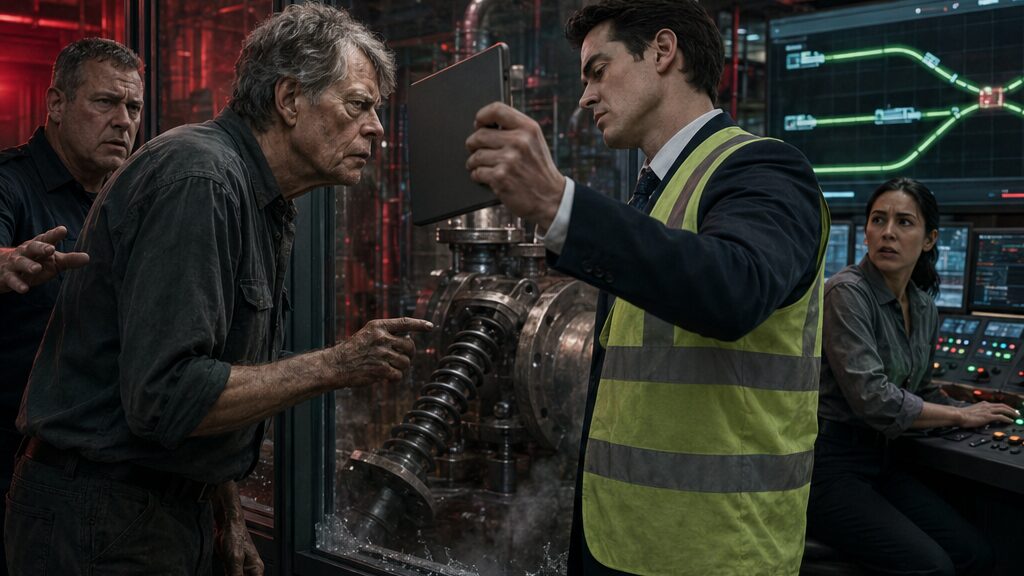
Through the compressor observation bay, the main housing trembled on its mounts. It was a cylinder of dark steel as long as a small car, connected to the shared network by thick pressure lines. Behind its front casing sat the decompression spring, packed under enough force to drive a steel shaft through the control room if the collars failed.
Stephen had inspected those collars every month until the company revoked his certification.
He pointed through the glass. “Bleed pressure manually through 302. Close the lab return at 88. That takes the load off 417.”
Justin laughed once, without humor. “And violate containment protocol based on your intuition?”
“Based on how the pipes are moving.”
“Pipes do not move.”
“That one is.”
A tremor passed through the observation window. Fine condensation gathered around the frame.
Stephen wiped two fingers through it and drew a line from the compressor housing toward the control room. Then another line, angled directly at the emergency braking console.
“When the rear collar shears,” he said, “the spring follows this path. Through the glass. Through that desk. Then you lose the manual brake controls.”
The veteran security officer beside him glanced at the drawing.
Justin did not.
“Your problem,” Justin said, “is that you still believe touching machinery gives you ownership of it.”
Stephen lowered his hand. Oil from the corridor pipe had darkened the creases of his palm.
Justin looked at those marks.
“This system costs fifty million dollars. If your rough hands break it, can you afford to pay for it?”
Silence moved across the room more sharply than the alarm had.
Stephen studied Justin’s face. Under the contempt, there was strain. A faint pulse beat near his temple. The inspection mattered to him. Matthew Brown, the senior safety inspector, was due before the morning peak ended. Justin wanted a clean room, clean data, and proof that the network could be controlled from a tablet.
Stephen had seen that kind of fear before. Men who feared appearing uncertain often became most certain at the worst possible time.
“My hands aren’t the expensive part,” Stephen said. “Your mistake is.”
Justin turned to Samantha. “Raise compressor output to one hundred and twelve percent.”
She did not move.
“Sir, the local reading—”
“Was from a retired gauge with no current calibration certification.”
“The ventilation reversal wasn’t.”
“The model includes a transient.”
Stephen stepped toward the threshold again. “Samantha, don’t do it.”
Justin’s voice sharpened. “You do not take instructions from him.”
She looked from one man to the other.
Stephen saw the memory in her hesitation. Years earlier, when she was new, he had taught her to rest her hand lightly against a pipe before trusting a screen. A screen reported what a sensor believed. Metal reported what force was doing.
Justin leaned closer to her. “Execute the approved recovery sequence.”
Samantha entered the command.
The compressor deepened into a roar.
For two seconds, every pressure indicator climbed exactly as Justin’s model predicted.
Then Pipe 417 bucked against its bracket.
The veteran security officer flinched.
Stephen did not. “There. First transfer.”
A second impact followed, harder.
“Second.”
Justin stared at the observation bay.
Stephen waited.
The third strike came with a long, high screech.
The officer’s grip loosened from Stephen’s arm.
“Third,” Stephen said. “Now the spring is walking.”
The control-room lights flickered. On the route display, the north-loop train shifted from a holding signal to approach clearance.
Samantha tried to cancel it.
The command returned an error.
“Routing relay is not responding,” she said.
Justin snatched up his tablet. “Refresh the control layer.”
“I already did.”
“Do it again.”
Stephen pointed to a red indicator emerging on the lower panel. “Signal coolant is dropping. You keep feeding that compressor, the relay bank overheats and freezes its last command.”
Justin’s tablet chimed. He turned it so the room could see the model stabilizing.
“The pressure curve is improving.”
“The curve is averaging both sides of the network.”
“It is a validated predictive system.”
“It’s hiding which side is dying.”
Justin faced the security officer. “Remove him.”
The officer hesitated.
“That is a direct instruction.”
Stephen held still as the officer took his left arm. A second guard came from the far door and seized his right.
Justin stepped close enough that only Stephen and the nearest operators could hear him.
“You had your chance to explain your theory during the audit.”
Stephen met his eyes. “You mean the audit you wrote.”
“I compiled the evidence.”
“You selected it.”
Justin’s expression barely shifted, but it was enough.
There it was.
Not proof. Not yet.
Recognition.
Justin moved away and ordered Samantha to increase the coolant-routing priority. She entered the command. The screen froze halfway through the update.
A harsh alarm filled the room.
Both route lines turned green.
Samantha tried the emergency separation command.
Nothing happened.
She tried again.
The eastern train accelerated into the final tunnel approach.
The north-loop train crossed into the same automated route block.
The routing board locked them together, and every correction Samantha entered returned the same message:
COMMAND REJECTED—PRESSURE CONTROL FAULT.
Chapter 3: The Report That Used Stephen’s Name
Justin projected Stephen’s old audit report across the main control-room wall before anyone could ask why the emergency commands had failed.
The document appeared above the route board in white and blue, stamped with corporate approval. Stephen’s name sat near the bottom.
Justin pointed to a highlighted paragraph.
“Recommended response to negative-pressure variance: increase compressor output until network stabilization.”
Several operators turned toward Stephen.
The two guards still held his arms.
Justin’s voice became calm again, almost instructional. “This is the same man now claiming that the approved response is dangerous. He caused panic during the original review, lost his certification, and has entered a restricted control area during a scheduled inspection.”
Stephen read the paragraph once.
He had never written it.
Yet beneath it was his scanned signature.
Beside the signature, a dark partial thumbprint stained the page. His thumbprint. He remembered the original paper—the grease on his hand, the cramped maintenance desk, the warning he had written in the margin because the digital form had no field for mechanical resonance.
None of that handwriting remained.
“Open the raw sheet,” Stephen said.
Justin folded his arms. “This is the authorized report.”
“The raw sheet had annotations.”
“The review board found no supporting notes.”
“You cropped them.”
A murmur passed through the operators.
Justin gestured toward the frozen route screen. “This is exactly what happened before. He makes accusations when his judgment is questioned.”
Stephen looked at Samantha.
She stood at the archive terminal, trying to access the original data package while keeping one eye on the train positions. A file opened on her screen. Stephen saw columns of pressure readings and an export stamp in the lower corner.
Samantha saw it too.
Her face emptied.
She closed the file.
Justin turned at the sound of the terminal window disappearing. “Did you find something?”
“No,” she said too quickly. “The archive is incomplete.”
Stephen knew that voice. He had heard it six months earlier outside the disciplinary room, when she had told him she was sorry without saying what for.
The eastern train was now four minutes from Junction C.
The north-loop train was four minutes and twenty seconds away.
“Three readings in that report can’t exist together,” Stephen said.
Justin looked back at him. “You are not qualified to interpret the data.”
“Pipe 417 is listed at negative twelve. Pipe 302 is listed at positive eight. Pipe 88 is listed as closed.”
“So?”
“If 88 is closed and 302 is positive eight, 417 can’t be negative twelve unless the bypass seal has failed.”
Justin’s silence lasted half a second.
Stephen continued. “And if the seal failed, increasing compressor output loads the decompression spring. The report recommends the one response the readings prove is unsafe.”
An operator near the rear console leaned toward the projected figures. “He’s right about the pressure relationship.”
Justin snapped, “The software model accounts for cross-network equalization.”
“Then show the equalization path,” Stephen said.
Justin touched his tablet, bringing up a maze of colored pipes. “There.”
He indicated a blue line.
Stephen shook his head. “That’s laboratory exhaust.”
A few heads turned.
Justin enlarged the diagram. “It connects to the shared return.”
“Through a one-way isolation gate.”
“The gate can modulate.”
“Not during containment operation.”
The laboratory status indicator on the wall glowed red: ACTIVE CONTAINMENT.
Justin lowered the tablet.
Stephen felt the guards’ hands tighten again, not from certainty but discomfort.
He could expose Samantha now. He could tell the room that the archive timestamp belonged to her login, that she had exported the original readings, that Justin had built his conclusion from her data. It might free him from restraint. It might force them to listen.
He looked at her.
She was pale, but her hands remained over the console, still working to separate the trains. She supported people outside this room. Stephen knew that from the months he had trained her, from the double shifts she accepted, from the way she never left food uneaten because someone at home had taught her waste was a luxury.
Six months earlier, he had chosen silence because he believed the truth would eventually emerge from the machinery itself.
Now eight hundred passengers were racing toward the price of that belief.
“Unlock the vestibule,” Justin ordered.
The inner security door opened.
“Put him inside until transit police arrive.”
The guards moved Stephen backward.
“Samantha,” he said.
She did not look at him.
“Manual separation through relay eleven. You still have a window.”
Justin stepped between them. “Do not give unauthorized instructions.”
“Relay eleven bypasses the frozen control layer.”
“It also interrupts laboratory pressure monitoring.”
“For six seconds.”
“You cannot know that.”
“I installed it.”
“You installed hardware under designs created by engineers.”
Stephen stopped resisting the guards. “And you signed a report without understanding any of it.”
Justin’s face hardened.
The guards pushed Stephen into the glass-walled vestibule. The lock engaged behind him with a heavy click.
From inside, he could see the whole control room but hear it only through the intercom. Justin disabled that channel.
The projected report remained on the wall, his name beneath a recommendation he had never made.
Samantha reopened the archive file. This time she kept it low on her screen. Stephen watched her eyes return to the export stamp.
Her login.
Her silence.
His choice.
A deep metallic groan rolled through the corridor.
Every person in the room looked toward the compressor bay.
The cylindrical housing had begun to bow outward near the rear collar. Not much. Perhaps the width of a finger. But Stephen knew the force behind that movement. The spring was no longer merely binding.
It was loading against failure.
He struck the vestibule glass with his palm.
Justin ignored him.
Stephen struck it again.
The security officer approached and activated the intercom from the outside. “What?”
“Tell him the housing is deforming.”
The officer glanced toward the bay. “We can see it.”
“Then listen carefully. When that collar opens, the spring crosses the room in under half a second.”
The officer looked at Justin.
Justin came to the glass and switched on the intercom. “You’ve made your position clear.”
“No,” Stephen said. “You still think this is about the report.”
“It is about you interfering with an emergency response.”
Stephen pointed through the glass toward the swelling housing.
The surface flexed again.
A thin line of oil appeared around the collar.
“You have less than four minutes,” Stephen said, “before that spring becomes a weapon.”
Chapter 4: The Controller Who Stayed Silent Twice
The eastern train passed the final automatic diversion point.
A red boundary vanished behind its moving icon, and Samantha’s console emitted a low tone she had never heard outside simulation.
“Remote rerouting unavailable,” the system announced. “Junction commitment active.”
Three minutes, thirty-eight seconds remained before the trains reached the same stretch of rail.
Justin stared at the locked route board. “Initiate the secondary software layer.”
“It’s not responding,” Samantha said.
“Restart it.”
“A restart takes four minutes.”
“Then isolate the pressure fault.”
Stephen stood behind the vestibule glass, one palm pressed flat against it. The intercom was still off, but Samantha could read his mouth.
Relay eleven.
She shook her head almost imperceptibly. Activating the relay would blind the laboratory pressure monitor for six seconds. Under normal conditions, that alone could cost her job.
These were not normal conditions.
Justin moved to another console. “Transfer route authority to central operations.”
“Pressure corruption is blocking the handoff.”
“That is a software authentication problem.”
From the compressor bay came a grinding note, followed by a dull impact.
Stephen raised one finger.
First collar shift.
Samantha had heard him describe it when she was still a trainee, back when he had been allowed inside the room. He had taken her into the maintenance corridor after midnight and placed her palm against Pipe 417.
Don’t squeeze it, he had told her. Let the pipe tell you what it’s carrying.
At first, she had felt only vibration.
Then Stephen had covered the back of her hand with his scarred fingers and guided it half an inch to the left. There, beneath the hum, she felt an uneven pulse.
Flow is regular, he had said. Strain argues with itself.
Now the argument shook the control-room glass.
Samantha glanced at Justin. He was trying to reach central operations, his voice clipped and controlled. The veteran security officer stood near the vestibule, watching the compressor housing instead of Stephen.
Samantha opened the maintenance menu and entered an old access string.
The obsolete gauge circuit came alive.
Its needle rose from zero, trembled, then dropped deep into the red.
A second indicator showed spring displacement.
Four millimeters.
Six.
Nine.
Her mouth went dry.
Stephen saw the readings through the glass. He held up both hands, then crossed them sharply.
Kill the compressor.
Samantha reached for the emergency cutoff.
Justin caught her wrist.
“What are you doing?”
“The spring is moving.”
“The sensor is obsolete.”
“It’s measuring physical displacement.”
“It is not part of the approved control chain.”
“It doesn’t have to be approved to be true.”
The words came out louder than she intended.
Operators turned toward them.
Justin released her wrist slowly. “Return to the route console.”
“If we keep feeding the compressor—”
“Return to your station.”
The collision timer dropped below three minutes.
Samantha sat, but instead of reopening the route controls, she activated the vestibule intercom through a maintenance channel Justin had not disabled.
Stephen’s voice came through in a burst of static. “Relay eleven. Manual separation sequence.”
Justin spun around.
Samantha spoke before he could cross the room. “I exported the data.”
Stephen became still.
“Six months ago,” she continued. “Justin told me to export the model-confirming window. He said the rest was sensor noise.”
Justin lunged for the intercom control. Samantha locked the channel from her console.
“I didn’t change the readings,” she said. “But I knew the export didn’t include the pressure reversal.”
Stephen’s expression did not change. That hurt more than anger would have.
“Why didn’t you tell the board?” she asked.
“You had been here eight weeks.”
“That wasn’t your decision to make.”
“You would’ve lost your job.”
“And now those trains may lose everything.”
Justin reached her desk and struck the intercom cutoff.
Stephen’s voice disappeared.
“What you exported,” Justin said quietly, “was the validated data interval. You followed procedure.”
“You told me the other readings would confuse the review.”
“They were transient.”
“Stephen wrote a warning beside them.”
Justin leaned closer. “Be careful what you say in front of witnesses.”
The threat settled over the room.
Samantha looked at the route display. The eastern train was less than three kilometers from the junction. The north-loop train had entered the descending tunnel, too fast to stop under standard braking.
“You used my login,” she said.
“You performed the export.”
“You wrote the conclusion.”
“And Stephen signed the maintenance sheet.”
Behind the glass, Stephen lowered his eyes for a moment.
Samantha understood then. He had known enough to expose her. Perhaps not every detail, but enough. He had stood before the disciplinary board and said almost nothing because her login was buried in the file.
His silence had protected her.
It had also protected Justin.
A metallic crack came from the compressor bay.
The displacement reading jumped to fourteen millimeters.
The veteran security officer stepped toward Justin. “Sir, should we evacuate?”
“No. That would abandon the controls.”
Stephen hammered once against the glass and pointed at the manual cutoff.
Justin ignored him.
Samantha opened the relay menu again.
“Do not touch that,” Justin said.
“Relay eleven gives us six seconds to reset the eastern route.”
“It also blanks containment monitoring.”
“The lab seals hold independently for twenty.”
“That is not in the operating procedure.”
“It was before the last revision.”
“Which Stephen wrote.”
“Yes.”
Justin reached across her and closed the menu.
Then he entered an override code and removed her control privileges.
Her screens went gray.
“You are relieved from the console.”
Samantha stared at the dead controls. “You can’t separate the trains without me.”
“I can restore your access when you are prepared to follow command.”
Another operator shifted uneasily. No one spoke.
Justin moved to the compressor schematic. “The pressure must be equalized at the source.”
Stephen’s face changed.
He pointed urgently toward the negative-pressure lock valve inside the observation bay.
Not that one.
Justin selected the valve on the schematic, then headed for the bay access panel.
Samantha rose. The security officer blocked her, but his attention remained on Justin.
“Opening that valve releases the spring,” she said.
Justin keyed his executive code into the bay door. “It relieves the imbalance.”
“You don’t know which side is loaded.”
“I know the system design.”
“Then tell me where Pipe 417 returns.”
Justin did not answer.
The bay door unlocked.
Samantha turned toward the vestibule panel. Her access had been revoked from the main system, but the old lock still had a mechanical service switch behind a plastic cover.
She struck the cover with the heel of her hand.
It cracked.
The collision timer showed two minutes, nine seconds.
Justin crossed the bay toward the polished valve lever.
Samantha tore the broken cover away and twisted the service switch.
One side of the vestibule lock released.
Stephen shoved the door open.
But Justin’s hand was already closing around the valve.
Chapter 5: When Authority Reached for the Wrong Valve
Ninety seconds appeared across every control-room screen in numbers large enough to silence the room.
COLLISION PROXIMITY ALERT.
Justin’s hand rested on the negative-pressure lock valve.
Stephen crossed the vestibule threshold, but the veteran security officer caught him from behind. A second guard seized his other arm.
“Let go,” Stephen said.
“Sir, I can’t.”
“If he pulls that valve, the spring comes through the glass.”
Justin looked back from inside the compressor bay. “The valve equalizes both sides of the network.”
“No. It isolates the laboratory return.”
“The schematic shows a common pressure junction.”
“After Pipe 302.”
Justin glanced toward the wall diagram.
Stephen saw uncertainty flicker across his face.
“Which line feeds signal coolant?” Stephen asked.
Justin pointed to the thick blue pipe running above the compressor.
“That’s laboratory exhaust.”
“It joins the shared return.”
“Through 88. And 88 is closed under containment.”
Justin looked at the valve again. “Opening the lock restores cross-flow.”
“It removes the last restraint on the decompression chamber.”
The timer dropped to eighty-one seconds.
On the route board, the eastern train entered the final straight tunnel. Its speed read one hundred and forty-two kilometers per hour.
Samantha stood beside her disabled console. “Justin, step away from it.”
He tightened his grip on the lever. “You are no longer authorized to issue instructions.”
“Neither are you if you can’t identify the return path.”
His face reddened. “I designed the recovery model.”
“You designed it from incomplete data.”
The words struck harder than shouting.
Justin looked around the room and saw doubt spreading. Operators who had obeyed him minutes earlier now watched Stephen. The security officer’s hands remained on Stephen’s arms, but without force.
Justin’s gaze shifted to the entrance clock. Matthew Brown’s inspection team could arrive at any moment.
Stephen understood what Justin saw: not trains, not pressure, but the collapse of the image he had built.
“Listen to the pipe,” Stephen said.
Justin gave a bitter laugh. “Machines are not interpreted by instinct.”
“No. They’re interpreted by evidence. You just refuse the kind you can’t put on a slide.”
The compressor housing struck its mount.
A red light appeared on the lower panel.
Stephen spoke quickly. “Pipe 417 goes red next.”
It did.
“Then 302 flashes amber.”
Amber.
“Pipe 88 will hold green because the containment gate is closed.”
Green.
“Then Pipe 11 loses coolant pressure.”
The indicator for 11 fell from green to red.
Nobody moved.
Stephen continued. “Four-seventeen carries the signal-coolant bypass. Three-oh-two balances the compressor return. Eighty-eight isolates the lab. Eleven feeds the emergency relay bank. Pull that valve and the spring unloads into the bay.”
Justin’s grip loosened.
For one second, Stephen thought he might step away.
Then Justin saw everyone watching.
He lifted the first safety catch.
A heavy click sounded inside the valve assembly.
Stephen stopped breathing.
The compressor pitch dropped, not because pressure had eased, but because the restraint had shifted.
“You’ve armed it,” Stephen said.
Justin stared at the catch. “I haven’t opened the valve.”
“You released the retaining stage.”
“It can be reset.”
“No. Not under load.”
The collision timer reached sixty seconds.
Samantha moved toward the relay station. “Restore my console.”
Justin backed away from the valve. “I need a systems reset.”
“You need to give me access.”
“I said I need—”
“You don’t know what you need.”
The veteran officer released Stephen’s left arm.
The second guard hesitated, then loosened his hold.
Justin saw it. “Restrain him.”
Neither man tightened his grip.
Justin pointed at Stephen. “He is a revoked contractor who assaulted protocol, accessed restricted controls, and is attempting to seize an active transit facility.”
Stephen looked at the exposed first catch.
The housing bowed farther.
Oil spread in a dark ring around the rear collar.
Forty-eight seconds.
“Open the vestibule and evacuate,” the officer said.
“There is no time,” Stephen replied.
He turned his wrists inward, broke the weakened grips, and stepped free.
Justin moved between him and the compressor bay.
Stephen stopped two feet away. “Move.”
“You touch that system and you will be arrested.”
“If I don’t, they’ll collect pieces of this room from the tunnel.”
Justin raised one hand as though authority could still hold Stephen back. “My uncle signed the operating mandate. I am the ranking technical officer here.”
“Your uncle isn’t on either train.”
Justin’s expression twisted. “You think this proves your old report was right?”
“I think eight hundred people don’t care.”
Thirty-nine seconds.
Samantha shouted from the console. “Both trains have crossed emergency approach!”
Stephen moved.
Justin grabbed his vest.
Stephen drove one shoulder into Justin’s chest and carried him backward into the wall. The impact knocked the air from Justin and sent his tablet skidding across the floor.
Justin swung blindly. His fist struck Stephen’s cheek.
Stephen caught his wrist, twisted him away from the bay door, and shoved him toward the security officers.
“Hold him.”
The officers did.
This time, Justin was the one restrained.
Stephen reached the bay entrance. The access door had begun closing automatically because of the pressure alarm.
He wedged his boot into the gap.
The motor strained.
Inside, the housing split with a sharp metallic report.
Twenty-eight seconds.
The door jammed at shoulder width. Stephen forced himself through and ran toward the compressor. A reinforced glass partition separated the service walkway from the spring assembly, its access lock frozen by the same fault corrupting the route controls.
Stephen struck the release.
Nothing.
Behind the glass, the rear collar peeled outward another inch.
He looked once at the partition frame, then at the red emergency hammer sealed in a cabinet ten feet away.
Too far.
He stepped back and kicked the lower corner of the glass.
A white fracture spread across it.
He kicked again.
The pane bowed but held.
“Stephen!” Samantha’s voice came over the bay speaker. “Twenty seconds.”
He drove his heel into the same point.
The reinforced layer burst inward in a shower of square fragments.
An alarm changed pitch.
Stephen climbed through, cutting his sleeve on the broken edge. Heat rolled from the compressor housing. The air smelled of scorched oil and hot metal.
Behind him, Justin shouted for security to stop him.
Stephen grabbed the manual mounting latch on the compressor assembly.
It would not move.
He wrapped both rough hands around it and pulled until the tendons in his forearms stood out.
The latch released.
The compressor shifted violently on its rails.
Ten seconds.
Stephen tore the overloading unit sideways, exposing the decompression chamber.
The spring housing split from end to end.
A steel coil surged forward with the force of a cannon.
Chapter 6: Blood on the Decompression Spring
The spring punched through its first steel collar as Stephen entered its path.
He caught it with both hands.
The force drove him backward into the compressor frame. Metal edges bit across his palms, and pain flashed up both arms. The coil kept advancing, slow only because the broken housing still dragged against it.
“Cut power!” he shouted.
Samantha’s answer came through the speaker. “Main cutoff is locked behind pressure control!”
“Relay eleven. Local sequence.”
“My access is disabled.”
“Service panel beneath your console. Manual keys.”
Stephen lowered his weight over the coil. Its surface was too hot to hold. Blood made his grip slick.
Through the shattered partition, he saw Samantha drop to her knees and tear open the panel beneath her station.
The collision timer showed eight seconds.
“Blue key left,” Stephen called. “Red key down. Hold both.”
Samantha found the switches.
“Now Pipe 11 bypass.”
“There are three toggles.”
“Middle, upper, lower.”
She moved them in order.
The route board flickered.
The eastern train’s icon changed from green to amber.
“Emergency brake request sent,” Samantha said.
“Not enough. The relay won’t confirm until coolant stabilizes.”
Stephen pushed harder. The spring trembled beneath him, each vibration scraping its edge deeper into his hands.
“Open 417 auxiliary bleed.”
“The software is blocking it.”
“Mechanical wheel beside the local gauge.”
The veteran security officer reached it first. “This one?”
“Counterclockwise. Half a turn only.”
The officer turned the wheel.
Pressure hissed through the wall pipes.
On the route board, the eastern train turned red.
Its speed began to fall.
One hundred and thirty-eight.
One hundred and twenty.
Ninety-seven.
The first small victory lasted less than a second.
The lights dimmed across the control room.
A new alarm appeared.
ELECTRICAL LOAD TRANSFER—NORTH ROUTE RELAY FAILURE.
Samantha looked at the second train. “Braking the east route overloaded the north relay.”
“Pipe 302,” Stephen said through clenched teeth. “Route coolant through the secondary return.”
“The secondary return was removed from the operating interface.”
“It was removed from the screen, not the building.”
“Where?”
“Rear wall. Panel marked obsolete ventilation.”
An operator ran to the panel and pulled it open. Inside were six unlabelled levers.
“Which one?”
“Second from the right.”
The operator grabbed it.
“Wait,” Stephen said. “Check Pipe 88 first.”
Samantha looked at the indicators. “Still green.”
“Containment gate?”
“Closed.”
“Pull it.”
The lever came down.
The spring jerked.
Stephen’s right hand slipped free.
The coil surged six inches toward the broken partition.
He rammed his forearm beneath it.
The edge struck bone. His vision whitened.
“Stephen!” Samantha shouted.
“Keep working.”
Blood ran down his wrist and soaked the rolled cuff of his shirt.
He had spent years believing pain belonged to the person carrying it. You did not name it. You did not burden the crew. You finished the repair, cleaned the tools, and went home.
That belief had followed him into the disciplinary room. He had carried the missing annotations, Samantha’s login, Justin’s selective report, and his own anger without asking anyone else to touch the weight.
Now the spring crushed his arm, and silence would kill people.
“I need help,” he said.
The words sounded strange in his mouth.
The veteran security officer came through the broken glass.
“Where?”
“Compressor rail. Lock it against the floor.”
The officer seized the detached mounting bar and wedged it beneath the spring assembly.
Another operator followed, using a steel tool handle to brace the bar.
“Not there,” Stephen said. “Six inches left. The frame is weaker on that side.”
They shifted together.
The pressure eased a fraction from his forearm.
Samantha watched the north-loop train speed toward Junction C. “It still isn’t braking.”
“Relay bypass has to be reset manually.”
“Where?”
“Pipe sequence. Four-seventeen open, three-oh-two return, eighty-eight isolated, eleven relay feed.”
“I have that.”
“Then reset in reverse.”
She stared at the controls. “Eleven, eighty-eight, three-oh-two, four-seventeen?”
“Yes. Three-second spacing. Too fast and you arc the relay. Too slow and the coolant drops.”
The eastern train’s speed fell below forty kilometers per hour, but it was still moving toward the junction.
The north train remained above one hundred.
Samantha placed her fingers over the switches.
“Now,” Stephen said.
Pipe 11.
Three seconds.
Pipe 88.
The laboratory containment alarm flashed yellow, then returned green.
Three seconds.
Pipe 302.
Coolant pressure climbed.
Three seconds.
Pipe 417.
The north route changed from green to amber.
“Brake request transmitted.”
“Confirmation?”
“Waiting.”
The spring rolled against Stephen’s forearm. He felt something tear in his palm when he caught it again.
The officer beside him said, “You’re losing too much blood.”
“Then hold harder.”
The officer set his shoulder against the brace.
The second operator joined him.
For the first time, the spring’s advance stopped.
Across the room, Justin had freed one arm from the second guard. “You’re bypassing containment safeguards! Stop them!”
Nobody obeyed.
He pointed at Samantha. “If the laboratory seal fails, this is on you.”
Samantha did not look away from the route board. “It was already on me.”
The north-loop train’s icon turned red.
Its speed began to drop.
One hundred and six.
Ninety-one.
Seventy-four.
But the eastern train had not fully stopped. It crawled into the outer junction block while the north train descended toward it.
“How much distance?” Stephen asked.
“East train, one hundred and twenty meters from crossover. North train, four hundred and falling.”
“Apply track resistance.”
“That system is disabled above twenty kilometers per hour.”
“East is below twenty-two. Arm it now. It will engage at twenty.”
Samantha entered the command.
The console rejected it.
SOFTWARE AUTHORITY LOCKOUT—AUDITOR OVERRIDE ACTIVE.
Justin’s tablet still lay on the floor.
Samantha ran toward it.
Justin lunged against the guard. “Don’t touch that.”
She picked it up.
The screen demanded biometric authorization.
Stephen’s arms shook. “Bypass through maintenance mode.”
“There’s no maintenance option.”
“Lower corner. Hold the system version number.”
Samantha pressed it.
A hidden menu opened.
Justin went still.
The menu had never appeared in his recovery model.
“Code?” Samantha asked.
“Five-zero-zero.”
The number of pipes.
She entered it.
Maintenance authority replaced Justin’s lockout.
The track-resistance command armed.
The eastern train reached twenty kilometers per hour.
Its icon stopped thirty-one meters before the crossover.
The north train continued braking.
Sixty.
Forty-three.
Twenty-eight.
Stephen could hear it now through the tunnel structure: steel wheels screaming against rail, a vibration that traveled into the same pipes he was holding.
The route display magnified the junction automatically.
The north train entered the final block.
Fifteen kilometers per hour.
Eight.
Three.
Then zero.
Its front carriage stopped less than twelve meters from the eastern train’s protected route.
For a moment, nothing moved except the blinking train icons and the blood running from Stephen’s hands.
The pressure board turned green.
One heavy relay clicked inside the wall.
The compressor fell silent.
The spring remained trapped beneath Stephen’s palms and the shared brace.
“Secure it,” he said.
The officer locked the mounting bar into a floor slot. Only then did Stephen let go.
His hands did not open properly. His fingers stayed curled as if the spring were still inside them.
Samantha crossed the broken glass toward him, but Justin’s voice cut through the room.
“Arrest him.”
He stood against the wall, one hand pressed to his bruised chest.
“He assaulted the ranking auditor,” Justin said. “He destroyed protected equipment, bypassed containment controls, and caused the compressor rupture.”
The veteran security officer looked at Stephen’s blood on the spring.
Justin raised his voice. “That is a direct order. Arrest Stephen King for assault and sabotage.”
At the entrance, the control-room doors opened.
Matthew Brown stepped inside with two safety inspectors and stopped beneath the green diagnostic board.
Chapter 7: Five Hundred Pipes and One Missing Truth
Matthew Brown stepped beneath the green diagnostic board, looked at the blood on the floor, and ignored Justin’s order.
“Do not arrest anyone,” he said.
The veteran security officer lowered his hands.
Justin pushed away from the wall. “He attacked me in front of witnesses.”
Matthew glanced through the shattered partition at Stephen, who sat against the compressor frame while an operator kept pressure on both of his palms with folded cloth.
“Then we will establish why.”
A medical team entered behind the inspectors. One paramedic knelt beside Stephen and reached for his right hand.
“Don’t close the bay yet,” Stephen said.
“You need treatment.”
“The pressure state will disappear when they isolate the network.”
Matthew heard him. “Leave the system live at minimum load. Preserve all readings.”
Justin stepped forward. “That risks containment integrity.”
Matthew pointed toward the wall schematic. “Identify the primary signal-coolant return line.”
Justin stopped.
The room seemed to narrow around him.
He turned toward the diagram and selected a thick blue line descending from the laboratory side. “That one.”
Stephen gave a tired shake of his head.
Matthew looked at the nearest inspector. “Record his answer.”
Justin’s jaw tightened. “The diagram is outdated.”
“The line you chose is the laboratory exhaust feed,” Matthew said. “It does not return coolant to the relay bank.”
“The shared junction makes the distinction operationally irrelevant.”
“No,” Stephen said. His voice was low, but every person heard it. “Not when Pipe 88 is closed.”
The paramedic began wrapping his left hand. Stephen tried to pull away.
“If you keep moving, the bleeding gets worse.”
“Then work around me.”
Using his elbow, Stephen touched the lower edge of the main display. Samantha understood and brought up the full pipe map.
Five hundred numbered lines spread across the wall.
Justin looked at the maze as though it had betrayed him.
Stephen began speaking.
“Pipe 1, primary compressor intake. Pipe 2, intake balance. Pipes 3 through 9, filtration distribution. Pipe 10, relay coolant header. Pipe 11, emergency relay feed.”
The room stayed silent.
He continued without looking at the screen.
“Pipes 12 through 27, platform cooling returns. Twenty-eight through forty-two, lower tunnel pressure compensation. Pipe 43, inactive inspection bleed. Pipe 44, sealed after the second tunnel extension.”
Matthew watched the map while one inspector followed each number.
Stephen moved through the network in sections, not reciting a list so much as rebuilding the system aloud. He named junctions hidden behind walls, obsolete bypasses, manual wheels removed from training diagrams, and the changes made when the containment laboratory connected to the metro infrastructure.
At Pipe 302, he stopped.
“Secondary compressor return. Open during signal overload only.”
Then Pipe 417.
“Signal-coolant bypass. Carries the first pressure loss when the negative lock begins to bind.”
He looked at Justin.
“You called that sensor noise.”
Justin folded his arms. “Memorizing an old layout does not establish present causation.”
Stephen nodded toward the damaged housing. “Rear collar moved under rising compressor load. First safety catch was released while chamber pressure was above limit. That freed the retaining stage. The physical scoring will show it.”
Matthew went to the valve assembly and examined the catch without touching it.
“Who released this?”
No one answered immediately.
Then Samantha stepped away from her console.
“Justin did.”
Justin turned on her. “You were relieved from duty for instability during an emergency.”
“I was afraid,” Samantha said. “That isn’t the same thing.”
She faced Matthew.
“Six months ago, I exported the audit data under my login. Justin told me to use only the window that matched his pressure model. The omitted readings showed the reversal Stephen warned about.”
Matthew’s expression did not change, but his attention sharpened.
“Did you alter any values?”
“No.”
“Did you know the selection was misleading?”
Samantha swallowed. “Not at first. I knew before the report was submitted.”
Justin gave a short, disbelieving laugh. “So now she admits professional misconduct and expects her testimony to be trusted?”
“I expect it to be recorded.”
Her voice trembled, but she did not step back.
“Stephen saw my login in the archive during his hearing. He could have exposed me. He didn’t.”
Matthew looked toward Stephen. “Why?”
The paramedic wrapped the final layer around his right palm.
Stephen watched the white fabric darken.
“She had been here eight weeks.”
“That does not answer the question.”
“I thought the machinery would prove the report wrong eventually.”
Matthew waited.
Stephen looked at Samantha. “And I thought keeping quiet was the same as protecting her.”
Samantha’s eyes filled, though she held his gaze.
“It protected Justin,” she said.
“Yes.”
That single word settled more heavily than any defense could have.
Matthew turned to the damaged system. “Based on the pressure history, collar deformation, route failure, and the surviving diagnostic state, Stephen’s intervention was mechanically consistent with the only viable emergency sequence.”
Justin stepped toward him. “He still caused the physical rupture.”
“The rupture began before he entered the bay.”
“He detached the compressor.”
“To expose and restrain a spring your valve action had already released.”
Justin’s face lost color.
The control-room doors opened again.
Benjamin Davis entered with two executives behind him. His gaze moved from Justin’s bruised face to the shattered glass, then to Stephen’s bandaged hands.
“We will continue this in the executive conference room,” Benjamin said.
Matthew did not move. “The technical record is being established here.”
“This facility is unsecured.”
Stephen pushed himself upright against the frame.
“No more closed rooms.”
Benjamin looked at him. “You require medical attention.”
“I required a hearing six months ago.”
A faint hardness entered Benjamin’s expression. “This is not the time.”
“It’s the only time anyone listened.”
The operators remained at their stations, but no one looked away.
Benjamin studied the room and seemed to understand that privacy would now look like concealment.
He turned to Justin.
“Is any part of what Stephen said false?”
Justin opened his mouth.
No answer came.
Chapter 8: The Hands They Could No Longer Ignore
Benjamin crossed the room and slapped Justin once across the face.
The sound was sharp and brief.
Justin stumbled half a step, more shocked than hurt.
Benjamin removed the executive badge from his vest and closed it inside his fist.
“You used my name to override technical staff, falsified the meaning of an audit, and nearly killed eight hundred passengers.”
Justin touched his cheek. “I followed the model.”
“You hid what the model could not explain.”
“I was trying to prove I belonged here.”
Benjamin’s expression hardened. “You proved the opposite.”
He ordered Justin’s system access revoked, stripped him of his executive position and inheritance privileges, and assigned him to the company’s remote maintenance facility under direct supervision.
Justin stared at him. “You can’t send me there like a laborer.”
Stephen looked down at his bandaged hands.
Benjamin heard the words too.
“That is exactly where you are going.”
Security escorted Justin from the room. No one applauded. The route board still showed the two trains resting on opposite sides of Junction C, close enough that the scale made the distance between them look like a narrow breath.
Benjamin approached Stephen after the doors closed.
“The company will reinstate your certification immediately,” he said. “There will be compensation, medical coverage, and a formal public acknowledgment.”
Stephen looked at the green diagnostic board.
“What kind of acknowledgment?”
Benjamin hesitated. “A statement recognizing your actions and clarifying the audit.”
“Clarifying?”
“Correcting.”
“In public?”
“We should first resolve the language privately.”
Stephen gave a faint, humorless smile. “That’s how the last language was resolved.”
Benjamin lowered his voice. “There are legal consequences affecting the transit authority, the laboratory, and every executive attached to the inspection chain.”
“There were physical consequences affecting two trains.”
“I am not disputing that.”
“You signed my revocation.”
Benjamin’s eyes shifted toward Matthew.
“I relied on the audit findings.”
“You didn’t read the field objections.”
Justin’s silence had answered one question. Benjamin’s silence answered another.
Stephen leaned back while the paramedic checked circulation in his fingers.
“Did you read them?”
“No,” Benjamin said.
“Why?”
“Justin told me the dispute was personal. He said you resented the modernization program and refused updated procedures.”
“And that was easier to believe.”
Benjamin did not defend himself.
Across the room, Samantha stood beside the obsolete local gauge. The cracked cover still hung from its hinge.
Stephen looked at the five-hundred-pipe map.
“My certification isn’t the problem.”
“It was taken unjustly.”
“So restore it. Publicly. But that doesn’t fix this.”
Benjamin’s tone sharpened slightly. “What are you asking for?”
“A field-led safety record for every pipe, bypass, manual control, and retired component still physically connected to the network. Not only the digital design. The real system.”
“That would require months.”
“It took thirty years to build.”
“We have current documentation.”
“No. You have drawings that call live controls obsolete and software that averages two failing sides into one safe number.”
Matthew remained nearby, listening.
Stephen continued. “Every change gets signed by an engineer and a field mechanic. Every emergency sequence is trained locally. No one person’s memory becomes the last backup.”
Benjamin looked at Stephen’s hands.
The medic flexed two of his fingers gently. Stephen did not feel the touch until pressure reached the knuckle.
The paramedic noticed his expression.
“There may be nerve damage,” she said. “You need surgery soon. Heavy mechanical work may not be possible for some time.”
The words landed quietly.
Stephen had imagined losing his title, his access, even his reputation. He had not imagined standing near a machine and being unable to feel what it was telling him.
He stared at the bandages.
For decades, knowledge had moved through his hands before it reached words. A pulse in a pipe. Heat beneath a housing. The faint drag of a bearing beginning to fail.
Now the fingers lay still.
Samantha came closer. “I can help build the record.”
Stephen looked at her.
Benjamin said, “You are under investigation.”
“I know.”
“This is not a reward,” Stephen told her.
“I know that too.”
She glanced toward the archive terminal.
“I’ll document the selective export, the omitted readings, and every instruction I followed. Then I’ll help map the network correctly.”
Stephen studied her for a moment, then nodded.
Not forgiveness. Not yet.
Responsibility.
Benjamin opened his hand. Justin’s badge lay against his palm.
“Your conditions will be implemented,” he said. “The inquiry will remain public to staff and regulators.”
“And the field objections?”
“Restored to the original audit record.”
“Uncropped.”
“Yes.”
Stephen looked toward Matthew.
Matthew gave one small nod. It would be recorded.
The medical team prepared to move Stephen. Before they did, he asked Samantha to open a blank system map.
A white grid appeared across the central display.
No colors. No predictive curves. No polished summary.
Stephen stood before it with one bandaged hand resting against the edge of the console.
Outside the control-room window, the eastern train remained stopped before the crossover. Beyond it, the north-loop train waited in the tunnel, its headlights shining across the rails without touching the other train.
Samantha placed her fingers above the keyboard.
Stephen looked at the blank map.
“Pipe 1,” he said. “Primary compressor intake.”
She typed.
“Pipe 2. Intake balance.”
The first two lines appeared.
Behind them, the damaged compressor sat silent, the spring secured beneath the brace Stephen had finally allowed others to help him hold.
He continued naming the system, one line at a time.
Th