They Tore Down His Lake Road Barrier Before Learning Who It Was Protecting
Chapter 1: The Sign Came Down Before Sunrise
The first post came out of the ground with a wet crack before Patrick Brown made it halfway down his porch steps.
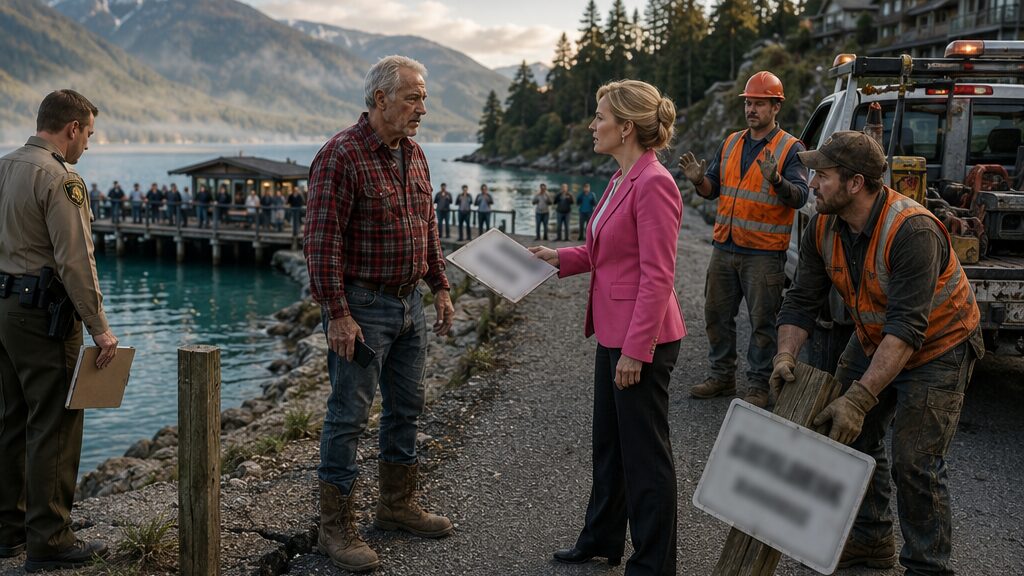
He stopped with one hand on the railing, bare fingers tightening on damp wood, and watched a worker in an orange vest rock the post back and forth until the packed gravel around it gave way. The rectangular sign bolted across the top tilted toward the lake road, its black letters flashing in the gray morning light.
PRIVATE PROPERTY
NO ACCESS
KEEP OUT
Behind it, a small utility truck idled with its hazard lights blinking. A second worker stood by the tailgate with a pry bar. A third held a cordless saw low against his thigh as if he was waiting for permission to use it.
Patrick did not shout. Shouting wasted time. He crossed the yard in his red plaid shirt and work boots, the grass soaking his cuffs, and took his phone from his pocket before anyone looked directly at him.
“Put the post back,” he said.
The worker with the pry bar turned first. He was young enough to look uncomfortable before he remembered he had been hired not to be. He glanced past Patrick toward the white SUV parked at the bend in the road.
Laura Wright stepped out from behind the open driver’s door in a bright pink blazer that looked wrong against the mud and lake fog. She had a folder tucked under one arm and a sheet of paper already in her hand.
“Mr. Brown,” she said, as if he had arrived late to a meeting she had scheduled properly. “The association is restoring community access.”
Patrick lifted his phone. “Say that again.”
Laura’s eyes went to the phone, then back to him. “The Lake Ridge Homeowners Association is removing an unauthorized obstruction from the access road.”
“That sign is on my property.”
“The access road serves the dock, the restaurant, and the community slips.”
“The shoulder is failing.”
“The board has reviewed your claim.”
Patrick looked at the loosened post lying against the worker’s shin. Beyond it, the narrow road curved along the turquoise lake, too pretty from a distance to look dangerous. On one side, rock and pine rose steeply. On the other, the land dropped toward the water behind a retaining wall that had been patched too many times by men who thought a crack was only a crack.
He had walked that road in the dark three nights ago with a flashlight, listening to water suck under the edge where it should not have been. He had seen gravel fall into a gap where gravel was supposed to hold.
He stepped toward the remaining post.
The worker with the saw shifted. “Sir, we were told to remove everything.”
“By whom?”
The worker looked toward Laura again.
Patrick followed his eyes. “I want your name, your title, and the written order before that tool touches another post.”
Laura held out the paper. “You were served with notice.”
“When?”
“This morning.”
Patrick stared at her. For the first time, his voice sharpened. “This morning when the crew was already here?”
A window slid open behind him at the house. He did not turn. He knew the sound. He knew the effort it cost Sandra to move from the kitchen chair to the side window, even with the walker. He also knew she would hate hearing her name in this road.
Laura’s mouth tightened. “Mr. Brown, this has been discussed for two weeks. You installed posts, signage, and construction materials without architectural approval. You closed a shared access route before a holiday weekend. You left the restaurant without its service approach. You created a liability issue.”
Patrick moved his phone closer. “Are you ordering removal before a county safety inspection?”
“I’m enforcing association rules.”
“That isn’t what I asked.”
The lake behind them was waking. A motor coughed at the dock. Someone laughed too loudly across the water. The restaurant’s string lights still glowed faintly around the floating deck, where empty chairs sat upside down on tables and a delivery van waited at the far end for the road to open.
Laura lifted her chin. “The board has authority to remove unapproved structures from common-use routes.”
Patrick pointed to the black line running through the gravel five feet behind the remaining post. “Do you see that crack?”
“I see unapproved excavation.”
“That crack opened after the last rain. The retaining wall is hollowing out underneath. I sent the engineer’s letter. I sent photos. I sent the emergency repair application.”
“And the board denied emergency status pending review.”
“No,” Patrick said. “You denied it pending aesthetics.”
Laura’s face colored, but her voice stayed even. “Materials must match the community standard. Your contractor staged steel plates and treated lumber along a visible lakefront approach.”
“Because the road is moving.”
The second worker bent toward the remaining post.
Patrick stepped into the gap between the saw and the wood.
The worker froze. “Sir, don’t do that.”
“I’m not touching you,” Patrick said. “And you’re not touching that.”
Laura took a step closer. “Mr. Brown, do not interfere with authorized work.”
“Then call someone who can tell me what law lets you reopen an unsafe road with people still standing on it.”
“I already did.”
The answer came before the engine sound behind him. A patrol vehicle rolled slowly down from the upper road and stopped behind Laura’s SUV. A uniformed officer got out, one hand resting near his belt, the other already raised in the weary gesture of someone hoping adults would decide to become adults before paperwork multiplied.
Laura walked toward him immediately with the folder open.
Patrick stayed between the crew and the post.
The officer listened to Laura first. Patrick watched her point to the sign, to the removed post, to the dock. Her words did not carry clearly over the truck engine, but her hand gestures did: obstruction, violation, access, enforcement.
Then the officer came to Patrick.
“Mr. Brown?”
“Yes.”
“I’m told you’re preventing removal of an association obstruction.”
Patrick kept the phone in his hand but lowered it slightly. “I’m preventing them from opening a failing road before inspection.”
The officer looked at the crack.
Laura said, “That is not established.”
Patrick said, “It’s established in the report they didn’t read.”
“Do you have that report?”
“In the house and in the email I sent the board.”
Laura slid a paper from her folder. “What we have is a denial of emergency authorization and a notice to cure. The obstruction must be removed by seven a.m.”
Patrick looked at the officer. “What time is it?”
The officer glanced at his watch. “Six forty-two.”
Patrick turned back to Laura. “You started before the deadline.”
Laura paused.
It was not much. A half second. But the young worker saw it. The officer saw it. Patrick saw it and felt no satisfaction, only a hardening in his chest.
“The crew arrived early to prepare,” Laura said.
“With a post already out of the ground.”
The officer walked toward the torn hole where the first post had stood. Mud clung to the bottom two feet of the wood. The sign dragged against the gravel, one bolt bent, the black lettering now angled toward the lake as if warning the water instead of the road.
“Everyone hold off,” the officer said.
Laura’s head snapped toward him. “Officer, the association has the authority—”
“I said hold off. I’m not deciding property rights on the shoulder of a lake road with equipment running.”
The worker with the saw let out a breath and lowered the tool.
Patrick did not move away from the post.
For a moment, the road quieted enough that he heard the sound he hated most: little stones ticking down somewhere below the edge. Not falling from the surface. Falling under it.
The officer heard something too. He looked toward the lake side of the road.
Patrick said, “That’s why I blocked it.”
Laura crossed her arms over the folder. “If it were that serious, you should have waited for the association’s review.”
Patrick almost laughed, but the sound stopped before it left him. He pictured Sandra’s hand on the porch rail three nights earlier, the way her right foot had dragged when the gravel shifted under her. He pictured himself catching her elbow too hard because fear had made him rough. He pictured her saying, Don’t tell them about me, Patrick. They’ll make me into the problem.
“I waited four weeks,” he said.
“You submitted an incomplete packet.”
“No. I submitted one you didn’t want to read.”
The delivery van at the far end honked once, impatient and distant. Across the water, a figure on the dock lifted a phone toward them.
Laura saw it. Her expression changed, not with guilt, but calculation. A public road closure was one problem. A filmed board president being challenged by a homeowner in front of an idling crew was another.
“Mr. Brown,” she said, lowering her voice, “you are making this much worse for yourself.”
Patrick held her gaze. “That road is doing that without my help.”
The crew supervisor, who had been silent by the truck, stepped around the open tailgate. “Officer, do you want us to clear the loose post out of the roadway at least?”
“It’s not in the roadway,” Patrick said.
“It’s close enough to be a hazard,” Laura said quickly.
The officer looked between them, then toward the sign. “Move it to the side. Don’t remove the second post.”
Patrick did not like it, but he nodded once. “I’ll move it.”
Laura objected. “The notice requires full removal.”
“And I’m telling everyone to pause until I understand what’s going on,” the officer said.
Patrick bent and took hold of the loosened signpost himself. It was heavier than it looked, waterlogged where the buried end had rotted dark. The young worker reached as if to help, but Patrick shook his head. He dragged the sign away from the road and laid it beside the ditch, letters facing up.
PRIVATE PROPERTY. NO ACCESS. KEEP OUT.
From that angle it looked less like a warning and more like evidence.
Behind him, the remaining post leaned slightly from where the crew had tested it. Patrick went to it and pressed his palm against the wood, feeling the vibration of the idling truck through the ground.
The worker with the pry bar shifted his weight.
The gravel under his right boot gave a soft, ugly sigh.
Before anyone could speak, his heel punched down through the shoulder.
He lurched sideways, arms windmilling, the pry bar clattering across the road. Patrick grabbed the back of his vest and pulled him hard toward the centerline. The young man stumbled against him, breathing fast.
Where his boot had been, the gravel had opened into a dark wet hole.
Under the road, lake water moved.
Chapter 2: The Lake Looked Beautiful From Far Away
By eight o’clock, people on the dock were filming Patrick as if the hole in the road were something he had dug with his own hands.
Phones lifted above coffee cups. A woman in a sun visor pointed from the restaurant deck. Two men near the boat slips stood shoulder to shoulder, one narrating into his screen while the other zoomed in on the removed sign lying beside the ditch.
Patrick could not hear every word over the lake traffic, but he heard enough.
“That’s him.”
“Been blocking the whole road.”
“Holiday weekend, too.”
“Private property people think they own everything.”
The crew had stopped working, but they had not left. Their truck sat by the bend with the tailgate down, the pulled post still visible like a trophy. The remaining post stood crooked. Orange cones, borrowed from the crew, now circled the wet hole where the worker’s boot had gone through.
Laura stood near her SUV making calls.
The officer remained beside the road, speaking quietly into his radio. He had not declared Patrick right. He had not declared Laura wrong. He had simply kept everyone in place, which was better than nothing and not nearly enough.
Patrick looked back toward the house.
Sandra was no longer at the window.
That worried him more than the phones.
He started up the porch steps, but a voice called from the dock path.
“Patrick.”
Kevin Mitchell came up the road in a faded restaurant shirt, one hand raised as if that would make his anger friendlier. He was younger than Patrick by twenty-five years and tired in the way men got when rent came due before tips did. He smelled faintly of fryer oil and lake fuel.
“You know what this is doing to us?” Kevin asked.
Patrick stopped at the bottom step. “You saw the hole.”
“I saw a worker step in mud.”
“That’s not mud.”
Kevin looked back toward the cones. “Scott’s got deliveries stuck. The lunch crowd’s already asking if they have to walk from the upper lot. You shut the access road with no warning.”
“I warned the board.”
“That doesn’t help the bartender. Doesn’t help the kitchen. Doesn’t help me when people cancel slips because they think the place is closed.”
Patrick held the porch rail. The wet wood pressed a line into his palm. “The road can’t handle delivery traffic.”
“Then why not tell people that instead of putting up a sign like everyone else is trespassing?”
Patrick’s eyes moved to the sign by the ditch.
Because the sign had been fast. Because posts and letters could stand where explanations got argued into fog. Because if he had written ROAD UNSAFE, half the neighborhood would have come to look at the crack and the other half would have driven over it to prove him dramatic.
Because Sandra had said, Don’t make them stare at me.
“I sent photos,” Patrick said.
“To the board,” Kevin snapped. “Not to the people losing money.”
That landed harder than Patrick wanted it to.
The door opened behind him. Sandra stood inside with one hand on her walker, not coming onto the porch. She wore a blue sweater despite the warming day, and her face had the careful composure she used when strangers were too near.
“Patrick,” she said softly.
He turned at once. “You all right?”
Her eyes moved past him to Kevin, then to the road. “I’m fine.”
She was not fine. He could tell from the angle of her shoulder, the way she had put more weight on her left side.
Kevin saw the walker. His expression changed, but not enough to become understanding. People noticed a walker and thought they had noticed the whole story.
Sandra gave him a polite nod. “Morning, Kevin.”
“Morning, Mrs. Brown.” He looked down, then back at Patrick. “I’m not trying to be cruel.”
“No,” Patrick said. “You’re trying to get to work.”
“And you’re trying to win a fight with Laura.”
Patrick’s jaw tightened.
Sandra’s hand shifted on the walker. “Kevin, the road really is unsafe.”
“Then somebody needs to fix it.”
“I hired somebody,” Patrick said.
“Then why isn’t he working?”
Because Laura stopped him. Because the board wanted cedar facing on an emergency brace. Because the packet had gone into whatever drawer inconvenient things went to die in. Because Patrick had trusted dates and emails more than doorbells and faces.
Instead of saying all of that, he said, “Come look.”
Kevin hesitated.
Patrick went inside long enough to take the brown repair folder from the kitchen counter. Sandra watched him open it. On top lay the printed photos Matthew Clark had taken: the undercut gravel, the bowed retaining wall, the diagonal crack near the tire line, the temporary steel plates staged along the side.
Under those was the doctor’s letter, folded in half and clipped separately.
Sandra saw his fingers pause near it.
“No,” she said.
“I wasn’t.”
“You were thinking about it.”
Patrick closed the folder around the photos only. “I’m thinking about keeping people off the road.”
“Then show them the road.”
He looked at her. For a second, the house held all the things they had not said since the first fall scare: that the walker did not fit well over gravel, that the porch steps had become a negotiation, that the lake house they had spent thirty years paying for had started asking for a younger body.
“I won’t use you like evidence,” he said.
Sandra’s mouth tightened. “I know. That’s part of the problem.”
Before he could answer, Laura’s voice carried from outside.
“Mr. Brown, your contractor is here.”
Matthew Clark’s pickup had pulled behind the crew truck. He got out slowly, already studying the cones. He wore work pants and a gray shirt with old sawdust caught in the seams. His face had the guarded look of a man counting liability in three directions.
Patrick met him at the road with the folder.
Matthew crouched near the hole, braced one hand on his knee, and leaned forward without touching the edge. “That opened this morning?”
“Worker stepped through.”
Matthew looked under the road shoulder, then back at the line of the retaining wall. “I told you not to let traffic on this.”
“I didn’t.”
Laura approached. “Mr. Clark, you are not authorized to resume work.”
Matthew stood. “I’m not resuming anything until I know whether I’m allowed to breathe near this road.”
Patrick opened the folder and showed Kevin the photos. “These were taken before I put the sign up.”
Kevin studied them. He did not apologize. But his anger lost some of its clean edge.
“That’s under the road?”
“Yes.”
“Why didn’t Laura show this at the meeting?”
“There hasn’t been a meeting.”
Laura said, “There will be one now.”
Patrick looked over the folder. “Now?”
“Emergency board hearing tonight. Six o’clock. Lake Ridge clubhouse.” She held out another paper. “You’ll have an opportunity to present your position.”
“My position is that you ordered a crew to remove a safety barrier before reading the report.”
“Your position is noted.”
Patrick did not take the paper immediately. “And Matthew can start shoring before then?”
“No. Not without written approval.”
Matthew gave a humorless breath. “Then I can’t touch it, Patrick. Not if the association is threatening enforcement and the county hasn’t weighed in. My insurance won’t cover me if they claim unauthorized work.”
“The road could fail before tonight.”
Matthew’s eyes flicked toward Laura. “I know.”
That, more than Laura’s refusal, made Patrick feel the ground tilt. Matthew believed him. Matthew knew the danger. And still he would pack up his tools because paperwork could scare a licensed contractor more efficiently than a crack in the earth.
Down by the dock, Scott Rivera came out of the restaurant and waved both arms at Kevin. A delivery driver leaned against the van with a clipboard, visibly irritated. More patrons had gathered along the rail, watching the house, the cones, the sign in the ditch.
Patrick looked at them and understood how the story would travel before he ever got to tell it. A stubborn old lakefront owner blocked the restaurant. A homeowner claimed danger when told to share access. A private-property sign appeared right before a holiday weekend.
It would be easy to believe. Easier than water under a road.
Kevin handed the photos back.
“I didn’t know,” he said, low enough that Laura could pretend not to hear.
Patrick nodded once. He wanted to say, You could have asked. But he had not given people much to ask about.
Laura extended the hearing notice again.
This time he took it.
The paper was warm from her hand and crisp with official language. Violation. Unauthorized obstruction. Non-compliant construction materials. Interference with shared access. Potential recovery costs.
Patrick folded it once and put it in the repair folder beside Matthew’s photos, but not beside Sandra’s letter.
At the house, Sandra stood behind the screen door. She had heard enough; he could tell.
Laura returned to her SUV. The officer stayed by the cones. Matthew went back to his pickup and began loading the tools he had not been allowed to use.
The crew supervisor lifted the removed signpost into the truck bed.
The black letters faced upward as it slid against metal.
PRIVATE PROPERTY. NO ACCESS. KEEP OUT.
By noon, Patrick knew, half the lake would have seen those words without seeing the hole.
Chapter 3: The Notice Called Safety A Violation
Laura began the hearing with a photograph of Patrick standing in front of the crew truck as if he were blocking an ambulance instead of a saw.
The image filled the screen at the front of the clubhouse meeting room. In it, Patrick’s shoulders looked broader than he felt, his red plaid shirt bright against the gray road, his phone raised in one hand. The loosened sign lay at his feet. Behind him, the lake shone blue and harmless.
Someone in the back whispered, “That’s the picture.”
Patrick sat at the end of the first row with the repair folder across his knees and heard the judgment moving through the room before anyone voted.
The clubhouse windows overlooked the same road from a flattering distance. At sunset, the lake turned gold there. The dock restaurant lights came on one by one. From this room, the cracked shoulder was hidden by trees, the cones barely visible, the danger reduced to a disputed detail.
Laura stood beside the screen with a stack of papers. She had changed from the pink blazer into a dark jacket, but her voice had the same polished control.
“This emergency session concerns an unauthorized obstruction of the Lake Ridge access route, unapproved construction staging, and interference with community and commercial use of association-served property.”
Patrick watched Rebecca Sanchez at the side table, typing minutes with her lips pressed together. She did not look at him. She looked at the paper trail.
Laura clicked to the next slide: a close-up of Patrick’s sign before the crew had pulled it down.
PRIVATE PROPERTY
NO ACCESS
KEEP OUT
A murmur passed through the room.
Laura let it breathe.
“Mr. Brown installed this sign and two wooden posts without architectural approval. He also staged construction materials along the lake road, including treated lumber and steel plates that do not meet visible exterior standards for the lakefront approach.”
Patrick stood.
Laura looked at him. “You’ll have a chance to respond.”
“I’m responding now because you started with the sign and not the crack.”
A board member shifted in his chair. Someone behind Patrick gave a soft, annoyed sigh.
Laura’s expression did not break. “Please sit until public comment.”
Patrick stayed standing. “You’re showing them the warning without showing them what it warned about.”
Rebecca’s fingers paused over the keyboard.
Laura clicked again. “We will cover Mr. Brown’s claims.”
Claims.
Patrick sat because anger wanted him to keep standing, and anger was not a plan.
The next slide showed his repair materials stacked neatly along the road shoulder, yellow caution tape tied between two stakes. Laura spoke about community standards, visual consistency, liability, access expectations, and emergency authority. Every word sounded reasonable if the road were solid.
When public comment opened, Scott Rivera spoke first. He stood in a white shirt with the restaurant logo on the pocket, sleeves rolled tight.
“I respect safety,” Scott said. “Everybody does. But I had vendors turned around today. We lost lunch reservations. We have staff depending on weekend shifts. The association can’t allow one owner to close the road whenever he disagrees with a process.”
Patrick looked down at his folder.
He disagreed with a process. That was the version that made him small.
Kevin stood near the back, arms crossed, not speaking.
Laura called Patrick’s name.
He walked to the table at the front and placed the folder down. He had sorted it twice at home, removing Sandra’s letter both times. It was now in the inside pocket of his jacket, where it felt heavier than paper.
“The retaining wall below the road has failed in two sections,” he said. “Water is undermining the shoulder. I submitted an emergency repair application four weeks ago, including photos, contractor notes, and an engineer’s risk page.”
He slid copies toward the board.
Laura took one without looking at it long. “The packet received by the association did not establish imminent failure.”
Patrick opened to the email receipt. “This is the submission confirmation.”
Rebecca leaned slightly forward.
Patrick noticed.
Laura noticed Patrick noticing.
“Receipt of a packet,” Laura said, “does not equal approval.”
“I didn’t say it did. I said you had the information before you sent a crew.”
A low hum moved through the room. Not support, not yet. Interest.
Patrick placed Matthew’s photos on the table one by one. The bowed wall. The crack. The place where gravel had begun to sink. The wet dark line beneath the shoulder.
“Today a worker stepped through here,” he said, tapping the final photo. “He would have gone down the lake side if I hadn’t grabbed him.”
Laura said, “And that incident occurred after you disturbed the area with unapproved work.”
Patrick looked at her. “You removed the barrier.”
“I removed an unauthorized obstruction.”
“You removed the thing keeping people away from the failure.”
A board member asked, “Mr. Brown, why didn’t you request temporary cones or association signage instead of putting up a private-property notice?”
Patrick had an answer. It was not the whole answer.
“Because my property line runs along that stretch,” he said. “And because cones get moved.”
“By whom?”
“People who want through.”
Laura folded her hands. “This is precisely the issue. Mr. Brown acted unilaterally.”
Rebecca cleared her throat softly.
Laura turned. “Yes?”
Rebecca looked at her laptop, then at a printed log. “For the minutes, I need to clarify something. I’m not seeing this request listed on the agenda for the last full board review.”
Laura’s eyes narrowed slightly. “It was reviewed administratively.”
“By the emergency committee?”
“By me, with consultation.”
Rebecca hesitated. The room felt it. Patrick felt it in the way people stopped shifting.
“The bylaws say emergency repair applications affecting access routes should be circulated to the full board within five business days,” Rebecca said.
Laura’s smile was small and cold. “And the president may act to prevent immediate harm to community access.”
Patrick said, “You thought the harm was the sign.”
Laura turned back to him. “The harm was an owner closing the road without approval.”
Patrick took out one more paper: the section of the bylaws he had highlighted at the kitchen table that afternoon while Sandra sat across from him, silent.
“Emergency stabilization may begin when delay increases risk to persons or property,” he read. “Applicant must notify the board in writing and use reasonable temporary safety measures.”
He looked up. “That’s what I did.”
Laura walked to her folder and withdrew a different document. “And this is the notice of denial sent to you. Your request lacked sufficient evidence for emergency classification and proposed materials inconsistent with lakefront exterior standards.”
Patrick stared at the page. He had read it so many times the phrases had become bitter in his mouth.
“Because you separated the materials from the risk,” he said.
“That is your interpretation.”
“No. That is the road.”
The debate might have continued until everyone tired of it, which was one way boards won. But then Rebecca spoke again, quieter.
“Laura, do we have the engineer’s risk page in the scanned packet?”
Laura did not answer immediately.
Patrick slowly turned toward Rebecca.
Rebecca clicked something on her laptop. “I have photos, contractor estimate, site sketch, material list, and owner statement. I don’t see the separate page labeled risk of progressive shoulder failure.”
Patrick’s hand tightened on the back of the chair.
“I submitted it,” he said.
Laura’s voice cut in. “Whether or not one page was misfiled does not authorize Mr. Brown to install a private blockade.”
Rebecca looked down.
The moment closed, but not before Patrick saw what had opened.
They had not read the whole thing. Maybe they had never had the whole thing. Maybe Laura had not wanted it badly enough to look.
Still, the board voted.
The fine was five hundred dollars, with recovery costs reserved. The access route was to be reopened by eight o’clock Saturday morning. All unapproved materials were to be removed or screened from public view. Any further obstruction could result in additional enforcement.
Patrick listened without moving.
When Laura asked if he understood the order, he said, “I understand what you’re putting in writing.”
He left before the room emptied. Outside, the sunset had turned the lake copper. The road below the clubhouse looked peaceful, almost staged. The cones were small orange marks near the bend.
His phone rang before he reached his truck.
Sandra.
He answered at once. “I’m coming.”
Her breathing was controlled, which frightened him more than panic would have.
“Patrick,” she said, “the temporary boards by the side door are gone.”
He stopped beside the truck.
“What?”
“The crew must have taken them with the other materials. I tried to get to the carport, but the gravel’s loose. I can’t get across it.”
Patrick looked down toward the road, then back at the clubhouse where Laura’s meeting still glowed behind glass.
Sandra tried to keep her voice steady.
“If I needed to leave tonight,” she said, “I don’t think I could.”
Chapter 4: What The Road Was Hiding Under Water
The delivery van’s rear tire sank before the driver could finish saying, “I’m just going slow.”
Patrick was already moving when the back corner dipped. The van leaned toward the lake with a soft grind of gravel under rubber. A crate inside slid and hit the wall with a hollow thud. The driver froze with both hands high on the steering wheel, eyes wide in the side mirror.
“Don’t accelerate,” Patrick said.
“I’m not touching anything.”
“Good. Stay that way.”
The road had been reopened for less than an hour.
The cones Patrick had dragged back into place before dawn sat uselessly against the brush where someone had moved them. The remaining post from his barrier leaned in the ditch like a broken finger. Tire tracks curved around the warning area, close to the lake side, where the old retaining wall held the road up by habit more than strength.
Patrick stepped to the van’s passenger side and looked under the rear tire.
The gravel was no longer just cracked. It had folded.
Water glimmered below the broken edge, dark and patient.
“Back it up?” the driver asked.
“No. If you shift weight, it may take more of the shoulder.”
The driver swallowed. “Then what do I do?”
“Wait.”
Patrick took out his phone and called Matthew Clark first. Then he called the officer’s non-emergency number. Then, because the road was open under written order now, he took three photographs before anyone could say he had imagined it.
By the time Laura arrived, Scott Rivera was already at the bend in the road, furious and pale.
“That’s my seafood delivery,” Scott said. “I told him to stay center.”
Patrick kept his eyes on the tire. “There is no safe center.”
Scott turned on him. “If you hadn’t half-started a project and left the place torn up—”
Patrick pointed down. “Look.”
Scott did not.
Laura came up behind him with Rebecca Sanchez at her side, both dressed too neatly for the smell of wet gravel and diesel. Laura’s expression tightened at the sight of the tilted van, but she recovered quickly.
“Mr. Brown,” she said, “why are there cones back in the access lane after last night’s order?”
“Because the lane is failing.”
“The order required you not to obstruct traffic.”
“The road is obstructing traffic now.”
The driver leaned out the window. “Can someone tell me if I’m going into the lake?”
Nobody answered fast enough.
Patrick walked to the tailgate and studied the angle again. “Not if everyone stops arguing and gets weight off this stretch.”
Scott finally looked down. His face changed when he saw the water through the gravel.
“What is that?”
“That,” Patrick said, “is what was under your access road yesterday.”
Matthew’s pickup came in from the upper road and stopped well short of the van. He got out carrying a measuring rod and a coil of caution tape. He did not ask permission. He walked straight to the damaged shoulder, crouched, and slid the rod into the opening.
It went down farther than anyone wanted to see.
He looked back at Laura. “This road needs shoring before anything heavier than a golf cart crosses it.”
Laura folded her arms. “Are you making that statement as Mr. Brown’s contractor?”
“I’m making it as someone who doesn’t want to watch a van slide into a lake.”
Scott dragged a hand over his face. “I have a full dining room in two hours.”
“You don’t have a service road,” Matthew said.
Laura’s voice lowered. “Everyone stop. We need to manage this carefully.”
Patrick almost laughed at the word manage. The road had been asking to be managed for weeks, in emails, photos, and the hollow knock beneath the retaining wall. It had not needed a crisis. It had needed permission.
Kevin Mitchell arrived on foot from the dock, breathless, wiping his hands on a towel. He stopped when he saw the van’s tilt.
“Is he stuck?”
“More than stuck,” Matthew said.
Kevin looked at Patrick, then at the opening under the tire. The accusation he had carried since morning did not come out this time.
Patrick noticed, but he did not soften. There was too much ground moving.
The officer from the day before returned with another patrol vehicle behind him. He stepped out, took in the van, the cones, the people, the exposed shoulder, and gave Patrick a look that was not quite apology but no longer suspicion.
“You warned them about this?”
Patrick handed him the photographs from before the sign removal. “I warned them with these.”
Laura stepped in. “Officer, Mr. Brown reopened a dangerous work condition after staging unapproved materials. We need to determine responsibility before anyone assumes—”
“Responsibility can wait,” the officer said. “Safety can’t.”
The words cut through the gathered voices. Even Scott went quiet.
Matthew directed the driver through unloading enough weight from the van to keep it stable. Kevin and two restaurant workers carried crates by hand to the dock path. Patrick kept people away from the edge, one arm out when patrons tried to wander closer with phones.
A woman filming asked, “Is this because of that private-property fight?”
Patrick looked at the phone pointed at his face.
“Yes,” he said. “This is what the sign was for.”
Laura heard him. Her jaw set.
Once the van was light enough, a tow strap was attached from Matthew’s truck at an angle that kept the van away from the lake side. The driver eased it back inch by inch while everyone held still. Gravel popped. The rear tire climbed out of the dip. When the van finally reached solid ground, a ragged piece of shoulder sloughed away and splashed below.
The sound was small.
It silenced the road.
Kevin stepped closer, now careful where he placed his feet. He looked into the gap and saw what Patrick had seen in pieces: the retaining wall bowed outward below the road, stones separated by dark seams, water moving where packed fill should have been dry.
“Patrick,” he said quietly, “how long has it been like that?”
“Long enough.”
“Why didn’t you say it was this bad?”
Patrick looked toward the house, visible through pines at the top of the slope. The side door was closed. Sandra was inside, with no temporary boards to the carport and no safe way over loose gravel if she needed to leave.
“I did say,” Patrick answered. “I just didn’t say everything.”
Kevin did not understand, but he heard the door in the sentence.
Scott came up behind Laura, speaking low and fast. “We cannot close all weekend. We can run hand deliveries. We can route guests from the upper lot. But if this gets posted as unsafe, people will think the dock is next.”
Laura kept her eyes on the road. “If we keep it open and somebody gets hurt, the association is exposed.”
“It’s already exposed,” Patrick said.
Laura turned on him. “You don’t get to create the problem and then accuse everyone else of being late.”
Patrick’s restraint slipped just enough to show its edge. “I didn’t put water under that road.”
“No. But you began work without approval.”
“I began work because approval was killing time the road didn’t have.”
Laura looked toward the officer. “I’m requesting a county inspection today. Formal. On record. If Mr. Brown’s property condition is creating hazard to association access, that needs to be documented.”
Patrick understood the move as soon as she said it. The failed wall ran along his property. If she could frame it as his neglected structure endangering association use, the story shifted again. Not the HOA blocking a repair. Patrick causing a hazard.
“Call them,” he said.
Laura seemed surprised.
“Call them,” he repeated. “But send them everything. Not your slide photo. Not the sign. The whole packet.”
Rebecca looked at Laura.
Laura’s face remained composed. “Of course.”
Patrick did not believe her.
The officer marked the edge with additional tape and told everyone to stay clear. Matthew walked the road with him, pointing out the hollow places, the way the shoulder dipped near the old drain, the places where water escaped in thin threads through the wall.
Patrick watched Kevin watching.
That was the first small change of the day: someone who had come angry now placed his feet like a man standing on a question.
Then the officer returned to Patrick and Laura.
“The county inspector can be here this afternoon,” he said. “Until then, no vehicle traffic on this section.”
Scott cursed under his breath.
Laura closed her eyes for half a second. “Pedestrian access?”
“Not along the damaged edge.”
“What about residents?”
The officer looked toward Patrick’s house, then at the side approach where the temporary boards had been removed with the other materials.
“That may include Mr. Brown’s home access,” he said. “If the inspector determines the approach is unsafe, nobody uses it until there’s a temporary approved path.”
Patrick felt the words move through him colder than lake water.
“My wife needs that path,” he said.
The officer’s expression changed slightly. “Then make sure the inspector knows.”
Laura looked at Patrick as if waiting for him to finally say the thing he had been holding back.
He did not.
Instead, he looked at the exposed hole in the road, the moved cones, the empty place where the sign had stood, and realized the official inspection might prove him right only after taking away the last path Sandra had.
Chapter 5: The Paperwork Was Missing One Page
“The page they voted on wasn’t the page you submitted.”
Rebecca said it so quietly that Patrick first thought she had called to ask him for another copy, not confess that the copy had disappeared.
He stood in the cramped HOA office Saturday afternoon, still smelling lake mud on his boots. Through the glass wall behind Rebecca’s desk, the clubhouse lobby buzzed with annoyed residents asking about road closure, dock reservations, and where they were supposed to park. Rebecca had pulled him aside beside the file cabinet, away from Laura’s closed office door.
Patrick held his repair folder against his chest. “Say that again.”
Rebecca glanced toward the lobby. “Your digital packet has the photos, the sketch, the contractor estimate, and the material list. It does not have the engineer’s risk page. The one you referenced last night.”
“I sent it.”
“I’m not saying you didn’t.”
“But it wasn’t in what the board reviewed.”
Her face tightened. “It wasn’t in what I uploaded.”
That was different from blame. Worse, maybe. Rebecca was not offering him victory. She was offering him a gap wide enough for everyone to fall into.
Patrick opened his folder on the nearest counter and found the page. ENGINEERING FIELD NOTE: RISK OF PROGRESSIVE SHOULDER FAILURE. The language was plain because he had asked the engineer to write it that way. Further delay may increase risk to persons, vehicles, and residential access. Temporary closure recommended until stabilization.
He turned it toward her.
Rebecca looked at it as if she wished it would become less clear.
“This wasn’t attached to the scanned file,” she said.
“Why?”
“I don’t know yet.”
“Did Laura see it?”
Rebecca’s eyes lifted. That was the wrong question, and they both knew it. Not because the answer was yes or no, but because either answer was dangerous.
“I know she handled the administrative review,” Rebecca said. “I know Scott Rivera called the board office twice this week about holiday access. I know Laura asked for a summary packet, not the full file, before she issued the notice.”
“She acted on a summary?”
Rebecca’s mouth pressed flat. “I’m telling you what I can verify.”
Behind them, the lobby door opened and closed. Someone said, “This is ridiculous,” to no one in particular.
Patrick put the risk page back in the folder with careful hands. Too careful. If he moved quickly, he might throw the whole packet against Laura’s door.
Rebecca touched the edge of the counter. “Mr. Brown, if you have any other documentation that establishes direct necessity, now is the time to make sure it’s in the record.”
He knew what she meant.
The doctor’s letter seemed to heat inside his jacket pocket.
Patrick closed the folder. “The road is direct necessity.”
“For the road, yes.”
“For people too.”
Rebecca’s voice softened. “Then they need to know which people.”
He looked at her then, and whatever she saw made her step back from advice into silence.
At home, Sandra was at the kitchen table with her walker beside her and the lake road visible through the window behind her. The removed boards had not been returned. Patrick had laid two sheets of plywood from the mudroom to the carport himself, but they did not sit right over the uneven gravel. He had tested them three times. He still did not trust them.
Sandra looked up when he came in. “You found something.”
“The engineer’s risk page wasn’t in the board packet.”
Her eyes moved to the folder. “Misfiled?”
“Maybe.”
“Or not?”
“Maybe.”
Patrick put the folder on the table, but not too close to her. That was another habit he had formed without noticing: keeping the fight on his side of the room.
Sandra noticed everything.
“Show me,” she said.
He spread out the documents. The scanned index Rebecca had printed for him. The photos. The missing field note. The denial letter. The violation. The fine.
Sandra read slowly. Her hands were steady until she reached the line about residential access. Then her thumb pressed into the paper.
“You didn’t include the doctor’s letter in the original packet,” Patrick said.
She did not look up. “No.”
“I thought you had.”
“I know.”
The admission sat between them with the weight of something older than the road.
Patrick pulled out a chair but did not sit. “Sandra.”
“I asked you not to make my legs a board issue.”
“This isn’t about your legs.”
Her eyes flashed. “That is exactly what people will make it about.”
He had no answer because she was not wrong.
“They’ll say it kindly first,” she continued. “Poor Sandra. We didn’t know. Then they’ll say it every time the road closes, every time a delivery is late, every time someone has to park uphill. I will become the reason.”
“You are the reason I’m not letting the road fail.”
“I know that.” Her voice broke only slightly, and she hated it enough to look away. “But I am not the reason the wall cracked. I am not the reason Laura ignored a report. I am not the reason Scott wants his holiday crowd.”
Patrick sat down then, slowly.
Outside, a car stopped at the roadblock, then reversed with an irritated chirp from its tires. The sound made Sandra flinch. Patrick saw it and hated himself for all the times he had mistaken her silence for agreement.
“I should have told them more,” he said.
“You told them the road was unsafe.”
“I hid the part that made it urgent for us.”
“You protected what I asked you to protect.”
“And now you can’t get to the car.”
Sandra looked toward the side door. The plywood sheets waited beyond it, temporary and inadequate. “I can get there if I have to.”
“No.”
The word came too fast.
She looked back at him.
Patrick forced his hands open on the table. “No, you can’t. Not safely. And I’m done pretending I can fix everything quietly.”
Her face softened, but not into surrender. “Quietly is how we survived a lot of things.”
“This isn’t surviving. This is shrinking the house around you.”
She looked at the walker. He did too.
For years, the lake had been their proof of arrival. They had bought the house when the siding was warped and the old dock leaned sideways. Sandra had painted the kitchen cabinets herself one summer with a brace on her knee and a radio in the window. Patrick had rebuilt steps, patched gutters, cleared drains, and told himself maintenance was love when words failed.
Now the house asked for something he could not fix with stubbornness alone.
His phone buzzed.
Laura’s name did not appear, but the message came from the association office.
Formal notice: Owner Patrick Brown remains responsible for incomplete emergency repair application and unauthorized obstruction removal costs. Continued restriction of access may result in legal recovery action.
He read it twice. Then he turned the screen toward Sandra.
She did not react at first. Then she laughed once, softly, without humor.
“Incomplete,” she said.
“That’s the word.”
“The page went missing, and now you submitted incomplete paperwork.”
“Rebecca knows it was missing.”
“Rebecca is not the board.”
Patrick looked toward the window. The lake was bright beyond the trees, beautiful enough to make strangers impatient with anyone who mentioned danger.
Sandra reached across the table and touched the edge of the folder, not his hand.
“I kept the letter out because I wanted one part of my life that wasn’t discussed by people with name tags and motions,” she said. “That was pride. Maybe fear too.”
“You had the right.”
“I still do.” She opened the folder clip, took the folded doctor’s letter from where Patrick had finally placed it on the table, and held it for a long moment. “But rights don’t help much if nobody knows they’re being stepped on.”
Patrick watched her unfold the paper, then fold it again along the same crease.
She handed it to him.
His fingers did not close around it immediately.
Sandra held his eyes. “Use it only if they make you.”
Chapter 6: The Officer Read The Order Twice
“Officer, Mr. Brown is refusing to comply with a lawful association order.”
Laura said it before the county inspector had closed his truck door.
Patrick stood beside the replacement cones Sunday morning with Sandra’s doctor’s letter sealed in an envelope inside his folder, and for one brief, tired second he wondered if the lake itself was listening. The water below the broken shoulder lapped softly under the road, patient as paperwork.
The uniformed officer looked at Laura, then at Patrick. “Which law?”
Patrick did not raise his voice. “That’s what I asked.”
Laura’s expression tightened. “The association has governing documents.”
“That’s not what he asked,” Patrick said.
The county inspector, a broad-shouldered man with a hard hat tucked under one arm, walked past all of them and crouched at the shoulder. He did not care about tone, authority, weekend reservations, or which side had more neighbors watching. He cared about the gap under the road.
Matthew stood beside Patrick’s pickup, arms folded, saying nothing unless asked. Kevin hovered near the dock path with two other workers, quiet now. Scott paced farther downhill, phone pressed to his ear, eyes flicking from the inspector to the restaurant and back again.
The removed sign was still in the bed of the HOA crew truck. Patrick could see the corner of it from where he stood.
PRIVATE PROPERTY.
The words had become less warning than accusation.
The officer unfolded Laura’s order and read it once. Then he read Patrick’s denial notice. Then he took the printed bylaw section Patrick handed him and read that too.
“Association enforcement order,” the officer said finally, “is not the same as a county safety clearance.”
Laura’s voice stayed controlled, but only just. “No one said it was.”
“You’re asking me to make him reopen a road.”
“I’m asking you to enforce access against unlawful obstruction.”
Patrick said, “The obstruction is the hole.”
The inspector pushed the measuring rod into the shoulder. It sank with almost no resistance for the first foot. He shifted position, tapped the asphalt edge with the rod, and listened to the hollow note beneath it.
“How many vehicles crossed yesterday?” he asked.
Scott answered before anyone else. “Light traffic only.”
Patrick looked at him.
Scott’s jaw worked. “A delivery van. Some staff. A few residents.”
“More than a few,” Kevin said quietly.
Scott turned. “Not now.”
The inspector stood and brushed grit from his hand. “No vehicle traffic across this section until it is shored.”
Laura closed her eyes briefly.
Patrick felt no relief. He looked toward the house.
The inspector followed his gaze. “Is that the primary residential access?”
“Yes,” Patrick said.
“Any alternate drive?”
“No. There’s the upper footpath, but it’s steep and not suitable.”
“For whom?”
Patrick felt the folder in his hand. He could have answered fully. He could have opened the envelope. He could have placed Sandra’s life into the public morning with Laura, Scott, Kevin, an officer, an inspector, and half the dock watching.
He heard Sandra’s voice: Use it only if they make you.
“For my wife,” he said. “She has limited mobility.”
Laura looked at him then, sharp and surprised, as though he had been withholding a card in a game she did not realize had stakes beyond the board table.
The inspector’s tone changed, not warmer, just more precise. “Does she need vehicle access for medical appointments?”
“Yes.”
“Soon?”
Patrick’s fingers tightened on the folder. “Tomorrow.”
That was true. It was also not the whole truth. The appointment was routine, but routine mattered when every trip had become a calculation. He had learned that people who did not count steps thought only emergencies were real.
The inspector looked at the plywood path Patrick had laid from the side door toward the carport. “That is not acceptable as an accessible route.”
“I know.”
“Did you install it?”
“Last night. The boards that were there were removed with the materials.”
The officer looked toward Laura.
Laura said, “Any removed material was part of an unapproved construction staging area.”
“It was how she got to the car,” Patrick said.
Laura opened her mouth, then closed it.
For the first time since sunrise Friday, she seemed to understand that a sentence could be procedurally correct and still sound wrong.
The inspector marked the road with spray paint and dictated notes into his phone. No vehicles. No pedestrian access along lake side. Temporary residential access required before regular use. Emergency stabilization permitted pending formal plan review, provided work remained within specified limits.
Matthew stepped closer. “If I get written clearance on temporary shoring, I can start today.”
Laura said, “The association still needs to review materials.”
The inspector looked at her. “Temporary shoring is not a decorative improvement.”
“It affects the lakefront approach.”
“So does the road collapsing.”
Kevin turned away, covering his mouth with one hand. It might have been a cough. It might have been the first time he let himself react.
Patrick did not smile.
The small payoff was not victory. The inspector had confirmed the danger, but in doing so he had made it official that Sandra’s path was unsafe. The house now stood on the wrong side of a rule meant to protect her.
The officer handed Laura’s paper back to her. “I’m not ordering Mr. Brown to remove safety cones or reopen this section.”
Laura took the document stiffly. “And the private-property sign?”
Patrick said, “The sign is already in your truck.”
Nobody answered that.
The inspector tore a sheet from his pad and wrote a temporary restriction notice. He handed one copy to Patrick and one to Laura.
“Until temporary access is approved, no routine traffic through here. Contractor may submit a stabilization method directly to county and association today. Residential accommodation needs to be addressed immediately.”
Laura seized on the word immediately. “We can work with that.”
Patrick did not like how quickly she recovered.
By late morning, they stood under the shade near the clubhouse steps while Scott argued into his phone and Matthew sketched a shoring plan on the hood of his truck. Kevin helped carry caution tape without being asked. Rebecca arrived with a portable scanner and avoided Laura’s eyes.
There was a way forward now, but it narrowed at the place Patrick feared most.
Laura approached him with two printed sheets.
“Mr. Brown,” she said, “I’m prepared to recommend a temporary compromise before the full board meets tonight.”
Patrick waited.
“We reopen a limited lane for dock service only during set hours. Your contractor focuses first on stabilizing the commercial access side. Once that is functional, the board will address the residential side approach and your wife’s access.”
Patrick stared at her.
The words were smooth. They almost sounded like help.
“No.”
Laura’s eyebrows lifted. “You haven’t heard the conditions.”
“I heard the order.”
“It is not an order.”
“It’s the same thing dressed nicer.”
Her voice lowered. “The restaurant cannot lose the weekend. The association cannot tell dozens of owners they have no lake access because of one residence.”
Patrick looked past her to the water, where sunlight broke into bright pieces around the dock. People still wanted lunch. Boats still bumped against slips. The world did not stop because Sandra could not cross gravel.
That was the part he hated most: the world was not cruel. It was busy.
“My wife leaves for an appointment tomorrow,” he said.
“We can arrange assistance.”
“She doesn’t need to be carried around a road you refused to repair.”
Laura flushed. “That is not what I suggested.”
“That is what your schedule means.”
The officer, standing close enough to hear, said nothing. The inspector kept writing. Matthew watched Patrick, waiting to see whether the man who had documented everything would finally say the private thing out loud.
Patrick touched the envelope inside the folder but did not remove it.
Not yet.
Laura held the compromise paper toward him. “If you reject this, you may be the reason the dock stays restricted another day.”
Patrick looked at the paper, then at the failed road, then toward the house where Sandra waited behind glass and pride and a promise he had made too well.
He did not take the paper.
“Then call the board,” he said. “Tonight, they choose whether access means boats first or people first.”
Chapter 7: The Vote Changed When Sandra Spoke
Laura began by calling it a private blockade, and Patrick placed the removed sign flat on the meeting table before she finished the sentence.
The room went still.
The sign had dried in the bed of the crew truck, but mud remained caked along the bottom edge where the post had been torn from the ground. One bolt was bent outward. The black letters faced the board, the neighbors, Scott Rivera, Kevin Mitchell, Rebecca Sanchez, and the people who had spent two days repeating those words without asking what they had been standing in front of.
PRIVATE PROPERTY. NO ACCESS. KEEP OUT.
Laura looked at it as if Patrick had brought in something indecent.
“Mr. Brown,” she said, “this is not necessary.”
“It was necessary Friday morning.”
“That is exactly what we are here to determine.”
“No,” Patrick said. “We’re here because you determined it before you knew.”
Sandra sat beside him in a chair from the clubhouse lobby, her walker folded within reach. Patrick had wanted to leave her at home. He had said it once, gently, and she had looked at him until he understood that his protection had begun to sound too much like the board’s control.
So now she sat under the bright meeting lights with her hands folded over a sealed envelope in her lap, looking at the lake through the tall windows as though it had not been part of every argument in the room.
Rebecca called the emergency meeting to order when Laura did not. Her voice was careful, but it carried.
“The agenda is limited to the temporary access restriction, emergency stabilization request, violation notice issued to Patrick Brown, and enforcement authority related to removal of the barrier.”
Laura’s jaw tightened at the last phrase.
Scott spoke first during public comment. He stood near the back wall, arms crossed.
“I want to be clear,” he said. “I pushed for access because I have employees who lose money when the road closes. I don’t apologize for caring about that. But if the county says it isn’t safe, we need a plan that doesn’t make the restaurant the villain either.”
A few people nodded. Patrick did not. Not because Scott was wrong, but because everyone wanted not to be the villain after the damage was visible.
Kevin stood next. He held his cap in both hands.
“I thought Patrick was just blocking people,” he said. “I said that to his face. I was wrong about the road. I saw underneath it. I helped unload the van. That shoulder wasn’t going to hold.”
He looked at Patrick, then at Sandra, and looked away as if apology still needed privacy.
Laura waited until he sat. “No one disputes that the road now requires stabilization. The question is whether Mr. Brown was authorized to install private signage, begin unapproved work, and interfere with shared access.”
Patrick touched the edge of the sign. “The question is whether you were authorized to remove a safety barrier before review.”
“The association cannot allow owners to decide unilaterally which common-use routes remain open.”
“And the association cannot call a danger a violation because the sign looks bad.”
Laura opened her folder. “We have proposed a compromise. Limited dock-service access first, with residential access addressed after temporary commercial stabilization.”
Sandra’s hand moved once on the envelope.
Patrick saw it.
He leaned forward. “No.”
A murmur rose.
Laura looked at him as though he had given her what she expected. “So you are rejecting a reasonable phased solution.”
“I’m rejecting one that puts restaurant deliveries ahead of the person who lives there.”
Laura’s eyes flicked to Sandra. “The board is sympathetic to Mrs. Brown’s inconvenience.”
Sandra’s head turned.
Patrick felt the air change before she spoke.
“Inconvenience?” Sandra said.
Her voice was not loud. It did not need to be. It cut through the room because it was the first thing she had said.
Laura’s expression adjusted too late. “I mean no disrespect.”
Sandra unfolded her walker with a deliberate click and stood. Patrick started to rise with her.
“Don’t,” she said.
He stopped halfway out of his chair.
Sandra steadied herself with both hands on the walker. For a moment, her face showed the cost of standing there. Then she placed the envelope on top of the sign.
“This is from my doctor,” she said. “It says I need stable, level access from my home to a vehicle. Not convenient access. Not pretty access. Safe access.”
Nobody moved.
Patrick stared at the envelope because he could not look at her without showing too much.
Sandra continued. “Three weeks ago, I slipped on the loose gravel by the side approach. Patrick caught me. He caught me hard enough to bruise my arm, because he was scared. I asked him not to tell the board why he was pushing the repair. I didn’t want to sit in a room like this while people calculated whether my ability to leave my house was worth disrupting lunch service.”
Scott lowered his eyes.
Laura’s face had gone pale, but Sandra did not let her look away.
“I am not the reason the retaining wall failed,” Sandra said. “I am not the reason the packet lost a page. I am not the reason a crew came before the deadline. But I am the person who could not reach the car after those boards were removed.”
Patrick closed his hand slowly around the back of his chair.
This was what he had tried to spare her. Not the truth. The watching.
And yet she was steadier now than she had been at the kitchen table.
Rebecca broke the silence, not to rescue, but to return the room to record. “For the minutes, Mrs. Brown has submitted medical documentation regarding residential access.”
Laura said, “The board did not have that information.”
Patrick looked at her. “The board did have the engineer’s risk page until it didn’t.”
Rebecca turned her laptop slightly toward the board. “I need to clarify the document issue. The original email attachment list shows six files. The scanned board packet contains five. The missing file is the engineer’s risk note recommending temporary closure.”
Laura’s mouth tightened. “That may be a clerical error.”
“It may be,” Rebecca said. Her voice trembled once, then firmed. “But the emergency application was not circulated to the full board within five business days. The denial was issued administratively. The removal notice was issued before the full record was reviewed.”
A board member leaned toward Laura. “Is that accurate?”
Laura’s answer came slowly. “I acted under emergency access authority.”
“Because of restaurant pressure?” Patrick asked.
Laura looked at him, then toward Scott, then back at the board. “Because the association had dozens of residents and a licensed commercial tenant reporting economic harm and loss of shared access. Because I believed Mr. Brown was escalating a property dispute under the cover of safety. Because if every owner blocks a road when they disagree with process, we have no process.”
It was the most honest she had sounded.
Patrick let it sit.
Then he said, “And because you thought I was the easier risk.”
Laura did not answer.
The room understood anyway.
Patrick stood now. He opened his folder, but he did not lead with the doctor’s letter. Sandra had already given enough. He placed Matthew’s temporary shoring sketch beside the sign, then the county restriction notice, then the engineer’s missing risk page.
“I’m not asking for control of the road,” he said. “I’m asking for written permission to stabilize it before it hurts someone. Temporary shoring first. Safe residential access at the same time. Controlled dock service after the inspector signs off. Materials screened where possible, not hidden where safety requires them visible. Review the permanent repair later if you want cedar facing or stone veneer. But don’t make people cross a failing road because a temporary brace doesn’t match the lakefront look.”
No one clapped. He was grateful for that.
Applause would have made it smaller.
One board member asked Matthew to explain the shoring plan. Matthew did, plainly, with no drama. He described load, water, temporary bracing, access limits, and why the residential path could be stabilized alongside the road shoulder if the crew was allowed to work in order, not according to who made more noise.
Scott rubbed both hands over his face. “If I agree to upper-lot service for two days and dock deliveries by hand, can the restaurant be part of the controlled plan after inspection?”
Matthew nodded. “If the inspector approves the shoring.”
Kevin said, “I’ll help with hand deliveries.”
Scott looked at him. “You already are.”
Laura stood very still.
Rebecca looked down the table. “I am calling for a formal vote. Motion one: withdraw the violation notice related to emergency safety measures, including the removed barrier, pending review of the full packet. Motion two: approve temporary stabilization as described by Matthew Clark, subject to county inspection. Motion three: suspend unilateral emergency enforcement action by the board president on this matter until full board review.”
Laura’s head turned sharply. “Rebecca.”
Rebecca did not look away. “It needs to be in the record.”
Patrick reached for Sandra’s hand under the table. She let him take it, but only after she had sat down by herself.
The board members looked at one another, suddenly aware that process could cut more than one direction.
Rebecca lifted her pen.
“All in favor?” she asked.
Chapter 8: The Road Reopened Only After It Was Safe
The first car crossed the repaired section at sunset, and Patrick watched the tires instead of the lake.
The driver moved slowly, exactly as the new access sign instructed. The wheels passed over fresh asphalt, the temporary steel support hidden now beneath compacted fill and a clean stone face that matched the curve of the old retaining wall better than Patrick had expected. No gravel shifted. No hollow tick sounded below. No water flashed through a place where road should have been.
Only after the car reached the dock side did Patrick breathe fully.
Beside him, Sandra leaned on her walker at the edge of the new level path from the side door to the carport. It was not fancy. It did not announce itself. It simply held firm beneath her feet, which was all either of them had ever asked it to do.
“You’re staring like you poured the asphalt yourself,” she said.
“I watched closely enough.”
“You watched everyone closely enough.”
Patrick looked down the road. Matthew Clark was loading the last cones into his pickup. The county inspector had signed off that afternoon. The controlled access plan had gone into effect an hour later: service windows, weight limits, posted speed, pedestrian restrictions along the lake edge, and a permanent rule that emergency stabilization requests involving safety had to be circulated in full before enforcement.
Not perfect. Not generous. Written.
Patrick had learned to respect written things only when people had to sign them in the open.
Near the clubhouse steps, Laura Wright stood with Rebecca Sanchez and two board members. Laura had signed the revised plan without a public apology. Her signature had been neat, tight, and placed exactly where Rebecca pointed.
She had not looked at Patrick when she did it.
That was fine. Patrick had not needed her regret as much as he had needed her authority limited.
Scott Rivera came down from the restaurant in a clean shirt already marked with kitchen steam at the collar. The dinner crowd had returned in cautious waves, parking in the upper lot and walking down under temporary guidance until the final approval came through. The restaurant had lost money. Not as much as Scott had feared. Enough that his gratitude remained practical, not sentimental.
“Road feels good,” Scott said.
Patrick nodded. “It is.”
“Hand deliveries were a pain.”
“I imagine.”
Scott looked toward Sandra’s path, then back at the repaired wall. “Should’ve listened sooner.”
Patrick did not absolve him. He only said, “A lot of people should have.”
Scott accepted that with a short nod and went back toward the dock.
Kevin came a few minutes later carrying the old sign.
Patrick had not seen it since the crew truck returned the removed materials under Rebecca’s inventory sheet. Kevin had cleaned off the mud but left the bent bolt in place. He held the post under one arm, the sign board against his hip.
“Wasn’t sure where you wanted this,” Kevin said.
Patrick looked at the black letters.
PRIVATE PROPERTY. NO ACCESS. KEEP OUT.
In the first days, the sign had been the whole story to everyone else. Selfish, harsh, ugly, too blunt for a pretty road. Then it had become evidence. Then a question. Now, in Kevin’s hands, it looked tired.
“By the shed,” Patrick said.
Kevin started to carry it that way, then stopped. “Patrick.”
He turned.
“I’m sorry I said you were trying to win a fight.” Kevin shifted the sign, uncomfortable. “I was thinking about shifts, not the road. Not Mrs. Brown.”
Sandra said, “You were thinking about rent.”
Kevin looked at her, startled.
She smiled faintly. “People protect what they’re afraid of losing.”
Patrick glanced at her.
Kevin swallowed. “Still. I should’ve asked.”
“Yes,” Patrick said.
The word was not cruel. That made Kevin hear it better.
He carried the sign to the shed and leaned it inside, not throwing it down, not displaying it. Just placing it where old tools went when they were no longer the right tool.
Laura approached as Kevin left.
Patrick felt Sandra’s posture change beside him. Not weaker. Sharper.
Laura stopped a respectful distance from the new path. She held a folder, because of course she did.
“The board will review permanent material standards next month,” she said.
Patrick looked at the repaired wall. “The temporary work stays until then.”
“Yes.”
“And the access path?”
“Approved as an accommodation-related safety repair. The board will not require removal.”
Sandra’s fingers tapped once against the walker handle.
Laura looked at her. “Mrs. Brown, I should have asked more questions before making assumptions.”
Sandra studied her for a long moment. “You should have read what you had.”
Laura absorbed it. “Yes.”
Patrick expected more, maybe an explanation, maybe a careful defense. Laura gave neither. She closed the folder.
“The revised emergency procedure passed this afternoon,” she said. “Full packets only. No enforcement crew before confirmed notice. County review required for safety disputes.”
“That helps the next person,” Patrick said.
“It should have helped you.”
The sentence was not an apology exactly. It was too controlled, too late. But it did not pretend nothing had happened.
Patrick nodded once.
Laura walked back toward the clubhouse where Rebecca waited by the door.
The sun slid lower, turning the lake copper the way it had on the night of the fine. The same road curved along the same water. The dock lights came on. People moved carefully at first, then more normally, trusting the surface because someone had finally done the work beneath it.
Sandra shifted her walker forward.
Patrick moved automatically to help, then stopped himself before his hand reached her elbow.
She noticed.
“Learning?” she asked.
“Trying.”
She stepped onto the new path. The walker did not wobble. Her right foot did not catch in gravel. She moved slowly, but she moved without negotiating with the ground.
At the carport, she turned and looked back toward the road.
“We should keep the old sign,” she said.
Patrick frowned. “For what?”
“To remind you that not every warning needs to sound like a locked door.”
He almost smiled. “That for me or the board?”
“For whoever needs it.”
They stood together while the first evening traffic followed the posted limits down toward the dock. A small new sign had been set beside the repaired stretch, plain and reflective.
SAFE ACCESS ROAD
WEIGHT LIMIT POSTED
SLOW SPEED REQUIRED
It was not dramatic. It would not make anyone stop and film.
That was the point.
Patrick looked once toward the shed where the old sign leaned in shadow, then back to the road holding steady above the water. The lake glowed as if nothing had happened. But beneath the curve, under the asphalt and stone and compacted earth, the repair held because someone had finally been forced to see what beauty had been hiding.
Sandra reached for his hand.
This time, he let her.
The story has ended.