The HOA Sent a Crew to Tear Down the Ramp That Kept His Wife Home
Chapter 1: The Crew Was Already Pulling Up the Ramp
The saw started before George Martin reached the back door.
At first he thought it was Kevin Baker, early again, cutting new rail stock down by the dock. Then the pitch changed. It was not the clean bite of a board being fitted. It was the angry, skipping grind of metal against bolt heads.
George set his coffee on the counter without drinking it and looked through the kitchen window.
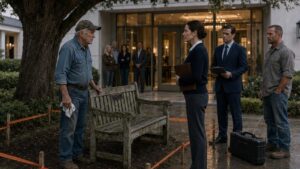
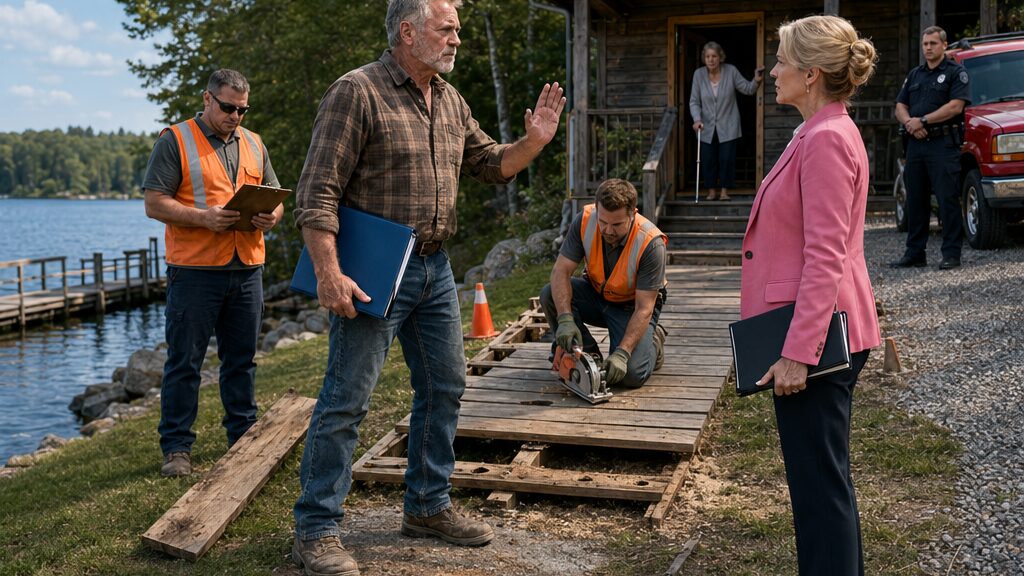
Two men in orange vests were kneeling on the lakefront ramp, the temporary access run Kevin had finished three days earlier. One had a saw. The other had a pry bar hooked beneath the first plank. A red vehicle sat crooked at the top of the gravel drive, its roof lights turning silently, washing the cabin wall in pulses of dull red.
HOA Patrol was printed on the door.
George grabbed the blue folder from the shelf by the mudroom before he put on his boots. He had kept the folder there because he had learned, over thirty years of owning a house beside water, that permits were not paperwork. They were tools. Sometimes they did more than a hammer.
By the time he reached the shoreline, the first plank was already loose.
“Stop,” he said.
The worker with the pry bar glanced up, then looked past George toward the dock path.
George followed his eyes.
Donna Carter was walking down from the driveway in a bright pink blazer that had no business near mud, sawdust, or lake spray. She carried a narrow black folder against her ribs. A patrol officer trailed a few steps behind her, one hand resting on his belt, his expression arranged into official boredom.
“Mr. Martin,” Donna said, as if she had expected him to be waiting politely on the porch. “You received notice.”
“I received the sound of somebody cutting into my ramp.”
“This is not a ramp. It is an unauthorized exterior alteration to a lake-facing structure.”
The saw whined again behind him.
George turned, and the worker froze with the blade half an inch from the next bolt.
“I said stop.”
The crew supervisor, a square man with a clipboard and sunglasses, stepped forward. “Sir, we have authorization to remove non-compliant material.”
“From who?”
He pointed toward Donna without looking at her.
Donna opened her folder. “The Lake Hollow Homeowners Association enforcement committee has determined that the unapproved structure attached to your dock violates sections five, eight, and twelve of the exterior standards.”
George looked at the half-raised plank, the exposed bolt holes, the fresh cuts Kevin had sealed with clear resin because the damp came fast off the water. Beyond the ramp, the lake sat flat and bright, indifferent as glass.
“You sent a crew onto my property without speaking to me.”
“We left notice.”
“When?”
Donna’s mouth tightened. “This morning.”
George looked at the saw, then at the plank already leaning against the rail. “This morning when the crew was already here?”
The patrol officer shifted his weight. The crew supervisor pretended to study his clipboard.
Donna held out a white envelope. “You are being served with a violation notice and an emergency removal order.”
George did not take it. “Do you have a court order?”
“This is an HOA enforcement order.”
“That is not what I asked.”
The edge in his voice was small. He made sure of that. George had spent most of his adult life fixing things that broke under pressure: dock braces, water pumps, stubborn doors, old motors. If you forced something too hard, it splintered. If you pressed exactly where the weight belonged, it moved.
Donna’s eyes flicked to the blue folder under his arm. “Mr. Martin, your ongoing refusal to comply has created unnecessary risk for this community.”
“This community wasn’t here when the north brace cracked in the March thaw.”
“The association reviewed photographs.”
“No, you photographed the finished repair after ignoring the application.”
“That is not accurate.”
The worker with the pry bar lowered the loose plank to the grass. The sound made George turn again. A gap now ran across the ramp where Linda’s left foot always hesitated. She knew that plank. She knew its grain, the slight rise near the middle, the place where George had sanded the edge twice because she had said it caught the rubber tip of her cane.
Donna stepped closer. “The structure changes the exterior profile of the dock approach.”
“It keeps the approach from dropping four inches where the storm took out the support.”
“The approved dock plans on file do not include this addition.”
“It is not an addition.”
“Then why was it built?”
George held her gaze. For one second, Linda’s voice rose in his mind, low and firm from the night before: Don’t make me into a committee exhibit, George.
He opened the blue folder and pulled out the county permit, the contractor’s drawing, and the shoreline repair receipt. He did not pull out the doctor’s letter. He had promised Linda he would not, not unless she said so.
“Emergency structural stabilization,” he said. “Submitted to your office four weeks ago. County permit approved. Contractor licensed. Materials matched as close as possible to the existing dock.”
Donna did not reach for the papers. “The issue is not whether you found a contractor. The issue is whether the association approved visible changes before installation.”
“The old brace was splitting. The ramp angle was unsafe.”
“For whom?”
The question landed harder than she likely meant it to. George felt his thumb press into the folder edge.
“For people who use the house,” he said.
Donna watched him for a moment, as if waiting for more. When he gave her nothing, she slipped the violation notice from her folder and held it out again.
“Removal will continue today under emergency authority. You may appeal after compliance.”
“After you take it apart.”
“Yes.”
George took out his phone, opened the camera, and held it low, angled toward the workers, the loose plank, Donna, the red HOA vehicle above the hill.
Donna’s face changed. Not fear. Calculation.
“Are you recording?”
“I am documenting damage to my property before you produce a court order.”
“Mr. Martin, obstruction may result in additional fines.”
“Tell your crew to step back.”
The crew supervisor gave a short laugh without humor. “Sir, don’t make this something it doesn’t have to be.”
George walked to the gap in the ramp and stood with one boot on each side of it. The lake wind moved through his gray hair, carrying sawdust against his jeans. He was not a large man the way he had been at forty, but the ramp was narrow, and he knew exactly where to stand so no one could cut without cutting near him.
“I am not touching anyone,” George said. “I am not threatening anyone. I am standing on the access to my home, asking for the legal order that lets you remove a safety repair.”
Donna’s jaw set. “This is a private community.”
“This is a private lot.”
“This shoreline is governed by association standards.”
“This section of dock is on my deeded parcel.”
“Your private-land theory does not override recorded covenants.”
“Then put that in writing with your signature.”
Donna looked toward the patrol officer. He looked back at her, waiting for instruction. The crew supervisor took off his sunglasses and rubbed one lens with his shirt.
For the first time, the work stopped completely.
The sudden quiet was worse than the saw. George could hear the water tapping beneath the dock. He could hear a sheep bell somewhere across the road. He could hear the cabin door open behind him.
He did not turn at first.
Donna did.
Her eyes moved up the slope toward the cabin, and something uncertain passed across her face.
George looked over his shoulder.
Linda stood in the doorway with one hand wrapped around the frame and the other around her cane. She had not put on her shoes. She had come out in the soft gray house sweater she wore on difficult mornings, her hair pinned badly because her fingers had been stiff when she woke. The porch steps were only five feet from her, but the ramp gap and the torn dock approach had changed the whole shape of the yard.
“George?” she called.
He saw her look at the removed plank. Then at the men in orange vests. Then at Donna’s folder.
Linda shifted her cane toward the first step, tested the distance, and stopped.
No one spoke.
For all Donna’s printed authority, for all the red light still turning on the patrol car, the only thing that mattered was the space between Linda’s bare feet and the broken path down to the car.
George lowered the phone.
Donna followed his gaze back to the half-dismantled ramp, and the paper in her hand suddenly looked very small.
Chapter 2: The Notice Said Appearance, Not Safety
The notice called the ramp a decorative exterior alteration.
George read the phrase three times at the kitchen table while the removed plank lay outside the open back door like something dragged from a body. Donna had agreed to a two-hour pause, not because she believed him, but because he had refused to move and kept the phone recording. The crew had left their cones by the shoreline. The patrol car was gone. The gap remained.
Linda sat across from him with her cane hooked over the chair beside her.
“Decorative,” George said.
She did not answer.
He slid the notice across the table, then pulled it back before it reached her hand. He regretted the motion as soon as he made it. Linda saw it. Of course she did.
“I can still read,” she said.
“I know.”
“You were about to spare me the word.”
“I was about to spare myself hearing you say it.”
That softened her, but only slightly. She took the notice and read it without changing expression. Linda had once run the office of a marina parts supplier and could make a vendor apologize with nothing more than a pause. Illness had changed her pace, not her eyes.
“They think you built a pretty walkway,” she said.
“They think I built without asking.”
“Did you?”
George opened the blue folder. “County permit. Contractor invoice. Drawings. HOA application. Photos of the cracked brace. Email to the committee.”
“That isn’t what I asked.”
He looked at her.
Linda tapped the notice. “Did you wait for their approval?”
“The brace was splitting.”
“George.”
“The ramp angle was getting worse every week.”
“George.”
He closed the folder. “No. I didn’t wait.”
Outside, the loose plank shifted in the wind and knocked against the porch step.
Linda looked toward the sound. “Kevin said they might object.”
“He said they might take too long.”
“He said both.”
George pushed back from the table and stood. He wanted to move, to tighten a hinge, clear the cones, carry the plank into the shed, do anything but sit beneath her careful disappointment.
“He also said the old support could fail if we waited another month.”
“I know why you did it.”
“Then why are you looking at me like that?”
“Because you keep acting like the paperwork is the whole truth.”
George looked down at the folder. The blue cover had water stains along one corner from the day he carried it out to the dock during a shower because the county inspector wanted the permit number. Every important page was labeled. Every receipt had a date. Every photo was printed and backed up. He had built a wall of proof, and Linda was telling him he had left out the door.
Kevin Baker came up the back steps without knocking, his cap in his hand. He stopped when he saw the notice on the table.
“Sorry,” he said. “I can come back.”
“You can tell me why your crew left my ramp half apart,” George said.
Kevin’s face tightened. “That wasn’t my crew.”
George stared at him.
“The removal guys weren’t mine,” Kevin said. “I pulled my people off when Donna’s office called at seven. Said if we touched another board we’d be named in the violation. By the time I got here, they had their own crew cutting.”
Linda’s fingers tightened around the notice.
George said, “You should have called me.”
“I did.” Kevin took out his phone. “Twice. Straight to voicemail.”
George remembered the shower running, the pill organizer open on the sink, Linda asking if the blue towel was clean because she could not reach the upper shelf. His phone had been in the mudroom under his gloves.
Kevin looked toward the open door. “I warned you not to start until the HOA stamped it.”
“You also told me the brace was unsafe.”
“It was. It is.” Kevin looked at Linda, then away, respecting more than George had managed. “That doesn’t mean they won’t make a mess of it.”
Linda folded the notice in half. “How long before that gap is dangerous?”
“It’s dangerous now,” Kevin said.
George took the county permit from the folder. “Can you put the plank back?”
“If I do, Donna files on my license for working under an active stop order.”
“It’s not her license to threaten.”
Kevin gave him a tired look. “George, I’ve got three employees and two kids. I can testify to what I built. I can send photos. But I can’t be the guy who ignores an association order on lakefront work the week before their insurance inspection.”
George caught the phrase. “Insurance inspection?”
Kevin realized too late that he had said it. He rubbed the back of his neck.
“What inspection?”
“Annual carrier review. Shoreline structures, common paths, anything near shared easements.” He nodded toward the notice. “Donna’s been jumpy about it. Everybody along the east bend got letters.”
“We didn’t.”
“You’re on the boundary. Maybe they figured you weren’t part of it.”
Linda gave a short, humorless laugh. “Until they wanted to tear something down.”
George opened his laptop at the end of the table. The machine took too long to wake. His fingers, usually steady with screws smaller than grains of rice, struck the wrong keys twice. He searched his email for Donna’s name, then for “dock,” then for “exterior modification.” The messages stacked on the screen.
Four weeks earlier: application submitted.
Attached: county permit, contractor drawing, repair photos.
Automatic reply: received by compliance office.
George clicked it open.
There it was, plain as a nail head.
Your submission has been received by the Lake Hollow HOA Compliance Office.
Timestamped. Dated. Sent to Donna Carter’s department.
George turned the laptop toward Linda, then Kevin.
“She said there was no approval request,” Kevin said quietly.
Linda’s face changed, not into surprise, but into something colder. “Maybe she meant no request she wanted to answer.”
George looked at the blank section on the application where the form asked whether the modification involved medical accommodation, disability access, or resident health necessity.
He had left it empty.
At the time, it had felt respectful. Linda was not a diagnosis. Linda was not a box on a form. The ramp had been needed because the brace was broken and the slope was wrong and anyone with eyes could see the repair made sense.
Now the empty box seemed to glow.
Linda saw where he was looking.
“No,” she said.
“I didn’t say anything.”
“You’re thinking it.”
“They’re calling it decorative.”
“Let them.”
“Linda.”
She pushed the notice back across the table. “I spent two years learning how to be seen as something besides a woman with a cane. I am not letting Donna Carter turn me into exhibit A because she ignored an email.”
George sat down slowly.
“I promised you,” he said.
“You promised we wouldn’t leave this house just because things got harder. You did not promise to make every room of our life public.”
Kevin shifted near the door, uncomfortable in the space between husband and wife.
George closed the laptop halfway, then opened it again. A new email had appeared at the top of the inbox. The subject line was in all caps.
FORMAL INSPECTION NOTICE — DOCK APPROACH VIOLATION.
He opened it.
Donna’s name appeared at the bottom. The inspection was scheduled for eight the next morning. Attendance required. Further removal authorized pending findings.
George scrolled down, already knowing what he would find and hoping he was wrong.
The message quoted his application number.
The same application Donna had received four weeks ago.
Chapter 3: The Pink Blazer Came Back With Patrol
The red HOA patrol vehicle was parked sideways across the gravel drive when Kevin’s truck rolled in the next morning.
Kevin stopped short, brake lights flaring. George watched from the porch as the patrol officer stepped out and lifted one hand, not quite a wave, not quite an order. Behind the patrol vehicle, Donna Carter stood near the dock path in the same bright pink blazer, this time with sunglasses and a phone held up like a weapon.
She was photographing the gap.
George picked up the blue folder and went down without hurrying. He had already told himself not to hurry. Hurry made other people think you were afraid of their clock.
Kevin climbed out of his truck. “I’m here to inspect my own work,” he called.
Donna lowered her phone. “No contractor activity is permitted until the association completes its review.”
“He’s not working,” George said. “He’s witnessing.”
Donna turned toward him. “Mr. Martin, you were instructed not to alter the site.”
“You altered it yesterday.”
“Emergency removal was initiated after repeated noncompliance.”
George stopped beside the first orange cone. Overnight, dew had darkened the exposed wood where the plank had been removed. The bolt holes looked black and open.
Donna snapped another photograph.
“What exactly are you documenting?” George asked.
“The condition of the violation after notice.”
“The condition caused by your crew.”
“The structure existed before removal began.”
“The danger did not.”
The patrol officer looked at the gap and said nothing.
Donna opened her folder. “The association has authority to correct unapproved exterior modifications that present liability exposure to the community.”
George took out his phone and started recording again. “Please repeat that.”
Her lips pressed together. “You may record. It does not change the facts.”
“It helps keep track of who invents them.”
Kevin looked at George sharply, a warning to pull back.
George knew he should. He heard Linda’s voice in the kitchen, refusing to be reduced to a form. He saw her standing at the cabin door, unable to come down. The memory steadied him and sharpened him at the same time.
Donna gestured toward the dock. “Your private-land theory will not protect you from daily fines.”
“My what?”
“You claimed yesterday that this portion of the dock is not subject to association oversight.”
“It is on my deeded parcel.”
“Your lot is within Lake Hollow. Your recorded covenants include exterior review for lake-facing structures.”
George opened the blue folder and pulled out the survey map. He unfolded it carefully against the dock rail, using two fingers to hold the paper flat against the breeze.
“Lot line,” he said. “High-water mark. Private dock approach. The old association easement ends here.” He tapped the line with his finger. “The ramp and brace are inside this boundary.”
Donna stepped closer despite herself. Her sunglasses hid her eyes, but George saw her chin shift as she read.
Kevin leaned over the other side. “That matches where I set the replacement posts.”
Donna removed her sunglasses.
For a moment, no one spoke. The morning lake made small clicking sounds beneath the dock, lifting and lowering against the pilings. Across the water, a sheep bell rang once and stopped.
Then Donna said, “This survey is from 1998.”
“It was recorded with the county.”
“Shoreline management rules have changed since then.”
“Property lines didn’t.”
“The association’s insurance carrier does not distinguish between your private preference and common exposure when an unsafe structure is visible from the lake.”
George almost laughed. It came out as a breath through his nose.
“So yesterday it was appearance. Today it’s insurance.”
“It was always compliance.”
“That’s not an answer.”
“It is the answer you are getting.”
Kevin stepped between them slightly. “The brace I replaced was unsafe. I can put that in writing.”
Donna looked at him. “You performed work before written HOA approval.”
“I performed emergency stabilization under county permit.”
“You performed work for pay on an unapproved structure.”
Kevin’s mouth shut.
George saw the effect immediately. Donna had not raised her voice. She did not need to. She had found the part of the machine that pressed on Kevin, and she pressed.
George slid the survey back into the folder. “You keep saying emergency authority. Show me where it applies to a repair that had county approval and a submitted HOA application.”
Donna’s eyes flicked to the folder.
There. A small movement, gone almost before it arrived.
“You did not submit a complete application,” she said.
“I submitted the application your office marked received.”
“Received does not mean approved.”
“I never said it did.”
“It also does not mean complete.”
George felt the first real crack in his certainty. “What was missing?”
Donna looked past him toward the half-dismantled ramp. “That will be addressed at the hearing.”
“What hearing?”
Rebecca Scott’s name appeared on the top page of Donna’s folder when the wind lifted it. George knew the name from ballot mailers and annual meeting minutes. She was one of the quieter board members, the kind who asked about drainage budgets and reserve studies while everyone else argued about paint colors.
Donna closed the folder.
“The board has called an emergency session tonight,” she said. “Seven o’clock. Clubhouse meeting room. Your violation and requested corrective action will be reviewed.”
“Requested by who?”
“The enforcement committee.”
“You.”
“As chair, yes.”
Kevin swore softly under his breath.
George said, “And if the board doesn’t agree with you?”
“Then you will have a decision in writing.”
“And if they do?”
Donna looked at the ramp. “Removal resumes tomorrow morning. Fines begin immediately. Contractor participation will be noted.”
Kevin looked away toward his truck.
The patrol officer finally spoke. “Ma’am, do you need anything else from the site?”
Donna slipped her sunglasses back on. “Photographs of the lower brace.”
The officer walked down toward the dock, careful not to step into the gap. Donna followed him with her phone ready.
George stood still, the survey folded in his hand but not yet tucked away.
Yesterday, he had believed the map would make her retreat. He had believed lines on paper still meant what they said. But Donna had taken the line and moved the argument somewhere else, into insurance, common exposure, incomplete forms, emergency authority. Every proof he produced became a door to another hallway.
Kevin came to stand beside him.
“George,” he said quietly, “you need more than the survey.”
“I have more.”
Kevin glanced toward the cabin.
George did not answer.
Donna’s phone flashed at the exposed bolt holes, bright and white in the morning sun.
At the top of the page in George’s folder, the old survey line cut cleanly across the paper. At the bottom of the ramp, the missing plank left a space no line could bridge.
Donna finished her photographs and turned back toward him.
“Seven o’clock,” she said. “If you do not attend, the board will proceed without you.”
Then she added, almost gently, “And Mr. Martin, I would not rely on the argument that this is only your land.”
George watched the red patrol vehicle reverse out of the driveway, clearing just enough room for Kevin’s truck to leave if he chose to.
For the first time since the saw started, George looked at the blue folder in his hand and wondered whether it held enough to keep Linda home.
Chapter 4: The Survey Proved Less Than George Needed
“Your permit is valid,” the county clerk said, sliding the paper back under the glass, “but it doesn’t answer their question.”
George kept his hand on the blue folder so he would not tap the counter. The clerk had not said it unkindly. That almost made it worse. Behind her, a printer clicked and sighed. Somewhere down the hall, someone laughed over a phone call as if the day had not placed a hole in the only safe path between his wife and the outside world.
“It answers whether I was allowed to repair the brace,” George said.
“Yes.”
“And whether the brace was unsafe.”
“Yes.”
“And whether the work was emergency stabilization.”
The clerk looked at the stamp again. “Yes.”
“Then what question doesn’t it answer?”
She folded her hands on the counter. “Whether your homeowners association can require separate approval for the exterior appearance or community liability of the structure. That’s a covenant issue. County permit doesn’t erase private covenants.”
George looked down at the paper as if the words might rearrange themselves. For weeks, the permit had felt like a key. Now it felt like a key to one door in a hallway full of locked rooms.
“I own the shoreline access.”
“I’m not disputing that.”
“They’re sending people to dismantle it.”
“You may need an attorney.”
“I need my ramp put back before my wife has to cross that yard again.”
The clerk’s eyes lifted. She did not ask. He was grateful and resentful of that at the same time.
She turned to her computer. “I can print the dock inspector’s note from the field visit. It says the prior brace showed shear damage and should be stabilized before regular use.”
“That would help.”
“It helps with safety.” She clicked a few times. “Not necessarily with the HOA process.”
George heard the careful line she was walking. The county would confirm the wood was unsafe. It would not stand between Donna Carter and the board hearing that night.
The printer behind her began to work.
While he waited, George opened his phone. An email from Donna had arrived twenty minutes earlier.
Emergency meeting packet attached.
He opened it and saw photographs of the ramp gap, the exposed bolt holes, Kevin’s truck, and George himself standing with one boot on either side of the missing board. The caption beneath his picture read: Resident obstructing emergency corrective action.
His throat tightened.
He scrolled lower. Another attachment listed the insurance carrier’s pre-inspection schedule. The date was not next month, as it had been every other year. It was Friday.
Two days away.
George read the line again, then again. Donna had moved the problem forward on the calendar and made his ramp the thing that had to disappear before someone with a clipboard walked the shoreline.
The clerk returned with the inspector’s note. “This is all I can give you without a formal records request.”
George took it. “Did anyone from Lake Hollow ask about this repair before today?”
The clerk hesitated. “I can only tell you what’s in the file.”
“And?”
“There was a call from the association office asking whether the county permit alone approved a finished exterior change.”
“When?”
She checked the screen. “Yesterday afternoon.”
After the crew had already cut into the ramp.
George placed the new page into the blue folder, but the folder no longer felt stronger. It felt heavier.
On the drive back, he called Kevin. The call went to voicemail. He called again and left a message with only the facts: county confirmed unsafe brace, insurance inspection moved up, hearing at seven. Then he drove faster than he should have on the lake road, loose gravel snapping beneath the tires.
The cabin came into view between the pines. For half a second, everything looked as it always had: gray roof, cedar siding, blue water beyond it. Then he saw Linda on the back path.
She was not on the porch.
She had come down the side way, the longer slope through the grass that avoided the broken ramp but curved over uneven ground toward the drive. One hand gripped her cane. The other reached for the trunk of the small birch near the path.
George parked crooked and got out before the engine stopped ticking.
“Linda.”
She turned her head, and that was when her cane slipped.
It was not dramatic. No cry, no flailing. Her left foot caught in the soft edge where rain had washed soil from the path, and she went down to one knee, then one hand, her face tightening in a way she hated anyone seeing.
George reached her in six strides.
“Don’t,” she said before he touched her.
He stopped with his hands open.
Her breath came shallow. A smear of damp dirt marked the heel of her palm. She stared at it as if she had betrayed herself.
“I was trying to get to the car,” she said.
“Why?”
“To prove I could.”
The answer hit him harder than the fall.
He crouched, not touching her yet. “You don’t have to prove anything.”
“Yes,” she said. “I do. Because everyone else keeps deciding what I am allowed to need.”
George looked toward the dock. The missing board was invisible from here, hidden below the slope, but he could see the orange cones Donna’s crew had left behind. They looked like small warnings around a wound.
“Let me help you.”
Linda closed her eyes. For a moment he thought she would refuse out of pure stubbornness, and for a moment he wanted her to, because then he could be angry instead of afraid.
Then she nodded.
He helped her up slowly, one hand under her elbow, the other steadying the cane until she took her own weight back. She winced but did not make a sound.
Inside, he cleaned the dirt from her palm at the kitchen sink. She sat in the chair, shoulders stiff, eyes fixed on the removed plank outside the door.
George placed the county inspector’s note on the table.
“They confirmed the brace was unsafe,” he said. “They confirmed the repair was urgent.”
“But?”
“But the HOA can still argue about approval.”
Linda gave a tired smile. “Of course they can.”
“The hearing packet calls me obstructive.”
“You were obstructive.”
“I was standing on our ramp.”
“You were standing on the part they hadn’t removed yet.”
He looked at her hand. The skin was reddened but not cut. That felt like mercy and accusation at once.
“Come to the hearing,” he said.
Her expression closed.
“They need to see—”
“No.”
“Linda.”
“No, George.”
He stopped.
She reached for the folded towel beside the sink and wrapped it around her damp hand. “I know what happens in rooms like that. People lower their voices. They look at the cane, not at me. They ask questions they think are kind. Then they make a decision and feel generous about it.”
“This is not about generosity.”
“It will be if you make me the reason.”
“You are the reason.”
Her eyes flashed.
George knew then he had said it wrong. He had made her sound like a burden he was carrying into evidence.
Linda stood carefully. “If you make me the reason, I won’t go to that hearing.”
The blue folder lay open on the table between them, thicker than it had been that morning, and somehow less able to say the one thing that mattered without taking something from the woman it was meant to protect.
Chapter 5: The Board Called It a Temporary Violation
The first thing on the screen was George’s boot.
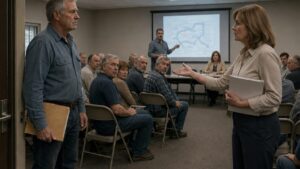
It filled half the clubhouse wall, paused mid-frame from Donna’s phone video, one work boot planted on each side of the missing ramp board. The angle made him look larger than he felt, stubborn and blocking, his blue folder tucked under his arm like a shield. Around the meeting room, neighbors sat in folding chairs with paper cups of coffee and the stiff posture of people grateful the violation was not theirs.
Donna stood beside the projection screen in her pink blazer.
“This image was taken during the association’s emergency corrective action,” she said. “The resident refused to clear the work area.”
George sat at the front table with the removed ramp board leaning against his chair.
He had brought it because he wanted them to see what their order had done. Now, beside Donna’s polished presentation, the board looked rough, damp, and almost foolish. A plank against a meeting table. A piece of the lake dragged indoors.
Rebecca Scott sat with the other board members, glasses low on her nose, a printed packet in front of her. She had not looked away from the image of George’s boot.
Donna clicked to the next slide. Exposed bolt holes. Orange cones. Kevin’s truck. The ramp angle before repair, photographed from low enough to make the new rail look taller than it was.
“Exterior alteration to dock approach,” Donna continued. “Unapproved materials. Unapproved profile change. Contractor work performed before written association approval. Resident obstruction of emergency removal.”
George opened the blue folder and kept his hand flat on the top page.
The board chair, a role-only man with a tired expression, turned to him. “Mr. Martin, you’ll have time to respond after the enforcement summary.”
“I’d like that time before the board votes on whether my wife can leave the house safely.”
A ripple moved through the room.
Donna’s eyes narrowed. The chair blinked. Rebecca looked down at the packet, then back up at George.
“Mr. Martin,” Donna said, “we are not here to discuss unrelated personal matters.”
“The ramp is the matter.”
“The violation is the matter.”
“That’s the same thing only if you ignore what the ramp does.”
The chair tapped his pen once. “Let’s keep order.”
George leaned back. He had promised Linda he would not bring her into that room as a spectacle. He had promised himself he would not let Donna turn the whole thing into a slide deck about appearance. Between those promises lay a strip as narrow as the ramp itself.
Donna finished her summary with the insurance inspection.
“The carrier will be on-site Friday,” she said. “Any unapproved, unstable, or inconsistent shoreline structure could affect renewal terms. Lake Hollow has been advised to correct visible issues before inspection.”
Rebecca raised her eyes. “Advised by the carrier or advised internally?”
Donna paused. “The carrier expects compliance with our own standards.”
“That isn’t the same answer.”
A few neighbors shifted.
Donna smiled without warmth. “It is the practical answer.”
The chair turned to George. “Mr. Martin, your response.”
George stood. He set the county inspector’s note, the permit, the contractor drawing, and the survey on the table. Then he lifted the removed ramp board with both hands and laid it across the front edge where everyone could see the fresh saw mark.
“This is what your crew took out before I was handed notice,” he said.
Donna said, “Your refusal to comply created—”
George looked at the chair, not at her. “May I respond without interruption?”
The chair nodded.
George pointed to the saw mark. “This board was part of a temporary stabilized ramp and brace repair after the March thaw cracked the north support. I applied to the county. Permit was granted. I hired Kevin Baker. I submitted the HOA application four weeks ago. Your office marked it received.”
He placed the printed email on top of the board packet.
Rebecca leaned forward. “We have your application in the file.”
Donna turned a page in her folder. “An incomplete application.”
George felt the room tilt slightly.
Rebecca flipped through her copy. “The medical accommodation section is blank.”
There it was.
He had known it would come. Still, the words struck the table like a tool dropped from a height.
George kept his hands at his sides. “I did not fill out that section.”
Donna looked around the room, letting the point breathe. “Then the association could not evaluate any claim that this was medically necessary.”
“I wasn’t asking you to evaluate my wife.”
The room went quiet enough that George heard the fluorescent light buzz.
Rebecca’s expression changed, not softening exactly, but sharpening. “Your wife uses the ramp?”
George looked at the door at the back of the room as if Linda might be there despite what she had said. She was not. He had left her in the cabin with her cane within reach, a phone on the table, and anger so controlled it frightened him more than shouting would have.
“The ramp gives safe grade access from the cabin to the drive and dock path,” he said. “Without it, the side path is uneven. She fell this afternoon trying to avoid the gap your crew left.”
Donna straightened. “This is the first time we are hearing any allegation of injury.”
“Because you didn’t ask why the repair was needed. You asked whether the board had stamped the form.”
A neighbor in the second row whispered something. The chair tapped his pen again, but more gently this time.
Rebecca looked at George’s application. “Why was the accommodation section left blank?”
Because Linda had cried in the bathroom the first time the doctor said permanent mobility decline.
Because she had made him promise not to turn the house into a shrine to what she could no longer do.
Because George had believed land records, permits, and basic sense could protect them without exposing the private terms of their marriage.
He said only, “To protect her privacy.”
Donna seized the sentence with both hands. “So you made a choice not to request accommodation, proceeded with unapproved work, and are now asking the board to treat a violation as an emergency after enforcement began.”
George looked at her.
He understood then, fully and cleanly, the mistake he had made. Not building the ramp. Not stopping the crew. The mistake was thinking silence was neutral. He had left an empty space on a form, and Donna had filled it with defiance.
Rebecca’s voice cut through before George could answer. “Ms. Carter, did your office contact Mr. Martin about the incomplete section?”
Donna did not look at her. “The application was pending review.”
“That wasn’t my question.”
“The volume of seasonal applications is high.”
“Did anyone contact him?”
Donna’s fingers tightened on her pen. “Not before the emergency issue arose.”
George felt the first small shift in the room. It was not victory. It was not even trust. It was the sound of one locked latch moving.
The chair cleared his throat. “Mr. Martin, do you have medical documentation for the access claim?”
George’s hand went to the blue folder.
The letter was there. Sealed in a plain envelope because Linda had refused to let him put it in the indexed tabs with permits and invoices. He touched the envelope through the cardboard cover but did not take it out.
“No,” he said.
Donna looked almost relieved.
George corrected himself. “Not without my wife’s consent.”
The board chair sighed. “Then we are limited in what we can consider tonight.”
George heard movement at the back of the room.
A cane tip struck the floor once. Then again.
Every head turned.
Linda stood in the doorway, one hand on the handle, her face pale from the effort it had cost her to get there. In her other hand was the envelope George had left inside the blue folder that afternoon, the one he had not realized she had taken.
She looked at Donna first, then at the screen still showing the torn ramp.
“Since everyone is discussing the path I have to cross,” Linda said, “you might as well let me speak.”
Chapter 6: Linda Refused to Be Hidden
“Don’t talk about me like I’m not the one who has to cross that ramp.”
Linda’s voice did not carry like a speech. It was not loud. But it made the room rearrange itself. Neighbors turned in their folding chairs. The board chair lowered his pen. Donna’s face went still in the way glass goes still before it cracks.
George stood too quickly.
Linda looked at him. “Sit down.”
He sat.
She walked forward one careful step at a time, the cane tip landing against the clubhouse floor with a flat rubber sound. George counted the steps without meaning to. Five to the back row. Four more to the aisle. Three before she paused and refused the hand a neighbor half-offered.
“I’m not here because I want pity,” she said. “If anybody feels it coming on, keep it to yourself.”
A nervous breath moved through the room, almost laughter, but not quite.
Linda reached the front table and placed the envelope on top of George’s blue folder. Her fingers rested there a moment. The gesture was small, but George felt it in his chest. She was not handing him permission. She was placing the truth where everyone could see it and still deciding how much of herself it contained.
Rebecca leaned forward. “Mrs. Martin, you don’t have to disclose anything you’re uncomfortable disclosing.”
“Good,” Linda said. “I’m uncomfortable with most of this.”
Donna opened her mouth, but Rebecca turned slightly. “Let her speak.”
Linda looked at the projected photo of the ramp gap. “That missing board is not a design choice. It is not George trying to make our dock look nicer. It is the part of the path where I know where to put my foot.”
George stared at the table.
The sentence was simple. It undid him more than any medical term could have.
Linda opened the envelope and removed one page. “My doctor recommended stable grade access after a fall last year. No loose gravel. No uneven slope. No step-down transition without a rail.” She set the letter on the folder. “That ramp is how I get from my kitchen to the car without turning every errand into a negotiation.”
The board chair picked up the letter. He read enough for his expression to change, then passed it to Rebecca.
Donna said, “No one is questioning Mrs. Martin’s needs.”
Linda turned to her. “Your crew cut through them yesterday.”
Donna’s face flushed. “The association acted on the information available.”
“You had an application.”
“Incomplete.”
“You had photographs of a broken brace.”
“Photos do not establish medical necessity.”
Linda nodded once. “And an empty box does not establish that there is none.”
The room went quiet again.
George looked at Donna then, really looked. Beneath the blazer and polished hair, she seemed tired in a way he had not noticed on the dock. Not sorry. Not yet. But stretched thin across something.
Rebecca set the medical letter down. “This changes how the board has to look at the matter.”
Donna’s answer came too quickly. “It changes the review category. It does not erase liability.”
“No one said it did.”
“The carrier inspection is Friday. If the association knowingly allows an unapproved alteration to remain—”
“Temporary accommodation pending review,” Rebecca said. “That is a different phrase.”
Donna turned sharply toward her. “And if the temporary structure fails?”
Kevin, who had been standing near the back wall, stepped forward. George had not even seen him arrive. He still wore his work shirt, one sleeve stained with sealant.
“It won’t fail if you stop pulling it apart,” Kevin said.
The chair looked relieved to direct the room toward practical ground. “You’re the contractor?”
“Yes.”
“Was the original brace unsafe?”
“Yes.”
“Was the repair built to code?”
Kevin glanced at Donna before answering. “Built under county permit for emergency stabilization. I can provide load specs.”
Donna said, “But not HOA approval.”
Kevin’s jaw worked. “I build docks, not forms.”
That did bring a small sound from the room. Not applause. Recognition.
The chair called a short recess.
People stood, but no one moved far. Conversations formed in low clusters. George reached for Linda’s chair, but she stayed standing, one hand on the table.
“You shouldn’t have driven here alone,” he said.
“I didn’t. The neighbor brought me.”
“You said you wouldn’t come.”
“You said you wouldn’t make me the reason.”
“I tried not to.”
Linda looked at the medical letter on top of the blue folder. “I know.”
Those two words gave him no absolution. They gave him something harder: a way to keep standing.
At the side of the room, Donna was gathering papers too tightly into her folder. George went to retrieve a copy of Kevin’s load specs from him, and Donna intercepted him near the hallway.
“I didn’t know about your wife,” she said.
George stopped. “You didn’t ask.”
“That form exists for a reason.”
“And people leave boxes blank for reasons.”
Her gaze flicked toward Linda. “Four years ago, before you were coming to meetings regularly, a dock on the west cove failed during a summer rental. Not fatal, but close. The carrier nearly dropped us. Every shoreline structure became my problem overnight.”
“That explains why you’re afraid of bad repairs.”
“Yes.”
“It doesn’t explain why you sent a crew before a hearing.”
Donna looked down the hall toward the meeting room. “The inspection was moved up. If the carrier saw an unapproved structure after we had notice, the whole association could pay.”
“So you made sure the one person paying first was Linda.”
Her face tightened, and for the first time, she had no prepared sentence.
The recess ended. Everyone returned to their seats with the awkward speed of people who knew the room had shifted but did not know where it would settle.
Rebecca spoke before Donna could resume control. “I move that we reclassify the matter as a potential accommodation and emergency safety repair pending full review.”
Donna said, “Pending full review, not approval.”
Rebecca looked at her. “Pending review. But enforcement removal should pause.”
The chair turned to Donna. “Do we have the timestamped application file?”
Donna looked down at her folder.
George saw it again — the brief hesitation from the dock, the tiny delay before a procedural answer.
Rebecca noticed too.
“Donna,” she said, quieter now, “please produce the original timestamped application and all internal notes attached to it.”
Donna’s hand rested on the black folder.
For one full second, she did not move. Then she said, “I may need to retrieve the complete file from the office.”
George looked at the medical letter lying on top of the blue folder, then at the removed ramp board against the table, and understood that the missing plank was no longer the only gap in the room.
Chapter 7: The File Had Been Delayed on Purpose
“There’s a second version of your file.”
George stood on the porch with the phone pressed to his ear, looking down at the board Donna’s crew had cut loose from the ramp. He had set it across two sawhorses after the hearing, intending to keep it dry, but the night air had raised the grain where the saw mark ran through the sealed edge.
The board secretary’s voice was low enough that he had to step away from the open kitchen door.
“What do you mean, second version?”
“I mean there’s the packet Donna circulated last night,” the secretary said, “and there’s the original intake file. They don’t match.”
George looked through the window. Linda was at the table with her cane hooked beside her chair, the medical letter lying facedown near her hand. She had not slept much. Neither had he.
“Send it to me,” George said.
“I’m not supposed to send internal files directly to residents.”
“Then why are you calling?”
A pause.
“Because Rebecca asked me to verify the timestamps after the meeting. And because I saw the note.”
“What note?”
Another pause, longer.
“You should come by the office.”
George closed his eyes. “I’m not leaving my wife with that ramp open.”
“I can meet you outside. Ten minutes. Bring your folder.”
The line clicked off.
George stood still for a moment, listening to the quiet after the call. From the dock came the small slap of water against pilings. From the kitchen came the scrape of Linda’s chair.
“You’re doing that thing,” she said from inside.
“What thing?”
“The thing where you stand like a fence post because something bad just learned how to walk.”
He turned. She was looking at him through the screen door.
“The office has another file,” he said.
Linda absorbed that without surprise. “Go.”
“I don’t want to leave you here.”
“I’m not crossing the yard while you’re gone.”
“That wasn’t funny.”
“It wasn’t meant to be.”
He almost argued. Then he saw the fatigue around her mouth and stopped. Trust, he had learned last night, was not only letting her speak in a room. Sometimes it was leaving when she told him she could hold her own ground for ten minutes.
He took the blue folder and drove to the HOA office at the clubhouse.
The board secretary met him beside the recycling bins, not inside. She held a manila envelope against her chest and looked toward the windows before handing it over.
“I can’t say where you got this.”
“I’m not asking you to.”
“You didn’t hear this from me.”
“I understand.”
She did not let go of the envelope immediately. “I’m not trying to hurt Donna. She’s under pressure from the carrier and the board. After that west cove accident, everyone wanted somebody to blame. She became the person who makes sure nothing gets missed.”
George looked at her hand still holding the envelope. “Something got missed.”
“No,” the secretary said quietly. “This got held.”
She let go and walked back inside.
In the truck, George opened the envelope on his lap. The first pages were familiar: his application, county permit, repair drawings, photographs of the cracked brace. Then came a page he had not seen.
Internal intake note.
Application received. Exterior dock repair request. Medical/accommodation section blank. Possible safety/access issue based on photos and applicant comment: “stable access needed before regular use resumes.” Recommend follow-up for clarification before enforcement.
Below it, a second line had been added three days later.
Hold pending insurance pre-inspection. Do not approve visible shoreline changes before carrier review.
Initials: D.C.
George read the initials twice.
He had expected negligence, perhaps. A lost email. An overworked office. Even a stubborn interpretation of a form. This was worse because it was smaller and cleaner. Not a conspiracy. Not a grand scheme. Just a decision made in a box on a screen, a delay that had turned into a saw at his ramp.
His phone buzzed.
Kevin.
“You near the house?” Kevin asked.
“Clubhouse.”
“Get back when you can. I looked at the gap again this morning. If that rain they’re calling for comes in tomorrow night, water’s going to run right under the exposed edge. That temporary brace was tied into the ramp section they cut. It’s not just inconvenient now.”
“How long?”
“Forty-eight hours before it gets stupid. Less if the rain hits hard.”
George looked at the envelope. “Can you fix it if they approve?”
“Yes.”
“If they don’t?”
Kevin was quiet. “Then I can’t touch it without a written release. I hate saying that.”
“I know.”
“No, you don’t. I built that ramp knowing why you needed it, even if you didn’t put the whole thing on paper. I should’ve pushed you harder to wait for the stamp or fill the box.”
George leaned back against the seat. “You warned me.”
“I warned you like a contractor trying not to lose a job. Not like a man looking at another man’s wife trying to stay in her own house.”
The words settled between them.
George said, “I have proof Donna held the file.”
“Then use it.”
“I will.”
“No,” Kevin said. “I mean use it to get the ramp back. Not to win the argument.”
George said nothing.
He drove home with the manila envelope on the passenger seat and the blue folder heavier beside it. By the time he reached the cabin, Linda was on the porch, seated this time, a blanket across her knees though the day was warm.
He brought the file to her.
She read the intake note slowly. Her face did not change until she reached Donna’s initials. Then she set the page down.
“She knew enough to ask,” Linda said.
“Yes.”
“But she didn’t.”
“No.”
Linda looked toward the lake. “What are you going to do?”
George had imagined himself sending the note to every neighbor, attaching Donna’s initials, forcing the board to see what she had done. He had imagined walking into the clubhouse with the removed board under one arm and making the room sit with every inch of the gap she had opened.
Instead, he looked at Linda’s cane against the porch rail, at the first dark cloud gathering beyond the hills, at the ramp board cut loose and waiting like evidence that had once been useful.
“I’m going to give them a choice they can’t soften,” he said.
He sat at the kitchen table and wrote the email carefully, with the intake note scanned, the county safety confirmation attached, Kevin’s warning quoted, and Linda’s medical letter included only because she sat beside him and nodded before he added it.
To Donna Carter, Rebecca Scott, the board chair, and the compliance office:
Effective immediately, pause all enforcement and removal activity on the dock access ramp and brace. Authorize temporary restoration by Kevin Baker under county permit pending full accommodation review. If the association refuses, provide written confirmation that it accepts responsibility for the known access risk, the known structural exposure, and the consequences of leaving the approach unsafe before forecasted rain.
He read it once aloud.
Linda listened without interrupting.
At the end, she said, “Add one thing.”
“What?”
“Tell them I am not asking for special treatment. I am asking to enter and leave my home.”
George typed the sentence exactly.
Then he sent it.
The email disappeared from the screen, and for the first time since the saw started, George did not feel larger for having proof. He felt smaller, more precise, like a hand finally placed where the weight actually was.
Twenty minutes later, Donna replied.
Not to the whole board.
Only to him.
I will come to the property tomorrow morning.
Chapter 8: The Ramp Went Back Before the Rain
Kevin’s truck returned with written authorization taped to the windshield.
George saw the paper first, white against the glass beneath the wiper blade, fluttering at one corner in the wind off the lake. Kevin rolled down the window and did not smile until George had walked close enough to read the heading.
Temporary Emergency Access Restoration Approved Pending Final Review.
Below it were signatures from Rebecca, the board chair, and Donna Carter.
George stood in the driveway, the blue folder under his arm, and read the page twice because the first time his eyes kept stopping at the word approved.
Kevin leaned out of the truck. “I’m not touching one board until you tell me that says what I think it says.”
“It says you can restore temporary access.”
“Good.” Kevin exhaled. “Then I’m going to restore it before somebody changes the font.”
He drove down toward the shoreline. His crew followed in a second truck, quieter than the removal crew had been, carrying boards instead of pry bars. No red patrol vehicle came behind them. No roof lights moved across the cabin wall.
Linda watched from the porch.
“You’re hovering,” she said.
George looked down. He had one boot on the top step and one on the porch, angled toward the ramp like a dog told to stay.
“I’m supervising.”
“You’re hovering with paperwork.”
“That’s more official.”
She smiled a little, but her eyes were on the path.
Kevin’s crew worked fast. They replaced the removed board first, fitting the new plank into the gap where the exposed bolt holes had darkened. Then they reinforced the brace Donna’s crew had loosened, added temporary side blocking, and set the rail back at the height Linda’s hand knew.
The sound was different this time. Not the tearing whine of removal, but the controlled rhythm of repair: drill, pause, mallet, level, drill again. Each sound put something back in the world.
A dark sedan pulled into the driveway just before noon.
George turned.
Donna Carter stepped out alone.
No patrol officer. No sunglasses. No pink blazer. She wore a pale jacket and shoes more suited to gravel, though she still moved as if the ground might try to catch her doing something informal.
Linda saw her and straightened.
George went down the steps.
Donna held a clipboard, but she did not raise it between them.
“Mr. Martin,” she said. “I’m here to inspect the temporary restoration.”
“Kevin has the authorization.”
“I know. I signed it.”
“So you did.”
The words came out flatter than he intended. Donna accepted them without flinching.
They walked together toward the dock. Kevin glanced up, saw Donna, and set his drill down with exaggerated care.
“I’m within the written scope,” he said.
“I can see that,” Donna replied.
He blinked, as if prepared for a different answer.
Donna crouched near the brace, one hand on the rail to steady herself. She looked at the new blocking, the repaired posts, the line where the old board had been removed. For a moment, she was not the woman from the meeting or the dock. She was simply someone trying to understand the thing she had ordered undone.
“This is the temporary configuration?” she asked.
Kevin nodded. “Until final materials are approved. Same footprint. Better load transfer. No extension past the existing dock approach.”
“And the rail height?”
“Matched to the medical recommendation and code tolerance.”
Donna wrote that down.
George watched her pen move.
The blue folder was on the porch rail behind him. He had brought it outside automatically, then left it closed. For days, every page inside had felt like something he might need to draw. Now the repair itself was answering questions paper had only complicated.
Donna stood. “The survey line runs here?”
George unfolded the old map and held it against the dock rail, as he had done the morning she came back with patrol. This time she stood beside him instead of across from him.
“Here,” he said, pointing. “The dock approach is inside my parcel. The shoreline setback begins there. The easement ends before the ramp.”
Donna followed his finger. “The association still has review authority for visible shoreline structures.”
“Review,” George said. “Not removal before hearing.”
“No,” she said. “Not removal before hearing.”
Kevin pretended not to listen. Failed.
George folded the survey.
Donna looked up toward the cabin, where Linda sat waiting with both hands on the top of her cane.
“I owe your wife an apology,” Donna said.
George’s first instinct was to say yes, you do. His second was to protect Linda from being approached. He held both instincts until neither drove him.
“You can ask her,” he said.
They walked back slowly. Donna stopped at the bottom of the porch steps.
“Mrs. Martin,” she said, “I’m sorry for the way this was handled.”
Linda looked at her for a long moment. “Which part?”
Donna’s hand tightened on the clipboard. “The removal before full review. The delay in follow-up. The assumption that the ramp was optional.”
Linda nodded once. “That’s a start.”
George looked at her, surprised despite himself.
Linda leaned forward slightly. “But an apology to me doesn’t help the next person who leaves a box blank because they’re embarrassed, or private, or tired, or don’t know the right words.”
Donna swallowed. “Rebecca is drafting an emergency access review procedure.”
“Drafting is not adopting.”
“It will be voted on.”
“When?”
Donna glanced at George, then back at Linda. “At the next regular meeting.”
“No,” Linda said.
The word was quiet, but Kevin’s drill stopped down by the dock.
Linda rested both hands on her cane. “You moved fast when you wanted the ramp removed before an insurance inspection. Move fast when people need to stay in their homes.”
Donna looked down at her clipboard. For once, it seemed to offer no sentence she could hide inside.
“I can request a special vote,” she said.
“Do that.”
“I can’t promise the outcome.”
“I’m not asking for a promise. I’m asking for the same urgency you gave the violation.”
George felt something inside him loosen, not because Linda had been gentle, but because she had not disappeared into anyone’s version of gentleness. Not his. Not Donna’s. Not the board’s.
By late afternoon, the ramp was whole enough for testing. Kevin walked it first, then the crew supervisor from his own team, then George, who felt every board through the soles of his boots. The new plank did not shift. The brace held. The rail was smooth beneath his palm.
Clouds had gathered thick over the far hills.
Linda stood at the porch steps.
“You don’t have to do it today,” George said.
She gave him a look.
He stepped back.
That was harder than stepping forward had been. Harder than standing in front of the saw. Harder than sending the email that could have turned the whole neighborhood against Donna. George moved to the side of the ramp and kept his hands at his sides.
Linda came down slowly. Her cane found the first board. Then the next. Her left hand slid along the rail Kevin had set back in place. At the section where the board had been missing, she stopped.
Everyone stopped with her.
George could see the fresh wood there, lighter than the rest, new grain crossing the old line of bolt holes. The repair would weather. The color would settle. But the cut would not vanish completely. He was glad of that.
Linda placed her foot on the new board.
It held.
She took another step, then another, until she reached the lower landing near the dock path. The lake moved behind her, bright under the darkening sky. She turned back, not triumphant, not tearful, simply standing where the missing plank had told her she could not stand.
Donna watched from the grass.
Kevin picked up a scrap of wood and looked away.
George stayed where he was.
For days he had thought dignity meant keeping the most fragile parts of their life out of other people’s hands. Then he had thought it meant proving, cleanly and completely, that he had been right. Now, watching Linda cross the ramp under her own strength, he understood it was neither silence nor victory.
It was room.
Room to enter. Room to leave. Room to be helped without being handled. Room to be seen without being reduced.
A week later, the board adopted the emergency access review procedure in a short meeting with no applause. Donna read the language herself: temporary safety modifications could not be removed before review when a resident raised access, health, or structural risk. Incomplete forms required follow-up before enforcement. Physical removal required board approval, written notice, and confirmation that no accommodation issue was pending.
George did not speak at the meeting. Linda did.
She kept it brief.
“Rules should keep a community safe,” she said. “When they make a home unsafe, somebody has to stop and ask what the rule is protecting.”
Afterward, Donna handed George the withdrawn violation notice. It was stamped closed across the top. Not erased. Closed.
At home, George placed it in the blue folder behind the survey and the county permit. Then he closed the folder and left it on the porch rail while Linda crossed the ramp at dusk, one steady step at a time.
He did not walk beside her until she reached for him.
The story has ended.