The HOA Guard Blocked One Delivery Until the Crate Behind Him Began to Move
Chapter 1: The Steel Boot Struck Before Anyone Spoke
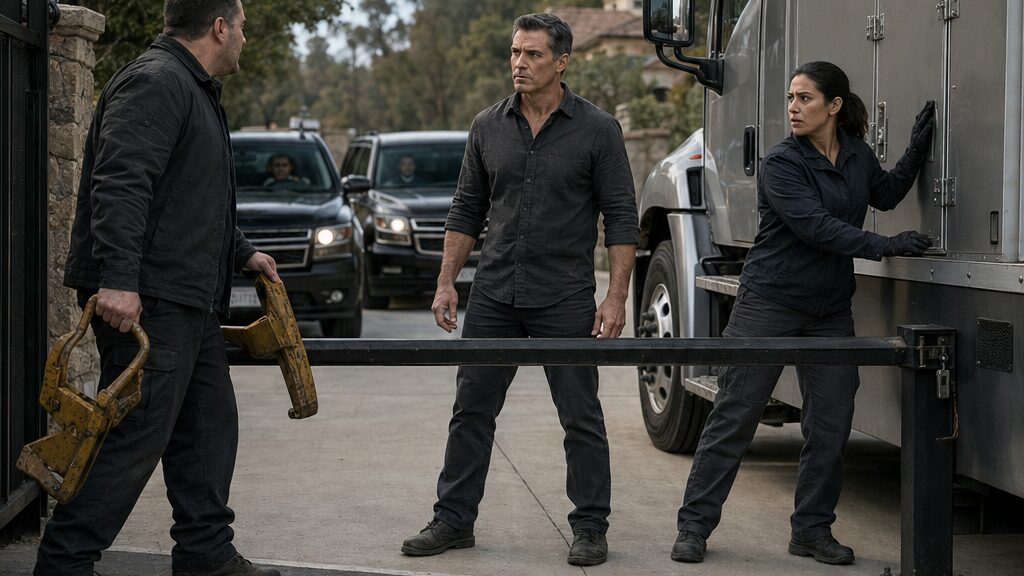
The steel boot hit the truck’s front wheel with a crack that carried across Robert Moore’s wet concrete driveway.
Inside the sealed cargo compartment, something heavy shifted.
Not cargo settling. Not a loose crate.
A single dull impact came from behind the insulated wall, followed by the low mechanical hum of the cooling unit.
Tyler Hall straightened beside the wheel, one hand gripping the black steel boot and the other wrapped around the handle of a galvanized bucket. Short metal spikes protruded from it like oversized nails. His navy shirt had shoulder patches, a plastic badge, and the words COMMUNITY TRAFFIC printed across the chest.
“Engine off,” he ordered.
Emily Torres leaned out of the driver’s window. “No.”
Tyler gave her a look of practiced disbelief. “Deliveries are only permitted on Tuesdays between two and two fifteen.”
“It is Tuesday.”
He checked his watch with exaggerated care. “Eleven forty-eight.”
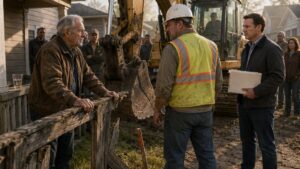
Robert came down the unfinished edge of his driveway, boots avoiding the orange cords that marked the curing slab. The concrete had been poured two days earlier, a level transfer pad extending from his side gate to the street. A strip of public asphalt ran along its front edge. The truck’s forward tires sat directly over the seam.
Robert stopped ten feet from Tyler.
“Move away from the wheel.”
Tyler turned slowly. He was younger than Robert by at least twenty years, broad through the shoulders, with a trimmed beard and dark glasses that reflected the white truck back at them.
“This is an unauthorized commercial vehicle.”
“It’s expected.”
“Not during an unauthorized hour.”
Emily opened the driver’s door but did not climb down. Her boots remained on the cab step. “The refrigeration system has to stay engaged.”
“Then reverse out.”
“I can’t.”
Tyler pointed behind the truck. “You came in. You can go out.”
Robert looked past the rear of the vehicle. The entrance lane narrowed between two stone columns before curving around a landscaped island. A delivery van could reverse through it with a spotter. This truck carried an extended climate-control housing and a rigid rear lift. Its right side already sat inches from the stone curb.
“You told her to pull forward,” Robert said.
“She crossed the entrance before stopping.”
“You waved her through.”
“I positioned her for inspection.”
The distinction was delivered too quickly.
Two neighbors stood near the mail kiosk, phones lifted. Another watched from behind a hedge. Tyler noticed them and rolled his shoulders back.
Robert stepped closer to the front wheel. “Whatever you think you’re inspecting, you’re doing it from the public side of my property line.”
Tyler tapped the boot against the tire. “This road is maintained by the association.”
Robert pointed down.
A metal survey pin had been driven into the joint where the asphalt met the new concrete. Blue chalk marked the line from one side of the driveway to the other. The truck’s front axle sat beyond it. Both front tires rested on Robert’s slab.
“You’re standing on the street,” Robert said. “The truck is standing on my property.”
Tyler glanced down but did not move.
“That doesn’t invalidate community access policy.”
“It invalidates you touching that wheel.”
Emily lowered herself from the cab. She wore gray transport coveralls and held a tablet against her chest. Her face was controlled, but Robert saw the tension in the muscles beside her mouth.
“Robert,” she said, “we need to clear the lane.”
Tyler swung toward her. “You need to provide a bill of lading and pay the gate assessment.”
“There is no gate assessment on the route authorization.”
“There is now.”
“How much?”
“Five hundred dollars.”
One of the neighbors lowered his phone, then raised it again.
Robert stared at Tyler. “You’re charging five hundred dollars to move ten feet.”
“I’m enforcing a commercial-access fee.”
“Show me the rule.”
Tyler nodded toward the small guard shelter near the stone column. “It’s posted.”
A laminated paper had been taped inside the window. From where Robert stood, he could read only the bold heading: TEMPORARY DELIVERY CONTROL NOTICE.
“Posted by whom?” Robert asked.
“The board.”
“Recorded where?”
“You can debate procedure at the next meeting.”
Emily moved toward the rear equipment panel.
Tyler blocked her path.
“I need to check the auxiliary system.”
“No one approaches the vehicle until inspection is complete.”
Her eyes sharpened. “There’s a living animal inside.”
The words changed the air.
The neighbor at the kiosk stopped whispering. Robert heard the cooling fan, the truck’s diesel idle, and somewhere within the sealed compartment, a faint scraping sound.
Tyler’s mouth tightened.
“What kind of animal?”
Emily glanced at the phones.
“I’m not authorized to disclose that in a public gathering.”
“So you expect me to wave through an unidentified animal shipment?”
“I expect you not to interfere with a regulated transport.”
“Regulated by who?”
Emily held his gaze. “Someone whose authority is real.”
Tyler stepped closer to her. “You are inside a controlled community entrance.”
Robert moved between them before Tyler could close the remaining distance.
“Back up.”
Tyler looked at Robert’s chest, then his face. “You threatening me?”
“I’m telling you where the line is.”
Robert pointed again to the blue chalk beneath Tyler’s boot.
For a moment, no one moved.
Then Tyler smiled.
It was small and humorless.
“You residents think property ownership makes you exempt from every agreement you signed.”
Robert had heard versions of that sentence since the concrete work began. Contractors had damaged two stretches of common landscaping during the previous month. The board had responded with notices, schedules, and a chain of temporary restrictions. Robert had expected resistance to the transfer truck. He had not expected a steel boot.
He had expected to handle it himself.
That was why he had not told the board what the pad was for.
Emily looked at him, and the question in her face was sharper than anything Tyler had said.
Robert took out his phone.
Tyler lifted the bucket slightly. The spikes rattled against one another.
“Call whoever you want. The truck does not move.”
Robert dialed Angela Wright.
The call rang once.
Behind them, metal groaned.
Tyler strode toward the rear of the truck.
“What are you doing?” Emily demanded.
He reached the security entrance’s metal drop-bar, pulled it down across the lane, and fed a heavy padlock through the catch. The bar struck its stop with a hard clang.
The truck was now blocked at the front by Tyler and trapped at the rear by the locked barrier.
Emily stared at him. “You just sealed a live transport inside the entrance.”
“You said it couldn’t reverse.”
“That does not mean you lock it in.”
“It means no one can claim I allowed an unauthorized departure.”
Robert’s call went to voicemail.
He watched Tyler return to the wheel.
The cooling unit changed pitch.
Inside the sealed compartment came another impact, weaker than the first.
Robert felt the sound in his ribs.
For an instant, the entrance lane disappeared. He saw another truck, another closed door, another man telling him to wait for authorization while an alarm sounded behind steel.
He forced the image down.
“Tyler,” he said, and his voice had lost all warmth, “put the boot on the ground.”
Tyler crouched beside the tire.
Emily stepped forward. “Do not attach that.”
He lifted the steel jaws toward the rim.
Robert called Angela again.
Tyler looked up at him.
“I’ll have this wheel clamped before your next phone call connects.”
Chapter 2: Fifteen Minutes of Authority Became a Cage
Robert raised his phone and took a photograph of Tyler’s badge.
Tyler covered it with his palm.
The movement was immediate and instinctive.
Robert took another picture.
“What agency issued that credential?” he asked.
Tyler stood, still holding the boot against his thigh. “You don’t have permission to photograph security personnel.”
“Then give me the number.”
“You can request it from the association.”
“There is no issuing agency, is there?”
Tyler removed his dark glasses. His eyes were pale and irritated. “I am contracted to enforce traffic control.”
“That wasn’t the question.”
Emily climbed back into the cab and reached across the passenger seat. The dashboard emitted a short electronic chirp. She studied the display, then pressed a sequence of controls.
Robert kept his attention on Tyler.
The plastic badge carried a gold shield and an embossed number, but no city, county, or state name. The shoulder patch showed a generic roadway symbol. Everything about the uniform suggested authority without identifying its source.
“Are you law enforcement?” Robert asked.
“No.”
“Code enforcement?”
“I’m an authorized community traffic warden.”
“Is that a public office?”
Tyler’s jaw shifted. “It’s a contracted position.”
“Through your company?”
“Through the HOA.”
“Then you’re private security.”
“I have traffic-control certification.”
“Which gives you the right to use a wheel boot?”
Tyler looked toward the people filming. “It gives me the right to secure vehicles violating posted access restrictions.”
Emily spoke from the cab. “Robert.”
He glanced at her.
The cooling display showed two temperatures. One was stable. The other had risen three degrees.
“How bad?” he asked.
“Not bad yet.”
Tyler seized on the answer. “Then there is no emergency.”
Emily turned in the seat. “That reading measures compartment air. It does not measure stress response.”
“What’s inside?”
“You’ve already been told what you need to know.”
“No. I’ve been told there’s an animal.”
Robert stepped to the guard shelter and pulled the laminated notice from the window. It had been printed on ordinary office paper.
TEMPORARY DELIVERY CONTROL NOTICE
COMMERCIAL VEHICLES PERMITTED TUESDAYS, 2:00 P.M.–2:15 P.M.
ALL OTHER ACCESS SUBJECT TO GATE ASSESSMENT AND SECURITY APPROVAL.
At the bottom was the HOA logo and a typed line: Issued by Traffic Oversight Contractor.
There was no board resolution number. No effective date. No signature.
Robert held it toward Tyler. “You issued this yourself.”
“The board approved restricted access.”
“Did they approve your fee?”
“They approved enforcement discretion.”
“That’s not what I asked.”
Tyler’s voice rose. “You don’t get to interrogate me because you’re angry about a schedule.”
Robert looked at the paper again. “Fifteen minutes once a week.”
“We’ve had repeated damage from contractor vehicles.”
“This isn’t a contractor vehicle.”
“It’s a commercial truck.”
“It’s a regulated transport.”
“You refuse to identify the cargo.”
Emily climbed down holding a red locking device. She crouched beside the front wheel and fitted it across the hub assembly.
Tyler stepped toward her. “Remove that.”
“No.”
“What is it?”
“Transport wheel-lock interlock. It prevents unauthorized external clamps from being attached without damaging the pressure monitors.”
Tyler looked from the device to his boot. “You’re obstructing an inspection.”
“I’m protecting the vehicle.”
“If you interfere with enforcement equipment, I’ll cite you.”
Emily stood. “On what authority?”
“The same authority that controls this gate.”
Robert gestured toward the lowered drop-bar. “The gate is behind the truck. The wheel is on my driveway.”
Tyler stepped over the blue chalk line.
“Everyone stay behind the boundary.”
Robert almost laughed.
“You crossed it to say that.”
Tyler looked down and moved one boot back onto the asphalt.
The cooling fan behind the truck surged, then settled into a strained hum.
Emily returned to the cab.
Robert followed and stood on the passenger step while she opened a diagnostic screen.
The upper number climbed another degree.
“Airflow?” he asked.
“Restricted.”
“Because we’re idling?”
“The intake is pulling heat off the stone column and the security vehicle. We need open space around the housing.”
“Can you increase output?”
“For a while.”
“How long?”
She did not answer.
Outside, Tyler spoke into a shoulder radio.
“Unit two and unit three, respond to south access. Noncompliant commercial vehicle. Driver and resident are escalating.”
Robert turned. “No one is escalating but you.”
Tyler kept speaking.
“Resident is confrontational. Driver has installed a device to defeat lawful immobilization.”
Emily stared at him through the open door. “You are filing a false report.”
“I’m documenting what I see.”
“You see a woman protecting a live transport.”
“I see a driver refusing inspection.”
Robert stepped down.
“What did you tell the board was in the truck?”
Tyler clipped the radio back to his shoulder. “Unpermitted commercial cargo.”
“So you don’t know.”
“I know enough.”
“You know nothing.”
“I know you poured a commercial-sized pad without disclosing its use. I know you scheduled a truck during restricted hours. I know you’re refusing to identify what you brought into a residential community.”
For the first time, Tyler’s frustration sounded rooted in something beyond performance.
Robert looked toward the fresh slab.
The board had asked twice why the driveway extension required reinforced concrete. He had answered that it was for equipment access. That was true, but not complete.
He had not wanted a meeting. He had not wanted questions about wildlife, liability, noise, or federal transport routes. He had believed the simplest way to protect the transfer was to tell no one until it was done.
Emily watched him from the cab.
Her silence made the choice feel less defensible.
Tyler mistook it for victory.
“You see?” he said to the neighbors. “He won’t answer because he knows this was concealed.”
Robert folded the temporary notice and put it in his pocket.
“What’s your company name?”
Tyler hesitated.
“Why?”
“So I can verify your license.”
“You can do that after the vehicle is removed.”
“Give me the name.”
Tyler tapped the logo on his sleeve. The embroidered words read HALL COMMUNITY COMPLIANCE.
Robert searched it on his phone.
The company existed. Its website showed traffic cones, parking patrols, and smiling guards near apartment entrances. Tyler’s name appeared beneath a title: Field Operations Contractor. A small notice at the bottom stated that certification renewal was pending.
Robert looked up.
“Your license expires this month.”
Tyler’s face hardened.
“That has nothing to do with this.”
“It has everything to do with why you need an audience.”
A murmur moved through the small group near the mailboxes.
Tyler pointed at Robert. “Remain behind the line.”
Robert did not move.
Tyler lifted his radio again. “Where are my vehicles?”
A voice crackled back. “Two minutes out.”
Emily called Robert’s name.
He returned to the cab.
The display now showed a countdown beneath the auxiliary cooling status.
Thirty-nine minutes, eighteen seconds.
“What happens at zero?” he asked.
“Automatic shutdown to protect the compressor from overheating.”
“Can you override it?”
“Once. For ten minutes. Then we risk losing the unit completely.”
Robert looked toward the rear compartment. “What about the primary system?”
“It’s operating, but not efficiently enough at idle. If we move onto the level pad, I can stabilize everything.”
He lowered his voice. “Tell him what’s inside.”
Emily’s expression changed.
“You arranged this transfer,” she said. “You know why the cargo identity is restricted.”
“I know.”
“There are people filming.”
“I know.”
“And you still haven’t reached Angela.”
Robert looked at the unanswered calls on his screen.
Emily’s voice went quieter. “Did you tell her the arrival time changed?”
He did not answer quickly enough.
Her eyes fixed on him.
“Robert.”
“The storm moved the route forward.”
“That wasn’t my question.”
“I was going to call when you reached the county line.”
“You knew before I left the holding facility.”
“The permit was already approved.”
“For two fifteen.”
“The animal needed to move.”
“And now we are trapped behind a private gate with incomplete timing confirmation.”
Tyler struck the side of the truck with his palm.
“Inspection window is closing.”
Emily looked at the countdown.
Thirty-eight minutes.
Then she looked back at Robert.
“You didn’t keep this secret to protect the animal,” she said. “You kept it secret because you thought you could handle everyone yourself.”
Behind them, the sound of approaching engines grew louder.
Chapter 3: The Manifest Proved Less Than Robert Expected
Emily unlocked the red document sleeve beneath the passenger seat.
“If I show this,” she said, “the incident becomes mandatory federal reporting.”
Robert stood below the open cab door. “It already is.”
“No. Right now it’s an access dispute. Once restricted cargo is disclosed in public, every person here becomes part of the exposure record.”
Tyler walked toward them as two dark security vehicles appeared beyond the stone entrance.
“Then don’t disclose it,” he said. “Back the truck out.”
Emily removed a sealed packet.
Robert recognized the blue federal strip across its edge.
Tyler’s pace slowed.
Emily stepped down and held the packet against her chest.
“Clear the cameras back,” she told him.
“You don’t give instructions here.”
“This document contains protected route and wildlife information.”
“Convenient.”
Emily looked at Robert. “Get them away from the rear compartment.”
Robert turned to the neighbors. “Stop recording the truck.”
No one lowered a phone.
One woman said, “We’re recording him.”
She pointed at Tyler.
“You’re recording the vehicle too,” Robert replied. “Move to the mailboxes or put the phones down.”
Something in his tone persuaded two of them. The others shifted but kept filming.
The security vehicles stopped at the entrance. One remained beyond the lowered bar. The other pulled near the stone column, further constricting airflow around the truck.
Emily’s face tightened.
“Move that vehicle.”
Tyler ignored her.
She broke the seal on the packet.
The first page bore the header of the Department of Fish and Wildlife. Beneath it were permit numbers, transport conditions, and a block of restricted identifiers.
Tyler reached for the paper.
Emily pulled it away.
“You may view it. You may not take it.”
“I need to verify it.”
“You are not an authorized receiving official.”
He leaned close enough to read.
Robert watched his eyes move down the page.
Species: Canis rufus.
Transfer classification: Endangered wildlife sanctuary relocation.
Transport condition: Sedated, temperature controlled, continuous monitoring required.
Tyler’s face did not soften.
Instead, he pointed to the arrival field.
“This says fourteen fifteen.”
“The route changed because the southern holding road flooded,” Emily said. “The transfer was advanced.”
“Where is the amendment?”
“Pending verbal confirmation.”
“Then it is not valid.”
“The permit is valid.”
“The schedule is not.”
Robert stepped beside her. “You read what’s inside.”
“I read a document with a different arrival time.”
“You also read that the animal is endangered.”
“That does not erase community access rules.”
“It does erase your claim that this is an ordinary commercial delivery.”
Tyler raised his radio. “Board contact, I have documentation confirming an unauthorized wildlife shipment with mismatched arrival credentials.”
Emily’s composure cracked.
“That is not what the document says.”
Tyler turned slightly away and took a picture with his phone.
Robert caught the movement.
“Delete that.”
“It’s evidence.”
“It contains a restricted route.”
“It contains proof you scheduled an unapproved delivery.”
Robert reached toward the phone, then stopped himself.
Tyler saw the hesitation and smiled.
“Touch me or my equipment and I’ll add assault.”
One of the security guards approached the lowered bar. Tyler showed him the photograph.
“Send that to Carol Johnson,” he said. “Tell her the resident concealed hazardous cargo and the federal form doesn’t match the delivery time.”
Emily folded the manifest shut.
“A sedated wolf is not hazardous cargo.”
The nearest neighbor inhaled sharply.
The word spread through the small crowd in whispers.
Wolf.
Tyler looked pleased that the secret was no longer controlled by anyone else.
“So it is a wolf.”
“A red wolf,” Emily said. “A federally protected endangered animal being transferred to sanctuary care.”
From the rear compartment came a faint scrape.
Emily closed her eyes for half a second.
Robert had worked around sedated animals long enough to know the sound was wrong. A properly settled animal shifted slowly. That scrape had been quick, followed by stillness.
Tyler motioned toward the truck. “An endangered predator in a residential neighborhood. That should have been disclosed.”
“It will not remain here,” Robert said. “This is a transfer point.”
“On a driveway you told the board was for equipment.”
“It is for equipment.”
“Wildlife transport equipment.”
“Yes.”
Tyler looked toward the watching residents. “And you didn’t think your neighbors had a right to know?”
Robert glanced at Emily.
She did not rescue him.
His phone rang.
Angela Wright.
He answered immediately. “Angela.”
“Tell me the transport is already on the pad.”
“It’s at the entrance.”
A pause.
“What happened?”
“The gate contractor blocked it.”
“Why is the driver at the entrance before noon?”
Robert looked at Emily.
“The route changed.”
“I know the route changed. I approved the holding-site departure. I did not approve early arrival at your transfer point.”
Robert said nothing.
Angela’s voice sharpened. “Did you fail to report the revised arrival?”
“The permit was valid.”
“That is not what I asked.”
Tyler stood close enough to hear Angela’s tone, if not every word.
Robert turned away.
“I intended to call.”
“You intended?”
“The truck needed to move before the storm line closed the county road.”
“And you decided the rest yourself.”
“Angela, the animal is trapped between a locked bar and a contractor with a wheel boot.”
“Is the crate secure?”
“Yes.”
“Cooling status?”
Emily answered loudly. “Primary active. Auxiliary shutdown in thirty-four minutes. Airflow restricted.”
Angela heard her.
“Emily, are you maintaining sedation monitoring?”
“Yes.”
“Any respiratory irregularity?”
“Not confirmed.”
“Do not open the crate.”
Tyler folded his arms.
Angela continued. “Do not move the truck until I arrive unless the compartment system fails or Emily declares a medical emergency.”
Robert looked at the concrete pad ten feet ahead.
“The path is clear except for him.”
“The documentation is now compromised because the arrival was not reported. If you force movement before I establish custody, we risk contamination of the transfer record and a possible permit breach.”
“The wolf doesn’t care about the transfer record.”
“The transfer record is what keeps people from seizing protected animals, Robert.”
Her answer landed harder because it was true.
“When will you get here?”
“Twelve minutes.”
Tyler spoke loudly. “No vehicle moves without HOA clearance.”
Angela heard him.
“Who is that?”
“The contractor.”
“Put me on speaker.”
Robert did.
Angela’s voice filled the entrance lane.
“This is Angela Wright with the Department of Fish and Wildlife. The vehicle before you is operating under federal endangered-species transport authorization. You are instructed not to attach equipment to the vehicle, obstruct access to its cooling systems, or interfere with the driver.”
Tyler lifted his chin.
“I’m enforcing private community regulations. The arrival time on your document does not match the actual delivery.”
“That discrepancy is between my department and the transport team.”
“It occurred on HOA-controlled property.”
“The front axle is on the receiving property.”
Robert looked at the blue chalk line.
Tyler’s mouth tightened.
“The rear of the vehicle remains within the entrance.”
“Then keep the lane clear and do not worsen the obstruction.”
Tyler glanced at the arriving guards and the people filming.
“You can address this when you arrive.”
“I am addressing it now.”
“Then send written authority.”
The call went quiet for a beat.
Angela said, “I am twelve minutes away. Do not touch that truck.”
Tyler pressed the end-call button on Robert’s phone with one finger.
Robert stared at him.
Tyler stepped back.
“She admitted the arrival wasn’t authorized.”
Emily rounded on Robert. “You didn’t notify her.”
“I was going to.”
“You said that already.”
“I knew the route had to change.”
“You knew yesterday.”
“Storm water cut the southern road.”
“And you decided that meant no one else needed to coordinate.”
Robert kept his voice low. “The last time I waited for everyone to coordinate, an animal died in a steel box.”
Emily’s anger faltered, but only for a moment.
“This is not that transport.”
“The alarm will sound the same.”
“You don’t get to turn your fear into my missing paperwork.”
The words struck cleanly.
Robert looked toward the truck.
Tyler had heard enough to understand the fracture between them. He lifted his radio.
“Maintain blockade. No movement until police and the board arrive.”
The auxiliary unit gave a sharp electronic tone.
Emily spun toward the cab.
A red warning flashed across the diagnostic screen.
Then something inside the sealed compartment hit the crate wall with a force that shook the truck.
The sound silenced everyone.
A second alarm began to pulse.
Edit
Chapter 4: The Animal Robert Once Failed Returned in Memory
The alarm pulsed twice, paused, then pulsed again.
Robert knew that rhythm.
For one disorienting second, the white transport truck vanished. In its place stood an older vehicle under fluorescent loading-bay lights, its metal walls streaked with rain. A supervisor’s hand had rested on the door latch while a cougar’s breathing rasped behind it.
Wait for authorization.
They had waited nineteen minutes.
Robert blinked, and the community entrance returned around him.
Emily was already inside the cab, fingers moving across the diagnostic screen.
“Respiration alert?” Robert asked.
“I don’t know yet.”
She switched camera feeds. A grainy infrared image appeared: the red wolf lay inside a reinforced crate, shoulder rising too quickly beneath a thermal blanket.
Robert climbed onto the passenger step.
“Open the gate.”
Emily did not look at him. “No.”
“The truck needs to move.”
“The alarm may be vibration-triggered.”
“You heard it hit the wall.”
“I also heard three vehicles arrive, a bar drop, people shouting, and someone striking the tire with steel.” She enlarged the sensor graph. “Moving before I know what changed could make it worse.”
Tyler stood below them, radio pressed to his shoulder.
“The vehicle remains detained,” he said.
Robert turned so sharply that the cab door shook.
“Stop using that word.”
“It’s accurate.”
“You have no detention authority.”
“I have a blocked commercial vehicle, mismatched paperwork, and an undisclosed predator.”
Emily leaned out. “You also have a direct instruction from Fish and Wildlife not to interfere.”
“And they’re not here.”
Robert stepped down.
The heavy cutters lay in his open equipment shed beyond the fresh driveway. From where he stood, he could see their red handles against the wall.
Ten feet to the shed.
Ten feet back.
One cut through the padlock.
Emily caught his sleeve before he moved.
“Don’t.”
“The animal is in distress.”
“The temperature is twenty-two degrees Celsius. Still within range.”
“The alarm—”
“Is tied to movement and respiration, not temperature.”
She showed him the graph. The compartment air had risen, but not enough to explain the wolf’s reaction. The respiration line spiked whenever Tyler’s radio cracked or an engine revved.
“Sedation stress,” Emily said. “Noise and vibration. If you smash that lock while the truck is boxed in, you may trigger another impact.”
Robert looked toward the sealed compartment.
“What do you need?”
“Less vibration. More airflow. No shouting.”
He faced Tyler. “Move the security vehicle away from the intake.”
Tyler glanced at the vehicle parked beside the stone column. “It stays.”
“You’re heating the intake and reflecting engine vibration into the compartment.”
“That sounds speculative.”
Emily came down from the cab. “It is not speculative. Move it twenty feet.”
One of the guards shifted near the second vehicle.
Tyler raised a hand, stopping him.
“No vehicles move until police arrive.”
Robert walked to the parked security unit. The keys were still in the ignition, but a guard blocked the door.
“Move it,” Robert said.
“I take orders from Mr. Hall.”
Robert looked past him. “Tyler, if that animal stops breathing because you needed your car parked close enough to look official, every camera here will have recorded the reason.”
The guard looked at Tyler.
That hesitation mattered.
Tyler saw it too.
“Move it to the outside shoulder,” he snapped. “Keep the exit blocked.”
The vehicle reversed beyond the stone column. Air opened around the transport housing, and the cooling unit’s strained pitch softened.
Emily watched the display.
The compartment temperature stopped climbing.
A minute later, it dropped by a fraction.
“There,” she said.
The small success loosened something in Robert’s chest, but the respiration line remained too high.
Emily reduced the truck’s idle speed and switched the auxiliary compressor to a quieter cycle. Robert placed rubber chocks beneath the rear stabilizers to dampen the trembling frame.
They worked without speaking.
For several moments, Tyler became background noise rather than the center of the conflict.
The wolf’s shoulder movements slowed on the infrared screen.
Emily exhaled.
“Better.”
Robert rested one hand against the open cab door.
“You were right.”
She looked at him.
“About not moving yet,” he added.
“That must have hurt.”
“Not as much as the animal hitting the crate.”
Her expression softened, then tightened again. “You nearly went for the cutters.”
“I’m still considering it.”
“Angela said twelve minutes.”
“She also once said twenty minutes.”
Emily waited.
Robert looked past her to the sealed compartment.
“It was eight years ago,” he said. “A cougar transfer. Spinal injury. The receiving clinic changed intake staff, and no one would sign custody.”
Emily said nothing.
“The transporter wanted to open the door. I told him not to. I said the paperwork protected everyone.”
The memory returned in pieces: rain on the loading dock, the alarm tone, his own hand flat against cold steel while the man inside the office searched for a supervisor.
“The cougar stopped breathing before anyone signed.”
“Was the delay the only cause?”
“No.”
“Did you know that then?”
“I knew it afterward.”
“That isn’t the same thing.”
Robert watched the blue chalk line beneath the truck.
“I stood there and obeyed.”
“And now you arrange every transfer as if someone will ask you to do it again.”
He did not answer.
Emily folded her arms. “You should have told Angela about the schedule.”
“The road was closing.”
“You should have told me you hadn’t told her.”
“I didn’t want the transfer postponed.”
“You didn’t trust anyone else to decide.”
A silver sedan stopped beyond the entrance. Carol Johnson stepped out carrying a leather folder.
Tyler moved toward her before the car door had fully closed.
“Board officer,” he announced, turning so the phones could capture her arrival. “We have an undeclared hazardous-animal shipment, fraudulent timing information, and a resident threatening security infrastructure.”
Carol looked first at Tyler, then at the truck, then at Robert.
She was dressed for an office meeting, not a roadside confrontation. Her gaze settled on the lowered drop-bar and the cluster of residents filming.
“Robert,” she said, “what have you brought into the community?”
“A protected animal in transit.”
“You told the architectural committee that slab was for equipment access.”
“It is.”
“You did not mention federal wildlife transfers.”
“I wasn’t required to advertise a one-hour controlled handoff.”
Carol’s mouth thinned. “That is exactly the kind of interpretation that created this problem.”
Tyler held out his phone, displaying the photograph of the manifest.
“The scheduled arrival is two fifteen. They arrived before noon.”
Carol read it.
“You had no amended authorization?”
Emily answered. “The transport permit is valid. The arrival update was not entered before departure.”
Carol looked at Robert. “Because?”
“He didn’t report it,” Emily said.
The admission struck harder coming from her.
Carol closed the folder against her side. “Then Tyler had a legitimate reason to stop the truck.”
“He had a reason to ask questions,” Robert said. “Not trap it. Not threaten the wheel. Not block its cooling intake.”
“The board hired him because residents complained that our rules were never enforced evenly.”
“You hired a private guard, not a traffic department.”
“We hired someone willing to say no.”
Tyler stood a little taller.
Carol glanced toward the fresh concrete. “And no one is breaking that gate while I’m here.”
Robert put one boot on the asphalt and the other on the curing edge of his driveway. The blue chalk line ran directly between his feet.
Behind him, the alarm had quieted.
Ahead, the red handles of the cutters remained visible in the shed.
“Carol,” he said, “if the driver declares a medical emergency, that bar comes up.”
“You will wait for the wildlife officer and the police.”
“Waiting is not neutral.”
“Neither is destroying association property.”
Tyler returned to his security vehicle.
When he came back, he carried the galvanized bucket.
The spikes inside rattled with each step.
“No truck moves until police arrive,” he announced.
Emily stared at the bucket.
Carol looked at it as if seeing it for the first time.
Robert shifted both boots onto the asphalt.
Chapter 5: The Board Member Saw the Badge Slip
“Show me the manifest you said did not exist,” Carol told Tyler.
The entrance went quiet enough for the truck’s cooling fans to be heard again.
Tyler held his radio near his mouth but did not speak into it.
“I said the driver refused inspection.”
“You told me by phone there were no transport documents.”
“I said there were no valid documents.”
Carol extended her hand. “Let me see them.”
Tyler glanced at Emily. “She took them back.”
“Because they contain restricted route information,” Emily said.
Carol turned to her. “May I view the first page?”
Emily looked toward the phones, then positioned herself so Carol could stand between the cab and the open document sleeve.
Tyler moved closer.
Emily raised one hand. “Not you.”
“I’m the officer conducting the stop.”
Carol looked at his chest.
“Officer?”
“Traffic warden.”
“Tyler, the agreement calls you an access-control contractor.”
“The operational role requires broader authority.”
“Broader than what the contract says?”
He said nothing.
Carol read the first page. Her eyes paused at the species classification, then at the federal restrictions.
“You knew this was a protected transport?”
“I knew that was what they claimed.”
“You sent me a photograph of this page.”
“I sent you the scheduling discrepancy.”
“You cropped the top.”
Robert saw the change in her face. It was not yet an apology. It was the recognition that someone had managed what she was allowed to know.
Tyler gestured toward the truck. “The arrival field is still invalid.”
Carol closed the packet and handed it back to Emily.
“Why did you tell me it contained construction equipment?”
“I said it could be equipment.”
“You said Robert was sneaking heavy construction machinery through the gate.”
“He poured an industrial pad. The assumption was reasonable.”
“It was useful,” Robert said.
Tyler turned on him. “You concealed the purpose of the property modification.”
“And you concealed the document that made your blockade look indefensible.”
Carol stepped between their lines of sight.
“No one is helping this by shouting.”
“You’re right,” Tyler said quickly. “Which is why control needs to remain with security.”
He raised his radio.
“Units, maintain hard closure. Park nose-to-nose if necessary. Nothing enters or leaves.”
The guard beside the stone column looked toward Carol.
“Do that,” Tyler continued, “and keep emergency access locked until I clear it.”
A small red light blinked on the dashboard camera of the nearest security vehicle.
Carol saw it.
“Did you just order them to block emergency access?”
“I ordered containment.”
“The fire lane runs through this entrance.”
“There is no fire emergency.”
“There is a live-animal medical warning.”
“That does not activate municipal fire access.”
Carol stared at him for a moment, then opened her leather folder and removed her phone.
“What are you doing?” Tyler asked.
“Preserving the radio logs.”
“You don’t need to.”
“I’m board treasurer. Yes, I do.”
His grip tightened on the bucket handle.
Robert watched the muscles in Tyler’s forearm. The man was losing control in increments, each one small enough for him to pretend the next could restore it.
Carol tapped through an account portal.
“The vehicle cameras upload automatically,” she said.
Tyler reached toward her phone.
She stepped back.
“Do not touch this.”
His hand stopped in the air.
For the first time, the neighbors watching did not look at Robert as the likely source of violence.
Tyler noticed that too.
He lowered his arm and forced a short laugh.
“Fine. Preserve everything. It will show I followed procedure.”
“Did procedure authorize those spikes?” Carol asked.
“They’re standard traffic-control equipment.”
“They are tire spikes in a bucket.”
“They’re used to prevent dangerous flight.”
“From a gated residential entrance?”
“Noncompliant drivers panic.”
Emily spoke without looking away from the cooling display. “You trapped the truck so it cannot reverse.”
“That does not mean it can advance.”
Carol pointed toward the steel boot at Tyler’s feet.
“And that?”
“Immobilization equipment.”
“The board did not authorize wheel boots.”
“The contractor agreement allows reasonable enforcement tools.”
“It allows cones, signage, and documentation.”
“It allows necessary escalation.”
“No,” Carol said. “It does not.”
Tyler’s expression emptied.
The correction had come in front of the residents, the guards, and every raised phone.
He bent, picked up the boot, and held it out toward Carol.
“Then take it.”
She did not.
“Put it on the ground,” she said.
“You wanted control. Here.”
“I said put it down.”
Robert could see the trap Tyler was building. If Carol accepted it, he could later say the board took custody. If she refused, he could claim he retained operational discretion.
Emily saw it too.
“Set it beside your vehicle,” she said. “Then step away.”
Tyler’s head snapped toward her.
“You don’t issue commands.”
“I’m telling you how not to worsen the record.”
The guard near the stone column looked down, hiding a reaction.
Tyler saw that.
His face flushed.
Robert stepped nearer the truck, placing himself between Tyler and Emily.
“Leave the equipment where everyone can see it.”
Tyler dropped the boot.
Metal struck asphalt.
The wolf shifted inside the crate.
Emily checked the monitor. “Keep the noise down.”
Carol moved toward Robert.
“I still cannot authorize you to break the drop-bar.”
“I didn’t ask you to.”
“You keep looking at your shed.”
“So do you.”
Her gaze flicked toward the red-handled cutters.
“Angela is coming,” Carol said.
“And if the wolf crashes before she arrives?”
“Then the driver declares an emergency.”
“Tyler already ignored her instructions.”
Carol’s voice lowered. “I am trying to keep this from becoming something none of us can reverse.”
Robert looked at the padlock.
“It became that when he locked the truck in.”
Behind them, Tyler spoke quietly into his radio.
“Bring unit two closer.”
Carol turned. “I told you not to block the fire lane.”
“I’m reinforcing the perimeter.”
“You are no longer authorized to change vehicle positions.”
“You don’t direct field operations.”
“I direct the contract paying for them.”
Tyler stared at her.
The insecurity underneath his uniform showed plainly now. His company name was his own name. His certification renewal was pending. This gate, this crowd, this blockade—everything had become a test he believed he could not afford to fail.
“You hired me because no one respected this board,” he said. “Contractors drove over lawns. Residents threatened staff. Every time someone complained, you made an exception.”
Carol flinched because part of it was true.
Tyler continued. “I gave you enforcement. Now the first time a homeowner pushes back, you want to pretend you never asked for it.”
“I asked you to enforce recorded rules.”
“You asked me to restore order.”
“And I am telling you that this is not order.”
His gaze moved from Carol to Robert, then to the residents filming.
“I’m not losing this contract because people change their story when consequences arrive.”
He seized the spike bucket with both hands.
Emily descended from the cab and moved toward the exterior cooling controls.
A warning light had begun flashing on the side panel.
Tyler stepped into her path.
“Stay away from the vehicle.”
“I need access to the compressor housing.”
“No.”
“It is my transport.”
“It is detained.”
Emily tried to pass him.
Tyler shoved her backward with his forearm.
She struck the truck’s side and caught herself on the wheel arch.
Robert moved.
Carol grabbed his sleeve.
“Robert, don’t.”
Tyler tipped the bucket toward the delivery truck’s front tires.
The first spike slid to the rim and hung there, one inch from falling.
Chapter 6: The Spikes Flew Toward the Wrong Tires
Tyler swung the bucket forward as the first security vehicle accelerated toward the entrance.
Robert crossed the distance before the spikes fell.
He did not aim for Tyler’s body. He drove the sole of his boot into the bottom of the galvanized bucket.
Metal boomed.
The bucket flew upward, turning once in the air. Spikes burst from it in a glittering arc, scattering across the asphalt beneath the approaching security vehicles.
The lead driver hit the brakes.
Tires screamed.
The vehicle stopped sideways, its front bumper inches from the stone column. The second unit swerved behind it and struck the landscaped curb with a grinding thud.
No spike touched the wildlife truck.
For one suspended second, everyone stared at the scattered metal.
Then sound returned all at once.
Tyler shouted, “Assault!”
Carol yelled for the guards to stop moving.
The wolf’s alarm began pulsing again.
Emily pushed away from the truck, one hand pressed to her shoulder.
“Robert, the monitor.”
He turned.
The exterior display flashed a respiratory warning. The line that had begun to settle now climbed in sharp, uneven peaks.
Emily reached the cooling controls.
Tyler caught her arm.
“Get away from it.”
She twisted free. “Let go of me.”
He grabbed the steel boot from the ground with his other hand and swung it toward the wheel-lock interlock.
Emily stepped between him and the tire.
The edge of the boot struck her upper arm.
She cried out and dropped to one knee.
Something inside Robert went silent.
Not calm.
A silence deeper than anger, where choice narrowed to a single point.
Tyler stood over Emily holding the boot, breathing hard. The plastic badge on his chest had twisted sideways.
Robert seized the front of his uniform.
Tyler’s eyes widened.
Robert could have driven him into the asphalt. He could have taken the steel boot and returned every ounce of force. The old loading bay flashed through him again—the closed door, the waiting, the helplessness—and for a fraction of a second Tyler became every person who had ever mistaken delay for caution.
Then Emily said his name.
Not loudly.
“Robert.”
He looked down.
She was still conscious, still reaching for the control panel.
He released Tyler.
Tyler stumbled back two steps.
Robert kicked the steel boot away, then crouched beside Emily.
“Can you move the arm?”
“Yes.”
“Are you sure?”
“No. Help me up.”
He lifted her by the uninjured side.
She leaned against the truck and checked the display.
“The respiration rate is rising. We need the level pad now.”
“Medical emergency?”
“Yes.”
The word changed everything.
Robert turned toward the drop-bar.
Tyler recovered his balance.
“You are not touching that gate.”
Carol held up her phone. “Tyler, stop.”
He ignored her.
“Robert assaulted me and deployed road hazards. All units, restrain him.”
The guards did not move.
Carol pressed a button on her screen.
Tyler’s own voice played through the phone speaker, captured from the uploaded vehicle radio.
“I saw the federal seal. It doesn’t matter. No vehicle moves until they understand who controls this entrance.”
The recording ended.
Tyler’s face went blank.
Carol stared at him. “You knew.”
“The schedule was invalid.”
“You knew what was in the truck.”
“I knew what they claimed.”
“You said the seal didn’t matter.”
He looked at the guards.
Neither would meet his eyes.
Robert ran toward his equipment shed.
Tyler chased him.
“Stop him!”
Robert crossed from asphalt to fresh concrete, his boots leaving faint dust prints along the cured edge. He took the red-handled cutters from the wall and turned back.
Tyler stood at the blue chalk line.
“You break that lock, you’re committing felony property damage.”
Robert kept walking.
“You cross this line,” Tyler shouted, “I will physically detain you.”
Robert reached the boundary.
For hours, the line had been used as an argument—public road, private driveway, HOA entrance, resident property. Now it was simply the distance between a failing animal and the level surface it needed.
Robert stepped over it.
Tyler lunged.
Robert shifted the cutters between them like a bar, stopping Tyler without striking him.
“Do not make me choose between you and that truck.”
“You already assaulted me.”
“I kicked a bucket away from the tires.”
“You endangered my vehicles.”
“You put the spikes in the road.”
Tyler grabbed one cutter handle.
They struggled over the tool.
Robert felt the old rage rising again, offering him the simplest answer: overpower the man, finish the fight, prove who had control.
But control was what Tyler wanted.
Robert let go with one hand.
The sudden change pulled Tyler off balance. Robert turned the cutters, slid them free, and stepped away instead of following him down.
Tyler fell to one knee on the asphalt.
Robert went to the padlock.
Carol moved toward him. “The board has not authorized this.”
Emily called from the truck, “Respiration forty-eight and rising.”
Robert fitted the cutter jaws around the lock shank.
Carol stopped.
Tyler pushed himself upright.
“If you cut that, you’ll pay for the entire gate.”
Robert squeezed.
The jaws bit but did not sever.
The metal groaned.
The alarm from the truck sharpened.
Emily opened the driver’s door. “I need a clear lane.”
The guards began moving the damaged security vehicles without waiting for Tyler’s orders.
Tyler looked from them to Carol.
“You’re all abandoning procedure.”
Carol held her phone up again. “Procedure did not tell you to hit her.”
“She interfered.”
“She tried to keep an endangered animal alive.”
“She disobeyed a lawful stop.”
“You are not an officer.”
The words landed harder than any blow.
Robert reset the cutters and squeezed again.
The lock snapped.
The broken half struck the pavement.
Tyler rushed toward the bar.
Robert dropped the cutters, caught the heavy metal beam with both hands, and forced it upward. The mechanism resisted, bent by the weight of the drop and the pressure of the trapped truck.
One of the guards stepped forward.
Tyler shouted, “Don’t help him.”
The guard took the opposite end anyway.
Together, he and Robert raised the bar high enough to clear the truck’s roofline.
“Go!” Robert shouted.
Emily climbed into the cab.
The truck rolled forward.
Its tires crossed the blue chalk boundary one axle at a time. The refrigeration housing cleared the stone column. The strained compressor note deepened as open air reached the intake.
Robert held the bar above his head until the rear lift passed beneath it.
Then the warped beam slipped from the damaged catch and crashed against the post.
The truck moved onto the level concrete transfer pad.
Emily stopped precisely inside the painted alignment marks and activated the stabilization system.
The respiratory alarm continued.
Robert ran beside the truck.
Behind him, Tyler began shouting before anyone had asked what happened.
“He attacked me. He destroyed private property. He scattered weapons under my vehicles.”
Engines approached from beyond the entrance.
Not police sirens.
White government vehicles with green department markings turned into view.
Angela Wright stepped from the lead vehicle before it had fully stopped.
Tyler rushed toward her, pointing at Robert.
“That man assaulted an authorized traffic officer.”
Angela did not look at him.
A rough, rapid breathing sound came through the transport compartment’s ventilation panel.
She ran past Tyler, across the broken gate, and onto Robert’s driveway.