The HOA Sent An Excavator To Tear Down His Wife’s Only Way Back Home
Chapter 1: The Excavator Was Already At The Side Door
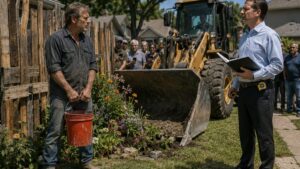
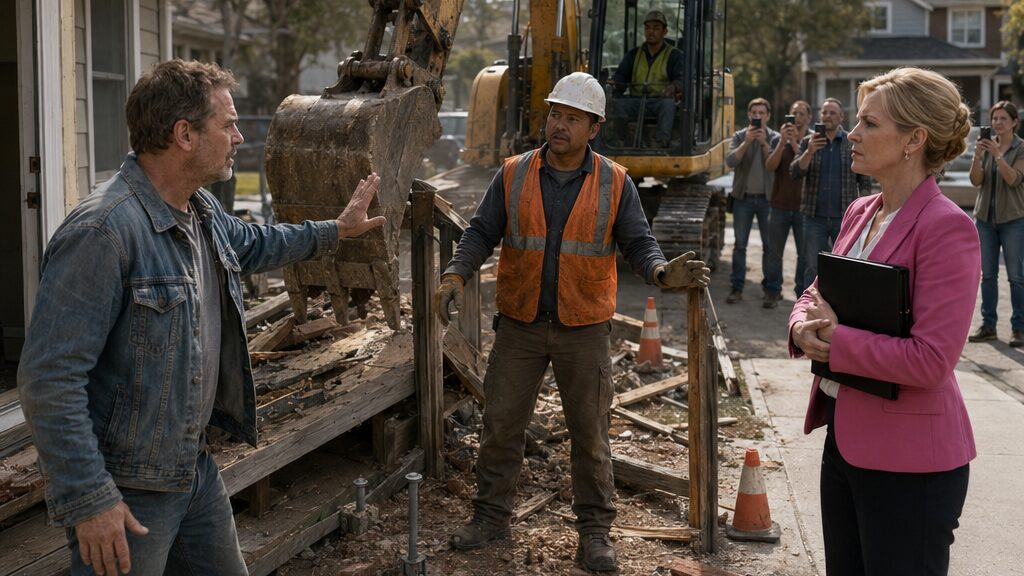
The yellow excavator’s bucket bit into the side-entry frame before Richard Hall reached the gate.
The sound was not a crash so much as a tearing—wet lumber splitting, screws shrieking out of fresh wood, brick dust coughing into the morning air. One of the new support posts jumped from its concrete anchor and swung sideways, still bolted to a section of ramp rail Richard had sanded smooth two nights ago under a work light. The bucket lifted again, slow and ugly, as if the machine were chewing.
“Stop!” Richard shouted.
Nobody stopped.
The crew supervisor in the orange vest glanced toward him, then toward the woman standing beside the driveway with a folder tucked under one arm. Cynthia Williams did not flinch. Her bright pink blazer looked almost unreal against the gray dust and yellow steel. She held one hand up, palm down, not to calm the situation but to control it.
Richard pushed through the side gate hard enough that the latch struck the fence.
The ramp was not finished. That was the first thing his mind grabbed because it could not yet grab the bigger thing. It was not finished, so the left rail was still clamped, the landing boards were stacked under a blue tarp, and the widened threshold had exposed brickwork around the frame. It had looked rough yesterday evening, yes. Temporary. Incomplete. But it had been solid enough for Samantha’s chair to cross once the final boards went down.
Now half of it hung broken from the side of the house.
“Back up, sir,” the crew supervisor said. He stepped toward Richard, both hands lifted. His hard hat had dust across the brim. “You can’t come into an active work zone.”
“This is my house.”
The man’s face tightened, but he did not argue. He looked again at Cynthia.
Cynthia opened her folder. “Mr. Hall, you were notified that this structure was in violation.”
Richard looked at the splintered rail in the excavator bucket. A screw dangled from it. He remembered driving that screw in with his palm pressed against the wood, testing for wobble, thinking of Samantha’s hand closing around the rail the first time she came home.
“Notified when?” he asked.
“A notice was placed at your front door this morning.”
“This morning?”
Cynthia’s chin lifted. “Emergency removal was authorized after review.”
The excavator engine idled behind her. It made every pause feel like a threat.
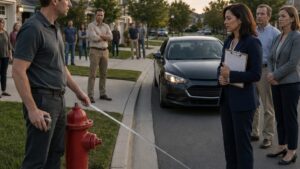
Across the street, two neighbors stood near Frank Roberts’s mailbox. One held a phone chest-high, recording. Another had one hand over her mouth. A delivery truck slowed, then rolled on. Richard saw the neighborhood watching him in pieces: phones, windows, half-open curtains, cautious faces.
He forced his voice lower. “Justin,” he said, reading the crew supervisor’s name from the patch on his vest, “tell your operator to shut that engine down.”
Justin Lee swallowed. “We were contracted to remove an unapproved exterior structure.”
“It’s a medical access ramp.”
Cynthia’s folder snapped shut. “It is an unapproved exterior alteration attached to a common-view side elevation.”
Richard stared at her.
Common-view side elevation. That was the phrase she had chosen for the place where his wife was supposed to come through the door.
He stepped around Justin and planted himself in front of the remaining ramp frame. Behind him, the excavator bucket lowered a few inches. The operator waited, one hand visible on the control.
“Mr. Hall,” Cynthia said, “do not interfere with authorized enforcement.”
Richard felt heat rise behind his eyes, but he kept his hands open. He had spent nineteen years telling angry homeowners not to touch workers, not to grab tools, not to make a bad morning worse. He had inspected sagging porches after storms and illegal basement bedrooms with wires hanging from joists. He knew the shape of a situation right before it became unrecoverable.
This one was already close.
“Show me the authorization,” he said.
Cynthia pulled a page from the folder and held it out like she was serving a bill. Richard did not take it. He read from where he stood.
Oakmere Crossing Homeowners Association. Emergency Exterior Compliance Action. Architectural Variance Violation. Removal approved by board authority.
“No court order,” Richard said.
Cynthia’s mouth tightened. “The governing documents allow the association to remove noncompliant structures after notice.”
“What date was the notice issued?”
“Today.”
“And the crew was already here when you left it?”
Cynthia glanced at Justin. It was quick, but Richard saw it. Justin saw it too.
“We are acting under emergency conditions,” Cynthia said. “The structure is unsafe.”
Richard turned slightly and pointed to the torn anchor bolts in the concrete. “It’s unsafe now because your excavator ripped out the bracing.”
“It was built without approval.”
“It was built because my wife is being discharged today.”
For the first time, Cynthia’s expression moved. Not softened. Adjusted. As if a fact had entered the room but had not yet been admitted as relevant.
“You had options,” she said. “You could have waited for the proper process.”
Richard almost laughed. The sound would have been too sharp, so he swallowed it.
The proper process. He had filled out the emergency form the day the hospital discharge coordinator told him that Samantha could return home only if the entry met clearance and slope requirements. He had attached the doctor’s note, the physical therapist’s measurements, the drawing with the side door widened by four inches because the front porch steps were too steep and the garage entry had a lip she could not clear safely. He had sent everything through the HOA portal at 11:42 p.m., then called the next morning. He had left two messages.
Then he had started building.
Because the hospital would not keep Samantha for paperwork.
Because she had cried once, quietly, when the coordinator mentioned a rehab extension.
Because Richard had promised, with too much certainty, “You’re coming home.”
Now the excavator bucket held the answer to that promise.
Justin stepped closer and lowered his voice. “Sir, I’m going to ask the operator to pause. Just pause. But you need to move clear.”
Richard looked at him, then at the bucket. “Shut it down.”
Justin hesitated.
Cynthia said, “Do not stop work.”
Richard reached inside his denim jacket.
The movement made one of the neighbors across the street whisper something. Cynthia’s eyes flicked to his hand. Richard drew out the old leather badge wallet, cracked at the fold, the gold shield still tucked inside from his years with municipal building safety. He did not flash it high. He opened it at chest level and held it where Justin could see.
“Former city building safety inspector,” Richard said. “Retired, not acting under city authority. But I know enough to ask the right questions. What is the emergency hazard classification? Who signed it? What code section authorized demolition of a medical access structure on private property without a city inspection? And where is the accommodation file number?”
The excavator engine finally cut.
The quiet that followed was not silence. It was the ticking of hot machinery, the scrape of a neighbor shifting on pavement, the small crackle of broken wood settling behind Richard’s shoes.
Justin looked at the badge, then at Cynthia. “Ma’am?”
Cynthia’s face had gone flatter. “That badge does not give him authority over this action.”
“No,” Richard said. “But the law does.”
“Don’t misrepresent this,” she said. “You are a homeowner in violation, not an inspector on duty.”
“I’m a homeowner whose wife needs that ramp.”
“Then you should have submitted the correct request.”
“I did.”
Cynthia’s eyes held his for half a second too long.
Richard felt the first clean thread of fear pull through his anger. Not fear of Cynthia. Fear that the file he had trusted had not gone where he thought it had gone. Fear that his careful packets and timestamps and folders were not enough because he had kept the fight quiet, tidy, private, manageable.
Justin removed his hard hat and rubbed the back of his wrist across his forehead. “I need to see something more specific before we continue. I don’t want my operator tearing into medical access.”
Cynthia turned on him. “You are under contract.”
“And if this goes sideways, my company’s name is on the truck.”
For a moment, Richard thought that might be it. The machine was off. The bucket was still. The neighbors had stopped murmuring. He could hear his own breathing, too heavy and too controlled at once.
Then Cynthia lifted her phone and tapped the screen.
“Fine,” she said. “We will pause active operation while I confirm with the board.”
Richard looked down at the broken rail near his boot. The top edge was gouged, the grain torn open. A pale line of new wood showed where the stain had split. He had planned to add a second coat after lunch. Samantha had teased him for that, for caring whether a ramp looked nice when what mattered was whether it held.
His phone rang.
The hospital number appeared on the screen.
Richard did not answer immediately. He looked from the ringing phone to Cynthia, then to the open side doorway behind him. There was no ramp now. There was only a drop, exposed anchors, dust, and the jagged outline of his unfinished promise.
Cynthia lowered her phone.
“The board already voted,” she said to Justin, loud enough for the neighbors to hear. “Keep the crew on-site.”
Chapter 2: The Paperwork Said Improvement, Not Accommodation
“The discharge team needs to confirm access before two o’clock,” the hospital coordinator said while Richard stood in his kitchen with brick dust on his jeans.
He had put the phone on speaker because his hands were shaking too much to hold it. The badge wallet lay on the table beside a folder of printed forms, its leather cover still open as if it had solved something. It had not solved anything. Outside the kitchen window, the excavator sat silent in his side yard, bucket lowered, yellow arm angled over the broken ramp frame like a warning.
“Mr. Hall?” the coordinator asked.
“I’m here.”
“Can Mrs. Hall enter the home safely today?”
Richard looked at the side door. From the kitchen he could see a slice of daylight where the widened threshold opened into air. The temporary plywood panel he had screwed over the old brick edge had been knocked crooked. Orange cones stood where his landing boards should have gone.
“Not yet,” he said.
There was a pause. Not judgment, exactly. Worse. Administrative sympathy.
“We can delay discharge pending home readiness,” the coordinator said. “But the insurance review may require a revised care plan if the home remains inaccessible.”
A revised care plan. Another clean phrase for something ugly.
“How long?” Richard asked.
“I can’t guarantee. It could affect placement recommendations.”
Placement. Facility. Not home.
“I’ll call back before two,” Richard said.
He ended the call before she could answer.
The kitchen smelled of sawdust and cold coffee. On the counter, Samantha’s favorite mug waited beside the pill organizer he had filled last night, each compartment labeled in his block handwriting. Morning. Noon. Evening. Bed. He had lined up everything as if order could pull her across the threshold.
His laptop was open to the HOA portal. He refreshed it once. Twice. The page loaded slowly, then showed the same entry under his address.
Architectural Variance Request: Exterior Improvement.
Status: Incomplete. Pending review.
Richard clicked the uploaded documents tab. There they were, at least the names were there: side-entry-slope-plan.pdf, hospital-clearance-note.pdf, physician-letter.pdf, temporary-emergency-work-notice.pdf.
He clicked physician-letter.
A gray error box appeared.
File unavailable.
He stared at it until the words blurred.
Three weeks earlier, Samantha had been sitting in a hospital bed with a folded blanket over her legs, watching him pretend not to measure the doorway in his head. The spinal injury had changed everything quickly and then slowly. First the emergency. Then the surgery. Then the careful language from doctors. Then the physical therapist talking about transfers and chair clearance and fall risks while Samantha looked out the window at the parking garage.
“Don’t make the house into a project,” she had said.
Richard had smiled too fast. “Too late. I already hated that side step.”
“I mean don’t make me into one.”
He had kissed her forehead because he did not know what to say that would not sound like a promise he could not guarantee.
The next night, he had filed the request. He used the portal because Cynthia always insisted conversations were not official unless documented. He selected the closest category the dropdown allowed: Exterior Improvement. There had been no button for medical accommodation, no emergency access option, no field that said: my wife needs to enter her own home.
So he wrote it in the description box.
Emergency medical access modification for resident returning from hospital. Supporting medical documentation attached. Temporary work may begin due to discharge timeline.
He had believed a clear sentence could protect them.
Now Cynthia’s email sat in his inbox, sent twenty-two minutes after the excavator stopped.
Mr. Hall,
No medical accommodation request is currently open for your property. The association has only an incomplete exterior improvement application for an unapproved structure. Continued refusal to comply may result in fines and further enforcement.
Cynthia Williams
HOA President
Richard printed it. The printer wheezed, caught, then fed the page out with one corner bent.
Outside, a truck door shut. He moved to the kitchen window.
Justin stood near the excavator speaking with one of the workers. He looked uncomfortable, arms crossed, weight shifting from one boot to the other. Cynthia was gone, but her car remained at the curb, a white SUV with a magnetic HOA placard on the door. Across the street, Frank Roberts still lingered near his mailbox, phone in hand.
Richard pulled up the sent confirmation from the portal. The timestamp was there. He printed that too. Then the auto-reply. Then the screenshot he had taken after uploading the files. His hands steadied as the pile grew.
Paper had always steadied him.
When he was still inspecting buildings, he had trusted paper more than men in polished shoes. Photos. Dates. Signatures. Measurements. If a beam sagged, he measured. If a stair rise varied, he noted it. If a homeowner shouted that his deck was safe because his cousin built it, Richard wrote the code section and stood there until the shouting ran out.
He had thought this would be the same.
A problem. A file. A remedy.
His phone buzzed again.
Samantha.
He almost let it ring. Not because he did not want to hear her voice, but because he did. Because she would know where his silence had corners.
He answered.
“You sound like you’re standing in the garage,” she said.
“I’m in the kitchen.”
“What’s that noise?”
Richard looked toward the side yard. One of the workers had started dragging broken lumber into a pile. The scrape carried through the open doorway.
“Crew noise,” he said.
“What crew?”
He closed his eyes. “HOA sent people this morning.”
A beat.
“For the ramp?”
“They’re claiming it wasn’t approved.”
“Richard.”
“I stopped them.”
“That is not what I asked.”
He moved the badge wallet aside and leaned both hands on the table. The folder under his left palm shifted, revealing the printed email: No medical accommodation request is currently open.
“They damaged part of it,” he said.
“How much is part?”
He did not answer quickly enough.
Samantha breathed out once, sharp and low. “You told me yesterday the landing boards were going on today.”
“They were.”
“You told me not to worry about the HOA because you had the paperwork.”
“I do have the paperwork.”
“Then why can I hear men taking apart my house?”
The word my landed harder than any accusation.
Richard looked around the kitchen he had been preparing like a stage set for her return. The mug. The pill organizer. The cleared path between the table and hallway. The chair cushion he had ordered in the color she wanted, not the gray medical one he thought would hide wear better. He had done all of it for her. He had done too much of it without her.
“The portal categorized it wrong,” he said. “I’m going to the board meeting tonight. Stephanie Rivera is on the board. She might actually listen. I’ll bring the doctor’s letter and the plans.”
“Did you start building before they said yes?”
Richard pressed his thumb against the table edge.
“Richard.”
“The hospital timeline changed. They wanted the entry ready.”
“That’s not an answer.”
“Yes,” he said. “I started after I filed. Before written approval.”
The silence on the line changed. It was no longer confusion. It was hurt arranging itself into words.
“You made that decision without telling me.”
“I was trying to get you home.”
“I know what you were trying to do.”
Outside, Justin called to one of his workers to leave the remaining rail alone. Richard turned toward the sound like it offered escape.
Samantha said, softer but not gentler, “How much did they take down?”
He picked up the printed portal screenshot. The uploaded medical letter was listed there, timestamped, proof that he had not imagined doing the right thing. But beside it on the screen was the HOA’s category: Exterior Improvement. The wrong door in the wrong system.
“Enough,” he said.
“Enough for what?”
He looked at the open side doorway and the bright gap where the ramp should have met the house.
“Enough that you can’t come through it today.”
Samantha did not cry. That would have been easier to answer. Instead she asked, very quietly, “Richard, what did they take down?”
Chapter 3: The Board Called Safety A Neighborhood Problem
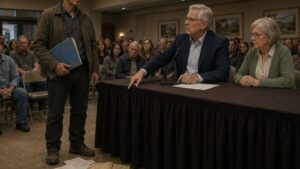
Richard walked into the HOA clubhouse and saw his torn-up side yard already glowing on the meeting screen.
The photo had been cropped tight. No hospital chair measurements. No side-entry plan. No view of the widened threshold that explained why the old step had to go. Just splintered wood, exposed brick, orange cones, and the excavator bucket in the background. From that angle, it did look like a careless project abandoned mid-destruction.
A few neighbors turned as he entered. Conversation dropped, then restarted in lower voices. Frank Roberts sat in the second row with his phone angled toward his lap, thumb moving. Richard saw the screen flash with the same image from outside his house, only now with comments stacked beneath it.
Cynthia Williams stood near the front table in the same pink blazer, though she had brushed the dust from it. She looked composed, not triumphant. That made him angrier.
“Mr. Hall,” she said. “You’re early.”
“Good,” Richard said. “Then we have time to correct the record.”
The board table held five chairs. Stephanie Rivera sat near the end, reading a packet with a pen held between her fingers. She looked up when Richard spoke, then down at the projected photograph. Something in her face tightened, but she said nothing.
Cynthia gestured toward the audience seating. “Homeowner comments will be taken in order.”
“My house is on the screen.”
“And your violation is on the agenda.”
Richard kept the folder under his arm rather than slapping it on the table. He had imagined doing that during the drive over, imagined the satisfying sound of paper against polished wood. Then he had heard Samantha’s voice in his head: Don’t make me into a project.
So he sat.
The meeting began with landscaping updates, pool access hours, and a reminder that garbage bins could not be visible from the street after pickup day. Richard heard every word too clearly. Each item received more orderly attention than the ramp that had been torn off his house that morning.
When Cynthia finally reached his agenda item, she clicked a remote. Another photo appeared. It showed the side of his home before the demolition, taken from the street through the gap between two shrubs. The ramp frame looked raw, angular, unfinished. The temporary rail clamps stood out like mistakes.
“Lot 42 has installed an exterior structure without approval,” Cynthia said. “The structure alters the side elevation, affects drainage near the shared easement, and creates potential liability exposure for the association.”
Richard felt the room absorb her words. Structure. Alters. Liability. Association.
Not Samantha.
He raised his hand.
Cynthia did not acknowledge it. “Emergency action was taken today after the owner failed to cease work.”
“That’s not accurate,” Richard said.
A few heads turned.
Cynthia looked at him over the top of her folder. “Mr. Hall, you will have time to respond.”
“You sent a crew before you served notice.”
“We posted notice this morning.”
“When the excavator was already running.”
Frank’s phone lifted slightly.
Cynthia noticed. Her mouth firmed. “The association is not here to litigate a social media version of events.”
“No,” Richard said. “You’re here to create one.”
The room shifted. Someone whispered his name. Stephanie’s pen stopped moving.
Cynthia set down the remote. “The homeowner filed an incomplete architectural request and began construction before approval. Those facts are not disputed.”
Richard stood. “What is disputed is why the request existed.”
“Mr. Hall—”
“My wife is being discharged from the hospital. The side entry is the only entrance that can be made accessible without rebuilding the front steps and porch. I submitted medical documentation.”
Cynthia’s expression changed just enough for Richard to see caution enter it.
A man at the board table leaned toward Stephanie and murmured something. Stephanie flipped through her packet.
Cynthia said, “No medical accommodation request is currently open.”
Richard opened his folder and removed the printed portal confirmation. “Because the portal gave me no accommodation category. I filed under the only available exterior option and wrote the medical necessity in the description. The doctor’s letter was attached.”
“According to our management record, the application was incomplete.”
“Then why did no one call me?”
“You proceeded without approval.”
“Because my wife’s discharge is today.”
“And you created an unsafe condition by doing so.”
Richard looked at the screen again. The cropped photo waited there, bright and damning. Public evidence used like a club. Frank’s video, the neighbor whispers, the comments already moving online—everything could be cut small enough to remove the part that mattered.
Stephanie lifted a page from her packet. “Cynthia, where is the medical letter?”
Cynthia turned. “The packet before the board contains the relevant architectural documents.”
“That isn’t what I asked.”
The room went quieter than before.
Cynthia’s hand rested flat on the table. “If Mr. Hall had a separate medical request, it should have been filed through management.”
Richard held up the portal confirmation. “It was uploaded with the request you’re showing.”
Stephanie looked at him. “May I see that?”
He walked it to her. Cynthia watched him cross the room as if every step were another violation.
Stephanie read the page once, then again. “This shows a physician letter uploaded at 11:42 p.m. three weeks ago.”
“File unavailable now,” Richard said. “But it was there.”
Cynthia’s voice sharpened. “A filename does not prove content.”
“No,” Richard said. “But it proves you had reason to pause before sending an excavator.”
That landed. Not with everyone, but with enough. The woman in the back row who had complained for years about mailbox colors looked away from the screen. Frank lowered his phone.
Cynthia clicked to the next slide. It was a notice of proposed fine.
“Given the ongoing refusal to comply, I recommend a daily fine beginning tomorrow and full removal of the remaining structure. Mr. Hall may avoid further enforcement by signing the compliance agreement tonight.”
She lifted a document from the table.
Richard did not move.
“Full removal?” Stephanie asked.
“The remaining frame and altered threshold must be restored.”
Richard felt the old badge wallet in his jacket pocket. His fingers moved toward it almost by instinct. He could open it again. He could let the room see that he knew what safe meant, what code meant, what liability meant when it was not being used to frighten people into obedience. He could make his voice hard enough to remind them he had stood in worse rooms with better facts.
But he stopped.
The badge had paused a machine. It had not explained Samantha. It had not fixed the file. It had not changed the fact that he had tried to handle this like an inspector instead of a husband.
He left it in his pocket.
“I’m not signing that,” he said.
Cynthia slid the agreement back into her folder. “Then the fines proceed.”
Stephanie was still looking at the upload confirmation. “Before we vote,” she said, “I want the complete file pulled from management.”
Cynthia turned to her. “This is not the time to reopen an incomplete submission.”
“It may not be incomplete.”
“It was categorized as architectural.”
“By whom?”
Cynthia’s face hardened. “By process.”
Richard almost missed the answer because it sounded like nothing. But Stephanie heard it too. Her pen moved once, a quick mark in the margin.
The meeting staggered forward after that, but the room had changed. Cynthia still controlled the agenda. The board still voted to continue enforcement pending review. The daily fine remained on the table. But when the meeting adjourned, Stephanie did not leave with the others.
Richard was gathering his papers when she approached him near the side exit.
“Mr. Hall,” she said quietly.
He looked past her toward Cynthia, who was speaking with two board members near the front.
Stephanie held the portal confirmation folded in half. “I checked the board packet twice.”
Richard waited.
“We never saw a medical letter.”
Chapter 4: The Missing Letter Was Not Missing
The county clerk found Richard’s emergency repair notice in less than four minutes, then frowned at the screen as if the second half of the record had gone somewhere it should not have gone.
“It’s here,” she said, tapping the monitor with the back of one fingernail. “Your notice to modify the side entry. Uploaded three weeks ago. Property address matches. Timestamp matches.”
Richard stood at the counter with his folder open, the badge wallet closed inside his jacket pocket. He had not taken it out. Not once. The county office did not need to see who he had been. They needed to show him what had happened.
“But?” he asked.
The clerk’s eyes moved left to right. “But your HOA portal category says architectural variance. Not reasonable accommodation.”
Richard felt the words settle into the same place Cynthia’s voice had left sore the night before.
“Can that category change after submission?”
The clerk looked at him over her glasses. She was careful now. People became careful when records stopped looking routine.
“Depends who has administrative access. I can’t speak for your association. I can only tell you what our copy received from the linked upload notice.” She turned the monitor slightly, just enough for him to see the line. “Emergency repair/accessibility note. That’s what came through to us.”
Richard leaned closer.
There it was. Not just a filename. Not just a memory. A county timestamp attached to the description he had written at nearly midnight, after Samantha had fallen asleep in the hospital and he had sat in the visitor chair with the laptop balanced on his knees.
Emergency medical access modification for resident returning from hospital.
His throat tightened, but he did not let himself feel relief too soon.
“Can I get a certified copy?”
The clerk nodded. “I can print the receipt and the metadata page. Not the medical letter itself unless you provided it directly to the county.”
“I uploaded it through the HOA portal.”
“Then the association has it, or had it.”
Had it.
Richard heard Cynthia at the clubhouse: By process.
The printer behind the clerk woke with a low hum. While it worked, Richard opened the HOA portal on his phone. The same entry remained.
Architectural Variance Request: Exterior Improvement.
Status: Incomplete.
He clicked the activity log.
Most of it was useless: submission received, file attached, review pending, notice generated. But one line sat between the submission and the incomplete status.
Administrative category adjustment.
No name. No explanation. Just date, time, and the cold neatness of a system designed not to blush.
The certified pages came out warm. Richard paid the fee, slid them into a plastic sleeve, and carried them outside to his truck as if paper could bruise.
He sat behind the wheel without starting the engine.
On his phone, Samantha had sent one message.
Do not go to war without me.
He read it twice.
Then he opened the photo from that morning: the excavator bucket holding the broken rail. The image Frank had posted looked dramatic from across the street, but Richard’s close-up showed what mattered. The anchor bolts were cleanly embedded. The bracket spacing was correct. The rail had not failed; it had been torn out.
His phone rang before he could call Samantha.
Unknown number.
“Richard Hall?”
“Yes.”
“This is Justin Lee. From yesterday.”
Richard sat up straighter. Through the windshield, county workers moved in and out of the building with paper cups and clipboards, ordinary people inside ordinary systems.
“What can I do for you?” Richard asked.
Justin breathed out through his nose. “I probably shouldn’t be calling you.”
“Then why are you?”
“Because I saw your wife’s name on the medical letter this morning.”
Richard went still.
“You saw the letter?”
“Only the first page. Cynthia had a copy in her folder. Not the whole packet, I don’t think. But enough.” Justin paused. “Enough for me to know I should’ve asked more questions before we started.”
Richard closed his eyes.
“Justin,” he said slowly, “when was your crew scheduled?”
Another pause. Longer.
“Two days before the notice date.”
Richard opened his eyes.
“You’re sure?”
“I have the work order on my phone. Removal of unapproved ramp structure, Lot 42. Start time seven-thirty yesterday morning. Cynthia told us notice had already been handled.”
“It hadn’t.”
“I figured that out when you asked her in front of everyone.” Justin’s voice lowered. “Look, I’m not trying to get in the middle of your HOA fight.”
“You were in the middle when your excavator touched my house.”
“I know.”
The answer was plain enough that Richard did not press.
“Will you send me the work order?”
“I can’t send company documents without authorization.”
“Then why call?”
“Because if this turns into somebody saying the ramp collapsed or was already unsafe before we touched it, that’s not what happened.” Justin hesitated. “We pulled the first post with the bucket. It didn’t come loose on its own.”
Richard looked at the certified copy on the passenger seat.
“Would you say that at a hearing?”
“Depends what they ask me.”
“Justin.”
“I’ve got four guys working under me. Contracts matter. Insurance matters. If Cynthia says we breached—”
“She ordered you onto private property with medical documentation in hand.”
“You started building before approval.”
The sentence hit because it was true.
Richard looked down at his hands. The knuckles were scraped from two nights of work, and there was still a thin line of stain under one thumbnail.
“Yes,” he said. “I did.”
“And that’s what they’re going to use.”
“I know.”
For the first time that morning, the anger in him shifted shape. It had been clean when he pointed it at Cynthia. Now it had weight. He had filed. He had documented. He had done more than most people would have done. And still, he had started before a written yes because he had needed the house ready and could not bear hearing Samantha ask what would happen if it wasn’t.
Need did not erase that.
But neither did it give Cynthia the right to tear out the ramp before the medical question was even seen.
“I’m not asking you to save me,” Richard said. “I’m asking you not to help bury what happened.”
Justin was quiet.
Then he said, “I can confirm the time we arrived if I’m asked directly.”
“That may be enough.”
After the call, Richard forwarded the county receipt to himself, then took screenshots of the HOA activity log before it could change. He saved them in three places. Old habits. Maybe good ones. Maybe the only ones he had trusted too much.
When he finally called Samantha, she answered on the second ring.
“I found the county notice,” he said.
“Good.”
“And the portal category was changed.”
“By Cynthia?”
“I don’t know yet.”
“You think you know.”
“That’s not proof.”
“Richard.”
He gripped the steering wheel. “I also know I started before written approval.”
“You already told me that.”
“I’m saying it because they’ll say it.”
“Then don’t pretend they won’t.”
He almost smiled. Not because anything was funny, but because her voice sounded more like herself when she was irritated with him.
“I don’t want you dragged into a room full of people arguing about your body like it’s a zoning issue,” he said.
“I am already in it. I just wasn’t invited.”
That was worse than anger.
He closed the folder and started the truck.
When he reached home, the side yard looked smaller than it had the day before. The remaining rail leaned inward. The exposed anchors stuck from the concrete like broken teeth. Someone had tied caution tape across the gap between two cones. Frank’s mailbox stood across the street, innocent and ordinary, as if it had not been the place where his humiliation became content.
Richard was halfway up the drive when his phone buzzed again.
An email from the HOA management office.
Emergency Safety Complaint Filed: Lot 42.
He opened it on the porch.
The complaint contained three photos of the damaged side entry. The same damage Cynthia’s crew had caused now appeared under the heading: Owner-created unsafe condition requiring immediate remediation.
At the bottom, in Cynthia’s name, was a request for authority to complete removal of remaining ramp components and restore the exterior opening.
Richard looked toward the doorway where Samantha was supposed to come home.
This time, the document did not merely threaten a fine.
It asked permission to use the damage as proof.
Chapter 5: The Second Crew Came For What Was Left
The second truck arrived while Samantha was sitting just inside the open side doorway, facing the gap where the ramp should have been.
Richard heard the brakes first. Not the heavy rumble of the excavator this time, but the flat metallic sigh of a work truck stopping at the curb. He looked through the side entry and saw two workers step down, then Justin Lee behind them, his orange vest folded over one arm instead of worn like armor.
Samantha’s chair was positioned a careful three feet from the threshold. Richard had measured it twice. Close enough for her to see the broken anchors. Far enough that one bad wheel movement would not take her over the edge.
She had insisted on sitting there.
“They’re back,” she said.
“I see them.”
“Don’t stand in front of me.”
Richard turned.
Samantha looked smaller in the chair than he wanted to admit, but not weak. Her hair was pulled back. A hospital bracelet still circled her wrist because neither of them had remembered to cut it off after the transport crew carried her through the garage the evening before. The move had taken two attendants, a portable ramp, and ten minutes of Richard pretending not to notice how tightly Samantha held the armrests.
Now she was home, and still unable to enter the house the way she was supposed to.
A white SUV pulled in behind the truck.
Cynthia Williams stepped out in a navy coat over the same bright blazer. She had changed the outer layer, not the message.
Richard moved toward the doorway.
Samantha said, “Richard.”
He stopped.
“Beside me,” she said. “Not in front.”
It was such a small correction that it went through him like a reprimand.
He stepped to the side of her chair.
Cynthia reached the caution tape and looked from Richard to Samantha. Her face did not show surprise exactly. More like the forced stillness of someone recalculating in public.
“Mrs. Hall,” she said. “I’m sorry to see you placed in an unsafe area.”
Samantha’s hand tightened on the chair arm. “I was placed in an unsafe area when you tore out the safe one.”
One of the workers looked away.
Justin stayed near the truck.
Cynthia held up a document. “An emergency safety complaint has been filed regarding the remaining unstable structure. We are here to secure the property.”
Richard kept his voice even. “By removing what your crew left standing.”
“By removing a hazard you created through unauthorized construction.”
Samantha gave a short laugh. It was not amused. “That sentence must sound better in a meeting.”
Cynthia’s jaw tightened. “Mrs. Hall, this is not personal.”
“It is the doorway to my home.”
“The association has no objection to accessibility modifications when properly submitted, reviewed, and safely constructed.”
Richard almost answered. Samantha lifted two fingers from the chair arm, barely a gesture, but he saw it and closed his mouth.
“Did you read the doctor’s letter?” Samantha asked.
Cynthia looked at Richard. “Your husband did not file the appropriate request.”
“I asked if you read it.”
A neighbor across the street stopped walking a dog. Frank Roberts came out onto his porch with his phone already in his hand. Richard saw him, saw the angle, and felt the old instinct to step between the camera and Samantha.
Samantha saw it too.
“Let him record,” she said.
Richard’s hand went still at his side.
Cynthia noticed the phone and adjusted her posture. “The issue before us is not whether you have a medical need. The issue is whether Mr. Hall built an exterior structure without approval and left an unsafe condition.”
“You made the unsafe condition,” Richard said.
“You began work without approval.”
“Yes,” he said.
Cynthia blinked. She had expected denial, not admission.
Richard continued before she could use the opening. “I filed an emergency access notice, uploaded the medical documents, and started temporary work because the discharge deadline changed. I should have pushed the accommodation issue harder before cutting into the threshold. That is on me. But it does not authorize you to send a crew before proper notice and then call your damage my hazard.”
Justin’s eyes flicked toward him.
Cynthia turned to Justin. “Please begin removing the remaining rail and temporary framing.”
Justin did not move.
“Mr. Lee,” she said.
He unfolded his vest, looked at it, then at Samantha seated inside the doorway.
“I need written clarification from management before I restart,” he said.
“You have it.”
“I have a complaint. I don’t have clarification on the medical accommodation.”
Cynthia stepped closer to him. “Your company accepted the contract.”
“And yesterday I found out there was a medical letter in the file.”
Cynthia’s expression hardened so sharply that even Frank lowered his phone a little.
Richard heard Samantha inhale.
Cynthia spoke quietly, but not quietly enough. “Be careful, Mr. Lee.”
Justin’s face reddened. “That’s what I’m trying to do.”
For a moment no one moved. The caution tape snapped lightly in the breeze. Behind Samantha, inside the kitchen, the pill organizer sat on the table exactly where Richard had left it. Morning. Noon. Evening. Bed. The ordinary future had come home and stopped at a broken doorway.
Cynthia turned back to Richard. “This matter will go to an emergency hearing tonight. Until then, the association’s position is that no further work may occur and the remaining structure must not be used.”
“It can’t be used,” Samantha said. “You made sure of that.”
“The hearing will determine responsibility.”
“No,” Samantha said. “The hearing will determine whether any of you can say the word responsibility without meaning blame.”
Richard looked down at her. He had seen Samantha afraid in the hospital, angry at the therapist, exhausted after standing for seven seconds longer than the day before. But this was different. She was not asking him to translate her need into measurements. She was giving it a voice.
Cynthia put the document back into her folder. “Mrs. Hall, I understand this is emotional.”
“Do you?”
Cynthia did not answer.
Samantha rolled her chair forward half an inch. Richard tensed but did not reach for it.
“My husband drives me crazy,” she said. “He thinks if he can measure a thing, label it, and put it in a folder, he can keep it from hurting me.”
Richard felt the sentence land in front of everyone.
“He should have told me more. He should have asked me before he made some of those choices. But you had a choice too. You could have knocked. You could have called. You could have said, ‘We need to understand what this is before we tear it down.’ Instead you sent a machine.”
Cynthia’s face did something complicated. For one second, Richard thought she might step back from the procedure she had built around herself. Then her eyes moved to Frank’s phone, to the workers, to the neighbors watching from driveways, and the opening closed.
“The board will hear all relevant statements tonight,” she said. “Seven o’clock.”
Justin gestured to his workers. “Load up. We’re not touching anything right now.”
Cynthia’s head snapped toward him. “This may affect future association contracts.”
Justin put on his vest slowly. “Then I guess it will.”
The workers returned to the truck. The second vehicle had arrived like a threat and now sat useless at the curb, its empty bed waiting for boards it would not carry away.
Richard should have felt victory. Instead he felt the terrible thinness of the pause. Nothing had been fixed. The ramp was still broken. Samantha was still at the edge of a doorway she could not cross. The hearing was no longer about whether there had been a mistake. It was about who would be allowed to define the mistake.
Cynthia walked back to her SUV. Before opening the door, she turned.
“Seven o’clock,” she repeated. “If you fail to appear, the board will proceed without you.”
Samantha rolled back from the threshold and turned her chair toward the kitchen.
Richard reached for the handle, then stopped until she looked at him.
“Can I?” he asked.
She studied him for a moment, then nodded.
He helped turn the chair fully, careful not to guide more than she allowed.
At the kitchen table, the hospital bracelet caught on the edge of the folder. Samantha pulled her wrist free and looked at the strip of plastic as if she had just noticed it.
“Cut this off,” she said.
Richard got scissors from the drawer. His hands were steady until he slid the blade beneath the bracelet.
Before he cut, she said, “I’m going tonight.”
“I know.”
“No. Listen to me.” She held his gaze. “I’m going through the front door if I have to. Or through the garage. Or through the gap they left. But I am not staying home while they talk about whether I belong here.”
The scissors closed. The bracelet fell onto the table between the badge wallet and the damaged ramp plan.
Chapter 6: The Hearing Turned The Rule Back On Them
Cynthia opened the emergency hearing by calling the broken ramp “a self-created hazard,” and Richard felt Samantha’s hand stop moving on the wheel of her chair.
They had placed her at the end of the front row because the clubhouse aisle was too narrow near the board table. Richard sat beside her with the folder on his knees and one broken ramp board propped against his chair. He had brought it because he wanted the room to see the fresh tear in the wood, the clean screw holes, the place where machinery had done what weather and weakness had not.
His badge wallet sat closed on top of the folder.
Cynthia saw it. So did he. He left it closed.
“The association is sympathetic to personal circumstances,” Cynthia said, standing at the front with her papers squared. “But sympathy cannot override safety procedures, architectural standards, or liability responsibilities. Mr. Hall began unauthorized construction, altered an exterior entry, and now seeks to shift responsibility for the unsafe condition that resulted.”
A few board members looked toward Richard. Others looked at Samantha and then away too quickly.
Stephanie Rivera sat with a laptop open and the portal activity log printed beside it. She had not greeted Cynthia when she came in. That small silence had told Richard more than a speech.
Cynthia continued. “The question tonight is narrow. Did the homeowner violate procedure and create a hazard requiring remediation?”
Richard stood.
Samantha’s hand moved once against her chair arm. Not stopping him. Reminding him.
He picked up the broken board.
“The question is not narrow,” he said. “That’s the problem.”
Cynthia folded her hands. “Mr. Hall, you may respond after the board reviews the complaint.”
“I’ll respond to the complaint now because it uses photographs of damage caused by the crew you authorized.”
Stephanie looked up. “Let him speak.”
Cynthia turned toward her. “We have an order.”
“We also have a resident in the room whose access was removed.”
The room went very still.
Richard placed the broken board across the front table. Not dramatically. Carefully, so the torn end faced the board.
“This was part of the side-entry ramp frame,” he said. “The anchors were set. The rail was braced. The landing was unfinished. That is true. It was temporary work pending final boards and inspection. It was also not failing before the excavator bucket pulled it out.”
Cynthia said, “You are not a neutral expert here.”
“No,” Richard said. “I’m the homeowner. I’m also the person who started the work before written approval.”
The admission moved through the room faster than denial would have. Frank, seated near the back, lowered his phone. Stephanie’s eyes stayed on Richard.
Samantha turned her head toward him. He had told her he would say it, but saying it in the room was different. He felt the old pride in him resist, then loosen.
“I did that because the hospital gave us a discharge timeline,” he said. “Because the front steps don’t meet her clearance needs, the garage entry has a lip she can’t cross safely, and the side door was the only practical path home. I filed through the portal. I uploaded the medical documents. I should have made sure the accommodation was recognized before I began. I didn’t. That mistake is mine.”
Cynthia reached for her folder. “Then the violation is established.”
Richard looked at her. “Not the one you charged.”
Stephanie slid a paper forward. “Cynthia, before we go further, I need an answer on the file category.”
Cynthia’s posture tightened. “The management system places requests according to submitted forms.”
Stephanie tapped the activity log. “This line says administrative category adjustment.”
“That can happen when a homeowner selects the wrong category.”
“Who made the adjustment?”
Cynthia glanced at the board members, then at the audience. “I don’t have that information in front of me.”
Stephanie turned her laptop around.
“You do now.”
The room leaned without moving.
On the screen was the portal record. Richard could see it from where he stood: his submission at 11:42 p.m., the attachments, the original description, then the category adjustment the next morning under Cynthia’s administrator login.
Cynthia’s mouth opened slightly, then closed.
Stephanie said, “The original description included the phrase emergency medical access modification.”
Cynthia’s voice became very controlled. “Because Mr. Hall submitted it under an architectural form. I moved it into the architectural review workflow.”
“You removed it from the reasonable accommodation review queue.”
“There was no formal queue because the request was not filed correctly.”
Richard saw the shape of it now. Not a vanished letter. Not a random clerical mistake. A procedural decision made small enough to defend.
Samantha spoke from the front row. “Did you read the letter?”
Cynthia did not look at her at first.
Samantha waited.
Finally Cynthia turned. “I saw that a medical document was attached.”
“That is not what I asked.”
Richard heard his own words from the driveway come back in Samantha’s voice.
Cynthia’s face colored. “I reviewed enough to know the homeowner was claiming medical necessity after beginning exterior work.”
“After?” Stephanie asked. “The upload was before construction photos were taken.”
“The work began before approval.”
Richard said, “Yes. And you scheduled removal before the final notice was delivered.”
Justin, seated near the wall in his work clothes, shifted but did not stand.
Stephanie looked toward him. “Mr. Lee, is that accurate?”
Justin rubbed his palms on his knees. “Our work order was sent two days before the notice posted at the property.”
Cynthia snapped, “The association had authority to act.”
Justin kept his eyes on Stephanie. “Maybe. I’m not a lawyer. But my operator pulled out the first post. It wasn’t lying loose when we arrived.”
The broken board on the table seemed to grow heavier.
Cynthia inhaled slowly. For the first time, Richard saw not just anger in her, but fear. Not fear of him. Fear of the room slipping beyond the process she could control.
“We have an insurance inspection next week,” she said. “The association has been warned about undocumented exterior modifications. Two years ago, an unapproved deck failed in this community and the board was accused of ignoring violations. I will not expose every homeowner here because one resident believes urgency exempts him from rules.”
There it was: her reason. Not enough. But real.
Richard looked at the board members and saw some of them react. They remembered the deck. He did too. A railing had given way during a graduation party. No one had died, but a teenager broke an arm, and for months every meeting had tasted like accusation.
Cynthia had inherited that fear and sharpened it into a weapon.
Richard put one hand on the broken board. “Rules matter. I know that. Bad construction hurts people. I spent years telling people things they didn’t want to hear because safe matters more than convenient. But a rule that can’t tell the difference between a party deck and a medical access ramp is not protecting anyone.”
Cynthia said, “You still bypassed approval.”
“I did not bypass the need for review. I bypassed waiting quietly while my wife was kept from her home.”
The room held the difference.
Then Samantha unlocked her wheels.
Richard turned instinctively, but she did not look at him. She pushed once, hard, moving her chair a few inches forward into the aisle.
“I need to say something,” she said.
Cynthia looked as if she might object. Stephanie said, “Please.”
Samantha’s voice was not loud. That made people listen harder.
“I have heard the word ramp tonight more than I have heard the word home,” she said. “I have heard structure, alteration, hazard, liability, variance. I understand those words. I know they matter. But that gap at my side door is not an architectural issue to me. It is whether I can come in without being carried. Whether I can leave without asking my husband to become equipment. Whether I can sit on my own porch when he is not home.”
Richard looked down.
She continued, “I am angry at the HOA. I am also angry at Richard.”
The room shifted.
Richard did not move.
“He tried to protect me by handling everything himself,” Samantha said. “He thought if he took enough measurements and printed enough papers, I would not have to feel how much my life changed. But keeping me out of the fight did not make me safe. It made me absent.”
Richard felt the words open something he had braced too long.
Samantha looked at Cynthia. “You did the same thing in a different way. You turned me into an attachment you did not read.”
No one spoke.
Stephanie closed her laptop halfway. “I want to make a motion.”
Cynthia turned sharply. “We are still in discussion.”
“We have discussed enough to know the current enforcement action was based on a misclassified request and incomplete review.” Stephanie’s voice shook once, then steadied. “I move that we withdraw the violation pending proper reasonable accommodation review, suspend all fines, prohibit further removal, and authorize temporary stabilization tonight.”
A board member near the center table said, “Can we vote on that without management counsel?”
Stephanie looked at the broken board, then at Samantha. “We voted to send machinery without counsel.”
That did what nothing else had done. It stripped the room of its comfortable delay.
Cynthia stood very still.
Richard’s hand rested near the badge wallet, but he did not touch it. He had wanted proof to end the fight. Instead, the truth had become messier and more human: his mistake, Cynthia’s fear, Samantha’s absence, the board’s trust, the crew’s hesitation, the ramp torn apart while every person involved claimed to be following a rule.
Stephanie lifted her hand.
“All in favor of immediate reco
Chapter 7: The First Board Back On The New Ramp
Richard watched the first new board settle over the old anchor marks, and for one sharp second he saw the excavator bucket again.
The worker lowered the board carefully, not with a machine this time but with both hands, checking the edge against the chalk line Richard had drawn and redrawn until Samantha told him he was wearing a trench in the plywood with his eyes. The board covered two of the scars left in the concrete. Not erased them. Covered them. There was a difference.
Justin Lee crouched near the landing frame with a level in one hand. He had come without the excavator, without the big truck, without the crew that had made the side yard look like a job site under siege. This time he brought two workers, a permit packet, and the kind of quiet that asked permission before making noise.
“Quarter inch high on the outside,” Justin said.
Richard started forward.
Samantha, seated beside the kitchen table with a mug in her lap, looked through the open side door and said, “Let him find it.”
Richard stopped with one foot on the threshold.
Justin glanced back, then adjusted the shim himself. “Got it.”
Two weeks had passed since the hearing, though Richard still counted time by the things that had arrived: the temporary stabilization order the next morning; the withdrawn fine notice three days later; the revised accommodation packet with a real header instead of architectural variance; the city inspector’s approval for the widened side-entry; the new lumber delivery; the formal letter from the HOA board announcing emergency accommodation procedures would be separated from exterior improvement review.
Each piece of paper had come clean and official. None of them had repaired the look on Samantha’s face the first time she sat at the gap.
That work was slower.
The side yard no longer looked like a spectacle. The neighbors had stopped standing at the curb. Frank Roberts had taken down the short video after giving Richard the original timestamped file, though Richard knew copies still moved somewhere online, stripped and captioned by people who did not know Samantha’s name. Frank had come over the day after the hearing with his phone in one hand and a paper bag of bakery rolls in the other, as if food could make the first part less awkward.
“I didn’t know what it was,” he had said.
Richard had almost answered too sharply. Samantha, from the kitchen, had called out, “Now you do.”
Frank had left the rolls.
Now his house across the street was quiet. No phone visible. No porch audience. Just the normal watchfulness of a neighborhood after it has learned that a thing it filmed was not entertainment.
Justin stood and wiped his hands on his work pants. “We’ll set the rail after lunch if the inspector signs off on the slope.”
“The inspector is due at eleven,” Richard said automatically.
Samantha made a sound behind him.
He turned. “What?”
“Nothing.”
“That was not nothing.”
“It was the sound of a man who has said ‘inspector’ fourteen times before breakfast.”
Justin looked down at the level to hide a smile.
Richard felt the old reflex to defend himself, to explain that inspections mattered, that the proper slope mattered, that safe was not a feeling. But Samantha already knew all of that. She had lived with him long enough to know the difference between care and control.
So he said, “Twelve times.”
“Fifteen now.”
The worker at the far end laughed once, quietly, and kept drilling.
At ten forty, a white SUV stopped at the curb.
Richard knew it before he looked. His shoulders changed first.
Cynthia Williams stepped out with a flat envelope in her hand. She wore a gray suit today, not the pink blazer. The difference was small and possibly meaningless, but Richard noticed it anyway. She paused at the edge of the driveway, not crossing onto the property until Richard came down the temporary plywood path.
Justin’s workers went still.
Cynthia saw that too. Her eyes moved to the new frame, to the covered anchor marks, to Samantha visible through the open doorway.
“I’m not here to stop work,” she said.
Richard waited.
Cynthia extended the envelope. “The board asked me to deliver the withdrawn violation notice and the accommodation approval in person.”
“The board asked you?”
Her face tightened. “Stephanie asked me.”
That sounded closer to the truth.
Richard took the envelope but did not open it immediately. “Is the file category corrected?”
“Yes.”
“And future medical accommodation requests?”
“Will be reviewed separately from architectural applications.” She looked toward the ramp. “With an emergency contact process.”
Justin shifted behind Richard. Cynthia noticed him, and a brief discomfort crossed her face.
“Mr. Lee,” she said. “Your company will be paid for the stabilization and rebuild work under the revised authorization.”
Justin nodded once. “Appreciate that.”
The words had no warmth, but they did not need any.
Cynthia turned back to Richard. “I also stepped back from administrator access to accommodation files.”
Richard had expected the notice. He had expected the approval. He had not expected that sentence.
“Was that required?”
Her eyes met his. “It was appropriate.”
For a moment, the morning held them in a narrow place where neither victory nor apology fit well. Richard could have said more. He could have asked whether appropriate had occurred to her before the excavator. He could have reminded her that Samantha had spent two extra nights under a discharge review because of a decision Cynthia called process. He could have opened the envelope and made her stand there while he checked every line.
Instead he looked back at the doorway.
Samantha was watching.
Not waiting for him to fight. Watching to see whether he knew when the fight had changed.
Richard opened the envelope, confirmed the two documents, and folded them back inside.
“Thank you for bringing it,” he said.
Cynthia’s mouth moved slightly, as if the sentence had landed somewhere she had not prepared. “Mrs. Hall,” she called toward the house, “I am sorry for the delay this caused.”
Samantha held her mug with both hands.
“The delay wasn’t the only thing,” she said.
Cynthia lowered her eyes. “No. It wasn’t.”
She did not make a speech. She did not ask to be forgiven. She turned, walked to her SUV, and left without looking toward the neighbors’ windows.
The inspector arrived eleven minutes later and checked the slope with less drama than Richard’s pulse thought necessary. Justin answered most of the questions. Richard answered two. Samantha answered one, when the inspector asked whether the landing position worked for her turning radius.
“I’ll tell you after I cross it,” she said.
By midafternoon, the rails were secure. The boards were fastened. The landing met the threshold with a small beveled plate Richard had run his hand over so many times that Samantha finally told him if he polished it any more she would be able to see her face in it.
Justin packed his tools slowly. “We can do the first test with me and Richard on either side.”
“No,” Samantha said.
Everyone turned.
She sat in her chair at the foot of the temporary mat inside the kitchen. The late light touched the new boards beyond the doorway. They were unstained, pale against the older siding, and the old anchor scars still showed at the concrete edge if someone knew where to look.
Richard stepped toward her. “Sam—”
“No.”
He stopped.
Her voice softened, but did not bend. “You can walk beside me. Not hold. Not pull. Not hover like I’m a ladder you forgot to brace.”
Justin suddenly found something important to do near the truck.
Richard moved to the side of the ramp, one hand open but down.
Samantha rolled forward.
The front wheels touched the beveled plate. For a second, they caught. Richard’s whole body leaned toward her before he stopped himself. Samantha rocked once, adjusted the angle, and pushed again. The wheels crossed.
The sound was small: rubber over metal, then wood.
Richard heard it as clearly as he had heard the first board break.
Samantha moved onto the landing, paused, then continued down the ramp. She kept her eyes forward. Not on him. Not on Cynthia’s absent SUV. Not on the neighbors’ houses. At the bottom, she turned carefully in the wider space Justin had built and looked back at the door.
“Well,” she said, a little breathless, “that’s better than being carried.”
Richard laughed once, but it came out rough.
Samantha looked at him then. “Now you may walk next to me back up.”
He did.
At the top, she reached for his hand, not because she needed balance, but because she wanted it. He took it without tightening his grip.
Later, after Justin’s truck was gone and the side yard had settled into evening quiet, Richard placed the approved ramp plan on the kitchen table. The withdrawn violation notice went beside it. The hospital bracelet, cut and curled, still lay near the pencil cup. Samantha had not thrown it away yet. Maybe she would. Maybe she would not.
Richard took the badge wallet from his jacket.
For years, he had kept it close out of habit, then pride, then something that looked too much like proof. He opened it once. The gold shield caught the kitchen light.
Samantha wheeled beside him. “You don’t have to get rid of it.”
“I know.”
He closed the wallet and set it in the drawer beneath the ramp plan instead of putting it back in his pocket.
Outside, the new boards waited under the side light, covering the place where the machine had torn into their home. Not hiding it. Holding above it.
Richard shut the drawer.
The story has ended.