The HOA Sent A Crew To Tear Out The Ramp Beside His Waterfall Gate
Chapter 1: The Crew Was Already Pulling Out The Ramp
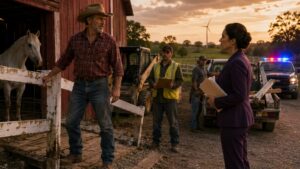
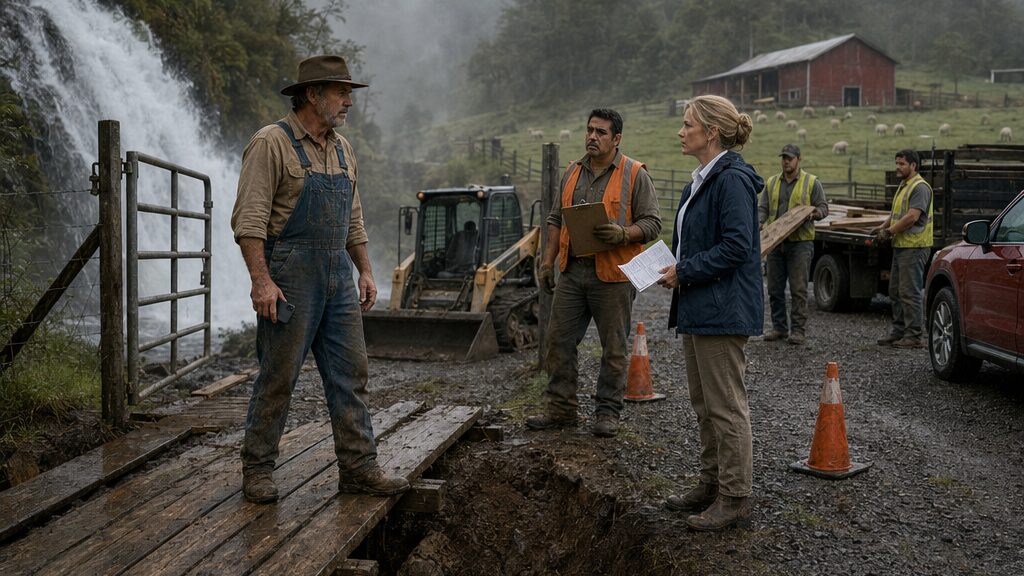
The machine was already running when Patrick Miller reached the gate.
Its engine coughed and growled above the sound of the waterfall, the bucket arm lifted over the gravel approach like a steel elbow, and one of the workers had a pry bar wedged under the first plank of the ramp Patrick had built three weeks earlier. The board came loose with a wet crack. Mud sucked at the post beneath it. A second worker carried the plank toward a flatbed truck as if it were scrap.
Patrick stopped with one hand on the metal gate.
For a moment he did not move. The sheep in the lower pasture had bunched near the fence, watching the strangers with their dull, nervous eyes. Beyond them, the red barn sat in the morning light, its roof still dark from the storm. Beside the gate, the waterfall dropped white and hard over the rock shelf, throwing mist across the road where Patrick had packed crushed gravel into the washed-out culvert.
A red SUV idled on the outside shoulder.
The letters on the door read HOA COMPLIANCE.
Patrick unlatched the gate and stepped through.
“Shut that machine down,” he said.
The worker at the ramp looked toward the man by the truck. That man wore a faded work vest, gloves, and the tired expression of somebody who had already been told this job would be unpleasant. Patrick recognized him from county road jobs two summers ago, though he could not remember his name until he saw it stitched on the vest.
Daniel Perez.
Daniel raised one hand to the operator. The bucket arm stopped moving, but the engine kept chugging.
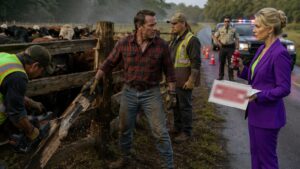
A woman in a navy rain jacket came around the front of the SUV with a clipboard hugged to her ribs. Her boots were too clean for the road. Her hair had been pinned tight, though the mist from the falls was already fraying it at the edges.
“Mr. Miller,” she said, as if she had been waiting for him to appear at the proper time.
Patrick looked at the plank in the worker’s hands. “Put that back.”
The worker hesitated.
Laura Thompson did not look at the plank. She looked at Patrick. “This structure has been deemed non-compliant by the Cedar Ridge Homeowners Association. You received notice.”
“No, ma’am.” Patrick kept his voice low. “I received a crew.”
She extended a folded paper across the open gate. “Notice of violation and enforcement action. Unauthorized exterior modification. Interference with scenic easement. Failure to obtain board approval.”
Patrick did not take it yet. He looked past her at the red SUV, then at Daniel, then at the two orange cones set on his side of the gate. Whoever placed them had crossed onto his property before he came down from the house.
“When was that notice delivered?” he asked.
Laura’s mouth tightened. “This morning.”
“This morning when?”
“It was posted at the gate.”
Patrick pointed to the torn plank. “Before or after he started pulling boards?”
Daniel looked down.
Laura held the notice a little higher. “The association is authorized to correct ongoing violations when an owner refuses to comply.”
“I didn’t refuse anything.” Patrick reached into the breast pocket of his work shirt and pulled out a clear plastic sleeve, folded twice. He opened it carefully, because his fingers were still stiff from replacing a lambing pen latch before sunrise. “Emergency repair notification. Sent by certified mail. Three weeks ago. Same day the culvert washed out.”
Laura glanced at the paper, then at him. “That was not an approval.”
“It was notice. Your rules say emergency repairs can proceed when access is unsafe.”
“Temporary stabilization,” she said. “Not new construction.”
Patrick turned, looking at the ramp as though seeing it through her eyes might help him understand the shape of the accusation. It was not pretty. He had never claimed it was. Rough timber rails, crushed gravel, pressure-treated boards, steel anchors sunk into the old concrete lip. It bridged the worst of the washout where rainwater from the upper pasture had torn a rut beside the culvert and left the gate approach sloping toward the drop.
But it held.
It had held the feed truck. It had held the medical van. It had held Linda’s chair when Patrick guided her down to watch the sheep after four days indoors.
Laura said, “The board received complaints that you blocked the waterfall approach.”
Patrick’s eyes came back to her.
“The what?”
“The scenic approach,” she said. “The recorded easement along the association road.”
“This is my gate.”
“The road is association-maintained.”
“The road ends at my gate.”
“And the view corridor runs adjacent to it.” She tapped the clipboard. “You installed a raised structure, visible railings, and gate-post extensions without approval. It changes the exterior appearance of the community entrance.”
Patrick almost laughed then. Not because it was funny, but because the waterfall was roaring beside them, the pasture was chewed up from floodwater, and this woman had driven through mud to tell him the problem was appearance.
Daniel stepped closer, voice quieter. “Mr. Miller, I was told to remove only the boards and loose rail. I don’t want trouble.”
“Then don’t take my property.”
Laura cut in. “The materials will be held pending compliance.”
Patrick looked at the flatbed. Two planks were already stacked there. One still had his pencil mark across the end, where he had measured twice because his hand had shaken that day from lack of sleep.
He took out his phone and opened the camera.
Laura’s chin lifted. “Recording is unnecessary.”
“It’s necessary to me.”
“Mr. Miller—”
“Daniel,” Patrick said, without looking away from Laura, “do you have a court order?”
Daniel’s jaw worked once. “I have a work order.”
“From who?”
“The association.”
Patrick nodded. “That’s not a court.”
Laura stepped closer to the gate. “This is not a seizure. It is correction of a violation under the covenants you agreed to when you bought this parcel.”
“My deed predates your association by eleven years.”
“And you joined the road maintenance agreement when Cedar Ridge expanded.”
Patrick held up the plastic sleeve. “Which is why I notified you before I fixed the washout.”
“You did not receive approval.”
“No one answered.”
“Silence is not approval.”
“Neither is silence permission to come onto my land and tear out access.”
The operator shut off the machine at last. The sudden quiet made the waterfall sound larger. Somewhere behind Patrick, a ewe bleated from the lower fence.
Laura looked irritated by the quiet, as if the machine had been helping her argument.
Patrick took the notice from her. He unfolded it and read just enough to see the words immediate removal authorized. His thumb paused over the date. Today’s date. Printed, signed, delivered, enforced, all in the same morning.
“You wrote this after you sent them,” he said.
Laura’s eyes flicked, only once, toward Daniel. “The board authorized action last night.”
“Then show me last night’s authorization.”
“It will be provided at the hearing.”
“What hearing?”
“You may appeal within ten business days.”
Patrick looked at the missing boards. “You’re tearing it out before I appeal.”
“The structure presents liability.”
“The washout presents liability.”
“The unauthorized repair presents liability.”
Patrick folded the notice along its original crease and put it in his shirt pocket beside the certified-mail receipt. His pulse had started to thud in his neck, but he kept his hands loose. He had learned over the years that anger made people listen less, not more. He had also learned that a quiet man could be mistaken for a man who would move.
He stepped onto the remaining ramp and stood between Daniel’s crew and the next rail.
Laura stared at him. “You need to step aside.”
“No.”
Daniel rubbed the back of his neck. “Mr. Miller, I can’t have you standing in the work area.”
“Then you can’t work.”
Laura’s voice sharpened. “You are obstructing authorized enforcement.”
Patrick looked at her across the gate, the waterfall mist silvering the shoulders of her jacket. “Oh please,” he said. “Take it if you can without a court order.”
For the first time, Laura did not answer immediately.
The younger worker shifted the plank in his arms. Daniel looked from Patrick to the exposed anchors and back to Laura, waiting for someone else to become responsible.
Laura closed her clipboard with a flat snap. “Fine. Suspend removal of the ramp surface until the board reviews obstruction conduct.”
Patrick did not move.
She turned to Daniel. “Mark the gate posts, both rails, and the entire approach. If he wants to make this difficult, we’ll include the full structure in the violation.”
Daniel’s face changed. Not much. Just enough.
Patrick looked past him to the metal gate he had welded with his father thirty years ago, the same gate Linda could see from the kitchen window when the cottonwoods were bare.
Laura pointed to it with her pen.
“That comes next,” she said.
Chapter 2: The Road Was Never Just A Road
Linda heard the machine stop before Patrick reached the porch.
She was sitting near the kitchen window with a blanket over her knees, angled so she could see the pasture road between the cottonwoods. Her wheelchair tires were still marked with pale mud from two days before, when Patrick had taken her down to the barn after the rain eased. A dark crescent of it had dried along the rim, and Patrick noticed it before he noticed the tightness in her hand around her coffee mug.
“How much is gone?” she asked.
Patrick hung his hat on the chair back instead of answering right away.
Linda’s eyes moved from his face to the folded paper in his shirt pocket. She set the mug down. It clicked too hard against the saucer.
“Patrick.”
“Two planks before I got there,” he said. “One rail loosened. They stopped for now.”
“For now?”
“They marked the gate.”
She closed her eyes.
The house was quiet except for the refrigerator hum and the far-off rush of the waterfall. That sound had always been part of the place. In summer, when the windows were open, it filled the rooms like breath. Lately, Patrick had begun to hear it differently. Not peaceful. Not scenic. Just water moving downhill with no care for what it took with it.
He put Laura’s notice on the table.
Linda did not touch it. “They can’t take the gate.”
“They think they can make us remove anything tied to the repair.”
“That gate was here before half those people built their decks.”
“I told her that.”
“And?”
Patrick leaned against the counter, arms crossed. “She had a clipboard.”
Linda almost smiled. It passed quickly.
He opened the plastic sleeve and laid out the certified-mail receipt, the emergency repair notification, the photos he had printed of the washed-out culvert, and the sketch he had drawn at the feed store counter because their printer had run out of ink. He arranged them as if order could make them heavier.
“I showed her this,” he said. “She said notice isn’t approval.”
“Is she right?”
He hated that she asked it softly.
“Maybe on paper.”
Linda turned toward the window. From where she sat, she could not see the gate itself, only the bend in the road and the upper edge of the red barn. When they were younger, she used to walk that road with a bucket in each hand, scolding sheep as if they were children. After the stroke, she had fought for every inch of movement back. Pride had done as much for her as therapy.
The first time the medical transport van crossed the new ramp, she had gripped the armrest and said nothing until they were inside the gate. Then she had whispered, “That didn’t feel like being carried.”
Patrick had pretended not to hear because she had needed him to.
The phone rang on the kitchen wall. Patrick took one step toward it, then stopped when Linda reached first. She pressed the speaker button.
“This is the Miller place,” she said.
A man’s voice crackled through. “Mrs. Miller? This is the transport office confirming for Thursday. Driver notes say the ranch approach may be under repair. Is the road passable for van lift clearance?”
Patrick looked at the table.
Linda’s hand tightened on the wheel rim. “It was passable.”
“Is it currently passable?”
Neither of them answered fast enough.
The dispatcher’s tone changed into practiced caution. “If the grade is unstable or the lift can’t deploy level, the driver may have to refuse pickup. We can reschedule once access is safe.”
“My appointment is Thursday,” Linda said.
“I understand, ma’am. We just need safe clearance.”
Patrick stepped closer. “I’ll make it safe.”
The line stayed quiet a moment. “Sir, the driver can assess on arrival, but if the access is compromised, we can’t risk loading.”
After the call ended, Linda kept her hand on the phone as if she could hold the appointment in place by touching the plastic.
Patrick said, “I’ll put the boards back tonight.”
“And when they come with more men?”
“They won’t touch it.”
“Patrick.”
He heard the warning in her voice and looked away.
She rolled back from the table, then stopped because the kitchen rug bunched under one front wheel. He moved automatically to fix it, but she lifted one finger. He stopped. She leaned forward, adjusted the rug herself, and only then looked up at him.
“Don’t make me the thing you use to win,” she said.
“That is not what I’m doing.”
“That is exactly what you want to do. You want to march in there with my medical letter and make every person on that board picture me stuck at the gate.”
Patrick’s jaw tightened. “If that’s what it takes.”
“It isn’t yours to spend.”
He stared at the notice, at the words exterior modification and scenic obstruction. “They’re already spending it. They just don’t know your name.”
Linda’s face changed, hurt moving through it before she could hide it. “You promised me.”
“I promised not to parade you in front of neighbors.”
“You promised not to turn my body into evidence.”
The words landed harder than anger would have.
Patrick pulled out a chair and sat, slowly. His knees ached from the morning mud. His hands looked older on the table than he expected, the knuckles scraped from lifting the ramp boards into place after midnight three weeks ago, when the rain had finally stopped and the culvert trench still smelled of torn roots.
“I thought the road would speak for itself,” he said.
Linda’s expression softened, but not enough to let him off. “Roads don’t speak. People with clipboards do.”
“I sent pictures.”
“You didn’t send the letter.”
“You asked me not to.”
“I asked you not to make me a story.”
The waterfall sounded through the window. Patrick had the sudden memory of Linda standing on the old gate rail years ago, one boot hooked through the bars, pointing at a lamb caught in brush below the slope. She had climbed down before he could stop her and come back scratched, furious, triumphant. No one would have believed then that there would come a day when a strip of boards and gravel would decide whether she could leave her own house.
His phone buzzed.
The email subject line showed before he opened it.
FINAL NOTICE OF NON-COMPLIANT EMERGENCY WORK.
He read it once. Then again.
Linda watched his face. “What does it say?”
Patrick set the phone on the table and turned it toward her.
The message was short, official, and colder than the paper Laura had handed him. The association acknowledged his “claimed emergency repair,” rejected it as exceeding temporary stabilization, and ordered all work removed by sunset. Daily fines would begin at 6:00 p.m. Failure to comply could result in further enforcement, including removal of related structures.
Linda looked from the phone to the window, toward the road she could no longer see.
Patrick reached for the medical letter on the sideboard, where it sat inside a folder under seed invoices and a grocery list. He did not open it. He only laid his hand on top.
Linda saw.
“Not yet,” she said.
The sun had not reached noon, and already the day had begun counting down.
Chapter 3: The Board Called It A Scenic Obstruction
Patrick walked into the community office and saw his gate frozen on the wall like a crime scene.
The projector image was crooked, but the yellow label across it was clear: UNAUTHORIZED OBSTRUCTION AT WATERFALL APPROACH. Someone had circled the ramp rail in red. Someone had drawn an arrow toward the metal gate. In the background, blurred by distance, one of Patrick’s sheep stood with its head down in the grass, innocent and ridiculous beneath the accusation.
Six board members sat behind folding tables. A few neighbors had taken chairs along the side wall. Laura Thompson stood near the projector screen with a remote in one hand and the same navy jacket folded over the chair behind her. The red SUV was visible through the blinds outside.
Patrick stopped just inside the door.
A man in the front row turned to look at him, then whispered to the neighbor beside him. The whisper traveled no farther than a breath, but Patrick felt it anyway. He had spent most of his life being known by people who waved from trucks, borrowed post-hole diggers, or asked about lamb prices. Being looked at like a problem was new enough to be useful. It told him what Laura had been saying.
Laura did not wait for him to sit.
“Mr. Miller,” she said. “This appeal meeting concerns your unauthorized construction at the Cedar Ridge waterfall approach, your refusal to allow corrective action, and your obstruction of an association contractor.”
Patrick walked to the empty chair facing the tables. He placed his folder on his lap, not on the table. “I’m here about the emergency repair you ignored.”
A low murmur moved along the side wall.
Laura clicked the remote. A second photo appeared. It showed the ramp from a lower angle, making the rail look taller than it was and hiding the washed-out culvert behind it.
“This structure was installed without architectural approval,” Laura said. “It alters the visual character of one of the association’s most significant shared corridors.”
Patrick looked at the photo. “That corridor is my driveway.”
“The road is maintained by the association.”
“To my gate.”
“And the waterfall view is subject to the scenic easement recorded in the community documents.” Laura lifted a packet. “Every owner agreed to protect that view and maintain exterior consistency.”
Patrick opened his folder and removed the certified-mail receipt. “I notified the board after the storm. The culvert edge washed out. The grade wasn’t safe.”
“We have your notice,” Laura said.
That made him look up.
She continued too quickly. “Your notice did not include sufficient specifications, contractor license information, drainage review, material compliance, or board approval. It was not an application.”
“It said emergency repair.”
“It said you intended to stabilize the access. Instead, you built railings.”
“Because the edge drops toward the creek.”
“Temporary caution tape would have been appropriate.”
A board member shifted in his chair.
Patrick imagined caution tape stretched across the approach while the medical van sat outside the gate. He imagined Linda waiting at the kitchen window, coat folded over her lap, pretending she did not mind.
He kept that image off his face.
Laura clicked again. The screen showed a cropped view of the gate posts.
“The board also notes that the gate structure itself may have been modified to support the unauthorized ramp.”
Patrick said, “That gate was welded before Cedar Ridge had a sign.”
“Then you should have no objection to review.”
“I object to removal.”
“Removal is required because you refused voluntary correction.”
“I refused to let your crew tear out my access before an appeal.”
Laura looked at the board. “You can hear the pattern. Mr. Miller continues to use personal ownership language for a shared compliance matter.”
Patrick leaned forward. “And you keep using shared compliance language for my home.”
The room went still for half a second.
At the end of the table, Patricia Robinson lowered her eyes to the documents in front of her. She had been writing minutes since the meeting began, neat lines in blue ink. Now she turned back two pages, then forward again. Her brow creased.
Laura began reading from the covenants: exterior alteration, view corridor, emergency exception, board discretion. Her voice was controlled, but Patrick could hear strain beneath it. She believed what she was saying, or needed to. That was worse than if she had simply wanted to win.
Patrick waited until she finished.
“I sent this three weeks ago,” he said, holding up the receipt. “Nobody answered.”
Patricia looked up. “May I see that?”
Laura turned toward her. “It’s in the packet.”
“The original receipt,” Patricia said.
Patrick stood and handed it to the end of the table. Patricia compared it with the top sheet in her binder. Her pen stopped moving.
Laura watched her. “The association receives many notices.”
Patricia said nothing, but she did not return the receipt right away.
A neighbor near the wall spoke up. “Is he blocking the falls or not?”
Patrick turned. “No.”
Laura answered at the same time. “The structure interferes with the approach.”
The neighbor looked between them, satisfied by neither answer.
That was when Patrick understood the trap. To Laura, the ramp was ugly. To the board, it was unauthorized. To the neighbors, it was about the waterfall. None of them were seeing the washed-out grade, the van clearance, the way Linda’s chair tilted if the front wheels hit loose gravel wrong. Because he had not shown them. Because he had thought they had no right to know.
Laura took back control with a vote.
“Pending full architectural review, I move that enforcement continue, daily fines apply, and all related structures remain subject to removal.”
Patricia’s head came up. “I’m not comfortable with removal before we clarify the emergency notice timeline.”
Laura smiled without warmth. “Your concern is noted.”
The motion passed anyway.
Not unanimously. Patrick saw Patricia’s hand stay down. One other board member hesitated, then raised his.
Laura closed the folder. “You may submit additional documentation within forty-eight hours. Until then, the violation stands.”
Patrick put his papers away. His face felt hot, though his voice did not change. “And the ramp?”
“Must remain removed.”
“It isn’t removed.”
Laura looked at him across the room. “Then I suggest you do not interfere when the contractor returns.”
Outside, the afternoon sun hit the red SUV hard enough to make Patrick squint as he stepped from the office. He had almost reached his truck when he heard the door behind him open.
Patricia Robinson came down the steps with his certified-mail receipt in her hand.
“Mr. Miller,” she said quietly.
Patrick turned.
She glanced back at the office windows before speaking. “Your notice was dated three weeks ago.”
“I know when I sent it.”
“No,” she said. “I mean the copy in our packet was logged two days ago.”
Patrick looked at the paper in her hand.
Patricia’s voice dropped even lower. “That timeline doesn’t look right.”
Chapter 4: The Notice That Arrived Too Late
“This proves you notified them,” the county clerk said, sliding Patrick’s papers back beneath the glass. “It does not prove they had to approve it.”
Patrick stood with both hands flat on the counter, looking through the smeared partition at the woman’s careful face. Behind her, file cabinets lined the wall in beige rows, each drawer labeled with road permits, drainage complaints, and easement maps. He had driven forty minutes from the ranch with Patricia’s warning still in his ears, expecting the county stamp to weigh more than Laura’s clipboard.
Instead, the clerk had made two piles.
One pile was his.
One pile was everything missing.
“The rule says emergency access repairs can proceed,” Patrick said.
“It says temporary repairs may proceed to prevent immediate danger,” she answered. Not unkindly. Not helpfully enough. “But for association-maintained roads or shared easement areas, you still have to document the hazard, the scope, and the necessity.”
“I sent photos.”
“You sent photos of storm damage. You did not include measurements, medical access requirements, contractor information, or a site-risk statement.”
“I built it myself.”
“That may be part of the problem.”
Patrick pushed his tongue against the back of his teeth and looked down at the counter. A strip of masking tape marked where visitors were supposed to stand. His boots were just over the line.
The clerk noticed. She did not mention it.
“I’m not saying the association is right,” she said. “I’m saying this packet doesn’t force them to stop.”
Patrick looked toward the window. Outside, trucks moved along the courthouse square, ordinary people going places on roads nobody had to justify. “They already tore part of it out.”
The clerk’s expression changed a little. “They removed materials before appeal?”
“They started before they handed me the notice.”
She took the packet back and read the top page again. “Who authorized that?”
“HOA president.”
“That is not a county order.”
“I know that.”
“Do they?”
Patrick almost smiled. “They know what they want to know.”
The clerk hesitated, then pulled a different form from a tray under the counter. “You can request a site review. Access and drainage. If the county finds the removal created a hazard or that the repair falls under emergency access stabilization, that gives you something stronger.”
“How long?”
“Normally? Two to three weeks.”
Patrick stared at her.
She looked past him at the empty waiting room, then lowered her voice. “If you state active medical transport access and ongoing removal, I can mark it urgent. But you have to state it.”
The words sat between them.
Patrick saw Linda’s hand on the medical letter. Not yet. He saw her face when she said, Don’t turn me into your argument.
“What if I say household access?” he asked.
The clerk’s eyes softened, but she did not bend. “Household access is broad. Medical transport is specific.”
Patrick folded the edge of his receipt with his thumb. “Can I request the review without that?”
“Yes. But the inspector may treat it as a private easement dispute.”
“Who’s the inspector?”
The clerk checked a calendar. “Michael Clark is on rural drainage this week.”
“Can I speak with him?”
She glanced toward the hallway. “He’s between calls.”
A few minutes later, a man in a county vest came out holding a paper cup of coffee and a phone tucked under his arm. Michael Clark had the look of someone who preferred culverts to meetings. He read Patrick’s packet while standing at the counter, his brow lowering at the photos of the washed-out grade.
“You put the boards over this edge?” Michael asked.
“Boards, gravel, side rail, steel anchors.”
“After the storm?”
“That night.”
“Water still cutting under it?”
“Not since I packed the gravel and opened the drain trench.”
Michael looked up. “HOA maintains the road?”
“To my gate.”
“And they removed part of your repair?”
“Started to.”
Michael turned a photo sideways. “Did you request architectural approval or emergency acknowledgment?”
“Emergency notice.”
“That’s not nothing,” Michael said.
The clerk gave him a look that seemed to remind him not to say too much.
Michael set the photo down. “I can inspect. But I need a formal request, and you need to understand something. If I come out there and your repair makes drainage worse, I’ll write that. If it’s unsafe, I’ll write that too.”
“Write what you see,” Patrick said.
Michael studied him. “And if there’s a medical transport issue, include it.”
Patrick looked at the form in the clerk’s hand.
For a long second, the courthouse seemed too quiet. No waterfall, no sheep, no engine, just paper sliding over paper.
“I’ll file the access and drainage request,” Patrick said.
The clerk held the pen out.
He filled what he could. Property address. Parcel number. Storm date. Description of removal. Active hazard. He stopped at the box marked medical or disability-related access concern.
The pen hovered.
He left the box blank.
Michael saw it. So did the clerk. Neither said anything.
By the time Patrick drove back, the afternoon had gone hard and bright. He reached the ranch road faster than he meant to, gravel snapping under the tires. The red SUV was gone. For one hopeful second, he thought the gate would look the same as he had left it.
Then he saw the rail.
The remaining side rail lay across the grass in two pieces, cut clean near the post. One orange cone had tipped into the rut. The ramp was still there, but the edge stood naked above the slope, its anchors exposed like broken teeth. Fresh boot prints crossed the mud on his side of the gate.
Patrick stopped the truck in the middle of the road and got out without shutting the door.
Daniel’s flatbed was pulling away downhill.
“Daniel!” Patrick shouted.
The brake lights flashed. The truck slowed, but did not stop. The driver’s arm lifted once through the window, not quite apology, not quite refusal, and then the truck rolled beyond the trees.
Patrick walked to the ramp.
The cut rail had been one of the boards he sanded smooth because Linda’s hand sometimes brushed it when he guided her chair down the incline. He crouched and touched the saw mark. Still fresh. Still pale.
His phone buzzed with an email from the county confirming receipt of the urgent site review request. Another email came in seconds later from the HOA.
Additional non-compliant rail and gate support removed as corrective safety measure. Owner advised not to reinstall.
Patrick stood slowly.
From the farmhouse porch, Linda called his name.
He turned. She had come outside in her chair, the blanket over her lap tucked hard beneath one hand. She had stopped at the top of the porch ramp, where she could see the gate approach clearly through the gap in the cottonwoods. Her face did not ask whether it was bad. It told him she already knew.
Patrick walked back toward her, the county form folded in his pocket like something too light to matter.
Linda’s eyes stayed on the exposed drop beside the ramp.
“You went to the county,” she said.
“I did.”
“And?”
“They’ll inspect if I request it.”
“You requested it?”
“Yes.”
She looked at him then. “Did you tell them?”
He did not answer fast enough.
Linda’s mouth tightened, not in anger first, but in recognition. “Patrick.”
“I told them access and drainage.”
“Not medical.”
His silence was the answer.
The waterfall sounded louder from the porch than it should have. Linda rolled forward an inch, then stopped when the small front wheels met the worn seam in the boards. She looked past him at the missing rail, the exposed anchors, the gap where a safe edge had been that morning.
When she spoke, her voice was quiet enough that he had to step closer.
“Then tell them why it’s there.”
Chapter 5: Linda Refused To Be The Excuse
Linda placed the medical letter on the kitchen table and kept two fingers pressed on top of it.
“Don’t turn me into your argument,” she said.
Patrick stood across from her with his cap in his hands. Mud had dried along his cuffs. He had not changed since finding the rail cut at the gate. The county request form lay beside the violation notice, the two papers nearly touching, as if one official tone could cancel another.
“I’m not trying to win with you,” he said.
“You are if I become the reason they’re wrong.”
“You are the reason they’re wrong.”
Linda looked at him, and the hurt in her face made him wish he had chosen different words even before she answered.
“No,” she said. “The reason they’re wrong is that they came onto our land and tore out something they didn’t understand.”
“They won’t understand unless I show them.”
“I know.”
The admission hung there, thin and terrible.
She released the letter and rolled back from the table. The chair wheels made a small gritty sound; mud from the gate road had dried in the treads and left faint marks on the kitchen floor. Patrick saw them and remembered pushing her down the repaired approach the first time after the storm. She had refused his help once they reached level gravel, insisting on rolling herself the last twenty feet to the barn.
“Let me do this carefully,” he said.
Linda laughed once, not because anything was funny. “Carefully is how we got here.”
He did not answer.
Her eyes went to the sideboard, where a framed photo leaned against a jar of fence staples. In it, Linda stood beside the old gate in work gloves, younger and sunburned, one boot on the bottom rail, laughing at something outside the frame. Patrick had nearly put that photo away after the stroke. Linda had stopped him.
“If you hide that woman,” she had said then, “you hide me twice.”
But the neighbors had done their part. Not cruelly at first. Casseroles. Slow voices. Doors held too wide. One woman at a board picnic had touched Linda’s shoulder and said she was “such an inspiration” for coming outside. Linda had smiled until they got home. Then she had sat in the kitchen and cried without making a sound.
Patrick had promised after that. No public explanations unless she chose them. No turning her recovery into community material. No letting people discuss what she could or could not do while she sat in the room.
“I promised you,” he said.
“You did.” Linda looked at the letter. “And I held you to it too hard.”
A truck horn sounded from the road.
Patrick turned toward the window.
The feed delivery truck had stopped outside the gate. Not at the barn. Not at the shed. Outside. The driver stood by the cab, looking toward the exposed ramp and the missing rail. Patrick was out the door before the second horn.
By the time he reached the gate, the driver had already lowered the first pallet of feed beside the road shoulder.
“Can’t cross that,” the driver said, nodding toward the ramp. “Not with the rail gone and that edge chewed out.”
“It’ll hold.”
“For your pickup, maybe. Not loaded.”
Patrick looked at the pallet sitting outside his gate, wrapped in plastic, useless where it was. “I can move it with the tractor.”
The driver looked embarrassed. “I’m not trying to make your day worse.”
“You’re doing your job.”
“I saw something online.” The driver pulled off one glove. “Somebody posted your gate. Said you built a private barrier to keep folks from seeing the falls.”
Patrick’s stomach went cold. “Who?”
“Didn’t catch the name. Community page, I think. Big red circle around your ramp. Folks talking.”
Patrick did not ask what they were saying. He could hear enough of it without knowing. Greedy. Difficult. Blocking the view. Ranchers thinking rules did not apply to them. The story Laura needed, built from the photo she had chosen.
After the truck left, Patrick stood beside the feed pallet and looked through the gate at the ramp. One missing rail had turned the road into a question every driver had to answer for himself. No board vote was needed for that. No scenic easement.
He carried feed sacks two at a time with the tractor bucket until his shoulders burned. Linda watched from the porch. She did not call out for him to stop.
When he came back inside, she had opened the laptop and found the post.
The photo was worse than he expected. Taken from the road side, it cut out the washout and showed only the ramp rail, the gate, and a sliver of waterfall mist behind it. The caption read: MILLER RANCH BLOCKING WATERFALL ACCESS AFTER HOA WARNING?
Below it, comments had already gathered.
Patrick read three and stopped.
Linda turned the laptop toward herself. “Don’t.”
“I should answer.”
“With what? ‘My wife uses a chair and you’re all fools’?”
His hand curled against the table edge. “I didn’t say that.”
“You were thinking something close.”
He was.
Linda closed the laptop. “That’s why I don’t want to be put in the middle. Once people know, they think they’re entitled to measure the need. They’ll decide whether I look sick enough, whether the chair is enough, whether the appointment is important enough. They’ll call it sad and then vote anyway.”
Patrick sat down slowly.
The medical letter was still between them.
“What do you want me to do?” he asked.
Linda’s eyes softened. “Stop deciding that protecting me means saying nothing.”
He looked up.
She pulled a blank sheet from the printer tray and placed it beside the letter. Her hand trembled when she picked up the pen, not badly, but enough. Patrick started to reach across the table. She shook her head.
“I’ll write it,” she said.
“You don’t have to.”
“I know. That’s the point.”
He sat back.
Linda wrote slowly. She did not write everything. She did not explain the stroke in detail. She did not describe the worst mornings, or the fear she hid when the chair tilted near loose gravel, or the way she counted steps in rooms where no one saw her counting. She wrote that she lived at the property. She wrote that the washed-out access affected medical transport, household entry, and safe use of the ranch. She wrote that the repair allowed her to leave home without being carried.
At that line, she stopped.
Patrick looked at her hand, not her face.
She finished with one sentence: I am not asking for special treatment; I am asking not to have safe access removed before anyone looks at what it is for.
Then she signed her name.
Patrick read it only after she pushed it toward him. His throat tightened on the line about being carried. He remembered the day before the repair, when he had lifted her from the van because the wheels would not clear the rut. She had put her face against his shoulder so the driver would not see her cry.
“I’m sorry,” he said.
Linda looked tired. “I know.”
His phone buzzed again.
He almost did not pick it up, because he already knew it would be bad. The subject line proved him right.
FINAL ENFORCEMENT HEARING SCHEDULED.
The message from Laura was brief. Next morning. Nine o’clock. The board would review continued noncompliance, obstruction of contractor access, and possible expanded corrective action at the gate and approach.
Patrick handed the phone to Linda.
She read it, then looked at the statement she had just written.
“Take that,” she said.
He nodded.
“And Patrick?”
He waited.
“If they talk about me like I’m not in the room, remind them whose words those are.”
Chapter 6: The Gate Became The Whole Argument
Laura opened the hearing by calling Patrick’s repair “a private obstruction disguised as safety work.”
The words appeared on the screen behind her before she finished saying them. PRIVATE OBSTRUCTION. Beneath them was the same photo from the community post, sharpened and enlarged until the ramp rail looked like a barricade and the waterfall mist seemed almost decorative. The missing side rail was not shown. The washed-out slope was not shown. Linda’s signed statement lay in Patrick’s folder, folded once, warm from his hand.
He did not open it yet.
The room was fuller than before. More neighbors had come after the post. Some stood along the back wall with arms crossed, prepared to hear how one man had tried to claim the waterfall. Patricia Robinson sat at the end of the board table with a separate stack of papers, not the packet Laura had arranged. She did not look at Patrick when he entered, but her pen was uncapped.
Laura clicked to the next slide. “We are not here to debate anyone’s private hardship. We are here to determine whether one owner may alter a shared visual corridor and association-maintained access without approval.”
Patrick felt the sentence reach for Linda before her name was even spoken.
He leaned forward. “I’m here to talk about the access your crew damaged.”
Laura looked at him over the projector remote. “Your language continues to imply ownership of a shared compliance issue.”
“My language implies I live there.”
A few neighbors shifted.
Laura’s mouth tightened. “The association has a responsibility to all members. Our insurer has raised concerns regarding unmanaged access near the waterfall, unapproved structures, and liability exposure. If we allow one owner to build first and explain later, the covenants become meaningless.”
There it was, Patrick thought. Not cruelty. Fear dressed as policy.
Patricia raised her hand slightly. “Before we go further, the minutes should reflect that Mr. Miller’s emergency notice was received prior to the insurance review.”
Laura turned. “That has not been established.”
Patricia lifted a paper. “Certified receipt shows delivery three weeks ago. The office scan is dated two days before enforcement. There is no log entry between those dates.”
“The office was behind on administrative uploads,” Laura said.
“Then enforcement should not have proceeded as if he failed to notify.”
Laura’s face remained still, but color rose at her neck. “Noted.”
Patrick watched the board. Some eyes dropped to their packets. A crack, small but real, had opened in the smooth surface of Laura’s argument.
He opened his folder and slid out his photos first. Not Linda’s letter. Not yet.
“This is the culvert after the storm,” he said, standing. “This is the edge your picture cuts out. This is the slope under the rail your crew removed. This is the medical van clearance line at the gate.”
Laura interrupted. “Medical van?”
The room caught on it.
Patrick hated her for that tiny lift in her voice, and hated himself because he had given her the opening.
He kept his eyes on the board. “Household access.”
Laura stepped closer to the table. “Mr. Miller, if you are claiming a medical accommodation, you were required to submit that claim properly.”
“That’s what I’m doing.”
“After enforcement.”
“After you ignored the emergency notice and sent a crew.”
She clicked her remote again. The slide returned to the ramp rail. “The structure remains unauthorized. Even if there is a household need, the board has to consider safe design, appearance, drainage, and precedent.”
A neighbor near the back muttered, “So it is about the waterfall.”
Patrick turned slightly. “It was never about the waterfall.”
Laura seized on it. “Then you should have no objection to restoring the gate approach to its prior condition while a compliant solution is reviewed.”
“The prior condition is a washout.”
“The prior approved condition,” Laura said.
That phrase landed harder than she seemed to expect. Prior approved condition. As if the storm had needed permission before tearing away the road.
Patricia interrupted again, firmer this time. “The prior condition may no longer exist.”
Laura looked at her. “Patricia.”
“No,” Patricia said. Her voice was not loud, but it was clear. “If the land changed in the storm, we cannot require restoration to a condition that is unsafe simply because it is the last version we approved.”
One of the other board members leaned toward the photos. “Do we have a county review?”
Patrick said, “Requested.”
Laura said, “Not completed.”
Both were true.
The room leaned back toward Laura. Patrick felt it. The incomplete form. The blank box. His own silence, now standing in the room like another person.
He took Linda’s statement from the folder.
For a second, he only held it. The paper was plain. One page. No hospital letterhead visible, no diagnosis waved like a flag. Linda had given him exactly what she wanted said and nothing more.
He unfolded it.
Laura’s face changed when she saw his hands. She expected a speech. Maybe a plea. Maybe the kind of moment that would let her say the board could not make decisions based on emotion.
Patrick did not give her one.
“My wife wrote this,” he said. “These are her words.”
He read slowly.
The room changed before he reached the end. Not dramatically. No gasp. No shame sweeping through like weather. Just bodies growing still. The neighbor in the back stopped whispering. One board member took off his glasses and looked at the projected photo again, as if the red circle had become something else.
When Patrick read, I am asking not to have safe access removed before anyone looks at what it is for, Patricia lowered her pen.
Patrick folded the statement and put it back in the folder.
Laura was quiet for one beat too long.
Then she said, “The board is sympathetic to Mrs. Miller’s situation. However—”
Patrick closed his eyes briefly.
“—the late submission of a personal statement does not cure noncompliance. Until proper review is complete, the removed portions should remain removed, and no further work should be installed.”
Patricia stared at her. “Laura.”
“We cannot let sympathy override procedure.”
Patrick looked at Laura then and saw, not for the first time, that she was afraid. Not of him. Not even of the ramp. She was afraid of what would happen if the board admitted it had acted too fast. Afraid of the insurer. Afraid of the neighbors who wanted the waterfall kept open. Afraid of being the president who let one exception unravel every rule she had used to hold the place together.
That fear might explain her.
It did not excuse the missing rail.
Patrick’s phone rang.
Every face turned toward him.
He checked the screen. County Access Review. He answered before Laura could object.
“This is Patrick Miller.”
A man’s voice came through, loud enough in the quiet room that those nearest him could hear. “Mr. Miller, this is Michael Clark. I’m at your gate.”
Patrick straightened. “Now?”
“I had another drainage call nearby. I looked at the approach from the road. Are you aware a side rail has been removed?”
“Yes.”
There was a pause, filled faintly by the waterfall through Michael’s phone.
“I’m not making a final determination from the road,” Michael said, “but the current condition appears to create a measurable access hazard. I need authorization to enter the property and complete the inspection.”
Patrick looked at Laura.
For once, she had no slide ready.
Patrick said, “You have my authorization.”
Michael’s voice came back flat and practical. “Then someone from the association needs to meet me here too. If they ordered removal, I
Chapter 7: The Inspector Measured The Gap They Made
“Who authorized removal before hazard review?” Michael Clark asked.
He was standing at Patrick’s gate with a measuring wheel in one hand and a clipboard tucked under his arm, his boots planted on the road side of the rut as if the ground itself had given him reason to be careful. The waterfall threw mist across his county vest. Behind him, Laura’s red SUV sat crooked on the shoulder, and Daniel Perez’s flatbed idled farther down the road with the ramp boards still strapped in back.
Laura had arrived six minutes after Patrick.
She had not expected the board members to come too. Patricia Robinson stood near the gate with two other members, silent and pale under the bright afternoon. A few neighbors had gathered at a distance, drawn by the sight of the county truck and the association SUV facing each other like animals that did not know which one owned the road.
Patrick kept his hands resting on the top rail of the gate.
He had opened it for Michael, but he had not moved from beside it. Linda’s statement was folded in his shirt pocket. The cut side rail lay on the grass at his feet.
Laura adjusted her grip on her clipboard. “Corrective action was authorized under association enforcement procedures.”
Michael looked at the exposed anchors, then at the slope where gravel had slumped toward the creek. “That is not what I asked.”
The silence after that was not loud. It did not need to be.
Laura said, “The board authorized removal of a non-compliant structure.”
“Did the board review the drainage hazard before the rail was removed?”
“The structure itself was unauthorized.”
Michael marked something on his form. “Still not an answer.”
Patrick looked down at the ramp. Without the rail, the boards seemed narrower. The edge beside them dropped only two feet before the ditch, but it dropped at the exact angle that caught a wheel wrong. He had known that before he built the rail. Anyone who had ever pushed a chair over wet gravel would have known it too.
Michael rolled the measuring wheel from the road shoulder across the ramp. The small clicking sound carried clearly beneath the waterfall. He stopped near the exposed side and crouched.
“Mr. Miller,” he said, “where was the rail attached?”
Patrick pointed. “There. Two anchors. Cross brace ran to that post. The post was set outside the culvert lip so water could pass.”
Michael looked at the cut marks. “Who cut it?”
Daniel stepped forward before Laura could answer.
“My crew,” he said.
Laura turned sharply. “Daniel.”
He did not look at her. “We were instructed to remove the remaining rail as a corrective safety measure.”
Michael stood. “Corrective safety measure?”
“That was the language on the work order.”
“Did it look unsafe to you before you removed it?”
Daniel took off his cap and wiped his forehead with his sleeve. “It looked rough. It did not look decorative.”
Patrick looked at him then.
Daniel kept going, each word sounding like it cost him part of the contract. “I told Mrs. Thompson the rail looked functional. I said if we were taking it down, somebody should verify the edge first. She said the board had already determined it was unauthorized.”
Laura’s eyes flashed. “You were not hired to interpret covenants.”
“No,” Daniel said. “I was hired to pull boards. I’m saying what I saw.”
Michael wrote again.
Patricia Robinson stepped closer to the gate. “Daniel, did you receive the work order before the notice was posted?”
Laura said, “This is not the hearing.”
Michael looked up. “It is now part of my site notes.”
Daniel swallowed. “Yes.”
Patrick felt the answer move through the group like a low current. Not shock. Confirmation. The kind that made people rearrange what they had already decided.
Laura’s voice lowered. “We were under a deadline.”
Michael turned toward her. “What deadline?”
She looked toward the road, where the waterfall mist drifted over the SUV windshield. “Our insurance carrier is reviewing the association’s risk areas this week. The waterfall approach has been mentioned in two prior complaints. Unmanaged access, unstable surfaces, non-standard structures. If we lose coverage, every owner here pays for it.”
For the first time that afternoon, nobody spoke against her.
Patrick watched her grip the clipboard harder. He could see now that her fear was real. Maybe it had been real from the beginning. The waterfall that looked beautiful in photographs was also a drop, a wet stone ledge, a place where visitors slowed their cars and stepped too close to take pictures. She had been trying to turn risk into order before anyone blamed her for failing to act.
But she had chosen the wrong thing to order.
Michael walked to the drop beside the ramp and set the measuring wheel against the exposed edge. “Insurance concern does not authorize creating a new access hazard.”
Laura’s jaw tightened. “The hazard was the unapproved structure.”
“The current hazard is the missing rail and exposed anchors.” He pointed with his pen. “A chair wheel, walker, stretcher lift, or even a delivery dolly can drift toward that slope. The grade is not level. The storm washout is still active under the shoulder. Removal did not restore a safe prior condition. It made the route less predictable.”
Patrick heard Linda’s words again. Then tell them why it’s there.
He looked toward the farmhouse. From the gate, he could see the kitchen window, a square of reflected sky. He did not know whether Linda was behind it. He hoped she was not. He hoped she was.
One neighbor near the road said, too quietly to be brave, “We didn’t know it was for that.”
Patrick turned. “You weren’t told because I didn’t tell you.”
The neighbor looked embarrassed.
Patrick kept his eyes on the gate. “My wife asked for privacy. I respected that. Then I let that privacy become a blank space people filled with whatever was easier.”
Laura looked at him. Something in her face moved, then sealed itself again.
Michael knelt by the anchors and took photos. “Mr. Miller, does medical transport use this route?”
Patrick took Linda’s statement from his pocket. “Yes.”
“Can I note that?”
Patrick unfolded the page, but he did not hand it over immediately. The paper trembled slightly in the mist, and he hated that his hand was the reason.
“These are my wife’s words,” he said. “Not mine.”
Michael accepted the statement and read only the necessary lines. He did not change expression. That was a kindness Patrick had not expected.
“I’ll note household medical transport access affected by removal,” Michael said. “I do not need diagnosis details.”
Patrick nodded once.
Laura looked away.
Michael walked the approach again, measuring the turning radius from road to gate, the slope beside the culvert, the width between the remaining rail and exposed edge. He asked Daniel where the boards had been loaded. Daniel showed him. He asked Patrick where stormwater ran before the repair. Patrick showed the trench he had cut by hand, the rock he had set, the gravel he had packed until his shoulders shook.
The small payoff came not as a declaration but as measurements.
Numbers on a county form began to say what Patrick had failed to say.
When Michael finished, he stood beside the gate and looked at both sides. “My preliminary finding is that the ramp repair served a functional access purpose after storm damage. I am not approving final construction today. I am saying removal should stop pending review, and the missing rail should be temporarily restored or blocked safely before transport or delivery use.”
Laura’s lips parted. “Temporarily restored?”
“Or blocked. But if blocked, access is restricted.”
“Restricted means what?” Patricia asked.
Michael looked at Patrick. “It means vehicles that require level loading may not safely enter.”
Patrick’s hand closed on the gate rail.
Laura looked at the farmhouse then. Not long. Long enough.
Patricia took a breath. “We need an emergency board action.”
Laura turned. “We need to consult counsel.”
“We needed to consult counsel before sending a crew,” Patricia said.
The words were not loud, but they landed harder than shouting.
Daniel shifted by his truck. “I still have the rail pieces.”
Everyone looked at him.
“I didn’t dump anything,” he said. “Didn’t feel right.”
Patrick looked down at the cut rail. Then at the boards strapped to Daniel’s flatbed. For the first time since morning, the possibility of repair seemed to have weight.
Laura saw it too.
Her face tightened around a decision she did not want to make. “The board can offer conditional temporary approval,” she said. “Restoration for access only. Neutral guardrail color. Drainage markers. No claim of permanent approval until full review.”
Patrick almost answered too fast.
A younger version of him would have said no because it came from her mouth. Because compromise felt like surrender when the other side had already crossed the gate. Because he had spent a lifetime believing that if a man was right, he did not need to accept conditions from people who were wrong.
Then he looked toward the house again.
Linda did not need his pride painted on a railing.
“What conditions in writing?” he asked.
Laura’s eyes narrowed, as if she had expected anger and did not know where to put his restraint.
“By morning,” Patricia said before Laura could shape the answer alone. “Written withdrawal of removal pending review. Written permission to restore temporary access. Written list of visible conditions.”
Michael nodded. “And I’ll note the county recommends temporary stabilization before further use.”
Laura looked at the board members behind her. Their faces had changed. Not against her entirely. But no longer behind her without question.
She closed her clipboard.
“By morning,” she said.
Patrick looked at Daniel’s truck, at the cut boards, at the exposed anchors, at the waterfall throwing mist over all of them as if it had watched the whole argument and cared nothing for who won.
He opened the gate wider.
“Then bring back what you took,” he said.
Chapter 8: The Waterfall Gate Opened Without An Apology Speech
Daniel returned with the same truck the next morning, but this time the boards were stacked like something worth saving.
Patrick heard the engine before he saw it from the barn. He stepped out with a coil of rope in one hand and watched the flatbed roll slowly down the gravel road toward the waterfall gate. The red SUV followed at a distance. Behind both vehicles, a county truck came over the rise and stopped near the fence, its amber light off.
Linda was already at the kitchen window.
Patrick had not asked whether she wanted to come down. He had learned something from the way she folded her statement, from the way she gave him permission without handing him her dignity. Asking too soon would have been another kind of pushing.
He walked to the gate as Daniel climbed out.
“Morning,” Daniel said.
“Morning.”
The two workers got down from the truck bed without meeting Patrick’s eyes at first. One carried the rail pieces. The other carried new brackets still in their packaging.
Daniel looked toward the exposed edge. “I brought extra fasteners. No charge.”
Patrick nodded. “Use the old anchor points. Don’t widen it.”
“Wasn’t planning to.”
Laura stepped out of the SUV with a folder tucked under one arm. She wore the same clean boots, though the left one picked up mud as soon as she crossed the shoulder. Patricia Robinson got out from the passenger side, holding a second folder.
That told Patrick more than the documents did.
Laura stopped outside the gate. Yesterday, she had pointed through it. Today, she waited.
Patrick opened it.
She entered carefully, watching the boards under her feet. “Mr. Miller.”
“Mrs. Thompson.”
Her mouth tightened at the formality. She opened the folder and removed a page. “Temporary access restoration authorization. Pending full architectural and drainage review. Conditions include natural-tone guardrail treatment, reflective drainage markers at the culvert edge, no expansion beyond current footprint, and recorded emergency-access status until final review.”
Patrick took the paper but did not look down yet. “Violation withdrawn?”
“Suspended.”
Patricia cleared her throat.
Laura’s jaw moved. “Withdrawn as to emergency removal and obstruction pending review.”
Patrick looked at Patricia.
Patricia said, “The daily fines are canceled. The removal order is rescinded. The board will issue corrected minutes.”
Patrick looked back at Laura. “In writing.”
Laura held out the second page.
He read it from top to bottom while the waterfall beat against the rocks beside them. There was no apology in it. No admission of cruelty. No line that said they should have knocked before cutting the rail. But the words mattered: removal action rescinded, temporary restoration permitted, fines withdrawn, county review pending, medical-access statement received.
It was not grace.
It was a door unlocked.
Patrick folded the paper once and put it in his shirt pocket. “That’ll do for now.”
Laura seemed prepared for another sentence from him. Something sharp. Something public. She glanced toward the neighbor standing at the road, toward Daniel’s crew, toward Michael Clark by the county truck. Her shoulders were braced for humiliation.
Patrick gave her none.
He walked to Daniel. “Let’s set the rail before the boards shift.”
Work changed the air.
Daniel’s crew moved with care now, not speed. Patrick held the rail while Daniel lined up the brackets. One worker tamped gravel along the edge. Michael measured the width twice and marked the drainage line with small stakes. Patricia took photos, not for accusation this time, but for the minutes.
Laura stood aside, watching the repair take shape from the thing she had tried to erase.
At midmorning, Patrick heard the porch door.
He turned.
Linda was coming down the farmhouse ramp in her chair, moving slowly, a folded blanket over her lap and her hair pinned back in the way she did when she intended not to be fussed over. Patrick’s first instinct was to go to her. His feet even shifted.
Then he stopped.
She crossed the yard path by herself. The ground there was level. He had made it that way after the stroke, working in sections because she refused to let the whole ranch become a project about her. At the barn, the front wheels caught briefly in a shallow seam. She leaned forward and corrected it before anyone could move.
The neighbor at the road looked away, then back, ashamed of having looked away.
Patrick waited at the gate.
Linda reached the restored ramp and stopped at the top of it. Daniel stepped back. Michael moved aside. Laura looked at the boards, then at Linda, then down at her own clipboard as if the papers had suddenly become too thin.
Patrick came to Linda’s side, not in front of her.
“You want me on the downhill side?” he asked quietly.
“Yes,” she said. “Not pushing.”
“No pushing.”
She set her hands on the rims.
The chair rolled onto the first board. The restored rail ran beside her, sanded smooth again where her hand might brush it. The drainage marker stood low and visible near the culvert edge. The gravel held. The front wheels crossed the seam between board and road with a soft bump.
Linda exhaled, once.
No one clapped.
Patrick was grateful.
At the bottom, she turned the chair herself and looked back up at the gate, the ramp, the waterfall behind it. Mist touched her face. For a moment, she looked like the woman in the old photograph, not because she stood, but because she had decided where she would be seen.
Laura stepped forward. “Mrs. Miller, I—”
Linda lifted one hand.
Laura stopped.
“I read the corrected order,” Linda said.
Laura blinked. “Yes.”
“That’s what we needed.”
The sentence left no room for performance.
Laura nodded. “The full review will still require board approval.”
“Then review what’s there,” Linda said. “Not what you were afraid it meant.”
Laura’s face changed.
Not enough to become absolution. Enough to become human.
One week later, the medical transport van came through the gate without stopping outside it.
Patrick stood near the barn with the corrected order in his hand while the driver eased across the ramp. The wheels stayed level. The lift cleared. Linda sat inside the van by the window, coat folded neatly over her lap. She looked toward the waterfall, then toward Patrick, and gave him the smallest nod.
He nodded back.
After the van left, he walked into the barn and opened the metal file box on the workbench. Inside were feed receipts, lambing records, deed papers, and the road maintenance agreement he had cursed more than once. He placed the corrected HOA order in a folder marked GATE ACCESS and slid Linda’s statement behind it, where it would be protected but not displayed.
Then he went back outside.
The metal gate stood open. The repaired ramp held its line beside the culvert. Sheep grazed beyond the fence as if none of it had ever mattered. The waterfall kept dropping over stone, loud and indifferent and beautiful.
Patrick rested one hand on the gate rail.
He had once thought the gate was there to keep people out.
Now he understood it also had to open the right way, for the right reasons, with the truth written down where silence could not be