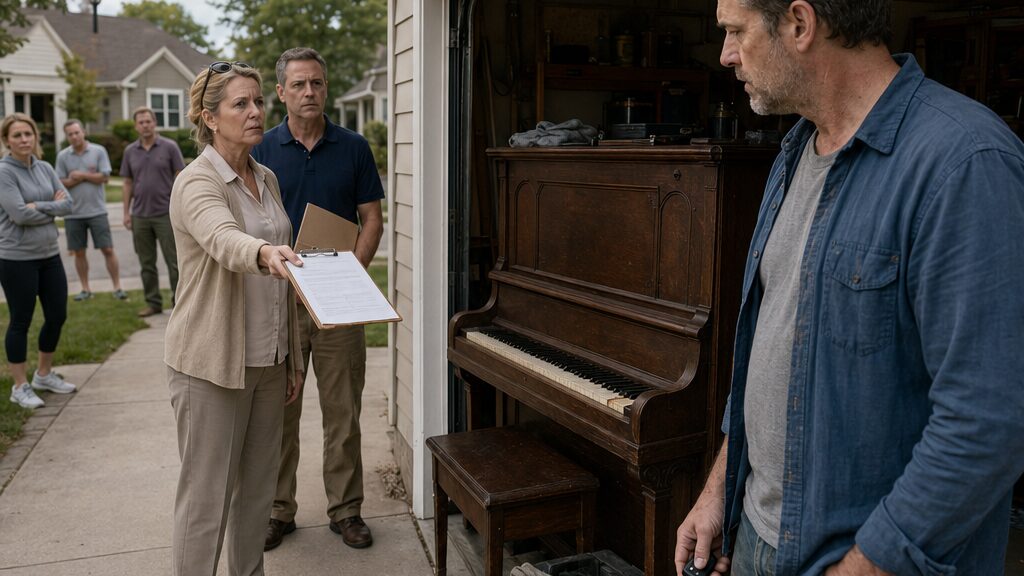
The Neighbor Called His Garage Piano Junk Until It Became the Voice of the Whole Street
Chapter 1: The Piano Nicole Called Junk Before Anyone Heard a Note
“Why is there a piano in your garage?”
Nicole Roberts did not ask it like a question. She asked it the way someone might point out a broken mailbox, a dead shrub, or trash left on the curb three days too long.
Gregory Wilson stood beside his workbench with a rag in one hand and a loose hinge in the other. The garage door was fully open because the morning was cool and because he had been fixing the left track before it started sticking again. He had not expected the HOA curb-appeal walk-through to stop in front of his driveway. He especially had not expected Nicole to step halfway onto the concrete, chin lifted, sunglasses pushed up into her blond hair, and aim one polished finger toward the back wall.
The piano sat there in the dimmer part of the garage, between plastic storage bins and an old folding table. Upright, dark wood, a little scarred along one side. Its bench was tucked under it. A yellowed lesson book rested closed on top. One ivory key near the middle had a chipped front edge that caught light whenever the garage door was open.
Gregory moved his hand so the rag covered the hinge. “Morning, Nicole.”
She glanced at him as if the greeting had been a detour. Behind her, two other board members lingered near the sidewalk with clipboards. A neighbor across the street slowed while rolling a trash can back up the drive. Gregory saw the neighbor look once at the piano, once at Nicole, then look away too late to pretend he had not been listening.
Nicole took another step in. “I asked why there’s a piano in your garage.”
“It’s mine.”
“That isn’t what I asked.”
Gregory set the hinge on the workbench. It made a small metal sound, sharper than he wanted. “Then I don’t know what you’re asking.”
She gave a short breath through her nose. Nicole had lived next door for seven years, long enough for Gregory to know the difference between her social smile and her board smile. This morning she wore the board smile. It was tight, useful, and already tired of him.
“This is a residential garage,” she said. “Not a storage unit. Not a rehearsal space.”
“Nobody’s rehearsing.”
Her eyes moved to the piano again. “Nobody wants to hear that thing.”
Gregory felt something in his chest tighten around the phrase that thing. Not anger exactly. Anger would have been easier. It was the sudden old urge to turn around, to check whether Shirley had heard, and the small fresh shock of remembering there was no reason to check anymore.
He folded the rag once. “Nobody’s playing it.”
The neighbor across the street stopped pretending with the trash can. One of the board members wrote something down. Nicole’s eyebrows lifted, almost triumphant, as if Gregory had opened a door she had been waiting to enter.
“Then why keep it?”
The question hung between them, simple and reasonable to everyone who did not know the answer.
Gregory looked at the piano. He had kept it angled away from the sunlight because Shirley had always warned him direct heat would ruin the finish. He had kept a folded towel over the back corner where the veneer had started to peel. He had kept the chipped key untouched, though the piano tuner had once told him it could be replaced cheaply enough.
Shirley had laughed when he said he would fix it someday.
“Don’t,” she had said. “Every good thing in this house has one stubborn flaw.”
Nicole shifted her clipboard against her hip. “Gregory?”
He looked back at her. “It’s not blocking the sidewalk. It’s not outside. It’s not making noise.”
“It’s visible from the street when your garage is open.”
“My garage is open because I’m repairing the door.”
“And how often is it open?”
He knew then that she had not stopped by because she had noticed the piano during the walk-through. She had been waiting to make the piano part of the walk-through.
Gregory’s jaw worked once before he answered. “Often enough.”
Nicole turned slightly, letting the board members hear her without raising her voice. “The covenants are clear about unsightly storage and nuisance conditions. Large indoor items stored in visible garage areas may be considered noncompliant.”
“It’s a piano.”
“It is a large indoor item.”
“It’s inside.”
“It is visible.”
The words were neat. That was what made them difficult to fight. Nicole did not need to call it ugly again. The form would do that for her.
Gregory picked up the garage remote from the workbench.
Nicole noticed. “I’m not finished.”
“I am.”
Her face changed then. Not much. Just enough for him to see the neighbor under the officer: a woman who did not like being dismissed in public, especially not while holding a clipboard. She lowered her voice.
“If you close this door while we’re documenting a violation, that will not help you.”
Gregory looked past her to the sidewalk. The board members were pretending not to stare. The neighbor with the trash can had finally gone inside, but his blinds were angled open. A delivery truck crawled through the cul-de-sac, the driver turning his head as if he had arrived at the second act of a play.
Gregory pressed the remote.
The motor groaned above him. The garage door jerked once, then began to descend. Sunlight narrowed across the concrete. Nicole stepped back fast enough to keep the door from forcing the issue.
For a moment, the piano was framed behind the falling door. The dark wood. The lesson book. The chipped ivory key catching one clean stripe of morning light.
Then the door shut between them.
The garage dimmed. The motor stopped with a final shudder.
Gregory stood inside with the remote in his hand, breathing in the smell of dust, oil, and old wood. Through the door, Nicole’s voice came muffled but clear enough.
“That will go in the report.”
He did not answer.
For several seconds he kept his eyes on the seam at the bottom of the garage door. A thin line of daylight ran under it. A pair of white sneakers appeared on the other side, motionless, then turned away.
Only after her footsteps faded did Gregory move. He crossed to the piano and lifted the lesson book from its top. The cover had softened at the corners. A child had written a D too large on the first page, then erased it so hard the paper had thinned.
He opened the bench. Inside were pencils, old metronome parts, two church programs, and a stack of sheet music Shirley had sorted with sticky notes. He did not take any of them out. He only rested his fingers along the inside edge of the bench, where she had once taped a small label because she labeled everything she loved and half the things she did not.
Property of Shirley Baker, it read, in her careful blue handwriting.
Not Wilson. Baker.
She had written it before she married him, before the house, before the HOA, before the subdivision had a second phase and a community website and monthly reminders about garbage bins. Before illness made her hands too stiff for octaves. Before she sat on the same bench and taught a girl from three streets over how to place her thumb under her third finger without apologizing.
Gregory closed the bench softly.
His phone buzzed on the workbench. He let it buzz once, twice, three times before he walked over.
A neighborhood alert had appeared.
HOA curb appeal review in progress. Please ensure all visible exterior and garage-facing areas remain compliant. Thank you for helping preserve the appearance and value of Green Hollow Estates.
Nicole had posted it two minutes ago.
Gregory stared at the words until the screen dimmed.
The garage felt smaller with the door shut. He reached for the track he had meant to repair, but his hand stopped halfway. Behind him, the piano waited in the half-dark like a person holding their breath.
By late morning, the first email arrived. It was polite, formatted, and copied to the board.
Potential compliance concern: visible non-garage household furnishing stored in open garage; possible nuisance instrument; follow-up required.
Gregory read it once, then deleted it. Ten seconds later, he opened the trash folder and restored it, because Shirley had always said deleting a problem was not the same as solving it.
At noon he made coffee and poured half of it down the sink after one sip. At one he went back to the garage and fixed the hinge. At two he opened the door six inches to test the track, saw Nicole’s blinds shift next door, and closed it again.
At four, he found a folded yellow flyer under a magnet on the side of the refrigerator.
Green Hollow Neighborhood Talent Afternoon — Saturday, 12 p.m.
Bring a chair. Bring a snack. Bring a little courage.
The last line was Shirley’s. He knew because she had argued for it at the kitchen table last winter, tapping the pen against her teeth while Gregory told her people did not put courage on flyers.
“They should,” she had said. “Most people need permission.”
He folded the flyer once and put it in his shirt pocket.
Near sunset, he heard Nicole’s heels on the driveway before she knocked. Three precise taps on the garage door, though the front door was twenty feet away.
Gregory opened the side door instead.
Nicole stood there with her phone in one hand and the same clipboard in the other. Without the board members behind her, she looked less official but more determined.
“I wanted to give you a courtesy warning before this goes further,” she said.
“That’s neighborly.”
She ignored the edge in his voice. “The board will review the matter Friday. If you move the piano before then, it may not have to become a formal fine.”
He looked at her phone. “You taking pictures again?”
“I already have what I need.”
Of course she did. Gregory leaned one shoulder against the doorframe, blocking her view into the garage.
Nicole’s gaze flicked past him anyway. “I understand you’ve had a difficult year.”
His fingers tightened around the side of the door.
She seemed to realize she had stepped on something, but she kept going. “But everyone has personal circumstances. The rules only work if they apply evenly.”
Gregory watched a child ride a bike past the end of the driveway, training wheels clicking against the asphalt. Somewhere down the street, a dog barked twice and stopped.
“What do you want me to say, Nicole?”
“I want you to say you’ll remove it.”
“No.”
Her mouth flattened. “Then the board will want it gone by Friday.”
She turned before he could answer, carrying the clipboard against her chest like a shield.
Gregory stayed in the doorway until she crossed into her yard. Then he stepped back inside and closed the side door. Not hard. Not loud. But completely.
In the garage, the piano sat behind him, silent as ever.
This time, the silence did not feel private. It felt reported.
Chapter 2: A Complaint Form Turns Grief Into a Property Violation
The envelope in Gregory’s mailbox was stamped SECOND NOTICE in red ink so large it showed through the little plastic window before he even pulled it free.
For a moment, he stood at the curb with the mailbox door hanging open and the rest of the mail pressed under his arm. Grocery coupons. A water bill. A postcard from a dentist he had never visited. Ordinary paper things that belonged to ordinary days. Then the HOA envelope, thick enough to carry consequence.
Across the street, a garage door hummed upward. Gregory slid the notice under the water bill before anyone could see it, though he knew hiding paper from the street was as useless as closing a door after Nicole had taken pictures.
Inside, he laid the envelope on the kitchen table and did not open it right away.
Shirley’s old music notebook lay beside the garage remote, exactly where he had left it the night before. Its green cover had a coffee ring on the corner from a morning she had laughed too hard at something he could no longer remember. The remote sat on top of it like a paperweight, black plastic against green cardboard, door against memory.
He opened the notice with a butter knife because Shirley had hated torn envelopes.
Dear Mr. Wilson,
Following the prior courtesy notification regarding visible noncompliant storage and possible nuisance use, the Green Hollow Estates Homeowners Association has received an additional complaint concerning the upright piano currently stored in your garage…
Gregory stopped after the word additional.
There had been no time for anyone else to complain unless Nicole had filed twice or encouraged someone to join her. He read on.
Corrective action required by Friday, 5:00 p.m. Failure to remove the noncompliant item or provide satisfactory remediation may result in fines, board action, and/or approved removal at owner expense.
At owner expense.
He set the notice down carefully, as if it were hot.
The amount was printed near the bottom. Initial fine, administrative fee, possible contractor charge. The numbers were not ruinous in the dramatic way numbers became in movies. They were worse than that. They were believable. Annoying enough to hurt. Large enough to make him choose between the piano and two months of careful budgeting.
Gregory had been a school music teacher for twenty-two years before the district merged programs and turned his job into part-time contract work with no benefits worth mentioning. Now he repaired cabinets, tuned instruments badly enough to know when to call a real tuner, and taught substitute music classes when someone remembered music still existed.
He could pay the fine if he had to.
He just could not pay it without feeling the shape of everything else it would take.
His phone buzzed while he was still staring at the numbers.
Ryan Anderson’s name appeared on the screen. Gregory had known Ryan mostly from annual meetings, where he spoke in careful sentences and always had an extra pen. Treasurer. Not unkind. Not brave either, as far as Gregory could tell.
He answered. “Gregory.”
“Mr. Wilson. Hi. It’s Ryan Anderson, from the board.”
“I know who it is.”
A pause. “Right. I wanted to make sure you received the notice.”
“It’s in front of me.”
“I’m calling unofficially.”
“That sounds official.”
Ryan exhaled, and Gregory heard paper moving on the other end. “I mean I’m not calling on behalf of a vote. Not yet. Nicole asked that the matter be placed on Friday’s agenda.”
“Nicole asked.”
“There have been concerns.”
“From Nicole.”
Another pause. “I can’t discuss complainants.”
Gregory looked toward the garage door visible down the hallway. It was closed. It had been closed all morning. “What exactly is the violation, Ryan?”
“That’s partly what I wanted to clarify. The language is… not as specific as it could be. There’s a section on visible storage, a section on nuisance noise, and a section on appropriate garage use.”
“Nobody’s heard noise.”
“I understand.”
“Do you?”
Ryan did not answer immediately. When he did, his voice lowered. “I understand that if this stays framed as visible storage, the board may authorize removal. Especially if there’s a claim that it attracts activity or creates a disturbance.”
“Activity.”
“I’m telling you what could happen.”
Gregory rubbed his thumb over the edge of the notice. “It belonged to my wife.”
The line went quiet.
When Ryan spoke again, his voice had changed. “I’m sorry. I didn’t know that.”
“No reason you would.”
“That might matter to some people.”
“It won’t matter to Nicole.”
“I can’t speak for Nicole.”
“Everybody says that right before speaking for Nicole.”
Ryan gave a tired little laugh that died quickly. “Look, if you can move it somewhere not visible from the street, even temporarily, that might take the pressure off.”
The suggestion was so reasonable that Gregory disliked it immediately.
Move it. Hide it. Save the object by stripping away the reason it had to be where it was.
“I’ll think about it,” Gregory said.
“Friday at five is the deadline. But the agenda meeting is Friday at three. If you plan to respond, don’t wait until five.”
The call ended with Ryan promising to send the bylaw section and Gregory promising nothing.
He carried the notice into the garage.
The room had the odd afternoon smell of warm cardboard and motor oil. He opened the piano bench, partly because he needed to see Shirley’s label and partly because he had no idea what else to do with his hands.
Property of Shirley Baker.
He ran one finger beneath the tape. It had started to curl at one corner. He pressed it flat.
Shirley had kept her maiden name on certain things long after she became Shirley Wilson to the bank, the insurance company, and the neighbors who never knew which name to use. Music books. Her old choir folders. The piano bench. “Baker hands learned it first,” she used to say, flexing her fingers before a hymn. “Wilson hands just got to borrow it.”
Gregory lifted the stack of sheet music, and a pencil rolled toward the chipped key. It struck the key softly, making no sound because the fallboard was down.
Behind the sheet music sat a small envelope he had not noticed in months. He opened it and found the receipt from the last proper tuning, dated four weeks before Shirley’s final hospital stay. At the bottom, in Shirley’s handwriting, was a note.
Ask about brightening middle D before Deborah’s solo.
Gregory closed his eyes.
There it was. Not all of it, but enough to make the notice on top of the piano look even colder.
He remembered Shirley sitting on the bench with a scarf around her head and Deborah Lee perched beside her like a bird ready to fly away. Deborah had apologized every time she played a wrong note, and Shirley had finally placed both hands flat on the keys to stop her.
“Wrong notes are allowed in this garage,” Shirley had said. “Apologies cost extra.”
The memory made Gregory smile before it hurt.
His phone buzzed again. This time it was an email from Ryan with three bylaw attachments and a short line: You may want to review Section 8.2 and 11.4 before tomorrow.
Gregory opened the first attachment. The words blurred almost immediately into categories and subcategories. Exterior appearance. Stored items. Nuisance activity. Board discretion.
Board discretion.
He looked at Shirley’s notebook, then at the garage door remote beside it. One button could hide everything from the street. One button could keep Nicole from taking more pictures. One button could also turn the garage back into a locked box where nothing Shirley planned would reach beyond concrete walls.
His phone buzzed a third time.
This message was not from Ryan.
Melissa Garcia: Is Deborah still safe to come tonight?
Gregory stared at the question until the screen went dark in his hand.
Safe.
Not available. Not scheduled. Not still practicing.
Safe.
From the kitchen window, he could see Nicole Roberts standing at the edge of her driveway, talking to a neighbor with one hand wrapped around her phone and the other gesturing toward his house.
Gregory turned the phone over, then turned it back.
He typed, Yes.
He deleted it.
He typed, Of course.
He deleted that too.
Finally he wrote, She can come through the side gate after dark. Garage door half-open like usual.
He sent it before he could make the sentence braver than he was.
For the rest of the afternoon, the notice remained on top of the piano, its red stamped letters facing upward. Gregory tried to move it twice and failed both times. It belonged there for now. Not because it was right, but because it had changed what the piano was in the eyes of the neighborhood.
Before Monday, it had been a memory.
Now it was evidence.
At six-thirty, just as the streetlights clicked on one by one outside, Gregory went to the garage and pressed the remote.
The door rose only halfway before he stopped it.
The evening air slipped in under the opening. Enough for a person to duck beneath. Not enough for Nicole to see clearly from her kitchen window.
Gregory set Shirley’s notebook on the bench, moved the notice underneath it, and waited.
A few minutes later, the side gate creaked.
Chapter 3: The Girl Who Practiced Only After the Streetlights Came On
Deborah Lee slipped through the side gate carrying sheet music against her chest like a shield.
Gregory saw her before she saw him. She paused beside the trash bins, looking toward Nicole’s house, then toward the half-open garage door. The streetlight at the curb caught the yellow cover of her music folder and the white soles of her sneakers. She was fifteen, but in that moment she looked younger, as if the act of coming to the garage had become something she might be caught doing wrong.
“You’re clear,” Gregory said quietly.
Deborah startled anyway. “Sorry.”
“You don’t have to apologize for arriving.”
“Sorry,” she said again, then winced at herself.
Gregory lifted the garage door another few inches so she would not have to duck too low. The motor gave a short whine before stopping. He watched Nicole’s kitchen window through the gap. The blinds did not move.
Deborah stepped inside.
The garage had been rearranged for her before she came. Gregory had moved the folding table against the wall, cleared the bench, and set a small lamp on an overturned crate beside the piano. The lamp made a warm circle over the keys while leaving the rest of the garage in shadow. Half-open door for air. Half-closed for privacy. That was how Shirley had done it when Deborah first began coming.
Deborah noticed the paper on top of the music notebook anyway.
“What’s that?”
“Nothing for tonight.”
“That’s from the HOA, isn’t it?”
Gregory did not answer fast enough.
She shifted the sheet music in her arms. “Mom said Mrs. Roberts was asking questions.”
“Nicole asks questions professionally.”
Deborah almost smiled, but it disappeared. “She asked if you were running lessons out of your garage.”
Gregory pulled the bench out. “I’m not running anything.”
“That’s what Mom said.”
“Your mom is right.”
Deborah stood beside the piano instead of sitting. “She asked if kids were coming here after dark.”
The sentence landed harder than Gregory expected. It was not the words alone. It was the way Deborah said kids, as if Nicole had made the word suspicious.
Gregory kept his voice even. “You’re allowed to be here.”
“Are you?”
He looked at her then.
Deborah’s hair was tied back in a loose ponytail, but strands had escaped around her face. She held the folder so tightly the edges bent. Shirley used to say Deborah had the hands of someone who expected doors to close before she reached them.
“I own the house,” Gregory said.
“That’s not what I asked.”
It was close enough to Shirley’s old tone that he had to look away.
He opened the fallboard. The keys appeared in their familiar uneven line. White, black, white, the chipped middle D with its little broken tooth. Deborah’s eyes went there immediately.
Gregory placed the lesson book on the stand. “Warm up with scales.”
“I don’t think I should play Saturday.”
There it was. Not a fear. A decision rehearsed until it could be spoken without shaking.
Gregory lowered himself onto the stool near the workbench. He did not sit beside her at the piano. Shirley had always known when to sit close and when to give a student space. Gregory was still guessing.
“Because of Nicole?”
“Because people are talking.”
“People talk when they don’t have enough to do.”
“They’re saying you keep junk in your garage.”
“People are wrong about a lot of things.”
“They’re saying the board might make you get rid of it.”
Gregory said nothing.
Deborah’s voice dropped. “If it’s because of me, I can stop.”
“It isn’t because of you.”
“But I’m the only one playing it.”
He looked at the garage door. Through the gap at the bottom, a car rolled slowly past, headlights sliding across the concrete. Deborah froze until the light moved on.
Gregory had thought he was protecting her by keeping the lessons quiet. Melissa worked double shifts some weeks. Deborah’s school music program had been cut to one shared keyboard and a teacher who visited twice a month. Shirley had offered lessons because she heard Deborah humming at the mailbox one afternoon and asked, with Shirley’s ordinary boldness, whether anyone had ever told her she had good rhythm.
After Shirley died, Deborah stopped coming for almost a month. Then one evening she appeared at the side gate with the yellow folder and red eyes and said, “She told me not to quit before I got brave.”
Gregory had not known how to say no to that.
He also had not known how to become Shirley.
“Start with the left hand,” he said.
Deborah stared at him. “Mr. Wilson.”
“One time through.”
“I’m serious.”
“So am I.”
For a second he thought she might leave. Then she set the folder down, sat on the bench, and placed her fingers on the keys.
Her first notes were too soft. The sound barely filled the garage. Gregory listened as she moved through the scale. Her right hand hesitated near the chipped key, adjusted too late, and struck it at an awkward angle.
The note came out dull and uneven.
Deborah flinched. “Sorry.”
Gregory leaned forward. “For what?”
“I hit it wrong.”
“You hit a damaged key. That’s different.”
“I know where it is. I should’ve—”
“Deborah.”
She stopped.
Gregory stood and crossed to the piano. He pressed the chipped key gently. It answered with the same muted sound.
“This key was chipped before you were born.”
“That doesn’t make it better.”
“No. But it makes it something you learn around.”
Shirley’s words, almost exactly. Gregory heard them after he said them, and the garage seemed to tilt with her absence.
Deborah looked up at him. “Mrs. Wilson said that.”
“I know.”
“She said sometimes the note you avoid teaches you the song.”
Gregory placed one hand on the top of the piano. The wood was cool under his palm. “She said a lot of things that sounded better when she said them.”
This time Deborah did smile, small and unwilling.
He let that be enough.
They worked for twenty minutes. Deborah played badly at first, then less badly, then with the focused stubbornness that made Shirley clap once and say, “There she is.” Gregory marked two fingerings in pencil. He was not as gentle as Shirley had been. He caught himself correcting too soon, explaining too much, filling every silence because he did not trust himself to sit inside one.
Halfway through the piece, Deborah stopped with her fingers still on the keys.
“Did she really think I could do it?”
Gregory did not ask who. “Yes.”
“She told Mom the talent show needed one real surprise.” Deborah swallowed. “I thought she was just being nice.”
“She was being nice. She was also usually right.”
Deborah looked at the yellow folder. “Mom says kindness can make people promise things they can’t finish.”
Gregory felt that one find its mark.
Outside, a car door closed next door. Nicole’s voice drifted faintly through the gap under the garage door.
“—just need to know whether minors are being brought in. That changes the situation.”
Deborah’s hands came off the keys.
Gregory moved to the side of the garage and looked through the narrow window. Nicole stood in her driveway, phone pressed to her ear, facing his house. She was not shouting. That made it worse. She sounded calm enough to be believed.
Deborah rose from the bench. “I should go.”
“No.”
“She’s going to make trouble.”
“She already has.”
“For you.”
Gregory turned back. “That’s not your job to carry.”
“It is if I’m the reason.”
“You’re not.”
She hugged the folder again. “Then tell her.”
The words struck harder because they were not angry. Deborah was asking for something simple. Something Gregory should have been able to give.
He saw Melissa’s worry in the question. He saw Ryan’s reasonable suggestion. He saw Nicole’s photographs. He saw Shirley’s label inside the bench and the flyer on the refrigerator and his own hand pressing the remote Monday morning, choosing the clean comfort of a closed door.
“I can’t tell her everything,” he said.
Deborah’s face changed. Not disappointment exactly. Recognition. As if she had just learned adults could be afraid in ways that looked like rules.
“Because of Mrs. Wilson?”
Gregory did not trust his voice, so he nodded once.
Deborah looked down at the keys. “She promised me I wouldn’t have to play if I wasn’t ready.”
“She did.”
“She also said I’d never feel ready, so that couldn’t be the only rule.”
Gregory almost laughed. It came out rougher than he intended.
Deborah touched the chipped key with one finger, not pressing it down. “I heard two women at the mailbox say your garage was creepy.”
“It isn’t.”
“I know.”
“But hearing it still matters.”
She nodded.
Gregory stepped away from the window. Nicole had gone inside, but the damage of her voice remained in the garage.
“I’ll handle the HOA,” he said.
“How?”
It was the question everyone kept asking in different ways. Nicole with accusation. Ryan with procedure. Melissa with worry. Deborah with a child’s directness.
Gregory had no answer that did not require opening something he had kept shut.
Deborah put the sheet music into her folder. “I don’t want everyone looking at me and thinking I’m part of some violation.”
“They won’t.”
“You don’t know that.”
No, he did not.
She walked toward the side door, then stopped beside the workbench. Shirley’s notebook lay there, half-hidden under the notice. Deborah saw the green cover, and her expression softened in spite of herself.
“She used to draw stars next to the parts I got right,” she said.
Gregory looked at the notebook. “She drew stars next to grocery lists.”
“She said people did better when they knew something counted.”
For a moment neither of them moved.
Then Deborah pulled the side door open. The cool evening air entered the garage, carrying the smell of cut grass and someone’s dinner from down the street.
At the threshold, she turned back.
“Mr. Wilson?”
“Yes.”
Her hand tightened on the folder.
“I can’t play at the talent show anymore.”
She said it quietly, but it seemed to make every object in the garage listen—the notice, the remote, the bench, the chipped key, the half-open door.
Then she slipped out through the side gate, leaving Gregory alone with the piano and the first clear understanding that his silence had not protected her at all.
Chapter 4: Nicole’s Rules Were Not as Simple as Her Voice
Nicole had Gregory’s garage projected onto the HOA meeting-room wall before he even sat down.
The photo was too bright and too sharp. The open garage looked larger than it was, the storage bins messier, the piano stranger. The chipped key was not visible, but the lesson book on top made the instrument look less like furniture and more like evidence someone had forgotten to hide.
Gregory stopped with one hand on the back of a folding chair.
Nicole stood beside the projector screen in a cream blouse and pale slacks, one hand holding a remote, the other resting near a stack of printed packets. The room smelled of burnt coffee and copier paper. Three board members sat at the long folding table. Ryan Anderson had a binder open in front of him and a pen lined up with the edge of the page.
“Mr. Wilson,” Nicole said, not quite smiling. “Thank you for coming.”
Gregory sat in the second row, though the room was almost empty. “Didn’t realize I had been invited to a presentation.”
“It’s a compliance review.”
The next slide appeared. A close-up of his garage taken from the sidewalk. Red circles had been added around the piano, the folding table, and a stack of boxes labeled CHRISTMAS.
Gregory looked at the boxes. Shirley had written that label three years ago. Her S curled like a ribbon.
Nicole faced the board. “As you can see, the concern is not simply the presence of a single item. It is the visible conversion of a garage into an improper storage and activity area.”
“Activity area?” Gregory asked.
Nicole clicked to another slide. The photo showed the garage door halfway open at night.
Gregory felt heat rise along the back of his neck.
Ryan looked up sharply. “Nicole, when was that taken?”
“Last night.”
“From where?”
“From the common sidewalk.”
Gregory kept his voice level. “You photographed my garage at night?”
Nicole turned toward him. “Your garage was visible from the street.”
“A child was inside.”
The room went still.
Nicole’s expression did not change fast, but Gregory saw her process the mistake. The board members shifted. Ryan’s pen stopped moving.
“I did not photograph any child,” she said.
“No. You just photographed the place she was sitting.”
Nicole clicked the remote, and the screen went blank. “Then perhaps that confirms the concern.”
Gregory stared at her. “What concern?”
“That minors may be attending lessons or gatherings in a garage not approved for that use.”
“They’re not gatherings.”
“So there are lessons?”
Ryan leaned forward. “Let’s slow down.”
Nicole did not look at him. “We have liability considerations, Ryan. If homeowners begin conducting unapproved instruction, performances, or events from garages, the association could be exposed.”
Gregory almost told them everything then. Deborah’s yellow folder. Melissa’s text. Shirley’s hands on the keys. The line on the flyer about courage.
Instead he heard Deborah’s voice: Then tell her.
He put both hands flat on his knees. “One student plays there sometimes.”
Nicole’s eyes sharpened. “So you admit the piano is being used.”
“Sometimes.”
“And neighbors were not notified.”
“About a girl practicing piano?”
“About a possible nuisance.”
“Nobody complained about hearing music.”
Nicole’s lips pressed together. “You don’t know that.”
Gregory looked from face to face at the table. No one met his eye except Ryan.
Ryan cleared his throat. “For the record, the written complaints reference visibility and potential nuisance. I haven’t seen a documented noise complaint.”
“Potential nuisance matters,” Nicole said. “We don’t wait until a problem becomes unmanageable.”
One of the board members murmured, “That’s true.”
Nicole seized the support without seeming to. “Last year we allowed a homeowner on Sycamore Court to keep a commercial freezer visible in his garage for ‘temporary family reasons.’ Within two months, three other residents had visible appliance storage. When we enforced, we were accused of favoritism. I was accused of making exceptions for people I liked.”
Her voice tightened at the end. Not much, but enough that Gregory looked at her differently.
So that was part of it.
Not the piano. Not only the piano. A freezer, an argument, a public accusation, and Nicole’s need to make the next line straight enough that no one could say she bent it.
Ryan said, “This is not a freezer.”
“No,” Nicole said. “It is a piano. Larger, more visible, and now apparently being used by minors.”
Gregory stood. “She’s not a case category.”
Nicole blinked. “Excuse me?”
“The student. She’s not a liability category.”
“And yet you won’t name her.”
“No.”
“Then how can we evaluate the risk?”
“You don’t need her name to decide whether a piano inside a garage is hurting property values.”
Nicole’s face flushed. “This association has a duty to apply rules evenly.”
Gregory looked at the projected blank wall. Even with the photo gone, he could still see his garage there. His workbench. The bins. The piano exposed under fluorescent light to people who knew nothing about it but felt ready to vote.
“What would satisfy the board?” he asked.
Ryan flipped a page in his binder. “Possibly moving the piano out of view until the board can determine whether an exemption applies.”
Nicole turned toward him. “There is no exemption for sentiment.”
“I didn’t say sentiment.”
The word hung there.
Sentiment.
Gregory hated how small it sounded. As if Shirley had been a decorative attachment to an otherwise reasonable violation.
Nicole lowered her voice into the tone she used when she wanted to sound fair. “Mr. Wilson, if this item belonged to your wife, I am sorry. Truly. But personal history does not convert a garage into an approved music studio.”
Gregory felt every head in the room turn toward him.
There it was. Shirley brought into the room, but only as an insufficient argument. A dead wife placed gently on the table and ruled irrelevant.
He picked up the printed packet from the chair beside him. The pages were clipped together, his address circled near the top. “I’m not asking for a music studio.”
“Then what are you asking for?”
The truth rose in him, and with it came panic. Because the truth was not neat. It involved a promise made by a woman who believed children should have chances even when families were too proud or too broke to ask. It involved a girl who still flinched when neighbors glanced at her. It involved Gregory himself, who had been pretending he could continue Shirley’s work without letting anyone see how badly his hands shook afterward.
“I’m asking for time,” he said.
Nicole looked disappointed, as if he had chosen the weakest possible answer. Maybe he had.
Ryan tapped his pen once against the binder. “The talent afternoon is Saturday, correct?”
Nicole’s head turned. “That event is in the common area. It has nothing to do with this.”
“It might,” Ryan said. “If the instrument is intended for event use.”
Gregory looked at him.
Nicole did too, but with warning in her face. “The event request did not list a piano.”
“Shirley submitted the original idea months ago,” Ryan said. “There may be older notes.”
“You approved folding chairs and refreshments,” Nicole said. “Not moving a garage piano into the street.”
Gregory heard, underneath all of it, the narrow space opening and closing. Not saved. Not yet. But a space.
One board member asked, “Can the piano be stored out of sight until Saturday?”
Nicole nodded immediately. “That would be a reasonable temporary cure.”
Gregory imagined it: hiring movers, shifting the piano to the back wall behind tarps or into a storage unit, keeping the object safe by making Deborah’s practice impossible and Shirley’s event smaller until it became nothing but chairs and snacks.
It was a false mercy. Even he could see that.
“I can’t move it before Saturday,” he said.
“You mean you won’t,” Nicole said.
“I mean I can’t.”
“Because it’s heavy?”
Because Deborah needs it tonight. Because Shirley drew stars beside her name. Because if I move it, I am admitting you were right about what it is.
Gregory said none of that.
Ryan closed his binder halfway. “The board can vote to issue a conditional notice. Removal by Friday unless Mr. Wilson provides proof of approved community event use or moves the item out of view.”
“Friday is today,” Gregory said.
“Five p.m. for remediation,” Ryan said. “But if the event-use question is legitimate, we can review it before enforcement.”
Nicole looked at the other board members. “If we do not act, we set a precedent.”
“If we act too broadly,” Ryan said, “we may create one.”
For the first time, Nicole looked uncertain. Not defeated. Just aware that the rule might not be as clean as she wanted it to be.
The vote passed in the smallest way possible: removal authorized unless Gregory proved event-use relevance before Saturday morning. Nicole recorded her vote with visible care. Ryan did not look pleased with his own compromise.
After the meeting, Gregory walked out into the late afternoon with the packet folded under his arm. The sidewalk outside the HOA office room ran along the subdivision’s small clubhouse and then toward the mailboxes. Garage doors faced the street in tidy rows, most of them closed, all of them suddenly looking like blank faces.
Nicole caught up with him near the curb.
“Mr. Wilson.”
He stopped but did not turn right away.
She came around to face him, clipboard held against her side now instead of in front of her. Without the projector, without the table, she looked less certain but no softer.
“I meant what I said about your wife,” she said. “I am sorry.”
Gregory nodded once.
“But sentiment is not an exemption.”
He looked at her then.
Maybe she intended the sentence as kindness. Maybe she thought clean rules were the only way to keep grief from flooding every meeting with exceptions. Maybe she had been embarrassed once by a freezer on Sycamore Court and never planned to be embarrassed again.
It did not make the harm smaller.
Gregory unfolded the packet enough to see the deadline printed in black.
Friday, 5:00 p.m.
Behind Nicole, a row of closed garage doors caught the lowering sun, each one bright and flat and perfectly compliant.
“Then I guess I’ll have to find something that is,” he said.
Nicole’s phone buzzed. She glanced down, then back at him. “You have less than twenty-four hours.”
“No,” Gregory said, folding the packet again. “I have until the music starts.”
Nicole’s eyes narrowed, but she did not answer.
As Gregory walked home, the packet felt heavier than paper. By the time he reached his driveway, his garage door was still closed, but he could no longer pretend keeping it that way would protect anyone.
Chapter 5: Shirley’s Notebook Had One Name Gregory Never Said Aloud
Gregory found Deborah’s name circled in Shirley’s notebook at 11:18 that night, and for a full minute he could not make himself turn the page.
The house was quiet except for the refrigerator’s hum and the occasional crack of the garage cooling after a hot day. He sat on the floor of the bedroom closet with a cardboard memory box between his knees. The HOA packet lay open beside him, Section 11.4 marked in Ryan’s blue ink: Temporary community event use may be permitted when pre-approved, noncommercial, and not creating unreasonable nuisance.
Pre-approved.
That word had driven him into the closet.
He had searched the kitchen drawer first, then the filing cabinet, then the plastic bin Shirley labeled EVENTS / MAYBE / ASK GREGORY before he finally found the green notebook inside a box with her scarves. The notebook smelled faintly like dust and the lavender soap she used to keep in dresser drawers.
On the open page, Shirley had written:
Green Hollow Talent Afternoon
Not a contest. Not cute trophies. Let them be seen.
Beneath that, in her slanted handwriting, was a list of names. Some crossed out. Some followed by question marks. Deborah Lee appeared halfway down the page, circled twice.
First solo if she is brave.
Do not let her apologize before she begins.
Gregory pressed his thumb against the edge of the page until it bent.
“Shirley,” he said, though the house had not answered him in almost a year.
He turned the page.
There was a rough sketch of the cul-de-sac in front of their house. Folding chairs in a semicircle. Lemonade table by the mailbox. Extension cord marked ask Ryan? And at the center, drawn with clumsy little lines that were somehow unmistakable, the garage door lifted high and the piano rolled just to the threshold, not fully outside, not hidden inside.
Under the drawing she had written: Like a curtain. G. can fix the track.
Gregory laughed once. It broke before it became a sound.
Of course she had assigned him the garage door. Of course she had known the track would stick and the piano would be too heavy and the whole thing would require ten favors she intended to collect with cookies and stubbornness.
He found another note tucked into the back pocket.
If I don’t get to run it, don’t make it sad.
Music is already allowed to miss people.
He shut the notebook too fast, then opened it again because closing it felt like panic.
The bedroom around him was half-changed and half-not. His clothes occupied both sides of the closet now, but Shirley’s scarves remained in the top box because he had once told himself he would donate them in the spring. Spring had come. Then summer. Then the next spring. The scarves stayed.
His phone buzzed against the floorboards.
Melissa Garcia.
He answered before the second vibration.
“She won’t come out of her room,” Melissa said without hello.
Gregory closed his eyes. “Deborah?”
“She heard something at school. One of the kids said their mom saw pictures of your garage at the HOA meeting.” Melissa’s voice was low, controlled, and worn thin. “Now she thinks the whole neighborhood knows she’s been sneaking over.”
“She wasn’t sneaking.”
“She came through a side gate after dark, Gregory.”
He accepted that because she was right.
Melissa continued, “I let it happen because Shirley asked me to trust her. Then I let it keep happening because Deborah was happy for the first time in months. But if this turns into people whispering about my daughter—”
“It won’t.”
“You don’t know that.”
The same words Deborah had used. Gregory looked at the circled name on the page.
Melissa’s voice softened, which made it harder. “I don’t need charity turning into spectacle.”
“It was never charity.”
“It feels different when you’re the one who can’t pay.”
Gregory had no clean answer for that. He had tried, clumsily, to make the lessons about Shirley’s promise, not Melissa’s money. But promises could still embarrass people if handled in secret too long.
“She’s good,” Gregory said.
“I know she’s good.”
“She’s ready.”
“She’s fifteen. Ready doesn’t matter if she thinks everyone is laughing before she sits down.”
Gregory rubbed one hand over his face. “What do you want me to do?”
“I want you to decide whether this is private or public. Because right now it’s somehow both, and my daughter is getting caught in the middle.”
The line stayed open. Neither of them spoke.
From the garage below, the door track gave another small metallic pop.
Gregory looked at Shirley’s sketch again. Like a curtain.
“Shirley planned the piano for the talent show,” he said.
Melissa was quiet.
“She wrote Deborah’s name down. She wanted her to play the first solo.”
“I know,” Melissa said, but her voice changed.
“You know?”
“She told me before she got too sick to talk long. She said Deborah had a way of listening before she played. Said that mattered more than confidence.” Melissa took an uneven breath. “I thought she was just trying to make me feel less guilty.”
“For what?”
“For not being able to give Deborah lessons myself.”
Gregory stared at the notebook until the lines blurred. All this time, he had believed he was the only one carrying the promise in full. But Shirley had left pieces of it everywhere, because she had never trusted one person with what a street could do together.
Melissa said, “Did she write anything else?”
Gregory looked at the back-pocket note again.
If I don’t get to run it, don’t make it sad.
He swallowed. “She wrote that Deborah should not apologize before she begins.”
A small sound came through the phone. Not a laugh exactly. Not a sob. Something caught between.
“That sounds like her.”
“Yes.”
“So what happens now?”
Gregory looked at the HOA packet. “Ryan said there might be an event-use exception.”
“Might be.”
“If the piano is part of the approved event.”
“Is it?”
“It was in Shirley’s notes. I don’t know if she filed it.”
“And if she didn’t?”
Then Nicole would have the rule. The truck. The board vote. The photographs. The word sentiment.
“I’ll ask Ryan,” Gregory said.
“Tonight?”
“Now.”
Melissa hesitated. “Gregory.”
“Yes?”
“If you do this, don’t do it just to prove Mrs. Roberts wrong.”
He closed his hand around the phone. “I’m not.”
“Because Deborah can’t be someone else’s lesson.”
The words settled hard.
“I know,” he said, though the truth was that he had almost let that happen. Not out of cruelty. Out of silence. Out of the desire to have the ending Shirley deserved without exposing the fear and shame beneath it.
After the call, Gregory stayed on the closet floor until his knees stiffened. Then he gathered the notebook, the HOA packet, and the flyer from the refrigerator. He carried them into the garage.
The piano waited in the dark. He turned on the lamp, and the keys appeared one by one.
He placed Shirley’s notebook on the music stand.
Under the sketch of the open garage, she had drawn little stars above the chairs. Not applause stars. Shirley never drew applause. She drew attention, little marks that meant look here, this matters.
Gregory opened the garage door.
Only halfway. Habit and fear moved his thumb before courage could. The motor groaned, lifted, stopped. Cool air entered. Down the street, most houses were dark except for porch lights and the blue flicker of televisions behind blinds.
Gregory stood in the opening and imagined the door higher. All the way up. No hiding. No half-measure. A curtain instead of a shield.
He took out his phone and called Ryan.
Ryan answered on the fourth ring, voice rough with sleep or surprise. “Gregory?”
“I need to ask you about community event use.”
“It’s after midnight.”
“The talent afternoon was Shirley’s idea.”
A pause.
Gregory kept going before he lost nerve. “She drew the piano into the setup. She wrote notes. Deborah was supposed to play. I don’t know whether she filed it formally or just talked to someone, but I need to know what counts.”
He heard Ryan move, maybe sitting up. “Do you have her notes?”
“Yes.”
“Any email? Form? Text?”
“I’m looking.”
“Send me photos of everything. The event request, the flyer, the notebook if you’re comfortable.”
Gregory looked at Shirley’s handwriting.
Comfortable had nothing to do with it.
“I’ll send them.”
Ryan lowered his voice. “Gregory, if this works, it may only delay enforcement. Nicole will argue the piano was not specifically approved.”
“Can she still remove it before noon?”
“If the board treats it as active noncompliance, yes. If we can classify it as part of a scheduled community event, no. Not until after review.”
“Then classify it.”
“I can’t just—”
“Ryan.”
The garage door hummed suddenly and jerked downward six inches, the old track slipping from where Gregory had left it. He caught the bottom edge with both hands and shoved it back up before it could close.
His heart pounded in his throat.
On the phone, Ryan said, “What was that?”
“The door.”
“The same door from the photos?”
Gregory looked up at the bent track he still had not fully fixed. Shirley’s note seemed to look back at him from the piano.
G. can fix the track.
“Yes,” he said.
“Fix it before morning,” Ryan said. “If the door won’t open safely, Nicole will use that too.”
After the call ended, Gregory stood beneath the half-raised garage door with his hands braced against the panels, holding open the thing he had used all week to hide.
Then he reached for the toolbox.
Chapter 6: The Board Came to Remove It Before the Music Started
The moving truck arrived at 9:07 Saturday morning, while the folding chairs were still stacked against Gregory’s mailbox.
It was smaller than he expected, plain white, with no company name on the side. That made it worse. An official truck might have looked like a mistake he could dispute. This one looked like a quiet errand.
Gregory stood in the driveway with a wrench in his hand and grease on his knuckles. He had slept less than two hours. The garage door track was fixed enough to rise without shuddering, though he did not trust it enough to say so aloud. Behind him, the piano sat near the front of the garage, angled exactly as Shirley had sketched it: not fully outside, not hidden inside.
The driver stepped down from the truck, checked an address on his phone, and looked toward the piano. “Wilson?”
Gregory set the wrench on the workbench. “Who sent you?”
The driver hesitated. “Association removal order. I was told to wait for a board rep.”
A car door closed next door.
Nicole crossed her lawn in white sneakers and a pale blue windbreaker, phone in one hand, folder in the other. Ryan followed from the sidewalk, binder under his arm and his expression tight.
Gregory felt the morning tilt toward something he could no longer postpone.
“Nicole,” he said.
She glanced at the chairs, the cooler near the curb, the hand-lettered sign Melissa had dropped off before sunrise: GREEN HOLLOW TALENT AFTERNOON. “This is exactly what I was concerned about.”
“Folding chairs?”
“A spectacle.”
Ryan stepped between them slightly. “Let’s keep this procedural.”
Nicole opened her folder. “The board authorized removal unless satisfactory event-use proof was provided.”
“I sent Shirley’s notes,” Gregory said.
“You sent personal notes,” Nicole replied. “Not an approved event diagram. Not an amended request. Not a safety plan.”
Ryan said, “The original event request is in the community folder. Shirley Baker submitted it before she passed. It references ‘music by neighborhood children.’”
Nicole turned to him. “It does not reference this piano.”
“It references live music.”
“Live music can be a Bluetooth speaker and a microphone.”
Gregory almost laughed. He looked at the upright piano, at the chipped key, at the lamp still sitting on the crate from Deborah’s lessons. “Not to Shirley.”
Nicole’s face tightened at the name, but she did not back down. “Mr. Wilson, I understand this is emotional. But if you roll a piano into the street without approval and someone gets hurt, the association is responsible.”
“It’s not going into the street. It’s staying on my property.”
“Visible from the street.”
“During a community event.”
“An event that did not list this equipment.”
Ryan opened his binder. “Section 11.4 allows temporary use of homeowner property for approved community events if the use is noncommercial, time-limited, and does not create unreasonable nuisance.”
Nicole looked at him as if he had betrayed not her, but order itself. “Temporary does not mean anything goes.”
“No one said it does.”
The driver shifted beside the truck. “Do you want me to wait or…?”
Nicole said, “Wait.”
Gregory said, “Leave.”
The driver looked at Ryan.
Ryan removed his glasses and rubbed the bridge of his nose. “Nobody touches the piano until we resolve the event-use question.”
Nicole’s voice sharpened. “The event starts in less than three hours. If you delay now, you are effectively granting the exemption.”
“No,” Ryan said. “I’m preventing irreversible action before a question is settled.”
Gregory looked at him then, really looked. Ryan was nervous. His collar sat crooked. His binder was stuffed with too many printed rules. He was not brave in the easy way, but he was standing there between a removal truck and a piano because the paperwork had become less clear than the harm.
Nicole saw it too. Her tone softened, which somehow made it more dangerous. “Ryan, you remember Sycamore Court.”
“This is not Sycamore Court.”
“It is exactly how Sycamore Court started. One exception. One emotional story. Then everyone decides the rules are optional, and when we enforce them, we are the villains.”
“You are not a villain for enforcing rules,” Gregory said.
Nicole turned to him.
He had not meant to say it. Or maybe he had meant to say it all week and only now found the shape of it.
“You’re not,” he repeated. “But you’re wrong about what this is.”
Nicole’s eyes flicked toward the garage. “Then say what it is.”
The street had begun to notice them. A neighbor came out carrying a folding chair, slowed, and stopped. A child on a scooter coasted silently near the curb. Melissa’s car turned into the cul-de-sac and parked hard against the curb. She got out first, then Deborah, who wore a yellow dress under a denim jacket and looked as if she might step back into the car at any sound.
Gregory saw Deborah see the truck.
Her face went pale.
Melissa put a hand on her shoulder, but Deborah did not move.
Nicole lowered her folder slightly. She had seen Deborah too. For one second, something like regret crossed her face. Then she looked back at Gregory, and the regret became procedure again.
“If this is about the girl,” Nicole said quietly, “that should have been disclosed.”
Gregory felt Melissa’s warning from the night before: Deborah can’t be someone else’s lesson.
“It’s not about using her to win an argument,” he said.
“Then don’t.”
The words struck because they were fair enough to hurt.
Gregory turned toward the garage. The door was still open, fully open now, lifted high above the piano. All week it had been barrier, shield, hiding place. This morning, with the fixed track holding and the sun touching the concrete threshold, it looked like Shirley’s sketch.
Like a curtain.
He walked to the piano and picked up the green notebook from the music stand. When he returned, he did not hand it to Nicole. He held it against his chest for one breath, then opened it to the page with the event plan.
“My wife started this talent afternoon,” he said.
Several neighbors had gathered by then, pretending to arrange chairs while listening to every word.
Gregory kept his eyes on Nicole because looking at Deborah might make him soften the truth into something safer. “She didn’t want a contest. She wanted kids who never signed up for things to have one afternoon where people paid attention. Deborah was one of those kids.”
Deborah’s head dropped.
Gregory stopped.
Melissa’s hand tightened on her daughter’s shoulder.
He had done it wrong. Even carefully, he had put Deborah in the center before she chose to stand there.
Gregory closed the notebook. “No. That’s not right.”
Nicole blinked. “What isn’t?”
Gregory turned to Deborah. “I’m sorry.”
Deborah looked up.
“This isn’t your problem to solve.”
The cul-de-sac seemed to hold still around them.
Gregory faced the neighbors now, not because he wanted to, but because hiding from them had already cost too much. “Shirley asked me to keep the music going. I thought that meant keeping the piano safe. Keeping her notes safe. Keeping the lessons quiet. But I think I mostly kept myself safe.”
His voice caught on the last word. He let it. He did not turn it into a cough or a joke.
“The piano belonged to her. The talent afternoon was her idea. If the board says I violated a rule by keeping it where it could be used today, then that’s on me. Not Deborah. Not Melissa.”
Nicole held the folder tighter.
Gregory looked at Ryan. “But it is being used today. Not stored. Not dumped. Not junk.”
Ryan checked the notebook page again, then the printed event request in his binder. “The event request does include live neighborhood music.”
Nicole said, “Not this piano.”
Ryan looked toward the garage. “It does now, if the board accepts a temporary clarification.”
“The board is not convened.”
“There are three members present.”
Two board members had arrived during the exchange, drawn from the clubhouse setup with coffee cups in hand. Nicole saw them and pressed her lips together.
Ryan spoke carefully. “I move that the upright piano be treated as temporary event equipment for today’s approved community event, subject to removal from visible event use afterward pending review.”
One board member said, “Second.”
Nicole stared at Ryan. “You cannot be serious.”
“I’m serious about preventing a removal truck from taking event equipment while guests are arriving.”
“This is how rules become meaningless.”
“No,” Ryan said. “This is how discretion works.”
The vote was informal, awkward, and very American-suburban: three people beside a white truck, holding coffee, phones, folders, and a binder while neighbors pretended not to watch. It passed two to one, with Nicole voting no.
The driver shrugged when Ryan told him to leave. “Fine by me.”
But he had barely climbed into the truck when Deborah spoke.
“I don’t think I can do it.”
Her voice was not loud, but Gregory heard it as if she had said it into a microphone.
The truck engine started. Folding chairs scraped behind him. Someone’s cooler lid slammed. The world resumed, careless and noisy.
Deborah stood near Melissa’s car, one hand holding the yellow folder, the other pressed against the front of her dress. She looked at the piano, then at the watching neighbors, then at Nicole.
Gregory wanted to go to her. To tell her Shirley believed in her. To remind her about the chipped key. To place himself between her and every eye on the street.
Instead he remembered Melissa’s warning and Shirley’s note.
Do not let her apologize before she begins.
He walked halfway down the driveway and stopped far enough away that Deborah would have to choose the rest.
“You don’t have to play to save the piano,” he said.
Deborah’s eyes filled, but she did not cry.
Gregory held up Shirley’s notebook. “You only have to play if you want them to hear you.”
The moving truck pulled away from the curb. Its engine faded toward the entrance of Green Hollow Estates.
For a moment, Deborah did not move.
Then she handed her folder to Melissa, took off the denim jacket, and walked past Nicole without looking at her.
Neighbors grew quiet as she stepped into the garage. Gregory followed, but only to the workbench. This was as close as he trusted himself to stand.
Deborah sat on the bench. The garage door stood open above and behind her, lifted high like the curtain Shirley had drawn.
She placed her hands on the keys.
The first note caught on the chipped middle D and came out dull, crooked, and terribly loud in the waiting silence.