The HOA Thought His Telescope Was for Spying Until One Night Changed the Whole Street
Chapter 1: The Complaint Under the Afternoon Sky
“What is that thing?”
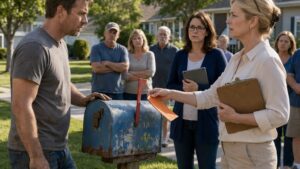
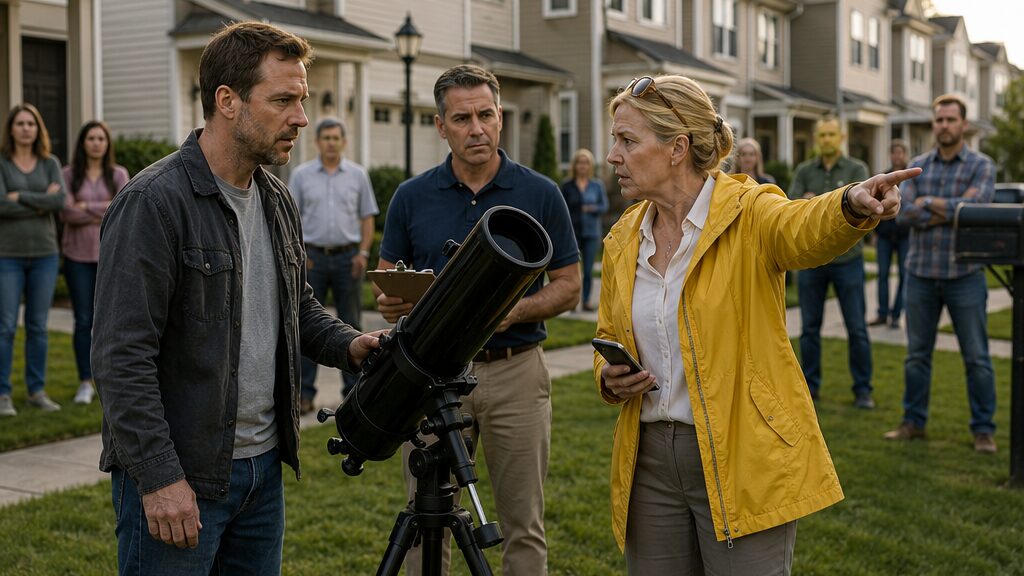
Patricia Clark’s finger stopped less than two feet from the telescope, as if the black tube on its tripod might move on its own. Her sunglasses were pushed into her blonde hair, and her pink zip-up jacket looked too bright against the clipped green of the common lawn. Two neighbors walking a terrier slowed at the corner. A garage door across the street stopped halfway up.
Ryan Carter kept one hand on the telescope mount.
“It’s a telescope,” he said.
Patricia’s eyes narrowed. “I can see that it looks like a telescope.”
He waited, because people usually filled silence with whatever they had already decided. His father used to say that. Sometimes silence saved a person the trouble of arguing. Sometimes, Ryan had learned, it made everything worse.
Patricia stepped onto the grass, careful not to sink her clean white sneakers into the softer ground near the sprinkler heads. “Why is it pointed at the houses?”
“It isn’t.”
“It is facing the homes on Willow Bend.”
“It’s facing east.”
“That’s where the homes are.”
Ryan looked past her, toward the row of townhomes with their beige siding, tidy shrubs, and identical porch lights. Above them, the late afternoon sky had begun to pale into the kind of blue that would disappear fast once the sun dropped behind the roofs. He had set the telescope early because the alignment always took longer when the green was crowded, and Daniel would be by after dinner if his mother’s shift ended on time.
Ryan adjusted the small silver knob near the mount. “I’m setting it up before dark.”
“For what?”
He should have said it then. He should have said, For Saturn. For a kid’s project. For something harmless. Instead, he heard the old tightness in Patricia’s voice, the polished certainty of someone who had already composed an email in her head, and his jaw set.
“For looking at the sky.”
Patricia gave a short laugh without humor. “The sky.”
“Yes.”
“With a telescope positioned beside a common area sidewalk, near private residences, after several evenings of unusual activity?”
The terrier’s owner pretended to check the dog’s leash. Ryan saw the man glance at the telescope, then at Patricia, then away. Nobody wanted to be part of an HOA issue until the issue was safely decided.
Ryan lowered his voice. “There’s no unusual activity.”
“You’ve been out here three times this week.”
“You’ve counted?”
“I notice things. That is part of keeping this community safe.”
Ryan’s hand tightened on the mount. The telescope shifted a fraction, and he stopped himself before correcting it too sharply. It had been his father’s old habit to touch the instrument gently, almost apologetically, as though glass remembered anger.
Patricia saw the movement and mistook it for guilt. “Are you watching people?”
The question landed louder than she had spoken it. The woman with the terrier looked down. The half-open garage door across the street resumed its rise, then stopped again.
“No,” Ryan said.
“Then you won’t mind telling me which windows you’ve been looking into.”
“I haven’t been looking into windows.”
“That’s exactly what someone would say if they were.”
Ryan almost laughed. Not because it was funny, but because the whole thing had the clean absurdity of a bad neighborhood forum thread. A man with a telescope. A committee chair with a suspicion. A patch of grass that had once held folding chairs and kids with paper cups of hot chocolate, back when his father still believed neighbors could be invited into something without ruining it.
He swallowed the memory.
“It’s a telescope, Patricia.”
“You know my name.”
“You’re on half the emails.”
Her mouth tightened. “And you’re Ryan Carter, 114 Willow Bend, freelance repair work, garage usually open after six, no standing committee assignments, no community volunteer record in the last four years.”
He stared at her.
She lifted her chin, as if the list proved something. “Residents talk.”
“No,” Ryan said quietly. “Residents watch.”
The words escaped before he could pull them back.
Patricia’s face changed. Not dramatically. Just a small hardening around the eyes, a tightening of the fingers around her phone. “Excuse me?”
Ryan looked down at the telescope case by his feet. The zipper was still open, foam cutouts visible inside. A red flashlight, a lens cap, the folded instruction card his father had laminated years ago. He nudged the case closed with his shoe.
“I’m packing up soon,” he said.
“You should pack up now.”
“This is common space.”
“Exactly.” Patricia’s voice sharpened. “Common. Not personal. Not a place to set up surveillance equipment without notice.”
“It isn’t surveillance equipment.”
“Then why are you so defensive?”
Ryan did not answer. The sky above the roofs had begun to lose its warmth. He could feel the evening slipping away, not just the light but the chance to align the finder scope before Daniel came by. Daniel was fourteen, maybe fifteen, all elbows and nervous focus, with a notebook full of careful drawings he tried to hide under his hoodie whenever neighbors passed. Ryan had promised him a clean look at Saturn when the seeing improved.
He had promised before checking the HOA common-area rules.
That, he knew, was the weak spot. Not spying. Not privacy. Not whatever story Patricia was building around him. Just a rule, probably buried in an attachment, about equipment on shared lawns.
Patricia tapped on her phone. “I’m documenting this.”
“Of course you are.”
“It is my responsibility.”
Ryan looked at her then. “Is it?”
For a second, something flickered across her expression—not doubt, exactly, but irritation touched by embarrassment. A neighbor had paused at the mailbox kiosk now. Another stood with a recycling bin in his driveway. Patricia knew they were watching. She straightened.
“Yes,” she said. “It is.”
Ryan bent to loosen one of the tripod legs. The telescope tilted, and he caught it with practiced ease. The movement was automatic, precise, almost tender. Patricia held up the phone, photographing him as though the care he took with the instrument only made him more suspicious.
“What are you planning to do with those?” Ryan asked.
“File a complaint.”
“For a telescope.”
“For unauthorized equipment in a common area and potential privacy violation.”
“Potential,” he repeated.
“That means we take it seriously before harm is done.”
Ryan folded the tripod legs in. Metal clicked against metal, small and final. Behind Patricia, the terrier tugged toward the grass, and its owner dragged it back too quickly.
Patricia glanced at the audience she had gathered, then back at Ryan. “If there’s nothing wrong, you’ll have nothing to worry about.”
Ryan had heard versions of that sentence before. At county offices. At school board meetings. At the last HOA meeting his father had ever attended, where a folding table had been covered with star charts and store-brand cookies, and someone had called the whole thing a liability issue before the first child got to look at the moon.
He slid the telescope into its case.
Patricia’s phone made a small sending sound.
The evening had gone still enough that Ryan heard it.
He lifted the case, heavier than it looked, and carried it across the common green toward his garage. Nobody stopped him. Nobody apologized. Nobody asked what he had hoped to see through it.
His phone buzzed before he reached his driveway.
He set the telescope case on the concrete and pulled the phone from his pocket. The email subject line was already waiting, official and cold under the HOA logo.
Resident Complaint Notice: Unauthorized Optical Device / Privacy Concern.
Ryan stood there with one hand on the telescope case, feeling the heat leave the black metal inside faster than the day left the sky.
Chapter 2: The Man Who Came With the Clipboard
William Davis arrived with a clipboard at exactly 4:58 p.m., which told Ryan the inspection was not a courtesy. It was a slot between two other problems, squeezed into the day and expected to close cleanly.
Patricia was already waiting on the common green.
She wore a yellow rain jacket despite the clear sky, and she stood beside the place where Ryan had set up the telescope two days before, as if guarding invisible evidence. Her phone was in one hand, her printed complaint in the other. The complaint pages were clipped so neatly Ryan could see the corner alignment from his driveway.
Ryan carried the telescope case across the street without hurrying. He had considered leaving it in the garage. He had considered answering the email with a single sentence: It was pointed at the sky. He had considered ignoring the whole thing until the HOA fined him, because that was what his father would have accused him of doing—letting stubbornness masquerade as principle.
Instead, he brought the telescope.
William looked up from the clipboard. He was a broad-shouldered man in a navy polo with the management company logo stitched above the pocket. His expression had the tired neutrality of someone paid to stand between people who wanted different versions of fairness.
“Mr. Carter?”
“Ryan is fine.”
“William Davis.” He extended a hand. “Community management office.”
Ryan shook it.
Patricia gave a small, controlled nod toward Ryan, not quite greeting him. “I appreciate you coming promptly, William. This has made several residents uncomfortable.”
Ryan looked around. The common green was emptier than usual, though curtains moved in two front windows. “Several?”
Patricia did not look at him. “People don’t always want to involve themselves publicly.”
William clicked his pen. “Let’s start with the basics. The complaint alleges two things: possible privacy intrusion and unauthorized equipment in a common area. I’m here to observe, not decide board action today.”
“Good,” Ryan said. “Then observe.”
Patricia’s eyes flashed. “That attitude is part of the concern.”
William lifted one hand slightly. “Let’s keep it simple.”
Ryan opened the case on the grass. The smell of foam and metal rose faintly in the cooling air. He extended the tripod legs, locked them one by one, set the optical tube into the mount, and tightened the bracket. It took less than a minute. He could do it in the dark. He could do it with cold fingers. He could do it while his father stood behind him saying, Don’t rush the stars; they’ve got time.
Patricia watched as if each click confirmed premeditation.
William crouched to look at the angle of the mount. “You set up here often?”
“Three times this week.”
Patricia made a small sound.
Ryan kept his eyes on the telescope. “For alignment practice and evening observation.”
“Observation of what?” Patricia asked.
Ryan straightened. “The sky.”
William turned slightly. “Can you be more specific?”
Ryan heard the politeness in the question, but also the warning. More specific was what reasonable people gave when they had nothing to hide.
“The moon when it’s up. Planets when conditions are right. Sometimes brighter deep-sky objects if the streetlights aren’t too bad.”
Patricia folded her complaint pages against her chest. “And yet the telescope is facing directly toward our homes.”
Ryan adjusted the altitude knob, then stepped back. “It’s facing east-southeast right now.”
“Which is where our homes are.”
“Above them.”
“That distinction is convenient.”
William moved behind the telescope and looked along its length without touching the eyepiece. “Ms. Clark, which residence are you concerned about specifically?”
“All of them along this side. Mine. The Halls’. The units near the bend.” She pointed in a clean line across the green. “From this position, he has a clear view right into second-floor windows.”
Ryan felt his face warm. “That isn’t how this works.”
Patricia turned. “Then explain how it works.”
The answer sat ready. Magnification. Focus distance. Field of view. The practical absurdity of using a long focal-length telescope to peer into bright windows while standing in a public green. But the words tangled with irritation. The more he explained, the more it would sound like he had studied the best way to deny it.
William noticed the pause.
“Mr. Carter,” he said, “would you be willing to show us what is visible through the instrument from this position?”
Ryan looked at him.
Patricia straightened. “I don’t think I should have to look through it.”
“You don’t have to,” William said. “But it may help clarify the privacy issue.”
Ryan loosened the clutch and moved the telescope, not toward the homes but above them, toward a pale point not yet visible to anyone but him. He knew it was too early for Saturn. Too much daylight. Too much haze. But he could align on a distant treetop above the roofline, far enough to show the angle, harmless enough not to invite another accusation.
He bent, made the fine adjustment, then stepped back.
“There,” he said.
William gestured to Patricia. “Ms. Clark?”
Patricia looked at the eyepiece as if it had insulted her. “I’m not interested in participating in his demonstration.”
“You filed a privacy complaint,” William said evenly. “This is the simplest way to assess what can be seen.”
A curtain moved in Patricia’s own second-floor window across the green. She saw it. Ryan saw her see it.
Her jaw tightened. She stepped forward.
Ryan moved away from the telescope, hands visible at his sides. He hated that he thought to do it. Hated that a hobby instrument on a lawn had turned into something requiring careful body language.
Patricia bent toward the eyepiece. She kept one hand on her complaint pages and one hand hovering near the telescope, refusing to touch it fully. Her eye reached the glass.
For two seconds, her posture stayed rigid.
Then her forehead creased.
She shifted slightly, as if the image might change if she found the right angle. “I don’t see a window.”
“No,” Ryan said.
William asked, “What do you see?”
Patricia did not answer immediately. When she finally spoke, her voice was lower. “A tree.”
“The top of the maple behind the units,” Ryan said. “Above the roofline.”
Patricia pulled back. A faint red had risen along her cheeks. “That doesn’t prove what he was doing two nights ago.”
“No,” William said. “It clarifies what the instrument is currently aimed at and how it is being positioned.”
“It could be repositioned.”
“So could binoculars,” Ryan said before he could stop himself. “So could a phone camera. So could a person standing at a window.”
Patricia turned on him. “You are not helping yourself.”
Ryan almost said, I stopped trying to help myself with this neighborhood years ago. He bit it back.
William wrote something on the clipboard. “The privacy allegation may require no further action unless there is evidence of misuse. However, the common-area provision is separate.”
Patricia seized the sentence. “Exactly.”
Ryan looked at William. “What provision?”
William flipped a page. “Section 6.4. Temporary structures, recreational equipment, displays, and unattended personal property may not be placed on common property without prior written approval.”
“The telescope wasn’t unattended.”
“Still equipment.”
“For an hour.”
“Still placed.”
Ryan looked at the green. The grass had mower stripes. The irrigation flags near the corner were crooked. A plastic scooter had been left by the mailboxes for three days last month, but nobody had filed a notice about that. He knew saying so would sound petty, and Patricia was waiting for petty.
William softened his tone by half a degree. “This doesn’t mean the board will prohibit it. It means you may need approval.”
Patricia folded her complaint papers with visible satisfaction. “And until then?”
William looked between them. “Until then, I’d advise Mr. Carter not to set up the telescope on common property.”
Ryan’s mouth went dry.
Tonight was supposed to be clear. Daniel had texted twice already about whether the rings would be visible.
Ryan latched the telescope case harder than necessary. The sound cut across the green.
Patricia flinched, then recovered. “That seems reasonable.”
Ryan lifted the case. “Reasonable.”
William lowered his clipboard. “Mr. Carter, the spying complaint may be wrong, but the violation isn’t gone.”
Ryan stood with the telescope weight pulling at his arm, watching Patricia tuck her phone away like a person who had lost one argument and won the one that mattered.
Chapter 3: The Boy Who Knew the Rings
Daniel Hall was waiting inside Ryan’s open garage with a notebook pressed to his chest and panic written plainly across his face.
Ryan stopped at the driveway.
The telescope case was still in his right hand. The garage smelled of sawdust, motor oil, and the faint cardboard dust from old moving boxes stacked along the wall. Daniel stood beside the workbench, half-hidden behind the lawn mower, as if he had come in and then realized too late that he was trespassing.
“I didn’t touch anything,” Daniel said quickly.
Ryan set the case down. “I know.”
“My mom said I should wait outside, but Ms. Clark was walking her loop again, and I didn’t want her to see me.”
That was exactly the sort of sentence that made Ryan want to pack the telescope into the back of his truck and drive it to some empty county road where nobody cared who looked up. Instead, he closed the garage door halfway, leaving enough space for air and not enough for neighbors to make easy guesses.
Daniel noticed the movement. “Is it bad?”
“It’s not good.”
“The complaint?”
Ryan nodded.
Daniel opened his notebook. The first page showed a careful pencil drawing of Saturn, shaded too heavily on one side, with small labels written in neat block letters: rings, shadow, tilt, Cassini division? He had added question marks wherever he refused to pretend certainty. Ryan liked that about him. Most adults faked knowledge faster than Daniel admitted doubt.
“Can we still observe tonight?” Daniel asked.
“Not from the green.”
Daniel’s face fell so quickly Ryan wished he had lied for one more minute.
“From your driveway?” the boy asked.
“Too many rooflines. Too much light. We might catch it later, but not the clean view we planned.”
Daniel looked toward the closed half of the garage door. “My presentation is Friday.”
“I know.”
“They asked for original observation if possible. Not just pictures online. I told them I had access to a telescope.”
“You do.”
“Not if the HOA says no.”
Ryan rubbed a hand over his jaw. The stubble rasped under his palm. He could tell Daniel the truth: that people with clipboards were often less interested in sense than process, and process could take longer than the window they needed. He could tell him that a scholarship committee would understand. He could tell him that one teenager’s project would not matter to a board that thought in liability paragraphs.
Instead, he opened the telescope case.
Daniel stepped closer despite himself.
Ryan removed the smaller eyepiece and held it out. “Tell me what this one does.”
Daniel blinked. “Now?”
“Now.”
“It gives higher magnification, but it’s harder to keep the image steady, especially if the atmosphere is bad.”
“Good. What else?”
Daniel took it carefully. “Narrower field of view. So it’s worse for finding, better for details once you’re centered.”
Ryan nodded. “You know more than you think.”
“That doesn’t help if I can’t see it.”
“It helps if you have to explain what went wrong.”
Daniel’s mouth twisted. “That sounds like losing with vocabulary.”
Ryan almost smiled. “Sometimes that’s all science is.”
The boy looked down at the eyepiece in his palm. His fingers were ink-stained from school, one thumbnail bitten short. He was trying not to look young and failing.
Ryan had first noticed him six weeks earlier near the mailboxes, staring up at a crescent moon while other kids cut across the green with basketballs. Daniel had asked one question about craters, then another about why planets did not twinkle like stars. The next evening he came back with a notebook. By the third, Ryan had brought out the telescope.
He had told himself it was informal. Temporary. Not a community event. Not a promise.
But Daniel had started saying “we” when he talked about the project, and Ryan had not corrected him.
A soft knock came at the side door.
Daniel snapped the notebook shut.
Ryan opened the door before the second knock. Elizabeth Hall stood on the small concrete step, still in navy scrubs under a gray cardigan, her hair pulled back with the tired precision of someone who had gone straight from work to worry.
“Daniel,” she said.
“I was just—”
“I know what you were just.” Her eyes moved from her son to Ryan, then to the telescope case. “Can I talk to Mr. Carter?”
Daniel’s shoulders tightened. “Mom.”
“Two minutes.”
Ryan gestured toward the driveway. Elizabeth stepped back outside with him, leaving Daniel in the garage. The air had cooled. Across the street, Patricia’s porch light was already on.
Elizabeth folded her arms, not angry, not quite. “I’m grateful for what you’ve been doing.”
Ryan said nothing.
“I mean that,” she said. “He talks about planets more than he talks about school, and lately that’s been better than him not talking at all.”
“He’s good at it.”
“I know.” Her face softened for one second, then tightened again. “But I can’t have him in the middle of whatever this is.”
“He isn’t.”
“Patricia took pictures.”
Ryan’s eyes moved to hers.
Elizabeth nodded toward the green. “Last week. Maybe before that. Daniel near the telescope. You beside him. I saw her from my kitchen window.”
Ryan felt the old anger rise, quick and clean. “She photographed your kid?”
“She photographed the common area,” Elizabeth said carefully, the way people spoke when they could already hear the defense from the other side. “That’s what she’ll say.”
“I can talk to her.”
“Please don’t.”
“Elizabeth—”
“No.” The word came sharper than either of them expected. She lowered her voice. “You don’t understand. I rent from my sister. I’m allowed to live here because she convinced the board it was temporary after my divorce. I don’t need Patricia deciding we’re another problem to solve.”
Ryan looked toward the line of townhomes. The same windows. The same porches. The same people behind blinds, measuring what counted as trouble.
Elizabeth rubbed her forehead. “Daniel finally has something that makes him feel like he belongs somewhere bigger than this street. I don’t want that taken from him. But I also can’t have his name in an HOA complaint.”
“I won’t use his name.”
“That may not be up to you.”
Inside the garage, Daniel’s shadow moved behind the frosted glass panel. Listening, probably. Pretending not to.
Ryan heard himself say, “I should have filed for approval.”
Elizabeth’s expression shifted. It was the first time he had said it plainly.
“Yes,” she said. “You should have.”
The words did not accuse him as much as the truth in them did. He had known the rules might matter. He had avoided them because paperwork turned wonder into permission, because permission could be denied, because denial had already happened once in this same neighborhood to a better man than him.
Elizabeth glanced toward Patricia’s house. “Just keep Daniel out of it, okay?”
“I will.”
She nodded, then opened the garage door enough to call her son.
Daniel came out with his notebook tucked under his arm. He looked at Ryan as if waiting for a secret signal that everything could still happen.
Ryan had none to give.
After they left, he stood in the garage with the telescope case open, the eyepiece still on the workbench where Daniel had set it down. The small glass circle caught the overhead light and reflected it back, bright but useless.
His phone buzzed.
This time the email was from the HOA portal, not William. Patricia Clark had uploaded additional evidence to the complaint file.
Ryan opened the attachment.
There he was on the common green, one hand on the telescope, his face turned away. Beside him stood Daniel, notebook open, looking through the eyepiece with his whole body tilted toward the sky.
Under the photo, Patricia had typed one sentence:
Repeated nighttime activity involving a minor resident confirms the need for immediate board review.
Chapter 4: The Rule That Closed the Night
Ryan saw his telescope listed under “Resident Safety Concerns” before he saw his own name.
The agenda lay on the folding table at the front of the HOA board room, printed on white paper with the community logo in blue across the top. Item four sat between irrigation repairs and pool gate access, as if his telescope belonged to the same category as broken sprinklers and lost key cards.
Unauthorized optical equipment after dusk.
Ryan stood just inside the doorway and read the line twice.
Behind him, two neighbors squeezed past with paper cups of coffee. One of them glanced at him, then at the agenda in his hand, and looked away too quickly. The room smelled of carpet cleaner, burnt coffee, and the dry paper scent of packets nobody wanted but everyone took. Fluorescent lights buzzed overhead.
Patricia Clark sat in the front row with a folder on her lap. She did not turn around, but Ryan knew she had seen him. Her posture changed by a fraction, becoming straighter, more formal, as though the meeting itself had plugged her into an outlet.
William Davis stood near the wall, flipping through his clipboard. When Ryan entered, William’s eyes lifted briefly. Not friendly. Not hostile. A man marking an expected complication.
Ryan took a chair at the end of the third row and kept the folder he had brought closed on his knees. Inside were two pages he had printed from the HOA rules, a diagram of telescope angles, and a short explanation he had written, deleted, rewritten, and almost thrown away. He had not included Daniel’s name. He had not included his father’s.
The board president tapped a pen against a water bottle. “Let’s move to item four.”
Patricia rose before anyone asked her to.
Ryan felt the room shift toward her.
“Thank you,” she said, voice calm and prepared. “This matter began as a privacy concern, but it has become clear that the larger issue is uncontrolled use of common property after dark.”
William’s pen paused above his clipboard.
Patricia opened her folder and distributed several printed photos to the board members. Ryan recognized the first image before it left her hand: the telescope on the common green, angled toward the roofline. The second photo showed him adjusting the tripod. The third made his stomach tighten.
Daniel, leaning into the eyepiece.
Patricia kept her voice even. “As you can see, this activity has not been isolated. It has involved repeated nighttime gatherings and at least one minor resident.”
A board member murmured something Ryan could not catch.
Ryan’s fingers closed around the edges of his folder.
Patricia continued. “My concern is not merely one resident’s hobby. It is precedent. If one person can set up equipment in common space after dusk without notice, what prevents others from doing the same? Cameras, drones, amplified music, private events. We have rules for a reason.”
Ryan looked at the photo of Daniel as it slid from hand to hand across the board table. The boy’s face was partly turned away, but not enough. His notebook was visible. So was the concentration in his posture.
“He’s a kid,” Ryan said.
Patricia looked back then. “Exactly.”
The word landed wrong.
Ryan stood. “He was looking at Saturn.”
The room went quiet, but not in the way he wanted. More like people had been offered a detail they did not know where to put.
Patricia’s chin lifted. “Mr. Carter, no one is criticizing a child for being curious.”
“You put his picture in a complaint packet.”
“I documented activity related to the violation.”
“You photographed him without asking his mother.”
Patricia’s face tightened. “From a public common area.”
Ryan heard the trap, stepped into it anyway. “Public enough for your camera, but not public enough for a telescope?”
A few heads turned. Someone in the back made a small sound, half cough, half interest.
The board president raised a hand. “Let’s keep this civil.”
William took one step away from the wall. “For the record, my inspection did not support the claim that the telescope was being used to look into residences.”
Patricia turned toward him. “I did not say it proved that.”
“You strongly implied it,” Ryan said.
“And you refused to provide context when asked.”
The room caught that, too.
Ryan felt the heat rise in his throat. He had context. He had too much of it. He had Daniel’s careful drawings, his father’s laminated star cards, the old flyer from a neighborhood night that had ended with folding chairs stacked in silence. He had years of refusing to explain things to people who turned explanations into attachments.
The board president cleared his throat. “The management recommendation is not a fine at this stage. It is a clarification. No resident-owned equipment may be placed on common property after dusk without written approval. That includes telescopes.”
Ryan looked at William. “After dusk?”
William’s eyes stayed on the board table. “That is the draft language.”
“That makes the telescope useless for planets.”
A board member shrugged apologetically. “It can still be used from your private property.”
“Not with the roofline. Not with the streetlights.”
Patricia said, “Then perhaps this community is not the right venue for that activity.”
Something inside Ryan went very still.
He saw his father standing in this same room twelve years earlier, though the carpet had been darker then and the chairs had been metal instead of plastic. Gary Carter had brought a box of paper star wheels, a thermos of hot chocolate, and too much hope. He had smiled while someone explained liability. Smiled while another resident asked if children wandering after dark would affect insurance. Smiled right up until the board asked him to remove the telescope from the green before people arrived.
Ryan had been twenty-nine and embarrassed by how badly his father wanted the neighborhood to say yes.
His father had carried the telescope home without a word.
Now Patricia stood in front of a different board, using different language to close the same sky.
Ryan opened his folder. The pages shook slightly, so he closed it again.
“You know what,” he said, too loudly, “just ban it.”
The board president blinked. “Mr. Carter—”
“Put it in the rules. No telescopes, no chairs, no kids learning anything after sunset unless it fits in a committee-approved planter.”
Patricia’s mouth parted.
William said quietly, “Ryan.”
But Ryan had already pushed the chair back. The scrape cut across the room.
“You want context?” he said, looking at Patricia because looking anywhere else might make him stop. “No, you don’t. You want a violation. You found one. Congratulations.”
The silence that followed was not victory. It was worse. It was the sound of everyone deciding he had confirmed something, though not the thing Patricia first accused him of.
Ryan picked up his folder and walked out before the vote.
In the hallway, the air felt cooler. He stopped beside the bulletin board where notices curled under clear thumbtacks: pool hours, landscape schedule, lost cat, spring cleanup day. His breath came hard through his nose.
The board room door opened behind him.
William stepped out, clipboard lowered at his side. He did not speak right away.
Ryan stared at the lost cat flyer. The cat had been found; someone had written HOME in blue marker across the bottom.
Finally William said, “That did not help you.”
Ryan laughed once, without humor. “I got that.”
“You were making points until you stopped making points.”
“I’m not good in rooms like that.”
“I noticed.”
Ryan turned. “Is this where you tell me to apologize?”
William’s expression did not change much, but something tired moved through it. “This is where I ask why a telescope matters enough for you to burn your own argument down.”
Ryan’s grip tightened around the folder.
From inside the board room, Patricia’s voice rose again, polished and controlled, carrying through the closed door in pieces: safety, common space, reasonable limits.
William waited.
Ryan looked toward the exit, toward the strip of evening visible through the glass doors, already dimming behind the roofline.
“My father tried this once,” he said.
William’s pen stopped moving.
Ryan opened his mouth to say more, but the board room door clicked behind them, and Patricia stepped into the hallway holding Daniel’s photo on top of her folder like proof that had not finished doing damage.
Chapter 5: The Old Star Chart in the Garage
The old star chart fell out of the telescope case when Ryan lifted the foam insert, and for a second he could not touch it.
It landed face down on the garage floor, one corner bent, the paper yellowed along the creases. His father’s handwriting showed through from the other side in blue ink: April viewing list. Moon. Venus. Saturn if clear.
Ryan stood over it in the morning light with a screwdriver in one hand and no memory of picking it up. He had opened the case to clean the lens. That was all. Something simple. Something practical after a night of bad sleep and worse imagination.
The HOA portal still showed the meeting status as pending. Under attachments, Patricia’s photos sat in a row. Daniel’s face had been blurred sometime after midnight. William’s doing, probably. Not enough to undo it.
Ryan crouched and turned the chart over.
His father had drawn little boxes beside each object, the way he used to when planning a neighborhood viewing night. Not because the sky followed lists, but because children liked checking things off. In the bottom corner, he had written, Bring extra step stool. Smaller kids can’t reach eyepiece.
Ryan pressed his thumb over the words until the ink blurred under his skin.
A knock sounded at the garage frame.
He looked up too quickly.
Patricia stood just outside, not crossing the threshold. She wore a pale blouse under a beige cardigan this time, softer colors than the yellow jacket, but her folder was still tucked under one arm. Without the board room behind her, she looked less official and more like a woman who had rehearsed three openings and disliked all of them.
Ryan folded the chart once, carefully.
“If you’re here about the vote,” he said, “I’m waiting for the portal like everybody else.”
“I’m not here officially.”
“That’s new.”
Her eyes moved to the telescope case, then to the paper in his hand. “William said I should speak with you.”
“William says a lot for a man who prefers neutrality.”
“He said I may have overstated the privacy concern.”
Ryan stood. “May have.”
Patricia accepted the correction with a small tightening of the jaw. “I overstated it.”
The apology should have felt better than it did. It should have opened something. Instead, Ryan heard the board room again, the phrase minor resident, the scrape of his own chair, his father’s silence under old fluorescent lights.
“Was that all?” he asked.
Patricia looked toward the back of his garage. Shelves of tools lined one wall. A broken toaster from a neighbor sat on the bench with its screws arranged in a magnetic tray. The telescope, half-open in its case, occupied the center like an object awaiting judgment.
“I didn’t know the boy’s face would remain visible in the packet,” she said.
“You uploaded the photo.”
“I know.”
“Then you knew what was in it.”
Her hand tightened around the folder. “I was trying to show repeated use.”
“No. You were trying to make repeated use look suspicious.”
Color rose in her cheeks. For a moment the old Patricia came back, the committee chair ready to defend each word. Then she seemed to swallow it.
“My son told me last month that I treat every conversation like a hearing,” she said.
Ryan did not answer.
“He said that when I visit, I inspect his apartment instead of asking how he is.” She gave a short, embarrassed breath. “I told him I was helping. He said that was what I called it when I wanted to be needed.”
The garage settled around them. Somewhere down the street, a mower started, then stalled.
Ryan looked at her then, truly looked. Patricia’s hair was clipped back neatly, but not as firmly as usual. Under her sunglasses, which hung from the neckline of her blouse, her eyes looked tired. Not defeated. Not harmless. Just tired in a way Ryan recognized because he had seen it in the mirror after years of pretending not to want anything from neighbors.
“That doesn’t give you the right to make Daniel part of it,” he said.
“No,” she said. “It doesn’t.”
The words were plain. They did not fix anything, but they did not dodge either.
Ryan opened his hand. The star chart unfolded slightly.
Patricia noticed the handwriting. “Is that old?”
“My father’s.”
“He lived here?”
“Before most of the current board did.”
“I don’t remember him.”
“You might remember shutting him down.”
Patricia’s head lifted. “I wasn’t on the board then.”
“No. But the room was the same.”
He regretted it as soon as he said it. Not because it was false. Because it was too much truth aimed at the wrong person.
Patricia stepped back half an inch. “What happened?”
Ryan almost folded the chart away. The habit rose in him like a door closing. He could say nothing. He could let her leave with her partial apology and her folder and her need to be official.
Instead, he looked at the telescope.
“He organized a stargazing night,” Ryan said. “Years ago. Nothing fancy. Folding chairs. Hot chocolate. He made star wheels for the kids. Got told an hour before it started that the green wasn’t approved for night use. Liability, supervision, common-area obstruction. Pick your phrase.”
Patricia was quiet.
“He had already told people to come,” Ryan said. “He had to stand out there and turn them away.”
“Why didn’t he apply again?”
Ryan smiled faintly, but there was no humor in it. “You ever see someone get embarrassed for caring too much? They don’t usually ask for a second round.”
Patricia looked down.
Ryan folded the chart along its old crease. “He kept the telescope. Stopped inviting people.”
“And you?”
“I learned.”
“That if you don’t ask, no one can refuse.”
He looked at her sharply.
She did not look pleased with the insight. If anything, she looked sorry to have said it.
A phone chimed from inside her folder. She pulled it out, read the screen, and her posture changed again. Committee chair returning. Armor sliding into place, but not all the way.
“The board scheduled the final vote,” she said.
“When?”
“Tomorrow evening.”
Ryan stared at her. “Daniel’s observation night is tomorrow.”
“I don’t know what that means.”
“It means if they ban common-area equipment after dusk tomorrow, his chance is gone.”
“Can he observe somewhere else?”
“He needs a clear southeast line. The green is the only place in walking distance without the roofline blocking it.”
Patricia looked toward the common area across the street. In daylight it seemed harmless, almost too small for so much conflict: a rectangle of grass, a maple tree, the sidewalk curving past mailboxes.
“I can’t stop the vote alone,” she said.
“You started it.”
Her face tightened, but she did not argue. “Then submit a request.”
Ryan laughed under his breath. “By tomorrow?”
“Yes.”
“They won’t approve it.”
“Maybe not.”
“That’s your advice?”
“My advice,” she said, choosing each word carefully, “is to give them something other than your anger to vote on.”
Ryan looked at the star chart in his hand. Bring extra step stool. Smaller kids can’t reach eyepiece.
His father had prepared for children who might never arrive. Ryan had spent years pretending that preparation was foolish.
Patricia turned to leave, then paused at the edge of the driveway. “For what it’s worth, I should have looked before I filed.”
Ryan did not forgive her. Not then. But he believed the sentence had cost her something.
After she left, he cleared the workbench. He pushed aside the toaster, the magnetic tray, the old receipts. He opened his laptop and downloaded the community-use form he had avoided for years.
Applicant: Ryan Carter.
Purpose of requested use: Supervised astronomy observation for residents.
He stopped at the description box.
Outside, the common green waited under the flat white morning sky.
Ryan unfolded his father’s chart beside the keyboard, placed Daniel’s careful Saturn sketch next to it, and began to write a request that finally told the truth before someone else could turn silence into proof.
Chapter 6: The Night the Board Had to Look Up
Ryan carried the telescope into the board room instead of a speech, and every conversation stopped before the door had finished closing.
The tripod legs were folded against the tube. The black case bumped once against his knee. He had polished the lens, tightened the mount, packed three eyepieces, two red flashlights, his father’s star chart, Daniel’s sketch, and the printed community-use request in a folder that already had a crease down the middle from being held too tightly.
Patricia sat in the front row, hands folded over her own folder.
William stood near the wall again, but this time his clipboard was tucked under one arm. When he saw the telescope, his mouth tightened—not disapproval, exactly. Recognition of risk.
The board president stared. “Mr. Carter, equipment isn’t usually brought into—”
“I know,” Ryan said. “I won’t set it up in here.”
A few chairs creaked. Someone whispered near the coffee table.
Ryan placed the telescope case gently beside his chair and stayed standing. If he sat, he might not get back up. If he opened with anger, he would lose them before the first sentence ended.
The board president looked toward William, then back at Ryan. “We’ll allow a brief comment before the vote.”
Ryan nodded.
Brief was not enough for twelve years. It would have to be enough for tonight.
He opened the folder. The paper inside shook once before he pressed it flat against the back of a chair.
“I used the common green without written approval,” he said.
The room shifted. Patricia looked down.
“That part of the complaint is true. I knew there were probably rules about equipment, and I didn’t check because I didn’t want to ask permission for something I thought should be harmless.”
His throat tightened. He kept going before pride could close it.
“That was my mistake.”
William’s pen moved.
Ryan looked at the board, not at Patricia. “The telescope was not used to look into homes. William verified the angle. Ms. Clark looked through it. There has been no evidence of privacy misuse because there was no misuse.”
Patricia’s fingers moved slightly against her folder, but she did not interrupt.
Ryan slid copies of his proposal onto the front table. “I’m asking for a limited supervised use permit. One night a month. Ninety minutes. Common green only. No photography through the telescope. No setup within twenty feet of any residence-facing sidewalk. Red safety lights only. Sign-up sheet. Parent or guardian present for minors. Equipment removed immediately after.”
A board member leaned forward despite herself.
Ryan placed another page beside the proposal. “This is the sky position for tomorrow evening. Saturn clears the roofline from the green. It doesn’t from my driveway. That matters because one resident has an astronomy presentation due Friday.”
He did not say Daniel’s name.
From the second row, a chair scraped.
Elizabeth Hall stood.
Daniel sat beside her with his notebook on his lap, eyes fixed on the floor.
Elizabeth’s voice was low but steady. “It’s my son.”
Ryan turned toward her, startled.
She did not look at him. She looked at the board. “He’s the student. Mr. Carter didn’t want to involve him because I asked him not to. I was worried about gossip. I still am.” Her hand brushed Daniel’s shoulder once. “But my son has been working on this for weeks. He didn’t do anything wrong.”
Daniel’s face flushed, but he did not shrink.
Elizabeth continued, “Mr. Carter gave him time and patience. Not secretly in the way people are implying. Quietly. There’s a difference.”
No one spoke.
That difference seemed to settle over the room, making several people uncomfortable in different directions.
Patricia looked back at Elizabeth. Something in her expression changed—not softening entirely, but absorbing a consequence she had kept at arm’s length when it was just a photo in a packet.
William stepped forward. “Management has reviewed Mr. Carter’s written proposal. With the restrictions listed, I believe the board could approve a temporary trial without creating broad permission for unattended common-area equipment.”
The board president frowned. “The draft rule would need modification.”
“Yes,” William said. “That may be better than passing language so broad it prohibits harmless supervised resident activity.”
Patricia’s head turned toward him.
Ryan heard the careful edge in William’s words. Neutrality had finally chosen a shape.
The board president looked at Patricia. “Ms. Clark, since you brought the complaint, do you have a response?”
Patricia stood slowly.
For a moment, Ryan braced for the polished version: privacy, precedent, responsibility. He could almost hear it before she opened her mouth.
“I still believe privacy matters,” she said.
A few board members nodded.
“And I still believe common areas need rules.”
Ryan lowered his eyes. Of course.
“But,” Patricia continued, and the word made him look up, “I did not verify enough before I characterized the activity. I treated uncertainty as evidence. That was unfair to Mr. Carter.”
The room changed in a way Ryan could feel more than hear.
Patricia turned slightly, not fully toward him. “And it was unfair to the Hall family.”
Elizabeth’s face remained guarded, but she nodded once.
Patricia swallowed. “I support a temporary supervised permit with the safeguards listed. I would also suggest advance notice to residents, so no one misunderstands what is happening.”
The board president blinked, then made a note.
Ryan should have felt relief. Instead, he felt the dangerous looseness of something that had been held too tightly for too long. He picked up the telescope case.
“Then look,” he said.
The board president stiffened. “Mr. Carter—”
“Not in here.” Ryan’s voice was quieter now. “Outside. Five minutes. Before you vote on whether the green can be used for this, look at what the green is good for.”
No one moved.
Then Daniel stood, clutching his notebook.
William looked at the board president. “There’s no procedural issue with a demonstration before the vote, provided no decision is made outside the meeting.”
The president sighed like a man surrendering to common sense with reluctance. “Five minutes.”
They walked out together in an awkward procession: board members, neighbors, Elizabeth and Daniel, William with his clipboard, Patricia with her folder held against her ribs. Ryan carried the telescope across the parking lot and onto the common green.
Evening had deepened into blue-black. Porch lights glowed along Willow Bend. A few residents who had not attended the meeting came outside when they saw the group.
Ryan unfolded the tripod legs. This time, no one spoke while the metal clicked into place.
Daniel handed him the eyepiece without being asked.
Ryan set the angle, adjusted the finder, and leaned briefly to the glass. His pulse hammered so hard he had to steady his breath. For one terrible second he saw nothing but dark blur. Then he touched the fine-focus knob, slow, slower, until the pale oval sharpened and the rings appeared, small and impossible.
He stepped back.
The first person he looked at was Patricia.
She froze.
Ryan could have made it a punishment. He could have said something sharp enough to be remembered. He could have handed the eyepiece to Daniel, to Elizabeth, to anyone else.
Instead he said, “Would you like to see?”
Patricia crossed the grass as if every step had witnesses. At the telescope, she hesitated. Ryan moved away, leaving space.
She bent to the eyepiece.
The common green held its breath.
Her shoulders, tight and square, slowly lowered.
“Oh,” she said.
It was barely a sound.
Daniel, unable to help himself, leaned forward. “Do you see the rings?”
Patricia stayed at the eyepiece. “I think so.”
Ryan adjusted the focus a fraction for her. “There.”
Patricia inhaled.
Her voice came out almost childlike, stripped of committee polish and complaint language and all the phrases people used when they were afraid of being wrong.
“Is that Saturn?”
Daniel looked at Ryan, then at the line of neighbors gathering behind her.
“Yep,” he said.
Chapter 7: The Woman Who Stayed After Everyone Else
A line of neighbors waited behind Patricia in the dark, and nobody knew where to put their hands.
Some held paper cups from the board room. One child bounced on the balls of her feet until her parent touched her shoulder. A man who had once complained about leaf blowers after 7 p.m. stood with his arms crossed, trying to look as if he had always intended to attend an astronomy demonstration in the common green.
Patricia remained at the eyepiece.
Ryan watched her from beside the tripod, close enough to protect the telescope, far enough not to turn the moment into instruction. He had expected her to step back quickly, embarrassed by the attention. Instead, she stayed bent toward the small circle of glass, one hand hovering near the focuser but not touching it, her folder pressed against her side.
Daniel shifted beside him. “Should I tell her about the tilt?”
Ryan looked at him. “Ask her what she sees first.”
Daniel swallowed, then stepped closer. “Ms. Clark?”
Patricia pulled back as if waking. “Yes?”
“Can you see how the rings aren’t straight across? They’re tilted.”
She bent again, more carefully this time. “Yes. A little.”
“That’s because we’re seeing them from an angle. The rings are thin compared to how wide they are, so sometimes they look more open and sometimes they almost disappear.”
Patricia listened without moving.
The board president stood a few feet away with his hands in his jacket pockets. William had taken position near the sidewalk, neither managing nor withdrawing, his clipboard finally held down at his side. Elizabeth stood behind Daniel, quiet but alert, ready to step in if the attention became too much.
A child whispered, “Can I see?”
Patricia stepped back immediately. “Of course.”
The child climbed onto the small step stool Ryan had brought without thinking. He had found it in the garage near the workbench, paint-splattered and old, the same one his father had used for smaller kids. He had almost left it behind. Carrying it across the green had felt like carrying a piece of unfinished business.
Ryan lowered the telescope a fraction and held the side steady. “Don’t grab the eyepiece. Just look.”
The child leaned in, then gasped so sharply that several adults laughed.
That sound changed the green more than the board vote had.
One by one, people stepped forward. Some looked for only a second, said “wow” too loudly, and moved aside. Some pretended not to be impressed until they forgot to pretend. A neighbor asked if Saturn was really that color, and Daniel explained atmosphere and distance with both hands moving in the air. Another asked if the telescope could see the flag on the moon. Daniel started to answer with too much seriousness, caught Ryan’s eye, and managed not to make anyone feel foolish.
Patricia stood apart, listening.
Not leaving.
When the board president finally cleared his throat, Ryan expected the spell to break. But the man only said, “We still have to finish the meeting.”
The group moved awkwardly back toward the board room, leaving Ryan, William, Patricia, Elizabeth, and Daniel near the telescope. A few children turned around twice before their parents guided them inside.
Patricia looked at Ryan. “I owe you more than what I said in there.”
Ryan put the lens cap into his pocket. “Maybe.”
She accepted that.
Elizabeth stepped closer, arms folded against the evening chill. “You also owe my son an apology.”
Patricia turned to Daniel. For the first time since Ryan had known her, she seemed unsure of the correct posture. Not committee-straight. Not neighbor-stiff. Just a woman standing on grass in the dark.
“You’re right,” Patricia said. “I used your picture to make a point before I understood what I was showing. I’m sorry.”
Daniel looked down at his notebook. “Okay.”
Elizabeth did not rescue her. Ryan respected that.
Patricia nodded once, as if the simple answer was all she had earned. Then she looked at the telescope again. “May I ask one thing?”
Ryan waited.
“Was it always Saturn?”
“Mostly.”
“What else?”
Ryan almost gave the short answer. Moon. Venus. Whatever was visible. The old habit rose, offering him the cleanest exit.
Instead, he reached into the open case and took out the folded chart.
“My father used to plan nights like this,” he said.
Patricia’s gaze lowered to the paper.
Ryan unfolded it enough for the nearest red flashlight to catch the old handwriting. Daniel leaned in, curious. Elizabeth’s face softened when she saw the line about the step stool.
“He wrote that?” Daniel asked.
Ryan nodded. “He thought details mattered.”
“They do,” Daniel said.
The words struck with such directness that Ryan had to look away for a moment.
Inside the board room, chairs scraped. The vote took less than ten minutes after that. The draft ban did not pass as written. Instead, the board approved a thirty-day trial permit for one supervised astronomy night, with notice to residents, a sign-up sheet, no recording, no unattended equipment, and William to review after the first event.
It was not a grand victory. It came with conditions, signatures, and the possibility of being reversed. But when William handed Ryan the stamped temporary approval, the paper felt less like permission and more like a door left open.
One month later, the line on the green was longer.
Ryan had posted the notice exactly as required: date, time, safety rules, parent supervision, red lights only. Patricia had reviewed the wording and suggested removing the phrase “for anyone interested,” replacing it with “for residents and their guests,” because rules still mattered to her. Ryan had almost bristled, then realized she was right.
Daniel had made a small hand-drawn sign showing Saturn, Jupiter, and the moon, with arrows that did not quite line up but looked better than anything printed.
Elizabeth brought a thermos of hot chocolate and disposable cups. “Not an official refreshment table,” she said when Ryan raised an eyebrow. “Just a mother standing near a thermos.”
William came by in a jacket instead of a polo and stood at the edge of the gathering, making no notes at all.
Patricia arrived last, carrying a clipboard.
Ryan saw it and felt his shoulders tighten.
She noticed. “Sign-up sheet,” she said, holding it out.
He looked at the top page. Names, time slots, phone numbers optional. At the bottom, in Patricia’s precise handwriting, she had added: Please allow children first viewing when objects are low in the sky.
Ryan handed it back. “Good note.”
“I do occasionally have those.”
Daniel, who had been adjusting the red flashlight taped to one tripod leg, hid a smile.
The night did not go perfectly. A younger child bumped the tripod and Ryan had to realign. One neighbor complained that the line moved slowly. A porch light came on and washed out the view for five minutes until Patricia crossed the street and asked, politely but with unmistakable committee authority, whether it could be turned off until nine.
The neighbor near the mailbox kiosk muttered, “Still seems a little suspicious, all this equipment in the dark.”
Patricia turned before Ryan could.
“It’s not suspicious,” she said. “It’s scheduled, supervised, and pointed at Jupiter.”
The neighbor blinked. “I was just saying—”
“I know what you were saying.” Patricia lifted the clipboard. “You’re welcome to sign up.”
Ryan looked down at the eyepiece and adjusted the focus so no one would see his expression.
Later, Daniel stood beside the telescope with three children gathered around him. He had stopped hiding his notebook. He held it open, showing the difference between drawings from memory and drawings after observation.
“Saturn’s rings look like one solid thing from here,” he told them, “but they’re made of ice and rock. A lot of pieces moving together.”
One child asked, “Why don’t they fall?”
Daniel looked to Ryan automatically, then stopped himself. “Because they’re moving fast enough around the planet that gravity keeps them there instead of pulling them straight down.”
The answer was not perfect, but it was his.
Elizabeth heard it. Her hand came up to her mouth briefly, then dropped before Daniel looked over.
Ryan stepped back from the telescope.
For years, he had thought the worst thing the neighborhood had done to his father was shutting down an event. Now, watching Daniel point carefully at the sky, he understood the deeper damage. It had taught Ryan that offering something could make it smaller. That if you loved a thing privately, nobody could vote on it. That if you stayed quiet, no one could call your care unreasonable.
But silence had nearly cost Daniel his chance.
It had nearly turned wonder into evidence.
The line thinned as the evening cooled. Families drifted back to their homes. William gave Ryan a nod and left without a report. Elizabeth collected cups. Daniel walked two younger children back to the sidewalk, explaining why stars twinkled and planets mostly did not.
Patricia stayed.
When Ryan looked up from packing the spare eyepiece, she was still near the telescope, hands clasped around the clipboard, eyes on the sky rather than the houses.
“You can take another look,” he said.
“I don’t want to hold up the line.”
“There isn’t a line.”
She glanced around, as if surprised to find that true.
Ryan adjusted the telescope toward Saturn again. It had moved higher, cleaner now, above the roofline that had caused so much trouble. He stepped aside.
Patricia bent to the eyepiece.
The common green was quiet enough for Ryan to hear the faint click of cooling metal. Across the street, windows glowed with ordinary evening life. People eating late dinners. Televisions flashing. Someone rinsing dishes. All the private worlds Patricia had claimed to protect and Ryan had resented, sitting under the same dark.
After a long while, she said, “My son used to have glow-in-the-dark stars on his ceiling.”
Ryan did not speak.
“I peeled them off when he was thirteen,” she said. “He said they were childish. I believed him too quickly.”
The admission floated there, small and strange.
Ryan looked at the telescope case, at his father’s chart tucked safely inside. “Kids say things before they know what they’re asking us to save.”
Patricia pulled back from the eyepiece. Her eyes shone, though she did not cry. “Adults too, I suppose.”
Daniel returned, hands in the pockets of his hoodie. “Mr. Carter? Do you want me to bring the stool back to your garage?”
Ryan looked at the old step stool standing beside the tripod, its paint-splattered legs pressed into the grass. For a second, he saw his father’s hand on it. Then Daniel’s. Then a line of children waiting in the cold.
“No,” Ryan said. “Leave it with the telescope stuff.”
“For next time?”
Ryan looked across the green.
Patricia had moved to the sign-up sheet and was carefully clipping the pages into place so they would not blow away. Elizabeth was walking toward them with the empty thermos under one arm. The board’s temporary approval sat folded in Ryan’s jacket pocket, imperfect and conditional and real.
“For next time,” Ryan said.
He loosened the telescope mount and lowered the tube into its case, but he did not fold the tripod. Not yet.
The black legs remained planted in the common green under the open sky, waiting for another night when someone would have to choose whether to look through the lens or only at the thing they feared it might be.
The story has ended.