She Removed the Bench Everyone Needed, Then Learned Why One Empty Space Would Not Stay Quiet
Chapter 1: The Argument Began Where the Green Bench Had Been
“Where is it?”
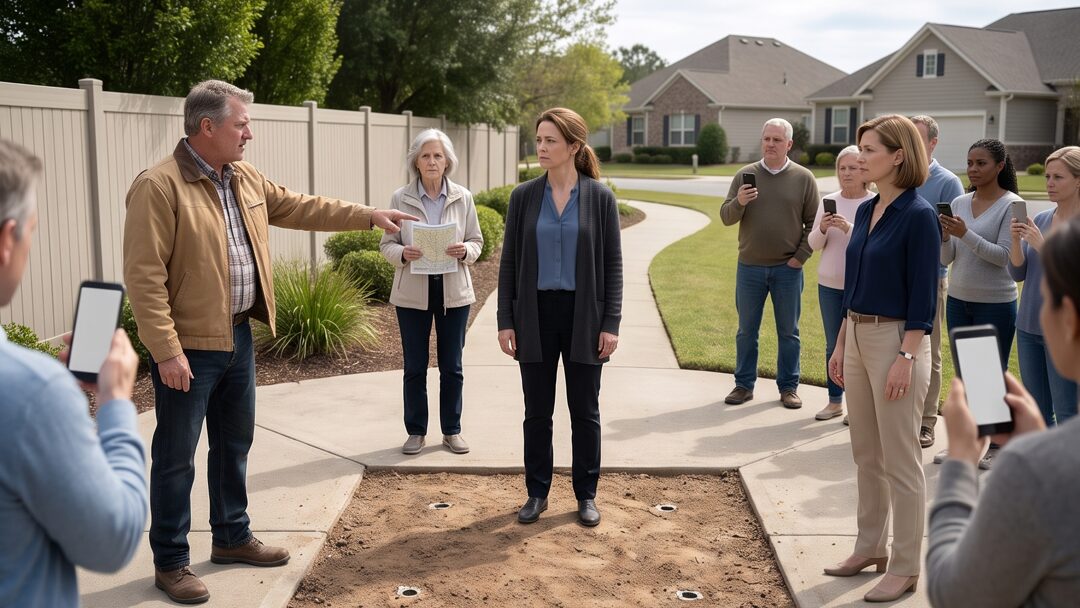
Thomas Wright stood with one arm extended toward the bare ground, his finger aimed at the rectangular patch of dirt as if Michelle Carter had buried something there.
She stopped on the path with her coffee still in her hand.
Four dark bolt holes showed through the exposed soil. The grass around them had been flattened into pale edges where the bench legs had once stood. Two days earlier, a green metal bench had occupied that exact space beside the walking loop, close enough to Michelle’s rear fence that she could hear every late-night conversation through her bedroom window.
Now there was only dirt.
Thomas looked at her. “I asked where the bench went.”
“You know where it went.”
“No, I know it’s gone.”
A couple walking a small dog slowed near the curve. Michelle noticed them pretending not to listen.
She took a sip of coffee. It had already gone lukewarm.
“The contractor removed it.”
Thomas’s face changed, not dramatically. That made it worse. “What contractor?”
“The landscaping contractor I called.”
“You called.”
“Yes.”
“And paid.”
“Yes, Thomas.”
He gave one short laugh and turned toward the empty patch. “Unbelievable.”
Michelle felt the familiar pressure gather behind her ribs.
“You didn’t live next to it.”
“I live six houses down.”
“You didn’t live next to it.”
The couple with the dog had stopped entirely now. A parent pushing a stroller approached from the other direction, saw Thomas’s posture, and slowed.
Thomas folded his arms. “So that’s your explanation?”
“My explanation is that people were out here at midnight. One in the morning. Leaving cups. Leaving food wrappers. Somebody threw a bottle over my fence.”
“Then call the police.”
“I called the property manager. More than once.”
“Then call again.”
“I did.”
Thomas stared at her as though repetition itself were evidence of guilt.
Michelle’s voice sharpened despite her effort to hold it level. “The bench was rusting. One armrest was loose. Nobody maintained it. Nobody could even tell me who it belonged to.”
“So you decided that meant it belonged to you?”
“No. I decided it had been abandoned.”
Thomas stepped closer to the dirt patch. “And you just removed it.”
“I had it removed.”
“That’s not better.”
A screen door slammed somewhere beyond the houses. Michelle heard footsteps on the path behind her.
Patrick Rivera came around the bend carrying his phone and a rolled sheet of paper. He was younger than the rest of them by at least fifteen years, usually brisk, usually smiling. He was not smiling now.
“What’s going on?” he asked.
Thomas answered without looking away from Michelle. “She paid somebody to take the bench.”
Patrick stopped.
Michelle watched his face move through disbelief before settling into something colder.
“You did?”
“Yes.”
Patrick looked at the exposed rectangle. “Why?”
“I’ve already explained.”
“To who?”
Thomas said, “Apparently nobody.”
Michelle tightened her grip on the paper coffee cup. “I reported the problems for months.”
Patrick unrolled the paper halfway, then seemed to forget he was holding it. “You knew people used that bench.”
“People sat there, yes.”
“That’s what benches are for.”
A few residents had gathered now. Nobody had announced a meeting, yet the path had acquired the shape of one. Michelle could feel every pause in the conversation becoming public property.
She said, “People also gathered there after dark. They shouted. They left trash. They leaned bicycles against my fence. One night someone tried my gate.”
Thomas’s arms dropped.
For one brief second, Michelle thought the detail had reached him.
Then he said, “And did you ever think maybe removing something from common property wasn’t your call?”
Common property.
Michelle nearly said, Ask Stephanie.
The words came all the way to the back of her teeth and stopped.
Instead she said, “Nobody was taking responsibility for it.”
A soft voice came from behind Patrick.
“What happened?”
Nancy Hill stood at the edge of the group with one hand resting against her side. She wore walking shoes and a light zip jacket despite the warmth. Her face was flushed.
Patrick moved toward her immediately. “Nancy, sit down.”
“Where?”
The single word quieted everyone.
Patrick glanced toward the empty patch.
Nancy followed his eyes.
Michelle watched her understand.
“Oh,” Nancy said.
Thomas turned away.
Nancy took two careful breaths. “I thought they were repairing it.”
Patrick said, “They weren’t.”
Nancy looked directly at Michelle. “Did you have it taken out?”
Michelle could have lied. For one ugly second she understood the temptation perfectly.
“Yes.”
Nancy’s expression did not become angry. It became tired.
“I see.”
“You’re welcome to rest at my house,” Michelle said too quickly. “It’s right there.”
Nancy looked toward the row of privacy fences. “Your house is off the loop.”
“It’s not far.”
“For you.”
The words were quiet.
Michelle felt them land harder than Thomas’s accusations.
Nancy pressed a hand against Patrick’s offered arm. “I’ll turn around.”
“You’re almost halfway,” Patrick said.
“I know.”
“I can walk you home.”
“I said I’ll turn around.”
Her irritation seemed aimed at all of them now, which somehow made Michelle feel worse.
Patrick unrolled the paper fully. It was a neighborhood map, hand-marked in blue ink.
“I’ve been working on this,” he said. “For the morning group.”
Thomas leaned over.
Michelle stayed where she was.
Patrick pointed to the loop. “People rest here. Then again near the pond entrance. It breaks the route up.”
Michelle saw a small circle where the bench had stood.
Nancy said, “Don’t make a production out of me.”
“I’m not.”
“You’re about to.”
Patrick closed his mouth.
Then he looked at Michelle. “We’re replacing it.”
“With whose authorization?”
“The community’s.”
“That isn’t an authorization.”
“No,” Patrick said. “It’s a fundraiser.”
A phone chimed in somebody’s hand.
Patrick continued. “I put it up twenty minutes ago.”
Michelle stared at him.
“How much?”
“Four hundred and eighty dollars so far.”
Thomas gave a low whistle.
Patrick rolled the map again. “People are angry.”
Michelle looked around the group. The couple with the dog. The parent with the stroller. Two neighbors she recognized but had not spoken to in years. Thomas, rigid with indignation. Nancy, breathing carefully.
The dirt rectangle suddenly looked larger than the bench ever had.
Michelle heard herself say, “You’re all acting like I woke up one morning and decided to hurt somebody.”
Nobody answered.
That silence was worse than accusation.
She turned and walked back toward her gate before her face could betray her.
Inside her kitchen, she set the coffee down so hard it spilled over the lid.
Her phone vibrated.
The neighborhood group had already started.
A photo of the empty patch filled the screen.
WHO REMOVED OUR BENCH?
Below it, comments multiplied.
Michelle locked the phone.
It vibrated again almost immediately.
This time the message was private.
Stephanie Wilson.
Michelle opened it.
There were only six words.
Do not mention our conversation.
Chapter 2: The Walking Map Showed Who Had Quietly Been Left Behind
The word REST was written beside Michelle’s property in thick blue ink.
She saw it before Patrick noticed her standing behind him.
He had spread the walking-route map across the hood of his car near the curb, weighing the corners with a water bottle, a roll of painter’s tape, and his phone. Blue circles marked three places around the neighborhood loop.
One circle had been crossed out.
Beside it: REST.
Michelle stared at her own street number printed less than an inch away.
Patrick looked up. “What do you need?”
“Nothing.”
“Then why are you here?”
It had been three hours since the confrontation. Michelle had spent most of that time answering no one. Her phone showed twenty-seven unread messages in the resident group.
She pointed at the map. “There are other benches.”
“Two.”
“There’s one near the pond.”
“That’s over half a mile from here.”
“There’s another by the mailboxes.”
“Wrong direction.”
Michelle folded her arms. “People can adjust the route.”
Patrick’s expression tightened. “That’s what I thought too.”
“Thought?”
He tapped the map.
“The morning walking group has twelve regulars. Four of them use this as a rest point. Two don’t always need it. Nancy does.”
Michelle looked toward Nancy’s house.
“She could take the shorter loop.”
“She already does some days.”
“Then—”
Patrick cut her off. “That’s not the point.”
Michelle disliked the certainty in his voice partly because it resembled her own.
“What is the point?”
“The point is she could choose the long loop before. Now she can’t.”
He began rolling the map.
Michelle stopped him with two fingers on the paper. “Show me.”
Patrick hesitated.
Then he flattened it again.
The neighborhood plan looked different with the notes added. Michelle knew every street, every rear fence, every drainage strip. She had lived there eighteen years. But Patrick’s blue marks showed another geography: shade, slopes, rest points, curb cuts, stretches without seating.
He traced the route.
“From Nancy’s place to the old bench: about six minutes at her pace. She rests. Then continues to the pond entrance. There’s another seat there.”
“And the mailbox bench?”
“Adds distance and a hill.”
Michelle said nothing.
Patrick watched her. “You really didn’t know?”
“I knew people sat there.”
“That isn’t what I asked.”
She removed her hand from the map.
Across the street, Nancy opened her front door.
Patrick called, “I’ve got the route sheet.”
Nancy frowned. “I said I don’t want my medical history on a flyer.”
“It isn’t.”
“You used my name?”
“No.”
“Good.”
Patrick picked up the map and walked toward her porch. Michelle remained by the curb for several seconds, then followed.
Nancy saw her coming and did not smile.
Patrick laid the map on the porch table.
“I’m marking the affected stop,” he said.
Nancy sat down. “Affected stop makes it sound like a bus route.”
“It basically functions like one.”
“It functions like a bench.”
Michelle stayed near the steps.
Nancy looked at her. “You can come up or stand there making everybody uncomfortable.”
Michelle came up.
Patrick pointed to the route. “I was explaining that some walkers rely on the midpoint.”
Nancy’s eyebrows rose. “Rely?”
Patrick exhaled. “Use.”
“Better.”
Michelle said, “I didn’t know.”
Nancy leaned back.
There was no softness in her face, but there was no performance either.
“No,” she said. “You didn’t.”
“I saw people sitting.”
“That’s generally how benches work.”
Patrick looked down, hiding what might have been a smile.
Michelle ignored him. “I thought it was mostly teenagers at night.”
“Sometimes it was.”
“And strangers.”
“Sometimes.”
“And there was trash.”
“Yes.”
Michelle felt an unexpected surge of relief. “Exactly.”
Nancy’s gaze sharpened. “Did you think I was going to lie to make this easier?”
“No.”
“You had a real problem. Then you made it everybody else’s.”
The relief disappeared.
Patrick shifted the map. “Nancy—”
“Don’t.”
He stopped.
Nancy tapped the blue circle with one finger. “I don’t need people telling the neighborhood I’m some poor old woman trapped in my house because a bench vanished.”
“I never said that.”
“You were about to put me in the fundraiser post.”
Patrick’s silence answered.
Nancy looked at Michelle again. “And I don’t need you offering me your living room like that makes the path the same.”
Michelle’s face warmed.
“I was trying to help.”
“No. You were trying to make the consequence smaller.”
The porch went quiet.
A sprinkler clicked on two yards away.
Michelle stared at the map.
The blue route line passed the rear of her property, paused at the crossed-out circle, then continued.
“I complained,” she said.
Patrick frowned. “About what?”
“The noise. The bottles. The gate.”
“You told the HOA?”
“Repeatedly.”
Nancy asked, “How repeatedly?”
Michelle took out her phone.
The property-management portal still had the tickets.
June 14: Late-night gathering after 12:30 a.m.
June 29: Broken glass near path.
July 8: Unknown person pulling rear gate latch.
July 19: Noise and litter beside bench.
August 2: Request for lighting review and bench relocation.
Patrick read the list over her shoulder.
His expression changed.
“You sent all these?”
“Yes.”
“Did they respond?”
“Mostly automated acknowledgments.”
Nancy held out her hand. “Let me see.”
Michelle passed her the phone.
Nancy scrolled.
“Here,” she said.
A response from the property manager:
Concern forwarded to board for review.
Another:
Common-area furnishings to be discussed during maintenance assessment.
Another:
Please contact local law enforcement for active disturbances.
Patrick rubbed his jaw.
“So they knew.”
Michelle took back the phone. “I told you.”
“You didn’t tell us this morning.”
“No one was interested in asking.”
“That’s not fair.”
“Neither was calling me a thief before breakfast.”
Patrick looked away.
For the first time all day, Michelle felt the ground beneath her shift in her direction.
Not fully.
Just enough to stand.
She returned home and opened her laptop.
If the bench belonged to the HOA, there would be an asset record. Purchase date. Maintenance entry. Insurance listing. Something.
Michelle had worked medical billing for twenty-three years. She knew what institutions forgot and what records remembered.
She emailed the property manager with a precise request.
Please confirm the asset number, ownership record, and maintenance history for the green metal bench formerly located on the east walking loop behind Lot 47.
The reply arrived at 6:18 p.m.
Michelle opened it at the kitchen table.
The message was short.
We have reviewed the current asset inventory and archived common-area furnishing list. We cannot locate an asset number, purchase record, or maintenance assignment for the bench described.
Michelle read it twice.
Then a third time.
The bench everyone insisted she had stolen from the community did not appear, on paper, to belong to anyone at all.
Chapter 3: When Everyone Raised a Phone, Michelle Finally Asked One Question
Thomas had not said a word before three phones were already pointed at Michelle.
The gathering was supposed to be about the replacement fundraiser.
That was what Patrick’s post had said.
Saturday, 10:00 a.m. Meet at the east loop. Community update. Replacement options.
Michelle had not planned to attend.
Then she saw Stephanie Wilson’s car parked near the path.
So she came.
Now thirty or more residents stood around the empty dirt rectangle, and Thomas occupied its edge like a man chosen to prosecute a case nobody had formally opened.
Patrick held a clipboard.
Nancy stood farther back.
Stephanie wore a navy blouse and the composed expression she used at annual meetings when homeowners asked why dues had increased.
Thomas looked at Michelle.
“Since you’re here,” he said, “maybe we can finally get a straight answer.”
A phone shifted closer.
Michelle kept her hands at her sides.
“You already have one.”
“No. We have pieces.”
“Then ask a question.”
Thomas pointed at the bare ground.
“Did you pay somebody to remove a bench that people in this neighborhood needed?”
The crowd stilled.
Michelle heard a child somewhere behind the adults ask what was happening. A parent murmured for quiet.
She said, “Yes.”
The phones did not lower.
Thomas blinked, perhaps disappointed that she had not fought the premise.
“Yes, what?”
“Yes, I paid for the removal.”
A whisper moved through the group.
Thomas nodded slowly. “There. Finally.”
Michelle felt anger rise, hot and immediate.
She let it pass before speaking.
“Finally? I told you that last week.”
“You told us you removed an abandoned nuisance.”
“I said I believed it was abandoned.”
“And now?”
“Now I know people used it differently than I understood.”
Patrick looked up from the clipboard.
Thomas stepped closer.
“Differently? Michelle, you stole a seat from people who needed it.”
There it was.
The sentence landed exactly as he intended.
Several heads turned toward Nancy.
Michelle saw Nancy’s mouth tighten.
Thomas continued. “People who walked that loop every day. Older residents. People with mobility issues.”
Nancy said, “Thomas.”
He did not hear her.
“People who did nothing to you.”
“Thomas.”
This time he stopped.
Nancy walked forward carrying the folded route map.
“I can speak for myself.”
His face reddened. “I wasn’t trying to—”
“I know.”
She unfolded the map on Patrick’s clipboard.
The blue circle marking the old bench sat directly beside the empty patch.
For a moment, no one spoke.
Michelle looked at the ink.
REST.
Nancy held the map flat against a breeze.
“This is where I stopped,” she said. “Not because I’m helpless. Because it made the longer loop possible.”
Her eyes met Michelle’s.
“That mattered.”
Michelle nodded once.
“I understand that now.”
Thomas said, “A little late.”
Michelle turned to him.
“Yes.”
The answer unsettled him more than denial would have.
She continued. “It is late.”
A woman near the back lowered her phone slightly.
Michelle stepped toward the dirt rectangle.
The four bolt holes remained visible.
She placed one foot inside the outline, then the other, until she stood exactly where the bench had been.
“I complained about late-night gatherings for months. I complained about trash, broken glass, and somebody trying my gate. I asked for lighting. I asked for relocation.”
Patrick said, “We saw the reports.”
Thomas glanced at him.
Michelle continued. “The bench had no asset number. The property manager has no purchase record and no maintenance assignment for it.”
Stephanie spoke for the first time.
“That does not mean a homeowner can remove common-area property.”
Michelle looked at her.
The crowd changed.
Not much. Just enough.
Stephanie must have sensed it too, because her shoulders became slightly more rigid.
Michelle said, “I agree.”
Thomas frowned.
Patrick lowered his clipboard.
Stephanie said, “Then I’m not sure why we’re continuing this.”
Michelle almost laughed.
Instead she asked, “You’re not?”
“Michelle, this has become unnecessarily personal.”
A bitter sound moved through a few residents.
Stephanie lifted one hand.
“The board’s priority is restoration and de-escalation.”
“De-escalation,” Michelle repeated.
“Yes.”
Michelle looked at the phones.
Then at Thomas.
Then at Nancy’s map.
She had imagined this moment several times since Stephanie’s message.
Do not mention our conversation.
In those imagined versions, Michelle exposed everything.
She opened her phone, read the messages aloud, watched Stephanie’s expression collapse.
But there was a problem.
The messages did not end where Michelle wished they ended.
She knew that.
Stephanie knew it too.
Michelle said, “I paid for the removal.”
Thomas crossed his arms.
“And I made the final decision.”
Stephanie’s posture eased by a fraction.
Michelle saw it.
So did Nancy.
“But,” Michelle continued, “I did not make that decision in the complete vacuum some people here are describing.”
Stephanie went still.
Patrick looked between them.
Thomas said, “What does that mean?”
Michelle did not answer him.
She looked directly at Stephanie.
“Would you like me to repeat the words you used in our private conversation?”
The path went silent.
One of the phones moved closer.
Stephanie’s face changed so quickly that Michelle almost missed it.
Not fear.
Calculation.
“Michelle,” she said carefully, “I think you should be very cautious about mischaracterizing informal conversations.”
“I agree.”
“Then don’t.”
The sharpness of the answer surprised everyone, including Stephanie.
Michelle felt something inside her settle.
For days she had been pushed backward by anger, accusation, shame.
Now she understood that she did not have to run.
She also did not have to lie.
“I won’t mischaracterize anything.”
Thomas looked at Stephanie. “What conversation?”
Stephanie ignored him.
Michelle stepped out of the dirt rectangle.
Patrick asked, “Do you have messages?”
Michelle’s hand moved instinctively toward her pocket.
Stephanie said, “This is exactly how neighborhood disputes become defamatory.”
A murmur passed through the residents.
Michelle looked at Patrick.
Then Thomas.
Then the phones.
“Yes,” she said. “There are messages.”
Thomas stared at her. “Then show them.”
She did not move.
“Michelle.”
“No.”
The word caused more reaction than her admission of removing the bench.
Patrick’s eyebrows drew together. “Why not?”
Because the first messages would help her.
Because the last ones would not.
Because selective truth was still a lie, and she was not yet ready for the whole truth.
Michelle said only, “Not like this.”
Thomas laughed in disbelief. “You imply the HOA president told you to do it, then refuse proof?”
“I didn’t say she told me to do it.”
Stephanie seized the distinction.
“Thank you.”
Michelle looked at her. “I said this did not happen in a vacuum.”
Nancy folded the map.
The sound of paper seemed unusually loud.
Then a voice came from beyond the circle.
“Stephanie Wilson?”
Everyone turned.
A local television reporter stood beside a camera operator near the entrance to the path.
Patrick’s face went blank.
The reporter stepped forward with a microphone lowered at her side.
“We’re covering the community fundraiser for the replacement bench,” she said. “But we just heard a resident suggest there may have been prior HOA involvement.”
Stephanie’s expression reorganized itself into public calm.
The reporter looked directly at her.
“Did the association encourage the removal of this bench?”
Chapter 4: The New Bench Plan Solved the Wrong Problem
The fundraiser passed its goal before anyone measured the new location.
Michelle learned that from Patrick’s post at 7:12 on Tuesday morning.
WE DID IT.
Below the words sat a photo of a digital total: $3,846 raised from sixty-two donors.
The comments were full of green heart emojis, offers to help with installation, and congratulations to Patrick for “turning something ugly into something good.”
Then Michelle saw the rendering.
A glossy green bench stood beneath two ornamental trees near the clubhouse entrance, facing a flower bed and the subdivision monument sign.
She enlarged the image.
The clubhouse was nowhere near the old walking-loop midpoint.
Michelle stared at the screen until the coffee maker clicked off behind her.
A second post appeared minutes later from Stephanie.
The Board is pleased to support a positive community-led solution at a safer, more visible location.
Safer.
Michelle read the word twice.
At ten that evening, the HOA clubhouse was standing-room only.
Patrick had pinned the fundraiser printout to a corkboard. The property manager sat at the folding table with a laptop. Stephanie occupied the center seat between the two other board members.
On an easel beside them was the same rendering Michelle had seen that morning.
The green bench looked perfect.
That was the problem.
Patrick stood near the front, energized and exhausted.
“We have enough for the bench, anchoring, and installation,” he said. “Possibly a small concrete pad depending on the contractor quote.”
A few residents applauded.
Michelle remained against the back wall.
Stephanie smiled. “This is exactly the kind of resident initiative the board wants to encourage.”
Thomas, seated in the second row, glanced back at Michelle.
She ignored him.
Patrick continued. “I do have one question about the site.”
Stephanie’s smile tightened by a degree.
“The site has been selected based on visibility, maintenance access, and risk considerations.”
Patrick looked at the rendering.
“Right, but this is by the clubhouse.”
“Yes.”
“The fundraiser was for replacing the east-loop bench.”
“It replaces the lost amenity.”
“No,” someone said from the back. “It replaces a bench.”
A murmur followed.
Stephanie leaned toward her microphone even though the room was small enough not to require one.
“The original location presents concerns.”
Michelle felt the room shift toward her before anyone looked.
Stephanie continued. “There have been reports of after-hours gatherings, litter, and possible security issues.”
Patrick frowned. “Then why wasn’t that dealt with before?”
“The board receives many reports.”
Michelle almost laughed.
The sound stayed inside her.
Patrick picked up a folded paper from his chair.
“I brought the route map.”
Stephanie said, “Patrick, we’ve reviewed general access.”
“This isn’t general.”
He opened the map.
Michelle recognized the blue circles immediately.
Nancy was not present.
That bothered her more than she expected.
Patrick laid the map across the end of the board table.
“The old bench sat here. The pond bench is here. This one—” he tapped the proposed clubhouse site “—is not on the same loop segment.”
Stephanie said, “Residents can modify their route.”
Michelle closed her eyes for half a second.
The exact argument.
Her argument.
She heard herself from days earlier.
People can adjust the route.
Patrick’s face changed.
He heard it too, though he did not know why.
Stephanie continued. “We cannot guarantee a furnishing at every preferred interval.”
“No one asked for that.”
“We also have liability exposure if we knowingly reinstall a gathering point beside a private residential fence after documented complaints.”
Michelle pushed away from the wall.
“What liability?”
Heads turned.
Stephanie looked directly at her.
“Michelle, please wait for homeowner comment.”
“What liability?”
The property manager lowered her eyes to the laptop.
Stephanie said, “Potential liability.”
“For what?”
“For creating a foreseeable nuisance condition.”
Michelle walked toward the front.
Thomas whispered, “Here we go.”
She stopped beside Patrick.
“You’re saying the board can’t put a bench near my fence because I complained about the bench.”
Stephanie’s jaw set.
“I’m saying the association must weigh competing concerns.”
“Then why didn’t it weigh them when I filed the complaints?”
A rustle moved through the room.
Stephanie said, “This is not the time to relitigate individual service requests.”
“You just used those requests to justify moving the replacement.”
“Because circumstances have changed.”
“No. The cameras changed.”
The words came out before Michelle could stop them.
Silence.
Stephanie looked toward the residents holding phones.
“That is inappropriate.”
Michelle felt heat climb her neck.
She could have released the messages then.
One swipe.
One screenshot.
She did not.
Instead she said, “The proposed bench is decorative.”
Patrick looked at her.
Michelle pointed to the map.
“The old one divided the loop.”
Stephanie gave a short, disbelieving breath. “You removed it.”
“I know.”
“Then perhaps you should allow the people repairing your decision to proceed.”
That hurt because it was true enough to be useful.
Michelle looked at Patrick.
“Has anyone walked the proposed route?”
He hesitated.
“No.”
The next morning, Nancy did.
Patrick asked Michelle not to come.
She came anyway, keeping half a block behind.
Nancy started from her porch with Patrick beside her and the folded map in his hand. Thomas joined near the first curve.
The route to the clubhouse looked modest on paper.
On foot, it included the gradual rise Michelle had stopped noticing years ago.
Nancy made it past the old dirt patch.
She did not look toward Michelle’s fence.
At the next bend, her pace slowed.
Patrick said something Michelle could not hear.
Nancy shook her head.
She continued another hundred yards.
Then stopped.
Her hand went to her hip.
Patrick pointed ahead toward the clubhouse, still visible beyond the landscaped island.
Nancy looked at it.
Then she turned around.
Patrick stood still for several seconds.
Michelle waited beside a mailbox cluster until Nancy passed.
Nancy saw her.
Neither spoke.
But the glance was enough.
At noon, Patrick knocked on Michelle’s door.
He held both the route map and the board’s site rendering.
“You were right.”
Michelle opened the door wider but did not invite him in.
“That isn’t a sentence you need to say to me.”
He looked tired.
“I should’ve checked.”
“Yes.”
“I thought getting the money was the hard part.”
“So did everyone.”
Patrick glanced toward the path behind her house.
“The clubhouse site photographs better.”
Michelle said nothing.
He folded the rendering once.
“The reporter wants an update.”
“That sounds like your problem.”
“It became yours before it became mine.”
Michelle stiffened.
Patrick immediately shook his head. “That came out wrong.”
“No. It came out honestly.”
She started closing the door.
He stopped her with one question.
“Why are you still protecting Stephanie?”
Michelle’s hand remained on the door edge.
“I’m not.”
“You have messages.”
“Yes.”
“She’s using your complaints to justify a plan that doesn’t work.”
“I know.”
“So show them.”
Michelle looked at him.
“You think a cropped conversation fixes this?”
“I think the truth matters.”
“Which part?”
Patrick frowned.
Michelle said, “The part where she encouraged me? Or the part where I was already angry enough to hear encouragement as permission?”
He stared at her.
That was more than she had intended to reveal.
Michelle closed the door gently.
That evening she went to the clubhouse meeting room for the final site discussion.
Patrick placed the walking map directly over Stephanie’s glossy rendering.
The paper edges did not align.
The routes did.
And the flaw became obvious.
The proposed bench sat outside the interval it was meant to restore.
Michelle stood during homeowner comment.
Thomas looked back at her.
Stephanie did not.
Michelle said, “I object to the proposed location.”
A few people laughed in disbelief.
She waited.
“I removed the old bench. That makes this harder to hear from me. It doesn’t make the map wrong.”
Patrick slid the map forward.
“The clubhouse site does not restore the function residents donated for.”
Stephanie said, “The board has fiduciary and liability obligations.”
Michelle replied, “Then put those obligations in writing and vote on them.”
One of the board members shifted uneasily.
Stephanie’s face hardened.
After the meeting, residents clustered in the parking lot.
Michelle was halfway to her car when Thomas called her name.
She stopped.
He approached without the anger he had worn at the path.
For once, his hands were not crossed over his chest.
“There’s something I didn’t say.”
Michelle waited.
Thomas looked toward the clubhouse doors.
“Back in June, you asked me whether I’d heard people at the bench after midnight.”
She remembered.
He had been trimming shrubs near his driveway.
He had barely looked up.
“Yes.”
“I told you it was probably kids and that you were getting worked up.”
Michelle said nothing.
Thomas rubbed one palm over the other.
“You asked me again after the bottle came over your fence.”
“I remember.”
“I said I’d mention it to Stephanie.”
Michelle’s stomach tightened.
“Did you?”
Thomas looked at her.
“No.”
Chapter 5: The Messages Protected Michelle Until the Last Line Was Read
The first message made Michelle look innocent.
That was why she distrusted it.
She sat at the kitchen table with her laptop open and her phone beside it, the rear window reflecting a pale rectangle of morning light. Beyond the glass, through the slats of her fence, she could see part of the empty dirt patch.
On the screen was her conversation with Stephanie.
August 4.
Michelle: I am asking again whether the bench can be relocated. No one is addressing the disturbances.
Stephanie: I understand your frustration.
Michelle: Then what is being done?
Stephanie: We have no confirmed ownership record for that furnishing.
Michelle: So whose responsibility is it?
Stephanie: At this time that is unclear.
Michelle scrolled.
August 6.
Michelle: Contractor says it is badly corroded underneath and can be removed without damaging the path.
Stephanie: The board cannot authorize work on an item we have not established belongs to the association.
Michelle: That is not an answer.
Stephanie: I am telling you what I can officially say.
Then the message that mattered.
Stephanie: Off the record, if an unassigned deteriorating item disappeared during routine cleanup, I doubt the board would object.
Michelle stopped scrolling.
There it was.
One screenshot.
Enough to change the neighborhood story.
Enough to turn Stephanie’s public statements into something else.
Michelle imagined sending it to Patrick.
To Thomas.
To the reporter.
She could already see the headline.
HOA PRESIDENT PRIVATELY ENCOURAGED BENCH REMOVAL.
Her pulse quickened.
Then she scrolled farther.
August 7.
Michelle: I need a clear answer.
Stephanie: I have given you the only answer available.
Michelle: No, you gave me a sentence designed so you can deny it later.
No response for twenty-three minutes.
Then:
Stephanie: Michelle, I am trying to prevent this from becoming a board dispute over an undocumented bench while we are already facing assessment objections and a reserve shortfall. I cannot direct you to remove it.
Michelle: But you will not object.
Stephanie: I said what I said.
Michelle stared at that line.
It did not absolve Stephanie.
It did not absolve Michelle either.
She scrolled again.
August 9.
Michelle: I have scheduled removal for Thursday.
Stephanie: I did not authorize that.
Michelle: I know.
Stephanie: Then cancel it.
Michelle: No.
The word sat alone.
No.
Michelle remembered typing it.
She had been standing in the kitchen after finding two beer cans beside her rear gate. Someone had scratched the paint near the latch.
Her hands had been shaking.
The next message was worse.
Stephanie: I am serious. Now that you have stated an intention in writing, I am telling you not to proceed until ownership is clarified.
Michelle: Ownership has been “under review” for months.
Stephanie: That does not give you authority.
Michelle: Then the board can stop me.
Michelle closed the laptop.
For several minutes she listened to the refrigerator hum.
The messages had protected her until the last lines were read.
Then they did something more difficult.
They told the truth.
At eleven, she drove to the property-management office.
The manager met her in a small conference room with a printer against one wall and a framed poster about community service above the other.
Michelle placed a folder on the table.
“I want copies of every complaint I filed about the east loop.”
The manager looked cautious.
“We can provide your submitted tickets.”
“And internal responses?”
“That may require review.”
“Review by who?”
“The board, depending on content.”
Michelle almost smiled.
“Of course.”
The manager shifted in her chair.
“Michelle, I need to say something.”
“Then say it.”
“We have received a records-preservation request.”
“From?”
“I can’t discuss another party’s request.”
“The reporter?”
“I said I can’t discuss it.”
Michelle leaned back.
The manager lowered her voice.
“This is becoming larger than the bench.”
“It was larger than the bench when nobody answered the complaints.”
The manager looked down.
There it was again.
That tiny institutional retreat.
Not guilt.
Not confession.
The practiced movement of someone standing near responsibility without wanting to touch it.
Michelle took out her phone.
“Did you know the bench had no asset number?”
“Yes.”
“When?”
The manager hesitated.
“Before removal.”
Michelle’s jaw tightened.
“And nobody told me.”
“We told you ownership was unclear.”
“That isn’t the same.”
“No.”
It was the first clean admission Michelle had heard from anyone in the office.
She gathered her folder.
As she stood, her phone vibrated.
Patrick.
She ignored it.
It vibrated again.
Then Thomas.
Then Patrick once more.
Michelle stepped into the hallway and opened the message.
A screenshot filled the screen.
Stephanie: Off the record, if an unassigned deteriorating item disappeared during routine cleanup, I doubt the board would object.
Above it, Patrick had written:
Is this real?
Michelle stopped walking.
A second message arrived.
The reporter has it.
For one moment, relief moved through Michelle so quickly it felt like air after being underwater.
Someone else had done it.
The incriminating line was public without her having to choose.
Then she saw the problem.
Only one line.
No warning to cancel.
No “I know.”
No “Then the board can stop me.”
Michelle called Patrick.
He answered immediately.
“Did you send this?”
“No.”
“Who did?”
“I don’t know. It showed up in the resident group and got deleted. The reporter called me before I could save the post, but somebody sent me the screenshot.”
“Where’s the rest?”
“What rest?”
Michelle closed her eyes.
Patrick’s voice changed.
“Michelle.”
“There are more messages.”
“How many more?”
“Enough.”
“Enough for what?”
“To make this screenshot dishonest.”
Silence.
Then Patrick said, “Does Stephanie deny it?”
“No.”
“Then it isn’t dishonest.”
“It is incomplete.”
“That’s not the same thing.”
“Sometimes it is.”
Patrick exhaled sharply. “You keep doing this.”
“Doing what?”
“Making everything impossible to hold.”
Michelle opened her eyes.
People moved through the property-management lobby beyond the glass door.
“A week ago you thought it was simple.”
“I know.”
“No, Patrick. You thought I removed a bench because I was selfish. Then you learned I complained. Then you thought Stephanie set me up. Now you want that to be simple too.”
“What do the other messages say?”
Michelle looked down at the phone.
“That after she told me not to proceed, I did it anyway.”
Patrick did not speak.
Michelle continued.
“She gave me room to think I’d be protected. Then she withdrew it. I knew she had withdrawn it.”
“Why?”
“What?”
“Why did you still do it?”
Michelle looked through the lobby windows toward the parking lot.
She could not answer.
Not honestly.
Not yet.
At home that afternoon, the reporter called.
Michelle let it ring twice before answering.
“I assume you’ve seen the screenshot,” the reporter said.
“Yes.”
“Is it authentic?”
“Yes.”
“Did Stephanie Wilson encourage the removal?”
Michelle sat at the kitchen table.
Through the rear window, the empty patch waited beyond the fence.
“She encouraged ambiguity.”
“That’s a careful answer.”
“It’s an accurate one.”
“Do you have the complete exchange?”
Michelle looked at the laptop.
“Yes.”
“Will you provide it?”
Her finger rested against the edge of the phone.
She thought of Stephanie’s public calm.
Thomas’s accusation.
Nancy turning around on the path.
Patrick saying, You keep doing this.
Then she thought of the single word she had typed.
No.
The word that had belonged entirely to her.
Michelle opened the laptop.
“I’ll send the full thread.”
There was a pause.
“Unredacted?”
“Except private contact information.”
“Michelle, you understand some of it may be unfavorable to you.”
“Yes.”
She attached the export before she could reconsider.
The screen asked for confirmation.
Michelle clicked send.
Chapter 6: Nancy Refused to Turn Michelle Into the Neighborhood’s Favorite Villain
The proposed plaque had Michelle’s name on it.
Patrick showed her the image from six feet away, as if distance might make it less ugly.
It was Saturday morning, two days before the emergency HOA meeting. Michelle had opened her front door expecting a package.
Instead Patrick stood on the porch holding his phone.
The mock-up showed a small metal plaque beneath a cartoon trash can.
IN HONOR OF MICHELLE CARTER
WHO TAUGHT US WHAT NOT TO REMOVE
Michelle stared at it.
Patrick said, “It hasn’t been ordered.”
“Yet.”
“No.”
“Who made it?”
“I’m not telling you.”
“Then why are you here?”
“Because people are voting on whether to add it to the fundraiser order.”
Michelle looked at him.
“Voting.”
“In the group.”
“Of course.”
Patrick lowered the phone.
“I thought you should know.”
She almost thanked him.
Instead she said, “Did you vote?”
His face answered before his mouth did.
“At first.”
Michelle nodded.
“For?”
He looked away.
“Yes.”
The word hurt less than it should have.
Perhaps because she had spent the week learning that truth rarely arrived clean.
Patrick said, “I changed it.”
“To what?”
“Against.”
“Why?”
He put the phone in his pocket.
“Because the full messages came out.”
Michelle gave a quiet laugh.
“So now I qualify for basic decency?”
“That isn’t what I mean.”
“It’s close.”
Patrick’s jaw tightened.
“You sent those messages knowing they made you look worse.”
“Yes.”
“That matters.”
“It does not turn me into somebody else.”
“No.”
“Good.”
She started closing the door.
Patrick said, “Nancy saw the plaque.”
Michelle stopped.
“What did she say?”
“You should ask her.”
Nancy was on her porch an hour later with the walking map folded into a square beside her chair.
Thomas stood at the railing.
Michelle nearly turned around.
Then Nancy saw her.
“Come up.”
Thomas looked surprised.
Michelle climbed the steps.
No one offered coffee.
That felt appropriate.
Nancy tapped the empty chair opposite her.
“Patrick showed you?”
“Yes.”
Thomas looked toward the street.
Michelle sat.
Nancy said, “I told them no.”
Michelle did not know what answer she had expected.
Certainly not that.
“Why?”
Nancy’s expression hardened.
“Don’t make me regret it.”
“I’m asking.”
“You think because I needed that bench, I need your name turned into a neighborhood joke?”
Michelle said nothing.
Thomas shifted against the railing.
Nancy continued. “You did something wrong. People can say so.”
“I know.”
“You hurt people you did not bother to understand.”
“I know.”
“You made my world smaller because yours felt invaded.”
The sentence landed so precisely that Michelle could not answer.
Nancy picked up the folded map.
“But cruelty does not become community service because the target behaved badly.”
Thomas looked at her.
Nancy turned on him.
“And that includes you.”
His eyebrows rose. “Me?”
“You’ve been feeding this.”
“I confronted her.”
“You enjoyed confronting her.”
Thomas’s mouth opened.
Then closed.
Nancy tapped the arm of her chair.
“You were loud because you felt guilty.”
Michelle looked at him.
Thomas stared at the porch floor.
Nancy said, “You think retirement made you subtle?”
Despite herself, Michelle almost smiled.
Thomas rubbed the back of his neck.
“I should’ve followed up on her complaints.”
“Yes.”
“I told her that.”
“Good. Tell everyone else.”
He looked toward Michelle.
“That isn’t the same as what she did.”
“No,” Nancy said. “It isn’t.”
The distinction stayed in the air.
No balancing.
No erasing.
Thomas had failed one way.
Michelle another.
Nancy folded the map differently, bringing the blue route line inward until the old rest point disappeared inside the crease.
Michelle watched her fingers.
“I’m sorry,” she said.
Nancy did not look up.
“I know.”
“I didn’t know about your route.”
“I know that too.”
“I should have.”
“Yes.”
There was no softness added to make the answer easier.
Michelle felt an old instinct rise.
Explain.
Defend.
Tell them about the bottle.
The gate.
The nights she woke to voices beyond the fence and lay rigid in bed.
She looked toward the walking path.
The top of the fence was visible between two houses.
“The bench was there when my husband collapsed.”
Thomas lifted his head.
Nancy stopped folding.
Michelle had not planned to say it.
Once spoken, the sentence seemed to alter the porch.
Thomas said quietly, “Michelle.”
She looked at him.
“You knew he collapsed on the loop.”
“I knew near the loop.”
“Near the bench.”
Thomas’s face changed.
Michelle kept going because stopping would make the confession feel like bait.
“He walked every evening.”
“I remember,” Thomas said.
“The night it happened, he asked me to go with him.”
Nancy’s hands became still.
“I was finishing month-end reports. I told him maybe later.”
No one interrupted.
“He left alone. Someone found him near that bench.”
Michelle looked down.
“He died at the hospital.”
Thomas sat on the porch step.
Michelle’s throat tightened, but her voice stayed level.
“Afterward, people left flowers there. For a while I could tolerate that. Then the flowers stopped. Years passed. Teenagers sat there. People laughed at midnight. Left bottles. Somebody pulled my gate.”
Nancy said, “And every time you heard them—”
“I knew that was not rational.”
“That isn’t what I asked.”
Michelle pressed her palms together.
“Every time I heard voices there, I thought about the one night I wasn’t.”
The porch went silent.
Michelle forced herself to look at Nancy.
“That does not excuse removing it.”
Nancy held her gaze.
“No.”
“I know.”
“Do you?”
Michelle almost recoiled.
Nancy continued.
“Because grief can become a very convincing lawyer.”
Thomas lowered his eyes.
Michelle looked toward the folded map.
“I thought if the bench disappeared, that part of the path would stop belonging to everyone else.”
Nancy’s expression shifted.
Not forgiveness.
Recognition.
“And then?”
Michelle gave a small, humorless smile.
“Then I learned it never belonged only to me.”
A notification sounded from Patrick’s phone somewhere across the street.
Thomas stood slowly.
“The meeting is Monday.”
Michelle nodded.
“Stephanie’s attorney may be there,” he said.
“I heard.”
“You should bring someone.”
“No.”
“A lawyer?”
“No.”
“Patrick?”
“No.”
Thomas frowned. “Then who?”
Michelle looked at Nancy.
Nancy did not rescue her.
Good.
Michelle rose.
“At the meeting, I’m going to read the part of the messages people keep leaving out.”
Thomas stared.
“The part where Stephanie told you to stop?”
“Yes.”
“And the part where you said no?”
“Yes.”
His face tightened.
“That will hurt you.”
“I know.”
“Then why do it?”
Michelle folded the walking map once more and set it carefully back on Nancy’s table.
“Because I am done asking partial truths to defend me.”
On Monday evening, she would walk into the HOA clubhouse alone.
And this time, she had decided not to ask anyone in the room to take her side.
Chapter 7: At the HOA Meeting, the Full Truth Left No One Completely Innocent
Stephanie intercepted Michelle before she reached the clubhouse doors.
“Two minutes.”
Michelle stopped under the entry light.
Residents were already filing past them. Through the glass, she could see rows of folding chairs, the board table, and a stack of printed meeting packets. On top of each packet was a photograph of the empty dirt rectangle where the bench had stood.
Stephanie held a slim folder against her chest.
“We can resolve this without turning tonight into a spectacle.”
Michelle looked at the folder.
“What does resolve mean?”
“The association waives any claim for unauthorized removal costs.”
Michelle said nothing.
Stephanie lowered her voice.
“No demand for reimbursement. No formal violation. No referral to counsel regarding damage to common-area property.”
“You still don’t know it was common-area property.”
“That is exactly why settlement is preferable.”
Michelle almost admired the construction.
“What do you want?”
Stephanie’s eyes flicked toward the doors.
“You state that you acted independently. The board proceeds with the approved replacement site. We close the matter.”
Michelle felt no surprise.
Only a tired certainty.
“And the full message thread?”
“Already public.”
“Not all of it.”
Stephanie’s grip tightened on the folder.
“The reporter has enough.”
“She has everything.”
For the first time, Stephanie lost control of her expression.
Michelle continued.
“I sent the complete exchange.”
Stephanie stared at her.
“Why would you do that?”
“Because the cropped version was false.”
“It was authentic.”
“So was the rest.”
“You have no idea what you’ve exposed the association to.”
Michelle looked through the glass at Nancy taking a seat near the aisle. Patrick stood beside the easel with the route map rolled under one arm. Thomas was speaking quietly to the property manager.
“I have some idea.”
Stephanie stepped closer.
“You think this is moral courage? Residents will pay for this. Legal review costs money. Insurance questions cost money. Every demand for a path upgrade costs money. Half these people screamed about the last assessment increase.”
There it was.
Not villainy.
Fear sharpened into control.
Michelle said, “Then tell them that.”
“I have.”
“No. You tell them what decision you already made and call it risk management.”
Stephanie’s face hardened.
“You removed the bench.”
“Yes.”
“After I explicitly told you not to.”
“Yes.”
“And you still expect to stand in there as if we are equally responsible?”
“No.”
The answer stopped her.
Michelle said, “That is exactly what I am not going to do.”
She opened the clubhouse door.
The room was full.
The local reporter stood at the back without a camera light this time, taking notes. Phones were visible but fewer than at the path confrontation. The emergency notice had drawn residents who had never attended an HOA meeting before.
Stephanie took her seat.
Michelle sat alone in the second-to-last row.
The meeting began badly.
One board member read a statement about unauthorized modification of common areas. Another read the fundraiser total. The property manager explained that the bench still had no confirmed asset number, purchase invoice, or maintenance assignment.
Then Stephanie spoke.
“The board acknowledges that informal communications were not handled with sufficient precision.”
A murmur moved through the room.
Michelle watched her.
Stephanie continued. “However, no informal communication supersedes governing documents or grants a homeowner authority to remove property.”
“That’s true,” Michelle said.
Every head turned.
Stephanie looked irritated.
“Homeowner comment will follow.”
Michelle nodded. “Sorry.”
The apology unsettled the room more than interruption would have.
When homeowner comment opened, Thomas stood first.
He faced the board.
“I need to correct something.”
Michelle looked up.
Thomas put both hands on the back of the chair in front of him.
“Michelle told me about the late-night problems before the bench was removed. Twice.”
The room shifted.
“I dismissed her.”
Someone near the wall asked, “Why?”
Thomas swallowed.
“Because I thought she was overreacting.”
He glanced at Michelle.
“And because I said I’d mention it to Stephanie, then didn’t.”
Stephanie leaned toward her microphone. “Thomas, private neighbor conversations are not board notice.”
“I know.”
“Then I’m not sure—”
“I’m sure.”
The firmness in his voice quieted her.
“I’m not saying I removed anything. I’m saying I helped convince somebody that nobody was listening.”
Thomas sat.
Patrick rose next.
He unrolled the route map across the front table.
“I started the fundraiser before I checked the replacement route.”
He tapped the proposed clubhouse location.
“I wanted a quick win.”
Several residents looked at him.
“I thought money meant solution. It didn’t.”
Nancy remained seated.
When her turn came, she spoke from the aisle.
“I needed the old bench.”
No one moved.
“I still need a rest point on that loop. That does not mean I want to be used as proof that Michelle is a monster or proof that Michelle is misunderstood.”
Her gaze moved across the room.
“She removed something I depended on because she had stopped seeing who else it belonged to.”
Michelle felt the words settle.
Nancy continued.
“The board ignored a nuisance problem because solving it was inconvenient. Thomas ignored it because he thought he knew better. Patrick raised money before measuring. Michelle acted alone because she was angry and because she had reasons she mistook for authority.”
Nancy sat back.
“That is all true at the same time.”
No applause followed.
Michelle was grateful.
Then Stephanie called her name.
Michelle walked to the front carrying no folder.
The photograph of the empty patch lay on the meeting packet before her.
She looked at it.
Four bolt holes.
Bare dirt.
“I paid to remove the bench.”
No one needed to hear it again, but she needed to say it there.
“I did not have authority.”
Stephanie lowered her eyes.
Michelle continued.
“I complained repeatedly about noise, trash, broken glass, and someone trying my gate. Those complaints were real.”
She looked toward the property manager.
“They were not resolved.”
Then at Stephanie.
“Stephanie told me privately that if an unassigned deteriorating item disappeared during routine cleanup, she doubted the board would object.”
A stir moved through the chairs.
Michelle raised one hand.
“That is not the end of the conversation.”
She took out her phone.
Stephanie watched her.
“Later, Stephanie told me she could not authorize removal. Then she told me to cancel once I put my plan in writing.”
The room became still.
Michelle read her own words.
“I said no.”
A man near the back shifted sharply.
Michelle kept going.
“She told me that did not give me authority.”
Her voice tightened.
“I wrote: Then the board can stop me.”
She lowered the phone.
No one looked triumphant anymore.
“I was encouraged by ambiguity. Then warned clearly. I proceeded anyway.”
The reporter stopped writing for a moment.
Michelle looked at Nancy.
“The reason I was so determined was not only the nuisance.”
Her mouth went dry.
“My husband collapsed near that location years ago, after asking me to walk with him. I stayed home to work.”
Thomas stared at the floor.
“He died at the hospital.”
Michelle pressed her thumb against the edge of the phone.
“I let that place become mine in my head. My regret. My noise. My fence. My problem. When people gathered there, I heard intrusion where other people heard a normal neighborhood.”
Nancy held her gaze.
“That explains part of my decision.”
Michelle took a breath.
“It does not excuse it.”
Stephanie shifted in her chair.
The board’s attorney was not there. Michelle noticed that only then.
Perhaps the threat of one had been enough.
One of the board members spoke.
“We still have a financial problem.”
The room turned.
“The legal review requested by the insurer is estimated at several thousand dollars. The current improvement budget cannot also absorb the path modifications proposed for the rest point.”
Patrick frowned.
“The fundraiser covers the bench.”
“Not grading, pad work, drainage, installation review, or maintenance reserve.”
A resident called out, “So now we get nothing?”
Another said, “Use the fundraiser.”
Patrick shook his head. “Donors gave for a bench, not legal fees.”
Stephanie said, “This is precisely why the clubhouse location remains the responsible option.”
Michelle looked at the glossy rendering.
The false solution.
Safe for the board.
Useless to the route.
Stephanie pushed the settlement folder slightly toward her.
The offer still existed.
Michelle could take it.
Walk away without reimbursement.
Let the bench go where it photographed well.
She looked at the picture of the empty patch.
Then at the route map.
“I’ll pay the removal cost.”
The room went quiet.
Stephanie frowned.
Michelle continued.
“The contractor invoice. I caused that loss. I will reimburse it.”
Patrick said, “Michelle—”
She raised her hand.
“But only if the board stops calling the clubhouse bench a replacement for what was removed.”
Stephanie’s expression cooled.
“You cannot condition restitution.”
“I’m not.”
Michelle looked at the board members.
“I’m offering restitution. Separately, I am asking for a recorded vote tonight on the accessible rest-point plan.”
One board member glanced at the other.
Stephanie said, “That plan is not fully funded.”
“Then vote on whether it is the plan.”
“We do not vote on unfunded concepts.”
Michelle turned to the residents.
“Then amend it.”
Patrick stepped forward.
He unrolled the map.
The property manager opened her laptop.
For the next twenty minutes, the room stopped behaving like an audience.
The concrete pad became smaller. The proposed location shifted several yards from the original patch to a flatter point on the same loop. A parent with a stroller identified a drainage problem. Thomas suggested a maintenance access route from his municipal experience. Patrick offered the remaining fundraiser surplus for installation review, subject to donor notice.
Nancy said only one thing.
“Put it where people can actually reach it.”
At 9:43 p.m., the revised motion was read aloud.
Stephanie sat rigid behind the microphone.
Michelle stood near the back now.
One board member voted yes.
The second voted yes.
Stephanie looked at the room.
Then at the route map.
Her voice, when it came, was quiet.
“Yes.”
The motion passed.
No one cheered.
Michelle was glad for that too.
The property manager recorded the vote into the minutes while the photograph of the empty patch remained on the packet between them.
Chapter 8: The Empty Patch Remained After the Neighborhood Finally Put Something Back
Michelle arrived early and discovered they had left the dirt rectangle untouched.
For six weeks, she had assumed the old site would be covered.
Sod, gravel, mulch—something.
Instead the pale shape remained beside the path, cleaner now, its four bolt holes filled but still visible as darker circles in the soil.
Several yards away stood the new bench.
Green metal.
Backrest slightly curved.
Mounted on a modest concrete pad at the true midpoint of the walking loop.
Michelle stopped between the two places.
The old absence.
The new function.
A landscaping contractor was packing tools into a truck.
“Drainage strip,” he said, noticing where she was looking.
“What?”
“The old spot. Water runs off the grade there. That’s part of why the anchors corroded.”
Michelle stared at the dirt.
“So it was a bad location.”
“For the bench? Long term, probably.”
The answer should have comforted her.
It did not.
A bad location could still have served people.
A real nuisance could still have been handled badly.
The contractor closed the truck bed.
“New spot should hold.”
He drove away.
By eight, residents began appearing.
There was no ribbon.
Patrick had suggested one, then apparently thought better of it.
The fundraiser post simply said the rest point was open.
Thomas arrived carrying two paper cups.
He handed one to Michelle.
She took it.
“Coffee?”
“Peace offering seemed too dramatic.”
She looked at him.
“Coffee is fine.”
They stood near the path.
Thomas nodded toward the new bench.
“Looks right.”
“It looks like a bench.”
“That’s usually what you want.”
She almost smiled.
Across the loop, Patrick adjusted a small laminated route map attached to the community notice board. The old circle had been removed. A new one sat several yards farther along the line.
He caught Michelle looking.
“This version is measured.”
“I heard.”
He winced.
“Fair.”
The relationship between them had not returned to friendliness.
Perhaps it never would.
But Patrick no longer spoke to her as a symbol, and Michelle no longer mistook his urgency for simple self-righteousness.
That was something.
Stephanie arrived alone.
The conversations nearest the path quieted.
Six days earlier, she had resigned as board president.
Not from the neighborhood.
Not from responsibility.
Just the office.
A brief statement had cited loss of confidence and the need for new leadership.
Now she walked past the empty patch and stopped near Michelle.
For a moment neither spoke.
Stephanie looked at the new bench.
“You got your recorded vote.”
Michelle said, “Nancy got a usable rest point.”
Stephanie’s mouth tightened.
“Yes.”
A pause.
Then she said, “The association’s insurer is still reviewing the communications.”
“I know.”
“There may be a special assessment.”
“I know.”
“People will blame me.”
“Some will.”
Stephanie looked at her.
“And you?”
Michelle considered the question.
“I blame you for what you did.”
Stephanie’s face hardened.
Michelle continued.
“I blame me for what I did.”
The hardness changed.
Not softened.
Changed.
Stephanie looked toward the clubhouse in the distance.
“I was trying to keep everything from becoming a fight.”
Michelle followed her gaze.
“You kept postponing the fight until someone else carried it.”
Stephanie gave one short breath.
“That sounds practiced.”
“It isn’t.”
“No?”
“No.”
Stephanie nodded once.
Then she walked away.
No apology.
No reconciliation.
Michelle found that she could live with that.
A little after eight-thirty, Nancy appeared at the far curve.
Patrick noticed first.
He started toward her.
Nancy waved him back.
He stopped.
Michelle watched her come.
Slowly.
Steadily.
Past the mailbox turn.
Past the place where the incline began.
Past the old dirt rectangle.
Nancy glanced at it but did not stop.
Then she reached the new bench.
She sat.
Nothing dramatic happened.
No one clapped.
No camera moved closer.
Nancy rested both hands on the top of her walking stick and looked down the path.
Her breathing eased.
Michelle remained several yards away.
After a minute, Nancy looked at her.
Michelle did not approach.
Nancy did not call her over.
They held each other’s gaze.
Then Nancy gave the smallest nod.
Not forgiveness.
Not absolution.
Recognition.
Michelle returned it.
Nancy stood after a few minutes and continued the loop.
She did not look back.
Patrick watched her go.
“She’ll finish it,” he said.
Michelle nodded.
“Yes.”
Near the notice board, someone had left the old folded walking map beneath the new laminated one.
Michelle recognized Nancy’s blue ink.
REST.
The word still sat beside Michelle’s property.
She picked up the paper.
For a long moment she stood between the new bench and the old patch of dirt.
Then she took out a pen.
She added a small circle at the new location.
No speech.
No dedication.
No name.
She almost drew something over the old rectangle.
An X.
A note.
A warning.
Instead she left it blank.
The empty patch had been accusation first.
Then evidence.
Then memory.
Now it was simply a place where something had once stood and where a mistake could not be covered merely because something better had been built nearby.
Michelle folded the map along its old creases.
Thomas had moved on.
Patrick was speaking with a parent pushing a stroller.
Stephanie was halfway down the path toward home.
Nancy was nearing the pond turn.
Michelle placed the updated map beneath the notice board cover.
Then she walked the loop.
When she passed the old patch, she did not stop.
When she reached the new bench, she did.
She sat for less than a minute.
Long enough to understand that resting was not the same as surrendering.
Then she stood and continued.
The story has ended.