The HOA Board Member Took His Empty Garage, Then His Quiet Paper Trail Took Everything Back
Chapter 1: The Woman In Lavender Blocked His Own Garage
“Move your truck,” Cynthia Davis said, pressing one hand flat against Mark Taylor’s chest, “or I’ll have it crushed.”
For a second, Mark did not move. He stood on his own driveway, one foot beside the faded oil mark near the garage threshold, his truck parked where it had sat every Friday morning for years. Cynthia’s sunglasses were too large for her narrow face, the lavender tracksuit bright enough to make the gray garage door behind her look dull and guilty.
Her hand stayed against him.
“Cynthia,” he said quietly, “this is my driveway.”
She leaned closer, close enough that he could smell mint gum and expensive laundry detergent. “Not if you’re blocking access.”
“Access to what?”
She gave him a look as if he had failed a simple neighborhood rule. “Don’t play games with me, Mark.”
He stepped back. His heel caught the edge of a recycling bin lid lying on the concrete. The small slip was enough to make him stumble. Cynthia lifted her hand away as if she had never touched him at all. From across the street, a garage door paused halfway open. Someone was watching.
Mark caught himself against the side of his truck. His palm struck the warm metal. Cynthia turned, the white soles of her shoes scuffing his driveway as she walked back toward the detached garage.
The “For Rent” sign was still wired to the fence beside it.
That sign had started the whole thing.
Three weeks earlier, Mark had carried it out from the garage with a zip tie between his teeth and a screwdriver in his back pocket. The sign was plain red and white, the kind bought from a hardware store near the paint counter. He had written his phone number in thick black marker and stood back to make sure it could be seen from the street.
The garage sat separate from the house, past the side gate, wide enough for a car and deep enough for shelves. It had belonged mostly to his brother’s tools after Mark brought them over in cardboard boxes that still smelled faintly of sawdust and old metal. For months, Mark had kept the door closed and told himself he would sort everything when he had a free weekend.
Free weekends had become another thing people talked about as if they existed.
The estate bills had not waited. Neither had the county tax notice or the repair bill for the roof after the spring storms. Renting the garage was not something Mark wanted to explain to the neighbors. It was just a clean solution to a private problem.
That first Saturday, Cynthia Davis had appeared with a folding lawn chair.
He noticed her from his kitchen window. At first, he thought she was waiting for someone. She had placed the chair near the mouth of his driveway, one leg crossed over the other, oversized sunglasses pointed toward the road. Her lavender jacket was zipped to her throat even though the morning was warm.
Mark stepped outside with his coffee still in hand.
“Morning,” he called.
Cynthia did not answer right away. She looked at the sign. Then she looked at the garage.
“You renting this out?”
“That’s the idea.”
“To who?”
“Whoever needs storage and can sign a basic agreement.”
Her mouth tightened. “You know we have rules about outside rentals.”
“I checked the covenants,” Mark said. “Storage rental is allowed if there’s no business traffic and no overnight occupancy. Joseph confirmed it.”
Cynthia’s sunglasses tilted toward him. “Joseph Martin confirms whatever keeps people from calling his office twice.”
Mark almost smiled, but she was not joking.
Cynthia had been on the HOA board for four years. Not president, though she let new residents think so. She chaired committees, corrected mailbox colors, reminded people about trash bins, and spoke at meetings with the slow certainty of someone reading from stone tablets. Mark had never had much trouble with her before. She disliked his truck, but she disliked most things that looked useful instead of decorative.
“I’m not trying to create traffic,” he said.
“That garage has been empty for months.”
“It hasn’t been empty.”
“It looks empty.”
Mark glanced at the closed door. Behind it were his brother’s table saw, a stack of toolboxes, two ladders, old paint cans, and a row of plastic bins he still could not bring himself to open. “Looks don’t decide ownership.”
Cynthia removed her sunglasses just enough to look over the top of them. “Don’t be dramatic. I’m talking about community use.”
“My garage isn’t community property.”
She gave a light laugh, almost friendly. “Nobody said it was.”
But she left the chair there for an hour after he went back inside.
Two mornings later, Mark came out to take measurements for a woman who had asked about storing furniture during a move. The side gate stood open.
He stopped with his hand on the latch.
Inside the garage, under the bare bulb, sat Cynthia’s white sedan.
It was parked neatly, nose in, as if she had been assigned the space. A black charging cable ran from the front of the car to the outlet near Mark’s workbench. The little green light on the charger pulsed steadily. Beside the passenger door, Cynthia’s folded lawn chair leaned against one of Mark’s storage shelves.
For a moment, Mark did nothing. The sight was so wrong his mind tried to arrange it into something accidental. Maybe there had been an emergency. Maybe she had meant to ask. Maybe she had confused his text with someone else’s.
Then he saw the “For Rent” sign through the open doorway, facing the street like a witness nobody had called.
Cynthia appeared from the sidewalk holding a travel mug.
“Oh,” she said. “You’re up early.”
Mark looked from her to the car. “Cynthia, why is your car in my garage?”
“I needed it out of the sun.”
“You needed it out of the sun.”
“Yes.”
“And plugged into my outlet?”
She stepped past him as if they were discussing a shared inconvenience. “It barely uses anything. Don’t make that face.”
“It’s on my meter.”
“Mark.” She sighed his name in the careful tone people used when they wanted to sound patient with a child. “You weren’t using the space.”
“I’m renting it.”
“You put a sign up. That isn’t the same thing as renting it.”
He set the measuring tape down on the workbench because he did not trust himself to keep holding it. “Move the car, please.”
“I have a board call in twenty minutes.”
“Then move it before your call.”
She lifted the travel mug and took a sip. “I’ll move it later.”
“No,” Mark said, more firmly than he meant to. “Move it now.”
Cynthia’s face changed a little. Not much. Just enough that the pleasant neighbor mask slipped and showed the board member underneath.
“You know,” she said, “this is why people don’t like informal arrangements. Everyone gets possessive.”
“It’s my garage.”
“And I’m telling you I’ll move it when I can.”
He wanted to say more. He wanted to tell her she had crossed a line so obvious that even naming it felt ridiculous. But the garage was open, two neighbors were walking dogs at the end of the street, and Mark could already feel the scene growing larger than the problem.
So he said, “By noon.”
Cynthia smiled like she had won something. “We’ll see.”
She did move it by noon. At 11:47, Mark heard the garage door rumble, the faint electronic chirp of her sedan unlocking, then tires rolling slowly down the driveway.
He stood in the kitchen and watched through the blinds.
The next day, it was back.
This time the charging cable was looped more neatly, tucked along the wall like it belonged there. Cynthia had moved her lawn chair fully inside, opened it beside the car, and placed a paperback facedown on the seat.
Mark walked to the electrical panel on the side of the house. The meter numbers clicked forward with tiny, indifferent movements.
He looked back at the garage, at the white sedan sitting beneath his brother’s old shelves, at the “For Rent” sign bending slightly in the breeze.
For the first time, the sign did not feel like an invitation.
It felt like a warning he had posted too late.
Chapter 2: The Polite Note Torn Across His Chest
Cynthia’s car was in the garage again before breakfast, parked so close to Mark’s workbench that the bumper nearly touched a cardboard box labeled in his brother’s handwriting.
Mark stood in the doorway with his keys in his hand and read the black marker on the box without meaning to.
Trim router. Bits. Don’t stack.
His brother had written instructions on everything. Mark had once teased him about it. Now those block letters seemed more orderly than the whole neighborhood.
The charging cable was plugged in again.
Mark took one breath through his nose, then another. He had told himself he would not be dragged into a shouting match over concrete, plywood, and a wall outlet. People in places like Ridgeview Commons remembered shouting. They remembered which driveway it happened in. They forgot who started it.
He crossed the lawn to Cynthia’s house and rang the bell.
She opened the door in a white visor and exercise clothes, phone in one hand. “I’m about to join a call.”
“Your car is in my garage.”
“Yes, I know.”
“I asked you not to park there.”
“You asked me to move it yesterday. I did.”
“And then you put it back.”
Her eyes flicked toward the street, checking whether anyone was close enough to hear. “Mark, I’m going to say this once. That garage is sitting empty. It’s creating an eyesore with that sign. I need temporary use of it. You need to stop acting like I broke into Fort Knox.”
“You opened my side gate.”
“It was unlatched.”
“It was closed.”
“But not locked.”
The sentence hung there, clean and shameless.
Mark looked at the phone in her hand. The screen showed a grid of faces waiting in a meeting. Cynthia’s thumb hovered over the mute button.
“I’m asking you again,” he said. “Move your car and don’t park there anymore.”
She smiled toward the phone before answering him. “Send me something in writing if you’re that concerned.”
Then she closed the door.
So Mark did.
He typed the note on his computer because handwriting felt too personal. He kept it short. He avoided anger. He avoided the word theft, though his fingers paused over the keys before deleting it. He wrote that the detached garage was private property, that no permission had been granted, that the charging cable was connected to his electrical service, and that her vehicle needed to be removed permanently.
At the bottom, he added: Please consider this a written request to stop using the garage.
He printed two copies. One he folded and placed in a kitchen drawer. The other he slipped under the windshield wiper of Cynthia’s sedan.
For nearly two days, nothing changed.
On Wednesday, Mark woke before dawn to the soft vibration of his phone. A message from Sarah Lewis sat at the top of the screen.
Hi Mark, just checking if the garage is still available. I’d like to see it Friday if possible. I’m moving out of my apartment next week and need a place for boxes and furniture.
Mark stared at the message longer than he needed to. Sarah had sounded tired but polite when she called the first time. She had explained that a storage unit across town had raised its price, that she only needed a few months, that she could pay the first month up front if the space was clean and secure.
He had told her Friday would work.
Now Cynthia’s sedan occupied the middle of the garage like an answer he had failed to give.
He replied that Friday still worked. Then he walked outside.
Cynthia was already there.
She stood beside the sedan, holding his printed note between two fingers as if it were something damp. Her sunglasses were pushed up on her head. The garage door was open behind her, the charger still glowing green.
“I found your little letter,” she said.
“It wasn’t hidden.”
“No, it was placed on my vehicle.”
“Your vehicle is in my garage.”
She looked past him toward the house across the street. A neighbor paused while rolling a trash bin to the curb. Cynthia raised her voice just enough.
“I sit on the board, Mark. There are ways to handle disputes. You don’t leave threatening notes on women’s cars.”
“It isn’t threatening.”
She snapped the paper open and read in a flat, mocking voice. “‘Private property.’ ‘No permission.’ ‘Electrical service.’”
“That’s what this is.”
Her face hardened. With both hands, she tore the note in half. Then she tore the halves again. The sound was small but sharp in the open garage.
Mark felt something in his chest tighten.
Cynthia stepped close and flicked the torn pieces at him. They struck his shirt and scattered onto the concrete between his shoes.
“There,” she said. “Now it’s handled.”
The neighbor with the trash bin looked away too quickly.
Mark crouched and picked up one piece. It held only the words no permission.
He straightened. “I’m asking politely.”
“You keep saying that like it makes you reasonable.”
“It does.”
“No,” Cynthia said. “It makes you passive-aggressive. You put a rental sign on a garage nobody uses, then you harass me because I found a practical solution.”
“You did not find a solution. You took space that wasn’t yours.”
She folded her arms. “Write me up, then.”
Mark looked at her. “What?”
“That’s what you want, isn’t it? Make a file. Send Joseph one of your little emails. Tell him I used the royal garage.”
“I don’t want a file. I want your car gone.”
“Then call a tow truck.”
The words came quickly, but he saw the flicker behind them. She wanted him to overstep. She wanted him angry enough to make the next mistake visible.
He thought of Sarah’s message. He thought of the boxes in his brother’s handwriting. He thought of his own habit of stepping aside until the path behind him disappeared.
“Move it by Friday,” he said.
Cynthia’s smile returned, slower this time. “Or?”
“By Friday.”
“Or what, Mark?”
He did not answer. He turned and walked back toward his house, the torn note pieces still in his hand.
That afternoon, he opened the HOA portal and began reading the rules again. Not because he had not read them before, but because Cynthia had made him doubt the plainest facts. The covenants were written in language that made every human problem sound like a drainage issue. Vehicles. Common areas. Architectural consistency. Nuisance. Private improvements. Utility use.
His detached garage was listed on his property plat. The side gate was his. The driveway extension was his. There was no shared easement, no common access lane, no board-controlled storage clause.
Still, he did not file anything.
He drafted an email to Joseph Martin and left it unsent.
Cynthia’s car came and went twice more before Friday. Each time, Mark saw it from a window or heard the low hum of the garage door. Each time, he told himself the deadline mattered because he had spoken it aloud.
On Thursday evening, he found an orange HOA reminder tucked into his mailbox.
NOTICE OF NEIGHBOR CONCERN
The form was unsigned, but Cynthia’s phrasing lived in every line.
Vehicle congestion. Improper rental signage. Possible unauthorized use of detached structure. Community appearance concern.
Mark stood under the porch light and read it twice.
By then, the “For Rent” sign had one corner bent loose from the fence. He walked down the driveway to fix it. As he tightened the zip tie, Cynthia came out of her house and stopped at the edge of her lawn.
“Board meeting is Monday,” she called.
Mark kept his hand on the sign.
Cynthia smiled in the dark, her front porch light making her sunglasses shine though the sun had already gone down. “You might want to move that truck before then.”
Chapter 3: The Scratch She Made And Blamed On Him
Cynthia was waiting outside before Mark reached the garage Friday morning.
She stood at the edge of his driveway with her arms crossed, sunglasses on, lavender jacket zipped to her throat, as if she had dressed for a hearing instead of a dispute between two houses. Her white sedan sat inside his open garage. The charging cable ran from the outlet to the front of the car. His recycling bins stood beside the fence, exactly where he had left them.
The “For Rent” sign hung behind her, one corner still crooked.
Mark stopped near his truck. “Move the car, Cynthia.”
She did not move. “Move the truck.”
“My truck isn’t blocking you.”
“It blocks the driveway.”
“It’s my driveway.”
“It blocks access to a vehicle.”
“That vehicle shouldn’t be in there.”
Cynthia’s mouth tightened. Across the street, the same neighbor who had looked away from the torn note stood near a half-open garage, pretending to sort something on a shelf. Another curtain shifted in a front window two houses down.
Mark hated that he noticed. He hated that Cynthia noticed too.
“I gave you until Friday,” he said.
“And I’m telling you that you don’t get to create a neighborhood hazard because you’re upset about sharing.”
“Sharing requires permission.”
“Oh, please.” Cynthia stepped toward the recycling bins. “You want to talk about rules? Let’s talk about keeping trash containers visible past collection day.”
“Those are recycling bins. Pickup was this morning.”
“They’re still out.”
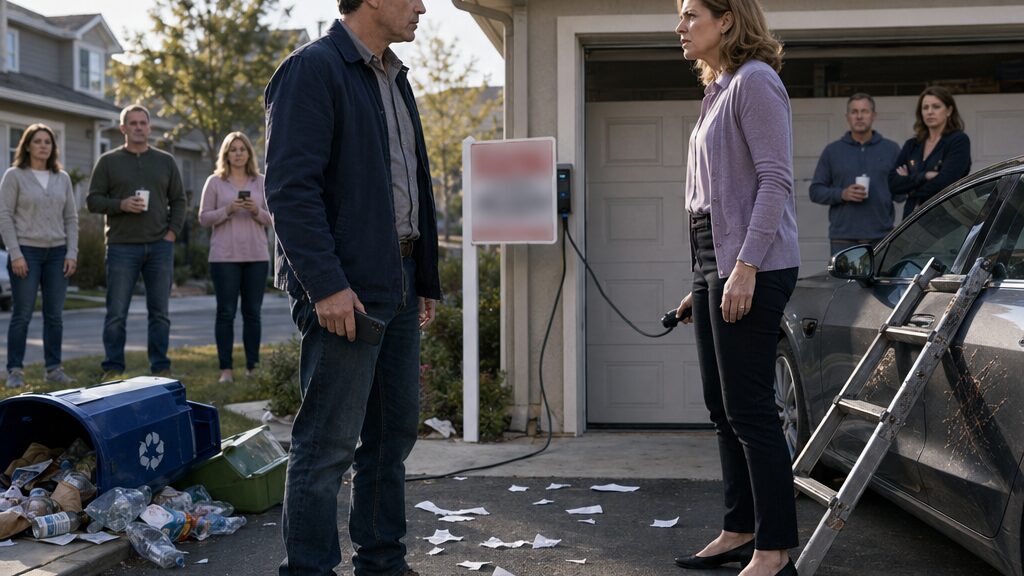
Before he could reach her, Cynthia grabbed the nearest bin by the handle and yanked it sideways. The lid flipped open. Bottles and cans tumbled across the grass with hollow clatters. A milk jug rolled into the gutter. Flattened cardboard slid beneath his truck.
“Cynthia, stop.”
She tipped the second bin harder. Glass struck concrete. A neighbor’s dog began barking.
“There,” she said. “Now we have a visible violation.”
Mark felt heat climb up his neck. He took one step forward, then stopped.
She wanted him in motion. She wanted hands, voice, anger. She wanted the scene to belong to both of them.
He looked past her into the garage. His aluminum ladder leaned against the wall where he had left it after replacing the porch light. Cynthia followed his gaze.
“You know what else is unsafe?” she said.
She walked into the garage and grabbed the ladder.
“Don’t touch that.”
“It’s obstructing access.”
“It’s against my wall.”
She pulled it anyway. The rubber foot caught on the concrete. The ladder swung awkwardly, scraping the side of the workbench, then slipped from her grip. It fell outward and struck the passenger door of her sedan with a flat metallic slap.
For one second, nobody spoke.
The scratch was not huge. A pale line cut through the glossy white paint near the handle. It was visible because the car was clean and because Cynthia stared at it as if she had just been handed exactly what she needed.
She turned on him.
“Look what you made me do.”
Mark stared at the ladder on the floor. “I didn’t touch it.”
“You crowded me.”
“I’m standing ten feet away.”
“You created an unsafe condition.”
“You picked up my ladder in my garage.”
She stepped closer, voice rising. “You saw me trying to move around your junk, and you did nothing. That is negligence.”
The neighbor across the street had stopped pretending now.
Mark’s right hand closed and opened at his side. He could feel words pushing at his teeth, all the words he had swallowed for three weeks. He wanted to tell her she was lying. He wanted to point to the garage, the cable, the sign, the bins, the ladder, the witnesses who would still somehow remember the version that sounded safer at the next board meeting.
Instead, he reached into his pocket and took out his phone.
Cynthia’s expression shifted. “What are you doing?”
“Documenting.”
He opened the camera and took a photo of the spilled recycling first. The cans on the grass. The cardboard under his truck. The bin turned on its side.
“Mark.”
He took a photo of the ladder on the concrete, its top rail still touching the lower part of her car door.
“Don’t photograph my car.”
“It’s in my garage.”
He stepped sideways and photographed the scratch from a distance, showing the ladder, the car, and the garage interior in one frame. Then he moved back and photographed the charging cable plugged into his outlet.
Cynthia followed him. “You do not have my consent.”
“You don’t have mine either.”
The words came out quiet. Quieter than he expected. They stopped her for half a second.
Mark photographed the green light on the charger. He photographed the outlet. He photographed the open side gate. He photographed the “For Rent” sign with Cynthia’s car visible behind it. Then he walked to the side of the house and took a close photo of the electrical meter.
The numbers clicked forward.
His hands were steadier now. Anger had not left him; it had narrowed into something useful.
Cynthia came after him onto the grass. “This is harassment.”
“No.”
“I’m calling Joseph.”
“Do that.”
“And the board.”
“Do that too.”
“You damaged my car.”
Mark lowered the phone and looked at her. “You damaged your car.”
“Because of your unsafe storage.”
“In my garage.”
“You keep saying that like it ends the conversation.”
“It should have ended it the first time.”
She took off her sunglasses, and without them she looked less theatrical, more tired around the eyes. For a moment, Mark saw not just the board member but the woman who had been sitting in a lawn chair beside a car she did not want parked in her own driveway. The flash of recognition did not soften him. It only made the whole thing sadder.
“I know how this place works,” she said, voice lower. “People cooperate.”
“That’s not what this is.”
“No, what this is, Mark, is you deciding to turn a small neighborly accommodation into a legal issue.”
“You told me to write you up.”
She looked toward the neighbor across the street. “And you threatened me in writing.”
“I asked you to move your car.”
“You left a note on my windshield.”
“Because your windshield was inside my garage.”
She glanced back at the garage. The car, the cable, the ladder, the open door, the torn privacy of it all. Then her chin lifted.
“Monday,” she said. “I’ll make sure the board sees every bit of this. The sign. The truck. Your little storage scheme. And now the damage.”
Mark took another photograph of the garage from the driveway.
Cynthia laughed once. “That’s your answer?”
“No,” he said.
He walked into the garage, stepping around the ladder. On the workbench, behind a coffee can full of old screws, sat a small folder he had placed there the night before. Inside were his printed copies of the covenants, the property plat, Sarah Lewis’s inquiry, and the draft of the email he had not yet sent.
Beside the folder lay his passport.
Cynthia saw it when he picked it up.
“What is that?”
“My passport.”
Her eyes narrowed. “Why?”
Mark did not answer.
He took one last photo of the inside of the garage, wide enough to show her sedan between his brother’s labeled boxes and the crooked “For Rent” sign beyond the open door. Then he closed the folder, tucked the passport under his arm, and walked back toward the house.
Inside, on the kitchen counter, his airline ticket waited beside his car keys. The destination line read Barcelona.
His phone buzzed before he unlocked it.
A message from Cynthia appeared at the top of the screen.
You better fix what you did to my car before Monday.
Mark opened his photo gallery. The newest images lined up in order: the bins, the ladder, the scratch, the charger, the meter, the sign, the car.
Below them, the blue cover of his passport sat in the corner of the camera frame like a second kind of document.
He looked from the gallery to the airline ticket, then back toward the garage where Cynthia’s car still sat plugged into his wall.
Chapter 4: The Garage Door Closed Before The Flight
Mark photographed Cynthia’s sedan from four angles before he touched the garage door.
He began at the driveway, wide shot first: open garage, white car inside, “For Rent” sign visible through the side opening, recycling still scattered near the lawn. Then he moved closer. Driver’s side. Passenger side with the fresh scratch. Front end with the charging cable plugged into his wall outlet. He crouched and took one more, careful enough to include the cable, the glowing charger light, and the lower corner of his workbench.
Cynthia stood at the end of the driveway with her phone in her hand.
“You’re making this worse,” she called.
Mark did not answer.
He took a photo of the ladder where it lay. Then the bins. Then the torn cardboard. Then the electrical meter again.
The numbers had moved since his first picture.
That steadied him more than anything else. The meter did not care who chaired a committee. It did not care who smiled at board meetings or who spoke first in a driveway. It only counted what passed through it.
Inside the garage, his brother’s cardboard boxes sat behind the car like patient witnesses. Mark saw the one labeled Trim router. Bits. Don’t stack and turned his camera slightly so the photo would not show the handwriting too clearly. Some things did not need to become evidence.
Cynthia walked closer. “I am telling you right now, if you lock my car in there, you’re going to have a real problem.”
Mark lowered his phone. “Your car is on my property without permission.”
“You can’t just trap someone’s vehicle.”
“I’m not trapping anything. I’ve asked you to remove it for three weeks.”
“I told you I needed temporary access.”
“You never had access.”
She laughed once, sharp and nervous. “You think repeating that makes you right?”
“No,” Mark said. “The property records do.”
For the first time that morning, Cynthia did not immediately answer.
Mark opened the folder on his workbench. The printed pages looked plain under the bare bulb: HOA covenants, property plat, utility statement, copy of the note Cynthia had torn, Sarah Lewis’s message printed from his email. He had not planned to use all of it. He had not planned to use any of it, really. He had been gathering paper the way some people stacked sandbags before a storm they hoped would turn.
He took a final photo of the folder resting beside the charger.
Then he opened the property-management portal on his phone.
His thumb hovered over the message to Joseph Martin.
For three weeks, he had held back from sending it because sending it made the conflict official. Official meant forms. It meant return calls. It meant board members using careful voices. It meant Cynthia telling people he had escalated, and maybe she would not be entirely wrong. He had let it go long enough that she could now pretend there had been an understanding.
Mark typed slowly.
Joseph, I need to formally document repeated unauthorized use of my detached garage at my property in Ridgeview Commons. Cynthia Davis has parked and charged her vehicle there without permission after multiple verbal requests and one written request to stop. Her vehicle is currently inside the garage. I am attaching photographs, meter readings, and a copy of my written notice. I am leaving town today as scheduled but will remain reachable by email.
He stopped before the next sentence.
Cynthia’s phone rang. She answered it loudly.
“Yes, I’m at his house right now,” she said. “No, he’s taking pictures of everything like I’m some kind of criminal.”
Mark attached the photos one by one. The process felt painfully slow. Each small thumbnail loaded beneath the message: car, cable, scratch, ladder, meter, sign, bins, folder.
His phone buzzed before he hit send.
Joseph Martin’s name appeared on the screen.
Mark answered. “Joseph.”
“What is going on over there?” Joseph’s voice was careful, not yet annoyed but preparing to be. “Cynthia just left a message saying you’re threatening to lock her vehicle inside a private structure.”
“I’m documenting a trespass.”
A pause.
“Is her vehicle currently in your garage?”
“Yes.”
“Did you give her permission to park there?”
“No.”
“Is there some shared driveway arrangement I’m unaware of?”
“No.”
Another pause, longer this time. Mark heard papers shifting or maybe Joseph turning in his chair.
“Mark,” Joseph said, “are you sure you want this documented formally?”
Mark looked at Cynthia’s car. He looked at the charger plugged into his outlet. He looked at the pale scratch she had made and the ladder she had moved. Behind all of it, his brother’s boxes remained pinned in place by somebody else’s convenience.
“No,” Mark said.
Joseph exhaled.
Then Mark said, “But I should have done it the first week.”
The line went quiet.
When Joseph spoke again, his voice had changed. “Send me everything. Do not touch her vehicle. Do not move it. Do not allow anyone else to move it unless there is a written release or law enforcement instruction. If you secure your own garage, make clear in writing that the vehicle was already there without permission.”
“I understand.”
“Are you leaving town?”
“Yes. Today.”
“That complicates things.”
“It was already booked.”
“Send the records before you go.”
“I’m doing it now.”
Joseph hesitated. “And Mark?”
“Yes.”
“Keep your language clean. No threats. No guesses. Just dates, times, facts.”
Mark almost smiled. “That’s all I have left.”
He ended the call and hit send.
The message disappeared into the portal with a small spinning circle. For several seconds, Mark watched it rotate. Cynthia watched him from the driveway, her sunglasses hiding her eyes but not the set of her jaw.
When the portal finally displayed Message submitted, Mark felt no triumph. Only a hollow little drop in his stomach, like stepping off a curb in the dark.
He walked to the garage entrance.
Cynthia moved toward him. “Don’t you dare.”
Mark held up his phone. “The property manager has been notified. The vehicle is documented as being inside without permission. I’m securing my garage.”
“You’re going to regret this.”
“Maybe.”
That answer seemed to unsettle her more than a denial.
Mark reached for the garage door handle. For an instant his hand stopped there. He remembered his brother installing the new rollers two summers earlier, grumbling about cheap hardware, wiping sweat with the bottom of his shirt. He remembered saying he would help and then mostly standing there holding screws.
The garage had never been empty. Not really.
He pulled the door down.
The panels rattled along the track, sunlight narrowing across Cynthia’s sedan until the white paint dulled in shadow. The charger light was the last thing he saw before the door settled shut.
Cynthia stepped onto the driveway. “Open it.”
Mark slid the lock bar into place.
“Mark.”
He put the padlock through the hasp.
“You cannot do this.”
He checked the side door, turned the deadbolt, and gave the knob one firm pull. Then he walked to the side gate and locked it too.
Cynthia stood close enough now that he could see himself reflected in her sunglasses. “My car is in there.”
“Yes.”
“I need it.”
“You needed to move it.”
Her mouth opened, then closed. For the first time, she looked toward the garage not like it belonged to her, but like it had become a door she did not know how to open.
Mark went inside and packed the folder into his carry-on. He changed his shirt, washed his hands, and picked up the passport from the counter. His phone vibrated twice while he called a rideshare. Both messages were from Cynthia. He did not open them.
At the airport, with his bag at his feet and the boarding announcement crackling overhead, Mark checked the property portal again. Joseph had replied.
Received. Preserve all records. Do not engage directly unless necessary.
Mark looked through the glass at the plane waiting under the afternoon light. His phone began ringing.
Cynthia Davis.
He let it ring until it stopped.
It rang again while he walked down the jet bridge.
By the time the plane lifted off, Cynthia had called six times, and her car was still locked inside his garage.
Chapter 5: The Board Member Walked Into Her Own Record
Cynthia Davis stormed into Joseph Martin’s office on Sunday afternoon and said Mark Taylor had stolen her car.
Joseph had one hand on a lukewarm coffee and the other on a maintenance invoice he had been avoiding since lunch. He looked up slowly, not because he failed to understand her words, but because he understood too well what they were designed to do.
Behind Cynthia, the glass door to the property-management office swung shut with a soft hydraulic sigh.
“My car,” she said, louder. “He locked it inside his garage and left the country.”
Joseph set down the coffee. “Good afternoon, Cynthia.”
“Do not good-afternoon me.”
The clerk at the front desk lowered her eyes to the keyboard.
Joseph stood and gestured toward the chairs in front of his desk. “Come in.”
“I don’t want to sit. I want access.”
“To Mark Taylor’s garage.”
“To my vehicle.”
“Which is inside Mark Taylor’s garage.”
Her nostrils flared. “Because he locked it in there.”
Joseph closed his office door halfway, enough to give the front desk some peace but not enough to make the conversation feel hidden. Cynthia noticed. Of course she noticed.
“I’m a board member, Joseph.”
“I’m aware.”
“Then you understand the liability.”
“I understand there are several possible liabilities.”
She placed both hands on his desk and leaned over it. Today she wore a cream jacket instead of lavender, but the oversized sunglasses were still perched on her head like a badge. “He admitted he locked it. He admitted he left. I have text messages.”
“Did he admit giving you permission to park there?”
Cynthia’s mouth tightened. “That’s not the issue.”
“It may be the first issue.”
“It’s a neighbor dispute that he escalated.”
Joseph sat. Not quickly. He had learned over sixteen years of managing residential communities that speed made people think you were either afraid or guilty.
“Tell me when your vehicle entered the garage.”
“I don’t know the exact time.”
“Was it Friday?”
She looked away. “It had been there.”
“For how long?”
“On and off.”
“How long, Cynthia?”
She straightened. “I don’t keep a diary of my parking.”
“No,” Joseph said. “But Mark appears to have kept records.”
That landed. He saw it in the small pause before she recovered.
Joseph turned his monitor slightly and opened the file Mark had sent through the portal. He had reviewed it once Saturday morning, again Saturday night after Cynthia’s third voicemail, and a third time before unlocking the office that afternoon. The first image appeared on the screen: Cynthia’s white sedan inside the detached garage, charging cable visible, “For Rent” sign in the background.
Cynthia looked at it and crossed her arms.
“He stages things,” she said.
Joseph clicked to the next photo. Same car, different date. The next. The next. Some were taken from the driveway. Some from inside the garage. The car came and went, but the pattern was plain.
“Twenty-three days,” Joseph said.
“That is misleading.”
“It may be incomplete. It is not misleading.”
She pointed at the screen. “That sign is an eyesore. He shouldn’t be renting the structure without board review.”
“He requested guidance. Storage rental is not prohibited if the use remains private and noncommercial.”
“I never saw that request.”
“You are not the property manager.”
“I am on the board.”
“You are one member of the board.”
Her cheeks colored.
Joseph clicked to another photo: the charger plugged into Mark’s outlet. Then a close-up of the meter reading. Then another reading taken days later. He opened the utility note Mark had attached, highlighting the rise in usage over the same period.
Cynthia gave a short laugh. “You’re not seriously treating a few dollars of electricity like some major violation.”
“I’m treating unauthorized utility use as part of the record.”
“It was temporary.”
“Was it authorized?”
She looked toward the half-open office door. “I needed a practical place to keep the car for a few days.”
“Why?”
The question came out before Joseph had fully decided to ask it. Cynthia’s eyes snapped back to him.
“Excuse me?”
“If there’s a practical explanation, this is the time to provide it.”
“My driveway is being resurfaced.”
Joseph knew her driveway. He had driven past it Thursday. “No work order was submitted.”
“It’s private work.”
“No contractor permit.”
“I don’t need to explain my home maintenance to you.”
“No,” Joseph said. “But you do need to explain why your car was inside another owner’s garage after written notice.”
Cynthia’s face shifted again. For the first time, Joseph saw something under the anger: fatigue, maybe embarrassment. It passed quickly.
“He left a threatening note on my windshield.”
Joseph opened the scanned copy of Mark’s note. “This note?”
She did not read it. She had already read it. “He had no right to touch my vehicle.”
“He placed a notice under the wiper.”
“On my vehicle.”
“In his garage.”
The words repeated themselves like a hallway neither of them could exit.
Cynthia turned from the desk and paced once to the wall where framed community maps hung in thin black frames. Ridgeview Commons looked peaceful from above: curved streets, tidy lots, detention pond, walking trail, the clubhouse roof drawn in pale gray. Joseph had always thought maps made conflict look impossible. From that distance, nobody could see a charger cord or a torn note.
“I know how this looks,” Cynthia said.
Joseph waited.
“I know you think I overstepped.”
“I think the record shows you used space that wasn’t yours.”
“I was trying to keep my car off the street. We’ve had complaints about street congestion. We’ve had complaints about rental traffic. We’ve had complaints about people treating detached structures like storage businesses.” She turned back. “I spend hours keeping this place from sliding into chaos while people like Mark act like rules only matter when they benefit him.”
Joseph heard the practiced board-meeting rhythm in her voice, but also something strained behind it.
“Did you tear up his note?”
She stared at him.
“Did you dump his recycling?”
“That was exaggerated.”
“Did you move his ladder?”
“It was obstructing access.”
“To a garage you had no permission to access.”
Cynthia’s jaw worked. “You’re choosing a side.”
“I’m choosing the file.”
“The board reviews your contract next quarter.”
There it was. Not shouted. Not even heavily emphasized. Just placed on the desk between them.
Joseph leaned back.
For years, he had treated Cynthia as difficult but useful. She answered emails. She showed up to meetings. She remembered which homeowners ignored letters and which ones needed a second reminder. She also made life harder for anyone who embarrassed her. Both things were true.
He clicked to the final image Mark had sent before leaving: the closed garage door, padlock visible, timestamp at the bottom. Attached beneath it was Mark’s statement.
Vehicle remained inside private garage after repeated requests to remove. Garage secured before scheduled travel. No access granted to third parties without written record.
Joseph folded his hands. “Cynthia, I cannot give you access to that garage.”
“You’re refusing?”
“I am refusing to authorize entry into a private structure owned by Mark Taylor without his consent or appropriate legal instruction.”
“My car is inside.”
“And your car’s presence there is the subject of the trespass record.”
“I’ll call the police.”
“You may.”
“I’ll call a locksmith.”
“You may do that too. But no locksmith should open that gate without proof that you own or control the property.”
She picked up her handbag. Her hand trembled once before she hid it against the strap.
“This is going to become a very expensive mistake for Mark.”
Joseph looked at the open file on his screen: the car, the cable, the meter, the sign. “It may become expensive for someone.”
Cynthia put her sunglasses on though she was indoors.
“Remember this conversation when the board asks why management failed to protect a resident’s vehicle.”
She walked out before he could answer.
Through the glass, Joseph watched her cross the small parking lot, phone already pressed to her ear. Her posture was rigid, her head high, but she stopped beside her car-less parking space and looked, for one brief second, like someone who had misplaced more than transportation.
Then she turned away from the building and spoke sharply into the phone.
“I need a locksmith at Ridgeview Commons. Right now.”
Chapter 6: The Locksmith Asked Who Owned The Door
The locksmith looked at Cynthia’s sunglasses, then at the locked side gate, then at the garage beyond it, and asked the one question she had been trying to avoid.
“Who owns the door?”
Cynthia tightened her grip on her phone. “The vehicle inside belongs to me.”
“That’s not what I asked.”
They stood in Mark Taylor’s driveway under the flat afternoon light, the kind that made every house in Ridgeview Commons look inspected. Cynthia had parked a borrowed compact car at the curb because arriving on foot would have made her feel exposed. Two neighbors had already found reasons to step outside. One watered a strip of grass that did not need water. Another carried a single envelope to the mailbox and lingered there.
“The owner is out of the country,” Cynthia said.
The locksmith set his tool bag down but did not open it. “Do you have written authorization from him?”
“I have proof my car is inside.”
“Do you have proof you’re allowed inside?”
“I’m on the HOA board.”
He blinked. Not disrespectfully. Worse. Blankly.
“That doesn’t make you the property owner.”
Cynthia felt heat climb under her collar. “This is an emergency access issue.”
“Police called?”
“Not yet.”
“Property manager?”
“Unhelpful.”
The locksmith looked at the gate again. A heavy padlock held the latch. Beyond it, the detached garage sat closed, ordinary, silent, impossible. The “For Rent” sign beside it had twisted slightly in the breeze so that only the words For Rent faced the street clearly. Cynthia hated the sign more than the lock. The lock could be explained as Mark’s overreaction. The sign made her look like someone who had skipped the part where people asked.
“My car is in there,” she said.
“I believe you.”
“Then open it.”
“I can’t open someone else’s property because you say your car is inside.”
“It isn’t just because I say so.”
“Then get the owner to say so.”
“He won’t answer.”
The locksmith gave a small shrug that held no sympathy and no cruelty. “Then I can’t help you.”
Cynthia stared at him. “So you came all the way out here to do nothing?”
“I came out here to see whether you had authorization. You don’t.”
“I’ll pay your service fee.”
“Yes, ma’am.”
He said it so calmly that for one wild second she wanted to argue that fee too. Instead, she pulled her card from her wallet and watched him run it on a small reader. The charge appeared on her phone before he had even zipped his bag.
A wasted fee. Another one.
The compact car at the curb belonged to a woman from her committee who had loaned it with a cheerful text full of question marks. Everything okay??? Cynthia had replied with one word: Fine.
Nothing was fine.
Her sedan was behind that garage door with three days of work files in the trunk, a blazer she needed for Monday’s meeting, and a charging account fob she had not meant to leave in the console. The car payment had already been late once this year. Charging at home had become expensive after the rate change. Charging stations near the office cost more than she liked admitting. Mark’s outlet had been temporary. Convenient. Harmless if he had simply understood that neighbors sometimes absorbed small things for the good of the larger peace.
Except she had known by the second week that it was not harmless to him.
She had known when he stood in the garage doorway and said please.
That memory irritated her more than the lock.
The locksmith drove away. The neighbor with the hose pretended not to watch.
Cynthia opened her phone and called the towing company Joseph had mentioned in an email after she demanded written options. She expected a clerk. She got a tired voice and hold music first. Then the clerk came on.
“I need to understand storage rates,” Cynthia said, keeping her voice low.
“For a vehicle?”
“Yes.”
“Where is it stored?”
“Private garage.”
“Your private garage?”
Cynthia closed her eyes. “No.”
The clerk paused just long enough to make the answer feel visible. “Is the vehicle being held by the property owner?”
“It’s complicated.”
“Daily indoor storage, if authorized and documented, can be billed depending on the arrangement. If a tow is ordered later, separate charges apply.”
“How much?”
The number the clerk gave her was not impossible. That made it worse. Impossible numbers could be dismissed. This one could accumulate quietly, day after day, until it became a bill she could not wave away at a board meeting.
“And if the owner claims unauthorized storage for twenty-three days?” Cynthia asked.
Another pause. “You’d need legal advice on that.”
“I’m asking what the yard would quote.”
The clerk gave a range.
Cynthia lowered the phone.
The borrowed compact’s hood reflected the pale sky. Her own sedan was fifty feet away and unreachable, sitting in a garage she had told herself nobody used. For the first time, she pictured it not as unused space but as Mark’s closed room: his shelves, his boxes, his outlet, his lock.
Then her phone buzzed.
A message from the committee woman: Do you need me to pick up the car tonight? My husband says if it’s locked in someone’s garage this could get weird.
Cynthia typed, deleted, typed again.
No. Handling it.
Another message arrived before she could put the phone away. This one was from an HOA board member, responding to Cynthia’s earlier complaint.
Joseph says there is a trespass filing. Is that accurate?
Cynthia stared at the words until they blurred.
She looked back at Mark’s garage. The sign shifted again in the breeze.
For Rent.
She had laughed at it. She had called it an eyesore. She had treated it as proof that Mark was trying to profit from the neighborhood, when the truth was simpler and more dangerous: the sign proved he had offered the space to someone else before she took it.
Her throat tightened.
She sat in the borrowed car and shut the door. For a few minutes, she let the air conditioning run without putting the car in gear. The dashboard smelled faintly of vanilla and fast food. Her own car smelled like leather cleaner and lavender packets tucked under the seat.
She called her credit card company, listened to the available balance, and ended the call before the automated voice finished offering options.
That was when anger returned. Not clean anger. Not the bright kind that carried her through meetings. This was heavier, braided with embarrassment.
Mark had made her look like a trespasser. Joseph had let him. Now the board was asking questions as if they had not all benefited from her being the person willing to knock on doors and enforce things nobody else wanted to enforce.
She opened her email and started a new message to the full board.
Subject: Urgent Resident Vehicle Access and Management Failure
She wrote quickly at first. Mark Taylor had unlawfully secured her vehicle. Mark Taylor had created a hostile neighbor situation. Mark Taylor had posted questionable rental signage and then used his own noncompliance to justify punitive action. Joseph Martin had refused to assist a resident in recovering personal property.
The words looked strong. Strong enough to stand behind.
Then she hesitated.
There was no way to write the next part cleanly. No way to explain why her car had been in the garage without using phrases that bent under their own weight. Temporary neighborhood accommodation. Informal access. Unused detached structure. Good-faith understanding.
She chose good-faith understanding.
Her thumb hovered over send.
Across the street, a child rode a scooter in a slow circle, watching without knowing what he was watching. The neighbor with the hose finally turned off the water.
Cynthia added one more line.
This matter should be reviewed before Monday’s meeting, including whether Mr. Taylor’s conduct constitutes illegal seizure of a resident vehicle.
She sent it.
Almost immediately, a different notification slid down from the top of her screen. It was not from the board.
It was a preview from Mark’s rental listing, forwarded automatically because she had once clicked on it through the community page.
Inquiry from Sarah Lewis: Hi Mark, just checking whether the garage is still available. I’m hoping to move the first boxes next week if we’re still set.
Cynthia sat very still.
The garage had not been empty.
It had been waiting for someone who had aske
Chapter 7: The Empty Garage Was Never Empty To Him
The HOA complaint was taped beside Mark’s “For Rent” sign when he came home from Spain.
He saw it before he saw his front door clearly. The rideshare had barely pulled away, his suitcase still upright beside him on the driveway, when the white sheet caught the late afternoon light. It was sealed in a plastic sleeve and fixed to the fence with blue painter’s tape, as if someone had wanted it visible but not quite vandalism.
URGENT REVIEW NOTICE.
His name appeared in the first line.
Mark stood there with jet lag behind his eyes and read the words without moving his suitcase.
Resident vehicle access. Improper detention of personal property. Questionable rental use of detached structure. Potential hostile conduct toward board member.
The “For Rent” sign hung three inches away, bent at one corner from the week before.
His phone buzzed in his pocket. A message from Sarah Lewis.
Hi Mark, just checking one more time before I reserve storage elsewhere. I’m sorry to bother you, but I need to move boxes by next week.
Mark closed his eyes for a moment.
Across the street, a neighbor lifted a hand but did not wave fully. The gesture stopped halfway, unsure whether friendliness was allowed during an active neighborhood scandal.
Mark pulled the complaint from the fence. The tape stretched, then gave way with a soft rip.
Inside the garage, Cynthia’s sedan still waited.
He did not open the door. Not yet.
He carried his suitcase into the house, set the complaint on the kitchen counter, and laid his passport beside it. The passport cover was scuffed now from the trip. Barcelona felt unreal already: narrow streets, coffee in a small cup, two days of looking at old stone while his phone filled with missed calls from home.
He had not enjoyed the trip the way he had planned. It had been booked months earlier, a promise to himself after his brother died that he would stop postponing every life he claimed he would return to later. Instead, he had sat at an outdoor café beneath carved towers and watched emails arrive from Joseph, Cynthia, the board, and Sarah.
Now all of it had followed him back to the driveway.
The board meeting was that evening.
Joseph called at six.
“Are you back?”
“Yes.”
“Cynthia requested a special review before the regular agenda.”
“I saw.”
“She’s framing it as unlawful seizure.”
“She parked in my garage for twenty-three days.”
“I know what the record says.”
Mark heard the caution in his voice. “But?”
“But the board wants this settled quietly.”
Mark looked at the folded complaint. “Quietly for who?”
Joseph did not answer right away. “Bring your documents. Bring your photos. And Mark?”
“Yes.”
“You’ll need to say more than ‘it’s my garage.’”
The sentence irritated him because it was true.
At seven, Mark walked into the clubhouse meeting room with the folder under his arm. The room smelled like carpet cleaner and coffee from a machine nobody washed properly. Folding chairs had been arranged in two uneven rows. A few residents sat with the alert posture of people who claimed not to like drama but arrived early for it.
Cynthia sat near the front.
No sunglasses tonight. Cream jacket, neat hair, phone face down on the table. She did not look at Mark when he entered.
Joseph stood by the wall with a stack of printed records clipped together. The board members whispered among themselves. Mark took a seat in the second row, folder on his knees, and noticed how tired his hands looked.
When the agenda reached “resident vehicle access,” Cynthia stood before anyone asked her to.
“I want to begin,” she said, “by making clear this is not personal.”
Mark looked at the “For Rent” sign through the clubhouse window. From this angle, it was only a small rectangle at the edge of the parking lot, but he could still see the bent corner in his mind.
Cynthia continued. “This is about whether homeowners can take extreme actions against neighbors and then hide behind technicalities. My vehicle was secured inside Mr. Taylor’s garage while he left the country. I was denied access for days. Management refused to assist. I had work materials in that car. I had personal property. I had no transportation.”
A murmur moved through the room.
She was good at this. Mark had forgotten that because he had mostly seen her in his driveway, angry and too close. In the meeting room, Cynthia knew how to make herself sound like the stable one.
“He had other options,” she said. “He could have called. He could have waited. He could have acted like a neighbor.”
One board member looked toward Mark. “Mr. Taylor?”
Mark stood.
The room turned its attention to him, and for a second his old habit rose in him like a hand pressing down on his shoulder. Keep it short. Don’t make it ugly. Let the papers speak. Don’t become the angry neighbor.
He opened his folder and looked at the top page. The property plat. Clean lines. Lot number. Detached garage within his boundary.
Then he looked at Cynthia.
“I did call it my garage too many times,” he said.
Cynthia blinked.
Mark felt Joseph watching him from the wall.
“I said it like that should settle everything. It should have, legally. But I know it didn’t settle the neighbor part.”
The room quieted.
He held up the first photo. “This is Cynthia’s car inside my garage. This was not one emergency. Not one afternoon. The photos Joseph has show repeated use over twenty-three days.”
He placed the photo on the table.
“This is the charging cable connected to my outlet. These are the meter readings. This is the written note I left asking her to stop. This is the copy I kept after she tore up the one on her windshield.”
Cynthia’s mouth tightened, but she did not interrupt.
Mark took out the email from Sarah Lewis.
“And this is the part I did not say clearly enough when I should have.”
His voice caught just slightly. He disliked that. He kept going anyway.
“The garage was not unused. It had my late brother’s tools in it. I was clearing it because I needed to rent it to cover estate costs and some overdue bills tied to his property. I had already been speaking with Sarah Lewis about renting it for storage. She asked properly. She waited. And while she waited, the space was being used by someone who never asked.”
A different silence entered the room. Not softer exactly. More attentive.
Cynthia looked down at her phone.
Mark folded Sarah’s email back into the folder. “I should have reported the first trespass. I didn’t because I didn’t want a neighborhood fight. That was my mistake. But not wanting a fight did not make my garage available.”
One of the board members cleared their throat. “Mrs. Davis, did you have any written permission from Mr. Taylor?”
“No,” Cynthia said.
“Any verbal permission?”
She looked at Mark, then away. “There was an understanding.”
Mark shook his head once. “There was no understanding.”
Cynthia’s chair scraped as she stood again. “I was trying to avoid street congestion. I was trying to keep things orderly. That sign was creating questions. People were already asking whether he was running some side business.”
“I was renting storage space,” Mark said. “Allowed under the rules Joseph sent me.”
“It still should have come to the board.”
“Maybe. But you don’t get to enforce a rule by using the property yourself.”
The words surprised him after he said them. Not because they were harsh, but because they were clear.
Joseph stepped forward and handed the board the clipped packet. “Management has verified the property boundary, the prior guidance on storage rental, and the timeline of the submitted photographs. I cannot verify every interaction between the residents. But the record does not support board-authorized access by Mrs. Davis.”
Cynthia turned on him. “You’re going to let this become a lawsuit?”
“I’m trying to prevent one.”
The room shifted again.
A board member leaned back. “Could both parties agree to close this with no further complaint, provided the vehicle is removed?”
Mark felt it then: the old pressure to accept a quiet ending that mostly protected people who had been loud. The same pressure that had kept him from sending the first email. The same pressure that had let Cynthia build a story before he built a record.
Cynthia looked at him for the first time that night.
There was no smirk now. Just calculation, fatigue, and a plea she would never call a plea.
Mark could waive it. He could open the garage. Let her drive away. Remove the sign. Tell Sarah the space was no longer available. Let the neighborhood settle around a lie because the truth was inconvenient.
He closed the folder.
“No,” he said.
The word sounded larger than he intended, but he did not take it back.
“I’m not asking for a scene,” he continued. “I’m not asking anyone to shame her. I’m asking for the record to say what happened. I will open the garage so Cynthia can remove her car after she signs an access statement confirming the vehicle was there without my permission, that no damage was done by me while it was secured, and that any utility or storage issue is handled through management.”
Cynthia’s face went pale with anger. “You want me to sign a confession.”
“I want you to sign the truth before I unlock my door.”
The room held still.
Joseph looked from Mark to Cynthia, then to the board. “That is the cleanest path.”
Cynthia picked up her phone, gripping it so hard her knuckles whitened.
Mark stayed standing, folder under one arm, heart beating hard but steady.
The board chair asked Cynthia whether she would agree to the access statement.
Cynthia did not answer.
She only looked at Mark as if he had finally become the neighbor she could no longer move around.
Chapter 8: The Sign Went Back Up For Someone Who Asked
Cynthia arrived one week later without sunglasses, holding the signed access agreement in both hands.
Mark saw her through the kitchen window before the doorbell rang. She stood on the porch in a gray sweater instead of the bright clothes she usually wore to be noticed. Her borrowed compact sat at the curb. Joseph Martin’s car was already parked behind it.
For a moment, Mark did not move.
The garage waited at the end of the driveway, locked, ordinary, and too central to too many lives. The bent “For Rent” sign had been removed after the meeting. A new one leaned against the wall inside Mark’s kitchen, still in its plastic sleeve.
The doorbell rang once.
Mark opened the door.
Cynthia held out the papers. “Joseph has a copy.”
Her voice was controlled. Not warm. Not apologetic. But smaller than it had been in the clubhouse.
Mark took the agreement and read the top page even though Joseph had already emailed it to him. Cynthia Davis acknowledged that her vehicle had been parked in Mark Taylor’s detached garage without written permission. Access would be granted for removal only. Existing claims regarding utility use and storage costs would be handled through management review. No claim of damage by Mark would be made without supporting evidence.
Her signature sat at the bottom.
Joseph stepped up behind her. “I confirmed the board received it.”
“What about the complaint?” Mark asked.
“Pending review. Cynthia has stepped back from vehicle and property enforcement matters until that’s complete.”
Cynthia’s jaw tightened, but she did not correct him.
Mark nodded once and picked up the garage keys from the small table by the door.
No one spoke while they walked down the driveway.
A neighbor across the street opened a curtain and then let it fall. Another stood near a mailbox, pretending to read an envelope. Mark saw them, but they mattered less than they had before. Maybe they had always mattered less than he imagined. Maybe his mistake had been giving their possible opinions more weight than his own locked door.
At the side gate, Joseph stood close enough to witness but not interfere.
Mark unlocked the padlock.
The click sounded simple. Almost disappointing after everything built around it.
He opened the gate, then the side door to the garage. The air inside was stale and faintly metallic. Cynthia’s sedan sat exactly where it had been, dust collected along the windshield, the charger unplugged now and coiled on the floor where Mark had left it after documenting the final meter reading. His brother’s boxes lined the shelves beyond it.
Cynthia stepped inside and stopped.
Her eyes moved from the boxes to the workbench to the empty rectangle of wall where the old sign had been visible through the open door. For the first time, she seemed to understand that she had not taken unused space. She had stepped into a room full of things Mark had not been ready to explain.
“I didn’t know about your brother,” she said.
Mark looked at the nearest box. Trim router. Bits. Don’t stack.
“No,” he said. “You didn’t ask.”
She absorbed that without defending herself. Then she opened her car door.
The sedan started with a soft electronic chime. Cynthia backed it out slowly, hands careful on the wheel, eyes fixed on the mirrors. The scratch on the passenger door caught the light as the car cleared the garage.
No one clapped. No one shouted. The neighbor at the mailbox went inside before the car reached the street.
Cynthia parked at the curb and came back on foot.
“I shouldn’t have used the garage,” she said.
Mark waited.
“And I shouldn’t have moved the ladder.”
It was not everything. She did not mention the torn note, or the recycling, or the way she had threatened him with the board. Her pride still stood between them like another locked gate.
But she had said enough to mark the direction.
“No,” Mark said. “You shouldn’t have.”
Cynthia looked toward Joseph, then back at Mark. “I’ll deal with the utility amount through management.”
“And the storage?”
Her mouth tightened. “Whatever they determine.”
Mark nodded. “Good.”
For a second, the old neighborly script waited for him to soften it. To say it was fine, or not a big deal, or they should just move on. He let the script pass.
Cynthia walked back to her car.
Joseph stayed behind while Mark lowered the garage door halfway to let the stale air out without putting everything on display.
“You all right?” Joseph asked.
Mark gave a tired half smile. “Ask me after I clear those shelves.”
Joseph looked into the garage. “Sarah still interested?”
“She is.”
“Then at least something useful comes out of it.”
Mark watched Cynthia drive away. Not fast. Not dramatically. Just a white sedan turning out of Ridgeview Commons with a scratched door and a driver who had finally run out of shortcuts.
The following Saturday, Sarah Lewis arrived in a small SUV with the back packed full of cardboard boxes.
She came alone at first, then opened the rear door and pulled out a folded dolly. Her hair was tied back, and she had a pen clipped to the collar of her shirt. She looked at the garage, then at Mark.
“Still okay to start today?”
Mark held up the signed rental agreement. “You asked. You signed. You paid. That puts you ahead of the last person.”
Sarah laughed, a quick tired sound. “Low bar, I guess.”
“Sometimes that’s enough.”
He opened the garage fully.
During the week, he had moved his brother’s tools to one side, not hidden, not displayed. The labeled boxes remained on the shelves, but the center of the garage was swept clean. Sunlight reached the back wall for the first time in months.
Sarah rolled in the first box and set it down carefully. “Where do you want things?”
“Your space,” Mark said. “As long as the walkway stays clear, arrange it how you need.”
She looked at him, maybe hearing more in the sentence than he meant to put there. Then she nodded and brought in another box.
By noon, the garage held someone else’s belongings lawfully: stacked bins, a small table wrapped in a blanket, two dining chairs, a child’s bicycle with a pink helmet hanging from one handlebar. Nothing dramatic. Nothing that would interest a board meeting. Just proof that a boundary could make room for the right person.
When Sarah left to get the next load, Mark took the new “For Rent” sign from the kitchen wall. He carried it to the fence, then stopped.
He did not need it anymore.
The old zip tie was still there, cut and curled around the metal like a small piece of stubborn history. Mark removed it with a pocketknife and dropped it into his palm.
For three weeks, that sign had been treated like an invitation to take. Then like evidence. Then like a wound. Now it was only plastic and wire.
He set the unused sign inside the garage, behind the workbench, and closed the door halfway against the afternoon glare.
The meter on the side of the house clicked softly, counting only what belonged to him now.
When Sarah returned, she pulled into the driveway with another load and leaned out the window.
“Where should I put the first box from this one?”
Mark looked at the cleared path, the signed agreement on the workbench, and the garage that had finally become what he had meant it to be.
“Anywhere on the right,” he said. “That side is yours.”
The story has ended.