When My HOA Chair Cut Down My Grandmother’s Roses, She Exposed the Rule She Had Been Hiding
Chapter 1: The Morning Deborah Marked the Roses for Removal
The orange flags had been pushed into the rose bed while Ruth Carter was inside making coffee.
There were six of them.
Thin plastic stems, bright enough to look almost fluorescent against the dark mulch, each one planted between canes her mother had trained by hand. One stood so close to the oldest root crown that Ruth’s first thought was not anger but absurd practical concern: whoever had put it there might have pierced a feeder root.
She set her mug on the back step.
“Deborah.”
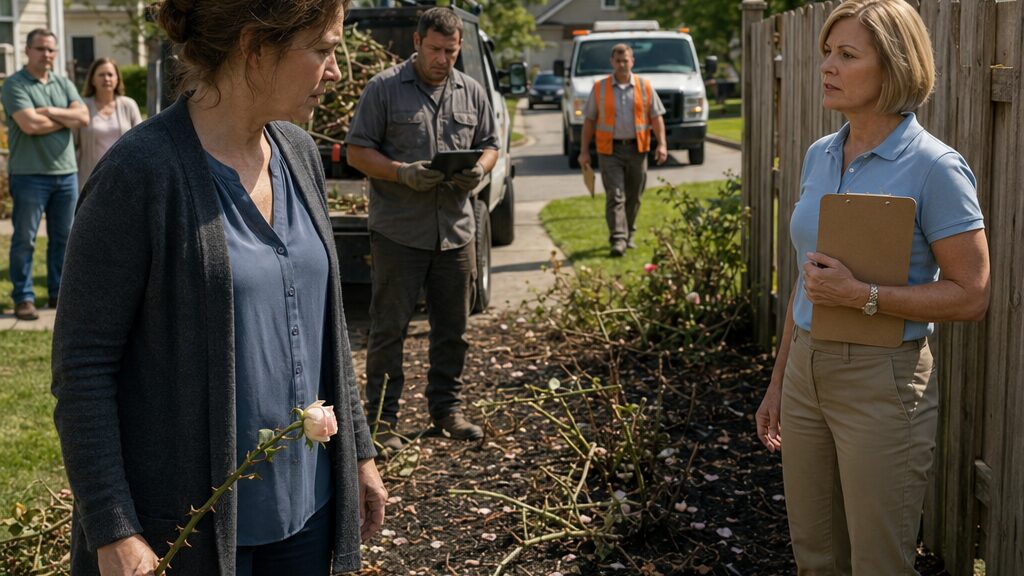
Across the narrow strip between the houses, Deborah Hill looked up from the shared fence line. She wore walking shoes, pressed khaki pants, and the pale blue polo the architectural committee had ordered for neighborhood inspections. A clipboard rested against one hip.
“You saw them,” Deborah said.
Ruth stepped off the patio. “I saw somebody came into my bed.”
“The flags mark the affected area.”
“Affected by what?”
Deborah gave her the patient expression she used at annual meetings when someone asked a question she considered answered by the packet.
“Ruth, we’ve been over this. The canes are crossing the property line and pushing through the fence. They’re outside the approved setback.”
One rose branch had indeed found a gap between two weathered boards. It curved toward Deborah’s side in a green arc tipped with a pale pink bud.
Ruth looked at it, then at the flags.
“So you put markers in my yard.”
“The committee did a compliance walk.”
“You did a compliance walk.”
“I chair the committee.”
“That isn’t an answer.”
Deborah’s mouth tightened. Their houses had shared that side boundary for eleven years. For most of them, the two women had managed a form of civility built on short greetings and mutual avoidance. Deborah disliked leaves in gutters, basketball hoops left out overnight, mismatched porch lights, and anything that made one property look less deliberate than the next. Ruth had always thought of her as irritating but useful, the kind of person who noticed a broken irrigation head before anyone else.
Lately, useful had become something else.
“The annual review is next week,” Deborah said. “This section has been cited repeatedly.”
Ruth crouched and pulled the nearest flag from the soil.
Deborah’s voice sharpened. “Please don’t remove those.”
“They’re in my flower bed.”
“They identify what needs correction.”
Ruth held the flag between two fingers. “Then identify it from your side.”
For a moment neither woman moved. Somewhere beyond the houses, a garbage truck released its brakes with a long mechanical sigh.
Deborah glanced at the rose branch crossing the fence.
“You need to cut them back.”
“I prune in February.”
“It’s June.”
“They bloom in June.”
“And they cross in June.”
Ruth almost laughed. Instead she pushed the flag into the pocket of her gardening apron.
Deborah looked down at her clipboard. “The crew is scheduled for Wednesday morning.”
The words landed without drama, which made them worse.
Ruth straightened. “What crew?”
“Landscaping.”
“For what?”
“To correct the encroachment.”
Ruth stared at her.
“You scheduled people to cut my roses?”
“I scheduled correction of a documented violation.”
“No.”
Deborah exhaled through her nose. “Ruth.”
“No one touches them.”
“You’ve received notices.”
“Not permission.”
“You’ve had ample time.”
Ruth stepped closer to the fence. “Those roses were propagated by my mother.”
The sentence came out before she could stop it.
Deborah’s expression changed only slightly. Not softened. Recalculated.
Ruth wished at once that she had said nothing.
Her mother had started with three cuttings from an older garden across town, rooting them in coffee cans on a sunny kitchen ledge. Years later, after Ruth bought this house, they had transplanted the strongest plants together. Her mother had been seventy then, still impatient with gloves, still convinced that every plant did better if spoken to as though it had disappointed you personally.
Ruth had not told Deborah any of that.
She would not tell her now.
“They’re not just shrubs,” Ruth said.
Deborah shifted the clipboard under her arm. “I understand that they’re sentimental.”
The word stung more than open mockery would have.
“Do you?”
“But sentimental value doesn’t eliminate maintenance obligations.”
Ruth looked at the remaining flags. “Get them out.”
“The contractor has the marked scope.”
“Get them out.”
“I’m not going to argue at the fence.”
“You came to my fence.”
Deborah’s cheeks colored. “This is exactly why the process exists. We cannot run the neighborhood according to which rules feel emotional to which homeowner.”
There it was: not cruelty exactly, but certainty polished until it could perform the same work.
Ruth pulled a second flag from the soil.
Deborah gathered her clipboard against her chest. “Wednesday. Seven-thirty. If you want to avoid contractor charges, handle it yourself before then.”
She turned toward her front yard.
Ruth called after her. “Who authorized the crew?”
Deborah kept walking.
“The committee.”
By Monday evening, Ruth had lined the six orange flags across the kitchen counter.
Lisa arrived at six-ten carrying takeout containers and stopped when she saw them.
“What are those?”
“Deborah’s latest hobby.”
Ruth told the story while opening cabinets more sharply than necessary. She left out the moment she had mentioned her mother. Lisa listened with her car keys still in one hand.
“So cut back the part through the fence,” Lisa said.
Ruth turned.
Lisa immediately looked tired. “Mom, I’m not saying she gets to come into your yard.”
“You just said cut them.”
“I said trim the part crossing the line.”
“That’s not what she marked.”
“Then document it. Email the management company.”
Ruth began placing plates on the table.
“Have you answered their emails?” Lisa asked.
Ruth did not respond.
“Mom.”
“They send notices about everything.”
“That wasn’t my question.”
Ruth pulled open the refrigerator.
Lisa lowered her voice. “How many?”
“I don’t know.”
“You do know.”
Ruth set a pitcher of tea on the table hard enough to make the ice jump.
Lisa looked toward the kitchen desk.
Three unopened envelopes lay beneath a grocery circular. Another had slipped halfway behind the phone charger. The return address belonged to the HOA management company.
Lisa stared at them.
“Oh, come on.”
“They sent the same complaint three ways.”
“And you answered none of them?”
“I spoke to Deborah in April.”
“Speaking across the driveway is not answering an HOA notice.”
Ruth sat down. “You sound like her.”
“No. I sound like someone who has watched you do this for years.”
“Do what?”
Lisa pressed her lips together.
Ruth knew the answer before it came.
“Turn every pruning issue into Grandma.”
The kitchen seemed to contract.
Lisa’s face changed immediately. “That came out wrong.”
“No, it came out clearly.”
“I mean you don’t have to fight every change because she touched something.”
Ruth folded her hands in her lap.
Lisa pulled out a chair but did not sit. “Mom, I loved her too.”
“Then don’t tell me what she is allowed to mean.”
“That isn’t what I’m doing.”
Ruth looked toward the darkening window over the sink. The roses were visible only as a dense black shape beyond the glass.
Lisa said quietly, “You haven’t let anybody help with that garden since she died.”
“I didn’t ask for help.”
“I know.”
That was the problem with Lisa. Sometimes she could make three words feel like a complete accusation.
They ate little. Lisa left before eight, taking one unopened container with her and leaving the other in Ruth’s refrigerator.
Ruth washed both plates.
She did not open the envelopes.
At six the next morning, she carried her coffee outside and found the orange flags gone from the counter.
For one startled second she thought someone had entered the house.
Then she remembered placing them in the trash after Lisa left.
The roses leaned against the fence in the early light. Pale blooms opened among glossy leaves. One cane had slipped farther through the gap overnight, as though the plant had ignored the argument entirely.
Ruth touched it with two fingers.
Inside, the phone chimed.
An email from the management company waited on the screen.
FINAL COMPLIANCE ACTION.
Ruth stood in the kitchen, reading the subject line twice.
Then she opened the latest paper envelope.
The notice inside carried the same words at the top.
Below them was a date.
Friday.
Three days before Deborah had stood at the fence and warned her that a crew was coming.
Ruth read the date again, then looked through the window at the roses.
Whatever had happened at the fence yesterday had not been a warning.
The decision had already been made.
Chapter 2: Half the Rose Bed Was Gone Before Breakfast
The wood chipper woke Ruth at seven-twenty Wednesday morning.
At first she lay still, disoriented by the violent chewing sound outside her bedroom wall. Then came the crack of something woody breaking under force.
She was out of bed before she understood what she had heard.
The kitchen window showed her sky.
Too much sky.
Where the roses had formed a thick green screen along the side fence, there was now a bright open gap.
Ruth ran outside in slippers.
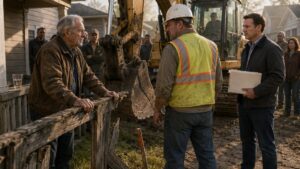
A landscaping worker stood inside the bed holding long-handled loppers. Another dragged a bundle of rose canes toward the driveway. The chipper idled at the curb behind a white truck.
For a second Ruth could not speak.
Half the bed was gone.
Not trimmed.
Gone.
Mature canes had been cut low. Two root crowns were exposed where soil had been pulled aside. Branches heavy with blooms lay tangled on the grass like something dropped after an accident.
“Stop.”
The worker with the loppers looked over.
“Stop!”
He lowered the tool.
A third man near the truck raised both hands. “Ma’am, we’ve got a work order.”
“You’re in my yard.”
“We were told this section was authorized.”
“Get out of the bed.”
The worker stepped backward immediately.
Ruth moved toward the nearest cut crown, then stopped because she did not know where to put her feet. Petals were scattered through the mulch. A pale bloom trembled on a severed cane, still fresh enough to seem attached to something living.
Behind her, a familiar voice said, “They’re not finished.”
Deborah stood on the sidewalk with her clipboard.
Ruth turned slowly.
“You did this.”
Deborah did not retreat. “The contractor did the corrective work.”
“You sent them into my property.”
“The affected vegetation crosses the shared boundary.”
“Look at it.”
“I can see it.”
“No. Look.”
Ruth pointed toward the open bed. Her hand shook.
One of the workers looked away.
Deborah’s face tightened, but her voice stayed measured. “Ruth, you were given repeated opportunities.”
“To cut branches.”
“To correct the violation.”
“You dug up roots.”
“I did not instruct anyone to remove healthy root systems.”
The contractor near the truck said, “We were told clear to grade on the marked section.”
Deborah snapped her head toward him. “That is not what I said.”
He frowned. “It’s what’s on the scope.”
Two neighbors had stopped on the sidewalk now. One held a coffee cup. Another stood with a dog straining at the leash.
Ruth felt their attention before she looked at them.
Deborah noticed them too.
Her posture changed.
“The point,” she said, more loudly, “is that the condition has been unresolved for months. This finally corrected what you refused to maintain.”
Ruth stared at her.
Deborah gestured toward the fence line.
“It improves the whole line of houses.”
The words were so calm that Ruth almost missed their ugliness.
Behind Deborah, the open gap revealed three matching backyards in a clean visual row. Fresh mulch. Straight fence. Trim lawn.
Improved.
Ruth looked down.
The pale bloom she had seen earlier lay across a sheet of paper near the bed’s edge.
The wind lifted one corner.
Ruth bent and picked up both the cane and the paper.
It was a copy of the compliance notice.
“Who gave you this?” she asked the contractor.
He glanced at Deborah. “Work order came through the association.”
“I asked who gave you this.”
“The property manager sent the packet.”
Deborah said, “Ruth, you have the same notice.”
Ruth smoothed the paper against her palm. “Where is the authorization?”
“The work order is the authorization.”
“Show me.”
“We’re not conducting a hearing in the street.”
“No. We’re looking at the document that put strangers in my garden.”
The neighbor with the dog shifted uncomfortably.
Deborah lowered her voice. “You ignored four notices.”
There was a small silence.
Ruth heard it spread through the people watching.
The coffee cup neighbor looked at her.
Ruth felt heat rise into her face.
Deborah continued, “One in March. Two in April. Final action last week.”
Ruth could have denied it.
She could have said she had spoken to Deborah, which was true. She could have said the envelopes repeated each other, also true. She could have said none of them clearly authorized destruction, which mattered more than either.
Instead, for one humiliating second, she said nothing.
The silence convicted her in public.
The contractor cleared his throat. “Ma’am, I can pull up the work order.”
“Do it,” Ruth said.
He took a tablet from the truck.
Deborah stepped closer. “This is unnecessary.”
Ruth looked at her. “Half my garden is in that machine.”
The contractor opened a file and turned the tablet around.
Ruth read the scope.
Vegetative encroachment correction. Fence corridor. Prune/remove as required for access and uniform clearance.
Then the parcel reference.
She read it once.
Again.
Something in her mind shifted.
For thirty-two years, Ruth had worked in a public-school office where forms failed in predictable ways. Wrong student number. Wrong bus route. Wrong emergency contact carried forward because no one checked the line above it. She had learned not to trust a document merely because it looked official.
“What’s my parcel number?” she asked Deborah.
Deborah blinked. “I don’t have it memorized.”
“You chair the committee.”
“That does not mean I memorize tax records.”
Ruth held out the tablet.
“This number ends in eighteen.”
“So?”
“Mine ends in sixteen.”
The contractor leaned closer.
Deborah’s face did not change quickly enough.
Ruth saw the moment.
The contractor scrolled. “Could be the adjacent reference.”
“Adjacent to what?” Ruth asked.
He looked toward the houses.
Ruth pointed to the printed address line. “That isn’t my bed.”
Deborah said, “The complaint concerns the shared boundary.”
“A shared boundary is not a shared parcel.”
“The work was based on the marked scope.”
“Marked by you.”
“By the committee.”
“Then show me the vote.”
Deborah’s jaw set.
One of the workers beside the bed quietly placed his loppers on the ground.
Ruth handed the tablet back to the contractor.
“No one cuts another stem.”
“We’ll pause,” he said.
Deborah turned toward him. “You cannot simply stop contracted work because—”
“Yes,” he said, still polite. “We can if the parcel reference is disputed.”
The power shift was small, almost administrative, but Ruth felt it.
Deborah did too.
“This is ridiculous,” she said. “The condition is plainly visible.”
Ruth picked up the severed cane.
One pale rose remained on it, its petals clean despite the mulch.
“You keep saying condition,” she said. “I’m asking who gave you the right.”
Deborah glanced toward the watching neighbors. “You had months to ask questions.”
Ruth looked at her.
That one landed because it was partly true.
The unopened envelopes seemed to appear in her mind, stacked on the kitchen desk.
Deborah saw the hesitation.
“You chose not to participate in the process,” she said.
Ruth’s grip tightened around the cane.
Then a white municipal vehicle turned into the street.
It slowed near the landscaping truck.
A city seal was printed on the door beneath the words COMMUNITY DEVELOPMENT.
Deborah stopped talking.
The vehicle parked.
A man in a field vest stepped out carrying a slim folder. He looked at the truck, the chipper, the open bed, and finally the severed roses.
His expression changed.
“Ruth Carter?”
Ruth raised one hand.
He crossed the lawn without waiting to be invited. At the damaged bed, he crouched and moved loose soil aside with his fingers.
Deborah stepped forward. “Can I help you?”
The man did not answer immediately.
He lifted a small, dirt-coated metal tag from beside an exposed crown and rubbed it with his thumb.
Then he stood.
“Daniel Clark,” he said. “Municipal horticultural liaison.”
His eyes moved from Ruth to the workers, then to Deborah.
“Who authorized cutting the registered canes?”
Chapter 3: The Flowers Were Special, but Not in the Way Ruth Hoped
Daniel Clark turned the dirt-coated tag toward the light.
Ruth saw only scratches at first.
Then a stamped number emerged beneath his thumb.
Daniel read it aloud.
“HG-2147.”
Ruth forgot Deborah, the workers, even the severed cane in her hand.
“That was my mother’s number.”
Daniel looked up. “Janet?”
Ruth’s breath caught.
“Yes.”
He glanced back at the tag. “Janet Carter?”
“Yes.”
For the first time that morning, something like certainty entered Ruth’s chest.
Deborah heard it too.
“What exactly is registered?” she asked.
Daniel slipped the tag into a small evidence envelope from his folder. “I need to confirm the current file before I answer that.”
“You just called them registered canes.”
“I said the tag is associated with registered plant material.”
Ruth almost smiled.
Not because she understood the distinction, but because Deborah had stopped looking certain.
Daniel examined the damaged crowns without touching more than necessary. He photographed the bed, the fence, the truck, and the remaining roses. Then he asked the contractor not to resume work until ownership and program status could be clarified.
Deborah folded her arms.
“Is this some kind of protected historical planting?”
Daniel looked at her. “Possibly. Not in the way people usually mean when they say protected.”
The answer irritated Ruth.
“What way do you mean?”
“I mean I need the record.”
By noon, Ruth was sitting across from him in a municipal office that smelled faintly of toner and old carpet.
Daniel’s desk held three stacks of folders, a mug full of plant labels, and a small framed photograph of a demonstration garden. He had found her mother’s name in less than ten minutes.
The rest took longer.
The Heritage Garden Partnership had begun nineteen years earlier as a modest municipal program linking several older public demonstration beds with participating homeowners and neighborhood associations. Certain cultivars had been propagated and distributed to preserve local planting lines that were disappearing from redevelopment sites.
Ruth listened, arms folded.
“My mother said they came from the old garden on Mercer Avenue.”
Daniel nodded. “That tracks. Mercer was one of the source sites.”
“So they were protected.”
He leaned back slightly.
“Some actions were restricted under participation agreements.”
“That means yes.”
“It means not automatically.”
Ruth stared at him.
Daniel rotated the computer monitor enough for her to see a scanned form.
Her mother’s signature appeared at the bottom.
Ruth recognized it instantly: large first letter, cramped surname.
The sight of it struck harder than she expected.
Daniel said, “Participants agreed to maintain records of distributed material, allow limited inspection when necessary, and notify the program before intentional removal of registered stock.”
Ruth pointed toward the screen. “There. Before removal.”
“Yes.”
“So Deborah violated it.”
“Maybe.”
Ruth sat back. “You came to my house and asked who authorized cutting registered canes.”
“I did.”
“And now it’s maybe?”
Daniel clasped his hands on the desk.
“Mrs. Carter, I’m trying not to tell you what feels good for fifteen minutes and turns out false tomorrow.”
The bluntness silenced her.
He continued. “The program did not create blanket legal protection for every descendant plant forever. Participation status mattered. Annual updates mattered. The exact agreement with your HOA may matter.”
Ruth looked again at her mother’s signature.
“May?”
“I haven’t found all the files.”
The small certainty she had carried into the office began to thin.
Daniel clicked through records.
There were photographs from years earlier. Her mother kneeling beside young rose canes in Ruth’s yard. Her mother wearing the straw hat Lisa used to complain embarrassed her at restaurants. Ruth herself appeared at the edge of one image holding a watering wand.
She had forgotten the photograph existed.
Daniel opened a program history.
“These were propagated from the Mercer collection,” he said. “Your mother received four rooted starts. Two were later documented as successful divisions.”
Ruth stared at the screen.
For years she had thought of the roses as private memory, almost secret in their importance.
Now there they were in municipal records.
Not famous. Not priceless. But known.
Her mother had not merely carried cuttings in coffee cans and hoped.
She had joined something.
“She never told me all this.”
“She may have assumed you knew.”
Ruth almost answered sharply, then stopped.
Her mother had assumed many things would continue because Ruth was there.
Daniel typed another search.
A line appeared.
His expression changed.
“What?”
He did not answer.
“What is it?”
“The registration history.”
Ruth felt cold.
Daniel scrolled upward, then back.
“The annual status was renewed consistently through six years ago.”
Ruth did the calculation before he said it.
The year her mother became seriously ill.
“And after?”
“There’s one conditional extension.”
“Then?”
Daniel looked at her.
“No renewal.”
Ruth stared at the monitor.
“That can’t be right.”
“It may be incomplete.”
“I would have seen something.”
Daniel did not say anything.
On Ruth’s kitchen desk, unopened envelopes appeared again in her mind. Not these exact envelopes. Others. Years of paperwork after the funeral. Utility transfers. Insurance forms. Medical bills arriving after there was no longer a patient to treat.
She had sorted what looked urgent.
She had ignored what did not.
“Would they have mailed me?”
“Usually.”
Ruth looked away.
Daniel’s voice softened. “The lack of renewal doesn’t necessarily erase every obligation. It changes what I can say confidently.”
“So Deborah can cut them?”
“No.”
The answer came quickly.
Ruth looked back.
Daniel pointed to the screen. “Program status and property authority are separate questions. A lapsed registration does not give an HOA automatic authority to enter a private bed. And if there was an association-level agreement, consultation requirements may survive individual renewal issues.”
Ruth held onto that sentence.
“If.”
“If.”
By Thursday morning, she had spent three hours in the HOA portal.
The record against her was worse than she wanted it to be.
March: first courtesy notice.
April: formal landscaping notice.
April again: reminder with photographs.
May: hearing opportunity.
She had opened none through the portal.
One showed as electronically delivered.
Another carried a note: homeowner previously advised informally.
Ruth knew exactly who had written that.
She printed every page.
The stack grew beside her laptop.
At eleven, Daniel called.
“I found something.”
Ruth stood so quickly her chair rolled backward.
“What?”
“A reference in the old partnership index. Your HOA was listed as an association participant.”
Her pulse quickened.
“So they knew.”
“Someone did.”
“Deborah?”
“I didn’t say that.”
“What does the agreement require?”
“That’s the problem.”
Ruth closed her eyes.
Daniel continued, “The index cites an attachment. HOA consultation protocol, landscape alteration, registered material.”
“And?”
“The attachment isn’t in our scanned file.”
“You lost it?”
“Our copy appears incomplete.”
Ruth gripped the phone.
“Then get another copy.”
“I’m requesting archives.”
“How long?”
“I don’t know.”
She hated the calmness of his answer.
“Daniel, half the bed is gone now.”
“I know.”
“No, you have photographs. That isn’t the same thing.”
Silence.
Ruth regretted the words, but not enough to take them back.
Daniel said, “You’re right.”
That disarmed her more than defensiveness would have.
He continued, “There should be another copy if the association received the agreement.”
Ruth looked through the kitchen window.
The fence line was nearly bare now. Without the roses, she could see Deborah’s side yard clearly: a new strip of uniform ornamental grass, fresh mulch, evenly spaced shrubs.
The landscaping initiative.
Ruth’s eyes narrowed.
“Who keeps old HOA attachments?”
“The management company, ideally. Sometimes board archives.”
“What year?”
Daniel told her.
Ruth wrote it on the back of the final compliance notice.
Before hanging up, she asked one more question.
“If the HOA had that agreement, would they have needed to call you before removing the roses?”
Daniel paused.
“Depending on the language, yes.”
Ruth looked at the date she had written.
For the first time since the cutting, the missing document felt more important than the damaged plants themselves.
Somewhere, there had been an attachment telling the association what it was required to do.
And the association had either lost it—
or someone had decided it was better not to find it.
Chapter 4: The File Deborah Said Had Never Existed
The property manager told Ruth the attachment did not exist.
She said it twice.
The first time, she was standing behind the reception counter at the management office with one hand resting on a keyboard.
The second time, she said it while Ruth was looking directly at the title of the attachment on a printed archive index.
Ruth tapped the page.
“Then what is this?”
The manager leaned over.
The document was a faded scan of an old board records list. Most entries were ordinary: irrigation contracts, insurance renewals, pool resurfacing bids. Near the bottom, beneath the date Daniel had given her, appeared a line in small type:
Heritage Garden Partnership—Association Consultation Protocol—Attachment B.
The manager’s face went still.
“That doesn’t mean we have the attachment.”
“You said there was no attachment.”
“I said I couldn’t locate one.”
“No. You said it never existed.”
The woman drew back from the counter. “Mrs. Carter, I’m trying to help you.”
Ruth folded the index and placed it beside her stack of notices.
For three days, she had carried those notices everywhere. She had begun to hate the sound of paper sliding against paper.
“I need the board file from that year.”
“We don’t allow unsupervised access to archived records.”
“I didn’t ask for unsupervised access.”
“The board can respond to a formal records request.”
“I sent one.”
“Yes.”
“When?”
The manager checked the screen. “The response period is running.”
“My roses were cut before anyone waited for a response period.”
The woman’s expression tightened.
Ruth regretted the line as soon as she said it. Not because it was false, but because anger made every conversation easier to dismiss.
She drew a breath.
“I’m asking you to tell me where Attachment B went.”
“I genuinely don’t know.”
That answer sounded different.
Ruth studied her.
The manager lowered her voice.
“Older records were migrated between systems. Some attachments came across without filenames. Some physical boxes were incomplete. I am not telling you that nothing ever existed. I am telling you I cannot produce it today.”
Ruth looked again at the index.
“Who could?”
“The board secretary at the time. Maybe the city. Maybe someone’s old email.”
“Current board members?”
“Possibly.”
“Deborah?”
The manager’s eyes flicked toward the office door.
“She chairs the architectural committee.”
“That wasn’t my question.”
“I’m not going to speculate.”
Ruth gathered her papers.
As she turned to leave, she noticed a penciled notation in the margin of the index copy.
Received by board—landscape review file.
She stopped.
“Can I photograph this?”
The manager hesitated, then nodded.
Outside, Ruth stood beside her car and enlarged the photograph on her phone until the letters blurred.
Landscape review file.
Not lost in some unrelated municipal archive.
Not buried among insurance documents.
The agreement had been placed where people responsible for landscaping should have found it.
At home, the absence along the fence had begun to look permanent.
The remaining rose canes cast thin shadows across the boards in the late afternoon. Where the mature plants had once woven through each other, empty wire supports showed in straight dark lines.
Ruth had always complained that the roses blocked the kitchen light.
Now the extra light irritated her.
She opened the HOA portal again and searched old board materials.
Minutes became an hour.
Meeting minutes. Budget packets. Vendor bids.
Then she found another index.
Same year.
Same title.
No attachment.
She was printing it when Lisa called.
“Are you busy?”
“Yes.”
“Can I come by?”
Ruth almost said no.
Instead, she said, “I’m here.”
Lisa arrived ten minutes later and did not come inside.
She sat behind the wheel with the engine off, hands resting at ten and two as though she were waiting for a driving test.
Ruth stood beside the open passenger door.
“What happened?”
Lisa looked toward the house.
“I need to tell you something before you hear it from somebody else.”
Ruth felt the first cold movement of dread.
“What?”
Lisa swallowed.
“A few months ago, I talked to Deborah.”
Ruth said nothing.
Lisa stared through the windshield.
“It was after Christmas. You remember when you skipped dinner at my place because you said the freeze cloth had come loose?”
“I remember.”
“You’d already checked it twice.”
Ruth’s face warmed.
Lisa continued quickly. “I was worried about you.”
“So you spoke to Deborah.”
“I asked if she knew whether there was some maintenance rule that could make you deal with the garden.”
For several seconds, Ruth heard only the faint clicking of the cooling engine.
“Make me.”
“That’s not how I meant it.”
“How did you mean it?”
“I thought if someone else pushed you, maybe you would stop treating every dead branch like an emergency.”
Ruth stepped back from the car.
Lisa turned toward her. “Mom.”
“No.”
“I didn’t ask her to cut anything.”
“You asked my neighbor to use the HOA against me.”
“I asked her to help.”
Ruth laughed once, without humor.
Lisa flinched.
“I know how it sounds.”
“It sounds accurate.”
“I thought you were disappearing into that yard.”
Ruth looked at her.
Lisa’s eyes were wet, but her voice stayed steady.
“You stopped coming over unless I asked three times. You left my birthday lunch because you thought a storm might damage the supports. You wouldn’t take a weekend trip because nobody else could water correctly.”
“That is not true.”
“It is.”
Ruth opened her mouth.
Nothing came.
Lisa looked down at her hands.
“I hated myself for being angry at Grandma,” she said. “Not really at her. At what happened after. Everything became something she had touched, or used, or planted, and therefore nobody could move it.”
The words went deeper than Deborah’s had.
Because Deborah had never known enough to hurt Ruth accurately.
Lisa did.
Ruth gripped the top of the car door.
“Did Deborah tell you she was starting a violation process?”
“No.”
“Did you speak more than once?”
Lisa hesitated.
That was answer enough.
“How many times?”
“Three, maybe.”
Ruth stepped away.
“Mom, listen to me.”
“I have listened.”
“I told her I didn’t want anything damaged.”
“But you wanted pressure.”
“Yes.”
The honesty stopped Ruth.
Lisa wiped under one eye angrily.
“Yes. I wanted pressure. I thought you needed it. I was wrong about her. I was wrong about what it would become.”
Ruth looked toward the bare fence.
For days she had built the conflict into clean sides. Deborah had crossed a line. Ruth had suffered the loss. The HOA had failed.
Now the shape changed.
Not because Lisa had caused the cutting.
She had not.
But something had started before the first orange flag.
A private complaint.
A daughter too afraid to speak plainly to her mother.
A mother too proud to admit the garden had become more than a garden.
Ruth closed the passenger door gently.
Lisa lowered the window.
“Say something.”
Ruth looked at her.
“I can’t yet.”
Lisa nodded once.
It was the first time in years that Ruth had seen her accept silence without trying to fill it.
That evening, Ruth returned to the records.
She searched not by the program name but by the phrase landscape review.
A board packet appeared from the previous spring.
The attachment itself was missing.
But in the minutes, one sentence caught her eye:
Committee chair summarized legacy restrictions affecting proposed uniform boundary landscaping.
Ruth read it twice.
Committee chair.
She downloaded the packet.
At nine-fourteen, her phone rang.
Samuel Rivera.
Ruth knew him mostly from annual meetings and the neighborhood budget emails he wrote in careful, apologetic paragraphs.
“Mrs. Carter?”
“Yes.”
“This is Samuel. HOA treasurer.”
“I know.”
A pause.
“I heard you requested the old partnership records.”
“From whom?”
Another pause.
“That doesn’t matter.”
“It matters to me.”
“I understand.”
Ruth waited.
Samuel exhaled.
“I don’t want to do this over the phone.”
“Then why did you call?”
“Because if you keep asking publicly, people are going to start denying things more firmly.”
Ruth went still.
“What things?”
“Can we meet?”
“Tell me one thing now.”
Silence.
Ruth looked at the printed board minutes spread across her table.
Then Samuel said, very quietly, “Deborah showed us that attachment last spring.”
Chapter 5: The Rule Was Real, and Ruth Had Broken One Too
Samuel’s scanned copy of Attachment B had Deborah Hill’s handwriting in the margin.
Ruth recognized it before he said a word.
A narrow slanted script.
Beside the paragraph on landscape alteration, Deborah had written:
May delay uniform plan—confirm scope.
Ruth stared at the note.
They were sitting in Samuel’s home office on Monday morning. A calculator, reserve study, and three unopened bank statements had been pushed aside to make room for the old file.
“You saw this last spring.”
Samuel rubbed his forehead.
“Yes.”
“You told me that Friday.”
“Yes.”
“And all weekend I wondered whether you were mistaken.”
“I wasn’t.”
“Why didn’t you say anything before the roses were cut?”
His hand dropped.
“I didn’t know they were going to be cut.”
“That is not what I asked.”
Samuel looked toward the doorway, though no one else was home.
“The attachment came up during review of the boundary landscaping proposal. Deborah wanted a more uniform planting plan along several visible side lots. The agreement complicated it.”
“How?”
He pointed to a paragraph.
Participating associations shall consult with the municipal program office before substantial removal, relocation, or alteration of registered distributed material where such material is known or reasonably identifiable.
Ruth read it slowly.
“Known or reasonably identifiable.”
“Yes.”
“And Deborah had this.”
“Yes.”
“Did the board?”
“Three of us saw it.”
“Was it discussed in a meeting?”
“A workshop.”
“Public?”
“No.”
Ruth looked up.
Samuel shifted in his chair.
“Workshops can be for preliminary review.”
“Did you vote?”
“No.”
“Did you decide to ignore it?”
“No.”
“What did you do?”
His answer came after too long.
“Nothing.”
The word settled between them.
Samuel leaned forward.
“I thought the city agreement was outdated. Deborah said the program was effectively dormant and individual registrations had lapsed. She said the legal question could be checked later if the plan moved forward.”
“And you believed her.”
“I accepted it.”
“That is a different sentence.”
“Yes.”
Ruth looked back at the page.
Two maps were attached.
One showed the old registered planting areas in hand-marked green.
The second showed the proposed uniform boundary project.
The outlines did not match.
Her rose bed sat squarely inside one of the old marked zones.
“Why wasn’t this in the records request?”
“I don’t know.”
“You are the treasurer.”
“I don’t manage archives.”
“You are on the board.”
Samuel’s face tightened.
“I am aware.”
For the first time, Ruth saw not a cautious ally but a man who had spent years mistaking nonconfrontation for innocence.
She knew something about that.
“What else?” she asked.
Samuel tapped the file.
“The agreement helps you. It does not make you clean.”
Ruth stiffened.
“I didn’t say I was clean.”
“You’ve been implying the flowers were fully protected.”
“Daniel used the word registered.”
“Were they current?”
Ruth said nothing.
Samuel leaned back.
“There it is.”
Her anger rose fast.
“You don’t get to lecture me after sitting on this.”
“No. I don’t.”
The immediate agreement stopped her.
Samuel continued. “But if this becomes a board hearing, Deborah will produce every notice you ignored. She will produce the lapsed annual status. She will argue that no one could reasonably identify the plants as current program material.”
“The tag was in the bed.”
“Was it visible?”
Ruth thought of Daniel digging it from loose soil.
“No.”
Samuel nodded.
“And the pruning requirement?”
“What about it?”
He slid a second page across.
Individual participants shall maintain distributed material in a manner consistent with local safety and property standards.
Ruth read the line.
Her stomach tightened.
At the municipal archive that afternoon, Daniel found the renewal history in a paper folder.
The last complete form bore Janet Carter’s signature.
The date was four months before Ruth’s mother entered hospice.
Ruth sat very still.
A medical appointment card had been clipped behind the form by mistake. Her mother’s name. Oncology.
Daniel started to remove it.
“Leave it.”
He stopped.
Ruth touched the renewal form.
Her mother’s handwriting was weaker than in the first application. The capital J shook slightly.
“She filled this out then.”
Daniel said nothing.
Ruth remembered that year in fragments: medication schedules, plastic hospital cups, her mother apologizing for needing help to stand. She remembered the roses blooming heavily while neither of them had energy to deadhead them.
And still Janet had renewed the program form.
Ruth had turned the garden into proof that she kept her promise.
But here was proof of something else.
Her mother had done paperwork because she understood that living things belonged to systems as well as memories. They had to be tended, recorded, changed.
Ruth had inherited the plants.
She had not inherited her mother’s discipline.
“I let it lapse,” she said.
Daniel did not soften the fact.
“Yes.”
“I ignored notices from everyone.”
“Some.”
“Enough.”
He closed the folder.
“The HOA still had a consultation obligation if they knew or reasonably should have known what was there.”
Ruth looked at him.
“And I had obligations too.”
“Yes.”
The word hurt.
It also steadied her.
On Tuesday morning, Deborah came to Ruth’s door.
No clipboard.
No committee polo.
She wore jeans and a gray sweater and held a manila envelope.
Ruth opened the storm door but not the main door.
“What?”
Deborah glanced toward the street.
“I would prefer to discuss this privately.”
“We are private.”
“May I come in?”
“No.”
A muscle moved in Deborah’s jaw.
She held out the envelope.
“The association is willing to arrange soil remediation in the affected bed.”
Ruth did not take it.
“What association?”
“The board.”
“Has the board voted?”
“This can be handled administratively.”
“So no.”
Deborah lowered the envelope.
“Ruth, I am trying to solve the practical problem.”
“You mean the governance complaint.”
“I mean the garden.”
“No, you don’t.”
For a moment, Deborah’s restraint cracked.
“You want honesty? Fine. I think this has become wildly disproportionate.”
Ruth waited.
Deborah continued, voice controlled but hard.
“You ignored repeated notices. The canes crossed the fence. Contractors were trying to create consistent access. Was the paperwork perfect? Apparently not. But you are acting as though there was no maintenance issue at all.”
“There was.”
Deborah stopped.
Ruth said, “I should have answered the notices. I should have renewed the registration. I should have pruned the crossing canes.”
Deborah stared at her.
The admission had taken away the argument Deborah was prepared to have.
Ruth continued. “You still knew about Attachment B.”
The color left Deborah’s face.
Only slightly.
Enough.
“I don’t know what Samuel told you.”
“He showed me your copy.”
Deborah looked toward the street again.
Ruth understood then that the envelope was not kindness.
It was containment.
Deborah spoke more quietly.
“The agreement was ambiguous.”
“Then you consult.”
“The program status was unclear.”
“Then you consult.”
“The landscaping plan had deadlines.”
“So you cut first.”
“I did not personally cut anything.”
“You changed what the crew was allowed to touch.”
Deborah’s eyes sharpened. “Can you prove that?”
There it was.
Not denial.
Challenge.
Ruth felt the old version of herself rise—the woman who would shut the door, hold the wound close, and wait for someone else to understand without being told.
Instead she opened the storm door.
“Keep the envelope.”
Deborah did not move.
Ruth said, “I’m requesting the open board agenda.”
“You should think carefully before turning this into a public fight.”
“I have.”
“Your own violations will be part of the record.”
“I know.”
“Your registration lapse.”
“I know.”
“Your ignored notices.”
“Yes.”
Deborah looked almost unsettled.
Ruth held her gaze.
“Put all of it in.”
By noon, Ruth had sent the formal request.
She attached the notices she ignored.
The lapsed registration history.
The contractor work order.
The incorrect parcel reference.
Attachment B.
And one sentence at the end:
I request that my own failures of compliance be included in the record alongside the board’s authorization process.
When the submission confirmation appeared, Ruth sat back.
For once, she had answered a notice before anyone could define her silence for her.
Chapter 6: At the Board Meeting, Ruth Refused the Easy Lie
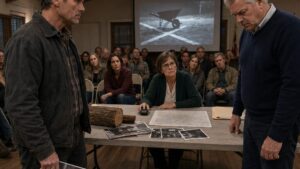
Deborah began the meeting by reading Ruth’s failures into the record.
“March ninth: courtesy notice unanswered. April second: formal landscaping notice unanswered. April twenty-first: second notice unanswered. May sixth: hearing opportunity not accepted.”
The clubhouse was fuller than Ruth had ever seen it.
Folding chairs filled two rows beyond the usual meeting setup. People stood along the back wall. The neighbor with the dog sat near the aisle. The landscaping contractor was absent, but the property manager had a laptop open in front of her.
Ruth sat beside Lisa.
Samuel was at the board table.
He had not looked at Ruth once.
Deborah continued.
“Program registration for the relevant plant material appears to have lapsed several years ago. The homeowner did not maintain required communication with either the municipal partnership or the association.”
She set the paper down.
The room stayed quiet.
Ruth could feel people looking at her.
Deborah folded her hands.
“I regret that the contractor’s work exceeded what any of us intended. But this was not a random act against a compliant homeowner. It arose from a long unresolved maintenance condition.”
There it was.
Not entirely false.
Which made it stronger.
The board chair asked, “Mrs. Carter, do you want to respond?”
Ruth stood.
She had brought the surviving rose cane in a plain paper sleeve because Daniel wanted to preserve a cutting after the meeting. She left it beneath her chair.
No display.
No performance.
“Yes,” she said.
She looked at Deborah, then at the room.
“I ignored every notice she just listed.”
A murmur passed through the chairs.
Deborah’s expression changed.
Ruth continued.
“I received them. I did not answer them properly. I thought the complaint was petty, and I thought speaking to Deborah at the fence was enough. It wasn’t.”
Lisa turned slightly toward her.
Ruth kept going.
“I also failed to renew the heritage program registration after my mother died. That was my responsibility.”
The board chair leaned back.
Deborah’s prepared papers suddenly looked less useful.
Ruth placed one hand on the table before her.
“The question tonight is not whether I was perfect. I wasn’t. The question is whether my failures authorized the committee to enter the wrong parcel scope, bypass a consultation agreement it knew existed, and remove mature plants before resolving those questions.”
Silence.
Ruth sat down.
For one brief moment, nothing moved.
Then Samuel raised his hand.
The board chair frowned. “Samuel?”
“I need to add something.”
Deborah turned toward him.
Samuel looked at the audience instead of Ruth.
“I saw Attachment B last spring.”
The room shifted.
Deborah’s voice was quiet. “We discussed that already.”
“No,” Samuel said. “We discussed whether it was current. We did not disclose that it existed when Mrs. Carter requested records.”
The property manager looked up sharply.
Samuel continued.
“I assumed the agreement was outdated because Deborah said the individual registrations appeared inactive. I did not verify that assumption. I did not ask whether consultation requirements applied independently.”
The board chair said, “Are you saying the board withheld a record?”
“I’m saying I knew a copy existed and did nothing when it later became difficult to locate.”
Deborah’s face had gone rigid.
“That is not the same as concealment.”
Samuel nodded.
“No. But it is not nothing.”
Ruth looked at him.
For the first time, he met her eyes.
The small payoff was not vindication.
It was responsibility crossing the room and landing somewhere other than on her alone.
Then Deborah stood.
“If we are going to be complete,” she said, “we should be complete.”
Her gaze moved to Lisa.
Ruth felt Lisa stiffen.
Deborah said, “Concerns about the garden did not originate solely with the committee.”
Lisa closed her eyes.
Deborah continued. “A family member contacted me months before formal enforcement began and expressed concern that Mrs. Carter was unable or unwilling to manage the property.”
The room turned.
Ruth heard someone whisper.
The board chair said, “Is that relevant?”
“It is relevant to the claim that the committee invented a problem.”
Lisa stood.
Ruth whispered, “You don’t have to.”
“Yes,” Lisa said. “I do.”
Her voice shook once.
“I contacted Deborah.”
The sentence seemed louder than Deborah’s entire opening statement.
Lisa faced the board.
“I was worried about my mother. I thought the garden had become something she couldn’t change because it reminded her of my grandmother. I asked whether there was a maintenance process.”
Deborah said, “More than once.”
Lisa looked at her.
“Yes.”
Then Lisa turned toward Ruth.
“I was wrong to go around you.”
Ruth felt every eye in the room.
Months earlier, she would have wanted the floor to open.
Now she understood something terrible and useful: humiliation was survivable.
Silence had cost more.
Ruth stood again.
“My daughter did complain.”
Deborah’s posture eased slightly.
Ruth continued. “That does not make the work order correct.”
The ease vanished.
Ruth lifted the contractor document.
“This is the parcel reference used for the cutting.”
She read the number.
Then she read her own.
“They do not match.”
Deborah said, “The project concerned the shared boundary.”
Ruth looked at her.
“You keep saying that.”
“Because it is true.”
“Then why was the number changed?”
The room went still.
Deborah did not answer.
Ruth turned to the property manager.
“The contractor’s first estimate. Do you have it?”
The manager looked at the laptop.
“I have the vendor file.”
“Please open the original estimate.”
Deborah said, “This is becoming a document scavenger hunt.”
Ruth ignored her.
The manager clicked through folders.
A PDF opened.
She read the parcel reference aloud.
It ended in sixteen.
Ruth’s.
The number on the work order ended in eighteen.
Someone at the back said, “So it changed?”
The board chair leaned forward.
“Who revised it?”
The property manager began typing.
Deborah spoke quickly. “Administrative references are corrected all the time.”
Ruth looked at her.
“Corrected from mine to one that supposedly authorized access?”
“It may have been used to identify the adjacent boundary.”
“After the estimate?”
Deborah’s voice hardened. “You are implying misconduct from a clerical change.”
Ruth felt anger rise.
This time she did not let it choose her words.
“I am asking a question.”
She placed both documents side by side.
“The original contractor estimate identified my parcel. The final work order used a different reference. The crew then entered my bed anyway. Who changed the number after the first estimate?”
The property manager stopped typing.
Her face had changed.
The board chair noticed.
“What?”
“There is a revision log.”
Deborah sat down.
No one spoke.
The manager rotated the laptop toward the board chair.
A sequence of entries appeared on the screen.
Original upload.
Scope revision.
Parcel reference edit.
User identification.
Timestamp.
The board chair read silently.
Then looked at Deborah.
The room changed before anyone said her name.
Ruth remained standing.
For weeks she had wanted one clean moment when truth arrived and everything became simple.
It did not.
Her ignored notices still existed.
Her lapsed registration still existed.
Lisa’s complaint still existed.
Samuel’s silence still existed.
And now, on the screen, so did the record of who had changed the work order.
The board chair closed his eyes briefly.
Then he said, “Deborah, I think you need to explain this entry.”
Chapter 7: The Notice Changed Hands, but Nothing Grew Back Overnight
The letter sat unopened on Ruth’s kitchen table until the coffee went cold.
It had arrived by certified mail that morning, white envelope, association logo in the corner, her name typed through the window. For ten minutes she stood over it without touching it.
Then she laughed once at herself.
After everything, she was still afraid of an envelope.
Ruth pulled out a chair and sat.
The first page began with formal language about a completed governance review. She forced herself not to skip ahead.
The review had examined the contractor estimate, revised work order, parcel references, committee communications, Attachment B, municipal consultation requirements, and the sequence of notices sent to Ruth.
Her own failures appeared in the second paragraph.
The association found that she had not responded to repeated maintenance notices and had allowed plant material to cross the fence line beyond the expected clearance standard.
Ruth read that sentence twice.
It irritated her.
It was also true.
She kept reading.
The committee, however, had exceeded its authority by converting an unresolved maintenance complaint into physical removal without adequate parcel verification, without required consultation under the association-level heritage agreement, and without a documented board determination authorizing entry into the affected bed.
Then came the sentence that made her put the page down.
The review found that Deborah Hill had personally altered the parcel reference on the contractor work order after the original estimate.
Ruth stared at the wall.
She had known what the revision log implied. Seeing it stated plainly felt different.
The report continued.
Deborah had argued that the change was intended to identify the adjacent boundary segment and prevent delay while ownership questions were resolved. The review found that explanation inconsistent with the actual sequence of instructions. Internal messages showed she wanted the crew mobilized before municipal consultation could interfere with the scheduled landscaping timeline.
Not a conspiracy.
Not a secret plot.
A deadline.
A plan Deborah had promoted.
A woman convinced that delay itself was failure.
Ruth turned the page.
Deborah was removed from the architectural committee and barred from holding a committee chair position pending future board eligibility review.
The association accepted financial responsibility for soil stabilization, root-zone assessment, replacement of damaged support structures, and reasonable restoration using reserve funds and applicable insurance coverage.
There would be no claim that the mature roses could simply be replaced.
Ruth read that line more slowly than all the others.
No claim that they could simply be replaced.
For the first time since the cutting, someone had written down the difference between repair and reversal.
Her phone rang.
Lisa.
Ruth answered.
“Did you get it?”
“Yes.”
“And?”
Ruth looked at the pages.
“They upheld most of it.”
“Most?”
“They listed my violations too.”
Lisa was quiet for a moment.
“Does that bother you?”
“Yes.”
“Do you think they’re wrong?”
Ruth leaned back.
“No.”
Another pause.
Then Lisa said, “That sounds new.”
Ruth almost snapped at her.
Instead she smiled despite herself.
“It is.”
By afternoon, the notice had become neighborhood news.
Ruth knew because the adjacent neighbor stopped at the mailbox and said, “I heard the board finally did something.”
Ruth did not ask what version had traveled fastest.
The board’s second letter went to Deborah.
Ruth saw it in her hand the next morning.
They met beside the bare fence line by accident.
Deborah stood on her side wearing gardening gloves. Ruth held her own notice folded in thirds.
For one strange moment, the two women simply looked at each other.
Matching envelopes.
Different consequences.
The image would have satisfied anyone who wanted a clean reversal.
Ruth did not feel clean.
Deborah looked older than she had two weeks earlier.
“So,” she said.
Ruth waited.
“They removed me.”
“I read that.”
“I assumed you would be pleased.”
“I don’t know what I am.”
Deborah looked down at her notice.
“I changed the reference because the contractor said the original scope could be delayed if the ownership line was disputed.”
“You knew consultation was required.”
“I knew an old agreement existed.”
“That isn’t the same sentence.”
Deborah gave a tired, bitter smile.
“No. I suppose it isn’t.”
Ruth studied her.
“Why?”
Deborah’s eyes moved toward the row of yards behind them.
“Because every time the board tries to enforce anything, someone says their house is different. Their fence is different. Their plants are special. Their deadline should move. Their violation needs another meeting.”
“That doesn’t answer why you hid the attachment.”
“I did not think it controlled.”
“You thought it might.”
Deborah said nothing.
Ruth nodded once.
There was the responsible choice.
Not ignorance.
Not confusion.
The moment Deborah decided uncertainty was inconvenient enough to bypass.
The following week, a landscape assessor met Ruth in the side yard.
He walked the bed slowly, pressing soil with a narrow probe and examining the remaining root crowns. Two surviving canes could likely be propagated. One damaged crown might recover. The open section would need soil work before replanting.
Then he unfolded a restoration proposal.
It showed the fence line returned to almost exactly what it had been before.
Ruth studied the drawing.
“What happens to those?”
She pointed through the fence.
On Deborah’s side, new ornamental grasses and three young shrubs had already taken root.
The assessor followed her finger.
“To recreate the old massing, some current plantings would probably need to come out. Especially if you want the original spread.”
Ruth looked at the plan.
For weeks she had imagined restoration as justice.
Now she saw another crew arriving.
Another set of flags.
Another person deciding that living things in the way of a desired picture could simply be removed.
“No.”
The assessor glanced up.
“You don’t want full reconstruction?”
“No.”
“The association approved it.”
“I understand.”
“We could phase it.”
Ruth folded the plan.
“No.”
That evening, she walked the bed with a can of marking paint.
Not orange flags.
No stakes.
She marked a smaller shape in the soil, leaving one section near the middle of the fence untouched.
Lisa came through the gate and stopped.
“What are you doing?”
“Changing the plan.”
“You fought for them to restore it.”
“I fought for them to take responsibility.”
“That’s not the same thing?”
Ruth looked at the bare ground.
“No.”
She marked the last curve.
The new bed would be narrower. Easier to maintain. Large enough for surviving cuttings, but not large enough to recreate every plant her mother had once grown.
Lisa stood beside her.
“What goes in the empty section?”
“Nothing yet.”
“Why?”
Ruth looked through the open stretch of fence.
Deborah’s side was visible now.
So was the sky beyond it.
“I haven’t decided.”
Lisa nodded.
For once, she did not offer a solution.
Ruth capped the paint can.
The old garden was not coming back.
That fact still hurt.
But for the first time, Ruth understood that refusing to destroy something new in order to imitate what had been lost was also a form of keeping faith.
She left the middle section empty.
And went inside before she could change her mind.
Chapter 8: What Ruth Chose to Let Cross the Fence Again
The first surviving rose bloomed on Deborah’s side of the fence.
Ruth noticed it in April while carrying a watering can toward the restored bed.
A thin new cane had grown through a gap between two boards, curved toward the morning light, and opened one pale pink flower beyond the property line.
Ruth stopped.
For several seconds she simply stared.
A year earlier, she would have pulled the branch back immediately.
Not because it harmed anything.
Because crossing had become dangerous.
She set down the watering can.
The restored bed looked different now.
Smaller.
Two propagated cuttings grew near the old support wire. The damaged crown Daniel had once photographed had survived, though unevenly, sending up only three strong canes. Between them Ruth had planted low herbs and open patches of mulch rather than trying to fill every inch.
The empty middle section remained.
She had discovered that emptiness changed with time.
At first it had looked like evidence.
Then failure.
Now, some mornings, it simply looked like space.
A gate clicked.
Lisa entered carrying a paper tray of seedlings.
“I brought too many.”
“You always do.”
“You say that like I learned it from strangers.”
Ruth took the tray.
Lisa walked toward the fence and stopped.
“Mom.”
“I see it.”
The bloom trembled slightly on Deborah’s side.
Lisa glanced at Ruth.
“What are you going to do?”
Before Ruth answered, Deborah’s back door opened.
She came across her yard slowly.
The past year had reduced their conversations to small practical exchanges. A package left at the wrong door. A sprinkler head leaking. One brief discussion about the fence contractor.
No apology had repaired them.
No friendship had replaced the damage.
Deborah reached the rose and stopped.
Her hand lifted halfway.
Then dropped.
She looked through the gap.
“Ruth?”
“Yes.”
“There’s a cane through here.”
“I know.”
Deborah waited.
The old rhythm of their conflict hovered between them.
Ruth could almost hear the first argument again.
Crossing the property.
Needs correction.
Not allowed.
Instead Deborah asked, “Do you want me to move it?”
Ruth looked at the flower.
“No.”
Deborah’s face revealed nothing.
“Cut it?”
“No.”
Another pause.
“All right.”
She began to turn away.
Ruth said, “Deborah.”
Deborah stopped.
“The fence still needs support wire.”
“I know.”
“I was thinking of adding one along this section. On my side.”
Ruth studied her.
Deborah continued carefully. “If you wanted, we could place it between the posts instead. Shared support. It might keep the heavier canes off the boards.”
Months earlier, Ruth would have heard strategy in the offer.
Maybe some remained.
People rarely changed into entirely new people.
“I’d want to see where it goes first,” Ruth said.
Deborah nodded.
“Of course.”
“And nothing gets cut without asking.”
“Yes.”
The answer came quickly.
Ruth looked at the bloom again.
“Leave that one.”
Deborah followed her gaze.
“All right.”
She walked back toward her house.
Lisa waited until the door closed.
“That was almost normal.”
“No, it wasn’t.”
Lisa smiled faintly. “Fair.”
They spent the morning transplanting seedlings.
At noon, Lisa found the old metal plant tag in Ruth’s potting box.
HG-2147.
Daniel had returned it after documenting the program record.
Lisa turned it over in her fingers.
“Was this Grandma’s?”
“Her participant number.”
“She never showed me.”
“She didn’t show me either. Not really.”
Ruth sat on the edge of the raised border.
Lisa lowered herself beside her.
For a while they listened to a lawn mower farther down the block.
Then Lisa said, “What did you promise her?”
Ruth looked at her.
“What?”
“You always say you promised Grandma something. You never say exactly what.”
Ruth had spent years protecting that sentence.
As though speaking it aloud would expose a private contract to interpretation.
Her mother had been in bed by then, thin beneath a cotton blanket, the bedroom window cracked because she complained the house smelled stale.
Ruth had been talking about the garden.
Of course she had.
Worrying about watering schedules. The old rose bed. Whether she could manage everything alone.
Her mother had closed her eyes and said, “Ruth, just keep something growing.”
That was all.
Not the roses.
Not every bed.
Not every branch.
Something.
Ruth looked at Lisa.
“She said, ‘Just keep something growing.’”
Lisa blinked.
“That’s it?”
Ruth laughed softly.
“That’s it.”
“You made it sound like she gave you instructions for the entire property.”
“I know.”
“Did she mean the garden?”
“I thought so.”
“And now?”
Ruth rubbed soil from her thumb.
“I think she knew I would need something to do after she was gone.”
Lisa looked down at the tag.
“I was angry at her for a while.”
“I know.”
“No, I don’t think you did.”
Ruth waited.
Lisa continued. “I was angry because you still had a relationship with her after she died. You had the roses. Her tools. All those routines. I felt like I only had stories, and you wouldn’t tell them.”
Ruth felt the words settle in a place she had kept defended for too long.
“I thought talking about it would make it smaller.”
Lisa frowned.
“What would?”
“What it meant.”
“So instead nobody knew.”
“Yes.”
The admission was quiet.
That did not make it easy.
Lisa handed her the metal tag.
“I’m sorry I went to Deborah.”
Ruth closed her fingers around it.
“I know.”
“I really thought I was helping.”
“I know that too.”
Lisa looked at her carefully.
“Are you still angry?”
“Yes.”
Lisa nodded.
“Okay.”
Ruth turned the tag in her palm.
“But not only angry.”
That was as close to forgiveness as she could honestly get.
Lisa accepted it.
Later that afternoon, they stood near the two strongest propagated cuttings.
Ruth had asked Lisa to choose which ones to keep in the central bed.
Lisa pointed to one with smaller leaves.
“That one.”
“Why?”
“Grandma would have picked the ugly one.”
Ruth laughed.
“She absolutely would have.”
“She always said the weak-looking plants were just badly marketed.”
“That sounds like her.”
They moved the selected cutting together.
By evening, the new support wire had not been installed.
No one rushed it.
The pale bloom still hung on Deborah’s side.
Ruth stood beside it with pruning shears in one hand.
Lisa came up behind her.
“Too long?”
“Yes.”
“Crossing?”
“Yes.”
Lisa waited.
Ruth looked at the cane.
For years, crossing the fence had meant negligence to Deborah, threat to Ruth, evidence to the HOA.
Now it was simply growth going where light allowed.
Ruth handed Lisa the shears.
“Take the dead tip.”
Lisa examined the branch.
“Not the whole cane?”
“No.”
“What about the part across the line?”
Ruth looked through the fence.
On the other side, Deborah had left the flower untouched.
“Leave it.”
Lisa clipped the dry tip.
The living cane remained.
Ruth guided it gently through the new opening in the support line, not back toward her own yard, but forward enough that it could bend without breaking.
Then she stepped away.
The rose crossed the boundary.
No notice followed.
No one claimed the crossing meant ownership.
Beside Ruth, Lisa closed the pruning shears and waited for her to say what came next.
Ruth looked at the smaller garden, the empty space, the surviving plants, and the one pale bloom growing where it had not been told to stay.
“Let’s leave it there,” she said.
The story has ended.