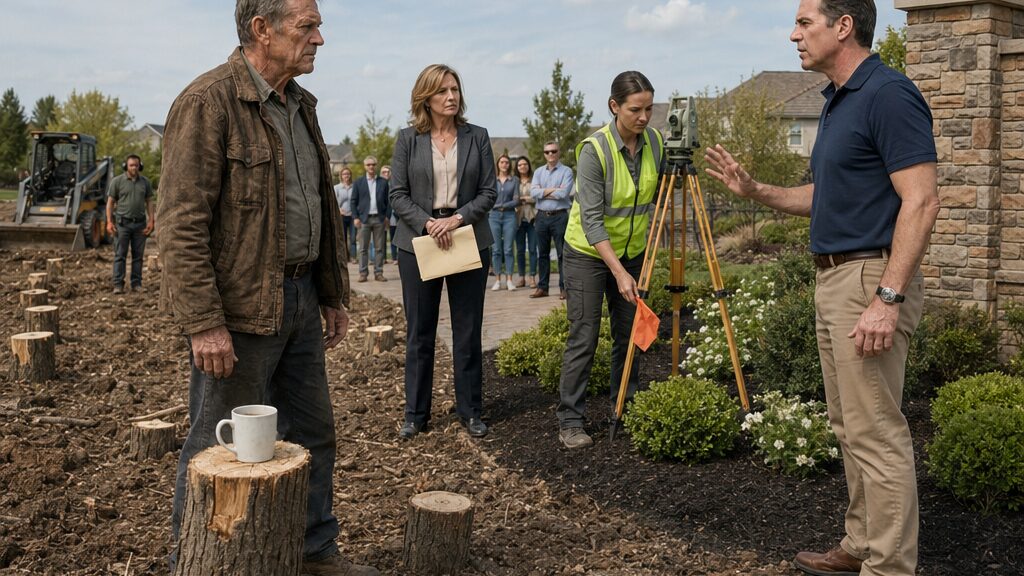
The HOA Cut Down His Orchard Screen, Then Learned Their Luxury Entrance Crossed His Land
Chapter 1: The Fine Was Handed Over Beside Fresh Stumps
The chainsaw was already biting into the last pear tree when Charles Miller came through the orchard gate with coffee in one hand.
For half a second, he did not understand what he was seeing.
The tree leaned toward the new stone entrance, its branches shivering under the saw’s vibration. Beyond it, three other trees were gone. Fresh stumps stood pale against the dark soil, their rings exposed like open clocks. A landscaping truck idled beside the road. Two workers in hearing protection watched a third man cutting a wedge into the trunk.
Charles set his white ceramic mug on a fence post.
“Kill the saw.”
The operator glanced toward the crew supervisor.
“Kill it,” Charles said again.
The engine dropped into a coughing idle.
Across the disturbed ground, Michael Roberts turned from the polished entrance wall. He wore pressed khakis and a blue polo, clean enough that the morning dust seemed to stop before reaching him.
“Charles.”
“You authorized this?”
Michael exhaled through his nose. “The board authorized vegetation removal along the entrance corridor.”
“My appeal hearing is Thursday.”
“The work order was already scheduled.”
Charles looked past him. The new entrance had cost enough that everyone in the community knew the number without anyone being able to prove it. Stacked stone. Low lighting. Irrigated beds. Ornamental grasses in disciplined rows. Two masonry columns framing the curved drive.
Beside all that finished work, his orchard looked as if a storm had chosen only one side of the property.
“You cut three trees before my appeal.”
“They were identified as obstructing sight distance.”
“By who?”
“The project consultant.”
Charles looked at the road. He had spent thirty-two years with the county road department, most of them solving drainage failures and sightline disputes that began with somebody saying a consultant had approved something.
“Show me the measurement.”
Michael’s jaw tightened. “This is exactly why the board has had trouble working with you.”
Charles turned back toward the pear tree. “I asked for a measurement.”
Several homeowners had stopped near the entrance. Some pretended to examine the new landscaping. Others watched openly.
Michael lowered his voice.
“You have fought every improvement on this side of the development.”
“I fought an irrigation trench through my roots.”
“You objected to lighting.”
“Because they aimed it at my bedroom.”
“You objected to the wall.”
“I asked where the line was.”
Michael gave a short laugh without humor. “And there it is.”
“What?”
“You don’t like change.”
Charles stared at him.
For years, he had believed the safest answer to people like Michael was no answer. Let a man hear himself long enough and he eventually showed you where the weak boards were.
But behind Michael, the felled branches of the first pear tree had been dragged into a pile. One still carried green fruit no bigger than walnuts.
Charles said, “Nobody touches the last tree until Thursday.”
A car door closed.
Kathleen White crossed the road from the HOA office vehicle with a folder pressed against her side. Her dark slacks and light jacket made her look prepared for an indoor meeting, not an orchard full of sawdust.
“Mr. Miller.”
He disliked being called that by people who had emailed him three times a week for twenty years.
“Kathleen.”
“I need to give you this.”
She extended an envelope.
Charles did not take it.
“What is it?”
“A notice of violation.”
A few feet away, the crew supervisor looked at the ground.
Kathleen continued in the careful tone she used at board meetings. “You interfered with authorized common-area maintenance this morning.”
Charles looked at the silent chainsaw.
“I got here three minutes ago.”
“You directed the contractor to stop.”
“On my trees.”
“That ownership question has not been established.”
“Then why are you cutting?”
Michael stepped forward. “Because the HOA controls the entrance strip.”
Charles turned to him. “According to what?”
“The approved site plan.”
“Not what I asked.”
Kathleen held the envelope out again. “Charles, please accept the notice.”
He took it.
The fine was two hundred fifty dollars, with additional daily penalties available if he continued to obstruct authorized work.
He read the sentence twice.
Then he folded the paper and put it into his shirt pocket.
One of the nearby homeowners murmured something Charles could not hear. Another turned away when he looked over.
He knew what they saw: an old man making trouble over trees beside a new entrance everyone had paid for. The orchard predated most of their houses. That did not make it beautiful to them. It made it old.
Charles walked to the nearest stump and picked up his mug.
The coffee had collected a skin of sawdust.
He stared at it, then set the mug directly on the fresh stump.
Michael said, “We can finish this calmly.”
Charles looked beyond him.
Something about the entrance was wrong.
Not the wall itself. The wall was straight, expensive, professionally laid.
The alignment was wrong.
For twenty-six years, an old wire fence had run from the drainage swale toward a cedar post near the road. Most of that fence had been removed during the entrance project. Charles had watched the equipment take it down and told himself the new work was on the same line.
Now, with three trees gone, he could see farther.
The wall did not follow the remembered fence.
It bowed inward toward his orchard before curving back to the road.
Charles stepped around the stump.
Michael said, “Where are you going?”
Charles ignored him.
He walked ten paces along the bare strip. Then five more. At the edge of a planting bed, he stopped and looked back toward the oldest apple row.
The geometry bothered him.
Road crews taught a man habits he could not switch off. Charles still judged slopes while mowing his lawn. Still noticed when culverts sat too high. Still saw lines where other people saw landscaping.
He crouched.
The crew had scraped away the topsoil, exposing compacted dirt beneath the mulch. A severed irrigation tube crossed the surface.
Charles brushed loose soil aside with two fingers.
Michael came closer. “What are you doing?”
“Looking.”
“For what?”
Charles did not answer.
He found rust first.
A small dark stain in the soil.
Then metal.
He dug with the edge of his pocketknife until the object emerged: the flattened head of an old survey nail driven into something buried below grade.
His pulse slowed.
That was the strange part. Not quickened. Slowed.
Michael stared down. “That could be anything.”
Charles wiped the nail head with his thumb.
A memory came back—not clear enough yet, but sharp at the edges. His wife at the kitchen table. A paper map. Her pencil circling a notation near the orchard corner.
He stood.
Kathleen had moved closer now.
“What is it?” she asked.
Charles looked from the old nail to the polished stone wall.
The wall sat several feet beyond it.
Michael said, “Charles, don’t start inventing a boundary dispute because you lost an appeal.”
Charles picked up his mug from the stump. Sawdust floated across the cold coffee.
“I haven’t had my appeal.”
Then he closed his hand around the rusted nail and walked back toward the house, leaving the final pear tree standing behind him.
Chapter 2: The Old Plat Showed a Line Nobody Mentioned
The rusted survey nail matched a pencil mark in his late wife’s handwriting.
Charles found the paper at 6:12 the next morning, inside a manila folder labeled ORCHARD—DRAINAGE in black marker.
He stood at the kitchen table with one hand resting on the back of a chair.
The notation was small.
Old pin? Ask board before fence work.
Beside it, his wife had drawn an arrow toward the road corner of their parcel.
Charles sat down.
For years after she died, he had avoided opening boxes that contained too much of her in too little space. Receipts with notes in the margins. Seed catalogs folded to particular pages. Lists that began with groceries and ended with reminders meant only for him.
Don’t forget Kathleen’s retirement card.
Call about pear blight.
Make Charles take a day off.
He touched the pencil mark with one finger.
Then he placed the rusted nail beside it.
His white mug sat near the top edge of the paper, coffee untouched.
By eight-thirty, Charles was at the county records office.
The clerk behind the counter listened without interrupting as he gave the parcel number and approximate dates. Charles had expected to feel foolish. Instead, the old habits returned. Start with the oldest reliable record. Work forward. Never assume a later drawing corrected an earlier mistake merely because it was newer.
The clerk brought him a scanned deed index, then directed him to subdivision plats.
The 1962 plat appeared on a large monitor.
Charles leaned closer.
There it was.
A boundary line running from a road monument past the orchard corner at a slight angle—the same angle he remembered from the old wire fence. A notation marked an iron pin near the location where he had found the nail.
He felt a brief, dangerous rush of satisfaction.
“Can I print this?”
The clerk nodded. “Large format or letter?”
“Both.”
He spent the next hour following transfers. His parcel had changed hands twice before he and his wife bought it. The neighboring land had been divided, recombined, then incorporated into the planned community years later.
The first records were clean.
Then the maps became less clean.
An HOA exhibit from the community’s early development showed a broad entrance strip beside his orchard. The line looked farther inward than the 1962 plat.
Charles laid the copies side by side on a reading table.
The older line angled.
The later line almost straightened.
No note explained why.
He checked the deed references again.
A clerk passing behind him stopped when he asked about easements.
“What kind?”
“Access, landscape, entrance construction. Anything recorded over this strip.”
She searched by parcel and grantor index.
Charles waited.
The printer behind the counter began feeding out someone else’s documents. A man at the next table whispered into his phone. Fluorescent lights hummed above the rows of shelves.
The clerk returned.
“I’m not seeing a recorded easement matching that description.”
Charles kept his face still.
“Could there be one somewhere else?”
“There could be an agreement not indexed the way you expect. Could be referenced in a title commitment. Could be unrecorded. I’m only telling you what I see here.”
“That’s fair.”
She glanced at his maps. “You have a surveyor?”
“Not yet.”
“You probably need one.”
Charles almost smiled. “Probably.”
At home that afternoon, he spread the records across the kitchen table.
The 1962 plat.
The later subdivision map.
The HOA entrance site plan he had printed from an old board email.
His wife’s drainage folder.
His coffee mug moved from one corner to another as the paper took over the room.
He measured distances with an old steel ruler.
Once.
Twice.
Then again.
The old plat gave him what he wanted: evidence that his memory had not invented the fence line.
The later map took some of that comfort away.
Its boundary did not simply contradict the first. It seemed to rely on a different reference point, one Charles could not reconcile from the documents in front of him.
He called the HOA office.
Kathleen answered.
“I need the recorded instrument supporting the entrance strip boundary on the site plan.”
A pause.
“Good afternoon to you too.”
“Afternoon.”
“Charles, the association’s site plan was professionally prepared.”
“That wasn’t my question.”
“I don’t have title records in front of me.”
“Then tell me who does.”
“Why?”
He looked at the rusted nail on the table.
“Because the 1962 plat doesn’t match your construction drawing.”
Silence.
When Kathleen spoke again, her tone had changed only slightly.
“You went to county records?”
“Yes.”
“You understand a historical plat doesn’t automatically override later recorded documents.”
“I understand enough not to cut trees before checking.”
“Charles.”
“I need the instrument.”
“I’ll ask counsel.”
“Thank you.”
He hung up before the conversation could become another argument.
Near sunset, he walked the orchard edge with copies folded in his jacket pocket.
The last pear tree still stood.
A strip of orange plastic mesh had been tied around it, marking it for later removal.
Charles stopped by the new wall.
From the road, the entrance looked finished. Low lights had come on beneath the stone caps. Water ticked through new irrigation heads. The effect was expensive and deliberate.
He stood where the old nail had been found and sighted toward the apple row.
Then he stepped to the line shown on the later map.
The difference was not inches.
Depending on which reference controlled, it could be several feet.
Several feet was enough for the wall.
Enough for irrigation.
Maybe more.
Charles returned to the kitchen and picked up his phone.
Sandra Davis answered on the fourth ring.
He knew her by reputation from county projects, though they had never worked directly together.
“I need a boundary survey,” he said.
“How soon?”
“Before somebody cuts down one more tree.”
“That sounds like a neighbor dispute.”
“It was this morning.”
Sandra was quiet for a beat.
“Send me the deeds and plats.”
“I have two maps that don’t agree.”
“That’s not unusual.”
“The new wall crosses both lines differently.”
This time the silence lasted longer.
“Send everything,” she said.
Charles looked down at the site plan.
The wall footprint did not merely sit near the disputed boundary. On one map it crossed the line at the entrance. On the other, it crossed farther down and then curved back.
He slid the 1962 plat over the newer subdivision drawing until both were visible.
For the first time, he saw the shape clearly.
The question was no longer whether one line had moved.
The question was why the expensive wall had been built in a place that neither map made comfortably safe.
Chapter 3: One Orange Flag Changed the Whole Argument
Michael arrived with an audience before Sandra had finished setting up her tripod.
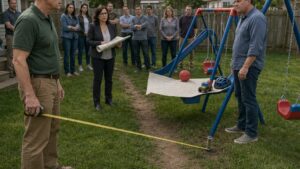
Charles counted twelve homeowners along the entrance sidewalk, plus Andrew Clark and the two other board members. Kathleen stood near the curb holding a folder. The landscaping crew had returned with a chipper and a compact loader.
The final pear tree wore its orange removal ribbon.
Charles brought his coffee from the house and said nothing.
Michael walked straight toward him.
“I was told there would be survey activity.”
“There is.”
“On association property.”
Sandra looked up from the instrument. “I’m surveying Mr. Miller’s parcel boundary. I’ll need access to visible monuments and record calls affecting the line.”
Michael turned to her. “And you are?”
“Sandra Davis.”
She gave him her card.
He glanced at it. “The board walkthrough was scheduled for ten.”
Sandra checked her watch. “It’s nine forty-three.”
One of the homeowners laughed softly.
Michael did not.
“This has become unnecessarily adversarial,” he said.
Charles looked at the pear tree. “You brought the crew.”
“The contractor is completing previously authorized work.”
“My appeal still hasn’t been heard.”
Kathleen stepped forward. “The hearing has been moved pending counsel review.”
Charles turned toward her. “First I’ve heard of it.”
“I sent notice this morning.”
“At what time?”
Her expression tightened. “Seven fifty-two.”
Charles had been outside with Sandra by then.
Michael gestured toward the tree contractor. “We’re not going to let a private survey disrupt association operations.”
That drew a murmur from the sidewalk.
Charles saw the assumption on their faces before anyone voiced it. He had seen versions of it for years. Charles against the gate lights. Charles against the widened shoulder. Charles complaining about irrigation. Charles refusing to understand that the community was no longer the rough collection of semi-rural lots it had been when he moved there.
Andrew Clark folded his arms.
“Can’t the survey happen without stopping the project?”
Charles looked at him.
Andrew was younger than Michael by perhaps fifteen years, with the tired expression of a man who spent too many evenings in meetings he had once volunteered to attend.
Sandra answered before Charles could.
“It can happen while you do anything you legally choose to do. Whether altering potential evidence during an active boundary dispute is wise is another question.”
Michael’s face hardened.
“There is no active boundary dispute.”
Sandra adjusted the instrument.
“I’m standing in one.”
The homeowner who had laughed before covered it with a cough.
Michael turned to the contractor. “Proceed with preparation. Do not cut until I say.”
The compact loader moved forward.
Charles walked to the nearest stump and placed his white mug on its flat surface.
Sawdust still clung to the bark.
Kathleen approached him with another envelope.
He stared at it.
“You’re kidding.”
“This is not a new fine.”
“What is it?”
“Formal acknowledgment of yesterday’s violation notice and notice that additional interference may result in daily penalties.”
Michael said from behind her, “Nobody wants that.”
Charles looked at Kathleen. “You could have mailed it.”
“I was instructed to serve it while we were here.”
“By who?”
She did not answer.
She did not need to.
Charles took the envelope and set it under his mug on the stump so the breeze would not carry it away.
Then he stepped back from the equipment path.
Michael watched him.
“That’s better.”
Charles felt something hot move through his chest.
For one dangerous second, he wanted to cross the bare strip between them and tell Michael exactly what he thought of a man who cut first and called procedure afterward.
Instead, he put both hands into his jacket pockets.
Sandra walked thirty feet toward the road.
Her assistant held a prism pole near the entrance bed. She called out a number. Sandra entered it, checked the screen, then looked toward the old apple row.
“Charles.”
He went to her.
“Do you know whether the original road monument was disturbed during entrance construction?”
“Shouldn’t have been.”
“Shouldn’t have?”
“It was outside the excavation limit.”
“That’s not the same answer.”
“No.”
She nodded once. “Good.”
Michael moved closer.
“What are you finding?”
Sandra said, “I’m not prepared to state a boundary opinion yet.”
“Then there is no reason to delay work.”
“I didn’t say that either.”
The audience had gone quiet.
Sandra relocated the tripod.
For the next twenty minutes, the scene became almost painfully ordinary. Measurements. Notes. A pole moved six feet. Then three. Sandra checked a record print. Her assistant scraped mulch away from a point near the wall.
Charles drank his coffee.
It had gone lukewarm.
Andrew walked over.
“You really think the HOA built on your land?”
Charles looked at him. “I think somebody should have known before cutting.”
“That’s not an answer.”
“No.”
Andrew frowned. “People are already talking about legal fees.”
“Tree’s still standing.”
“That’s not what I mean.”
“I know.”
Andrew glanced toward Michael. “We spent two years getting that entrance approved.”
Charles studied him.
There was no contempt in Andrew’s face now. Only worry.
“Then you should want the line right.”
Sandra called, “I need everyone clear of this bed.”
They moved.
She crouched near the stone wall and pressed a thin stake into the soil.
Then she tied a strip of orange ribbon around it.
The flag stood in fresh black mulch among ornamental grasses.
Nothing happened for a moment.
Michael said, “What is that supposed to represent?”
Sandra rose.
“A calculated point based on the 1962 record call, subject to monument verification and reconciliation with later documents.”
Michael stared at the flag.
It was not at the orchard edge.
It was inside the finished landscaping.
Several feet inside.
One homeowner lifted a phone, then seemed to think better of it.
Kathleen took two steps toward Sandra.
“Are you saying the property line is there?”
“I’m saying this is where one controlling record calculation currently places a point on the line. I am not issuing a final survey opinion in a parking-lot conversation.”
Michael gave a sharp nod. “Exactly.”
Charles looked from the orange ribbon to the wall.
The polished stone base sat beyond it.
He could hear water moving through the irrigation system beneath the mulch.
Michael said, louder now, “So we have no conclusion.”
Sandra turned to her instrument.
“We have measurements.”
“The board cannot operate on preliminary measurements.”
Charles spoke for the first time in several minutes.
“Sandra.”
She looked at him.
“Read the coordinate.”
Michael said, “Charles, don’t turn this into theater.”
Charles did not look at him.
“Read it.”
Sandra hesitated, then read the point identification and coordinate values from her field controller.
Charles took the folded 1962 plat from his jacket and opened it against his palm.
He did not understand every number, but he understood enough.
The road reference matched.
The angle was where it should be.
Andrew moved nearer to the flag.
“How far from the old fence line?”
Sandra said, “Approximately eighteen inches, depending on which physical remnant is accepted as the fence reference.”
“And from the wall?”
She measured with her eyes, then refused the shortcut.
“Give me a minute.”
Michael said, “No. We are done here until counsel is present.”
Andrew turned toward him. “Why?”
“Because this is exactly how misinformation starts.”
Andrew looked at the orange flag.
“It’s a flag.”
“It is a preliminary calculation being presented as ownership.”
“No one presented it as ownership.”
Michael’s voice sharpened. “You’re a board member.”
“I know.”
The sentence changed something.
Not dramatically. Nobody cheered. Nobody apologized to Charles.
But Andrew unfolded his arms.
Kathleen opened her folder and began reading something inside it.
The contractor shut down the loader.
Michael noticed.
“I did not tell you to stop.”
The supervisor removed one ear protector. “I’m not digging around a disputed marker.”
“It’s not a marker.”
“Looks disputed enough to me.”
Charles picked up his mug from the stump. The violation notice remained beneath it.
For the first time since the trees had fallen, he felt hope.
He did not trust it.
Hope could make a man careless faster than anger.
Sandra moved another forty yards down the boundary, toward the place where the entrance landscaping narrowed beside Michael’s property. His showcase yard began beyond a low hedge: sculpted beds, a stone patio, a long strip of lawn descending toward a reflecting pool.
Charles followed at a distance.
Michael came too.
“Your surveyor is trespassing now.”
Sandra stopped without turning. “I am on the Miller side of the calculated line.”
“You just said the line wasn’t final.”
“I did.”
“Then you can’t know that.”
Sandra finally looked back.
“That is why I’m measuring.”
Charles almost smiled.
She set the prism again.
A reading.
Then another.
Her expression changed.
It was slight, but Charles saw it.
“What?” he asked.
Sandra did not answer immediately.
She checked the field controller, walked five paces, and measured again.
Michael said, “What now?”
Sandra looked toward the orange flag near the entrance.
Then toward the decorative irrigation trench running past the hedge.
Then farther still, toward the edge of Michael’s private landscaped yard.
“I need to verify the later subdivision control,” she said.
Charles heard the caution in her voice.
He also heard what was underneath it.
“How far?” he asked.
Sandra pointed to a place beyond the hedge.
“Set the pole there.”
Her assistant crossed the grass.
Michael stepped forward. “That is my yard.”
Sandra took the next reading.
The instrument beeped.
She stared at the screen.
Charles watched her tie a second strip of orange ribbon.
This one did not stand beside the HOA entrance.
It stood beyond the hedge, in the landscaped ground leading toward Michael Roberts’s stone patio.
Chapter 4: The Survey Was Right, but Charles Had Stayed Silent
Michael was waiting in Charles’s kitchen when the old email appeared on the table.
He had brought a printed copy in a clear plastic sleeve.
Charles stood by the counter with his hand around the handle of his white mug, though he had not taken a drink since Michael arrived. The coffee had gone from hot to merely warm while Michael talked about legal review, preliminary findings, reliance, and the danger of treating a survey calculation like a verdict.
Then he slid the page forward.
“Read the date.”
Charles already had.
Seven years earlier.
The email was from an old board address. His own reply sat beneath it.
I don’t see a need for a formal boundary review at this time. The existing fence line and orchard edge can remain as they are.
Michael tapped the sentence with one finger.
“You knew there was a question.”
Charles said nothing.
“You knew.”
“I knew there was an inconsistency.”
“And you declined a survey.”
“I declined spending association money on one.”
Michael gave a short, disbelieving laugh. “That distinction is doing a lot of work.”
Charles looked at the page.
He remembered writing the message.
He had forgotten the exact words, but not the day.
His wife had been alive then. The old board president had come to the house after a drainage complaint and stood on this same kitchen floor with mud on his boots. They had discussed the fence, the old pin, and the mismatched sketch attached to an early HOA map.
Nothing formal.
Nothing signed.
Just men looking at paper and agreeing that the orchard edge would be left alone.
His wife had been the one who asked the important question after the board president left.
Shouldn’t that be written down?
Charles had told her there was no need to turn neighbor business into a legal fight.
Now Michael sat across from him with proof of that decision.
“You stayed silent for seven years,” Michael said.
“I stayed out of a fight.”
“You watched the entrance plans.”
“I objected to the wall.”
“You never said the land was yours.”
“I asked where the line was.”
“That’s not the same thing.”
No, Charles thought.
It was not.
The mug remained between his hands.
Michael leaned back.
“For months, you let us proceed.”
“I told you the line needed checking.”
“You told everyone everything needed checking. Drainage. Lighting. grading. setbacks.”
“Somebody should have listened.”
Michael’s face hardened, then softened into something more tired.
“You don’t get to make yourself the only responsible person in the room.”
The words landed harder than Charles expected.
He looked toward the window.
Beyond the glass, the last pear tree stood alone at the orchard edge, orange removal ribbon still tied to one branch.
Michael followed his gaze.
“You could have stopped this years ago.”
Charles said, “So could you.”
“Yes.”
The answer came without hesitation.
That was worse.
For a moment, neither man spoke.
Then Michael said, “The association attorney is reviewing whether your silence created reliance.”
Charles looked back.
“Reliance on what?”
“On the visible line. The fence. The site plan. Years of use.”
“The fence was removed for your project.”
“I know.”
“And the site plan is what’s in question.”
“I know that too.”
Charles frowned.
Michael’s anger had not disappeared, but something underneath it had shifted.
Fear, perhaps.
Not fear of Charles.
Fear of what came after Charles.
Later that afternoon, Sandra met him at the yard edge with a rolled survey sketch under one arm.
She had verified enough control points to speak more firmly.
“The entrance wall crosses the calculated parcel line.”
“How much?”
“At the widest point, a little over six feet.”
Charles stared at the stonework.
“And down here?”
Sandra walked toward the hedge.
“The irrigation line crosses. Part of the planting bed crosses. The private landscaping beyond that is more complicated.”
“Michael’s yard.”
“Yes.”
She stopped near the second orange flag.
“The record line places a strip of it on your side.”
Charles felt the old surge of satisfaction again.
This time Sandra cut it off before it fully formed.
“Do not celebrate yet.”
“I’m not.”
“You are.”
He almost argued.
She handed him the sketch.
“Your survey position is strong. That does not mean a judge would order every improvement removed. There are later records, long use, access questions, and this subdivision exhibit.”
She pointed to a shaded strip near the entrance.
“What is that?”
“Potential access area. Poorly described. It may not match the physical construction, but it gives their attorney something to argue.”
“So the wall’s over.”
“Likely.”
“The irrigation’s over.”
“Likely.”
“And they still might keep it?”
“I said the remedy is not automatic.”
Charles folded the sketch.
He hated cautious answers even when he knew cautious people were often the only ones telling the truth.
That evening, he took the old drainage folder from the kitchen drawer.
His wife’s pencil note waited on the paper.
Old pin? Ask board before fence work.
Underneath that, in smaller writing he had missed the first time, she had added:
They said they’ll leave orchard edge alone.
Charles sat down slowly.
Memory returned in pieces.
The old board president standing by the sink.
His wife asking whether the agreement should be recorded.
Charles waving the concern away.
We live next to these people. We don’t need lawyers for everything.
He closed his eyes.
Michael had been right about one thing.
Charles had known enough to ask.
He had simply preferred a promise to a fight.
The next morning, the HOA attorney joined a meeting in the management office by speakerphone.
Kathleen sat at one end of the conference table. Michael at the other. Charles took the chair nearest the door.
The attorney’s voice came through a black device in the center.
“The survey creates material exposure for the association.”
Michael said, “Material exposure meaning?”
“Potential encroachment, restoration costs, tree claims, legal fees.”
Charles watched Kathleen write each phrase.
The attorney continued. “However, there are questions regarding reliance, historical use, the later subdivision exhibit, and possible access rights.”
Michael looked at Charles.
Charles felt the accusation before it was spoken.
The attorney said, “Mr. Miller’s prior awareness of a discrepancy could be relevant.”
Charles answered, “I never gave permission to cut my trees.”
“No one is saying you did.”
“That’s exactly what this sounds like.”
“I’m saying litigation rarely gives either party the clean story they expect.”
Michael’s fingers tapped once against the table.
“What about complete removal?”
“Premature to discuss.”
Charles said, “Convenient.”
Kathleen looked up.
The attorney ignored the comment.
“If the association relied in good faith on existing plans, a court could consider practical remedies. Easement clarification. Compensation. Partial relocation. Injunctive relief depends on facts we do not yet have.”
Charles looked at his hands.
His victory had lasted less than forty-eight hours.
The line might be his.
The remedy might not.
Outside the office, Michael caught up with him.
“You see the problem now?”
Charles turned.
“I see several.”
“You want to tear out a six-figure project over a line you questioned seven years ago and chose not to resolve.”
“You cut living trees while my appeal was pending.”
Michael’s face tightened.
“That was a board process.”
“No. That was somebody’s choice.”
Michael said nothing.
Charles stepped closer.
“Who moved the work up?”
For the first time, Michael looked away.
That answer was enough to keep Charles from walking off.
Before he could press further, the office door opened.
Kathleen stood there.
“Charles.”
He turned.
Her expression was different from the careful professional mask she usually wore. Not friendly. Not apologetic.
Uneasy.
“Can I speak to you privately?”
Michael said, “About what?”
Kathleen looked at him.
“Management records.”
Michael’s shoulders went still.
Charles followed her back into the office.
She closed the door.
Then she spoke quietly.
“The tree-removal authorization was released before your appeal deadline expired.”
Charles stared at her.
“How far before?”
“Two days.”
“Who released it?”
Kathleen’s eyes shifted toward the closed door behind him.
“I need to verify the full timeline.”
Charles understood what she was not yet willing to say.
Michael had accused him of years of silence.
Now Charles had to learn whether Michael had used two days of stolen time to make the trees disappear before anyone could stop him.
Chapter 5: The Board Timeline Made the Mistake Look Deliberate
Kathleen came to Charles’s porch after dark carrying a stack of printed emails she held against her chest as if the night itself might read them.
Charles opened the screen door.
“You could have called.”
“I didn’t want to discuss this by phone.”
That was enough to make him step aside.
She did not enter.
Instead, she looked toward the road, then toward Michael’s property beyond the orchard.
“Here is fine.”
Charles brought out a second mug without asking. He set it on the small porch table beside his own.
Kathleen never touched it.
“What did you find?”
She handed him the top page.
“Work-order release.”
The contractor had originally been scheduled to begin after Charles’s appeal hearing.
A later email moved the date forward.
Charles read the sender.
Michael Roberts.
He read the timestamp.
Then the message.
Proceed with corridor completion at earliest contractor availability. We cannot allow one unresolved owner objection to delay the entrance schedule.
Charles looked at Kathleen.
“You had this.”
“I had hundreds of project emails.”
“You processed the order.”
“The contractor communication came through the board president. I assumed appeal timing had been addressed.”
“Did you check?”
Her jaw tightened.
“No.”
The answer cost her something.
Charles turned to the second page.
Another message.
This one referred to sight distance, vegetation obstruction, and project completion.
Then a line near the bottom caught his attention.
View corridor should be fully opened before final photography and lender inspection.
He read it twice.
“View corridor.”
Kathleen nodded.
“That phrase appears in three messages.”
“Safety problem?”
“There were safety references too.”
“But this came first.”
“Yes.”
Charles looked across the dark orchard.
The empty spaces where the trees had stood were almost invisible now.
“You thought I was resisting modernization.”
Kathleen folded her arms.
“I thought you objected to nearly every project affecting your side of the community.”
“That’s still not an answer.”
“No.” She paused. “I thought you used procedure to delay things you disliked.”
“And now?”
“Now I think the process was used against you.”
The words were plain.
That made them heavier.
Charles turned another page.
There it was: a contractor note confirming early availability. Michael’s response came six minutes later.
Take it. Finish removals before walkthrough.
The walkthrough had been the day Sandra placed the first orange flag.
Charles felt a cold clarity settle through him.
Michael had not merely failed to wait.
He had hurried.
Kathleen said, “I don’t know whether he understood the boundary risk at that point.”
“He knew I disputed the line.”
“Yes.”
“He knew the appeal wasn’t heard.”
“Yes.”
“And he told them to finish.”
“Yes.”
Charles placed the papers on the porch table.
For a moment, justice felt simple again.
Then Kathleen said, “There’s more.”
Of course there was.
She gave him another document.
This one was not about trees.
It was a financial summary.
The entrance project had been funded partly through reserve money and partly through a short-term association loan tied to scheduled refinancing.
Charles read the figures.
His anger made room for surprise.
“That much?”
Kathleen nodded.
“Landscaping, wall, electrical, drainage modifications, professional fees.”
“And if the encroachment claim stands?”
“The association’s insurer may reserve rights. If they decide the board knowingly proceeded after notice of a property dispute, coverage gets complicated.”
“Meaning?”
“Meaning homeowners may pay.”
Charles looked at her.
“How much?”
“I don’t know.”
That answer was worse than a number.
The following afternoon, Michael came to the orchard without a folder, attorney, or board member.
Charles was replacing a split handle on a pruning tool near the shed.
Michael stopped ten feet away.
“Kathleen showed you the emails.”
It was not a question.
Charles kept working.
“She showed me enough.”
Michael shoved his hands into his pockets.
“You think that proves I wanted your trees gone for my view.”
“It proves you wanted the corridor open before photography and inspection.”
“The lender was inspecting the common project.”
“And your property sits beside it.”
“Yes.”
“The trees blocked your view too.”
Michael’s mouth flattened.
“Yes.”
Charles set down the tool.
The admission surprised him.
Michael looked toward the new wall.
“You want the clean version? Fine. The entrance looked unfinished. People had been complaining for months. We had buyers touring homes. We had a refinance deadline. Every delay cost money.”
“So you cut first.”
“I moved a scheduled job.”
“Before my appeal.”
“Yes.”
“Knowing I challenged the line.”
Michael’s voice rose. “You challenged everything.”
Charles stood.
“That doesn’t make the one time I was right disappear.”
Michael looked away.
The anger went out of him so quickly that Charles almost mistrusted it.
Then Michael said, “Do you know what happens if the association loses coverage?”
“Tell me.”
“Special assessment.”
“How large?”
“I don’t know yet.”
“Kathleen doesn’t either.”
“No.”
Michael rubbed a hand over his face.
“My refinance is part of this too.”
Charles frowned.
Michael gave a humorless smile.
“You think I’m protecting a patio.”
“Aren’t you?”
“I’m protecting that too.”
The honesty stopped Charles.
Michael continued.
“I pushed this project. I told people it would improve values. I told the board the loan was manageable. I told owners the entrance would help us compete with newer developments.”
“You also told a contractor to cut before an appeal.”
“I did.”
“Why?”
“Because I thought you were stalling.”
There it was.
Not innocence.
Not a conspiracy.
A choice.
A bad one made by a man who had decided another person’s objection was predictable enough to ignore.
Michael looked toward the gaps in the orchard.
“I thought we had the right strip.”
“You didn’t check.”
“I trusted the site plan.”
“You wanted to.”
“Yes.”
The answer came low.
Charles felt no satisfaction.
That irritated him more than another argument might have.
Michael reached into his jacket and removed a folded sheet.
“Counsel thinks we should settle.”
Charles did not take it.
“What kind?”
“Private.”
“Of course.”
“Compensation for the trees. Boundary adjustment discussions. Construction changes where necessary.”
“And the work-order timeline?”
“Resolved as part of the settlement.”
“Meaning buried.”
“Meaning settled.”
Charles laughed once.
Michael’s face tightened.
“You think I’m asking for this because I’m afraid of embarrassment.”
“Aren’t you?”
“Yes.”
Again, the answer.
“But I’m also trying to keep sixty-three households from getting a bill because you and I couldn’t resolve a line.”
Charles stared at him.
“You rushed the cutting.”
“I know.”
“You made it official.”
“I know.”
“You fined me for standing by my own trees.”
Michael’s eyes shifted.
“I know.”
Charles picked up the folded offer at last.
He did not open it.
“How much?”
Michael named a figure.
It was more than Charles expected.
Enough to replace trees.
Enough to repair drainage.
Enough to make refusing it feel less like principle and more like stupidity.
Michael said, “No admission. No public escalation. We resolve the property issues through counsel.”
Charles looked at the empty spaces in the orchard.
Then at the expensive entrance.
Then back at Michael.
“What happens to the board process?”
“We review it internally.”
“What happens to the early work order?”
“It becomes part of a settled dispute.”
“And the next homeowner?”
Michael said nothing.
That silence answered more clearly than the emails.
Charles folded the offer once more and put it into his jacket.
Michael watched him.
“You’ll consider it?”
Charles said, “I’ll read it.”
That night, alone at the kitchen table, he opened the settlement packet.
The compensation figure sat on the first page.
The confidentiality language began on the second.
By the third, Charles understood exactly what the money would buy.
Not just his trees.
His silence again.
Chapter 6: He Could Win Quietly and Let Everyone Else Pay
The check was not attached, but the number printed beside the confidentiality clause looked just as real.
Charles sat at his kitchen table before sunrise with the settlement papers squared neatly in front of him.
Compensation.
Mutual release.
Non-disparagement.
Confidentiality.
Boundary adjustment subject to title review.
He read the documents until the words lost shape.
Then he looked at the white mug by his elbow.
A brown stain ringed the inside from yesterday’s coffee.
He carried it to the sink.
For years, the mug had gone everywhere with him when he wanted time before speaking. Porch. Orchard. Board meeting parking lot. County office.
He washed it slowly, wiped it dry, and left it upside down beside the sink.
He did not take it with him.
The closed board session began at nine.
Charles sat at one end of the conference table. Michael sat opposite him. Kathleen had arranged copies of the survey, financial summary, and preliminary title memorandum.
Andrew Clark arrived last.
He looked as if he had not slept.
The HOA attorney joined remotely.
“Before we discuss settlement,” the attorney said, “everyone needs to understand the exposure.”
Michael leaned back.
Charles said nothing.
The attorney continued.
“The survey supports Mr. Miller’s claim that portions of the entrance improvements cross the record boundary. The irrigation line is particularly problematic. The wall segment is likely encroaching.”
“Likely?” Michael asked.
“Strongly likely.”
“And the yard?”
“More complicated.”
Charles looked up.
The attorney referred them to the title memorandum.
A narrow access strip appearing in later subdivision records did not match the construction perfectly, but it was not meaningless. The language was ambiguous enough that litigation could last.
Charles felt irritation rise.
“So Sandra was right and still not right enough.”
The attorney answered, “That is one way to describe property law.”
Andrew almost smiled.
No one else did.
The attorney moved to insurance.
“If a carrier concludes the association knowingly proceeded after receiving notice of a plausible ownership dispute, coverage for some claims could be contested.”
Kathleen looked down.
Michael said, “Could be.”
“Yes.”
“Not will be.”
“Yes.”
Charles watched Michael cling to the distinction.
He knew the instinct.
He had done the same with drainage forecasts and road failures: maybe was easier to carry than probably.
Andrew asked, “What does uninsured exposure mean per household?”
The attorney did not answer directly.
Kathleen did.
“Potential special assessment.”
“How much?”
“We do not know.”
Andrew pushed his chair back slightly.
“I have two kids starting college.”
Michael said, “No one is proposing an assessment today.”
“That’s not what I asked.”
The room went still.
Andrew turned toward Charles.
“I voted for the enforcement action.”
Charles had not expected that.
“I know.”
“No. I mean the accelerated work.”
Michael said, “Andrew.”
Andrew ignored him.
“I voted yes.”
Charles studied his face.
“Why?”
“Because I thought you were dragging it out.”
The sentence echoed Michael’s earlier admission.
Andrew continued.
“We’d already raised dues. People were angry. The entrance loan was supposed to be temporary. Every delay meant more cost.” He rubbed both hands over his face. “I told myself one homeowner couldn’t hold the whole place hostage.”
Charles looked down at the settlement papers.
“How much did you know about the line?”
“Almost nothing.”
“Did you ask?”
Andrew’s silence was enough.
There it was again.
Not one villain.
A chain of people choosing convenience because uncertainty belonged to somebody else.
Michael said quietly, “This is why settlement matters.”
Charles looked at him.
“Because everyone shares blame?”
“Because everyone shares consequences.”
The attorney cleared his throat.
“There is another point.”
The title memorandum appeared on screen.
The narrow access strip.
Charles leaned closer.
The later subdivision record suggested some association access rights near the entrance. Not enough to justify every improvement. Not enough to excuse cutting trees on disputed ground.
But enough to destroy the fantasy of a simple order forcing everything out.
Michael looked at Charles.
“You wanted the truth.”
Charles said, “Still do.”
“This is it.”
“No. This is a piece.”
Michael’s control slipped.
“What do you want from me?”
The room held the question.
Charles had imagined answers.
Remove the wall.
Replace every tree.
Pay damages.
Resign.
Admit it.
He had imagined Michael watching machinery undo the entrance while Charles drank coffee from his porch.
Now Andrew sat two seats away worrying about college bills.
Kathleen had risked her job by producing the timeline.
Michael had made the choice that caused the harm, but he had not invented the whole machine alone.
Charles said, “I want to see the site.”
Michael stared at him.
“Now?”
“Now.”
They walked out together.
At the entrance, the orange flags remained.
Sandra’s first marker stood in the ornamental bed. The second waited beyond the hedge.
The final pear tree still carried its removal ribbon.
Charles stopped beside the fresh stumps.
Michael came up behind him.
“What are you thinking?”
“That full demolition would feel good for about ten minutes.”
Michael said nothing.
“And then?”
“Then lawyers argue over the access strip. Insurance argues over notice. Homeowners pay. You blame me. I blame you. The orchard is still gone.”
Michael looked toward the wall.
“What do you want?”
Charles turned.
“The encroaching wall segment moved.”
Michael’s jaw tightened.
“The irrigation removed from my parcel.”
A pause.
“Grade restored.”
Michael nodded once.
“Compensation for the trees.”
Another nod.
“A new enforcement rule. No emergency work on disputed property before appeal unless there is an immediate safety threat documented by someone independent.”
Kathleen, standing behind them, wrote something down.
Charles continued.
“The entrance design relocates where the line requires it.”
Michael said, “And confidentiality?”
“No.”
The word came easily.
Michael’s face closed.
“Then there’s no settlement.”
“There can be a settlement.”
“Not one that turns this into a public spectacle.”
Charles almost laughed.
For years he had used the same phrase in his own head.
Don’t make a spectacle.
Keep neighbor business quiet.
Handle it privately.
He looked at the stumps.
“That’s what got us here.”
Michael stared at him.
Charles pulled the folded settlement packet from his jacket.
He held it out.
“I’m rejecting confidentiality.”
Michael did not take it.
“Think carefully.”
“I have.”
“You could get paid. Your property gets addressed. We avoid panic.”
“And nobody knows you ordered cutting before my appeal.”
Michael’s voice dropped.
“You admitted you knew there was an old boundary issue.”
“Yes.”
“So you’re going to stand in front of everyone and pretend—”
“No.”
Charles interrupted him.
Michael stopped.
Charles said, “I’m going to tell them that too.”
For the first time all morning, Michael had no answer.
Charles turned toward Kathleen.
“Schedule an open meeting.”
Her pen paused.
“You’re sure?”
“No.”
He looked once more at the final pear tree.
“Schedule it anyway.”
Chapter 7: Charles Told the Room What He Had Failed to Do
By the time Charles entered the community meeting room, every chair facing the board table was taken.
People stood along the back wall. Others leaned against the windows. The orange-marked survey map had been enlarged and mounted on a foam board beside the podium, its boundary line cutting visibly through the entrance landscaping and toward Michael’s yard.
Charles stopped just inside the door.
Michael was already seated.
He looked at Charles once, then at the stack of papers in Charles’s hand.
No mug.
No folded settlement packet.
Just the survey map, the work-order timeline, and the old email Charles had written seven years earlier.
Andrew saw him and pulled out a chair near the front.
Charles shook his head.
“I’ll stand.”
The room settled badly, not into silence but into the small noises people make when they expect a fight. Chair legs scraped. Someone whispered behind him. A homeowner near the aisle held a phone low against one knee.
Kathleen called the meeting to order.
She moved through the formal opening quickly.
Then she said, “The principal matter tonight concerns the entrance project, the Miller parcel boundary, vegetation removal, and proposed corrective action.”
A man at the back called, “How much is this going to cost?”
Another voice answered before Kathleen could.
“That’s what we’re here to find out.”
Michael leaned toward his microphone.
“We need to keep this orderly.”
Charles heard the old phrase inside that sentence.
Keep it orderly.
Keep it private.
Keep it from becoming a spectacle.
Kathleen summarized the survey findings in cautious language. Likely encroachment. Ongoing title review. Disputed access strip. Potential removal and relocation.
The room tightened with every phrase.
Then Michael spoke.
“The board believed it was acting on approved plans and in the community’s interest. We are reviewing errors in both the construction assumptions and enforcement process.”
Charles watched him.
It was careful.
Too careful.
Michael continued. “We also need to acknowledge that the boundary question was not newly discovered. There is evidence Mr. Miller was aware of a discrepancy years ago and declined formal review.”
The room shifted.
Heads turned toward Charles.
There it was.
The opening Michael had expected to use.
Charles walked to the front.
Michael looked almost relieved.
He thought the argument had arrived.
Charles placed his papers on the podium.
“I did know.”
The room went still.
Michael’s expression changed.
Charles picked up the old email.
“Seven years ago, I was asked whether I wanted the association to spend money on a formal boundary review. I wrote back that I didn’t see the need.”
Someone near the wall said, “Then why are we here?”
Charles looked toward the voice.
“Because I was wrong.”
No one spoke.
He held up the email.
“I knew the old plat and the fence line didn’t fit perfectly. I knew there was an old pin near the orchard edge. The board president at the time told my wife and me the edge would be left alone.”
He paused.
“My wife asked me to get that in writing.”
The admission scraped more than he expected.
“I told her we didn’t need lawyers for everything.”
He looked at the orange map.
“I thought keeping peace meant leaving it alone.”
A woman in the second row lowered her eyes.
Charles continued.
“That was my mistake.”
Michael sat motionless.
Charles placed the email on the podium.
“I should have fixed the uncertainty before it became useful to somebody else.”
A murmur moved through the room, quieter now.
Andrew leaned forward.
Charles turned to the printed timeline.
“But my mistake did not authorize anyone to cut trees before an appeal.”
Kathleen’s shoulders tightened.
Charles read the dates.
His notice of appeal.
The scheduled hearing.
The contractor’s original start date.
Then Michael’s email moving the work forward.
The room changed.
Not loudly.
One person whispered, “Before the hearing?”
Charles read the next line.
Proceed with corridor completion at earliest contractor availability.
Then the contractor’s confirmation.
Then Michael’s final message.
Finish removals before walkthrough.
A homeowner near the center said, “Why?”
Michael reached for his microphone.
Charles spoke first.
“There were safety reasons in the file.”
Michael looked at him sharply.
Charles continued.
“There were also lender deadlines. Final photography. Entrance completion. A view corridor.”
He turned to Michael.
“You should answer the rest.”
The room waited.
Michael’s hand remained on the microphone.
For several seconds, he said nothing.
Then he pressed the button.
“I believed the objection was another delay tactic.”
Someone said, “That’s not an answer.”
Michael looked toward the back wall.
“It is the answer.”
The room quieted again.
He continued.
“We had a refinance deadline. Costs had increased. The board had been receiving complaints about dues and delays. I believed the entrance strip was association-controlled. I believed the work was authorized.”
Charles watched his face.
Michael’s voice tightened.
“And I moved the contractor forward before the appeal was complete.”
A man near the aisle swore under his breath.
Kathleen said, “Please.”
Michael looked at Charles.
“I made that decision.”
For the first time since the trees had been cut, Charles felt the room tilt away from simple sides.
Not because Michael was forgiven.
Because he had stopped hiding behind the board.
Andrew raised his hand.
Kathleen recognized him.
“I voted for acceleration too,” he said.
Several people turned toward him.
Andrew swallowed.
“I thought Mr. Miller was holding up the project. I didn’t ask enough questions.”
A woman near the front said, “So all of you just decided he was difficult?”
Andrew answered quietly.
“Yes.”
Charles looked at the faces around him.
This was the moment he had imagined differently.
In those first days, he had pictured exposure as satisfaction. Michael trapped by documents. The board forced to admit everything. Neighbors finally seeing who had been right.
Standing there now, he felt no triumph.
Only responsibility.
He turned the enlarged map toward the room.
“The survey shows the wall segment crosses my parcel. The irrigation line crosses. Some landscaping crosses.”
He pointed to the orange marks.
“The title review also shows a narrow access strip that is not clear enough for me to stand here and pretend every inch is simple.”
Michael stared at him.
Charles continued.
“I could demand full removal and let lawyers fight over the rest.”
The room held still.
“I’m not doing that.”
A few people looked confused.
Michael’s face gave nothing away.
Charles read from one sheet.
“The wall segment on my parcel gets relocated. Irrigation gets removed from my land. The grade gets restored. The association compensates for the trees that were cut before appeal. The entrance is redesigned where the line requires it.”
He turned a page.
“New rule: no emergency work on disputed property before appeal unless there is a documented immediate safety threat reviewed independently.”
Kathleen nodded once.
Charles looked at Michael.
“And the timeline becomes part of the public board record.”
There it was.
The cost.
Michael’s mouth tightened.
Charles said, “I won’t sign confidentiality.”
A homeowner asked, “What does this cost us?”
Charles answered before Michael could.
“Less than pretending the problem never happened.”
“That’s not a number.”
“No.”
He looked at the room.
“I don’t have one. Nobody honest does yet.”
That answer did not comfort them.
It was not meant to.
Michael lowered his eyes to the proposed correction plan.
The silence stretched.
Then he reached for his microphone.
“I move that the board accept the corrective framework subject to final engineering, title review, and negotiated cost controls.”
Someone gasped softly.
Andrew said, “Second.”
Kathleen called the vote.
One board member hesitated, then voted yes.
The other followed.
Michael voted last.
“Yes.”
The motion passed.
There was no applause.
Charles was grateful for that.
Kathleen began gathering papers.
People immediately started talking over one another.
Then Michael raised his hand.
“I have one more statement.”
The room quieted reluctantly.
Michael looked at the homeowners, then at Charles.
“I will remain through implementation of the correction plan.”
His voice was steady now.
“After that, I will resign as board president.”
A man at the back said, “You should resign tonight.”
Michael looked toward him.
“Maybe.”
Then he turned back to the table.
“But I’m not leaving someone else to clean up a project I pushed through.”
Charles studied him.
It was not absolution.
It was not defeat either.
It was the first useful thing Michael had done without needing to win.
As the meeting broke apart, Charles remained beside the orange-marked map.
For years, he had believed silence kept conflict small.
Now everyone knew exactly how much space silence could give a mistake.
Chapter 8: The New Boundary Left No One Completely Innocent
The first section of the entrance wall came out on a Tuesday morning.
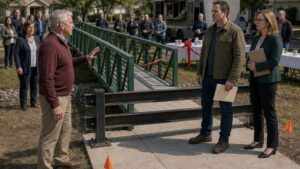
Charles watched from the orchard edge as a machine lifted the stone cap away and set it onto a pallet. The crew worked slowly this time. Survey stakes stood protected behind temporary barriers, each one marked with orange ribbon.
No one crossed them casually.
Six weeks had passed since the meeting.
Long enough for agreements to become drawings.
Long enough for drawings to become permits.
Long enough for the empty places in the orchard to stop looking fresh and start looking permanent.
Sandra stood near the restored strip with a level rod.
“Another inch on the low side,” she called.
The equipment operator adjusted the grade.
Charles held his white mug in both hands.
He had brought it back to the orchard that morning without thinking.
Sandra finished her reading, checked the new permanent marker, then walked over.
“Grade is good.”
“And the line?”
She looked at him.
“You ask that every time.”
“I paid you.”
“You did.”
She pointed toward the marker.
“The line is where we agreed it is.”
Charles nodded.
The wall segment was gone from his parcel. The irrigation crossing had been removed. The entrance curve had been redesigned several feet away. The disputed access strip remained documented for future title resolution, but no one was pretending it justified the old construction anymore.
At the orchard edge, replacement pear trees waited in burlap root balls.
They looked too small.
That was the truth no settlement had repaired.
The old trees had taken decades.
These saplings barely reached Charles’s shoulder.
Kathleen came by with final restoration papers and left after ten minutes. Andrew stopped once to ask about the new enforcement policy. He seemed embarrassed every time he spoke to Charles now, which Charles found less useful than honesty but better than avoidance.
Michael arrived last.
He carried a weathered wooden sign.
Charles recognized it before Michael reached him.
The orchard sign had hung on the old fence for years.
MILLER PEARS
The paint was faded. One corner had split.
“I found it behind the contractor storage shed,” Michael said.
Charles took it.
“You could’ve thrown it away.”
“I know.”
They stood beside the new marker.
The machinery worked farther down the entrance.
Michael had not yet resigned. Final implementation remained open, and he had kept his word about staying until it closed.
He looked older than he had six weeks ago.
Charles supposed he did too.
“The board approved the tree compensation transfer,” Michael said.
“I saw.”
“And the rule change.”
“I saw that too.”
Michael nodded.
Neither man seemed to know what came next.
Charles looked at the replacement trees.
“They won’t screen much.”
“No.”
“Not for years.”
“I know.”
There were apologies that came too late and apologies that came dressed as explanations.
Charles had no interest in either.
Michael said, “I’m sorry I ordered the work early.”
Charles looked at him.
Michael continued.
“I’m not asking you to make that enough.”
Charles lowered his eyes to the mug.
“No.”
The answer stayed between them.
Then Charles walked to the first planting hole.
A wooden stake lay beside it.
He set the white mug on top of the new survey marker.
For a moment, he saw the old version of himself standing there: coffee in hand, concern unspoken, trusting that people would remember a promise because he remembered it.
He picked up the stake.
Michael turned as if to leave.
Charles said, “Hold this straight.”
Michael stopped.
He looked at the young pear tree.
Then at Charles.
“You serious?”
“No.”
Michael almost smiled.
Charles handed him the stake anyway.
Michael took it and stepped into the loose soil beside the sapling.
Charles crouched to check the trunk.
“Little left.”
Michael moved the stake.
“Your left or mine?”
“Mine.”
“That explains a lot.”
Charles looked up.
Michael’s expression changed, uncertain whether he had gone too far.
Charles adjusted the tree.
“Hold it there.”
Michael did.
The entrance behind them was smaller now.
Less dramatic.
More accurate.
Charles packed soil around the root ball with his boot.
The new pear tree cast almost no shade.
That would take time.
He stood, brushed dirt from his hands, and reached for the mug beside the marker.
Then he stopped.
“Keep holding it.”
Michael looked down at the stake.
“For how long?”
Charles picked up the shovel.
“Until it stands on its own.”
The story has ended.