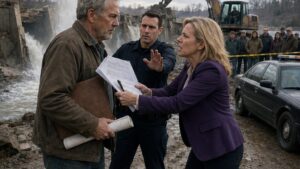
They Tore Down His Father’s Dock, Then the Old County Map Changed Who Controlled the Water
Chapter 1: The Last Piling Fell Before David Knew Who Had Ordered It
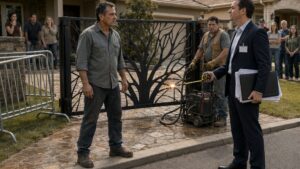
The chainsaw stopped, and for half a second the dock remained standing.
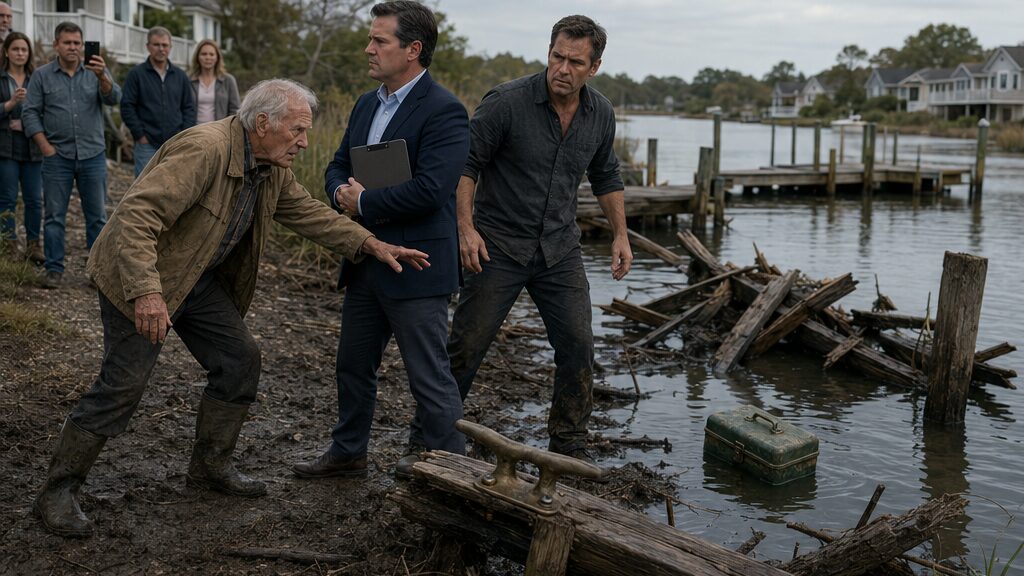
David heard the engine wind down before he understood what he was looking at. The final outer piling had already been cut nearly through. A pale crescent of fresh wood showed beneath forty years of gray weathering.
Then the piling split.
The dock dropped hard on one side, twisted, and slid into the narrow channel with a cracking sound that sent two gulls up from the reeds. Planks struck water. One railing vanished beneath the surface. A folding chair tipped backward and floated away upside down.
David was already moving.
“Hey!”
The marine contractor nearest the bank stepped back from the saw. He wore ear protection around his neck and kept both hands visible, as though David had entered a room where something unfortunate but properly authorized had taken place.
David looked past him.
His father stood six feet from the water.
George Mitchell had one hand closed around the empty handle of his thermos bag. His face was still, but David knew that stillness. At eighty-one, George had become careful with anger, careful with surprise, careful even with pain. He spent emotion the way he spent money: only after checking whether there would be enough left.
A broken section of dock rolled in the current.
Bolted to one splintered beam was the old brass cleat.
David had tied his first fishing line beside that cleat when he was nine.
“Who told you to do this?” he asked.
The contractor glanced toward the gravel lane.
A man in a navy blazer was walking down it with a clipboard tucked against his ribs.
Nicholas Scott did not hurry.
That was the first thing David would remember later—not the saw, not the collapsing boards, not even George’s face. Nicholas walked toward the wreckage as if everyone else had arrived late to a meeting he had scheduled.
“Mr. Mitchell,” Nicholas said.
David stepped between him and George.
“Which one?”
Nicholas stopped.
His eyes moved briefly to George, then back to David. “The association sent notice.”
“No. You sent paper. I’m asking who ordered that.”
Nicholas lifted the clipboard slightly. “The board approved removal of an unauthorized structure within managed shoreline space.”
Behind him, one of the contractors began pulling a loose plank toward the bank with a boat hook.
David heard George say, very quietly, “Unauthorized.”
Nicholas turned to him with the patient expression of a man explaining a parking rule.
“The structure did not appear on the association’s approved shoreline-use plan.”
George looked at the channel.
A green tackle box had come loose from somewhere under the ruined decking. It drifted slowly past a broken piling, lid still latched.
David pointed at the water. “That was my father’s dock.”
“I understand you’re upset.”
“No. You understand that sentence because it’s plain English.”
Nicholas’s mouth tightened.
“The association has been trying for eighteen months to standardize access. We have insurance exposure, unpermitted tie-ups, deteriorated structures, residents using common water frontage without contributing to maintenance—”
“My father built that dock.”
Nicholas looked down at the clipboard.
David nearly laughed. The movement was so small and so precise that it felt obscene.
“Then he should have supplied documentation when requested.”
George finally looked at him. “Requested by who?”
“The board.”
“The board wasn’t here.”
Nicholas paused.
A plank bumped another plank in the water.
David turned toward George. “What do you mean?”
George rubbed his thumb over the handle of the empty thermos bag.
“I mean it wasn’t here.”
“When you built it?”
George nodded once.
Nicholas shifted his weight. “Historic use does not automatically override current governance.”
David ignored him.
“When did you build it?”
George looked at the remains of the dock as if the answer might still be nailed somewhere underneath.
“Eighty-three.”
David stared at him.
“You built that in 1983?”
“Spring into summer. Took longer than it should’ve.”
The words changed the wreckage.
Until then, David had seen an old dock—his father’s, yes, but old in the impersonal way roofs and fences became old. Now he saw George at thirty-nine, carrying bags of mix down the bank, setting pilings by hand, measuring twice because lumber cost money.
David remembered a childhood photograph: his mother sitting on the unfinished frame with her shoes off. George behind her, thinner, sunburned, one hand resting on a post.
Nicholas cleared his throat.
“There is also the matter of continued access.”
David turned.
Nicholas removed a sheet from the clipboard.
The debris was still drifting when he held it out.
“Effective today, any use of the managed shoreline corridor without an approved access designation will incur a forty-dollar-per-day fee.”
David did not take the paper.
For a moment, nobody spoke.
Even the contractor stopped moving boards.
“You tore his dock down,” David said, “and now you’re charging him for using the water beside it.”
Nicholas’s expression changed, but only slightly. Something in him hardened against the accusation.
“We are not charging for water. We are enforcing access rules designed to spread costs fairly among residents.”
George gave a dry little breath that might have been a laugh.
Nicholas looked at him. “People cannot simply maintain private arrangements indefinitely because they predate current standards.”
“Private arrangements,” George repeated.
David saw the thermos bag tighten in his father’s hand.
He stepped closer to Nicholas.
“Who inspected it before demolition?”
“The contractor assessed condition.”
“That’s not what I asked.”
“The board reviewed the situation.”
“Did anybody check permits?”
“The structure was not in our approved plan.”
“Did anybody check county records?”
For the first time, Nicholas looked irritated rather than calm.
“This is association property management, Mr. Mitchell. We do not need to relitigate every informal use that existed before development.”
Before development.
The phrase caught somewhere in David’s mind, but anger crowded it out.
He looked toward the water.
The green tackle box had reached a patch of reeds and turned slowly in place.
George took one step down the muddy bank.
David caught his elbow. “Dad.”
“My box.”
“I see it.”
George pulled gently away. “Then let go.”
“Not with boards in the water.”
George did not answer.
Across the channel, two neighbors had come out onto a newer common dock. One held a phone at chest height. Another stood with both arms folded.
David suddenly felt the shape of the scene from the outside: the old man, the wreckage, the blazer, the clipboard, the son about to lose his temper.
He hated being watched.
He hated even more that Nicholas seemed comfortable with it.
Nicholas extended the notice again.
“I suggest you read the policy before making this worse.”
David took the sheet.
Not because Nicholas told him to. Because he wanted to stop himself from knocking the clipboard into the mud.
The page carried the association logo at the top. Under it were references to safety, managed access, insurance compliance, and fee schedules.
David scanned the first paragraph.
Then the second.
Nothing on the page said when the association had acquired the right Nicholas kept describing.
Nothing identified the old dock by permit number, parcel number, or recorded boundary.
There was only the repeated phrase managed shoreline.
Behind him, George said, “David.”
He turned.
His father was staring at the tackle box.
The current had nudged it free of the reeds. It was moving again now, slowly downstream.
David folded the notice in half.
Nicholas tapped the clipboard with one finger.
“You should also understand this clearly. The board controls every inch of usable shoreline in this development.”
David looked at the broken dock.
Then at the old brass cleat still bolted to one shattered beam.
Then at his father.
Every inch, Nicholas had said.
David looked back at him.
“Do you?”
Chapter 2: He Said “Sue Me,” Then Stopped Arguing About the Water
George stepped into the mud before David could grab him.
His right boot sank almost to the ankle. He pulled it free with a wet sucking sound and kept going toward the water.
“Dad.”
“The box is getting away.”
“I’ll get it.”
“You said that five minutes ago.”
George reached the edge of the broken shoreline, where torn roots and splintered boards had turned the bank into a trap.
David moved after him.
Nicholas came down from the gravel lane at the same time.
“You cannot enter the managed corridor during active debris removal.”
George did not look at him.
Nicholas raised his voice. “Mr. Mitchell.”
George put one boot in the shallows.
The water was brown enough that David could not see the bottom.
He caught up and took his father by the upper arm.
“Stop.”
“My tackle box.”
“I know.”
“There’s forty years in there.”
David looked at the green box.
It had lodged again, this time behind the remains of an outer piling fifteen feet from shore.
“What does that mean?” he asked.
George’s eyes stayed on it. “Means I’d like it back.”
Nicholas was beside them now, holding the clipboard under one arm.
“This is exactly the kind of uncontrolled access the policy addresses.”
David turned slowly.
“You’re giving him a violation while he tries to recover his own property from a dock you destroyed?”
“I’m telling both of you to stay out of an unsafe area.”
“That’s not what your paper says.”
“The paper addresses unauthorized access.”
“Pick one.”
Nicholas’s jaw shifted.
For a second, David saw something behind the board-president calm: not cruelty exactly, but fear of losing the frame of the argument.
Nicholas lowered his voice.
“You think this is just about your father. It isn’t. People tie up wherever they want. Old platforms collapse. Boats block passage. New owners pay assessments for dredging and insurance while long-term residents insist their arrangements are grandfathered because nobody stopped them twenty years ago.”
“Forty.”
“What?”
“The dock was there forty years.”
Nicholas glanced toward the wreckage.
“Age does not prove entitlement.”
Behind them, a woman’s voice said, “Neither does a clipboard.”
Deborah Allen stood near the gravel lane with her arms crossed.
Nicholas did not turn around.
David knew Deborah by sight. She had lived three houses down from George longer than the subdivision entrance sign had existed, though she had kept mostly to herself since her husband died.
Nicholas said, “This is not the time.”
Deborah gave a small shrug. “Wasn’t the time when you cut my canoe loose either.”
That made David look at her.
Nicholas closed his eyes briefly.
“The canoe was unsecured in a restricted tie-up area.”
“It was tied.”
“To an unapproved post.”
“It floated half a mile.”
A man standing farther up the lane called out, “He charged me two hundred for the johnboat.”
Nicholas turned then.
The retired mechanic was leaning against a pickup.
“You were repeatedly warned.”
“About tying up for one afternoon.”
Another neighbor, a disabled veteran who used a cane, said nothing. He only lifted a folded notice from his shirt pocket.
David looked from one face to another.
This was bigger than George.
The realization should have cooled him.
Instead it made something hot rise behind his ribs.
George pulled his arm free.
“I’m getting my box.”
He stepped again.
The mud slid beneath his boot.
Everything happened at once.
George pitched sideways. Nicholas reached out, perhaps to stop him, perhaps to steady him—David never knew which. George struck Nicholas’s forearm, lost what balance he had left, and went down toward the water.
David caught him under the chest.
His knee hit the mud hard enough to send pain up his thigh.
For one terrible second, George’s weight kept moving.
Then David planted his boot against a broken root and hauled him back.
“Easy,” he said.
George was breathing through his nose.
“I’m fine.”
“You’re not.”
“I slipped.”
“You’re eighty-one.”
“That’s not a diagnosis.”
David almost shouted at him.
Instead he saw the phone.
A resident on the common dock was photographing them.
Nicholas saw it too.
“This is why access has to be controlled,” he said.
David looked up from the mud.
Something inside him went very still.
Nicholas continued, “You have now entered a restricted area after direct warning. If association property is disturbed further—”
David helped George sit on a dry section of bank.
Then he stood.
His jeans were muddy to the knee.
Nicholas took half a step back.
David pointed toward the phone across the channel.
“I hope you photographed it.”
The resident lowered the device slightly.
Nicholas said, “Mr. Mitchell—”
“Good. Keep that picture.”
David walked into the water.
Nicholas’s voice sharpened. “Do not do that.”
The bottom dropped unexpectedly near the first piling. Cold water came above David’s boots.
He kept going.
“David,” George said.
The green tackle box rocked behind the broken timber.
David reached it, caught the handle, and pulled.
The box snagged.
He felt beneath the water and found fishing line wrapped around a bolt. He worked it loose, lifted the box, and turned toward shore.
Nicholas stood with the clipboard against his chest.
“You’ve been warned.”
David raised the tackle box.
“Sue me.”
Nobody answered.
The phrase landed harder than David intended.
For a few seconds he enjoyed that.
Then he saw George’s face.
Not proud. Not relieved.
Tired.
David waded back.
He set the tackle box beside his father and opened it.
Water had seeped through one corner. Inside were rust-spotted lures, two reels, a folding knife, old packets of hooks, and a faded photograph sealed inside a cloudy plastic sleeve.
George took the photograph first.
David did not ask what it was.
He turned toward the wreckage instead.
A piece of beam had drifted closer to shore. The brass cleat was still attached.
He stepped onto a stable plank and crouched.
The cleat had gone green at the base with age, but the top was polished from decades of rope.
David ran his thumb over it.
“When did you say you built this?”
George looked at him.
“Eighty-three.”
“Before the houses across there?”
“Most of them.”
“Before the association?”
George’s silence lasted half a beat too long.
David looked up.
“Dad.”
“I don’t know when they incorporated.”
“But the dock was here first.”
“It was here.”
Nicholas said from behind him, “That proves nothing.”
David turned.
For the first time since the dock fell, he did not answer immediately.
He looked at Nicholas’s clipboard.
Then at the new common dock.
Then at the rows of houses behind it.
He had spent twenty-six years supervising building maintenance. Not legal work. Not title work. But enough to know that ownership, permits, easements, access rights and maintenance responsibilities were rarely as clean as the person holding the newest binder wanted them to be.
He unbolted the brass cleat from the broken beam with a wrench borrowed from the contractor.
Nicholas watched him.
“Removing debris does not establish a claim.”
David stood with the cleat in one hand.
“I didn’t say it did.”
That seemed to bother Nicholas more than another argument would have.
David helped George to the truck.
The neighbors began dispersing, but Deborah came close enough to speak quietly.
“He’s been pushing this for two years.”
“Why?”
“Money. Insurance. Control. Depends which meeting you attend.”
“You fought it?”
Her expression changed.
“Not at first.”
Before David could ask, she stepped away.
Inside the truck, George set the wet tackle box between his boots.
David put the brass cleat on the dashboard.
The old metal looked strange against the black plastic.
He started the engine but did not put the truck in gear.
“You ever have a deed issue with that dock?”
George stared through the windshield.
“No.”
“Permit issue?”
“Not that I remember.”
“Access agreement?”
George rubbed mud from one palm with the other.
“You’re getting ahead of yourself.”
“Somebody just tore down what you built.”
“I noticed.”
“And he says he owns every inch of the shoreline.”
“Controls.”
“What?”
“He says controls. Men like that usually choose words for a reason.”
David looked at his father.
George finally turned toward him.
“Don’t make promises because you’re mad.”
The sentence hit an old place.
Years ago, during one of their worst arguments, David had accused George of always choosing the water over people. The dock, the boats, the repairs, some neighbor needing help with a motor—there had always been something.
David had left not long after.
Now he looked at the wet tackle box, the old cleat, his father’s muddy boots.
“I’m not making a promise.”
He pulled out his phone.
The county records office number took less than a minute to find.
George watched him dial.
A clerk answered after three rings.
David gave his name, then George’s address.
“I need recorded plats for the parcel,” he said. “And anything older than the subdivision.”
There was a pause.
“How old?”
David looked at the brass cleat on the dashboard.
“Start before 1983.”
Chapter 3: The Old Plat Answered One Question and Created Three More
The county records clerk found a plat with no subdivision name on it.
She set the oversized sheet on the counter between them and said, “This one predates the homeowners’ association file you asked about.”
David leaned closer.
The paper was a reproduction, not an original, but age showed in every mark: uneven lines, handwritten bearings, faded notations that had survived several generations of copying.
In the upper corner was a recording date.
Twelve years before the association’s formation.
David felt something in his chest release.
“There.”
The clerk did not share his excitement.
“There what?”
“The dock.”
“You see a dock?”
He looked again.
There was no dock drawn.
There was a shoreline. Parcel lines. A channel. A narrow strip marked with abbreviated language David did not fully understand.
The clerk rested one finger near the margin.
“This establishes what was recorded then. It does not tell you everything that existed physically.”
“But the association wasn’t there.”
“No.”
“And the development wasn’t there.”
“Not under its current name.”
David smiled despite himself.
For three days he had been living on coffee, anger, and the certainty that Nicholas Scott had made one careless mistake. Now the mistake was sitting under fluorescent lights in black ink.
The clerk brought out the newer association plat.
The contrast was immediate.
Roads had names. Lots had numbers. Common areas were shaded. The channel edge had been simplified into a cleaner line.
David laid the two sheets side by side.
“What happened here?”
The clerk bent down.
“Could be survey method. Could be shoreline change. Could be fill. Could be nothing more than drafting.”
“The line moved.”
“The line is different.”
“That’s the same thing.”
“No,” she said. “It really isn’t.”
By noon, David had copies of both plats, index references for George’s deed, and a headache.
By two, he was back at George’s kitchen table.
The brass cleat sat on one corner beside a stack of paper.
George made coffee as though none of it mattered.
David flattened the oldest plat.
“Look.”
George set down two mugs.
“I’m looking.”
“This was recorded before the association existed.”
“I can read a date.”
“Twelve years before.”
George sat.
David tapped the channel line.
“And this older layout doesn’t match what Nicholas is calling association-controlled shoreline.”
George lifted his mug but did not drink.
“That doesn’t make you a surveyor.”
“I know.”
“Do you?”
David leaned back.
There it was again. That refusal to meet urgency with urgency. The same thing that had driven him crazy when he was twenty-five.
“I’m trying to help you.”
“I know that too.”
“Then act like it.”
George’s eyes moved to the brass cleat.
David immediately regretted the sentence.
He covered it by gathering the papers.
“I called someone.”
“Who?”
“A surveyor.”
George gave him a look.
“What?”
“You don’t do anything halfway when you’re angry.”
“I’m not angry.”
George took a sip of coffee.
David pointed at him. “That right there is why people stop talking to you.”
“Which people?”
David stood.
“Forget it.”
Sandra Lee met him at the channel the next morning.
She arrived in work boots, carrying a field tablet and a rolled copy of the plats. Her first act was not to inspect the wrecked dock. She stood near the road and looked at the entire shoreline.
Then she walked.
She checked monuments. Took measurements. Compared angles. Asked where old structures had stood and where the channel had been dredged.
David followed until she stopped and turned.
“You can stay close,” she said, “or you can ask questions every thirty seconds. Not both.”
He folded his arms.
She continued.
Nicholas appeared twenty minutes later.
This time he wore no blazer, only a pale button-down shirt with the sleeves rolled once. The clipboard was still there.
“What is this?”
Sandra showed identification and explained that she had been asked to review recorded boundary and access information.
Nicholas looked at David.
“This is private association property.”
Sandra said, “I’m standing on Mr. Mitchell’s parcel.”
Nicholas checked.
The smallest possible change crossed his face.
David enjoyed it more than he should have.
Nicholas turned to Sandra. “The association has an adopted shoreline-management plan.”
“I’m not reviewing your policy.”
“You should be aware—”
“I am aware that policy and title are different things.”
David almost smiled.
Sandra saw him and said, “Don’t.”
Three hours later, she spread both plats across the hood of her vehicle.
David stood on one side. George had come down reluctantly and stood on the other.
Nicholas remained several feet away.
Sandra pointed first to the old plat.
“The good news for you is simple. The association’s claim that all preexisting shoreline use was merely informal is too broad.”
David looked at Nicholas.
Sandra tapped the paper.
“There is recorded access language here. And the physical evidence suggests structures existed in this reach before the current development pattern.”
“The dock,” David said.
“I said structures.”
“My father built it in 1983.”
“That matters.”
David felt the answer he wanted coming.
Sandra continued.
“But it does not settle current scope.”
He stared at her.
“What?”
“The channel moved.”
Nicholas stepped closer.
Sandra pointed to the modern aerial overlay on her tablet.
“Not dramatically, but enough. The old line and present ordinary high-water indicators are not identical. There appears to have been dredging. Possibly bank work. The common dock was built later. Your father’s original structure may have extended through an area described differently under the older instrument.”
David looked from the screen to the channel.
“So the easement disappeared?”
“I did not say that.”
“Then what are you saying?”
“I’m saying old rights can survive physical changes, but determining where and how they apply now is not something I can responsibly decide from one photocopied plat.”
Nicholas let out a breath.
David heard it.
He turned.
“Don’t get comfortable.”
Nicholas’s expression sharpened. “I’m not the one claiming a forty-year-old sketch invalidates current governance.”
Sandra rolled her eyes.
“It’s a recorded plat, not a sketch.”
Nicholas went quiet.
George had said nothing.
David looked at him.
“You knew any of this?”
George studied the water.
“No.”
The answer came too quickly.
David noticed, but Sandra was already speaking.
“There’s another issue.”
She pointed to the association’s demolition documentation David had obtained through a records request to the management office.
“Your board review references the current subdivision plat, shoreline plan, contractor assessment, and insurance recommendations.”
Nicholas said, “Correct.”
“It does not reference the older recorded plat.”
Nicholas folded his arms.
“The structure was deteriorated.”
“That is a condition argument.”
“It was unauthorized.”
“That is a title-and-governance argument.”
“It violated policy.”
Sandra looked at him.
“Policy is not what I’m discussing.”
David watched Nicholas’s face.
The calm was still there, but it had become work.
“Did you review this older plat before authorizing demolition?” David asked.
Nicholas did not answer him directly.
“The board acted on the documents supplied through management.”
“That’s a no.”
“We acted on professional recommendations.”
“That’s still a no.”
Nicholas’s voice hardened.
“You are trying to turn an administrative omission into ownership.”
“No. I’m trying to find out why you tore down my father’s dock without checking what was recorded before your association existed.”
For a moment the only sound was a halyard tapping against the newer common dock.
Sandra gathered the papers.
“I need the underlying instrument.”
David looked at her.
“What instrument?”
She unrolled the old plat again and traced a line of handwriting near the lower margin.
The notation was cramped and faded. David had seen it at the records office and assumed it was a survey reference.
Sandra circled it with a pencil.
“No conclusion until I read this.”
David bent closer.
The words included a book number, a page number, and an abbreviated reference.
“Navigation easement?” he asked.
“Looks like it.”
Nicholas stepped forward.
Sandra put one hand over the page.
“Don’t.”
He stopped.
David looked at George.
His father’s face had changed.
Only slightly.
But enough.
“You know what that is,” David said.
George looked away.
Sandra tapped the circled reference.
“This plat is pointing to a separate recorded instrument.”
David felt his earlier triumph drain into something sharper.
The association had missed the oldest plat.
The oldest plat pointed somewhere else.
And George, standing beside the water where his dock had been, suddenly looked like a man who had spent years hoping nobody would follow it.
Chapter 4: The Easement Was Real, but George Had Been Hiding Something Else
The violation packet arrived in a white overnight envelope with George Mitchell’s name printed in block letters.
David found it wedged beneath the storm door the following Monday morning.
By the time he reached the kitchen, he had already read enough to feel his pulse in his jaw.
“Three hundred twenty dollars?”
George was standing at the sink, rinsing a coffee mug.
David slapped the packet onto the table.
“Daily access charges. Debris interference. Failure to comply with a restricted-corridor notice. And now they’re reserving the right to assess legal costs.”
George dried his hands.
“Whose legal costs?”
“Ours, apparently.”
“That’s ambitious.”
David stared at him.
His father’s calm had become unbearable.
“Do you understand what they’re doing?”
“I can read.”
“They’re turning the day they destroyed your dock into a list of things you did wrong.”
George sat down and pulled the packet toward him.
The brass cleat lay nearby, where David had left it after returning from the survey site. Green oxidation ringed the bolt holes. Its upper curves were smooth from decades of rope.
George glanced at it, then at the charges.
“Did Sandra call?”
David had been waiting for him to ask.
“She found the easement instrument.”
George stopped moving.
Only for a second.
But David saw it.
He pulled out his phone.
“She wants us at the common dock at eleven. She’s finished the first field comparison.”
George folded the packet once along its center.
“I’ve got things to do.”
“No, you don’t.”
George’s eyes lifted.
David heard himself and knew immediately that he had made the mistake, but pride kept him from taking it back.
“You’re coming.”
His father leaned back.
“You always did like deciding when other people were ready.”
David picked up the packet.
“And you always did like waiting until there was nothing left to decide.”
At eleven, Sandra Lee had three sets of documents clipped to a field board.
Nicholas Scott was already there.
He stood near the newer common dock with the HOA treasurer and one of the board members, his posture controlled but less effortless than before. A fresh clipboard rested under his arm.
The sight of it made David want to laugh.
Instead he walked beside George toward Sandra.
She wasted no time.
“The easement is real.”
David looked at Nicholas.
Sandra continued before he could speak.
“It was separately recorded, properly indexed, and referenced by the older plat. The grant language provides navigation and access rights benefiting specified upland parcels.”
A sharp, clean satisfaction moved through David.
“There it is.”
Sandra looked at him.
“No.”
He frowned.
“You just said—”
“I said the easement is real. I did not say your interpretation is.”
Nicholas’s shoulders loosened by a fraction.
David saw it and felt the satisfaction turn brittle.
Sandra laid out a copy of the recorded instrument.
“The original description follows the channel as it existed at the time of recording. It refers to access along a navigable reach and use of certain bank areas for landing and passage.”
“So my father had a right to the dock.”
“Possibly.”
“Possibly?”
“The document does not say ‘George Mitchell’s 1983 dock.’ It predates the dock.”
David looked at George.
His father was studying the water.
Sandra pointed to an overlay.
“The shoreline shifted. There was dredging. Some fill appears to have been placed along the eastern bank. The later common dock occupies part of an area that may overlap the historic access corridor.”
Nicholas stepped closer.
“That is precisely why the association adopted a unified plan.”
Sandra did not look at him.
“A unified plan does not extinguish a recorded easement.”
The HOA treasurer turned toward Nicholas.
Nicholas said, “No one claimed extinguishment.”
David almost spoke, then stopped.
Sandra glanced at him, as though noticing the effort.
She tapped a shaded area on the overlay.
“What I can say now is this: the association’s claim to control every inch of usable shoreline is not supported by the records I reviewed.”
The words landed quietly.
No one cheered.
No one needed to.
David looked at Nicholas.
For the first time, the clipboard seemed too small.
Nicholas recovered quickly.
“The association still has safety obligations.”
“Yes,” Sandra said.
“And insurance requirements.”
“Yes.”
“And authority over common property.”
“Yes.”
He spread one hand. “Then this is not the sweeping reversal Mr. Mitchell seems to think it is.”
David said, “You tore down a dock before checking the easement.”
Nicholas’s face tightened.
“We removed a deteriorated structure after contractor review.”
“You called it unauthorized.”
“It was not in the approved plan.”
“That’s different.”
The sentence came from George.
Everyone looked at him.
His voice was quiet.
“Not approved by you is not the same thing as unauthorized.”
Nicholas held his gaze.
“No one is suggesting history has no relevance, Mr. Mitchell. But communities change. Liability changes. The old arrangement had become impossible to administer fairly.”
David heard the word arrangement.
George looked away.
Sandra began gathering the documents.
“I still need to reconcile the old corridor with current conditions. But until that work is complete, I would not make any broad claim of exclusive control.”
The HOA treasurer said, “Does that include the fees?”
“That is not a surveying question.”
Nicholas answered before anyone else could.
“The fees remain in effect.”
David turned on him.
“After this?”
“Until the board takes formal action.”
“You mean until you decide whether the facts are convenient.”
Nicholas’s composure cracked.
“You think I enjoy this?”
David said nothing.
Nicholas gestured toward the newer houses.
“Do you know what the insurance renewal looked like last year? Do you know how many unrecorded tie-ups we had? One child fell through rotten decking on an abandoned platform. Boats were blocking the channel after storms. Half the owners wanted enforcement. The other half wanted everyone else to pay.”
His voice dropped.
“We needed one system.”
“And you needed it fast,” David said.
Nicholas looked at him.
There it was again—the fear beneath certainty.
Not fear of David.
Fear of being wrong too late.
Nicholas picked up his clipboard.
“The board will address the new information.”
He walked away.
David watched him go, then turned to George.
“You knew.”
George’s face remained blank.
David stepped closer.
“At the records office you lied to me.”
“I said I didn’t know what Sandra would find.”
“No. I asked if you knew anything about this.”
“I knew there had been access.”
“Recorded access.”
George said nothing.
David felt the old anger return, but now it had somewhere personal to go.
“How long?”
George bent and picked up the brass cleat from the field board where David had set it.
He turned it once in his hand.
The metal was heavy, familiar.
Then he set it back down.
“I didn’t know the exact language.”
“That’s not what I asked.”
“David.”
“How long did you know there was some kind of right?”
George looked toward the place where his dock had been.
“A long time.”
David laughed once.
No humor in it.
“So Nicholas missed the old plat, and you spent years pretending it didn’t exist.”
“I did not pretend.”
“What would you call it?”
“Leaving something alone.”
“They destroyed your dock.”
“I know.”
“They’re charging you to walk to your own water.”
“I know.”
“And you knew there might be a recorded right that stopped them?”
George’s jaw moved.
“Might.”
David took a step back.
He could feel Sandra nearby but no longer cared who heard.
“You let me stand here making a fool of myself.”
George looked at him sharply.
“No. You did that on your own.”
The words cut clean.
David went still.
George continued, quieter.
“You came in angry, decided what the story was, and started swinging at it.”
“I was protecting you.”
“From what I wouldn’t tell you?”
“Yes.”
“That is not protection.”
David looked at the packet in his hand, at the fees, at the broken shoreline.
“You think silence helped?”
George’s face changed then.
Not much.
Enough.
“No.”
The answer took some of David’s anger with it.
But not enough.
“Then why?”
George stared at the old cleat.
When he spoke again, his voice had lost its edge.
“Because once, before there were gates and assessments and board meetings, people along this channel had to live with each other.”
David waited.
George rubbed his thumb across the greened base of the cleat but still did not pick it up.
“And because I made a promise before there was any association here.”
Chapter 5: The Promise Behind the Dock Made David’s Easy Victory Impossible
George produced no deed, no letter, and no signed agreement.
He brought a stained repair ledger to the kitchen table and opened it to a page from 1987.
David stared at the names.
Not one.
Seven.
Some had amounts beside them. Twelve dollars. Twenty-five. Four hours labor. One entry read bolts and chain. Another said gas for auger. A third had no dollar figure at all, only helped set south post.
David looked at his father.
“What is this?”
“Repairs.”
“To your dock?”
George sat across from him.
“To the dock.”
David heard the distinction.
He looked down again.
The ledger smelled faintly of mildew and machine oil. Several pages were warped. In the margin of one entry, George had drawn a crude sketch of a piling brace.
“You told me you built it.”
“I did.”
“By yourself.”
“I said I built it. You added the rest.”
David closed the ledger.
Two days had passed since George mentioned the promise. For most of those two days, they had spoken only when necessary.
Now David forced himself to stay seated.
“Tell me.”
George looked toward the window.
“The parcel next to ours belonged to a man I knew before you were old enough to remember him.”
David waited.
“He had the better bank for launching. I had the straighter reach for tying up. We used both. Everybody did, within reason.”
“The easement.”
“Part of it.”
George touched the ledger.
“The recorded right was older than either of us. Most people didn’t talk about it because nobody needed to. Somebody had a motor fail, they tied up. Storm came in, you used the nearest safe landing. Nobody measured a rope.”
David thought of Nicholas’s forty-dollar fee notice.
“What happened?”
“Development.”
The word was not bitter.
That made it heavier.
“His family sold pieces. Mine didn’t. New houses came. New owners wanted certainty. Old owners wanted nothing to change. Same argument every place, I suppose.”
“And the promise?”
George folded his hands.
“The man next door got sick. Before he died, he asked me not to use the old access right to lock his children out if they sold.”
David frowned.
“Why would you?”
“Because the deed situation was already getting complicated. Survey lines. Bank work. There was talk that one parcel might control more of the landing than people thought.”
“So you promised him.”
“I promised I wouldn’t turn the water into a weapon.”
David leaned back.
“And you decided that meant never mentioning the easement at all.”
George’s face tightened.
“I decided people were still using the channel.”
“Until they weren’t.”
“Yes.”
“You watched Nicholas start charging people.”
George did not answer.
“You watched him cut Deborah’s canoe loose.”
“I spoke to him.”
“That worked well.”
George’s eyes hardened.
David felt the argument rising and nearly followed it.
Then he looked at the ledger.
Seven names.
He opened it again.
“Who are these people?”
“Families.”
“Their boats used the dock?”
“Some.”
“How many?”
George shrugged.
“Over forty years?”
“Yes.”
David almost laughed.
The dock he had spent a week defending as his father’s private legacy had never been entirely private.
That afternoon he carried the ledger to Deborah Allen’s porch.
She did not invite him inside.
She stood behind the screen door until he showed her the page.
Then she opened it.
“My husband’s name is in there.”
David handed her the ledger.
She traced one entry with a finger.
“Chain.”
“What?”
“He bought that chain. I remember because I told him it was too expensive.”
David leaned against the porch rail.
“So people used Dad’s dock.”
“Of course.”
“Why didn’t anyone say that?”
Deborah gave him a long look.
“You didn’t ask.”
The answer sounded enough like George that David looked away.
She sat on the porch chair.
“Things changed slowly. That’s the part people forget. No one woke up one morning and handed Nicholas a crown.”
“I didn’t say they did.”
“No. You just look like you think it.”
David said nothing.
Deborah closed the ledger.
“When the shoreline-management plan first came up, I voted for it.”
He turned back.
“You what?”
“We had problems.”
“You told me Nicholas cut your canoe loose.”
“Later.”
“You supported him?”
“I supported rules.”
The shame in her voice was quiet but unmistakable.
“My husband was gone. Property values were climbing. Insurance letters kept coming. One old platform had partially collapsed. People left trailers near the ramp. I thought a plan would stop the fighting.”
“And then?”
“Then every exception became favoritism, so Nicholas stopped allowing exceptions. Every old arrangement became a liability, so he treated history like an excuse.”
She looked toward the channel.
“And I kept telling myself he’d gone too far only after it reached me.”
David took the ledger back.
“You could say that at the board meeting.”
Her mouth tightened.
“There’s a vote?”
He frowned.
“What vote?”
Deborah stood.
She retrieved her phone from inside and showed him an association notice posted less than an hour earlier.
SPECIAL BOARD SESSION.
The proposed resolution would ratify the shoreline-management plan, affirm exclusive association control over designated common access points, and authorize continued enforcement pending final review of disputed historic claims.
David read it twice.
“Pending review.”
Deborah nodded.
“They’re trying to make the current policy harder to unwind before Sandra finishes.”
His phone rang.
Sandra.
He stepped off the porch to answer.
“I was about to call you.”
“Then listen first,” she said.
Something in her tone stopped him.
“I finished comparing the easement description with the old and current channel geometry. I’m not giving you a legal opinion, but your father’s position is stronger than Nicholas has been representing.”
David looked toward the water.
“How strong?”
“Strong enough that total exclusive control is not a responsible claim.”
He closed his eyes.
For one clean second, victory returned.
“Good.”
“David.”
He heard the warning.
“What?”
“If you push the broadest interpretation, the easement may support access benefiting more than your father’s parcel.”
He looked down at the ledger in his hand.
“How many more?”
“I can’t tell you without title work on the benefited parcels. But this is not necessarily a private key that belongs only to George.”
The porch boards creaked behind him.
Deborah had come closer.
David said, “Nicholas called a vote.”
“When?”
“Tomorrow night.”
Sandra was silent.
Then: “Do not overstate what I found.”
David almost snapped at her.
Instead he looked at Deborah, who had voted for rules before those rules turned on her.
He looked at the ledger, where seven families had once recorded bolts and gas and labor without writing the word ownership beside any of it.
“Send me everything you can support.”
“I will.”
“And the parts you can’t?”
“I’ll label them.”
After the call, Deborah said, “You’ve got him, don’t you?”
David looked at her.
A week ago, he would have said yes.
He would have imagined Nicholas losing the vote, the fees erased, George’s dock rebuilt exactly where it had stood. Maybe a lawsuit. Maybe a public resignation.
Now the picture felt too neat.
He returned to George’s house near sunset.
His father was seated at the kitchen table, the brass cleat in front of him.
David set the special-meeting notice beside it.
George read the first paragraph.
“They’re voting tomorrow.”
“I see that.”
“I can fight it.”
George looked at him.
“With what?”
“The easement. Sandra’s work. Their failure to review the old plat.”
“And then?”
David opened his mouth.
Nothing came.
George waited.
David imagined winning exclusive restoration rights for his father. A private dock. A recorded boundary. A gate, perhaps, if things got ugly enough.
He imagined Nicholas standing on the other side of it.
Then he imagined Deborah’s husband buying chain. Other hands setting posts. Boats tying briefly to the same polished brass.
David sat down.
For the first time since the dock fell, he understood that the easiest victory available to him might break the promise George had kept badly, silently, and at real cost.
Nicholas had tried to control the water by making everyone else ask permission.
David could stop him.
But only if he resisted doing the same thing.
Chapter 6: At the Board Meeting, David Refused the Victory Everyone Expected
The private settlement offer reached David eleven minutes before the board meeting began.
The HOA treasurer intercepted him in the clubhouse parking lot and held out a sealed envelope.
“Nicholas doesn’t know I’m giving you this out here.”
David looked through the glass doors.
Residents were filling folding chairs inside. Nicholas stood near the front table arranging documents on his clipboard.
“What is it?”
“Read it.”
David opened the envelope beneath the parking-lot light.
The proposal was short.
The association would waive all charges against George, contribute toward reconstruction of a private landing within a newly designated footprint, and suspend enforcement against George during permitting.
In return, George and David would acknowledge the HOA’s general shoreline-management authority and release claims arising from the demolition.
David read the reconstruction paragraph again.
Private landing.
Designated footprint.
For George alone.
The treasurer said quietly, “It gives your father what he wants.”
David folded the pages.
“You sure?”
The treasurer looked uncomfortable.
“It gets him his dock back.”
“That wasn’t my question.”
Through the glass, George sat in the last row.
He had insisted on coming but had spoken perhaps ten words since leaving home.
David put the offer back in the envelope.
“No.”
The treasurer blinked.
“David, you should at least—”
“No.”
“You may not get better.”
“That’s the problem.”
He walked inside.
The room was too small for the number of people in it. Neighbors stood along the walls. Deborah sat near the center beside the retired mechanic. The disabled veteran neighbor had taken an aisle seat.
Sandra stood at the back with a document tube under one arm.
Nicholas called the meeting to order at seven sharp.
He spoke first about safety.
Then insurance.
Then fairness.
David listened.
That surprised him.
Nicholas described the complaints that had preceded the management plan: deteriorating structures, blocked navigation, inconsistent costs, unapproved tie-ups, a near injury involving rotten decking.
Nothing he said sounded invented.
That was what made the rest worse.
“We cannot administer a community,” Nicholas said, “through unwritten memories of who allowed what thirty years ago.”
David looked at George.
His father’s face gave nothing away.
Nicholas continued.
“The resolution before the board does not erase legitimate recorded rights. It preserves orderly management while disputed claims are reviewed.”
David stood.
“You demolished first.”
The room shifted.
Nicholas looked at him.
“You will have an opportunity to speak.”
“I’m speaking now.”
One board member reached for the microphone, but Nicholas raised a hand.
“Fine.”
David walked toward the front table.
He carried no speech.
Only a folder and the brass cleat.
He set the cleat down beside Nicholas’s clipboard.
The metal struck the table with a dull weight.
Several residents recognized it.
David saw that in their faces.
Nicholas did too.
“This came off the dock you authorized them to tear down.”
Nicholas said, “Its age is not disputed.”
“No. That’s new.”
A murmur moved through the room.
David opened the folder.
“The oldest recorded plat wasn’t reviewed before demolition. The separate easement instrument wasn’t reviewed. Sandra’s field comparison wasn’t done.”
Nicholas looked toward Sandra.
She remained still.
David continued.
“You called the dock unauthorized because it wasn’t in the association plan. But it was there about twelve years before the association existed.”
The retired mechanic said, “That part’s true?”
Sandra answered from the back.
“The dates are.”
Nicholas’s voice sharpened.
“This is precisely the problem with presenting technical work in fragments.”
David turned toward him.
“Then let’s not.”
He looked at Sandra.
“Tell them the hard part.”
A few heads turned.
Sandra walked forward reluctantly.
“The recorded navigation easement is valid,” she said. “Its current physical application is not simple. The channel changed. Some shoreline positions changed. The full benefited-parcel analysis is incomplete.”
Nicholas leaned back.
David heard several people exhale.
The easy victory vanished in public.
He let it.
Sandra continued.
“However, based on the records reviewed, I would not support a blanket statement that the association possesses exclusive control over every usable shoreline area.”
This time the room went completely quiet.
Nicholas tapped one finger against the clipboard.
“The board never claimed to extinguish recorded rights.”
Deborah stood.
“You charged me for using a post my husband helped maintain before half these houses were built.”
Nicholas looked at her.
“You voted for the plan.”
“Yes.”
That answer stopped him.
Deborah swallowed.
“I did. I thought rules would protect what we had.”
She looked around the room.
“I was wrong about what we were handing over.”
No applause followed.
Only discomfort.
Better, David thought.
Discomfort meant people were listening.
Nicholas’s face had gone pale with contained anger.
“You are all speaking as though there were no consequences to doing nothing. Our insurer required a risk-control response. The renewal was threatened. The dredging reserve was underfunded. Owners demanded consistency.”
The HOA treasurer looked down.
David saw it.
A movement too small for anyone else.
He turned.
“What?”
The treasurer said nothing.
David stepped closer.
“What aren’t we hearing?”
Nicholas stood.
“This meeting is not a cross-examination.”
Sandra said, “No. But documentation still matters.”
The treasurer closed both eyes briefly.
Then reached into the board packet.
He removed a letter.
Nicholas said, “Don’t.”
The single word changed the room.
The treasurer placed the letter on the table.
“It’s from the title-review consultant.”
David picked it up.
The date was three weeks before demolition.
He read the first paragraph.
Then the second.
The consultant had flagged unresolved historic access references affecting the shoreline and recommended additional review before actions that might interfere with preexisting structures.
David looked up.
“You had a warning.”
Nicholas’s face hardened.
“It was preliminary.”
“You authorized demolition anyway.”
“The contractor found structural deterioration.”
“That is not what this letter is about.”
Nicholas struck the table once with his palm.
Not hard.
Hard enough.
“You want the truth?”
David waited.
Nicholas looked around the room.
“The insurance renewal deadline was six weeks away. We had already delayed the shoreline plan twice. Every delay increased the projected cost. Owners were threatening to challenge assessments. The consultant could not tell us whether the old references affected that structure.”
“So you guessed,” David said.
“I made a decision.”
“You guessed with somebody else’s dock.”
Nicholas looked at George.
For the first time that night, his certainty disappeared entirely.
“I believed delay exposed the whole community.”
George said nothing.
David felt the room waiting for him.
This was the moment he had wanted.
Nicholas had admitted enough.
The private settlement sat folded in David’s pocket. He could demand George’s dock. Waived fees. Damages. Exclusive access.
He looked at the brass cleat.
Then at his father.
George was not looking at Nicholas.
He was looking at David.
David took the settlement envelope from his pocket.
“Nicholas offered us a deal before the meeting.”
The room stirred.
Nicholas went rigid.
David opened the pages.
“Fees waived. Money toward a new private landing for my father. We accept the association’s general control and release the demolition claim.”
Deborah stared at him.
The retired mechanic said, “You taking it?”
David tore the pages once.
Not dramatically.
Just down the middle.
“No.”
Nicholas’s mouth tightened.
David put the pieces on the table.
“I’m not replacing one exclusive claim with another.”
George looked down.
David continued.
“Suspend the shoreline-use fees until independent review is complete. Not just George’s. Everyone’s.”
The board member near the microphone said, “That could take months.”
“Then it takes months.”
David held up the consultant’s warning letter.
“Independent title review. Independent survey reconciliation. Written process for old access claims. No demolition of disputed preexisting structures without completed review.”
Nicholas laughed once.
“You do understand the cost of that?”
“Yes.”
“No, you understand maintenance. You do not understand association finance.”
David nodded.
“Then put the numbers in front of everyone.”
That landed harder than anger.
He continued.
“And rebuild access.”
Nicholas looked at him sharply.
“For your father?”
David glanced at George.
“No.”
The word came out quieter than he expected.
“A modest shared landing. Safe. Permitted. No private gate. Short-term tie-up rules people can actually read. The association contributes because it authorized the demolition. My father contributes only if he chooses.”
George lifted his head.
David felt the risk then.
Not legal.
Personal.
He had come to the meeting determined not to decide for his father again.
And here he was proposing something in George’s name.
He looked directly at him.
“I should have asked you first.”
The room seemed to recede.
George’s face remained unreadable.
David went on because stopping would be another form of hiding.
“But I won’t take a private dock as payment for everybody else losing the water.”
Nicholas sat slowly.
One board member whispered to another.
The treasurer pulled the resolution packet closer and began crossing out notes.
David placed the brass cleat beside Nicholas’s clipboard again.
“Vote on your control resolution if you want.”
He looked around the room.
“But now everyone knows what you didn’t review, what you were warned about, and what that old access may have been for.”
No one applauded.
The silence was too serious for that.
At the back, Sandra capped her pen.
Deborah raised her hand.
“So amend the motion.”
Another hand went up.
Then another.
Nicholas stared at the torn settlement pages.
David returned to the last row and sat beside George.
For several minutes, his father said nothing.
At the front, the board began arguing over suspension language, independent review, demolition costs, and whether a shared landing could be approved before final easement mapping.
David leaned toward George.
“I meant what I said.”
George kept his eyes on the front.
“Which part?”
“The part about asking.”
A long pause.
Then George said, “You’re late.”
David nodded.
“I know.”
The board chair called for order.
A revised motion was being written by hand.
David looked at his father.
George still had not said whether he wanted any of it.
And for the first time since the dock fell, David understood that winning the vote would not answer the question that mattered most.
Chapter 7: The New Landing Kept One Old Piece of What They Had Destroyed
The first replacement timber arrived at eight in the morning, and George refused to come outside.
David stood in the yard while the delivery truck backed toward the channel, its warning beeper sounding through the trees.
The timber was pressure-treated, square-edged, clean.
Nothing like the boards they had pulled from the water six weeks earlier.
The driver lowered it beside the bank.
David signed the slip.
When he looked toward the kitchen window, the curtain moved.
George was watching.
Then the curtain fell back into place.
The board vote had not fixed everything.
It had suspended the disputed shoreline fees. It had authorized independent title review and survey reconciliation. The association’s insurer had accepted an interim safety plan. Demolition authority over disputed older structures had been removed from the president’s office and placed under full board review.
Nicholas had lost enforcement authority.
He had not lost his house.
He still lived three streets over.
Sometimes David saw him at the mailbox.
Neither man waved.
The association had agreed to contribute to a replacement landing because the demolition had proceeded despite the unresolved title warning. George was not charged. Neither were the other residents whose access claims remained under review.
But the new structure would not recreate the old dock.
That had been David’s assumption.
It turned out to be another thing he had decided without asking.
The marine contractor arrived after nine.
Not the same crew that had cut the old pilings. David had made that clear.
Sandra came soon after with the final layout for the interim landing. She had marked the footprint to avoid prejudicing the larger title questions still being reviewed.
“Short-term tie-up here,” she said, pointing. “No permanent storage. Clear passage. Public-facing edge on this side.”
David nodded.
The new landing would be smaller than George’s old dock.
Eight feet shorter.
Narrower.
Safer.
Useful.
He hated it at first glance.
Sandra noticed.
“You wanted a monument?”
“No.”
“Yes, you did.”
David looked toward the house.
“I wanted it back.”
Sandra rolled the plans.
“That’s different.”
The contractor began setting the first support.
The sound of the auger carried across the water.
David waited.
George still did not come out.
By noon, Deborah Allen had appeared with a bag of sandwiches nobody had asked for. The retired mechanic came behind her carrying a thermos. The disabled veteran neighbor stood near the gravel lane and watched the first frame take shape.
No crowd gathered.
No one treated it like a ceremony.
They simply remained.
Deborah looked toward the house.
“He okay?”
David shrugged.
“He says he is.”
“That usually means no.”
“You sound like him.”
“I’ve had practice.”
She handed David a sandwich.
He did not open it.
“You know he didn’t want the old dock rebuilt.”
David turned.
“What?”
Deborah immediately looked as though she regretted speaking.
“He told me.”
“When?”
“Two weeks ago.”
David stared at her.
“And you didn’t think to mention that?”
“He asked me not to interfere.”
David laughed once.
“Of course he did.”
Deborah’s expression sharpened.
“You’re not the only one who gets to be angry because people keep things from you.”
The words stopped him.
She walked away toward the others.
David looked at the new frame.
Then at the kitchen window.
He went inside.
George sat at the table with the green tackle box open in front of him.
The box had dried badly. One hinge had begun to rust. Inside, the old lures were arranged in rows on a towel.
David stood in the doorway.
“You told Deborah you didn’t want the dock rebuilt.”
George kept working on a reel.
“Yes.”
“You could have told me.”
“You were busy.”
“With rebuilding your dock.”
“No.”
David stepped closer.
“Then what have I been doing?”
George set down the reel.
“That is the question, isn’t it?”
The old impulse rose immediately: argue, demand, force clarity.
David felt it.
Then let it pass.
He pulled out a chair.
“What do you want?”
George looked at him.
David waited.
It was harder than shouting.
Outside, the contractor drove a fastener into the new frame.
George looked toward the sound.
“I don’t want the old dock back.”
“Why?”
“Because it’s gone.”
“That’s not a reason.”
“It is to me.”
David said nothing.
George touched the tackle box lid.
“The old one carried too much by the end.”
“Too much what?”
“Memory. Argument. Ownership.”
His eyes moved to David.
“You were trying to save something I had already lost before they cut it down.”
David felt the words settle.
George continued.
“The dock stopped being what it was years ago. People quit using it. Then they were told they couldn’t. Then I told myself staying quiet was keeping the peace.”
He shook his head.
“It wasn’t.”
David looked toward the window.
“So what do you want?”
George stood slowly.
“Show me.”
They walked outside together.
The contractor paused when George approached.
The new landing was only a frame, but its shape was visible now.
David explained the layout.
George listened.
No interruption.
No complaint.
When David finished, George asked, “Where’s the cleat?”
David went to his truck.
The brass cleat had been wrapped in an old shop towel for six weeks.
He carried it back and placed it in George’s hand.
George turned it over.
The green oxidation remained around the base. David had cleaned only the salt and mud. He had resisted polishing it.
“Where do you want it?” David asked.
George looked surprised.
It was such a small thing that David nearly missed it.
“Where do I want it?”
“Yes.”
David pointed to the new frame.
“Inside edge? End post? Near the bench if they add one?”
George walked slowly along the unfinished structure.
Everyone watched without pretending not to.
He stopped on the channel-facing side.
“Here.”
David frowned.
“That’s the public tie-up side.”
“I know.”
“People will use it.”
“That’s the idea.”
David looked at him.
George held out the cleat.
For a moment, neither moved.
Then David took it.
The contractor supplied bolts.
David drilled the holes himself.
The brass sat against new timber, old metal on fresh wood.
It looked wrong.
Then less wrong.
By the following week, the landing was finished.
The independent review remained open. No one had solved every parcel question. The board had adopted temporary access rules in plain language and published the maintenance costs. The disputed fees were still suspended.
Nicholas attended the next meeting as a resident.
He sat in the third row.
He did not carry a clipboard.
David noticed.
He also noticed that Nicholas spoke once about insurance requirements and was not wrong.
The difference was that someone asked for the documents.
And Nicholas provided them.
Six weeks after the first timber arrived, George walked onto the completed landing carrying the green tackle box.
David followed.
The morning was quiet.
Deborah’s canoe was tied briefly at the outer edge. The retired mechanic had left a small johnboat farther down the channel where passage remained clear.
George stopped beneath the brass cleat.
He had repaired the tackle box hinge.
Not replaced it.
Repaired it.
He took a short length of rope from inside.
David watched him loop it through the handle.
“What are you doing?”
George tied the other end beneath the cleat.
“Keeping it from floating away.”
David looked at the knot.
It was one George had taught him when he was a child.
“You trust that old thing?”
“The box or the cleat?”
“Either.”
George gave the smallest smile.
Then he held out the loose end of the rope.
David looked at it.
George said nothing.
This time David did not decide what the gesture meant before accepting it.
He took the rope.
Together they tightened the knot beneath the old brass cleat, where anyone using the landing could see it.
The story has ended.