The HOA Chained His Old Truck Until He Unfolded the Map Beneath Their Road
Chapter 1: The Chain Across Michael Carter’s Driveway
The chain snapped tight just as Michael Carter reached for the handle of his truck.
Steel rang against steel. The sound traveled across the quiet entrance of the subdivision, sharp enough to turn heads behind curtains and stop a woman halfway through loading groceries into her SUV.
Michael left his hand on the door handle.
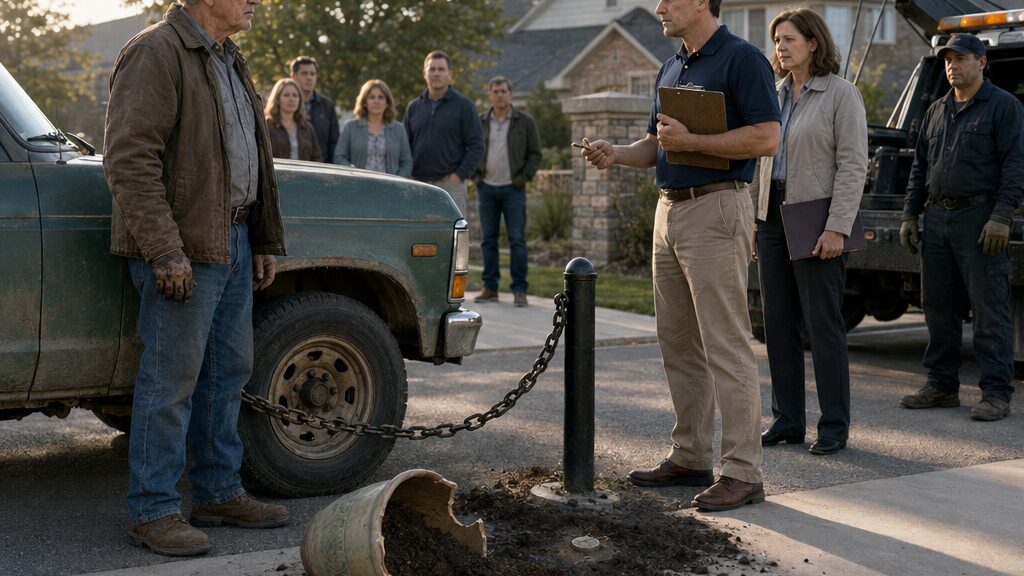
A heavy towing chain had been threaded through the front wheel of his faded green pickup and pulled toward a black post beside the curb. The tow-truck operator leaned back from the ratchet, avoiding Michael’s eyes.
Charles Wright stood on the other side of the hood with a clipboard tucked against his navy polo shirt.
“That vehicle is now under an association immobilization order,” Charles said.
Michael looked at the chain, then at Charles.
“You put that through my wheel.”
“You received three notices.”
“I received complaints.”
“They became violations when you ignored them.”
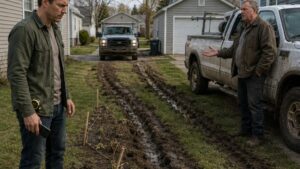
Behind Charles, Michael’s large ceramic planter lay on its side near the subdivision sign. Soil had spilled across the edge of the sidewalk. One red geranium had been crushed beneath the base.
Michael had found the planter upright when he went inside twenty minutes earlier. Now it looked like evidence arranged for a photograph.
Charles lifted the clipboard and read from the top page.
“Unapproved commercial-style vehicle visible from the road. Deteriorated exterior condition. Obstruction of community sight lines. Nonconforming planter placement. Failure to respond.”
“It’s not a commercial vehicle.”
“There are toolboxes mounted in the bed.”
“I worked for the county. I kept the toolboxes.”
“You’re retired.”
Michael glanced at the tow operator. The man shifted his weight and inspected the chain as though he had never seen it before.
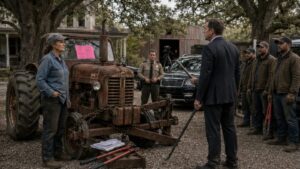
Several neighbors had stepped onto their porches. Two members of the HOA board stood near the subdivision sign, speaking quietly. Emily Davis was among them, holding a folder against her chest.
Michael knew Emily well enough to wave, not well enough to visit. She lived three houses beyond the curve and had once asked whether he planned to restore the pickup. He had told her the engine started every morning, which was restoration enough.
Charles turned slightly so his voice carried.
“We’ve tried informal cooperation. We’ve tried written notice. The board cannot allow one property to drag down standards for everyone.”
Michael released the door handle.
The truck was twenty-three years old. Its paint had faded along the roof, and one wheel arch carried a patch of primer where Michael had stopped rust before it spread. The engine was clean. The brakes were new. The tires had less than eight thousand miles on them.
Charles had never looked under the hood.
“What’s the fine?” Michael asked.
“Two hundred dollars, plus administrative costs. If it’s not paid and the vehicle isn’t removed by noon, towing begins.”
Michael looked toward the entrance road.
Morning traffic moved slowly around the gathering. A delivery van passed. A father drove two children toward school. Tires rolled over the pavement that crossed in front of Michael’s property and curved between rows of trimmed lawns.
Charles followed his gaze.
“This road belongs to the community,” he said. “That means the rules apply to everything visible from it.”
Michael looked back at him. “Everything?”
“The road, the common landscaping, the entrance structures and the adjoining appearance standards. Yes.”
The certainty in Charles’s voice seemed more important to him than the words.
Michael had heard that tone from young supervisors at the maintenance yard—men who quoted policy before learning where the shutoff valves were. Most eventually learned. A few flooded buildings first.
Charles stepped closer.
“You’ve lived here long enough to understand how this works.”
“Eleven years.”
“Then none of this should surprise you.”
Michael bent beside the fallen planter. A fracture ran along the rim. He placed both hands beneath it and rolled it upright. Loose dirt shifted inside.
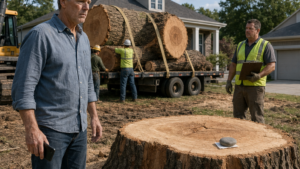
Under the planter’s former position, half buried beside the curb, a round metal head showed through the soil.
Michael froze.
It was no larger than a quarter, dark with age, with a shallow cross stamped into the center.
For a moment he saw his father’s boot beside it.
Not here as it looked now. Before the stone sign. Before the rows of mailboxes. Before the road had a neighborhood name.
Edward Carter had once tapped that metal head with the toe of his boot and told Michael never to let a surveyor bury a corner without knowing which side he stood on.
Michael had been nineteen and impatient. He had wanted to leave for work, not listen to a lecture about bearings, drainage and promises made to developers.
He brushed more dirt away with his thumb.
Charles noticed the movement. “Do not alter common-area markers.”
Michael looked up. “You know what this is?”
“It’s probably irrigation hardware.”
“It isn’t.”
Charles’s mouth tightened. “Whatever it is, it sits within the entrance landscaping maintained by the association.”
Michael stood slowly.
The chain stretched from his truck wheel to the black post. The post had been installed three years earlier when the HOA replaced the old wooden entrance rail. Michael remembered the drilling. He had heard the auger strike stone—or metal—and stop.
He had not gone outside to ask.
That was how he handled the neighborhood. He watched, understood enough, and kept his door closed.
Emily took a few steps forward. “Charles, maybe we should pause until legal reviews the towing policy.”
Charles did not turn. “The board approved stronger enforcement.”
“We approved revised notices.”
“And meaningful consequences.”
“I don’t remember voting on chains.”
The tow operator cleared his throat. “I was told this was authorized.”
Charles tapped the clipboard with one finger. “It is.”
Michael looked at Emily. Her eyes moved from the chain to the exposed marker.
“You knew this was happening?” he asked.
“I knew there was an enforcement visit,” she said. “Not this.”
Charles stepped between them.
“This is exactly why the board has struggled to get compliance. Every simple action becomes a debate. Meanwhile, residents call me about the entrance, the truck, the weeds along this drive, the drainage stains—”
“The drainage stains come from the road,” Michael said.
Charles stopped.
After heavy rain, water ran off the entrance pavement and crossed the lower corner of Michael’s drive. He had dug a shallow channel twice. Each time the HOA landscapers filled it because it disturbed the approved border.
Charles lifted his chin. “Then submit a maintenance request.”
“I did. Two years ago.”
“I don’t have that in front of me.”
“You had it when you denied it.”
A few neighbors murmured.
Charles looked toward them, then back at Michael. The public attention sharpened his posture.
“This is not about drainage. This is about whether one homeowner can ignore standards everyone else follows.”
Michael felt the old urge to walk away. It had served him for years. Let people talk. Let forms pile up. Let meetings happen without him.
Silence had always felt cleaner than argument.
But the chain through his wheel changed the shape of that silence. So did the metal marker at his feet.
Charles removed a small brass key from his pocket and set it on top of the clipboard.
“Pay the assessment, move the truck behind your garage and correct the planter. The chain comes off.”
Michael stared at the key.
“You chained private property to that post.”
“The post is association property.”
“You sure?”
Charles gave a humorless laugh. “Mr. Carter, I’m not going to argue about a post.”
Michael stepped around the front of the truck. He gripped the chain near the wheel and pulled once. The links tightened. The black post did not move, but the soil at its base shifted slightly against the old survey marker.
The two objects were less than six inches apart.
Michael released the chain. Grease darkened his palm.
“What are you doing?” Charles asked.
“Checking your work.”
“The tow company will return at noon. Once the truck is removed, storage charges will be added daily.”
Michael wiped his hand on the thigh of his jeans.
“Who told them they could come onto my drive?”
“The association’s enforcement authority extends to visible violations adjacent to common property.”
“That isn’t an answer.”
“It is the answer you’re getting.”
Michael looked past him toward the road. A line of cars entered beneath the subdivision sign. Every one of them crossed the strip his father had once refused to sell.
Or had he?
Michael knew only fragments. A quarrel at the kitchen table. An old folder Edward had pushed toward him. Michael refusing to open it because the refusal hurt his father more than any words he could find.
Six years after Edward’s death, the estate packet still sat unclaimed at the county records office.
Michael had received two certified notices. He had signed for neither.
He picked up the broken geranium and pressed its roots back into the soil.
Emily came closer. “Michael, what is that marker?”
He did not answer immediately.
Charles gave a short sigh. “It does not matter. The association maintains this entrance.”
Michael stood.
“It matters where you put a chain.”
Charles tucked the key into his pocket. “Noon, Mr. Carter.”
Michael met his eyes.
“You should check what that post is standing on before noon.”
Chapter 2: The Folded Map Behind the County Seal
Donna Martinez placed the sealed packet on the counter as though it had been waiting for Michael personally.
His name was typed across the front beneath the county seal. Two yellow forwarding labels crossed one corner. A red stamp showed the dates of the certified notices he had never claimed.
“You made us store this six years,” Donna said.
Michael kept his greasy hand off the paper. “You charge rent?”
“Not yet.”
The county records office had changed since the last time he visited. Computer screens stood where index books used to lie open. The old fluorescent lights remained, along with the dry smell of paper and toner.
Donna wore reading glasses low on her nose. She had worked in the office when Edward filed the last deed amendment. Michael remembered her as younger and less patient. He suspected she remembered him the same way.
“You could’ve opened it without me,” he said.
“It concerns an unsettled estate interest. I could index it. I could notify you. I could not make you care.”
“That sounds like legal advice.”
“It’s irritation. Legal advice costs more.”
She slid a clean sheet of scrap paper toward him.
“Put your hand there.”
Michael rested his right palm on it. A black crescent of chain grease marked the page.
Donna looked at the stain. “What happened?”
“The HOA chained my truck to a post.”
Her expression changed, but only slightly. “For what?”
“Being visible.”
“That is not usually a towable offense.”
“They say it is.”
“And you came here because?”
“There’s an old survey marker beside the post.”
Donna studied him for a moment, then cut the packet open.
Inside were copies of Edward Carter’s will, an executor’s statement, tax parcel descriptions and a folded map tied with cotton tape. Donna loosened the knot and spread the map across the counter.
The paper resisted at the creases. Michael put one finger on an edge to hold it flat. Grease transferred from his skin before he noticed, leaving a faint gray mark beside the county stamp.
Donna glanced at it but said nothing.
The map showed the land before the subdivision. Michael recognized the creek line, the old fence and the rectangular footprint of the equipment shed Edward had torn down when the developers arrived.
A narrow parcel ran from the county road along the present subdivision entrance and widened near Michael’s current property.
Donna traced it with a capped pen.
“Parcel C-Seventeen. One-point-eight acres originally. Reduced by boundary adjustment, but this strip remained separate.”
Michael leaned closer. “Separate from what?”
“From the land sold to the developer.”
The words settled without drama.
Michael followed the outlined strip. It ran beneath the entrance landscaping, under the stone sign and directly down the center of the asphalt road before ending beyond the first curve.
“They built the road on it.”
“Yes.”
“And Dad kept it.”
“According to the recorded deed, Edward Carter retained fee ownership.”
Michael felt an unexpected lift in his chest. It was not joy. It was the clean satisfaction of a bolt finally turning after years of rust.
Charles’s face came to him—the lifted chin, the brass key, the declaration that everything beside the road belonged to the community.
Michael touched the map near the entrance post.
Donna placed the pen across his finger.
“Keep reading before you start smiling.”
“I’m not smiling.”
“You are internally.”
She opened another document.
It was an easement agreement between Edward Carter and the original subdivision developer. The pages were dense with legal descriptions, maintenance provisions and rights of ingress and egress.
Donna pointed to a paragraph.
“The subdivision owners, their guests, service providers and successors have a permanent right to cross the parcel for access.”
“Permanent.”
“That is the word.”
“So I own the ground, but they own the use.”
“They have a protected use. You retain ownership subject to that use.”
Michael straightened. The lift in his chest disappeared.
“Can they install posts?”
“I cannot answer that.”
“You just read the agreement.”
“I can tell you what is recorded. I cannot interpret disputed rights for you.”
“Can they chain my truck to one?”
Her mouth tightened. “That sounds less defensible.”
He looked again at the map.
“What if the road needs inspection?”
“The agreement allows temporary interruption for necessary repair, inspection and emergencies, provided reasonable access is preserved when possible.”
“What if the association violates the agreement?”
“Then a lawyer earns money.”
Michael folded his arms.
Donna turned another page.
“The document assigns routine surface maintenance, drainage and liability coverage to the subdivision association or its successor.”
“The HOA.”
“Most likely.”
“Do they file proof?”
“Annual insurance certification is referenced. Maintenance reports every five years.”
She moved to her computer and typed the parcel number.
Michael watched the screen change through reflections in her glasses.
“How long?” he asked.
Donna did not answer.
She opened one index, then another. Her fingers slowed.
“The last insurance certificate linked to this easement was filed four years ago.”
“And maintenance?”
“I see the original acceptance report. One resurfacing notice twelve years ago.”
“That’s it?”
“That’s what is indexed here.”
Michael thought of the brown water crossing his driveway. The shallow channel the landscapers filled. The dark stains around the storm grate near the entrance.
“Could filings be somewhere else?”
“They could be referenced under the HOA parcel rather than the easement parcel.”
“Could?”
Donna gave him a look over her glasses. “Records are made by people. People select the wrong boxes.”
She searched the subdivision name.
Several documents appeared: amendments, liens, notices, annual disclosures. No road-maintenance certification.
Michael stared at the screen as if absence had a shape.
“Dad knew this would happen,” he said.
Donna returned to the counter. “Your father expected a disagreement eventually.”
“He told you that?”
“He filed carefully.”
“That isn’t the same.”
“No.”
Michael looked at the packet. “Why didn’t he sell them the strip?”
Donna hesitated.
“Because he didn’t trust the developer to maintain the drainage after buildout.”
“That sounds like him.”
“He also said ownership was the only thing that made people return a phone call.”
That sounded even more like him.
Michael remembered their last argument with uncomfortable clarity. Edward had pushed a folder across the kitchen table. Michael had pushed it back.
You keep land like other men keep grudges, Michael had said.
Edward’s face had gone still.
Some things are only safe while somebody is responsible for them.
Michael had left before supper. Three weeks later, Edward suffered the stroke that killed him.
Donna retied the cotton tape around the map.
“You need a property attorney and a surveyor,” she said. “Not a barricade.”
“I didn’t say barricade.”
“You came in with chain grease on your hand and asked whether you could interrupt a road.”
“My truck gets towed at noon.”
“Then address the truck. Do not turn thirty households into defendants before lunch.”
Michael looked at her.
“You think I would?”
“I think anger makes ownership feel simpler than it is.”
She copied the deed, easement and map, then stamped each page. The heavy seal pressed into the paper with a dull mechanical thump.
Michael paid the copying fee. When Donna handed him the folder, she kept one document back.
“What?”
She was reading the final page of the easement.
“This section refers to a supplemental maintenance acknowledgment.”
“Do you have it?”
“I don’t see an indexed image.”
“Lost?”
“Missing from this file is not the same as lost.”
She typed the reference number. Nothing appeared.
Then she turned the page sideways and examined a handwritten notation near the margin.
“There was supposed to be a compliance filing after the entrance drainage was altered.”
“When?”
“Three years ago.”
Michael thought of the black post being installed. The auger striking something beneath the soil.
Donna reached for the phone.
“Who are you calling?”
“Archives first. Then engineering records.”
Michael held the folder against his chest.
Donna covered the receiver before dialing.
“Your ownership is real,” she said. “So is everyone else’s access. The question now is whether the association kept its side of the agreement.”
Chapter 3: The Board Meeting Charles Could Not Control
“The association’s attorney will not defend the immobilization order.”
Charles Wright read the sentence twice before looking up from his phone.
The clubhouse conference room was still empty except for Emily Davis, who sat near the far end of the table arranging copies of the agenda. Through the windows, the evening sun reflected off parked cars and the roofs beyond them.
Charles placed the phone beside his clipboard.
“What exactly did he say?” Emily asked.
“That the policy requires review.”
“That isn’t what you just read.”
Charles disliked the way she waited after speaking. She left silence in the room as though it belonged to her.
He read the message again.
Based on the facts provided, the association’s governing documents do not clearly authorize physical immobilization of a privately owned vehicle on an owner’s lot. Counsel cannot recommend enforcement or defend continued restraint pending review.
“It’s cautious language,” Charles said.
“It says he won’t defend it.”
“It says he wants more documentation.”
Emily slid an agenda toward him. “Did you send him the board minutes?”
“I sent the enforcement resolution.”
“Which resolution?”
“The one from March.”
Her hands stopped.
“In March we approved revised notice procedures.”
“And stronger consequences for repeat noncompliance.”
“We approved hearings, fines and referrals to counsel.”
Charles pulled out a chair. “Physical immobilization is a referral mechanism.”
“No, it isn’t.”
The door opened. Two board members entered, followed by several residents who had heard about Michael’s truck. They filled the folding chairs along the wall.
Charles felt the room measuring him before the meeting had begun.
For eight months, residents had complained about falling sale prices, faded fences, unmowed strips near rental properties and a reserve account too small to cover the road estimate. At every meeting, someone demanded action. At every meeting, someone else objected to paying for it.
Charles had promised standards.
He had believed visible enforcement would reassure people. The old truck at the entrance had become a symbol before Michael knew anyone was looking at it.
A symbol could be useful.
Unless it refused to move.
Charles called the emergency meeting to order.
“We are here to address a potential claim by Michael Carter concerning the subdivision entrance road and to protect uninterrupted access for residents.”
A board member raised his hand. “Does he own it?”
“We have not verified that.”
Emily opened her folder. “The county deed appears to show that the Carter estate owns the underlying parcel.”
Charles turned to her. “Appears.”
“The parcel number matches the entrance.”
“An old deed does not automatically override subsequent transfers.”
“Did you find a transfer?”
“Legal is reviewing.”
A resident near the wall spoke. “Is he blocking the road?”
“No,” Charles said. “Not currently.”
“Then why is his truck chained?”
“It is subject to enforcement for repeated violations.”
Emily placed a copy of the March minutes in front of each board member.
Charles watched the pages move down the table.
“What is this?” he asked.
“The vote you cited.”
He already knew.
Emily read aloud. “‘The board authorizes updated notices, hearings and fines consistent with the declaration and applicable state law.’ There is nothing about towing from private driveways. Nothing about wheel locks. Nothing about chains.”
The room shifted.
Charles kept his voice level. “The board also directed me to implement meaningful enforcement.”
“Within the documents.”
“I acted within the authority necessary to carry out the vote.”
“You hired a tow company without a second signature.”
“The amount was under the contracting threshold.”
“That threshold applies to routine services.”
A board member frowned at Charles. “You told me legal approved the procedure.”
“I said legal had approved towing as an available remedy.”
“From common parking areas,” Emily said.
Charles felt heat rise beneath his collar.
The distinction had seemed minor when the tow company offered immobilization as a lower-cost alternative to immediate removal. It gave owners a final chance to comply. It avoided storage charges. It looked firm without being permanent.
He had not expected Michael to stand beside the chain as though he had been waiting for it.
Charles took the brass key from his pocket and set it beside the clipboard.
“The vehicle is still there. Nothing irreversible has happened.”
Several residents looked at the key.
A woman near the door said, “You chained a man’s truck to the ground.”
“To association property.”
Emily looked directly at him. “We no longer know that.”
Charles picked up the key again.
For the first time that evening, uncertainty entered the room in a form everyone could see.
He wanted to tell them why he had pushed so hard. The insurance carrier had warned that poorly documented entrance maintenance could raise premiums. The reserve study showed a deficit. A real estate agent had sent photographs of Michael’s truck in response to a buyer complaint.
None of those facts excused the chain. But they explained the pressure that had made it seem reasonable.
Explaining pressure, Charles knew, sounded like confessing weakness.
His phone vibrated.
He glanced down.
The HOA’s insurer requested copies of all deeds, easements, maintenance agreements and access-control policies relating to the subdivision entrance. The documents were due within forty-eight hours. Coverage review would remain open pending receipt.
Charles read the message silently.
“What now?” Emily asked.
He locked the phone.
“Routine insurance inquiry.”
“About the road?”
“About documentation.”
A board member leaned forward. “Do we have the easement?”
“We have the recorded subdivision documents.”
“That isn’t what he asked.”
Charles looked at the faces around the table. Eight months earlier, many of these people had thanked him for taking the presidency no one else wanted. They had wanted cleaner lots, faster responses and a board willing to confront owners who ignored notices.
Now they watched him as though enforcement had been his private hobby.
He opened the reserve report.
“The road needs work. We have drainage complaints, cracking near the entrance and an insurance review. If Carter’s claim is valid, it could interfere with repairs and access. We need to establish control before he does.”
Emily’s expression hardened. “Control is what brought us here.”
“What would you suggest? Wait while he hires a surveyor and decides the neighborhood owes him something?”
“He may already be owed something.”
Charles struck the table with the flat of his hand—not hard, but hard enough to make the chain key jump.
The room went quiet.
“He ignored six violation notices,” Charles said. “He ignored certified letters. He refuses meetings. His property is the first thing every visitor sees. He has had years to raise any ownership claim, and he waited until enforcement reached him.”
The argument sounded strong because parts of it were true.
Michael had not participated. He had not answered. He had let every concern pass into silence until the silence became its own kind of challenge.
Emily closed the folder.
“That does not give you authority we never voted to grant.”
Charles looked toward the darkening windows.
At noon, the tow operator had delayed removal after Michael produced stamped county documents. Charles had agreed to wait until morning, believing legal would support him.
Legal had stepped away.
The insurer was asking questions.
A survey crew was reportedly scheduled for eight.
Every hour Michael’s truck remained chained made Charles’s decision harder to defend. Every hour the truck remained in place also made Charles look less capable of carrying out the order.
He could remove the chain now and call it prudence.
The neighbors would call it retreat.
He had spent too much of the year promising that rules meant something.
Charles picked up his phone and left the room without formally ending the meeting.
Emily followed him into the hallway.
“What are you doing?”
“Resolving the vehicle issue.”
“By removing the chain?”
He opened the tow company contact.
“Charles.”
“The survey begins at eight?”
“That’s what Michael told the county.”
“If the truck is gone before then, the driveway issue is separate from the road claim.”
Emily stared at him. “You heard the attorney.”
“I heard caution.”
“You heard no.”
Charles pressed the call button.
The tow operator answered on the fourth ring.
“This is Charles Wright,” he said. “Return at seven tomorrow morning. Bring the flatbed. I want Carter’s truck removed before the survey begins.”
Chapter 4: The Tow Truck Stopped at the Survey Line
The tow truck’s winch began pulling while the county surveyor was still driving his second stake into the ground.
The chain lifted from the pavement. Michael’s truck lurched forward six inches, its locked front wheel scraping sideways with a sound that brought him out of the garage at a run.
“Stop!”
The tow-truck operator released the control. The cable slackened, but the pickup remained twisted against the chain attached to the black post.
Charles stood near the flatbed with his clipboard under one arm.
“You were informed of the deadline,” he said.
“It isn’t seven-thirty.”
“The removal window began at seven.”
“You told me noon.”
“That was yesterday.”
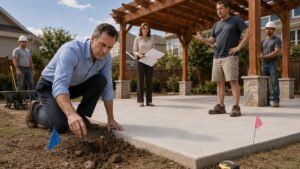
Michael looked past him. The surveyor had stretched a bright line from the old metal marker beside the planter toward a new stake in the grass. The white cord crossed beneath the towing chain at an angle.
“Do not pull that truck again,” the surveyor said.
Charles turned. “This is an HOA enforcement matter.”
“This is an active boundary survey.”
“You don’t have authority to interfere with a lawful tow.”
The surveyor straightened from the stake. “And you don’t have authority to move equipment across my line until I know what you installed on whose parcel.”
Charles looked down at the string as if it were an insult.
Michael went to the front wheel. The chain had bitten into the tire’s sidewall. Not deeply enough to cut it, but enough to leave a dark groove.
The tow operator climbed down from the control panel.
“I was told the vehicle was abandoned.”
Charles’s head snapped toward him. “You were told it was subject to removal.”
“You said the owner had refused contact.”
Michael stared at Charles.
Charles adjusted the papers on his clipboard. “Mr. Carter has repeatedly refused association communication.”
“I was standing beside you yesterday.”
“And you still refused to comply.”
A county vehicle waited partly in the entrance lane with hazard lights flashing. Cars entering the subdivision had to pass one at a time around it. A line was already forming near the county road.
A woman lowered her window.
“Are we blocked?”
“Temporary survey,” Michael called.
Charles stepped toward the lane. “The association will have this cleared shortly.”
Michael heard the promise beneath the words. Charles still believed the scene could be forced back into its old shape: Michael silent, Charles directing, everyone else moving when told.
The surveyor crouched beside the post and brushed soil from its base.
“This concrete footing is newer than the monument,” he said.
Michael joined him. “Three years.”
“You saw it installed?”
“Heard it.”
The surveyor measured from the metal marker, then checked the folded copy of Edward’s map.
“The post appears to be inside the Carter parcel.”
Charles gave a short laugh. “Appears?”
“That is why I’m surveying.”
“The entrance landscaping has been maintained by the association for more than a decade.”
“Maintenance does not establish title.”
Charles opened his mouth, but a sheriff’s cruiser turned into the subdivision before he could answer.
The deputy parked behind the county vehicle and walked toward them. His eyes moved from the flatbed to the chained wheel, the survey string and the growing traffic line.
“Who called?”
“I did,” Charles said. “We have a homeowner interfering with an authorized tow.”
The tow operator looked away.
Michael wiped his hands on a shop rag. “The truck is on my driveway. They chained it to a post that may be on my land.”
The deputy looked at the surveyor. “Boundary dispute?”
“Ownership is recorded. Exact line is being marked.”
Charles held out a document. “The association has enforcement authority.”
The deputy read the first page, then flipped it over.
“This authorizes fines and hearings.”
“It also permits removal of noncompliant vehicles.”
“From common areas.”
“The driveway adjoins the entrance.”
The deputy handed the paper back.
“I’m not deciding an easement or title question on the side of the road. But I’m also not treating this as a simple tow from association property.”
Charles’s jaw tightened. “So you’re allowing him to ignore the rules?”
“I’m telling the operator not to move the truck until ownership and authorization are clear.”
The tow operator disconnected the winch cable immediately.
For the first time since the chain had snapped tight the previous morning, something loosened in Michael’s chest. The pickup would remain where it belonged.
Then a horn sounded from the road.
Another car had joined the line. A school bus waited behind it.
The surveyor walked the string across the lane and placed a cone over it.
“I need half the entrance closed while I locate the eastern corner.”
Charles turned toward Michael. “There. That is exactly what I warned the board about. You are disrupting access.”
“I didn’t put the parcel under your road.”
“You scheduled this during morning traffic.”
“The tow truck was your idea.”
A man in the second car leaned out his window. “How long is this going to take?”
“Twenty minutes if no one drives over the line,” the surveyor answered.
The driver looked at Michael, not Charles.
Michael felt the direction of every impatient glance. Yesterday the neighbors had watched him being punished. This morning they watched their own routines being delayed, and the boundary between victim and cause had already begun to blur.
Emily came walking quickly from the curve, still wearing office clothes beneath an unbuttoned coat.
“Charles, what did you do?”
“I enforced the order.”
“You called the tow company after counsel refused to support it.”
Charles lowered his voice. “Not here.”
“You made it here.”
The surveyor called Michael over to the storm drain near the entrance sign. The grate sat lower than the surrounding asphalt, dark with leaves and silt.
“This drain was shifted when the entrance was widened,” he said. “See the patch seam?”
Michael knelt. A broad strip of newer pavement ran from the grate toward his driveway.
“That’s where the water crosses,” Michael said.
The surveyor checked his measurements. “The drain, post footing and part of the widened shoulder are all inside the Carter parcel, assuming the monument is undisturbed.”
“Can you confirm that today?”
“I can confirm the field location. Legal effect is somebody else’s job.”
Charles had followed them.
“The association paid for that drainage work.”
“Then the association should have an installation agreement,” the surveyor said.
Charles looked toward Emily.
She shook her head once.
The clipboard slipped beneath Charles’s arm. He caught it before it hit the pavement.
Michael noticed the brass chain key clipped to its top.
A woman left her car and approached, frustration visible in the way she held her phone.
“My mother has a medical appointment. Are you closing the road?”
“No,” Michael said.
Charles answered at the same time. “Mr. Carter requested the survey.”
The woman looked between them.
Michael glanced at the single open lane. “You can pass in two minutes. The surveyor will lift the string.”
“You’re not putting up a gate?”
“No.”
Charles folded his arms. “Not yet.”
Michael felt anger move through him, hot and immediate.
He could have fed it. One sentence about ownership would have turned every anxious face toward Charles. One threat could have made the man feel what Michael had felt beside the chained truck.
Instead, Michael walked to the cone and held the string above the pavement while the surveyor recorded his measurement.
“Bring the cars through one at a time,” he said.
Emily helped direct traffic. The waiting vehicles moved past slowly. Some drivers thanked Michael. Others stared straight ahead.
When the final car cleared, the surveyor lowered the string again.
The tow operator coiled his cable.
“What about the chain?” Michael asked.
The deputy looked at Charles. “Unlock it.”
Charles did not move.
“The enforcement order remains in dispute,” he said.
“The truck is not being towed,” the deputy replied. “Leaving it physically restrained on contested property increases everyone’s problem.”
Charles removed the brass key from his clipboard.
He crossed the driveway and knelt beside the post. The lock opened with a stiff metallic click.
Michael pulled the chain free from the wheel. It dropped across the bright survey string, dark links divided by the white line.
The surveyor pointed to the pavement.
“There is your boundary.”
On one side stood the post Charles called association property. On the other sat Michael’s truck. The chain connected them, but only because Charles had placed it there.
Michael lifted the links and carried them to the edge of his garage.
The victory should have felt cleaner.
Instead, he saw the woman hurrying back to her car, the school bus disappearing around the curve and neighbors gathering with worry rather than satisfaction.
Emily waited until Charles walked toward the clubhouse.
Then she faced Michael.
“Tell me plainly,” she said. “Are you planning to lock all of us out?”
Chapter 5: The Promise Written in Edward Carter’s Hand
The envelope fell from the deed folder when Michael set it on his workbench.
It landed behind a socket tray, yellowed and unsealed, with one word written across the front in Edward Carter’s narrow block letters.
Michael.
He stood looking at it while the garage settled around him. The pickup remained outside, free of the post but not yet moved. The chain lay coiled near the door where he had dropped it after the survey.
Emily’s question had followed him inside.
Are you planning to lock all of us out?
He had answered no.
She had asked what he did intend to do.
That answer had not come as easily.
Michael pulled the envelope from behind the tray. Inside was a single folded sheet and a copy of the easement map, older than the county copy and marked with Edward’s handwritten notes.
The page began without greeting.
If you are reading this, you finally opened the file.
Michael almost put it down.
Edward had always written as though conversation were a repair order: identify the fault, list the parts, state the required action. Even dying had not softened his phrasing.
Michael carried the paper into the kitchen and placed it beside the chain key Charles had surrendered that morning. The brass key was small enough to disappear beneath Edward’s letter.
He read on.
The road strip was never kept so we could close it. It was kept because the developer wanted the benefit without the duty. Families will live beyond that entrance who had no part in the bargain. Do not make them pay for a board’s arrogance.
Michael sat.
For years, he had remembered only their last argument.
Edward at the table, one swollen knuckle pressed against the folder. Michael standing with his coat already on.
Take the road parcel, Edward had said.
Sell it to them, Michael had answered.
They’ll stop maintaining it the minute nobody can hold them to the paper.
Then let them.
Edward had stared at him as though the answer revealed a defect no tool could correct.
That was the moment Michael had carried forward. Not the worry under his father’s anger. Not the reason the folder mattered. Only the control in Edward’s voice and the old resentment it woke in him.
He returned to the letter.
Ownership is not the same as permission to punish. Keep the access open. Make them maintain the drainage. Make them show what they collect and what they spend. If they refuse, use the deed. If they comply, leave people in peace.
Beneath the paragraph, Edward had added a final line in darker ink.
Silence is useful until people start filling it with their own answers.
Michael read that sentence twice.
His father had known him too well and spoken to him too poorly. Both things could be true.
The phone rang on the counter.
Donna Martinez did not waste time with a greeting.
“Archives found the supplemental acknowledgment.”
“What does it say?”
“The developer modified the entrance drainage three years before turnover to the HOA. The successor association accepted inspection and maintenance obligations.”
“Anything filed after the new drain went in?”
“No approval tied to the Carter parcel. Engineering has a permit for work within the subdivision right-of-way, but the parcel description may be wrong.”
“May be?”
“The plan labels the entire entrance as HOA common area.”
Michael looked toward the garage, where the coiled chain sat in shadow.
“Charles believed it.”
“Belief does not correct a parcel description.”
“What about the maintenance reports?”
“We found none.”
Michael took a pencil from the drawer.
“Tell me exactly what they were supposed to file.”
Donna listed inspections, insurance certificates, drainage maintenance and five-year surface reports. Michael wrote each item in the margin of Edward’s map.
When she finished, he asked, “Can I close the road?”
Donna was silent long enough for him to regret the question.
“You can ask a court to enforce the agreement,” she said. “You may be able to obtain temporary relief for unsafe conditions. You cannot use my office as permission to barricade residents.”
“I said can, not will.”
“That distinction is why lawyers have offices.”
After the call, Michael opened the HOA statements he had ignored in a drawer by the refrigerator.
Most were still sealed.
He cut them open one by one.
Annual road reserve fee.
Special drainage assessment.
Entrance improvement surcharge.
The numbers were modest individually. Together, across thirty homes and several years, they were not.
Michael found no breakdown showing where the money had gone. The statements referred residents to annual budget reports he had never requested and meetings he had never attended.
His own silence had kept him from seeing the pattern.
He called Emily.
She arrived twenty minutes later carrying a binder and a guarded expression.
Michael spread the assessment notices across the kitchen table.
“Did the HOA collect these from everyone?”
“Yes.”
“For drainage?”
“Partly.”
“Where did it go?”
She opened the binder.
“The reserve fund covered entrance landscaping, sign lighting and a portion of pavement sealing.”
“What about the drain?”
“Charles said replacement could wait until the full road project.”
“The easement says it cannot.”
Emily studied Edward’s map.
“I never saw this.”
“You saw the budget.”
“I saw categories. I didn’t ask for invoices.”
“Why not?”
Her mouth tightened. “For the same reason you didn’t open your mail. It was easier to assume somebody else had it handled.”
The answer stopped him.
He had expected defense. Instead she placed two years of financial summaries beside his notices.
The drainage line item appeared in each budget. The expenditures beneath it were mostly landscaping and consulting fees.
“No theft,” Emily said. “At least nothing I’ve seen. But the money was used for whatever felt urgent.”
“Flowers felt urgent.”
“Property values felt urgent.”
Michael looked at the broken planter outside.
“And water crossing my drive didn’t.”
“No.”
She did not soften it.
Emily turned Edward’s letter toward herself but did not read past the first line.
“What are you going to ask for?”
Michael placed the brass chain key on the paper.
Yesterday he might have asked for Charles to stand in front of the neighborhood and admit what he had done. He might have demanded the post be pulled out before sunset. He might have let everyone wonder whether the road would open the next morning.
The thoughts still carried a certain satisfaction.
Edward’s words sat beneath the key.
Do not make them pay for a board’s arrogance.
“I want the chain order canceled,” Michael said. “Every towing charge reimbursed. The drainage inspected and repaired. Full accounting of the road assessments. No enforcement action on private property without a hearing.”
Emily nodded slowly.
“And the easement?”
“Recorded again with the current HOA named. Maintenance deadlines. Insurance proof. Independent audit.”
“That will cost money.”
“So did the entrance sign.”
She looked toward the window.
“Charles will say you’re taking over the association.”
“I don’t want the association.”
“What do you want?”
Michael folded Edward’s letter along its original crease.
“For them to keep their side of the road.”
He picked up the phone and called the clubhouse number. Charles answered on the second ring.
“I’m requesting an emergency meeting tomorrow,” Michael said.
“You don’t get to request board meetings on demand.”
“This one concerns the recorded easement, the drainage failure and the association’s authority to access my parcel.”
Silence came through the line.
Michael continued.
“I want every board member present. I want counsel there. Bring the budgets, insurance records and maintenance reports.”
“What happens if we refuse?”
Michael looked at the chain coiled beyond the kitchen doorway.
“Then the next meeting won’t be in your clubhouse.”
Chapter 6: The Easement Terms Nobody Had Read
Michael entered the clubhouse carrying the chain in both hands.
Conversation stopped before the door closed behind him.
Emily had expected papers. Perhaps the old folded map. Instead, the dark links dragged once across the threshold with a rough metallic scrape before Michael lifted them clear of the floor.
Charles stood behind the board table.
“What is that doing here?”
Michael crossed the room and set the chain beneath the empty chair reserved for him.
“It belongs to the discussion.”
Nearly every folding chair was occupied. Residents lined the back wall, some holding copies of the emergency notice, others carrying phones they had been told not to use for recording without consent. The HOA attorney sat at the end of the board table with a thin stack of documents and the expression of a man who had already advised everyone to speak less.
The county survey map had been enlarged and mounted on a foam board near the entrance. Its red parcel line ran beneath the subdivision road.
That line had changed the neighborhood in twenty-four hours. People who had passed Michael’s house for years without seeing him now watched the door whenever he moved.
Emily called the meeting to order because Charles did not.
“Mr. Carter requested time to present proposed terms concerning the entrance easement.”
“Proposed demands,” Charles said.
The attorney raised one hand. “Let’s avoid characterizations.”
Michael remained standing.
He wore the same brown work jacket he had worn beside the truck. Chain grease still marked one cuff. He placed Edward’s folded map on the table but did not open it yet.
“I’m not closing the road,” he said.
The room reacted before anyone spoke. Shoulders lowered. A woman in the second row let out a breath loud enough to hear.
Charles frowned.
“No one said you were.”
“Several people asked. You suggested it yesterday.”
“I explained the risk created by your claim.”
Michael looked toward the residents.
“The access easement is permanent. It protects every house beyond the entrance. I won’t block it to settle a dispute with the board.”
The attorney leaned toward his microphone.
“For clarity, Mr. Carter may have grounds to seek an injunction concerning unapproved installations or failure to maintain the easement area. A court could impose temporary restrictions if safety conditions require them.”
A murmur moved across the room.
Michael turned to him. “I’m not asking for that tonight.”
The attorney nodded once.
Emily saw the effect. Until that moment, many residents had regarded Michael’s restraint as strategy—as though the threat was merely waiting behind his silence. By refusing the strongest weapon named in the room, he made the refusal visible.
Michael opened the county-certified deed.
“The Carter estate owns the underlying parcel. Your road crosses it under an agreement signed before most of these homes were built. That agreement requires open access. It also requires the association to maintain the pavement, drainage and liability coverage.”
Charles folded his arms.
“The association maintains the entrance every year.”
“You maintain flowers and lights.”
“Those are entrance expenses.”
“The drain has not been inspected under the agreement. The insurance certificate has not been filed in four years. The five-year maintenance report does not exist.”
“We are not required to file internal maintenance with the county.”
The attorney spoke quietly. “The easement language appears to require notice to the parcel owner.”
Charles looked at him. “Appears?”
“It is sufficiently clear that I would not advise ignoring it.”
Michael passed copies of his proposed terms down the table.
Emily read the first page.
Immediate cancellation of the vehicle violation and tow order.
Reimbursement of all towing and survey costs caused by the unauthorized immobilization.
Removal of the chain post from the Carter parcel.
Independent drainage inspection within thirty days.
Publication of road-assessment income and expenditures for the previous five years.
A recorded maintenance agreement naming the current HOA.
No physical enforcement against property on an owner’s lot without notice, hearing and documented authority.
The terms were firm, but they were not the terms of a man trying to own his neighbors.
One board member cleared his throat.
“The association doesn’t have money for all this at once.”
Michael looked at him. “You collected money for it.”
“Reserve funds cover multiple needs.”
“Then show where it went.”
Charles tapped the proposal.
“This is an attempted takeover. He ignored the association for years, and now he wants veto power over our budget.”
“I asked for accounting, not veto power.”
“You are using a forgotten deed to put yourself above elected representatives.”
Michael’s hand tightened on the edge of the table.
Emily saw the old instinct rise in him: close down, let the accusation stand, punish everyone with silence.
Charles saw it too.
“You did not attend a single annual meeting,” he continued. “You ignored certified mail concerning the estate parcel. You ignored maintenance notices. You never informed the association that you claimed ownership beneath the entrance. If there is confusion, you helped create it.”
The room turned toward Michael.
This was the part Charles had been waiting to use because it was true.
Michael looked down at Edward’s map.
“I did ignore the notices,” he said.
The admission landed more heavily than a denial.
Charles leaned forward. “Exactly.”
“I didn’t settle my father’s records. I didn’t answer the county. I didn’t come to meetings. I knew there was an old agreement, but I never read it.”
Residents shifted again, less certain.
Michael continued before Charles could take the silence from him.
“I thought staying out of the association meant the association would stay out of my life. That was foolish.”
Charles gave a small, sharp nod as if Michael had finally confirmed the whole case.
Michael raised his eyes.
“But my silence did not authorize a chain. It did not move the property line. It did not inspect the drain. And it did not spend the assessments you collected.”
Emily looked down at her binder.
There it was: responsibility without surrender.
The attorney reviewed the proposed terms.
“The reimbursement request may be negotiated. The procedural reforms are consistent with due process. The maintenance and insurance provisions largely track the existing easement.”
Charles stared at him. “Largely?”
“The independent audit is additional.”
“Unnecessary.”
Emily opened the financial binder.
“It is necessary.”
Charles turned. “You approved these budgets.”
“I voted for summaries presented to the board. I did not verify that drainage assessments were used for drainage.”
“That is your failure as secretary.”
“Yes,” Emily said.
Charles paused.
She had not expected the word to come so easily. Perhaps because Michael had already used it first.
Emily removed three pages from the binder and placed them before the residents.
“These are the assessment totals. These are the expenditures categorized as entrance and road. The numbers do not reconcile without invoices we have not been given.”
A man in the front row asked, “Are you saying money is missing?”
“No. I’m saying we cannot prove how it was allocated.”
Charles’s voice hardened. “This meeting is becoming reckless. We have an insurance review, a road reserve deficit and a homeowner threatening legal action. Public speculation will damage every property in this subdivision.”
Michael unfolded Edward’s original map.
The paper was softer than the county copy, its creases darkened by age.
“My father expected the developer to stop caring once the last house sold,” he said. “That is why he kept the strip. Not to shut the road. To make somebody answer for it.”
Charles looked at the map but did not touch it.
“And now that somebody is you?”
Michael considered the question.
“That’s what I was trying not to inherit.”
For the first time, Charles did not have an immediate answer.
The attorney broke the silence.
“A recorded agreement can assign inspection procedures without giving Mr. Carter control over ordinary association operations. It can also protect the HOA by clarifying uninterrupted access.”
A board member read the final page.
“What happens to the current president’s enforcement authority?”
Michael looked at Charles.
The chain lay beneath the table between them.
“That authority is a board question,” Michael said. “But the order against my truck was issued without a board vote. Everybody here should decide whether that was a mistake or a power your president still ought to have.”
Charles pushed back his chair.
“You came here pretending this was about drainage.”
“It is.”
“This is about removing me.”
“No,” Michael said. “It’s about removing what you were allowed to do without anyone stopping you.”
The room went still.
Emily looked at the other board members. One avoided her eyes. The other stared at the March minutes laid beside the budget summaries.
Charles’s clipboard rested near his hand. The brass key was no longer attached to it.
Michael folded his father’s map carefully.
“My silence helped create this confusion,” he said. “I won’t use silence to finish it.”
He looked from the board to the residents.
“I’m asking for a vote on the proposed agreement. After that, I’m asking for a separate vote on whether Charles Wright retains unilateral enforcement authority.”
Emily reached for the formal motion sheet.
Charles remained standing, one hand pressed flat against the table.
No one had yet voted, but the room no longer belonged to him.
Chapter 7: The Vote After the Clipboard Fell
The vote deadlocked at two to two.
Emily stared at the tally sheet, then at the board members seated on either side of Charles. One had voted to suspend his enforcement authority. The other had voted against it. Emily’s vote supported suspension. Charles had voted for himself.
Under the bylaws, the motion failed without a majority.
Charles lowered himself into his chair.
“There,” he said. “The board has spoken.”
No one moved.
The residents along the wall had been quiet during the roll call. Now their silence carried disappointment rather than uncertainty.
Michael stood beside the table with Edward’s folded map in one hand. The chain remained beneath the empty chair, its links dull against the clubhouse floor.
The HOA attorney gathered the proposed agreement into a neat stack.
“The maintenance motion remains separate,” he said. “The board can still approve negotiations concerning the easement.”
Charles reached for his clipboard.
“If my authority remains intact, I will appoint a committee to review the matter.”
Emily looked at him.
“A committee you control?”
“A committee appointed under association procedure.”
“You mean delay.”
“I mean order.”
Michael felt the anger return, but it had changed. Earlier it had wanted Charles embarrassed. Now it wanted the room to stop pretending procedure was neutral when one man held every lever.
Charles picked up the clipboard and stood.
“We have spent enough time on accusations. The president’s authority has been challenged and sustained. The next step is a structured legal review.”
Emily opened her binder.
“No,” she said.
Charles looked at her. “The vote is complete.”
“The vote was incomplete.”
She removed her phone from the binder pocket and connected it to the clubhouse printer. The machine behind the board table woke with a mechanical hum.
Charles’s face tightened.
“What are you printing?”
“A message I sent you three days before the chain order.”
The printer fed out a single page.
Emily took it and remained standing.
“I should have brought this forward sooner,” she said. “I thought warning you privately was enough.”
Charles extended his hand. “This is not on the agenda.”
“It concerns the authority we just voted on.”
She read the first lines.
“‘Charles, the March resolution does not authorize wheel locks, chains or towing from private driveways. Counsel’s earlier memo applies only to vehicles abandoned in common parking areas. Please do not proceed without a recorded board vote.’”
A sound moved through the room—not a gasp, but chairs shifting as people leaned forward.
Emily continued.
“‘If you act alone, I will not certify the action in the minutes.’”
She placed the page on the table.
“Charles did not respond.”
The board member who had voted against suspension reached for the printout.
“When was this sent?”
“Friday morning.”
Charles kept his hand on the clipboard.
“I receive dozens of messages.”
“You opened it,” Emily said. “The delivery receipt is attached.”
The board member read the second page, then looked at Charles.
“You knew the resolution didn’t cover the chain.”
“I knew Emily disagreed with my interpretation.”
“That is not the same thing.”
“It is exactly the same thing when the secretary attempts to limit authority the board delegated.”
Emily’s voice remained steady.
“I did not limit it. I described it.”
Michael watched Charles’s fingers tighten around the clipboard. The edges of the paper beneath the clip began to bend.
The attorney leaned forward.
“Mr. Wright, did you represent to the towing company that the board had specifically approved immobilization?”
Charles did not answer immediately.
The tow operator’s statement had been delivered that afternoon. Michael knew because the attorney had shown him the paragraph before the meeting: association president confirmed board authorization and owner abandonment status.
Michael’s truck had never been abandoned.
Charles set the clipboard down.
“The company required a clear instruction.”
“So you gave one that was not true?” Emily asked.
“I gave an instruction necessary to enforce the rules.”
The board member pushed the printed email away.
“I want to change my vote.”
Charles looked at him sharply.
“The roll call is closed.”
The attorney shook his head. “A member may move to reconsider during the same meeting.”
Emily made the motion.
The second came before Charles could speak.
During the new vote, he sat rigidly, both hands flat on the table. This time the result was three to one.
His unilateral enforcement authority was suspended.
No one applauded.
The quiet was worse.
Charles looked across the table at Michael.
“You wanted this from the beginning.”
Michael placed Edward’s map down.
“I wanted the chain off my truck.”
“You brought a property claim, a survey, an audit demand and half the neighborhood into this room.”
“You brought the chain.”
Charles’s eyes moved toward the links beneath the chair.
Something in him seemed to give way—not remorse, exactly, but the effort required to keep every decision framed as necessity.
“The association was slipping,” he said.
The words were quieter than before.
“Every meeting was the same. Complaints about the entrance. Complaints about dues. Complaints that nobody enforced anything. Houses sat longer. The insurer asked about maintenance. The reserve study showed we were short.”
He looked toward the residents.
“You all wanted someone to take control.”
A few people lowered their eyes.
Charles continued.
“The truck was the first thing buyers saw. The planter leaned into the walk. Notices went unanswered. I thought if I could make one order hold, the board would stop questioning every decision.”
Emily’s expression changed.
“You used Michael to prove you still controlled us.”
Charles looked at her, then at the clipboard.
“Yes.”
The admission was nearly inaudible.
Michael had imagined this moment while sitting alone at his kitchen table. In those imagined versions, Charles apologized clearly. He faced the neighbors. He acknowledged the humiliation beside the truck and the danger of ordering the tow.
Instead, he offered the truth stripped of repair.
It should not have been enough.
It was, however, more honest than anything Charles had said since the chain snapped tight.
The attorney slid two forms across the table.
“The first cancels the vehicle violation and towing order. The second acknowledges that the immobilization lacked documented board approval.”
Charles read them.
“Signing this exposes the association.”
“Not signing it does not erase the facts.”
Charles picked up a pen.
His clipboard shifted under his forearm, slid from the table and struck the floor.
The crack echoed through the room.
Several people flinched.
Charles stared down at it for a second before signing both forms directly on the table.
He did not pick the clipboard up.
The board then approved negotiations for the recorded easement agreement, an independent financial audit and immediate drainage inspection. Improper towing expenses would be reimbursed from the association’s administrative account rather than the road reserve.
When the final motion passed, Charles removed the brass chain key from his pocket.
He walked around the table and held it out to Michael.
The key lay in his palm, polished at the edges from two days of handling.
Michael looked at it.
“You should keep it,” Charles said. “Proof of what happened.”
Michael thought of placing it beside Edward’s letter. A small trophy. Something solid to touch whenever memory softened the insult.
Then he looked beneath the chair at the chain.
“No.”
Charles’s hand remained extended.
Michael closed Charles’s fingers over the key.
“It opened your lock,” he said. “It was never mine.”
Charles lowered his hand.
“I am resigning as president effective tonight.”
A woman near the wall asked, “Are you leaving the board?”
Charles turned toward the room.
“I have not decided.”
There was no apology.
No promise to do better. No request for forgiveness.
He picked up his fallen clipboard and walked out of the clubhouse.
The door closed without force.
Michael felt the absence of the apology like a space where a tool should have been. Then he saw Emily collecting the signed cancellation forms, the attorney marking deadlines on the agreement draft and residents studying the enlarged map rather than staring at him.
The work had moved beyond Charles.
Emily handed Michael a copy of the voided violation.
“The truck is clear,” she said.
He folded the paper once.
“What happens now?”
“The audit begins. The drainage inspection gets scheduled. And somebody has to negotiate the recorded agreement with you.”
“I already gave you the terms.”
“Terms are the beginning.”
Michael looked toward the door Charles had closed behind him.
For years he had believed that winning meant being left alone afterward. The chain had taught him otherwise. Once people were connected by a road, even a victory created another obligation.
The board adopted one final motion before midnight.
The HOA would enter a binding maintenance and access agreement with the Carter estate, subject to county recording and independent review.
Michael voted on nothing. He held no board seat.
But when Emily asked who would represent the property owner during negotiations, every face turned toward him.
Chapter 8: The Road Left Open at Sunrise
The post came out of the ground at six-twelve in the morning.
Michael heard the hydraulic puller from his bedroom and reached the driveway before the road crew lifted the black steel column free of its concrete footing.
Wet soil clung to the base. A broken piece of old concrete hung from one side, and beneath it the original survey marker remained undamaged.
The crew supervisor pointed toward the hole.
“We’ll fill this after the drainage trench is tied in.”
Michael nodded.
Six weeks had changed the entrance without making it unrecognizable. Orange cones lined the shoulder. A new drain channel crossed beneath the pavement, wider than the old one and angled away from Michael’s driveway. The broken planter had been replaced with a low bed of native grass that did not cover the survey marker.
No chain hung between the post and his truck.
The pickup waited near the garage, washed but otherwise unchanged. Michael had repainted the primer patch along the wheel arch, not for the HOA, but because leaving it unfinished had begun to feel like letting Charles own the reason it stayed that way.
A county sedan stopped beside the cones.
Donna Martinez stepped out carrying a document case.
“You always schedule signatures before breakfast?” Michael asked.
“You always make county employees meet beside construction equipment?”
“It seemed appropriate.”
Emily arrived from the clubhouse with two board members and a thermos. Since Charles’s resignation, meetings had grown longer and less dramatic. No single person controlled the agenda. This made every decision slower.
Michael had discovered that fairness was often inefficient.
Donna opened the document case on the hood of her sedan.
The final agreement was nearly thirty pages. It confirmed uninterrupted residential access, assigned drainage and pavement duties to the HOA, required annual insurance proof and public accounting of road assessments, and prohibited new structures on the Carter parcel without written consent.
It also required the parcel owner to respond to maintenance notices within thirty days.
Michael had argued against that clause.
Donna had told him responsibility worked in both directions.
Attached to the back was Edward’s original map, copied and certified. The gray chain-grease mark remained visible near the county seal.
Michael touched the stain.
“You could have cleaned that up.”
“It is part of the recorded exhibit now.”
“My father would hate it.”
“Your father filed maps with coffee rings.”
“That was different. He made those.”
Donna turned to the signature page.
“The independent audit is referenced in the supporting resolution. Road assessments used for unrelated entrance expenses will be restored over two budget years. Towing and survey costs have already been reimbursed.”
Emily poured coffee into the thermos lid.
“The board approved refunds for three other vehicle penalties that lacked hearings.”
Michael looked at her. “I didn’t know there were others.”
“Neither did most of us.”
That was what the audit had uncovered—not stolen money or a hidden conspiracy, but habits that had gone unchallenged. Fees moved between categories. Notices became punishments without hearings. Convenience hardened into authority.
Charles had not attended another meeting. He remained listed as a homeowner but had resigned from the board entirely two weeks earlier.
He had sent no apology.
Michael no longer expected one.
The crew supervisor approached with a bolt cutter and pointed toward the garage.
“What do you want done with the old chain?”
Michael had kept it coiled by the workbench during the negotiations. At first he told himself it might be evidence. After the agreement was signed in draft, it became harder to explain why it remained.
“Bring it out,” he said.
The worker carried the chain to the shoulder and laid it across two wooden blocks.
Emily watched.
“You could mount one link in the clubhouse,” she said.
“No.”
“As a reminder.”
Michael looked at the dark links.
“People turn reminders into decorations.”
The cutter’s handles closed. The first link separated with a hard snap.
Michael felt the sound in his shoulders.
The worker cut the chain into short sections for scrap recycling. No single piece remained long enough to fasten anything.
Donna tapped the agreement.
“We still need your signature.”
Michael took her pen.
Beside his line was the title the attorney had insisted upon: Owner of Servient Parcel.
He disliked the language. It made the road sound like an argument even when no one was arguing.
“What happens if I sell?” he asked.
“The agreement follows the land.”
“And if the HOA changes boards?”
“It follows them too.”
He looked at Edward’s map.
His father’s signature appeared on the original easement in dark, slanted ink. Michael remembered that hand gripping tools, pointing at property corners and pushing a folder across the kitchen table.
Some things are only safe while somebody is responsible for them.
Michael had spent six years hearing only the command in those words.
Now he heard the fear beneath them.
He signed.
Donna blotted the ink and closed the document case.
“That makes it ready for recording.”
Emily handed Michael the coffee.
“The temporary road committee meets Thursday.”
“I know.”
“We still need a parcel-owner representative.”
“I know that too.”
She waited.
Michael looked toward the repaired entrance. A line of cars approached from inside the subdivision. The crew moved the cones, leaving one lane open while the new drain cured.
Michael had agreed to serve for six months, no longer. He had required that the committee publish minutes and rotate its chair. Emily had smiled when he added those conditions.
“You will come?” she asked.
“Thursday. Seven o’clock.”
“Without making us send certified mail?”
“I said I’d come.”
“That is not the same as answering.”
He glanced at her.
She hid her smile behind the thermos lid.
The crew supervisor waved that the lane was clear.
Michael climbed into his pickup. The engine turned over on the first try, deep and even. He rested one hand on the wheel and looked through the windshield at the entrance road.
For eleven years, he had driven across it without thinking about what lay beneath. Then for six weeks, every foot of pavement had carried the weight of ownership, anger and unfinished history.
Now it was a road again.
He eased forward.
The front tire crossed the place where the chain post had stood. Water from the new drain ran beneath the pavement instead of over his driveway. A worker raised one hand as Michael passed.
At the county road, Michael turned around.
Donna was packing the signed agreement into her sedan. Emily spoke with the crew supervisor. The cut sections of chain sat in a recycling bin beside the removed post.
Michael drove back to the entrance and parked along the open shoulder.
He took Edward’s original map from the document case before Donna left and unfolded it across the hood of the truck.
The paper fluttered at the corners. Michael held it flat with both hands.
Near the bottom, beneath Edward Carter’s signature, Donna had added the new recording reference and a second line for acknowledgment by the current parcel owner.
Michael signed again, slower this time.
His name settled beneath his father’s without covering it.
Cars continued through the entrance behind him. No driver had to stop. No gate lowered. Nothing blocked the road.
Michael folded the map along the old creases, but he did not put it away.
The story has ended.