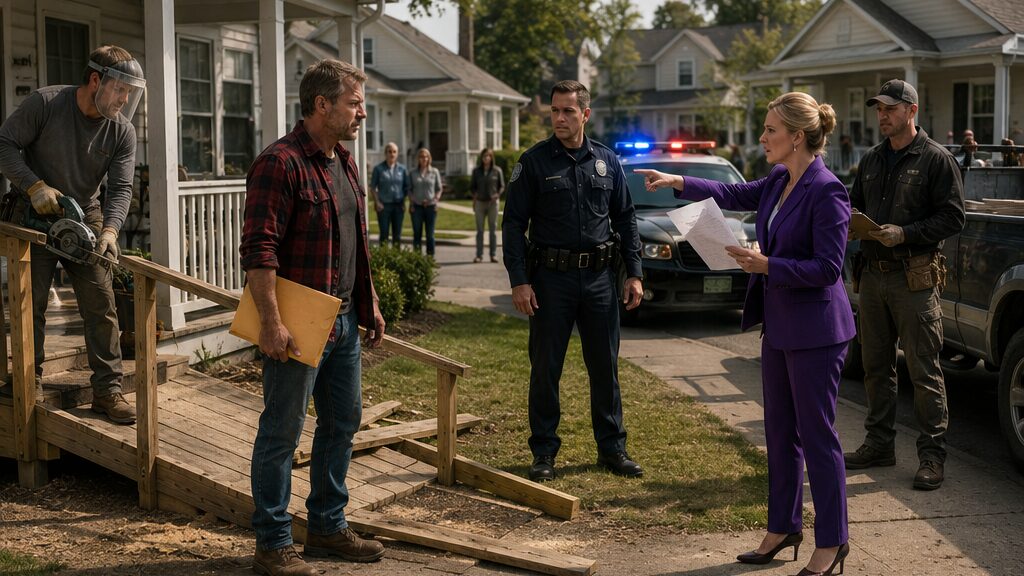
When The HOA Sent A Crew To Tear Out His Mother’s Ramp, He Opened The Yellow Folder
Chapter 1: The Crew Was Already Taking The Ramp Apart
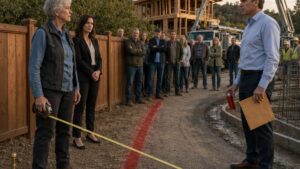
The saw screamed before Richard Carter reached the front steps.
For one second he stood in the driveway with the grocery bag still in his left hand, watching a man in work gloves press a blade into the new porch rail Richard had bolted on three nights earlier. Bright curls of pale wood jumped from the cut. Another worker had already loosened two boards from the lower platform of the ramp, and one of the boards lay across the grass like something broken off a boat.
Richard dropped the grocery bag beside his truck.
“Stop,” he said.
The man with the saw lifted his face shield but did not turn off the tool. He looked toward the woman standing near the curb in a purple suit, her hair pinned back, her phone held chest-high as if she had been expecting a scene.
Pamela Rivera did not step onto the lawn. She pointed at the ramp.
“Continue,” she said. “The structure is unauthorized.”
The word structure hit Richard harder than the saw. It was not a structure. It was fourteen feet of treated lumber, two rails, a landing wide enough for a wheelchair, and the difference between his mother entering through her front door or being carried like furniture.
Richard walked to the foot of the ramp and put himself beside the first post, close enough that no one could cut without risking his arm.
The saw finally died.
The sudden quiet made everything else louder: a dog barking two houses down, a truck idling at the curb, Pamela’s heels clicking once on the pavement as she shifted her weight. Neighbors had started to appear on porches. Someone’s curtain moved.
John Martin, the crew supervisor, came around the truck with a clipboard. He was broad through the shoulders, sunburned at the neck, and unwilling to meet Richard’s eyes for more than a second.
“Sir,” John said, “we’ve been contracted to remove a non-compliant exterior addition.”
“You were contracted by whom?”
“The HOA.”
“Then you can wait while I call the city inspector.”
Pamela came up the walkway then, stopping just where the concrete met Richard’s grass. She held out a paper with the HOA logo at the top.
“You were notified,” she said. “This ramp violates community exterior standards and was installed without architectural approval. You were instructed to remove it voluntarily.”
Richard looked at the paper but did not take it.
“When was that left?”
Pamela’s jaw tightened. “Today.”
“Today when?”
“It was posted.”
“The crew was cutting before I got home.”
“The association is within its rights to abate violations.”
Richard turned to John. “Touch another board, and I will document every cut.”
Pamela’s voice sharpened. “You do not get to threaten contractors.”
“I’m not threatening anyone.” Richard pulled his phone from his shirt pocket, opened the camera, and began recording. His hand stayed steady, though his chest had gone tight. “I’m documenting who is on my property.”
A low murmur came from the sidewalk. Pamela glanced toward the neighbors and raised her voice just enough for them to hear.
“This is exactly the issue, Richard. You ignored the process, built an unsafe obstruction, and now you’re intimidating a crew doing lawful work.”
He almost answered too fast. Almost told her what the obstruction was for. Almost said his mother’s name in front of people who had watched her bring pies to block parties and wave from the porch for twenty years.
Instead, he walked to his truck, opened the passenger door, and took out the yellow folder.
Pamela saw it and frowned. “That paperwork does not change the violation.”
“It might change whether your crew keeps cutting.”
The first police cruiser turned onto the street with its lights flashing but no siren. Then a second.
Richard looked at Pamela. She did not look surprised.
The responding officer got out slowly, one hand resting near his belt, his eyes moving from the half-cut rail to Richard, to Pamela, to the watching neighbors.
“Who called?” he asked.
“I did.” Pamela stepped forward immediately. “I’m Pamela Rivera, president of the Lakeview Crossing Homeowners Association. This man is interfering with authorized enforcement and threatening workers on behalf of the association.”
Richard kept the yellow folder tucked under his arm. “I asked them to stop cutting until they showed me a valid order.”
Pamela pointed at him so sharply that the officer glanced down at her hand.
“He stepped in front of the crew. He’s obstructing lawful removal. Arrest him.”
The street seemed to hold its breath.
Richard felt heat move up the back of his neck, but he did not raise his voice. He looked at the officer, not at Pamela.
“I haven’t touched anyone. I haven’t threatened anyone. I’m standing beside my own ramp, on my own property, asking for the removal order in writing.”
Pamela gave a short laugh, hard and humorless. “His own ramp. That is exactly the problem. He believes ownership means he can ignore the governing documents everyone else follows.”
The officer turned to John. “Were you threatened?”
John shifted the clipboard from one hand to the other. “He told us to stop. He started recording.”
“Did he threaten bodily harm?”
“No.”
Pamela cut in. “He blocked the crew physically.”
Richard opened the yellow folder. The top page was the city’s temporary emergency access permit, printed on white paper and clipped to the HOA submission receipt. Behind it were photos: Betty’s walker, the rehab discharge checklist, the old porch step with a crack running through the corner.
He handed the first two pages to the officer.
“I submitted the HOA request four weeks ago,” Richard said. “No answer. The city issued temporary access clearance after my mother’s discharge plan changed. This ramp is not decorative.”
Pamela’s face changed for only a moment, a small flicker around the eyes. Then it closed again.
“The association has no approved request on file,” she said. “He is presenting unrelated documents to delay enforcement.”
The officer read the city page, then the HOA receipt. His expression did not soften, exactly, but it became less automatic.
“This is a submission receipt?”
“Yes.”
“Do you have approval?”
“No. I have no denial, either. I have no response.”
Pamela lifted the notice. “Because the request was withdrawn.”
Richard looked at her.
“What did you say?”
“The request was withdrawn by the Carter family. The structure remained anyway. That is why enforcement proceeded.”
The officer held up a hand before Richard could answer. “This is a civil HOA issue unless someone commits a crime. I’m not here to decide architectural compliance. But if you physically block workers after being ordered to move, it can become a separate issue.”
Richard stared at the half-cut rail. The saw mark went halfway through the post he had sanded by hand because Betty hated splinters. A worker had set one of the removed boards on the lawn, and sawdust had blown across the porch mat where his mother’s shoes used to sit.
“I understand,” he said.
Pamela exhaled as if that settled it.
Richard stepped away from the post, but not from the ramp. He moved to the side, still recording, still holding the folder open.
“I’m not blocking,” he said. “I’m witnessing.”
John did not restart the saw. He looked at Pamela, then at the officer, then at the ramp as if it had become heavier than lumber.
The officer looked at the HOA notice in Pamela’s hand and read the lower half.
His brow tightened.
“Mr. Carter,” he said, “this says your request was withdrawn.”
Chapter 2: The Notice On The Door Came Too Late
The violation notice was taped to Richard’s front door under a smear of fresh sawdust.
It hung crooked, one strip of blue painter’s tape folded over itself at the top, the lower corner fluttering every time the porch rail creaked in the wind. Richard stood on the half-dismantled landing after the police cruiser pulled away, looking at the paper as if it might rearrange itself into something honest.
The crew had stopped for the moment. Not because Pamela had changed her mind. She had not. She had spoken to John in a low voice near the truck, then announced that work would pause “pending clarification,” as though clarification had not been available before the saw bit into the rail.
Now the neighborhood was pretending not to watch.
Richard peeled the notice from the door carefully, keeping the tape attached. The page said the HOA had authorized removal of an unapproved exterior modification. It listed section numbers, cure periods, association rights, and fees. Near the bottom, in bold, was a timestamp.
9:14 a.m.
Richard looked at his phone. He had started recording at 9:07. The first video showed the saw already running.
He took a picture of the notice in his hand. Then one of the door. Then one of the sawdust on the porch mat. Then one of the cut in the rail. He did not trust memory. Memory could be argued with. Pictures could still be dismissed, but not as easily.
Behind him, John loaded the saw into the truck bed.
“Who told you to start before posting the notice?” Richard asked.
John kept his eyes on the tool case. “We were told notice had been given.”
“By Pamela?”
“By the work order.”
Richard walked down the ramp, stopping where the lower boards had been removed. The gap was not huge, but it was enough. A walker wheel would catch there. A wheelchair would not clear it without a lift.
“My mother is coming through this door tomorrow,” he said.
John finally looked at him. Something moved in his face, not apology, not quite. Discomfort.
“I didn’t know that.”
“No one asked.”
Pamela’s car was still at the curb, a polished white SUV with a Lakeview Crossing parking decal on the windshield. She stood beside it typing on her phone. When Richard looked over, she lowered the phone and said, “All further communication should go through the board.”
“This is my communication.” He lifted the notice. “You posted this after the crew started.”
“It was posted this morning.”
“After the crew started.”
“That distinction does not change the violation.”
“It changes whether you gave notice.”
Pamela’s mouth became a flat line. “You had weeks to follow the procedure.”
“I did follow it.”
“You installed without approval.”
“Because you didn’t answer.”
“Silence is not approval, Mr. Carter.”
“No,” Richard said. “But silence is not withdrawal.”
For the first time, Pamela had no immediate answer. Then she opened her car door.
“You will receive the file summary by email.”
She drove away without looking at the ramp.
Richard carried the yellow folder and the notice inside.
The kitchen table was already covered with the last month of his life: printed emails, receipt numbers, a city form with a temporary approval stamp, a handwritten list of ramp measurements, a discharge packet from the rehab center, and a photo of Betty standing between parallel bars with a therapist just outside the frame. Richard had printed that photo because Betty had insisted she looked “ridiculous” in it, which meant she was proud and did not want to say so.
He laid the violation notice beside the HOA submission receipt.
The receipt was dated four weeks earlier. It showed the subject line exactly: Temporary Accessibility Ramp and Porch Rail for Medical Discharge.
Richard had written that subject line three times before sending it. Not “improvement.” Not “addition.” Not “porch work.” He had wanted no one to misunderstand.
He opened his laptop and searched his email again. Submission received. Documents pending review. Architectural committee meets monthly. No guarantee of expedited approval.
Then nothing.
For three weeks, nothing.
He had called twice. Left one voicemail. Sent one follow-up message with the city permit attached. He had not gone to Pamela’s house. He had not made a scene at the clubhouse. He had told himself that calm people got better outcomes, that if he kept everything in order, the papers would speak when they needed to.
The papers had spoken that morning, and a saw had kept cutting.
His phone buzzed.
An email from Pamela appeared at the top of his inbox.
Richard opened it.
Mr. Carter,
As discussed with the responding officer, the association’s position is unchanged. Your original modification request was marked withdrawn based on communication received from the Carter family indicating that the ramp may no longer be necessary due to alternate care arrangements. Because the unapproved structure remained after withdrawal, enforcement was initiated.
Attached: enforcement file summary.
Pamela Rivera
HOA President, Lakeview Crossing
Richard read the paragraph twice.
The Carter family.
Not Richard. Not Betty. The Carter family.
He opened the attachment. It was a scanned packet: his application, the city permit, photos of the front porch before the ramp, a note from the architectural committee, and then one printed email reply.
The sender line made his jaw tighten.
Brandon Carter.
Most of the message was hidden in the scan preview, but the visible part was enough.
We are still discussing whether Mom should return to the house at all. The ramp may not be needed if we go forward with assisted living.
Richard pushed back from the table.
For a moment the kitchen blurred, not because his eyes filled, but because every object on the table seemed to accuse him at once. The folder. The discharge papers. The grocery bag he had left in the driveway. The empty chair where Betty used to sit with her coffee while telling him he used too much pepper in everything.
He had not told Brandon everything.
He had told himself Brandon was busy. Brandon had his own mortgage, his own kids, his own reasons for calling only at night. Richard had sent updates that sounded manageable because manageable was easier than saying their mother had fallen hard enough to stop trusting her own front steps.
The phone rang before he could call his brother.
Unknown number.
Richard answered.
“Mr. Carter?” a woman said. “This is the discharge coordinator from Brookside Rehab. I’m calling to confirm tomorrow morning’s home discharge for Betty Carter.”
Richard looked through the kitchen doorway toward the front porch. Through the window, he could see the gap in the ramp.
“Tomorrow,” he repeated.
“Yes. Transport is scheduled for ten. We just need confirmation that the home entry is ready and safe for assisted access.”
Richard picked up the yellow folder, then set it down because his hand had tightened enough to bend the corner.
“The entry,” he said, “is not ready.”
There was a pause on the line.
“Mr. Carter, if the home cannot be safely accessed, we may need to delay discharge or reassess placement options.”
Through the window, one of the loosened ramp boards shifted in the breeze and knocked softly against the post.
Richard closed his eyes for one second.
Then he opened them.
“My mother is supposed to come home tomorrow,” he said. “Tell me exactly what document you need to keep that possible.”
Chapter 3: The Email Richard Never Sent
Brandon’s name sat in the email thread like a nail Richard had not noticed until he stepped on it.
Richard printed the scanned message, though he already knew what it said. The printer made its slow, irritated sounds in the corner of the kitchen, dragging the page out inch by inch while Richard stood with his arms crossed and tried not to decide what his brother had meant before hearing his voice.
The page dropped into the tray.
We are still discussing whether Mom should return to the house at all. The ramp may not be needed if we go forward with assisted living.
There was no signature beyond Brandon’s name. No cruelty. No demand. Just enough uncertainty for Pamela to turn into a withdrawal.
Richard called him.
Brandon answered on the fourth ring, breathless. “I’m between meetings. Is Mom okay?”
“That depends on whether she can get through her front door.”
A pause.
“What happened?”
“The HOA sent a crew to remove the ramp.”
“What?”
“They say the request was withdrawn by the Carter family.”
Another pause, longer this time.
Richard folded the printed email once, then unfolded it, smoothing the crease with his thumb.
“Did you tell Pamela the ramp wasn’t needed?”
“I told her we were discussing options.”
“Why were you discussing options with Pamela?”
“She emailed me because I’m listed as secondary contact on the property file. You put me there years ago.”
“I put you there for emergencies.”
“This is an emergency.”
Richard laughed once, without humor. “You think the emergency is the ramp?”
“I think the emergency is you pretending that house is still safe for Mom.”
The words entered the room and stayed there.
Richard looked toward the hallway, where Betty’s framed photos still lined the wall. Betty in the garden. Betty holding a pie at the Fourth of July picnic. Betty and Richard’s father standing on the porch before the old rail had started to sag.
“You don’t know what the house needs,” Richard said.
“I know she fell.”
Richard went still.
Brandon’s voice changed. “The rehab nurse mentioned it when I called last week. She said Mom was scared of the front steps.”
Richard pressed his hand flat on the table.
“She shouldn’t have told you medical details.”
“She didn’t give me details. That’s the problem. No one gives me details. You say, ‘I’ve got it.’ Mom says, ‘Don’t fuss.’ Then I get copied on some HOA email about a ramp I’ve never seen, and Pamela asks whether this is permanent, temporary, or even necessary. What was I supposed to say?”
“You were supposed to call me.”
“I did call you. You said everything was handled.”
Richard remembered the call. He had been in the garage, drilling pilot holes into the second rail while his phone sat on the workbench. He had answered on speaker. Brandon had asked whether Betty was really coming home. Richard had said, “That’s the plan.” Brandon had asked if they needed to talk about money. Richard had said, “Not now.” The drill battery had died, and he had taken that as permission to end the conversation.
“Maybe they’re right,” Brandon said quietly. “Maybe Mom shouldn’t be in that house anymore.”
Richard’s grip on the phone tightened.
“That house is her home.”
“It’s also stairs, narrow halls, old wiring, and you trying to fix everything with a toolbox after midnight.”
“She wants to come home.”
“Of course she does. She’d say that if the roof was gone.”
The yellow folder lay open on the table. Richard looked at the documents that proved parts of the truth. Permit. Receipt. Discharge checklist. Measurements. Photos. None of them showed the night Betty fell. None showed Richard sitting beside her on the porch floor with his hand under her shoulder, telling her not to move while she kept apologizing for making him worry.
He had not put that in the file.
He had not put it anywhere.
“You don’t get to help them remove the one thing that lets her come inside,” Richard said.
“I didn’t help them remove anything. I answered a question.”
“You gave Pamela a sentence she could use.”
“And you gave her an unapproved ramp.”
That landed because it was true in the narrowest way.
Richard walked away from the table, then came back because there was nowhere in the kitchen that did not contain the problem. He had installed before formal approval. He had known it was a risk. He had weighed the risk against Betty sitting in rehab another week because a committee met once a month and preferred matching materials.
“I submitted the request,” he said.
“And then built anyway.”
“She was being discharged.”
“You didn’t tell me that.”
“I told you she was improving.”
“That’s not the same thing.”
“No,” Richard said. “It isn’t.”
Silence moved between them, not empty but crowded. Richard could hear Brandon breathing. He could hear the old refrigerator click on. Outside, a truck passed slowly, tires crunching over the edge of the curb where the crew had parked.
Brandon spoke first. “What exactly did the doctor say?”
Richard looked at the folder. “I don’t have the formal letter yet.”
“You don’t have—Richard.”
“I have discharge notes. I have the city temporary access permit.”
“Do you have a medical accommodation letter?”
“Not yet.”
“So Pamela has an email from me saying placement is being discussed, no formal doctor’s letter, and a ramp you built without HOA approval.”
Richard shut his eyes.
“I’m not saying she’s right,” Brandon said. “I’m saying you made it easy for her to be wrong.”
The anger drained out of Richard so quickly it left him tired. He sat down at the table and pulled the printed email closer.
“I should have told you about the first fall.”
“The first fall?”
Richard did not answer right away.
“Richard,” Brandon said, “how many times did Mom fall?”
“Twice. The bad one was on the front step.”
Brandon said something under his breath that Richard did not catch.
“She didn’t want me to tell you,” Richard said.
“That’s not a reason.”
“I know.”
“Do you?”
Richard looked at the yellow folder. It had seemed so solid that morning when he held it in front of the officer. Now it looked thin. It held paperwork, but not enough truth.
“I thought if I fixed the step, then the rail, then the ramp, then I could make the whole thing simple before anyone had to worry.”
“And instead the HOA is cutting it apart.”
“Yes.”
His phone buzzed while he was still on the call. An email banner appeared from Pamela Rivera.
Emergency Board Session Notice.
Richard opened it with Brandon still on the line.
The meeting was scheduled for 6:30 that evening at the Lakeview Crossing clubhouse. The subject line read: Continued Enforcement Authorization and Fine Assessment, Carter Property.
He read the first paragraph once, then again.
“They’re holding a board meeting tonight,” he said.
“For what?”
“To authorize full removal and daily fines.”
“Tonight?”
“Yes.”
Brandon exhaled. “I’ll come.”
Richard almost said no. The word rose automatically, shaped by habit. No, I’ve got it. No, stay out of it. No, don’t make this harder.
Instead he looked at the printed email with Brandon’s name on it, then at the empty space in the folder where a doctor’s letter should have been.
“If you come,” Richard said, “you don’t get to talk around me to Pamela again.”
“And you don’t get to leave out half the truth because it makes you feel less guilty.”
Richard said nothing.
The email from Pamela ended with a line in bold.
Failure to comply may result in continued removal activity and immediate fines beginning tomorrow at noon.
Richard folded the notice and slid it into the yellow folder.
For the first time all day, the folder would not close.
Chapter 4: The Board Called It A Visual Obstruction
Pamela Rivera began the meeting by putting Richard’s face on the clubhouse wall.
The projector hummed above the folding tables. On the screen, Richard stood in his front yard with his red-and-black flannel sleeves rolled to the forearms, the yellow folder open in one hand, the half-cut ramp rail behind him. From that angle, the photo made him look larger than he had felt, planted in front of the crew, jaw tight, eyes fixed somewhere beyond the camera. It did not show the sawdust on the welcome mat. It did not show the timestamp on the notice. It did not show the gap where his mother’s wheelchair would catch.
Pamela stood beside the screen with a remote in one hand.
“This is what happened this morning,” she said. “A homeowner physically interfered with authorized association enforcement after installing an exterior structure without architectural approval.”
Richard sat in the second row with the yellow folder on his knees. Brandon sat two chairs away from him, close enough to count as family, far enough to show they had not solved anything. He had arrived late, still wearing a work shirt tucked too tightly into slacks, and had said only, “I’m here,” before sitting down.
The clubhouse smelled faintly of floor cleaner and old coffee. Three board members sat behind a long table. Laura Smith was at the end, her hands folded around a pen. She had lived across the bend from Betty for years, but she had not looked at Richard since he came in.
Pamela clicked to the next slide. A close-up of the ramp filled the wall. It was not a flattering photo. Taken low, it made the railing look bulky and the lower platform look awkward beside the porch. Richard recognized the angle; it was from the morning, after the workers had already removed two boards.
“The issue before the board,” Pamela continued, “is not whether Mr. Carter has personal concerns. Everyone has personal concerns. The issue is whether one resident may unilaterally alter an exterior facade, create liability exposure, and then use confrontation to prevent enforcement.”
Richard raised his hand.
Pamela did not look at him. “You’ll be given time.”
“It’s my mother’s access.”
“You’ll be given time.”
Brandon shifted in his chair. The move was small, but Richard saw it. He wondered if Brandon had come to help or to make sure he did not say too much.
Pamela clicked again. A section of the governing documents appeared: exterior changes required prior approval. Temporary structures required review. Unsafe installations could be removed. She read from the highlighted lines, her voice level, trained, almost calm.
That calm bothered Richard more than the pointing had that morning.
A board member asked, “Was there an application?”
Pamela clicked to another slide. Richard’s submission receipt appeared, cropped at the edges.
“There was an initial submission,” she said. “It was incomplete. The committee requested clarification, including duration, material specifications, and whether the ramp was still necessary given family communications indicating alternate care arrangements.”
Richard turned his head toward Brandon.
Brandon stared at the table.
Pamela clicked again. Brandon’s email appeared on the screen.
We are still discussing whether Mom should return to the house at all. The ramp may not be needed if we go forward with assisted living.
A few chairs creaked behind Richard. He did not turn around. He could feel the neighbors reading the sentence and deciding things from it.
“That was not a withdrawal,” Richard said.
Pamela faced him. “Then you should have clarified.”
“You should have asked the applicant.”
“I did.”
“You asked my brother about my application.”
Pamela’s nostrils flared. “Your brother is listed as secondary family contact on the property file.”
“Emergency contact,” Richard said. “Not project owner.”
Laura’s pen stopped moving.
Pamela clicked off the email, but the sentence remained in Richard’s head. The ramp may not be needed. It sounded worse projected onto a wall. It sounded like Betty had already been moved out of her own life.
“Mr. Carter,” Pamela said, “you installed before approval. That is not in dispute.”
“No,” Richard said. “It isn’t.”
The room quieted, surprised by his answer.
He opened the yellow folder and stood. The officer’s business card was clipped to the front now, along with the photo of the notice in sawdust.
“I submitted the request four weeks ago. I called twice. I sent the city temporary access permit. I received no denial. This morning, a crew started cutting before a notice was properly posted. The notice is timestamped after my recording began.”
He handed copies to the board table. Pamela did not reach for them, but Laura did.
Richard kept his voice low because if he let it rise, it might crack.
“My mother is scheduled to come home from rehab tomorrow morning. She cannot use the front steps safely. She cannot be carried up and down because somebody thinks the railing doesn’t match the porch trim.”
Pamela’s expression hardened. “No one is objecting to accessibility in principle.”
“In principle doesn’t get her inside.”
A murmur went through the room. Pamela turned slightly, regaining the board’s attention.
“We must be careful here,” she said. “Two years ago, this association received an insurance warning after an unapproved deck extension collapsed during a delivery. The board was told very clearly that inconsistent enforcement creates exposure. If we allow residents to build first and justify later, the entire community assumes risk.”
That was new.
Richard saw it land with the board members. Even Brandon looked up. For the first time that evening, Pamela sounded less like someone protecting a rule and more like someone trying not to be blamed for what a rule failed to prevent.
Laura looked from the projected photo to Pamela.
“Who authorized removal before tonight’s vote?”
Pamela’s jaw moved once before she answered. “The enforcement policy allows abatement when an unapproved structure creates safety or liability concerns.”
“Did the board vote on that?”
“The policy already exists.”
“That isn’t what I asked.”
The room changed. Not dramatically. No one gasped. But Richard felt the first small shift, like a board flexing under weight.
Pamela set the remote down. “I made an executive decision to prevent further liability.”
Laura glanced at the photo of the half-removed ramp. “Before confirming the medical status?”
“We had communication indicating alternate placement was under consideration.”
Brandon leaned forward. “That communication was from me. I didn’t withdraw anything.”
Pamela looked at him as if he had broken an agreement he had not known he made.
“You said the ramp may not be necessary.”
“I said we were discussing it.”
“Your message was reasonably interpreted.”
“No,” Richard said. “It was conveniently interpreted.”
Pamela’s face flushed, but her voice stayed controlled. “Mr. Carter, you are not helping yourself.”
Richard looked at the board, not her. “Then tell me what helps. Tell me exactly what paper matters more than my mother’s discharge plan.”
A board member asked for the doctor’s accommodation letter.
Richard opened the folder and felt the missing space like a hole. He had discharge notes. Therapy notes. A city permit. Photos. He did not have the formal letter yet.
“I’m getting it tomorrow morning,” he said.
Pamela turned immediately to the board. “Then as of tonight, the required medical accommodation documentation has not been provided.”
Brandon made a sound under his breath.
Richard did not look at him. He could not. The folder was heavy in his hand and suddenly not heavy enough.
Laura rubbed her thumb along the edge of Richard’s timestamped photo. “We should not continue removal until noon tomorrow. Give him time to produce the letter and have the city confirm the safety requirements.”
Pamela’s smile was thin. “And leave an unapproved structure in place overnight?”
“It’s already half removed because we acted before the board reviewed the complete file.”
The other board members exchanged glances. Richard stood still while they whispered. Pamela stood still too, but her stillness was different. His came from holding himself together. Hers came from refusing to bend where anyone could see it.
Finally, the board member at the center spoke.
“Removal will remain paused until noon tomorrow. Mr. Carter must provide formal medical accommodation documentation and evidence that the ramp can be inspected for safety. If those are not provided by noon, removal may continue. Fines for continued non-compliance will begin at noon tomorrow if the matter is not resolved.”
Richard heard each piece separately. Paused. Noon. Documentation. Fines. Removal.
A pause was not permission. It was only a narrower clock.
Pamela gathered her papers. “The daily fine will be assessed according to the schedule.”
“How much?” Brandon asked.
Pamela looked at Richard when she answered.
“Two hundred dollars per day until the remaining structure is removed or brought into compliance.”
Richard closed the yellow folder. This time it shut, but only because he forced it.
Chapter 5: The Doctor’s Letter Was Not Enough
“The home entry has to be confirmed safe before transport,” the rehab nurse said, blocking the doorway with a clipboard.
Richard stood in the hallway of Brookside Rehab at 8:10 Wednesday morning with the yellow folder tucked under his arm and a paper cup of coffee going cold in his hand. Behind the nurse, through the open door, Betty Carter sat in a wheelchair beside a neatly made bed, wearing her blue cardigan and the careful smile she used when she wanted everyone to stop worrying.
“I’m working on that,” Richard said.
The nurse did not move. “I understand. But working on it and having it ready are different.”
Betty looked down at her hands.
Richard hated that. He hated the clipboard, the hallway smell of disinfectant, the cheerful posters about recovery, the way every process had its own kind of locked door.
“I need the doctor’s accommodation letter,” he said. “The HOA won’t pause removal without it.”
“The doctor signed a mobility recommendation.”
“Is that the same thing?”
The nurse gave him the tired look of someone who knew it was not and wished it were. “For medical care, yes. For property disputes, maybe not.”
Betty lifted her head. “Richard, don’t make that face.”
“What face?”
“The one your father made when a bolt stripped.”
“I don’t have a stripped-bolt face.”
“You have had it since you were nine.”
The nurse stepped aside enough to let him enter. Betty’s suitcase sat on the chair by the window, packed and zipped. Her walker stood folded beside it. On top of the suitcase was the quilted pouch where she kept peppermint candies and folded tissues.
“You packed,” Richard said.
“They told me I might go home.”
“You are going home.”
Betty looked past him. “Not if it causes all this.”
He set the coffee down, opened the folder, and pulled out the discharge checklist. “It’s not you causing it.”
“It’s my legs, then.”
“No.”
“My bones?”
“Mom.”
She smiled without humor. “I am trying to find the thing we are allowed to blame.”
He had no answer for that.
The doctor signed the letter twenty minutes later. It stated that Betty required step-free or ramp-assisted entry for safe discharge, that stairs posed a fall risk, and that home access was medically necessary for return to residence. Richard read it twice before sliding it into the yellow folder. The words should have felt like a key.
Instead, they felt like another piece of paper someone could decide was not shaped correctly.
He drove from the rehab center to the city inspection office with the folder on the passenger seat, buckled under the seat belt because he had taken a turn too sharply and spilled half the pages onto the floorboard. At a red light, he called Brandon. No answer. He texted one line.
Got doctor letter. Going to city.
The reply came before the light changed.
I’m leaving work at 10:30. Don’t go alone if board meets again.
Richard typed, I’m fine, then deleted it.
He put the phone down.
At the city office, a clerk looked through the papers and sent him to the inspection counter. The city accessibility inspector was not unkind, which somehow made the answer harder.
“The emergency access permit allows temporary installation,” the inspector said, laying Richard’s photos on the counter. “It doesn’t certify the installation as complete or code-compliant.”
Richard put both palms on the counter.
“What needs changing?”
The inspector tapped the photo of the ramp. “Landing width here. Rail height here. Edge protection along this side. And I’d want the lower approach secured better. It looks like you built fast.”
Richard did not deny it.
“I built before she was discharged.”
“I understand why.”
“But?”
“But if the HOA is asking whether the ramp is safe, I can’t sign off on this as-is.”
The word as-is did what the board meeting had not. It pushed through Richard’s anger and found the place where he already knew the truth. He had measured. He had leveled. He had braced the posts. But he had also worked after dark with a flashlight clamped between his teeth because the rehab discharge date had moved closer, and he had told himself temporary meant forgivable.
“What can you sign?” he asked.
The inspector looked at him for a moment, then pulled a blank form from a tray.
“I can sign that a ramped entry is medically and practically appropriate if corrected to these specifications. I can note that removal before correction would eliminate safe access. I can come out this afternoon if the HOA agrees not to remove more before then.”
“That’s not approval.”
“No. It’s a path.”
Richard took the form.
A path was more than he had had an hour ago. Less than he needed by noon.
His phone buzzed as he left the building.
A text from John Martin.
Crew ordered back at 12 unless we hear otherwise. I don’t make the call.
Richard stopped on the sidewalk. People moved around him toward the parking lot. Somewhere a delivery truck beeped as it backed up. He read John’s message again and heard the saw from yesterday morning in the space between the words.
He called Pamela.
She did not answer.
He forwarded the doctor’s letter and the inspector’s correction list to the board email, then sent a separate copy to Laura. His thumb hovered over Brandon’s name before he added him too.
At 11:17, Laura replied.
Received. I am reviewing. Do not let anyone alter the ramp before inspection if possible.
If possible.
Richard drove back to Brookside because he could not go home and wait beside the cut rail without seeing Betty first. He found her in the rehab room with her coat across her lap, no longer smiling.
“Did they say yes?” she asked.
“They said the ramp needs corrections.”
“That sounds like no dressed up.”
“It’s not no. The doctor wrote the letter. The city inspector gave me a list. If the HOA pauses long enough, I can fix it.”
“If they don’t?”
He looked at her suitcase, packed so neatly it seemed to accuse him of promising too much.
“Then I keep pushing.”
Betty looked toward the window. “Your brother called me.”
Richard’s shoulders tightened.
“What did he say?”
“That he is worried about you.”
Richard almost laughed. “That’s convenient.”
“He is worried about me too.”
“I know.”
“He said assisted living is not prison.”
“I know that too.”
She turned back to him. Her eyes were tired, but not weak. That was the mistake people made with Betty. They confused a body that needed help with a person who had stopped deciding.
“I want to come home,” she said. “But not if home becomes a courtroom every time I need to use the door.”
“It won’t.”
“You cannot promise that today.”
Richard had promised too many things inside his own head. He had promised the porch would be fixed before the first fall. He had promised the ramp would be done before discharge. He had promised paperwork would be enough.
He sat on the edge of the bed, careful not to disturb the folded blanket.
“I’m sorry,” he said.
Betty watched him. “For what?”
“For making this harder.”
She reached over and put her hand on the yellow folder. Her fingers were thin, the knuckles swollen, but her grip still had the old firmness.
“This folder is not the same as a door,” she said.
“No.”
“You know that?”
“I’m starting to.”
His phone buzzed again. He expected Laura or Pamela. Instead, it was John.
On site early. Pamela here.
Richard stood so fast the folder slid from Betty’s hand.
Betty saw his face and understood before he spoke.
“Go,” she said.
“I’ll stop them.”
She closed her eyes briefly, then opened them and looked straight at him.
“Maybe Brandon is right,” she said. “Maybe I should not come home.”
Chapter 6: The Missing Step Richard Would Not Mention
Richard found the old cracked step under the ramp gap because one of the removed boards had shifted just enough to expose it.
He crouched in front of the porch with his phone in one hand and the yellow folder under his elbow, staring at the dark split in the corner of the original wood. It ran diagonally from the edge to the old nail head, the same split he had noticed in spring, then again in summer, then again the week before Betty fell.
Behind him, John’s truck idled at the curb.
The crew had not started cutting yet. Two workers stood near the tailgate, waiting. Pamela’s white SUV was parked behind them. She was speaking on her phone, facing away from Richard, but every few seconds she glanced back at him as if measuring how close he stood to the ramp.
Richard touched the cracked step with two fingers.
The wood flexed slightly.
He had meant to replace it. That was the sentence that had lived in him for weeks. He had meant to. He had bought the board. He had put it in the garage. He had planned to fix it on a Saturday morning, then Betty had wanted the gutters checked, then the water heater had coughed rust into the utility sink, then he had told himself the step would last another week.
It had lasted until Betty’s foot found the weak corner.
A car door shut behind him.
“You didn’t answer my calls,” Brandon said.
Richard did not stand.
“I was with Mom.”
“I know. She called me after you left.”
That made Richard look up.
Brandon stood at the end of the walkway, tie loosened, face pale with anger or fear or both. He looked past Richard at the ramp, at the missing boards, at Pamela, at the workers waiting with tools.
“So this is what we’re doing?” Brandon said. “Standoff number two?”
“If they remove more before inspection, she can’t come home.”
“Richard, look at the step.”
“I am looking at it.”
“No, you’re looking at Pamela. Look at the house.”
Richard stood slowly. “Don’t start.”
“I’m starting because you won’t. This whole time you’ve acted like the HOA is the only problem, but that step was rotten before Pamela ever showed up.”
Richard’s hand closed around the phone.
“Lower your voice.”
“Why? So the neighbors don’t hear? So Pamela doesn’t hear? So I don’t say out loud what you left out of every email?”
The workers had gone still. Pamela lowered her phone but did not approach.
Richard stepped closer to Brandon. “This is not the time.”
“That’s what you always say. Not now. Later. I’ve got it. Meanwhile Mom is apologizing for needing a door.”
Richard felt the words strike something raw. “I built the ramp.”
“After she fell.”
“Yes.”
Brandon blinked. The anger on his face faltered, not because it left, but because the answer was not the one he expected.
Richard looked back at the cracked step.
“Yes,” he said again. “After she fell.”
For a moment, no one near the porch spoke. A bird called from one of the maples by the street. Pamela took one careful step closer, listening now.
Brandon’s voice dropped. “How bad was it?”
Richard stared at the old nail head. “Bad enough that she stopped trusting her own feet.”
“Why didn’t you tell me?”
“Because I thought I could fix what scared her before you saw it.”
“That is not an answer.”
“It’s the only one I have.”
Brandon walked to the porch and crouched where Richard had been. He touched the split, then pulled his hand away as if it had burned him.
“She fell here?”
Richard nodded.
“And you let me argue about assisted living without telling me this?”
“I didn’t let you. I avoided you.”
Brandon gave a short, stunned laugh. “That’s supposed to be better?”
“No.”
Richard heard his own voice and barely recognized it. It was quieter than he meant it to be. He was tired of sounding controlled. Tired of control being mistaken for innocence.
“I was in the garage when she fell,” he said. “Cutting the first rail piece. She told me not to fuss with the step until after dinner. I listened because it was easier than arguing with her. Then I heard her hit the porch.”
Brandon stood.
Richard kept going before he could stop himself.
“She kept saying she was sorry. That’s what I remember. Not the ambulance. Not the rehab intake. Her saying sorry because she knew I’d blame myself.”
“Do you?”
Richard looked at him.
Brandon’s face changed.
“You do,” he said.
Pamela cleared her throat from the walkway. “Mr. Carter, while I’m sympathetic to family difficulties, the association still has—”
“Don’t,” Brandon said.
Pamela stiffened.
Brandon turned toward her. “You used my email to mark his request withdrawn.”
“I used information provided by an authorized family contact.”
“I said we were reconsidering home access.”
“Correct.”
“I did not say withdraw the application.”
“You said the ramp may not be necessary.”
“Because I didn’t know she had to have step-free entry to come home. He didn’t tell me. That is on us. But you didn’t confirm it with him, with my mother, with the doctor, or with the city before sending a crew.”
Pamela’s face had gone tight, but there was something else under it now. Not regret. Calculation under pressure.
“Mr. Carter,” she said to Brandon, “your message created ambiguity.”
“And you chose the interpretation that let you cut first.”
John shifted beside the truck. Richard looked at him.
“What time were you told notice had been posted?” Richard asked.
John looked at Pamela, then at the ground.
“Work order said proceed at nine.”
“And the notice says 9:14.”
Pamela snapped, “The posting time is not material to whether the structure was approved.”
“It is material to whether you gave me a chance to stop you before you touched it.”
Richard opened the yellow folder on the hood of his truck. The pages lifted in the breeze. He weighted one corner with his phone and another with a tape measure he had left in the cup holder.
Doctor letter. City correction list. HOA submission receipt. Timestamped photo of the notice. Photo of the saw running before the notice time. Brandon’s email. The old step photo he had just taken.
The folder looked less like defense now and more like confession.
Richard took a picture of the cracked step and sent it to Laura with the message: This is the original hazard. Ramp removal exposes it. Can the board come to the property before noon?
He stared at the sent message. It was not enough. He called.
Laura answered on the second ring.
“Richard?”
“I need the board to see this in person.”
“We’re reviewing the documents.”
“No. Not in a file. Here. Pamela’s here with the crew. The transport is still scheduled. The city inspector can come if the ramp stays. My brother is here, and he’ll confirm his email was not a withdrawal.”
Pamela’s eyes narrowed when she heard that.
Laura was quiet.
Richard looked at the broken step, then at the half-removed ramp, then at Brandon, who stood with his hands at his sides like a man who had arrived ready to fight and found the wrong opponent.
Richard said the part he had avoided all week.
“And I’ll put on record that my mother fell on this step because I waited too long to repair it. I’m not asking the board to pretend I handled everything perfectly. I’m asking you to stop them from making the entry more dangerous before anyone with authority looks at the whole truth.”
On the other end, Laura exhaled.
“Do not let the crew remove another board,” she said. “I’m calling the others now.”
Richard ended the call.
John looked at him. “I need direction from whoever’s paying us.”
Pamela lifted her phone again. “And I need the board to stop being manipulated by emotional theater.”
Richard slid the doctor’s letter back into the yellow folder, but he did not close it.
“The board is coming here,” he said.
Pamela’s hand froze around her phone.
From the street, one of the workers called out, “There’s a medical transport van turning in.”
Richard turned.
At the far end of the block, a white van slowed beneath the maple trees and came toward the house.
Chapter 7: The Yellow Folder Opened On The Hood
John Martin’s crew returned to the ramp at the same time Betty’s transport van rolled to the curb.
For a moment, nobody moved. The van stopped behind Pamela’s SUV, its side lift folded against the door, its windows tinted enough that Richard could not see whether Betty was inside. One of John’s workers had a drill in his hand. Pamela stood near the walkway with her phone against her ear. Brandon turned toward the van, then back toward Richard, as if there were two emergencies and only one body to put between them.
Richard picked up the yellow folder from the hood of his truck and walked to the middle of the driveway.
“John,” he said, “your crew does not touch the ramp.”
John lowered his clipboard. “I still don’t have a stop order.”
“You have a doctor’s letter, a city correction list, a board member on the way, and a medical transport van at the curb.”
Pamela ended her call. “You have no authority to direct the contractor.”
Richard looked at her. “Neither do you, unless you can put the removal authority in writing with the medical documents attached.”
Her eyes narrowed. “You don’t dictate board procedure from your driveway.”
“No. I document it.”
He opened the yellow folder on the hood of his truck.
The wind tried to lift the pages, so Brandon stepped forward and placed his hand on one corner before Richard asked. Richard set his phone on another page, then laid the tape measure across the doctor’s letter. The hood became a table: city permit, HOA receipt, timestamped notice photo, saw video still, doctor’s letter, inspector’s correction list, Brandon’s printed email, and the fresh photo of the cracked step under the ramp.
Pamela stared at the spread as if it were an insult.
“You are turning this into a spectacle,” she said.
“No,” Richard said. “You did that when you called police before checking the file.”
The front door of the transport van opened. The driver stepped out, glanced at the ramp, then looked back into the van and spoke to someone inside. Richard’s throat tightened. He could imagine Betty sitting there in her blue cardigan, seeing the cut rail, the people, the clipboard, the board members’ cars that had begun to turn onto the street.
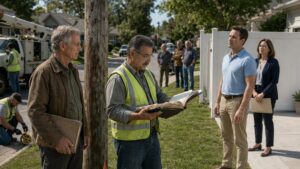
Laura Smith pulled up behind the van and got out with a folder of her own. Two other board members arrived seconds after her. They did not look pleased to be there. They looked like people who had expected paperwork and found a driveway full of consequences.
Laura walked straight to Richard’s truck hood.
“Show me the timing,” she said.
Pamela stepped in. “Laura, this is highly irregular.”
“So was authorizing removal before the board reviewed the medical documentation.”
“The medical documentation did not exist in the file.”
“It was submitted to the board email this morning.”
“This morning,” Pamela said. “After the violation.”
Richard tapped the HOA receipt. “The request was submitted four weeks ago.”
Pamela tapped Brandon’s email. “Then later called into question by an authorized family contact.”
Brandon lifted his hand off the paper and faced the board.
“I need that corrected,” he said. “I did not withdraw the request. I said we were discussing whether our mother should return home because I did not know the full medical situation. Pamela never asked me to clarify. She never asked my mother. She never asked Richard after that. She treated a maybe like a no.”
Pamela’s voice sharpened. “You were copied on the correspondence as secondary contact.”
“Emergency contact,” Brandon said. “Not owner of Mom’s legs.”
No one spoke for a beat.
Richard saw Pamela’s face tighten, not with embarrassment exactly, but with the recognition that the line had landed somewhere she could not immediately control.
Laura picked up the timestamped photo. “Richard, your video began at 9:07?”
“Yes.”
“And the posted notice says 9:14?”
“Yes.”
John cleared his throat.
Everyone looked at him.
“The work order had us scheduled at nine,” he said. “I was told notice was handled.”
Pamela turned on him. “You are not being asked to interpret association procedure.”
“I’m not interpreting,” John said. “I’m saying what the work order said.”
Richard watched him. The man still did not look comfortable, but his eyes no longer slid away.
Laura looked at Pamela. “Did you personally confirm posting before the crew began?”
Pamela hesitated.
That hesitation did more than any accusation Richard could have made.
“I instructed that notice be posted,” she said.
“That is not the same thing.”
Pamela’s hand tightened around her phone. “The structure was unapproved and presented liability exposure.”
“The city inspector says removal before correction eliminates safe access,” Laura said, holding up the form.
“The inspector has not approved the ramp.”
“No,” Richard said. “He approved a path to make it safe. That’s what I’m asking for. Not a free pass. Not special treatment. A chance to correct it before you destroy it.”
Pamela looked toward the other board members. “We cannot let emotion override governing documents.”
Richard felt the old reflex rise: stay quiet, stay measured, let someone else read the papers. But the transport van door was opening now. The driver stepped out again, this time lowering the side lift just enough to prepare it. The metal platform unfolded with a hydraulic whine.
Betty was inside.
Richard took the doctor’s letter from under the tape measure and held it up.
“My mother fell on that step,” he said.
The words stopped the small movements around him. Brandon looked down. Laura’s face changed.
Richard pointed to the cracked board under the ramp gap.
“That step. I knew it needed repair. I waited. I thought I had time. Then she fell, and after that she stopped trusting the front door. I built fast because she was coming home, and I should have asked for help before it got to that point.”
He turned to Pamela.
“That does not make the ramp decorative. It does not make your notice on time. It does not make Brandon’s email a withdrawal. And it does not give you the right to make the entrance more dangerous while hiding behind the word compliance.”
Pamela’s lips parted, but no answer came.
The responding officer from the day before arrived in a cruiser without lights. He stepped out slowly, taking in the van, the crew, the board members, the ramp, and Richard’s open folder.
Pamela turned toward him immediately. “Officer, I need assistance preventing further interference with authorized enforcement.”
The officer looked at Richard. “Are you blocking the crew again?”
Richard shook his head. “No. I am asking for written authority before work continues, with all current medical and inspection documents attached to the decision.”
The officer looked at Pamela. “Do you have that?”
Pamela glanced at Laura. “The board authorized enforcement last night.”
“Conditional on new documentation by noon,” Laura said. “That documentation was provided before noon.”
“It was incomplete,” Pamela said.
“It was sufficient to trigger review,” Laura answered.
The other board members moved closer to the hood. One read the doctor’s letter. Another looked at the inspector’s correction list and then at the ramp itself.
The lift on the van finished lowering. The driver stood waiting.
Inside the van, Betty’s face was visible now through the open door.
Richard saw her looking not at Pamela, not at the board, not at the officer, but at the ramp.
The half-removed ramp.
The rail with the cut through it.
The gap.
Her hand gripped the arm of the wheelchair.
Something in Richard settled. Not softened. Settled.
He stepped away from the hood and walked to the van.
“Mom,” he said.
Betty looked at him. “That’s a lot of people for one porch.”
“I know.”
“Did you tell them?”
“Yes.”
“All of it?”
He swallowed. “Enough to start.”
She studied his face, then nodded once.
Richard returned to the truck hood.
“I’m not asking you to pretend I built it perfectly,” he said to the board. “I’m asking you to let the city inspector tell us how to fix it before anyone removes another piece. I’ll make the corrections. I’ll pay for the materials. I’ll accept reasonable conditions in writing. But my mother is not going to sit in that van while an HOA decides whether the word temporary is prettier than the word safe.”
Pamela’s eyes flashed. “That is an unfair characterization.”
“No,” Laura said, quiet but firm. “It is an avoidable one.”
Pamela turned toward her. “Laura.”
“We did not have the complete file,” Laura said. “We did not have the doctor’s letter. We did not have the inspector’s list. We did not have confirmation that Brandon’s email was not a withdrawal. We did not have notice timing. And we did not vote on same-day removal before the crew began.”
Pamela said nothing.
Laura looked at the other board members. “I move we suspend removal immediately, waive enforcement activity pending city inspection, and allow temporary corrected access under emergency accommodation review.”
One board member rubbed his forehead. The other looked from Betty in the van to the ramp.
Pamela’s voice dropped. “You understand what precedent this sets.”
Laura did not look away from her. “I hope it sets the precedent that we read the whole file before we send a crew.”
The first board member said, “Second.”
Pamela’s face went still.
The officer stepped back, no longer in the center of the matter. John told his workers to put the tools in the truck.
Richard did not breathe fully until the drill disappeared into its case.
Laura looked at Richard. “We still need the inspection. We still need corrections. This is not final approval.”
“I understand.”
“I’m calling for an emergency vote now.”
She turned to the board members beside the truck hood, the yellow folder open between them and the half-removed ramp behind them.
“All in favor of suspending removal pending immediate inspection?”
Richard looked toward the van, where Betty waited with both hands folded in her lap.
One hand went up.
Then another.
Laura’s hand rose last.
Chapter 8: The Ramp Stayed Because The Rule Changed
The city inspector measured the widened landing while Pamela Rivera watched from the walkway without saying a word.
One week had passed, though Richard could still hear the saw whenever a tool started too abruptly. The cut rail was gone now, replaced by a corrected one at the proper height, sanded smooth and bolted into reinforced posts. The lower approach had edge protection. The landing was wider. The old cracked porch step had been removed entirely, its weak corner tossed into Richard’s scrap pile where he could see it every time he went to the garage.
He had kept it there on purpose.
The inspector stretched his tape across the landing, checked the slope, then knelt to test the bottom transition. Richard stood beside the truck with the yellow folder under one arm, though he had not opened it yet that morning.
Pamela stood apart from everyone in a cream blouse and dark slacks, her purple suit nowhere in sight. She had arrived with the board packet, not a phone held like a weapon. If she had slept badly during the week of emergency meetings and insurance calls, she did not show it except in the careful stillness around her mouth.
Laura stood closer to the ramp, speaking quietly with the other board members. John’s crew had not returned to remove anything. Instead, John had come two days earlier to confirm in writing that the original work order showed a nine o’clock start time. He had not apologized exactly. He had stood in Richard’s driveway and said, “I should have asked more questions.” Richard had accepted that because it sounded like the truth.
A pickup turned onto the street and stopped behind Richard’s truck.
Brandon got out carrying two lengths of treated lumber.
Richard looked at the boards, then at his brother.
“What’s that?”
“Extra rail stock,” Brandon said. “In case the inspector finds something.”
“The rail is done.”
“I know.”
“Then why bring it?”
Brandon looked at the ramp. “I didn’t want to show up empty-handed.”
Richard almost smiled. Not fully. Not yet. But something in his chest loosened.
The inspector stood and filled out the top of his form on a clipboard.
“This meets temporary access requirements with the listed corrections completed,” he said. “The city will note it as approved for emergency residential accessibility pending standard review if it becomes permanent.”
Richard let out a breath he had been holding for seven days.
Laura turned to Pamela. “That satisfies the condition.”
Pamela opened the board packet. Her hands were steady.
“The association will record temporary approval for the corrected ramp and rail,” she said. “The prior violation assessment will be withdrawn. No daily fines will be applied. Permanent installation, if requested, must go through standard review with updated drawings.”
Her voice was formal enough to keep distance from every human part of the sentence.
Richard nodded. “I’ll submit drawings if it becomes permanent.”
Pamela looked at him then. For the first time, there was no camera between them, no officer, no running saw. Just the ramp, the folder, and Betty’s house.
“The board will also review emergency accommodation procedures,” Pamela said.
Laura’s eyebrows lifted slightly, as if that line had cost more than the others.
Pamela continued, “Future medical access requests will require direct confirmation with the resident or primary applicant before enforcement action is taken.”
Richard waited. He did not know for what. An apology, maybe. A real one. Or at least the shape of one.
Pamela closed the packet.
“I regret that the process became adversarial.”
There it was. Clean, polished, and carefully built not to carry too much weight.
Brandon shifted behind him.
Richard could have pushed. He could have said it became adversarial because you sent a crew. Because you called police. Because my mother watched from a van while strangers voted on her front door.
But Betty was waiting inside, and the inspector had signed the form, and the rail was solid under Richard’s hand.
Sometimes a person had to decide whether he wanted a better sentence or a working door.
“I regret that too,” Richard said.
Pamela looked faintly surprised, then gave one small nod and returned to Laura.
Brandon came to stand beside Richard as the inspector handed him the signed form.
“Is that it?” Brandon asked.
“For today.”
“That sounds like something Mom would say.”
“She taught me most of my annoying lines.”
Brandon looked toward the porch. “Does she know?”
“She’s been pretending not to watch from the front window for ten minutes.”
At that, the curtain moved.
Richard looked up and saw Betty’s face disappear from behind the glass.
Brandon laughed once, softly.
The rehab delay had lasted two days. Betty had not forgiven either of them for it. She had told Richard the corrected ramp had better be worth “all that committee nonsense,” and told Brandon that assisted living brochures were not reading material unless she asked for them. But she had also let Brandon bring soup, and she had let Richard install a second grab bar by the hallway without calling it fussing.
Now Richard went inside and found her waiting in the foyer with her walker.
“You were watching,” he said.
“I was supervising.”
“The inspector signed off.”
“I saw the clipboard.”
“Pamela withdrew the violation.”
“I saw her mouth moving.”
“She said the process became adversarial.”
Betty made a small sound. “That must have hurt her terribly.”
Richard laughed despite himself. Then his eyes stung, and he turned slightly as if checking the door.
Betty saw anyway.
“Don’t start dripping,” she said. “I have not even used the thing yet.”
He opened the door.
Brandon came in behind him, then stopped at the threshold, uncertain whether to help or keep back. Betty looked at him and held out one hand.
“Not my elbow,” she said. “Just walk beside me.”
Brandon obeyed.
Richard stepped onto the porch first. The new rail was smooth under his palm. The ramp boards smelled faintly of cut lumber and sun. The screw holes from the first version were gone under corrected boards, but Richard knew where they had been. He knew where the saw had cut. He knew where the old step had cracked.
Betty came through the doorway slowly, her walker placed carefully, Brandon beside her with his hands open but not touching. At the top landing, she paused.
Richard did not speak.
Neither did Brandon.
Betty put her right hand on the rail. Her fingers closed around it. She tested her weight, then moved forward one small, deliberate step.
The ramp held.
She took another.
At the bottom, she stopped on the walkway and looked back at the house. Not at the board members. Not at Pamela. Not at the inspector. At the house.
“Well,” she said, “that is better than being carried.”
Brandon looked away quickly.
Richard pretended not to notice.
Pamela had already moved toward her SUV, but Laura remained near the curb. She watched Betty reach the bottom of the ramp, then looked back at Richard.
“The board vote on procedure is tomorrow,” Laura said. “I have the votes.”
Richard nodded. “Thank you.”
“Don’t thank me too much. I should have asked more questions earlier.”
“So should I.”
Laura accepted that with a small nod and left him with it.
By late afternoon, the street was quiet again. No police lights. No crew truck. No neighbors frozen on porches pretending not to stare. Brandon stacked the unused lumber in the garage, then stood beside the scrap pile looking at the old cracked step.
“You kept it,” he said.
“For now.”
“Why?”
“So I don’t turn this into a story where I did everything right.”
Brandon nodded slowly. “I don’t want to turn it into one where I did either.”
Richard leaned against the workbench.
“We’ll have to talk about the house,” Brandon said.
“I know.”
“And Mom’s care.”
“I know.”
“And money.”
Richard made a face.
Brandon almost smiled. “That one too.”
They stood in the garage without fixing anything for once.
That evening, after Betty went to rest, Richard gathered the documents from the kitchen table. The yellow folder was bent at the corners now. One edge had a dark smudge from the truck hood. The clasp no longer lined up cleanly because he had forced too many pages inside.
He removed the duplicate photos, stacked the signed inspection form on top, and placed Pamela’s withdrawal notice behind it. Then he slid the doctor’s letter into a clear sleeve where it would not tear.
For a moment, he held the folder in both hands.
All week, it had felt like a shield. Then a weapon. Then a confession. Now it was only a record.
Richard walked to the hall drawer beneath the mirror, the one where Betty kept spare keys, batteries, old takeout menus, and birthday candles no one ever remembered to use. He opened it and laid the yellow folder inside.
Not buried. Not displayed.
Close enough to reach.
But no longer in his hand.
The story has ended.