The HOA Sent a Crew to Tear Down the Ramp That Kept His Farm Alive
Chapter 1: The Crew Was Already Pulling Out the Ramp
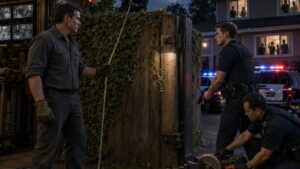
The first white rail section hit the bed of the truck with a flat wooden crack, and Patrick Lewis stopped halfway between the farmhouse and the barn with his coffee still in his hand.
For a second, he did not understand what he was seeing.
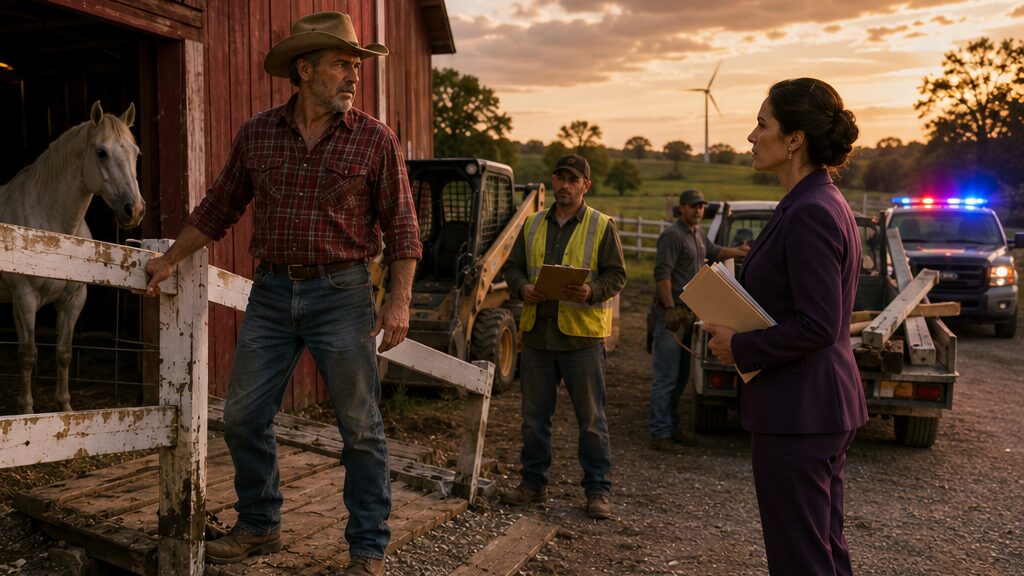
The skid-steer sat idling beside the red barn, its bucket lowered near the gravel edge of the new access ramp. One worker had a pry bar under the second rail post. Another stood with gloved hands on his hips, watching the first section slide across the truck bed. The white horse in the paddock lifted her head, ears stiff, unsettled by the engine.
Patrick set the coffee cup on the fence post without looking away.
“Hold up,” he called.
The worker with the pry bar glanced toward the crew supervisor, not Patrick. That told Patrick enough to make his stomach tighten.
The supervisor was near the barn door, clipboard tucked beneath one arm. He wore a yellow vest over a gray shirt and had the tired, guarded face of a man paid to finish a job before someone asked why it had started.
Patrick walked down the gravel lane, boots crunching over the stones he had spread himself two Saturdays earlier. The new ramp was not pretty, but it was solid: treated timber edges, packed gravel, white rail on the outer side, a safer grade where the old washed-out slope had become a narrow chute of mud after the last storm.
“Who gave you permission to remove that?” Patrick asked.
The supervisor looked past him toward the road. “Association work order.”
“This is my property.”
“We were told the structure’s non-compliant.”
Patrick stopped at the bottom of the ramp. The second post groaned when the worker leaned on the pry bar. Patrick stepped onto the gravel and planted himself between the man and the remaining rail.
The worker froze. “Sir, I need you to move.”
“No,” Patrick said. “You need to stop.”
The skid-steer engine rattled. A chicken shot out from behind the barn and vanished under the fence. Beyond the paddock, the wind turbine turned slowly in the late sun, clean and indifferent above the fields.
The supervisor shifted the clipboard. “We’re not here to argue.”
“Then you should’ve come before you started tearing out boards.”
A purple SUV was parked near the lane entrance, angled like it had arrived in a hurry and stopped wherever it pleased. Its driver’s door opened before Patrick could ask another question.
Susan Rivera stepped out in a tailored purple suit and closed the door with one hand while holding a folder in the other. Her shoes were wrong for the farm, narrow heels sinking slightly into the gravel, but she walked as if the lane belonged to her. Patrick had seen her twice before at association meetings, always seated at the center of the table, always speaking in clean sentences about standards and liability.
“Mr. Lewis,” she said. “Please step away from the work area.”
Patrick looked from her to the half-removed rail. “Work area?”
“The board has authorized enforcement action.”
“You authorized a crew to come onto my land and dismantle a safety repair.”
Susan opened the folder and removed a printed notice with the Green Hollow Ridge HOA header at the top. “You were notified that the exterior modification was installed without approval and does not meet community standards.”
Patrick did not take the paper. “When was I notified?”
“A notice was left.”
“When?”
Susan’s mouth tightened. “This morning.”
Patrick looked at the rail section already in the truck. “This morning, when the crew was already here?”
The supervisor looked down at his clipboard.
Susan held the notice higher. “The association followed its enforcement procedure.”
Patrick pulled his phone from his shirt pocket and started recording. He did not point it in anyone’s face. He held it low, steady, catching the truck, the removed rail, the skid-steer, Susan with the paper in her hand.
“For the record,” he said, “what time did your crew start removing my ramp?”
Susan’s expression sharpened. “You do not have permission to record me.”
“We’re standing outside on my property while your crew removes my property.”
“It is not an approved structure.”
“It replaced the washed-out barn access after the June storm.”
“You were required to wait for written approval.”
“I sent the emergency repair notice three weeks ago.”
Susan glanced at the supervisor, then back at Patrick. “The board did not approve this design.”
“The board didn’t answer.”
“That does not give you the right to build whatever you want.”
Patrick felt the heat in his chest, the old instinct to say too much and too loudly. He pressed his thumb against the side of the phone until the edge bit into his skin. The horse shifted behind him, hooves scuffing at the ground near the gate.
“This ramp keeps the barn reachable,” he said. “It keeps the gate safe. It keeps people from slipping on a washed-out slope.”
Susan’s gaze flicked toward the barn, then returned to the notice. “This property is still subject to association standards.”
“This barn was here before your association had a letterhead.”
“And yet you agreed to the covenants when the property was incorporated.”
Patrick gave a short, humorless breath. “I agreed not to paint the barn neon orange. I didn’t agree to let you rip out a safety rail because the board took too long to open an email.”
The worker nearest the rail shifted his weight. The pry bar remained where it was, wedged under the post, waiting.
“Remove the rest,” Susan said to the supervisor.
Patrick did not move.
The supervisor swallowed. “Ma’am.”
“Proceed.”
Patrick lifted his phone a little higher. “I want your name, your supervisor’s name, and the written order that says you can physically remove a safety repair from my property today.”
“You have the notice,” Susan said.
“That notice is not a court order.”
“It is an HOA enforcement order.”
“That’s not the same thing.”
For the first time, Susan looked irritated rather than merely official. “Mr. Lewis, you are obstructing authorized remediation. If you refuse to clear the work area, I will contact law enforcement.”
Patrick looked at the open gap where the first rail had been. Without it, the edge dropped into the shallow drainage cut beside the ramp. In the right light, it looked like nothing. In the wrong step, it was enough to put someone on the ground.
“You should’ve contacted me before you sent men with tools,” he said.
Susan’s face did not change. She took out her phone.
The supervisor lowered his voice. “Sir, I don’t want anybody hurt.”
“Then don’t remove the thing built to keep that from happening.”
The worker with the pry bar took his hands off the tool.
Susan turned away, one finger pressed to her ear. Patrick heard only fragments: property owner, refusal, association order, unsafe obstruction. She did not mention the unanswered emergency notice. She did not mention the rail already loaded into the truck. She did not mention that the crew had arrived before the paper touched Patrick’s hand.
Patrick kept recording until his arm began to ache.
The skid-steer idled on. The horse tossed her head once, nervous at the sound. Patrick thought of Nancy inside the house, resting after her afternoon exercises, believing the barn path was still whole.
Susan ended the call and faced him.
“A deputy is on the way,” she said. “I suggest you think carefully before turning a civil enforcement matter into something more serious.”
Patrick slipped the phone into his shirt pocket but kept the camera lens above the fabric.
“You already did that,” he said.
Minutes later, the first patrol car turned into the farm lane, lights flashing red and blue against the side of the old barn.
Chapter 2: The Notice Looked Official Until Someone Read It
“He’s interfering with an authorized removal,” Susan said before the deputy had both boots on the gravel.
Patrick stood at the bottom of the ramp with one hand resting on the remaining rail, not gripping it, just touching it as if to remind himself it was still there. The patrol car lights washed over the barn siding, turning the faded red boards purple, then blue, then red again. A second patrol car stopped farther back near the lane, blocking the crew truck from leaving.
The deputy took in the scene without speaking: skid-steer idling, rail section in the truck, worker holding a pry bar, Susan with her folder, Patrick standing still.
“Engine off,” the deputy said.
The crew supervisor raised one hand toward the skid-steer operator. The engine died, and the sudden quiet made the horse’s restless breathing audible from the paddock.
Susan stepped forward. “Deputy, I’m Susan Rivera, president of the Green Hollow Ridge Homeowners Association. We have an enforcement order for removal of an unapproved structure. Mr. Lewis has refused to leave the work area.”
The deputy looked at Patrick. “Sir?”
“Patrick Lewis,” he said. “This is my barn access ramp. They started removing it before giving me that notice.”
Susan held the notice out. “It was served today.”
Patrick looked at the deputy. “Ask her what time.”
The deputy took the paper first. It looked official enough from a distance: bold header, section numbers, a compliance deadline, language about exterior uniformity and unauthorized modifications. Patrick could see why Susan liked holding it. It had the kind of weight people gave paper when they did not want to look at what the paper was doing.
The deputy read silently. His eyes paused at the enforcement paragraph.
“Ms. Rivera,” he said, “do you have a court order?”
“This is an association enforcement order.”
“That isn’t what I asked.”
Susan’s shoulders rose a fraction. “Our covenants allow remediation of unapproved exterior structures after proper notice.”
“Do you have a court order authorizing entry and removal today?”
Susan’s grip tightened on the folder. “This is private property within an HOA.”
Patrick said, “It’s also still my property.”
The deputy glanced toward the truck. “Who removed that rail?”
The crew supervisor cleared his throat. “My guys, before Mr. Lewis came down.”
“At what time?”
“Little before four, maybe.”
Patrick looked at Susan. “And the notice?”
Susan said, “It was placed at the residence today.”
“After four,” Patrick said. “I was in the barn until three-thirty. Nothing was on the door.”
The deputy lifted a hand, not sharply, but enough to stop them. “One at a time.”
Patrick walked to the farmhouse porch, aware of the deputy watching him and Susan watching as if he might run into the house and return with a shotgun instead of a folder. He came back with a manila packet that had been sitting by the door for weeks. Its corners were soft from being opened too often.
He handed the first page to the deputy. “Emergency repair notice. Sent three weeks ago. Storm washed out the slope to the barn. I sent photos and told the association I needed to repair access before someone fell.”
Susan said, “Submission does not equal approval.”
Patrick kept his voice level. “No answer doesn’t equal permission to send a crew.”
The deputy looked at the printed email. “Date and time are here.”
Patrick passed him the photos next. One showed the old slope collapsed into brown ruts after rain, the gravel gone, the ground cut away near the fence line. Another showed the horse gate half-blocked by mud. A third showed the new ramp before the rail was painted white.
The deputy’s face changed slightly when he looked from the photos to the ramp. Not sympathy exactly. More like recalculation.
“This was repair work?” he asked.
“Replacement access,” Patrick said. “Same barn. Same path. Safer grade.”
Susan stepped closer. “The issue is not whether Mr. Lewis prefers the new path. The issue is that he installed a visible exterior modification without written approval.”
“It’s a ramp to a barn,” Patrick said.
“It is a raised structure visible from the community lane.”
Patrick looked toward the lane. The only view from the road was a sliver of white rail beyond pasture fence and wind-bent grass. “There are three houses on this road, Susan.”
“And all three are subject to the same standards.”
The deputy handed the notice back to Susan. “This is a civil dispute. I’m not removing him from his own ramp based on this.”
Susan blinked as if the sentence had arrived in the wrong language. “Deputy, he is obstructing the association’s authorized contractor.”
“He’s standing on his property. I don’t see a court order, and I’m not here to enforce HOA design standards.”
The crew supervisor exhaled through his nose, almost too quietly to hear.
Patrick should have felt relief. Some part of him did, but it was thin and temporary. The first rail was still in the truck. The second post leaned loose in its hole. The outer edge of the ramp was exposed. If Nancy tried to cross it without thinking, if she reached for the rail that was no longer there—
His hand went cold.
Susan slid the notice back into her folder. “The board can still assess daily fines. We can still require full removal. Nothing about this response prevents us from moving forward through association remedies.”
“I understand,” the deputy said. “But not with my badge as your removal tool.”
Patrick looked at him then, really looked. The deputy was not on his side. That mattered. He was only refusing to be used. Patrick knew better than to mistake that for victory.
“Can I put the rail back?” Patrick asked the crew supervisor.
The supervisor looked at Susan first.
Susan said, “Any reconstruction will be considered continued noncompliance.”
Patrick almost laughed, but there was no humor in him. “You had them remove it halfway, and now you’re warning me not to make it safe?”
“I am warning you not to continue unauthorized work.”
The deputy said, “Ms. Rivera, if your crew leaves that area unsafe after starting removal, that’s something you may want to think about.”
Her mouth tightened again. It was the only visible sign that the day was not going as she had expected.
The supervisor ordered his workers to unload the rail section and place it beside the ramp, not reinstall it. Susan objected, but not loudly enough to make the deputy respond. The workers set the white rail on the grass like a bone taken out of something still living.
Patrick walked to the gate and checked the latch. The horse, pale and watchful, pushed her nose toward his shoulder. He rubbed the flat of his hand down her face.
Behind him, the deputy took brief statements. Susan spoke in polished fragments: unapproved structure, liability concerns, board authorization, enforcement consistency. Patrick gave his answers plainly. Storm date. Email date. No response. Crew arrived first. Notice second.
When the patrol lights finally shut off, the barn seemed duller, as if the color had been drained from it.
The deputy gave Patrick a card. “You’ll want to document everything from here.”
“I have been.”
“Document more.”
Patrick nodded.
Susan paused at her SUV before leaving. “There will be an emergency board review. I suggest you come prepared to explain why you believed the rules did not apply to you.”
Patrick picked up the loose rail section with both hands. It was heavier than it looked.
“I never said they didn’t apply,” he said. “I said you didn’t answer.”
Susan got into the SUV and drove away with a spray of gravel.
The crew followed, leaving the ramp scarred and half-open. Patrick stood beside it until the dust settled. Then his phone rang.
Nancy’s name glowed on the screen.
He answered before the second ring.
“Patrick,” she said, her voice tight from the house. “Why is the horse gate open?”
Chapter 3: The Barn Path Was Not Just for Hay
Nancy reached for the porch rail and stopped when she saw the empty space where the ramp rail should have been.
Patrick was two steps below her, one hand lifted but not touching her elbow. He had learned not to grab unless she asked. After the stroke, everyone had grabbed. Nurses, therapists, neighbors with good intentions, him most of all in those first panicked weeks. Nancy had finally told him, very quietly, that being loved like she might break was still being treated like she was broken.
Now her right hand hovered in the air above nothing.
“They took the outer rail?” she asked.
“Started to.” Patrick kept his voice even. “I stopped them before they got the rest.”
Her eyes moved from the porch to the barn path. The white rail section lay in the grass beside the ramp, where the crew had left it. The second post leaned crookedly, its base loosened. The horse stood at the paddock fence, waiting for the evening routine that had not come.
Nancy’s jaw set. “You told them?”
“I told them it was a safety repair.”
“That’s not what I asked.”
Patrick looked toward the barn because it was easier than looking at her.
Nancy held the porch rail, testing her balance before stepping down. Her left side still tired before the rest of her. Most days she moved well enough that strangers would not notice if they did not look too long. Bad days, she counted distances in rails, chairs, fence posts, doorframes, anything steady enough to trust.
“You didn’t give them the letter,” she said.
“No.”
She waited.
“You asked me not to.”
“I asked you not to make my medical records the neighborhood newsletter.”
“I know.”
“Do you?”
Patrick turned back. “Nancy.”
“No.” She stepped down one stair, slow and precise. “Do not say my name like that.”
He closed his mouth.
The house behind her was warm with lamplight. For a moment she looked exactly as she had before all of it: hair pinned back, chin lifted, eyes sharp enough to stop him from lying even by omission. Then she shifted her weight and reached for the rail again, and the present returned.
Patrick moved one step lower. “Let me put the rail back tonight.”
“And get fined faster?”
“I can brace it temporarily.”
“Can you brace the part where they think we’re hiding something?”
He had no answer that did not sound like an excuse.
They made it down the porch and across the packed yard slowly. Nancy refused his arm until the gravel changed texture near the barn path; then she touched his sleeve with two fingers. Not leaning. Not accepting help, exactly. Letting him know where he was allowed to be.
At the ramp, she stopped again.
The missing rail made the whole thing look different. Yesterday it had looked rough but dependable, a farm repair done by a man who knew how water moved across land and how feet slipped when mud dried with a crust. Now it looked unfinished, almost careless. Susan would have liked that. The damage made her accusation look more true.
Nancy stared at the open edge. “I told you white was too noticeable.”
Patrick almost smiled. “You told me white would keep me from backing the feed cart into it.”
“That too.”
The horse gave a low sound from the paddock. Nancy’s face changed before the rest of her body did. Softened, but only in the private way she allowed around animals. She moved toward the gate, one careful step at a time, using the inner rail.
Patrick stayed close.
The horse lowered her head over the fence. Nancy lifted her left hand first, the slower one, and pressed her palm against the horse’s white blaze. She closed her fingers with effort. The horse stood still.
There it was—the part Susan had not seen, the part Patrick had failed to make visible. The ramp was not about hay deliveries or barn convenience or whether the lane looked uniform from the road. It was the path Nancy walked every evening because the therapist had said uneven ground helped if it was safe enough, because the horse made her willing to go farther than the driveway, because touching something living that did not pity her brought back a piece of herself no exercise sheet could reach.
Patrick looked away before she caught his face doing too much.
Inside later, the manila folder lay open on the kitchen table. Emergency repair email. Storm photos. Receipts for lumber and gravel. A copy of the HOA standards. The doctor’s letter stayed in a separate envelope, cream-colored, sealed again after Nancy had opened it weeks ago and said, “Not unless we have to.”
Patrick reached toward it.
Nancy put her hand over the envelope.
“No.”
“They’re holding a hearing.”
“They can hear about drainage and slopes and old barn access.”
“They already heard that today.”
“Then say it better.”
He pulled his hand back. “Ronald Davis will be there. He’ll ask why it’s necessary. Susan will ask why I didn’t wait.”
“Then tell them the storm washed out the path.”
“That’s not the whole truth.”
Her eyes lifted. “It is enough truth.”
The refrigerator hummed. Outside, the wind turbine’s faint mechanical pulse moved through the dark, a soft turning sound Patrick usually stopped hearing. Tonight he heard every rotation.
“They will use the missing piece against us,” he said.
Nancy’s mouth tightened. “You mean against you.”
“No. Against the ramp.”
“Patrick.”
He knew that tone too. It was the warning before she cut through whatever careful structure he had built around the thing he did not want to admit.
She tapped the envelope once with her fingertips. “I know what that letter says. I know why the doctor wrote it. I also know what happens when people decide your need is the only interesting thing about you.”
“I’m trying to keep you safe.”
“I know.” Her voice softened, which somehow made it worse. “But sometimes you keep me safe by making the room smaller.”
He sat back.
She looked toward the dark window, where the kitchen reflected them both: her seated with one hand on the envelope, him across from her with sawdust still in the lines of his palms.
“I want the ramp,” she said. “I want the barn. I want to walk to my own horse without three people discussing my left foot. Can you fight for that without handing them all of me?”
Patrick looked at the folder. He had built the ramp because work made sense when fear did not. Measure the grade. Set the timber. Pack the gravel. Paint the rail. Make something solid enough to hold. Paper was different. Paper wanted explanations. Paper wanted categories. Paper wanted him to turn his wife into a reason.
“I’ll keep the letter out,” he said.
Nancy watched him, searching for the promise beneath the words.
“For now,” he added.
Her hand remained on the envelope. “For now.”
The email came at 9:17 p.m., while Patrick was tightening a temporary brace onto the loosened rail post by flashlight.
His phone buzzed against the ramp boards.
Green Hollow Ridge HOA: Emergency Compliance Hearing Scheduled.
He opened it with cold fingers.
The meeting was set for the next night. Attendance strongly recommended. Failure to appear may result in continued enforcement, daily fines, and further remedial action.
Patrick looked from the glowing screen to the rail he had braced in the dark.
Behind him, from the kitchen window, Nancy was watching.
Chapter 4: The Board Called It an Exterior Standard
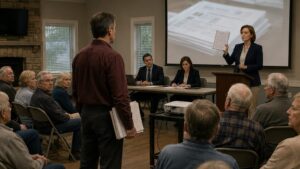
Susan Rivera opened the hearing with a photograph of Patrick standing in front of the half-dismantled ramp, one hand lifted toward the crew, his phone visible in his shirt pocket.
The image filled the pull-down screen at the front of the Green Hollow Ridge meeting room. It made him look larger than he felt, a man blocking workers while a white rail lay in the grass behind him. No sound came with the image. No skid-steer engine. No horse shifting at the open gate. No late-afternoon dust. Just Patrick in a red plaid shirt, framed as the problem.
“This,” Susan said, “is why we are here.”
Patrick sat in the second row with the manila folder across his knees. The room smelled faintly of floor cleaner and coffee that had been sitting too long. Three board members sat behind folding tables pushed into a line. Ronald Davis sat at Susan’s left, his hands folded over a calculator and a binder tabbed with colored flags.
Nancy had stayed home.
Patrick had not asked twice. She had stood at the kitchen sink before he left, one hand around the counter edge, and said, “Do not let them make me the subject unless there is no other way.” He had nodded because he knew how to obey a promise. He was less certain he knew when to break one.
Susan clicked to the next photograph. The ramp before removal. White rail. Timber edging. Gravel surface. The red barn behind it.
“Unapproved exterior structure,” she said. “Visible from the community lane. Constructed without board approval. Materials not submitted. Dimensions not submitted. No variance granted.”
Patrick raised his hand.
Susan did not look at him. “You’ll have an opportunity to respond.”
“I sent an emergency repair notice.”
“We’ll get to that.”
“You started removal before you got to it.”
Ronald’s eyes moved from Susan to Patrick. Susan’s stayed on the room.
“Mr. Lewis,” she said, “this is a formal compliance review. Please allow the board to establish the record.”
The record, Patrick thought. Not the ramp. Not the washed-out slope. Not Nancy’s hand hanging over empty air. The record.
Susan clicked again. The violation notice appeared on the screen. Section numbers. Exterior consistency. Liability. Remediation. He could almost admire the way the words lined up like fence posts, straight and clean, hiding the gap between them.
Ronald leaned toward his microphone, though the room was small enough not to need one. “Mr. Lewis, the issue before us is not whether the prior slope was damaged. It is whether the replacement was built in compliance.”
“It was built because the prior slope failed,” Patrick said.
Ronald’s face did not harden. That was worse. He seemed tired, not cruel. “I understand that. But the association carries liability exposure for unapproved structures. Our insurer has already questioned several exterior modifications this year.”
“Several?” Patrick asked. “Or mine?”
Ronald looked down at his binder. “Yours is the one requiring immediate action.”
Susan clicked to a photograph of the removed rail in the truck. Patrick realized the angle had been taken from near Susan’s SUV. She had photographed the rail after the crew started, before he came down, as if the removal itself proved the violation had existed.
He stood.
The board members shifted. Susan’s eyes narrowed.
Patrick opened the manila folder and took out three pages. “Emergency repair notice sent June 18. Attached storm photos. Attached material receipts. Attached description: repair washed-out barn access, same location, safer grade, rail added because the old slope failed.”
He walked to the board table and placed copies in front of Susan, Ronald, and the other members.
Susan did not touch hers.
Patrick returned to his seat but did not sit. “No one answered.”
Susan said, “The management inbox receives many submissions.”
“It received mine.”
“An unanswered request is not an approval.”
“I didn’t say it was. I said you knew before you sent a crew.”
Ronald lifted the page. He read the date, then the attached description. For the first time that night, the room went quiet without Susan controlling it.
One of the unnamed board members whispered something to another. Susan’s hand moved to the mouse, but she did not click.
Ronald looked at Patrick. “Was there any medical necessity attached to this request?”
Patrick felt the question strike harder than it should have.
He saw Nancy’s hand on the envelope. Not unless we have to.
“It was a safety repair,” he said.
“That isn’t what I asked.”
Patrick held Ronald’s gaze. “No medical document was attached.”
Susan finally touched her copy of the emergency notice, sliding it half an inch as if it had been left in the wrong place. “Then what the board had before it was an unapproved exterior modification after construction.”
“You didn’t have anything before you,” Patrick said. “Because nobody reviewed it.”
Susan’s cheeks colored, but her voice stayed smooth. “Mr. Lewis, your frustration does not change the covenant process.”
“My wife could have fallen because your process paused at an inbox.”
The room changed. Not much. Enough.
Ronald looked up sharply. Susan’s eyes fixed on him. Patrick knew immediately he had said too much and not enough. He had opened a door without showing what was behind it.
“Is your wife part of this application?” Susan asked.
“No.”
“Then we should be careful not to introduce unrelated personal circumstances.”
Patrick stared at her. “Unrelated?”
Ronald intervened. “Let’s stay with the structure. Mr. Lewis, if the board were to allow a replacement, it would need to meet standards.”
Susan clicked again. A diagram appeared. Narrower ramp. Lower rail. Dark stain instead of white paint. No outer gravel flare at the gate. It looked tidy, minimal, almost invisible.
Patrick recognized the danger before anyone explained it.
“That turn is too tight,” he said.
Ronald said, “It reduces visual impact from the lane.”
“It reduces the ability to turn a feed cart.”
Susan said, “Then use the rear access.”
“The rear access is mud half the year.”
“The association cannot approve every owner’s preferred route based on convenience.”
Patrick put both hands on the back of the chair in front of him. The metal frame creaked under his grip.
“It is not convenience.”
“Then submit the required documentation.”
He nearly said it. Nancy’s stroke. The walker. The evening route. The horse waiting because it had become the only exercise she did not resent. He nearly put all of it under the fluorescent lights and let the room have it.
Instead he said, “I submitted enough for an emergency repair.”
Susan folded her hands. “The board has heard your position.”
The vote took less than five minutes. The violation stood. Daily fines would be suspended for forty-eight hours if Patrick agreed to remove the remaining noncompliant portions and submit a revised application using the board’s approved dimensions. If he refused, fines would begin and further enforcement would be considered.
Patrick heard the decision as if from the far side of the room.
He gathered his folder slowly. The emergency notice copies remained on the board table, finally in the record, finally too late to stop the first rail from being pulled out.
As people stood, Ronald came around the end of the table. He did not offer a handshake.
“Mr. Lewis,” he said quietly, “check the old lot map before you come back.”
Patrick looked at him.
Ronald’s expression was guarded, almost regretful. “Not the association map. The old farm map.”
Before Patrick could ask why, Susan called Ronald’s name from the front of the room, and he turned away.
Chapter 5: The Old Farm Line Ran Under Their Rules
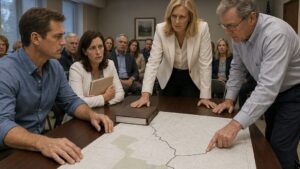
The county records clerk slid the old map across the counter and tapped a yellowed line that ran straight through the place where the HOA’s newer map showed nothing but common setback.
“Your barn lane isn’t where their overlay says it is,” the clerk said.
Patrick leaned over the counter, one hand braced on the folder, the other holding his reading glasses low on his nose. The map smelled faintly of dust and dry paper. The property lines were hand-drawn, ink faded brown at the folds, but the lane was clear: a narrow access corridor running from the farm road past the red barn, across the old service strip, and out toward the turbine field.
“That line predates the association?” Patrick asked.
“By a good bit.” The clerk opened another book, this one with typed entries and old stamps. “Agricultural access easement. Recorded before subdivision incorporation. Looks like it was preserved when the ridge parcels were created.”
Patrick did not let himself smile. Not yet.
“Does that mean they can’t touch the ramp?”
The clerk gave him the careful look of someone who had learned not to turn paper into promises. “It means the access corridor exists in the county record. What they can regulate on top of it, that’s a different question.”
“Different how?”
“Use, dimensions, structures, safety rails, materials. Depends on covenants, state law, disability accommodation if that applies, and what exactly was built.” She softened her voice slightly. “I can print certified copies. I can’t tell you what wins.”
Patrick nodded. “Print them.”
While the machine hummed behind the counter, he spread the HOA map beside the county map. On the association version, his barn ramp sat inside a shaded zone labeled exterior frontage. On the county version, that same strip was part of the farm’s original access. The difference was not dramatic unless you knew where to look. Then it was everything.
Ronald had known enough to send him here.
That bothered Patrick almost as much as it helped.
He left the records office with certified copies tucked flat inside his folder and drove back along the ridge road without turning on the radio. The day was clear, the fields washed pale under morning sun. As he neared home, the wind turbine rose beyond the barn, blades turning above the pasture.
The clerk’s words came back to him: agricultural access easement.
Patrick parked by the barn instead of the house. The half-braced rail stood crooked where he had secured it in the dark. The removed section still lay in the grass, paint scuffed from the truck bed. The horse watched from the paddock, expecting him to open the gate.
He walked the lane with the old map in hand.
The easement line followed the same route his father had used for hay trucks before Green Hollow Ridge had been anything but open land and survey stakes. It ran past the barn, widened near the gate, then continued toward the turbine service road. Patrick had signed plenty of HOA papers when the ridge parcels were incorporated, but he had never believed anyone could erase a farm lane with a committee vote.
At the far end of the barn, he found the small metal utility marker half-hidden in weeds. Wind service access. He had seen it a thousand times and not looked at it once with the right fear.
He took a photograph.
Then another of the map held beside the marker.
Then another looking back toward the ramp, the red barn, the white horse, and the rail lying on the ground like an unfinished sentence.
His phone buzzed.
Susan Rivera.
He let it ring until voicemail caught it. A minute later, an email appeared instead.
Notice of Continuing Violation and Fine Schedule.
Patrick opened it standing by the marker.
The wording was colder than the first notice. The board had reviewed his objection and found the structure remained noncompliant. Fines would begin at midnight unless all remaining unapproved ramp components were removed. Any reconstruction outside the approved alternate design would be treated as a continuing violation.
At the bottom, in Susan’s precise language, one sentence stood out:
The association recognizes no emergency exception for owner-installed exterior structures absent full supporting documentation.
Patrick read it twice.
Full supporting documentation.
The old map answered one question and opened the one he had been avoiding. The easement might protect the path, but not the rail. Not the width. Not the grade. Not the reason Nancy needed a turn broad enough to move without fear.
He took the certified copies to the kitchen.
Nancy was at the table with a cup of tea gone cold, the cream envelope beside it. She looked at the county map without touching it.
“That’s good,” she said.
“It may not be enough.”
“No.”
He sat across from her. “They sent another notice. Fines start at midnight.”
Her fingers tightened around the mug.
“I found the old easement,” he said. “The farm access predates the HOA. Ronald tipped me off.”
“Ronald Davis?”
“Yes.”
“Why?”
“I don’t know.”
Nancy looked toward the window, where the barn roof showed above the lower pasture. “Maybe somebody on that board still knows the difference between a rule and a mistake.”
Patrick wished he believed that.
He placed the second notice beside the map. Nancy read it slowly. Her face did not change until she reached the line about full supporting documentation.
Then she looked at the cream envelope.
Patrick did not reach for it this time.
The silence held long enough for the refrigerator motor to start, for the house to settle, for a horse to knock once against the paddock rail outside.
“I can argue the easement,” he said. “I can argue repair. I can argue notice timing.”
“And they can argue rail height.”
“Yes.”
“And materials.”
“Yes.”
“And why you needed that design.”
Patrick looked down at his hands. “Yes.”
Nancy pushed the envelope an inch toward him, then stopped with her fingertips still on it.
“This is not permission,” she said.
“I know.”
“It is me thinking.”
“I know.”
But when he opened the second email again, midnight looked closer than it had before.
Chapter 6: The Compromise Would Have Left Her Outside
Patrick measured the HOA-approved ramp width with a tape in one hand and Nancy’s folded walker in the other, and before the tape locked at the far edge, he already knew she could not make the turn.
Thirty-six inches at the narrowest point. A lowered rail to reduce visibility from the lane. No gravel flare near the gate. No widened landing where the ground dipped before the barn door.
It looked acceptable on Susan’s diagram because no one had drawn a person trying not to fall.
Patrick unfolded the walker and set it where the approved ramp would meet the gate. One front foot caught at the edge of the drainage cut. He adjusted it, tried again, angled the frame the way Nancy did when her left side dragged after too much effort. The rear leg slipped off the painted line he had marked with blue tape.
He stood there looking at the tape.
From the house, Nancy called, “It doesn’t work, does it?”
Patrick turned. She stood on the porch in a gray sweater, one hand wrapped around the rail. She had come outside without telling him. He hated that his first feeling was fear instead of pride.
“No,” he said.
She looked toward the barn, then the marked lines. “Show me.”
“Nancy—”
“Show me.”
He carried the walker back to the start and moved it through the turn slowly. The first angle worked if he cheated the line. The second did not. To fit the approved design, Nancy would have to lift and pivot the walker near the open edge, then step sideways where the gravel narrowed.
She watched without speaking.
Patrick folded the walker again. “It leaves you outside.”
There. He had said it.
Not out of the barn. Outside.
Outside the routine. Outside the place where she could be alone without being unwatched. Outside the small, stubborn recovery she had built one evening at a time.
Nancy came down the porch steps. He stayed still until she reached the ground, letting her choose the distance. She stopped beside the blue tape and nudged it with the toe of her shoe.
“Very neat,” she said.
“That’s one word.”
“It would photograph well.”
Patrick looked at her. The dry edge in her voice was still there, and he was grateful for it. It meant she was angry, not defeated.
Inside, he called a homeowner rights number the county clerk had written on the back of a receipt. The woman on the line did not ask for a speech. She asked for dates. Notice time. Removal time. Medical need, if any. Whether the association knew. Whether the request included documentation. Whether the structure was the least intrusive safe option.
Patrick answered until he reached the letter.
“There is medical documentation,” he said.
“Was it submitted?”
“No.”
“Why not?”
He looked across the kitchen. Nancy sat at the table, the cream envelope in front of her, both hands folded on top of it.
“Privacy,” Patrick said.
The woman on the line paused. “That matters. But if you are asking them to accommodate a need they can’t see, you’ll likely have to disclose enough to establish the need. Not everything. Enough.”
Enough. The word sat between him and Nancy after the call ended.
Nancy opened the envelope herself.
Patrick had read the letter once before, standing in the hallway outside the clinic while Nancy pretended to be busy with her purse. It was short, direct, and mercifully limited. It did not tell the story of the stroke. It did not describe the first weeks, the frustration, the way she had cried once because she could button a shirt but not carry a coffee cup across the room without spilling it. It stated that Nancy Lewis required stable, railed, low-grade access between the residence and barn area as part of safe daily mobility and recovery activity. It recommended sufficient turning clearance for mobility equipment and avoidance of narrow edges near drainage cuts.
Nancy read it again now as if checking whether the paper had betrayed her in the night.
“I hated when he wrote ‘mobility equipment,’” she said.
Patrick sat across from her.
“I know it’s accurate,” she said. “That’s why I hated it.”
He said nothing.
She looked up. “I asked you to keep it private.”
“You did.”
“And you were relieved.”
The words landed quietly.
Patrick started to deny it, then stopped. The truth had been sitting under the table with them all along. He had told himself he was honoring her wishes. He was. But he had also been grateful not to explain, not to ask a board for permission with his wife’s body turned into supporting material, not to say aloud that the ramp was built because the woman who used to carry feed bags on one shoulder now measured courage in railings.
“Yes,” he said.
Nancy’s eyes shone, but her voice held. “That’s what made me angry. Not that you protected me. That you hid with me.”
Patrick looked down.
“I thought land records would be enough,” he said.
“You hoped they would be.”
“Yes.”
She slid the letter across the table, but kept one finger on the top edge. “They do not get all of me.”
“No.”
“They get need, access, safety. They do not get details that don’t belong to them.”
“I’ll redact anything outside that.”
“You’ll say I approved it.”
“Yes.”
“You’ll say the first packet was incomplete because we were trying to protect privacy, not because the ramp wasn’t necessary.”
Patrick looked at her hand on the letter. “I will.”
“And you won’t make me sound helpless.”
That was the one that made his throat tighten.
He leaned back and took a breath through his nose. “No.”
The rest of the day became paper and measured proof. Patrick photographed the blue tape with the walker beside it. He photographed the drainage cut, the missing rail, the old easement map beside the modern HOA diagram. He printed the deputy’s card information and the first emergency email. He wrote a timeline in plain sentences because anything polished would sound like Susan and anything angry would be easier to dismiss.
At dusk, he carried his phone to the barn ramp.
The white horse stood beyond the gate, waiting. The missing rail left a blank edge in the frame. Patrick pressed record and held the camera on the gap before turning it toward himself.
“My name is Patrick Lewis,” he said. “Tomorrow I’m bringing the board what they should have asked for before they sent a crew. This ramp is not decorative. It is not an expansion. It is safe access on an old farm lane, and the person who needs it has a right to privacy and a right to get through her own property.”
He stopped before his voice could change.
Behind him, the horse lowered her head over the fence, nose hovering near the place where the rail should have been. Patrick saved the recording, then sent Susan Rivera one email with four attachments and one sentence.
I will attend tomorrow’s hearing and challenge the removal order, the notice timing, the map, and the unsafe replacement design.
Chapter 7: The Second Hearing Started With the Broken Rail
Patrick set the removed rail post on the board table, and the room went quiet before he said a word.
It was heavier than it looked. He had carried it in under one arm, white paint scuffed from the truck bed, one end scarred where the pry bar had chewed into the wood. A little dirt still clung to the base. It did not belong under fluorescent lights beside water bottles, binders, and Susan Rivera’s tablet. That was why he had brought it.
Susan stared at it as if he had dropped an animal carcass in front of her.
“Mr. Lewis,” she said, “this is unnecessary.”
Patrick stood with his folder in his left hand. “Which rule made this safer on the ground?”
No one answered immediately.
Ronald Davis sat to Susan’s left again, but his binder was closed this time. In front of him lay the copies Patrick had emailed: the county easement map, the storm photos, the first emergency notice, the deputy’s card, the doctor’s limited letter with only the relevant lines unredacted. Nancy had stayed home, but her permission was in the folder, one sentence signed in her steady, careful handwriting.
Need, access, safety. Nothing more.
Susan folded her hands. “This hearing is to review your continued noncompliance and your challenge to the board’s proposed replacement standard.”
“It is also to review why a crew began removing a safety repair before final notice was delivered.”
“That claim is disputed.”
Patrick opened his folder and took out the sheriff’s incident report.
“Not anymore.”
The room shifted. The two unnamed board members leaned forward. Ronald reached for his glasses.
Patrick placed copies on the table, one at a time. He did not rush. Rushing looked like pleading. He had spent too much of the last week sounding like a man asking permission to keep his own doorway usable.
“The deputy recorded the crew’s statement,” Patrick said. “Removal began before four. Your notice was placed at the house after that. The crew supervisor confirmed they were already working when I came down.”
Susan took the report but did not look at it right away. “The association had already authorized enforcement.”
“Authorized by whom?”
“The board.”
“When?”
Susan looked down now. “Following the initial compliance review.”
“The emergency request was in your inbox before that review.”
“The request was incomplete.”
Patrick nodded once. “Yes.”
That made Susan glance up.
“It was incomplete,” he said. “Not because the repair was optional. Because I left out private medical documentation while trying to protect my wife’s dignity. That was my mistake.”
The last sentence cost him more than he expected. Not because the board deserved it, but because Nancy deserved to hear it first. He had told her that morning. She had not softened. She had only nodded and said, “Then say it that clearly.”
Patrick lifted the redacted doctor’s letter.
“This is all you need to know. Stable railed access between the house and barn area. Safe grade. Turning clearance for mobility equipment. Avoidance of narrow edges near drainage cuts. The proposed replacement you approved does not meet that.”
Susan’s lips pressed together. “Mr. Lewis, no one on this board is dismissing medical need. But the association cannot be expected to evaluate needs it was not given.”
“No,” Patrick said. “But it can be expected not to send a removal crew before it reviews the request it did receive.”
Ronald’s eyes stayed on the incident report. “Susan, did management confirm the emergency repair email was received before the first enforcement vote?”
Susan did not answer quickly enough.
One of the other board members said, “I don’t remember seeing it.”
“It was in the management packet,” Susan said.
Ronald looked at her. “Was it discussed?”
“The structure was discussed.”
“That is not the same thing.”
Patrick said nothing. For once, someone else had said the sentence he needed.
Susan turned to Ronald, her composure thinning at the edges. “We were facing an insurance review. You know that better than anyone. We had three owners asking why exterior changes were being ignored. You specifically said we could not let the rural lots become exceptions.”
Ronald’s face tightened. “I said we needed consistency. I did not say to start removal before notice.”
“You pushed for immediate action.”
“I pushed for review.”
The room was no longer arranged the way Susan wanted. Patrick could feel it. Not victory. Not even agreement. Just movement. The board was beginning to look at the same papers without seeing the same story.
He placed the county map beside the HOA diagram.
“This is the old agricultural access easement,” he said. “It predates Green Hollow Ridge. The barn lane, the turbine service marker, and the ramp location are on that corridor. The HOA map you used treats it as ordinary frontage.”
Ronald leaned closer. “The turbine access is tied to the same strip?”
Patrick slid over the photograph of the utility marker. “Yes.”
Susan tapped the HOA diagram. “An easement does not exempt visible structures from standards.”
“No,” Patrick said. “But it means your map was incomplete when you decided the ramp was an unauthorized exterior addition instead of a repair to a protected access route.”
“And your repair exceeded what was necessary for farm access.”
Patrick lifted the folded walker he had brought and set it beside the rail post. He hated the sound it made opening in the meeting room. Metal clicking into place. Rubber feet settling on tile. A small domestic sound dragged into public.
“This is the turn your approved design requires,” he said.
He moved the walker over the blue-taped dimensions he had marked on a piece of cardboard. The front leg cleared. The rear leg fell off the edge.
No one spoke.
“This is not a medical demonstration,” Patrick said. “It is a measurement. Your approved design leaves the person it is supposed to accommodate at the drainage cut.”
Susan looked at the walker, then at the rail post. Her expression did not break, but it changed. Patrick saw the first sign of real understanding and hated that it had taken this much wood, paper, and exposure to reach it.
“The board can approve a modified design,” she said carefully, “with conditions.”
“Not the narrow one.”
“With neutral coloring and revised rail placement.”
“If it remains safe.”
“With owner assumption of liability for the modification.”
Patrick shook his head. “No.”
Ronald looked up.
Susan said, “That is standard.”
“You sent a crew before final notice. You used the wrong map. You ignored the emergency request. And now you want me to accept all liability for rebuilding what you damaged?”
Susan’s voice cooled. “You are asking for an exception.”
“I am asking you to correct a mistake.”
“That correction creates precedent.”
Patrick put one hand on the broken rail. “Good.”
The word landed harder than he meant it to. He lowered his voice.
“Good,” he said again. “Let the precedent be that before this board sends people to tear out a safety repair, it checks the request, checks the map, checks whether the owner has a protected need, and gets the authority it claims to have.”
Ronald sat back.
Susan looked down the table. “Motion to uphold the violation subject to conditional approval of a revised, board-compliant ramp.”
No one moved.
Ronald said, “Motion to withdraw the violation, approve temporary restoration to safe dimensions, and require a revised emergency accommodation procedure before any future physical enforcement.”
Susan stared at him. “That is not on the agenda.”
“It is now.”
The vote split.
One board member sided with Susan. Ronald and the other sided with Patrick’s motion. The tie left the room suspended around Susan, whose name was still printed at the top of the enforcement notice, whose signature authorized the crew, whose choice now had nowhere to hide.
Patrick watched her look at the rail post, the walker, the deputy’s report, and the county map.
Then she reached for the microphone with the same hand that had held the first violation notice.
Chapter 8: The Ramp Went Back Up Before the First Rain
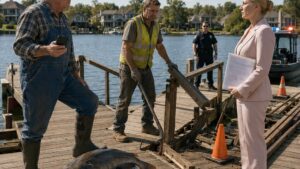
The same crew truck returned one week later, but this time the workers unloaded the white rail sections instead of carrying them away.
Patrick stood beside the barn with a thermos in one hand and the approved repair packet in the other. He did not smile when the crew supervisor stepped down from the truck. The man did not smile either. He glanced toward the place where the skid-steer had idled the week before, then toward the loose post hole still dark in the gravel.
“Morning,” the supervisor said.
“Morning.”
“We’re here to reinstall and finish to the approved dimensions.”
Patrick looked at the packet. “Safe dimensions.”
The supervisor nodded once. “Safe dimensions.”
That was enough.
They worked without the skid-steer at first. Hand tools. Levels. Post-hole mix. The sound was different from demolition. Less violent, but not gentle. A hammer did not know whether it was repairing or undoing harm. It only struck what a person aimed it at.
The horse stood at the paddock fence, watching every movement. Chickens wandered near the barn until Patrick shooed them away from the wet concrete. Beyond the field, the wind turbine turned under a low gray sky. Rain was expected by evening.
The delay had cost them. The temporary brace had held, but badly. Nancy had not gone to the barn for six days except once with Patrick on one side and the porch cane in her right hand. She had hated every step of it. He had hated that he had noticed.
The purple SUV arrived just before noon.
Patrick saw it in the lane and set down the level he had been holding for the crew. Susan Rivera parked farther back this time, leaving the driveway open. She wore a navy coat instead of the purple suit, though the folder in her hand was the same kind.
The supervisor stopped working. Patrick did not tell him to continue. Everyone had learned, apparently, that papers could change what tools were allowed to do.
Susan approached the ramp but did not step onto it.
“Mr. Lewis.”
“Ms. Rivera.”
She handed him two documents. The first was a formal withdrawal of violation. The second was a revised approval form with the ramp dimensions, rail height, gravel flare, and easement note attached. At the bottom was a new line: Emergency access or accommodation-related repairs must be reviewed before physical enforcement is authorized, except under court order or immediate public safety hazard.
Patrick read that line twice.
Ronald’s signature was there. So were the others. Susan’s was last.
“You got the board to write it down,” he said.
“The board voted to clarify procedure.”
“That’s one way to say it.”
Her face tightened, but not with the same sharpness as before. “I made a decision with incomplete information.”
Patrick looked at her.
She corrected herself. “I made a decision before confirming the information was complete.”
The crew supervisor bent to pick up a rail bracket, then thought better of making noise and stayed still.
Susan looked toward the barn. “The insurer had flagged unapproved structures. There were complaints about rural lots getting flexibility other owners did not. I believed acting quickly was protecting the association.”
“From a ramp?”
“From liability.”
Patrick folded the withdrawal notice once, carefully. “You created some.”
“Yes.”
The admission did not heal anything. It did not put the first rail back before Nancy stood at the porch and saw empty air. It did not erase the photograph of him framed as obstruction, or the way the walker had sounded opening in the meeting room. But it sat on the gravel between them, plain and useful.
“I’m not asking you to like the board,” Susan said.
“I wasn’t planning to.”
“For what it is worth, the procedure will change.”
Patrick looked past her to the crew setting the restored rail into place. “That’s worth something.”
She gave a small nod, not quite gratitude, not quite apology. Then she returned to her SUV and left without dusting the lane.
By late afternoon, the ramp was whole again.
Not exactly as before. The rail was set an inch higher. The gravel flare widened near the gate. The outer edge had a low timber lip where the drainage cut began. The white paint had been touched up, but the repaired section still showed faint scuffs beneath the new coat if Patrick looked closely.
He decided not to sand them out.
Nancy came out when the last truck left.
Patrick was standing by the gate, one hand on the new rail, when he heard the porch door open. He turned too quickly, then made himself stop. She wore her gray sweater and had the folded cane in one hand, though she had not opened it.
“Is it ready?” she asked.
“Yes.”
“For me, or for the file?”
He almost answered too fast. Then he stepped away from the start of the ramp.
“For you.”
Nancy came down the porch steps slowly. Patrick waited at the bottom, not reaching. When she reached the gravel, she looked at his empty hands and gave him the smallest nod.
The sky had darkened. The first rain had not fallen yet, but the air held the metal scent that came before it. At the ramp, Nancy placed her left hand on the rail. Her fingers closed around the painted wood. She tested it once.
“Solid,” she said.
“I checked it.”
“I know.”
She moved forward. One step. Then another. At the turn, she paused, not because she had to, but because both of them remembered the blue tape and the walker slipping off the edge. Her hand stayed firm on the rail. Her foot cleared the widened gravel. The drainage cut remained where it had always been, but it no longer decided the path.
The horse came to the fence before Nancy reached the gate.
“Impatient,” Nancy murmured.
Patrick stayed behind her.
At the gate, she lifted her hand and pressed her palm to the horse’s face. The horse lowered her head, still and careful, as if she too understood that this was not a greeting to rush.
Nancy stood there for a long moment. No board members. No deputy. No folder open on a table. No one asking for proof.
Patrick looked toward the barn, then the lane, then the rail beneath Nancy’s hand. Protection, he had learned, was not the same as deciding alone. A ramp could keep someone safe. It could also become a wall if he used it to hide the person it served.
That evening, after the rain finally began, Patrick placed the withdrawn violation notice into a folder behind the approved ramp packet, the county easement map, the deputy’s report, and Nancy’s limited letter.
He did not throw it away.
Some papers had to be kept, not because they were right, but because they proved where the wrong thing had started.
The story has ended.