The Will Gave Her The Lake Cabin, But The Deed Date Told Him Something Was Wrong
Chapter 1: The Will Said Her Name, Not His
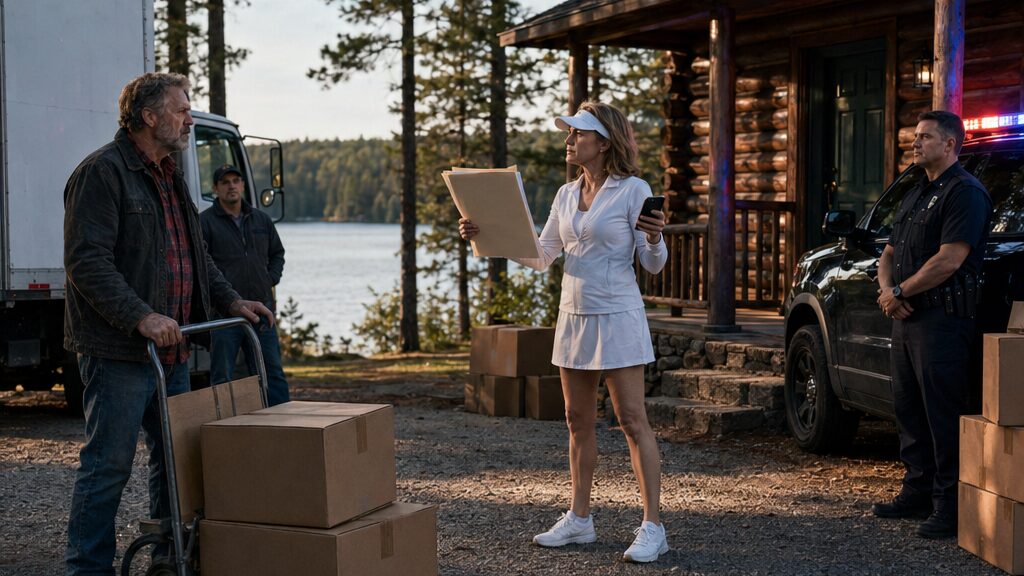
“I own this block, Jack. Get your boxes off my property or I’m calling 911.”
Sandra King stood halfway between the white moving truck and the cabin steps, one arm pointed at him as if she could pin him to the gravel by gesture alone. Her visor threw a hard shadow over her eyes. In her other hand she held a phone, screen already lit, thumb hovering.
Jack Martin kept both hands on the metal handle of the hand truck.
Behind him, three cardboard boxes leaned against the truck gate. One was marked KITCHEN TOWELS in his mother’s careful writing. One said PORCH PHOTOS. The third had no label because he had not been able to decide what to call the things inside: her old pill organizer, the blue cardigan she wore when the lake air turned cool, the chipped mug with a loon painted on it.
“This was Mom’s cabin,” he said.
Sandra’s laugh came out sharp. “Was. That’s the word you’re looking for.”
The cabin rose behind her, all dark logs and wide windows, the lake flashing through pines beyond the porch. Jack had replaced those porch railings two summers ago when Michelle’s balance started slipping. He had sanded the step edges so she could feel them under her shoes. He had installed the grab bar by the back door after she snapped at him for treating her like glass, then used it every morning without saying another word.
Sandra moved closer.
“You don’t live here anymore,” she said. “You don’t get to come in and start taking things.”
“I’m not taking things. I’m packing what needs sorting before the truck leaves.”
“That truck leaves empty if I say it does.”
The moving driver, who had been tightening a strap near the cab, looked away with the stiff discomfort of a man paid to lift furniture, not witness a family coming apart in public.
Jack glanced at the cabin door. The brass key was still on his ring. It had been there for twenty-three years.
Sandra saw him look.
“Don’t even think about it.”
He loosened his grip on the hand truck handle. “Sandra, we can talk inside.”
“No.” She lifted her phone higher. “We talk right here, where you don’t get to pretend you’re the grieving son while you clean the place out.”
A pickup slowed on the lake road. Jack recognized the shape of John Walker behind the wheel, but the truck kept rolling. Neighbors did that at the lake. They saw everything and called it privacy.
Sandra reached into the white folder tucked under her arm and pulled out a thick packet clipped with a black binder clip. Across the top page, in formal print, was the name of Gregory Harris’s office.
“I have the will,” she said.
Jack felt the words land before he understood them.
“The reading is Thursday,” he said.
“It was moved.”
“You didn’t tell me.”
“You were notified.”
“No, I wasn’t.”
Sandra’s mouth tightened, but not with surprise. More like irritation that he had made her say the next part.
“Mom changed things, Jack. She wanted this property handled cleanly. She left the lake cabin and the association shares to me.”
The lake sound seemed to pull back from the shore.
Jack looked from the papers to Sandra’s face. He tried to find in her expression some sign that she knew what she had just done. Not only claimed the cabin. Not only blocked the door. She had put their mother between them like a locked gate.
“She told me I could stay here,” he said.
Sandra’s eyes flicked toward the moving boxes. “Of course she did. You were always standing close enough to hear whatever you needed.”
He took one breath. Then another. The old habit rose in him, the one learned beside hospital beds and insurance calls and his mother’s sudden angers: stay level, keep your voice low, do not make fear worse by feeding it.
“What date does it say she signed that?”
Sandra blinked. “What?”
“The will. What date?”
She hugged the packet closer. “It doesn’t matter.”
“It matters to me.”
“It mattered to Mom. She signed it. That’s all you need to know.”
A siren chirped once from the road.
Sandra turned before Jack did. A police SUV rolled into the gravel driveway, lights flashing without the full scream. The blue and red washed over the cabin logs, over the white truck, over the boxes marked in Michelle’s handwriting.
Jack closed his eyes for half a second.
“You called them already,” he said.
Sandra did not answer.
The officer stepped out, one hand resting near his belt, his expression measured but tired. He looked at Sandra first, then Jack, then the moving truck.
“We got a call about a trespass issue?”
Sandra moved immediately toward him. “Yes. This man is refusing to leave private property.”
“This man is my brother,” Jack said.
“And he has no legal right to be here,” Sandra added. “My mother passed, the estate documents are clear, and he’s trying to remove property from the home.”
The officer held up a hand. “One at a time.”
Jack nodded. He could feel heat crawling up his neck, not anger exactly, but humiliation. There were neighbors behind curtains now. He knew it. The lake had always carried sound too far.
The officer asked for identification. Jack gave his license. Sandra gave hers with a clipped movement, then handed over the packet as if she had been waiting for that moment.
“This is the estate summary and deed transfer documentation,” she said. “The lake association recognizes the owner of record through the estate.”
The officer did not read every page. He did what people did with documents: he respected their weight. He set the packet on the hood of the SUV, smoothed the top page against the metal, and scanned.
Jack saw the title then.
Last Will and Testament of Michelle Martin.
Below it, in black print, was a date.
November 12.
His fingers went cold.
Not cold all at once. It began at the tips, then traveled inward until the hand truck handle felt slick in his palms.
November 12.
Six weeks before Michelle died.
He remembered that week with a sharpness that made the present tilt. The burnt toast smell in the kitchen. The fleece blanket over Michelle’s knees. The way she had stared out the porch window at the lake she had looked at for thirty years and asked, “Is your father bringing the horses in?”
His father had been dead twelve years. They had never owned horses. Michelle had grown up on a farm two counties away, and by that afternoon she had thought the glittering lake beyond the pines was a pasture.
The officer looked up. “Mr. Martin, do you have any paperwork showing you have authority to remove items from the property?”
Jack heard the practical fairness in the question. The officer was not taking Sandra’s side. Not yet. But the question still put Jack outside the door of his own life, asking permission to touch his mother’s towels.
“I lived here with her,” Jack said.
“That isn’t what I asked.”
“No,” Jack said quietly. “It isn’t.”
Sandra folded her arms. “He lived here because Mom let him. He confuses that with ownership.”
Jack turned to her. “Did you take her to Gregory’s office on November 12?”
Something small moved across her face. It was not guilt. Not enough to name. But it was there.
The officer glanced between them. “This sounds like an estate matter. I can’t settle that in the driveway.”
“I’m not asking you to,” Sandra said. “I’m asking you to make him leave.”
Jack looked down at the packet on the hood. The pages fluttered slightly in the lake breeze. Michelle’s name sat at the top, neat and official, as if the paper knew her better than he did.
“Officer,” he said, “I’ll stop loading until this is sorted.”
Sandra gave a short breath of satisfaction.
“But I’m not leaving the boxes in the driveway,” Jack continued. “Those are Mom’s personal things. Not furniture. Not valuables. Towels. Photos. Medical items. If Sandra wants to accuse me of stealing those, she can say that plainly.”
The officer looked at Sandra.
Sandra’s jaw tightened. “I want him gone.”
“That’s not the same answer,” the officer said.
For the first time that morning, Sandra had to look away.
The officer allowed Jack to move the three boxes back onto the porch, not inside. Jack carried each one by hand. He did not use the hand truck. The first box felt too light. The second rattled with picture frames. The third pressed against his chest with the hard corner of the loon mug inside.
When he came back down the steps, Sandra was retrieving the packet from the SUV hood.
Jack stopped beside her.
“What date?” he asked again, though he had already seen it.
She slid the papers back into the folder. “Mom changed her mind.”
“She changed her mind six weeks before she died, when she couldn’t remember what year it was.”
Sandra’s eyes sharpened. “Careful.”
It was the word, more than the threat in it, that steadied him.
For three years, he had been careful. Careful with Michelle’s pills, her steps, her temper, her pride. Careful not to ask about money when she said the cabin would be his. Careful not to tell Sandra how bad things were because Sandra always heard accusation in need. Careful not to call Gregory because Michelle got tired after ten minutes and he did not want to turn her promise into paperwork while she was afraid.
Now the paper existed anyway.
And his name was not in it.
Jack looked past Sandra to the porch window. In the glass, he could see a faint reflection of himself: gray beard, plaid shirt, shoulders stiff, standing in the driveway like a hired man dismissed from the job.
November 12.
That was the afternoon Michelle had looked at the lake and asked him whether it was spring.
Chapter 2: The Date On The Paper Would Not Sit Still
The box Sandra had told him not to touch was the only one that still smelled like Michelle’s house instead of cardboard.
Jack stood in the cabin kitchen after sunset, one hand on the lid, listening to the refrigerator hum and the floorboards settle. He had no legal right to be inside, Sandra had said. The officer had not ordered him out, not exactly, but he had warned that any further dispute could turn ugly fast.
Jack had waited until the moving truck left, empty except for the driver’s dolly and folded blankets. He had waited until Sandra’s white SUV disappeared toward the main road. Then he had used the brass key on his ring and entered through the back door because the porch light was still on the timer he had set for Michelle last fall.
The kitchen looked abandoned only if a person had never cared for someone sick. Jack could see her everywhere. The chair turned slightly toward the lake because she liked to watch the morning light. The strip of blue tape on the cabinet where he had written SUGAR after she twice salted her coffee. The chipped plate he had never thrown away because she insisted it was still good if food stayed on it.
The box sat on the table.
PORCH PHOTOS.
Sandra had pointed to it before leaving and said, “That one stays. Mom’s albums are estate property.”
Estate property. As if grief came inventoried.
Jack opened the lid.
On top were three framed photographs wrapped in dish towels. Michelle younger, laughing in a green jacket near the dock. Jack’s father with a fish he had probably bought at the market and claimed he caught. Sandra at fourteen, arms folded, refusing to smile beside a canoe.
Beneath the frames lay a stack of envelopes tied with red yarn.
Jack almost closed the box then.
There were lines a decent person did not cross. He had told himself that all evening. A son did not rummage through his dead mother’s private things looking for ammunition. A man who loved her did not turn her drawers into evidence.
But a sister did not call police on her brother beside their mother’s porch and call it estate management.
He untied the yarn.
Most of the envelopes held photographs. Some were blurred. Some were duplicates. Then, near the bottom, he found a manila folder folded around its contents, the tab labeled in Michelle’s writing:
Cabin papers — Jack ask Gregory.
He sat down slowly.
Inside was an old property tax bill, a lake association notice, and a draft document with Gregory Harris’s letterhead. It was not a will. Not exactly. The title read:
Proposed Life Use Agreement — Lake Cabin Residence.
Jack read the first paragraph twice before the words held still.
Michelle Martin grants John “Jack” Martin the right to occupy and maintain the lake cabin property for the duration of his natural life, subject to ordinary maintenance responsibilities and payment of utilities…
His throat closed before he reached the second page.
In the margin, beside a paragraph about transfer upon death, Michelle had written his name again. Jack — for staying.
Not for owning. Not for selling. Not for winning over Sandra.
For staying.
He pressed the heel of his hand against his eye until the kitchen blurred.
He remembered the day she must have put this folder together. Early September. She had been alert that morning, bossy about oatmeal, angry that he had moved her favorite chair two inches to fit the walker through. She had said, “We need to call Gregory about the cabin.”
He had said, “We can do it next week.”
She had stared at him over her glasses. “Next week is what people say when they’re afraid of today.”
He had smiled because she sounded like herself, and because smiling was easier than admitting that he did not want to discuss what happened after she died while she sat alive in front of him.
Next week had filled with a medication change, a fall by the bathroom door, two nights when she tried to leave the cabin to “go home,” and then Sandra’s sudden burst of visits with flowers, smoothies, and a tone that made Jack feel like hired help in his own kitchen.
The draft in his hand was unsigned.
No notary stamp. No recorded copy. No witness lines filled.
A paper that proved intent but not protection. A bridge drawn on a map but never built.
Jack searched the folder again. He found no completed agreement. No cover letter. No final version. Just Michelle’s notes, the draft, and a sticky note that had lost most of its glue.
Ask J if this keeps peace with S.
J. Jack, or Gregory? S. Sandra, surely. Even in shorthand, Michelle had been trying to balance them.
He set the draft on the table, then pulled out his phone and photographed each page. His hands shook only once, when the camera focused on Michelle’s penciled words.
Jack — for staying.
He looked toward the hallway, where Michelle’s room waited with the door half-open. For a moment he heard her voice as clearly as if she had called from the bed.
Don’t make me choose between my children.
“You didn’t,” he said into the empty kitchen. “Somebody else did.”
But even as he said it, the old shame caught him.
He had let the draft sit in a folder. He had heard the urgency and answered with next week. He had thought refusing to talk about inheritance made him honorable. Maybe it had only made him absent from the one conversation where Michelle had needed him to be practical.
Near midnight he carried the folder to the porch and sat in the chair beside the door. The lake was black except where cabin lights from the far shore trembled in the water. He opened Michelle’s wall calendar on his lap. It had hung by the refrigerator for years, the square boxes crowded with appointments, pill notes, birthdays, and reminders to call people she had no intention of calling once reminded.
September was full of Jack’s writing.
October was mixed.
By November, Sandra’s handwriting appeared in sharp blue ink.
Sandra groceries.
Sandra bank.
Sandra lunch.
Sandra attorney ride — November 12.
Jack stared at the words until the paper seemed too white beneath the porch light.
Attorney ride.
Not doctor. Not pharmacy. Not lunch.
Attorney ride.
He flipped back one page, then forward again, searching for something that made it ordinary. There was nothing. No note that Jack had been told. No appointment card. No call from Gregory’s office.
Just Sandra’s blue ink in Michelle’s calendar, on the same date printed on the will packet.
His phone buzzed against the porch table.
A text from Sandra.
Do not go through Mom’s things. I’ll know.
Jack looked through the window at the kitchen table, where the old draft lay beside the empty photo box. He did not answer.
Instead he took one more picture of the calendar square. November 12. Sandra attorney ride.
Then he opened his contacts, found Gregory Harris, and wrote a message he should have written months earlier.
I need an appointment. I have questions about the date my mother signed the revised will.
His thumb hovered.
For a second, he saw Michelle at the kitchen table in September, impatient and frightened beneath her impatience.
Next week is what people say when they’re afraid of today.
Jack pressed send.
Chapter 3: Legal Does Not Mean She Was Alone
“The documents are legal,” Gregory Harris said. “The signatures are verified.”
He said it before Jack had fully settled into the leather chair across from his desk, as if the sentence had been waiting there longer than Jack had. Sandra sat to Jack’s right, legs crossed, a white folder balanced neatly on her lap. She had not looked at him when he came in.
Gregory’s office faced the small courthouse square downtown, not the lake. The walls were lined with framed certificates, old county maps, and photographs of sailboats owned by men who probably had trusts instead of worries. On the desk between them lay a photocopy of Michelle’s revised will.
Jack kept his hands on his knees.
“I didn’t ask if they were legal.”
Gregory adjusted his glasses. “You asked for a meeting about the signing date. Usually that means someone intends to challenge validity.”
“Usually?”
The attorney’s expression did not change. “Often.”
Sandra made a small sound, not quite a laugh. “This is exactly what I told you he would do.”
Jack turned his head toward her. “You told him before I got here?”
“I told him you were upset.”
“You told him I was upset or you told him I was greedy?”
Gregory lifted one hand. “Let’s keep this productive.”
That word again. Productive. Clean. Legal. Estate. Words that made a mother’s dying weeks sound like a file drawer.
Jack pulled a folded sheet from his jacket pocket and laid it on the desk. A copy of Michelle’s calendar page. He had not brought the old draft. Not yet. Something in him resisted showing Sandra the penciled line with his name. She would find a way to make it ugly before he understood what it meant.
“What time did she sign on November 12?” he asked.
Gregory glanced at the calendar copy but did not touch it. “The execution ceremony was completed at approximately two-fifteen.”
“Execution ceremony,” Jack repeated.
“That is the term.”
“She was having confusion episodes that week.”
Sandra sat forward. “She had good days and bad days. You know that.”
“I know that on November 10 she thought the lake was a farm.”
“She was tired.”
“On November 11 she asked me whether her mother was coming for dinner.”
Sandra’s face tightened. “And on November 12 she knew exactly what she wanted.”
Jack looked back at Gregory. “How do you know?”
For the first time, the attorney paused.
“I met with Michelle regarding her wishes.”
“Alone?”
Gregory folded his hands. “For part of the consultation.”
Jack felt something inside him sharpen.
“What part?”
“Mr. Martin—”
“What part of the consultation did you meet with my mother alone?”
Sandra uncrossed her legs. “This is insulting.”
“No,” Jack said, still looking at Gregory. “It’s specific.”
Gregory leaned back. Behind him, through the window, a delivery truck rolled past the courthouse square. The ordinary world kept moving with a cruelty Jack had noticed since the funeral.
“Your mother came to the office with Sandra,” Gregory said. “That is not unusual. Elderly clients often arrive with family members.”
“She was seventy-nine, not a suitcase.”
“I didn’t say otherwise.”
“Did Sandra stay in the room?”
Sandra slapped the folder lightly against her knee. “I drove Mom because you were too busy controlling everything at the cabin to take her where she asked to go.”
Jack looked at her. “She asked you?”
“Yes.”
“When?”
Sandra’s eyes held his. “That week.”
“What day?”
“I don’t remember the exact day.”
“But you remember she was clear.”
“She was clear enough to know she didn’t want you turning the cabin into your retirement plan.”
There it was, finally. Not the legal argument. The older one. The one Sandra had been carrying beneath her tennis whites and paperwork and calls to police.
Gregory cleared his throat. “I did speak with Michelle privately. Briefly.”
“How briefly?”
“Long enough to confirm she understood she was signing a will and related estate documents.”
“Related documents,” Jack said. “What related documents?”
“The lake association transfer instructions. Beneficiary updates. A durable power provision had already been discussed.”
Jack stared at him. “Beneficiary updates?”
Sandra’s folder shifted in her lap.
Gregory’s eyes moved, just once, toward her.
Jack caught it.
“What account?”
“That is a separate estate matter,” Gregory said.
“My mother changed more than the cabin that day?”
“Jack,” Sandra said, “don’t do this.”
He almost answered too quickly. Anger rose in him, hot and useful, but he swallowed it down. Anger would let them put him in the corner they had prepared: grieving son, disappointed heir, difficult brother.
He turned back to Gregory.
“When exactly were the beneficiary updates signed?”
Gregory’s jaw worked slightly. “The same afternoon.”
“And you met with her alone for how long before all of that?”
“I don’t have the minute-by-minute breakdown in front of me.”
“Who does?”
“The office file may contain notes.”
“Then I’d like the notes.”
Sandra stood. “Absolutely not.”
Gregory’s voice softened in the way professionals soften when they are about to deny something. “You are not currently the personal representative of the estate.”
“She is,” Jack said.
“Yes.”
“And the revised will made her that.”
“Yes.”
“So the person who benefited from the changes controls the file that explains how the changes happened.”
Gregory did not answer.
The room became very quiet.
Jack looked at the photocopy on the desk. Michelle’s signature sat at the bottom of the page, shaky but recognizable. He knew that signature. He had seen it on birthday cards, grocery checks, permission slips, angry notes to the lake association about dock fees. This one looked like hers and not like hers, the way Michelle in the last weeks had sometimes sounded like herself until the sentence drifted into another decade.
“Sandra,” he said, “were you in the room when she signed?”
She did not sit back down. “I was where Mom wanted me.”
“That isn’t an answer.”
“It’s the only one you deserve after accusing me of dragging our mother around like she didn’t have a mind.”
“I’m asking because she had a mind,” Jack said. “And I want to know who was speaking over it.”
Sandra’s eyes flashed, but behind the anger he saw something else. Not fear exactly. A wound touched too hard.
“You always did this,” she said. “You stood close, talked soft, made yourself necessary. Then everyone acted like I abandoned her because I didn’t move into the cabin and play saint.”
Jack flinched despite himself.
Gregory said, “This is not helping.”
But it was helping. Not legally. Not in the way Gregory meant. It was the first honest thing Sandra had said since the driveway.
Jack picked up the calendar copy and slid it back into his pocket.
“I’m not asking you to solve this today,” he told Gregory. “I’m asking you to preserve every note, message, draft, and witness record connected to November 12.”
Gregory’s expression cooled. “That sounds like a litigation hold.”
“It sounds like a son asking what happened.”
“Sons can ask,” Gregory said. “Courts require evidence.”
Jack nodded. “Then I’ll look for evidence.”
Sandra gave a brittle smile. “You do that. And while you’re looking, remember the cabin isn’t yours.”
He stood then. Slowly. Not because he had an answer, but because if he stayed he might say all the things they expected from him.
At the door, Gregory spoke again.
“There were two witnesses for the execution. One was from my office. The other was not.”
Jack turned.
“Who?”
“I would need to review the file before giving names.”
Sandra turned on Gregory. “Is that necessary?”
Gregory did not look at her. “It may become necessary.”
Jack held the doorknob, feeling the brass warm under his hand.
“Was the other witness someone I know?”
Gregory hesitated just long enough to make the answer matter.
“I believe he lives near the lake,” he said. “And the notary assistant handled the certification.”
Chapter 4: The Neighbor Remembered The White Truck
“I saw your mother that afternoon,” John Walker said, and then he looked past Jack toward the lake as if the rest of the sentence might still be out there on the water. “She wasn’t herself.”
Jack had found him at the dock behind the low gray house two coves down, kneeling beside an overturned canoe with a wrench in one hand. John had watched Jack walk the gravel path but had not stood. He only tightened a bolt that was already tight and said, “If this is about court, I don’t want my name in it.”
“I’m not in court.”
“Not yet.”
The words landed with the dull honesty of someone old enough to know how families became legal files.
Jack stopped at the edge of the dock. The boards under his boots gave a small familiar creak. John had lived on the lake longer than Michelle had. He had brought her tomatoes in paper bags and complained about association dues with her every spring. At the funeral, he had stood near the back, hat in hand, and left before the family meal.
“Gregory Harris said one witness lived near the lake,” Jack said.
John’s hand froze on the wrench.
For a moment only the sound of water tapping the dock filled the space between them.
“I didn’t know what it was,” John said.
Jack did not move closer. “What did you sign?”
John set the wrench down carefully, as though a sudden motion might make him remember more than he wanted. “Sandra came by that day. White SUV. Your mother was in the passenger seat. She had one of those blankets over her lap even though it wasn’t cold.”
“November 12.”
John nodded once.
Jack saw the vehicle before John described it: Sandra’s white SUV against the gray lake road, clean and bright in a season when everything else wore pine dust and damp leaves. He had seen that same SUV in the cabin driveway for weeks, appearing more often after Michelle stopped wanting visitors.
“She said they’d been to town,” John continued. “Said your mother needed a witness for some lake association transfer acknowledgment. I told her I wasn’t comfortable signing legal papers. Sandra said it wasn’t that kind of legal. Just confirming Michelle was present and understood she’d picked up the packet.”
Jack kept his voice even. “Did Mom speak?”
John looked down at his hands.
“Not at first.”
The admission moved through Jack like a chill.
“Then Sandra opened the passenger door and said, ‘Mom, tell John you know what you’re signing.’ And your mother looked at me.” He rubbed his thumb across a dark stain on the dock board. “She said, ‘John, did they move the mailbox?’”
Jack closed his eyes.
Michelle had asked that question in her last months whenever some piece of the world seemed wrong to her. At first, it meant the real mailbox at the end of the drive. Later, it meant anything: the medicine tray, the lake, the picture frames, Sandra’s face after too long away.
“Did you sign after that?”
John’s shoulders lifted, then settled. “Sandra said she’d had a long morning. Said Michelle had already answered everything for the attorney. She said they just needed a neighbor witness for the association record. Your mother looked tired. I thought refusing would embarrass her.”
Jack turned toward the lake before he answered. The surface was too bright under the noon sun, broken into hard pieces.
“What did the page look like?”
“One page on a clipboard. Top half covered by another sheet. I saw a signature line. I saw my name typed below it.”
“Typed?”
“That’s what bothered me later.”
Jack looked back.
John’s face had gone tight. “My full name. John Walker. Not like somebody grabbed a blank form and asked me to help. Like they knew I’d sign before they came down the road.”
A boat engine started somewhere beyond the pines, rose, then faded.
“Why didn’t you call me?” Jack asked.
The question came out flatter than he meant it.
John picked up the wrench and set it down again. “Because I told myself it wasn’t my family. Because your sister said Michelle didn’t want you involved. Because old people on this lake spend half their lives signing forms we don’t read and trusting folks we shouldn’t.”
“That’s not an answer.”
“No,” John said. “It’s what I’ve got.”
Jack wanted to be angry with him. It would have been easier than feeling the outline of all the moments where decent people had stepped back because family trouble looked private from the outside.
“Did you see her after they came back from town?”
“That was after.”
“You just said she was in the SUV.”
John nodded toward the road. “They stopped here before going back to the cabin. Maybe after the attorney, maybe after the bank, I don’t know. Sandra had a stack of papers. Your mother kept trying to get out of the car. Not all the way, just pulling at the belt. Sandra told her, ‘We’re almost done.’”
“Almost done,” Jack repeated.
“That’s what she said.”
Jack looked up the hill toward the narrow road where Sandra’s SUV would have passed between the pines. From John’s dock, the Martin cabin was not visible, but its chimney rose above the trees if a person knew where to look.
“Did Mom seem upset?”
John’s mouth pressed into a line. “She seemed lost.”
That was worse.
Jack took out his phone. “Would you write down what you remember?”
John drew back. “Jack.”
“I’m not asking you to accuse anybody. Dates. What you saw. What Sandra said. What Mom said.”
“I don’t want to be dragged into a fight between you two.”
“She already dragged you in when she put your name on a page.”
John flinched, and Jack regretted the force of it. Not because it was untrue, but because truth could be used like Sandra used paper: to corner someone before they could breathe.
He lowered the phone. “I’m sorry.”
John looked at him for a long moment. “Your mother used to bring muffins when my wife was still alive.”
“I remember.”
“She’d tell me not to make a big thing of it. Just leave the plate on the porch and wave like she happened to be passing by.” His voice roughed at the edges. “After my wife died, people asked what I needed for about two weeks. Michelle kept asking for two years.”
Jack swallowed.
John stood slowly. His knees cracked. “I’ll write what I remember. Not guesses.”
“That’s all I’m asking.”
“No, it isn’t,” John said, not unkindly. “You’re asking whether anyone saw your mother disappearing before your sister put a pen in her hand.”
Jack had no answer for that.
They walked together up the slope from the dock, John slower than Jack remembered him. At the driveway, John stopped beside his mailbox and stared toward the Martin cabin through the trees.
“The next morning,” he said, “there was an argument on your porch.”
Jack turned. “Between who?”
“Sandra and the nurse. Rachel, I think. The hospice one.”
“Rachel Torres?”
“That sounds right. She came in that little blue car. Sandra was on the porch with her arms folded. I couldn’t hear all of it, but I heard the nurse say, ‘She can answer if you let her.’”
Jack felt the sentence strike harder than any document had.
John looked ashamed now, not of signing, but of remembering late.
“I went inside after that,” he said. “Told myself it wasn’t my business.”
Jack looked down the road toward the cabin, where his boxes still sat trapped between the porch and the truck that had gone away empty.
“What did Sandra say back?”
John closed his eyes, searching.
“She said, ‘You don’t understand this family.’ Then she shut the door with the nurse still outside.”
Chapter 5: The Old Deed Proved Less Than He Hoped
“The deed you’re asking about was never recorded,” the county clerk said, and pushed the paper back under the glass as gently as if it were something breakable.
Jack stared at the copy of Michelle’s proposed life-use agreement. He had known, before he drove downtown, that it had no stamp. No book number. No county seal. But some stubborn part of him had brought it anyway, as if a public office might recognize his mother’s pencil in the margin and make it official by mercy.
“Nothing at all?” he asked.
The clerk turned to her screen again. “I see the original cabin deed in Michelle Martin’s name, then a transfer-on-death filing connected to the estate documents. The most recent packet references Sandra King as beneficiary under the will. But this life-use draft?” She tapped the copy. “No recording. No filing. No instrument number.”
“It was prepared by an attorney.”
“A lot of things are prepared and never recorded.”
The clerk said it without judgment, which almost made it worse.
Jack folded the copy and put it back into the folder. The old paper had felt powerful in the cabin kitchen. Here, under fluorescent lights beside a scratched counter and a plastic tray of numbered tickets, it became what it was: intention without force.
“Can I get certified copies of the recorded transfer packet?”
“You can.”
“How long?”
She looked at the clock. “If you wait, twenty minutes.”
He waited forty-three.
During that time, three people came and went with marriage licenses, property maps, and tax forms. Jack sat on a wooden bench beneath a bulletin board of county notices and watched his mother’s old promise shrink into a file that had never crossed the right desk.
When the clerk called him back, the certified packet was clipped at the top with a blue county stamp on the first page. He paid for it with cash because using a card felt too modern for the kind of loss he was holding.
Outside, in his truck, he opened the packet.
The first pages repeated what he had already seen: Michelle’s name, the cabin property description, the lake association shares, Sandra’s name as personal representative and beneficiary. The language was dry and certain. Lot lines. Rights. Transfer upon death. No mention of porch railings or nights Jack slept in a chair because Michelle woke frightened if he was not within earshot.
Near the back was an attached inventory note.
Related non-probate beneficiary updates completed November 12.
Jack read the line once, then again.
Non-probate. That meant assets that passed outside the will. He knew enough from late-night searches to understand that. Accounts. Insurance. Designations that could move quietly, without the drama of a will reading.
He flipped to the next page. It was not a full statement, only a summary page attached to the estate packet.
Lake maintenance reserve account — beneficiary updated to Sandra King.
The account had not been large, but Jack knew it. Michelle called it “the roof money.” It paid for dock repairs, winterization, sudden leaks, things the cabin demanded when nobody had planned for them.
Sandra had changed that too.
No. Michelle had changed that too. That was what the paper said.
Jack sat with both hands on the steering wheel, the certified packet open across his lap.
If he challenged the cabin, people could say he wanted a house. If he questioned the reserve account, they could say he wanted money. If he asked about every signature from November 12, he would become exactly what Sandra had already named him in advance: a man turning grief into a claim.
He almost put the packet away.
Then he saw Michelle in the kitchen doorway six months before she died, one hand gripping the walker, telling him the porch light needed a new timer. “The house has to outlive us both,” she had said.
He had laughed. “That’s asking a lot of a roof.”
She had looked at him sharply. “Not the roof. The care.”
Jack refolded the packet.
By afternoon, he was in the nursing facility lobby where Rachel Torres still worked part-time with hospice patients. The receptionist behind the desk asked him to wait, then gave him a laminated visitor badge that did not stick well to his jacket. Around him, televisions murmured in two corners. Someone’s slippers whispered along a hallway. A cart rattled past with cups of juice and folded napkins.
He hated the smell most. Not because it was bad, exactly. Because it was clean in a way that could not hide fear.
Rachel came out after fifteen minutes, wearing navy scrubs and the careful expression of someone who had already been told this conversation might matter.
“Mr. Martin?”
“Jack is fine.”
She nodded but did not use it. “We can talk in the family room.”
The family room had a round table, three chairs, and a fake plant glossy with dust. Rachel closed the door but did not sit right away.
“I heard from Mr. Harris’s office,” she said.
Jack’s hand tightened around the folder. “Gregory called you?”
“His assistant asked whether I had records from your mother’s hospice period. I told her records require proper requests.”
“Did Sandra call you?”
Rachel looked down. That was answer enough.
“She said you were trying to upset settled estate matters,” Rachel said.
Jack gave a short, tired breath. “That sounds like Sandra.”
“She also said your mother knew exactly what she wanted.”
“And did she?”
Rachel sat then. She folded her hands on the table, fingertips pressed together.
“Your mother had lucid periods,” she said carefully. “She could answer questions. She could recognize people. She could also become confused, especially later in the day, after pain medication, or when overstimulated.”
“November 12?”
“I’d need to review my notes.”
“I’m asking what you remember.”
Rachel’s eyes moved to the folder. “Memory is not a medical record.”
“No. But sometimes it’s where the record starts.”
For the first time, her professional calm cracked slightly. “I remember being concerned.”
Jack waited.
“I visited the next morning. November 13. Michelle was agitated. She kept saying she had signed the wrong card.”
“The wrong card?”
“That was her phrase. I asked what card. Sandra answered for her.”
“What did she say?”
“That your mother meant a greeting card. That she was confused about holiday mail.”
Jack leaned back. The room seemed suddenly too small.
“Did you believe her?”
Rachel did not answer immediately.
“I believed there was family tension I did not understand,” she said. “I believed your mother was tired. I believed I had to be careful.”
“She can answer if you let her,” Jack said.
Rachel’s face changed.
“John Walker heard you say it.”
She closed her eyes briefly. When she opened them, the caution was still there, but something else had joined it.
“Sandra kept interrupting,” Rachel said. “Not loudly. Not cruelly. She would touch Michelle’s shoulder and say, ‘Mom, remember, we already handled that.’ Or, ‘Mom, that’s not what you meant.’ It is difficult, in home care, to know when family is helping and when family is steering.”
“Was Sandra in the room when Mom answered medical questions?”
“Sometimes.”
“Did you ask her to step out?”
“Yes.”
“Did she?”
“Not always.”
Jack opened the folder and showed her the certified summary, the November 12 date, the beneficiary update. He did not push it across the table. He only turned it so she could see.
Rachel read without touching the page.
Her mouth tightened at the date.
“I can’t say your mother didn’t sign,” she said.
Jack nodded, though disappointment still moved through him.
“I can’t say she didn’t have a lucid window,” Rachel continued. “I can’t tell you a legal conclusion.”
“I’m not asking for one.”
Her eyes lifted to his.
“I can say who wouldn’t leave the room.”
Chapter 6: The Offer Came With A Warning
“You’re going to tear this family apart over money,” Sandra said, and placed a cream-colored envelope on the porch rail between them.
Jack had been stacking boxes just inside the cabin door when her SUV came up the drive without warning. The moving truck had not returned; there was nothing left in the driveway now but flattened leaves, tire marks, and the place where the police SUV had idled days earlier. Sandra walked straight to the porch as if she had never threatened to keep him off it.
The envelope lay clean and heavy against the weathered wood.
Jack did not pick it up.
“What is it?”
“A way for you to stop before you make this uglier.”
He looked at her then. She wore no visor today, no tennis whites. Just jeans, a gray sweater, and the pinched tiredness of someone who had not slept enough but still intended to win.
“How much?”
Her face hardened. “So it is about money.”
“You brought an envelope.”
“I brought peace.”
“No,” Jack said. “You brought a price.”
Sandra looked past him into the cabin. Her gaze moved over the stacked boxes, the bare hooks where Michelle’s coats had hung, the kitchen table visible through the doorway. For one second, grief came near her face. Then she shut it out.
“Fifteen thousand,” she said. “From me personally. You sign a release, stop contacting people, stop implying Mom was incompetent, and remove your belongings by the end of the week.”
Jack almost laughed, but there was no humor in it. “Fifteen thousand for the cabin, the account, and my silence.”
“For your disruption.”
“My disruption.”
“Yes, Jack. Yours.” Her voice rose, then lowered fast, as if she had trained herself not to sound uncontrolled. “Do you know what people are saying? You’re going to the county office, bothering John, cornering Rachel at work. You’re making it sound like I dragged Mom around town with a pen in her hand.”
“Did you?”
Her eyes flashed. “Be careful.”
“You said that in the driveway.”
“And you didn’t listen.”
Jack turned away from the envelope and picked up a box from beside the door. It was lighter than it looked, filled mostly with folded curtains Michelle had never put back up after he washed them. He set it on the porch floor between them because holding something kept his hands from becoming fists.
Sandra stared at the box. “This is what you do. You make everything look humble. Boxes. Flannel. Quiet voice. Like you weren’t living here rent-free for years while the rest of us had lives and bills.”
Jack felt the old sting, sharpened by the fact that part of it had always frightened him. He had lived there. He had eaten food from Michelle’s refrigerator, used her electricity, slept in the small back room after she began falling at night. He had told himself it was caregiving, which it was. He had also needed a place after his contracting work slowed and his marriage ended, which Sandra knew and never let him forget without saying it plainly.
“You think I used her,” he said.
“I think you needed her needing you.”
The words hit too close. Not true in the way Sandra meant, but close enough to hurt.
Jack looked through the open door at the blue tape still stuck to the sugar cabinet. There had been days when Michelle’s dependence gave shape to his own broken life. Days when being useful was easier than being alone. He could admit that and still know it did not make Sandra’s papers clean.
“I needed to take care of her,” he said. “Those are not the same thing.”
Sandra gave a small, bitter smile. “Convenient difference.”
“You visited every week for six months and none of us knew why until now.”
“I visited because she was my mother.”
“Then why didn’t you tell me about November 12?”
“Because she asked me not to.”
Jack looked back at her. “Say that again.”
Sandra’s jaw worked. “She didn’t want another fight.”
“What fight?”
“The one where you made that face.”
“What face?”
“The wounded one.” Sandra’s voice cracked on the word, and she seemed to hate herself for it. “The one where Mom could ask for one thing from me, and you would stand there like she had betrayed you by remembering she had a daughter.”
Jack said nothing.
Sandra looked away toward the lake. “You think I didn’t see it? Every time I came here, you had the medicine chart, the doctor updates, the grocery list, the neighbor stories. You and Mom had a whole world I had to knock to enter. And if I got one detail wrong, one pill name wrong, you’d go quiet.”
“I was tired.”
“So was I.”
“You weren’t there.”
“No,” she said. “I wasn’t. I was working double shifts after the divorce. I was paying off debt you don’t know anything about. I was calling Mom and hearing you answer the phone because she was asleep, or confused, or not up to talking, and every time I hung up I wondered if that was true or if you had decided I was too much trouble for her.”
Jack stared at her.
For the first time, her story had a shape he had not allowed himself to imagine. Not enough to excuse her. Enough to make the porch smaller.
“I never kept her from you,” he said.
“You never had to. You were already inside.”
The lake wind moved between them, lifting the edge of the envelope.
Jack bent and picked it up at last. Sandra’s eyes followed the movement with a brief flash of hope.
He opened it.
Inside was a cashier’s check and a typed release. The release named him as John Martin, also known as Jack Martin. It required him to cease inquiry into Michelle Martin’s estate documents, property transfers, and related beneficiary designations. It required him to remove all personal items from the cabin within five days. It required confidentiality.
He looked up.
“This isn’t peace.”
“It’s more than you’ll get if you keep pushing.”
“I’m doing this because she didn’t sign that alone.”
Sandra’s face closed.
For a second, neither of them moved.
Then Sandra took another paper from her bag and held it out.
“What is that?”
“Formal notice.” Her voice had gone flat now. Businesslike. Gregory’s language had entered her mouth. “As personal representative, I’m requiring removal of all unauthorized belongings from estate property. If they’re not gone within seventy-two hours, I’ll have the locks changed and the remaining items inventoried.”
Jack did not take the notice. She set it on top of the box.
The paper looked absurd there, beside Michelle’s curtains.
“Sandra,” he said.
She stepped back down one porch stair. “You wanted documents. Now you have another one.”
He watched her walk to the SUV. She did not look back until she had opened the driver’s door.
“You keep saying Mom couldn’t choose,” she said. “Maybe what you can’t stand is that she chose me.”
The SUV rolled down the driveway, leaving the formal notice on the box between them.
Jack stood on the porch until the sound faded. Then he picked up the notice and read the deadline twice.
Seventy-two hours before the locks changed.
Chapter 7: Michelle’s Voice Was Not A Perfect Answer
“Your mother knew your name that morning,” Rachel Torres said. “By afternoon, she thought the lake was your father’s farm.”
Jack sat across from her in the small hospice office with Sandra’s seventy-two-hour notice folded in his jacket pocket like a second pulse. The room had no window. A lamp glowed on a file cabinet beside a stack of pamphlets about grief, medication schedules, and how to ask for help before help became an emergency. Jack had spent three years ignoring pamphlets like those because the real emergencies always arrived before the reading was done.
Rachel had a folder in front of her, but her hands stayed on top of it.
“I need to be precise,” she said.
“I know.”
“No, Mr. Martin. I need you to understand what precise means. I can say Michelle had fluctuating cognition. I can say there were documented episodes of confusion. I can say she was vulnerable to fatigue and suggestion. I cannot say she lacked capacity for every minute of November 12.”
Jack nodded once.
It was not the answer he wanted. That was becoming the shape of the truth: nothing came whole. Everything arrived with one edge missing.
Rachel opened the folder.
“On November 10, she mistook the lake for another place. On November 11, she was oriented in the morning, confused by evening. On November 13, she repeatedly referred to signing the wrong card. That is in my note.”
Jack leaned forward. “You wrote that down?”
“I wrote the phrase down. I did not know what it meant.”
“Did Sandra?”
Rachel’s mouth tightened. “Sandra said your mother was referring to holiday mail.”
“In November.”
“Families explain things,” Rachel said quietly. “Sometimes they are right. Sometimes they are trying to make the room easier.”
“And sometimes they are trying to control the answer.”
Rachel looked at him then, not as a nurse fending off a difficult family member, but as a person who had been in too many rooms where the sick became quiet because the healthy were louder.
“Yes,” she said. “Sometimes.”
The word did not solve anything. It entered the room and stayed there.
Rachel slid a photocopied page across the table. “This is not the full record. It is a summary I can provide with proper authorization and your counsel’s request. But I wrote this myself, and I can confirm it if asked.”
Jack looked down.
Patient became anxious when asked about prior day. Repeated phrase: “wrong card.” Daughter Sandra answered several questions despite request to allow patient time. Patient able to identify son Jack in morning visit, later disoriented to place and year.
He read the last line twice.
Disoriented to place and year.
The phrase was colder than memory. Cleaner. Less forgiving.
“My mother hated being corrected,” he said.
Rachel’s face softened. “Most people do.”
“No. I mean, if she said the lake was a farm, you couldn’t tell her it wasn’t. She’d get embarrassed. Then angry. Then quiet.” He touched the edge of the paper. “So I stopped correcting her unless it mattered.”
Rachel waited.
“Maybe I stopped too much.”
The admission felt different from guilt. Guilt was familiar, heavy, almost comfortable by now. This was sharper. He had protected Michelle’s pride so fiercely that he had sometimes left the truth unnamed in rooms where other people were willing to name something else.
Rachel folded her hands. “Caregiving teaches people to choose peace ten times a day. That doesn’t mean you caused what happened.”
“I helped make it easy to say she was fine.”
“No,” Rachel said. “You helped her keep dignity. Someone else may have used that dignity as cover.”
Jack looked up.
Rachel did not look away.
He put the summary in his folder with John’s handwritten statement, the calendar copy, the certified packet, and the old life-use draft. It was not a winning file. It was a file full of not-quite-enough. But for the first time, the papers seemed to lean in the same direction.
Before he left, Rachel stopped him at the door.
“There was one more thing,” she said.
Jack turned back.
“Your mother asked me once whether a house could owe a person anything.”
“When?”
“Late October. She was sitting by the porch window. You had gone to pick up a prescription.”
Jack held still.
“What did you say?”
“I said houses don’t owe people. People do.”
Rachel looked down at the folder. “She said, ‘Then I need to stop making the house do my talking.’”
Jack felt the sentence open something in him and leave it exposed.
He drove back to the cabin without turning on the radio. Sandra’s deadline had less than two days left. He parked beside the porch and sat in the truck until the engine ticked itself quiet.
Inside, the cabin looked less like home each day because he had been packing it into categories. Keep. Donate. Ask Sandra. Leave. Every label felt like a lie. There was no box for the way Michelle had tapped twice on the wall when she needed help but did not want to call out. No box for the mornings she accused him of hiding her slippers, then cried when he found them under the bed. No box for the September folder he had been too afraid to finish.
He went into her bedroom because he had avoided it all afternoon.
The curtains were half-open. Dust moved in the light over the dresser. Sandra had already taken the jewelry case, leaving behind a pale rectangle where it had sat. Jack did not blame her for that. The pearls were hers if Michelle had said so, or if the will said so, or if daughters were allowed to want one pretty thing from a mother without being judged for it.
He opened the closet.
On the floor, behind a laundry basket and a folded walker tray, sat a small cedar keepsake box he had not seen in years. The brass latch was stiff. When he opened it, the scent rose first: cedar, lavender, old paper.
Inside were things too small for estate inventories. A lock of hair in an envelope. His father’s fishing license. A lake association pin. A photograph of Sandra at eight, asleep in a lawn chair with a book on her chest. A photograph of Jack at seventeen, shirtless and sunburned, holding a hammer beside the unfinished porch steps.
At the bottom was a folded note on Michelle’s stationery.
His hands went still.
He unfolded it carefully.
The house is not a prize. It is where care happened.
That was all.
No date. No names. No instructions. No signature, though the handwriting was hers.
Jack sat on the edge of the bed with the note in his hand.
It was not enough. Of course it was not enough. Michelle, stubborn even in absence, had left him one sentence that explained everything and proved almost nothing.
He laughed once, quietly, and the sound almost became something else.
The house is not a prize.
He thought of Sandra on the porch, saying he had lived inside Michelle’s need. He thought of himself, standing in Gregory’s office with his questions sharpened like tools. He thought of the cabin as both shelter and weapon, depending on who held the paper.
He placed the note back in the cedar box, then set the box on the kitchen table beside the deed packet. For a long while he looked at them together: one cold, stamped, and official; one small, fragrant, and useless to anyone who measured truth by filing numbers.
His phone rang.
Gregory Harris’s name appeared on the screen.
Jack answered without greeting.
“Mr. Martin,” Gregory said. His voice had lost some of its polished distance. “I spoke with Sandra.”
Jack waited.
“She has agreed to one final meeting before proceeding with removal of your belongings.”
“When?”
“Tomorrow morning. At the cabin.”
Jack looked at the deed packet. Then at the cedar box. Then at the seventy-two-hour notice on the table.
“Will she bring the estate documents?”
“Yes.”
“Then I’ll bring the timeline.”
A pause followed.
Gregory said, “Mr. Martin, understand that this may not change the legal posture.”
Jack touched Michelle’s undated note through the open lid of the cedar box.
“I’m not coming because the law is ready,” he said. “I’m coming because the truth is.”
Chapter 8: He Did Not Need The House To Tell The Truth
Jack placed the deed packet on the hood of the police SUV before anyone asked him to.
The same officer had come at Gregory’s request, not with lights this time, but with the weary caution of a man who remembered the first driveway scene and did not want a sequel. The SUV sat in the same place as before, angled toward the porch, its hood catching the pale morning sky. Jack laid the certified county copy flat, then set beside it Michelle’s calendar page, John Walker’s statement, Rachel Torres’s summary, the old life-use draft, and the cedar keepsake box.
Sandra stood three feet away with her arms folded.
Gregory Harris held his leather folder against his chest.
No moving truck waited behind Jack now. The boxes remained stacked inside the cabin door. Some were sealed. Some were still open. He had stopped packing at midnight, not because he had finished, but because he finally understood he could not pack his way into being fair.
The officer looked at the papers on the hood. “I’m here to keep the peace. Not decide anything.”
“I know,” Jack said.
Sandra’s voice came thin and sharp. “Then why the display?”
Jack looked at her. “Because last time, you put Mom’s will on this hood and called me a trespasser. I want the rest of the papers to stand in the same place.”
Gregory cleared his throat. “Let’s keep this focused.”
Jack almost smiled. The old words had returned. Legal. Productive. Focused. He could let them have those words now. He had brought different ones.
He pointed to the county packet. “November 12. Revised will. Transfer instructions. Beneficiary updates.”
Then the calendar. “Same date. Sandra attorney ride, in Mom’s kitchen calendar, in Sandra’s handwriting.”
Sandra stared at the calendar but said nothing.
Jack touched John’s statement. “John says Sandra brought Mom back from town in the white SUV. He signed a witness page he did not understand, with his name already typed. He says Mom asked whether someone moved the mailbox.”
“She had moments,” Sandra said. “That doesn’t mean she didn’t understand.”
“No,” Jack said. “It doesn’t.”
Sandra blinked, as if she had expected him to overreach and was unsettled when he did not.
He touched Rachel’s summary. “Rachel says Mom knew my name that morning. By afternoon, she was disoriented to place and year. The next day she said she signed the wrong card.”
Gregory stepped closer and read the page again, though Jack had already sent him a copy.
“That note is concerning,” Gregory said.
Sandra turned on him. “Concerning is not invalid.”
“No,” Gregory said. “It is not.”
The officer shifted his stance but remained quiet.
Jack opened the cedar box last. He did not take everything out. Only the folded note.
“The house is not a prize,” he read. “It is where care happened.”
Sandra looked away quickly.
“It’s undated,” she said.
“Yes.”
“It doesn’t say who gets what.”
“No.”
“It doesn’t prove anything.”
Jack folded it again. “It proves she was trying to say something all of us made harder for her to say.”
Sandra’s face flushed. “Do not put this on me like you weren’t part of it.”
“I am part of it.”
That stopped her.
Jack rested one hand on the SUV hood, near the deed packet but not on it. “I didn’t call Gregory in September when she asked me to. I didn’t want to talk about the cabin because I thought it made me look like I was waiting for her to die. I let next week become never. That’s mine.”
Sandra’s eyes shone now, though her jaw stayed set.
“But you,” he continued, “took her to sign papers when she was moving in and out of confusion. You stayed in rooms where people asked her questions. You answered for her. You put John in front of a covered page. Then you came here with the will and called me a trespasser before I could ask when it happened.”
Sandra looked at Gregory. “Are you going to let him accuse me like this?”
Gregory did not answer immediately.
“Sandra,” he said at last, “I need to ask something plainly.”
Her expression changed. Not much. Enough.
“When Michelle was asked what provision, if any, should be made for Jack’s continued occupancy of the cabin, were you present?”
Sandra’s mouth opened.
No words came.
Jack felt the silence move through the driveway.
Gregory’s voice remained even. “Was she ever asked that question without you in the room?”
Sandra looked toward the porch, then the lake beyond it. For the first time since all this began, she seemed less like someone defending a document and more like someone hearing the document from outside herself.
“She knew he was here,” she said.
“That is not what I asked.”
“She knew he had been taken care of.”
Jack’s hand tightened on the hood.
Gregory said, “Sandra.”
She turned back, eyes wet now, angry at the wetness. “You all act like I came in from nowhere and stole something. You have no idea what it was like hearing about this place for years like it was some holy ground I wasn’t allowed to step on without permission. Mom would say Jack fixed the porch. Jack handled the medication. Jack knows the lake bills. Jack this, Jack that. And I was supposed to smile and be grateful because he did what I couldn’t.”
Jack said nothing.
“I had debt,” she said. “I had work. I had a divorce that left me counting grocery money. And every time I came here, he looked at me like I was a visitor.”
“I looked at you like I needed help,” Jack said.
“No,” Sandra said. “You looked at me like I was already too late.”
The sentence struck him because it was not entirely false.
Sandra wiped under one eye with the heel of her hand, rough and quick. “Mom said the house made things unequal. She said I needed security too. She said Jack would manage because Jack always manages.”
Gregory’s voice softened. “Did she say he should be removed?”
Sandra looked down at the papers.
“Did she say he should be treated as having no right to stay?”
No answer.
The officer glanced toward the road, giving them the privacy of not looking directly at grief.
Sandra’s shoulders lowered. “I thought I was correcting it,” she said. “I thought if I didn’t make it clean, he’d end up with everything just because he was here.”
Jack felt the words settle. Not apology. Not confession. Something more human and less useful than either.
“You corrected Mom out of her own house,” he said quietly.
Sandra flinched.
Gregory closed his folder. “There are enough concerns here that I cannot advise proceeding as if there is no dispute. A full challenge would be costly and uncertain. But there is room for a written family settlement: protected occupancy, defined responsibilities, and a distribution adjustment. It would not be an admission of wrongdoing.”
Jack looked at Sandra.
She gave a tired, bitter laugh. “Of course it wouldn’t.”
“No,” Jack said. “It needs to admit one thing.”
Gregory glanced at him. “What?”
“That the will is not the whole story.”
Sandra looked at the cabin. The porch railing Jack had sanded. The step Michelle had feared. The window where she had mistaken the lake for a farm and still known, somehow, that the house was not a prize.
“What do you want?” Sandra asked.
Jack thought of the fifteen-thousand-dollar check. The release. The locks. The old urge to say nothing so nobody could accuse him of wanting too much.
Then he said it plainly.
“I want the right to stay through my lifetime if I keep up the utilities, taxes, and ordinary maintenance. If the cabin is ever sold, I want a protected share reflecting the care agreement Mom started. I want the roof account used for the cabin, not emptied. And I want her keepsake box.”
Sandra’s eyes moved to the cedar box.
“The pearls are already yours,” Jack said. “I’m not asking for them.”
“She wanted me to have those,” Sandra said.
“I believe you.”
The words seemed to take something out of her.
Gregory said, “We can draft a memorandum today. The life-use term will require formal recording. The financial details need review.”
Sandra wiped her face again. “And if I say no?”
Jack placed Michelle’s note back into the cedar box and closed the lid.
“Then I file what I have, and everyone reads everything. Rachel’s note. John’s statement. The office file, if we get it. Maybe it changes the will, maybe it doesn’t. But nobody gets to say Mom simply chose this cleanly.”
For a long time, Sandra said nothing.
Then she reached for the deed packet on the hood. Jack’s body tightened before he could stop it.
She did not take it.
She turned it so Michelle’s name faced them both.
“I won’t say I forced her,” Sandra said.
Jack nodded. “I’m not asking you to say something you won’t stand by.”
“I won’t say I stole from you.”
“No.”
Her voice became smaller. “But I can say it wasn’t clean.”
Gregory looked between them. “That can be language we work with.”
The officer exhaled quietly, as if a sound had been waiting in him too.
They moved into the kitchen to sign a short written agreement that Gregory drafted by hand first, then typed on a portable printer from his car. It was temporary, careful, full of phrases that did not heal anything. Standstill. No lock change. No removal of personal items. Good-faith settlement discussions. Preservation of records. Proposed life occupancy terms.
Jack signed last.
Sandra’s signature looked steadier than Michelle’s had in the photocopy.
When they were done, Gregory gathered the legal papers. Sandra took the pearls from the dresser drawer where Jack had left them in a padded envelope. She held them in her palm for a moment, then closed her fingers around them.
At the door, she paused beside the boxes.
“Mom did talk about the porch,” she said.
Jack looked up.
Sandra kept her eyes on the floor. “In October. She said you fixed it so she could keep pretending she didn’t need help.”
Jack’s throat tightened.
“That sounds like her.”
Sandra nodded once. “I didn’t know how to be useful here.”
He did not forgive her then. Not fully. Maybe not ever in the way families liked to pretend forgiveness worked. But he understood the shape of the wound she had mistaken for permission.
After she left, the driveway was quiet.
The police SUV pulled away. Gregory followed. Sandra’s white SUV sat at the end of the drive for almost a minute before turning toward the main road.
Jack stood on the porch with the cedar box under one arm. The cabin behind him felt neither won nor lost. It felt entrusted, which was heavier.
Inside, he picked up one cardboard box from beside the door. It was the one labeled PORCH PHOTOS. He carried it across the threshold, not out to the driveway, and set it back on the kitchen table where Michelle’s calendar used to hang.
Then he opened the box and took out the photograph of Sandra asleep in the lawn chair, young and sunburned, still belonging before any of them knew how much paper it would take to prove otherwise.
The story