She Locked the Ambulance Gate, but the Deed in My Desk Changed What Happened Next
Chapter 1: The Gate Closed After He Said Cardiac Arrest
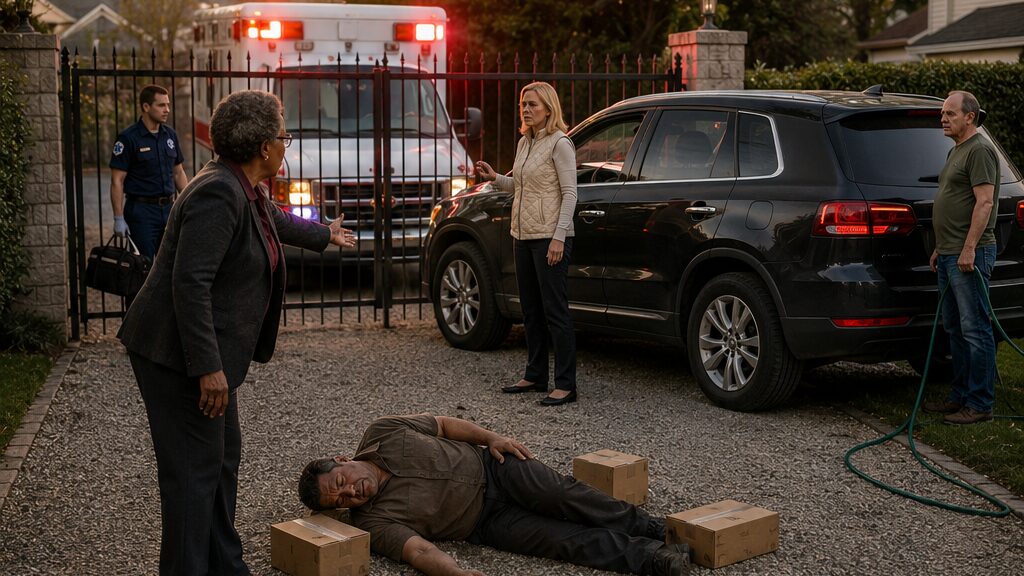
The ambulance stopped so hard its front end dipped toward the pavement.
Twenty feet beyond the gate, a man lay on his back beside three crushed cardboard boxes, one hand still curled against his chest.
Sharon Campbell heard the brakes before she understood what had happened. Then the siren cut down to a throbbing pulse, red light sweeping across the brick entrance columns, the black bars of the gate, and Donna Miller’s dark SUV sitting sideways across the narrow lane.
“Move your car!”
Sharon did not recognize her own voice.
Donna stood beside the driver’s door with one hand raised toward the ambulance as if she were stopping a contractor who had arrived on the wrong day.
“They have to wait.”
“Wait for what?”
“Temporary access has to be authorized.”
Sharon stared at her.
Behind them, the man on the gravel made a wet, shallow sound.
Ten minutes earlier he had been carrying a package toward Sharon’s porch. He had paused halfway up the drive, looked annoyed rather than frightened, and rubbed the center of his chest with the heel of his hand.
“You all right?” Sharon had called.
“Yeah. Just give me a second.”
Then his knees folded.
She had reached him before his head struck the gravel. His name, she later learned, was Mark Ramirez, but at that moment he was only a stranger whose face had gone frighteningly loose. Sharon had called 911 with one hand and tried to keep him responding with the other.
By the time she heard the ambulance, his lips were losing color.
Now the ambulance was here, and Donna’s vehicle was between it and him.
A paramedic leaned out the passenger window. “Ma’am, clear the lane.”
Donna pointed toward the keypad mounted on the stone post. “This is private property. Your vehicle isn’t in the entry system.”
Sharon took two steps toward her. “A man is dying twenty feet behind you.”
Donna’s jaw tightened.
“This is exactly why we have a process. We’ve had unauthorized vehicles damage that gate twice.”
“Do you hear yourself?”
“I hear you shouting.”
The old answer. The one Donna used at board meetings whenever Sharon pressed too hard: lower your voice, follow the process, submit the concern in writing. Sharon had spent six years watching urgency disappear inside polite sentences.
The rear doors of the ambulance opened. Two paramedics jumped down with equipment.
“Open the gate now,” one of them shouted.
Donna looked toward the approaching crew, then back at Sharon.
“I’m not accepting liability for an unverified entry.”
The paramedic nearest the gate stopped.
“He’s in cardiac arrest.”
Something in the lane changed.
Even the neighbor who had come out holding a garden hose lowered it to the ground.
Sharon expected Donna to move.
For one second, Donna did.
She stepped toward her SUV. Sharon felt a rush of relief so sharp it almost made her weak.
Then Donna reached through the open driver’s window toward the manual release mounted inside the gate post.
Metal struck metal.
Clang.
The latch settled into place.
Red emergency light washed over Donna’s cream vest and disappeared.
Sharon went still.
“You locked it,” she said.
Donna did not look at her. “I secured it until access is properly handled.”
The paramedic swore under his breath and turned to his partner. “Grab the monitor. We go over.”
Sharon’s first instinct was to keep yelling. She could already feel the words rising—years of words, board meetings, certified letters, complaints returned with procedural notes.
Then she saw Donna’s hand still resting near the latch.
Sharon reached into her pocket and pulled out her phone.
Donna gave a humorless laugh. “Of course.”
Sharon started recording.
She framed the gate, Donna, the SUV, the ambulance lights pulsing against the metal.
“Four forty-seven p.m.,” Sharon said clearly. “Emergency crew has stated the patient is in cardiac arrest. Donna Miller has manually re-engaged the gate latch.”
“Turn that off.”
Sharon kept filming.
“You always think a phone makes you right.”
“No.”
Her voice surprised her by becoming quiet.
“It makes this exact.”
The paramedics were already climbing. One passed a medical bag over the top rail. The other hauled himself across, landed hard, and ran.
Sharon lowered the phone.
There was no triumph in the recording. No satisfaction. Mark was still on the ground.
She shoved the phone into her pocket and pointed toward the side fence.
“There’s a service gap behind the utility hedge. It’s narrow, but you can get a folded stretcher through.”
The second paramedic looked at her. “Show me.”
Sharon ran.
At sixty-four, she had learned which pains could be negotiated with and which could not. Her right knee protested halfway across the gravel, but she kept moving, cutting behind the row of mailboxes and through the strip of grass that separated her lot from the association’s drainage easement.
“There,” she said, pulling branches aside.
The opening was ugly and half-hidden. Years earlier, before the new gate system, maintenance crews had used it to reach a utility box.
The paramedic squeezed through with equipment.
By the time Sharon returned to Mark, one rescuer was pressing hard against the center of his chest.
Another tore open packaging.
A machine spoke in a flat electronic voice.
Sharon stood three feet away, useless.
“Clear.”
Mark’s body jerked.
Nothing.
The paramedic resumed compressions.
Donna remained beyond the gate.
For the first time, she looked uncertain.
Sharon watched the crew work until someone guided her backward. She remembered fragments afterward: the stretcher arriving by hand, the sound of shoes sliding on gravel, a second shock, the neighbor crying without seeming to notice.
At some point, the gate was opened.
Sharon did not see who did it.
The ambulance finally came through and left with Mark inside.
The lane became quiet in the ugly way places do after emergencies. Boxes remained scattered near Sharon’s drive. One had split open, spilling rolls of packing paper into the dust.
Donna approached slowly.
“You should understand,” she began, “that there are serious issues with letting any vehicle—”
Sharon turned.
Donna stopped.
Sharon did not shout.
That seemed to trouble Donna more.
“You heard him say cardiac arrest.”
“I heard a lot of things at once.”
“You locked the gate after he said it.”
“I followed the security procedure we adopted after the damage incident.”
Sharon touched the phone in her pocket.
Donna’s eyes followed the movement.
“This is not going to become another one of your property campaigns.”
Sharon looked at the metal latch.
For years she had hated that gate for reasons she could explain in page numbers. The recorded lane. The access language. The amendment nobody could interpret the same way twice. She had copies of everything because copies did not interrupt, distort, forget, or call her difficult.
Now she saw the latch differently.
Not as an argument.
As a choice.
That evening, after a deputy had taken brief statements and after Sharon had learned only that Mark was alive when the ambulance reached the hospital, she sat alone in her home office.
She should have eaten. She should have called someone.
Instead she opened the bottom cabinet of her desk.
Inside sat a gray fire-resistant document box.
She had not touched it in months.
The key turned with a small resistance.
Property tax records. Closing papers. Survey copies. HOA notices. County correspondence.
Then her fingers found the thick folded sheet she wanted.
She opened it across the desk.
The paper crackled under her palms.
At the top, beneath a recorder’s stamp faded to purple, were the words:
RECORDED ACCESS EASEMENT.
Sharon looked from the legal description to the old site plan attached behind it.
Her breathing slowed.
The gate drawn on that paper was not the gate standing outside her house.
Chapter 2: The Paper Route Did Not Match the Metal Gate
At 12:18 a.m., Sharon laid a ruler across the recorded site plan and confirmed what her eyes had already told her.
The emergency access line ran east of the hinge post.
Outside, the physical gate had been built west of it.
She checked again.
Then a third time.
The old plan showed a twelve-foot clear corridor continuing through the entrance and along the lane toward her property. The current gate assembly narrowed that route with a fixed post, electronic arm, and manual latch housing.
Sharon sat back.
For a few dangerous minutes, anger felt like certainty.
There it was.
Donna had locked emergency responders out of an access corridor that, on paper, was supposed to remain passable.
Sharon pulled her laptop closer and began making a list.
Recorded easement.
Current gate plan.
911 dispatch log.
Video timestamp.
Board access policy.
She stopped with her fingers above the keyboard.
The old habits returned easily. Build the chronology. Separate fact from conclusion. Never underline before reading the entire instrument.
For eleven years at the county records office, Sharon had watched people arrive furious over deeds they had not read and relieved over documents that did not mean what they thought. She knew the difference between a strong fact and a satisfying one.
So she turned to page six.
The easement language was less clean than the drawing.
Ingress and egress, yes. Access for service and emergency purposes, yes. But maintenance and reasonable control of improvements were assigned, in part, to the “servient residential association or successor entity.”
Sharon read the sentence twice.
“Reasonable,” she whispered.
That word could feed lawyers for months.
At seven the next morning she was at the county records office before the public counter opened.
The clerk behind the glass recognized her.
“You look like you didn’t sleep.”
“I didn’t come for appearance review.”
The clerk’s mouth twitched. “Good morning to you too.”
Sharon slid a parcel number under the glass.
“I need the full chain on the access easement. Recorded amendments, exhibits, maintenance agreements, anything cross-referenced.”
The clerk glanced at the number.
“That development?”
“Yes.”
The clerk’s expression changed just enough for Sharon to notice.
“You heard?”
“About the ambulance? Half the county heard.”
Sharon looked away.
The clerk did not ask more. She disappeared into the back.
An hour later, Sharon occupied a research table beneath fluorescent lights with copies spread around her.
The original easement remained intact.
That was the first small victory.
No release. No extinguishment. No recorded abandonment.
Sharon felt something inside her loosen.
Then she found the amendment.
It had been recorded fourteen years after the original subdivision plan and six years before Sharon bought her house.
The document authorized the association to maintain “security improvements” at the entrance, subject to continued access rights.
Attached was a later sketch.
Sharon placed it beside the original site plan.
Two gates.
Two alignments.
The first preserved a straight corridor.
The second introduced the fixed post and control housing now standing in the lane.
She traced the lines with one finger.
“Who approved you?”
The amendment bore signatures from the association and a former property owner. It did not clearly approve the precise current installation. The sketch was stamped received, not necessarily engineered. A note referenced “field adjustment as required.”
Sharon hated phrases like that.
They were where certainty went to hide.
Her phone vibrated.
A message from the HOA management portal.
NOTICE TO MEMBERS: Due to yesterday’s medical incident, residents are reminded that emergency personnel are not subject to ordinary guest authorization once identity is confirmed. The board is reviewing compliance with entry procedures.
Sharon read it again.
Once identity is confirmed.
Donna was already building a softer version of what had happened.
Not refusal.
Verification.
Not obstruction.
Procedure.
Sharon opened her video and stopped at the frame where the paramedic stood at the gate.
She advanced five seconds.
Donna’s hand moved.
The latch closed.
Sharon captured the timestamp.
At the records counter, she requested certified copies of the original easement and amendment.
The clerk counted pages.
“You planning to fight the association?”
“I’m planning to know what I’m talking about.”
“That wasn’t my question.”
Sharon met her eyes.
“No. It wasn’t.”
Back home, she spread the documents across her dining table because the office desk was too small.
The old plan.
The amendment.
A printout of the current parcel map.
A photograph of the gate.
For the first time since the ambulance left, she felt the shape of an argument.
The easement had not disappeared.
The emergency-access purpose remained.
The present gate did not clearly match the original alignment.
Donna’s temporary-access policy could not simply erase recorded rights.
But another truth sat beside those facts: the HOA may have possessed some authority to control and maintain the entrance. The documents did not hand Sharon the clean victory she wanted.
She leaned back and closed her eyes.
Years earlier, she might have called that uncertainty weakness.
Now she knew better.
Uncertainty did not erase facts. It only demanded more of them.
She opened her old correspondence folder.
There were letters to Donna. Responses from management. Meeting minutes with Sharon’s comments reduced to phrases like “owner raised concern regarding access.”
Then she found a photograph she had taken six months earlier.
The gate.
The latch.
A yellow tape measure stretched from the fixed post to the opposite curb.
Sharon stared at it.
She did not remember printing the photograph.
She turned it over.
Nothing.
Beneath it was a photocopy of the amended sketch.
In the margin, written in dark blue ink, was a note.
CURRENT LATCH HOUSING ENCROACHES APPROX. 19″ INTO RECORDED CLEAR LINE. VERIFY BEFORE MEDIATION.
Sharon’s fingers stopped.
She knew the handwriting immediately.
Her own.
The room seemed to narrow around the table.
Six months earlier.
Before Mark collapsed.
Before the ambulance.
Before Donna’s hand closed that latch.
Sharon sat very still, looking at the note she had made and never sent to anyone.
Chapter 3: The Evidence Against Donna Also Pointed Back at Sharon
“Why did you wait until somebody almost died?”
Nicole Wright asked the question in a hospital corridor before Sharon had introduced herself properly.
There was no raised voice. That made it worse.
Nicole stood beside a vending machine with her arms folded tightly across her chest. She had Mark’s eyes, Sharon thought, though she had only seen his open for seconds before he lost consciousness.
“I didn’t wait for this to happen.”
“But you knew there was a problem with the gate.”
Sharon held the folder against her side.
“I knew the installed configuration might conflict with an older recorded plan.”
Nicole stared at her.
“That is the kind of sentence people use when they don’t want to say yes.”
The hospital corridor smelled faintly of disinfectant and burnt coffee. At the nurses’ station, a phone rang twice and stopped.
Sharon looked toward Mark’s room.
“I came because I wanted to ask about using the dispatch timing and, eventually, his account of what happened.”
“For what?”
“An independent complaint. Fire inspection. HOA review. Possibly insurance.”
Nicole gave a short laugh without humor.
“My father is in there learning that his heart stopped, and people are already deciding what his worst day is useful for.”
“That isn’t what I’m doing.”
“Isn’t it?”
Sharon felt the old defensive machinery engage.
Facts lined themselves up inside her.
Donna had blocked access.
Donna had heard cardiac arrest.
Donna had closed the latch.
Sharon had video.
The easement remained recorded.
All of it true.
Nicole stepped closer.
“The neighbor told me you’ve been fighting that board for years.”
“Your father nearly died because emergency access was obstructed.”
“My father nearly died because his heart stopped.”
The words landed cleanly.
Nicole’s face tightened.
“And yes, maybe the delay mattered. I think it did. I keep hearing that siren in my head, and I wasn’t even there. But don’t turn him into proof that everything you ever said about those people was right.”
Sharon looked down at the folder.
For once, paper offered no immediate shelter.
“I’m sorry,” she said.
Nicole’s expression did not soften.
“For what part?”
Sharon almost answered too quickly.
Instead she said, “For arriving with a request before asking what your family needed.”
That changed something—not forgiveness, but perhaps the direction of the anger.
A nurse appeared at Mark’s door.
“He’s awake again.”
Nicole turned at once.
The nurse lowered her voice. “Just briefly. Keep it calm.”
Nicole looked at Sharon.
“You can come in for one minute. No questions about the HOA.”
Sharon nodded.
Inside, Mark looked smaller than he had on the gravel. Tubes, tape, monitor wires. His face had color again, but not strength.
Nicole moved to his bedside.
“Dad?”
His eyes opened halfway.
“Hey.”
His voice was rough.
Nicole bent close, laughing once through tears she immediately wiped away.
Mark’s gaze drifted past her and found Sharon.
Recognition took several seconds.
“You,” he whispered.
Sharon stepped nearer.
“I’m Sharon. You collapsed at my house.”
His brow moved.
“The boxes.”
“Yes.”
A faint grimace.
“Didn’t finish.”
Nicole made a sound between a laugh and a sob.
“No, Dad. You did not finish the delivery.”
Mark closed his eyes, then opened them again.
“People filming?”
Sharon felt heat rise into her face.
Nicole glanced at her.
“There’s video of the gate,” Sharon said carefully. “Not of you, from me.”
Mark swallowed.
“Don’t want… internet.”
“It won’t come from me.”
His eyes stayed on her as if testing the sentence.
Then he whispered, “Good.”
The nurse stepped forward.
“That’s enough.”
Outside the room, Nicole leaned against the wall.
“He’s been asking that since he woke up the first time.”
“Why?”
“Because somebody told him a neighbor posted about the ambulance. No video of him, apparently. But he knows people talk.”
Sharon thought of her own phone held steady while the gate flashed red.
Evidence could preserve truth.
It could also take possession of a moment.
Nicole looked at the folder again.
“What exactly did you know before?”
Sharon could have answered narrowly.
She could have said she knew only of a discrepancy.
She could have explained that she had planned to verify it.
She could have described the failed history with Donna, the meetings where concerns became minutes and minutes became nothing.
Instead she said, “Six months ago I measured the latch housing. I believed it encroached into the clear access line shown on the old plan.”
Nicole’s face went still.
“Did you tell anyone?”
“I raised access concerns before.”
“That’s not what I asked.”
Sharon looked through the glass panel toward Mark’s bed.
“No.”
“Why?”
Because she had been tired of being patronized.
Because Donna had called her submissions repetitive.
Because a previous property dispute had taught Sharon what happened when institutions decided your tone mattered more than your facts.
Because Donna had offered mediation, and Sharon had suspected it was only a way to dilute the record.
All true.
None sufficient.
“I didn’t trust the board to handle it honestly.”
Nicole nodded once.
“And they didn’t trust you.”
“No.”
“So everybody protected themselves.”
Sharon had no answer.
Two days later, Nicole came to Sharon’s kitchen.
The gray document box sat on the sideboard, locked.
Sharon noticed Nicole notice it.
Neither mentioned it.
“I spoke with the paramedic supervisor,” Sharon said. “They won’t make a medical causation statement. They can confirm the timeline and that access was delayed.”
“Good.”
Sharon blinked.
“Good?”
“I don’t want people claiming they know exactly what would have happened.”
Nicole wrapped both hands around a mug she had barely touched.
“But I also don’t want them pretending the delay was nothing.”
“That’s fair.”
Nicole studied her.
“You really don’t hear yourself, do you?”
“What?”
“You say things like you’re stamping them approved.”
Sharon almost smiled.
Almost.
Nicole looked toward the box.
“Are all your records in there?”
“Most of them.”
“Including the note?”
“Yes.”
“And you still haven’t shown the board?”
“I’m assembling the full chain first.”
“There it is again.”
Sharon’s shoulders stiffened.
Nicole stood.
“I’m not giving permission for you to use my father’s name in a public campaign. Not now.”
Sharon felt the loss immediately. A case without the human center would be easier for the board to reduce to another technical dispute.
“I understand.”
“Do you?”
“Yes.”
Nicole picked up her bag.
At the door, she stopped.
“For what it’s worth, I believe you tried to save him.”
Sharon looked at her.
Nicole continued, “I also think you need to figure out why being right six months ago mattered more to you than making sure somebody listened.”
Then she left.
Sharon remained in the kitchen.
The document box sat six feet away.
Locked.
Her phone buzzed on the table.
A message from Patrick Nelson.
Patrick rarely contacted her directly. As HOA treasurer, he specialized in careful neutrality—sentences that entered a room and left no fingerprints.
The message contained no greeting.
I think you should see this before the board meets.
An attachment followed.
Sharon opened it.
The document carried the insurer’s letterhead. The date was four months old.
She read the subject line once.
Then again.
SECOND EMERGENCY-ACCESS WARNING — CORRECTIVE ACTION REQUIRED.
Sharon scrolled to the distribution list.
Donna Miller was the first recipient.
Chapter 4: The Board Had Been Warned Before the Sirens Came
The insurer had used four words Donna could not explain away.
EMERGENCY ACCESS FAILURE.
Sharon read them from Patrick’s phone while he stood beside her in the HOA records room, breathing through his nose as if even the sound of the words might travel under the door.
The letter was four months old.
The first warning, Patrick admitted, was older.
“How much older?”
He looked toward the locked filing cabinet.
“Eight months.”
Sharon lowered the phone.
“You had two warnings.”
“We had two letters.”
“That is what a warning is when an insurance company sends it.”
Patrick rubbed a hand over his mouth.
The records room occupied the back of the clubhouse, behind folding chairs and holiday decorations. Metal shelves held binders labeled by year. The air smelled of dust and printer toner.
Sharon had expected anger to sharpen her.
Instead, she felt something colder.
“Show me the first one.”
“I can’t just hand you board correspondence.”
“You already handed me the second.”
“I showed it to you.”
“Patrick.”
He flinched at the use of his name.
For years he had been the man who looked down at spreadsheets while Donna spoke. Treasurer. Careful. Soft-voiced. Always concerned about process, never quite present when process hurt anyone.
Now he unlocked the cabinet.
The first letter was shorter.
The insurer’s inspector had noted that the entrance gate lacked a tested emergency override accessible to responding agencies. It recommended corrective action before renewal review.
Attached was a photograph.
Sharon leaned closer.
There it was.
The latch.
The same squared metal housing Donna’s hand had reached toward while red lights moved across the gate.
A yellow inspection arrow pointed directly at it.
Sharon touched the page with one finger.
“She knew.”
Patrick’s face tightened.
“She knew there was concern.”
“She knew enough to receive a second warning.”
“That is not the same as knowing what would happen that day.”
“No.”
Sharon looked at him.
“What happened that day was a choice.”
The informal board meeting began twenty minutes later.
Donna sat at the head of the long table without her usual binder. Two board members occupied one side. Patrick sat at the other, leaving the chair beside Sharon empty.
Donna noticed.
Her eyes moved from Patrick to Sharon.
“So this is how we are doing it now.”
Patrick said nothing.
Sharon placed copies of the insurer letters on the table.
Donna’s expression changed only once, and only briefly.
“You had no authority to distribute confidential correspondence.”
Patrick looked down.
Sharon said, “You can discuss confidentiality after we discuss why emergency-access warnings were not disclosed to residents.”
Donna folded her hands.
“They were risk-control recommendations.”
“The second says corrective action required.”
“And the proposed correction was not free.”
One board member shifted in his seat.
Donna continued, “You want context? Fine. The first contractor estimate was forty-eight thousand dollars.”
Sharon had expected denial.
The number stopped her.
Donna saw it.
“Yes,” she said. “Forty-eight thousand. The second estimate was fifty-three.”
Patrick spoke quietly.
“Before engineering.”
Donna turned toward him.
“Exactly.”
The other board member muttered, “That would have been what, twelve hundred a household?”
“More for larger lots,” Patrick said.
Donna leaned back.
“After dues rose the previous year. After residents threatened to vote out anyone who approved another assessment. After an unauthorized moving truck damaged the gate and half this neighborhood demanded stricter access control.”
Sharon looked at the insurer’s photograph.
“You could have told them.”
“And said what? Congratulations, everyone, your monthly budget is already strained and now we may need another thousand dollars from each house because an inspector used cautious language?”
“Emergency access failure is not cautious language.”
“It is insurance language.”
Sharon felt anger return.
“Mark Ramirez’s heart stopped behind that gate.”
Donna’s face hardened.
“And I did not cause his heart to stop.”
“No.”
The room went silent.
Sharon forced herself not to fill it.
Donna’s voice dropped.
“I am tired of people saying I nearly killed a man. I did not give him heart disease. I did not decide he should ignore his own symptoms. I did not design that gate.”
“You closed it.”
“I followed the access protocol because we had been told repeatedly to control entry.”
“By whom?”
“The same residents who complained when packages disappeared. The same people who blamed the board for the truck damage. The same people who would have demanded my resignation if I opened the gate to an unverified vehicle and something happened.”
“It was an ambulance.”
“I saw a vehicle with lights behind another vehicle blocking my view.”
Sharon stared at her.
“You heard the paramedic say cardiac arrest.”
Donna’s fingers tightened around each other.
For the first time, she looked away.
That was enough.
Not legally.
Not institutionally.
But humanly.
Enough.
Patrick opened a spreadsheet on his laptop.
“The reserve account could not absorb the full correction.”
Donna gave him a sharp look.
He continued anyway.
“We discussed a phased project.”
“And rejected it,” Sharon said.
Patrick hesitated.
“Deferred.”
“Same result.”
“No,” Donna said. “Not the same. We were trying to avoid putting people in a position where they had to choose between assessments and groceries.”
The sentence landed harder than Sharon wanted it to.
She thought of the older couple near the mailboxes. The single mother who had argued about dues at the last annual meeting. The retired man who paid assessments in three checks because one would not clear.
Donna saw the shift in her face.
“Do not mistake pressure for malice.”
“I don’t.”
Donna blinked.
Sharon looked again at the photograph of the latch.
“But pressure does not move your hand for you.”
Patrick closed his laptop.
“There is more.”
Donna stood.
“No.”
Patrick did not look at her.
“The board delayed the second warning from general disclosure because we were waiting for the management company to confirm whether it had to be listed in the renewal materials.”
One of the unnamed board members stared at him.
“You told us counsel was reviewing it.”
“They were.”
“For four months?”
Patrick swallowed.
Donna’s voice went flat.
“You are not going to rewrite your own participation because you are scared now.”
“I am not.”
“You signed the budget recommendation.”
“Yes.”
“You argued against an emergency assessment.”
“Yes.”
“And now you slide emails to Sharon in hallways?”
Patrick looked at her then.
“Yes.”
The honesty seemed to strip something from the room.
Sharon felt no satisfaction.
This was not a hidden conspiracy opening neatly under pressure. It was worse in a more ordinary way: people had known pieces, postponed decisions, softened language, waited for someone else to take the risk.
Donna gathered the letters into a stack.
“You want the full record? Take the full record.”
She crossed to a side cabinet and pulled out a thin folder.
Then she placed it in front of Sharon.
On top was a meeting notice.
Six months old.
PROPOSED ACCESS EASEMENT MEDIATION.
Sharon’s stomach tightened before she read the next page.
Her own name appeared beside a notation.
OWNER DECLINED PARTICIPATION.
Donna watched her.
“You measured the gate, didn’t you?”
Patrick looked at Sharon.
The room became very still.
Donna tapped the folder.
“You raised the discrepancy. Management proposed mediation. You refused to attend.”
Sharon heard Nicole’s voice in the hospital corridor.
Why did you wait until somebody almost died?
Donna leaned closer.
“You keep talking about what I knew.”
Her finger remained on Sharon’s name.
“Tell them what you knew.”
Chapter 5: The Meeting Where Nobody Could Keep a Clean Story
“Show them the note.”
Donna did not raise her voice.
She did not need to.
The clubhouse was full enough that residents stood along the back wall, shoulders against the bulletin board and trophy case. Phones rested faceup on laps. Folding chairs scraped whenever someone shifted.
Sharon sat at the front table with the gray document-box key in her pocket.
Donna stood three feet away.
“Show them,” she repeated, “the note you made six months before the ambulance came.”
A murmur moved through the room.
Sharon looked at Patrick.
He looked sick.
The property-management representative sat beside a stack of printed agendas, saying nothing.
Sharon had spent the previous week preparing for this meeting.
She had organized the insurer letters.
Prepared a timeline.
Printed still frames from her video.
Marked the easement language.
She had imagined Donna minimizing everything.
She had imagined herself correcting the record.
She had not imagined beginning here.
A resident near the aisle said, “What note?”
Donna kept her eyes on Sharon.
“The one where she identified the same access discrepancy she now says made the gate dangerous.”
Sharon felt every old instinct tell her to narrow the answer.
The note was preliminary.
The measurement was approximate.
The legal effect was unresolved.
All true.
All available.
She reached into her bag and removed the photocopy.
The room quieted.
“I wrote this,” she said.
Someone in the back asked, “When?”
“Six months ago.”
The murmur returned, sharper.
Sharon placed the page flat on the table.
Her own handwriting looked larger under the fluorescent lights.
CURRENT LATCH HOUSING ENCROACHES APPROX. 19″ INTO RECORDED CLEAR LINE. VERIFY BEFORE MEDIATION.
A man in the second row said, “You knew?”
“I knew there was a discrepancy.”
Donna gave a short, bitter laugh.
“There. That sentence.”
Sharon looked at her.
“What?”
“That sentence you use whenever plain words might touch you.”
The room went still again.
Donna pointed at the note.
“You measured the gate. You believed it was wrong. You were invited to mediation.”
“I did not believe the board was approaching mediation in good faith.”
“And so you kept it.”
Sharon’s hand moved toward her pocket.
The key pressed against her palm through the fabric.
A woman near the back said, “Why weren’t residents told about any of this?”
Patrick answered.
“Because the board was still reviewing the insurance recommendations.”
“That was months.”
“Yes.”
“And the access issue?”
Patrick looked toward Sharon.
She understood the invitation.
Or perhaps the trap.
Either way, the answer was hers.
“I did not circulate my measurement.”
The words felt small.
A resident said, “Why not?”
Sharon could hear herself breathing.
She looked around the room.
Some faces were angry at Donna.
Some at the board.
Now some at her.
Good, she thought suddenly.
Not because she wanted their anger.
Because for the first time, nobody in the room could hide inside a clean story.
“I had raised access issues before,” Sharon said. “I believed management minimized them. I believed Donna treated my concerns as personal attacks. When mediation was proposed, I thought it would produce another file full of language and no correction.”
Donna crossed her arms.
“So you refused.”
“Yes.”
“You trusted yourself more than everyone else.”
Sharon almost answered that she had reason.
Instead she said, “Yes.”
That unsettled Donna more than an argument would have.
The room held the word.
A neighbor Sharon recognized from the lane spoke up.
“Wait. Are we saying Sharon caused this?”
“No,” Nicole said from the back.
Sharon turned.
She had not known Nicole would come.
Nicole stood beside the door, arms folded.
“My father’s heart stopped. The ambulance was blocked. Those are facts. Do not use Sharon’s mistake to erase what happened at the gate.”
Donna’s face tightened.
Nicole continued.
“And do not use my father to pretend Sharon made no mistake either.”
No one spoke.
Sharon looked at her.
Nicole gave no sign of reassurance.
That made the intervention feel more honest.
The property-management representative finally leaned toward the microphone.
“We should keep comments focused on governance and access procedure.”
A man near the wall snapped, “That is what everybody has been doing. Focusing until nobody did anything.”
Several people spoke at once.
Special assessment.
Insurance.
Who knew what.
Why the gate was changed.
Whether Donna should resign.
Whether Sharon should have reported the measurement.
Whether Mark’s family planned to sue.
Nicole’s face changed at that.
“No.”
The single word cut through the noise.
She stepped forward.
“You do not get to discuss my father like he is a legal strategy.”
The room quieted.
“He is alive,” she said. “He is embarrassed that strangers know his heart stopped. He does not want his name on somebody’s campaign. He also remembers almost nothing, so stop inventing what he would say.”
Sharon felt the folder in front of her become suddenly obscene.
Timelines.
Screenshots.
Useful, necessary facts.
But facts did not own Mark.
Patrick rose halfway from his chair.
“We need an independent review.”
Donna turned on him.
“You mean an investigation of me.”
“I mean all of it.”
His voice shook, but he kept going.
“The insurer letters. The board delay. The access policy. The gate installation. Sharon’s prior notice. The emergency timeline.”
One board member said, “That could expose the association.”
Patrick looked exhausted.
“We are already exposed.”
The room erupted again.
Sharon stopped listening.
Her fingers had closed around the key in her pocket.
For years the document box had been the one place nobody could revise her memory.
After an earlier property dispute, she had watched meeting minutes reduce an hour of testimony to “owner expressed dissatisfaction.” She had learned to keep copies, timestamps, certified envelopes.
Documents did not save her then.
But they let her know she had not imagined what happened.
Somewhere along the way, proof had become more than protection.
It had become permission not to trust anyone.
Sharon stood.
The room slowly quieted.
She removed the key from her pocket.
It was a small brass thing, unimpressive under the lights.
“I have more records than the pages on this table.”
Donna watched her carefully.
“Of course you do.”
Sharon ignored the tone.
“I have correspondence going back years. Board notices. My measurements. My unanswered drafts. The mediation invitation I declined.”
Patrick looked up.
Sharon continued.
“I also have notes that make me look better than I deserve.”
A faint movement passed through the room.
“And notes that do not.”
She placed the key on the table.
The click was almost lost in the ventilation hum.
“I will provide the full box to an independent reviewer.”
Donna stared at her.
One resident said, “Everything?”
“Yes.”
“Even private correspondence?”
“Anything relevant to the access dispute.”
The property-management representative leaned forward.
“Ms. Campbell, you should consider legal advice before—”
“I have considered protecting myself.”
Sharon looked toward Nicole.
“I have done a great deal of that.”
Nicole’s expression softened by a fraction.
Donna stepped closer to the table.
“You think this makes you noble?”
“No.”
Sharon met her eyes.
“I think it makes the record complete.”
Donna’s gaze dropped to the key.
For the first time since the ambulance incident, Sharon saw something other than defiance in her face.
Fear.
Not fear of Sharon.
Fear of the whole story.
Patrick picked up the proposed motion for independent review.
The vote did not pass cleanly.
Nothing did anymore.
But it passed.
After the meeting, residents clustered in angry knots. Nicole left without speaking to Sharon. Donna disappeared through the side door.
Patrick remained by the table.
“You understand,” he said, “they may use your own records against you.”
Sharon looked at the key between them.
“Yes.”
“You could limit the production.”
“Yes.”
He waited.
Sharon slid the key toward him.
“No limits.”
Patrick did not touch it immediately.
When he finally did, Sharon felt the strangest sensation.
Not relief.
Loss.
The box was still in her house, but for the first time, what it contained no longer belonged only to her version of events.
Chapter 6: Mark Survived, but He Refused to Become Their Weapon
Mark’s first question to Sharon was not about the gate.
It was about the ground.
“Did anybody film me lying there?”
He sat in a rehabilitation chair beside the hospital window, thinner than before, one hand resting over the blanket across his knees.
Sharon had left her phone face down on the table before entering.
“No,” she said. “Not me.”
Mark studied her.
Nicole stood near the door.
“There was video of the gate,” Sharon added. “The ambulance. Donna. Not you.”
“Good.”
His voice was stronger than it had been days earlier, but every few sentences seemed to cost him.
Sharon opened the folder on her lap and stopped.
Mark noticed.
“You brought homework.”
Nicole gave him a look.
“Dad.”
“What? Looks like homework.”
Sharon almost smiled.
“I brought a request.”
Mark leaned back.
“Everybody does.”
The sentence removed the smile.
A representative from the HOA insurer had asked for records. The board’s independent reviewer wanted a patient-impact statement. A neighbor had suggested a local news station. Someone online had posted that Mark was a father of three, which was not true.
Sharon closed the folder again.
“The reviewer wants permission to use factual timing related to your emergency. Dispatch, arrival, access delay.”
“Not my medical chart.”
“No.”
“My diagnosis?”
“No.”
“Pictures?”
“No.”
He looked at Nicole.
“She rehearsed you.”
“I did not,” Nicole said.
“She did,” Sharon said.
Nicole’s mouth tightened, but Mark gave a tired laugh.
The sound changed the room.
Then he became serious.
“I don’t want to be the guy who almost died because of an HOA.”
Sharon said nothing.
“I deliver things,” he continued. “I fix motorcycles badly. I forget birthdays. Apparently I ignore chest pain.”
Nicole looked away.
Mark rubbed his thumb against the chair arm.
“I had pressure for two days.”
Sharon felt herself go still.
“Two days?”
“On and off.”
Nicole’s voice sharpened.
“He told himself it was indigestion.”
Mark looked at the ceiling.
“It felt like indigestion.”
“You were sweating through your shirt.”
“I work outside.”
“You see?” Nicole said to Sharon. “This is what he does.”
Mark’s expression closed.
Sharon recognized the move.
Not denial exactly.
Control.
The instinct to make a frightening thing smaller by choosing the least dangerous language available.
Donna did it with risk recommendations.
Sharon did it with discrepancies.
Mark did it with chest pain.
Different stakes. Same human habit.
“I am not asking you to blame anyone for your heart stopping,” Sharon said.
Mark looked back at her.
“And I am not asking you to say the delay caused an outcome no doctor has said it caused.”
Nicole’s posture eased slightly.
“What are you asking?” Mark said.
“Permission to use the objective timing. Nothing more.”
He considered it.
“Why?”
“Because the access system failed.”
“That is your answer.”
“Yes.”
“Not because Donna is awful?”
Sharon hesitated.
Mark noticed.
Nicole did too.
Sharon said, “Donna made a choice I believe she should answer for.”
“Better.”
“But the board delayed warnings. The gate design was disputed. I knew there was an access discrepancy and did not share everything I had.”
Mark frowned.
“You?”
“Yes.”
Nicole watched her carefully.
Mark shifted in the chair.
“So everybody messed up.”
“Not in the same way.”
“No.”
He looked toward the window.
“That would be too easy.”
A nurse entered to check his monitor and reminded them to keep the visit short.
When she left, Mark reached for the pen on the table.
“I’ll sign for timing records.”
Nicole said, “Dad, you don’t have to.”
“I know.”
He looked at Sharon.
“No speeches. No clips. No picture of me in a hospital bed.”
“Agreed.”
“And if somebody says I would have been fine if the gate opened ten seconds sooner, you correct them.”
“Yes.”
“If somebody says the delay didn’t matter because I survived, you correct that too.”
Sharon felt the sentence settle into her.
“Yes.”
Mark signed.
It was not the testimony she had once imagined wanting.
It was better.
Two hours later, in the hospital cafeteria, Nicole sat across from Sharon with untouched coffee between them.
“You could have pushed him harder.”
“I know.”
“You didn’t.”
“No.”
Nicole watched her for several seconds.
“I was wrong about one thing.”
Sharon waited.
“I thought you wanted to win more than you wanted the truth.”
Sharon looked down at her hands.
“So did I.”
Nicole exhaled.
“That is not an apology.”
“No.”
“Good.”
A faint smile appeared and disappeared.
The independent review moved faster after Mark’s limited consent.
Without emotional testimony, the story became colder on paper.
911 call received.
EMS dispatched.
Ambulance arrived.
Access obstructed.
Crew advised gatekeeper of cardiac arrest.
Manual latch engaged.
Alternate foot entry used.
Vehicle access delayed.
Sharon read the preliminary sequence at the property-management office three days later.
Patrick sat opposite her. The property-management representative stood near the printer. Donna had declined to attend the preliminary findings session.
The reviewer’s summary was careful.
No medical causation conclusion.
No criminal determination.
No simple statement that one act explained everything.
Sharon respected it for that.
Then she reached the final page.
Patrick was reading the same paragraph.
His face changed.
“What?”
He turned the document toward her.
The reviewer had synchronized Sharon’s phone video with dispatch audio and the ambulance unit timestamp.
At 4:46:51 p.m., the paramedic stated the patient was in cardiac arrest and requested immediate access.
At 4:47:03, Donna’s hand moved toward the control housing.
At 4:47:06, the latch audibly engaged.
Sharon stared at the times.
Twelve seconds.
The reviewer’s conclusion appeared below:
Available evidence supports that the manual gate latch was deliberately re-engaged after the emergency crew communicated the nature of the medical emergency.
Patrick sat back.
For months he had looked like a man trying to stand between two doors and keep both from closing.
Now one had shut.
“She knew,” he said.
Sharon thought of Donna at the board table.
Forty-eight thousand dollars.
Residents choosing between assessments and groceries.
Insurance pressure.
The damaged gate.
All of it real.
None of it moved her hand for her.
The property-management representative asked quietly, “What happens now?”
Sharon looked at the page.
For the first time, she did not want the simplest answer.
Because the record had become complete enough to show what simplicity would erase.
Donna had made the acute choice.
The board had delayed.
Patrick had avoided conflict.
Sharon had withheld what she knew.
Mark had ignored his own warnings.
And none of those truths canceled another.
Patrick folded his hands.
“There is already a motion circulating to remove Donna from the board.”
Sharon looked up.
“From the board?”
“And another to bar her from any gate authority immediately.”
“The second one makes sense.”
“The first one includes a public censure.”
The representative said, “Some residents want the meeting streamed.”
Sharon felt something old stir in her.
The image of Donna’s hand.
The clang.
The ambulance lights.
For one second, public humiliation felt like balance.
Then she remembered Mark asking whether anyone had filmed him on the ground.
She closed the report.
“Send me the full motion.”
Patrick looked surprised.
“Why?”
“Because if we turn this into a punishment show, we will learn nothing except how to choose the next person we hate.”
Patrick stared at her.
Her phone remained face down beside the report.
Before anyone could answer, the printer behind the property-management representative came alive.
A single page slid into the tray.
The final independent finding.
The representative lifted it, read silently, then passed it to Sharon.
Donna Miller was to be removed from operational control of the gate pending formal board action.
Sharon read the sentence twice.
The question was no longer whether Donna would face consequences.
It was whether the community would mistake consequences for repair.
Chapter 7: The New Gate Opened Before Anyone Had to Ask
Donna arrived at the meeting carrying no binder.
That was the first thing Sharon noticed.
For years, Donna had entered HOA meetings behind a shield of tabs, printed policies, color-coded agendas, and pages marked with yellow flags. Six weeks after the ambulance stopped outside the gate, she walked into the clubhouse with only a folded sheet of paper in one hand.
She was still a board member.
She was no longer allowed to touch the gate controls.
The room followed her in silence.
At the front table, the independent review sat in stapled packets. Beside each copy lay three proposals: emergency-access correction, phased assessment, governance reform.
And a fourth motion.
PUBLIC CENSURE OF DONNA MILLER.
Sharon had read it twice before the meeting began.
The language did not merely remove authority. It recounted the worst seconds of the emergency, proposed that Donna’s conduct be published in the association newsletter, and required her to read a formal acknowledgment into the meeting record.
A month earlier, Sharon might have called that accountability.
Now she was not sure.
Donna took her seat.
Patrick cleared his throat.
“We have a quorum.”
No one answered.
The property-management representative summarized the independent findings in a voice so neutral it made the details heavier.
The association had received two emergency-access warnings.
The board had deferred corrective action.
The existing gate configuration did not clearly preserve the full access geometry shown in the original recorded plan.
Sharon had identified a discrepancy and withheld her measurement from the broader membership.
Donna had manually re-engaged the latch after an emergency responder communicated that the patient was in cardiac arrest.
No single fact erased another.
When the representative finished, a resident in the second row said, “So who is being sued?”
Several people turned.
Patrick closed his eyes briefly.
The representative said, “That is not the question before the membership tonight.”
“It will be.”
“Possibly.”
Another resident lifted the assessment sheet.
“Three years?”
Patrick nodded. “The correction can be phased over three years if the reserve transfer is approved.”
“Meaning we pay for their mistake.”
Donna spoke for the first time.
“Our mistake.”
Heads turned toward her.
Her voice was low.
“The board deferred the work.”
One of the unnamed board members shifted uncomfortably.
Donna continued.
“I supported that decision.”
The room did not soften.
A woman near the aisle said, “And then you locked the ambulance out.”
Donna’s mouth tightened.
“Yes.”
No explanation followed.
Sharon had expected one.
Insurance.
Security.
The damaged moving truck.
Pressure.
All the true things Donna had once stacked between herself and the moment.
Instead, she looked at the folded paper in her hand.
“I heard the paramedic,” she said.
The room became still.
“I told myself I needed ten more seconds to control the situation.”
Sharon felt the words move through her.
Donna looked down.
“I was wrong.”
No applause.
No forgiveness.
Just the ventilation system humming overhead.
Patrick moved to the motions.
The first passed quickly: Donna would remain barred from operational gate authority pending the next board election and completion of corrective measures.
The second established independent emergency-access testing.
The third required insurer warnings involving life-safety systems to be disclosed to members within ten business days.
Then came the censure.
A resident immediately moved for approval.
Another seconded.
Patrick looked at Sharon.
She did not know why.
Perhaps because everyone knew the motion existed because of what had happened outside her house.
Perhaps because, for weeks, people had treated her anger as a kind of public property.
“Discussion?” Patrick asked.
A man near the back stood.
“She should read it.”
Several voices agreed.
“People need to hear exactly what she did.”
“Put it in the newsletter.”
“She embarrassed this whole community.”
Donna sat motionless.
Sharon looked at the censure text.
Then at the brass key on her own key ring.
She had started carrying the document-box key again after the reviewer returned her records. But it felt different now. Less like a lock. More like a reminder of what she had once kept from everyone.
She raised her hand.
Patrick recognized her.
Sharon stood.
“I oppose the motion as written.”
The reaction was immediate.
“What?”
“After everything?”
Someone laughed sharply.
Donna looked at her for the first time.
Sharon continued.
“I support the findings. I support removing gate authority. I support recording the decision.”
A resident interrupted. “Then what is the problem?”
“The part where we pretend humiliation is a safety system.”
The room quieted unevenly.
The man in back said, “She humiliated herself.”
“Maybe.”
Sharon looked at Donna.
“But making her read a confession for us will not open that gate one second faster.”
A woman near the aisle folded her arms.
“So she gets away with it?”
“No.”
Sharon’s voice stayed level.
“She loses authority. The finding remains public to members. The review stays in the association record. That is consequence.”
She touched the assessment proposal.
“And this is consequence too. We delayed. The board delayed. I withheld information because I trusted my own file box more than I trusted any of you.”
No one interrupted now.
“I will pay my share of the correction.”
A resident said, “You are not equally responsible.”
“I did not say I was.”
Sharon looked around the room.
“Different failures do not become identical because they are in the same report.”
Nicole stood at the back wall.
Their eyes met.
Sharon continued.
“If we need Donna to be a monster, then the rest of us get to be innocent. The record does not say that.”
Donna’s face changed.
Only slightly.
Patrick called for an amendment.
The public-recitation requirement was removed.
The newsletter language was reduced to a factual summary of findings and board actions.
The amended censure passed.
Donna voted against it.
Sharon was glad she did.
The emergency-access project took longer.
Nothing about repair looked dramatic.
There were contractor bids, engineering notes, county questions, arguments over reserve transfers, and three meetings where residents complained about the assessment.
The final plan removed the old manual latch housing from the clear corridor and installed a verified emergency override system accessible to responding agencies. The board adopted a testing schedule. Access failures had to be logged. Life-safety correspondence could no longer disappear into closed folders.
On installation day, Sharon stood beside the lane while a worker unbolted the old latch.
The metal housing came free with a scrape.
He set it on the pavement.
Sharon stared at it.
Smaller than she remembered.
That surprised her.
For weeks, the latch had occupied more space in her mind than the gate itself.
Donna approached from the clubhouse side.
She stopped several feet away.
Neither woman spoke at first.
Finally Donna said, “They are keeping the old hardware for the file.”
“Good.”
“You would say that.”
Sharon almost smiled.
Donna looked toward the new control unit.
“I thought if I loosened one rule, every other problem would come through behind it.”
Sharon considered the sentence.
“I thought if I gave the board one document, you would bury that too.”
Donna nodded once.
“We were both right about each other sometimes.”
“Yes.”
“And wrong.”
“Yes.”
That was as close to reconciliation as either woman could manage.
It was enough for the moment.
The official emergency-access test took place the following Tuesday.
A fire inspector stood near the entrance with a clipboard. Patrick waited beside the control cabinet. Several residents gathered along the curb despite being told the test was routine.
Sharon stayed near her mailbox.
Nicole had texted that morning.
Dad started cardiac rehab. Complaining about the schedule already.
Sharon had replied:
That sounds promising.
Nicole sent back:
It is.
No mention of the board.
No mention of blame.
A small thing.
A real one.
At 10:03, an EMS unit turned into the subdivision entrance.
No patient.
No emergency.
Just a test.
Still, Sharon’s body remembered before her mind did.
The angle of the vehicle.
The light bar.
The narrow lane.
For an instant she saw Mark on the gravel again.
Donna’s hand.
Red light across metal.
Clang.
The siren began one low rising note.
The new system recognized the emergency signal.
A light on the control unit changed.
The gate started moving.
No resident code.
No temporary permit.
No argument.
The opening widened before the siren finished its first rise.
The EMS unit rolled through without stopping.
Nobody applauded.
Sharon was grateful for that.
The fire inspector made a notation on his clipboard. Patrick let out a breath. A neighbor murmured something about the assessment still being too high.
Ordinary complaints returned almost immediately.
Sharon watched the ambulance continue down the lane toward the last house, where the old recorded easement had always said access was supposed to reach.
Then she looked at the removed latch lying beside the maintenance truck.
For years she had believed the safest truth was the one nobody else could alter.
She understood now that a truth locked away could become another kind of gate.
Sharon took the brass document-box key from her pocket.
She turned it once between her fingers.
Then she walked home to the desk where the box stood open.
The story has ended.