They Called Her Deed Worthless Until the HOA Learned Its Only Entrance Crossed Her Land
Chapter 1: The Tow Cable Crossed a Line No One Could See
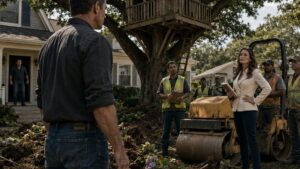
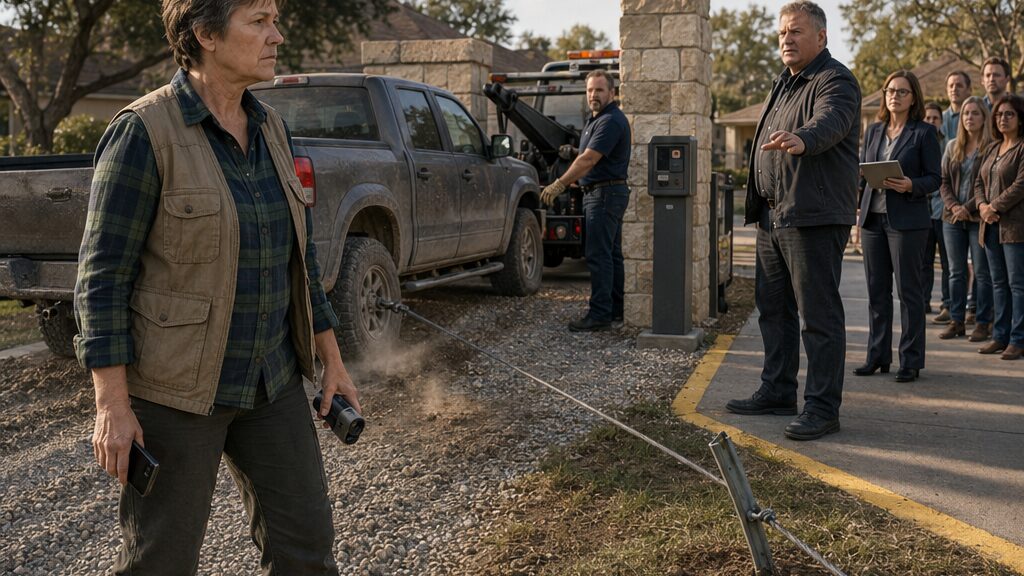
The tow cable snapped tight beneath Laura Adams’s pickup with a metallic crack that made three people on the sidewalk flinch.
“Stop,” Laura said.
The tow-truck driver did not stop.
Her rear tires shifted six inches through the gravel, carving twin grooves beside the yellow-painted edge of the neighborhood entrance. A loose stone jumped against the steel drainage grate. The truck’s suspension dipped, then lurched as the winch pulled again.
Laura stepped forward.
The driver raised one palm without looking at her. “Ma’am, don’t come near the equipment.”
“That truck is on my property.”
This time he looked at her, but only for a second. His eyes moved past her toward Robert Nelson.
Robert stood beside the stone monument sign for Briar Glen, one hand hooked into the pocket of his gray jacket. He had the composed posture he used at board meetings when someone objected to a late fee or asked why the landscaping contract had gone up again. Behind him, two neighbors had stopped with their dogs. A young parent stood beside a stroller. The HOA management representative held a tablet against her chest.
Robert gave the driver a small nod.
The winch whined.
Laura’s pickup scraped sideways another foot.
She felt the heat rise into her face and forced both hands open at her sides.
“Robert.”
He sighed, as if she were delaying everyone. “You were notified.”
“I received an email twenty-three minutes ago.”
“You’ve been told before not to obstruct the access lane.”
“I’m not in the access lane.”
Robert pointed at the yellow line painted across the gravel shoulder. “You’re inside the marked association area.”
Laura looked at the line.
Then at him.
For fifteen years she had measured corners other people could not see. She had stood in soybean fields, warehouse yards, suburban lots, creek beds, and highway margins with owners insisting that fences, hedges, tire tracks, and old family stories proved where land ended.
Paint proved paint.
Nothing more.
She crouched beside the rear wheel of her truck.
The yellow stripe ran under the tow cable and curved toward the gate pedestal. Six inches beyond it, partly hidden by crushed stone and dry grass, a narrow steel survey stake leaned at an angle.
Laura stopped breathing for a moment.
The stake had not leaned yesterday.
She took out her phone.
Robert’s voice hardened. “Laura, we’re past taking pictures.”
She photographed the stake.
Then the tow cable.
Then the position of the truck.
The driver shifted his weight. “You want me to keep going?”
“Yes,” Robert said.
“No,” Laura said at the same time.
The management representative stepped between the words. “The board authorized removal under the common-access obstruction rule.”
Laura stood. “Who determined this is common access?”
Robert laughed once, without humor. “The same people who have maintained it for years.”
“That wasn’t my question.”
A few more residents had slowed near the entrance. Laura knew most of them by sight. That made the embarrassment worse. No one was shouting. No one needed to. She could feel the story forming around her anyway: Laura had parked where she should not. Laura was being difficult. Laura, who worked with property lines for a living, had somehow become the person blocking the neighborhood gate.
Robert folded his arms. “The lane is marked. The association maintains it. Every plat packet distributed to owners shows it as access.”
“Which plat?”
His expression changed only slightly.
Laura noticed.
“The recorded community plan,” he said.
“Which recording number?”
The young parent pushed the stroller a little farther away.
Robert looked toward the management representative. She tapped at the tablet.
Laura walked to her truck’s toolbox and removed a compact measuring tape, a field notebook, and a short rangefinder.
Robert stared at her. “What exactly are you doing?”
“Checking.”
“For what?”
She pointed toward the stone monument at the public road. “Fixed corner reference.”
“You’re making a scene.”
“My truck is attached to a tow cable.”
The driver looked down.
Someone behind Robert coughed to hide a laugh.
Laura set the rangefinder, took a reading, wrote it down, then measured back toward the leaning stake. She checked once. Then again.
The numbers did not make sense.
Or rather, they made a kind of sense she did not want yet.
According to the deed dimensions she remembered, the yellow line was not merely close to her parcel.
It was inside it.
So was part of the tow truck.
Laura straightened slowly.
Robert saw something in her face. “What?”
“I need the recorded plat.”
“You have your deed. You’ve waved it around enough.”
“I haven’t waved anything.”
He stepped closer, lowering his voice. “Then frame it, Laura. Hang it in your office. Out here, the entrance is what people use. That line is what people follow.”
For a second, the noise around her seemed to thin.
The cable.
The truck.
The yellow paint.
The bent stake.
Laura had spent years telling clients that use and ownership were different questions. She had also spent years avoiding fights that might stain her small firm’s reputation. One angry developer had once filed a complaint after she refused to move a boundary to suit a sale. The complaint had gone nowhere, but for months her name had appeared in search results beside the word dispute.
She had learned to be careful.
Too careful, perhaps.
Laura looked at the management representative. “Did you hear him say the association owns this strip?”
The woman blinked. “I heard the discussion.”
“That wasn’t what I asked.”
Robert’s jaw tightened. “Don’t turn this into theater.”
Laura raised her phone. “I’m documenting an active removal from disputed land. Robert, are you claiming the association owns the gravel strip from the yellow line to my parcel?”
“I’m claiming you cannot block this entrance.”
“Different question.”
His face flushed.
The tow-truck driver cleared his throat. “I need to know if I’m finishing this.”
Robert did not look away from Laura.
“Finish it.”
The pickup moved.
One rear tire dropped off the gravel lip with a jolt. Metal scraped. Laura closed her eyes for half a second, then opened them and kept filming.
By the time the truck was hauled toward the road, the crowd had doubled.
Robert walked away without another word.
Laura remained beside the crooked stake.
When everyone else began to disperse, she knelt and brushed gravel from its base. The exposed steel carried a fresh bright scar where something heavy had struck it.
She did not straighten it.
Not yet.
At home, she spread the HOA packet across her kitchen table.
The management representative had emailed it while the tow truck was still loading her pickup: violation notice, community access map, enforcement policy, towing authorization.
Laura ignored the policy.
She found the map.
The drawing was a reduced copy, badly scanned, with a title block from the original development phase. A number appeared in the lower corner. Laura searched the county index from her laptop.
Nothing.
She tried the subdivision name.
Nothing matching the packet.
Then she opened her own deed file and compared references.
Her parcel description pointed to an earlier plat.
The HOA packet did not.
One recording number had vanished between the older deed chain and the association’s map.
Laura sat back.
The county office opened at eight-thirty.
She wrote the missing number on a yellow sticky note and placed it beside the photograph of the bent stake.
Chapter 2: The Yellow Lines Had Been Moving for Years
The photograph on Laura’s phone was three years old, and the yellow line was six feet farther east.
She enlarged it until the pixels softened.
There was no question.
In the picture, her pickup sat beside the gravel shoulder with a load of survey tripods in the bed. The neighborhood entrance curved behind it. The painted edge stopped well short of the steel stake, which stood upright and visible beside a patch of brown grass.
Laura looked out her kitchen window.
From here she could see the present line shining through the morning dimness.
Six feet closer.
Maybe more.
She began searching backward.
Her phone contained thousands of work images: monument caps, fence corners, utility marks, drainage culverts, temporary benchmarks. She had always photographed her own property almost by accident. A new crack in the driveway. A delivery left near the gate. A storm-felled branch. The mailbox after a snowplow clipped it.
One year earlier, the line had moved again.
Not dramatically.
Eighteen inches, perhaps two feet.
A maintenance crew had resurfaced the entrance and repainted the edge afterward. Laura remembered standing at the end of her drive while a worker pushed the striping machine.
She had noticed.
That was the part she could no longer excuse.
At the time, she had told herself the paint was temporary.
Then came the drainage work.
She found a photograph from the following spring. A shallow swale had been widened beside the lane. Crushed stone covered the lower half of the boundary stake. Orange construction mesh leaned against her fence.
She had noticed that too.
She had even started an email.
Laura searched her sent folder.
Nothing.
Drafts.
There it was.
Robert—
The drainage crew appears to be working beyond the association access limits. Before additional work proceeds, I suggest we confirm—
The message ended there.
She remembered why.
That week, a developer had threatened to move a contract from her firm after she challenged an inaccurate site plan. Laura had spent two days explaining to a client that professional caution was not obstruction. She had come home exhausted, opened the draft to Robert, and imagined the inevitable replies copied to board members and management.
So she had closed it.
Quiet work, careful records.
That was how she described her business.
Laura pressed her fingertips to her forehead.
Careful records were not much use when she kept them to herself.
A new email arrived at 8:07.
FORMAL NOTICE OF CONTINUING ACCESS VIOLATION.
She opened it.
The language was polished and bloodless. The board had determined that her vehicle had obstructed a designated common-access area. Future violations could result in additional towing, fines, legal costs, and suspension of certain association privileges where permitted by governing documents.
At the bottom sat Robert’s name.
Board President.
Laura read the notice twice.
Then she laughed once, quietly.
Not because it was funny.
Because twenty-four hours earlier she had still been trying to decide whether yesterday’s tow had been a misunderstanding.
Now it had a letterhead.
She printed the notice and laid it beside the old photographs.
At nine, her survey field assistant arrived.
“You look like you’ve been awake for a week.”
Laura handed over the oldest photograph. “Tell me what changed.”
The assistant studied it, then looked through the window.
“The stripe.”
“What else?”
A longer pause.
“The shoulder widened.”
Laura nodded.
“And the gate pedestal might be newer.”
“It is.”
She found another image, this one from two summers earlier. The gate had once been mounted on a narrow concrete island farther inside the neighborhood. In the current arrangement, a newer metal pedestal stood closer to Laura’s parcel, aligned with the repainted lane.
The pieces were small.
Each one had seemed too small to fight over.
A little paint.
Some gravel.
A drainage cut.
A gate pedestal.
Laura had watched visible authority replace uncertain ownership one improvement at a time.
By late morning, she had built a timeline across the kitchen table.
The oldest image showed the stake clearly.
The next showed stone piled around it.
Another showed mowing clippings hiding it.
Then drainage work.
Then fresh paint.
Then the newer gate pedestal.
Finally, yesterday’s photograph: the stake bent toward her property while the tow cable crossed above it.
The assistant pointed at the sequence. “You think they did it on purpose?”
Laura shook her head. “I don’t know.”
It mattered to her that she said that.
She would not turn suspicion into fact just because Robert had humiliated her.
Her phone rang.
Robert.
She let it ring four times before answering.
“Laura.”
“Robert.”
“I’m calling before this gets more expensive than it needs to.”
She looked at the violation notice.
“For whom?”
A silence.
Then his board voice returned. Calm. Administrative. “The entrance has served this neighborhood for years. You know that. If you’re upset about the tow, there’s a procedure.”
“The procedure began after I warned you the land was disputed.”
“You warned me while the tow truck was already there.”
“I told management last month the shoulder wasn’t association property.”
“You said you had concerns.”
“Yes.”
“That is not the same as providing evidence.”
Laura looked at the unfinished email from a year earlier.
There it was again: the gap between what she knew and what she had been willing to make official.
Robert continued. “I’m asking you not to escalate this.”
“My truck was dragged across gravel yesterday.”
“And I’m asking you to use the normal process.”
“What plat did you rely on?”
A pause.
“The community map.”
“Recording number?”
“Laura.”
“Recording number?”
His exhale sharpened. “I’m not doing this interrogation.”
“Then send me the recorded easement.”
“The what?”
“The instrument granting the association access over my parcel, if that’s what you believe exists.”
“You’re assuming your parcel reaches the lane.”
“I’m checking.”
“You’re making a lot of trouble over dirt.”
Laura looked at the oldest photograph again.
The steel stake stood straight.
“I’ll call you later,” she said.
She ended the call before he could.
At noon she logged into the county records index.
Her deed referenced a survey recorded eleven years earlier, before the newer gate configuration and before the association had taken over several maintenance obligations from the developer.
She entered the recording number.
A result appeared.
SURVEY PLAT—ADAMS PARCEL AND ADJOINING ACCESS TRACT.
Laura leaned closer.
The image itself was not available online. Retrieval required an in-person request or archive scan.
But the index showed enough to tighten something in her chest.
Recorded eleven years ago.
Prepared by a licensed surveyor.
Referenced in her deed chain.
And nowhere in the HOA packet Robert had relied upon.
She printed the index page.
The old survey had not disappeared.
Someone had simply built an argument without it.
Chapter 3: Thirty-One Feet Changed the Meaning of Everything
The stamped survey placed Laura’s property line beneath the HOA entrance.
Not beside it.
Beneath it.
She stood at the county records counter at 8:43 the next morning while the clerk flattened the large sheet under weighted corners.
The paper had yellowed slightly along the folds. A recording stamp crossed the lower margin. Eleven years earlier, another surveyor had tied Laura’s parcel to two fixed monuments, a road right-of-way point, and an iron marker near the drainage edge.
Laura read the bearings once.
Then again.
Her pulse accelerated, but her hands stayed still.
The clerk glanced at her. “You need a copy?”
“Yes.”
“Full size?”
“Yes.”
The linework was not ambiguous.
The current HOA entrance had changed since the survey was recorded, but Laura knew enough from her field measurements to see the problem immediately. The parcel boundary projected through an area now occupied by part of the paved lane.
She took out yesterday’s notebook.
The first rough calculation put the encroachment at twenty-eight feet.
She checked the scale.
Thirty.
Then she found the drainage reference.
Thirty-one, approximately, at the widest occupied point.
Laura sat down at a small research table.
For twenty minutes she did nothing except verify.
She traced the original access tract shown beside her parcel. It was narrower than the current paved entrance. The legal corridor did not appear to include the full modern lane configuration. More important, the survey depicted Laura’s boundary stake exactly where her older photographs had shown it before gravel and maintenance work buried its base.
The tow truck had not merely stood close to her land.
Its rear axle had likely been on it.
The county clerk returned with the copy tube.
“You okay?”
Laura realized she had been staring at the same dimension.
“Yes.”
The answer came out too quickly.
She rolled the plat carefully.
Outside, she sat in her pickup’s temporary replacement vehicle—a compact loaner from the towing company’s storage contractor—and called her field assistant.
“Bring the total station.”
There was a pause. “You found something.”
“Bring the total station.”
An hour later, they set up beside the public road.
Cars passed through the HOA entrance as Laura established control from the monument shown on the old survey. She checked the instrument height herself. Then she checked the backsight.
The first reconstructed point landed beneath the gravel shoulder.
The second fell near the painted yellow line.
The third was worse.
Her assistant looked through the instrument and lowered his face from the eyepiece.
“Laura.”
“I know.”
The projected boundary cut across the modern entrance lane and passed alarmingly close to the gate pedestal.
They moved to the drainage edge.
Laura measured again.
Thirty-one feet.
Not along the entire entrance.
But at the broadest occupation, the HOA’s physical improvements extended roughly thirty-one feet beyond the line shown on the recorded survey.
She stood in the lane until an approaching SUV forced her aside.
The driver waved apologetically.
Laura watched the vehicle pass over the place where her map said her parcel began.
For one bright, ugly moment, satisfaction rose in her.
Robert had called her deed worthless.
Robert had authorized the tow.
Robert had told her paint mattered more than paper.
Now his gate appeared to be sitting on her land.
She hated how good that felt.
“Don’t mark anything permanent yet,” she told the assistant.
“You’re sure?”
“No.”
That surprised him.
Laura pointed toward the gate. “We have occupation and record evidence. We don’t yet have the full access history.”
By noon she had permission to fly a small mapping drone from her own property.
The aerial view changed the scale of the problem.
From ground level, the entrance looked inevitable: two painted edges, a gate pedestal, drainage, curb transitions, landscaping. From above, the geometry looked less natural. The lane widened toward Laura’s side. The newer gate equipment sat offset from the older corridor. The drainage swale curved outward.
Laura overlaid preliminary record lines on the imagery.
The first pass made her think she had entered something incorrectly.
She ran it again.
The same result.
The painted lane crossed her parcel.
The gate pedestal intruded.
Part of the drainage edge did too.
Even the place where residents slowed to scan their access devices appeared to occupy land the HOA packet treated as unquestionably common.
Her assistant stared at the screen.
“How long has it been like this?”
“Not all of it. The pieces changed.”
“You could shut the gate.”
Laura looked at him.
“I said could.”
She closed the laptop.
Back in her office, she spread the full-size survey beside the HOA map.
That was when she saw the handwriting.
Faint pencil.
Near the original access tract, beside a dashed line that did not match the final recorded boundary, someone had written:
future access easement
Laura froze.
The phrase was not part of the stamped survey certification. It appeared to be an annotation, perhaps added during planning or copied from an earlier working document.
But it changed the emotional temperature of everything.
A future easement suggested intent.
Maybe an owner had agreed.
Maybe paperwork existed elsewhere.
Maybe the HOA’s current use was not invented from nothing.
Laura pulled the county index back up.
She searched her parcel number.
No easement.
She searched the adjoining tract.
Nothing obvious.
She searched the subdivision.
Dozens of instruments appeared: covenants, utility rights, drainage grants, amendments, releases.
She opened each relevant entry.
No access easement over her parcel.
At four-thirty, she called the county clerk.
“I’m looking for an access instrument that may have been intended but recorded under a different reference.”
The clerk asked for names.
Laura gave the previous owner listed in her deed chain, the developer entity from the plat, and the HOA.
Keyboard clicks sounded through the phone.
“I’m seeing utilities,” the clerk said. “Drainage. Temporary construction access from much earlier.”
“Permanent vehicle access?”
“Not under those.”
“What about an unrecorded agreement?”
The clerk gave a small, careful laugh. “Wouldn’t be in county records if it wasn’t recorded.”
Laura thanked her and hung up.
She should have felt triumphant.
Instead, she stared at the handwritten note.
The old survey had answered the question that began with the tow cable.
Yes, the visible lane appeared to cross her land.
But it had opened a larger question.
Someone, eleven years earlier, had expected a future easement.
Laura searched again under every variation she could think of.
Owner names.
Developer name.
Association name.
Parcel.
Tract.
Road reference.
Nothing.
Near sunset, the county system returned the same empty result for the final search.
No recorded access easement.
Laura looked from the words future access easement to the aerial image of thirty-one feet of occupied land.
Either an agreement had been lost, hidden, or never completed.
And she no longer knew which possibility would be worse.
Chapter 4: The Missing Easement Was Not the Only Thing Withheld
By seven the next morning, someone had posted a photograph of Laura’s bent boundary stake in the neighborhood message group.
The caption read: SHE’S TRYING TO BLOCK THE ENTRANCE NOW.
Laura stood at her kitchen counter with one hand around a coffee mug she had forgotten to drink from.
The photograph had been taken from a low angle. The stake looked taller than it was, a thin piece of steel jutting beside the yellow line. The tow marks were outside the frame. So was the gate pedestal. So was Laura’s driveway.
Twenty-three comments had appeared beneath it.
Can she even do that?
Call management.
People need this road.
This is getting ridiculous.
One resident had written, She’s a surveyor. She knows exactly what she’s doing.
Laura read that one twice.
Then she closed the app.
The old survey lay open across the table behind her. Beside it were the preliminary drone image, the handwritten note about a future access easement, and a blank legal pad on which she had written three possible next steps.
Request voluntary suspension of gate operations.
Send formal notice of encroachment.
Demand removal.
She crossed out the third.
Then she uncrossed it.
At nine, the HOA management representative called.
“We need to talk before this becomes something none of us can control.”
Laura looked through the kitchen window toward the entrance. Cars moved steadily through the gate.
“What exactly can’t be controlled?”
“The concern among residents.”
“You mean the message group.”
“I mean people are worried you intend to close access.”
“I haven’t said that.”
“Robert says you threatened to challenge the gate.”
“I asked for the recorded easement.”
A pause.
The representative lowered her voice. “I’m not taking sides.”
Laura almost laughed.
Instead she said, “Send me every instrument the association relies on for access across my parcel.”
“I’ll see what we have.”
“That isn’t the same thing.”
“No,” the woman said. “It isn’t.”
The call ended.
At noon, Laura walked to the HOA office carrying only a folder.
She had decided not to bring the full-size survey.
Not yet.
Robert was already there with Kathleen Lee, the treasurer, and two board members. Kathleen sat nearest the file cabinet, her hands folded over a yellow legal pad. She had always struck Laura as someone who disliked being noticed while noticing everything.
Robert did not offer her a seat.
“You wanted records,” he said.
“I asked for the recorded access instrument.”
He slid a photocopy across the table.
It was not an easement.
Laura knew that before she touched it.
The page was an old concept plan showing the neighborhood entrance with a dashed path near her parcel. A handwritten notation in the margin referenced owner cooperation.
“No recording stamp,” Laura said.
“It reflects the agreement.”
“What agreement?”
Robert leaned back. “The previous owner and the developer had an understanding.”
“Written?”
“Not everything meaningful gets filed at the courthouse.”
Laura looked at him.
“A handshake agreement.”
“That was common enough then.”
“For permanent vehicle access?”
“For a neighborhood project everyone understood was necessary.”
Kathleen’s eyes dropped to her legal pad.
Laura noticed.
Robert continued. “The entrance has existed openly for years. The association maintains it. Residents rely on it. You bought with full knowledge it was there.”
“I bought before the current gate pedestal and expanded lane.”
“You knew there was access.”
“I knew there was a lane. That is not the same as granting thirty-one feet of my parcel.”
One board member shifted sharply. “Thirty-one?”
Robert turned toward him. “Preliminary claim.”
“It’s a measured occupation against a recorded survey,” Laura said.
The room changed.
Not dramatically.
But Kathleen stopped writing.
Robert’s face tightened. “And yet you still haven’t produced a final survey.”
“No. Because I verify before I accuse.”
The words landed harder than Laura intended.
Robert stood.
“Let me be very clear. If you interfere with that gate, you will affect every household that uses this entrance.”
“I know.”
“School traffic. Deliveries. Emergency circulation.”
“I know.”
“Then act like it.”
Laura closed her folder.
There it was.
The move she had been expecting.
Not ownership.
Need.
By three that afternoon, need had acquired faces.
A delivery van backed up near the entrance because a landscaping truck blocked the main road on the other side of the subdivision. A young parent hurried through the secondary gate to meet a school bus. An elderly neighbor drove slowly beneath the arm and lifted two fingers from the steering wheel when she saw Laura standing near the shoulder.
Laura watched each one.
Her anger did not disappear.
It became less convenient.
“Mrs. Adams.”
She turned.
Andrew Martinez stood near the edge of her driveway with his arms folded. Laura knew him as the neighbor from two streets over who left early most mornings and returned after dark. He had commented once in the message thread.
He did not look pleased.
“Can I ask you something?”
“You just did.”
His mouth tightened. “Are you closing the gate?”
“I haven’t decided what action I’m taking.”
“That sounds like yes with extra words.”
Laura looked toward the entrance. “Do you know where the property line is?”
“No. I know where the road is.”
“That’s part of the problem.”
“For you.”
“For everyone, if the association built on land it doesn’t control.”
Andrew stepped closer but stopped at the gravel edge. “My wife works nights. I get the kids out in the morning. That entrance saves us fifteen minutes when the main road backs up.”
Laura said nothing.
“My father had chest pain last winter,” he continued. “The ambulance came through that gate because the main entrance was blocked by utility work.”
The statement struck precisely where Robert’s argument had not.
Not because it proved ownership.
Because Andrew was not performing authority.
He was afraid.
Laura looked down at the bent stake.
“I’m not trying to trap your family.”
“Then what are you trying to do?”
She could have answered easily.
Protect my land.
Correct the record.
Make Robert admit he was wrong.
All true.
None complete.
“I’m trying to find out what was actually agreed to,” she said.
Andrew shook his head. “From where I’m standing, everyone’s waiting to see whether one person can shut down a road.”
“From where I’m standing, an organization towed my truck off land it may not own.”
He looked toward the entrance.
For the first time, some of the anger left his face.
“That part,” he said, “I didn’t know.”
Laura believed him.
That bothered her more than if he had been lying.
By evening, Robert had posted a formal board statement.
The association, it said, possessed longstanding access rights supported by historical owner consent and continuous community use. The board would resist any unilateral interference with essential neighborhood infrastructure.
Historical owner consent.
Laura read the phrase slowly.
A handshake had become consent.
Consent had become rights.
Rights had become essential infrastructure.
She took a screenshot.
At 8:17, a private message appeared from Kathleen Lee.
Please do not respond to the board statement tonight.
Laura stared at it.
Another message arrived.
And do not search archive box 14B if management gives you access tomorrow.
Laura typed, Why?
The three dots appeared.
Disappeared.
Appeared again.
Then Kathleen sent one final line.
Because if you find what I think is in there, this stops being only Robert’s mistake.
Chapter 5: The Board Had Known the Line Was Wrong
Kathleen Lee arrived at Laura’s house before sunrise carrying the archive box she had told her not to search.
Laura opened the door and stared at it.
The cardboard was gray with dust. A faded label on one side read 14B—ACCESS / DRAINAGE / DEVELOPER CLOSEOUT.
Kathleen held it against her chest.
“You have ten seconds to decide whether you’re letting me in.”
Laura stepped aside.
Kathleen entered without taking off her coat.
In the kitchen, she set the box on the table beside the old survey.
For a moment neither woman touched it.
“You took association records,” Laura said.
“I removed records that should never have been kept where one board officer could decide whether they existed.”
“That doesn’t answer me.”
“No.”
Kathleen sat down.
Her face looked older than it had in the HOA office.
“I told you not to search it because I was afraid management would log the request.”
Laura remained standing.
“Why would that matter?”
“Because Robert asked yesterday whether you had contacted the archive vendor.”
The room went still.
Kathleen opened the box.
Inside were meeting packets, contractor sketches, folded correspondence, and copies of old invoices. Nothing looked dramatic. That was the first thing Laura noticed.
Institutional mistakes rarely announced themselves with red ink.
Kathleen pulled out a thin folder.
“Start here.”
The first document was eleven years old.
A board transition memo from the developer period.
Laura read the paragraph twice.
Permanent secondary access subject to completion and recordation of easement documentation.
Her finger stopped beneath the line.
“Subject to,” she said.
Kathleen nodded.
“No easement attached.”
“No.”
The next document was a letter from a land-use consultant recommending that the developer resolve the access strip before transferring maintenance responsibility to the association.
The next was a board minute from nine years earlier.
Counsel review deferred due to projected redesign and legal expense.
Another minute.
Temporary continued use approved pending title clarification.
Another.
No action taken.
Laura looked up.
“They knew.”
“Some of them knew.”
“For years.”
“Yes.”
Kathleen’s voice was quiet.
Laura turned another page.
A handwritten note had been clipped to a contractor estimate.
Reroute cost too high. Existing lane functioning. Revisit if ownership challenged.
Laura sat down.
The phrase struck harder than Robert’s insult beside the tow truck.
Revisit if ownership challenged.
The board had not mistaken paint for title.
Not entirely.
At least some people had known the difference and decided silence was cheaper.
Laura felt anger move through her with an almost cleansing force.
“You let him tow my truck.”
Kathleen flinched.
“I didn’t authorize it.”
“You’re treasurer.”
“That doesn’t give me operational control.”
“You sat in the room.”
“Yes.”
The answer came without defense.
Kathleen looked at the box.
“I sat in a lot of rooms.”
Laura said nothing.
“I joined the board six years ago,” Kathleen continued. “By then the entrance was treated like a settled fact. The records were scattered. Every time the issue came up, someone said the developer had handled it. Then someone else said the prior owner had agreed. Then legal review was postponed because there was no active dispute.”
“And you accepted that.”
“For too long.”
Laura stared at her.
Kathleen met her eyes.
“You are not the only person who can mistake avoiding conflict for being reasonable.”
The words landed so cleanly that Laura looked away.
She pulled the next packet closer.
The minutes from three years earlier showed Robert present as a board member, not yet president.
Discussion: access documentation incomplete.
Action: seek updated title review before future capital improvement.
Laura’s pulse quickened.
She turned the page.
Two years earlier.
Gate modernization proposal.
A note in the margin: title concern unresolved.
One year earlier.
Drainage improvement approved.
No title review attached.
Then, six months ago, a management email to Robert.
Homeowner Laura Adams has questioned association ownership of gravel shoulder. Recommend confirming boundary before enforcement.
Laura read it again.
The date was unmistakable.
Months before the tow.
Robert had known she was questioning ownership.
Kathleen watched her.
“He didn’t know the full survey result.”
“He knew enough to check.”
“Yes.”
“He authorized the tow anyway.”
“Yes.”
The kitchen refrigerator clicked on.
Laura sat with both palms flat on the table.
For two days she had imagined a single clean moment when evidence would turn the story around. She would show the line. Robert would lose his certainty. The board would have nowhere to stand.
Instead, the truth had widened.
Past boards had delayed.
Kathleen had stayed quiet.
Laura herself had stayed quiet.
Robert had inherited a problem.
Then he had chosen to enforce through it.
“Why bring this to me now?” Laura asked.
Kathleen looked toward the window.
“The board’s reserve study came in last month. Rerouting the entrance could force a special assessment. People are already angry about insurance increases.”
“So you’re protecting the association.”
“Partly.”
“Yourself?”
“Yes.”
The honesty surprised Laura.
Kathleen’s hand rested on the edge of the archive box.
“And partly because yesterday Robert told us, in executive discussion, that if you pushed this he would make an example of you.”
Laura felt her jaw tighten.
“What did he mean?”
“Fines. Legal action. Anything management counsel could justify.”
“Did anyone object?”
Kathleen did not answer quickly enough.
Laura stood and walked to the sink.
Outside, early traffic moved through the disputed gate.
A school bus passed the far intersection.
When she returned, Kathleen had unfolded a photocopied sketch.
It showed the entrance before the current gate work. A small X marked the approximate location of the original boundary stake.
Someone had circled it.
Beside the circle were initials.
Laura recognized them from a dedication plaque near the clubhouse.
Robert’s late wife had served on the landscape and access committee.
Kathleen saw recognition pass over her face.
“She worked on the redesign.”
Laura looked up.
“Robert’s wife?”
“She pushed for the secondary entrance to stay where it was.”
“Did she know about the title issue?”
“I don’t know.”
“That matters.”
“I know.”
Kathleen’s expression changed.
For the first time since entering, she looked less afraid of documents than of a person.
“She died three years ago.”
Laura said nothing.
“Robert took over the access committee work after that. He talks about the entrance like it was the last project they finished together.”
Laura looked down at the photocopy.
The line of the lane crossed the sketched boundary.
Suddenly Robert’s behavior made more sense.
Not enough to excuse it.
Enough to complicate hatred.
“He thinks I’m attacking her work.”
“I think he thinks admitting the problem means saying she got it wrong.”
Laura sat again.
The anger remained, but it had lost its clean edges.
On the table lay proof of years of institutional avoidance, Robert’s conscious enforcement choice, Kathleen’s silence, Laura’s silence, and a dead woman’s unfinished project.
No single villain.
Plenty of responsibility.
At eleven, Kathleen returned the box to the HOA office with copies missing only from her memory, not the file.
Laura spent the afternoon organizing her evidence.
She separated facts from assumptions.
Recorded survey.
Field measurements.
Drone overlay.
No recorded easement located.
Board records acknowledging incomplete documentation.
Management warning before the tow.
Robert’s authorization afterward.
At five-thirty, an email arrived.
EMERGENCY BOARD MEETING NOTICE.
The meeting would be held the next evening.
Agenda item one: threat to community access.
Agenda item two: proposed legal response.
Attached was Robert’s memorandum.
Laura opened it.
The first sentence accused her of asserting “unilateral control over essential neighborhood infrastructure.”
The final paragraph recommended authorizing counsel to seek immediate relief against any interference.
Laura read the whole thing once.
Then she placed Robert’s memo beside the old survey and the tow invoice.
For the first time since the cable tightened under her truck, she knew she had enough evidence to hurt him.
The question was whether hurting him was the same thing as fixing anything.
Chapter 6: She Could Close the Gate, but That Was Not Her Answer
Robert Nelson opened the emergency meeting by accusing Laura of threatening the neighborhood.
He did it before she had taken off her coat.
“Let the record reflect,” he said, “that the board is responding to an asserted claim that could disrupt essential access for residents.”
Laura stood at the back of the clubhouse with a document tube under one arm.
Nearly every chair was occupied.
Andrew Martinez sat near the aisle. Kathleen was at the board table, expression unreadable. The management representative had a laptop open. Two board members whispered over printed packets.
Robert continued.
“This is not about one homeowner’s inconvenience. It is about safety, property values, and the continuity of services.”
Laura felt the old instinct rise in her.
Wait.
Let him finish.
Avoid sounding emotional.
Do not make yourself the difficult one.
She tightened her grip on the document tube until the cardboard flexed.
Then she walked forward.
“Robert.”
He looked at her.
“I’d like the record to reflect that my truck was towed after management had already warned you the boundary was disputed.”
A murmur moved through the room.
Robert’s face hardened.
“This is not the time for accusations.”
“It is on the agenda.”
“You will have an opportunity to speak.”
“I’m speaking now because you opened by describing my position inaccurately.”
The words came out steady.
Laura almost did not recognize how little apology they contained.
The management representative looked at Robert.
“Perhaps we should allow her presentation.”
Robert sat.
Not gracefully.
Laura placed three things on the front table.
The tow invoice.
The recorded survey.
A map showing the reconstructed boundary stake and current entrance improvements.
The room quieted.
She did not begin with thirty-one feet.
She began with her own mistake.
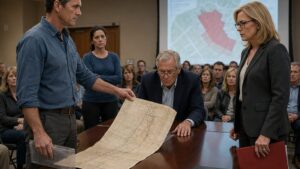
“For several years, I noticed changes along the edge of my parcel and chose not to formalize my objections.”
Robert looked up sharply.
Laura continued.
“I told myself the paint was temporary. Then the gravel. Then drainage work. Then the newer gate equipment. I believed avoiding a fight was the same as being reasonable.”
No one moved.
“It wasn’t.”
She unrolled the map.
The boundary line cut across the entrance.
A resident near the front leaned forward.
Laura pointed to the first fixed monument, then the second, then the reconstructed stake.
“This is the recorded survey tied into my deed chain. This is current occupation based on preliminary field work and aerial mapping. At the broadest point, association improvements extend approximately thirty-one feet into my parcel.”
Voices broke out.
Robert lifted his hand.
“Preliminary,” he said loudly.
“Yes,” Laura replied. “Which is why I have not represented it as a final certified boundary survey.”
His interruption died there.
She placed another page on the table.
“I also searched for a permanent recorded access easement.”
“And found evidence one was intended,” Robert said.
Laura looked at him.
“So you know about the note.”
A small silence opened.
Robert realized his mistake.
Kathleen closed her eyes briefly.
Laura did not press.
Not yet.
“Yes,” she said. “A future easement was contemplated. I found no completed recorded instrument. The board’s own files show the same issue remained unresolved for years.”
She laid copies of the minutes down.
People began reading over one another’s shoulders.
A young parent raised a hand without waiting to be recognized.
“Are you closing the gate?”
The room turned toward Laura.
There it was.
The simplest version of the story.
Her land.
Their gate.
Yes or no.
Laura looked at Andrew.
He did not nod.
He did not ask for anything.
She looked back at the room.
“I believe I have grounds to seek immediate restrictions on continued unauthorized use.”
The reaction was instant.
Someone swore under their breath. A chair scraped. Robert leaned forward as if the sentence had proven everything he had said.
Laura raised one hand.
“I am not asking for that tonight.”
Silence fell much faster than the noise had risen.
Robert stared at her.
Laura continued.
“I’m not shutting you down.”
The words felt strangely familiar, as if she had been moving toward them since the tow cable tightened.
“I am asking for three things. First, no further enforcement against me on the disputed strip. Second, reimbursement of the towing and survey expenses caused by enforcement before ownership was verified. Third, negotiation of a properly recorded access agreement if the association wants continued use.”
Robert laughed once.
It was a brittle sound.
“So this is about rent.”
“It is about legal access.”
“You want the neighborhood to pay you for dirt.”
Laura looked at the map.
“For land your gate depends on.”
The room went still again.
Robert stood.
His face had changed.
Not into defeat.
Something more wounded.
“You have no idea what you’re doing to this place.”
Laura felt the anger rise again.
“I know exactly what was done to my truck.”
“This entrance was built to keep traffic off the main road. We spent years making it work.”
“We?”
Robert’s mouth closed.
Kathleen looked down.
Laura saw it then.
Not the president.
The husband.
Robert’s gaze had shifted toward the clubhouse wall, where an old photograph showed volunteers beside newly planted entrance landscaping. His late wife stood near the center.
“She believed in that entrance,” he said.
No one interrupted.
“She spent two years dealing with contractors, residents, the developer. Every time someone complained, she fixed something.”
Laura said quietly, “Robert—”
“No. You want the truth? Fine. She kept this neighborhood moving when half the board couldn’t agree on a mailbox color. After she died, I wasn’t going to let people tear apart the last thing she finished.”
There was no speech in his voice now.
Only refusal.
Laura looked at the photograph.
Then at the records on the table.
“I’m not tearing down her work.”
“You’re saying it was built wrong.”
“I’m saying the paperwork was never finished.”
“Same difference.”
“No.”
Robert’s face tightened.
“No,” Laura repeated. “It isn’t.”
She slid forward the management email dated months before the tow.
“This warned you to verify the boundary.”
He stared at it.
“You approved the tow after receiving that.”
A murmur moved through the room.
Robert did not deny it.
That was the deepest turn of the night.
Not the map.
Not the thirty-one feet.
His silence.
Laura looked at him and understood something she had not wanted to understand.
He had not towed her truck because he knew the line was his.
He had towed it because he could not tolerate the possibility that it was not.
Kathleen pushed back her chair.
“I have a motion.”
Robert turned.
She spoke without looking at him.
“I move that the board immediately suspend unilateral towing authorization by the president or any single officer for disputed property areas.”
One board member inhaled sharply.
Kathleen continued.
“I further move that the association enter mediated negotiations for a recorded access agreement, reimburse documented towing costs subject to review, and commission independent title and boundary confirmation.”
Robert stared at her.
“You’re doing this now?”
“Yes.”
“You knew what this could cost.”
“Yes.”
“And you think she won’t use that against us?”
Kathleen looked at Laura.
“I think we already used uncertainty against her.”
No one spoke for several seconds.
Then Andrew stood from the aisle.
“I want the gate open,” he said. “I’ve said that.”
Laura watched him.
“But if we need her land to keep it open, then we should stop pretending the line doesn’t matter.”
The motion was seconded.
Robert remained standing while the board prepared to vote.
Laura looked down at the tow invoice beside the reset stake map.
She had entered the room afraid that speaking would make her vindictive.
Now silence seemed like the more dangerous choice.
The vote had not happened yet.
Nothing was settled.
The gate still crossed the line.
The money would still hurt.
Robert still believed concession betrayed his wife.
But Kathleen’s motion sat before the board in plain language, and for the first time the association was being asked to choose between authority and accountability.
Robert slowly took his seat.
“Call the vote,” he said.
Chapter 7: The New Boundary Stayed Visible on Purpose
The survey crew cut straight through the old yellow line at 8:12 on a Tuesday morning.
Laura stood beside the entrance with her hands in the pockets of her work vest while a saw blade bit into the pavement. Dust rose in a pale cloud. The painted stripe that had once seemed more authoritative than her deed broke into two clean pieces.
Cars still passed through the gate.
That had been the hardest part for some residents to understand.
The settlement did not make the road disappear.
Six weeks of mediation, title review, board votes, revised insurance language, and strained emails had produced something less dramatic and more difficult than revenge: a recorded agreement everyone would have to live with.
The independent boundary confirmation matched Laura’s work closely enough that no one challenged the central fact. The association’s modern entrance improvements crossed onto her parcel. The widest occupation measured just over thirty feet.
The old future access note had not been enough to create a permanent right.
The handshake story had not been enough either.
There had been intent.
There had been use.
There had not been completed paperwork.
The HOA reimbursed Laura for the towing charge, the damage inspection, and the reasonable cost of the independent survey work forced by the dispute. Her pickup’s scraped undercarriage had required less repair than she feared, though the sound of metal over gravel still returned to her sometimes when a tow truck passed on the highway.
The board also agreed to pay for a recorded access easement.
Not forever without conditions.
Not for free.
The agreement defined the exact strip, maintenance obligations, drainage responsibility, insurance, gate-equipment limits, and a modest annual payment to Laura.
More important to her, no one could move the lane, widen the shoulder, install equipment, or enforce parking rules outside the recorded area simply because paint suggested they could.
Kathleen had insisted on that language.
The board had also changed its enforcement policy.
No single officer could authorize towing from disputed property.
Robert was no longer president.
He had resigned three days after the emergency meeting vote, before the mediation began.
He remained a homeowner.
That distinction mattered.
Laura watched the crew set a fresh monument near the place where the old stake had been bent.
The survey field assistant crouched with a hammer and cap.
“You want this below grade?” he asked.
Laura looked at the entrance.
A car slowed at the gate. The arm lifted. Tires crossed the newly documented strip of her parcel.
Six weeks earlier, the sight would have felt like theft.
Now it felt stranger.
Still hers.
Lawfully crossed.
“Leave it visible,” she said.
The assistant looked up. “You sure?”
“Yes.”
He nodded and set the cap.
The crew had just begun marking the revised pavement edge when Laura heard footsteps behind her.
Robert stopped several feet away.
He looked thinner than she remembered from the board meeting. He wore jeans and an old work jacket instead of the pressed gray one he had favored as president.
For a moment, neither spoke.
Then he pointed toward the new stake.
“That the final one?”
“Yes.”
He stared at it.
“So the old marker really was in the right place.”
“Close enough that the independent survey confirmed the same boundary.”
Robert nodded slowly.
The saw started again. They waited until the noise passed.
He said, “I thought you’d make them move everything.”
Laura looked at the gate pedestal.
“We discussed it.”
“I know.”
“You were in mediation.”
“I mean at the beginning.”
Laura understood.
He had expected punishment.
Perhaps because that was what he would have chosen.
Perhaps because that was what she had nearly chosen too.
“I wanted to,” she said.
Robert turned toward her.
She had not planned to admit it.
But silence no longer felt automatically dignified.
“When I found the old survey,” Laura continued, “I wanted the gate off my land. All of it. I wanted you to explain to every resident why.”
Robert looked down.
“You would’ve had the right to try.”
“Yes.”
The answer remained between them.
A delivery van rolled through the entrance.
Behind it came a small sedan with a child in the back seat. The driver lifted one hand toward Laura.
She returned the gesture.
Robert watched.
“My wife would have hated this mess,” he said.
Laura did not tell him what his wife would have wanted. She had never known her well enough.
Instead she said, “The entrance wasn’t the mistake.”
His face tightened slightly.
“The unfinished paperwork was a mistake,” Laura continued. “Ignoring it was another. Towing my truck was yours.”
Robert absorbed that without looking at her.
After a while he said, “I know.”
It was the closest thing to an apology he had offered.
Laura found she did not need to improve it for him.
He nodded toward the stake again.
“Why leave it sticking up?”
The question surprised her.
She crouched beside the new marker and brushed loose dust away from the cap.
“Because people kept covering the old one.”
“With gravel?”
“With gravel. Grass. Paint. Assumptions.”
Robert gave a short breath that might have been a laugh, though there was little humor in it.
“That sounds like something a surveyor would say.”
“It probably is.”
He began to walk away, then stopped.
“For what it’s worth,” he said, “I shouldn’t have told you the deed was worthless.”
Laura looked at him.
“No.”
He nodded once.
Then he left.
Later that afternoon, the crew finished cutting the old painted edge and laid out the corrected markings. The new yellow line did not follow the property boundary exactly; the recorded easement did not require it to. That, too, was part of the compromise. Ownership and access were related now, but they were not the same thing.
Andrew passed on foot and stopped near the entrance.
“My wife says the new gate timing is better.”
Laura smiled. “That wasn’t my condition.”
“I know. Kathleen’s been taking credit.”
“She probably earned it.”
Andrew glanced at the visible stake.
“People are going to trip over that.”
“It’s outside the walking path.”
“They’ll complain anyway.”
“I know.”
He smiled and continued home.
Near sunset, Laura returned alone.
The equipment was gone. The cut pavement looked raw. The new yellow line curved through the entrance, clean and bright.
Beside it, the boundary stake stood upright.
A tire had thrown a little gravel against its base.
Laura bent down and straightened the loose stones around it.
For years she had believed avoiding conflict kept the peace.
Then she had learned that unspoken lines did not stop people from crossing them. Sometimes silence merely made the crossing easier.
She rested two fingers on the metal cap.
The neighborhood would continue using part of her land.
Children would ride through the gate.
Ambulances could take the shorter route.
Delivery vans would pass over the strip Robert once claimed paint had settled.
And every year, the association would renew its obligations in writing.
Laura stood.
She could have covered the stake to make the entrance prettier.
Instead she left it where anyone looking closely could see it.
The story has ended.