The HOA Vice President Sent Two Starving Dogs at Her, Then Learned Why Rachel Never Ran
Chapter 1: The Violation Notice Waiting Beside Rachel’s Muddy Truck
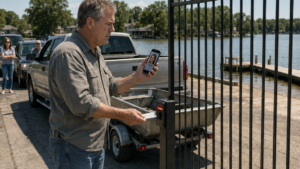
The photograph on the violation notice showed Rachel’s truck, three inches of dried mud along the rear wheel well, and a blurred dog muzzle where no dog should have been.
She stopped halfway down her driveway.
The paper had been tucked under her windshield wiper in a clear plastic sleeve, the kind the HOA used for official notices when it wanted embarrassment to survive rain. Across the top, beneath the Briar Glen Community Association logo, someone had highlighted the words EXTERIOR CLEANLINESS in yellow.
Rachel barely saw them.
Her thumb covered the lower corner of the photograph while she tilted the page toward the morning light.
The picture had been taken from across the street, probably from Carolyn White’s phone. Rachel’s truck filled most of the frame. Behind it, beyond the ornamental fence separating Carolyn’s side yard from the narrow service lane, something dark pressed between two cedar slats.
A muzzle.
Broad. Short-haired. Too high off the ground to belong to the little terriers Rachel had once seen Carolyn walking.
Rachel looked up.
Carolyn’s house sat diagonally across from hers, white stone facade, black shutters, clipped boxwoods, nothing left where wind or accident might rearrange it. The side gate was closed. No dog stood behind it now.
A recycling truck groaned at the far end of the street.
Rachel slipped the notice free of its sleeve.
“Morning.”
John Allen stood at the edge of his lawn with a coffee mug in one hand and his sprinkler controller in the other. He followed her gaze to the notice and gave a tired little wince.
“Again?”
“Apparently mud is contagious.”
He smiled despite himself. “Carolyn did mention the streetscape.”
“Of course she did.”
Rachel opened her truck door, set her work bag on the seat, then looked again at the photograph.
John noticed.
“What?”
“Nothing.”
The answer came too quickly.
His eyebrows rose, but he had spent nine years living beside Rachel and knew the limits of pressing her. He took a drink instead.
Across the street, a garage door lifted.
Carolyn White emerged in white slacks, a cream blouse, oversized sunglasses, and the kind of posture that made even taking out a garbage bag look supervisory. She carried a leather folder under one arm.
“Rachel.”
Not good morning. Just the name.
Rachel folded the notice once.
Carolyn crossed the street.
“You received it.”
“I found it.”
“There’s a difference?”
“One involves consent.”
John looked down into his coffee.
Carolyn stopped just outside Rachel’s driveway, as though the concrete itself required permission. “The board has had multiple complaints.”
“From multiple people?”
“The board does not disclose complainants.”
Rachel glanced at John.
He became very interested in the sprinkler controller.
Carolyn continued. “Your guest parked overnight last Thursday. Your recycling container remained visible for four hours beyond the collection window. Now the truck.”
“The truck I use for work.”
“That doesn’t exempt it from standards.”
Rachel felt the familiar pull in her chest, the urge to answer with every technically correct thing she knew and none of the things she felt.
She had learned years ago that anger made excellent evidence for other people.
So she kept her voice flat.
“I’ll wash it.”
Carolyn’s mouth tightened, disappointed by the absence of a fight.
“That would be wise.”
From behind Carolyn’s house came a bark.
Low. Heavy.
Rachel’s eyes shifted past her.
Carolyn did not turn.
A second bark answered.
Higher pitch, faster rhythm.
Then a third sound—two quick notes followed by a long, hoarse bay.
Rachel went still.
Three dogs.
At least.
Carolyn adjusted the folder against her hip.
“You have a question?”
Rachel looked at her. “How many dogs are you keeping now?”
John’s sprinkler clicked off.
For the first time that morning, Carolyn’s expression changed.
Only slightly. Her chin lifted a fraction, and one hand closed over the edge of the folder.
“My pets are not HOA business.”
“I didn’t say they were.”
“Then I’m not sure why you’re asking.”
Another bark came from behind the fence. This one ended in a scraping sound.
Rachel knew that sound.
Nails against wood or concrete. Repeated confinement. Restless pacing.
She glanced at the SUV parked in Carolyn’s driveway. Two black leather leashes hung from a hook beside the open garage door. Thick ones, meant for large dogs.
Only two.
The barking had not come from two animals.
Carolyn followed Rachel’s gaze and stepped sideways.
It was a tiny movement. Almost nothing.
Enough.
Rachel folded the notice again and put it in her jacket pocket.
Carolyn said, “Since you’re so concerned about compliance, you’ll be interested to know the board is conducting an emergency frontage inspection Wednesday.”
Rachel looked back at her. “Emergency.”
“We’ve had increasing disregard for neighborhood standards.”
“Meaning my bin?”
“Meaning cumulative deterioration.”
John finally spoke. “Carolyn, come on.”
She turned toward him. “You’re treasurer. You know what deferred standards do to values.”
“I know what a muddy truck does to values,” John said. “Nothing measurable.”
Carolyn removed her sunglasses.
Without them, her eyes looked more tired than Rachel expected.
“You both bought here because somebody enforced rules before you arrived,” she said. “People love to mock standards after they benefit from them.”
There it was—the part that made Carolyn difficult to dismiss as merely ridiculous. She believed this. Maybe not every citation. Maybe not every photograph. But the larger thing, the ordered lawns and quiet streets and houses that held their price because someone noticed when decay began.
Rachel understood belief sharpened into habit.
She also understood what happened when habit needed an enemy.
Carolyn looked directly at her.
“Some of us have more invested here than others.”
John’s face hardened.
Rachel felt heat rise under her collar.
She could have asked what Carolyn meant. She could have made her say it cleanly.
Instead she said, “Wednesday, then.”
Carolyn put her sunglasses back on.
“Make sure the frontage is accessible.”
She turned and crossed the street.
Rachel watched her go.
The barking stopped before Carolyn reached her driveway.
Not gradually.
All at once.
Rachel’s work phone vibrated in her pocket. A reminder for a facility inspection forty miles away. She should have left six minutes earlier.
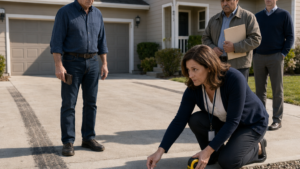
Instead she walked to the edge of her property and looked down the service lane between the houses.
The lane was technically common access, used for utilities and landscaping. Carolyn’s fence ran along one side. Fresh cedar boards covered three sections near the rear corner, lighter than the rest.
Rachel told herself she was only looking because of the photograph.
She had told herself similar things before.
Three weeks earlier, she had heard barking at two in the morning. A week after that, she had seen stacked dog-food bags inside Carolyn’s garage when a delivery driver raised the door. She had noticed them. Logged nothing. Reported nothing.
Because Carolyn was already citing her.
Because the last thing Rachel needed was another allegation that she used professional authority to settle personal scores.
Because five years ago an owner had turned a legitimate inspection into six months of accusations, and Rachel had learned how quickly a truthful report could become a story about the inspector.
She took out her personal phone.
No photographs.
Not yet.
That distinction mattered to her more than it should have.
She walked the lane.
Near Carolyn’s rear fence, the air smelled faintly of wet fur and old kibble. One cedar slat bore parallel scratches at shoulder height.
Rachel crouched.
A sound came from the other side.
Not a bark.
Breathing.
Slow, congested.
She stayed there for three seconds, then stood.
“This is not your case,” she whispered.
The sentence sounded sensible.
That was the problem.
She was turning back toward her truck when something red near the curb caught her eye.
A strip of cardboard lay half under a hedge, rain-softened, printed with the logo of a premium leather collar company. Carolyn’s trash bin stood ten feet away.
Rachel bent and picked it up.
The cardboard wrapper had been torn open along one side.
On the inside surface, where a collar must have rubbed before being discarded, a dark red smear glistened.
Fresh enough to shine.
Rachel stared at it.
Across the fence, something heavy shifted.
Then came a fourth bark.
Chapter 2: When the Leashes Went Slack, Rachel Did Not Run
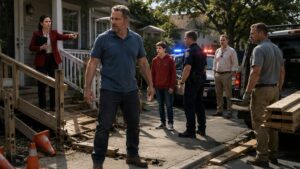
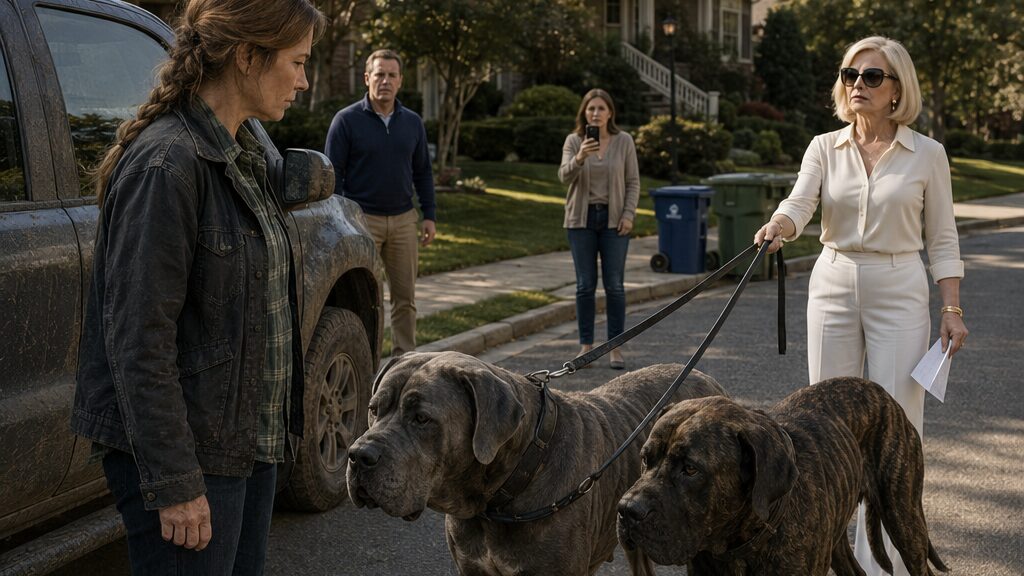
The mastiff lunged so fast that the woman filming from the sidewalk screamed before Rachel moved at all.
One second the dog stood beside Carolyn’s knee.
The next, eighty pounds of gray muscle drove forward hard enough to snap the leash straight.
Rachel saw the open mouth, the pale gums, the blunt head.
She did not run.
“Rachel!” John shouted.
Carolyn’s hand jerked back, bracelets flashing.
The leash pulled taut.
Then, almost delicately, her fingers opened.
Slack spilled onto the pavement.
For Rachel, the street narrowed.
No HOA clubhouse. No watching neighbors. No white SUV idling at the curb. No phone held upright by the concerned neighbor across the way.
Only the dog.
Its head was low, but not fixed on her throat or face. Its front stride broke half a beat as it crossed the edge of her driveway. Its nose moved.
Left.
Right.
Toward Rachel’s jacket pocket.
Rachel knew what was inside.
A sealed pouch of soft training treats she carried for work.
The realization landed before fear had time to become panic.
The dog was following food.
“Don’t run,” Rachel said.
She did not know whether she meant John, the neighbor, or herself.
A second mastiff surged from Carolyn’s other side, darker brindle, ribs visible even beneath the moving skin.
Rachel lowered her center of gravity without crouching fully. Turned one shoulder. Kept her hands low.
The gray dog reached her first.
It stopped so abruptly its nails skidded against concrete.
Its nose struck her jacket.
The crowd made a collective sound.
Rachel smelled sour breath and infected skin.
Then she saw the neck.
Beneath the thick collar, hair had been rubbed away in a raw band. One edge of the leather pressed directly into swollen tissue.
Her fear changed shape.
“Easy,” she said.
The dog trembled.
Not with rage.
With effort.
Rachel looked at its side.
Ribs rose beneath the hide in hard, regular bars.
Ladder rungs.
The brindle dog came closer, pulling less now that the gray one had stopped. Its eyes looked dull, almost unfocused, until Rachel shifted the treat pouch inside her pocket.
Both heads followed the sound.
Plastic crinkling.
That was the truth of them.
Not harmless. No large frightened animal was harmless.
But not what Carolyn wanted everyone to believe.
Rachel lifted her eyes.
Carolyn stood twenty feet away holding the ends of both leashes.
“Call them back,” she said.
Rachel’s voice was quiet.
Carolyn laughed once, too sharply. “I thought you people who work outdoors liked dogs.”
“You let the leash go.”
“I lost my grip.”
“No.”
The neighbor’s phone remained raised.
Carolyn glanced toward it.
Then she smiled.
It was the smile she used at board meetings when she wanted a cruel statement to sound administrative.
“Well, you’re standing there, aren’t you?”
Rachel felt the gray dog nose her pocket again.
“Secure them.”
“They seem perfectly secure.”
“Carolyn.”
“What?”
“Take them home. Feed them. Then call a veterinarian.”
The smile vanished.
A beat passed.
“Excuse me?”
Rachel looked at the raw collar line again.
“Today.”
Carolyn walked closer, gathering the loose leash inch by inch. “You do not issue orders on my street.”
Rachel almost laughed.
Not because anything was funny.
Because there, finally, was the shape of the thing. Carolyn did not believe the dogs were a crisis. She believed Rachel’s attention was.
“You asked whether I belonged here,” Rachel said. “Right now that isn’t the important question.”
Carolyn’s face changed.
Small. Fast.
Fear.
Rachel saw it and knew she had touched something hidden.
The concerned neighbor lowered her phone slightly. “Are the dogs sick?”
Carolyn spun toward her. “They are not sick.”
The gray mastiff flinched at the sharpness in her voice.
Rachel saw that too.
So did John.
He stepped off his lawn. “Carolyn, maybe just take them inside.”
“This has nothing to do with you.”
“I’m standing ten feet away.”
“You’re always standing ten feet away from something and pretending that makes you involved.”
John’s jaw tightened.
The brindle dog leaned toward Rachel.
She took one slow step sideways.
The dog followed.
Not charging.
Following the scent.
Rachel pulled one treat from the pouch but kept it inside her closed fist. Feeding an unknown dog in an active confrontation could complicate everything, including behavior assessment. She hated that she was already thinking in report language.
The gray mastiff sat.
Its hindquarters dropped with visible fatigue.
The neighbor whispered, “Oh my God.”
Now that the dogs were still, the neglect became harder to hide.
Hip bones.
Dull coats.
A crusted sore where the brindle’s collar met its throat.
Carolyn yanked both leashes short.
The gray dog yelped.
Rachel took one step forward.
“Don’t.”
Carolyn froze.
The street did too.
Rachel heard her own breathing.
There were many things she could say. She could identify herself fully. She could tell Carolyn that she inspected animal facilities under state contract, that she knew the difference between a lean working dog and an underfed one, between leash pressure and attack commitment.
She said none of it.
Not with phones raised.
Not in a personal dispute.
Not after weeks of HOA notices.
Instead she said, “That collar needs to come off under veterinary supervision if the tissue has adhered.”
The neighbor’s phone lifted again.
Carolyn stared at Rachel.
“How would you know that?”
Rachel held her gaze.
“I know what I’m looking at.”
It was enough.
Too much, perhaps.
Carolyn pulled the dogs toward her SUV.
The brindle resisted—not against Carolyn, Rachel thought, but toward the treat scent.
Carolyn’s face flushed.
“Move.”
The dog took one step.
“Move.”
Another yank.
Rachel’s hands curled.
John said, “Stop pulling him like that.”
Carolyn rounded on him. “Do you want them loose?”
“No.”
“Then perhaps let the person holding the leash handle the dog.”
She dragged them across the street.
The gray mastiff looked back once.
Rachel hated the human habit of assigning meaning to an animal glance. She had testified against it. Written corrections about it. A dog looking backward was not gratitude, accusation, or plea merely because a person needed it to be.
Still, she watched until the garage door closed.
Only then did she notice the concerned neighbor approaching.
“I got most of it,” the woman said.
Rachel’s stomach tightened.
“Most?”
“The dogs came at you. Then you were just standing there.”
Of course.
“What happened before they moved?”
“I was unlocking my phone.”
Carolyn’s voice carried from inside the garage, too muffled to make out.
Rachel walked toward the curb.
The neighbor looked uncertain. “Should I send you the video?”
“Don’t post it.”
“I wasn’t—”
“Please.”
The woman glanced at the closed garage.
“All right.”
Rachel turned toward John.
He was looking at her differently.
“What?” she asked.
“You didn’t even step back.”
“I almost did.”
“No, you didn’t.”
She picked up the violation notice Carolyn had dropped during the confrontation. One tire track marked the corner.
“Rachel.”
She kept walking.
“How did you know?”
There it was.
The question the street would carry by dinner.
She looked at him. “I’ve seen hungry animals before.”
That was true.
It was also an evasion.
John heard both.
Before he could answer, Carolyn’s side door opened.
Rachel stopped beside her truck, partly hidden by the cab.
Carolyn stood just inside the garage with a phone pressed to her ear. Her voice was low and urgent.
“No. Tonight.”
A pause.
Rachel could not hear the reply.
Carolyn turned toward the interior of the house.
“I don’t care where.”
Another pause.
Then, sharper:
“She noticed.”
Rachel’s pulse slowed rather than quickened.
Carolyn lowered her voice, but the stillness of the street carried the final words clearly.
“The others have to be moved tonight.”
Chapter 3: Six Dogs Behind One Fence and One Missing Report
The county database returned six animal entries tied to Carolyn White’s address history.
Rachel stared at the screen until it dimmed.
Then she touched the trackpad and brought the names back.
Two active county licenses.
One expired.
Three records with incomplete status codes linked through prior vaccination submissions and address transfers.
Six.
She sat alone in her home office with the curtains open and every light off except the desk lamp. Across the street, Carolyn’s house showed a warm glow through the kitchen windows.
No barking.
That silence bothered Rachel more than noise would have.
She opened another tab.
Parcel records first.
Carolyn’s lot was zoned residential, standard single-family use. No approved kennel structure. No variance for commercial boarding. No obvious permit matching the rear enclosure Rachel had seen from the service lane.
She searched county inspection history.
Nothing useful.
Then vaccination records.
Incomplete.
The two mastiffs she had seen that afternoon appeared to have license histories under Carolyn’s address, but the dates did not line up cleanly. One rabies certificate was missing from the accessible file. Another had expired months earlier unless a newer record had not yet synchronized.
Rachel leaned back.
There were explanations for bad databases.
Clerical lag. Moves. Duplicate animals. Misspelled owner names.
She knew better than to treat gaps as guilt.
She also knew what she had seen under those collars.
Her phone lay beside the keyboard.
Donna Moore’s number was in her contacts.
Rachel did not call.
Instead she opened her private notes folder.
The file was named C.W. OBSERVATIONS.
Her mouth went dry.
She had created it twenty-three days earlier.
The first entry was short:
Multiple large-dog vocalizations, approx. 2:10 a.m. Unclear source certainty. No action.
The next:
Observed stacked feed bags in open garage during delivery. Quantity appears inconsistent with two known animals. Personal-neighbor context. Do not initiate without independent basis.
Then:
Possible rear enclosure modification. Check parcel only if public access; avoid agency system absent referral.
Rachel closed her eyes.
She remembered every decision.
At the time, each had felt careful.
Professional.
Ethical, even.
Carolyn had already filed three HOA complaints against her. Rachel had been trying not to turn suspicion into retaliation. So she had kept notes on her personal computer, looked only at public parcel information, and waited.
For what?
A cleaner case.
A complaint from someone else.
Permission to act without becoming part of the story.
She opened the date history.
Two weeks earlier, she had searched Carolyn’s parcel.
The record was there.
She had known enough to look.
And she had filed nothing.
Rachel stood so suddenly the chair rolled backward.
She walked into the kitchen, filled a glass with water, did not drink it.
Outside, headlights moved along the street and slowed near Carolyn’s house.
A dark pickup.
The garage door rose halfway.
Rachel stepped closer to the window.
Two figures moved in the gap.
She could not identify either clearly. Something large shifted behind them.
Then the garage door closed.
Rachel reached for her phone.
Stopped.
A photograph taken from her darkened house into a neighbor’s garage would look exactly like what Carolyn had accused her of doing: surveillance motivated by a feud.
She hated that the accusation had power.
She hated more that she had helped give it power by keeping everything private.
Her work phone buzzed.
An email.
The subject line read:
FORMAL COMPLAINT — CONFLICT OF INTEREST / MISUSE OF ACCESS
Rachel opened it.
Carolyn had moved faster.
The complaint was addressed to county administration and copied to the state contract oversight office. The language was polished, calm, devastating in its restraint.
A resident who has been engaged in an ongoing HOA dispute with me appears to have accessed or referenced private animal and property information for purposes of intimidation…
Rachel read on.
Carolyn listed dates of HOA notices.
Parking complaint.
Recycling container.
Truck cleanliness.
Wednesday confrontation.
Then:
Ms. Walker made specialized accusations concerning my animals immediately after a personal dispute and implied official authority without identifying any lawful inspection basis.
Rachel’s hand tightened around the phone.
That sentence was not entirely false.
She scrolled.
I am concerned that a government contractor may be leveraging professional databases to target a neighbor with whom she has a documented personal grievance.
Rachel sat again.
The room felt smaller.
She looked at the six entries on the county screen.
If she reported now, Carolyn would claim retaliation.
If she did not, dogs could disappear before morning.
Her cursor hovered over Donna’s name.
Five years earlier, Rachel had sat in a conference room while attorneys dissected another case. Not whether the animals were neglected—they had been—but whether Rachel had crossed from observation into unauthorized pressure before a formal inspection opened.
The case survived.
Barely.
Her reputation did too.
What stayed with her was not the accusation.
It was the moment her supervisor had asked, Why didn’t you tell us earlier that you had prior contact?
Rachel had thought she was protecting the case by handling the ambiguity herself.
The memory made her stomach turn now.
Same instinct.
Same silence.
She called Donna.
Voicemail.
“Donna, it’s Rachel. I need conflict screening on a potential welfare situation involving a neighbor. There was an incident today with two large dogs, visible body-condition concerns and collar injuries. I also have reason to believe there may be additional animals at the property.”
She paused.
The next sentence resisted her.
“I had prior observations.”
Her throat tightened.
“I did not refer them.”
She ended the call.
Then she sent a written summary.
Not her private notes.
Not yet.
That omission sat on the desk between her hands.
At eleven forty, the neighborhood was silent.
Rachel put on a jacket and walked—not toward Carolyn’s house, she told herself, but along the public sidewalk circling the outer edge of the subdivision.
At the rear service access, she slowed.
Carolyn’s fence stood dark.
The fresh cedar sections looked almost pale under the streetlight.
Rachel heard nothing.
No pacing.
No breathing.
No scrape of nails.
She continued to the corner.
A vehicle engine started somewhere beyond the houses.
By the time she returned home, the two black leashes that had hung beside Carolyn’s garage door Monday morning were gone.
At 7:12 the next morning, Donna called.
Rachel answered before the first ring finished.
“Tell me exactly what happened,” Donna said.
Rachel did.
The rush.
The slack leashes.
The visible ribs.
The collar injuries.
Carolyn’s phone call.
The line about moving the others.
Donna listened without interruption.
Then she asked, “What systems did you access?”
“Public parcel record.”
“Anything else before yesterday?”
Rachel looked at her computer.
The six animal entries remained open.
“Not before yesterday.”
“And yesterday?”
“County licensing.”
A pause.
“Through your credentials?”
“Yes.”
“Was there an active referral?”
“No.”
Donna exhaled.
Rachel closed her eyes.
“I know.”
“Do you?”
“Yes.”
“Because Carolyn’s complaint reached legal before your voicemail reached me.”
Rachel said nothing.
Donna’s voice lost none of its professionalism, which made the next question worse.
“She says you’d been investigating her for weeks.”
“I wasn’t investigating.”
“What were you doing?”
Rachel looked at the folder on her desktop.
C.W. OBSERVATIONS.
She could still choose the narrow answer.
She could say noticing.
She could say documenting personal concerns.
She could say nothing formal.
All true.
None complete.
Donna spoke again.
“Rachel, why did you know to pull Carolyn White’s parcel before the street incident?”
The cursor blinked beside the unopened private notes.
Rachel realized, with a clarity that felt almost physical, that the case had already turned around.
It was looking at her now.
Chapter 4: The Case Against Carolyn Turned Back Toward Rachel
The animal-control truck stopped in front of Carolyn White’s house at 8:16 the next morning and left forty-three minutes later without a single dog.
Rachel watched from behind her kitchen blinds.
Two officers had gone to the front door with Donna. Carolyn had let them inside. That surprised Rachel. What followed surprised her more.
No raised voices.
No visible resistance.
No dogs brought out.
When the county truck pulled away, Carolyn remained in her doorway wearing dark slacks and a pale blue sweater, one hand resting lightly against the frame. She looked composed enough to be receiving a package.
Then she turned her head toward Rachel’s house.
Even across the street, Rachel knew she had been seen.
Her phone rang.
Donna.
Rachel answered.
“Before you ask,” Donna said, “we did not clear the property.”
“Then why are you leaving?”
“Because I’m not discussing an active review through your window.”
Rachel stepped away from the blinds.
“Donna.”
“We found two licensed dogs on site.”
“Only two?”
“That is what was presented.”
“And the others?”
“Unknown.”
Rachel pressed two fingers to her forehead.
Donna continued. “The animals we saw were not the mastiffs from your description.”
Rachel looked toward the empty curb.
“Then she moved them.”
“Possibly.”
“She said she would.”
“I know what you reported.”
“Then go back.”
A pause.
When Donna spoke again, her voice had gone cooler.
“This is exactly why you are screened out of direct action right now.”
Rachel said nothing.
“The complaint against you is being reviewed,” Donna continued. “Your database access is being audited. Until legal clears the conflict issue, you do not direct field response on this property.”
“I’m not directing.”
“You just told me to go back.”
Rachel closed her eyes.
There it was.
The instinct she kept mistaking for responsibility.
“I’m sorry.”
“I know you are worried about the animals.”
“That doesn’t help them.”
“No. But contaminating the case helps them less.”
Rachel gripped the counter.
Donna’s next words landed more quietly.
“If you have prior notes, I need to know they exist.”
Rachel looked toward her office.
“I have personal observations.”
“Send them.”
“I need to review them first.”
“No.”
Rachel’s jaw tightened.
Donna heard it.
“That hesitation,” she said, “is the problem.”
The call ended six minutes later with no resolution and one new restriction: Rachel was not to access additional county animal records connected to Carolyn without written authorization.
By noon, a different kind of pressure arrived.
The HOA president emailed every homeowner announcing a special informational meeting concerning “allegations of targeted harassment, inappropriate use of professional influence, and disruption of community governance.”
Carolyn’s name did not appear.
Rachel’s did.
Not directly, but close enough.
A state-contracted professional residing within Briar Glen…
John knocked on Rachel’s door twenty minutes later.
She opened it and held up her phone.
“Did you vote for this?”
He looked at the email.
“No.”
“You’re treasurer.”
“That does not mean every board message comes through me.”
“You expect me to believe that?”
His face closed.
Rachel regretted the question before he answered.
“I came over because I thought you might want to know something.”
She stepped aside.
John did not enter.
He stood on the porch, coffee absent for once, both hands in his jacket pockets.
“Carolyn asked me to change the walk-through calendar.”
Rachel’s anger thinned into attention.
“What calendar?”
“Monthly compliance route.”
“I know what it is.”
“I mean the actual sequence.”
He glanced toward Carolyn’s house.
“She wanted the rear loop postponed twice.”
“When?”
“Last month. Then again this month.”
“Why?”
“She said landscaping contractors had damaged common access and she didn’t want false citations issued while repairs were pending.”
Rachel looked toward the service lane.
“There were no repairs.”
“I know.”
“You knew then?”
“No.” His answer came fast. “I checked yesterday.”
Rachel folded her arms.
John looked older than he had Monday morning.
“I thought she was being Carolyn. Controlling. Overprepared. Whatever word you want.”
“And now?”
“Now I found something else.”
He took out his phone but did not hand it to her.
“The complaint spreadsheet.”
Rachel waited.
“Carolyn had access to the raw submission queue before assignments.”
“That’s normal for vice president?”
“No.”
“Who gave it to her?”
John’s mouth tightened. “I did.”
Rachel stared at him.
He raised one hand.
“She said the president was overwhelmed. I gave her shared access for sorting. I thought I was reducing noise.”
“And she did what?”
“Complaints near her rear lot kept getting pushed down.”
The street seemed to go still around them.
Rachel said, “How many?”
“Enough that I noticed after I looked.”
“Why tell me?”
John’s eyes moved toward the pavement.
“Because I kept telling myself neutrality was the responsible position.”
Rachel almost answered.
He went on.
“It isn’t neutral if one person controls what everybody else sees.”
For the first time since the confrontation, Rachel felt a piece of the pattern settle into place.
The mud.
The bin.
The overnight guest.
The sudden frontage inspection.
Carolyn had not simply enjoyed humiliating her.
Rachel’s house sat nearest the service lane.
Every complaint dragged attention to Rachel’s curb, Rachel’s driveway, Rachel’s visible disorder.
Away from the rear fence.
Away from the fresh cedar boards.
The small payoff brought no satisfaction.
It made the whole thing worse.
“Send the records to the HOA president,” Rachel said.
“I will.”
“And Donna.”
John looked at her.
“You’re not asking me to send them to you?”
Rachel nearly smiled.
“That would be a terrible idea.”
He nodded once.
Then his attention shifted across the street.
Carolyn’s garage door was open.
Rachel turned.
The hook beside the interior door stood empty.
The two black leashes were gone.
So were the thicker red leads she had not consciously registered before.
Empty hooks.
Clean wall.
No stacked food bags.
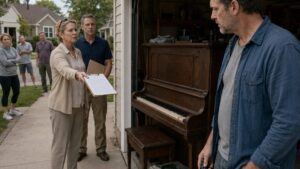
Carolyn appeared behind the SUV carrying a cardboard box.
She saw them.
For a moment, nobody moved.
Then Carolyn set the box down.
“John.”
His shoulders stiffened.
“You’ve been busy,” she said.
He did not answer.
Carolyn looked at Rachel.
“This is what you wanted, isn’t it?”
Rachel stayed on her own porch.
“What?”
“A spectacle.”
“I want to know where the dogs are.”
Carolyn gave a thin laugh.
“There. That. You’re incapable of hearing yourself.”
“Where are they?”
“You have spent weeks watching my property.”
Rachel felt John look at her.
Carolyn continued.
“You accessed records after I cited you. You stood in the street making medical claims. Now county vehicles arrive at my home.”
“I didn’t send that truck.”
“No? How fortunate that it came by itself.”
Rachel forced herself not to step forward.
“Where are the mastiffs?”
Carolyn’s expression hardened.
“My animals are safe.”
“Where?”
“Not your concern.”
“Carolyn.”
“You don’t get to say my name like you own the answer.”
The words were controlled, but something beneath them was fraying.
She pointed toward Rachel’s house.
“You think because you wear an ID badge for work, everyone else has to live under your inspection lamp. Some of us are trying to hold a neighborhood together.”
Rachel saw the exhaustion again.
Not innocence.
Not remorse.
But pressure.
Carolyn looked at John.
“And some people forget who asked them to serve.”
John flinched as if struck.
Carolyn picked up the box and carried it inside.
The garage door descended.
By late afternoon, Donna had enough independent information to seek a broader review of movement records, clinic intake notifications, and possible emergency placements.
Rachel was not invited to participate.
That hurt more than she expected.
At 6:40 p.m., she received a formal notice suspending her access to the relevant county case file pending conflict review.
At 7:05, John forwarded confirmation that he had submitted HOA records independently.
At 8:13, Rachel stood in her office and opened the private notes folder again.
She read the first entry.
Then the second.
She selected all.
Her finger hovered over the attachment icon in an email addressed to Donna.
Still she did not send.
A phone rang.
Not hers.
The landline.
Rachel almost ignored it. Hardly anyone used that number.
She answered.
“Rachel Walker?”
“Yes.”
“This is the emergency veterinary clinic on Route Nine. Your number was listed in a county advisory note connected to a possible neglect concern.”
Rachel sat down.
“What happened?”
“Two large mastiff-type dogs were left here approximately twenty minutes ago.”
Her grip tightened around the receiver.
“By whom?”
“Unknown. They were tied to the exterior intake rail before staff opened the side door.”
Rachel could hear movement behind the caller. Metal. A short bark. Then a human voice calming something out of earshot.
The veterinarian came back on.
“One gray, one brindle. Both severely underweight. Both have significant collar injuries.”
Rachel looked through her dark window at Carolyn’s silent house.
“Are they alive?”
“Yes.”
The word released something in her chest and tightened something else.
“Where are the other four?” Rachel asked.
The veterinarian was quiet.
“What other four?”
Chapter 5: The Brother Carolyn Never Mentioned Came Looking for Four Dogs
“Which two did she leave?”
The man on Rachel’s porch looked as if he had driven through the night.
His jacket was unzipped despite the cold. Dust streaked one sleeve. In his left hand, four nylon leashes were knotted together so tightly they looked like one ruined rope.
Rachel kept the storm door closed.
“Who are you?”
He swallowed.
“William Brown.”
The name meant nothing.
Then he said, “Carolyn’s my sister.”
Rachel’s hand stayed on the latch.
Behind him, an older pickup idled at the curb.
“What do you mean, which two?”
William looked over his shoulder as if someone might be listening.
“The gray one and the brindle?”
Rachel said nothing.
His face answered for her.
He closed his eyes.
“She left those two.”
“You need to start over.”
“I need to know where the other four are.”
Rachel opened the inner door only enough to hear him better.
“You’re asking the wrong person.”
“No. I’m asking the person she’s been talking about for three weeks.”
Rachel’s posture changed.
William saw it.
“She said you were trying to ruin her.”
“She told you that?”
“She told everybody something different.”
He lifted the knotted leashes.
Rachel looked at them.
Four.
Not decorative.
Used.
Frayed near the clips.
“Those belong to the dogs?”
His jaw worked.
“Yes.”
“Why do you have them?”
“Because I moved the dogs.”
Rachel opened the storm door.
“Come inside.”
He shook his head.
“No.”
“Then get off my porch before I call the county.”
“Call them.”
The answer came so quickly she stopped.
William stepped down one stair and turned back.
“Call whoever you need. I’m done helping her hide this. But I need to know if she abandoned those two at a clinic or somewhere worse.”
Rachel studied him.
His eyes were red, not theatrical, not wet enough to invite sympathy. Just exhausted.
“The two mastiffs are alive,” she said.
His shoulders dropped.
He sat on the porch step without asking permission.
For several seconds, he said nothing.
Rachel remained standing.
Finally he rubbed both hands over his face.
“They weren’t supposed to stay with her.”
There it was.
Not innocence.
A beginning.
Rachel sat in the porch chair across from him, leaving the door open behind her.
“How many were yours?”
“Four.”
“And the mastiffs?”
“Hers.”
“So six total.”
He nodded.
Rachel looked at the leashes again.
“Why did she take your four?”
William laughed once, without humor.
“Because I ran out of places.”
He stared at the yard.
“I lost my apartment after the company cut our shift. Then I stayed with a friend. Two dogs was already too many for him. Four wasn’t happening.”
“You had four dogs in an apartment?”
“House before that.”
Rachel waited.
William’s mouth tightened.
“I know what it sounds like.”
“I haven’t said what it sounds like.”
“No. You have that worse thing.”
“What?”
“The face where you’re waiting for me to say the part that condemns me.”
Rachel leaned back.
He was not entirely wrong.
“I asked Carolyn for three weeks,” he said. “She said no. Then she called back and said one month. Just until I found somewhere.”
“How long ago?”
“Five months.”
Rachel felt the answer settle heavily.
“Did you provide food?”
“At first.”
“At first.”
“My checks got smaller.”
“Did you reclaim them?”
“I tried.”
“When?”
William looked at her.
That hesitation mattered.
“Twice.”
“Five months.”
“I know.”
“No, I don’t think you do.”
He stood.
“Forget it.”
Rachel rose too.
“You came here.”
“Because I thought you might care whether they live.”
“I care enough not to make you the innocent one because your sister did worse.”
He stared at her.
The street remained quiet.
Then his shoulders sagged.
“I couldn’t take them.”
The words were plain.
No defense attached.
Rachel said nothing.
“I kept telling her another week. Then another. She bought food. Paid for shots on two of them. Called me every night for a while.”
Rachel’s assumptions shifted.
Not disappeared.
Shifted.
“She tried?”
William nodded.
“At first.”
“What changed?”
“She got scared.”
“Of what?”
“Neighbors. The board. Money. Pick one.”
He looked toward Carolyn’s house.
“She liked being the woman who knew everybody’s violations. Couldn’t exactly announce she had six dogs behind the fence.”
“So she hid them.”
“She put up new boards. Started walking only two at a time. Asked me to come after dark if I brought food.”
Rachel remembered the fresh cedar.
The moved inspection route.
“What about the condition of the mastiffs?”
William’s face tightened.
“I didn’t see them like that.”
“When did you last see them?”
“Three weeks ago.”
“And?”
“They were thinner.”
“How much thinner?”
“I don’t know.”
“You do.”
He looked away.
Rachel felt anger rise.
William spoke before she could.
“She called me crying once.”
The sentence stopped her.
“Carolyn?”
He nodded.
“Said she couldn’t keep doing it. Said the dogs were eating through everything, one had diarrhea, one tore up the utility room. She asked me to take mine.”
“And you didn’t.”
“No.”
The word sat between them.
“She paid for food?”
“For a while.”
“Veterinary care?”
“Some.”
“Then what?”
“She stopped telling me things.”
Rachel thought of Carolyn in the street, the dogs on leashes, control made visible.
William twisted the knot of nylon in his hand.
“She begged me to take mine back.”
The deeper truth did not absolve Carolyn.
It complicated the path into harm.
Rachel hated how much easier the story had been when she imagined a woman collecting animals out of vanity or profit.
“What happened after the confrontation?” she asked.
William’s eyes lifted.
“She called me.”
“What time?”
“Late afternoon.”
“What did she say?”
“That you knew.”
“Knew what?”
“Enough.”
He sat again.
“She said county people would come. Said the HOA would find out. Said she’d lose the board seat, maybe the house if somebody made it sound like a kennel.”
“So you moved four dogs.”
William nodded.
“Where?”
His silence changed the air.
Rachel stood very still.
“William.”
“I thought it was for one night.”
“Where?”
“A storage place.”
The words were so quiet she almost missed them.
Rachel’s stomach turned.
“A storage unit?”
“Not inside a sealed unit.”
“That is not an answer.”
“It has exterior bays. One of them opens to a fenced loading strip.”
“Climate control?”
“For the building.”
“For the bay?”
He said nothing.
Rachel stepped closer.
“When did you move them?”
“Last night.”
“After Carolyn said I noticed?”
“Yes.”
“You left four dogs at a storage facility overnight?”
“I put water down.”
Rachel stared at him.
He flinched.
“I know.”
“No. Stop saying that.”
Her voice sharpened enough that he looked up.
“You keep saying you know as though recognition is action. You knew you couldn’t house them. You knew she was failing. You knew they were being hidden. And then you moved them somewhere worse.”
His face went pale.
Rachel heard herself.
The words were accurate.
They were also too familiar.
Recognition is not action.
Her own private notes sat unsent in her office.
She stepped back.
William noticed the change.
“What?”
“Nothing.”
“That’s not nothing.”
Rachel turned toward the door.
“I need the address.”
He did not move.
“If I give it to you, they take them.”
“They may.”
“I lose them.”
“You already did.”
His face hardened.
Rachel regretted the cruelty but not the truth beneath it.
William looked down at the four leashes.
“I love those dogs.”
“I believe you.”
He looked up, almost angry at that answer.
“Then why are you talking to me like—”
“Because love does not make food appear.”
Silence.
“Love does not make a room safe. It does not treat infection. It does not turn temporary into responsible because you are ashamed.”
William’s eyes dropped.
Rachel’s own words pressed back against her.
Silence did not become integrity because she was afraid.
For a long moment, neither spoke.
Then William untangled one leash from the knot.
A brass key was looped through the handle.
He held it out.
Rachel did not take it.
“Address first.”
He gave it.
A commercial storage facility beyond the subdivision, near the highway.
Rachel’s pulse quickened.
“Unit number?”
“C-seventeen.”
“Who else knows?”
“Carolyn.”
“Does she have a key?”
“Yes.”
Rachel took out her phone.
William stood abruptly.
“You calling county?”
“Yes.”
“She’ll move them.”
“When?”
“I don’t know.”
“That is why I’m calling.”
His face twisted.
“I can go first.”
“No.”
“They know me.”
“No.”
“They’ll be scared.”
Rachel looked at the leashes in his hand.
“Then tell Donna that. Tell her everything.”
He backed away.
“I’m not talking to county.”
“You came here asking for help.”
“I came for the dogs.”
“Same thing now.”
He shook his head.
Rachel began dialing.
William turned toward the steps.
Then stopped.
His shoulders stayed rigid.
Without facing her, he said, “There’s something else.”
Rachel lowered the phone.
“What?”
“When we moved them, Carolyn said she’d come back before daylight.”
“For what?”
“To split them up again.”
Rachel felt cold spread through her arms.
“Where?”
“I don’t know.”
“William.”
“I swear.”
He turned at last.
“She said if they stayed together, somebody could count them.”
Rachel looked at the key on the leash.
“How long before she realizes you came here?”
William’s answer was almost a whisper.
“She already knows.”
He held out the brass key.
This time Rachel took it.
Chapter 6: Rachel Put Her Own Failure Into the Official Record
Rachel began her statement with the date that could end her career.
“May third,” she said.
Donna looked up from the conference table.
Rachel kept reading.
“Approximately 2:10 a.m. I documented multiple large-dog vocalizations believed to originate near Carolyn White’s property. I did not open a referral.”
The room was small, windowless, and cold enough that Rachel could hear the faint rattle in the air vent between sentences.
Donna sat across from her.
The county clerk occupied the far end of the table with a laptop.
Rachel’s private notebook lay unopened beside her right hand.
The four knotted leashes from William sat inside a clear evidence bag near the center.
“Continue,” Donna said.
Rachel looked down.
“May tenth. I observed multiple stacked feed bags inside the open garage during a delivery. Quantity appeared inconsistent with two known dogs.”
Her throat tightened.
“I did not open a referral.”
The clerk typed.
Rachel heard every key.
“May seventeenth. I observed recent rear-fence modifications and checked publicly available parcel information. No kennel-related permit was visible.”
Donna’s expression did not change.
“I did not open a referral.”
Rachel stopped.
The sentence had become heavier each time.
Donna folded her hands.
“Why?”
Rachel knew the answers she could give.
Conflict sensitivity.
Prior allegations.
Uncertain source attribution.
None were lies.
She chose the one that hurt.
“Because I was afraid.”
The clerk’s typing paused.
Rachel continued.
“Carolyn and I were already in a personal HOA dispute. I believed a referral from me would look retaliatory. I thought waiting for independent evidence protected the integrity of any future case.”
Donna said, “Did it?”
“No.”
The word came cleanly.
Rachel opened the notebook.
Pages of private observations.
Dates.
Times.
Descriptions.
Everything she had kept because keeping it privately had felt safer than sharing uncertainty.
She pushed it across the table.
“I should have disclosed the conflict and referred the concern for independent screening.”
Donna did not touch the notebook at first.
“You understand what this does?”
“Yes.”
“It establishes that you had prior suspicion.”
“Yes.”
“It supports Carolyn’s claim that the street incident did not create your concern.”
“Yes.”
“It may trigger contract review.”
Rachel looked at her.
“Yes.”
Donna’s voice softened by half a degree.
“And you’re giving it to me anyway.”
Rachel glanced at the leashes.
“I’m done deciding alone what other people are allowed to know.”
Donna finally took the notebook.
For one second, Rachel felt as if something had been removed from her chest.
Not forgiven.
Removed.
The relief was so sharp it almost frightened her.
The conference-room phone rang.
Donna answered.
Listened.
Her eyes shifted toward Rachel.
“Do not enter until officers arrive,” she said into the receiver. “No, not even if the door is open.”
She hung up.
“Storage facility manager confirmed four dogs are present in C-seventeen.”
Rachel exhaled.
“Alive?”
“Visible movement on camera.”
Donna stood.
Rachel stood too.
“You’re staying here.”
“No.”
“Rachel.”
“I can identify—”
“You are staying out of the entry team.”
“I know those dogs may be connected to the case.”
“Exactly.”
Rachel’s jaw set.
Donna leaned both palms on the table.
“This is where you prove you meant what you just said.”
The words hit harder than an order.
Rachel looked at the notebook now in Donna’s possession.
Agency meant accepting limits too.
She sat.
Donna left.
For thirty-seven minutes, Rachel remained in the conference room with the county clerk.
No updates.
No access.
No control.
It was one of the longest waits of her professional life.
At minute thirty-eight, Donna called.
“They’re in.”
Rachel stood.
“All four?”
“All four alive.”
Her knees weakened.
Then Donna added, “One is in distress.”
The small relief vanished.
“What kind?”
“Severe dehydration, possible gastrointestinal complication. Emergency transport is moving now.”
Rachel closed her eyes.
“Condition on the others?”
“Poor. We’ll know more later.”
The clerk looked at her.
Rachel turned away.
“Was Carolyn there?”
“No.”
“William?”
“Outside perimeter with an officer. He disclosed his role voluntarily.”
Rachel absorbed that.
Donna continued. “Manager says the bay had water containers and bedding. Not adequate, but not an empty concrete box.”
Again, complexity.
Again, no clean villain shape.
“And the key?” Rachel asked.
“Matched.”
Rachel looked at the evidence bag.
Four leashes.
A key.
Responsibility knotted into nylon.
By early afternoon, the county office had become a corridor of overlapping consequences.
The emergency veterinarian confirmed one dog needed urgent treatment but was expected to survive the next several hours.
The other three were transferred for assessment.
William gave a formal statement.
Carolyn retained counsel.
Rachel received notice that her contract access remained restricted pending administrative review.
Then Donna returned to the conference room carrying the private notebook and a second evidence bag.
Inside were two thick collars.
One black.
One dark brown.
Rachel recognized them immediately.
“The mastiffs?”
Donna nodded.
“Clinic removed them.”
Rachel stepped closer.
The inner surfaces were stiff with dried material. The black collar had a distorted edge where repeated pressure had worn into the lining.
Donna placed Rachel’s notebook beside the evidence.
For a moment, the objects seemed to accuse different people.
Carolyn.
William.
Rachel.
Not equally.
But not separately either.
Donna said, “Your admission hurts you.”
“I know.”
“It also gives us something useful.”
Rachel looked at her.
“Timeline continuity. Your notes predate the street confrontation and describe independent observable concerns.”
“That is exactly what Carolyn will use against me.”
“Yes.”
Donna’s mouth tightened.
“But because you disclosed them voluntarily, legal can separate your conduct review from the emergency-welfare basis. The storage recovery is now independently supported by manager testimony, William’s statement, camera footage, veterinary condition, and officer observation.”
Rachel let out a breath.
“So the case survives me.”
Donna held her gaze.
“That is one way to say it.”
Rachel almost smiled.
“Not a flattering one.”
“I’m not here to flatter you.”
“No.”
Donna touched the notebook.
“You should have called sooner.”
“I know.”
“Don’t say it like William.”
Rachel looked sharply at her.
Donna had heard enough of his statement to understand.
Rachel nodded.
“You’re right.”
The small payoff was not vindication.
It was structure.
The animals did not need Rachel to be spotless.
They needed the record to be honest enough to withstand pressure.
At four o’clock, Rachel was permitted to observe from outside the veterinary intake area as the four recovered dogs arrived.
She did not approach the crates.
One animal, a black mixed-breed with graying around the muzzle, lay against the gate and did not lift its head.
The dog in distress had already been taken through another entrance.
William stood fifty feet away with an officer.
He saw Rachel.
For a moment, neither moved.
Then he held up his empty hands.
No leashes now.
Rachel nodded once.
That was all.
Her phone vibrated.
HOA EMAIL — URGENT SPECIAL SESSION
She opened it.
The subject line read:
EMERGENCY BOARD REVIEW OF RESIDENT CONDUCT AND COMMUNITY COMPLIANCE AUTHORITY
Carolyn had invoked a special meeting under the bylaws.
Rachel read the first paragraph.
The purpose was to consider removal of Rachel from the neighborhood compliance committee, formal censure for “harassing use of external governmental influence,” and referral of her conduct to association counsel.
The meeting would occur in forty-eight hours.
Attached was a statement from Carolyn.
Rachel opened it.
The first sentence quoted directly from Rachel’s own admission:
I had prior observations. I did not refer them.
Rachel stared at the words.
Carolyn had found the one true sentence capable of making every lie around it sound plausible.
Donna came to stand beside her.
“What is it?”
Rachel handed over the phone.
Donna read.
“You don’t have to attend.”
“Yes, I do.”
“You are under review.”
“I know.”
“Anything you say publicly may affect that.”
Rachel watched William through the glass as he signed another page.
Two days earlier, she would have treated silence as safety.
Now she understood the cost.
“I’m going,” she said.
Donna gave the phone back.
“To defend yourself?”
Rachel looked at the collars in the evidence bag, then at the empty hands of the man who had finally stopped holding on.
“No.”
Her answer surprised even her.
“I’m going to tell them where I failed before Carolyn gets to decide what the truth means.”
Chapter 7: The Board Meeting Where Nobody Could Hide Behind Procedure
Carolyn began the meeting by reading Rachel’s confession aloud.
“I had prior observations. I did not refer them.”
Her voice carried cleanly through the HOA clubhouse.
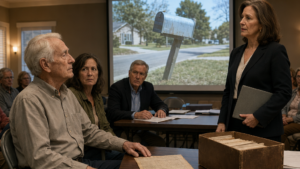
Rachel had taken a chair in the second row, not at the committee table. The room smelled of burned coffee and dry-erase marker. Every folding chair was occupied. Several residents stood along the back wall.
Carolyn sat beneath the association seal with an empty black leash looped once around her left hand.
Rachel noticed it before anything else.
The leather was not one of the thick collars from the clinic. It was a leash she had seen hanging inside Carolyn’s garage weeks earlier.
Empty now.
Carolyn lowered the printed statement.
“Those are Ms. Walker’s words, not mine.”
A murmur moved through the room.
The HOA president tapped a pen against the table.
“Carolyn, this session concerns association governance. We are not retrying a county matter.”
“I agree completely.”
Carolyn sounded almost relieved.
“That is precisely why residents deserve to know whether a person serving on our compliance committee used professional access while pursuing a personal grievance.”
She looked at Rachel.
Not triumphant.
Tired.
The difference unsettled Rachel more than a smile would have.
Carolyn continued.
“For months, Ms. Walker objected to routine enforcement involving her vehicle, her guests, her waste containers, and frontage maintenance. Then she began examining my property records.”
Rachel felt several heads turn.
Carolyn lifted another sheet.
“She admitted she had suspicions before the incident involving my dogs. She failed to report those suspicions. Later, after our personal dispute escalated, county authorities became involved.”
Every sentence was arranged around something true.
That was the danger.
The HOA president said, “Rachel, you’ll have time to respond.”
Rachel nodded.
Carolyn leaned forward.
“I am not asking anyone to ignore the condition in which two animals were found. I am asking whether rules apply equally when the person accused of breaking them carries government credentials.”
The room went quiet.
Rachel looked at the empty leash.
For one brief moment, she understood exactly why Carolyn believed this argument could save her.
Maybe not from the county.
Maybe not from the veterinary findings.
But here, in this room, among people whose mortgages and retirement plans sat behind identical landscaping standards, procedure mattered. Selective authority frightened them because most had imagined themselves protected by rules, not exposed to whoever interpreted them.
The HOA president turned.
“Rachel.”
Rachel stood.
She had prepared notes.
She left them on the chair.
“I did have prior observations.”
A ripple moved through the room.
Carolyn’s hand tightened around the leash.
Rachel continued.
“I heard multiple dogs. I saw quantities of feed that raised questions. I checked publicly available parcel information. I did not open a referral.”
Someone near the back whispered.
Rachel looked toward the board table.
“That was a mistake.”
Carolyn blinked.
Not much.
Enough.
Rachel went on.
“I was already in a personal conflict with Carolyn. I believed reporting my concerns would look retaliatory. I told myself waiting for independent evidence was the more ethical choice.”
She paused.
“It wasn’t.”
The room had changed.
Not softened.
Changed.
Carolyn said, “So you admit—”
“Yes.”
The interruption came quietly.
Carolyn stopped.
Rachel looked directly at her.
“I admit I waited.”
No defense followed.
No title.
No claim that expertise excused delay.
The absence seemed to unsettle the room more than denial would have.
Rachel turned slightly so she could see the residents behind her.
“Two dogs were later left at an emergency clinic in severe condition. Four others were recovered from a storage facility. Those facts do not erase my failure to refer concerns earlier.”
The HOA president said, “Please avoid discussing active proceedings beyond confirmed public information.”
Rachel nodded.
“That is fair.”
Carolyn gave a small, humorless laugh.
“Fair.”
Rachel looked back at her.
Carolyn lifted the leash.
“You stood in the street and accused me before any inspection.”
“I told you the dogs needed veterinary care.”
“You used your profession to frighten me.”
“I did not identify my employer.”
“You didn’t have to.”
Carolyn’s voice cracked on the last word.
She recovered immediately.
But Rachel heard it.
So did William Brown, standing near the rear door.
Rachel had not known he would come.
His work jacket was clean this time. His hands were empty.
Carolyn saw him.
Her face lost color.
“William.”
He did not move.
The HOA president looked between them.
“Sir, this is a resident meeting.”
“I know.”
“You’re not a member.”
“I’m part of why you’re here.”
Carolyn stood.
“No.”
One word.
Not commanding.
Pleading.
William’s jaw tightened.
“I left four dogs with her.”
The room went still.
Carolyn closed her eyes.
William continued.
“I lost housing. She said one month. It became five.”
Carolyn whispered, “Stop.”
“I kept telling her I’d come back.”
“Stop.”
“I didn’t.”
Rachel watched the residents absorb a story that refused the shape they had expected.
William looked at Carolyn.
“She bought food. She paid for things I couldn’t pay for. She called me to take them back.”
Carolyn’s fingers loosened around the empty leash.
Someone in the room shifted.
William’s next words came harder.
“And when it got bad, we hid them.”
No one spoke.
“I helped move four after she got scared about inspection. I put them somewhere they should never have been.”
Carolyn stared at him.
“You said one night.”
“I know.”
“Don’t.”
The word came out almost as a gasp.
William lowered his head.
Rachel remembered Donna’s warning.
Don’t say it like William.
Carolyn sat slowly.
For the first time since Rachel had known her, she looked small in the oversized board chair.
Not innocent.
Not absolved.
Human.
The HOA president called for five minutes of recess.
Nobody moved.
Then John Allen stood.
He carried a thin folder.
Carolyn looked at him with something close to disbelief.
“John.”
He stopped beside the treasurer’s seat.
“I submitted records to the president.”
“What records?”
“You know.”
The old instinct crossed his face—the desire to reduce harm by saying less.
Then he opened the folder.
“Complaint-routing history.”
Carolyn’s posture stiffened.
John looked at the HOA president.
“I gave Carolyn shared access to the raw queue. That was my decision. I thought she was helping sort reports.”
He swallowed.
“She changed priority on complaints involving the rear loop and service lane. She also asked me to move walk-through dates.”
Carolyn said, “Because of contractor access.”
“There were no contractors.”
“I was told—”
“No.”
John’s voice was not loud.
It did not need to be.
“I checked.”
The room shifted again.
This was not county evidence.
Not Rachel’s authority.
It belonged entirely to the HOA.
Carolyn looked around the table.
“I was protecting property values.”
John’s expression tightened.
“By hiding complaints?”
“By preventing chaos.”
“There were six dogs.”
“My brother abandoned four animals with me.”
William flinched.
Carolyn pointed toward him.
“He came to my house with nowhere to go and nowhere to put them. What was I supposed to do?”
“Ask for help,” Rachel said.
Carolyn turned on her.
“From you?”
The question struck cleanly.
Rachel had no quick answer.
Carolyn laughed again, softer now.
“You had been waiting weeks to decide what kind of person I was.”
Rachel felt that land.
Because there was truth in it.
“I should have referred what I saw sooner,” she said.
Carolyn stared at her.
“But you still chose what happened after.”
The silence that followed was not satisfying.
It was necessary.
Rachel continued.
“You chose to hide them. You chose to redirect attention. You chose to use the mastiffs’ condition and size to frighten me.”
Carolyn’s eyes dropped to the leash.
“I lost my grip.”
Rachel could have argued.
Instead she said, “Then that is what the county process will examine.”
Carolyn looked up.
No dramatic defeat came.
No applause.
Only the sound of someone at the back setting down a paper cup.
The HOA president called the meeting back to order.
The board voted first on Rachel’s compliance committee position.
She was removed pending completion of her external professional review.
Three votes to two.
Rachel felt the result in her chest.
She had expected anger.
What came was something quieter.
She had wanted the truth to protect her from consequence.
It did not.
Then came the motion concerning Carolyn’s access to enforcement functions and complaint-routing authority.
John voted yes.
The HOA president voted yes.
One board member abstained.
The remaining votes made the result final.
Carolyn was removed from enforcement authority and barred from complaint-system administration pending a broader governance review.
Not removed from the HOA.
Not expelled from the neighborhood.
Not ruined.
The reform motion—independent auditing of complaint assignments and revised access controls—was postponed for legal review.
John stared at the table.
Rachel understood his disappointment.
The institution had corrected the person faster than the system.
Residents began gathering coats.
Carolyn remained seated.
The empty leash lay on the table in front of her.
Rachel walked toward the exit.
As she passed, Carolyn spoke.
“You won.”
Rachel stopped.
The words sounded exhausted.
She looked at the leash.
Then at Carolyn.
“No.”
Carolyn’s mouth tightened.
Rachel continued toward the door.
Behind her, the HOA president announced that broader governance reforms would be reconsidered at a later session.
Rachel stepped outside knowing Carolyn had lost authority, she had lost her committee seat, the dogs were still recovering, and the system that had helped hide them had merely promised to discuss itself later.
For the first time, she understood that the harder question was no longer who had won.
It was what justice was supposed to look like after everyone had been forced to admit what they had done.
Chapter 8: The Last Leash Hung Empty for a Different Reason
The gray mastiff stopped at the rehabilitation gate and refused to come any closer to Rachel.
She stood twelve feet away with both hands visible.
The dog had gained weight, though not enough to hide the shape of its ribs completely. New hair had begun filling the damaged band around its neck. The old collar was gone.
A rehabilitation worker held a loose leash.
No tension.
No pulling.
The dog looked at Rachel, then away.
“It remembers the street?” Rachel asked.
The worker gave a small shrug.
“Maybe. Maybe not the way people mean when they say that.”
Rachel almost smiled.
“Fair.”
Three weeks had passed since the board meeting.
Long enough for neighbors to stop lowering their voices when she crossed the street.
Not long enough for anything to feel settled.
The four recovered dogs were improving unevenly. The oldest remained under close veterinary care after the storage-facility decline. Two had been approved for foster placement once medical holds cleared. One still panicked at enclosed loading doors.
The brindle mastiff tolerated handling but startled at sudden leash pressure.
The gray one did not trust Rachel.
That seemed reasonable.
She waited.
The worker said, “You can try a treat.”
Rachel had one in her pocket.
She left it there.
“No.”
The worker looked at her.
Rachel kept her eyes slightly aside from the dog.
“He gets to decide whether this is happening.”
Minutes passed.
A truck moved on the road beyond the yard.
The mastiff’s ears shifted.
Rachel thought of the first time it had rushed toward her, nose searching for food, everyone around it mistaking hunger for intent.
She had seen correctly.
Then she had built too much of herself around the fact that she had seen correctly.
The dog took one step.
Rachel did nothing.
Another.
The leash remained curved between collar and worker’s hand.
Rachel watched the empty space in that curve.
Slack.
Once, slack had meant danger because Carolyn had released control with cruelty behind it.
Now it meant room.
The mastiff stopped within arm’s reach.
Rachel did not reach.
Its nose moved.
Her jacket pocket still held the treat.
A soft breath touched the back of her hand.
Rachel waited.
Then the dog leaned its shoulder against her knee.
The contact lasted less than two seconds.
It was enough.
The worker said nothing.
Rachel was grateful.
Her phone vibrated.
She stepped away before checking it.
The email came from contract oversight.
FORMAL REVIEW DETERMINATION.
Rachel opened it beside the rehabilitation yard.
The first paragraph confirmed a written reprimand for delayed conflict disclosure and unauthorized access to licensing information before assignment of an active referral.
She read the sentence twice.
There would be mandatory retraining.
Temporary supervision on sensitive cases.
A review period.
Then:
Continued eligibility for contracted field work is maintained subject to conditions above.
Rachel lowered the phone.
She had imagined this moment in several forms.
Vindication.
Dismissal.
Some clean decision that would tell her what kind of person she had been.
Instead she had a reprimand and a job.
Consequences and continuation.
Donna called ten minutes later.
“You saw it?”
“Yes.”
“You all right?”
Rachel looked at the gray mastiff, now sniffing the fence line.
“I think so.”
“That sounds suspiciously healthy.”
“Don’t get used to it.”
Donna laughed once.
Then her voice changed.
“Carolyn’s proceedings are still active.”
“I know.”
“No final outcome yet.”
“I know.”
“Civil restrictions, animal-welfare review, licensing matters. Nothing instant.”
Rachel watched the loose leash.
“Good.”
Donna was quiet.
“Good?”
“I don’t mean good for her.”
“I know.”
Rachel breathed out.
“I mean I’m done needing it to be instant.”
After the call, she remained at the yard until the mastiff completed one slow circuit.
On the wall beside the gate hung several hooks.
Most held leads.
One was empty.
The worker noticed Rachel looking.
“That was his old assignment hook,” she said. “He’s moving to supervised walks from the open yard now.”
Rachel touched nothing.
An empty hook.
Once, missing leashes had meant animals moved in secret.
Now the absence meant a dog no longer needed that particular restraint.
The difference was not the object.
It was the responsibility around it.
That afternoon, Rachel returned home to find John standing near her mailbox.
He held no coffee.
Some habits, apparently, did change.
“The board approved an independent complaint audit,” he said.
Rachel looked at him.
“I thought legal review would take months.”
“It nearly did.”
“It has been three weeks.”
“Felt like months.”
She smiled despite herself.
John looked toward Carolyn’s house.
The blinds were closed.
Carolyn had not moved.
She remained in the neighborhood while proceedings continued, no longer controlling the complaint system, no longer attending board meetings.
Rachel had seen her only twice.
Once collecting mail.
Once sitting in her car without starting it.
Neither woman had spoken.
John said, “I should have checked sooner.”
Rachel leaned against the mailbox post.
“Yes.”
He blinked.
She added, “So should I.”
That seemed to relieve him more than forgiveness would have.
He nodded.
On Rachel’s front door, held beneath a small magnet, was the old violation notice.
She had found it weeks earlier beneath a pile of case papers. The photograph still showed her muddy truck and, behind it, the blurred muzzle through Carolyn’s fence.
She had nearly thrown it away.
Instead she kept it.
Not as proof that Carolyn had been wrong.
As proof of how much a photograph could contain while everyone chose where to look.
A county transport vehicle turned onto the street.
Rachel straightened.
The rehabilitation program had arranged a controlled neighborhood walk for the gray mastiff as part of desensitization. She had not known the route would pass her house.
The worker stepped down first.
Then the dog.
Its body looked stronger.
Not restored.
Recovering.
The leash hung loose.
Rachel stayed beside her mailbox.
John moved a few feet back without being asked.
The mastiff noticed Rachel’s truck.
Then Rachel.
It slowed.
For one second, memory—or scent, or caution, or nothing humans could name accurately—held it in place.
Rachel did not call.
Did not crouch.
Did not offer food.
The worker waited.
The dog chose.
One step.
Then another.
It passed the edge of Rachel’s driveway.
The old violation notice lifted slightly in the breeze where it hung on the door.
The mastiff walked past it without pulling the leash.
Rachel watched the curve of slack between animal and human until they reached the corner and disappeared.
This time, nobody had let go.
The story has ended.