She Asked the HOA Twice to Move the Machines—Then the Survey Stakes Reached the Million-Dollar Pool
Chapter 1: The Excavator Was Already on Her Side of the Fence
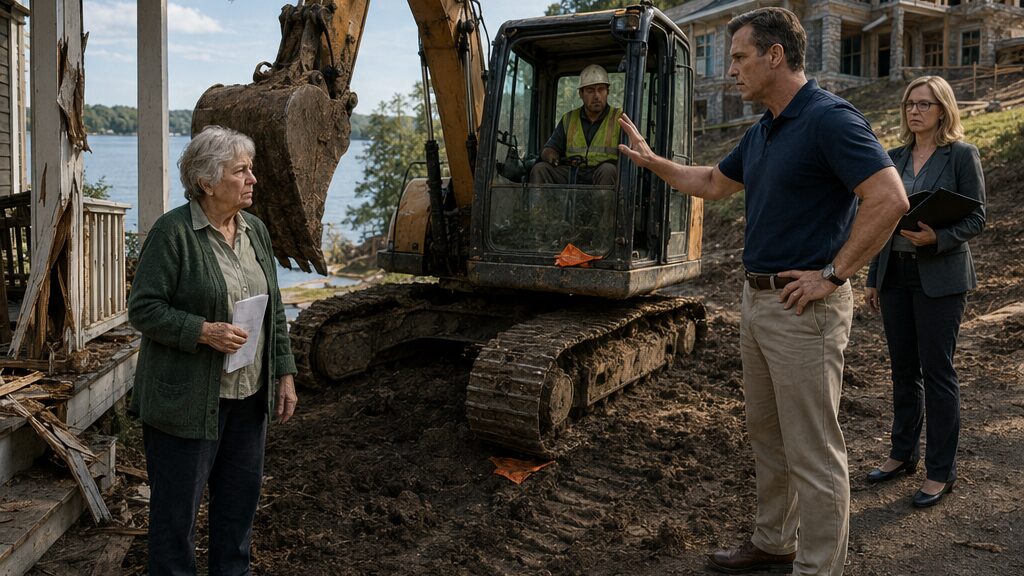
The excavator bucket swung over Barbara Lewis’s porch at 8:17 in the morning.
For one suspended second, she saw everything beneath it with unnatural clarity: the faded green paint on the railing, the coffee ring on the small table, the cracked ceramic planter her husband had glued twice because he refused to throw away anything that still held dirt.
Then the operator lowered the bucket.
“Stop!”
Barbara’s voice vanished beneath the engine.
She came through the screen door in house shoes, one hand still holding the phone she had been using to call the community management office. The machine’s track had already chewed a dark path through the side yard. One porch post leaned outward. Two boards had split where the bucket or the machine’s turn had caught them.
The operator saw her at last and lifted both hands from the controls.
A man in a hard hat shouted from near the retaining wall, “Hold!”
The engine dropped to a heavy idle.
Barbara stood at the bottom of the steps she could still use and looked past the excavator toward Richard King.
He was on the uphill side of the yard in a navy polo and pale shorts, one hand pressed to his hip. Behind him, his renovation rose in pale stone and glass above the lake. For eight months, trucks had come and gone from his property. Crews had cut into the slope, poured retaining walls, delivered steel, tile, landscaping stone, and equipment too large for the narrow private drive.
Barbara had complained about noise once.
About mud twice.
About access across her property in writing.
Twice.
Richard came down the slope slowly.
“Barbara,” he said, in the tone people used when they intended to call you unreasonable before you had spoken. “We’ve been over this.”
“No. You’ve spoken. I’ve said no.”
“The equipment needs a safe turning radius.”
“Then turn it on your property.”
His jaw tightened.
“The access lane has been used for years.”
“Not by an excavator.”
The operator climbed down from the cab. He looked at the broken post and then away.
Barbara raised her phone. “I sent you an email last Thursday. And another one Monday morning.”
Richard glanced toward the contractor.
“She’s upset,” he said.
Barbara felt the words land harder than the broken boards.
Not wrong. Not mistaken. Not the owner.
Upset.
“I’m standing here,” she said.
Richard looked back at her. “Nobody is trying to take anything from you.”
“You already did.”
She pointed at the porch.
The screen door behind her clicked in the breeze.
Richard exhaled through his nose. “That can be repaired.”
“So can your schedule.”
For the first time, anger showed openly in his face.
“This project affects more than one house. Property values in this community have been flat for years. We are making a substantial improvement.”
Barbara looked uphill at the broad pool terrace under construction behind his house.
“We?”
“As HOA president, I have to think beyond one lot.”
“There it is.”
Before Richard could answer, a silver SUV pulled up near the road.
Sarah White stepped out carrying a black compliance folder.
Barbara recognized her from the HOA office: tidy blond hair, low heels unsuitable for torn ground, the practiced expression of someone arriving after trouble had already become expensive.
“Good,” Richard said. “Sarah can clear this up.”
Barbara almost laughed.
Sarah approached carefully around the excavator track.
“I got your voicemail,” she told Barbara.
“At 7:52.”
“I came as quickly as I could.”
Richard stepped in before Barbara could answer. “This is a temporary access issue. Barbara has been asked to cooperate with approved work.”
Barbara stared at him.
“Asked?”
Sarah opened the folder.
Richard continued. “The route is consistent with historical access.”
“I refused twice,” Barbara said.
Sarah looked between them. “Let’s keep this factual.”
Barbara reached into the pocket of her cardigan and pulled out two folded pages. She had printed the emails because thirty-two years at a public library had taught her that people became strangely forgetful when a record existed only on a screen.
She handed them to Sarah.
“Read the dates.”
Sarah scanned the first page.
“August fourteenth.”
“And the second?”
“August eighteenth.”
“Read the sentence in bold.”
Sarah hesitated.
Richard said, “We don’t need a performance.”
Barbara did not look at him.
“Read it.”
Sarah’s mouth tightened slightly.
“‘I do not grant permission for construction vehicles, machinery, contractors, or subcontractors to enter Lot 17 from the eastern boundary.’”
“And the second?”
Sarah turned the page.
“‘This is my second written notice that no construction equipment is authorized to cross my property.’”
The excavator engine idled between them.
The contractor shifted his weight.
Richard said, “That doesn’t change the existing access notation.”
Barbara looked at him.
“What notation?”
Richard’s pause was brief, but she saw it.
Sarah lowered the pages. “There is a historical file reference.”
Barbara’s anger cooled so suddenly it became something else.
“What file?”
Richard gestured toward the folder. “The association has maintained access there for years.”
“For what?”
“Utilities. Maintenance. Emergency work.”
“This is a swimming pool.”
“It’s not that simple.”
Barbara looked down then.
An orange plastic flag lay crushed beneath the outer edge of the excavator track. It had been there for months, marking nothing she understood. Richard’s crew had planted several during early grading, shifting them as work moved. She had once pulled one from her flower bed and left it beside the fence.
This one was flattened into the mud.
She bent, picked it up, and wiped the black grit from the thin metal stem.
Then she walked to the excavator and laid the crushed flag on its hood.
“No one moves another foot,” she said.
Richard gave a short laugh. “You can’t shut down approved work.”
Barbara took another folded paper from her pocket.
Her deed.
She handed it to Sarah.
“Read the parcel number.”
Sarah’s eyes narrowed.
“Barbara—”
“Please.”
Sarah read it.
Barbara pointed toward the damaged porch.
“Now read the parcel number in your work authorization.”
Sarah opened the folder.
The contractor stopped looking bored.
Even Richard became still.
Sarah flipped one page, then another.
“The work authorization references Lot 17 for adjacent access coordination.”
“Coordination isn’t permission.”
Richard said, “You’re splitting words.”
“I spent thirty-two years explaining late fees to people who thought words didn’t matter.”
Sarah looked again at the deed.
Then at the file.
“The parcel numbers match,” she said quietly.
Barbara did not smile.
For one brief moment, satisfaction came anyway. Small and clean.
Her property. Her refusal. Her record.
Then Richard reached into Sarah’s folder.
He removed a photocopy Barbara had never seen.
“There,” he said.
Across the top was an old subdivision map. Along one side, in faded type, someone had added:
TEMPORARY ACCESS — EAST SERVICE EDGE.
A handwritten notation sat beneath it.
Maintenance access acknowledged.
Barbara stared at the marks.
The page was old enough that the copier had turned the paper gray around its edges.
“I’ve never signed that.”
Richard tapped the bottom corner.
“Maybe not.”
Barbara followed his finger.
Two initials appeared beside the handwritten note.
D.L.
Her husband had been dead four years.
But she knew the slant of the D.
She knew the way the L leaned forward as though hurrying to catch up.
David Lewis had written those initials.
Chapter 2: The Note in the File Was Not the Permission Richard Claimed
“The attachment is missing.”
The county records clerk said it without drama, as though missing attachments were ordinary things and not objects capable of altering the shape of a marriage after death.
Barbara leaned closer to the counter.
“What attachment?”
The clerk turned the photocopy toward the fluorescent light.
“This notation references Exhibit C.”
Barbara looked at the line again.
Temporary access — east service edge.
Maintenance access acknowledged.
D.L.
She had slept badly and refused to call Emily.
By nine the next morning, she had driven to the county records building with her deed, the HOA photocopy, and both refusal emails inside a blue accordion folder she had owned since the library switched payroll vendors twelve years earlier.
“Is Exhibit C recorded?” she asked.
“Not with this instrument.”
“Could it be somewhere else?”
“It could be attached to a later filing. Could be association records. Could be nothing.”
“Nothing?”
The clerk gave her a sympathetic look.
“People write notes on working copies.”
Barbara hated sympathetic looks.
“Can you show me the original plat?”
Twenty minutes later, she sat at a long table beneath a magnifying lamp with a subdivision map spread before her.
The lake curved along the southern edge. Lots climbed the slope in uneven rectangles. Her parcel—Lot 17—was narrow at the road and broad near the water. Richard’s Lot 18 rose above it.
There was no permanent access easement drawn across her yard.
Barbara checked twice.
Then a third time.
A narrow utility corridor did appear near the east edge, but it was marked in dotted lines and ended well before the place where the excavator had turned beside her porch.
She felt a pulse of vindication.
Not proof. Not yet.
But the first solid piece of ground under her feet.
At the HOA office that afternoon, Sarah let her examine the property file.
Richard was not there.
“I should have checked this before sending the compliance notice,” Sarah said.
Barbara kept turning pages.
“Yes.”
Sarah accepted the answer.
The old notation appeared on a copy of the plat, not the recorded original. No signature line. No date beside David’s initials. No attached Exhibit C.
Barbara tapped it.
“Richard called this permanent access.”
“He said historical access.”
“He told the contractor he had the right to use it.”
Sarah folded her hands.
“I can’t speak to private conversations.”
“You sent me a notice saying I was interfering with approved work.”
Sarah’s face tightened. “Because I believed the access question had already been resolved.”
“By whom?”
Silence.
Barbara found the answer there.
She closed the file.
“Who told you?”
Sarah looked toward the office door.
“Richard said the board had long recognized the route.”
“Richard is the board president.”
“He is one member of the board.”
“Who also happens to own the pool.”
Sarah rubbed one thumb over the edge of a paper.
“I’m not defending how this was handled.”
“No. You’re explaining it.”
Barbara stood.
She should have felt stronger.
Instead she felt tired.
That evening, after dinner she barely touched, she returned to the county building for one more record the clerk had suggested: old maintenance logs submitted by the association during a drainage dispute.
The file was thin.
Most entries were mundane.
Storm grate cleared.
Utility trench inspected.
Tree roots near line.
Then she saw her husband’s name.
David Lewis — access granted verbally for east utility inspection.
Barbara sat very still.
The entry was nineteen years old.
A second note appeared three years later.
Lewis permitted maintenance crew through side edge; restore garden border afterward.
She read it again.
Not construction.
Not excavators.
Not pool work.
Still, the neat certainty she had carried into the building cracked.
David had allowed access.
More than once.
She remembered him opening the side gate for workers. She remembered complaining about mud on the stepping stones. She remembered him saying, It’s easier to let them through than make everybody fight over ten feet.
Had she forgotten?
Or had she chosen not to remember because the present conflict made memory inconvenient?
Barbara copied the pages.
On the drive home, Emily called.
Barbara watched the name glow on the dashboard screen.
She let it stop ringing.
At home, she placed the maintenance records beside the HOA notation.
D.L.
Her husband’s initials no longer looked like evidence against her.
They looked like a question.
The next morning she called Andrew Torres, a licensed surveyor whose name the county clerk had written on a yellow sticky note.
He arrived two days later in a white truck with equipment cases strapped behind the cab.
He was younger than Barbara expected, perhaps in his early forties, with a careful way of speaking that irritated her at first.
“I don’t determine who’s morally right,” he said after reviewing the papers at her kitchen table.
“I didn’t ask you to.”
“I’m saying boundaries can be straightforward while use history is not.”
“Can you mark my line?”
“Yes.”
“Then mark it.”
Andrew looked through the window toward Richard’s property.
“I’ll need control points from both sides.”
“You can work from mine.”
“For a preliminary locate. Not for what you’re talking about.”
“What am I talking about?”
“A dispute that may end up in a hearing.”
Barbara disliked that he had named it before she had.
Andrew folded the plat.
“There’s another problem.”
“What?”
“The pool corner.”
Barbara stared at him.
“What about it?”
He tapped the copied subdivision map.
“The controlling monument I need to verify appears to sit uphill, beyond that retaining wall.”
“On Richard’s property?”
Andrew nodded.
“And if I can’t inspect that point, I can’t give you the boundary opinion you think you want.”
Chapter 3: The First Survey Stake Landed Beside the Pool Coping
The first orange stake went into the ground six inches from Richard King’s new pool coping.
Andrew Torres drove it with three measured taps.
Barbara watched from the lower edge of the slope.
Richard watched from the terrace above.
“No,” he said.
Andrew stopped.
The orange ribbon tied to the stake moved in the lake breeze.
Richard came across the unfinished terrace wearing work boots and a pale button-down shirt with the sleeves rolled to his elbows. He looked less polished than usual. Tired, Barbara thought. Or simply unprepared to see a survey marker so close to something that had cost him more than her entire house.
“You need to remove that,” he said.
Andrew rested the mallet against his leg.
“I’m establishing a working point.”
“On my deck.”
“Beside your coping.”
“It’s my construction area.”
Andrew glanced at Barbara. “The marker is based on the record geometry. It is not yet my final boundary opinion.”
Richard gave Barbara a thin smile.
“There. You heard him.”
“I did.”
“Then stop turning this into a spectacle.”
Barbara looked around.
No neighbors were watching.
No phones were raised.
Only three people stood beside a half-finished pool.
“You brought an excavator through my porch,” she said. “I hired a surveyor.”
Richard’s smile disappeared.
Andrew cleared his throat.
“I still need access to the upper control point.”
Richard folded his arms.
“My contractor is working.”
“I can coordinate around him.”
“No.”
Andrew waited.
Richard said, “You have enough from her side.”
“Not for a defensible survey.”
“This is private property.”
Barbara almost laughed at that, but the sound never came.
Andrew said, “Then I’ll document denied access and continue with available monuments.”
Richard looked at Barbara.
“You see what you’re doing?”
“Yes.”
“No, you don’t. My financing has a completion schedule. The pool inspection is tied to the retaining work. The retaining work is tied to final landscaping. Every delay rolls downhill.”
“So did your excavator.”
He looked away first.
Andrew worked for another hour.
He set a second marker lower on the slope, then returned to the tripod.
Barbara stood near him while the instrument turned with faint mechanical clicks.
“What does that one mean?” she asked.
“Working line.”
“Is it mine?”
“It’s a line supported by the record evidence I have so far.”
“That sounds like a sentence designed not to be quoted.”
“It is.”
She almost smiled.
Then Andrew moved the lower stake.
Not away from the pool.
Closer.
Barbara watched him pull the metal pin, measure again, and set it eighteen inches uphill.
Richard noticed too.
“What changed?”
Andrew checked the screen in his hand.
“I reconciled a monument near the road.”
“And?”
“And the first position was conservative.”
Richard came down two steps.
“Conservative for whom?”
Andrew did not answer.
The question altered the air.
Barbara looked from the new stake to the pool.
The orange ribbon now sat nearly beneath the outer line of the coping.
For the first time since the porch broke, she felt something like hope.
It frightened her.
Hope could make a person careless.
Andrew finished the lower measurements and walked back to his truck.
Barbara followed.
“Well?”
“Your side-yard concern is substantially supported.”
She waited.
He closed one equipment case.
“That machine crossed beyond the line indicated by the record survey.”
The words were plain.
Barbara absorbed them slowly.
“So Richard was wrong.”
“About the path? Based on what I have, yes.”
A small payoff.
Not revenge. Not victory.
Just a fact.
She looked toward the broken porch below.
“Then we file.”
Andrew did not move.
“What?”
He took a photocopy from his clipboard.
“I found another reference in the association material.”
Barbara recognized the maintenance log.
Her stomach tightened.
“Your husband allowed occasional access.”
“For utilities.”
“Yes.”
“Not for construction.”
“Agreed.”
“Then why are we discussing it?”
“Because use history matters when people start arguing reliance. Not necessarily legal right. But context.”
Barbara heard Richard’s voice in her memory.
We’ve been over this.
Historical access.
Had he believed it?
Not entirely. Not honestly enough.
But perhaps he had not invented it from nothing.
Andrew pointed toward the east edge.
“Your husband appears to have allowed crews through a narrow strip near the utility route. That may explain why people in the association came to think this side was available.”
“People?”
“Or one person repeating it until others stopped checking.”
Barbara looked uphill.
Richard had gone back to the terrace. He was on the phone now, pacing beside the unfinished pool.
“What are you saying?”
“I’m saying your boundary case is stronger than your access history is simple.”
The hope inside her changed shape.
“What do we do?”
“We finish.”
Richard denied Andrew access again the next day.
So Andrew worked from public control points, two recorded monuments, and the lower corner he could verify from Barbara’s side.
He returned at seven the following morning before the contractor arrived.
Barbara met him outside with coffee.
He did not take the cup.
That worried her more than if he had.
“I need to show you something.”
They climbed the slope.
The orange stakes now formed a broken visual line through grass, past the retaining structure, toward the pool.
Each one looked too bright against the expensive stone.
Andrew stopped at the first pool corner.
He stretched a tape between a nail set in the coping joint and his marked line.
Barbara watched the numbers.
“How much?”
“I want to verify.”
“Andrew.”
He measured again.
The pool water was perfectly still.
Richard’s house reflected in it upside down.
Andrew crouched, wrote something on the field sheet, then stood.
“The outer corner of the constructed pool area crosses the record boundary.”
Barbara felt no triumph.
Not yet.
“How far?”
“At the widest measured point here?”
“Yes.”
Andrew looked at her.
“Approximately four feet.”
Barbara turned toward Richard’s house.
Four feet.
Enough space for a person to lie down.
Enough space for an excavator track.
Enough space for a man to call another person unreasonable while building across the line he claimed to understand.
Andrew began packing the tape.
Barbara did not move.
“Could it be a mistake?” she asked.
“Yes.”
The answer came too quickly for comfort.
“What kind?”
“Design revision. Bad staking. Setback compression. Someone relying on an old assumption.”
Barbara looked at the orange ribbon beside the pale stone.
“And if someone knew?”
Andrew closed the field book.
“Then that’s a different story.”
Chapter 4: Her Husband Had Kept a Record She Refused to Open
Emily found the box before Barbara could move it.
She had come through the kitchen carrying two grocery bags and an argument already prepared, but stopped in the hallway when she saw the cardboard carton beneath the narrow table.
“Mom.”
Barbara set down the coffee mug she had been rinsing.
“Leave it.”
Emily crouched.
The box was taped across the top in two yellowed strips. David’s handwriting ran along one side in black marker:
SHOP — LOT / DRAIN / SERVICE
Emily touched the lettering with one finger.
“You’ve had this the whole time?”
“I said leave it.”
“That isn’t an answer.”
Barbara crossed the kitchen and took the grocery bags from where Emily had abandoned them. Milk. Bread. Chicken. Apples she had not asked for.
“I know what I have in my own house.”
Emily stood.
Andrew’s preliminary survey map lay on the table behind Barbara, weighted at one corner by the sugar bowl. Orange pencil marks traced the working boundary. One line cut visibly toward Richard’s pool.
Emily had already seen enough.
“You hired a surveyor before you called me.”
“I didn’t need you to hire a surveyor.”
“That’s not what I said.”
Barbara put the milk in the refrigerator.
Emily followed her.
“You let me find out from a neighbor that part of your porch got hit by a machine.”
“It was one post and several boards.”
“The pictures did not look like several boards.”
“Pictures enlarge things.”
Emily stared at her.
Barbara knew that was a foolish sentence the moment she heard it. Still, she did not take it back.
Emily turned toward the hallway.
“Dad kept property notes.”
Barbara closed the refrigerator door.
“He kept notes about everything.”
“Then why haven’t you opened the box?”
“I haven’t needed to.”
Emily looked at the survey map.
“You have an excavator track through your yard, an HOA dispute, Dad’s initials on an access note, and a pool that may be four feet over a boundary.”
She pointed toward the box.
“What would qualify as needing to?”
Barbara’s hand tightened around the refrigerator handle.
Because opening it would release his smell, perhaps. Sawdust and machine oil and the peppermint gum he chewed when he worked.
Because the last time she had opened one of David’s drawers she had found a folded receipt for two fishing licenses purchased three weeks before the diagnosis.
Because information could be useful and still hurt.
Instead she said, “You’re making this dramatic.”
Emily gave a short, disbelieving laugh.
“Me?”
Barbara turned away.
Emily did not raise her voice. That made it worse.
“Sell the place.”
Barbara stopped.
There it was.
The suggestion Emily had been circling for four years.
“Don’t.”
“You could sell before this gets worse.”
“I said don’t.”
“You’re fighting an HOA president with a construction loan and attorneys. Your porch is broken. You don’t sleep. Every time I ask whether you need help, you say no.”
“I am managing.”
“Dad is dead, Mom.”
The kitchen became very still.
Emily’s face changed immediately.
Barbara looked at her.
“Get out.”
“I shouldn’t have said it like that.”
“Get out.”
Emily pressed both hands against the edge of the counter.
“I’m not saying forget him.”
“You don’t know what you’re saying.”
“I’m saying the house has become the only way you let yourself stay married.”
Barbara felt the words enter with terrible accuracy.
She picked up Emily’s car keys from the table and held them out.
Emily did not take them.
“You refused to replace the roof until water came through the laundry room,” she said. “You wouldn’t let me repaint the bedroom. You wouldn’t even move Dad’s chair off the porch when the fabric started splitting.”
“That is none of your business.”
“I’m your daughter.”
“That does not make everything yours.”
Emily took the keys.
For a second neither moved.
Then Emily walked into the hallway, bent, and put one hand on the taped box.
Barbara’s voice came out lower.
“Don’t.”
Emily straightened.
“I’m not opening it.”
She left.
The front door shut.
Barbara stood alone with the box.
At dusk, she carried it to the kitchen table.
She used a butter knife to cut the tape.
The top opened with a soft tearing sound.
Inside were old utility bills, folded plats, hardware receipts, two carpenter’s pencils, and three spiral notebooks.
Barbara sat down.
The first notebook contained measurements for porch repairs and drainage channels. The second recorded tree trimming, dock boards, fence posts.
The third began fourteen years earlier.
David’s writing was compact and slanted.
East edge wet again after storm.
Utility crew asked through. Fine if narrow route. Told them garden border restored.
Barbara turned the page.
Another entry:
Cable inspection. Let truck use east strip only. No heavy equipment near porch.
She read it twice.
Only.
The word looked almost aggressive on the page.
A later entry showed a rough sketch of the lot. David had marked the utility route with orange pencil. The narrow line ran close to the east edge and stopped before the porch.
Richard’s excavator route had curved far inside it.
Barbara put one hand against her mouth.
Her husband had allowed access.
Richard had not invented that history.
But David had understood its limit.
Barbara kept reading.
A memory returned with embarrassing clarity: David waving a utility pickup through the side gate, then spending half an afternoon resetting bricks because the tires had pressed the garden border crooked.
She had been angry.
He had laughed.
Better bricks than a feud, Barb.
She had forgotten the sentence.
Or buried it.
The next morning Emily’s car was parked at the curb when Barbara came outside.
Emily sat behind the wheel but did not get out.
Barbara opened the passenger door.
For several seconds they faced forward.
“I opened it,” Barbara said.
Emily nodded once.
“I knew it existed.”
Emily turned toward her.
Barbara kept looking through the windshield.
“I knew David had notebooks. I knew they were in that box.”
“Why didn’t you tell Andrew?”
“I didn’t know what was inside.”
“That’s different.”
“Is it?”
Emily did not answer.
Barbara handed her the third notebook.
Emily read the access entries.
“So Dad did let crews through.”
“Yes.”
“Narrowly.”
“Yes.”
Emily closed the notebook.
“You should give this to Andrew.”
Barbara stared toward her house.
“If I do, Richard will say I hid it.”
“Did you?”
The bluntness hurt because Emily had earned the right to ask.
Barbara rubbed her thumb over a crack in the dashboard.
“I told myself it was grief.”
Emily waited.
Barbara swallowed.
“Some of it was pride.”
For the first time since Emily arrived, the air between them loosened.
Not forgiveness.
Room.
Emily opened the notebook again.
“What’s this?”
Barbara looked.
Near the back, an orange pencil line crossed a hand-drawn corner of the upper lot. Beside it David had written a date from nine months earlier than his death, then added a later note in darker ink.
New pool line? Too close. Mentioned setback problem before revised work.
Barbara took the notebook.
The entry was dated months before Richard’s current construction began.
Below it, David had written four more words:
Warning sent before approval.
Barbara read them aloud.
Emily’s expression sharpened.
“Sent to who?”
Barbara turned the page.
There was no name.
No copy.
Only the orange line and the words her husband had left behind.
Chapter 5: The Warning Was Sent Before the Porch Came Down
Sarah White called at 7:06 the next morning.
“I found something you need to see.”
Barbara was already awake. David’s notebook lay open on the kitchen table beside Andrew’s survey.
“What?”
“An archived board attachment.”
“From when?”
“Before the current construction approval.”
Barbara stood.
“Does it mention the pool?”
Sarah paused.
“Yes.”
Forty minutes later, Barbara sat inside the HOA office while Sarah closed the blinds.
That small action frightened Barbara more than urgency would have.
Sarah placed three printed pages on the desk.
“I was reviewing old board packets because of the notebook reference you sent me.”
Barbara had photographed only the relevant page. Sending it had taken ten minutes and three abandoned drafts.
Sarah touched the first sheet.
“This was attached to a preliminary design review.”
At the top was an engineering firm’s letterhead. Beneath it, a technical note addressed revisions to Richard’s pool terrace and retaining plan.
Barbara read slowly.
Revised water feature footprint reduces eastern setback margin.
Field verification recommended prior to final excavation.
Potential conflict with legacy lot geometry should be resolved before construction staking.
She looked up.
“When was this sent?”
Sarah pointed to the date.
Seven months before the excavator damaged Barbara’s porch.
“Who received it?”
“The design committee account.”
“Richard?”
Sarah did not answer immediately.
“He was copied.”
Barbara read the line again.
Potential conflict.
Field verification recommended.
Not proof that Richard knew the pool crossed her boundary.
But proof that uncertainty existed before the machine entered her yard.
“Why wasn’t this in the active file?”
Sarah pressed her lips together.
“That is the question.”
“Was it removed?”
“I can’t say that.”
“You can say where you found it.”
“Archived email storage.”
“And the board packet?”
“The attachment was not included in the final packet circulated to the full board.”
Barbara sat back.
“Who circulated the packet?”
Sarah looked ashamed now.
“I did.”
Barbara waited.
“Based on materials forwarded to management,” Sarah added.
“By Richard?”
“Yes.”
The word was nearly a whisper.
Barbara did not feel victorious.
Sarah had sent the compliance notice. Sarah had arrived with the folder. Sarah had treated Barbara’s refusal as a problem to contain.
But now Barbara could see the other machinery operating beneath the visible one: hierarchy, assumptions, a salaried manager trusting a board president who sounded certain.
“You believed him.”
Sarah nodded.
“I believed this was an access dispute with a difficult resident.”
Barbara looked at her.
Sarah did not look away.
“I was wrong.”
Barbara gathered the pages.
“Wrong is not the same as finished.”
“No.”
“Is there more?”
“I don’t know yet.”
Richard was waiting in his driveway when Barbara left the office.
She suspected Sarah had called him. Or perhaps he had seen Barbara’s car.
He stood beside a delivery pallet of stone tiles, arms folded.
“Barbara.”
She continued walking.
“We need to talk.”
“I have a hearing request to prepare.”
His expression shifted.
“So Sarah showed you.”
Barbara stopped.
The admission was small but useful.
“You knew the engineering note existed.”
“I knew there was a caution.”
“You were copied.”
“A caution is not a survey.”
“No. That would be why it recommended one.”
Richard stepped closer, then stopped well short of her.
For once he did not speak like the HOA president.
He looked like a man whose project had become a ledger of deadlines.
“The design changed three times,” he said. “The original pool was smaller. Then the retaining requirements changed. The lender required value completion by the end of the quarter.”
Barbara said nothing.
He continued.
“The house was opened up. I had crews scheduled in sequence. If the project stopped, I would have had exposed work, penalties, subcontractors walking.”
“So you kept going.”
“I relied on what this community had done for years.”
“David letting a utility truck through?”
“The east side had always been used.”
“For maintenance.”
“For access.”
“Not the same thing.”
Richard’s voice sharpened.
“It bought room.”
Barbara stared at him.
He seemed to realize what he had said.
She repeated it.
“Bought room.”
“I mean operational flexibility.”
“No. You mean you thought an old favor from my husband gave you room.”
Richard looked toward the lake.
When he spoke again, his anger had thinned.
“I thought the boundary issue would be inches, if anything.”
“Then why not survey?”
“Because every answer creates another delay.”
There it was.
Not innocence.
Not a secret plan to steal her property.
A choice.
He had seen uncertainty and decided speed mattered more.
Barbara took out her phone.
“I want you to say that again.”
His face closed.
“Don’t play games.”
“I’m not.”
“You think one sentence makes this simple?”
“No.”
That was the truth, and it surprised them both.
Richard looked at her.
Barbara thought of David’s notebook. The limited access. Her own silence. Sarah’s assumptions. The four-foot measurement.
Nothing was simple.
But some things were still wrong.
Richard lowered his voice.
“I’ll replace the porch.”
Barbara said nothing.
“Entirely. Not patch it. Replace it.”
“With what condition?”
His eyes flicked toward the papers in her hand.
“You withdraw the boundary filing.”
Barbara almost admired the directness.
“You haven’t seen the final filing.”
“I know what it will do.”
“To your pool.”
“To everything.”
He gestured uphill.
“You see a pool. I see a project with debt attached to it. Crews with invoices. A house I can’t refinance until it closes. You think I’m protecting a toy.”
“I think you kept building after you were warned.”
“I thought the old access custom and practical lot line gave us room to resolve it.”
“After construction.”
“Yes.”
The answer came hard.
Honest enough to matter.
Richard took one step closer.
“I’ll restore your porch. Landscaping too. Better than it was.”
Barbara thought of the broken green railing.
David’s chair.
The cracked planter.
“What about the boundary?”
“We settle it privately.”
“Meaning?”
“No public hearing. No HOA conduct review. We negotiate a line adjustment if necessary.”
“A line adjustment.”
“Compensated.”
Barbara looked at him for several seconds.
Years ago, money might have been the simplest answer. Even now, Emily would tell her to consider it. A repaired porch. New landscaping. Attorney fees avoided. The conflict ended before it consumed another season.
She saw the appeal.
That was what made the choice difficult.
“Richard,” she said, “did you authorize the excavator to continue after my second email?”
His silence answered first.
Then: “I told the contractor the access issue was being handled.”
“By whom?”
“The association.”
“You are the association president.”
“Yes.”
“And the homeowner benefiting from the work.”
His jaw tightened.
Barbara folded the engineering note and placed it inside her folder.
“I’m requesting a formal hearing.”
“Barbara.”
“My history is imperfect. Yours is expensive. Neither changes the need for somebody neutral to look at it.”
“You could lose.”
“I know.”
That was the difference now.
At the end of the driveway, she stopped.
Richard called after her.
“If you lose, the porch offer is gone.”
Barbara turned.
For a moment she saw not a villain but a frightened man using the only leverage he thought remained.
It did not make his choice smaller.
“Then put that in writing too,” she said.
That afternoon, Barbara submitted the hearing request with Andrew’s preliminary survey, the deed, the maintenance logs, David’s notebook entries, the engineering warning, photographs of the orange flags before and after the excavator entered, and both of her refusal emails.
She included one additional paragraph.
The applicant acknowledges historical limited maintenance access permitted by her late husband and requests that the hearing body distinguish such informal permission from construction access and permanent boundary rights.
Her finger hovered over the submit button.
For the first time, she was not presenting herself as entirely right.
She pressed Send anyway.
Chapter 6: At the Hearing, Barbara Corrected Her Own Version First
Richard’s attorney began with David Lewis’s initials.
The enlargement appeared on a screen at the front of the municipal hearing room before Barbara had even settled her hands on the table.
D.L.
Gray photocopy.
Slanted letters.
The zoning hearing officer looked down at the file.
Richard sat across the aisle in a dark jacket. Sarah was two seats behind him. Andrew waited near the wall with a rolled survey under one arm.
The attorney said, “The applicant’s late husband acknowledged access along the eastern service edge.”
Barbara felt every face in the room turn slightly toward her.
Not many faces. The hearing was administrative, not theatrical. Two neighboring residents sat in the back row. The HOA treasurer had come. No crowd waited to cheer.
Still, shame did not require a crowd.
The attorney continued.
“For years, maintenance and service personnel entered through that area with the Lewis household’s knowledge. My client relied on an established course of conduct when coordinating temporary construction access.”
The hearing officer looked at Barbara.
“Ms. Lewis, you will have an opportunity to respond.”
Barbara nodded.
The attorney displayed the maintenance log.
David Lewis — access granted verbally.
Then another.
Lewis permitted maintenance crew through side edge.
Each page was familiar.
That did not make seeing them enlarged easier.
Richard did not look triumphant.
He looked exhausted.
His attorney argued that historical tolerance had created reasonable reliance, that the route had been used openly, and that Barbara’s objection came only after major construction commitments had been made.
Then he used the phrase Barbara had expected.
“Detrimental reliance.”
When her turn came, Barbara stood with the blue accordion folder in both hands.
She had prepared six pages of notes.
She did not open them.
“The first complaint I filed was incomplete,” she said.
Richard looked up.
His attorney stopped writing.
Barbara continued.
“When I filed it, I said no access had been authorized across my property. That was not accurate.”
The hearing officer leaned forward.
Barbara heard Emily’s voice in her mind.
Did you hide it?
“Yes,” Barbara said, though no one had asked a question yet. “My husband allowed limited access in the past.”
Richard’s attorney rose slightly.
The hearing officer lifted a hand.
“Let her continue.”
Barbara looked at David’s initials on the screen.
“He let utility and maintenance crews through a narrow section near the east edge. I found that in his notebooks after my first complaint.”
“Did you know the notebooks existed?” the hearing officer asked.
Barbara’s mouth went dry.
“Yes.”
A quiet movement passed through the room.
“Did you review them before filing?”
“No.”
“Why not?”
There were answers that would sound better.
Grief.
Stress.
Age.
Confusion.
Barbara chose the one that cost her something.
“Because I did not want to open the box they were in.”
The officer waited.
Barbara said, “My husband died four years ago. I had left his work records sealed. I told myself that meant I did not know what they contained. But once his initials appeared on the HOA copy, I should have checked sooner.”
Richard’s attorney wrote something quickly.
Barbara saw it.
She continued before fear could stop her.
“When I did open them, I learned two things. The first weakens my original statement. My husband allowed limited maintenance access.”
She turned toward Andrew.
“The second is that he drew the route.”
Andrew unrolled the survey.
The hearing officer allowed it to be displayed.
An orange pencil line from David’s notebook appeared beside Andrew’s measured boundary and the contractor’s machine path.
Three different lines.
Barbara pointed.
“My husband’s tolerated route is here. The excavator traveled here.”
The distance between them was visible without explanation.
Richard’s attorney stood.
“An informal sketch is not a recorded easement.”
“I agree,” Barbara said.
The answer stopped him.
She looked at the hearing officer.
“I am not asking you to treat my husband’s notebook as a deed. I am asking you not to treat his courtesy as a blank check either.”
The officer turned to Andrew.
“Mr. Torres?”
Andrew testified carefully.
He explained monuments, recorded geometry, the absence of a permanent access easement across the disputed route, and the distinction between historical use and boundary ownership.
He refused to exaggerate.
When asked whether the excavator had crossed the record line, he said yes.
When asked whether the pool area crossed it, he said the outer constructed corner extended approximately four feet at the widest measured point.
The room changed.
Not loudly.
Richard simply stopped moving.
The attorney asked, “Could this result from differing historical monument interpretation?”
“Yes,” Andrew said.
Barbara’s stomach tightened.
Then he added, “But not all four feet are explained by that difference.”
A small payoff.
Not total victory.
Enough truth to hold.
The attorney shifted to reliance. He argued that old access practices had shaped Richard’s understanding, that plans evolved, and that enormous costs had been committed before Barbara escalated.
Then Sarah was called.
She looked pale.
The engineering warning appeared.
Revised water feature footprint reduces eastern setback margin.
Field verification recommended.
“Was Richard King copied?” the hearing officer asked.
“Yes.”
“Was the full attachment included in the final board packet?”
“No.”
“Why not?”
Sarah looked at Richard.
“I circulated the materials forwarded to management.”
“By whom?”
“Mr. King.”
Richard’s attorney objected to implication.
The officer noted the answer without commentary.
Barbara watched Richard.
He had not lied about everything.
That was what made the case harder.
He had inherited a genuine old custom, misunderstood or stretched it, faced a real financial deadline, and believed the community benefited from his project.
Then he had received a warning.
Then he had chosen speed.
When Richard testified, he did not pretend otherwise.
“I believed the historical route gave us practical room,” he said.
“Despite Ms. Lewis’s written refusal?” the officer asked.
“I believed the association would resolve it.”
“You were association president.”
“Yes.”
“And project owner.”
“Yes.”
The word sounded smaller each time.
The hearing officer recessed for twenty minutes.
Barbara went into the hallway.
Emily was waiting near the water fountain.
She had arrived without telling Barbara.
“You came.”
Emily shrugged.
“You hate driving home after dark when you’re upset.”
Barbara almost corrected her.
Then did not.
Emily looked through the hearing-room window.
“You told them about the notebook.”
“Yes.”
“All of it?”
“Yes.”
“That must have been awful.”
“It was.”
Emily touched Barbara’s elbow once.
No hug.
Barbara was grateful.
When the hearing resumed, the officer separated the issues one by one.
Historical maintenance tolerance did not create unrestricted construction access.
The unsigned HOA notation did not establish a permanent easement.
Barbara’s delayed disclosure damaged the clarity of her initial complaint but did not change the recorded boundary.
The contractor’s route exceeded the narrow historical maintenance practice.
The surveyed pool corner encroached across the record line and required correction.
Richard closed his eyes briefly.
The officer continued.
“The appropriate remedy is not automatic removal of the entire pool facility. The encroaching portion must be redesigned or removed sufficiently to restore compliance with the valid boundary, subject to permitting and verified survey.”
Barbara heard someone behind her exhale.
“Costs associated with correction shall not be shifted to Ms. Lewis.”
Andrew lowered his eyes to the table.
The officer then looked toward Sarah and Richard.
“As to the association’s handling of private construction access, conflict-of-interest procedures, and management communications, I am reserving findings pending supplemental review.”
Richard opened his eyes.
The pool ruling had landed.
But the HOA matter remained alive.
The officer looked at Barbara.
“Ms. Lewis, you will be permitted to submit a proposed scope of remedy regarding restoration of damaged property and any requested boundary-related relief.”
Barbara nodded.
Outside the hearing room, Richard approached her.
His attorney remained several steps behind.
Richard looked older than he had a month earlier.
“You got your ruling,” he said.
Barbara tightened her grip on the blue folder.
“No.”
His face hardened.
Then she said, “I got a chance to ask for a remedy.”
Richard studied her.
He understood before she did that this was now the most important choice left.
The ruling allowed correction.
The evidence might support more aggressive demands.
The HOA review could widen the damage to Richard’s position.
Barbara thought of her broken porch, David’s narrow orange pencil line, and the offer to make everything “better than it was” if she disappeared quietly.
Richard asked, “What exactly are you going to ask them to take?”
Barbara looked through the glass doors toward the lake.
She did not yet answer.
Chapter 7: She Asked for Her Porch Back, Not His Ruin
“Are you going to make them tear out the whole pool?”
Richard asked the question from the edge of Barbara’s yard.
He did not step across.
That was new.
Orange stakes now marked the correction zone in a sharp, almost embarrassing line between the two properties. The hearing order had been issued three days earlier. Andrew’s survey had been accepted for the limited purpose of restoring the recorded boundary, and a civil contractor had already submitted two corrective options.
Richard stood with a folded set of plans under one arm.
Barbara remained on what was left of her porch.
“No,” she said.
He looked at her as if he had misheard.
“No?”
“I said no.”
The old green railing still leaned outward where the machine had struck it. Someone had screwed a temporary brace into the post so the steps could be used safely. Barbara hated the pale new lumber against the weathered boards.
Richard glanced uphill.
“You could argue for more.”
“I know.”
The answer seemed to unsettle him more than anger would have.
The broader claim had been discussed in the remedy conference. One interpretation of the setback consequences could have forced a larger redesign. The HOA’s handling of the access issue had also opened separate questions about costs and governance.
Barbara had listened.
Then she had submitted four requests.
Correct the encroaching pool corner.
Restore the damaged porch and landscaping.
Pay the documented survey and filing costs tied to the dispute.
Adopt neutral procedures so an HOA officer could not use association authority to advance a private project.
Nothing more.
Richard unfolded the plans.
“The contractor says the smaller correction will still require cutting into the coping and moving drainage.”
“That sounds like your contractor’s problem.”
His mouth tightened.
Then, unexpectedly, he nodded.
“Yes.”
Barbara studied him.
For weeks, every conversation had felt like pushing against a locked door. Now the door stood open an inch, and neither of them seemed to know what to do with it.
Richard looked toward the broken porch.
“I thought you wanted to punish me.”
“I wanted you to stop.”
“That’s not the same thing now.”
“No.”
He shifted the plans under his arm.
“You had leverage.”
“I still do.”
He looked at her.
Barbara said, “I am using it to get my property back.”
A truck passed on the road behind him.
For a moment, neither spoke.
Then Richard said, “I should have stopped the work after your second email.”
Barbara felt the sentence land quietly.
Not apology enough to erase anything.
Not nothing.
“Yes,” she said.
He nodded once and walked uphill.
That evening, the HOA meeting room filled beyond its usual six or seven residents.
Barbara sat near the back beside Emily. Sarah had arranged printed copies of proposed conflict-of-interest procedures on a side table.
Richard took his place at the front but did not sit in the president’s chair.
The HOA treasurer did.
That too was new.
One of the neighboring residents raised a hand.
“Given the hearing findings, I move that the board require recusal whenever an officer has a personal property interest in an enforcement or access matter.”
The motion came faster than Barbara expected.
Another resident seconded it.
Richard stared down at the table.
The treasurer asked whether he wished to comment.
Richard’s face hardened briefly.
Then he said, “The motion is appropriate.”
A murmur moved through the room.
No applause.
Barbara was glad.
Applause would have made the whole thing too easy.
Sarah spoke next.
“Management also recommends that no access notation be treated as enforceable unless it is supported by a recorded easement, written license, or current owner authorization.”
Emily leaned closer.
“That’s because of you.”
Barbara shook her head.
“It’s because they should have done it before me.”
Later, when the floor opened for resident comments, a man near the aisle asked Barbara whether she planned to seek additional damages.
The room turned toward her.
She hated that.
Barbara stood anyway.
“I asked for what was damaged, what crossed the line, and what it cost to establish the truth.”
The man waited.
“That’s all?”
Barbara looked toward Richard.
He did not look away.
“That is enough.”
She sat.
Emily whispered, “You could have gone harder.”
“I know.”
“Why didn’t you?”
Barbara folded her hands in her lap.
“Because then I would still be letting him decide who I become.”
Emily was silent.
The meeting ended with the recusal rule adopted and Richard temporarily stepping aside from property-dispute matters until the reserved HOA review was complete.
Outside, Sarah handed Barbara a printed work schedule.
“The correction contractor starts next Tuesday.”
Barbara scanned the page.
Her stomach tightened.
Equipment access: east lane.
She looked up.
“That is the same route.”
“Not exactly,” Sarah said quickly. “The corrected route stays within the surveyed temporary work corridor. Written authorization is attached. Limited duration. Restoration required.”
Barbara saw her own signature line at the bottom.
Blank.
Sarah noticed.
“You can refuse.”
Barbara looked past the parking lot toward the dark shape of the lake.
The same class of machine would return.
The same engine noise.
The same narrow side of her house.
She folded the schedule and put it into her bag.
“I’ll decide tomorrow.”
Chapter 8: She Unfolded His Old Chair Beside the New Boundary Line
The machine returned at 7:43 on a cold early-autumn morning.
Barbara heard it before she saw it.
The low diesel vibration moved through the kitchen floor and into her chest.
For one second she was back at the broken porch, shouting beneath an engine that did not hear her.
Then she looked through the window.
The excavator was smaller this time.
Its bucket hung still.
The operator waited at the road.
No track had crossed the yard.
Barbara opened the front door.
Andrew stood beside the first orange stake with a clipboard. Sarah was near the contractor’s truck. Richard waited uphill.
And Emily was on the porch carrying a bundle of folded fabric.
“What is that?”
Emily looked down.
“Dad’s chair.”
Barbara stopped.
The old folding chair had spent four years in the shed after its canvas seat split. Emily had replaced the fabric with dark green material.
“You fixed it.”
“I fixed the seat.”
Barbara touched the aluminum frame.
“You should have asked.”
Emily’s face fell slightly.
Barbara let the silence sit.
Then she said, “You should have asked what color.”
Emily laughed despite herself.
Barbara carried the chair to the edge of the yard and unfolded it beside the marked work corridor.
She had signed the access authorization the previous afternoon.
Four pages.
Start time.
End time.
Width.
Restoration obligations.
No access beyond the marked corridor.
No assumption of future permission.
She had read every word.
Richard came down the slope.
At the final orange stake, he stopped.
“Barbara.”
She looked at him.
“I need to cross for the contractor meeting.”
He remained on his side.
The question between them was simple now because it had finally become a question.
Barbara glanced at the written corridor.
“You can cross within the marked area.”
“Thank you.”
He stepped over carefully.
No one celebrated.
The work began.
Stone cutting first.
Then drainage.
Then the removal of the outer pool corner that Andrew had measured across the line.
Barbara sat in David’s chair with a mug between both hands.
The irony was visible enough without anyone naming it: machinery working beside Richard’s expensive pool while she watched from a folding chair on the property he had once treated as an inconvenience.
But the scene did not feel like revenge.
Not to her.
Revenge would have required enjoying his fear.
What Barbara felt was steadier.
The line was being honored.
At midday, Emily sat on the porch step beside a stack of replacement boards.
“I told the carpenter not to install them.”
Barbara looked over.
“Why?”
“I said you had to choose the layout.”
Barbara raised an eyebrow.
“You stopped a contractor?”
“I’m learning.”
Emily opened two sketches.
“One keeps the old width. One adds a deeper corner near the lake.”
Barbara studied them.
The old porch could be restored exactly.
That had been her first instinct.
Same width.
Same railing.
Same placement of David’s chair.
Then she looked at the second drawing.
A slightly wider corner.
Room for two chairs.
“Which do you like?” Barbara asked.
Emily blinked.
“You’re asking me?”
“I am aware.”
Emily pointed to the second.
“The corner.”
Barbara nodded.
“Me too.”
Near sunset, Andrew completed the verification.
He walked the line one final time, checking each point.
Then he stopped beside the last orange stake.
“That’s it,” he said.
Barbara stood.
“The correction is inside?”
“Yes.”
“The line is clear?”
“Yes.”
Andrew smiled.
“You can pull it.”
Barbara walked to the stake.
The orange ribbon had faded slightly in the weeks since the first survey. Wind had twisted it around the metal stem.
She wrapped one hand around it.
For a moment, she remembered the crushed flag beneath the excavator track.
Disposable.
Ignored.
Something other people could drive over because they believed no one would insist it meant anything.
Barbara pulled.
The stake came free with a soft release of earth.
Behind her, Emily was discussing porch measurements with the carpenter.
Richard stood on his own side of the boundary speaking quietly to the contractor.
The lake moved beyond the trees.
Barbara looked at the orange flag in her hand.
Then she folded it once