The HOA Demolished Stephen’s Dock Before Breakfast—Then Learned Which Shoreline It Never Owned
Chapter 1: The Morning the Board Took the Shoreline
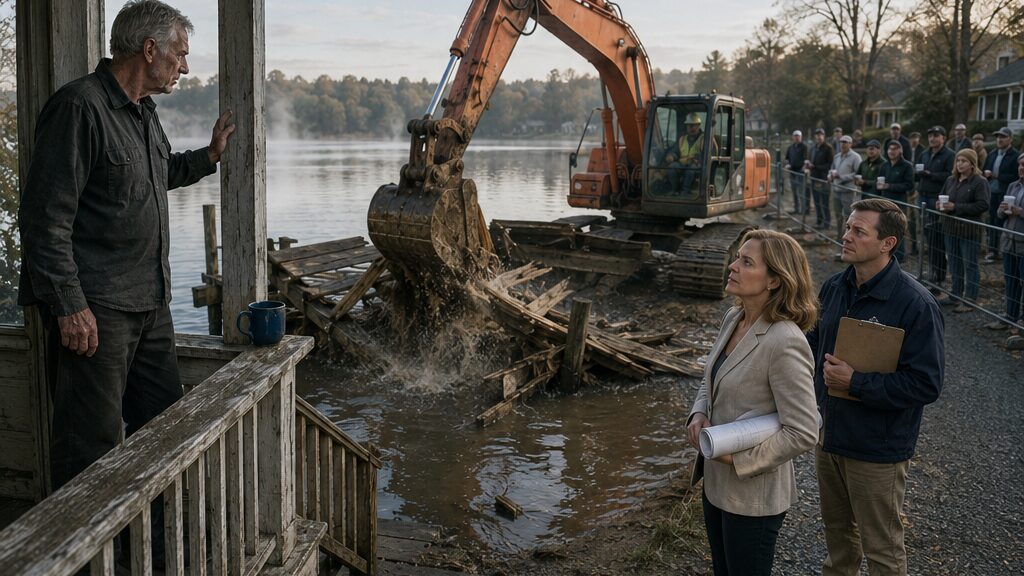
The excavator bucket came down before Stephen Harris could set his coffee on the porch rail.
Its steel teeth struck the outer edge of the dock, punched through two gray planks, and lifted a section of timber as easily as a man tearing cardboard. The boards twisted against their bolts. One snapped with a crack that traveled across the water. The far corner dropped into the lake and sent a sheet of muddy spray over the reeds.
Stephen stood in his slippers with the chipped blue mug warming both hands.
For several seconds, he did not move.
The dock had groaned in winter ice and held through storms that pulled newer structures loose. Margaret had once painted its posts white, though the paint had long since peeled away. Now an orange machine sat on the shoreline where her flower bed had been, its engine idling between blows.
A man in a reflective vest raised one hand toward Stephen, not in greeting but warning.
“Sir, stay back from the work area.”
“My work area,” Stephen said.
The man glanced toward the gravel lane.
Jennifer Wright was walking down it with the HOA property manager beside her. She wore narrow black pants, a pale jacket, and shoes that sank slightly in the damp soil. Behind them, half a dozen neighbors had gathered near the temporary construction fence. Some held coffee. One had brought a child still wearing pajamas.
Jennifer stopped at the bottom of Stephen’s porch steps.
“We sent notice,” she said.
The excavator bucket dropped again. Another section of dock folded into the lake.
Stephen lowered his mug to the rail. The small chip along its rim faced him, the same way it had every morning since Margaret bought the pair at a church sale twenty-three years ago. Her mug was still in the kitchen cabinet. He had never used it.
“What notice authorized demolition?” he asked.
“The shoreline improvement notice. The board approved the project in March.”
“That wasn’t my question.”
The property manager shifted the rolled plans beneath his arm. “Mr. Harris, the association survey identifies this as common shoreline. Your dock was an unapproved private structure.”
Stephen looked at him. “It was built before the association existed.”
“Which doesn’t make it compliant now,” Jennifer said.
The machine reversed. Broken boards dragged in the shallows, knocking together like loose bones.
Jennifer gestured toward the stakes already placed along the bank. “The pavilion will improve access for everyone. Families have been asking for this for years. We’re adding a launch lane, seating, lighting, and a safe path down from the road.”
“You’re putting it here.”
“This is the only practical grade.”
“This is my lot.”
Her expression tightened, not with uncertainty but impatience. Stephen had seen the look before at annual meetings when older residents asked questions about reserve spending. Jennifer never raised her voice. She made delay sound irresponsible.
“The board relied on a licensed survey,” she said. “The shoreline tract belongs to the association.”
“Which tract?”
The property manager unrolled the top sheet against his chest. The breeze caught one corner. Jennifer placed two fingers on the paper and read from the title block.
“Common Area Parcel C. Tax parcel ending in four-one-seven.”
Stephen’s hands went still.
The number belonged to the strip north of his lot—the old drainage corridor running from the county road to the lake. It did not include his dock. It did not include Margaret’s flower bed. It did not include the section of shoreline where the excavator now sat.
He lifted the mug again, though he no longer wanted the coffee.
“Say the full parcel number.”
Jennifer stared at him.
“For what purpose?”
“So there’s no misunderstanding later.”
The property manager gave a short, uneasy laugh. “There’s no recording happening here.”
“I didn’t say there was.”
A neighbor behind the fence murmured something. Stephen could not make out the words, only the tone: the old man was being difficult again.
Jennifer read the number in full.
Stephen repeated it once, quietly.
The property manager rolled the plan tighter than necessary. “You’ve had thirty days to dispute the survey.”
“I’ve had thirty days since what?”
“The mailing.”
“I received a concept drawing. No legal description.”
Jennifer crossed her arms. “Stephen, we cannot restart every approved project because one owner refuses to participate.”
The word one landed harder than she intended. Or perhaps exactly as hard.
For years, he and Margaret had maintained the path along the water when the association would not. They had cleared storm debris, replaced warning rope, and let neighbors launch canoes from the shallow bank when the public ramp was crowded. After Margaret became sick, the visits stopped. Then she died, and the path narrowed under weeds.
The community remembered the locked gate that came afterward. It did not remember why he had installed it.
The excavator operator leaned from the cab. “We moving the shed too?”
Stephen looked toward the small boat shed at the dock’s landward end. Its lower boards were dark with age. Inside were two paddles, a rusted anchor, Margaret’s folding lake chair, and a box of tools he had not opened since the funeral.
Jennifer answered before he could.
“Not today. The shed is phase two.”
Stephen took one step down from the porch.
The property manager moved quickly between him and the shoreline. “Please don’t interfere with the contractor.”
Stephen stopped.
Every face near the fence turned toward him. He could have shouted. He could have walked into the machine’s path and forced them to call the sheriff. He could have told Jennifer that the number she had read was wrong.
Instead, he asked, “Who signed the demolition authorization?”
Jennifer’s mouth flattened. “I did, as board president.”
“And you verified title?”
“The association attorney reviewed the project.”
“That isn’t what I asked.”
For the first time, the property manager looked directly at Jennifer rather than Stephen.
She noticed.
“The board acted properly,” she said. “If you believe otherwise, use the appeal process.”
The next blow tore free the outer posts.
Stephen watched the dock sag into the water. One white-painted cap remained visible for a moment, tilted toward the sky, then disappeared beneath the churned surface.
The child by the fence began to cry at the noise. His mother drew him back toward the road.
Jennifer turned to leave. “You should receive the revised construction schedule Monday.”
Stephen picked up his mug.
“Jennifer.”
She looked over her shoulder.
“You’ll want to keep the survey you used.”
A flicker crossed her face. It might have been doubt. It vanished before he could be certain.
By noon, the dock was a pile of wet timbers stacked beside the gravel lane. The excavator had scraped the bank flat and crushed Margaret’s last row of stone edging into the mud. Red construction paint marked a rectangle where the pavilion footings would go.
Neighbors passed in golf carts to look. Some slowed. None stopped.
Stephen remained inside until the machinery left.
Then he went to the bedroom closet.
Margaret’s coats still hung along the left wall, covered in clear garment bags. He moved them aside and knelt. Behind a box of Christmas ornaments lay a cardboard tube with a rusted metal cap.
His name and Margaret’s were written on it in black ink.
Stephen carried it to the kitchen table. When he pulled the cap free, the smell of old paper rose from inside.
He unrolled the original subdivision plat beneath his hands.
A red property line ran straight through the place where the HOA had begun to build.
Chapter 2: The Red Line Beneath Margaret’s Notes
Margaret’s handwriting crossed the red boundary at a slant.
Shared path after agreement, she had written in the margin, with a thin arrow pointing toward the northern edge of their lot.
Stephen held the plat flat with his chipped mug at one corner and a salt shaker at another. The paper had spent nearly three decades rolled inside the tube, and its edges resisted the table. County seals crowded the lower right corner. Survey bearings, monument references, and handwritten corrections filled the shoreline with more history than the clean digital map Jennifer had shown.
He traced their western boundary with his finger.
The line began at an iron pin near the road, followed a bearing through the old drainage swale, and extended to the lake’s ordinary high-water mark. The dock sat well inside it. So did half the proposed pavilion footprint marked on the HOA concept plan.
The parcel number Jennifer had read belonged to the narrow corridor next door.
Stephen knew enough to distrust certainty drawn from one sheet of paper. For thirty-two years, he had reviewed drainage maps and utility plans for the county. He had watched contractors build to the wrong benchmark and property owners swear by fences placed ten feet from true lines. Maps did not become true because they were old.
But recorded plats mattered.
So did monument calls.
He spent Saturday afternoon comparing the original document with the HOA mailing he had nearly thrown away in February. The mailing showed benches, a roofed pavilion, and a curving path labeled COMMUNITY WATERFRONT ACCESS. It did not show property lines. In small print beneath the rendering, it stated that final location might be adjusted during construction.
Sunday morning, Stephen drove to the county records office annex, which opened limited weekend hours during tax season.
The clerk behind the counter accepted the plat book and page number without comment. She disappeared into a back room and returned with a scanned image on her monitor.
“This is the recorded original,” she said.
“Any vacations or amendments?”
She searched by subdivision name, then by Stephen’s parcel.
“One corrective instrument from 1998. Utility language. Nothing transferring shoreline.”
“What about common-area Parcel C?”
The clerk pulled up the tax map.
A yellow polygon appeared north of Stephen’s boundary.
It ended exactly where he remembered.
“That’s the drainage and pedestrian corridor,” she said.
“Not my shoreline.”
“Not according to this.”
The words gave him less satisfaction than he expected. He pictured the dock collapsing and Jennifer standing beside the machine with her arms crossed.
“Can you print certified copies?”
The clerk nodded and entered the request.
While the printer worked, she enlarged a faint notation near the northern corner of Stephen’s parcel. “There’s a reference here.”
Stephen leaned closer.
The notation was partly hidden beneath the scanned fold line: SEE PROPOSED ACCESS ESMT.—UNREC.
“Unrecorded,” he said.
“That’s what it looks like.”
“Can you search grantor-grantee under Harris?”
The clerk did. Several documents appeared: their deed, a refinance, a utility easement, Margaret’s death certificate attached to an affidavit of survivorship.
No access easement.
She searched the association’s name. Nothing.
“Sometimes proposed instruments stay in private files,” she said. “Closing attorney, developer, title company.”
Stephen looked again at Margaret’s note on his copy.
Shared path after agreement.
Not after dedication. Not common area. Agreement.
The clerk handed him the certified pages. “You may want a surveyor before you rely on that line in a dispute.”
“I know one.”
Outside, Stephen sat in his truck with the papers on the passenger seat. He could have called Jennifer then. He could have emailed the certified plat to the entire board and stopped the concrete trucks before Monday.
Instead, he called Daniel Lewis.
Daniel answered on the fourth ring. His voice had changed little since the county contracted him for bridge right-of-way work fifteen years earlier.
“Stephen Harris,” Daniel said. “That usually means somebody moved a pin.”
“Somebody moved a shoreline.”
There was a pause.
Stephen explained the demolition, the parcel number, and the conflicting plats. He did not mention Margaret’s note until Daniel asked whether the original showed any easements.
“One proposed reference,” Stephen said. “Unrecorded.”
“That can still matter.”
“It doesn’t transfer title.”
“I didn’t say it did.”
Daniel asked him to send scans of everything, including the HOA survey if he could obtain it.
“I don’t have their full survey.”
“Then I’ll request it from the association before I set a crew.”
“They may refuse.”
“They hired a licensed surveyor. If they’re relying on the work publicly, there should be a sealed drawing somewhere.”
Stephen looked across the parking lot at a family loading bags of mulch into an SUV. Ordinary people, ordinary Sunday errands. By Monday, crews would begin pouring footings on his land unless he spoke.
“How soon can you come?”
“End of the week.”
“That’s too late.”
“It’s the earliest I can verify monuments and research the lake calls properly.”
“They’ll have concrete in by then.”
Daniel was quiet.
“File for temporary relief,” he said.
“On what? My own reading of a thirty-year-old plat?”
“You spent your career reading plans.”
“I also spent it telling people not to certify their own work.”
“That sounds sensible.”
Stephen heard Margaret’s voice in the phrasing. She used to say his principles were strongest when they kept him from doing what frightened him.
Daniel continued, “Stephen, I’ll survey it. But I want to be clear about something.”
“What?”
“If that proposed easement has supporting documents, the answer may not be entirely yours.”
“The land is mine or it isn’t.”
“Title can be yours while rights are shared.”
“No agreement was recorded.”
“Maybe not. But you didn’t call me only to win a boundary argument.”
Stephen looked at the certified plat on the seat. Margaret’s handwritten arrow was not visible on the county copy. That note existed only on the paper in his kitchen.
“What do you think I called for?”
“To find out whether you’re defending a line or defending something that happened on it.”
Stephen ended the call without answering.
When he returned home, fresh lumber had been delivered beside the demolished dock. Bundles of reinforcing bar lay across the scraped bank. Orange paint marked footing centers over the red line on Margaret’s plat.
He set the certified copies on the kitchen table. His mug held the corners down while he sharpened two pencils and began transferring measurements.
At the northern edge of the drawing, Margaret’s note waited beneath his hand.
Shared path after agreement.
Stephen circled the words once.
Then he called Daniel back.
“Do the whole search,” he said. “Not just the boundary.”
Daniel exhaled softly. “That’s what I intended.”
“Come Friday.”
“I can come Friday.”
“And Daniel?”
“Yes?”
“Don’t assume I’m afraid of what you’ll find.”
“I don’t,” Daniel said. “I think you’re afraid it won’t let you stay angry in the same way.”
Chapter 3: Stakes Driven Through the New Pavilion
Daniel’s first red survey stake landed in wet concrete.
The wooden point pierced the gray surface near the pavilion’s western footing and stood trembling while a laborer shouted from beside the mixer.
“What the hell are you doing?”
Daniel stepped back, checked the reading on his data collector, and looked through the instrument toward his assistant near the road.
“Marking a boundary.”
“You just ruined the pour.”
“No,” Daniel said. “Your pour crossed the line.”
Stephen watched from the edge of the scraped shoreline. Where his dock had stood, a temporary silt fence now bowed toward the water. The boat shed remained untouched, isolated beyond stacks of lumber like the last building in a condemned block.
The concrete foreman strode toward Daniel, wiping his gloves on his pants.
“We have approved plans.”
“Then show me the boundary control.”
“You need to speak to the property manager.”
“I asked for the control file Wednesday. He sent a landscape layout.”
The foreman looked at Stephen. “Is this your doing?”
Stephen nodded.
A truck engine rumbled behind them. Jennifer’s SUV stopped hard on the gravel lane, followed by the property manager’s pickup. She came down the slope holding a folder against her side.
“What is that stake doing in our foundation?” she demanded.
Daniel introduced himself and offered his license number.
“I know who you are,” Jennifer said. “You contacted our survey firm.”
“They sent the sealed drawing this morning.”
“And?”
“And their boundary base references the tax display map, not the recorded subdivision monuments.”
The property manager frowned. “The county map shows common shoreline.”
“The county tax map says on its face that it is not a survey.”
Jennifer glanced toward Stephen. “You waited until concrete day to arrange this.”
“I called Saturday.”
“You could have notified the board.”
“You notified me with an excavator.”
Her jaw tightened.
Daniel turned back to the instrument. “I need the work area clear while we finish locating the southern corners.”
Jennifer stepped in front of him. “You do not have permission to enter association property.”
Daniel pointed to the red stake. “According to the monument evidence, I’m standing on Mr. Harris’s parcel.”
The foreman looked from one of them to the other.
Jennifer opened her folder. “This project has county approval, board approval, and legal review. No private surveyor is stopping it.”
“I’m not stopping anything,” Daniel said. “I’m documenting where it is.”
The distinction irritated her more than a direct threat would have.
For the next two hours, Daniel’s crew worked from road to water. They recovered the original iron pin beneath six inches of soil near the drainage swale, found a second monument beside an old oak, and set temporary points along the bearing described in the recorded plat.
Each red stake cut through the construction site.
One stood inside the launch lane. Another fell beneath the planned pavilion roof. A third marked the edge of a retaining wall trench.
Stephen followed without speaking. The line was not where he had hoped it might be.
It was farther into the project.
Daniel measured again before giving him the number.
“Forty-two feet at the widest encroachment.”
Stephen looked across the foundations. “How much of the pavilion?”
“Just under half the footprint. Most of the west side.”
“And the launch?”
“Entire lower approach. The common parcel is north of here.”
The words settled into him with a cold, precise weight. The dock had been his. The bank was his. Jennifer had authorized demolition on a parcel the association did not own.
A small cluster of neighbors had gathered near the fence again. This time they were not looking only at Stephen. They were looking at the red stakes running through the new construction.
Laura Anderson came down from the road carrying a phone and a folded budget packet.
“Jennifer,” she said, “what does this mean?”
“It means Stephen hired someone to create confusion.”
Daniel turned. “It means the recorded monument line does not match the construction base.”
Laura looked toward the concrete. “Are we building on his lot?”
“We are building on association property,” Jennifer said.
“Then why are the stakes there?”
“Because surveys can conflict.”
Daniel nodded once. “They can. That’s why you resolve the conflict before demolition.”
The property manager stepped closer to Jennifer and spoke low enough that Stephen caught only fragments: schedule, lender inspection, draw deadline.
Jennifer closed the folder.
“To the contractors,” she said, “continue work shown on the approved plans.”
Daniel looked at her. “You should consult counsel before disturbing marked points.”
“We have consulted counsel.”
The excavator operator climbed back into his cab.
Stephen watched the bucket swing toward the western trench. “Jennifer.”
She faced him.
“You now have actual notice.”
“I have competing opinions.”
“You have recovered monuments.”
“I have a project representing three years of board work and hundreds of thousands of dollars in committed funds.”
“And a boundary.”
“I have thirty-one households that have paid assessments for lake access while you treated this shoreline like a private memorial.”
The words struck close enough that Stephen felt them before he understood them.
Laura looked down.
Jennifer continued, quieter now. “You stopped speaking to people after Margaret died. You locked the path. You ignored every committee request. So yes, when professionals told us the shoreline was common, I believed them.”
“You believed what made the project easier.”
“I believed the community was entitled to use what it had maintained.”
Stephen looked at the scraped bank, the crushed stones from Margaret’s garden, the red stakes standing where dock posts had been.
“The community never maintained this section.”
“We paid for weed clearing.”
“Once.”
“We insured the access corridor.”
“The corridor next door.”
Jennifer’s eyes flicked toward Daniel’s line.
That flicker was enough.
She knew the distinction now, even if she had not known it before.
A laborer approached the concrete stake and reached down.
Daniel raised his voice. “Do not remove that.”
The laborer hesitated.
Jennifer said, “Move it outside the pour.”
Daniel took out his phone. “I will document the instruction.”
“You document whatever you like.”
The laborer pulled the stake free. Wet concrete released it with a sucking sound. He carried it three feet west and pushed it into loose soil.
Something in Stephen gave way—not his restraint, but the belief that restraint alone made him different from her.
“You were warned before today,” Daniel said.
Jennifer turned sharply. “Excuse me?”
Daniel scrolled through his tablet. “Your survey firm’s transmittal email says their boundary overlay was preliminary and required reconciliation with the original plat.”
The property manager went pale.
Laura stepped closer. “When was that sent?”
Daniel looked at the date. “January eighteenth.”
Jennifer’s face did not change, but her hand tightened around the folder.
“The board never received that,” Laura said.
“It may have gone to management,” Jennifer answered.
“I’m treasurer. I reviewed the loan package. That warning wasn’t included.”
The mixer continued rotating behind them. No one spoke over its slow mechanical churn.
Jennifer looked toward the foreman. “Finish today’s pour.”
“Jennifer,” Laura said.
“We cannot abandon open forms because of an email sentence taken out of context.”
Daniel planted a replacement stake at the recovered line and sprayed a red circle around it.
“This one stays,” he said.
The excavator resumed work farther down the bank.
Stephen felt anger rise cleanly now, stripped of shock. Jennifer had been given a reason to slow down months before his dock was destroyed. Perhaps she had misunderstood it. Perhaps she had trusted management. But after the monuments, after the stakes, after the warning had been spoken in front of witnesses, she still chose the schedule.
Daniel packed the instrument near sunset.
Before leaving, he handed Stephen a printed field sketch. The boundary line cut through the pavilion in thick red ink. Near the top, Daniel had added a note concerning the unrecorded easement reference.
“Proposed only,” he said. “I found no executed grant.”
“So the access claim is nothing.”
“Legally, it may be nothing. Historically, it may be something.”
Stephen folded the sketch.
Daniel then handed him a second page.
It was the January email from the HOA’s survey firm. The warning appeared in the third paragraph, plain enough that no one could call it technical noise.
Boundary depiction based on assessor mapping is preliminary. Original subdivision monumentation and the Harris parcel legal description should be reconciled prior to site disturbance.
Below the message was a list of recipients.
The property manager was one.
Jennifer Wright was another.
Stephen read the line twice.
Across the construction site, Jennifer stood beside her SUV, speaking urgently into her phone while workers smoothed concrete over the hole where the first red stake had been.
Daniel closed his equipment case.
“You wanted proof,” he said.
Stephen looked at Jennifer’s name on the email.
“No,” he said. “Now I want to know who decided the board didn’t need to see it.”
Chapter 4: The Stop-Work Order That Hurt Everyone
The zoning inspector held Stephen’s complaint above the counter and asked, “Are you requesting that we close the entire site?”
Stephen had expected a form, not a choice.
The inspector tapped the attached field sketch. “Your surveyor shows encroachment through the pavilion footing, the launch approach, and part of the retaining system. Once we issue a stop-work order, the contractor cannot continue in the disputed area. Depending on site safety, that may mean shutting down everything.”
Stephen looked at the photographs clipped behind the sketch: broken dock boards in the lake, red stakes driven through fresh concrete, an excavator sitting where Margaret’s stone border had been.
“What would you do if it were your land?” he asked.
The inspector lowered the papers. “I wouldn’t answer that from this side of the counter.”
The county office smelled of toner and damp coats. A fluorescent light buzzed above Stephen’s chair. His chipped mug sat beside the stamped copies he had brought from home, a faint band of red construction dust still clinging to its base.
The inspector turned to the recorded plat.
“This gives us enough to inspect,” he said. “It does not resolve ownership. The county does not adjudicate title.”
“I understand.”
“We can act on permit accuracy, site disturbance, and work outside the approved legal description.”
“That is what happened.”
“Based on your evidence.”
“Based on the monuments.”
The inspector studied him. “You worked for the county?”
“Engineering department. Retired.”
“That explains why your complaint has an index.”
Stephen said nothing.
The inspector slid one sheet forward. “Initial here if you want immediate enforcement.”
The pen rested between them.
Stephen pictured Jennifer ordering the laborer to pull the red stake from wet concrete. He pictured the outer dock post disappearing under the water.
He initialed.
By eleven, two county vehicles were parked at the shoreline entrance.
The inspector walked the red line with Daniel’s sketch in hand. The contractor shut down the mixer. Workers stood beside open forms while officials photographed the relocated stake, the footings, and the scraped bank. Jennifer arrived before the inspection was complete, still speaking into her phone as she came down the slope.
“This is unnecessary,” she said. “We are already arranging a boundary review.”
“You continued after receiving notice of a conflict,” the inspector replied.
“We have an approved permit.”
“For plans tied to a legal description that may not cover the work.”
Jennifer glanced at Stephen. “You filed this morning?”
“Yes.”
“You could have called me.”
He looked toward the pile of dock timbers.
“So could you.”
The inspector fixed a bright notice to the construction fence. STOP WORK appeared across the top in red block letters. Beneath it, the order prohibited further grading, concrete placement, structural work, or removal of survey markers until the permit discrepancy was resolved.
The workers began securing equipment.
Jennifer stepped close enough that only Stephen and the inspector could hear her.
“The lender inspection is Thursday.”
Stephen did not answer.
“If we miss it, they hold the next draw.”
“That sounds like a matter for the board.”
“It becomes a matter for every homeowner when the association cannot pay the contractor.”
The inspector interrupted. “Ms. Wright, the order is effective now.”
Jennifer looked at the notice, then at the unfinished pavilion behind it. For the first time since the demolition, she seemed less angry than frightened.
By late afternoon, chains crossed the main gate.
The HOA had planned a preview gathering that evening. A banner reading FUTURE LAKEFRONT FOR ALL still hung from two posts near the road. Families arrived carrying folding chairs and paper plates, then stopped when they saw the county notice.
A child asked why the playground by the water was locked.
“It isn’t a playground,” someone said.
Another neighbor answered, “It was supposed to be.”
Stephen stood on his porch while the crowd gathered near the gate. No one approached him at first. Their voices carried across the scraped ground.
“How much has already been spent?”
“Does insurance cover this?”
“Why didn’t anybody check?”
“I heard Stephen waited until the concrete was poured.”
That last sentence moved through the group faster than the others.
Laura Anderson came down the lane after most of the families had left. She still carried the folded budget packet Stephen had seen at the survey.
“You got what you wanted,” she said.
“The work stopped.”
“That’s what I said.”
Stephen leaned against the porch post. “Those aren’t the same thing.”
Laura looked toward the chained gate. “The contractor submitted a payment application yesterday. The bank releases the next construction draw only after the pavilion reaches the inspection milestone.”
“Jennifer mentioned that.”
“If the draw freezes, the association still owes for work completed.”
“Then the board should make a claim against the surveyor.”
“The survey firm already says its drawing was preliminary.”
Stephen watched her face change as she heard herself say it.
“You knew about the email?” he asked.
“No. Not until Daniel read it aloud.”
“Did Jennifer?”
Laura unfolded the packet and flipped to a cash-flow page. “I don’t know what she understood. I know what happens if the lender stops funding.”
She pointed to three figures.
The reserve account was smaller than Stephen expected. The shoreline project had required a construction loan secured partly by future assessments. Insurance reimbursement was uncertain because the association had authorized the demolition.
“If the bank suspends the loan and the contractor files a lien,” Laura said, “we may need a special assessment.”
“How much?”
“Best case? Several thousand per household. Worst case, more.”
Stephen looked toward the houses climbing the slope above the lake. Some belonged to retirees. Some to families who had bought when interest rates were low and budgets were tight. They had voted for a pavilion, not a boundary fight.
Laura folded the packet again.
“I thought you opposed the project because you didn’t want anyone near your property,” she said. “Maybe I was wrong about the property. I’m not sure I was wrong about the rest.”
Stephen’s hand moved toward the mug, then stopped.
“You signed the demolition vote,” he said.
“I voted for removal of an unapproved structure on association land.”
“It wasn’t association land.”
“I know that now.”
“You could have asked before.”
“So could you.”
The words remained between them.
Laura’s anger softened first, but not into forgiveness. “Did you receive the project notices?”
“A rendering.”
“Did you know where they planned to build?”
“I knew generally.”
“And you said nothing.”
“They did not send a survey.”
“That isn’t an answer.”
Stephen looked at the broken timbers stacked near the lane. He had known enough to ask. He had known enough to walk into the management office before the excavator arrived. Instead, he had left the envelope beneath a pile of catalogs because the phrase community waterfront had made something inside him close.
Laura followed his gaze.
“My oldest starts college next year,” she said. “I can absorb an assessment. Some people here can’t.”
“Jennifer authorized the work.”
“Yes. And if she was reckless, that matters. But money does not come out of a board president. It comes out of the association.”
She left without waiting for a response.
At dusk, Stephen carried the mug inside and set it beside the certified plat. Red dust marked a ring on the table.
His phone sounded once.
An email from Laura had arrived with no greeting and no explanation. Attached was the complete board packet for the January financing vote.
The file contained thirty-eight pages.
Page seventeen was missing from the version distributed to homeowners.
Stephen opened it.
At the top was the survey firm’s warning. Beneath it was a handwritten note in Jennifer’s narrow script:
Resolve after closing. Do not delay board approval.
Chapter 5: The Email Jennifer Never Read Aloud
Laura placed the missing page in the center of her kitchen table and said, “This was never in the minutes.”
Stephen remained standing.
The original email was displayed on her laptop beside the printed board packet. Jennifer’s note appeared in the right margin, darker than the rest of the page, as if she had pressed hard enough to leave an impression through several sheets.
Resolve after closing. Do not delay board approval.
Laura’s kitchen was bright, orderly, and crowded with evidence of ordinary expenses: a school calendar on the refrigerator, a stack of utility bills, a cracked phone charging near the fruit bowl. Stephen noticed these things because it was easier than looking at the numbers highlighted in yellow.
“How did you get this version?” he asked.
“The management portal keeps revision history. The property manager uploaded the original packet, then replaced it three hours later.”
“Who removed the page?”
“The revised file was uploaded under his account.”
“That does not mean he made the decision.”
“No.”
Laura closed the laptop halfway. “The emergency meeting starts in forty minutes.”
“You invited me?”
“You are the complainant and the affected owner.”
“Jennifer won’t want me there.”
“That is no longer my main concern.”
Stephen looked at the untouched cup of coffee Laura had poured for him. He had brought his chipped mug out of habit, but it remained beside his hand, empty.
“What is your concern?” he asked.
“That we approved debt using a site plan the president knew might be wrong.”
At the clubhouse, chairs had been arranged in uneven rows. The county order had changed the mood of the room. Neighbors who usually discussed landscaping or trash pickup spoke in clipped whispers about liens, lawsuits, and assessments.
Jennifer sat at the front table with the property manager and association attorney. A thick binder lay open before her. She did not look at Stephen when he entered.
Laura called the meeting to order because Jennifer’s motion to do so received no second.
“We need to address the withheld survey warning,” Laura began.
Jennifer leaned toward her microphone. “Before we use inflammatory language, the email did not determine that the boundary was wrong. It requested reconciliation.”
“And you removed it from the board packet,” Laura said.
“I removed a preliminary technical comment that management and counsel were handling.”
The attorney adjusted his glasses. “For clarity, my office was not asked to resolve the Harris parcel description before the construction vote.”
A murmur moved through the room.
Jennifer turned to him. “You reviewed the project.”
“We reviewed the association’s authority to improve common property based on the materials supplied.”
“The survey was supplied.”
“The final overlay was. The warning email was not.”
The property manager stared at the table.
Laura lifted the printed page. “Why did you write, ‘Resolve after closing’?”
Jennifer looked at the neighbors, then at Stephen.
“Because the lender deadline was that week,” she said. “If we delayed, the loan terms expired. Interest rates had already risen twice.”
“So you knew there was a boundary issue.”
“I knew there was a technical inconsistency.”
“You knew enough to hide it.”
“I knew enough to believe it could be corrected without sacrificing the entire project.”
The room grew louder.
Jennifer raised her voice only slightly. “For six years, residents have asked for safe lake access. Parents carry kayaks down an eroded drainage path. Older owners cannot reach the water at all. We had a grant window, a contractor bid, and financing lined up. Every delay increased the cost.”
Her gaze returned to Stephen.
“And every attempt to discuss access with Mr. Harris ended with silence.”
Stephen felt several neighbors turn toward him.
Jennifer continued. “He locked the old path after Margaret died. He ignored committee letters. He declined mediation. When the survey showed the shoreline as common property, I believed we finally had a way to complete something this neighborhood had been promised since the subdivision was built.”
“You believed the map because it solved your problem,” Stephen said.
“Yes,” she replied. “And you believed your silence had no consequences because it protected yours.”
The answer struck the room quiet.
For a moment, Stephen saw not the woman beside the excavator but someone who had spent three years making promises she could no longer fulfill. It did not excuse the demolition. It made the choice worse in a different way. She had not acted from ignorance alone. She had acted because she had convinced herself that the result justified what she did not want to examine.
Laura placed both hands on the table.
“You still authorized demolition after the survey firm warned you.”
Jennifer’s expression hardened. “I authorized removal under a board vote.”
“You signed it.”
“Yes.”
“And after Daniel recovered the monuments?”
“We had competing surveys.”
“You told the contractor to move a stake.”
“I told them to protect an active pour.”
The attorney closed his binder. “That instruction creates a separate issue.”
Jennifer looked at him sharply.
He continued, “Removal of a marked boundary point after notice may affect insurance coverage and any claim of good-faith reliance.”
The property manager finally spoke. “I told her we should pause.”
Jennifer turned. “You told me the contractor would charge delay costs.”
“I also told you the email needed to go to the full board.”
“When?”
“January.”
Laura looked at Stephen. “Do you have the original plat?”
“Yes.”
“And the easement notation?”
A new murmur rose.
Jennifer sat forward. “What easement?”
Stephen had not expected the question to come from her.
“Proposed access,” he said. “Unrecorded.”
“You knew about that?”
“I found it after the demolition.”
“Margaret discussed access with the original developer,” Jennifer said. “There are references in old committee notes.”
Stephen’s chest tightened. “What notes?”
Jennifer opened her binder and removed a photocopy. Margaret’s name appeared near the top of a meeting summary dated twelve years earlier.
The line beneath it read: Harris family open to limited pedestrian access subject to privacy buffer, maintenance agreement, and no public launch.
Jennifer slid the page across the table.
“You knew she wanted a path,” she said.
Stephen read the sentence twice. He remembered Margaret at the kitchen table with graph paper. He remembered refusing to discuss it after a neighbor left a fishing boat tied to their dock overnight. He remembered saying they could settle it later.
Later had become illness. Then hospice. Then a locked gate.
Laura asked, “Did you know about this note before today?”
“I knew Margaret talked about an agreement.”
“Why didn’t you tell the board?”
“There was no agreement.”
“That is not what I asked.”
Stephen folded the photocopy once, carefully, and placed it beside his empty mug.
Jennifer watched him. “You received the construction notice in February.”
He said nothing.
She opened another section of the binder and removed a certified-mail receipt. His signature appeared at the bottom.
“The notice included the proposed footprint and the demolition date,” she said. “You signed for it.”
“The legal description was not included.”
“But you knew where we intended to build.”
The room waited.
Stephen could have said the drawing was vague. It was. He could have said Jennifer had a duty to verify title regardless of his response. She did. He could have kept the focus on the missing page, the wrong parcel, the ruined dock.
Instead, he looked at Laura.
“I saw the notice.”
“When?” she asked.
“The day it arrived.”
“And you did not respond?”
“No.”
Jennifer’s anger changed. It did not disappear, but something like recognition entered it.
“You let us proceed,” she said.
Stephen looked at the copied note bearing Margaret’s name.
“I chose not to answer.”
Chapter 6: What Stephen Allowed Them to Lose
Margaret’s final draft was folded inside the plat tube beneath a sheet Stephen had never removed.
He found it after midnight.
The paper was thinner than the recorded plat and covered in her handwriting. At the top she had written SHORELINE ACCESS TERMS—not a deed, not an easement, only a list.
Pedestrian path along north twelve feet.
Daylight access only.
Association maintains surface and drainage.
No motorized launch.
No tying boats to private dock.
Privacy screen at house side.
Gate remains under Harris control for closures and repairs.
At the bottom, beneath a sketched path ending several yards before the dock, she had written: Shared water does not require shared ownership.
Stephen sat at the kitchen table until the refrigerator motor clicked off and the house became completely still.
He remembered arguing with her about the gate.
People will push farther, he had said.
Then we mark where farther ends, she had answered.
He had treated the dock as the center of the disagreement. Her drawing placed it outside the path entirely. She had not wanted to surrender the shoreline. She had wanted to define a boundary the neighborhood could understand.
The chipped mug stood beside the sink. Red dust had collected in the crack around its base. Stephen ran water over it and rubbed the grit away with his thumb.
Margaret had drunk from the matching mug during her last summer on the porch. By then, she could no longer walk to the end of the dock without resting. Children from three houses up had carried her chair down for her one evening. Later, their parents asked again about a formal path.
Stephen had said they would discuss it when she was stronger.
She never became stronger.
A knock sounded at the back door.
Laura stood outside wearing a sweatshirt over her clothes from the meeting. She held a folder against her chest.
“It’s almost one,” Stephen said.
“I know.”
He let her in.
She noticed the document on the table. “Is that Margaret’s?”
“Yes.”
Laura read the heading but did not touch the page.
“The association attorney called me,” she said. “The county hearing is at nine. He wants authority to negotiate before then.”
“Jennifer agree?”
“She has not agreed to anything.”
Laura opened the folder. Inside were preliminary estimates for removing the pavilion foundations, restoring the slope, rebuilding the dock, and defending a title action if settlement failed.
The highest figure was nearly enough to empty the reserves and trigger an assessment larger than Laura had predicted.
“Those numbers assume complete removal,” she said. “The contractor says dismantling the retaining system may destabilize the bank. If the county requires full restoration, engineering costs rise.”
Stephen looked at Margaret’s drawing.
“They built where they had no right to build.”
“Yes.”
“They destroyed my dock.”
“Yes.”
“They ignored the warning.”
Laura’s voice stayed level. “Yes.”
He looked up.
“And you want me to protect them.”
“I want you to decide who ‘them’ means.”
Stephen moved away from the table.
Outside, temporary lights cast the unfinished pavilion in a hard white glare. The concrete footings looked larger at night, stripped of workers and machinery. Red stakes stood along the site, some leaning where tires had pressed the soil.
Laura followed him to the porch.
“The attorney believes insurance may cover part of the dock and professional errors,” she said. “The association can pursue management, the survey firm, and possibly individual directors. But those claims take time.”
“And the bank?”
“They froze the next draw this afternoon.”
Stephen looked toward the dark houses above the lake.
Laura continued. “If the association defaults, the lender can accelerate the loan. If that happens before claims are resolved, homeowners carry the gap.”
“Jennifer knew that risk.”
“She thought the pavilion would raise values enough to justify it.”
“She gambled with everyone’s money.”
“Yes.”
The directness surprised him.
Laura leaned against the porch rail, leaving space between herself and his mug.
“I voted for the project,” she said. “I wanted the access. I also wanted the resale value. I told myself those were the same thing as community.”
Stephen unfolded Margaret’s draft.
“She wanted a path.”
Laura read the conditions under the porch light.
“This would have solved most of it.”
“If it had been completed.”
“Why wasn’t it?”
Stephen looked toward the boat shed.
Because he had objected to the gate width. Because a neighbor wanted boat access. Because Margaret became tired during meetings. Because he disliked the way people spoke as if kindness, once offered, became obligation.
Because after she died, unfinished plans felt more sacred than finished ones.
“I kept waiting for the right version,” he said.
Laura handed the paper back. “And after the construction notice?”
He folded it along the old crease.
“I knew they were close to the line. I did not know they were forty-two feet over.”
“But you suspected.”
“Yes.”
“You could have sent the plat.”
“Yes.”
“Why didn’t you?”
The answer had been available since the excavator struck the dock. Stephen had hidden it behind procedure, behind certification, behind the need for a professional survey.
“They had already decided I was unreasonable,” he said.
“That is not a reason.”
“No.”
He gripped the porch rail.
“I wanted Jennifer to be wrong where everyone could see it.”
Laura did not rescue him from the admission.
The lake moved softly against broken boards near the shore.
Stephen continued, “When she told the operator to keep going, I wanted the loss to belong to her.”
“But it does not.”
“No.”
“That does not make what she did smaller.”
“I know.”
Laura looked at Margaret’s conditions again. “The attorney says there are two practical remedies. Full removal and litigation, or a redesigned pavilion shifted north with the encroaching portion removed. Your dock would be rebuilt. The path could follow this alignment if you agreed.”
“Who pays?”
“Insurance where available. Reserves for the uncovered portion. Recovery actions against responsible parties. Possibly a smaller assessment.”
“And Jennifer?”
“The board can require her resignation as part of any internal resolution. Personal liability depends on coverage and whether the concealment was intentional.”
Stephen’s first instinct was that resignation was too little. He pictured her beside the excavator, telling him the community had voted. He imagined the pavilion torn out, every footing lifted, the shoreline returned to the shape it had held before she arrived.
Then he imagined Laura opening an assessment notice at this same kitchen table. He imagined retirees selling. Families blaming him for choosing the most expensive form of being right.
Margaret’s final line remained visible beneath his thumb.
Shared water does not require shared ownership.
The dock had become, in his mind, the last thing she had asked him to protect. But she had not asked him to close the lake. She had asked him to mark the edge.
Stephen went inside and spread Daniel’s survey beside Margaret’s sketch.
The path she proposed could run along the northern twelve feet without touching the dock. The pavilion would need to shift. The launch lane would need to narrow and lose motorized access. The retaining wall could be redesigned around the true boundary.
He took out tracing paper.
Laura watched as he drew two alternatives.
The first showed complete removal of all encroaching work, restoration of the original grade, replacement of the private dock, damages, legal fees, and no access agreement.
The second showed removal of the western pavilion section, relocation of the path, reconstruction of the dock, a privacy buffer, controlled pedestrian access, and a maintenance obligation secured by the association.
“You already know which one Margaret would choose,” Laura said.
“This is not Margaret’s hearing.”
“No.”
Stephen placed both plans in separate folders.
The association attorney called again before dawn. He warned that the county could refer the matter for enforcement penalties if the hearing became adversarial. He also warned that accepting a negotiated correction might limit some claims.
Stephen listened without committing.
At eight-thirty, he dressed in the same work shirt he had worn when Daniel surveyed the shoreline. He put the certified plat, Margaret’s draft, the January email, and both remedy plans into his old leather case.
Before leaving, he filled the chipped mug and carried it to the porch.
The unfinished pavilion stood behind the chained gate. The red stakes formed a line from the road to the water, no longer looking like weapons or warnings. They looked like instructions.
Stephen drank once, set the mug on the rail, and picked up the two folders.
At the county hearing room, Jennifer sat at one table with the attorney. Laura waited behind her. Daniel had placed his survey tube against the wall.
Stephen took the seat opposite them.
One folder before him demanded everything be removed.
The other preserved a path Margaret had drawn twelve years earlier.
When the hearing officer entered, Stephen rested one hand on each.
Chapter 7: The Boundary Stephen Chose to Keep
The hearing officer looked from the survey to Stephen and asked, “Do you want every structure removed?”
The question was simple enough to fit on one line of the official record.
Stephen looked down at the two folders beneath his hands.
The first demanded complete restoration: pavilion footings excavated, retaining work dismantled, original grade reestablished, dock rebuilt, damages paid. The second accepted a corrected design, limited access, and a division of costs among insurance, reserves, and the parties responsible for the error.
Across the aisle, Jennifer sat rigidly beside the association attorney. Laura occupied the chair behind them. Daniel waited near the wall with the survey tube across his knees.
“I want the encroachment removed,” Stephen said.
Jennifer closed her eyes briefly.
The hearing officer uncapped his pen. “That does not answer whether you demand removal of the entire project.”
“No,” Stephen said. “It doesn’t.”
He opened the first folder, removed the complete-removal plan, and placed it beside Daniel’s survey. Then he opened the second.
“The association has no right to build on my parcel,” he said. “The private dock was lawfully placed. The demolition authorization used the wrong parcel number. The board had written warning that the boundary depiction was preliminary, and construction continued after the monuments were recovered.”
The hearing officer turned toward Jennifer. “Do you dispute those points?”
The association attorney answered. “The association disputes certain characterizations but not the current surveyed boundary.”
Jennifer’s face tightened at the phrasing. It was the language of retreat without admission.
Stephen slid the January email forward.
“This was withheld from the board packet.”
Laura stood. “I can verify that. I reviewed the portal history and the distributed materials.”
The officer accepted the page. “Ms. Wright, did you write the notation in the margin?”
Jennifer looked at the sentence she had written months earlier.
“Yes.”
“Why?”
“The financing deadline was expiring. I believed the discrepancy could be reconciled after closing without changing the project.”
“Did you tell the full board?”
“No.”
“Did you authorize demolition before reconciliation?”
“Yes.”
The admissions produced no dramatic reaction. No one gasped. A chair creaked in the rear row. The county clerk continued typing.
Stephen had imagined this moment differently during the week after the dock fell. In those private versions, Jennifer’s certainty broke in front of everyone. He felt vindicated. Neighbors understood him without requiring explanation.
The real room held no such clean release.
Jennifer’s hands shook once before she folded them on the table.
The hearing officer turned back to Stephen. “You also received advance notice of construction.”
“Yes.”
“Did you object before demolition?”
“No.”
“Why not?”
The association attorney shifted, perhaps expecting Stephen to limit the answer. Stephen looked toward Margaret’s folded draft inside the second folder.
“I believed the board had already decided what kind of man I was,” he said. “I decided to let the board discover the mistake in a way it could not dismiss.”
The clerk’s typing slowed.
Stephen continued before pride could shorten the truth.
“I did not know the full extent of the encroachment. But I suspected the plans crossed my boundary. I had the original plat in my house. I could have raised the issue earlier.”
Jennifer looked at him for the first time that morning.
“You wanted us to fail,” she said.
“For a while,” Stephen replied, “yes.”
Laura lowered her gaze.
The hearing officer rested his pen on the file. “Mr. Harris, your silence does not transfer ownership. It may, however, affect damages and settlement.”
“I understand.”
“Then what remedy are you proposing?”
Stephen removed Margaret’s page.
“This was never executed,” he said. “It creates no legal right. My wife drafted it twelve years ago when the neighborhood first discussed lake access.”
He placed it beside Daniel’s corrected survey.
The proposed path followed the northern twelve feet of the Harris parcel and ended before the private dock. Margaret’s conditions appeared in blue ink around it: daylight use, no motorized launch, association maintenance, privacy screening, controlled closure for repairs.
“She believed access could be shared without pretending the land was,” Stephen said.
The hearing officer studied the drawing.
Daniel came forward and overlaid a transparent sheet on the survey. The corrected pavilion sat farther north. Its western section disappeared. The path narrowed and curved away from Stephen’s house. The private dock returned to its original footprint.
“This alignment is technically feasible,” Daniel said. “The encroaching foundation and part of the launch approach must be removed. The remaining retaining work can be stabilized and incorporated after revised engineering approval.”
“What about the motorized launch?” the officer asked.
“It does not fit within association property while meeting setback and slope requirements.”
A neighbor in the back muttered, “So no boats.”
Laura turned toward him. “Kayaks and canoes can still be carried down.”
The hearing officer reviewed the cost schedule. “Funding?”
The association attorney rose.
“Subject to final carrier decisions, the dock reconstruction and some property restoration should fall under liability coverage. The association reserves can fund immediate corrective work. Claims may be pursued against management, professional providers, and any director whose conduct falls outside coverage. A reduced assessment may still be required.”
“How reduced?” someone asked.
Laura answered without looking at her notes. “Roughly one-third of the full-removal estimate, possibly less if recovery succeeds.”
The room stirred. Not relief exactly, but the sound of people realizing the consequence had changed shape.
Jennifer leaned toward her attorney. They spoke in low voices.
Stephen watched the second plan lying open. It did not restore the shoreline as if nothing had happened. The pavilion would remain visible from his porch. Families would pass near the northern edge of his land. The old solitude would not return.
Neither would Margaret.
The hearing officer said, “A negotiated correction requires agreement on accountability. The county will not approve revised permits while the same authorization dispute remains unresolved.”
Laura stood again.
“The board met before this hearing,” she said. “A majority will support the corrective plan under three conditions: independent project oversight, release of all relevant records, and the president’s resignation.”
Jennifer’s head turned sharply, though she must already have known.
“You held a vote without me?”
“You recused yourself after counsel advised it.”
“I did not agree to resign.”
“No,” Laura said. “You did not.”
Jennifer looked at the rows of homeowners behind her. Some avoided her eyes. Others did not.
“I spent three years on this project,” she said. “No one else could get it financed. No one else could get the county grant. Half the people in this room complained every summer that they paid dues for a lake they could barely reach.”
Her voice remained controlled, but the effort showed.
“I made a decision because delay would have killed the project.”
Stephen said, “You made the decision alone because you thought the rest of us would get in the way.”
Jennifer looked at him. “You did get in the way.”
“Yes.”
The answer surprised her.
Stephen placed his hand on Margaret’s draft.
“But a boundary is not an insult,” he said. “It tells people where consent begins.”
Jennifer’s gaze dropped to the map.
The hearing officer allowed silence to hold.
At last, Jennifer removed the board-president pin from her jacket and set it beside the attorney’s binder.
“I will resign when the settlement is signed,” she said. “I will cooperate with the insurance investigation.”
Laura asked, “And the records?”
“All of them.”
The officer began listing the terms for the record: immediate removal of encroaching work, dock reconstruction, revised engineering, controlled pedestrian access only after a recorded agreement, privacy screening, maintenance duties, insurance claims, reserve funding, recovery rights, and no waiver of responsibility for concealed information.
When he asked Stephen whether he accepted, Stephen looked once at the complete-removal folder.
Then he closed it.
“I accept the corrected plan,” he said, “provided the boundary markers remain visible and the access agreement says exactly where the community’s rights end.”
Several months later, the new dock extended over the lake on fresh cedar posts.
It was not an exact copy of the old one. The boards were straighter, the rail stronger, the boat shed repaired rather than removed. Stephen had asked the carpenter to reuse two weathered planks salvaged from the demolition. They formed a bench at the far end, their old bolt holes still visible.
North of the dock, the community path descended through a planted privacy buffer. Families carried kayaks and fishing rods to a small hand-launch area. A locked barrier prevented trailers and motorized boats from entering.
The redesigned pavilion stood beyond the true property line.
Jennifer no longer attended board meetings. Stephen occasionally saw her showing a house on the opposite side of the lake. They did not wave, but neither pretended not to see the other.
Laura became acting president long enough to complete the corrective work. She posted monthly cost reports and left copies in Stephen’s mailbox even after he told her he could read them online.
Daniel returned on the final inspection day.
He drove permanent markers at the two corners of the access strip and capped them in red. The association wanted decorative stones placed over them.
Stephen refused.
“They stay visible,” he said.
Laura nodded. “That is in the agreement.”
On the first Saturday after the path opened, Stephen carried his coffee down to the rebuilt dock.
A family paused at the red marker. The child who had cried during the demolition pointed toward Stephen’s bench, but his mother guided him toward the community launch instead.
The boundary worked without anyone raising a voice.
Stephen set the chipped blue mug on the railing. Morning light caught the crack near its base, the place where red construction dust had once settled.
Behind him, footsteps moved along Margaret’s path.
Ahead of him, the lake remained open.
The story has ended.