The HOA Towed Eleven Cars Before Dawn—Then Nicole Found Who Actually Owned the Road
Chapter 1: The Tow Trucks Arrived Before Anyone Was Awake
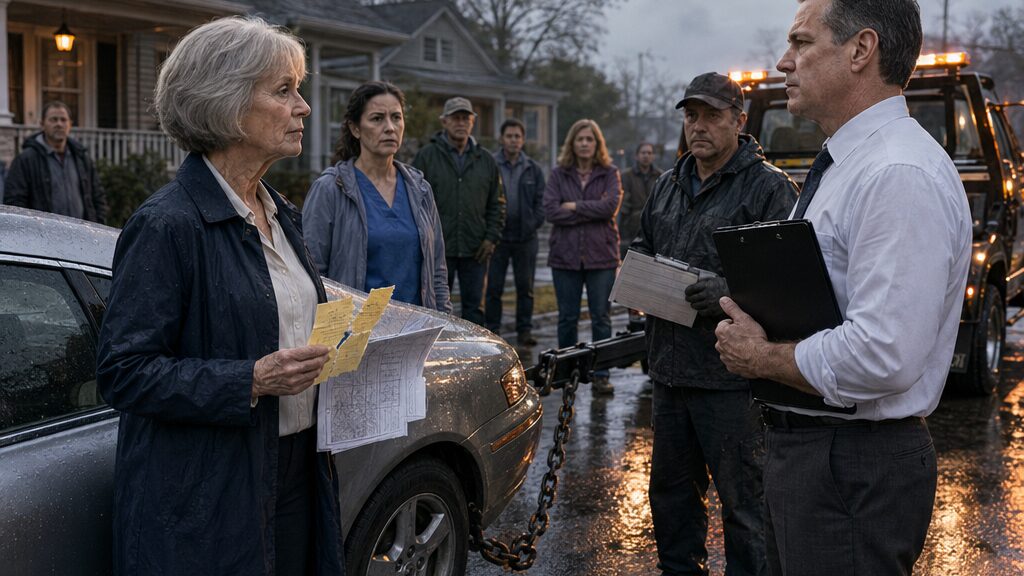
The tow chain snapped tight around Deborah Williams’s sedan just as she ran into the street in a pink bathrobe.
“Wait! Stop!”
Her slippers slapped through the rain. The tow truck’s amber lights turned the wet pavement the color of rust, and the sedan’s rear tires jumped the curb with a hard scrape. Deborah reached the driver’s door, but the truck was already moving.
Nicole Lee stood behind her front window with one hand pressed against the curtain.
It was 5:17 in the morning.
Across the street, Deborah stopped beneath the glow of the streetlamp, breathing hard as her car disappeared around the corner. One slipper had come off. She did not seem to notice.
A man in a white shirt and dark tie stood beside her mailbox holding a black clipboard. George Hill, president of the Willow Ridge Homeowners Association, watched the tow truck leave with the settled expression of someone checking off a delivery.
“You people were warned,” he said.
Deborah turned toward him. “My work bag is in there.”
“The bylaws are available online.”
“I have to be at the hospital in an hour.”
George tapped the clipboard against his palm. “Then you should have read the notice.”
Nicole stepped away from the window and reached for her phone. She took one photograph through the glass, then another after wiping condensation from the pane.
Two additional tow trucks waited near the entrance to the cul-de-sac.
Their engines idled beneath the rain. Each driver had a sheet of paper clipped near the dashboard. One truck already had its chains lowered.
This was not a response to a complaint made overnight. It had been planned.
Nicole pulled a sweater over her nightclothes and opened the front door. The rain was cold enough to tighten her shoulders. Deborah had retrieved her slipper and now stood barefoot on one foot, calling the towing company. George was walking from mailbox to mailbox, leaving yellow slips beneath windshield wipers.
“George,” Nicole said.
He looked up. “Morning.”
“What time did enforcement begin?”
“The rule went into effect today.”
“That wasn’t my question.”
His smile narrowed. “Six.”
Nicole raised her phone and photographed the nearest tow truck. The screen showed 5:22.
George glanced at the phone but said nothing.
At the house beside Deborah’s, an older man came outside pulling on a coat. His pickup was already gone. Farther down the street, a garage door opened onto an empty driveway. Another neighbor stood beneath an umbrella, staring at the place where her son’s car had been.
Nicole counted the missing vehicles.
Three on the north side. Four near the curve. Two from the short row opposite the retention pond. Deborah’s sedan. The pickup.
Eleven.
By the time the third tow truck left, the street looked strangely polished and vacant, as though the neighborhood had been staged for a real-estate photograph. Only the scraps remained: muddy tire tracks, drops of hydraulic fluid, and yellow notices fluttering beneath wipers.
George approached Nicole’s driveway.
Her sedan was parked at the curb directly in front of her house, where she had left it for thirteen years without complaint. He slid a yellow notice beneath the driver’s-side wiper.
Nicole lifted it before the rain could soak through.
ILLEGAL STREET PARKING.
FORTY-DOLLAR ASSOCIATION FINE.
FUTURE VIOLATIONS SUBJECT TO TOWING.
The printed enforcement time read 6:00 a.m.
Nicole held the notice beside her phone and took another photograph. The timestamp was 5:31.
“You’re documenting the violation?” George asked.
“I’m documenting the notice.”
“The distinction won’t matter.”
Behind him, Deborah ended her phone call. “They want two hundred dollars before they’ll release my car.”
George turned. “That fee is between you and the towing company.”
“You hired them.”
“The board contracted an enforcement service after repeated safety complaints.”
“What safety complaints?” Deborah demanded. “Nobody even parks on both sides here.”
George lifted the clipboard. “Emergency access. Congestion. Declining compliance. We’ve discussed all of it.”
Nicole had attended the last three meetings. Parking had appeared once under “new business,” followed by a promise that residents would receive thirty days’ written notice before enforcement.
She looked at the rainwater collecting along the bottom edge of her yellow slip.
“When was the written notice mailed?” she asked.
George’s expression sharpened. “It was posted in the portal.”
“On what date?”
“You can submit a records request.”
Deborah laughed once, without humor. “You took my car before sunrise and now I need a records request?”
George stepped toward Nicole’s mailbox and tapped the clipboard against its metal side.
“The association owns and maintains this road,” he said. “Residents park where the association allows them to park. This isn’t complicated.”
Nicole looked past him at the empty curb.
The phrase should have sounded ordinary. Instead, something in it caught against an old habit in her mind.
Owns and maintains were not the same thing.
She had spent enough years reading deeds to know how often people treated them as interchangeable.
“What document transferred the road to the association?” she asked.
George gave a brief, impatient laugh. “Nicole, this development is thirty-five years old.”
“That also wasn’t my question.”
“You may appeal the fine.”
“To whom?”
“The board.”
“And who approved the towing?”
“The board.”
Deborah moved closer. “So you approve it, we appeal to you, and you tell us no?”
George’s gaze stayed on Nicole. “Appeals are rarely successful when the violation is photographed.”
Nicole folded the yellow notice once, carefully, without creasing the printed time.
George mistook the movement for surrender.
“Move your car into your driveway before tomorrow,” he said. “Then there won’t be another problem.”
Nicole’s driveway was narrow. Her late husband had poured the concrete himself, leaving enough room for one car between the house and the maple tree. The sedan fit, but only if the garbage bins were moved and the passenger door remained nearly against the hedge.
She could comply.
That was what George expected. One car moved, one fine paid, one less person asking questions.
Instead, Nicole photographed the two remaining tow trucks as they turned out of Willow Ridge.
By seven, the rain had weakened to a mist. Neighbors stood in clusters comparing yellow slips and release fees. Deborah had borrowed a car from someone on the next block and left for work with wet hair and no breakfast.
Nicole went inside and placed her notice on the kitchen table.
She opened the HOA portal. The parking announcement had been uploaded at 11:48 the previous night.
Five hours and twenty-nine minutes before Deborah’s sedan was taken.
Nicole printed the page.
At nine, she sent a written request for the board resolution, the towing contract, the complaint log, and any deed or easement granting the HOA authority over the road. She kept the wording neutral.
At 9:17, George replied.
Your request has been received. Please be advised that continued violation may result in additional enforcement.
No documents were attached.
Nicole read the message twice. Then she looked through the front window at her sedan.
A white envelope protruded from the mailbox.
She crossed the lawn and opened it where she stood.
The letter inside warned that unpaid fines could be added to her account, secured by a lien against her property, and considered during any review of driveway access.
At the bottom, beneath the association logo, George Hill’s signature had been printed in blue.
Nicole looked from the words driveway access to the empty street.
Her property had not merely been included in the sweep.
Someone had decided it required pressure.
Chapter 2: The Parcel Number Beside the Hanging Chain
The tow operator slid a steel hook beneath Nicole’s front axle at 6:08 the next morning.
Nicole heard the chain before she saw the truck.
She came outside carrying a clear plastic folder. George stood at the curb in the same white shirt and dark tie, though the cuffs were rolled once above his wrists. Deborah watched from her porch in hospital scrubs, her arms folded tightly.
“You received notice,” George said.
“I submitted an appeal yesterday.”
“It was reviewed.”
Nicole stopped beside the sedan. “There was no hearing.”
“The bylaws don’t require one.”
“Who reviewed it?”
“The enforcement committee.”
“Who is on the committee?”
George’s jaw tightened. “The board has denied the appeal.”
The tow operator crouched beside the wheel, feeding the chain through the hook. He was a broad man in a rain jacket, his movements practiced and impersonal.
Nicole did not touch him or the equipment.
She removed the yellow notice from the folder. George had torn it the previous afternoon after she asked him to correct the enforcement time. He had ripped it cleanly down the center and dropped the halves beside the mailbox.
Nicole had picked them up before the rain carried them into the gutter.
Now she placed both pieces on George’s clipboard, aligning the torn edges.
“What are you doing?” he asked.
“Returning the document you altered.”
“It’s a copy.”
“It has your handwritten initials.”
The tow operator glanced up.
Nicole added a photocopy beneath the notice. It showed part of the subdivision plat, including the curve of Willow Ridge Lane and several parcel lines. She had found it among the closing papers stored in the cabinet above her late husband’s workbench.
The copy was incomplete, but one number appeared beside the road.
Parcel 14-B.
“Before he removes my car,” Nicole said, “I’d like the parcel number of the land he’s removing it from written on the authorization.”
George stared at her. “The road belongs to the association.”
“Then the parcel number should be easy to provide.”
“This is obstruction.”
“No. I’m asking what property your contractor is entering.”
The chain hung inches from her tire.
Its links turned slowly beneath the amber lights.
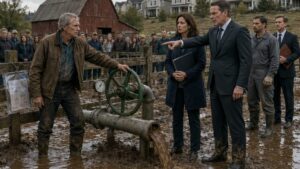
Across the street, a garage door rose. A neighbor stepped out holding a phone. Another appeared near the corner. Within a minute, six people were watching.
George lifted the plat copy with two fingers. “You pulled this from an old closing packet and now you think you’re a lawyer?”
“No.”
“Then stop pretending a parcel notation overrides thirty-five years of association control.”
“I’m not claiming it does.”
“You’re delaying lawful enforcement.”
Nicole looked at the tow operator. “Does your work order identify a property owner?”
He straightened and wiped his glove against his jacket. “It says Willow Ridge HOA.”
“Does it identify the parcel?”
“No, ma’am.”
“Does your company have written authorization from the titled owner?”
George cut in. “I am authorizing it now.”
The operator looked from George to Nicole. “You the property owner?”
“That is the question.”
George gave a sharp laugh meant for the gathered neighbors. “She’s trying to seize the street over a filing technicality.”
A murmur moved along the curb.
Deborah came down her steps. “Is that true?”
Nicole turned toward her. “I haven’t said that.”
“You’re asking whether you own the road.”
“I’m asking who does.”
George pointed at the plat. “Her lot touches the old road tract. She’s decided that means she can control access for everybody.”
Nicole felt the accusation land before she could decide how much to disclose.
The records were not complete. She had only an old copy, no certified deed, no full chain of title, and no confirmation that a later conveyance had not been recorded under another instrument number.
Facts should be spoken only when they were ready.
That rule had protected clients once.
It had also failed one family badly enough that Nicole had left the work she loved.
“I have not claimed anyone’s access,” she said.
“But you won’t say you don’t own it,” Deborah replied.
“I don’t know yet.”
The honest answer sounded weaker aloud than it had in her kitchen.
George seized it immediately.
“There,” he said. “She doesn’t know. Yet she’s interfering with a valid contract because she wants special treatment.”
Nicole looked at the tow operator again. “Will your company proceed when ownership is disputed and the work order contains no parcel identification?”
The operator exhaled through his nose. “I need to call dispatch.”
George lowered the clipboard. “You don’t need to call anyone.”
“My boss likes paperwork.”
“You have authorization.”
“From the HOA,” Nicole said. “Not necessarily from the owner.”
The operator stepped toward the cab.
George followed him. Their voices dropped, but the frustration in George’s posture was visible. He pointed twice toward Nicole’s car, then toward the entrance of the neighborhood.
The operator shook his head.
When he returned, he carried a blank form on a metal board.
“Dispatch says we need indemnification before we continue,” he said. “Name of authorizing party, basis of control, parcel description, and agreement to cover any wrongful-tow claim.”
George stared at the form. “We already have a service contract.”
“This is separate.”
“You towed eleven vehicles yesterday.”
“Ownership wasn’t disputed yesterday.”
“It is now,” Nicole said.
For the first time since the trucks arrived, George looked uncertain.
It lasted only a second.
Then he turned toward the neighbors.
“Let everyone be clear about what is happening,” he said. “Nicole is asserting a private interest in a road maintained by all of us. If she succeeds, your driveways, deliveries, and emergency access could depend on her permission.”
Deborah’s face changed.
Not anger exactly. Something tighter.
Fear.
Nicole could have told them about implied easements, recorded access rights, and the limits on any fee owner’s ability to obstruct a subdivision road. She could have explained that ownership beneath pavement did not erase the rights of the homes built around it.
But she had not verified the language.
She said nothing.
George handed the unsigned indemnification form back to the operator.
“Remove your equipment,” he said.
The chain came free with a metallic rattle.
A small, immediate relief passed through Nicole, followed by the knowledge that she had won the wrong thing. Her car remained at the curb, but the people around her were no longer looking at George alone.
They were looking at her.
The operator raised the hook and drove away.
George gathered the torn notice and plat from his clipboard. Nicole held out her hand.
“Those are mine.”
He returned them.
“Enjoy your technical victory,” he said quietly. “The association will respond formally.”
He walked toward his house without looking back.
Deborah stayed at the curb.
“Are you going to block the road?” she asked.
“No.”
“Can you?”
“I don’t know.”
“That’s not comforting.”
Nicole slipped the torn notice and plat into the plastic folder. “It’s the truth.”
Deborah’s mouth tightened. “The truth would help more if you told us all of it.”
She returned to her porch.
Inside, Nicole carried the folder to the back room that had once been her husband’s workshop. Dust softened the edges of old binders stacked above the workbench. She moved aside tax records, appliance manuals, and the closing file from 1990.
The original plat was folded inside.
As Nicole lifted it, a plastic card slid onto the floor.
She recognized the blue stripe before she picked it up.
NICOLE LEE
SENIOR TITLE EXAMINER
The photograph showed her at forty-six, hair cut to her jaw, expression certain.
On the reverse, in faded ink, someone had written:
Never assume the road followed the houses.
Nicole sat down with the card in her hand.
She remembered exactly who had written it.
She also remembered the file that had made her stop believing she deserved the advice.
Chapter 3: The Map That Did Not Name the Association
The handwritten notation appeared only when Nicole held the plat beneath the green desk lamp.
It ran along the inside edge of Willow Ridge Lane in thin brown ink:
Private access easement reserved over Tract B. Fee to adjoining Parcel 14-B unless separately conveyed.
Nicole read it three times.
The photocopy she had carried outside contained the printed parcel lines but not the handwritten sentence. The ink had faded into the paper’s yellowing surface, nearly invisible beneath ordinary light.
She placed the two halves of the parking notice across the corners to keep the plat from curling.
The torn paper looked childish beside the surveyor’s careful lines.
For two hours, Nicole built a provisional chain of title on a legal pad. Developer acquisition. Subdivision plat. First conveyance of Lot 14. Creation of the homeowners association. Supplemental covenants. Road-maintenance agreement.
No deed to the HOA appeared in the closing file.
That did not mean none existed.
She wrote the sentence at the top of a fresh page.
Absence from private file is not absence from public record.
It was the kind of caution she once gave younger examiners. The kind she had stopped trusting herself to follow.
At eight the next morning, Nicole entered the county administration building with the plat in a protective sleeve. Fluorescent lights hummed above rows of public terminals. A clerk directed her to the records counter, where Amanda Rodriguez examined the handwritten notation through a magnifying lens.
“You worked title,” Amanda said.
“Twenty-two years.”
Amanda looked at the old identification card clipped inside Nicole’s folder. “Recently?”
“No.”
She did not ask why.
Instead, Amanda entered the plat book and page into the county system. “Let’s find the originating instrument, then search forward from Tract B and Parcel 14-B.”
Nicole sat beside her at the terminal.
The first records matched Nicole’s notes. The developer had created Willow Ridge Lane as a private access easement serving the residential lots. Maintenance obligations were later assigned to the HOA through the covenants.
But the underlying tract remained separate.
Amanda opened each subsequent instrument tied to the subdivision. Amendments. Releases. Utility easements. A drainage agreement. A road-resurfacing contract.
No conveyance transferred fee title to the association.
At 10:14, Amanda leaned back.
“I don’t see a deed.”
Nicole’s pulse moved hard once against her throat.
“So the fee stayed with Parcel 14-B.”
“That appears to be the chain.”
“My lot.”
“It appears attached to your lot’s legal description, yes.”
Nicole looked at the screen, where the road had been reduced to lines, numbers, and recording references.
For one clean moment, the answer felt absolute.
George had claimed the association owned the road. It did not.
The tow trucks had entered land whose fee title ran with Nicole’s property.
She imagined returning to Willow Ridge with certified copies and placing them on George’s clipboard.
Then Amanda closed the image.
“Before you do anything,” she said, “ownership of the underlying fee is not the same as exclusive possession.”
“I know.”
“Do you?”
Nicole’s irritation came too quickly. “I examined easements for two decades.”
Amanda held her gaze. “Then you know why I’m saying it.”
Nicole looked back at the plat.
Every residential lot carried a right of access over Willow Ridge Lane. Delivery vehicles, emergency services, residents, guests—those rights did not disappear because the fee owner’s name had been overlooked.
“You can’t gate it,” Amanda said. “You can’t charge neighbors for ordinary access. You likely can’t interfere with reasonable maintenance.”
“I never intended to.”
“But you may have standing to challenge activities outside the easement’s purpose.”
“Such as towing?”
“Possibly. Parking enforcement can get complicated. Maintenance authority may include safety restrictions. Blanket towing for revenue is another question. You’ll need counsel or mediation for a final answer.”
Nicole heard the distinction clearly.
Ownership gave her leverage.
It did not give her a kingdom.
Amanda printed the index and marked the instruments Nicole should order as certified copies. “You also need the HOA’s towing contract, board resolutions, and complaint records. Find out what authority they believed they were exercising.”
“Believed?”
“Or claimed.”
Nicole paid the certification fees and carried the documents to a table near the window. She should have felt vindicated.
Instead, an old closing room returned to her.
A young couple had sat across from her years earlier, surrounded by boxes because their lease had expired. Nicole’s preliminary report had missed an ambiguous access notation attached to an adjoining tract. The problem was eventually resolved, but not before their purchase was delayed six weeks and their belongings were placed in storage.
No one lost a home.
No court blamed Nicole.
Her supervisor called it a correctable oversight.
The woman had still cried in the lobby.
Afterward, Nicole began checking every road twice, then three times. She stopped signing reports without another examiner beside her. When her husband became ill, retirement had offered an exit she could describe as practical.
She had never told anyone in Willow Ridge that she left because certainty had become impossible to reach.
Her phone vibrated.
Three missed calls from Deborah.
A message followed.
Are you at the county? George says you confirmed the street is part of your property.
Nicole typed, I confirmed no deed to the HOA is recorded.
She erased it.
Then she typed, The records are more complicated than George is saying.
She erased that too.
Until she had the certified copies and the easement language reviewed, fragments would only create more confusion.
She placed the phone facedown.
By the time Nicole returned home, three neighbors stood near Deborah’s driveway. Their conversation stopped when she parked.
Deborah crossed the street.
“Did you find out?” she asked.
“I found that the HOA does not appear to hold fee title.”
Deborah’s eyes widened. “So you own it.”
“The underlying tract may run with my parcel, but everyone has recorded access rights.”
“Can George tow cars?”
“I don’t know yet.”
Deborah let out a strained breath. “You keep saying that.”
“Because the answer matters.”
“So do our cars.”
Nicole looked toward Deborah’s empty driveway. Her sedan remained at the towing yard because she could not afford the release fee until payday.
“I understand.”
“No,” Deborah said. “You understand documents. I’m not sure you understand what this feels like for the rest of us.”
Before Nicole could answer, a garage door opened nearby. Someone called Deborah’s name, and she turned away.
Nicole went inside carrying the certified index against her chest.
At the kitchen table, she opened her phone.
The neighborhood message board had forty-three new posts.
At the top was a photograph of the plat copy from the curbside confrontation. Someone had circled Parcel 14-B in red.
The caption read:
URGENT: Nicole Lee claims she owns Willow Ridge Lane. Board warns she may restrict driveway access or install a private gate.
Below it, neighbors argued over deliveries, home values, emergency vehicles, and whether Nicole could demand fees from every household.
George had commented once.
The board is taking all necessary steps to defend community access.
Nicole read the sentence twice.
He had turned the ownership question into a threat before she had made any claim at all.
A new message appeared beneath it.
Emergency HOA meeting in two days. All residents should attend.
Nicole looked at the torn yellow notice holding down the old plat.
For years, she had believed silence prevented an uncertain fact from causing harm.
Now her silence had become the space where George placed his version of the truth.
Chapter 4: When the Neighbors Feared the Wrong Owner
The first resident through the clubhouse door asked Nicole how much she planned to charge them for using their own driveways.
He did not sit down afterward. Neither did the woman behind him, who held a printed copy of the neighborhood message with the words PRIVATE ROAD circled in red.
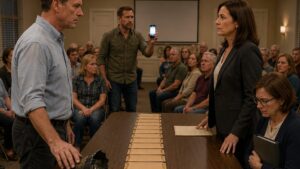
By six thirty, every folding chair was taken. People stood along the walls beneath framed photographs of Willow Ridge ribbon cuttings and holiday decorating contests. Deborah sat near the front, still wearing her hospital identification badge. She avoided Nicole’s eyes.
George occupied the center seat at the board table. A taped copy of Nicole’s yellow parking notice lay in front of him beside the gavel, as if the torn paper had become an exhibit against her.
“We called this emergency meeting,” he began, “because the community’s access and property values may now be at risk.”
Nicole heard the may. It gave him room to imply anything.
A man near the back raised his hand without waiting to be recognized. “Can she put up a gate?”
“No,” Nicole said.
George lifted the gavel. “Questions will be directed through the chair.”
“I answered it.”
“You answered without providing the board any supporting opinion.”
Nicole opened the folder on her lap. Certified copies of the plat index rested inside, but Amanda’s warning remained louder than the room. Fee ownership did not erase easements. Nor did it automatically answer who could regulate parking.
“I have found no recorded deed conveying the road to the HOA,” Nicole said. “That does not mean residents lose access.”
“Do you own it?” another neighbor asked.
“The underlying tract appears attached to my parcel.”
The room broke into overlapping voices.
“Appears?”
“What does attached mean?”
“Can she sell it?”
“My closing papers say we have access.”
George waited until the fear had gathered enough weight, then struck the gavel.
“This is precisely the danger of an individual advancing an unverified claim,” he said. “The association has maintained Willow Ridge Lane for decades. We insure it. We repair it. We regulate it for everyone’s benefit.”
“Maintaining property does not establish title,” Nicole said.
“No one said it did.”
“You told me the association owned the road.”
“I used ordinary language.”
“You used it to authorize towing.”
George’s mouth tightened. “We authorized enforcement because vehicles were interfering with safe access.”
Deborah finally looked at him. “Whose vehicle blocked anything?”
“We received complaints.”
“How many?”
“That information may identify residents.”
“So none?”
A few people murmured agreement.
George turned toward Samuel Carter, who sat at the far end of the table with a calculator and a thick budget packet. “The treasurer can explain why enforcement became necessary.”
Samuel adjusted his glasses. His fingers remained on the closed packet.
“Our insurer conducted a risk review last quarter,” he said. “They noted inconsistent parking controls and inadequate road reserves.”
“What does a reserve have to do with my car?” Deborah asked.
Samuel glanced at George.
The pause was small, but Nicole saw it.
“The association is responsible for long-term resurfacing,” Samuel said. “Current reserves are below the recommended level.”
“How far below?” someone asked.
Samuel opened the packet. “Approximately sixty-eight thousand dollars.”
The room changed.
George leaned toward the microphone. “That figure reflects projected work over several years, not an immediate crisis.”
“But you knew?” Deborah asked.
“The board has been addressing it.”
“By towing us?”
George’s voice hardened. “By enforcing rules that protect access, reduce liability, and maintain standards.”
Samuel turned one page, then another, though he did not seem to be reading them.
Nicole watched him. “Were towing proceeds included in the reserve projections?”
George answered first. “The HOA does not receive towing fees.”
“That wasn’t my question.”
Samuel’s shoulders lowered.
“The contract includes administrative credits,” he said.
George turned toward him. “Samuel.”
“What are administrative credits?” Deborah asked.
Samuel spoke more quietly. “A portion of enforcement-related revenue offsets contract and patrol expenses. Any savings were reflected in the road account projections.”
“So the more cars they tow, the less the HOA pays,” Deborah said.
“It isn’t structured as a commission.”
“But the board benefits.”
“The association benefits,” George corrected. “Every homeowner benefits when shared costs are controlled.”
Nicole looked at the yellow notice taped beside him. What had seemed like an act of personal contempt now carried another meaning. George had needed the fines and towing to look impartial because the policy’s value depended on volume.
“Was the ownership question discussed before the contract was signed?” Nicole asked.
Samuel looked down.
George struck the gavel. “Title is not on tonight’s agenda.”
“It is the reason we’re here.”
“We are here because your unsupported claim created panic.”
A woman near the wall held up her phone. “The board’s post said Nicole might restrict access. She never said that.”
George’s expression did not change. “The board has a duty to identify possible consequences.”
Deborah stood.
“Did Nicole ever tell you she planned to gate the road?”
“No.”
“Charge us?”
“No.”
“Block our driveways?”
“No.”
Deborah turned toward the room. “Then why did the message say she might?”
No one answered immediately.
Nicole felt the opening and still hesitated.
She could explain the recorded access easements. She could show the handwritten notation and the missing conveyance. But Amanda had not issued an opinion, and Nicole had not obtained every instrument. A sentence spoken too early could become another red circle on another screenshot.
George recognized her silence.
“This uncertainty is exactly why the association must preserve the status quo,” he said. “Until counsel resolves the title issue, existing parking enforcement remains valid.”
Nicole rose. “You cannot call towing the status quo when you began it two days ago.”
“The parking restriction has existed for years.”
“Not blanket towing.”
“The board has discretion over enforcement.”
One board member shifted toward the microphone. “We have a motion prepared.”
Samuel looked at the paper in front of him as though seeing it for the first time.
George read aloud. “The board will affirm emergency parking enforcement pending legal review, including towing when authorized by the president or designated agent.”
Deborah said, “You’re voting before answering anything?”
“The board must act to prevent disorder.”
Nicole looked at Samuel. “Did you know about this motion?”
He did not answer.
The vote passed three to one. Samuel abstained.
George announced that towing would resume at midnight.
Chairs scraped backward. Residents crowded around Deborah, some angry at the board, others demanding that Nicole promise in writing never to interfere with access. She could not offer the promise in the form they wanted without knowing its legal effect.
Her careful answers sounded evasive.
Outside the clubhouse, Deborah caught up with her beneath the parking-lot light.
“I know you didn’t start the rumor,” she said.
Nicole stopped.
“But you let him define what your silence meant.”
“I’m trying not to make claims I can’t support.”
“And he’s making them for you.”
Deborah’s voice was tired rather than accusing now. “Eleven cars were taken. At midnight they can start again. When will you know enough?”
Nicole looked toward Willow Ridge Lane, where porch lights traced the curve of the road.
Her certified copies would not arrive until morning.
George had given the tow trucks a six-hour head start.
Chapter 5: The Invoices Behind the Parking Rule
The public-records response arrived at 6:42 the next morning with an attachment containing eighty-seven towing invoices.
Nicole opened the first file before pouring coffee.
The oldest invoice was four years old. The newest listed Deborah’s sedan. Between them were vehicles she recognized and names she did not—former renters, visiting relatives, a home-health aide, a contractor who had parked for nineteen minutes beside the retention pond.
Each invoice contained the same internal authorization code.
WR-HILL-01.
By seven, Deborah sat at Nicole’s kitchen table sorting printouts into piles. The torn yellow notice lay beneath the lid of Nicole’s scanner.
“You kept this?” Deborah asked.
“He tore an original document carrying his initials.”
“I would have thrown it at him.”
“That would have changed what it proved.”
Deborah gave her a sideways look. “You really did this for a living.”
Nicole fed the two halves through the scanner side by side. The digital image joined a shared folder Deborah had created for the affected residents.
It was the first time Nicole had allowed anyone else to hold part of the case.
Deborah had already collected statements from nine households. By noon, all eleven were included. Dates, release fees, work missed, childcare disrupted, medication left in vehicles. The records changed the dispute from an argument about parking into a ledger of consequences.
At the towing yard, a dispatcher met them behind reinforced glass.
“We don’t release internal contracts,” she said.
“We have the invoices,” Nicole replied.
“Then you have what the county gave you.”
“Several show administrative credits. Who received them?”
The dispatcher’s eyes moved toward a camera mounted in the corner. “That’s between our company and the contracting party.”
“Did your company verify road ownership?”
“We rely on the property manager or association.”
“Will you tow tonight?”
The dispatcher hesitated. “Not from disputed property without additional authorization.”
“Written indemnification?”
Her expression sharpened. “I didn’t say that.”
“You didn’t have to.”
Outside, Deborah smiled for the first time in days. “So they’re scared.”
“Cautious.”
“Same result tonight.”
“Only if George refuses the indemnification.”
Deborah’s smile faded. “Would he?”
Nicole thought of the emergency vote. “Yes.”
They drove from the yard to the county building, where Nicole collected the certified plat and deed records. Amanda had flagged one additional document: a road-maintenance covenant granting the HOA responsibility for repairs and reasonable safety rules, but no express towing authority and no conveyance of title.
The distinction strengthened Nicole’s position without making it complete.
When they returned to Willow Ridge, Samuel Carter waited beside Nicole’s mailbox.
He held a grocery bag in one hand.
Deborah said, “What is that?”
“Documents.”
“Board documents?”
“Copies.”
Nicole unlocked her front door. “Come inside.”
Samuel remained in the kitchen while Deborah closed the blinds. He removed budget reports, email printouts, and a thin legal memorandum from the bag.
The memorandum was dated three months earlier.
Nicole read the first paragraph.
Title to Willow Ridge Lane is unclear. Available records indicate the association possesses maintenance obligations and easement-related authority but may not own the underlying fee. Counsel recommends confirmation before expanding enforcement activities.
She looked up. “George received this?”
Samuel nodded.
“So did you.”
“Yes.”
“And you signed the towing contract afterward.”
“I signed the payment authorization.”
Deborah pushed away from the table. “That’s supposed to sound better?”
“No.”
Samuel folded his hands. “The insurer wanted a corrective plan. The reserve study showed we couldn’t afford resurfacing without a special assessment. George believed aggressive enforcement would satisfy the risk review and reduce contract costs through credits.”
“How much?” Nicole asked.
“Not enough to solve the deficit. Enough to delay the assessment.”
“Delay it until when?”
“After the board election.”
Deborah stared at him. “So he took our cars to make the budget look less terrible.”
Samuel flinched. “He believed the rule was enforceable through the easement.”
“Did you?”
“I believed counsel would clarify it before towing began.”
“But you knew it hadn’t.”
“Yes.”
“Why didn’t you warn anyone?”
Samuel looked at the table. “Because the reserve shortfall happened while I was treasurer. I approved lower annual contributions for three years. People were already angry about dues. If the numbers became public, every decision would become mine.”
Nicole felt anger rise, clean and immediate. “Instead, you let the cost become theirs.”
“Yes.”
His admission left nowhere for her anger to go.
Samuel continued. “I told myself we could correct it quietly. Stop towing if counsel objected. Raise reserves gradually. No public panic.”
Nicole looked at the closed blinds.
Quiet correction. Controlled facts. No public panic.
The shape of his excuse was uncomfortably familiar.
“You used silence to protect the institution,” she said.
Samuel met her eyes. “And you used it to protect your certainty.”
Deborah said, “Those are not the same.”
“No,” Nicole replied. “But they harmed some of the same people.”
Samuel slid the memorandum toward her. “George will say longstanding practice gave the board implied authority. The HOA attorney is preparing that argument now.”
Nicole examined the invoices again. Years of sporadic towing had created a pattern, but the latest sweep was different in scale, timing, and financial purpose.
“Will you provide a statement?” she asked.
Samuel’s face tightened. “Not publicly.”
“Then this is only paper someone can call stolen or incomplete.”
“I can authenticate it in mediation.”
“That may be too late.”
“I have a family here.”
“So does Deborah.”
Samuel looked at her, then at the empty driveway visible through the narrow gap in the blinds.
“I need until tomorrow,” he said.
After he left, Deborah spread the eleven affidavits across the table.
“We send everything now,” she said. “All of it.”
Nicole’s instinct was to organize, verify, cross-reference, and wait for a complete chronology. Midnight was less than ten hours away.
She opened the shared folder.
For the next four hours, they matched invoices to resident statements and calculated towing charges, credits, and dates. Nicole drafted a notice disputing authority and attached the certified instruments. Deborah called each household, explained what they knew and what remained uncertain, and obtained permission to include their losses.
At five forty, the HOA attorney emailed a response.
The board, it said, relied on decades of maintenance, established covenant authority, and longstanding enforcement practice. Any interference with the towing contract could expose Nicole to damages.
Attached was a formal demand bearing George’s signature.
Nicole Lee must withdraw all claims of exclusive ownership, cease communications with association vendors, and confirm that she would not obstruct enforcement.
Failure to comply could result in litigation.
Deborah read it over Nicole’s shoulder.
“They want you alone again,” she said.
Nicole looked at the names in the shared folder—eleven households who had trusted her with evidence before she could promise them victory.
She moved the demand letter aside and placed the torn yellow notice on top of it.
Then she began drafting a response that started with we.
Chapter 6: The Hearing Where Ownership Was Not Enough
“The association cannot produce a deed conveying Willow Ridge Lane to it.”
The HOA attorney delivered the sentence in the county mediation room without looking at George.
For several seconds, no one moved.
Nicole sat across the table with Deborah and the eleven resident affidavits arranged in a single binder. Samuel occupied a chair near the wall, separate from the board. A representative from the towing company had joined by speakerphone.
The court mediator folded her hands. “Then we can stop referring to the association as the titled owner.”
George leaned toward his attorney. “We never based authority solely on title.”
“You told residents the HOA owned the road,” Nicole said.
“I used language they understood.”
“You used language the towing company relied upon.”
The mediator raised one hand. “We are not deciding intent yet. We are identifying rights and obligations.”
Nicole placed the certified plat on the table. Beside it, she laid the original yellow notice, its torn halves held together by a transparent sleeve.
The same parcel number appeared on both the plat and several towing invoices.
Parcel 14-B.
The mediator traced the number with a capped pen. “Ms. Lee, your position is that fee title beneath the road runs with your lot.”
“Yes.”
“And therefore all towing was trespass?”
Nicole felt every resident’s attention shift toward her.
This was the easy opening. The satisfying answer would have been yes.
Instead, she said, “Not automatically.”
George looked up.
Nicole continued. “Every lot in Willow Ridge holds recorded access rights. The HOA also has maintenance duties and authority to adopt reasonable safety rules connected to those duties. My ownership does not allow me to block residents, gate the road, charge access fees, or interfere with legitimate maintenance.”
Deborah’s shoulders loosened beside her.
The mediator asked, “Then what are you challenging?”
“The board’s claim that maintenance authority allowed blanket towing without verified obstruction, meaningful notice, or a neutral appeal. The contract also created financial credits tied to enforcement volume.”
The HOA attorney opened the covenant binder. “The board may regulate conduct affecting common access.”
“Regulate, yes,” Nicole said. “But the towing sweep began before the stated enforcement hour. Eleven cars were removed under a notice uploaded five hours earlier. Some vehicles were not obstructing travel at all.”
She slid forward photographs showing the empty street and timestamps.
The attorney replied, “Procedural defects do not eliminate the underlying authority.”
“No,” Nicole said. “But they reveal how that authority was used.”
The mediator turned to Samuel. “Mr. Carter, did the board receive legal advice concerning ownership before expanding enforcement?”
Samuel’s face had gone pale.
“Yes.”
“Did the advice confirm towing authority?”
“No. It recommended confirming title and scope first.”
George sat back. “It was preliminary.”
“It was a warning,” Samuel said.
The words changed the room.
George looked at him. “You approved the budget.”
“I did.”
“You approved the contract payments.”
“I did.”
“And now you’re presenting yourself as an objector?”
Samuel swallowed. “I objected privately and then stayed silent publicly.”
The mediator asked why.
Samuel described the reserve deficit, the insurance review, and the postponed special assessment. He did not blame George for all of it. He admitted voting for lower contributions and allowing the board to count administrative towing credits in its projections.
“I thought we could contain the problem,” he said.
George’s face hardened. “We were trying to prevent every homeowner from receiving a four-figure assessment.”
“That concern was real,” Nicole said.
Deborah turned toward her, surprised.
Nicole kept her attention on George. “But you chose residents who could least afford an immediate tow bill to carry part of the cost without telling them why.”
“We chose enforcement,” George replied. “The financial benefit was secondary.”
“You continued after counsel questioned ownership.”
“Because failing to act would have confirmed to the insurer that we lacked control.”
There it was.
Not greed alone. Fear of exposure. Fear that the neighborhood would see the road reserve, the delayed assessment, and the board’s uncertainty as George’s failure.
The mediator asked the towing-company representative whether the company would continue operations.
“Not without full indemnification from the association and confirmation of enforcement authority,” the voice on the speakerphone said. “We also reserve claims for any losses arising from inaccurate property representations.”
George’s attorney closed his eyes briefly.
The mediator listed the dispute’s possible paths: injunction, title action, wrongful-tow claims, contract litigation, special assessments, and months—possibly years—of expense.
“No party leaves that process whole,” she said.
George looked toward Nicole. “What do you want? Control of the road?”
The question carried less certainty than it had at the curb.
Nicole touched the sleeve containing the torn notice.
A week earlier, she had wanted the paper to prove contempt. Now it proved something larger: how easily one person’s certainty could become another person’s burden.
“I want the towing charges repaid,” she said. “All lien threats withdrawn. An independent audit of the road reserve and enforcement credits. No towing except for documented obstruction or emergency access under a recorded policy.”
The HOA attorney asked, “And your ownership claim?”
“I will sign a recorded access agreement confirming every lot’s existing rights and granting the HOA limited authority to maintain the road and enforce clearly defined safety restrictions.”
George stared at her. “You would give the association authority after all this?”
“Limited authority. Transparent authority. Not ownership it does not have.”
“And if we refuse?”
Nicole looked at the affidavits, then at the certified deed.
“Then I join the residents in seeking an injunction and restitution, and I ask the court to define the easement.”
The room remained quiet.
George rubbed one thumb along the edge of his legal pad. “Refunding every charge could empty the operating account.”
“Then the settlement can use installments,” Nicole said. “But the obligation must be acknowledged.”
“You’re protecting people who accused you of trying to gate their homes.”
Deborah started to speak, but Nicole touched her arm.
“I gave them too little information,” Nicole said. “You gave them false information. Those are different mistakes, but pretending mine caused no harm would make this agreement dishonest.”
George looked down.
The mediator asked for a private caucus with the board.
As the others stood, George remained seated.
“You think this makes you the reasonable one,” he said to Nicole.
“No.”
“What, then?”
Nicole gathered the torn notice and placed it over the plat.
“It makes the road usable without requiring anyone to trust a single person’s version of the truth.”
George’s expression shifted—not acceptance, not apology, but the first recognition that she was not seeking the authority he would have sought in her place.
The mediator returned twenty minutes later.
The board would consider the terms, but only if the towing company suspended action and Nicole paused any filing for an injunction.
Nicole agreed to forty-eight hours.
Before leaving, she added one condition to the written proposal.
Every improper towing charge had to be repaid, including Deborah’s release fee, before the access agreement would be recorded.
The mediator read the sentence aloud.
Across the table, George’s pen remained motionless above the signature line.
Chapter 7: The Road Everyone Was Allowed to Use
The tow trucks returned to Willow Ridge six weeks later, but this time their chains stayed coiled.
Nicole watched from her driveway as the first truck stopped outside Deborah’s house. The operator stepped down carrying an envelope instead of a hook. Behind him, Deborah’s sedan rolled from a flatbed, its tires touching the pavement with a soft double thump.
Deborah stood at the curb in hospital scrubs, one hand covering her mouth.
“There’s no release charge,” the operator said. “Company’s refunding the original payment. Paperwork’s inside.”
He handed her the keys.
For a moment, Deborah did not move. Then she opened the driver’s door and checked the back seat. Her old work bag was still there, wedged against a box of unopened gloves.
Across the street, two other residents waited beside vehicles being returned or inspected for reimbursement claims. No amber lights flashed. No chains scraped across asphalt. The machinery that had once arrived before dawn now sat quiet under the late-morning sun.
Nicole held the settlement folder beneath her arm.
The board had accepted the mediated terms on the final evening of the forty-eight-hour pause. Not unanimously. George had voted against the first version, then abstained when the HOA attorney explained the likely cost of an injunction, title action, and eleven separate wrongful-tow claims.
The final agreement required the association to repay improper towing charges in installments from the operating account, withdraw every related fine and lien warning, commission an independent reserve audit, and suspend blanket towing permanently.
In return, Nicole would record a road-access agreement confirming the rights already attached to every lot.
It did not give the residents everything they had demanded.
Cars could not block fire hydrants, narrow the travel lane below the county’s emergency-access standard, or remain near the sharp curve by the retention pond overnight. Documented hazards could still result in towing after notice, except during an immediate emergency.
At the first resident meeting after mediation, several people had objected.
“We won,” one man said. “Why are we agreeing to restrictions?”
“Because some restrictions are reasonable,” Nicole replied.
“That sounds like the board.”
“It should sound like the easement.”
The room had gone quiet then. Not pleased, but listening.
Justice, Nicole had discovered, was less satisfying when it had measurements painted on pavement.
Deborah crossed the street now and held up the refund check. “Every dollar.”
Nicole smiled. “Keep a copy.”
“I already took three pictures.”
“That’s excessive.”
Deborah laughed. “Look who’s talking.”
They walked together toward the clubhouse, where the final documents waited for signature. Fresh white markings had been painted along the curb that morning: short, clean sections near the hydrants and the narrow bend, not a continuous ban across the entire street.
Samuel stood outside the door holding a cardboard box.
His resignation had taken effect after he delivered the financial chronology to the auditor. The box contained budget binders, meeting notes, and the calculator he had used at every board meeting for five years.
“The preliminary audit found the reserve reporting was accurate,” he told Nicole. “The assumptions were not.”
“That distinction matters.”
“I used to think it protected me.”
He looked toward Deborah’s returned car.
“It doesn’t.”
Samuel had agreed to remain available to the auditor, but he would not serve on the replacement board. No one had asked him to. His statement during mediation had helped the residents, but it had not erased the years he had kept quiet.
Nicole understood that better than she wanted to.
Inside the clubhouse, George sat alone at the board table. His white shirt had been replaced by a gray sweater. The black clipboard rested in front of him, empty.
The HOA attorney placed three documents beside it: the settlement, George’s resignation, and the recorded-access agreement awaiting Nicole’s signature.
George signed the resignation first.
His pen paused above the final line.
“I did not invent the reserve deficit,” he said.
“No,” Nicole replied.
“I did not invent the insurance warning.”
“No.”
“If we had ignored it and someone had been injured, everyone would be saying I failed to act.”
Nicole looked at the man who had torn her notice and told Deborah an appeal would not matter. His fear had not been imaginary. Neither had the choices he made with it.
“You were responsible for acting,” she said. “You were also responsible for knowing what authority you had.”
George pressed the pen to the page.
“I was trying to keep this place from sliding backward.”
“You decided control and protection were the same thing.”
He signed his name.
There was no apology. Nicole had stopped expecting one.
The absence did not undo the settlement.
After George left, Deborah and two other residents joined Nicole at the table. They would form the temporary road committee until the next board election. No member could authorize a tow alone. Every non-emergency action required photographs, written notice, and review by someone who did not issue the violation.
Nicole opened the access agreement.
The legal description covered nearly two pages. The practical rules fit on one.
She read both.
Then she signed.
At the recorder’s office that afternoon, Amanda Rodriguez checked the document for margins, acknowledgments, and exhibit references.
“You added resident oversight,” Amanda said.
“Deborah insisted.”
“Good insistence.”
Amanda stamped the recording information onto the first page. “Once indexed, this becomes part of the chain.”
Nicole watched the red numbers settle into the paper.
For most of her working life, recording had felt like an ending. A transaction closed. A risk transferred. A file moved to storage.
This time, the stamped page felt like a promise made visible.
Before leaving, Nicole removed the transparent sleeve containing the torn yellow notice from her folder.
“I’d like this included with the supporting settlement record.”
Amanda examined the two halves. “You don’t want to keep it?”
“I’ve kept it long enough.”
The notice had begun as an accusation. Then it became evidence, leverage, and a warning against contempt. Displayed at home, it would become a trophy, and Nicole did not want the road’s future organized around anyone’s victory.
Amanda placed it behind the certified plat.
The torn edges remained visible through the sleeve.
When Nicole returned to Willow Ridge, Deborah was guiding her sedan into the space in front of her house. She stopped within the new curb marks, stepped out, and examined the distance between her bumper and the hydrant.
“Legal?” she called.
Nicole looked.
“Legal.”
A delivery van passed without slowing. A child rode a bicycle along the sidewalk. Near the bend, two residents studied the painted restriction and argued quietly over whether it should extend another three feet.
The road was not peaceful because every disagreement had vanished.
It was peaceful because no single person could turn disagreement into punishment without being questioned.
Nicole stood beside her mailbox as the afternoon light moved across the pavement. The fresh paint was still bright, its edges not yet softened by tires or weather.
Beneath that asphalt, fee title remained attached to her parcel.
Across it, every household retained the right to come home.
Nicole had once believed ownership was the final answer a record could give. Now she understood that the harder question was what a person chose to do after the record placed power in her hands.
A tow truck passed the entrance without turning in.
Its chains remained still.
The story has ended.