They Locked His Private Road, So He Made the Neighborhood Confront What Their Gate Had Hidden
Chapter 1: The Gate That Appeared Before Sunrise
The padlock had not been there when Gregory Carter went to bed.
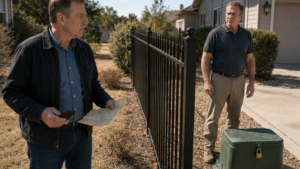
At five forty-two on Monday morning, it hung from a new length of chain looped around a black steel gate across the gravel road. The gate stretched from one fresh post to another, both sunk into ground Gregory had graded, drained, and patched for nearly forty years.
He stopped ten feet from it with his coffee cooling in one hand.
Beyond the bars, the road continued uphill toward twelve houses with pale siding and matching mailboxes. Porch lights glowed in the last darkness. A sprinkler clicked somewhere behind the new stone entrance sign for Cedar Glen.
Gregory set his mug on the hood of his truck.
He walked to the left post first. The concrete around it was still damp. Tire tracks from a small excavator crossed the shoulder, and a ridge of wet clay had been pushed against his ditch. Whoever had done the work had not bothered to restore the drainage channel.
A laminated sign had been zip-tied to the gate.
CEDAR GLEN RESIDENTS AND AUTHORIZED GUESTS ONLY.
Under that, in smaller print: GATE OPERATED BY HOMEOWNERS ASSOCIATION.
Gregory read it twice.
Then he looked at the patch of grass beside the post where a yellow-capped survey stake had stood since the last county plat correction.
The stake was gone.
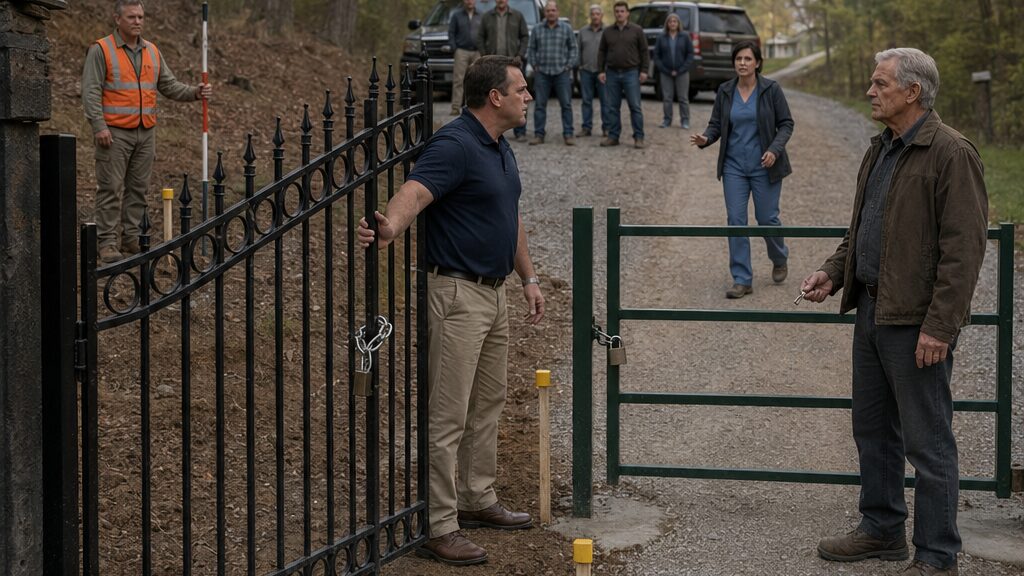
A garage door opened uphill. A dark sport utility vehicle rolled toward him, stopped on the far side of the gate, and idled. Scott Wilson climbed out wearing a navy polo tucked into khaki pants. He carried a paper cup and a phone.
“You’re up early,” Scott said.
Gregory kept his eyes on the missing stake. “Who installed this?”
“The association.”
“Who authorized work on my road?”
Scott gave a short laugh, as though Gregory had asked who authorized the sunrise. “The board approved it.”
“This road isn’t association property.”
“It serves the association.”
“That wasn’t my question.”
More garage doors opened. Two homeowners came down the hill on foot, both holding phones. A woman in running clothes stopped several yards behind Scott. A man in sandals raised his camera before anyone had said anything worth recording.
Scott noticed and straightened.
“We had a unanimous vote,” he said. “There have been thefts, delivery vehicles turning around in yards, and somebody prowling behind the houses. Residents asked for security.”
“You voted to place a structure on land you don’t own.”
“We have access rights.”
“Access is not ownership.”
Scott took a sip from his cup. “That distinction may have mattered when this was a farm lane.”
“It matters now.”
Gregory returned to his truck. Behind the seat was a weathered folder he had carried to two meetings and never opened. He took out a folded copy of the deed, walked back to the gate, and held it against one of the bars.
The paper trembled slightly in the morning breeze, not in his hand.
“The easement grants passage over twenty feet of roadway,” he said. “It does not transfer title. It does not authorize gates, posts, locks, signs, or alterations without the owner’s written consent.”
Scott glanced at the page but did not move closer.
“That thing is forty years old.”
“Recorded documents don’t expire because you dislike the date.”
The man with the phone snorted. The sound was small, but the others heard it. Scott’s expression changed. Gregory recognized the change from county meetings years earlier, when a speaker stopped addressing the problem and began performing for the room.
“We’re not taking security advice from someone who leaves rusted equipment beside the road,” Scott said. “The neighborhood has changed. You may not like it, but you don’t get to freeze everything in 1983.”
Gregory folded the deed along its old creases.
“You drove two posts into my ground.”
“Then prove it.”
“I already did.”
Scott stepped close enough that Gregory could smell coffee and cigarette smoke beneath mint gum.
“Or what?” Scott asked.
The phones remained raised.
For a moment Gregory pictured taking the chain in both hands and jerking until the new latch bent. He pictured backing his truck into the gate slowly enough to call it an accident. The images arrived clean and practical, the way solutions had once arrived when a culvert collapsed during a storm.
Then he noticed something behind Scott’s right shoe.
A torn strip of orange survey ribbon lay pressed into the gravel.
Gregory crouched and picked it up.
Scott’s mouth tightened.
“You remove my stake?” Gregory asked.
“I don’t know anything about a stake.”
“This ribbon was tied to it.”
“Contractors clear markers all the time.”
“Not legal boundary markers.”
“It was in the way.”
The words came too quickly.
The woman in running clothes lowered her phone. Scott looked toward her, then back at Gregory.
“I said I don’t know what happened to it.”
Gregory slid the ribbon into his shirt pocket.
Scott exhaled smoke to one side. He had not been smoking when he arrived, but a cigarette now burned between his fingers. He tapped ash onto the gravel near Gregory’s boot.
“You’ve had two years to work with us,” he said. “Every time we ask about road repairs or access, you ignore the letters. Now the board has acted.”
Gregory looked through the gate at the houses beyond it. A child with a backpack stood on a porch. A delivery van had stopped behind Scott’s vehicle. The driver leaned out, confused by the new barrier.
The gate was not only steel and chain. It was a declaration. The neighborhood had made a decision about Gregory’s land and expected him to accept it because the work was finished, the concrete poured, the vote taken, and the cameras already running.
“You need to remove it,” Gregory said.
Scott smiled. “Have your lawyer call ours.”
Gregory nodded once.
That seemed to disappoint him.
“No shouting?” Scott asked. “No threats?”
Gregory put the folded deed back into its folder.
“I asked you to remove it.”
“And I answered.”
“Yes,” Gregory said. “You did.”
He picked up his coffee, now cold, and walked toward his house.
One of the homeowners called after him, “So that’s it?”
Gregory did not turn around.
At the bend near his fence, he stepped off the road and followed the shallow ditch back toward the new post. From below, where the phones could not easily see him, he studied the disturbed soil.
The missing stake had not been crushed by equipment. Its hole remained clean and narrow. Two fresh gouges marked the packed earth beside it, the kind left when someone worked a steel bar back and forth to loosen a stubborn marker.
Gregory touched one of the cuts with his thumb.
The damp soil came away red against his skin.
Someone had not merely built in the wrong place.
Someone had removed the thing that showed them where the wrong place began.
Chapter 2: The Old Deed and the Unanswered Letters
The county recorder placed the certified deed beneath the glass and tapped one paragraph with a blunt fingernail.
“There,” she said. “Grant of ingress and egress. Twenty feet in width. Running with the parcels.”
Gregory read the clause without leaning closer. He knew the words.
“What about structures?”
“Nothing here grants a right to install them.”
“And title?”
“Remains with the servient estate.” She looked over her glasses. “That’s you.”
The answer should have settled something inside him. Instead, Gregory heard Scott’s voice from the road.
You’ve had two years to work with us.
The recorder stamped the certification and slid the document across the counter. The old courthouse smelled of paper dust, floor wax, and wet coats. Gregory had spent enough years in county buildings to know that certainty often came printed in language nobody wanted to read until after the damage.
“I need the full easement file,” he said. “All amendments, correspondence, plats, anything submitted by Cedar Glen.”
The recorder turned toward a terminal. “That development changed hands twice before the last phase was completed.”
“I know.”
“You may get more than you want.”
“I’ll take all of it.”
She returned twenty minutes later with a thick folder held together by an oversized clip. The early documents were familiar: Barbara’s parents granting access to two rear parcels, then a widening amendment after the old dairy tract was divided. Later pages showed the developer’s subdivision plans and county comments about drainage, maintenance, and emergency turnaround space.
Near the back were copies of three letters addressed to Gregory.
He recognized the envelopes before reading them.
The first had arrived eighteen months earlier, after a concrete truck broke the edge of his culvert. The HOA had proposed a road-maintenance agreement. Gregory had set it on his desk while waiting for the developer to repair the damage.
The repair never came.
The second letter requested permission for a keypad gate, lighting, and security cameras. He had opened it after Barbara’s funeral and placed it beneath a stack of insurance forms.
The third was sent by certified mail.
He remembered refusing delivery.
The recorder rested one hand on the counter. “Those are part of the public submission because the HOA asked whether the county could clarify maintenance responsibility.”
“What did the county say?”
“That it was a private matter governed by the recorded easement and whatever agreement the parties reached.”
“They didn’t reach one.”
“No.”
Gregory turned the pages.
Attached to the second letter was a sketch of a proposed gate set thirty feet farther uphill than the one now standing. It included a turnaround, an emergency override box, and a note requiring the landowner’s written approval.
The proposal was not careless. It was incomplete, perhaps self-serving, but it recognized his title.
Someone had written in blue ink beside the maintenance section.
Worth discussing. Ask about ditch costs.
Gregory stopped breathing for half a beat.
Barbara’s handwriting leaned slightly to the right. She had always crossed her t’s after finishing the whole word.
He remembered her at the kitchen table, reading the letter while he replaced a cabinet hinge.
“They’re going to keep building whether we answer or not,” she had said.
“They can build on their side.”
“The road isn’t only their side anymore.”
“It’s still ours.”
“I know, Greg.”
He had taken the letter from the table and placed it with the property files. In his memory, that had ended the conversation. Looking now at the note in the margin, he wondered what else she had said that he had reduced to silence.
The recorder cleared her throat softly. “Do you need copies?”
“All of it.”
Back home, Gregory spread the documents across the long oak desk Barbara had used for school payroll reports. He arranged them by date, then by legal weight.
The deed was clear.
The easement allowed passage.
The survey showed the roadbed inside his parcel.
No recorded amendment granted the HOA control over the entrance.
No document authorized permanent posts, a lock, or a sign.
That was the first truth, and it was strong.
The second truth sat in Barbara’s handwriting.
Gregory had not refused a bad agreement. He had refused to engage with any agreement at all.
His phone vibrated against the desk.
A neighborhood group message had been forwarded to him by an old acquaintance. The image showed Gregory standing at the gate with his deed held against the bars. The caption read: LOCAL MAN THREATENS TO BLOCK TWELVE FAMILIES OVER OLD FARM PAPERWORK.
He enlarged the photograph.
Scott stood opposite him, broad-shouldered and composed. The missing stake was outside the frame. So was the fresh concrete poured into Gregory’s shoulder. The image made the gate look like a neighborhood entrance and Gregory look like an intruder objecting from the public side.
Below it, comments accumulated.
Somebody needs to explain easements to him.
This is why developments need HOAs.
He just hates that families moved in.
Gregory turned the phone face down.
He drafted a notice on his computer. He cited the deed, plat, and easement language. He described the unauthorized gate, missing survey marker, blocked drainage, and demand for removal. He gave the association forty-eight hours to restore the property.
At the end, he added a sentence, deleted it, then typed it again.
Nothing in this notice waives any right arising from prior damage, unauthorized use, or failure to maintain the road.
He printed three copies.
One went by certified mail to the HOA.
One went to the registered agent.
One stayed on his desk beneath Barbara’s note.
By late afternoon, rain began tapping against the windows. Gregory walked to the workshop and opened the cabinet where he kept old county maps. Behind a rolled drainage plan lay a steel gate latch he had bought years earlier for the south pasture and never installed.
He held it in his palm.
A gate was not complicated. Posts, hinges, clearance, load, alignment. The difficulty was never the steel. It was knowing where the steel had a right to stand.
He returned inside and called Nicholas Adams.
Nicholas answered on the fourth ring. “You calling as a friend or hiring me?”
“Hiring you.”
“That answer usually means trouble.”
“I need the north access line re-established.”
There was a pause.
“The Cedar Glen road?”
“Yes.”
“I saw the gate.”
“Then you know why.”
“I know enough to ask whether you want a survey or permission to do something foolish.”
Gregory looked at Barbara’s blue note.
“A survey,” he said. “Before dawn, if you can.”
Nicholas sighed. “I’ll bring the old plat and the total station.”
“Bring extra stakes.”
“What happened to the originals?”
Gregory rubbed the strip of orange ribbon between his fingers.
“Somebody decided the line would be easier to argue with if they pulled it out of the ground.”
Chapter 3: Two Gates, One Narrow Strip of Gravel
Nicholas drove the first new stake into the earth six feet behind the HOA’s locked gate.
The hammer blow rang through the dark like a warning.
Gregory stood beside the ditch holding a flashlight while the surveyor checked the instrument, turned toward the rear benchmark, and checked again. Dawn had not yet reached the roofs of Cedar Glen. The black gate was only a shape against the gray road, its chain glinting whenever Nicholas moved through the beam.
“You’re certain?” Gregory asked.
Nicholas gave him a flat look. “You paid me to be certain.”
“I paid you to be accurate.”
“That too.”
He crouched beside the stake. “Property line runs here. Easement corridor continues uphill, but their western post sits nearly four feet inside your land. Eastern one is worse because they angled the gate to meet the stone sign.”
Gregory looked at the concrete footings.
“So they crossed the line.”
“They crossed the line, altered the shoulder, and narrowed the usable width.”
“Can they claim necessity?”
“They can claim anything. Survey won’t make it true.”
Nicholas moved to the missing marker’s location and pushed a probe into the loosened hole. After several inches, metal scraped stone.
“What?” Gregory asked.
Nicholas widened the hole with a hand trowel. He lifted out the yellow-capped stake, bent near its base.
“They didn’t haul it away,” he said. “They snapped it and buried the lower half.”
Gregory stared at the broken marker.
Nicholas wiped mud from the cap. “This wasn’t an excavator.”
“Scott said contractors clear markers all the time.”
“Contractors know better than to bury evidence of it.”
A pickup approached from the subdivision side and stopped behind the gate. Scott stepped out before the engine was off.
“What are you doing?” he called.
Nicholas continued working.
“Licensed boundary survey,” Gregory said.
Scott came to the bars. His hair was uncombed, and his polo had been replaced by a quarter-zip jacket. Without the two homeowners filming beside him, he looked less like a spokesman and more like a man awakened by bad news.
“The board’s attorney told us the easement allows security improvements.”
“Did the attorney approve this location?” Gregory asked.
Scott’s gaze shifted toward Nicholas’s instrument.
“We’re still reviewing details.”
“You installed first and reviewed later.”
“We had an insurance deadline.”
Nicholas rose with the broken stake in his hand. “Did your contractor see this before pouring the western footing?”
Scott looked at the marker.
“I wasn’t supervising every shovel.”
“That wasn’t the question,” Nicholas said.
Scott’s jaw worked. “We used the site plan the developer provided.”
Nicholas pointed at the fresh stake. “The site plan shows the owner’s line. Your post is over it.”
“The road is for neighborhood access.”
“Passage,” Gregory said. “Not possession.”
Scott gripped one of the bars. “You could have answered our letters.”
“You could have waited for permission.”
“We waited eighteen months.”
“You did not have permission.”
For several seconds neither man spoke.
Then Scott said, “What are you planning?”
Gregory folded the certified notice he had brought and slid it between the bars.
“Read that.”
Scott opened it, scanned the first page, and looked up. “Forty-eight hours?”
“To remove the gate and restore the ground.”
“And if we don’t?”
Gregory glanced at Nicholas.
The surveyor shook his head slightly, a warning Gregory understood. A survey was a fact. What a man did with the fact belonged to him alone.
“You’ll find out,” Gregory said.
By noon, the certified delivery receipts had arrived by email. The HOA’s agent had signed. The association office had signed. Scott’s copy, handed directly to him, had a witness.
At one o’clock, Gregory began cutting steel in his workshop.
He used two lengths of square tubing left from a county equipment auction, cleaned the rust from the hinges, and welded a rectangular frame wide enough to span the road without touching the easement’s outer edges. He had built cattle gates, maintenance barriers, and temporary storm closures. This one required no invention.
Only precision.
Nicholas returned near sunset and found the frame resting on sawhorses.
“I hoped the foolish part was theoretical,” he said.
“Their deadline expired at noon.”
“So you’re building a gate.”
“On my side of the line.”
“That answers where. It doesn’t answer why.”
“Because asking failed.”
Nicholas walked around the frame. “And what happens to the people behind it?”
“They can remove their gate.”
“Tonight?”
“They had forty-eight hours.”
“You know boards don’t move that fast.”
“They moved fast enough to pour concrete.”
Nicholas touched the cooling weld with one gloved finger. “Being right about the line won’t make every consequence right.”
Gregory lowered his welding shield. “I didn’t hire you for moral advice.”
“No. You hired me because you trust my measurements.”
“I do.”
“Then trust this measurement too. Six feet is not much room for judgment.”
Gregory looked past him toward the road.
For two summers, concrete trucks had ground ruts into the gravel. Landscapers had piled mulch against his fence. A drainage crew had cut roots from Barbara’s maple without asking. Each time Gregory complained, someone promised to follow up. Each time, the neighborhood grew more finished while his land absorbed the unfinished costs.
The black gate had made the pattern visible.
“I’m not touching their property,” he said.
Nicholas nodded. “That may matter in court.”
“It matters to me.”
“That’s what worries me.”
The next morning, Gregory and a hired road contractor set two steel posts wholly inside his boundary. Nicholas observed the placement but refused to help with the gate itself.
By midafternoon, the green frame hung level.
The HOA’s black gate opened inward from the subdivision. Gregory’s green gate stood behind it, leaving a strip of gravel just over six feet wide between them. Both could open fully.
Neither opening led anywhere.
Residents gathered as Gregory fitted his chain. Phones appeared again. Scott arrived red-faced, carrying the certified notice.
“You cannot do this,” he said.
Gregory threaded the chain through the latch.
“It’s on my property.”
“We have an easement.”
“You have passage. Your gate obstructs it.”
“You’re obstructing it now.”
Gregory closed the padlock.
The click was smaller than he expected.
Scott pulled the black gate open. It swung smoothly until the bars faced Gregory’s green barrier. The two gates stood nearly parallel, one dark and ornamental, the other plain and newly painted.
A woman behind Scott whispered, “You’ve got to be kidding.”
Gregory put the key in his pocket.
Scott stepped through the first gate into the narrow strip. “Open it.”
“Remove yours.”
“The board will sue you.”
“Then the board can explain why it buried a survey marker.”
Scott’s face changed.
It was slight, but Gregory saw it.
So did Nicholas, standing near the ditch with his field book closed against his chest.
The first vehicle arrived from uphill twenty minutes later. Then another. A delivery driver stopped on Gregory’s side and stared at the double barrier. Someone began directing residents to park along the subdivision shoulder.
The first satisfaction Gregory felt was quiet and exact. No shouting. No damaged lock. No trespass onto HOA property. The expensive black gate could still open exactly as designed.
It simply opened into the consequence of where it had been placed.
Then Heather Martin came down the hill in blue hospital scrubs.
She did not carry a phone.
“Mr. Carter,” she said, breathing hard. “I need to talk to you.”
Scott turned. “Heather, the attorney is handling this.”
“No, you’re handling it, and that’s the problem.”
She moved closer to Gregory’s gate.
“I voted for the security gate,” she said. “We’ve had packages stolen three times. Somebody was behind my daughter’s window in March. Scott told us the land question had been cleared.”
“It wasn’t,” Gregory said.
“I see that now.”
Scott said her name sharply.
Heather ignored him. “The elderly resident in the last house has a cardiac condition. An ambulance came twice this winter. This road is the only route wide enough for emergency vehicles.”
“There’s a rear service track,” Scott said.
“It washes out after rain, and you know it.”
Gregory looked uphill. The parked vehicles had formed an uneven line. A child stood beside a sedan holding a violin case. An older woman waited in the passenger seat of another car while someone carried grocery bags through the gates by hand.
Heather gripped the bars.
“I’m not asking you to pretend they had the right to build this,” she said. “They didn’t. I’m asking whether your lock opens if an ambulance comes tonight.”
Gregory felt the key in his pocket.
The green paint was still soft in places. Beyond it, the black bars cast narrow shadows across the gravel like lines on a form waiting for signatures.
Scott had chosen the wrong place, removed the marker, and turned a vote into permission it had never been.
Gregory had answered with a gate no one could ignore.
Now Heather’s question stood between the two barriers, with only six feet of gravel around it.
He closed his hand over the key but did not take it out.
Chapter 4: The Morning Scott Came to the Screen Door
Scott’s fist struck the screen door hard enough to rattle the loose glass in the storm frame.
Gregory opened his eyes before the second blow.
The bedside clock read 5:18.
“Carter!” Scott shouted. “Open this door.”
Gregory dressed without hurrying. By the time he reached the front hall, Scott was pounding with the flat of his hand. Beyond him, the first gray light showed the gravel road and, farther down, the dark outline of the two gates.
Gregory switched on the porch light but left the inner door closed.
“What do you want?”
Scott leaned toward the screen. His face was flushed, his hair damp at the temples.
“You locked twelve families in.”
“No.”
“There are cars parked along the road. People can’t get to work. A woman had to carry groceries half a mile.”
“You installed the first obstruction.”
“And you made it worse.”
Gregory slid the certified-mail receipt from the small table beside the door and held it where Scott could see it through the mesh.
“You received notice.”
“I received a threat.”
“You received forty-eight hours to remove a structure from land you don’t own.”
Scott slapped the screen with the back of his fingers. “You think that piece of paper protects you from liability if somebody dies up there?”
Gregory’s hand tightened around the receipt.
Heather’s question from the evening before had followed him into the house and remained there all night.
Does your lock open if an ambulance comes?
He had not answered her then. Instead, he had given her his phone number and said she could call if there was an emergency. It had sounded reasonable beside the gate. At two in the morning, alone in his kitchen, it had sounded like a man appointing himself dispatcher over twelve homes.
Scott pointed past Gregory toward the road.
“We had two package thefts in one week,” he said. “A man was seen behind Heather’s house. Our insurance carrier sent a notice that unsecured access could affect renewal. People were scared. They elected me to deal with it.”
“Being elected does not give you title.”
“I never said it did.”
“You acted as if it did.”
“We proposed a gate a year ago.”
“You proposed a different gate in a different location.”
“And you ignored us.”
The words landed because they were true.
Gregory kept his face still.
Scott saw something in the silence and pressed harder. “You want everyone to think this is about one arrogant board president. Fine. Maybe I should have waited for the attorney. Maybe I should have pushed the contractor back when he said the line was unclear. But I had parents calling me at night. I had homeowners saying their houses would lose value if we couldn’t control the entrance.”
“So you buried my survey stake.”
Scott looked away.
“There it is,” Gregory said.
“I didn’t bury anything.”
“Nicholas recovered it under fresh soil.”
“I moved a marker that was in the construction path.”
“You told me you knew nothing about it.”
Scott’s mouth closed.
For the first time since arriving, he looked less angry than cornered.
Gregory opened the inner door but kept the screen latched.
“I did not lock your gate,” he said. “I locked my land.”
Scott stared at him.
“My gate is behind yours,” Gregory continued. “Inside the surveyed boundary. Remove the unauthorized gate, restore the shoulder, and we can discuss access.”
“You don’t get to hold the neighborhood hostage to force a contract.”
“And you don’t get to build first, lie afterward, and call it community protection.”
Scott stepped closer to the screen until the wire pattern crossed his features.
“The board’s attorney will bury you in filings.”
“Then the attorney can explain why no written approval was issued before construction.”
A flicker passed across Scott’s face.
Gregory noticed it.
“So there wasn’t approval,” he said.
“We had preliminary guidance.”
“That is not approval.”
Scott turned toward the road, breathing through his nose. When he looked back, some of the performance had gone out of him.
“There’s an emergency board meeting at nine,” he said. “You should come.”
“I’m not on your board.”
“You’re the reason for the meeting.”
“No. Your gate is.”
Scott pulled the porch door open so sharply that the spring groaned.
“If the county orders both gates removed, don’t pretend you won.”
He walked down the steps without waiting for an answer.
At nine fifteen, Heather stood in the Cedar Glen clubhouse beneath fluorescent lights while fifteen residents spoke over one another.
Some wanted the black gate cut down immediately. Others demanded that the HOA sue Gregory before appearing weak. A man near the back held up his phone and said the video of Gregory had already been shared outside the neighborhood.
Scott stood at the front beside a whiteboard.
“The immediate issue is access,” he said. “Our attorney is pursuing an emergency order.”
“Did the attorney approve the gate?” Heather asked.
The room quieted.
Scott capped the marker in his hand. “The attorney advised that the easement supports reasonable security measures.”
“That wasn’t my question.”
“We acted under time pressure.”
Heather folded her arms. “You told us the property issue was cleared.”
“It should have been.”
“Was it?”
Scott looked around the room, measuring the faces.
“We had a responsibility to protect the neighborhood.”
A homeowner beside Heather spoke up. “My truck is parked on the wrong side of those gates. I’m not interested in whose responsibility speech this is.”
Another voice followed. “What about the insurance letter?”
Scott lifted a page from the table. “The carrier asked us to address uncontrolled vehicle access.”
Heather held out her hand. “Let me see it.”
He hesitated, then passed it over.
The notice recommended lighting, cameras, visitor records, or controlled entry. It did not require a gate. It did not threaten immediate cancellation. The final paragraph requested a written risk-reduction plan within sixty days.
“You told us coverage was at risk now,” Heather said.
“It was moving in that direction.”
“You promised a security improvement before the annual meeting.”
“That has nothing to do with this.”
“It has everything to do with why you rushed.”
The room began to stir again.
A sharp knock sounded at the clubhouse door. A uniformed fire marshal entered carrying a clipboard, followed by a county inspector.
“Who is the association contact?” the marshal asked.
Scott raised his hand.
“And who owns the access road?”
No one answered immediately.
Heather looked through the windows toward Gregory’s house beyond the lower field.
By noon, the fire marshal had examined both gates, measured the space between them, photographed the locks, and requested the easement records. Gregory accompanied him along the ditch but offered no argument.
“This cannot remain the only access arrangement,” the marshal said. “Emergency response cannot depend on locating one private key holder.”
“The first gate created the problem,” Gregory said.
“The second gate multiplied it.”
“My gate is on my property.”
“That will matter in the hearing. It does not make delayed emergency access safe.”
Gregory looked at the green bars.
The same precision that had satisfied him the day before now made the space between the gates look smaller.
At three o’clock, a county deputy pulled into Gregory’s drive. He approached without urgency, removed an envelope from a leather folder, and handed it over.
“You’ve been served with notice of an emergency administrative hearing,” he said. “Tomorrow at two.”
Gregory opened the envelope on the porch.
The county would review obstruction of an access easement, unauthorized improvements, emergency access, and potential interim orders.
Both Gregory Carter and Cedar Glen Homeowners Association were required to appear.
At the bottom, in bold type, was a warning that the hearing officer could order immediate removal or modification of either structure.
Gregory looked down the road.
Scott stood beyond the black gate with several residents around him. Even from a distance, Gregory could see the white copy of the same notice in his hand.
For the first time since the second padlock clicked shut, neither man controlled what happened next.
Chapter 5: What Barbara Had Written in the Margin
The folded note slipped from the survey map and landed beneath Gregory’s kitchen chair.
He had been searching for the original drainage plan when it fell, a square of yellowed paper folded twice, with one corner softened by years of handling.
Barbara’s handwriting covered the outside.
Greg—before you say no.
He sat down.
The house was silent except for the refrigerator motor and the faint ticking of gravel against a passing tire outside. Since the county notice, residents had been walking through the narrow gap one at a time whenever Scott opened the black gate. Gregory’s remained locked.
He unfolded the note.
The first lines were practical.
Ask them to share grading costs.
No posts inside our line.
Emergency lockbox required.
Written acknowledgment that road remains Carter property.
Below that, Barbara had drawn a small gate set well uphill from the boundary. Beside it she had written: open by agreement, not taken for granted.
Gregory read the words again.
He remembered the afternoon she wrote them. The developer had sent a representative to the house with a glossy packet. Barbara had made coffee for everyone while Gregory stood by the sink and refused to sit.
“They want control,” he had said after the representative left.
“They want certainty,” Barbara answered.
“Same thing.”
“No, it isn’t.”
He remembered that sentence because it had irritated him. He did not remember the rest.
Now the note gave it back.
You can protect a boundary without making the road a weapon.
Gregory pressed the heel of his hand against his forehead.
For months after Barbara died, he had kept the house exactly as she left it. Her mug remained on the second shelf. Her raincoat stayed on its hook until dust marked the shoulders. When Cedar Glen’s letters came, each one had seemed like another demand arriving before he had finished answering the last loss.
He told himself silence was firmness.
He told himself Barbara would have understood.
Yet her own hand disagreed.
The phone rang.
Heather Martin’s name appeared on the screen.
Gregory let it ring twice before answering.
“What happened?”
“No emergency yet,” she said. “But the elderly resident at the top of the hill has a cardiology appointment at six tomorrow morning. Her daughter usually drives her down. She’s frightened the gates will delay them.”
“They can call me.”
“That’s not reliable access.”
“I’ll be awake.”
“You shouldn’t have to be. That’s the point.”
Gregory looked at Barbara’s sketch.
Heather’s voice softened. “I know Scott was wrong. I know the gate is on your land. But the rest of us were told the legal work was done.”
“You voted without seeing it.”
“Yes.”
The answer came without defense.
“I was afraid,” she continued. “Someone stood behind my daughter’s window. Maybe it was a teenager. Maybe it was a contractor cutting through. I didn’t know. The police found nothing. When Scott said a gate would help, I voted yes because doing something felt safer than waiting.”
“And now?”
“Now I think we mistook action for authority.”
Gregory traced Barbara’s line showing the setback.
“Why are you telling me this?”
“Because tomorrow Scott will make you sound unreasonable, and you’ll make him sound dishonest. Both things may be true. But neither one gets an ambulance through.”
He did not respond.
Heather exhaled. “The fire marshal says he may recommend both gates be opened pending review.”
“He can recommend.”
“And the hearing officer can order.”
“I read the notice.”
“Then you know holding the line exactly where it is may cost you the ability to shape what comes after.”
Gregory looked toward the dark window. His reflection sat alone at the table, Barbara’s note beneath his hand.
“What do you want me to do?”
“Open your gate until the hearing. Keep your notice in effect. Keep the survey stakes visible. Make it clear that temporary access is not permission.”
“And give Scott what he wants.”
“No. Give the residents what they need.”
The distinction stung because it sounded like Barbara.
Gregory ended the call without promising anything.
He carried the note to the file room and opened the oldest deed box. Beneath tax receipts and survey copies lay an envelope in Barbara’s handwriting, addressed only with his name.
Inside was a draft letter she had never sent.
The language was measured. It acknowledged the neighborhood’s need for dependable access and shared maintenance. It objected to unauthorized construction. It proposed annual gravel contributions, drainage responsibilities, emergency access, and a sign stating that the road remained privately owned.
Near the end, she had written:
Gregory believes any concession will be treated as weakness. I believe silence will eventually be treated as consent.
He lowered the page.
The mistake had not begun with the black gate.
It had begun each time he left a letter unanswered because answering felt too much like yielding. Each unanswered request gave Scott room to tell the board that Gregory would never cooperate. Each delay turned a fixable road agreement into a contest over who could act without the other.
That did not excuse the removed stake.
It did not authorize the posts.
But it changed the shape of Gregory’s own innocence.
At eleven thirty, he put on his jacket and walked down the road carrying a flashlight.
The black gate stood open. Scott had apparently left it that way after the fire marshal’s visit. Gregory’s green gate remained locked behind it.
A car approached from uphill and stopped. Heather stepped out.
“You came,” she said.
“I live here.”
She did not smile.
Gregory inserted the key into the padlock but did not turn it.
“If I open this, Scott will say the blockade was a stunt.”
“Scott will say whatever protects Scott.”
“And the board may argue I accepted their gate.”
“I asked the attorney about that. Temporary emergency access can be stated in writing as non-waiver.”
“You spoke to the attorney?”
“I’m the board secretary. I finally started reading what I sign.”
The words held shame but also resolve.
She handed him a single sheet. It stated that Gregory’s temporary unlocking of his gate did not authorize the HOA structure, waive property claims, or amend the recorded easement.
Scott’s signature line was blank.
Heather’s was not.
“You signed without him?” Gregory asked.
“I signed as a witness to what you are doing, not on behalf of the board.”
Gregory folded the page and placed it in his pocket beside Barbara’s note.
Then he turned the key.
The padlock opened.
The chain loosened in his hands with a metallic scrape. He drew it free but did not remove it from the gate. Instead, he looped it over the top rail and kept the key.
Heather pulled the green gate inward. The road opened in a straight line for the first time since Gregory built the barrier.
Headlights appeared at the top of the hill.
The elderly resident’s daughter was making a trial run before morning.
Gregory stepped aside as the car passed between the survey stakes. Its tires moved slowly over his gravel, neither asking permission nor pretending ownership.
Heather looked at the key in his hand.
“Does this change your position tomorrow?” she asked.
“No.”
“Does it change anything?”
Gregory watched the taillights disappear beyond the bend.
“Yes,” he said. “It changes what I’m willing to defend.”
Chapter 6: The Hearing Where Nobody Owned the Whole Truth
Scott’s first exhibit was a photograph of Gregory closing the green gate.
The image filled the hearing room monitor. Gregory stood with one hand on the chain, his face turned partly away. Behind him, several residents waited beside their vehicles. The black HOA gate had been cropped almost entirely out of the frame.
“Our position,” the HOA attorney said, “is that Mr. Carter deliberately obstructed an established access easement serving twelve occupied homes.”
Gregory sat beside his attorney at the opposite table. Heather occupied the first row behind the HOA, a binder on her lap. Scott sat rigidly at counsel’s side.
The hearing officer adjusted her glasses.
“Is that the only gate shown?”
“No,” Gregory’s attorney said. “The association’s structure is just outside the crop.”
The officer looked at the attorney who had presented the photograph.
“Submit the uncropped version.”
A pause followed.
“We have additional photographs,” the HOA attorney said.
“That was not my instruction.”
Scott shifted in his chair.
The full image appeared a minute later. The black ornamental gate stood open only feet from Gregory’s green one. Fresh stakes marked the space between them.
The hearing officer studied it.
“That context seems significant.”
Gregory’s attorney began with the deed, easement, and certified notice. Nicholas explained the survey in direct language. The HOA’s western post sat inside Gregory’s parcel. The eastern post narrowed the easement corridor. The original marker had been bent, broken, and buried.
“Could construction equipment have done that unintentionally?” the hearing officer asked.
“Not in the condition I found it,” Nicholas said. “The upper portion was removed. The lower portion was deliberately covered.”
Scott stared at the table.
The HOA attorney objected to the word deliberately.
Nicholas did not raise his voice. “Then I will say it could not have ended up beneath compacted soil by remaining where it was.”
The officer allowed the answer.
For the first hour, Gregory’s position strengthened with every page. The deed was his. The gate lacked written consent. The HOA had no recorded amendment granting structural control. The county inspector confirmed that the posts altered the shoulder and drainage.
Then the HOA attorney opened the correspondence file.
“Mr. Carter, you received multiple requests to discuss maintenance and security improvements, correct?”
Gregory looked at the letters arranged before him.
“Yes.”
“You did not respond.”
“No.”
“Not even to reject the proposals?”
“No.”
“You refused certified delivery of one letter.”
“Yes.”
His attorney touched his sleeve lightly, but Gregory continued.
“I believed the developer should repair existing damage before asking for additional rights.”
“Did you communicate that belief?”
“Not in writing.”
“So the association had no response from you for eighteen months.”
“That did not give them permission.”
“No,” the attorney said. “But it left twelve households without a modern agreement governing road upkeep, emergency access, or security.”
The statement was designed to shift blame. Gregory knew that.
It also contained truth.
The hearing officer leaned forward. “Mr. Carter, why did you not answer?”
He could have said grief. He could have said distrust. He could have said every promise from the development arrived after damage and before repair.
Instead he said, “Because I thought silence protected my position.”
“And did it?”
Gregory glanced at Barbara’s note inside his folder.
“No.”
The answer changed the room.
Scott looked at him for the first time since testimony began.
When Heather was called, she carried her binder to the witness table. She described the thefts, the prowler report, and the insurance notice. She admitted voting for a gate without reviewing the deed.
“Why?” the hearing officer asked.
“Because I believed the legal work had been completed.”
“Who gave you that impression?”
Heather looked toward Scott.
“He did.”
The room became very still.
Scott’s attorney rose. “The witness is characterizing informal board discussion.”
“I took minutes,” Heather said. “I brought them.”
She opened the binder.
At a special meeting six weeks earlier, Scott had reported that the HOA attorney saw “no barrier” to controlled access. Heather then produced an email sent the day before that meeting.
The attorney’s actual language was narrower: no gate should be installed until ownership, location, emergency override, and written landowner consent were resolved.
The hearing officer read the email twice.
“Mr. Wilson,” she said, “did you receive this before the board vote?”
Scott’s shoulders lifted, then fell.
“Yes.”
“Why did you tell the board the issue was cleared?”
“I said there was no barrier to pursuing the project.”
“The minutes say no barrier to installation.”
“The secretary summarized.”
Heather’s face tightened. “You approved the minutes.”
Scott turned toward her. “We had sixty days to answer the insurer. Residents were demanding action. The developer had left us with nothing but old maps and complaints. I believed Mr. Carter would refuse any proposal.”
“So you proceeded without asking again?” the officer said.
“We had asked for eighteen months.”
“Did you remove a survey stake?”
Scott hesitated.
“I moved a marker that interfered with the contractor’s layout.”
“After receiving the attorney’s warning that the boundary was unresolved?”
“Yes.”
The word seemed to reduce him in his chair.
Gregory felt no triumph. Scott had done exactly what Gregory accused him of doing, but the explanation around it was not empty. Fear of losing control had pushed one man to act without permission and another to refuse every conversation.
The hearing officer recessed for twenty minutes.
When she returned, she spoke without ceremony.
“The recorded documents establish that Mr. Carter owns the roadbed and that Cedar Glen possesses an easement for passage. The HOA lacked authority to install its gate without consent, and its handling of the boundary marker is deeply concerning.”
Scott lowered his eyes.
“However,” she continued, “Mr. Carter’s second locked gate created an additional obstruction across an active residential access route. Property ownership does not erase obligations attached to an easement, particularly where emergency access is foreseeable.”
Gregory’s attorney began to rise.
The officer lifted one hand.
“I am not ruling today on damages or permanent removal. I am issuing an interim order. Both gates must remain unlocked pending further agreement. Neither party may alter the road, posts, locks, drainage, or survey markers. The parties will submit a joint access and maintenance plan within forty-eight hours.”
Scott looked up sharply. “Joint?”
“Yes.”
“With respect, we have not been able to negotiate with Mr. Carter.”
The officer turned to Gregory. “And Mr. Carter has not been willing to negotiate with you.”
Gregory accepted the rebuke without looking away.
The officer continued. “Your legal rights are not identical. Your responsibility to resolve this is shared.”
She ordered the HOA to provide its insurance correspondence, construction invoices, board minutes, and attorney communications. Gregory was ordered to provide proposed access terms and prior maintenance records.
“If no joint plan is filed,” she said, “the county will impose temporary conditions and refer the disputed structures for removal review. Neither side should assume that outcome will preserve what it values most.”
The gavel struck once.
Outside the hearing room, Scott approached Gregory near the elevators.
“You enjoyed that,” he said quietly.
“No.”
“You got your title recognized in a public record.”
“I already had title.”
“And I got made into the liar.”
“You approved minutes that changed your attorney’s warning.”
Scott’s face hardened. “You left us with no path.”
“I left your letters unanswered. I did not put your post in my ground.”
Heather joined them, binder held against her chest.
“We have forty-eight hours,” she said.
Scott looked at her. “You testified against your own board.”
“I testified about what happened.”
“You think they’ll trust you after this?”
“I’m not asking them to trust me. I’m asking them to read.”
The elevator doors opened.
Gregory stepped inside, then placed one hand against the sensor before the doors could close.
“Tomorrow morning,” he said. “Nine o’clock. Folding table at the gates.”
Scott gave a bitter laugh. “You want to negotiate in the road?”
“I want every line we discuss sitting beside the thing that made it necessary.”
Heather nodded.
Scott did not.
The elevator alarm began to sound under Gregory’s hand.
Finally Scott said, “Forty-eight hours isn’t enough.”
“It was enough time to pour concrete,” Gregory replied.
He removed his hand.
As the doors closed, Heather remained beside Scott in the hallway. Gregory saw her open the binder and hold out the attorney’s warning once more.
This time, Scott took it.
Chapter 7: The Price of Keeping the Road Open
Gregory arrived at the gates carrying two keys and a draft agreement thick enough to bend the folding table beneath it.
Heather had set up four metal chairs on the gravel between the survey stakes. Scott stood on the subdivision side with the HOA attorney and three board members. Nicholas waited near the ditch with a rolled site plan under one arm.
The black gate and Gregory’s green gate were both open under the hearing officer’s interim order. Their chains hung loose from the rails.
Gregory placed one key beside each stack of papers.
Scott looked down at them. “What is this supposed to mean?”
“That neither lock stays where it is.”
The HOA attorney opened Gregory’s draft.
The first page acknowledged Gregory’s ownership of the roadbed. The second required removal of the HOA gate and repair of its footings, shoulder damage, and drainage channel. Later sections divided annual grading costs among the twelve homes, required liability coverage, prohibited new structures without written consent, and established an emergency-access box for any future setback gate.
Scott read the removal clause twice.
“You’re demanding we destroy an asset the residents paid for.”
“You installed it without permission.”
“We can relocate it.”
“That is in the draft.”
Scott turned another page. “After we reimburse your survey, attorney fees, culvert repairs, fence damage, and two years of grading.”
“Those costs did not appear this week.”
One board member frowned at the figures. “We don’t have this amount in reserves.”
Gregory looked at her. “Then the association has been using a private road without budgeting for its upkeep.”
“We paid the developer.”
“The developer stopped maintaining it eighteen months ago.”
Scott tapped the agreement. “This is punishment dressed as maintenance.”
“No,” Gregory said. “Punishment would be revoking every informal service I have provided without charging you.”
The HOA attorney looked up. “What services?”
Gregory slid a second folder across the table.
Inside were fuel receipts, gravel invoices, equipment logs, and dated photographs. He had cleared fallen limbs, opened ditches, filled washouts, and spread stone after storms. Because the old easement did not assign maintenance clearly, he had done the work rather than watch the road fail.
Heather turned through the pages.
“You never billed us,” she said.
“I expected the developer to finish what it started.”
Scott leaned back. “And now you expect twelve families to pay years of charges they never approved.”
“I am asking for documented damage and a future plan. The unbilled labor is there so no one claims this road maintained itself.”
Nicholas unrolled his plan over the table. It showed a new gate location seventy feet uphill, beyond Gregory’s boundary, with a widened turnaround and a recessed emergency box.
“This layout preserves the easement width,” he said. “It keeps vehicle stacking off Gregory’s parcel and gives fire equipment room to turn.”
Scott studied the drawing. “That places the equipment entirely on HOA land.”
“Yes,” Nicholas said.
“And Gregory keeps veto power over access rules.”
Gregory shook his head. “I keep veto power over structures on my land. What you build on yours is your business if it does not obstruct passage.”
The distinction settled over the table.
For the first time, the road was being divided by rights rather than personalities.
The HOA attorney reached the indemnity section and stopped. “Our draft requires Mr. Carter to indemnify the association for injuries arising from road conditions.”
Gregory removed that page from the attorney’s version and laid his own replacement over it.
“No.”
“The association cannot accept open-ended risk.”
“Neither can I.”
“You own the road.”
“You use it.”
The attorney folded his hands. “Then we may not have an agreement.”
Gregory looked past him at the homes beyond the gates. A delivery vehicle approached, slowed through the open passage, and continued uphill. No one moved to stop it.
“Shared insurance,” Gregory said. “Shared inspection every spring. The HOA pays for damage caused by its contractors. I remain responsible for hazards I create or fail to disclose. Neither side indemnifies the other for negligence.”
Heather read the replacement clause.
“That is fair,” she said.
Scott turned toward her. “You are not counsel.”
“No. I’m one of the people paying for this.”
“You helped create the problem.”
“I voted for a security gate. I did not vote to bury a marker or misstate legal advice.”
The three board members exchanged glances.
Scott’s face tightened. “You think siding with him fixes your part?”
“No,” Heather said. “Signing something honest might.”
The HOA attorney asked for a private recess. Scott led the board twenty yards uphill, but their voices carried.
He argued that Gregory’s terms would lower property values by putting private-road disclosures into every resale packet. A board member answered that an emergency order and unresolved access dispute would do worse. Scott warned that reimbursing Gregory would force a special assessment. Heather reminded them that litigation would cost more before a judge reached the same documents.
Gregory remained at the table with Nicholas.
“You could reduce the damage claim,” Nicholas said.
“I already removed my labor.”
“You could remove the attorney fees.”
“I would not have them without the gate.”
Nicholas watched him. “Barbara would have liked the shared-inspection clause.”
Gregory glanced at him.
“She told me years ago that the road needed rules before the houses multiplied,” Nicholas said. “You told her rules invited lawyers.”
“She told everybody too much.”
“She told me because she wanted the survey updated.”
Gregory touched the key to his gate.
“I thought keeping control meant refusing to formalize anything.”
“And now?”
“Now I think unspoken control is just another argument waiting for concrete.”
The board returned after twenty minutes.
Scott remained standing while the others sat.
“We’ll accept shared maintenance,” he said. “We’ll accept the setback plan and emergency box. We will not acknowledge misconduct by the board president.”
Gregory closed the folder.
“Then we are finished.”
Scott laughed once. “There it is. This was never about access. You want a confession.”
“I want the agreement to state that the existing gate was unauthorized and must be removed.”
“That language exposes us.”
“You were already exposed when you poured the footings.”
The attorney spoke quietly to Scott, but Scott shook his head.
“If this gets signed,” Scott said, “I resign. And I will tell every resident exactly who forced the assessment.”
Heather stood.
“You can resign,” she said. “You cannot rewrite the vote.”
She turned to the three board members.
“All in favor of accepting the agreement with the factual gate language and negotiated insurance clause?”
Scott stared at her. “You cannot call a vote here.”
“The hearing order requires a joint plan. Our bylaws allow emergency action with a quorum. We have one.”
The attorney did not contradict her.
The first board member raised her hand.
Then the second.
The third looked at Scott before raising his own.
Heather lifted hers last.
Scott remained still.
“Four to one,” she said.
For several seconds, only the loose chains moved, tapping softly against the open gates.
The attorney placed the signature page before Scott.
“You are still president until resignation is submitted,” he said.
Scott looked at the road, the survey stakes, and the residents watching from a distance. The status he had tried to protect had narrowed to one line above his printed name.
He signed.
Heather signed for the board after him. Gregory added his name beneath the ownership acknowledgment.
Then he placed both keys in the center of the table.
“The locks come off today,” he said. “The posts come out after the county approves the plan.”
Scott pushed back his chair.
“You got what you wanted.”
Gregory looked at the two gates.
“No,” he said. “I got something we should have written down before either of us tried to win.”
Chapter 8: The Boundary That Stayed After the Locks Were Gone
The road contractor’s saw bit into the first black post at eight on a Tuesday morning.
Sparks scattered across the gravel and died before reaching the ditch. Gregory watched from beside the fence as the ornamental gate shuddered, sagged against its support strap, and was lowered onto a flatbed.
No one filmed.
The green gate came down next.
Gregory had expected that removal to feel different. He had welded every joint himself and set it precisely inside his line. Yet when the hinges were unbolted and the frame lifted away, it looked like what it had always been: steel built to answer steel.
The workers broke out the unauthorized concrete footings, restored the shoulder, and reopened the drainage channel. Nicholas checked the grade before the final gravel was spread.
“Water should clear now,” he said.
Gregory nudged one of the restored survey stakes with his boot. Its yellow cap remained bright against the repaired ground.
“You leaving these exposed?” Nicholas asked.
“Yes.”
“Someone may complain they’re ugly.”
“Then they can look somewhere else.”
Nicholas smiled. “That sounds more like you.”
Seventy feet uphill, entirely within Cedar Glen property, a new setback gate stood open. Its posts were aligned outside the easement width. A red emergency-access box had been mounted on the left column, and a paved turnout allowed vehicles to wait without blocking Gregory’s road.
The agreement required the gate to remain open until the fire marshal approved its override system. Even after approval, Gregory would not carry its only key. Emergency services, the HOA, and Gregory would each have documented access.
No one man would become the road’s single point of failure again.
The settlement did not leave anyone untouched.
Each household paid a special assessment smaller than Scott had predicted but large enough to cause anger. The HOA reimbursed Gregory for the survey, damaged shoulder, culvert repair, and part of his legal fees. The contractor’s insurer covered the fence damage after receiving photographs Barbara had taken before construction began.
Scott submitted his resignation two days after signing.
His final message to the residents blamed “irreconcilable management differences” and warned that the settlement weakened neighborhood security. Heather circulated the attorney’s original warning and the approved agreement without commentary.
After that, the argument lost much of its fuel.
Facts were less exciting than accusations, but they were harder to edit.
Gregory installed a weatherproof document box on a post beside his workshop door. Inside he placed the recorded agreement, the new survey, maintenance schedule, inspection forms, and a list of emergency contacts.
On the inside of the lid, he hung Barbara’s old brass key.
It had once opened the wooden pasture gate that stood near the same road before Cedar Glen existed. The lock itself was long gone. The key opened nothing now, but Gregory kept it there beside her note.
Open by agreement, not taken for granted.
On the first scheduled maintenance day, Heather arrived at seven carrying coffee and a clipboard. Two residents brought rakes. Another drove a rented compactor. Gregory showed them how to crown the gravel so water ran toward the ditch rather than along the wheel tracks.
A homeowner who had filmed the first confrontation approached him near the culvert.
“I deleted the video,” the man said.
Gregory set down his shovel. “That doesn’t delete what happened.”
“No.”
The man looked toward the repaired shoulder. “Scott told us you threatened to close the road before the gate went in.”
“I threatened nothing. I answered nothing. That helped him tell the story he wanted.”
The admission seemed to surprise them both.
“I should have asked you,” the man said.
“Yes.”
Gregory picked up the shovel again.
An apology did not require applause. It required different behavior afterward.
Over the next weeks, delivery trucks slowed at the private-road sign. Contractors checked in with the HOA before parking equipment near the shoulder. The maintenance account received its first quarterly payment. Heather sent inspection dates in writing, and Gregory answered every message, even when his answer was no.
Especially then.
One afternoon, he found Scott standing near the new setback gate.
Scott no longer wore the navy polo with the association emblem. He had come home from work in a plain white shirt with the sleeves rolled above his forearms.
“The emergency system passed inspection,” he said.
“I heard.”
“They changed the resale disclosure.”
“They were required to.”
Scott looked down the road. “Two buyers backed out of one of the houses.”
Gregory waited.
“I thought if people saw me lose control of the security problem, they’d replace me,” Scott said. “So I kept promising it was handled.”
“They replaced you anyway.”
“Yes.”
There was no satisfaction in saying it. Gregory had expected there might be.
Scott put one hand on the new gatepost. “I should not have moved the stake.”
“No.”
“I should not have told the board the attorney cleared it.”
“No.”
Scott looked at him. “You could say something else.”
“I could.”
But Gregory did not offer forgiveness as a shortcut around consequence. Scott had lied, altered a boundary, and turned fear into permission. Understanding the pressure did not erase the choice.
After a moment, Scott nodded.
“At least the road works,” he said.
“It always worked.”
Scott glanced at the repaired ditch and the maintenance crew’s fresh stone.
“No,” he said. “It was only surviving.”
He walked uphill without asking Gregory to agree.
On the first morning of the new school term, Gregory heard the diesel engine before he saw the bus. It approached from the county road, slowed beside the private-access sign, and rolled between the restored survey stakes.
The driver lifted one hand.
Gregory returned the gesture.
Children waited beyond the setback gate with backpacks and lunch boxes. The gate stood open, its emergency box sealed, its posts exactly where the agreement said they belonged.
The bus continued uphill without stopping at Gregory’s boundary.
He went inside the workshop and opened the document box. Barbara’s key swung gently against the lid. Beneath it lay the agreement bearing his name, Heather’s, Scott’s, and the signatures of the board members who had finally read what they approved.
Gregory checked that the survey map was dry.
Then he closed the lid.
His hand rested on the small latch where a padlock could have been fitted.
He left it empty.
The story has ended.