They Called Her the Clubhouse Help Until She Proved the Building Stood on Her Land
Chapter 1: The Woman Pamela Mistook for the Help
“Take the chairs from the back, sweetheart. That’s what the help is for.”
Pamela Hall did not lower her voice.
The sentence traveled across the clubhouse, past the board’s polished table, through six rows of residents waiting for the monthly meeting to begin. A few people looked at Sharon Taylor. Most looked away.
Sharon stood beside the public-comment sign-up sheet with a blue folder pressed against her ribs. She had changed out of the old shirt she wore for cleaning, but there was still a pale streak of disinfectant across one cuff of her denim jacket. Pamela noticed it. Sharon could tell by the quick downward movement of her eyes.
“The storage room is unlocked,” Pamela added. “We’re expecting a larger crowd.”
There were already three empty folding chairs against the wall.
Sharon could have pointed that out. She could also have said that she was a homeowner, that her name appeared on the same dues register as Pamela’s, and that she had signed up to speak before the meeting was called to order.
Instead, she placed her folder on the nearest chair and walked toward the storage room.
The old reflex embarrassed her more than Pamela’s tone. When something needed doing, Sharon did it. Her mother had lived that way. You did not make yourself a problem. You did not ask people to notice what you contributed. You left the room cleaner than you found it and trusted decent people to understand.
The storage room smelled of dust and metal. Sharon unfolded six chairs, carried them out two at a time, and arranged them along the back wall.
As she set down the last one, a woman in the second row caught her eye.
“There’s a seat here,” the resident said quietly, lifting her purse from the chair beside her.
“Thank you,” Sharon said. “I’m all right.”
She returned to her folder.
Pamela was now speaking to the board secretary, tapping a manicured finger against the printed agenda. At the far end of the table, Gary Carter reviewed a thick financial packet. He did not look up.
The clubhouse had been built in the early years of the development, when Sharon was still in high school and her mother had been among the first owners. It was a plain building—brick front, vinyl siding, a small kitchen, and a meeting room that smelled permanently of coffee and floor wax.
For the past two years, Sharon had cleaned it.
No one had hired her formally. It had begun after the previous janitorial company stopped showing up. A retirement luncheon was scheduled, the bathrooms were filthy, and Pamela had called Sharon because everyone knew Sharon kept spare supplies in her garage.
“It’s only this once,” Pamela had said.
Then once became every Thursday morning.
At first Sharon accepted grocery-store gift cards from the social committee. Later, even those stopped. Pamela said the budget was tight and promised the arrangement would be corrected after the annual review. Sharon never asked again. The clubhouse was three houses from her own. Her mother had attended card nights there. Sharon told herself she was helping the neighborhood.
The gavel struck.
Pamela called the meeting to order and moved quickly through landscaping updates, pool access, and mailbox repairs. Sharon watched the clock above the exit. Public comments were listed near the end.
When Pamela reached the financial report, Gary adjusted his glasses.
“Operating expenses remain within projection,” he said. “The clubhouse account is slightly over budget due to cleaning, supplies, and event turnover.”
Sharon looked down at the packet placed on the empty chair beside her folder.
A line in the expense summary had been highlighted for residents:
CLUBHOUSE CLEANING SERVICE — $620 MONTHLY.
She read it twice.
The amount was not for supplies. Supplies appeared on the next line.
Six hundred twenty dollars every month.
Gary continued speaking about reserve contributions, but Sharon heard only the hum of the fluorescent lights.
She opened her folder. Inside were photographs of her damaged rose bed, two violation notices, a copy of the email she had sent asking to file a formal complaint, and Pamela’s one-line response telling her the matter had been reviewed.
There was nothing about cleaning payments because Sharon had not known there were payments.
Pamela glanced toward her. “Before public comment, we have an enforcement item.”
The board secretary slid a white envelope across the table.
Pamela held it up. “Lot nineteen has continued to violate the waste-container policy.”
Several people turned.
Sharon lived at lot nineteen.
“My container was out for one morning,” Sharon said.
Pamela smiled without warmth. “Public comment has not begun.”
“It was out because the landscaping crew blocked the side gate.”
“Ms. Taylor.”
The use of her surname sounded less respectful than sweetheart had.
Pamela opened the envelope. “The violation is now eighty dollars, with an additional administrative charge if unpaid after thirty days.”
Sharon felt the room watching her. The amount was not ruinous. That was part of the design. It was small enough to make resistance look petty.
She looked at the financial packet again.
“Who cleans this building?” she asked.
Pamela’s smile tightened. “This is not the time.”
“You just reported six hundred twenty dollars a month for cleaning.”
Gary finally raised his head.
Pamela placed the envelope down. “The association contracts for necessary services.”
“With whom?”
“Submit a records request.”
“I have cleaned this clubhouse every week for two years.”
A murmur moved through the room.
Pamela leaned toward the microphone. “You volunteered to assist during a staffing transition. The association appreciates community participation.”
“Two years is a long transition.”
The woman who had offered Sharon a seat stared at the expense sheet in her lap.
Pamela struck the gavel once. “We will not turn a routine financial report into a personal dispute.”
Sharon almost apologized. The word rose automatically, ready to smooth the room.
She swallowed it.
“Put my question in the minutes,” she said.
Pamela’s face changed—not dramatically, only enough for Sharon to see that something had landed.
“The minutes reflect board business.”
“Then make it board business.”
Silence gathered around the long table.
Gary looked down at the numbers again.
Pamela moved public comment to the final five minutes and finished the remaining agenda at unusual speed. When Sharon’s name was called, half the room was already standing to leave.
Sharon carried her folder to the front.
Pamela checked the clock. “You have two minutes.”
“I want the cleaning contract, the invoices, and proof of payment.”
“You may submit a written request.”
“I did. Three weeks ago.”
“That request concerned landscaping.”
“It asked for all records connected to services performed at the clubhouse.”
Pamela folded her hands. “Then it will be handled according to policy.”
Sharon placed the eighty-dollar notice on the table.
“And this?”
“Pay it or appeal it.”
“To whom?”
“The board.”
The answer was delivered smoothly, almost pleasantly.
Sharon looked from Pamela to Gary, then to the board secretary. No one spoke.
She picked up the notice and returned to her chair.
After the meeting, she wiped coffee rings from the board table because no one else moved to do it. Halfway through, she stopped.
Pamela was by the exit, laughing with two residents. Gary had left his financial packet behind.
Sharon stared at the spray bottle in her hand, then set it down.
At home, she spread the packet across her kitchen table. She found the cleaning expense in each monthly column. The payments were identical, regular, and approved.
At the bottom of the vendor schedule was a company name she had never seen before.
BrightWay Facility Services.
Sharon traced the name with one finger.
For twenty-four months, someone had been paid for work she had done for free.
Chapter 2: The Roses Beneath the Grass Clippings
The smell reached Sharon before sunrise.
Wet grass had a sweet, heated odor when it began to rot, and that morning it pushed through the kitchen window so strongly that she thought a sewer line had broken.
She stepped onto the back porch in slippers.
A mound of clippings leaned against the rear fence, dark green on top and already brown underneath. It stretched nearly twelve feet along the property line. The weight had bowed two fence boards inward.
Beneath it was her mother’s rose bed.
Sharon crossed the yard without shoes. Cold grass soaked the hems of her pajama pants. She pulled at the pile with both hands, flinging heavy clumps aside. The cuttings were packed tight, mixed with small branches and dirt. Heat rose from the center.
When she uncovered the first rose bush, three canes had snapped at the base.
The second had been flattened.
The oldest bush, the pale pink one her mother had planted beside the fence, was buried completely.
Sharon knelt and dug with her fingers until her nails filled with black compost. A branch emerged, stripped of leaves. When she lifted it, it came free without resistance.
She sat back on her heels.
For several minutes she did nothing.
Her mother had planted those roses the week Sharon moved home after her marriage ended. She had not asked Sharon what happened. She had simply handed her a shovel and said, “Roots need room before they need answers.”
The back gate rattled.
Melissa Johnson came around the side of the house carrying two coffees. She stopped when she saw the mound.
“What happened?”
Sharon stood too quickly. “Landscaping.”
“They dumped this here?”
“It can be cleared.”
Melissa set the coffees on the porch rail. “That wasn’t my question.”
Sharon pulled another armful away from the fence.
“Mom.”
“I need gloves.”
Melissa stepped into the bed and caught Sharon by the wrist. Her gaze dropped to Sharon’s dirt-blackened fingers.
“Who told them to do this?”
“I don’t know yet.”
“You do know who’s been sending you fines.”
“That doesn’t prove anything.”
Melissa looked toward the clubhouse roof visible beyond the neighboring yards. “You always say that right before you decide not to do anything.”
Sharon pulled her hand free. “I’m doing something now.”
“You’re cleaning up after them.”
The words stung because they were accurate.
By eight, the landscaping crew returned to finish the common strip behind the houses. Sharon met the supervisor at the end of the alley. He was checking equipment beside a trailer.
“You left a debris pile against my fence,” she said.
He wiped his hands on his work pants. “We were told to stage it there for pickup.”
“On my flower bed?”
He glanced past her toward the property. “We don’t usually dump on private lots.”
“Who told you?”
He hesitated, then reached into the truck cab and pulled out a clipboard. A printed work order was clipped to the top.
“Rear service boundary beside lot nineteen,” he read. “Remove common-area clippings and place behind Taylor fence for temporary collection.”
“Who issued it?”
He turned the page toward her.
At the bottom, beneath the typed instruction, was an approval line.
Pamela Hall, Association President.
Sharon took out her phone and photographed it.
The supervisor shifted his weight. “We can send somebody back.”
“You already sent somebody.”
“I mean to remove it.”
“And the roses?”
His expression hardened into caution. “You’ll have to contact management about damages.”
“There is no management company.”
“Then the board.”
Sharon almost laughed.
By afternoon, Melissa had found one living cutting on the least damaged bush. She trimmed it below a node, wrapped the stem in a wet paper towel, and placed it in a glass jar on the kitchen windowsill.
“It may not take,” she said.
“It might.”
“That’s not the same thing.”
Sharon looked at the small green stem. “It’s what we have.”
Melissa watched her. “Sell the house.”
The suggestion came too quickly, which meant Melissa had been carrying it for some time.
“No.”
“You don’t owe this place the rest of your life.”
“It was your grandmother’s.”
“It was a house she owned. It wasn’t a commandment.”
Sharon turned from the window.
Melissa softened. “You think leaving means you failed her.”
“I didn’t say that.”
“You never have to.”
The next morning Sharon printed the work-order photograph, the rose pictures, and a repair estimate for the fence. She placed them in a clean folder and walked to the clubhouse.
Pamela was in the hallway outside the office, speaking with the board secretary.
“I need to file a formal complaint,” Sharon said.
Pamela glanced at the folder. “About?”
“The landscaping order you approved.”
The board secretary looked between them.
Pamela extended her hand. “Let me see.”
Sharon did not give her the folder. “I want it entered through the complaint process.”
“The board reviews all homeowner complaints.”
“Then where is the form?”
“We don’t use a separate form.”
“How do I get a hearing?”
Pamela’s expression shifted into patient instruction. “You submit the matter in writing. The board decides whether it requires action.”
“You signed the order.”
“It was a routine staging direction.”
“It destroyed my mother’s roses.”
“That was not the intent.”
“You put common-area waste on private property.”
Pamela crossed her arms. “The rear strip has always been treated as shared access.”
“My fence is not shared access.”
“Property maintenance is not always as precise as homeowners imagine.”
Sharon thought of the financial packet on her kitchen table and the company that had been paid for her labor.
“I also want the records for BrightWay Facility Services.”
For the first time, Pamela’s control slipped. Her eyes moved—not to Sharon, but to the board secretary.
Then the smile returned.
“Those are separate issues.”
“They may not be.”
Pamela lowered her voice. “You have been given unusual flexibility because of your history with this community. I would be careful about turning neighborly accommodations into accusations.”
Sharon felt heat rise into her face.
“What accommodation?”
“The use of clubhouse supplies. Access outside posted hours. Informal work arrangements.”
“You asked me to clean.”
“And you agreed.”
“You charged residents for a company.”
Pamela stepped closer. “If you believe the board has acted improperly, file a complaint.”
“That’s what I’m trying to do.”
Pamela’s smile widened by a fraction.
“Oh, Sharon,” she said. “I am the board.”
The secretary looked down.
Sharon stood in the narrow hallway with the evidence pressed against her chest. She had expected denial, perhaps irritation. What she heard instead was ownership—not of the clubhouse, but of every path by which anyone might challenge it.
She looked at Pamela’s signature on the work order.
Pamela had not merely made a careless decision. She had written it down because she believed no one could use the record against her.
Chapter 3: The Fee Nobody Could Explain
On Monday morning, a resident carrying a yoga mat stopped Sharon outside the clubhouse and thanked her for cleaning up after Saturday’s birthday party.
“They ought to send the company earlier,” the woman said. “You shouldn’t have to finish what we’re already paying for.”
Sharon tightened her grip on the trash bag in her hand.
“What company?”
The resident blinked. “The cleaning contractor. It’s in the budget.”
Sharon looked through the glass doors at the tiled lobby she had mopped less than an hour earlier.
“I am the cleaning contractor,” she said, though both of them knew that was not true.
The woman lowered her voice. “Then who is BrightWay?”
By noon, Sharon had copies of every financial summary distributed during the past two years. Melissa sat across from her at the kitchen table, entering dates into a spreadsheet.
The BrightWay payments appeared on the fifteenth of every month. Six hundred twenty dollars. No variation for holidays, canceled events, or weeks Sharon had cleaned twice.
Sharon opened the paper calendar she kept beside the refrigerator. She had written small notes on cleaning days: floors, kitchen, bathrooms, chairs, windows.
Melissa compared the entries.
“Every payment month matches your work.”
“That proves I cleaned.”
“It proves they charged for cleaning while you cleaned.”
“It doesn’t prove where the money went.”
Melissa stopped typing. “You’re defending them again.”
“I’m being exact.”
“No. You’re finding the narrowest possible version of what happened so you don’t have to be angry.”
Sharon drew a straight line through two duplicated service dates.
“I am angry.”
“You alphabetized the evidence.”
“That doesn’t mean I’m calm.”
The HOA records policy required requests to be submitted in writing. Sharon delivered one by certified mail even though the clubhouse office was three houses away. She requested the cleaning contract, invoices, proof of payment, vendor registration, and all board votes authorizing BrightWay Facility Services.
Gary Carter called her two days later.
“We need to talk,” he said.
“At the office?”
A pause. “Not during posted hours.”
They met in the small HOA office at seven that evening. Gary closed the blinds before unlocking the filing cabinet.
“That looks dramatic,” Sharon said.
“It isn’t meant to.”
“Then leave them open.”
Gary looked at her, then reopened the blinds.
He was a careful man, always dressed as though he might be called to a bank meeting. He placed a thin folder on the desk.
“This is what we have under BrightWay.”
Inside were vendor summary sheets, monthly payment approvals, and a tax identification page copied so many times the numbers had blurred.
“No contract,” Sharon said.
“Not in this file.”
“No invoices.”
Gary adjusted the folder’s edge until it aligned with the desk. “There may be older records in storage.”
“You approved the payments.”
“The board approved them.”
“Your initials are beside each one.”
“As treasurer, I verify that an expense category was authorized.”
“Did you verify the company performed the work?”
His mouth tightened. “That is usually the president’s responsibility.”
“Have you ever met anyone from BrightWay?”
“No.”
“Seen a truck?”
“No.”
“Received an invoice?”
“I have seen monthly authorization sheets.”
“That isn’t what I asked.”
Gary leaned back. “You are implying fraud.”
“I am asking who got paid.”
His gaze moved to the window, where the clubhouse parking lot lay empty beneath the security lights.
“I have never seen a signed cleaning contract,” he said at last.
The admission was quiet, but it changed the room.
“Why did you keep paying?”
“Because the line item was already established when I became treasurer.”
“That was three years ago.”
“We are volunteers, Sharon. We inherit systems. We do not audit every recurring vendor from the ground up.”
“You audited my eighty-dollar trash fine.”
“That is not my committee.”
“But this money is.”
Gary removed his glasses and pressed two fingers against the bridge of his nose. “If there is an error, we can correct it.”
“Privately?”
“Efficiently.”
“Is that what Pamela asked you to say?”
His silence answered first.
Then he said, “Pamela believes you are combining unrelated grievances.”
“She buried my roses and billed my neighbors for my work.”
“She did not bury them personally.”
“No. She signed a paper and sent someone else.”
Gary looked at the folder. “BrightWay was registered years ago. It may have changed ownership.”
“Who owns it now?”
“I don’t know.”
“Then stop paying it.”
“I cannot suspend an authorized vendor without board action.”
“Put it on the agenda.”
He shook his head. “Pamela controls the agenda.”
Sharon laughed once, without humor. “Of course she does.”
The following morning, a notice was taped to Sharon’s front door.
CLUBHOUSE ACCESS UNDER REVIEW.
The letter stated that because of “ongoing disputes regarding volunteer status and unauthorized handling of association records,” Sharon’s keys might be deactivated pending board review.
She read the sentence twice.
They had used her labor for two years. Now that she asked who had been paid for it, they were preparing to call her access unauthorized.
Melissa arrived while Sharon was still standing on the porch.
“You need an attorney,” she said after reading the notice.
“I need proof.”
“You have proof.”
“I have a missing contract and a suspicious payment.”
“You also have two years of calendars.”
“My calendars prove what I did. They don’t prove what Pamela did.”
Melissa stepped inside and placed her bag on the kitchen chair. “Then let’s find something that does.”
They searched the hall closet first, then the filing cabinet in the spare room. Sharon’s mother had kept records in labeled envelopes—taxes, repairs, insurance, warranties. Everything was orderly until they reached the bottom drawer, where old property papers had been stuffed into a cardboard box.
Melissa lifted out a brittle envelope containing the original deed.
Beneath it lay a roll of yellowed paper tied with faded cotton string.
“What’s this?”
Sharon wiped dust from the edge. “Probably the subdivision plan.”
Melissa set it on the table and untied the string.
The paper opened slowly, fighting its curl. Blue and red lines crossed the page. Lot numbers filled the development in neat blocks. Near lot nineteen, a dark pencil mark had been drawn along the rear boundary.
The clubhouse footprint sat beside it.
Melissa held one corner flat while Sharon pressed down the other.
A handwritten note appeared near the margin in her mother’s careful script.
Keep original. Do not give to association.
Sharon read the words again.
Her mother had filed every ordinary property paper neatly in labeled envelopes.
This survey she had hidden at the bottom of a box.
Chapter 4: Four Feet Under the Clubhouse Wall
The clubhouse corner landed on the wrong side of the line.
Sharon saw it before Melissa did.
They had spread the old survey across the kitchen table and weighted its curled edges with a sugar bowl, a cast-iron trivet, and two unopened cans of soup. The subdivision lines were faded blue, the property boundaries red. A pencil note in Sharon’s mother’s handwriting marked the rear pin of lot nineteen.
Melissa held a ruler against the page.
“That can’t be right.”
Sharon leaned closer. The clubhouse footprint had been drawn partly over the red line separating her lot from the association parcel.
“Plans change,” she said.
“You said the building was already there when Grandma bought the house.”
“The original clubhouse was smaller.”
Melissa tapped the paper. “Then we measure.”
They began at the rear fence.
The survey marked an iron pin near the northwest corner of Sharon’s lot. Years of mulch and grass had hidden it. Sharon worked a narrow garden trowel into the soil while Melissa held the old measurements on her phone.
Six inches down, metal scraped metal.
They cleared the dirt until the rounded top of an iron marker appeared.
From there, they stretched a measuring tape toward the clubhouse. The tape crossed beneath the bowed fence board, over the strip where the grass clippings had been dumped, and toward the building’s vinyl-sided rear wall.
Sharon walked backward, keeping tension on the tape.
“Twenty-seven feet,” Melissa called.
The clubhouse corner stood nearly four feet inside the distance shown for Sharon’s parcel.
Sharon checked the tape again.
Then a third time.
A resident walking a dog slowed on the service path. Sharon pretended to examine the fence until the resident passed.
Melissa watched her. “Why are you hiding?”
“I’m not.”
“You just crouched behind a hydrangea.”
“I don’t want half the neighborhood discussing a mistake before we know it’s real.”
Melissa glanced at the clubhouse wall. “And if it is real?”
Sharon released the tape. It snapped back through the damp grass.
For a brief moment, the discovery felt clean. Pamela had called her the help, fined her, buried her roses, and threatened her access to a building that might stand on Sharon’s land. The symmetry of it was almost intoxicating.
Then Sharon pictured the residents who used the clubhouse every week: retirees playing cards, children at birthday parties, families who rented the room because restaurants cost too much. The building was not Pamela, even if Pamela behaved as though it were.
“We verify it,” Sharon said.
The county records office occupied the first floor of a low government building beside the courthouse parking garage. Sharon carried the survey in a cardboard tube and the certified-mail receipts in her folder. Melissa insisted on coming but waited silently while Sharon explained the issue to the clerk.
The clerk unrolled the old survey beneath a glass weight.
“This appears to be an original development survey,” she said. “But this is not the same as a current boundary certification.”
“Is the recorded plat different?”
The clerk searched by parcel number and brought up a scanned image on her monitor. The same red line appeared behind lot nineteen. The clubhouse footprint was not shown on the earliest plat because the building had not yet been expanded.
She opened a later site plan.
The addition was there.
Its rear corner crossed the line.
Melissa exhaled sharply.
The clerk held up one hand. “This is enough to raise a question. It is not enough to tell you the remedy.”
“Is there an easement?” Sharon asked.
“Not indexed under your parcel.”
“A lease?”
“Nothing recorded here.”
“Permission?”
“Informal permissions are not always recorded.”
Sharon looked at her mother’s handwritten warning on the survey.
“Can I get certified copies?”
“Yes.”
The clerk printed the plat, the later site plan, and the property index. Each page received a raised county seal. The stamp made the matter feel heavier without making it simpler.
Before returning the file, the clerk frowned at the screen.
“There’s a title note.”
“What kind?”
“It references a boundary exception raised during an insurance review two years ago.”
Sharon gripped the chair arm. “Who was notified?”
“The note doesn’t include the full correspondence. It says notice was sent to the association president’s office and its title agent.”
Melissa leaned forward. “Can we see it?”
“Not from this terminal. The underlying correspondence may be in archived title records or with the association.”
Sharon thought of Pamela’s face when BrightWay was mentioned. Not surprise. Recognition.
The clerk printed the title note.
At the bottom, beneath a reference number, were the words:
POTENTIAL ENCROACHMENT — REAR CLUBHOUSE ADDITION.
Sharon read them until they blurred.
On the drive home, Melissa kept both hands wrapped around the cardboard tube.
“She knew.”
“We don’t know who opened it.”
“It went to the president’s office.”
“Pamela may not have been president when it was sent.”
“She was. Two years ago was when she took over.”
Sharon stared through the windshield. Two years ago was also when Pamela had asked her to clean the clubhouse “just once.”
At home, Sharon placed the certified documents beside the BrightWay payment summaries. The lines began to connect, though not yet into a shape she trusted.
The cleaning arrangement had given her access to the building. It had also kept her useful, grateful, and unlikely to challenge the board.
Melissa pointed to the county seal. “You can end this.”
“No.”
“You can at least stop her.”
“A survey question doesn’t remove a board president.”
“It gives you leverage.”
The word unsettled Sharon.
Her mother had never spoken about leverage. She had spoken about neighbors, favors, and not keeping score. Yet she had hidden the original survey and warned Sharon not to give it to the association.
Sharon returned to the yard alone.
She found the iron pin again and ran a string from it toward the clubhouse wall. The line passed directly through the space where the roses had been buried. It cut across the service strip Pamela had called shared access and ended against the building’s foundation.
For years, the boundary had been invisible because no one needed to see it.
Now Sharon could see nothing else.
She folded the title note into her blue folder.
Someone in the president’s office had been warned about the clubhouse two years earlier.
The next question was no longer whether Pamela had a problem.
It was whether Sharon had been made useful so she would never discover it.
Chapter 5: Property Lines Do Not Move Quietly
“Sharon, we need eight more chairs.”
Pamela’s voice carried from the front of the packed clubhouse.
Residents stood shoulder to shoulder along the walls. The monthly meeting had drawn nearly three times its usual attendance after rumors spread that clubhouse rentals had been suspended. Sharon had told only Melissa and the county clerk what she found, but neighborhoods did not require facts to produce certainty.
Sharon held the cardboard survey tube beneath one arm.
“There are chairs in storage,” Pamela said. “You know where.”
A few residents turned toward Sharon. The same woman who had once offered her a seat looked down at the floor.
Sharon placed the tube on an empty chair and went to the storage room.
She carried out eight chairs.
Not because Pamela ordered her to. Because older residents were standing, and because Sharon would not make their discomfort the stage for her anger.
She arranged the chairs along the back wall. Then she lifted the final one and carried it past the rows to the board table.
Pamela watched her approach.
Sharon unfolded the chair and set it beside Pamela.
“That one is for whoever has to explain the property records,” she said.
The room quieted.
Pamela’s gaze settled on the cardboard tube. “Public comment is at the end.”
“I signed up first.”
“The agenda has been amended.”
“By whom?”
“The chair.”
Sharon looked at the board secretary. “Was the amendment voted on?”
The secretary hesitated. “No.”
Pamela touched the microphone. “We have urgent financial matters.”
“So do I.”
Gary Carter sat at the far end of the table with three binders stacked in front of him. He looked as though he had slept in his shirt.
Pamela struck the gavel. “The meeting will come to order.”
She began with a prepared statement about “temporary administrative precautions” affecting the clubhouse. She said the board had paused rentals because of a routine insurance review. She warned residents not to spread “unverified property claims.”
Sharon listened without moving.
When Pamela attempted to proceed to landscaping, Sharon stood.
“I move that my property question be entered into the minutes before this board discusses the building.”
“You are not a board member,” Pamela said.
“No. I’m the owner of lot nineteen.”
“We are all aware of that.”
“Then you are aware this clubhouse may be four feet inside it.”
The room broke into overlapping voices.
Pamela struck the gavel twice. “That statement is unverified.”
Sharon removed the certified county plat from her folder.
“It was verified enough for the county to certify the recorded line.”
“Certification means it is a copy of a record. It does not prove your interpretation.”
“I agree.”
The answer stopped Pamela.
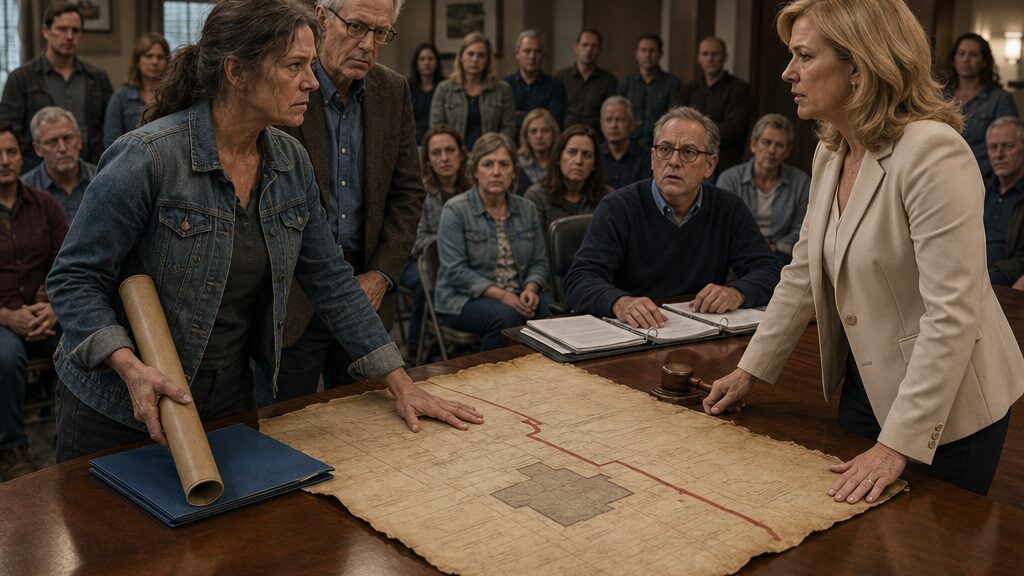
Sharon pulled the survey from its tube and carried it to the board table. She unrolled it slowly. The paper spread across the polished surface, pushing aside Pamela’s agenda and Gary’s calculator.
The red boundary line ran through the clubhouse footprint.
Pamela stared at it, then looked toward the residents.
“This document is decades old.”
“So is the property line.”
“Developments change. Easements are created. Uses become established.”
“Then show me the easement.”
Gary opened one binder, then another.
Pamela’s voice sharpened. “The association is not required to produce legal records in response to a theatrical accusation.”
Sharon placed the certified property index beside the survey. “There is no recorded easement under my parcel.”
A man in the third row rose slowly.
Thomas Wright had lived in the community for eleven years. Sharon knew him as the neighbor who corrected people when they called a drainage swale a ditch.
“May I look?” he asked.
Pamela answered before Sharon could. “Thomas, this is not a survey hearing.”
“No,” he said. “It is a room full of people arguing over a line none of them can read.”
A few residents laughed nervously.
Thomas approached the table. He did not touch the survey at first. He asked Sharon where she found the corner pin, what reference distance she used, and whether the clubhouse addition appeared on the original or later site plan.
His questions felt less like support than examination.
Sharon answered each one.
“You used a hardware-store tape?” he asked.
“Yes.”
“That is not a boundary survey.”
“I know.”
“You measured through a fence?”
“Under it.”
“That introduces error.”
“I know.”
Pamela leaned back, relief appearing in her posture.
Thomas studied the certified plat. “But not four feet of error.”
The relief vanished.
He traced the line with one blunt fingertip.
“Property lines do not move because a building gets older,” he said. “If this record is accurate, the building moved across the line when the addition was constructed.”
Silence settled over the room.
Sharon felt no triumph. Only the weight of everyone looking from the line to the walls around them.
A resident near the kitchen asked, “Does she own part of the room?”
Another said, “Are we losing the clubhouse?”
Pamela raised both hands. “No one is losing anything. This is why incomplete information should not be presented publicly.”
“You had complete information two years ago,” Sharon said.
Pamela’s face became still.
Sharon placed the title note on the table.
“An encroachment warning was sent to the president’s office.”
Gary stopped turning pages.
Pamela did not look down. “I receive hundreds of notices.”
“This one concerned the building you manage.”
“The association’s title matters are handled by professionals.”
“Then where is the letter?”
Pamela’s fingers tightened around the gavel. “I will not conduct privileged legal review in an open meeting.”
The board secretary whispered something to Gary.
He opened the insurance binder and began scanning the index. “There’s no easement rider.”
Pamela turned toward him. “Gary.”
“No lease either,” he said.
A woman in the front row stood. “We’ve paid rental fees for fourteen years.”
The room erupted again.
An insurance representative seated near the exit stepped forward. She had attended because of the rental suspension and now asked to see the certified documents. Pamela tried to postpone the review, but the representative shook her head.
“If the association has actual notice of a potential encroachment, continued rental use creates a coverage issue.”
“What does that mean?” a resident demanded.
“It means rentals remain suspended until title and liability are reviewed.”
Someone near the back muttered that a canceled anniversary party had already cost a deposit. Another asked whether assessments would rise. The questions struck Sharon from every direction, though none of them were hers to answer.
Pamela pointed at her.
“This is exactly the panic I was trying to prevent.”
The accusation landed harder than the earlier insults.
For a moment Sharon saw what Pamela saw: frightened homeowners, fixed incomes, a building tied to resale values, and an administrative defect capable of becoming a neighborhood-wide bill.
Then she remembered the roses under steaming grass and the warning on her front door.
“You were trying to prevent questions,” Sharon said. “Panic came later.”
Pamela’s composure cracked. “You have no idea what it takes to keep this association solvent.”
“No,” Sharon said. “Because you kept the records from me.”
Gary closed the binder.
“I need ten minutes,” he said.
Pamela told him to sit down.
He did not.
Gary left through the office door and returned carrying a gray archive box. Dust marked the sleeves of his shirt. He set the box on the board table and pulled out folders labeled TITLE, EXPANSION, and INSURANCE.
At the bottom lay a sealed envelope.
The return address belonged to a title company. A red stamp across the front read SECOND NOTICE.
Gary turned it over.
The flap was intact.
Across the delivery receipt attached to the envelope was Pamela Hall’s signature.
No one spoke.
Pamela stared at her own name as though someone else had written it.
Gary pushed the envelope toward Sharon.
“This was in the president’s archive,” he said.
Sharon did not open it.
She looked at Pamela instead.
The question in the room had changed.
It was no longer whether the clubhouse crossed the line.
It was why Pamela had signed for the warning, left it sealed, and spent the next two years making sure Sharon stayed busy cleaning the building built across it.
Chapter 6: The Warning Pamela Chose to Bury
The HOA attorney offered Sharon thirty-five thousand dollars before he answered a single question.
The amount appeared on the second page of a proposed agreement placed between them in a rented conference room ten days after the meeting. A yellow tab marked the signature line.
In exchange, Sharon would grant a permanent easement beneath the clubhouse addition, waive claims related to past use, withdraw her records complaints, and keep the terms confidential.
Pamela sat across from her with both hands folded. Gary occupied the far end of the table, separated from the board president by an empty chair.
Sharon turned the page.
“The confidentiality clause is longer than the property description.”
The attorney adjusted his legal pad. “That is standard.”
“Is it standard to offer money before disclosing what happened?”
“This is an effort to avoid unnecessary expense for all parties.”
“You mean court.”
“I mean surveys, title litigation, insurance disputes, and assessments.”
Pamela spoke for the first time. “Thirty-five thousand dollars is more than fair for a narrow strip of land you have not used in decades.”
Sharon looked at her. “Then why did you fine me over a trash container sitting on it for one morning?”
Gary lowered his eyes.
The attorney slid the agreement closer. “The board is prepared to cancel the violation and compensate you for the damaged landscaping.”
“My roses are not a line item.”
“No one is suggesting they are.”
“The agreement calls them incidental vegetation.”
Pamela exhaled. “We are trying to solve this.”
“No. You are trying to purchase silence.”
The attorney removed his glasses. “Ms. Taylor, the association has legitimate defenses. The building has stood for years. Your mother knew it was there. There may have been permission, even if it was not recorded.”
“Then why is the board offering me money?”
“To remove uncertainty.”
Sharon looked at the blank easement line. On the attached exhibit, the boundary was drawn in black, running beneath the clubhouse wall. Her signature would turn the hidden line into a permanent right for the association.
“What was in the envelope?” she asked.
The attorney glanced at Pamela.
Gary answered. “A title-company request for documentation of an easement.”
“And?”
“A warning that the clubhouse addition appeared to encroach on lot nineteen.”
“Was the envelope truly unopened?”
Gary’s jaw tightened. “That one was.”
“One?”
Pamela turned toward him.
Gary reached into his briefcase and removed a copy of an email.
“I found an earlier electronic notice,” he said. “It was sent to the president’s account four days before the paper letter.”
Pamela’s face drained of color.
The attorney held out his hand. Gary did not give him the page.
Sharon said, “You knew.”
Pamela looked at the conference table. “I knew there was a possible discrepancy.”
“You said my property claims were unverified.”
“They were.”
“You redirected landscaping waste onto the disputed strip.”
“It was a maintenance decision.”
“You threatened my clubhouse access.”
“You were removing records.”
“I copied financial packets left for residents.”
Pamela’s voice rose. “You were turning every administrative issue into an accusation while I was trying to keep three hundred households from being hit with a special assessment.”
The room went quiet.
For the first time, Pamela was not speaking like the board president. She sounded tired.
She pushed the agreement away.
“When the title notice came, the reserve account was already short. The roof needed replacement. Insurance premiums had increased. If I reported an encroachment, rentals would stop and legal review would begin. Do you know who gets blamed when assessments rise?”
“Not the person who built the addition,” Sharon said.
“The person sitting at the microphone.”
Pamela’s mouth tightened. “People say they want transparency until transparency costs them four thousand dollars.”
The explanation did not absolve her. It made the harm more deliberate.
“You decided I was cheaper,” Sharon said.
Pamela looked up.
“A fine here. A warning there. Keep me busy. Keep me grateful. Keep me from asking why a company was being paid for my work.”
“I did not create BrightWay.”
“But you kept paying it.”
Pamela said nothing.
Gary placed both palms on the table. “So did I.”
Sharon turned toward him.
He had spent the past week reviewing ledgers. BrightWay’s payments had begun before Pamela’s presidency, attached to an old service authorization with no current contract. The checks went to a mailing address used by a former board contractor. Gary had questioned the expense once, then allowed it to continue because reopening vendor files might expose other accounting weaknesses.
“I told myself six hundred twenty dollars was smaller than an audit,” he said. “Then every month it became easier not to ask.”
“Where did the money go?”
“The attorney is tracing it. We do not have a complete answer.”
“You signed the checks.”
“Yes.”
“Why didn’t you say anything at the meeting?”
Gary looked toward the window. “My wife and I live on a fixed retirement plan. So do half the people on our street. I thought if I kept the association stable, I was protecting them.”
“You protected the number on the budget.”
He nodded once. “I know.”
The attorney tried to return them to the settlement. Sharon closed the document.
“I will not sign confidentiality.”
“Then the offer changes,” he said.
“That is the point.”
She agreed not to demand immediate closure of the clubhouse while a licensed boundary survey and financial review were completed. She would not waive claims. She would not accept the permanent easement. She would not allow the board to describe the matter as a misunderstanding.
Pamela stood before the meeting ended.
“You are going to make people pay for this.”
Sharon remained seated. “You already did.”
At home that evening, Melissa was sorting the last papers from the property box. The rose cutting had begun to form two pale roots in its glass jar.
“You should take the money,” Melissa said.
“You haven’t read the agreement.”
“I don’t need to. Thirty-five thousand dollars gets you out of here.”
“I don’t want out.”
“Then what do you want?”
Sharon did not know how to answer without sounding like her mother.
Melissa pulled a narrow envelope from beneath the cardboard lining of the box.
It was addressed to Sharon in her mother’s handwriting.
The paper inside was undated.
Sharon read standing at the kitchen counter.
Her mother wrote that the clubhouse addition had crossed the rear line during construction. The developer had promised to correct the plans, but the neighborhood needed the room before winter. She had allowed the wall to remain because the clubhouse was used for meals, child care during emergencies, card nights, and memorial gatherings.
No formal easement had been signed.
Her mother had not trusted the developer’s attorney, and she wanted the permission to remain personal and revocable.
Near the end, one sentence had been underlined twice:
They may use that ground while the house belongs to our family, but only if the building remains for neighbors, not profit.
Sharon lowered the letter.
For days, she had believed her mother hid the survey because she expected a fight.
Instead, she had hidden it because she had made a promise without surrendering the right to end it.
Melissa read the sentence over Sharon’s shoulder.
“So what does that mean?”
Outside the kitchen window, the clubhouse lights came on automatically, though no rentals were allowed. The building stood quiet beyond the damaged rose bed, four feet across a line no one had respected because Sharon’s mother had once chosen not to enforce it.
Now the choice belonged to Sharon.
And whatever she decided would define whether she was preserving her mother’s generosity or repeating her silence.
Chapter 7: The Boundary Sharon Chose to Keep
The HOA attorney had arranged three documents in front of Sharon before she entered the clubhouse.
One granted the association a permanent easement on nearly every term it had requested. One began the process of removing the encroaching section of the building. The third proposed a temporary license that would postpone the decision for another year.
Sharon looked at the yellow tabs waiting for her signature, then closed all three documents.
“I brought my own terms,” she said.
Six weeks had passed since the title-company warning was opened. The clubhouse remained available for board meetings but closed to rentals. A licensed surveyor had installed bright wooden stakes along the recorded boundary, making the invisible line impossible to ignore. One stake stood within inches of the rear wall. Another rose from the damaged edge of Sharon’s rose bed.
Every resident entering the special meeting had walked past them.
Pamela sat at the center of the board table, but her gavel was gone. Gary had placed it in a drawer before the meeting began.
The room filled slowly. Some residents nodded at Sharon. Others avoided her. A man near the kitchen complained loudly that his granddaughter’s graduation party had been moved to a restaurant because of the rental suspension.
“It cost us nine hundred dollars,” he said to no one in particular.
A woman beside him replied, “And whose fault is that?”
Both looked toward the board. Then, after a moment, toward Sharon.
Melissa sat in the back row with the rooted rose cutting in a small plastic nursery pot at her feet. She had offered to leave it at home, but Sharon asked her to bring it.
Pamela called the meeting to order without a gavel.
“The purpose of this session is to consider resolution of the clubhouse boundary matter,” she said. “Counsel has prepared several lawful options.”
Sharon rose.
“The association’s options were prepared before anyone asked what I would permit.”
The attorney began to speak, but Gary stopped him.
“Let her finish.”
Pamela looked down the table at him. Their working alliance had ended quietly during the audit. They now spoke only when the minutes required it.
Sharon carried a four-page proposal to the front. She did not bring the old survey. It was no longer necessary. The new boundary drawing lay enlarged on an easel beside the board table, stamped by the licensed surveyor and marked with the line everyone could now see outside.
“The clubhouse can remain,” she said.
A wave of relief moved through the room. It was not applause. It was breath released by people who had expected a threat.
Sharon waited until the room settled.
“But not under the arrangement that brought us here.”
Pamela’s shoulders stiffened.
Sharon placed copies of her terms before each board member.
The first condition required a recorded easement limited to the existing building footprint. It would not allow expansion, storage, landscaping waste, or access beyond the marked strip.
The second ended commercial rental of the clubhouse. Residents could reserve it for community events at cost, but the association could not treat land borrowed from Sharon’s family as a source of profit.
The third required a full public accounting of BrightWay Facility Services and credits to residents for unsupported cleaning charges.
The fourth required written contracts for all future labor, including volunteer work that became regular service.
The fifth required Pamela’s resignation and the release of the title correspondence, audit findings, and board minutes connected to the encroachment.
The attorney leaned toward his microphone. “Some of these conditions extend beyond the scope of a property easement.”
“Then the board can choose removal,” Sharon said.
The room tightened again.
She did not raise her voice. She did not need to.
The building’s rear wall stood four feet across her land. For years, that fact had been treated as too inconvenient to acknowledge. Now inconvenience had become authority, and Sharon understood how dangerous that could feel in the wrong hands.
She looked toward the residents.
“My mother allowed the addition to remain because this room was used when neighbors needed one another. Meals after funerals. Child care during emergencies. Meetings when homes were too small.”
She placed her mother’s letter on the table.
“She did not give the association permission to profit from it. She did not give anyone permission to hide the boundary. And she did not give me instructions to punish people who had nothing to do with the decision.”
The man whose graduation party had been canceled lowered his gaze.
Pamela picked up the proposal.
“You are asking the community to absorb an assessment anyway,” she said. “Survey costs, attorney fees, the audit, insurance review. Your conditions do not make those disappear.”
“No,” Sharon said. “They make them visible.”
A resident in the front row asked what the assessment would be.
Gary opened the ledger.
“Under the proposed easement and insurance correction, approximately four hundred eighty dollars per household, payable over twelve months.”
Several people protested at once.
Gary did not close the book.
“If we had addressed the first warning two years ago,” he said, “the cost would have been significantly lower.”
Pamela looked at him. “That estimate is speculative.”
“The missing money is not.”
He turned the ledger so the room could see the highlighted columns. The review had found that BrightWay received payments for twenty-seven months without valid invoices. Some funds had gone to an old contractor’s account. The full recovery remained uncertain, but the board had agreed to issue credits from reserves and pursue repayment separately.
Gary’s voice shook when he admitted that he had approved the payments.
No one praised him for confessing. No one needed to. Accountability was not a performance that erased what came before.
Pamela remained still.
The board secretary asked whether she wished to respond to the resignation condition.
Pamela looked around the clubhouse. For years, every chair had faced her. Every complaint had reached her table. She had mistaken that arrangement for proof that the room belonged to her.
“I believed disclosure would damage the community,” she said. “I made decisions intended to contain the cost.”
Sharon waited.
Pamela’s eyes moved to the survey line on the easel.
“And when Sharon began asking questions, I treated her as the threat instead of the problem I had avoided.”
The words were not an apology. They were more useful than one.
Pamela removed her board key from its ring and placed it beside the unsigned minutes.
“My resignation will be effective tonight.”
No one applauded.
The vote followed. The easement terms passed by a clear majority, though several residents voted against them. The assessment passed more narrowly. The open-records policy passed without opposition.
When the documents were ready, the attorney slid them toward Sharon.
This time there was no confidentiality clause.
The easement drawing showed the corrected line in dark ink. Sharon signed beside it, then passed the pen to Gary for the association’s signature.
The act did not feel like victory. It felt like placing weight on something that had floated loose for too long.
Outside, residents gathered near the survey stakes. Some thanked Sharon. One woman told her the assessment would strain her budget. Sharon did not defend herself.
“I know,” she said.
Dignity, she had learned, did not guarantee approval.
Near the damaged rose bed, Melissa knelt with the rooted cutting. Together they planted it beside a new wooden trellis. The landscaping crew had removed the ruined soil and repaired the fence, but Sharon had insisted that the trellis be built only after the survey markers were installed.
Melissa pressed dirt around the small roots.
“Grandma would have kept the clubhouse, wouldn’t she?”
“Yes.”
“And she would have made them put it in writing?”
Sharon looked at her mother’s letter folded inside her jacket.
“Eventually,” she said. “She left that part to us.”
They tied the fragile stem loosely to the lowest slat.
The clubhouse wall stood beyond it, close enough to cast an afternoon shadow across the bed. Between the roses and the building, the new boundary marker remained visible.
The trellis ended exactly at the recorded line.
The story has ended.