They Locked Ronald Out of His Own Road, Then His Eleven Photographs Changed the Entire Neighborhood
Chapter 1: The Chain That Appeared Before Sunrise
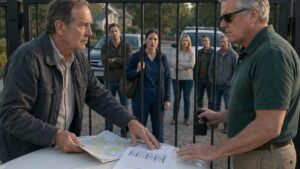
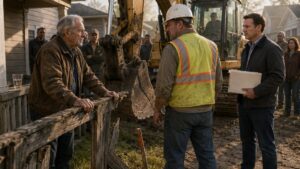
The chain was looped through Ronald Harris’s gate before the sun cleared the cottonwoods.
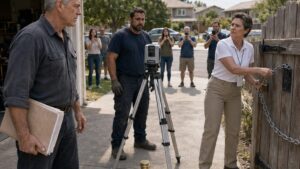
It crossed the galvanized bars twice, pulled tight through a new brass padlock, and rested directly over the white sign that read PRIVATE EASEMENT — NO TRESPASSING. Beyond it, Ronald’s dark pickup sat where he had parked it the night before, nose pointed toward the road and completely trapped.
Beyond the pickup stood a forty-foot motor home.
Its rear wheels occupied the gravel lane. One slide-out hung over the drainage ditch. A stabilizer jack had been lowered into the shoulder near the fence line, and a blue electrical cord ran from the RV toward an outlet on the neighboring lot.
Ronald stopped six feet from the gate with his coffee cooling in his hand.
For several seconds, he did nothing.
Then the RV door opened.
A broad man in gray sweatpants stepped down, stretched, and looked at Ronald as if Ronald had wandered onto the wrong property.
“Morning,” the man said.
Ronald set his mug on the fence post. “That your lock?”
The man glanced at it. “That’s our security.”
“It’s on my gate.”
“We were told this was shared access.”
Ronald looked past him at the RV. Its front windshield reflected the pale strip of dawn. A folding chair, two leveling blocks, and a rolled outdoor rug had already been arranged near the door.
“Move the coach,” Ronald said. “Take the chain with you.”
The man gave a patient smile that made Ronald’s jaw tighten.
“We just got settled,” he said. “Name’s Tyler Green. Michelle said this lane was common emergency access. We’re not hurting anything.”
Ronald pointed through the bars. “My truck is behind you.”
“You’ve got another way out.”
“No.”
Tyler’s smile faded by half an inch. “Then we can work something out.”
The RV door opened again. A blonde woman appeared with a phone already raised in front of her.
“Is everything okay?” she asked, though the camera was aimed at Ronald.
Tyler turned slightly toward the phone. “Our neighbor says we have to move.”
The woman stepped down and swept the lens from the RV to Ronald’s gate sign.
“This is Stephanie,” Tyler said. “My wife.”
Ronald watched the small red light on her screen.
Stephanie’s expression softened for the camera. “We were told we could be here temporarily. We’re not trying to cause trouble.”
“You chained my gate.”
“For safety,” Tyler said.
“You locked my vehicle in.”
Stephanie tilted the phone. “You can ask without being aggressive.”
Ronald felt heat rise behind his ears. He had not raised his voice. He knew that if he said so, the sentence would become proof that he had.
He reached into his jacket pocket and took out a compact digital camera.
Stephanie lowered her phone a fraction. “What are you doing?”
Ronald photographed the gate.
The shutter clicked once.
He photographed the padlock, then the chain crossing the private-easement sign. He stepped sideways and took a wider frame containing the RV, his trapped pickup, and Tyler standing between them.
Tyler’s face hardened. “You don’t have permission to photograph us.”
“I’m photographing my road.”
“You’re photographing my home.”
Ronald checked the image on the camera screen. The time stamp showed 6:18 a.m.
Stephanie swung her phone back toward herself. “This is what we were warned about,” she told whoever was watching. “He hasn’t asked if we need help. He came straight out taking pictures.”
Ronald looked at her. “Who warned you?”
“The board knows there have been problems with you.”
“What problems?”
Tyler folded his arms. “You don’t cooperate.”
The words landed more deeply than Ronald wanted them to. He had heard versions of them since his wife died—at meetings, in clipped emails, once from a neighbor who had borrowed his tractor three times.
He picked up his coffee.
“I want the chain removed by eight,” he said.
Tyler laughed softly. “That’s not realistic.”
Ronald turned toward the house.
Stephanie followed him with the phone. “So you’re refusing to have a conversation?”
He kept walking.
Inside, Ronald set the camera beside the kitchen sink and opened the drawer where he kept association correspondence. He found Michelle Torres’s number on the bottom of a landscaping notice and called.
She answered on the fourth ring.
“Ronald?”
“There’s an RV across my easement.”
A pause.
“Yes,” Michelle said. “I was going to call you.”
“They put a lock on my gate.”
“That was not part of the arrangement.”
“What arrangement?”
“The Greens needed temporary access.”
“To what?”
“The rear utility corridor.”
“There is no utility corridor on my parcel.”
Michelle exhaled. “The subdivision map marks that lane as emergency access.”
“My deed marks it private.”
“We’re not resolving the entire map history at six-thirty in the morning.”
“Did you authorize them to park there?”
“I told them the board would allow temporary access while their situation was reviewed.”
“Parking a residence across my road is not access.”
“They told me they would stay close to the shoulder.”
“They are the shoulder.”
Michelle’s tone sharpened. “Ronald, they’re under pressure. Let’s not turn this into something bigger than it needs to be.”
He looked through the kitchen window. The top of the motor home rose above the hedgerow like a white wall.
“My truck is trapped.”
“I’ll speak to them.”
“When?”
“Today.”
Ronald ended the call before his anger became useful to someone else.
By seven-thirty, two neighbors had slowed their vehicles near the entrance. One waved at Tyler. The other stopped long enough for Stephanie to lean toward the passenger window and speak.
Ronald stood in the equipment shed with bolt cutters in his hands.
He could remove the lock in under ten seconds. He could back his tractor down the interior lane, hook the RV’s rear frame, and drag it far enough to free his pickup. Twenty years earlier, he might have done both before anyone finished telling him why he should not.
Instead, he returned the bolt cutters to the pegboard.
At eight-fifteen, the chain remained.
He photographed it again.
Then he walked the fence line, examining the gravel shoulder. Near the RV’s rear stabilizer, a narrow strip of orange plastic protruded from beneath the steel foot. Ronald crouched.
It was a survey stake, old but familiar, driven beside the boundary point he had checked himself years before.
The RV’s weight had folded it almost flat.
Ronald touched the exposed tip without pulling it free. The soil around the jack was freshly compressed, and the edge of the gravel pad extended farther onto his side than Tyler appeared to understand.
He raised the camera.
This time, before he pressed the shutter, Ronald framed the bent orange stake, the lowered jack, and the private gate locked behind them.
Chapter 2: Eleven Mornings Behind the Same Locked Gate
On the second morning, someone had taped a sheet of printer paper to Ronald’s gate.
TRY KINDNESS, it said in thick black marker.
The stranger’s padlock remained beneath it.
Ronald photographed both at 6:21 a.m.
He photographed the RV from the same position he had used the day before, keeping the left gatepost at the edge of the frame. Then he stepped closer and recorded the stabilizer jack. Less orange was visible now. The jack had settled overnight, pressing the bent stake deeper into the wet soil.
Stephanie watched from the RV window.
By breakfast, her first video had reached the neighborhood Facebook group.
Ronald found it because Matthew Lopez called him.
“Tell me you’ve seen this.”
“No.”
“You need to.”
Ronald opened the link on his kitchen laptop.
The video began after Tyler had already explained the supposed HOA permission. It showed Ronald asking whether the lock belonged to them, then cut directly to him lifting his camera.
The caption read: ELDERLY NEIGHBOR PHOTOGRAPHS FAMILY AFTER HOA GRANTS TEMPORARY ACCESS.
The comments had divided quickly.
Some asked why the RV blocked the gate. Others said Ronald had always been territorial. One person wrote that landowners sometimes confused ownership with the right to mistreat people.
Matthew arrived twenty minutes later in his work van.
He was thirty-eight, square-shouldered, and already angry when he stepped out.
“Where’s the cord?” he asked.
“What cord?”
“Their power. If it crosses your parcel, I’m disconnecting it.”
“No.”
“They locked your truck in.”
“I’m handling it.”
Matthew looked at the RV, then at Ronald. “Taking pictures isn’t handling it.”
“It is if the pictures are dated.”
“It is if someone cares.”
Ronald turned away. “County offices open at eight.”
Matthew followed him toward the gate. “You called them?”
“I left a message.”
“And the sheriff?”
“It’s a civil access dispute until there’s an order.”
Matthew swore under his breath.
Tyler emerged holding a travel mug. “Morning.”
Matthew walked straight toward him.
Ronald caught his sleeve.
“Not your fight.”
Matthew pulled free, but he stopped.
Tyler’s eyes moved between them. “You here to threaten us too?”
“No one threatened you,” Ronald said.
Stephanie appeared beside the RV with her phone raised.
Matthew pointed at the electrical cord. “That connected to the vacant house?”
“We have permission.”
“From the utility company?”
Stephanie moved closer. “Can you repeat that?”
Matthew took one step toward the cord.
Ronald blocked him.
For a moment, Ronald and Matthew stood chest to chest while Stephanie filmed from ten feet away.
“Go home,” Ronald said quietly.
Matthew stared at him as if the betrayal were personal. Then he turned, got into his van, and left hard enough to throw gravel against the ditch.
By noon, Stephanie had posted a second clip. It began with Matthew striding toward the RV and ended with Ronald restraining him. The electrical cord and the preceding argument were absent.
The caption called Matthew “an aggressive relative.”
Ronald did not comment.
On the third morning, he noticed a dark wet patch beneath the RV’s rear quarter. It spread from a flexible waste hose toward the ditch, leaving a sour odor in the cool air.
He photographed the hose connection, the stain, and the direction of runoff.
On the fourth, he found a disposable wipe caught in the grass downstream.
On the fifth, Michelle sent him an email advising all parties to “de-escalate interpersonal behavior” while the board reviewed the access question. She copied the HOA attorney.
Ronald printed the email and placed it in a manila folder.
He added each photograph behind it in date order.
By the sixth morning, the orange stake was visible only as a dirty crescent.
Tyler had placed a potted plant beside the stabilizer jack.
Ronald moved the plant long enough to take a photograph, then put it back exactly where it had been.
“You really do this every day?” Tyler asked from behind him.
“Yes.”
“You know how that looks?”
Ronald straightened. “Accurate.”
Tyler shook his head. “We’re not criminals.”
“I didn’t call you criminals.”
“You’re building something.”
“You built something across my road.”
Tyler looked toward the RV. “It’s temporary.”
“You said the season.”
“We’re working it out.”
“With whom?”
Tyler’s mouth tightened. “Not everything is your business.”
Ronald glanced at the curtained windows. Laundry hung from a rack behind the windshield. A pair of women’s sneakers sat beneath the steps, too small for Stephanie.
He had assumed the Greens were vacationing, perhaps renovating a house. Now he noticed the school backpack tucked beside the passenger seat.
On the seventh morning, a light came on inside the RV before six. Someone coughed behind the curtains.
On the eighth, Stephanie carried groceries inside, including a gallon of milk and a pharmacy bag.
On the ninth, Tyler installed insulated skirting along the RV’s lower edge.
By then, Ronald no longer believed they intended to leave soon.
Matthew returned that afternoon with a moisture meter and a calmer face.
“I’m not touching anything,” he said before Ronald could speak.
They walked to the drainage ditch while the Greens were away. Matthew crouched beside the stain and pressed the meter probe into the soil.
“This isn’t clean water.”
“I know.”
“It’s moving downhill toward the culvert.”
“I photographed the progression.”
Matthew removed his work glove and rubbed his forehead. “You should call environmental health.”
“I did.”
“And?”
“They want the code inspector to establish occupancy and jurisdiction first.”
Matthew looked at the RV skirting. “They’re living here.”
Ronald said nothing.
“You knew?”
“I suspected.”
“That changes things.”
“It changes the violations.”
“That’s not what I meant.”
Ronald closed the camera case.
Matthew watched him. “You can be right and still act like no one else exists.”
Ronald felt the sentence strike the place he kept guarded.
“I asked you not to interfere.”
“You didn’t ask me anything. You told me to leave.”
“There was a phone pointed at you.”
“So?”
“So you were about to give her the picture she wanted.”
Matthew laughed once, without humor. “And you think silence gives her nothing?”
He walked back to his van.
On the eleventh morning, Ronald stood at the kitchen table arranging the files.
Eleven folders.
Eleven dated photographs of the locked gate.
Eleven wide shots of the RV blocking his access.
Separate images documented the leak, the deepening soil stain, the insulated skirting, the waste hose, the crushed marker, and the chain crossing the sign.
He uploaded them to his phone and scrolled through the gallery.
The images looked nearly identical until viewed in sequence. Then the changes became unmistakable: the stake vanishing, the stain widening, the RV settling more firmly into place.
Eleven mornings. Eleven files.
His phone rang.
The call went to voicemail before Ronald recognized Tyler’s number.
A moment later, the message appeared.
Ronald played it on speaker.
Tyler’s voice arrived with laughter behind it.
“Hey, Ron. Got your little towing notice. You can’t tow a home, genius. That’s somebody’s residence. Maybe look up the law before you start threatening families.”
Stephanie’s voice said something indistinct in the background. Tyler laughed again.
Ronald replayed the message.
Then he opened the county code page he had bookmarked.
The section on abandoned recreational vehicles did not apply. Neither did ordinary parking enforcement. But a separate provision addressed obstruction of a recorded private easement, unlawful utility occupancy, sanitation discharge, and interference with emergency access.
Residence status did not erase those sections.
It might make enforcement more complicated.
It did not make the RV untouchable.
Ronald saved the voicemail to the eleventh folder. Then he noticed the school backpack through the kitchen window, resting on the RV steps beside a pair of small shoes.
The Greens were not simply refusing to move a vehicle.
They had made his road their address.
Chapter 3: The Marker Hidden Beneath Forty Thousand Pounds
Stephanie was already live when she stepped out of the SUV.
She held the phone vertically at shoulder height, smiling toward the screen as Michelle Torres walked beside her carrying a rolled map and a leather folder.
“We’re at the disputed access lane,” Stephanie said. “The board president has agreed to inspect the situation so everyone can hear the facts.”
Ronald stood inside his locked gate with a stack of photographs under one arm.
Tyler leaned against the RV, freshly shaved and wearing a clean button-down shirt. The insulated skirting had been straightened. The waste hose was hidden behind a plastic storage bin.
Michelle stopped at the gate.
“Ronald, will you open this?”
“It isn’t my lock.”
Stephanie turned the camera toward him. “He’s still refusing access.”
Ronald looked at the chain crossing his sign. “I’m locked inside.”
A few comments floated up Stephanie’s screen too quickly for him to read.
Michelle’s cheeks colored. “Tyler, unlock the gate.”
Tyler pushed away from the RV. “I thought we were keeping it secured during the inspection.”
“Unlock it.”
He did, slowly.
The chain fell away from the sign with a metallic scrape. Ronald opened one gate panel just wide enough for Michelle to enter. Stephanie followed without asking.
Michelle lowered her voice. “This could have been resolved privately.”
“It was private until they filmed it.”
Stephanie angled the phone toward herself. “I’m documenting.”
“You edit,” Ronald said.
Her smile held, but only for the audience. “Would you like to explain why you want a family removed from its home?”
Ronald set the photographs on the gate rail.
“Because it blocks my only road.”
“You have twelve acres.”
“None of them connect to the county road.”
Tyler gestured toward the lane. “This is emergency access. Michelle has the map.”
Michelle unrolled the document across the hood of Ronald’s trapped pickup. A bold line ran along the gravel lane. In a faded legend near the bottom, it was labeled SHARED EMERGENCY AND UTILITY ACCESS.
“There,” Tyler said.
Ronald did not look at the map yet.
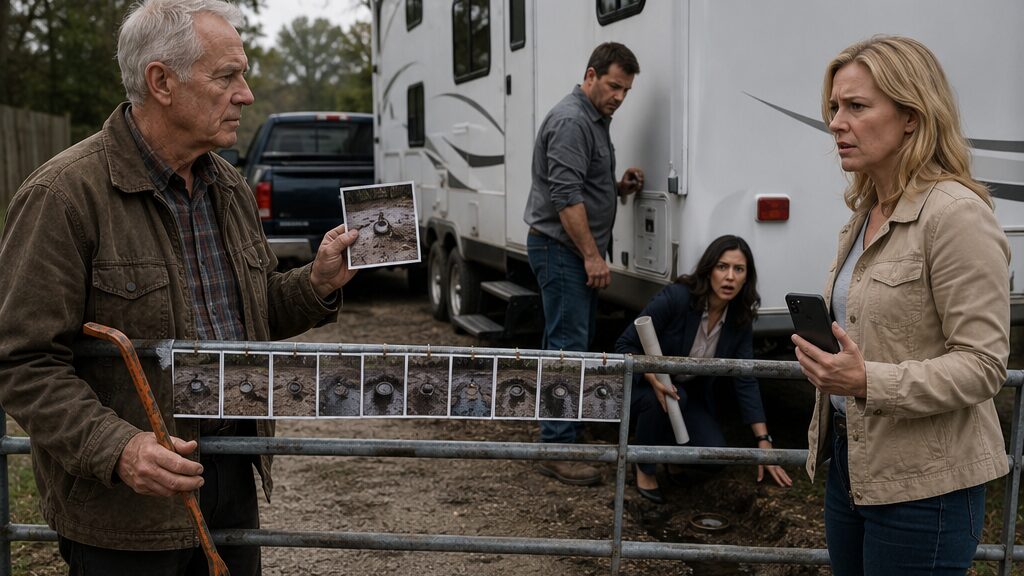
Instead, he took the first photograph from his stack and clipped it to the horizontal gate rail with a small black binder clip.
Day one: Tyler’s chain over the private-easement sign.
The second photograph went beside it.
Day two: the paper reading TRY KINDNESS.
The third showed the wastewater stain.
The fourth showed the stain reaching the ditch.
He continued until eleven photographs stretched along the galvanized rail like a timeline.
Stephanie’s phone turned toward them.
Her voice lost some of its certainty. “What is this supposed to prove?”
“Condition and progression.”
Tyler gave a short laugh. “It proves he’s obsessed.”
Ronald placed the last photograph at the end of the row.
The orange survey stake was visible beneath the RV jack.
Michelle stepped closer.
“What’s that?” she asked.
“A boundary witness.”
“That plastic flag?”
“The plastic marks what’s below it.”
Tyler folded his arms. “That thing was already bent.”
“Lift the jack.”
“No.”
“Six inches.”
“You don’t touch my leveling system.”
“I didn’t ask to touch it.”
Stephanie swung the phone toward Tyler. “You don’t have to comply with demands on camera.”
Ronald looked at Michelle. “You came to inspect.”
Michelle studied the photograph. “Tyler, raise it.”
The motor home’s hydraulic system hummed when Tyler activated the controls. The rear corner rose gradually. Mud clung to the square steel foot.
A crushed strip of orange plastic sprang partly upright.
Under it, dark soil shone with moisture.
The odor reached them a second later.
Stephanie covered her nose with her free hand.
Tyler stopped the jack.
“Higher,” Ronald said.
The steel foot rose another inch, revealing the circular top of a metal cap set flush with the ground. Dirt filled most of its stamped lettering, but Ronald could still make out the county abbreviation and monument number.
Michelle crouched without touching it.
“That’s a recorded pin?”
“Yes.”
Tyler stared at the cap. “That was not visible when I parked.”
“The stake was.”
“It looked like trash.”
Ronald pulled on a work glove, lifted the bent orange marker from the mud, and held it beside the photograph taken on the first morning.
The angles matched.
Behind the marker, the lifted jack exposed a shallow channel of gray water leading from beneath the RV toward the ditch.
Stephanie’s livestream went silent except for the faint sound of comments arriving.
Michelle stood. “Tyler, where is your waste line connected?”
“It’s contained.”
“Where?”
“We had a small seal issue.”
“You told me you were using the approved cleanout at the vacant property.”
“We are.”
Ronald pointed to the wet soil. “Not all of it.”
Tyler’s face changed. Not surrender, but calculation.
“This is fixable,” he said. “We can clean it.”
“The point remains,” Michelle said. “The marker changes the boundary issue.”
Stephanie lowered her phone enough to look directly at Ronald. “You knew that was there the whole time.”
“I knew where it should be.”
“And you let us park over it?”
“I told you to move before seven.”
“You could have explained.”
Ronald met her gaze. “You were recording before you asked.”
For the first time, she had no quick answer.
Michelle returned to the map on the truck hood. “This monument may mark the edge of the easement, not ownership.”
Ronald finally approached the document.
The linework was familiar in the way an old scar was familiar. Parcel numbers, bearings, utility notations, the drainage reserve at the subdivision’s southern edge. The sheet had been copied so many times that portions of the title block were gray.
He traced the lane with one finger.
“This isn’t the recorded deed exhibit.”
“It is the HOA’s subdivision map.”
“It’s a planning copy.”
“It has been used for twenty-three years.”
“That does not make it controlling.”
Tyler stepped close enough that Ronald could smell coffee on his breath. “So what are you saying? Everybody’s map is wrong except yours?”
Ronald ignored him.
Near the lower-right corner, beneath the revision table, he saw a notation.
FIELD ACCESS MODIFIED PER SITE CONDITION.
Two initials followed.
R.H.
His own.
The pressure in his chest changed.
Michelle noticed where he was looking. “You recognize it.”
Ronald did not answer.
He remembered a hot afternoon, survey flags snapping in a dry wind, his wife standing beside the kitchen counter with both hands around a glass of water. He remembered promising her that a corrected line did not need to become another neighborhood war.
But this sheet should not have carried that note.
Not in this form.
Stephanie raised the phone again. “Ronald?”
He rolled the map halfway closed, then stopped.
“Where did the board get this copy?”
Michelle’s expression became guarded. “It has always been in the association records.”
“No. This revision was never filed.”
Tyler looked between them. “What does that mean?”
Ronald gathered the eleven photographs from the rail. The small victory of the exposed survey cap had already collapsed into something older and more dangerous.
“It means,” he said, “someone turned a field note into a property right.”
At home, he unlocked the metal cabinet in his study and removed a narrow survey notebook bound in cracked black vinyl.
He had not opened it in years.
Inside, between two pages of bearings and elevation checks, lay a faded orange field flag pressed flat as a ribbon.
Ronald turned to the date written in the map’s revision table.
His own handwriting filled the page.
At the bottom, beside a sketch showing the easement entirely within his parcel, were his initials—and a note that contradicted the map Michelle had carried to the gate.
Chapter 4: The Map Ronald Never Let His Family See
Matthew opened the locked survey drawer before Ronald reached the study door.
The thin brass key was still in Matthew’s hand. Ronald stopped in the hallway and saw the black field notebook lying open on the desk, its cracked cover flattened beneath Matthew’s palm.
“You had no right,” Ronald said.
Matthew did not turn around. “You left the key in the cabinet.”
“That is not permission.”
“No. It’s what people use when permission never comes.”
The words landed harder than the accusation. Ronald crossed the room and reached for the notebook, but Matthew slid it away.
A faded orange field flag lay between the pages. Its plastic ribbon had gone brittle with age, but the color remained unmistakable.
Matthew tapped the sketch beneath it.
The easement ran entirely inside Ronald’s parcel. A second line, drawn in red pencil, showed the subdivision access route shifted several feet east to avoid a drainage swale. Beneath the drawing, Ronald had written: FIELD ADJUSTMENT FOR CONSTRUCTION ONLY. NO CHANGE TO RECORDED OWNERSHIP.
“This is the same date as the map Michelle brought,” Matthew said.
Ronald looked at the window instead of the page. The RV roof was visible beyond the trees.
“You knew their map was wrong.”
“I knew the construction line was temporary.”
“You signed it.”
“I signed field notes.”
“And then somebody used them as a property map.”
Ronald reached for the notebook again. This time Matthew let him take it.
“You should have told me,” Matthew said.
“There was nothing you could have done.”
“That’s what you always say.”
Ronald closed the notebook. “Because it is usually true.”
Matthew’s face tightened. “You let me stand out there looking like an idiot while you knew this whole thing was bigger.”
“I did not know what copy the board had.”
“But you knew there was another line.”
Ronald placed the notebook inside the drawer but did not lock it.
“The developer found water where the planned utility trench was supposed to go,” he said. “The ground would not carry equipment. We shifted the working route during construction.”
“Onto your road.”
“For machinery. Not ownership.”
“Then why didn’t you correct the board?”
Ronald’s hand stayed on the drawer pull.
He could have said the board had never asked. He could have said the developer was gone, the original engineer dead, the county files incomplete. Every answer would have been partly true.
Matthew waited.
“Your mother asked me not to,” Ronald said.
The room changed.
Matthew looked toward him slowly. “What?”
“She believed filing the correction would start another boundary fight.”
“What boundary fight?”
“Several back lots were already using the shifted drainage line as if it were their edge. Fences had gone up. Gardens. A shed. One family had poured a patio.”
“And Mom told you to leave it?”
“She asked me to wait until the association could correct it without putting people against one another.”
Matthew gave a disbelieving laugh. “How long were you supposed to wait?”
Ronald looked at the black notebook. “It never seemed like the right time.”
“No. It never seemed comfortable.”
Ronald’s jaw tightened.
Matthew went on before he could answer. “You protected her from an argument she isn’t here to have, and now everyone else is living inside it.”
A knock sounded at the front door.
The county clerk stood on the porch holding a flat envelope and a receipt clipboard. Ronald signed for the certified copy.
Inside was the recorded subdivision map from the county archive.
It did not match Michelle’s copy.
The county version showed Ronald’s easement as private. The temporary construction shift appeared only in a faint supplemental note with no transfer language and no board authority.
Matthew studied both maps side by side on the kitchen table.
“So Michelle’s map is not recorded,” he said.
“No.”
“Then the Greens have nothing.”
“They have the board’s representation.”
“That’s not your problem.”
Ronald traced the parcel lines near the southern lots. Three fences and two patios, according to recent aerial photographs, likely crossed the corrected drainage strip.
“If the county treats the field line as an error that must be cured,” Ronald said, “those owners may lose use of land they believed was theirs.”
Matthew leaned back. “They bought property. They should know the lines.”
“Most people know what they are shown.”
“And what were they shown?”
Ronald did not answer.
Matthew looked at the notebook again. “Your silence.”
By afternoon, they were at the county records office with the maps spread beneath fluorescent lights. Sandra Williams stood at the counter, reading without expression.
She checked the title block, revision number, field note, and deed exhibit. Then she compared Ronald’s notebook entry with the HOA copy.
“This association sheet is not a recorded plat,” she said.
Michelle had labeled it as one in her email.
Sandra continued. “It appears to be a working construction plan later incorporated into internal HOA records.”
“Can they authorize occupancy from it?” Matthew asked.
“No.”
“Can the RV be removed?”
“Yes, based on the obstruction and sanitation evidence.”
Matthew looked at Ronald as if the case had ended.
Sandra did not close the file.
“But this is not a clean victory,” she said. “If we formalize the discrepancy, the county surveyor may require a full correction process. Notices, title review, drainage access, possibly encroachment agreements.”
“How many parcels?” Ronald asked.
“From this sheet? At least four. Maybe six.”
Matthew crossed his arms. “None of that changes his road.”
“No,” Sandra said. “It changes what happens after we clear it.”
She turned one map toward Ronald.
His initials appeared in the revision table on the HOA sheet. On the county copy, they appeared only in the field annotation.
“Mr. Harris, I can authorize towing tomorrow morning,” Sandra said. “But before I sign the final order, I need an answer.”
Ronald felt Matthew watching him.
Sandra tapped the two sets of initials.
“Why does your name appear on both maps?”
Chapter 5: A Legal Victory That Would Leave a Child Homeless
The tow truck arrived before Sandra finished reading Ronald’s supplemental statement.
Its diesel engine idled beside the gate while the supervisor walked around the RV, photographing axle positions and checking clearance. A sheriff’s deputy parked behind him. The metal boom rose over the lane like a question already answered.
Tyler came out barefoot.
“You said we had time.”
Sandra stood beside her county vehicle with the removal order clipped to a board. “You received notice seventy-two hours ago.”
“We challenged it.”
“You left a voicemail.”
“That was a response.”
Stephanie appeared in the doorway holding her phone, but she was not filming. Her face looked pale and unprepared.
Ronald stood near the gate with Matthew. He had expected satisfaction when the truck arrived. Instead, the scene felt crowded with consequences he had not yet measured.
The RV door remained open behind Stephanie.
Inside, a school uniform hung from a hook beside a narrow bunk. A pharmacy bag sat on the dinette table next to a plastic weekly pill organizer. On the floor were two textbooks, a pair of small sneakers, and a folded blanket printed with constellations.
A teenage girl stepped into view and stopped when she saw the tow truck.
Stephanie moved sideways, blocking her.
“Go back inside.”
The girl did not.
Tyler walked toward Sandra. “You cannot put us on the roadside.”
“The vehicle is obstructing a recorded private easement and discharging wastewater.”
“We fixed the seal.”
“The soil remains contaminated.”
“We can clean it.”
“You were directed to move eleven days ago.”
Tyler pointed at Ronald. “He knew this was our home.”
Ronald said, “I knew by the seventh day.”
“You knew before that.”
“I knew there were signs.”
“And you kept building your file.”
“Yes.”
Stephanie’s voice sharpened. “Because that mattered more than asking where we would go.”
Matthew shifted beside Ronald, but Ronald raised one hand.
Sandra looked toward the open RV. Her procedural tone softened without disappearing.
“Is there another legal site available to you today?”
Tyler said nothing.
Stephanie stared at the gravel.
The tow supervisor approached. “I need to know whether we’re disconnecting utilities.”
The teenage girl stepped down from the RV carrying the bent orange survey stake.
Ronald had left it beside the gate after the inspection. She pushed it upright into the soft ground near the steps, unaware that it no longer marked anything accurately.
“There,” she said quietly. “So nobody runs over it again.”
Ronald looked at the crooked strip of orange beside her shoe.
Sandra closed the removal file.
“Mr. Green,” she said, “answer the question.”
Tyler looked at his daughter before responding.
“My contracting business failed in March.”
Stephanie turned toward him sharply.
He kept speaking.
“We lost the rental last month. We were supposed to stay on a friend’s land, but the county shut that site down. Michelle said this lane was common access and the board could give us until winter.”
Ronald looked at Michelle’s name in his own file.
“Did she put that in writing?” Sandra asked.
“No.”
“Did she know you would occupy the RV full-time?”
Tyler hesitated.
Stephanie said, “She knew we had nowhere else.”
“That is not the same answer,” Sandra said.
“She knew.”
The deputy looked away toward the ditch.
Matthew leaned close to Ronald. “This does not erase what they did.”
“I know.”
“They locked you in.”
“I know.”
“They lied about you.”
Ronald watched the girl straighten the orange stake again after it leaned.
“I know.”
The tow supervisor called from the rear axle. “We can move it, but not with people or unsecured contents inside.”
Stephanie’s control finally cracked.
“You want us to pack our lives on the road while everyone watches?”
“No one said that,” Sandra replied.
“That is what the truck means.”
Tyler rounded on Ronald. “You wanted this.”
For eleven mornings, Ronald had imagined the lane empty. His pickup free. The chain gone. The motor home rolling away while the evidence remained behind in neat folders.
Now the victory stood in front of him wearing a school uniform.
“You still have to move,” Ronald said.
Tyler’s face hardened.
“But not this minute.”
Matthew turned. “Ronald.”
Ronald walked to Sandra.
“Can the removal be stayed?”
“Temporarily,” she said. “If there is a documented compliance plan and the public-health risk is contained.”
“How long?”
“Forty-eight hours, perhaps seventy-two. After that, I need an approved destination.”
“And the evidence?”
“Preserved.”
“The map issue?”
“Separate proceeding.”
“No,” Ronald said. “It is the same proceeding.”
Sandra studied him. “Explain.”
He removed the folded county map from his jacket. Then he took out the HOA copy and placed both on the hood of her vehicle.
“The board represented a temporary construction route as common access. They did not do that only for the Greens.”
Sandra’s eyes moved across the lower parcels.
Ronald continued. “The drainage line, the utility corridor, the rear-lot fences. They have been using informal arrangements to avoid correcting the recorded map.”
Michelle’s promise to the Greens had not created the problem. It had exposed it.
Sandra looked at him. “Are you prepared to submit your original field notebook?”
Ronald felt the weight of the question.
Once filed, the notebook would become part of the record. His initials. His wife’s request. Years of silence. The correction could reach every property built around the wrong assumption.
Matthew stood a few feet away, waiting without urging him.
Ronald looked at the orange stake beside the RV steps. The girl had pressed it too deeply now, trying to make it stand straight in ground where it did not belong.
“Yes,” he said.
Tyler stared at him. “What are you doing?”
“Stopping the tow for seventy-two hours.”
Stephanie’s shoulders dropped.
Ronald’s voice remained level.
“And submitting the map Michelle hoped nobody would ask for.”
Chapter 6: The Board Meeting Where Every Boundary Moved
Michelle opened the emergency meeting by telling forty-two homeowners that Ronald Harris had endangered every title in the neighborhood.
She stood behind the clubhouse lectern with the HOA attorney seated to her right and the association map projected on the wall behind her. Red digital lines marked the disputed easement, drainage reserve, and utility corridor.
“Mr. Harris’s newly submitted materials,” she said, “could trigger survey claims, insurance review, and substantial legal expense for every owner in this room.”
Murmurs moved through the folding chairs.
Ronald sat in the front row with Matthew beside him. The bent orange stake rested across his knees.
Stephanie and Tyler sat near the rear. Their daughter was not present.
Michelle continued. “The board acted in good faith using the map maintained in association records for more than two decades.”
A homeowner near the aisle raised her hand. “Did you authorize the RV?”
Michelle paused.
“I approved temporary emergency access.”
“For a family to live there?”
“I approved limited use while their circumstances were reviewed.”
Tyler spoke from the back. “You told me winter.”
Michelle’s face tightened. “That was not a formal board decision.”
“It was formal enough when you gave me the gate code.”
The room shifted.
Stephanie touched Tyler’s sleeve, but he pulled away.
The HOA attorney leaned toward Michelle and whispered. She nodded once.
“Mr. Green’s interpretation of a private conversation is not the issue before us.”
Ronald stood.
Michelle looked at him. “You will have time during homeowner comment.”
“No,” Ronald said. “This began on my road. It can begin there tonight.”
He walked to the long table beneath the projected map.
From his folder, he removed two documents.
The first was the county-recorded subdivision map.
The second was the HOA construction copy.
He placed the bent orange stake between them.
No one spoke.
“This one,” Ronald said, touching the county map, “controls ownership.”
He moved his hand to the second.
“This one guided machinery during construction.”
A man in the second row said, “Then why does the HOA copy say shared access?”
“Because a field adjustment became an assumption. Then the assumption became convenient.”
Michelle’s voice was cold. “You signed that adjustment.”
“Yes.”
The admission silenced the room more completely than any accusation.
Matthew turned toward him, though he had already heard the truth.
Ronald continued. “I moved a working line around unstable ground. I did not transfer an easement. I wrote that in my field book.”
“Which you never filed,” Michelle said.
“No.”
“Why not?”
Ronald looked at the orange stake.
“My wife asked me to wait.”
Several older residents knew her name without hearing it. Ronald saw recognition move through their faces.
“She believed a correction would divide the neighborhood,” he said. “Fences were already built. A shed. Patios. She thought the board could solve it gradually.”
Michelle stepped away from the lectern.
“She did more than think,” she said. “She came to the board.”
Ronald looked at her.
Michelle’s expression had changed. The authority remained, but something personal had entered it.
“She sat in my kitchen,” Michelle said. “She asked us not to send notices until the drainage work was funded. She said you would insist on filing everything if you knew we were delaying.”
Matthew whispered, “You did not know that?”
Ronald did not answer.
Michelle faced the room.
“The board inherited a conflict between recorded boundaries and actual use. We chose informal agreements because formal correction would have cost money the association did not have.”
“Then raise the dues,” someone said.
“And tell six families their fences might be wrong?” Michelle replied. “Tell the insurer our drainage access was never properly recorded? Tell lenders there could be title exceptions?”
Her voice cracked at the edges, then steadied.
“You call it concealment now. At the time, it felt like preventing damage.”
Ronald said, “It prevented one kind.”
Michelle looked at him. “And you let us.”
“Yes.”
The word cost him more the second time.
A low conversation spread across the room. Some residents looked at Michelle. Others looked at Ronald.
The attorney stood.
“I advise everyone to avoid conclusions until title counsel reviews the materials.”
Sandra Williams entered from the rear carrying a county file.
“I can help with one conclusion,” she said. “The private easement was obstructed. The sanitation discharge occurred. The HOA did not possess authority to grant residential occupancy on Mr. Harris’s parcel.”
She placed the file on the table.
“The removal stay expires tomorrow evening.”
Stephanie rose. “We were told we could stay.”
Sandra looked at her. “You were also told to remove the lock.”
Stephanie sat down.
Michelle pointed toward Ronald’s map. “If the county accepts his notebook, what happens?”
“Not automatically what everyone fears,” Sandra said. “The county can record a corrective easement, approve encroachment agreements where safe, and require drainage access where necessary. But someone must fund surveying, legal descriptions, and remediation.”
The room became still again.
The attorney began listing possible assessments. Each number hardened the residents’ faces.
One homeowner said Ronald should pay because he had withheld the correction. Another said the board should pay because it had used the wrong map. A third demanded that the Greens be removed immediately before discussing anything else.
The meeting started to fracture along predictable lines.
Ronald listened until he recognized the old pattern: every person defending only the boundary nearest them.
Then Stephanie’s phone chimed.
She looked down.
The color left her face.
“What?” Tyler asked.
She turned the screen toward him.
Her edited video had been forwarded to the HOA’s insurance carrier with a complaint alleging dangerous access conditions, unapproved occupancy, and board misconduct. The carrier had acknowledged receipt and requested all association records.
Michelle closed her eyes.
“This is exactly what I was trying to prevent,” she said.
Stephanie stood. “I did not send it to them.”
“You posted it publicly,” Matthew said.
“I was trying to protect my family.”
“And now it is evidence,” Sandra replied.
Michelle gripped the lectern. For the first time, she looked less like a president than a woman who had spent years holding a wall upright with her shoulder.
Ronald could have let it fall.
Instead, he unrolled a third sheet.
It was a sketch he had drawn that afternoon.
“The eastern frontage of my parcel is wide enough for a temporary access lane,” he said. “Not for permanent use. Not for occupancy. But enough for utility and remediation equipment while the correction is recorded.”
Matthew stared at the drawing.
Ronald went on. “I will grant a six-month temporary construction easement over that strip.”
A homeowner asked, “At what price?”
“No price.”
The room reacted with confused silence.
“In return,” Ronald said, “the association records the true private easement, funds the corrective survey, repairs the drainage failures, and ends informal occupancy permissions.”
Michelle looked at the sketch.
“And the Greens?”
“They move to an approved site within seventy-two hours. The association uses emergency housing funds to cover the first month. Tyler contributes labor to the drainage remediation under county supervision.”
Tyler stood. “You cannot volunteer me.”
“No,” Ronald said. “You can decline and let the tow order proceed.”
Stephanie looked at Tyler. This time, he did not perform confidence for anyone.
Sandra examined the proposed lane. “It may work, subject to review.”
The attorney began to object, but Michelle raised one hand.
She walked from the lectern to the table and touched the bent orange stake.
Ronald watched her understand what it had become: not proof that one side owned everything, but proof that everyone had allowed a temporary marker to carry more weight than truth.
Michelle faced the homeowners.
“I will place the correction plan to a vote,” she said.
A man near the front demanded to know whether she would resign.
Michelle did not look away.
“If it passes, yes.”
The room went quiet.
Ronald rolled the maps together, leaving the orange stake on the table between them.
For years, he had believed silence kept his promise to his wife. Now he understood that silence had only delayed the cost until other people were forced to pay it.
Michelle called for the vote.
Before the first hand rose, Ronald added one condition.
“The temporary lane comes from my frontage,” he said. “But the corrected boundary goes into the public record. No side agreements. No private map. No promise that depends on somebody staying quiet.”
Chapter 7: The Gate Opened Only After Ronald Told the Whole Truth
Tyler unlocked Ronald’s gate himself.
Sandra stood beside him with the county file tucked under one arm while the tow-company supervisor waited near the shoulder. The brass padlock opened with a small click. Tyler pulled the chain free, gathered it into both hands, and set it on the gravel rather than letting it strike the sign.
For the first time in seventeen days, nothing crossed the galvanized bars.
Ronald stood on the other side with Matthew. He could have opened the gate before Tyler finished stepping away, but he waited until Sandra nodded.
“Access restored at eight-fourteen,” she said, writing the time on her inspection sheet.
Ronald pulled the gate toward him. Its lower hinge complained, then swung through the full arc without touching the RV.
Tyler looked at Ronald but did not offer his hand.
“The approved site is ready,” Sandra said. “You have a direct route and a county escort to the highway. No unscheduled stops.”
Stephanie stood near the RV door with her phone in her pocket. Her daughter waited inside the cab, visible through the windshield with the constellation blanket folded across her lap.
The association vote had passed by four votes.
Michelle had cast the final one.
The correction plan required a special assessment, county review, temporary utility access, environmental remediation, and an independent survey of every affected rear parcel. Michelle had submitted her resignation before the meeting adjourned. She remained in office only long enough to sign the emergency housing payment and temporary construction easement.
No one had applauded.
Several homeowners had left without speaking to Ronald.
Tyler walked around the motor home, checking the storage doors. Matthew helped the supervisor remove the wheel chocks but exchanged no words with him.
Stephanie approached Ronald.
“I posted a correction,” she said.
“I saw it.”
The correction stated that Ronald had not threatened the family, that the lane was a private recorded easement, and that the HOA’s permission had been incomplete. It did not reach nearly as many people as the original video. The first post had traveled through neighborhood groups beyond the county. The correction remained beneath it like a small label on a large stain.
“I deleted the other clips,” she said.
“They were preserved by the insurer.”
“I know.”
Ronald looked toward the RV. “Your daughter ready?”
Stephanie’s eyes moved to the windshield. “As ready as she can be.”
There was no apology in her voice, but there was no performance either.
“Tyler should not have locked your gate,” she said. “I should not have edited what happened.”
“No.”
“I thought if people believed we belonged there, then maybe we would.”
Ronald understood the sentence more than he wanted to.
“A camera cannot make a boundary,” he said.
Stephanie looked at him. “Neither can pretending one does not exist.”
She walked back to the RV before he could decide whether she had meant the property line or something else.
The engine started. Its low vibration passed through the gravel and into Ronald’s boots.
Tyler climbed into the driver’s seat. The hydraulic jacks retracted one by one. When the rear jack lifted completely, a wide blackened patch of soil appeared beneath it.
The crushed orange stake lay in the center.
The wastewater stain was larger than Ronald’s photographs had shown. It extended beneath the RV’s weight in an uneven fan, dark at the source and pale near the ditch. Plastic leveling blocks had hidden part of the channel. So had the storage bin.
Sandra called the environmental health officer forward.
“No one walks through that section,” she said.
The tow supervisor guided Tyler with hand signals. The RV moved six inches, stopped, then moved again. Its rear wheels passed within a foot of Ronald’s sign.
When the entire vehicle cleared the lane, the original metal survey cap appeared near the edge of the contaminated ground.
It was muddy but intact.
Ronald crouched beside it.
Seventeen days of weight had not moved it.
Matthew stood over him. “All that, and the actual point never shifted.”
Ronald brushed the stamped surface with his glove. “Points rarely move as much as people claim.”
The motor home paused at the county road. Stephanie’s daughter turned in the passenger seat and looked back through the side window.
Beside Ronald, the bent orange stake lifted slightly in the breeze created by the departing vehicle.
Then the RV turned and disappeared behind the trees.
The work did not end with its removal.
Ronald’s eleven folders became the official chronology for the cleanup. Each photograph established the stain’s growth, the position of the waste hose, the depth of the jack, and the dates on which the board had been notified. The county did not use the images to calculate revenge. It used them to determine which soil required removal and which costs belonged to the association, the Greens, and the property insurer.
Tyler accepted the county agreement rather than contesting the tow order. He contributed supervised labor to the drainage project, working three Saturdays in a reflective vest beside men who knew exactly why he was there.
He and Ronald spoke only when the work required it.
“Grade is high here,” Tyler said once, holding a laser rod near the ditch.
“Two tenths,” Ronald replied.
Tyler adjusted the rod.
That was all.
Stephanie’s correction remained online. Some neighbors believed it. Others continued to greet Ronald with the cautious politeness reserved for someone they had already judged. One homeowner who had called him dangerous crossed the street rather than pass his mailbox.
Ronald learned that truth entering the record did not mean it entered every mind.
The independent survey took five weeks.
Two fences crossed the corrected drainage reserve. One shed corner sat beyond its permitted setback. The patios remained untouched under recorded encroachment agreements. No one lost a home. No yard vanished overnight.
The special assessment hurt.
So did Michelle’s resignation.
At the final county filing, she sat three chairs away from Ronald in the clerk’s office. She looked smaller without the board folder in front of her.
“I should have corrected it years ago,” she said.
“So should I.”
“She was trying to keep peace,” Michelle said.
Ronald knew she meant his wife.
“So were you,” he replied.
Michelle looked down at her hands. “Peace should not require this many people to misunderstand the same thing.”
The clerk called Ronald forward before he could answer.
He signed the corrective easement, the temporary access release, and the drainage agreement. Michelle signed on behalf of the association for the last time.
When they left, she walked toward the parking lot without asking forgiveness.
Ronald did not offer it merely because the paperwork was complete.
On the eighth week, Sandra returned with the survey crew to set the permanent monument.
The new marker was not orange plastic. It was a capped steel rod seated below grade inside a small concrete collar, with the recorded reference number stamped into the top.
Matthew held the level while Ronald checked the field book.
“Bring it east three hundredths,” Ronald said.
Matthew adjusted the rod.
“Too far.”
Matthew moved it back.
Ronald watched the bubble settle between the lines.
“There.”
The surveyor drove the monument to depth. Metal struck metal beneath the ground, a clean sound that carried along the open lane.
Sandra removed the temporary orange stake. Its bent plastic had faded from sun and mud.
“Do you want this?” she asked.
Ronald took it.
For a moment he considered placing it in the locked drawer beside the older field flag. Instead, he folded it once and set it in the disposal bag with the contaminated gloves and broken marking tape.
The gate remained open while they worked.
After the crew left, Ronald and Matthew carried the black survey notebook into the study. The drawer stood open.
Matthew placed the book on the desk.
“You still planning to lock this up?”
Ronald looked at the brass key beside it.
“No.”
Matthew opened to the first field sketch. “Then teach me how to read it.”
Ronald pulled a second chair close.
He showed Matthew the benchmark symbol, the bearings, the difference between a construction offset and a recorded line. He explained why temporary stakes were bright enough to see but never meant to outlast the work.
Outside the study window, the gravel road ran unobstructed from the house to the county pavement. The new monument could not be seen from there, but Ronald knew exactly where it stood.
Matthew turned a page.
Ronald did not take the notebook from him.
The gate stayed open until evening.
The story has ended.