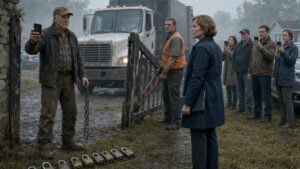
He Measured Fourteen Inches of Stolen Ground—and Uncovered the HOA’s Quietest Betrayal
Chapter 1: Fourteen Inches Beneath a Fishing Boat
The boat was outside Michael Lewis’s kitchen window.
Not beyond the fence. Not passing on the road. Its white hull filled the narrow view above the sink, close enough that he could see dried lake mud along the lower seam and a green registration sticker peeling at one corner.
Michael stood with the coffee pot tilted over his mug until hot coffee spilled across the counter.
He set the pot down and went outside.
The side yard had been a twelve-foot strip of pale gravel the night before. Now two deep trailer ruts ran through it. One wheel had crushed the timber edging around the planting bed. The rear corner of the trailer had struck a cedar fence post and split it near the ground, leaving the post leaning toward Michael’s house.
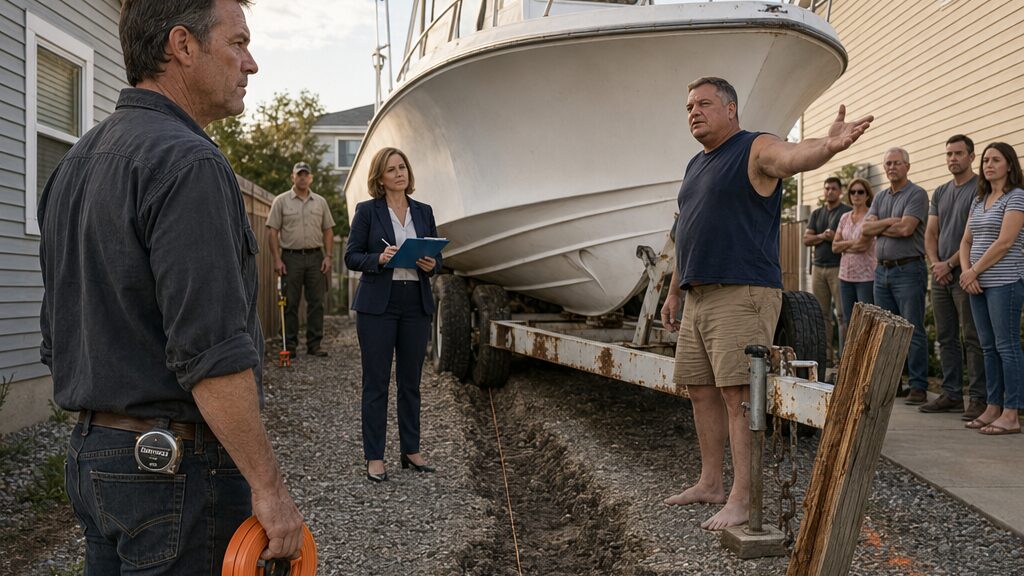
The boat sat diagonally between the homes, its bow near Patrick Hall’s garage and its stern over Michael’s gravel. A faded blue cover had been tied over the cockpit. The engine hung above a patch of displaced stone.
Patrick was tightening a chain around the trailer tongue.
“You hit my fence,” Michael said.
Patrick looked over his shoulder. He wore gym shorts, a navy tank top, and no shoes. “Post was rotten.”
“It was vertical yesterday.”
“That doesn’t make it good.”
Michael crossed the gravel carefully, following the unbroken edge beside the house. The tape measure clipped to his belt knocked once against his thigh.
Patrick noticed it and laughed. “You planning to measure the damage?”
“I’m planning to know where your trailer is.”
Patrick stood. He had always been a large man, but that morning he seemed to occupy more space deliberately. He planted himself between Michael and the trailer tongue.
“The marina changed its storage rules,” he said. “I needed somewhere to put it for a few days.”
“You didn’t ask.”
“I didn’t think I needed an appointment to use my own side.”
Michael looked past him at the nearest trailer tire. Its outer edge rested well beyond the line Michael had always understood as the boundary.
“This isn’t your side.”
Patrick folded his arms. “There it is.”
“There what is?”
“That thing you do. Like everybody else misplaced their property and only you know where it went.”
Michael crouched near the broken post. Gravel had been pushed aside, exposing damp clay and the squared base of the timber. The impact had torn up a small metal landscape staple. He touched the split wood but did not pull it.
Patrick’s voice came from above him. “My brother told me for years you were using fourteen inches of our lot.”
Michael looked up.
Patrick smiled now, pleased by the reaction. “Fourteen stolen inches. That gravel strip of yours jogs over. Always has.”
“Your brother never said that to me.”
“He didn’t like wasting time arguing.”
Michael stood slowly. Patrick’s brother had died the previous winter. Until that moment, Michael had heard Patrick mention him only twice, both times to complain about probate paperwork.
“You drove a boat through my fence because of something he told you?”
“I backed a trailer onto land that belongs to this house.”
“You broke a post.”
“I’ll replace it after we settle the line.”
“We can settle it now. Move the boat.”
Patrick’s smile vanished.
“The boat stays.”
The words carried farther than they needed to. A garage door opened across the street. Someone paused with a trash bin near the curb.
Michael felt heat rise behind his ribs. He imagined releasing the trailer brake and letting the weight answer for him. He imagined calling a tow company before Patrick could find the keys. Instead, he turned toward the front of his lot.
Patrick followed him two steps. “Adults compromise, Michael.”
“Compromise requires permission.”
“No. Compromise means you stop acting like every inch is a federal case.”
Michael glanced back at the hull looming between the houses.
“Fourteen inches mattered enough for you to move a twenty-four-foot boat.”
Patrick’s mouth tightened. “You’ve got until the board looks at it.”
“The board?”
“I called Nicole.”
Of course he had.
Nicole Roberts had served as HOA president for four years and had perfected the expression of someone listening carefully while already knowing which outcome would produce the least paperwork. She arrived twenty minutes later in a silver crossover, carrying a blue folder against her chest.
Patrick met her in the driveway.
Michael remained beside the broken post.
Nicole walked the length of the boat, stopping once to photograph the ruts. “This should not have happened without notice,” she told Patrick.
Patrick spread his hands. “Emergency storage.”
“And property damage?”
“An old post gave way.”
Nicole turned to Michael. “I understand you believe the trailer crosses your boundary.”
“I know it does.”
Her eyes moved briefly to the tape on his belt. “The association has a landscape-maintenance map showing the working division between these lots. According to that map, the gravel edge may not be the legal edge.”
“May not be?”
“The map is not a survey.”
“Then it should not decide where a boat sits.”
“No one is deciding anything this morning.” She opened the folder and showed him a reduced site drawing. A thick green line ran between the houses, several inches inside Michael’s gravel. “This is what our maintenance crews have followed for years.”
Michael studied it without taking the page.
The green line angled around the planting bed and passed close to the damaged post. It was not the line on his recorded plat.
Patrick stepped beside Nicole. “Looks pretty clear.”
“It looks thick,” Michael said. “A marker line that wide could hide half a foot.”
Nicole’s politeness sharpened. “I’m arranging a compliance inspection tomorrow. Until then, neither of you moves or alters anything.”
“The boat is altering my yard by being in it.”
“And an unauthorized tow could create a larger liability issue. Twenty-four hours, Michael.”
Patrick gave a short laugh. “You can survive one day without those fourteen inches.”
Michael looked at him.
Then he smiled.
Patrick’s laugh stopped.
Michael went to the front corner of his lot, where the original subdivision plat placed an iron pin beneath a shallow layer of soil. He retrieved a narrow shovel from the garage and pressed it into the ground. Nicole asked what he was doing, but he did not answer until the blade clicked against metal.
He cleared the dirt with his fingers.
The round head of the survey pin emerged, rust-dark but intact.
“That is one corner,” Nicole said. “It does not establish the whole line.”
“No,” Michael agreed. “But tomorrow it gives us somewhere honest to start.”
He returned to the damaged post after they left. Patrick went inside, leaving the boat’s hull to cast a long white shadow across the gravel.
Michael pulled loose stones away from the split base. Beneath them, half-covered by clay, was a streak of old orange marking paint. It did not run toward the iron pin.
It angled toward Patrick’s garage.
Michael scraped farther with the edge of his shovel.
The paint continued under the broken post.
Chapter 2: The Line That Passed Under the Hull
By two o’clock Tuesday, Patrick was standing on the trailer tongue as though it were a stage.
Six neighbors had gathered along the sidewalk. Two more watched from a shaded porch across the street. Patrick had apparently told them the HOA was coming to settle Michael’s “fourteen-inch land grab,” because the phrase traveled through the group in lowered voices before Nicole even arrived.
Michael carried a reel of orange mason’s line, two steel stakes, a mallet, and a copy of his recorded plat.
The county survey technician arrived in a dusty pickup but remained near the curb, explaining that he had been asked only to identify visible monument references, not perform a certified resurvey. Nicole repeated that limitation loudly enough for everyone to hear.
“We are here to document conditions,” she said. “Not conduct a trial.”
Patrick rested one hand on the boat’s winch. “Good. Maybe we can get him to stop treating this like one.”
Michael placed his tools beside the exposed iron pin.
Nicole opened her blue folder. “Before we start, I want to suggest a reasonable interim solution. The HOA maintenance line is here.”
She pointed to a faint orange mark running through the gravel. Someone had refreshed a short section since the previous morning. Michael could smell new aerosol paint.
“We could treat that as a temporary boundary,” Nicole continued, “and ask Patrick to shift the trailer enough to avoid further damage.”
“Shift it where?” Michael asked.
Patrick answered. “Onto my side.”
“You mean farther into my yard.”
A neighbor near the sidewalk murmured something about stubborn men.
Nicole lowered her voice. “Michael, a temporary compromise prevents escalation.”
“Record the measured line first.”
“The map already reflects years of accepted use.”
“Record the measured line.”
Patrick stepped off the trailer tongue. “You hear yourself? Fourteen inches. That’s what this is about. You’d turn the whole neighborhood upside down over fourteen inches.”
Michael drove the first steel stake beside the iron pin.
The mallet struck three times.
The watching neighbors went quiet.
At the rear of the lots, the plat referenced a second monument near the storm inlet. The county technician located it beneath compacted mulch and confirmed the cap number against the subdivision record. Michael thanked him, then tied the orange cord to the front stake and walked it toward the rear.
The line pulled taut through the narrow side yard.
It crossed the crushed post.
It continued toward the trailer.
Patrick’s expression changed before anyone spoke.
The orange cord met the outer sidewall of the nearest tire, climbed slightly where the rubber pressed against it, then disappeared beneath the boat’s shadow.
Michael crouched and fed the line under the trailer frame. The cord emerged beyond the axle, bright against Patrick’s darker gravel.
Nicole stared at it.
“Measure from the cord to the tire edge,” Michael said.
“I brought a tape,” Patrick said quickly.
“So did I.”
Michael hooked the tape against the stretched line and extended it to the trailer’s outermost point.
The yellow blade lay flat across the gravel.
Fourteen inches.
One of the neighbors whispered the number before Michael did.
Patrick climbed down from the tongue. “That pin could have moved.”
“The technician confirmed both monuments,” Michael said.
“He said he wasn’t certifying a survey.”
“He confirmed the monuments shown on the recorded plat.”
Nicole knelt beside the tape. “Measure again.”
Michael retracted it and repeated the process from a second point near the rear axle.
Thirteen and seven-eighths.
He moved to the widest metal support.
Fourteen and one-quarter.
“The encroachment varies with the trailer angle,” he said. “Fourteen inches is a fair average.”
Patrick’s face reddened. “You practiced that line?”
Michael turned to Nicole. “Please enter the measurements in the inspection log.”
She remained kneeling for a moment. Then she stood and wrote.
The scratch of her pen was the first small victory Michael had felt since seeing the boat outside his window.
Patrick heard it too.
“You’re writing down his version?”
“I am recording a physical measurement.”
“On a line he set.”
“Between monuments identified on the plat,” the technician said from the curb.
Patrick looked toward the neighbors, but their attention had shifted to the orange cord beneath the hull. The visual argument was too plain. A boat large enough to dominate both houses had been defeated, for the moment, by a line no thicker than twine.
Nicole closed the log. “This establishes an apparent discrepancy. It does not resolve why the association map differs.”
Michael pointed toward the faded orange paint near the broken post. “Then record that too.”
The technician crouched beside it. He brushed away gravel and exposed several more inches. The old mark ran parallel to the green line on the HOA map, not the legal boundary.
“That looks like utility or construction paint,” he said.
“Maintenance used orange,” Patrick said. “Always did.”
Michael looked at him. “You knew about it?”
“Everybody knew where the crews stopped mowing.”
“That is not the same as a property line.”
“It was treated like one.”
Nicole pulled out the reduced maintenance map. She held it over the ground, comparing the printed green path to the orange paint.
They aligned.
A murmur traveled through the neighbors again, but this one did not belong entirely to Michael. The legal line was clear. So was the evidence that the neighborhood had behaved differently for years.
Patrick seized on it. “There. That’s the line we used. That’s the line his gravel followed until he widened it.”
Michael looked toward the planting bed. Its timber edge had been replaced twice, but the shape had remained nearly the same.
“When did the association adopt this map?” he asked Nicole.
“It has been in the maintenance binder since before my term.”
“Who prepared it?”
“I’ll have to check.”
“Was it filed with the county?”
“It is not a legal plat.”
“Then why did you cite it yesterday?”
Nicole’s jaw tightened. “Because it documents established practice.”
Patrick stepped closer to Michael. “Established practice you accepted.”
Michael met his eyes. “Did I?”
“You helped make it.”
Patrick went to his garage. He returned carrying a clear plastic sleeve with an old photograph inside.
The image had faded toward blue. It showed a younger Michael beside two men spreading pale gravel along the side yard. One of the men was Patrick’s brother. Behind them, an orange painted line curved past the same post.
Michael’s hand was on the handle of a wheelbarrow.
Patrick held the photograph up for the neighbors.
“Tell them,” he said. “Tell everybody you didn’t know where that line was.”
Michael recognized the date before he saw it printed in the corner.
He also recognized the open bedroom window of his house in the background and the pale curtain his wife had tied back so she could watch them work from inside.
Chapter 3: The Photograph Michael Could Not Explain
Katherine placed the photograph on Michael’s desk beside the recorded plat.
She did not sit down.
“Is it real?”
Michael looked through the office window. The boat remained outside, its hull silvered by the last light. The orange mason’s line had been removed after the inspection, but two steel stakes still marked its path.
“Yes.”
“You helped put the gravel there.”
“Yes.”
“Along the HOA line.”
He aligned the photograph with the edge of the plat, though there was nothing left to compare. “Along the line the maintenance crew marked.”
Katherine crossed her arms. She had inherited her mother’s ability to wait through incomplete answers without rescuing the speaker.
Michael opened a legal pad. At the top he wrote: REMOVAL REQUIREMENTS.
Below it:
Licensed marine hauler.
Insurance release.
Written notice.
County access confirmation.
Drain clearance.
Fourteen inches.
Katherine read the last line upside down.
“You’re making a checklist.”
“I need the process clean.”
“You need to tell me why Patrick has a picture of you building the boundary you now say is wrong.”
“I didn’t build a boundary. We spread gravel.”
“That is not an answer.”
“It is the accurate description.”
She leaned forward and put one finger on the photograph. “Mom is inside that window, isn’t she?”
Michael’s pen stopped.
The curtain was visible as a white triangle behind the glass. His wife had been too weak to come outside that day. She had insisted on watching because the side garden was hers, and because Patrick’s brother had volunteered to finish the gravel before the next round of appointments.
Katherine lowered her voice. “You knew.”
“I knew the paint did not match the plat.”
“And you said nothing.”
“Not then.”
“Why?”
Michael closed the legal pad. “The inspection is tomorrow. I need to find out what lies under the trailer before anybody moves it.”
Katherine stepped back as though he had pushed her.
“You turn every question into a task.”
“This task can stop two houses from being damaged.”
“And the other question?”
He did not answer.
She picked up the photograph, slid it into its sleeve, and left it on the desk.
“Patrick is wrong about the boat,” she said at the door. “But that doesn’t automatically make you honest.”
The next morning Michael entered the HOA records room with Nicole beside him. It occupied the rear of the clubhouse and smelled of cardboard, toner, and old carpet. Metal shelves held meeting minutes, vendor contracts, architectural requests, and binders labeled by year.
Nicole unlocked a cabinet. “You have one hour. Nothing leaves the room.”
“I only need copies.”
“Copies require board approval.”
“Then I’ll photograph relevant pages.”
She considered objecting, then checked her watch. “Relevant pages only.”
The maintenance binder contained the same green-line map she had shown him. Behind it were work orders for a drainage improvement completed nine years earlier, when water had collected between the two houses after heavy storms.
Michael scanned the invoices.
Excavation. Perforated pipe. Gravel backfill. Inlet connection. Landscape restoration.
On the original contractor proposal, the trench was located within a recorded HOA drainage easement. A handwritten change order shifted the trench toward Patrick’s lot.
Reason: root obstruction and access limitations.
The drawing attached to the change order showed a new centerline, but no dimensions from the legal boundary.
Michael placed the recorded plat beside it.
Nicole watched him trace the two diagrams. “What are you seeing?”
“The approved drain should sit twenty-four inches from the lot line.”
“And?”
“The maintenance map appears to use the edge of the backfill as the working division.”
“That could explain the paint.”
“It does not explain why the trench moved.”
“The note says roots.”
“There were no mature trees in that strip nine years ago.”
Nicole’s expression closed. “You cannot know that from this file.”
“I lived there.”
“You also helped spread the restoration gravel.”
Michael looked at her.
She had seen the photograph. Patrick had made sure of that.
Nicole continued more carefully. “Which means the association may argue that both owners accepted the completed work.”
“Acceptance does not relocate a deeded line.”
“No, but it complicates an enforcement decision.”
Michael turned another page.
The final invoice charged the association for forty feet of additional pipe and two extra loads of gravel. Beside the amount was a note: Field adjustment approved.
The initials were difficult to read.
R.G.
Michael photographed the page.
Nicole reached over and closed the binder. “Your hour is nearly finished.”
“It has been twenty-six minutes.”
“We are done until counsel reviews this.”
He held her gaze, then gathered his phone and plat.
Outside, a flatbed truck was parked near his driveway. The licensed marine-hauling foreman stood beside it, studying the narrow access between the houses.
Michael joined him.
The foreman pointed toward the trailer wheels. “We can move the boat. Question is whether we should move it from there.”
“What’s the concern?”
“Ground feels hollow along this edge.”
He stamped one boot lightly on the gravel. The sound changed beneath the boat, dull at first, then faintly drumlike.
“Drainpipe?” Michael asked.
“Could be. Could be washed-out base. Trailer’s putting a lot of load on one side.” The foreman crouched and examined the rut. “If there’s perforated pipe under that tire, pulling sideways could crush it or tear the connection.”
“I can get the plans.”
“Get someone to mark the actual pipe. Plans tell you where it was supposed to go.”
The sentence stayed with Michael.
By noon he had drafted a formal notice giving Patrick an opportunity to arrange voluntary removal after subsurface verification. He photographed the notice on Patrick’s door and emailed copies to Nicole and the HOA attorney.
At three, Nicole replied that the association disputed Michael’s authority to remove the boat until the maintenance-boundary question was resolved.
At four, Katherine called. He let it ring out.
At five, Michael returned to the invoice photographs.
He enlarged the field-adjustment page until the initials filled the screen.
R.G.
Raymond Garcia had coordinated volunteer maintenance for the HOA during those years. He had supervised drainage cleanouts, fence repairs, and contractor access. He had also been one of the men in Patrick’s photograph, half-hidden behind the wheelbarrow.
Michael found Raymond’s number in an old contact list and called.
The line rang six times.
Raymond answered without greeting.
Michael said, “I found the drainage change order.”
Silence followed.
Then Raymond exhaled.
“You need to stop digging beside that post,” he said.
“What did you put under it?”
Raymond did not answer the question.
Instead, he said, “Meet me at the clubhouse tomorrow before Nicole gets there.”
Chapter 4: What the HOA Buried Beside the Fence
Raymond Garcia was waiting beside the clubhouse dumpster when Michael arrived.
He wore a faded work jacket despite the warmth and held a ring of old brass keys in one hand. He did not offer a greeting. He unlocked the rear service door, glanced toward the parking lot, and motioned Michael inside.
“You came alone?” Raymond asked.
“Yes.”
“Nicole?”
“Not here yet.”
“She will be.”
The storage room was narrower than the records room and crowded with folded tables, broken sprinkler heads, bags of ice melt, and paint cans labeled by year. Raymond moved directly to a metal shelf in the back and pulled down a red plastic toolbox.
He did not open it.
“You asked what we put under the post,” he said. “The answer is a drain. But not where the plan says.”
Michael waited.
Raymond stared at the toolbox latch. “The contractor hit roots along Patrick’s side. Not tree roots. Old construction debris. Concrete chunks, wire mesh, pieces of the original curb pour. He said digging through it would cost another day.”
“There were no trees,” Michael said.
“I know.”
“So the change order was false.”
“It was convenient.”
Raymond finally opened the box. Inside were grease pencils, rusted utility flags, and a roll of brittle orange marking ribbon.
“The board at the time wanted the flooding fixed before the annual meeting. The contractor shifted the trench toward your lot. We marked the new path with orange paint.”
“Outside the recorded easement.”
“Partly.”
“How far?”
Raymond rubbed his thumb along the ribbon. “Fourteen inches at the tightest point.”
The number landed without surprise. Michael had already suspected it. Hearing it spoken still tightened something behind his ribs.
“And the post?”
“We set it where the gravel edge looked clean. It covered the bend in the pipe.”
“You used my fence post to hide the field adjustment.”
Raymond looked up sharply. “We didn’t think of it that way.”
“What way did you think of it?”
“As finishing the job.”
Michael took the old photograph from his folder and placed it on the toolbox. Raymond’s younger face appeared behind the wheelbarrow, turned partly away from the camera.
“You knew the paint did not match the legal line.”
Raymond nodded once.
“So did I.”
“That is why I called you.”
“No. You called because I found your initials.”
Raymond flinched but did not deny it.
Footsteps sounded in the hallway.
Nicole appeared in the doorway carrying her blue folder. “I wondered why the rear door was open.”
Raymond closed the toolbox.
Nicole’s gaze moved from him to Michael, then to the photograph. “This is not an authorized records review.”
“It is a conversation,” Michael said.
“In association storage.”
“With the man who approved the drainage shift.”
Raymond looked at the floor.
Nicole went still. “Approved what shift?”
Michael watched her closely. “You have not read the change order?”
“I read what was available.”
“Then read the field note beneath the invoice.”
Nicole’s face hardened, but the defensiveness arrived too quickly. “The association’s attorney has advised that no excavation, towing, marking, or alteration occur until the board determines jurisdiction.”
“The trailer may be sitting over a perforated drain.”
“That has not been established.”
“It was just established by the man who marked it.”
Nicole turned to Raymond. “Did you perform a subsurface verification?”
“No.”
“Did you retain a certified as-built survey?”
“No.”
“Then nothing has been established.”
Raymond’s shoulders sank. Michael saw what Nicole was doing: converting memory into uncertainty, uncertainty into procedure, and procedure into delay.
“The pipe is outside the easement,” Michael said.
Nicole looked at him. “If you excavate association-maintained drainage without approval, you may be fined for damaging common infrastructure.”
“It lies on my property.”
“That is one of the questions under review.”
“No. The lot line is recorded. The easement is recorded. The only unrecorded item is your working map.”
Her grip tightened on the folder. “Do not confuse confidence with authority.”
Michael almost laughed. It was the sentence Patrick would have chosen if he had known the words.
Instead, he gathered the photograph and turned to Raymond. “Show me where the pipe bends.”
Nicole stepped into his path. “I am formally instructing both of you not to disturb the site.”
“Then come watch.”
Outside, the boat seemed even larger after the cramped storage room. Its left trailer wheel had sunk deeper into the rut, compressing the gravel into a hard dark track.
Raymond stood beside the broken post. For several seconds he did nothing. Then he placed one boot against the timber base and pointed toward the boat.
“The trench came through here. It bent around the debris and ran under that wheel before turning back toward the inlet.”
Michael paced the distance.
He measured from the legal line to the faded paint.
Fourteen inches.
Then he measured from the paint to the visible edge of the trailer rut. Less than three.
“The pipe needs clearance on both sides,” he said.
Raymond nodded. “It was backfilled with washed stone. If the wheel crushed the bedding, water could be trapped.”
Nicole opened her folder. “I am issuing a temporary compliance hold.”
“On the boat?”
“On all action by either owner. No removal. No excavation. No additional stakes.”
Michael looked at the hull. “So the object causing the risk stays, but I am prohibited from confirming the risk.”
“Until the attorney and insurer respond.”
“How long?”
“I cannot promise.”
Patrick came out through his side door. He had been listening from inside.
“This mean he can’t touch it?” he asked.
Nicole did not answer immediately. “It means neither of you may alter current conditions.”
Patrick’s relief was visible. “Good.”
Michael turned toward him. “Your trailer may be crushing a drain.”
Patrick’s eyes flicked to Raymond, then back. “That drain has worked for years.”
“It was not carrying a boat for years.”
“You’re trying another angle because the boundary argument didn’t finish the job.”
“The boundary argument is finished.”
“Then why isn’t the boat moving?”
Nicole cut between them. “Because there are competing responsibilities.”
Patrick gave Michael a small, satisfied shrug.
Michael understood then that winning the measurement had changed less than he wanted. The physical truth was recorded, but the institution that had relied on the wrong line now had every reason to slow the consequences.
He spent the afternoon at the county records counter.
The clerk retrieved the subdivision plat, drainage easement, and original permit set. The approved drain alignment was clear. No amended easement appeared in the index. No corrected as-built drawing had ever been filed.
A county drainage inspector reviewed the documents without offering a formal opinion.
“If the installed line crosses private property outside the easement,” the inspector said, “that is a title and maintenance issue. If it is obstructed, it becomes a drainage issue too.”
“Can the county stop the HOA from leaving a trailer over it?”
“Not without verifying the pipe and an immediate hazard.”
“The HOA forbids excavation.”
“Then they should commission a noninvasive locate.”
“Before the next storm?”
The inspector looked toward a monitor behind the counter. A weather alert banner ran across the bottom of the screen.
Heavy rainfall expected Friday evening.
“How much?” Michael asked.
“Three to five inches, depending on the cell.”
Michael returned home carrying certified copies.
A notice had been taped to his front door.
TEMPORARY ENFORCEMENT HOLD.
Below it, in smaller text, the association warned that unauthorized excavation or towing could result in fines, repair liability, and suspension of common-area privileges.
Patrick stood beside the boat reading the same notice on his phone.
“You got one too?” Michael asked.
Patrick shook his head. “Nicole sent me confirmation that the boat stays until review.”
Michael looked at the trailer wheel sunk over the hidden drain.
Across the street, sprinklers clicked on and sent clean arcs of water across a lawn that had nowhere difficult to go.
His phone vibrated.
The county weather service had upgraded the forecast.
Flash-flood conditions possible Friday night.
Chapter 5: The Night the Water Chose Its Boundary
By eight Friday evening, water covered the bottom third of the trailer tires.
It did not rush dramatically. It collected with patient force, filling the wheel ruts, spreading beneath the boat, and pressing against the timber border of Michael’s planting bed.
Michael stood in the rain with a flashlight and watched the level climb over the first mark he had scratched into the broken post.
The storm drain at the curb was clear. The problem was between the houses.
He called Patrick.
No answer.
He called again and saw a light come on next door. A moment later Patrick opened the side door, wearing a rain jacket over his clothes.
“What?” he shouted.
“The water is backing up.”
Patrick looked at the trailer. “It always puddles there.”
“It is six inches deep at the axle.”
“It’ll drain.”
“The pipe is compressed.”
“You don’t know that.”
Michael shone the flashlight along the waterline. “Then help me move the trailer two feet so we can relieve the load.”
Patrick stepped beneath the eave but no farther. “The hold says no movement.”
“The hold was written before the flood warning.”
“I’m not violating it so you can claim I admitted fault.”
“This is not about fault.”
“It is always about fault with you.”
Water reached the lower edge of the gravel bed. A thin stream began moving toward Michael’s foundation.
He took out his phone and called Nicole. The call went to voicemail. He called the HOA emergency number and reached a recorded message directing residents to contact local services for life-threatening conditions.
He tried the marine-hauling foreman.
“We cannot mobilize without written authorization,” the foreman said over the rain. “And not during lightning.”
“What can I do?”
“Relieve the water. Do not pull the trailer sideways. If the ground washes out, the boat could shift.”
Michael ended the call.
Patrick had gone back inside.
For a moment Michael stood alone between the houses, rain striking the boat cover with a hollow drumming sound. He could let the water rise. He could document it. He could allow Patrick’s trailer and the HOA’s delay to produce the evidence no meeting could dismiss.
Then he saw the stream reach the first row of stones in the garden his wife had planted.
The bed curved along the house with low boxwoods, daylilies, and a narrow strip of lavender. She had designed it from a hospital recliner, pointing at catalog pictures while Michael held a ruler over the plan. The drainage path she left between the bed and the gravel was exactly fourteen inches wide.
He had never told anyone why.
Michael went to the garage and returned with a trenching shovel.
Katherine pulled into the driveway as he drove the blade into the garden edge.
She ran toward him without an umbrella. “What are you doing?”
“Making an outlet.”
“That is Mom’s bed.”
“I know.”
He cut through the timber border.
Water pushed into the opening at once, carrying gravel and mulch through the gap. He widened the cut toward the front yard, sacrificing two lavender plants and the corner of the daylilies.
Katherine grabbed his arm. “Stop for a second.”
“If I stop, it reaches the slab.”
“What about Patrick’s side?”
“His grade is higher.”
“So yours takes all of it.”
Michael pulled free and drove the shovel down again.
The temporary channel opened.
Water moved through it in a brown, fast ribbon. The level beneath the trailer dropped half an inch, then held.
“Not enough,” Michael said.
The trailer wheel had settled farther. The hull leaned slightly toward his house.
Patrick appeared again, this time carrying a flashlight.
“You cut your garden?”
Michael ignored him. “The trailer needs to be stabilized before the base washes out.”
“I said we’re not moving it.”
“We do not have to move it. We have to keep it upright.”
Patrick stared at the boat. The lean was visible now.
Michael fetched two heavy wheel chocks and a length of timber. Patrick watched until the trailer gave a low metallic groan.
Then he stepped into the water.
“Where?” he asked.
Michael pointed. “Chock the uphill wheel. I’ll brace the frame.”
Patrick waded around the bow. Water filled his shoes. Together they forced the timber beneath the trailer rail and drove the chock into place with Michael’s mallet.
The boat shifted once.
Patrick put both hands against the frame as though he could hold the weight himself.
“Easy,” Michael said. “Do not stand under the hull.”
“I know boats.”
“You do not know saturated gravel.”
Patrick looked at him, anger ready, then swallowed it.
They worked without speaking for the next twenty minutes. Katherine held both flashlights. Michael deepened the runoff channel. Patrick cleared floating mulch from the opening and stacked stones to keep the water from cutting toward the foundation.
When the level finally began to fall, they stood beneath the boat’s shadow, breathing hard.
Patrick looked at the torn garden. “You could’ve let it flood my trailer.”
“It would have flooded my house first.”
“You still could’ve let the ground drop under it.”
Michael rinsed mud from the shovel blade with rainwater. “And send a twenty-four-foot boat into my wall?”
“That’s not the only reason.”
Michael looked at him.
Patrick rested one hand on the trailer fender. His voice changed.
“The marina didn’t change its rules.”
Michael waited.
“I stopped paying.”
Rain ran from Patrick’s hood onto his face.
“My brother left me the boat and the loan. Storage was another four hundred a month. I thought I could sell it, but every offer was less than what’s owed.”
“So you put it here.”
“He always said that strip was ours. He said the HOA moved the line when the drain went in.”
“He was wrong about the property line.”
“Maybe. But he wasn’t lying to me.”
Michael understood the distinction Patrick needed. It did not excuse the broken post or the intimidation. It did explain why each measurement had sounded to him like an accusation against the dead.
Patrick looked up at the covered cockpit. “Last summer before he got sick, we took it out before sunrise. He could barely climb aboard. Sat in the stern for three hours and didn’t catch anything. Best morning we had all year.”
Michael looked toward the channel cutting through the lavender bed.
“My wife planned that garden,” he said.
Patrick followed his gaze. “I figured.”
“She left exactly enough space for runoff.”
“Fourteen inches?”
Michael nodded.
Patrick gave a tired breath that was almost a laugh. “Of course.”
The rain eased after midnight. The channel continued carrying water toward the street. Neither foundation flooded. The trailer remained upright.
Nicole arrived the next morning with the county drainage inspector and an insurance adjuster. She stood beside the damaged planting bed, taking photographs.
“You altered association drainage without authorization,” she said.
Michael pointed to the temporary channel. “I prevented structural damage.”
“You also changed grade.”
“For one night.”
The inspector interrupted. “The temporary cut was appropriate under the conditions.”
Nicole’s mouth tightened.
The inspector used a locator wand along the faded orange line. Near the broken post, the instrument gave a clear signal. It continued beneath the trailer wheel, then curved back toward the approved easement.
“The pipe is there,” he said. “And the wheel load is directly over the bend.”
Patrick looked at Michael but said nothing.
The adjuster photographed the rut and asked who had placed the boat.
“I did,” Patrick said.
It was the first time he had answered without qualification.
Katherine arrived carrying coffee. She stopped at the torn garden edge. Mud covered the spot where the lavender had been.
Michael expected anger. Instead, she watched Patrick help the inspector move a loose timber brace out of the way.
“You protected his boat,” she said quietly.
“I protected both houses.”
“You could have let him lose it.”
“Yes.”
“But you didn’t.”
Michael took the coffee she offered.
Katherine looked at the broken bed, then at the old curtain visible through his bedroom window.
“What promise are you still keeping?” she asked.
Michael did not answer.
This time, she did not let him turn toward the inspector or the paperwork.
“Dad,” she said, “what did Mom ask you not to fight about?”
Chapter 6: The Promise Behind Michael’s Silence
Nicole had enlarged the photograph to poster size.
It stood on an easel at the front of the clubhouse, beside the HOA maintenance map and the recorded subdivision plat. In the photograph, Michael’s younger self pushed a wheelbarrow along the orange painted line while Patrick’s brother and Raymond spread gravel behind him.
Every chair in the room faced it.
Nicole opened the emergency hearing by pointing to Michael’s hand on the wheelbarrow.
“This image demonstrates longstanding owner participation in the maintenance boundary now under dispute.”
Michael sat at the end of the first row beside Katherine. Patrick sat across the aisle, shoulders bent, his hands clasped between his knees.
The HOA attorney occupied a small table near the board. The county drainage inspector stood at the rear wall, invited only to answer technical questions.
Nicole continued. “No one disputes that the recorded plat places the legal boundary in a different location. The issue is whether prior conduct, association maintenance, and owner reliance create obligations that cannot be resolved by unilateral removal.”
Unilateral.
Michael looked at the photograph.
His wife’s curtain showed behind his shoulder, pale and almost invisible.
Nicole invited him to respond.
He stood but did not approach the microphone.
“The photograph is genuine,” he said.
A movement passed through the room.
Nicole had expected resistance. Michael saw it in the way she glanced at the attorney.
“I helped spread that gravel,” he continued. “I knew the orange line did not match my plat.”
Patrick raised his head.
Katherine remained still beside him.
Nicole said, “Then you acknowledge accepting the working boundary.”
“No.”
“You participated in creating it.”
“I participated in restoring the yard after the drain installation.”
“While knowing the line differed.”
“Yes.”
The room tightened around the admission.
One of the board members leaned toward Nicole and whispered. The attorney made a note.
Michael walked to the easel. He placed a printed photograph of the fourteen-inch measurement beside the older image.
“The legal line is here,” he said, touching the new photograph. “The painted maintenance line is here. The drain was shifted outside its easement and buried beneath the gravel. The HOA then treated the edge of that work as though it were a property boundary.”
Nicole folded her hands. “And you allowed that treatment to continue.”
“Yes.”
Patrick stood suddenly. “Why?”
The question did not sound angry. That made it harder.
Michael looked toward Katherine.
She had asked him the same thing in the rain, but the answer had belonged to a room he had avoided entering for nine years.
“My wife was sick,” he said.
No one moved.
“The drainage job happened during the last year of her illness. There were contractors between the houses, board emails, complaints about access, and arguments over who would pay for the extra excavation. I found the discrepancy while they were working.”
He touched the old photograph near the window.
“She asked me not to turn the yard into another fight. She wanted to sit by that window and see the garden finished before winter.”
Katherine lowered her eyes.
Michael continued because stopping would turn the truth back into concealment.
“I told myself the legal documents would still exist when things were quieter. I told myself fourteen inches could wait. Then she died, and correcting the line meant admitting I had let the wrong one stay. So I did what I have done too often. I said nothing and called it restraint.”
Patrick looked at the enlarged photograph. “My brother thought the line was real.”
“The HOA treated it as real.”
“And you knew it wasn’t.”
“Yes.”
Patrick’s face tightened. “You let him believe our family had been right all those years.”
“I let everyone believe the issue did not matter.”
“It mattered when you wanted my boat gone.”
“It mattered before that. I refused to say so.”
Nicole stepped in. “This is precisely why a confidential settlement may be best. Both owners relied on inconsistent information. The association is prepared to coordinate removal, repair the drainage, and divide costs without assigning public fault.”
The attorney slid a document toward Michael.
Nicole lowered her voice. “The terms would prevent further claims based on the historical mapping error.”
Michael did not touch the paper.
“What claims?” a resident asked from the back.
Nicole turned. “This hearing concerns two lots only.”
The attorney spoke for the first time. “If maintenance maps differ from recorded plats elsewhere, broad statements could create unnecessary uncertainty.”
Raymond stood near the rear door. “They do differ elsewhere.”
Nicole looked at him sharply.
Raymond swallowed. “Not every lot. But more than two.”
Whispers rose across the room.
The attorney stood. “We should recess.”
“No,” Michael said.
Nicole faced him. “You have already acknowledged complicity.”
“I acknowledged silence.”
“Silence that created reliance.”
“Yes. Mine and the association’s.”
The distinction settled over the room.
Michael picked up the proposed agreement. The first page offered drainage repair, fence replacement, and coordinated boat removal. The second required confidentiality and released the association from all historical boundary claims.
It would give him nearly everything he wanted.
Patrick’s boat would leave. The post would be replaced. The gravel restored. The garden repaired.
All he had to do was allow the incorrect map to remain a private mistake.
Katherine watched him read.
Patrick watched too, but without the old challenge in his face.
Nicole said, “This resolves the immediate harm.”
Michael thought of the water choosing the path left for it. He thought of the orange paint disappearing under timber, gravel, habit, and grief.
Then he tore neither page nor contract.
He simply set the agreement back on the attorney’s table.
“No confidential settlement.”
Nicole’s composure slipped. “You may lose the cost protections offered here.”
“I understand.”
“You may expose yourself to a reliance claim.”
“I understand that too.”
“Then what are you asking for?”
Michael turned toward the board, the residents, and Patrick.
“Enter the recorded plat into the HOA maintenance records. Disclose the drainage shift. Inspect every lot where the working map replaced a legal description. Vote in public on the correction.”
The attorney said, “That could trigger association-wide expense.”
Michael looked at Nicole.
“That expense already exists,” he said. “Silence only decides who discovers it last.”
Patrick rose slowly across the aisle.
For one moment Michael thought he would object.
Instead, Patrick looked at the enlarged photograph of his brother, then at the new measurement beside it.
“I want the boat moved,” he said. “But I want the real line recorded first.”
Nicole stared at him.
Patrick sat down again.
The room had not applauded. No one smiled. Several residents looked frightened by what the correction might cost them.
Michael preferred it that way.
Truth had finally entered the record without pretending to be painless.
Chapter 7: Inch by Inch, Without Taking Everything
The marine hauler arrived Monday morning with a county-approved diagram taped inside the windshield.
The foreman stepped from the cab carrying a clipboard and walked directly to Michael’s front door before anyone touched the boat.
“We have a revised pull path,” he said. “Straight forward six feet, slight turn toward Patrick’s driveway, then onto the flatbed. No sideways load over the drain.”
Behind him, workers placed rubber mats across the gravel and set steel plates near the trailer wheels. A county drainage inspector marked the buried pipe with blue flags. The line curved beneath the rear axle exactly where Raymond had described it.
Patrick stood beside the garage with both hands in his jacket pockets. He had removed the faded blue cover from the boat. The open cockpit made it look smaller somehow—not less heavy, but less defiant.
Nicole arrived with the HOA attorney and two board members. She carried a new binder instead of the blue folder.
Michael noticed that before he noticed anything else.
The orange mason’s line had been stretched again between the verified pins. It ran beneath the trailer frame, bright and level in the morning light.
The foreman handed Michael a form.
“This authorizes removal from your property and confirms the pull plan. There’s also a storage election.”
Michael read the lower section.
If Patrick failed to pay the hauling and marina-transfer costs, Michael could claim a possessory lien against the boat and direct it to secured storage. After the required notice period, he could begin an impound process.
Patrick watched him read.
“The marina gave me thirty days,” Patrick said. “I can make the first payment Friday. They’ll hold the slip if the boat arrives today.”
The foreman tapped the form. “We need both owners to sign the damage allocation before we start.”
Patrick took the clipboard first.
The agreement assigned him responsibility for the broken fence post, damaged gravel, timber border, and the initial hauling charge. The HOA accepted responsibility for locating and repairing the misplaced drain. Michael was responsible for restoring the part of the garden he had cut during the storm, though the association would reimburse the materials because the emergency channel had prevented broader damage.
Patrick read every line.
When he reached the fence provision, he stopped.
“I can’t pay all of this at once.”
Michael said nothing.
Nicole opened the new binder. “The association has approved a six-month payment schedule for Patrick’s portion. That is contingent on his written acknowledgment of the encroachment and damage.”
Patrick looked at her. “You already voted?”
“Saturday evening.”
“In public?”
Nicole’s mouth tightened slightly. “With minutes.”
Michael looked at the binder again.
Patrick signed.
The pen hesitated only once, above the line stating that the recorded property boundary—not the historic maintenance map—controlled future use.
Then he pressed his name firmly onto the page.
The foreman turned to Michael. “Your signature releases us to proceed.”
Michael signed beneath Patrick.
The workers attached straps to the trailer and connected the winch cable. One man crouched beside the buried drain, watching the steel plate for movement. Another stood at the bow giving hand signals.
The winch engaged.
For several seconds, nothing happened.
The cable tightened until it gave a high metallic hum. The trailer hitch creaked. Gravel shifted beneath the mats.
Then the nearest wheel turned.
The boat moved forward less than an inch.
Patrick took one involuntary step with it.
The foreman raised a hand. The winch stopped while the drainage inspector checked the blue flags.
“No movement at the pipe,” the inspector said.
The pull resumed.
The orange boundary line slid from beneath the axle. An inch of Michael’s gravel appeared, then two, then the full width of the compressed rut.
No one spoke.
The operation was too slow for celebration. Every few feet, the crew stopped to reposition plates, inspect the trailer, and confirm that the ground remained stable. The hull gave low groans as the weight shifted from the damaged strip toward Patrick’s driveway.
Michael stood beside the broken post.
For days, he had imagined this moment as a clean reversal: the boat leaving, Patrick silenced, the line restored. Instead, he found himself watching Patrick’s face.
Patrick did not look defeated.
He looked as though something was being taken from him even while it was being saved.
When the stern finally crossed the orange cord, the foreman called, “Clear.”
The boat stood entirely on Patrick’s side for the first time since Monday.
One of the workers began winding up the mason’s line.
“Leave it,” Michael said.
The worker paused.
Michael stepped forward and released it from the front stake himself. The cord went slack in his hands.
The foreman approached with a second document.
“Marina transfer is confirmed, but the account balance is not covered. Under the signed election, you can still direct us to secured impound if you prefer. That gives you stronger leverage on the damage costs.”
Patrick stared at the boat.
Nicole looked between the two men. She did not offer advice.
Michael read the form.
He could take control without breaking a rule. Patrick had put the boat on his land, refused to move it, damaged the yard, and used the HOA’s mistake as a weapon. The impound provision existed for precisely that kind of unpaid liability.
Katherine stood near the garden, holding two small trays of replacement lavender. She said nothing.
Michael thought of the confidential agreement he had rejected. A lawful option could still be the wrong boundary.
He handed the form back unsigned.
“Send it to the marina.”
The foreman glanced at Patrick. “You understand the transfer debt remains yours?”
Patrick nodded.
“And the property-damage schedule?”
“I signed it.”
The foreman folded the form into the clipboard. “Marina it is.”
Patrick looked at Michael. “You could’ve kept it.”
“I could have tied the damage to it.”
“Why didn’t you?”
“Because removing what crossed the line is enough.”
Patrick’s eyes dropped. “I didn’t think you knew what enough was.”
“Neither did I.”
The workers loaded the boat onto the flatbed. The tires climbed the ramps, one at a time, until the hull rose above both men and settled into the supports.
As the truck pulled away, Patrick kept his hands in his pockets. He watched until the stern disappeared beyond the curve of the street.
No one applauded.
The only sound left was the clatter of workers stacking steel plates.
Nicole opened the new HOA binder on the hood of her crossover.
Inside was a certified copy of the subdivision plat, a list of affected maintenance maps, and the board’s corrective resolution. She called the remaining residents closer, but her voice carried none of the polished certainty it had before.
“The association has entered the recorded plat as the controlling reference for these lots,” she said. “The historic landscape map is withdrawn. A licensed survey review will be offered wherever maintenance boundaries conflict with recorded documents.”
A resident asked who would pay.
Nicole paused. “The association will cover the initial review. Repairs and adjustments will be determined by responsibility.”
Another asked whether dues would rise.
“They may.”
No one thanked her.
Nicole looked toward Michael. “The drain replacement begins next week. The fence and gravel restoration are approved.”
Michael nodded.
It was not forgiveness, and it was not triumph. It was a correction entered where a concealment had once been easier.
Three weeks later, the trench beside the houses was open again.
The contractor removed the crushed section of perforated pipe and reset the drain within the recorded easement. Raymond stood with the county drainage inspector during the work and answered every question, including the ones that made him look careless.
Nicole posted the revised map in the clubhouse and mailed copies to affected owners.
Patrick made his first damage payment on time.
The replacement fence post arrived on a cool Saturday morning.
Patrick carried it from the delivery truck to the side yard without being asked. Michael had already cleared the hole and laid out a level, concrete mix, and the tape measure.
Katherine worked at the garden edge, pressing new lavender into the soil. She had kept the emergency runoff opening, reshaping it into a shallow stone-lined channel rather than closing it entirely.
Patrick set the cedar post upright.
“Here?” he asked.
Michael hooked the tape against the newly marked drain clearance.
Fourteen inches.
For a moment, the number held everything it had become: accusation, proof, error, danger, silence, and the narrow space his wife had once left for water to pass.
“Move it half an inch toward me,” Michael said.
Patrick shifted the post.
Michael checked the level. “There.”
They filled the hole together. Patrick steadied the wood while Michael tamped the concrete around its base.
When the post stood on its own, Patrick wiped his hands on his jeans.
“My brother would’ve argued about that half inch,” he said.
Michael looked at the repaired strip. “So would I.”
Patrick gave a brief nod and walked back toward his house.
Michael measured the clearance once more.
Fourteen inches.
Then he closed the tape, set it on the workbench inside the garage, and returned to the garden without clipping it back onto his belt.
The story has ended.