He Crushed My Survey Stake, Then Learned the HOA Had Built Its Wall on My Land
Chapter 1: The Morning Anthony Crushed the Orange Survey Stake
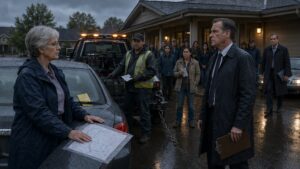
Anthony Walker’s boot came down before I could reach the stake.
The orange-painted top disappeared beneath the heel of his mud-caked work boot. The wood bent once, gave a dry crack, and split against the wet ground. He shifted his weight and ground the broken pieces into the strip of soil between our yards.
For several seconds, neither of us spoke.
Behind him, the new retaining wall curved along the slope in neat gray blocks. Fresh mortar still showed pale at the joints. It looked expensive, deliberate, and permanent.
Anthony lifted his foot.
“There,” he said. “Now we can stop pretending that stick decides anything.”
Two houses down, a garage door paused halfway open. Across the street, a woman holding a travel mug stopped beside her car. Anthony noticed them watching and straightened his shoulders.
I crouched instead.
The lower half of the stake remained in the soil, torn lengthwise. I picked up the orange tip with two fingers and turned it over. Mud had pressed into the grain.
Anthony gave a short laugh. “You planning to glue it back together?”
I took out my phone and photographed the broken tip, the buried half, his boot prints, and the wall behind him.
His smile tightened.
“You’re recording me now?”
“I’m documenting the site.”
“It’s a piece of wood.”
“It was a boundary marker.”
“It was something you hammered into the ground while I was building an approved drainage wall.”
I stood, keeping the broken tip in my hand. “Approved work still has to stay on the approved lot.”
Anthony glanced toward the neighbors as if inviting them to appreciate the absurdity. “You’ve been retired too long, Joshua. Nobody is taking your backyard measurements as law.”
“They aren’t my measurements.”
“You put the stake there.”
“Because the original monument is there.”
I pointed toward the corner where a rusted iron pin sat below the grass line. Anthony did not look.
He folded his arms. He was younger than me by almost twenty years, broad through the shoulders and still wearing the reflective vest he had started using since becoming chair of the HOA landscape committee. The vest made him look official from a distance. Up close, the zipper was broken.
“The board approved the plan,” he said.
“The board does not move property lines.”
“You object to everything.”
“I objected to the location.”
“After the blocks arrived.”
“Before the first course was laid.”
“You sent an email full of bearings and monument references. Nobody understood it.”
“That doesn’t make it wrong.”
His face changed at that. Not much, but enough. The performance for the neighbors slipped, and irritation showed underneath.
He stepped closer.
“You know what your problem is?” he asked. “You think every conversation is a test only you know how to pass.”
I looked down at the crushed marker.
“Your problem may cost more.”
He snorted. “What, five dollars for another stick?”
“Potentially thousands.”
The woman across the street lowered her travel mug.
Anthony’s expression flattened. “You threatening me?”
“No.”
“That sounded like one.”
“It was an estimate of what happens when construction crosses a recorded boundary and the person responsible destroys notice of it.”
He looked past me toward my house. “You have proof the wall crosses?”
“I have enough to stop guessing.”
“That means no.”
He turned toward the wall and slapped one of the cap blocks with his palm.
“This wall keeps runoff from washing through my yard. Sarah approved it. The committee approved it. The contractor built from the plan. You don’t get to hold the neighborhood hostage because you found an old pin in the dirt.”
The name Sarah settled into the conversation like a second authority. Sarah Green had been HOA president for three years, and she spoke in polished sentences that always sounded as if minutes were being taken.
As if summoned, her white SUV rolled around the corner.
Anthony saw it and smiled.
Sarah parked beside the curb and stepped out with a folder tucked beneath one arm. She wore office clothes despite the mud and moved carefully along the driveway edge.
“What happened?” she asked.
Anthony pointed at the shattered stake in my hand. “Joshua put another homemade marker inside the drainage project.”
“It wasn’t inside the project,” I said. “The project is across the line.”
Sarah opened her folder. “The architectural committee approved Anthony’s retaining wall based on the drainage improvement plan submitted last month.”
“May I see the sheet with the boundary call?”
Her eyes paused on mine. “The plan shows the wall location.”
“That wasn’t my question.”
Anthony exhaled loudly.
Sarah removed a reduced copy of the site drawing and held it out. A bold curved line represented the wall. Lot lines appeared as thinner strokes. In the lower corner, an approval stamp had been added over the scale notation.
I studied it without taking it from her.
The drawing looked familiar, but not correct.
The rear lot line angled properly. The side line did not. It had been drawn from the edge of Anthony’s patio rather than from the recorded monument at the street. More troubling, the drainage easement I remembered crossing both properties did not appear at all.
“Where did this base map come from?” I asked.
“The management portal.”
“Which recorded plat?”
Sarah closed the folder halfway. “Joshua, this is exactly why people find it difficult to work with you. We are standing in the mud at seven-thirty in the morning. Anthony has an approved project intended to address a documented runoff problem.”
“And part of it may be on my land.”
“Then we can arrange a review.”
“The work should stop until that review is complete.”
Anthony laughed once, without humor. “The work is finished.”
I looked at the wall.
At first glance, it followed the slope cleanly. Then I noticed the western end turning inward toward my yard, its final cap block almost touching the line where my wife had once planted daylilies. The soil there had been scraped smooth, erasing the shallow swale that used to carry rainwater toward the rear easement.
I stepped around the broken stake and walked to the old iron pin near the front corner. I brushed dirt away with the side of my shoe, then sighted toward the rear monument.
Twenty-six years in county survey work teaches the body certain habits. You stop needing an instrument to recognize when a line is badly wrong. Your eye follows grade, occupation, old fencing, utility placement, and the small inconsistencies people overlook.
The wall’s corner sat well inside that sight line.
Anthony called after me. “You done?”
I walked the length of the wall, counting my steps. At the far end, the blocks crossed deeper. The curve disguised it. A straight wall would have made the trespass obvious.
I returned to the iron pin and opened the measuring application on my phone only long enough to confirm what my eyes had already told me. It was not a legal survey, but it was enough for an immediate check.
Sarah watched my face.
“How far?” she asked.
“Near the middle, about fourteen inches. At the last corner, close to two feet.”
Anthony shook his head. “That’s impossible.”
“The wall runs across my lot for roughly eighteen feet.”
“You can’t know that from walking.”
“No,” I said. “I know it from the monuments. The walking only told me how badly we need a licensed crew.”
Anthony stepped into the mud between us. “Bring whoever you want. That wall isn’t moving.”
I looked at the orange splinter in my palm, then at the curved line of concrete blocks planted across ground he had decided was his.
For the first time that morning, I stopped feeling embarrassed that the neighbors were watching.
I felt certain.
Chapter 2: The Old Plat Beneath My Wife’s Storm Notes
My wife’s handwriting appeared before the boundary line did.
I had unfolded the 1994 plat across the dining table and was pressing the corners flat with coffee mugs when a yellow sheet slipped from beneath it. The paper landed faceup beside the broken orange stake.
Three lines had been written across the top in blue ink.
Water backs up here after hard rain.
Board says swale is decorative.
Take photos next storm.
I knew the handwriting before I read the words.
Mary had formed her capital letters with narrow, upright strokes, as if even a grocery list deserved good posture. She had made those notes six years earlier, before the treatments began, when she still attended HOA meetings and came home angry enough to clean the kitchen twice.
I sat down.
For a while, the plat remained open but unread.
The broken stake lay diagonally across it, its muddy orange tip pointing toward the drainage easement near the rear of our lot. Mary’s notes covered part of the legal description.
I moved them aside carefully.
The recorded plat was clear. Our side boundary ran from the front iron pin to a rear monument near the community buffer. A ten-foot drainage easement crossed both parcels at an angle, following the natural low point that existed before the subdivision was graded.
Anthony’s approved wall cut across both.
I found the email I had sent Sarah twelve days before construction. It contained the lot number, monument references, plat book and page, and a warning that the proposed curve appeared to enter my property.
Her reply had arrived twenty-three minutes later.
Thank you. The committee will confirm compliance with the approved plan.
No question. No request for the plat. No pause.
I had read the message then and decided not to send more.
That decision now sat in the room with me.
By ten that morning, I was in the county records office beneath fluorescent lights that made every document look older than it was. The clerk brought me the subdivision file on microfilm and pointed me toward a reader.
The first plat matched mine.
The second file contained revisions from later road work. The third showed utility relocation. I moved through each page until I found the drainage exhibit filed when the subdivision developer transferred maintenance responsibility to the HOA.
The easement was still there.
A handwritten note in the margin referenced an iron monument that had later been buried by landscaping but never legally abandoned.
I requested certified copies.
While the printer worked, I asked the clerk whether the HOA had accessed the file recently.
She checked the public log. “Someone downloaded the subdivision plat about two months ago.”
“Which pages?”
She turned the monitor slightly, though I could not see the names. “Main plat, cover sheet, landscape exhibit.”
“Drainage exhibit?”
“No.”
“Monument notes?”
“No.”
The printer stopped.
The clerk gathered the copies and tapped them square. “People usually take the first drawing that looks like the one they need.”
“That’s how expensive mistakes begin.”
She gave me a brief look. “You sound like you’ve seen a few.”
“More than a few.”
Outside, I sat in my truck with the certified envelope on the passenger seat.
My satisfaction lasted less than a minute.
The HOA had relied on an incomplete file. That supported my position, but it also meant Sarah might not have intentionally ignored the easement. She had been careless, perhaps arrogant, but the missing page changed the shape of the fault.
I thought of Mary at the dining table, writing notes while rainwater pressed against the flower-bed edging. She had asked me to attend the next board meeting with her.
I had refused.
“They don’t listen to technical explanations,” I had said.
“Then explain it differently,” she answered.
I never did.
Back home, I laid the certified copies beside Sarah’s reduced approval plan. The mismatch was obvious once the sheets were aligned. The HOA drawing treated Anthony’s patio edge as a control line. The recorded plat used the iron monuments. The omitted drainage exhibit showed why the original swale had been left open.
I photographed every page.
Then I called Ryan Anderson.
He answered on the third ring. “Joshua Miller. That’s either good news or a boundary dispute.”
“Boundary dispute.”
“How ugly?”
“Retaining wall. Possible two-foot encroachment. One destroyed marker.”
Ryan went quiet. He had worked under me at the county before earning his license and opening a private practice.
“Destroyed by accident?”
“No.”
“That makes it uglier.”
“I need an independent boundary survey.”
“When?”
“Tomorrow, if possible.”
He exhaled. “I can move a small crew to late afternoon today. Initial fieldwork only. Final certification takes longer.”
“Do it.”
“And Joshua?”
“Yes?”
“If you already know where the line is, let me establish it without coaching.”
“I know how independent work functions.”
“I know you do. I’m reminding both of us.”
He arrived at four with two crew members, a total station, data collector, metal detector, and enough bright flagging to make the property edge visible from the next block.
Anthony came outside before the tripod legs were fully spread.
“What is this?” he demanded.
“A licensed survey,” Ryan said.
Anthony looked at me. “You couldn’t wait for the board review?”
“This is the review.”
Sarah appeared twenty minutes later. By then, Ryan’s crew had recovered the front pin and located the rear monument beneath four inches of compacted soil near the buffer fence.
Ryan stretched the computed line between them. The retaining wall crossed it exactly where I expected.
He drove two temporary wooden stakes outside the construction footprint and marked the boundary with orange flags.
Sarah stood with her folder pressed against her ribs.
“How certain are you?” she asked.
“Field position is consistent with the recorded plat and recovered monuments,” Ryan said. “I’ll verify the record history before issuing anything final.”
Anthony pointed toward the rear. “That pin could have moved.”
Ryan looked at him. “Iron monuments don’t typically crawl uphill.”
One of the crew members hid a smile.
Anthony did not.
Sarah turned to me. “Send me everything you relied on.”
I had the certified drainage exhibit in a clear sleeve inside my truck.
I could have handed it to her then.
Instead, I gave her a copy of the main plat and the monument references. Enough to prove the boundary. Not enough to show the full drainage problem.
“You said everything,” she said.
“That is sufficient for the encroachment review.”
Her expression sharpened. “That wasn’t what I asked.”
“It’s what you need to stop further work.”
The words felt clean when I said them. Precise. Defensible.
They also sounded like something Mary would have hated.
Anthony walked to the newest stake and stared down at it. “These stay until your report?”
“They stay until the line no longer needs to be marked,” Ryan said.
Anthony turned away without answering.
At seven that evening, a flatbed truck rolled slowly past my house carrying a compact excavator. It stopped in front of Anthony’s driveway.
The driver lowered the ramps.
Anthony stood beside the cab with his phone pressed to his ear. Through my open window, I heard him say, “First thing tomorrow. Before anyone has time to interfere.”
I looked toward the clear sleeve containing the page Sarah had asked for.
Then I closed the folder and left it on the table.
Chapter 3: Forty-One Photographs Beneath the Excavator Bucket
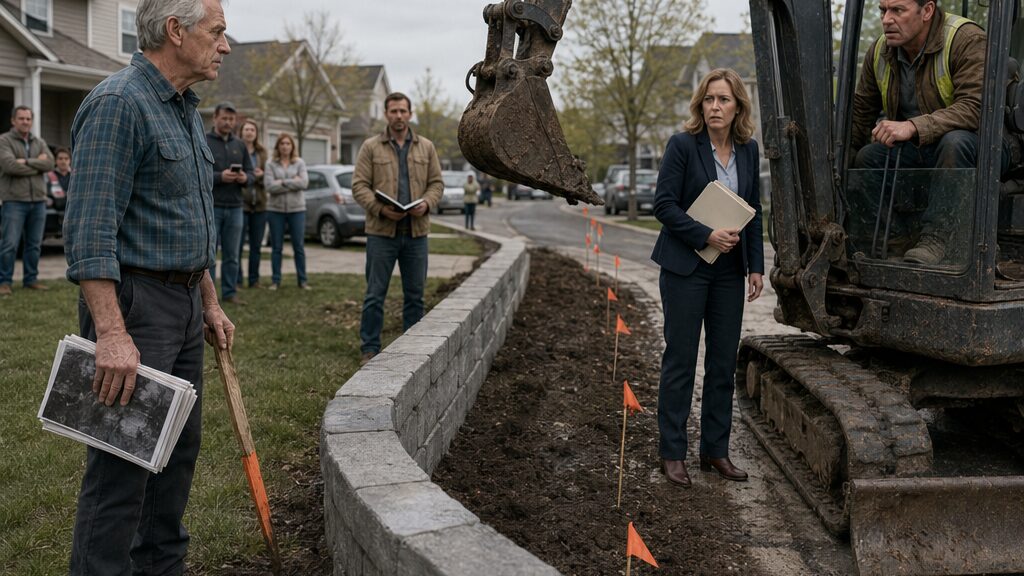
The excavator bucket swung over my lawn at seven twelve the next morning.
Its steel teeth passed above the orange flags, close enough that the air pushed them sideways. Anthony sat in the cab with one hand on the controls and the other gripping the open window frame.
“Move the markers,” he called over the engine.
I stood three feet inside my property with a camera hanging from my neck and a document envelope tucked under my arm.
“No.”
The machine idled between us.
Ryan’s stakes formed a bright line from the front pin toward the rear buffer. Overnight rain had darkened the soil around them. The wall rose on Anthony’s side at first, then curved across the flags like a slow gray wave.
Anthony lowered the bucket until its teeth hovered a foot above the ground.
“You were told not to obstruct approved drainage work.”
“You were told the work crossed a surveyed boundary.”
“The HOA says the approval is valid.”
“Approval and ownership are separate questions.”
He leaned toward the window. “I’m correcting the grade beside my wall. If your flags are in the way, that is your problem.”
“They are not my flags.”
That checked him for half a second.
Ryan’s truck turned onto the street.
Behind it came Sarah’s SUV and the HOA management representative’s sedan. Garage doors opened along both sides of the road. Nobody approached, but several residents stood at the ends of their driveways.
Ryan parked without blocking the excavator and stepped out carrying his field book.
Anthony lifted both hands. “Good. Tell him to move his equipment.”
Ryan walked to the first stake and checked it without looking up. “My equipment is where I placed it.”
“You were hired by him.”
“I was retained by him. The monuments were not.”
Sarah crossed the grass in low shoes already gathering mud. “Anthony, shut the machine down while we talk.”
“I rented this by the day.”
“Shut it down.”
The engine continued to rumble.
I raised my camera and took another photograph.
Anthony saw me. “How many pictures do you need?”
“That was forty-one.”
A man across the street shifted his phone from his side to chest height.
Anthony looked around at the watching neighbors. Whatever private fear had brought the excavator that morning was no longer visible. What remained was the version of himself he had chosen to perform: decisive, practical, unwilling to be slowed by an old man with paperwork.
He pointed toward the wall.
“This whole area washed out twice last year. The board ordered drainage corrections. I volunteered to coordinate them. Joshua fought every proposal because he doesn’t want anybody touching the strip beside his flower beds.”
“That strip is his lot,” Ryan said.
Anthony ignored him. “The wall protects my house and the property below us.”
Sarah’s head turned. “The board did not order you to proceed after a disputed survey.”
“You approved the plan.”
“Based on the submission.”
“The submission came through your portal.”
The management representative opened a leather portfolio. “We are reviewing which documents were attached.”
Anthony gave a bitter laugh. “Reviewing. That’s what everyone does after the contractor gets paid.”
For the first time, I heard something beneath his anger that was not contempt.
Fear.
It vanished when he looked at me.
“You knew I was building,” he said. “You watched the crew set forms.”
“I emailed the board.”
“You sent coordinates nobody could use.”
“I identified the plat.”
“You never walked over and said, ‘Anthony, your wall is two feet into my yard.’”
The accusation landed harder than it should have.
I could have answered that he had avoided me. That the contractor had started while I was out of town. That Sarah had acknowledged my objection.
All of those things were true.
None answered his exact point.
Ryan opened his field book. “The recovered front monument is consistent with the subdivision plat. The rear monument is consistent with the drainage exhibit reference and historic occupation. The measured boundary places approximately eighteen feet of this wall across Mr. Miller’s lot. Encroachment ranges from just under a foot to almost two feet at the western end.”
The street seemed to quiet around the machine.
Sarah looked at the wall, then at me. “You have the drainage exhibit?”
I kept my eyes on Anthony. “I have the recorded documents.”
“That is not an answer.”
“It is the document Ryan verified.”
Ryan glanced at me. Only briefly, but I saw the question.
Anthony slapped the side of the cab. “So we’re doing this because of inches on a page from thirty years ago?”
“Property lines do not expire,” I said.
“And neither does water. It keeps coming downhill whether your paperwork approves or not.”
The words carried more weight than his earlier insults. Behind the wall, the grade rose toward the street. His basement windows sat low on the foundation. I had noticed that before. I had not asked why the wall mattered so much to him.
Sarah stepped toward the cab. “Turn it off. The board is issuing a temporary stop.”
“You can’t stop me from grading my own property.”
“The disputed area may not be your property.”
His face reddened.
He looked at the flags, then at me.
“You want a show?” he asked. “Fine.”
He pulled the left control lever.
The excavator’s upper body rotated. The bucket moved over the first two flags, slow enough that every person watching understood it was deliberate.
Sarah stepped back. “Anthony.”
Ryan raised one hand. “Do not disturb the marked line.”
Anthony lowered the boom.
I stayed where I was.
The bucket descended until the steel teeth touched the soil inside my lot. One orange flag bent beneath its edge. Mud pressed outward.
A tremor moved through my knees, but my hands remained steady around the camera.
I took the photograph.
The shutter sounded small against the engine.
Anthony looked directly at me through the cab window.
“There,” he said. “Now prove what that cost you.”
Ryan closed his field book.
“You just crossed the surveyed boundary after verbal notice,” he said.
Anthony lifted the bucket a few inches. “I touched dirt.”
“You disturbed marked property.”
“Call somebody.”
Sarah’s voice had gone flat. “Turn off the machine, Anthony.”
He finally killed the engine.
The sudden silence was startling. Without the diesel rumble, we could hear water dripping from the wall caps and a dog barking behind one of the houses.
Anthony climbed down.
His boots struck the mud hard. He reached into the excavator cab and pulled out a large envelope with certified-mail markings across the front.
He walked toward me and let it fall at my feet.
The return address belonged to a law office.
“Formal notice,” he said. “Stop interfering with an approved drainage improvement and stop placing objects in the work zone.”
I looked at the envelope but did not pick it up.
Sarah spoke behind him. “The board did not authorize that letter.”
“I did.”
“As committee chair?”
“As a homeowner protecting his property.”
The distinction mattered, though he did not yet understand how much.
Ryan crouched beside the bent flag and photographed the bucket impression. “Joshua, do you want me to document the disturbed area as supplemental field evidence?”
“Yes.”
Anthony stepped closer until only the fallen envelope separated us.
“You’ve wanted this from the beginning,” he said quietly.
“What?”
“For me to make one mistake big enough that you could bury me in paper.”
The watching neighbors were too far away to hear him, but Sarah and Ryan could.
I should have denied it immediately.
Instead, I looked at the bucket mark on my side of the line and felt a hard, private satisfaction settling beneath my anger.
I had warned him. He had ignored me. Now the measurements, photographs, witnesses, and certified demand all pointed in the same direction.
My case was no longer arguable.
That satisfaction must have shown somewhere in my face.
Anthony nodded once.
“Go ahead,” he said. “Sue me.”
He turned and walked back toward the machine.
Sarah waited until he was out of earshot before facing me.
“I need the complete record set by noon,” she said. “Not what you consider sufficient. Everything.”
The clear sleeve containing the missing drainage exhi
Chapter 4: The HOA Approval That Left One Page Missing
Sarah began the emergency meeting by saying the HOA might charge me for delaying drainage work.
She did not raise her voice. She sat at the center of the folding tables in the clubhouse records room, hands aligned over a yellow legal pad, speaking as if the conclusion had already been reviewed by counsel.
“Until we determine otherwise,” she said, “the association must consider whether Mr. Miller’s interference created additional contractor costs or increased flood exposure.”
Anthony sat two chairs to her right. A bruise-colored shadow marked the skin beneath his eyes. The excavator was gone, but mud still clung to the cuffs of his work pants.
I placed the broken orange stake on the table.
The wood made a small hollow sound.
Sarah’s gaze dropped to it, then returned to me. “That does not answer the drainage question.”
“It answers whether notice was visible.”
The HOA treasurer shifted in his chair. The management representative opened a laptop and avoided looking at Anthony.
Ryan sat beside me with his field book closed. He had brought the preliminary survey sketch, but he had made clear in the parking lot that he was not there to argue my case.
Sarah pushed a copy of Anthony’s approved plan across the table. “This is the drawing reviewed by the architectural committee.”
I unfolded the recorded plat beside it.
The two sheets overlapped badly. Sarah’s plan showed the wall curving through open lawn. The plat showed the same curve crossing my boundary. Neither document, as presented, explained where the runoff was supposed to go.
“The wall location was approved from this base map,” I said. “The base map is incomplete.”
Anthony leaned forward. “It came from the HOA portal.”
“That does not make it complete.”
“You keep saying that like somebody altered it.”
“I said a page is missing.”
The management representative stopped typing.
Sarah turned toward her. “Is there a missing page?”
The woman adjusted her glasses. “The application file contains the cover sheet, the main subdivision plat, and the landscape exhibit.”
“And the drainage exhibit?” I asked.
She clicked through a folder. “I do not see it attached.”
The room changed.
Not dramatically. No one gasped. But the treasurer’s pen stopped moving, and Sarah’s shoulders drew back from the table.
Anthony looked at the management representative. “You told me the submission was complete.”
“I told you the portal accepted it.”
“That is not the same thing.”
“No,” she said. “It is not.”
Sarah pressed two fingers against the legal pad. “Where would the drainage exhibit normally appear?”
“In the county record set,” Ryan said. “Separate sheet. Same subdivision filing.”
She looked at me. “And you have it.”
It was no longer a question.
I removed the certified copy from my folder.
For one second, I considered giving her only the page without Mary’s notes. Then I saw the broken stake lying between us and understood how childish that would be.
I slid the drainage exhibit across the table.
Sarah studied it, tracing the diagonal easement with one fingernail. The line passed through Anthony’s lot, crossed mine, and continued toward the community buffer behind the three lowest houses.
“This was not on the approval drawing,” she said.
“No.”
“When did you obtain this copy?”
“Monday.”
Her eyes lifted. “Before the excavator incident?”
“Yes.”
Anthony gave a slow, humorless laugh. “There it is.”
I looked at him. “The boundary was independently marked before you moved the machine.”
“That isn’t what she asked.”
Sarah held up one hand, though he was not speaking to her. “Why did you not provide this when I requested the complete record set?”
“I provided enough to establish the encroachment.”
“You decided what the board was allowed to see.”
“The board had already decided what it wanted to see.”
The answer came too quickly.
Ryan turned his head toward me.
Sarah sat back. “That may be true, Joshua. It does not excuse withholding a document tied to drainage safety.”
Anthony pushed his chair away from the table, then pulled it back. “So he watched us proceed with incomplete plans.”
“I objected before construction.”
“With bearings and book numbers. You could have shown me this.”
“I could have.”
The admission remained between us.
The HOA treasurer cleared his throat. “We need to separate conduct from physical risk. What does the missing sheet mean now?”
Ryan opened his field book.
“It means the original drainage route was intended to stay open across both lots,” he said. “The retaining wall blocks part of that route and occupies Mr. Miller’s property. The boundary issue is clear. The drainage effect requires an engineer or county inspection.”
Sarah looked toward the management representative. “Issue a temporary stop on all work near the wall.”
Anthony stared at her. “The wall is already built.”
“No grading, excavation, backfill, or removal until we know what changes will do.”
“You’re freezing the only thing keeping water away from my foundation.”
“I’m freezing work based on a plan we cannot defend.”
For the first time since the stake was crushed, Sarah’s voice lost its polished calm. Not much, but enough to reveal fear beneath it.
A board that admitted an approval error risked legal fees, insurance claims, and a special assessment. She knew every homeowner in the room would eventually calculate the cost.
The clubhouse door opened.
The county drainage inspector stepped inside carrying a tablet and a rain jacket folded over one arm. He had visited the site that afternoon after Ryan submitted the preliminary survey and Sarah requested an urgent review.
“I can give you an initial assessment,” he said, remaining near the door. “Not a final engineering determination.”
Sarah motioned him toward the table.
He spread three photographs beside the competing plans. One showed the wall from above. Another showed the filled swale behind it. The third showed the lower yards beyond my property.
“The constructed wall interrupts the historical surface path,” he said. “That does not mean the original condition was adequate. It clearly was not, or residents would not have reported repeated flooding.”
Anthony folded his arms. “So the wall is necessary.”
“I did not say that.”
“Then what are you saying?”
“I am saying the wall may reduce water reaching your foundation while redirecting it laterally toward the Miller lot and the properties below.”
The treasurer looked at Sarah. “How many properties?”
“Potentially three,” the inspector said.
I studied the photograph. The lowest house belonged to a retired couple who rarely attended meetings. Their rear door sat nearly level with the yard.
“What if the encroaching section is removed?” Sarah asked.
“Immediately?”
“Yes.”
The inspector shook his head. “That could reopen the blocked route without restoring the original swale or installing an outlet. During a heavy storm, water could move rapidly toward those three houses.”
The room went still.
Anthony spoke first. “There’s rain forecast this weekend.”
“More than rain,” the inspector said. “The current projection is several inches over a short period.”
Sarah closed the folder containing the approval plan.
The motion looked final, but nothing had been resolved. The wall could not remain across my land. Removing it without a drainage correction could threaten other homes. Leaving it untouched might do the same if the storm exceeded its capacity.
My private boundary dispute had become a neighborhood hazard.
The inspector gathered his photographs but left one on the table—the image of the wall curving across the filled swale.
“No one touches this structure,” he said, “until a temporary water plan is in place. Not the contractor. Not the homeowner. Not the HOA.”
His eyes moved from Anthony to me.
“And if the forecast holds, you may not have much time.”
Chapter 5: The Settlement That Looked Like Perfect Revenge
“The wall can stay,” Emma Sanchez said, “but it will not stay for free.”
Anthony’s attorney looked at her across the mediation table. Anthony sat beside him, motionless except for one thumb rubbing the edge of a paper cup.
Emma had arranged three proposals in separate folders.
The first required removal of the encroaching wall section and restoration of my land.
The second created a temporary construction license while an engineered drainage solution was designed.
The third—the folder open before us—treated the existing encroachment as leased land.
Emma tapped the payment schedule.
“Back compensation for use, damage, and professional costs would begin at nineteen thousand two hundred dollars,” she said. “Ongoing use would be three hundred twenty dollars per month, adjusted annually, for as long as the wall occupies Mr. Miller’s property.”
Anthony’s attorney looked at the figures again. “That monthly amount is aggressive.”
“The alternative is removal.”
“Removal may damage the attached slab.”
“Which is why the lease has value.”
Anthony looked at me. “You’d rather collect rent on two feet of dirt than fix the drainage?”
I kept my hands flat on the table. “The drainage requires a separate plan.”
“That’s convenient.”
Emma closed the folder halfway. “Nothing is final. We are identifying settlement structures.”
The broken orange stake lay beside my copies of the survey and photographs. I had brought it without deciding why. Under the office lights, it looked less like evidence than debris.
Anthony’s attorney turned to me.
“Mr. Miller, are you prepared to allow the wall to remain permanently if the financial terms are satisfied?”
“Yes.”
The answer came easily.
Too easily.
Emma watched me for a moment before writing anything down.
Anthony leaned back. “You said it was unsafe.”
“I said the drainage arrangement had to be corrected.”
“You want the wall on your property if it pays you.”
“I want responsibility attached to it.”
“No. You want a meter running.”
His attorney touched his sleeve, but Anthony pulled away.
Emma opened the temporary-license folder. “The county’s current position is that no permanent option can be executed until the engineer assesses the system. The lease is a framework, not permission to ignore safety.”
Anthony looked at her. “And if the engineer says the wall can stay?”
“Then you decide whether the cost is preferable to reconstruction.”
“How long does the lease run?”
“As long as the concrete remains.”
A faint change passed over his face.
He understood then what I had understood when Emma first proposed it. The monthly payment could eventually exceed the original construction cost. The wall he had called permanent would become a permanent invoice.
For the first time, he looked defeated rather than angry.
I felt the satisfaction return.
It was quieter than it had been beside the excavator, but no less real.
Emma slid a legal pad toward me. “Before we go further, I need clarity on the record sequence.”
Ryan sat at the far end of the table as a technical consultant. He had not spoken except to confirm the survey distances.
Emma looked at him.
“When did Mr. Miller first possess the drainage exhibit showing the original easement?”
Ryan’s gaze moved to me.
“He obtained the certified copy Monday morning,” he said.
Anthony’s attorney checked his notes. “The excavator incident was Tuesday.”
“Yes.”
“And when did the HOA receive the drainage exhibit?”
“Thursday,” Ryan said.
Anthony’s thumb stopped moving against the cup.
Emma turned to me. “Why did you delay?”
“I had already provided the plat and monument references.”
“That is not what I asked.”
The room seemed suddenly smaller.
I looked at the stake.
“Because Sarah dismissed my objection before construction,” I said. “Because Anthony destroyed the first marker. Because every time I raised a technical issue with that board, they treated me like I was manufacturing trouble.”
“All of that may explain your anger,” Emma said. “Why did you delay the drainage information?”
“I wanted the boundary established beyond argument.”
Ryan spoke quietly. “It already was.”
I looked at him.
“You hired me to establish it,” he continued. “You did not need the excavator mark to make the line defensible.”
Anthony gave a sharp breath through his nose.
His attorney wrote something down.
Emma’s voice stayed level. “Did you believe another confrontation would strengthen your position?”
I could have answered in careful language. I knew enough about depositions and public records to shape the truth without technically lying.
Instead, I said, “Yes.”
Anthony’s wife had been sitting behind him near the wall. Until then, she had remained silent. She lowered her eyes.
Emma closed the lease folder.
The sound was soft, but it felt like a door shutting.
“Mr. Miller,” she said, “Anthony remains responsible for the construction, destruction of the marker, and machine intrusion. Your delay does not transfer those acts to you.”
Anthony’s attorney nodded once.
“But,” Emma continued, “your conduct affects how every person at this table understands damages, urgency, and good faith.”
Anthony finally spoke.
“You wanted me to do it.”
“No.”
“You wanted me to make it worse.”
“I wanted you to stop pretending I was wrong.”
“That isn’t the same as wanting me to stop.”
I met his eyes.
There was no clean answer.
For years, Mary had told me that accuracy was not communication. She would stand at the kitchen counter with HOA letters spread around her and ask me to come explain the runoff problem in language people could not avoid.
I always believed the documents should be enough.
When they ignored her, I blamed them.
When Anthony ignored me, some part of me had wanted the consequences to become impossible for anyone to dismiss.
Emma reopened the temporary-license folder instead of the lease.
“We pause permanent settlement,” she said. “The engineer’s report comes tomorrow. After that, we negotiate removal, correction, cost allocation, and damage. No one gains by turning this into a contest over who behaved worse.”
Anthony’s attorney gathered the lease pages.
Anthony did not move.
Then he reached into his briefcase and removed a photograph.
He placed it on the table in front of me.
A basement room filled the image. The carpet had been pulled back in dark, heavy folds. Water stood several inches deep around the legs of a small desk. A pair of shoes floated near the wall.
Anthony pointed to the corner of the frame.
“My daughter’s room,” he said.
The picture showed a narrow bed elevated on blocks and a poster peeling from the wall.
“She woke up with water touching the mattress last spring. The sump pump failed. The outside drain was already overwhelmed.”
His wife pressed her lips together.
Anthony looked at me, not accusing now.
“We borrowed against the house to repair it. The contractor said the wall and grading would keep the next storm away from the foundation. The HOA said the same thing.”
He tapped the photograph once.
“I knew you objected. I did not know the wall crossed two feet into your lot. I thought you were doing what you always do—finding a technical reason nobody else could understand.”
“You crushed the marker after I told you.”
“Yes.”
“You lowered the bucket after Ryan confirmed the line.”
“Yes.”
The admissions cost him. I could see that.
He did not look away.
“I was afraid they would stop the only work anyone said might keep this from happening again.”
The photograph remained between us, beside the broken stake and the closed lease folder.
For a week, I had imagined the moment Anthony finally admitted the wall was on my land.
Now that he had, it gave me almost none of what I had expected.
Chapter 6: The Water Took the Path None of Us Chose
Water appeared at the end of the retaining wall just after midnight.
It did not spill over the top. It forced itself around the unfinished western corner in a brown, pressurized stream, carrying mulch, leaves, and pieces of fresh sod into my yard.
I saw it from the kitchen window when the motion light came on.
The loose orange survey flag bent nearly flat in the current.
I pulled on boots and a raincoat, grabbed a flashlight, and stepped outside. Rain struck the hood hard enough to blur the beam. Water had already spread across the daylily bed and was moving toward the lowest property behind mine.
Anthony’s back door opened.
He ran into his yard without a coat.
“The basement window well is filling,” he shouted.
“Your wall is holding on that side.”
“Then where is this coming from?”
I pointed my light toward the filled swale. “Around the end. The water cannot follow the old route.”
Sarah’s SUV stopped at the curb with its hazard lights flashing. Behind her came the county drainage inspector and the civil engineer retained that afternoon. The engineer carried rolled plans inside a plastic sleeve, but one look at the water made him leave them in the vehicle.
“We need to keep it away from the lower houses,” he said.
A neighbor appeared at the rear fence in boots and pajamas. “It’s at our patio.”
The stream widened.
Anthony moved toward the compact pile of landscaping blocks beside the wall.
“Don’t stack those there,” I said.
“We have to block it.”
“That sends it directly downhill.”
“It’s already going downhill.”
“Not all of it.”
He reached for a block.
I caught his forearm.
For a second, we stood in the rain exactly as we had beside the survey stake—each certain the other was obstructing the only sensible action.
Then the neighbor behind us shouted that water had reached the door threshold.
I released Anthony and swept the flashlight across the ground.
The original drainage easement ran diagonally through my property. Most of it had been planted years ago. Mary’s garden occupied the shallow center, bordered by stone and mature roots. If we opened that route temporarily, water could move toward the community buffer instead of collecting behind the lower homes.
But equipment would have to cross my yard.
The garden would not survive intact.
The engineer followed my light. “What are you seeing?”
“The recorded easement. It starts near that pin, crosses behind the wall, then cuts through my flower bed.”
“Is there an outlet?”
“Old swale into the buffer. Partially filled, but still lower than the patios.”
The drainage inspector crouched and watched the surface flow. “If we open a shallow channel, it might relieve pressure.”
Anthony looked toward the garden. “That’s your wife’s bed.”
I stared at him.
He had lived beside us for nine years. I had not known he remembered.
Another rush of water struck the end of the wall and spread across the lawn.
“Bring the machine,” I said.
Sarah stepped closer. “The stop order—”
“I authorize temporary access across my property.”
The inspector looked at me. “You understand the damage?”
“Yes.”
Anthony did not move.
“Go,” I told him.
He ran for the excavator parked in his driveway under the county hold. The inspector called the emergency authorization through while Sarah contacted the lower homeowners.
When the engine started, every instinct in me tightened.
The last time that bucket crossed my line, Anthony had done it to defy me.
This time, he stopped at the first orange flag and waited.
“Where?” he called.
I walked ahead of the machine, flashlight in one hand, an old survey lath in the other. I marked the easement path from memory and checked it against the visible grade.
“Follow my stakes exactly,” I said. “No deeper than eight inches until the garden edge.”
Anthony nodded.
No argument.
The bucket lowered.
It peeled back sod in a narrow strip, exposing dark soil beneath. At the garden, I hesitated. Mary’s daylilies bowed under the rain. The stones she had placed by hand still formed an uneven border.
The engineer shouted over the machine. “We need the channel now.”
I pulled the first stone away.
“Through here.”
Anthony eased the bucket forward.
The garden opened under steel.
Roots tore. Mud folded over the flowers. Water found the new depression almost immediately, first as thin fingers, then as a single current rushing toward the rear buffer.
The loose survey flag rose halfway as pressure shifted away from it.
At the lower fence, the neighbor shouted, “It’s dropping.”
Anthony stopped the machine and looked toward his basement window.
His wife stood there with a flashlight. She raised one hand.
The water in the well had stopped climbing.
For the next hour, we worked without discussing the boundary. The engineer adjusted the channel. The inspector cleared debris at the buffer outlet. Sarah carried sandbags from a maintenance truck and ruined her office shoes in the mud.
Anthony followed every direction I gave him.
When the bucket needed to turn near my patio, he asked permission.
When a stake disappeared beneath the water, he stopped until I replaced it.
Near three in the morning, the rain eased enough for us to hear the current running through the temporary channel. It passed through what remained of Mary’s garden and away from the houses.
Anthony climbed down from the excavator.
Mud covered his clothes to the knees. He stood beside the broken flower-bed border and looked at the flattened plants.
“I’m sorry,” he said.
I could not tell whether he meant the garden, the stake, the wall, or all of it.
“So am I,” I answered.
Sarah joined us beneath the edge of my patio roof. Her hair had come loose, and rainwater ran from the sleeves of her jacket.
“The engineer thinks the permanent fix will require removing the encroaching section,” she said. “New inlet, buried line through the easement, controlled outlet at the buffer.”
“Who pays?” Anthony asked.
“The board will meet with insurance and counsel.”
“That means everyone pays.”
“It means responsibility has to be divided.”
He looked at me. “And the lease?”
The monthly lease had been drafted to make the wall hurt him for as long as it remained. In the mediation room, that had felt elegant.
Standing beside the channel cut through Mary’s garden, it felt small.
“The wall cannot remain as built,” I said.
Anthony’s face tightened, expecting the rest.
“I’m withdrawing the permanent lease proposal.”
Sarah studied me. “What are you proposing instead?”
I looked toward the wall, then followed the temporary channel with my flashlight. The water moved where the original plan had intended, but now it did so through torn soil and exposed roots.
“Remove the eighteen-foot encroaching section,” I said. “Rebuild only where the engineer permits. Install the drainage line in the recorded easement. Anthony pays for the wall correction and damage he caused. The HOA pays for the drainage system and the approval failure.”
Anthony’s hands hung at his sides.
“I cannot cover all of that at once.”
“Then the settlement needs terms,” I said. “Not a punishment disguised as one.”
The words surprised me as I spoke them.
The drainage inspector walked past carrying the bent orange flag. He set it upright near the original line, pressing it into the softened ground.
Dawn had begun to lighten the roofs beyond the buffer.
Anthony looked at the flag, then at the channel crossing my ruined garden.
“You’d still let the ea
Chapter 7: We Set the New Boundary After the Rain
The first block of the encroaching wall lifted from my property six weeks after the storm.
A steel clamp tightened around the gray concrete, the small crane took the weight, and the block rose with a wet sucking sound from the soil beneath it. Mud clung to the bottom where Anthony’s contractor had set it across the line.
I stood beside Ryan near the recovered iron monument.
Anthony watched from the opposite side of the temporary fence. He had lost weight since the mediation. The reflective committee vest was gone. He wore an old brown jacket and kept both hands in his pockets.
The contractor swung the block toward a waiting pallet.
No one spoke until it settled.
“There’s the first one,” Ryan said.
There were twenty-seven more in the encroaching section.
The final agreement had taken three weeks of engineering revisions, insurance calls, and meetings that ended without handshakes. Emma had reduced every argument to a table of responsibilities.
Anthony would pay for removal and reconstruction of the portion built across my lot. He would also cover the damaged survey markers, Ryan’s supplemental work, and restoration of the soil where the excavator bucket had crossed the line.
The HOA would fund the buried drainage line, inlet, controlled outlet, and reconstruction of the easement because its approval process had relied on an incomplete record set.
The contractor’s insurer would contribute to the wall correction after admitting that no independent boundary verification had been performed before construction.
I would receive compensation for the physical damage to my property.
I would not receive monthly rent.
Emma had asked me twice before removing the lease provision.
“Once it is gone,” she said, “you cannot use it later as leverage.”
“I know.”
“Even if reconstruction is delayed?”
“Yes.”
“Even if Anthony misses a payment?”
“The agreement has remedies for that.”
She studied me, perhaps waiting for the part of myself that had wanted the meter to run forever.
It did not disappear. It simply no longer made the decision.
The crane lifted another block.
Behind us, the new drainage inlet sat beneath a temporary cover at the top of the slope. A buried line now followed the recorded easement through my property, passing under the rebuilt section of Mary’s garden before discharging into the community buffer. The civil engineer had added an inspection port near the rear fence and a shallow overflow swale designed to remain clear.
Nothing about it was decorative.
At the HOA meeting that evening, every chair in the clubhouse was occupied.
Sarah sat at the same folding tables where she had once suggested charging me for delaying the project. The approval plan, recorded plat, drainage exhibit, and final engineering drawing were displayed on a screen behind her.
She opened the meeting with procedural language, but her voice changed when she reached the item everyone had come to hear.
“The association’s review process failed to include the complete recorded drainage documents,” she said. “The board approved construction from an incomplete base file and did not respond adequately when a homeowner raised a boundary concern.”
The room remained quiet.
Sarah looked down at the prepared statement, then set it aside.
“That failure belongs in the official minutes exactly as stated,” she said. “Not as a misunderstanding. Not as a communication issue.”
The management representative typed the words.
A resident near the back asked whether dues would increase.
The treasurer answered that insurance and reserve funds would cover most of the drainage work, but a modest special assessment might still be required for future records modernization.
A low murmur moved through the room.
Sarah did not try to silence it.
“We should have verified the documents before approving the wall,” she said. “Paying to correct that is not pleasant, but pretending the error belongs entirely to two neighbors would cost more.”
Anthony sat in the last row beside his wife.
When the landscape committee report came up, he stood.
“I resigned as chair this morning,” he said.
No one applauded. A few people shifted in their seats.
He looked toward the screen, where the incorrect plan remained beside the corrected one.
“I pushed the project because my house flooded,” he said. “That explains why I wanted the wall. It does not excuse what I did after the boundary was marked.”
His eyes found mine.
“I destroyed the stake. I moved the excavator across the line. Those were my choices.”
He sat down before anyone could respond.
The meeting continued.
That was all the public reckoning there was.
No shouting. No vote to expel anyone. No satisfying collapse of the people who had dismissed me.
Only a corrected record, divided costs, and a room full of homeowners learning that every shortcut eventually sent an invoice.
The next morning, Ryan returned to set the permanent marker.
The reconstructed wall now stopped entirely inside Anthony’s lot. Its new alignment was straighter and less dramatic than the original curve. A narrow strip of gravel separated it from the boundary, leaving space to inspect the drainage inlet.
Mary’s garden had been replanted above the buried line.
Some of the old daylilies had survived. Others had been replaced with smaller divisions from the plants near the patio. Their leaves looked thin, but new green growth had begun at the centers.
Ryan placed the metal pin over the verified point and checked it twice against both monuments.
“Ready for the witness stake?” he asked.
I handed him a new wooden stake with an orange-painted top.
Anthony stood on his side of the gravel strip. He had come to review the final contractor invoice, though the papers remained folded in his back pocket.
Ryan offered me the stake.
I held it above the pin.
For a moment, I remembered Anthony’s boot coming down, the crack of wood, and the neighbors watching from their driveways. I remembered the pleasure I had felt when the excavator marked my soil and made the case undeniable.
Then I passed the stake to Anthony.
He looked at it but did not take it immediately.
“You want me to set that?”
“Over the pin,” I said. “Not through it. Six inches north so it stays visible.”
He accepted the stake.
Ryan handed him the mallet.
Anthony positioned the wood where I indicated and tapped it carefully into the soil. After the third strike, he stopped and looked at me.
“Straight?”
“A little toward your house.”
He adjusted it.
This time, when he drove the stake down, it stood upright above the line instead of disappearing beneath his boot.
Ryan measured the offset and entered it in his field book.
“That is the recorded witness,” he said. “If either of you moves it, I charge double.”
Anthony almost smiled.
Ryan packed his equipment and left us beside the new marker.
The property line was not visible beyond that orange tip. It continued through grass, gravel, roots, and buried water pipe according to bearings no one could see without instruments or records.
Still, we both knew where it was.
Anthony glanced toward the restored garden. “The contractor left a wrench near your inspection cover.”
It lay several feet inside my yard.
He walked to the edge of the gravel, then stopped.
“Can I cross over and get it?”
The question was ordinary.
That was why it mattered.
I opened the small gate in the temporary garden fence.
“Yes,” I said. “Come through.”
Anthony stepped across the line, retrieved the wrench, and returned the same way.
The orange stake remained upright between us.
The story has ended.