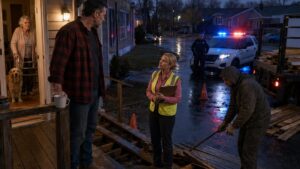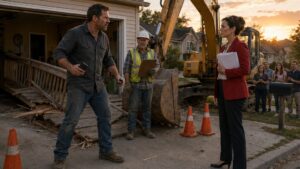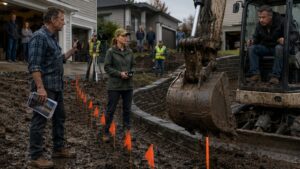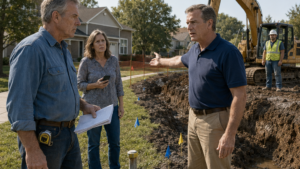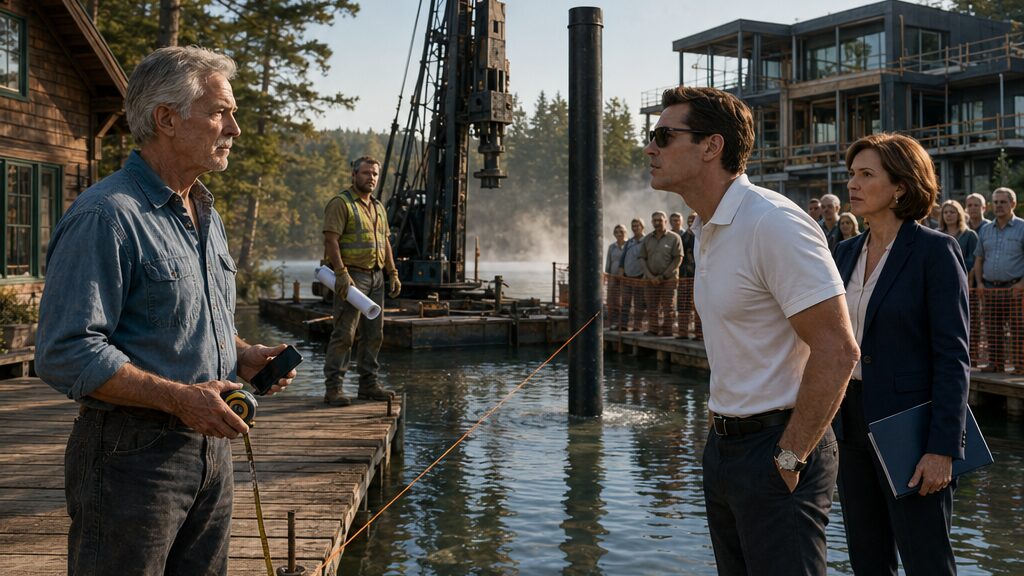
The Neighbor Built Into the Lake, but the Quiet Engineer Knew Which Line Mattered
Chapter 1: The Piling Beyond the Orange Line
The steel piling struck the lakebed on Andrew Carter’s side of the orange line.
The impact traveled through the water before the sound reached him. A dark ring spread beneath the floating drill platform, lifting dead leaves and pale silt from the bottom. Then the pile driver hammered again, and Andrew felt the vibration through the boards of his cedar dock.
He lowered his coffee without drinking it.
The orange mason’s line had been there since dawn, pulled tight from an old iron pin beside his cabin to a temporary stake near the shared dock. It was not an official boundary by itself. Andrew knew that better than anyone. But it reproduced the bearing shown on the site sketch approved by the homeowners association, and the new black piling stood well beyond it.
Not inches.
Several feet.
The pile driver rose and fell again.
Andrew set the mug on the dock rail and walked back toward the cabin. Inside, the kitchen table was still covered with the papers he had examined the night before: the subdivision plat, Brandon King’s construction notice, a reduced copy of the approved site plan, and Andrew’s own penciled calculations along the margins.
He took a steel tape, a survey rod, and his phone.
By the time he returned, three homeowners had gathered near the shared dock. They stood behind a temporary plastic barrier, watching the construction as if it were entertainment. Across the water, the frame of Brandon’s boathouse rose in silver beams and wide glass panels. It was less a boathouse than a second residence—two stories, a roof deck, an enclosed lounge, and enough pilings to carry a small commercial pier.
Brandon stood beside the construction foreman in a white polo and mirrored sunglasses. He saw Andrew approaching and stepped toward the barrier.
“You can’t be in here,” Brandon called.
Andrew stopped at the orange line.
“I’m not in there.”
“You stretched that across the access path.”
“It crosses the path. It doesn’t block it.”
Brandon glanced toward the watching homeowners. “This is exactly what I told the board would happen.”
Andrew did not ask what he meant. He clipped the steel tape to the old pin near his dock and began walking the bearing shown on the approved drawing.
Brandon came closer.
“You’ve already complained to the board. They reviewed it.”
Andrew kept his eyes on the tape.
“The board reviewed a sketch.”
“They approved the project.”
“That doesn’t move the line.”
One of the homeowners shifted uncomfortably. Another raised a phone but lowered it when Andrew looked in that direction.
The pile driver stopped. The sudden quiet made the distance across the water seem smaller.
Donna Martin came down the path from the clubhouse carrying a blue folder. She wore low heels unsuitable for the uneven ground, but she moved carefully enough that she never appeared off balance. As HOA president and one of the community’s busiest real-estate brokers, Donna had spent years learning how to look calm while other people became emotional.
“Andrew,” she said, “we need to keep this from turning into a scene.”
He glanced at the stopped machine. “That would have been easier before they put steel in the wrong place.”
Donna held out a paper.
The words NOTICE OF OBSTRUCTION appeared beneath the association letterhead.
Andrew read the first paragraph. It accused him of entering a restricted construction area, placing an unauthorized marker across a common access route, and interfering with work approved by the architectural committee.
“I haven’t entered the site.”
“You’ve been speaking directly to the crew.”
“I asked where the piling was going.”
“That is not your role.”
Andrew folded the notice once and tucked it beneath the clipboard holding the approved plan.
Brandon gave a brief laugh. “There. Now it’s official.”
Andrew looked at him. “An association notice isn’t a survey.”
“No, but it means you need to stop harassing my contractors.”
“I spoke to one man.”
“You walked around here with a tape measure like you own the lake.”
Andrew looked past him to the newest piling. Water lapped against its black surface. The orange line passed between Andrew and Brandon, bright enough to be visible from the far bank.
“I don’t own the lake,” Andrew said. “That’s part of the problem.”
Brandon removed his sunglasses. His expression had lost the easy amusement.
“My property goes to the water. My permit package was reviewed. My bank reviewed it. The board reviewed it. You don’t get to stop a project because you don’t like looking at it.”
Andrew placed the survey rod against the orange line and checked the distance to the piling.
Brandon stepped into his path.
“Did you hear me?”
Andrew lifted his phone and took a photograph. The frame captured the survey rod, the line, the piling, and the edge of the floating platform. A location stamp appeared beneath the image.
Brandon’s face tightened.
“If you think you have a case, call a lawyer.”
Andrew extended the tape.
Eleven feet, two inches.
He took another photograph.
“Andrew,” Donna said, more quietly now, “you are making assumptions from an association sketch. Shorelines shift. Water levels change. That string does not establish ownership.”
“No,” he said. “It establishes where your approved plan says the edge of construction should be.”
The construction foreman had come ashore. He was a broad man with a sunburned neck and a rolled set of drawings beneath one arm.
Brandon turned to him. “We’re fine, right?”
The foreman looked at Andrew’s line, then at the piling.
“We’re building from the control points your survey crew marked.”
“Exactly.”
Andrew asked, “What’s the federal authorization number?”
The foreman did not answer.
Brandon frowned. “The what?”
“For structures in navigable water. The authorization number should be on the permit sheet.”
The foreman shifted the drawings to his other arm. “The owner gave us the approved package.”
“I’m asking whether your package includes the waterways permit.”
“I’d have to check.”
“Then check before you place another piling.”
Brandon stepped between them. “You don’t give orders to my crew.”
Andrew looked at the foreman rather than Brandon. “If the permit exists, the number ends the question.”
The foreman’s eyes moved toward the floating platform. He raised one hand. The operator shut down the pile driver completely.
The watching homeowners went still.
For the first time that morning, Brandon looked uncertain.
It lasted only a second.
He turned on the foreman. “Why did you stop?”
“He asked about the permit number.”
“And I’m telling you the project is approved.”
“By the association,” Andrew said.
Brandon pointed toward the platform. “Start it back up.”
The foreman hesitated.
Donna closed the blue folder. “Perhaps we should pause until the paperwork is confirmed.”
Brandon stared at her. “You told me everything was cleared.”
“I said the board approved the architectural application.”
“That is what cleared means.”
“No,” Andrew said. “It means the board approved what it had authority to approve.”
Brandon turned on him with a controlled anger that seemed more dangerous than shouting.
“You’ve been waiting for this,” he said. “You sit in that old cabin and watch everyone else improve their property, and now you finally have a reason to feel important.”
The words landed closer than Andrew wanted them to.
He had heard versions of them before: at public meetings, in conference rooms, in the months after the project that ended his career. An engineer could be technically correct and still become the person everyone blamed for the cost of being correct.
Andrew unclipped the tape.
Brandon misread the gesture as surrender.
“That’s what I thought.”
Andrew wound the steel tape carefully, returned it to its case, and photographed the full site from three more angles. He included the orange line in every frame.
Then he asked the foreman, “Where are your control points tied?”
The man nodded toward two wooden stakes near the upper bank.
Andrew photographed those as well.
Brandon put his sunglasses back on. “You done?”
“For now.”
Andrew walked toward his cabin.
Behind him, Brandon said, “Start the machine.”
The engine coughed, then deepened into a steady mechanical growl. The hammer rose above the water.
Andrew did not turn around.
Inside the cabin, he transferred the photographs to his computer. He enlarged the clearest image and compared the coordinates with those printed on the HOA site sketch.
The line on the drawing should have run southeast from the old iron pin.
The coordinates recorded by his phone placed the new piling on a different bearing altogether.
Andrew checked the numbers twice.
Then he opened the subdivision plat and entered its control points.
The piling did not match that line either.
By late afternoon, the pile driver had placed two more steel columns beyond the orange string.
Andrew sat at his kitchen table with the obstruction notice beside his phone. On the screen, three maps showed three slightly different shorelines.
Only one fact remained consistent.
The pilings crossed every one of them.
Chapter 2: Eight Copies of a Broken Boundary
The county clerk placed two official plats side by side and said, “They cannot both be right.”
Andrew leaned closer to the counter.
The older plat, recorded when the subdivision was created, showed the shoreline as a smooth arc behind the lots. The newer digital record showed a sharper indentation near his cabin, as if the lake had taken a bite from the bank. Each document carried a recording stamp. Each had been used in property transactions. Each placed the common dock in a different relationship to Andrew’s parcel.
“Where did the digital line come from?” he asked.
The clerk adjusted her glasses and studied the lower corner.
“County GIS conversion. About fifteen years ago.”
“Was it field verified?”
“I don’t see a survey reference.”
Andrew had expected a clean answer. He had driven into town believing the county record would settle the dispute, expose Brandon’s intrusion, and let Andrew remain what he preferred to be: a man presenting facts rather than asking anyone to trust him.
Instead, the facts had multiplied.
The clerk opened a second database and searched by subdivision name. “There’s a shoreline adjustment exhibit.”
“Recorded?”
“Filed, but not attached to individual deeds.”
She printed it.
The exhibit showed the shoreline before a period of erosion repairs along the eastern bank. A dashed line marked a proposed stabilization edge. Andrew recognized the drafting style before he saw the initials.
A.C.
Small, neat, and written beneath a block of technical notes.
His own.
The clerk turned the page toward him. “Does that mean anything?”
Andrew did not answer immediately.
The exhibit had been prepared twelve years earlier, when the association asked him informally to review repeated erosion near the common dock. He had warned that the shoreline shown on the original plat no longer matched the physical bank. He had also recommended a full boundary resurvey before further waterfront approvals.
The recommendation had never been completed.
Andrew remembered Donna calling him after the board meeting. The association could not afford the survey that year, she had said. Property owners would resist a special assessment. Could they treat his drawing as a maintenance guide instead?
He had said yes, provided no one used it to establish property limits.
Then he had withdrawn from the matter entirely.
At the time, he was still working through the public-works dispute that ended his consulting practice. A retaining system he had recommended had failed during an unusual flood. No one had proved negligence, but the repair costs had become public, then political. His reports had been quoted without context. His caution had been described as indecision; his final recommendation as arrogance.
When the lake association ignored his advice, he had let them.
He had told himself it was not his responsibility.
“Sir?” the clerk said.
Andrew folded the exhibit before she could see his hands tighten.
“It was a preliminary document.”
“Do you want a certified copy?”
“Yes.”
“How many?”
He looked at the two plats, the adjustment exhibit, and the approval drawing Brandon had filed with the HOA.
“Eight.”
The clerk paused. “Eight complete sets?”
“Yes.”
The copying took nearly half an hour. Andrew stood beside a bulletin board covered with notices for tax sales, public hearings, and road closures. Through the glass doors, people crossed the courthouse square carrying lunches and folders. No one knew that the line beneath Brandon’s boathouse had just become less certain, not more.
When the clerk returned, she placed eight clipped packets on the counter.
Andrew signed the request and paid the certification fee.
Before leaving, he asked, “Has anyone else requested this adjustment exhibit recently?”
The clerk checked the log.
“An association representative, six months ago.”
“Name?”
“I can’t release the requester’s personal information from this screen.”
“Was it connected to a permit file?”
She looked again. “Architectural review support.”
Andrew felt the first clean edge of anger he had experienced since the piling entered the water.
Someone had seen the discrepancy before Brandon began building.
At home, he spread the eight packets across the kitchen table. The cedar walls held the afternoon heat, and the pile driver sounded faintly through the trees. Each impact made the water in a glass near the sink tremble.
Andrew placed transparent drafting film over the original plat. He traced the property bearings in black, the digital shoreline in blue, and the HOA-approved construction limit in red.
The lines disagreed about ownership.
They did not disagree about the pilings.
Under the oldest plat, the structure crossed beyond Brandon’s projected side boundary.
Under the digital map, it entered common-water frontage.
Under the shoreline adjustment exhibit, it extended into an area Andrew had identified as unstable and requiring further survey.
Eleven feet did not disappear under any interpretation.
That was the small certainty he had wanted. It should have relieved him.
Instead, his initials on the exhibit seemed to darken each time he looked at them.
He made a separate stack for documents he intended to send: the two recorded plats, Brandon’s approved site sketch, the geotagged photographs, and a one-page explanation of the measured discrepancy.
The shoreline adjustment exhibit remained beneath his hand.
If he included it, he would have to explain why the association had been warned years ago and why he had never forced the issue. If he excluded it, the complaint would still be valid—but incomplete.
Andrew removed the exhibit from the packet.
He placed it in the bottom drawer of the sideboard, beneath old tax records and a folder from his former engineering practice.
The pile driver stopped just before sunset.
In the quiet, Andrew heard a vehicle on the gravel lane. A white HOA utility cart pulled up beside his cabin.
Gregory Hill climbed out carrying an envelope.
Andrew met him on the porch.
Gregory had worked around the lake since before the association hired him. He repaired dock lights, cleared drainage ditches, checked pumps, and knew which homeowners complained before calling and which called before looking. Years earlier, he and Andrew had fished together twice. Then Andrew had stopped accepting invitations from almost everyone.
Gregory held out the envelope.
“Board asked me to deliver this.”
“Certified mail would have been simpler.”
“They wanted it today.”
Andrew opened it.
The first page announced an emergency HOA hearing for Friday evening. The second imposed a five-hundred-dollar fine for obstructing approved construction and interfering with contracted personnel.
Gregory watched him read.
“You could’ve just talked to Donna before stretching that line,” he said.
“I did talk to her.”
“Not lately. I mean before all this.”
“She had the same map I had.”
Gregory looked toward the lake. Through the trees, the black pilings stood in a row beside Brandon’s unfinished frame.
“People think you’re trying to shut the whole project down.”
“I’m trying to stop them from building where they weren’t approved to build.”
“Those don’t sound different to Brandon.”
“They are different.”
Gregory rubbed the back of his neck. “You always do that.”
“Do what?”
“Talk like the right sentence should end the argument.”
Andrew folded the hearing notice.
“The right measurement ought to.”
Gregory gave a tired shake of his head. “That’s not how people hear things.”
He returned to the cart without saying goodbye.
Andrew watched him drive away, then carried the envelope inside.
On the kitchen table, the eight certified packets looked orderly and convincing. Beside them sat the fine, the hearing notice, and the empty place where the old adjustment exhibit should have been.
Andrew opened the sideboard drawer.
He saw his initials through the thin paper.
For several seconds, he considered putting the exhibit back with the other records.
Then the pile driver started again in the dark.
Andrew closed the drawer.
Chapter 3: The Hearing That Made Him the Problem
Andrew’s map appeared on the clubhouse screen with the warning removed.
He recognized the image immediately. The red construction line, the old iron pin, the projected side boundary—all of it came from the one-page diagram he had given Donna two days earlier.
But the note at the bottom was gone.
FIELD VERIFICATION REQUIRED BEFORE WATERFRONT CONSTRUCTION.
In its place, the slide displayed a title in large letters:
CARTER OBJECTION—UNVERIFIED PRIVATE INTERPRETATION.
Andrew remained standing at the back of the room with his folder beneath one arm.
Nearly forty homeowners filled the folding chairs. Some had come because the hearing concerned the largest construction project in the subdivision. Others had come because Donna’s email described Andrew’s actions as a threat to approved property improvements. Brandon and Kimberly sat at the front beside the HOA attorney.
Donna stood at the lectern.
“We are not here to decide federal jurisdiction or conduct a boundary trial,” she said. “We are here to determine whether a resident interfered with authorized work and created a hazard across a common access path.”
Andrew looked at the cropped map.
“You altered the exhibit.”
Donna’s expression did not change. “Please wait until public comment.”
“You removed the verification note.”
The HOA attorney leaned toward his microphone. “Mr. Carter, you will have an opportunity.”
A murmur moved through the room.
Andrew sat in the last open chair.
On the screen, his orange survey line looked less like a boundary than an accusation.
Donna summarized the board’s position. Brandon’s design had passed architectural review. A licensed survey crew had placed construction stakes. The contractor had relied on those points. Andrew had entered the area, spoken to workers, installed an unauthorized line, and caused an interruption that cost the project several hours.
When she finished, Brandon stood.
He did not raise his voice.
“My wife and I followed every process we were given,” he said. “We submitted plans, paid review fees, revised the roofline, reduced exterior lighting, and waited months for approval. The lender releases funds according to construction milestones. If the enclosure isn’t complete within ten days, we lose the current financing terms.”
Several homeowners nodded. They understood interest rates better than shoreline bearings.
Brandon turned toward Andrew.
“One person has decided his interpretation matters more than every professional involved.”
Andrew opened his folder.
Donna said, “You may respond now.”
He walked to the front carrying three sheets.
“The newest piling is eleven feet two inches beyond the construction limit shown in the board-approved site sketch.”
The HOA attorney asked, “Is that construction limit a recorded property boundary?”
“No.”
“Then your statement does not establish trespass.”
“It establishes deviation from the approved plan.”
“Unless the control points on the plan were adjusted in the field by the surveyor.”
“Were they?”
The attorney looked toward Brandon.
Brandon said, “The crew followed the stakes.”
Andrew placed the geotagged photograph on the document camera. The orange line appeared on the screen, leading directly toward the black piling.
“This photograph records the position of the piling and the old iron control pin. The bearing does not match the approved drawing.”
Donna folded her hands. “You are not acting as a retained engineer for the association.”
“No.”
“You have not performed a certified boundary survey.”
“No.”
“You are retired and carry no current professional liability coverage for this matter.”
A few people shifted in their seats.
Andrew understood what she was doing. She was not disproving the measurement. She was making him personally unsafe to believe.
He replaced the photograph with the two county plats.
“These records also disagree with each other.”
That drew more attention than the piling photograph had.
The attorney leaned forward. “Then you are acknowledging the boundary is uncertain.”
“The ownership line is uncertain. The approved construction limit is not.”
“You cannot separate those questions so neatly.”
“I can separate a private boundary claim from construction in regulated water.”
Donna said, “Again, that is outside the purpose of this hearing.”
Andrew looked at the homeowners. “The contractor could not produce a waterways permit number.”
Brandon rose halfway from his chair. “Because you stopped a working foreman and demanded paperwork he didn’t carry in his pocket.”
“I asked for the number.”
“You tried to scare him.”
“No. I asked whether authorization existed.”
Kimberly turned around.
Until then, she had remained silent, one hand resting over a closed notebook. She wore none of Brandon’s visible confidence. Her face looked tired rather than angry.
“Are you trying to destroy our financing?” she asked.
The room became quiet.
Andrew had prepared answers for the board, the attorney, and Brandon. He had not prepared one for her.
“I am trying to stop work until the location and permits are verified.”
“That means missing the deadline.”
“If the structure is authorized, verification protects you.”
“And if it isn’t?”
Andrew looked at Brandon.
“Then completing it makes the problem more expensive.”
Kimberly’s mouth tightened. “For us.”
“Yes.”
The bluntness hurt him as soon as he said it.
Brandon stood fully. “There it is.”
Andrew could have explained that he did not want their house, money, or marriage damaged. He could have said he had spent years watching public projects become more expensive because someone was afraid to pause them. He could have admitted that he understood what it meant to be blamed for costs that arrived after a warning.
Instead, he returned to the documents.
“The board’s map relies on a shoreline that no longer exists.”
Donna’s eyes sharpened.
It was only a small reaction, but Andrew saw it.
The attorney said, “What is the basis for that statement?”
Andrew felt the hidden exhibit waiting in the drawer of his cabin.
He could disclose it now.
He could say that he had drawn the adjustment study twelve years earlier, that the board had been advised to commission a full resurvey, and that the current approval rested on unresolved information.
But then the room would ask why he had said nothing while homes were bought and sold, docks replaced, and permits issued.
Andrew closed the folder.
“The county records conflict,” he said.
The opportunity passed.
Donna called for the board vote. The fine was upheld. Andrew was ordered to remove the orange line from the common access path and communicate with the project only through the HOA attorney.
The vote was not unanimous, but it was not close.
As chairs scraped and residents moved toward the doors, Gregory approached Andrew near the back wall.
“You had more,” Gregory said.
Andrew looked at him. “More what?”
“Something you weren’t saying.”
“That’s an assumption.”
Gregory gave a humorless laugh. “You’re not the only one who can recognize one.”
He glanced toward Donna, who was speaking with the attorney.
Then he lowered his voice.
“There was gray water in the reeds yesterday morning.”
Andrew stopped gathering his papers.
“Where?”
“Below the concrete pump hose. East side.”
“Did you photograph it?”
“No.”
“Did you log it?”
Gregory’s jaw tightened. “I log everything.”
“Then preserve the entry.”
“I’m not taking orders from you.”
“That isn’t an order.”
“It always sounds like one.”
Andrew softened his voice. “Concrete wash can change the water chemistry. If it reached the cove, the maintenance record matters.”
Gregory looked across the room at Brandon, who stood with Kimberly near the projected map.
“I told the foreman to contain it,” he said. “He said it was muddy runoff.”
“Was it?”
Gregory did not answer.
Donna called his name.
He walked away.
Andrew gathered the cropped exhibit from the document table before anyone could remove it. At the bottom, a clean white strip showed where his warning had been cut away.
Outside, the clubhouse parking lot was almost empty when Gregory came through the side door carrying a maintenance binder.
Donna followed him.
“You don’t need the old book,” she said. “Start a clean log for the construction period.”
Gregory stopped beside the utility cart.
“The old one covers the same area.”
“It also includes informal notes that could be misinterpreted.”
“They’re maintenance notes.”
“The attorney wants relevant entries transferred into a new record.”
Andrew stood in the shadow beside his truck, unseen by both of them.
Donna handed Gregory a fresh binder.
“Use this one starting tomorrow,” she said. “Copy over anything routine. Leave out speculation.”
Gregory looked at the old binder in his hand, then at the new one.
“What counts as speculation?”
Donna’s answer came without hesitation.
“Anything that creates a problem we cannot verify.”
She walked back inside.
Gregory remained beside the cart with both binders pressed against his chest.
Then he opened the old log to the previous day’s entry.
Even from across the parking lot, Andrew could see the dark line of Gregory’s handwriting beneath the date.
Chapter 4: The Permit Number Nobody Could Produce
The first dead fish appeared beneath the reeds before the concrete truck left the shoreline.
Andrew saw three of them floating on their sides in water the color of weak cement. Their silver bellies caught the morning light each time the wake from the construction platform pushed into the cove.
A hose hung over the eastern edge of Brandon’s site. Gray water dripped from its mouth.
Andrew stepped off his dock wearing rubber boots and carried a clear sample jar in one hand. The orange survey line no longer reached the piling. New decking covered the water between the steel columns, cutting across the bearing like a lid.
The line disappeared beneath it.
A worker near the pump called, “You can’t come through here.”
Andrew stayed on the exposed strip of bank below his cabin.
“I’m not coming through.”
He crouched beside the reeds and filled the jar.
The water clouded immediately.
The construction foreman approached from the platform. He looked more tired than he had during the first confrontation, and he kept glancing toward the road as if expecting someone.
“That doesn’t prove anything,” he said.
Andrew sealed the jar. “It proves what was in this spot at eight twelve this morning.”
“It rained last night.”
“Rainwater doesn’t usually leave alkaline residue on cattails.”
The foreman looked at the dripping hose.
“I told them to contain the wash.”
“Who is them?”
“The concrete subcontractor.”
“Where is their containment basin?”
The man did not answer.
Brandon came down the new stairway from the glass frame above the dock. The outer walls had gone up quickly. Wide panels reflected the lake and trees, making the building seem transparent from a distance. Up close, it blocked half Andrew’s view of the eastern cove.
“You’re collecting water now?” Brandon asked.
Andrew stood. “Three fish are dead.”
“Fish die.”
“Not usually beside a concrete hose on the morning of a pour.”
Brandon looked toward the workers. “Move that hose.”
The foreman lifted it onto the platform.
Andrew took photographs before anyone could disturb the reeds.
Brandon stepped closer. “You keep showing up with a new theory every day.”
“The location hasn’t changed.”
“The county says the maps conflict.”
“The structure crosses your approved plan under every version.”
“My surveyor says otherwise.”
“Then ask him to identify the control monument he used.”
“I don’t work for you.”
“No. But the lake doesn’t work for you either.”
Brandon’s expression tightened. “The enclosure has to be weather-tight by Friday.”
“That doesn’t create authorization.”
“It creates a deadline.”
Andrew looked at the glass walls, the decking, and the row of pilings sunk beneath them. “Deadlines do not change jurisdiction.”
For a moment Brandon said nothing. The anger in his face looked less like contempt now and more like fear held in place by effort.
Then he turned to the foreman.
“Keep moving.”
Andrew carried the sample back to his cabin.
He spent the next two days assembling a complaint that could survive being dismissed as a neighbor’s grievance. He omitted language about ownership wherever possible. Instead, he documented location, construction type, water disturbance, fill placement, and the absence of any permit number in the materials Brandon or the HOA had provided.
He called the state environmental office first.
The reviewer listened without interruption, then asked, “Do you have laboratory results?”
“Not yet.”
“Photographs?”
“Yes.”
“Evidence of discharge?”
“Gray runoff in the reeds, dead fish, and a maintenance observation.”
“Signed?”
“I don’t know.”
The pause on the line was slight but clear.
“If this is primarily a private boundary dispute, our office may not intervene before construction is complete.”
“It isn’t primarily private.”
“That is what the property owner will argue.”
“The pilings are in navigable water.”
“Then you need the federal office as well.”
“I know.”
The reviewer’s tone changed. “You’ve dealt with this before?”
Andrew looked at the closed sideboard drawer.
“I’ve worked around water permits.”
“Professionally?”
“I’m retired.”
“That was not my question.”
Andrew did not answer it.
The reviewer gave him a submission address and a case reference number. Before ending the call, she said, “Send the strongest facts first. Not the history. Not the personalities. Location, activity, authorization status, environmental effect.”
Andrew wrote each word down although he did not need to.
That afternoon, Gregory’s utility cart stopped beside the cabin.
He came to the porch carrying a brown envelope, but he did not offer it to Andrew immediately.
“Donna asked whether you spoke to me after the meeting.”
“What did you tell her?”
“That you asked about runoff.”
“And?”
“That I didn’t give you anything.”
Andrew waited.
Gregory looked back toward the road, then handed him the envelope.
Inside was a photocopy of the maintenance log page. The entry recorded cloudy discharge below the concrete pump, dead minnows near the reeds, and a verbal instruction to the foreman to install containment.
The original ink had been pressed hard enough to emboss the paper.
“You kept the old book,” Andrew said.
“It’s in my truck.”
“Donna told you to replace it.”
“She told me to transfer relevant entries.”
“And leave out speculation.”
Gregory’s mouth twisted. “I decided dead fish weren’t speculative.”
Andrew studied the copy. “Will you sign a statement?”
“No.”
The answer came quickly.
“My job is tied to the association,” Gregory said. “Insurance, too. I’m not stepping into court because you and Brandon can’t stand each other.”
“This isn’t about whether we like each other.”
“That’s what you keep saying. Everybody else hears two men fighting over a line.”
Andrew folded the copy carefully.
“Why give me this?”
Gregory stared past him at the water.
“My father taught me to fish in that cove. He’d have made me drink the runoff before calling it harmless.”
It was the closest thing to an explanation Andrew was going to receive.
“Thank you,” Andrew said.
Gregory looked almost irritated by the words. “Don’t make it into something.”
He drove away before Andrew could answer.
The certified warning went out that afternoon. Andrew mailed copies to Brandon, Donna, the HOA attorney, the state office, and the federal waterways regulator. He included the photographs, plat comparisons, measured offsets, construction description, and Gregory’s log copy without identifying Gregory as the source.
He did not include the old shoreline-risk exhibit.
The envelope addressed to Brandon arrived the next morning.
Brandon signed for it himself.
He carried it into the unfinished boathouse and set it on a temporary desk between lender documents and invoices. The red certified-mail sticker faced upward.
Kimberly called from the upper level, asking whether the glass contractor had confirmed Friday.
“Yes,” Brandon answered.
“Did the bank send the revised draw schedule?”
“It’s here.”
He placed the certified envelope beneath the schedule.
“Anything from the HOA?”
“Nothing that matters.”
Kimberly came down the stairs holding a tablet. She stopped when she saw his hand resting on the pile of papers.
“What is that?”
“Construction correspondence.”
“From Andrew?”
Brandon slid the lender schedule over the red sticker.
“He’s sending complaints everywhere.”
“Does he have a permit issue or not?”
“We have approvals.”
“That isn’t what I asked.”
Brandon looked toward the open wall facing the lake. Workers were installing the last roof panels.
“If we stop now, the bank reclassifies the project. We lose the rate, the draw, maybe the contractor.”
Kimberly lowered the tablet. “So we don’t know.”
“We know the HOA approved us.”
“Brandon.”
He pulled the envelope from beneath the schedule, unopened, and dropped it into the desk drawer.
“We finish the enclosure. Then we deal with him.”
He locked the drawer.
At the state office two days later, Andrew sat across from the environmental reviewer while she moved through his packet page by page.
She stopped at the plat comparison.
“You understand this weakens your private encroachment claim.”
“It complicates ownership. It does not authorize the work.”
She nodded once. “Correct.”
The word gave him no satisfaction.
She turned to the photographs of the pilings and runoff.
“We can inspect the discharge issue. We can also refer the structural work. But I need to be clear: we may not stop construction solely because your boundary evidence conflicts.”
“I’m not asking you to.”
“You began this because the piling crossed your line.”
“Yes.”
“And now?”
Andrew looked through the office window at a drainage pond behind the building. A white heron stood motionless in the shallows.
“Now I’m asking who approved filling regulated water.”
The reviewer closed the packet.
“That is the stronger question.”
She opened a digital file on her computer. Her eyes moved across the screen, then stopped.
“Mr. Carter.”
Andrew recognized the change in her voice.
She turned the monitor slightly toward him. A scanned memorandum appeared beneath the subdivision name. The lower corner bore his initials.
“Did you author the shoreline-risk memo attached to this community’s older stabilization file?”
The question left no space for another technical answer.
Andrew looked at the initials he had hidden from every packet he sent.
“Yes,” he said, but the word remained behind his teeth.
Chapter 5: The Housewarming Built on a False Approval
The guests raised their glasses directly above the piling Andrew had measured.
From the upper deck, the steel column was invisible beneath dark water and reflected party lights. Music drifted across the cove. A caterer moved between tables with champagne, and the glass walls held the sunset in long sheets of copper.
Kimberly stood beside the railing while Donna introduced Brandon to a couple considering a vacant lot on the western shore.
“This is what thoughtful improvement looks like,” Donna said. “Modern, restrained, fully integrated with the water.”
Kimberly watched Brandon smile.
He had always been good at smiling when figures did not work.
The lender representative had arrived an hour earlier, inspected the enclosed exterior, and confirmed that the next construction draw would be released. Brandon had squeezed Kimberly’s hand beneath the table as if the money solved everything.
It did not solve the extra collateral agreement she had found in the closing folder that morning.
Their original home—the one they had owned before the lake property—had been pledged against the revised loan.
Her signature appeared on the consent page.
It was genuine. She remembered signing the packet at the kitchen counter while Brandon turned pages and explained that the bank needed routine updates. She had not understood that “additional security” meant the house where her mother still lived in the downstairs apartment.
Brandon had.
Across the water, Andrew sat at the end of his cedar dock with papers on his lap. He wore the same pale work shirt he had worn to the HOA hearing. No drink, no guests, no attempt to approach the party.
The orange line remained tied to the old iron pin, but most of it lay submerged beneath the new deck. Underwater lights caught a short section of it, turning it into a glowing stripe below the surface.
One of Brandon’s guests noticed Andrew.
“Is that the neighbor?”
Donna answered before Kimberly could. “He has concerns about an old mapping discrepancy. The appropriate offices are reviewing it.”
“Is he the one who stopped the crew?”
“For part of a morning,” Brandon said.
The guests laughed politely.
Brandon lifted his glass toward Andrew.
“To progress,” he called across the water.
Andrew did not respond.
Kimberly looked at her husband. “Was that necessary?”
“He’s sitting there to make everyone uncomfortable.”
“He lives there.”
“He wants us to look guilty.”
Donna touched Kimberly’s arm. “Tonight should not be about him.”
The gesture was meant to calm her. Instead, it made Kimberly feel managed.
She excused herself and went inside.
The main room smelled of fresh wood, glass cleaner, and electrical wiring warming behind new walls. Temporary furniture had been arranged to suggest how the completed space would look. On the desk near the stairs, loan folders sat beneath a silver bowl filled with unopened mail.
Kimberly searched for the collateral agreement.
The desk drawer was locked.
She knew where Brandon kept the small key. He had used the same leather case for years, carrying vehicle keys, office keys, and the tiny brass one he claimed opened nothing important.
She found the case in his jacket.
The drawer slid open.
The certified envelope lay beneath the revised draw schedule.
It had been opened.
Kimberly removed the pages.
Andrew’s letter was dated twelve days earlier. It described the eleven-foot deviation, conflicting county records, the missing waterways authorization, and the runoff observed after concrete placement. The final paragraph requested an immediate voluntary pause before enclosure.
A delivery receipt was clipped to the back.
Brandon had signed for it before pledging their first home as collateral.
Kimberly read the letter twice.
Behind her, the music lowered. Donna’s voice came through the speakers outside, thanking the association’s architectural committee and describing the project as proof that “responsible investment and clear governance can coexist.”
Kimberly carried the envelope onto the lower deck.
Brandon saw it in her hand.
His smile disappeared before she reached him.
“Inside,” he said.
“No.”
Several nearby conversations faded.
Brandon moved closer. “Not here.”
“You received this before the revised loan agreement.”
He glanced at Donna.
Kimberly held up the delivery receipt. “You knew there was a federal authorization question.”
“There was an accusation.”
“You told me nothing had changed.”
“Nothing had changed. Andrew was still complaining.”
“He asked you to stop before we pledged the other house.”
Brandon lowered his voice. “We were already committed.”
“No. You were committed. I was uninformed.”
The lender representative looked away.
Brandon took Kimberly by the elbow. She pulled free.
Donna stepped between them with a practiced smile. “This is not the place to discuss financing.”
Kimberly turned on her. “Did you know about the letter?”
Donna’s pause was brief, but it answered the question.
“I knew Andrew had circulated material,” she said. “His conclusions remain disputed.”
“Did you know Brandon received it before the bank filing?”
“That is between you and Brandon.”
“No. The approval came from your board.”
“The board approved the design under the records available.”
“The records Andrew says were wrong.”
Donna’s expression hardened. “Andrew helped create those records.”
Kimberly stared at her.
Brandon said, “Donna.”
But she had already decided the information was useful.
“Twelve years ago,” Donna continued, “he prepared the shoreline adjustment exhibit now causing confusion. He had the opportunity to resolve this then. He did not.”
Across the cove, Andrew looked up from his papers.
The music had stopped completely.
Kimberly turned toward him, then back to Brandon. “Did you know that?”
“I knew he’d been involved.”
“When?”
Brandon did not answer.
Donna said, “That is why the board has been cautious about treating him as an impartial authority. He cannot create uncertainty and later use it to attack an approved project.”
Kimberly looked down at the certified letter. Andrew had not mentioned his prior role.
For a moment, the story rearranged itself. Andrew was no longer simply the careful older neighbor Brandon had ignored. He was part of the history that had made the boundary uncertain.
But Brandon had still hidden the warning.
Both things could be true.
The thought made the situation worse, not easier.
A low engine sounded on the entrance road.
Then another.
Guests turned toward the trees beyond the clubhouse. Headlights moved between the trunks, followed by the white roof of a state vehicle. A dark federal utility truck came behind it.
Donna handed her microphone to the caterer.
“There may be a misunderstanding,” she said.
No one answered.
The vehicles stopped near the shared dock.
A state environmental inspector stepped out carrying a hard case. The federal waterways regulator emerged from the second truck with a red document folder beneath one arm.
Brandon set his glass on the railing.
Kimberly saw his hand miss the table edge the first time.
Across the water, Andrew closed the folder on his lap and stood.
The regulator looked from the glass boathouse to the steel pilings beneath it.
Then he asked, “Who is the responsible property owner?”
Chapter 6: The Truth Andrew Left Out
The red cease-work notice was posted on the glass wall beside the champagne bar.
Its adhesive corners trapped air beneath the paper, making it flutter each time someone opened the deck door. Behind it, the reflection of the lake broke across the words UNAUTHORIZED ACTIVITY IN REGULATED WATERS.
No one had touched the champagne since the officials arrived.
Brandon stood with the federal regulator near the lower deck. Kimberly remained several feet away, Andrew’s certified letter folded in her hand. Donna and the HOA attorney spoke in low voices beside the temporary dining table.
Andrew crossed from his dock only after the state inspector called him by name.
The party guests parted without looking directly at him.
The federal regulator held Andrew’s packet. “You documented the first piling?”
“Yes.”
“And the runoff?”
“The photographs are mine. The maintenance entry is not.”
The state inspector opened her hard case and removed sample bottles. “We found elevated pH in pooled water below the pour area. We’ll need laboratory confirmation.”
Brandon said, “The contractor handled the washout. That is not the same as saying I ordered a discharge.”
“No one said it was,” the inspector replied.
The restraint in her voice left him with nothing to fight.
The regulator turned toward the boathouse. “We found no authorization covering these pilings, the deck extension, or the fill placed along the eastern edge.”
Brandon looked at Donna. “You said the application was complete.”
“The HOA does not issue federal permits,” Donna said.
“You reviewed the package.”
“For architectural compliance.”
“You advertised the project as fully approved.”
Donna’s face changed when she realized several homeowners were listening.
“The board acted on the representations submitted.”
Brandon laughed once, without humor. “So now it’s mine.”
“The property owner is responsible for required permits.”
Kimberly held up Andrew’s letter. “He told us before the enclosure was finished.”
Brandon looked at her. “Not now.”
“When would be better?”
The federal regulator took the letter, checked the date, and returned it.
“The cease-work order is effective immediately,” he said. “No further construction, occupancy, or alteration. A restoration assessment will follow.”
“Restoration?” Brandon repeated. “You mean a fine.”
“I mean determining what must be removed.”
The words traveled through the room more effectively than a shout.
One guest quietly set down a plate and left.
Donna stepped forward. “Before this becomes broader than necessary, the association has relevant historical material. Mr. Carter’s complaint relies on shoreline records he helped prepare.”
Andrew felt every face turn toward him.
The HOA attorney placed the old shoreline-risk memo on the dining table. Donna must have obtained it from the county file after the hearing—or had kept a copy all along.
His initials appeared in the lower corner.
Donna addressed the officials rather than the homeowners.
“Twelve years ago, Mr. Carter produced an adjustment exhibit showing a different shoreline. He now claims the association relied on a defective map, but he participated in creating the uncertainty and never completed a certified survey.”
The regulator looked at Andrew. “Is that accurate?”
Andrew could have answered narrowly.
The exhibit had not been a boundary survey. It had been a maintenance drawing. The board had been warned not to use it for property decisions. Donna’s description omitted those facts.
Every technical correction was available to him.
So was the truth beneath them.
“Yes,” Andrew said. “I prepared the exhibit.”
A murmur moved through the room.
Donna folded her arms.
Andrew placed his folder on the table and opened to the old memo.
“The association asked me to review erosion near the common dock. I concluded the physical shoreline no longer matched the recorded plat closely enough for new waterfront approvals. I recommended a full field survey.”
“Which was never done,” Donna said.
“No.”
“Because your work was preliminary.”
“Because the board did not want the assessment required to pay for it.”
Donna’s jaw tightened. “And you accepted that decision.”
Andrew looked at the homeowners gathered around the glass room. Some had bought homes after the memo was written. Some had replaced docks. Most had trusted the association files because that was what residents were expected to do.
“Yes,” he said. “I accepted it.”
The word quieted the room.
He continued before he could retreat into qualification.
“I had recently been involved in a public project that ended badly. My recommendation had become part of a dispute over cost and responsibility. When this board declined the survey, I did not push. I marked the exhibit preliminary, withdrew from the committee, and let the issue disappear into the files.”
Donna said, “So your own silence created the condition you are complaining about.”
“Partly.”
The admission seemed to unsettle her more than denial would have.
Andrew looked toward Brandon.
“It does not excuse building beyond the approved plan. It does not create a federal permit. It does not erase the warning you received before completion.”
Brandon’s face was pale beneath the deck lights. “You knew the maps were unreliable and watched me build.”
“I objected when the pilings crossed every version of the line.”
“You could have said this at the first meeting.”
“Yes.”
“Why didn’t you?”
Andrew looked at the memo.
“Because I wanted to be right without having to explain where I had been wrong.”
No one moved.
Kimberly lowered the certified letter.
The federal regulator pulled a chair from the table and spread out the subdivision plat, the digital shoreline map, Andrew’s old exhibit, and the recent site plan. Four versions of the water’s edge crossed one another in black, blue, red, and gray.
“This is no longer a single-lot restoration question,” he said.
Donna leaned forward. “The violation is on Brandon’s property.”
“The structures are there. The mapping failure is wider.”
He pointed along the eastern shore.
“If approvals were issued from inconsistent baselines, we have to assess every recent structure tied to those records. Emergency access, habitat disturbance, common frontage, and ownership projections all need review.”
Homeowners began speaking at once.
“Are our docks affected?”
“What about the sale last spring?”
“Does this invalidate permits?”
The regulator raised a hand. “Nothing is being decided tonight beyond the cease-work order. But a restoration and correction plan must address the community shoreline, not just Mr. Carter’s frontage.”
Donna’s control finally slipped.
“You cannot hold an entire association responsible for one unauthorized project.”
The state inspector said, “The association’s records were used to support the project.”
“Our attorney will contest that.”
“That is your right.”
Gregory entered through the open deck door carrying the old maintenance binder.
Donna turned toward him. “Why is that here?”
He placed it on the table beside the maps.
“Because you told me to replace it.”
The room stilled again.
Gregory opened to the entry documenting gray discharge and dead fish. Then he opened several earlier pages showing erosion repairs, failed bank markers, and repeated notes that shoreline references no longer matched field conditions.
“I wrote what I saw,” he said. “I’m not rewriting it because it causes trouble.”
Donna stared at him. “You work for the association.”
“I work around the lake.”
It was not a dramatic line. Gregory said it with the exhausted tone of a man who had spent too many years clearing other people’s messes.
That made it harder to dismiss.
The federal regulator copied the relevant pages. The state inspector tagged the binder as a voluntary record and returned it to Gregory.
By morning, the party tables were gone. Yellow restriction tape crossed the boathouse entrance, and the red notice remained on the glass wall.
The officials reconvened in the clubhouse with Andrew, Brandon, Kimberly, Donna, Gregory, and the HOA attorney. The regulator presented two possible paths.
The first treated Brandon’s project as an isolated unauthorized structure. It would require removal of the outer pilings and fill, penalties, and a corrected survey for the two adjoining lots.
The second created a community-wide shoreline correction and restoration agreement. It would examine recent approvals, establish reliable control points, restore the damaged cove, and create protected access along the common waterfront.
“The first option is faster,” the regulator said. “It also leaves the underlying mapping problem unresolved.”
Donna immediately said, “The association favors the first.”
Brandon said nothing.
Kimberly looked at the map, then at Andrew. “What does the second option do to his property?”
The regulator pointed to the narrow strip beside Andrew’s cabin.
“Potentially establishes shared emergency shoreline access where the existing records overlap. Mr. Carter could lose exclusive control of that approach.”
Andrew studied the strip.
It included the path beside his old iron pin, the place where he had tied the orange line, and the clearest route from the common dock to the eastern cove.
The narrow settlement would remove the intrusion from his frontage and give him the cleanest personal victory.
It would also leave the rest of the community dependent on the same broken system he had once allowed to remain.
Donna saw him hesitate.
“You wanted the structure off your line,” she said. “This gives you that.”
Andrew looked through the clubhouse windows. The orange string floated in the water beneath the unfinished deck.
For weeks, he had treated it as proof of where Brandon should have stopped.
Now it marked the edge of his own choice.
He pushed the narrow settlement back across the table.
“No,” he said.
The HOA attorney frowned. “No to what?”
“To fixing only the part that reaches my cabin.”
Andrew pulled a blank sheet from his folder and placed it over the conflicting maps.
“The eastern bank can be restored without forcing every owner into separate litigation. The common access can remain if it follows stable ground. The habitat shelf can be rebuilt below the cove. But the reference line has to be established from new control points, not inherited drawings.”
The regulator watched him sketch the first bearing.
Donna said, “You are proposing to surrender part of your claim.”
“I’m proposing a line the water, the records, and the people living here can all survive.”
Brandon finally spoke.
“And who pays for it?”
Andrew looked at the unauthorized glass structure, visible through the clubhouse window.
“That is the next line we draw.”
Chapter 7: Redrawing the Line After the Water Returned
The first unauthorized piling came out of the lake with a sound like a long breath being pulled through steel.
Mud streamed from its black surface as the crane lifted it above the water. The restoration crew swung it toward the barge, where it landed against the others with a hollow clang that carried across the cove.
Andrew stood beside the old iron pin near his cabin.
The orange string was still tied around it.
Three months of sun and rain had faded the line almost pink, and one section remained trapped beneath the edge of the dismantled decking. Each time the crew removed another board, more of the string floated free.
Gregory stood knee-deep near the reeds, directing workers as they placed bundles of native plants along the rebuilt habitat shelf. He had kept his HOA job through the transition, though the title on his new employment agreement no longer included enforcement. The independent shoreline committee had made him site coordinator instead.
He claimed the work was mostly the same.
Andrew knew it was not.
A restoration contractor approached carrying the final access drawing in a plastic sleeve.
“We need your signature before we set the marker,” he said.
Andrew took the plan.
The new surveyed boundary ran where the field control points placed it, not where the old plats had guessed. Most of the disputed strip remained with Andrew’s parcel. A narrow corridor beside his cabin, however, was marked as shared emergency shoreline access.
Eight feet wide.
Wide enough for rescue personnel, maintenance equipment, or residents evacuating from the eastern docks.
It crossed the place where Andrew kept his small workbench and stored his canoe each winter.
“You knew this was in the agreement,” the contractor said.
“I knew.”
“We can shift the marker six inches toward the water without affecting the corridor.”
Andrew studied the drawing. “No.”
The contractor waited.
“Set it where the survey says.”
Andrew signed.
The man carried the plan toward the bank, where a crew member held a permanent bronze-topped marker above a prepared hole.
Across the lake, the glass boathouse no longer resembled the building Brandon had unveiled at the party. The outer lounge and roof deck were gone. The eastern section had been cut back behind the corrected construction limit. What remained was a smaller structure connected to the original house by a narrow covered walkway.
Kimberly had called it the part they could afford to keep.
The rest would be sold in pieces: glass panels, fixtures, steel framing, anything the restoration company could remove without further disturbing the water.
A dark pickup stopped near the shared dock.
Brandon stepped out alone.
Gregory saw him first and rested both hands on the top of his shovel.
Andrew had not spoken to Brandon since the final settlement session. Attorneys had carried most of the language between them. The agreement assigned Brandon the largest share of removal and habitat costs. The HOA’s insurer covered part of the mapping correction. The association funded the independent committee through a special assessment spread over several years.
Andrew paid for the survey work beside his own lot.
No one had escaped without cost.
Brandon walked down the path holding a folder.
“You started without me,” he said.
“The crane started at seven.”
“I was told nine.”
“The signing is at nine.”
Brandon looked toward the barge. Two workers secured the latest piling among the others.
“Fine.”
He had lost weight. Without sunglasses and construction crews around him, he appeared younger and more exhausted.
Kimberly arrived several minutes later in a separate car. She carried another copy of the settlement and greeted Andrew with a small nod.
“We accepted an offer on the addition materials,” she said.
Andrew looked toward the reduced structure. “That should help.”
“It pays the environmental portion and part of the bank adjustment.”
“And the first house?”
“We’re keeping it.”
The relief in her voice was controlled, but unmistakable.
Brandon stared at the water.
Kimberly added, “We’re selling the unfinished upper level here, not the original home.”
Brandon looked at her. “You don’t have to explain our finances.”
“I’m not explaining them. I’m saying what changed.”
The regulator and state inspector arrived together. Donna came with the HOA attorney but did not enter the center of the group. She had resigned as president under the governance settlement and suspended her real-estate work in the subdivision while the board reviewed past disclosures.
No one had forced her to attend.
She stood near the edge of the dock with her hands clasped in front of her.
The federal regulator opened the signing folder on a temporary table.
“This agreement closes the immediate enforcement action once removal, stabilization, and record correction are certified,” he said. “It does not erase future responsibility for maintenance.”
His eyes moved around the group.
“The shoreline committee will assume review authority for work affecting common frontage. Any private construction still requires applicable local, state, and federal authorization.”
Brandon signed first.
His pen stopped above the last page.
“Once I sign this,” he said, “the removal order is final.”
“It has been final for weeks,” Kimberly replied.
He looked at Andrew. “You could have taken the narrow settlement.”
“Yes.”
“You would have gotten your view back and paid almost nothing.”
“Yes.”
“Instead, everybody pays.”
Andrew glanced toward the new access corridor.
“Everybody was already exposed.”
“That is not the same thing.”
“No.”
Brandon waited, perhaps expecting a defense.
Andrew offered none.
After a moment, Brandon signed his name.
Kimberly signed next.
Donna placed her hand on the table but did not reach for the pen.
“I should have stopped the approval,” she said.
The attorney shifted beside her.
Donna continued anyway.
“When I found the old adjustment exhibit, I thought ordering a new survey would freeze sales and force the board to admit we had approved other structures from uncertain maps. I told myself the records had worked well enough for years.”
Andrew said, “Until they didn’t.”
She nodded.
“I also knew Brandon’s project would raise comparable values. Including properties I represented.”
The admission carried no drama. It sounded like something she had repeated privately until she could say it without protecting herself.
The regulator pointed to the disclosure page.
Donna signed.
When the papers were complete, the contractor returned with a level and called Andrew toward the new marker.
The bronze cap sat flush with the ground beside the emergency corridor. A stamped arrow indicated the corrected bearing toward the lake.
Gregory leaned on his shovel.
“That one going to stay put?” he asked.
“It will outlast us,” Andrew said.
“Not what I asked.”
Andrew looked at the rebuilt bank. Water moved through the new plants instead of striking a raw wall of soil. The cove remained cloudy from the work, but the gray residue was gone. Small fish had already begun gathering in the shallow shelf.
“No line stays put by itself,” Andrew said. “Someone has to keep checking what happens around it.”
Gregory smiled faintly. “That sounds like a committee answer.”
“It probably is.”
The final section of decking came free before noon.
A worker found the trapped end of the orange string and held it up.
“Do you want this?”
Andrew took it.
For months, the line had meant proof. It had shown where Brandon’s construction should have stopped, where the HOA’s authority ended, and where Andrew believed his own responsibility began.
Now the permanent marker stood several feet inland from the water, leaving the shared corridor open beside his cabin.
Brandon approached while Andrew untied the other end from the iron pin.
“I thought you wanted that strip,” Brandon said.
“I did.”
“What changed?”
Andrew wound the faded string around his hand.
“The water was never the only thing on the other side of it.”
Brandon looked down the corridor toward the shared dock.
“Kimberly says we should stay.”
“That is between you and Kimberly.”
“She thinks leaving would make the whole thing another lie.”
Andrew considered him.
“Staying will not make it true by itself.”
“No.”
It was the first time Brandon had answered him without trying to win the exchange.
The crane engine shut down. In the sudden quiet, water moved softly through the restored reeds.
Andrew carried the orange string to his workbench, then stopped. The bench stood partly inside the new access corridor. By the following week, he would have to move it closer to the cabin.
He set the string down only long enough to lift one end of the bench.
Gregory came over and took the other side without being asked.
Together they shifted it beyond the bronze marker.
When the work was finished, Andrew returned to the shore. The lake had risen slightly from overnight rain, touching the new marker’s projected line exactly where the restoration plan predicted.
He unwound the orange string one final time.
Then he removed it from the old iron pin and carried it inside, leaving the corrected shoreline open behind him.
The story has ended.