The HOA Tried to Silence His Door Camera Until Its Own Walls Started Talking
Chapter 1: The Orange Notice on the Smallest House
Kathleen White pressed the orange notice flat against Michael Walker’s windshield as if she were sealing evidence to a crime scene.
She used both palms, smoothing the corners beneath the wiper blade, then stepped back to make sure he could not miss it. Her navy polo carried the embroidered neighborhood crest. Her khaki pants were sharply pressed. Even at seven-thirty on a Monday morning, she looked prepared for a board photograph.
Michael stopped halfway down his front steps, travel mug in one hand, work keys in the other.
“Morning, Kathleen.”
She turned without surprise. “You’ll need to read that before Friday.”
His truck sat in the shortest driveway on Willow Ridge Lane, beside the smallest house on the block. The neighboring homes had stone-faced mailboxes, curved landscaping walls, and lawns trimmed into patterns. Michael’s place had painted siding, a concrete walk, two porch chairs, and no debt attached to it.
Above his front door, a black weatherproof camera watched the porch.
Kathleen looked up at it with open distaste.
“It has been documented,” she said.
Michael set his mug on the porch rail and lifted the notice from the windshield. The paper was heavier than ordinary printer stock, bright enough to glow against the gray morning.
UNAPPROVED EXTERIOR DEVICE, the heading read.
Below it, the board demanded removal by Friday at five. Failure to comply would trigger an initial fine, followed by daily penalties. The final paragraph referred to liens and collection costs.
Michael read it twice.
“What section prohibits it?”
“The architectural standards.”
“Which section?”
Kathleen’s jaw tightened. “You received the governing documents when you bought the property.”
“I did.”
“Then you know exterior additions require approval.”
Michael glanced toward the camera. “It replaced a porch light. Same mounting box. No new wiring visible.”
“It is still a device.”
“So is the doorbell across the street.”
“That one is an approved model.”
He looked at her then. “Approved because it’s white?”
“Approved because the owner followed procedure.”
Michael folded the notice once, careful not to crease the printed dates.
He installed security systems for offices, warehouses, medical clinics, and private homes. Most days, his work involved ladders, cable trays, network switches, and people who wanted cameras until they learned what cameras could actually see. He knew the model above his door. Its viewing angle ended at the bottom step. The sidewalk appeared only as a narrow strip at the edge of the frame.
Kathleen pointed toward it.
“It changes the character of the street.”
“It’s three inches wide.”
“It is visible.”
“So is your clubhouse camera over the pool gate.”
Her expression changed so slightly another person might have missed it.
Michael did not.
Kathleen tucked a clipboard under her arm. “This isn’t a debate on your driveway.”
“You came to my driveway.”
“The board will address your violation Friday night.”
Michael looked down at the notice again. There had been no meeting announcement in his mailbox, no email from the property manager, no agenda posted on the neighborhood portal.
“What meeting?”
“The special compliance session.”
“When was that called?”
“You’ll receive notice.”
“You’re telling me now.”
“I’m advising you to solve the problem before then.”
A lawn service truck turned onto the street. Kathleen waited until it passed before lowering her voice.
“If the camera is still there Friday, the board will begin enforcement immediately.”
The words were controlled, but the urgency beneath them was not. She did not sound like someone offended by aesthetics. She sounded like someone working against a deadline.
Michael unfolded the paper and studied the schedule.
The first fine was two hundred dollars. After forty-eight hours, it became four hundred per day. Administrative costs could be added at the board’s discretion. The language was aggressive enough to make an ordinary homeowner remove almost anything before asking questions.
He had learned years earlier that institutions counted on that.
At a previous job, a supervisor had blamed him for a failed access-control installation after ignoring three written warnings about defective hardware. Michael had trusted the meeting, the handshake, and the promise that the paperwork could wait. When the client threatened legal action, the supervisor produced a file with Michael’s name on every work order and none of the warnings they had discussed.
Michael had kept records ever since.
He photographed the notice on his truck, the angle of the camera, the front steps, and the visible boundary of his property. Then he opened the camera application and captured a still image from the live feed.
The frame showed his doormat, porch posts, rail, and the top of the concrete steps. A wedge of lawn occupied one corner. No neighboring window, driveway, or front door was visible.
Kathleen watched him.
“You always document everything?”
“When people put deadlines on my house.”
Her face hardened. “That attitude is part of the problem.”
“What attitude?”
“The belief that every rule has to be argued personally.”
Michael slipped the folded notice into the inside pocket of his work jacket.
“Rules should survive questions.”
Kathleen stared at him for a moment, then walked toward the curb. Her white SUV was parked beside the community mailbox instead of in his driveway, as if she had been careful not to place her tires on his property.
Before she opened the door, Michael called after her.
“Why Friday?”
She turned.
“The board meets Friday.”
“That isn’t what I asked.”
For the first time, she looked toward the camera rather than at him.
“Remove it, Michael.”
Then she left.
He stood beneath the small black lens until the SUV disappeared past the landscaped entrance.
By eight-fifteen, he should have been driving to a dental office installation across town. Instead, he opened the association documents on his laptop at the kitchen table. The architectural standards prohibited visible satellite dishes, exposed wiring, commercial signs, reflective window film, and devices that intruded into common areas. Cameras were mentioned only in a revision added two years earlier.
Exterior recording equipment required board approval unless installed entirely within the owner’s property line and directed only toward the owner’s entrance or enclosed yard.
Michael read the sentence three times.
His camera appeared to fall within the exception.
He saved the document, printed the page, and placed it beside the orange notice.
At noon, during his lunch break, he called the property manager. The manager sounded uncomfortable before Michael finished explaining.
“The board president is handling that matter directly.”
“Is there a written complaint?”
“I’m not authorized to discuss complaints.”
“Was one submitted?”
A pause.
“You should attend Friday’s meeting.”
“Has the agenda been posted?”
“It will be.”
“When?”
Another pause. “Soon.”
Michael thanked the manager and ended the call.
That evening, he drove to the clubhouse under the pretense of checking the bulletin board near the entrance. He did not need a pretense. The lobby, mailroom, and exercise corridor were common areas available to residents until nine.
The printed meeting notice had been taped beside the pool rules.
SPECIAL COMPLIANCE SESSION.
The agenda contained one enforcement item but no homeowner name.
Michael photographed it and started back toward the parking lot.
A service door near the side hall stood open. Inside, a property-management employee was moving boxes beneath a bank of monitors.
Michael slowed.
The room beyond the doorway was no larger than a storage office, but one wall glowed with live camera feeds. Pool deck. Mailroom. Clubhouse entrance. Rear hallway. Package station. Exercise room. Parking lot.
Nine windows in all.
As Michael watched, a resident entered the mailroom on one screen, took out a phone, and began speaking. The image had no visible sound indicator, but above the mailroom door in the live feed, Michael recognized the rounded housing of a camera model he had installed dozens of times.
That model did not come standard with a microphone.
Audio was an upgrade.
The employee noticed Michael and pushed the service door closed.
For one second before it latched, the monitor wall reflected across the glass like nine pale eyes.
Chapter 2: Nine Lenses Above the Clubhouse Hall
Michael heard his own footsteps twice.
The first sound came from his boots crossing the clubhouse tile. The second arrived a fraction later through a faint ceiling speaker near the service corridor, thin and metallic, like an echo trapped in a pipe.
He stopped beneath a dome camera.
The housing was smoked acrylic, designed to conceal which direction the lens faced. Along the lower ring were three narrow openings no wider than a paper clip.
Microphone ports.
A cleaning cart stood unattended near the restrooms. Somewhere behind the locked service door, a monitor gave a soft electronic chirp.
Michael continued walking.
He had returned Tuesday evening with no tools except his phone and his resident key card. He did not touch the camera, climb a ladder, or enter any restricted room. He moved only through spaces open to homeowners, photographing what anyone could see if they knew where to look.
The pool corridor had two domes. The mailroom had one. The lobby had another above the entrance. There were cameras in the exercise room, package station, rear hallway, parking area, and main meeting hall.
Nine.
At each location, he stood beneath the housing and zoomed in with his phone. Some models had obvious microphone ports. Others required reading the tiny product code printed on the mounting ring.
In the mailroom, a woman sorted envelopes while speaking quietly into a headset. She glanced at Michael as he photographed the ceiling.
“Something wrong?”
“Possibly.”
Her hand paused over a stack of mail.
“With the camera?”
“I’m checking the model.”
She looked up at it. “They’ve always had those.”
“How long is always?”
“Three years? Maybe four.”
“Do you remember any notice about audio recording?”
“Audio?”
Michael lowered the phone. “I’m not saying it records. I’m checking.”
The woman took her envelopes and left without answering.
That was the problem with knowledge delivered too early. Once spoken, even carefully, it changed the room.
In his work van, Michael searched the manufacturer database. Three of the units matched an integrated audio model. Four others used an optional microphone module fitted inside the same housing. Two were older cameras whose audio capability depended on the recorder configuration.
Capability did not prove use.
The distinction mattered.
At the dental office installation Wednesday morning, Michael was terminating network cable when his employer found him kneeling beside the equipment rack.
“You’re distracted.”
“I’m working.”
“You’ve cut that jacket back three times.”
Michael looked down. The cable in his hand had less than an inch of insulation left near the connector.
He set it aside.
His employer leaned against the door frame. “What happened?”
Michael explained the notice, the clubhouse system, and the microphones. He kept the story technical, avoiding Kathleen’s tone and his own anger.
When he finished, his employer rubbed the bridge of his nose.
“You can identify hardware. Fine. You cannot tell forty homeowners the association is breaking the law because you saw microphone holes.”
“I know.”
“Do you?”
Michael’s silence answered for him.
“You don’t know whether audio is enabled. You don’t know retention settings. You don’t know who authorized it. You don’t know what signs were posted when the system went in.”
“There aren’t any signs now.”
“That’s not the same thing.”
Michael began stripping a new cable jacket.
His employer watched him for another moment. “You were right at the warehouse job.”
Michael’s hands stopped.
“And you still nearly lost your license because you walked into the meeting acting like proof made you untouchable.”
“They blamed me.”
“They did. And you made it easier for them to call you difficult.”
Michael looked toward the rack.
His employer’s voice softened. “Be accurate before you’re angry.”
By lunch, Michael had compiled the visible model numbers into a private note. He listed nine cameras and marked each by confidence level: confirmed integrated microphone, optional audio module, recorder-dependent, uncertain.
He did not write illegal.
He did not write secret recording.
He wrote questions.
That afternoon, he returned to the clubhouse parking lot and examined the exterior equipment cabinet from several feet away. A faded vendor label clung to one side.
SECUREVIEW INTEGRATED SYSTEMS.
Below the company name was an installation number and a service date from three years earlier.
Michael photographed the label and called the vendor from his van.
The receptionist would not release client records, but when he gave the installation number, she confirmed it referred to a “community-wide security upgrade.”
“Does that package include audio?”
“I can’t discuss system specifications.”
“Is audio standard on that package?”
“I can’t discuss—”
“I’m not asking about the client’s settings. I install these systems. I’m asking whether the package designation included microphone-capable cameras.”
The receptionist hesitated.
“Some units offered audio options.”
“Activated at the camera or recorder?”
“Both, depending on the unit.”
“Thank you.”
“That is not a confirmation of the client’s configuration.”
“I understand.”
He ended the call before she could ask his name.
By Wednesday evening, the special meeting agenda had appeared on the community portal.
Michael opened it at his kitchen table.
The first item read:
Enforcement Hearing—Unapproved Exterior Surveillance Device, Lot 47.
His lot.
The second item concerned holiday lighting left up past the seasonal deadline. The third concerned a fence stain dispute.
He stared at the order.
The board could have placed him anywhere on the agenda. Instead, they had put him first, before residents grew tired or left. The hearing was scheduled in the main hall beneath one of the audio-capable cameras and directly in front of the monitor wall.
He printed the agenda and placed it beside the orange notice and the covenant exception.
His phone vibrated.
A message from Laura Perez appeared. She lived two streets over and had served as board secretary before resigning the previous year.
You should just take the camera down before Friday.
Michael typed a reply.
Why?
Three dots appeared, vanished, then returned.
Because Kathleen has already decided what this meeting is for.
What is it for?
Laura did not answer immediately.
When her response came, it contained only six words.
Not to hear your side.
Michael looked again at the agenda.
Lot 47, first item.
The meeting was not arranged to decide whether his camera complied.
It was arranged to make compliance visible.
Chapter 3: The Question Kathleen Answered Too Quickly
Kathleen called Michael’s name before half the residents had found their seats.
“Lot forty-seven. Michael Walker.”
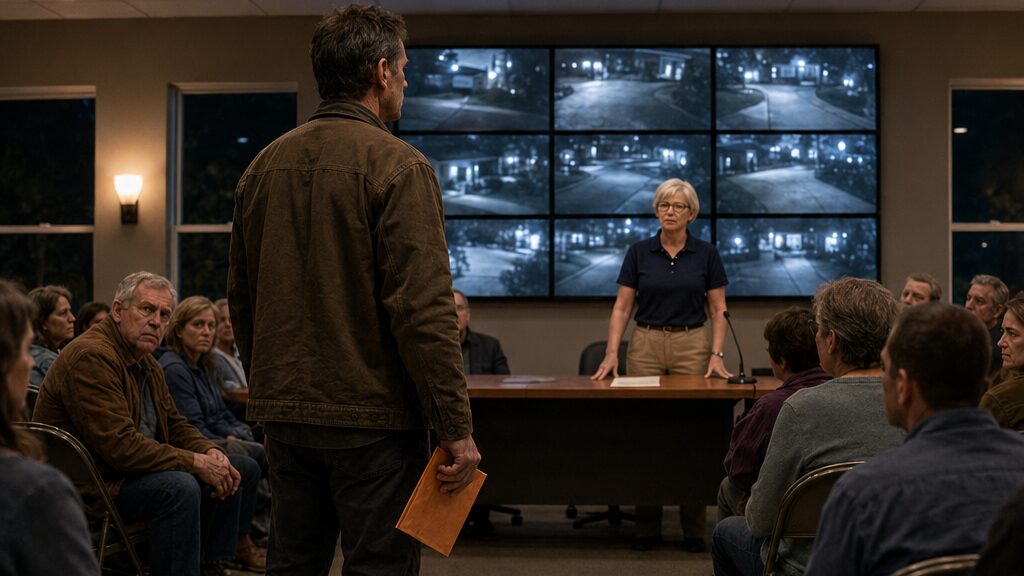
Chairs scraped across the clubhouse floor. People turned with coats still over their arms and paper cups in their hands. The board sat behind a long folding table beneath the wall of surveillance feeds.
Nine live images glowed behind Kathleen.
Michael remained standing near the aisle.
“The meeting hasn’t been called to order,” he said.
Kathleen glanced toward the HOA treasurer, who lifted a wooden gavel and tapped it once against the table.
“It has now.”
A few residents exchanged looks. Laura Perez sat near the back, her hands folded tightly over a legal pad. Gary Robinson occupied an aisle seat closer to the front. Michael knew him only well enough to wave when Gary collected mail.
Kathleen opened a folder.
“The board has received multiple complaints regarding an unapproved recording device installed on the exterior of Mr. Walker’s property.”
“How many complaints?” Michael asked.
“This is your opportunity to respond, not interrogate the board.”
“You said multiple.”
Kathleen’s eyes narrowed. “The device is visible from the common street and negatively affects the consistent appearance of the neighborhood.”
Michael reached into his jacket and removed the covenant page.
“The standards exempt devices installed inside the owner’s property line and directed only toward the owner’s entrance.”
“The board determines whether an installation qualifies.”
“Based on what?”
“Based on the full standards.”
“Then show me the section I violated.”
The treasurer shifted in his chair. Another board member looked down at the table.
Kathleen did not reach for the governing documents.
Instead, she turned toward the residents.
“This is exactly the kind of argument the board has been forced to manage. Every homeowner agrees to a common standard. That standard means nothing if one resident decides his interpretation overrides everyone else’s.”
The room settled around her words. Michael could feel the social pressure changing shape. The question was no longer whether his camera pointed at his porch. It was whether he considered himself entitled to resist.
Kathleen faced him again.
“Your home is part of a shared visual community.”
“My home is paid for by me.”
Several heads turned.
Kathleen’s expression sharpened. “And governed by covenants you accepted.”
“I accepted the written covenants.”
“You installed surveillance equipment without approval.”
“It records my steps.”
“It is an eyesore.”
The bluntness of the word produced a small silence.
Michael looked past her at the monitor wall. The pool feed showed blue water under white lights. The mailroom feed showed a man opening a package. In the rear hallway, two teenagers stood near a vending machine, talking with their backs against the wall.
Nine cameras watched without attracting comment.
Kathleen slid a document toward the edge of the table.
“The board is imposing an initial two-hundred-dollar fine. If the device remains after Sunday, the fine will increase to four hundred dollars per day, plus administrative and collection costs.”
Someone near the back whispered, “Four hundred?”
Kathleen continued.
“If necessary, the association will pursue every enforcement option available under the governing documents.”
Michael kept his face still.
“How long?”
“As long as the violation remains.”
“So the board can charge more than twelve thousand dollars in a month over a three-inch camera?”
“The board can enforce compliance.”
“You could have asked me to submit an application.”
“We are past that.”
“Why?”
Kathleen leaned forward.
“Because you have treated every contact from this association as a challenge. You photograph notices. You demand citations. You question volunteers as though they are defendants. The board will not be intimidated by technical language.”
Michael heard his employer’s warning: Be accurate before you’re angry.
He folded the covenant page and put it away.
Kathleen mistook the movement for surrender.
Her shoulders lowered slightly.
“The camera must be removed by Sunday evening,” she said. “If you comply, the board may consider suspending additional penalties.”
Michael looked toward the residents. Some avoided his eyes. Others watched with the cautious interest people brought to a conflict that did not yet belong to them.
He had imagined this moment several ways.
In one version, he listed every camera model and explained audio pathways, retention settings, microphone modules, and consent rules. In another, he accused Kathleen of hypocrisy and forced the board to defend the monitor wall.
Both versions required the room to trust him before it understood the issue.
Instead, he asked one question.
“Before I remove mine, do the clubhouse cameras record sound?”
Kathleen blinked.
The shift seemed to irritate her.
“This hearing concerns your device.”
“It’s a yes-or-no question.”
“The association’s security system is not under review.”
Michael waited.
Kathleen looked toward the treasurer. He gave no help.
She turned back to Michael with the strained confidence of someone refusing to be cornered by a detail.
“Yes,” she said. “The system records audio.”
The room changed.
Not loudly. Not at first.
A paper cup stopped halfway to someone’s mouth. Laura’s pen lifted from her legal pad. Gary leaned forward.
Michael kept his voice level.
“All nine cameras?”
Kathleen gave a short, dismissive laugh.
“The audio is crystal clear. That is part of having a proper security system.”
Behind her, the monitor wall continued showing residents moving through hallways, opening mailboxes, entering the exercise room.
Michael felt no satisfaction. Not yet.
“Where are the notices?”
Kathleen’s smile faded. “What notices?”
“Signs telling residents their conversations are being recorded.”
“This is a community facility.”
“That doesn’t answer the question.”
“The cameras are visible.”
“Cameras are visible. Microphones aren’t.”
The treasurer reached toward his microphone, then seemed to reconsider touching it.
Kathleen closed the folder in front of her.
“We have legal counsel.”
“Good. Counsel can explain the difference between video monitoring and capturing private conversations in a state where consent matters.”
A murmur spread through the room.
Michael raised one hand before it grew.
“I am not saying every second of audio is automatically unlawful. I don’t know the system settings. I don’t know retention. I don’t know what was disclosed when it was installed.”
He looked directly at Kathleen.
“But I know the models. There are nine microphone-capable cameras in this clubhouse. I checked every public area. There are no current notices at the pool, mailroom, exercise room, hallways, package station, or entrance.”
Kathleen’s face had gone pale around the mouth.
“You inspected association equipment?”
“I observed equipment visible from common areas.”
“Without authorization?”
“I didn’t touch it.”
“You contacted our vendor.”
The statement came too quickly.
Michael noticed Laura look up.
“I identified the vendor label,” he said. “How did you know I called?”
Kathleen did not answer.
The treasurer whispered something to her, but she pushed his hand away.
“This has nothing to do with your violation.”
“It has everything to do with why you want my camera gone before this meeting.”
“That is an accusation.”
“It’s a question.”
“No,” Kathleen said, and for the first time her control cracked. “It’s what you do. You turn ordinary management into suspicion. We installed that system to protect this community.”
“Then why didn’t you tell the community it was listening?”
The room erupted.
Residents spoke over one another. Someone demanded to know how long recordings were stored. Another asked who had access. A woman near the wall pointed toward the exercise-room feed and asked whether the microphones ran continuously.
Kathleen struck the gavel twice.
“Order.”
No one stopped.
The property manager moved toward the service-room door. Michael saw the motion and stepped into the aisle—not blocking the door, but making it obvious that he had noticed.
“Don’t change any settings,” he said.
Kathleen stood. “You do not have authority to issue instructions.”
“Neither do you have authority to destroy records after notice of a dispute.”
The room quieted enough for the words to land.
Michael immediately regretted how certain they sounded. He was not an attorney. He had promised himself he would stay inside what he knew.
So he added, “The board should call counsel before anyone touches the recorder.”
That restraint mattered. Several residents turned from Kathleen toward the property manager, who removed his hand from the service-room handle.
Laura stood at the back.
“Were microphones mentioned in the installation vote?”
Kathleen looked at her.
“You were secretary.”
“I’m asking what the residents were told.”
“We approved integrated monitoring.”
“That phrase was never defined.”
Kathleen’s face hardened. “You signed the minutes.”
Laura sat down as if struck.
The room’s anger shifted again. Not away from Kathleen, but outward, toward the possibility that the truth had been sitting inside language no one had bothered to examine.
Gary Robinson rose slowly from his chair.
He was a broad-shouldered man in his late sixties, though the way he held the seatback made him look older. His voice was quiet enough that the room had to settle to hear him.
“My wife made her medical calls in that hallway.”
He pointed toward the rear-hall feed glowing behind Kathleen.
“She didn’t like talking at home when our daughter visited. She’d sit on the bench outside the exercise room and call the hospital.”
Kathleen opened her mouth.
Gary did not let her speak.
“Are you telling me you recorded her?”
No one moved.
On the monitor behind him, the empty hallway remained perfectly visible.
And somewhere beyond the locked service door, a machine kept listening.
Chapter 4: The Letters That Frightened the Victims
Michael sealed the certified envelope before he had decided whether anyone else should know what was inside it.
The adhesive strip caught against his thumb. He pressed it down hard, then wrote the association’s address in block letters across the front.
The demand was three pages long.
It requested preservation of all audio associated with the clubhouse system, identification of the equipment and retention schedule, and copies of any recording containing Michael’s voice. He had added dates and locations where he remembered speaking inside common areas. The list included board meetings, the package room, the mail corridor, and a short conversation with a delivery driver near the pool gate.
He had not asked a lawyer to draft it.
He had researched terms, compared sample preservation letters, and removed every sentence that sounded like a threat. The document relied on facts: Kathleen’s public admission, the existence of microphone-capable equipment, the absence of current notices, and the possibility that disputed records might be altered.
At the bottom, his signature looked too dark.
Michael placed the envelope beside the orange violation notice and stared at both.
One had been designed to make him comply alone.
The other might force everyone into the fight with him.
At the post office, the clerk attached the green tracking label and slid the envelope into a plastic bin.
“Important one?” she asked.
“It needs a receipt.”
“That usually means important.”
Michael watched the bin disappear behind the counter.
By the time he returned home, Gary Robinson was waiting on his front walk.
Gary stood with his hands in the pockets of a brown jacket. He looked toward the small camera above the porch, then at Michael.
“You sent something.”
Michael unlocked the front door. “How do you know?”
“The property manager called Kathleen. Kathleen called the treasurer. The treasurer called somebody who called me.”
“That sounds efficient.”
Gary did not smile. “What did you ask for?”
Michael considered inviting him inside, then saw the tension in Gary’s shoulders and remained on the porch.
“Preservation of the recordings. Information about the system. Copies of anything containing my voice.”
Gary’s eyes narrowed. “Copies for you?”
“That’s what the letter requests.”
“What about my wife?”
“You can make your own request.”
“That isn’t what I asked.”
Michael leaned one shoulder against the porch post.
Gary looked older than he had in the meeting hall. Anger had held him upright Friday. Today, worry pulled him forward.
“If they preserve everything,” Gary said, “who gets to listen?”
“I don’t know yet.”
“Then why did you demand it?”
“Because if nobody does, they can erase it.”
“And if they don’t erase it?”
“Then there’s evidence.”
“Evidence of what happened to us, or evidence of us?”
The question landed more sharply than Michael expected.
Gary stepped closer.
“My wife had chemotherapy complications last winter. She made calls from that hallway because our granddaughter was staying with us. She didn’t want the child hearing words she couldn’t understand.”
Michael said nothing.
“She cried there,” Gary continued. “She argued with the hospital there. She told our daughter things she never told me. Now you’re saying some attorney, board member, insurance adjuster—whoever—might listen because you need evidence?”
“I didn’t create the recordings.”
“No. But you may be the one who keeps them alive.”
Michael’s first response came quickly and defensively.
“If they’re destroyed, Kathleen can say nothing happened.”
Gary’s jaw worked.
“And if they’re saved, my wife loses control of it again.”
A car slowed at the curb, the driver looking openly toward them. Gary waited until it passed.
“I want the board held responsible,” he said. “I also want her voice left alone.”
Those desires did not fit neatly into Michael’s letter.
“That may not be possible,” Michael said.
Gary’s expression hardened. “You mean it may not be possible for you.”
He walked away without another word.
Michael remained beneath the camera, listening to Gary’s steps cross the sidewalk. The lens above him had always felt protective. Now he was aware of how easily protection became possession.
By Monday afternoon, six residents had sent certified demands of their own.
The envelopes began appearing in photographs shared through a private neighborhood message thread. White envelopes. Green receipts. Tracking numbers partially covered by fingers. Each represented a person who wanted proof before proof vanished.
Ashley Lopez did not post a photograph.
She came to Michael’s house after dark and refused to step beneath the porch camera.
“Can we talk over there?”
She pointed toward the edge of the driveway.
Michael followed her beyond the camera’s viewing angle.
Ashley held a folded copy of his demand letter. Someone had forwarded it to her.
“I need to know exactly what they could have recorded.”
“Audio depends on configuration and storage.”
“That’s not what I asked.”
Michael recognized the fear beneath her irritation.
“If audio was active continuously, it could include conversations within range of the microphones.”
“How far?”
“Depends on the room. Ceiling height. Background noise. Microphone sensitivity.”
“The small conference room?”
“There’s a camera in the hall outside it.”
“The door doesn’t close right.”
Michael waited.
Ashley looked toward the neighboring houses. Most curtains were drawn, but porch lights lined the street.
“I met my family-law attorney there,” she said. “Twice.”
Michael lowered his voice. “In the conference room?”
“The first time. The second time in the hall because another group had reserved it.”
“What date?”
She flinched.
“I’m not asking to hear it,” he said. “The date helps determine whether anything might still exist.”
“I don’t know the exact date.”
“That’s fine.”
“No, it isn’t.” She folded the letter smaller. “If I make a demand, does my husband get notified?”
“I don’t know.”
“Could the recordings be subpoenaed?”
“I don’t know.”
“Could the board release them to prove they did nothing wrong?”
“They shouldn’t.”
“That wasn’t my question.”
Michael had answers for hardware, power requirements, storage capacity, and network paths. Ashley was asking about human consequences, and he had none.
She held out the copied letter.
“You wrote ‘all recordings containing the requesting resident’s voice.’ How do they find those?”
“They may have to review files by date and location.”
“So strangers listen.”
“Possibly.”
Ashley’s hand dropped.
“You made this sound like getting bank records.”
“I was trying to preserve evidence.”
“You were trying to win.”
The words were quiet.
Michael looked at the folded paper between them.
Ashley exhaled.
“I’m not defending Kathleen. What she did is wrong. But if the cure is a room full of people listening to everyone’s worst conversations, that isn’t privacy.”
She left the letter on the hood of his truck and walked home.
The next morning, an email from the property manager arrived at 8:12.
The association acknowledged receipt of multiple records requests. It had referred the matter to legal counsel and instructed residents not to contact board members individually.
At 10:40, a second message appeared.
This one came from the HOA’s insurance representative.
It was addressed to the board but had been forwarded anonymously to several residents. The subject line read: NOTICE OF COVERAGE REVIEW.
The letter requested immediate disclosure of the surveillance system, audio settings, resident notices, prior complaints, preservation measures, and any pending claims. Until review was complete, the insurer reserved its rights under the policy.
The neighborhood message thread exploded.
Some residents treated the letter as victory.
Others calculated what uncovered legal costs might do to annual dues.
One homeowner wrote that Michael had put every house at risk over a door camera.
Another demanded Kathleen’s resignation before lunch.
Michael sat at his kitchen table with the insurer’s notice open on his laptop. Around it lay seven certified-mail receipts.
The envelopes had multiplied exactly as he had hoped.
For the first time, he understood why that frightened him.
Chapter 5: The Security Vote Nobody Remembered Clearly
The official minutes used two words that could mean almost anything.
Integrated monitoring.
Michael read the phrase again beneath the fluorescent light at the county records desk. The resolution had passed three years earlier by a wide margin. It authorized equipment upgrades at the clubhouse, pool entrance, mail station, and package area after “a pattern of security incidents.”
There was no mention of microphones.
No mention of audio.
No mention of consent.
The county clerk watched him turn another page.
“Those are the only association filings attached to that year.”
“What about amendments?”
“If they were recorded with the county, they would be in the packet.”
Michael examined the signature page.
Kathleen White had signed as board president.
Laura Perez had signed as secretary.
The resolution contained a budget ceiling and a broad description of the project. At the bottom, a handwritten notation referred to a vendor attachment that was not included.
“Can I get copies?”
The clerk nodded toward a machine along the wall. “Twenty-five cents a page.”
Michael copied everything.
When he left, Laura was waiting in the parking lot beside her sedan.
“You could have asked me,” she said.
“I did.”
“You texted me after Kathleen put you on an agenda. That isn’t the same as asking about three years ago.”
Michael held up the folder.
“Then tell me what integrated monitoring meant.”
Laura looked toward the courthouse doors.
“Not here.”
Her dining room table was covered with old board binders she had stored after resigning. She had arranged them in careful stacks, each labeled by year.
Michael placed the county copies beside them.
Laura did not sit.
“There were break-ins,” she said. “Not just packages.”
“What kind?”
“Cars. Garages. The pool office. Someone broke the glass at the clubhouse entrance twice.”
“Police reports?”
“Yes.”
“Any arrests?”
“No.”
She pulled a binder from the lowest stack and opened it.
The pages inside included incident logs, repair invoices, and photographs. A smashed passenger window. A pried-open garage side door. Spray paint across the clubhouse brick.
Then Michael saw a photograph of Kathleen’s mailbox.
The post had been split near the ground. Black paint covered the front panel in a crude threat.
“Was this reported?”
Laura nodded. “Her daughter was staying with her at the time.”
“What did it say?”
“You can see enough.”
Michael could.
The words were partly obscured in the photograph, but their intent was clear.
Laura sat at last.
“Kathleen started getting calls at night. Someone drove past her house slowly for a week. Maybe it was connected to the vandalism. Maybe it wasn’t. Nobody proved anything.”
“So she pushed cameras.”
“We all did.”
“All?”
“Most of the board. Most of the residents who came to the meeting.” Laura tapped the county resolution. “People were scared. Packages were disappearing. Cars were being opened. The pool gate was found propped at two in the morning.”
“Did anyone discuss audio?”
“No.”
“You’re sure?”
“I recorded the minutes.”
“That isn’t what I asked.”
Laura gave him a tired look.
“No one said microphones. They said better coverage. Better identification. Integrated monitoring. I thought it meant all the cameras fed one recorder.”
“And you signed.”
“Yes.”
The answer carried no defense.
Michael opened one of the binders.
“What happened after installation?”
“The vandalism stopped.”
“Immediately?”
“Within a few months.”
“That made the system untouchable.”
“It made people feel safe.”
“Those aren’t the same.”
Laura looked down at her hands. “At the time, nobody cared about the difference.”
That was the first truth Michael had not expected.
The surveillance system had not appeared because a bored board wanted control. It had entered through fear, supported by neighbors who believed more visibility meant less danger.
Kathleen had not invented the need.
She had learned what power became available once people stopped questioning it.
Laura reached for another binder.
“I resigned last year because every disagreement became an emergency. Paint color. Parking. Fences. Kathleen started treating exceptions like threats.”
“Why didn’t you say anything about the cameras?”
“Because I didn’t know.”
“You knew the board could watch everyone.”
“So did everyone else.”
“Not listen.”
“No.”
Laura’s voice sharpened. “Do you think that makes me feel better?”
Michael closed the binder.
“I’m trying to find who approved the audio.”
“And when you do?”
“I’ll know who is responsible.”
“You already know who is responsible for the fines.”
“That isn’t the same issue.”
“It is to you.”
The accusation was accurate enough to irritate him.
Laura stood and walked toward a narrow cabinet. From the bottom drawer, she removed a manila folder.
“This came from the vendor during installation. I kept copies because Kathleen said the board files were disorganized.”
Inside were equipment diagrams and a proposal from SecureView Integrated Systems. Camera locations were marked on a clubhouse floor plan.
Near several domes, tiny speaker-shaped symbols appeared in the margins.
Michael leaned closer.
“Audio modules.”
“I never noticed them.”
The proposal listed a base system and optional features. High-capacity storage. Remote access. License-plate enhancement. Integrated microphones.
The microphone line had been left unchecked in the first proposal.
A later vendor invoice included an audio hardware charge.
The date was six weeks after the board vote.
Michael compared the documents.
“Who approved the change order?”
Laura turned to the next page.
There was no signed change order.
Only an invoice marked paid.
At the clubhouse archive that evening, the property manager allowed Michael and Laura to inspect nonprivileged board records under supervision. The manager remained near the door while they searched payment folders.
The vendor invoice appeared in the accounting file.
Attached to it was a photocopy of a one-page amendment.
Enable audio on common-area units. Increase storage retention where practical.
The lower half contained a signature line for board approval.
No signatures appeared.
In the upper corner, someone had handwritten two initials.
K.W.
Michael held the page beneath the desk lamp.
Laura stared at it.
“That wasn’t in my packet.”
“You were secretary.”
“I know what I was.”
“Could Kathleen authorize a change alone?”
“Not at that cost.”
The property manager stepped closer. “That copy should not be there.”
Michael looked at him. “Where should it be?”
“In the privileged file.”
“Why?”
“I’m not discussing legal advice.”
Laura took out her phone and photographed the amendment before the manager could stop her.
“You signed the minutes,” Michael said.
She looked at the initials.
“I signed what the board voted on.”
The distinction mattered now.
Kathleen’s fear explained the cameras. It did not explain the microphones added six weeks later without a recorded vote.
Michael studied the page again.
The initials resembled Kathleen’s.
But an unsigned amendment in the wrong file was not proof of who had ordered anything.
It was proof that someone had wanted the order to look informal.
Chapter 6: What the Board Planned to Erase
The warning arrived as a photograph of a work order taped to the recorder cabinet.
SYSTEM REPLACEMENT—THURSDAY, 11:00 P.M.
Michael enlarged the image on his phone until the lettering blurred.
Below the scheduled time, a handwritten note read:
Existing unit to be wiped and removed.
The message had come from an unknown number.
Michael sat in his truck outside a commercial job site, the engine off, his tool bag unopened beside him. It was Wednesday afternoon.
Less than thirty-two hours remained.
He called the property manager.
“What is being replaced Thursday night?”
“I can’t discuss active systems.”
“I have a photograph of the work order.”
Silence.
“Was the insurer told?”
“I’m not authorized to—”
“Was counsel told?”
“Michael, this is not my decision.”
“Whose decision is it?”
The manager lowered his voice.
“The board says the recorder is failing.”
“Is it?”
“I said it isn’t my decision.”
Michael ended the call.
His first impulse was to drive to the clubhouse, open the equipment cabinet, remove the recorder, and lock it in his truck. He knew exactly how to disconnect it without damaging the drives.
That impulse lasted perhaps ten seconds.
Then he imagined Kathleen accusing him of theft, evidence tampering, and unauthorized access. He imagined residents learning that the man who had warned them about surveillance had taken possession of years of private recordings.
He set the phone on the dashboard.
Facts did not make him untouchable.
He called Laura.
By six that evening, an emergency resident meeting had formed in the clubhouse. No one had officially called it. Residents simply arrived after Laura circulated the work-order photograph and asked whether the board intended to destroy disputed records.
The monitor wall remained on.
One feed blinked black, returned, then flickered again.
Kathleen entered through the side door with the HOA treasurer and community attorney. She carried no clipboard.
“We need everyone to sit down,” the attorney said.
Gary remained standing.
“No,” he said. “We need the recorder left alone.”
The attorney raised a hand. “The board has not authorized destruction of evidence.”
Michael held up his phone. “The work order says wipe and remove.”
“It says the unit is scheduled for replacement.”
“After a coverage review and seven preservation demands.”
“The association has obligations to maintain functioning security.”
Ashley spoke from near the back. “Then replace it without wiping the old one.”
The attorney looked toward Kathleen.
Kathleen’s face was drawn. She seemed smaller without the table in front of her.
“The recorder has been unstable for months,” she said.
“Then why schedule replacement now?” Michael asked.
“Because the vendor had an opening.”
“At eleven at night?”
“To avoid interrupting security coverage.”
Michael pointed to the monitor wall. Another feed went black.
“Who approved the wipe?”
Kathleen’s gaze shifted toward the screen.
“The board discussed disposal of obsolete equipment.”
“Before or after the demands?”
The treasurer cleared his throat. “There was no formal vote.”
A murmur spread through the room.
Kathleen turned on him. “We agreed the system had to remain operational.”
“We did not agree to wipe anything.”
The attorney stepped between the exchange.
“No one is touching the recorder tonight.”
“The work order says tomorrow,” Michael said.
“And counsel will review it.”
“After the archive disappears?”
The attorney’s patience thinned. “You are not qualified to direct evidence procedure.”
“No. But I’m qualified to know wiping a recorder destroys data.”
Kathleen moved toward the monitor wall.
“You keep speaking as if the system was built to spy on people.”
“Why was audio added?”
The room quieted.
Laura placed the copied amendment on the table.
Kathleen looked at the initials in the corner.
For several seconds, she said nothing.
Then she sat.
“My daughter was twenty-two,” she said.
The change in her voice made Michael lower his phone.
“She had moved back home after college. Someone began calling the house at night. They knew which room was hers. They knew when she worked late.”
Gary folded his arms. “Did you report it?”
“Yes.”
“And?”
“The police increased patrols for two weeks.”
Kathleen touched the edge of the amendment.
“Then someone left a dead bird on the front steps.”
No one interrupted her.
“I asked the vendor whether audio could help identify voices if the threats continued. They said the cameras could capture sound near entrances.”
“You approved it alone,” Laura said.
“I authorized an option already included in the system proposal.”
“That was not a board vote.”
“We had an emergency.”
“For three years?” Michael asked.
Kathleen looked at him.
“The threats stopped.”
“So you left it running.”
“People were safer.”
“People were recorded.”
“I believed signs would tell whoever was doing it where the blind spots were.”
Ashley’s voice came from the back. “We were not the threat.”
Kathleen flinched.
That reaction carried more truth than any denial.
Michael looked at the woman who had threatened to bury him in fines. Her fear was real. So was the choice she had made with it.
“You could have told the residents after the immediate threat passed,” he said.
“And caused panic? Lawsuits? Property-value damage?”
“You mean consequences.”
“I mean a neighborhood collapsing because one decision made under pressure was treated as malicious.”
“You fined me four hundred dollars a day to protect that decision.”
Kathleen’s face tightened.
“That was separate.”
“No,” Laura said. “It wasn’t.”
The treasurer slid his chair away from the table.
Kathleen stared at the monitor wall. One by one, the feeds flashed as if the system were losing its grip.
Michael’s phone vibrated.
The unknown number had sent another image: a screenshot from the recorder interface. A countdown showed scheduled maintenance beginning at 11:00 p.m. the next night.
A button labeled INITIALIZE STORAGE sat beneath it.
Michael showed the screen to the attorney.
“Can you stop that remotely?”
“I don’t know.”
“I can.”
Kathleen rose. “You are not touching association equipment.”
“I said I can. I didn’t say I would.”
The distinction cost him. Every instinct told him to act before permission became another form of delay.
But taking the recorder would repeat the same mistake in a different direction: one person deciding that fear justified control.
He turned toward the residents.
“We need a written preservation agreement before midnight tomorrow. The board, affected residents, counsel, and an independent technician. No one listens. No one copies files. The recorder is sealed until terms are set.”
Gary shook his head. “Sealed for who?”
“For the community.”
“That answer means nothing.”
Michael met his gaze.
“Then help write one that does.”
The attorney looked at the time on his phone.
Kathleen remained beside the glowing wall, surrounded by nine images she had once believed would keep danger outside.
The countdown continued somewhere behind the locked service door.
And for the first time, stopping it depended on whether the neighborhood could agree on what protection was allowed to mean.
Chapter 7: The Agreement That Protected No One Completely
The recorder showed fifty-eight minutes remaining when Michael entered the equipment room.
A red maintenance banner stretched across the monitor. Beneath it, the system listed nine camera channels, three storage drives, and one scheduled operation:
INITIALIZE STORAGE—11:00 P.M.
The community attorney stood beside him, reading the screen without touching anything.
“Can it be stopped?” she asked.
“Yes.”
“Without changing the data?”
“Yes.”
“Can you prove that?”
Michael looked at her.
“I can document the current state, disable the scheduled task, and leave the drives untouched. But I won’t do it unless the authority is clear.”
Behind them, voices pressed through the open door from the meeting hall.
The emergency session had begun with twenty-seven residents and no agreement. By ten-fifteen, it had grown to nearly forty. Some wanted every file copied immediately. Others wanted the entire archive destroyed before anyone could hear it. The insurer’s representative had joined by speakerphone, warning that failure to preserve potentially relevant material could jeopardize any remaining coverage.
Kathleen sat alone at the board table.
The treasurer had moved into the audience.
Michael photographed the recorder screen with the attorney’s phone, then his own. He included the clock, drive status, camera channels, and maintenance timer.
“Now what?” the attorney asked.
“Now the people who own this system decide what they’re asking me to preserve.”
When they returned to the meeting hall, Gary was on his feet.
“No unrestricted review,” he said. “Not by the board, not by lawyers, not by some outside company.”
A resident near the front answered, “Then how do we prove anything?”
“Prove the equipment recorded sound. Don’t play my wife’s calls.”
“What if the recording is the only evidence?”
“Evidence for who?”
The room fractured into overlapping arguments.
Ashley sat near the aisle with a notebook open on her knee. Laura stood beside the whiteboard, where she had written three headings:
PRESERVE
ACCESS
DESTROY
Nothing appeared beneath them.
Michael walked to the front.
“We have less than an hour.”
The room quieted unevenly.
He set a printed proposal on the table. He had drafted it in his truck while residents argued. The first version required a full forensic image of the recorder and independent review by counsel.
Gary had refused before Michael finished reading the second paragraph.
“You’re still making a copy of everything,” Gary said.
“A forensic image preserves the system as it exists now.”
“It preserves my wife.”
“It preserves evidence that the board recorded her.”
“Those are the same files.”
Michael’s patience tightened.
“If we don’t preserve them, Kathleen can argue no audio existed.”
Kathleen looked up but said nothing.
Gary stepped into the aisle.
“And if we do, who decides when my wife’s fear becomes useful enough to hear?”
Michael opened his mouth.
No answer came.
The room waited.
He looked toward the monitor wall. The live feeds had been disabled at the attorney’s request, leaving nine dark rectangles behind the board table. Without the images, the wall looked less powerful. It also looked more honest.
Michael took back the proposal.
“What do you want?” he asked Gary.
“I want proof without playback.”
“That may not be enough.”
“Then make it enough.”
Michael glanced at Ashley.
She closed her notebook.
“Metadata,” she said.
Several residents looked at her.
Michael understood before she continued.
“The files should have dates, channels, durations, audio tracks, maybe access logs. You can establish that sound was recorded without listening to every conversation.”
“Correct,” Michael said slowly. “A forensic examiner could inspect file structure, system configuration, and logs first.”
Gary remained standing. “And the recordings?”
“Sealed.”
“For how long?”
“Until each affected resident chooses.”
A woman near the wall asked, “How would we know who is affected without listening?”
Michael turned to the whiteboard.
“By date and location. Residents can submit private time windows. The examiner checks whether files exist for those periods without playing the content.”
“And if someone wants their file destroyed?” Ashley asked.
“The association preserves only what is legally necessary to establish the system’s operation. Personal content remains sealed unless the resident opts in or a court orders otherwise.”
The attorney spoke from the side wall.
“That would require a protocol, independent custody, and conflict waivers. It is possible, but it must be precise.”
Laura uncapped a marker.
For the next twenty minutes, the blank board filled.
No board member could access the recorder.
No resident could request another person’s files.
An independent examiner would create an encrypted image under dual control.
The original unit would be physically sealed.
Metadata and configuration records would be reviewed first.
Residents could submit confidential date-and-location requests.
Playback required the recorded resident’s written consent, except where a court specifically ordered otherwise.
Files not needed for claims or system verification would be destroyed according to a schedule approved by affected residents and counsel.
At 10:43, the insurance representative agreed that such a process could satisfy immediate preservation concerns, though coverage remained under review.
At 10:47, the treasurer approved the proposal.
At 10:49, Laura asked Kathleen to sign.
Kathleen did not move.
The room became still around her.
“You are asking me to authorize an investigation of my own decision,” she said.
“Yes,” Laura replied.
“You signed the security resolution.”
“I signed what we voted on. I did not sign the audio amendment.”
Kathleen looked toward Michael.
“If I refuse?”
“The attorney seeks an emergency order,” he said. “The vendor is told not to wipe the unit. The insurer receives the work order and the unsigned amendment tonight.”
“You already sent them enough to destroy us.”
Michael felt the old answer rising: You did that yourself.
He let it pass.
“This is not about destroying you.”
Kathleen gave a small, exhausted laugh. “You don’t believe that.”
A week earlier, he had.
He had imagined the moment when the evidence became too clear to deny, when Kathleen would be forced to face the same helplessness she had tried to impose on him. He had called that justice because it required nothing from him except accuracy.
Now Gary stood three rows back, waiting to learn whether his wife’s private voice would become the price of proving Michael right.
“I wanted the fines stopped,” Michael said. “Then I wanted the system exposed. Those are not the same as protecting everyone in this room.”
Kathleen studied him.
“And now you know how easy it is to call control protection.”
The line was not an apology. It was not even fully an admission.
But it was true.
Michael nodded once. “Yes.”
At 10:52, Kathleen signed.
The attorney countersigned. The treasurer signed. Laura signed as resident witness. Gary and Ashley signed as representatives for affected homeowners.
Michael returned to the equipment room.
With the attorney filming, he disabled the scheduled wipe. He did not alter retention settings, open recordings, or connect an external drive. He printed the system configuration, shut down remote administrative access, and placed numbered tamper seals across the recorder cabinet.
The final seal covered the keyhole.
When he pressed it flat, the adhesive made a soft tearing sound.
Behind him, residents completed individual forms: preserve, review metadata only, destroy when permitted, contact before any playback.
The process satisfied no one completely.
That was how Michael knew it belonged to all of them.
At 12:18 a.m., he returned to the meeting hall.
Kathleen’s chair was empty.
On the board table lay a single sheet addressed to the treasurer.
The first line announced her resignation as HOA president, effective immediately.
The second requested that the independent review include every authorization she had made.
There was no apology at the bottom.
Only her name.
Chapter 8: The Lens Turned Back Toward Home
The clubhouse wall was dark for the first time in three years.
Nine monitors remained mounted above the board table, but none displayed the pool, mailroom, hallways, or package station. Each screen showed the same plain message from the independent examiner:
SYSTEM OFFLINE PENDING PRIVACY REMEDIATION.
Residents still glanced toward the wall when they entered, as though expecting it to wake.
Six weeks had passed since Kathleen’s resignation.
The review did not produce a dramatic recording, a secret confession, or a single file that resolved everything. It produced something slower and harder to argue with.
The system logs confirmed that audio had been enabled on seven of the nine camera channels. Two older units had captured video only. Audio files had been retained between thirty and ninety days, depending on available storage, then overwritten automatically.
The settings had changed twice over three years.
The authorization trail led back to the unsigned amendment initialed K.W. Vendor emails showed that Kathleen had requested the audio option after the threats against her family. Later messages showed that she had resisted posting notices because she believed warnings would weaken deterrence.
No evidence showed that she had routinely listened to residents.
Access logs showed occasional playback by the property manager after vandalism reports, package thefts, and one dispute near the pool. The logs did not identify which audio had been heard.
That absence helped no one.
Gary’s request covered four dates when his wife had made medical calls in the rear hallway. Metadata confirmed files had once existed for two of them. Both had been overwritten months before the dispute.
A third file remained in the preserved archive because the recorder’s retention cycle had failed during a storage error.
Gary chose not to hear it.
Under the agreement, the examiner verified the date, location, duration, and presence of an audio track. Gary’s wife signed a destruction authorization from home.
The file was erased without playback.
The examiner issued a certificate stating exactly that.
Gary carried the certificate folded in his wallet.
Ashley requested metadata for the dates she had met her attorney. One corresponding hallway file remained. She chose preservation under seal until her family case ended, with no playback permitted without her written consent.
Other residents made different choices.
Some requested deletion.
Some wanted copies of short conversations.
Several decided they did not want to know.
The unauthorized microphones were removed from every common-area camera. The remaining video system was redesigned with fixed viewing zones, limited retention, posted notice, documented access, and an annual resident vote.
Laura Perez agreed to chair the interim privacy committee only after the bylaws were amended to prevent the chair from controlling access alone.
At the first meeting, she placed three keys on the table.
One for the property manager.
One for the independent custodian.
One sealed for emergency use.
“No single person holds enough authority to open the system,” she said.
No one objected.
The insurance decision arrived two days later.
The carrier would continue coverage under strict conditions: higher premiums, independent oversight, removal of undisclosed audio, revised policies, mandatory training, and resolution of pending resident claims.
The annual assessment would increase.
Not catastrophically, but enough to matter.
At the clubhouse meeting where the figures were announced, a resident near the front asked why innocent homeowners should pay for Kathleen’s decision.
The insurance representative answered through a speakerphone.
“Because the policy belongs to the association.”
The answer produced no satisfaction.
Michael sat beside Gary while the treasurer explained the numbers. Legal review, equipment replacement, forensic work, and insurance costs would require a one-time assessment spread across every lot.
Michael’s share was less than one month of the fines Kathleen had threatened, but it was not nothing.
A resident across the aisle turned toward him.
“So your camera stays, your fines disappear, and the rest of us pay?”
The room tightened.
Michael could have pointed to Kathleen, the former board, the vendor, or the residents who had approved vague language three years earlier.
Instead, he said, “I pay too.”
“That doesn’t answer me.”
“No.”
The resident waited.
Michael continued.
“The board was wrong to fine me under a rule that contained an exception. The audio system was wrong because residents were not properly informed. Correcting both costs money. I wish the cost belonged only to the people who made the decisions.”
“But it doesn’t.”
“No.”
The resident looked away.
There was no applause.
The board formally rescinded Michael’s fines that night. The written decision did not declare his camera untouchable. It stated that his installation qualified for the existing exception, subject to the same privacy review now required for all exterior recording devices.
Michael accepted the condition.
A week later, Laura and Ashley came to his house with a measuring tape and a printed diagram.
Michael stood on a ladder beneath the porch eave while they marked the camera’s field of view.
The lens captured the door, mat, steps, and a narrow section of walkway. At the far edge, part of the public sidewalk entered the frame.
“About eighteen inches,” Laura said.
Michael looked down. “That area triggers only after someone steps onto the walkway.”
“It is still recorded.”
“The resolution allows incidental public-area capture.”
Ashley checked the wording.
“Minimal incidental capture where technically unavoidable.”
“It is technically unavoidable at this mounting height.”
Laura looked at the adjustable bracket.
“Is it?”
Michael followed her gaze.
The old instinct arrived immediately. He knew the equipment better than they did. He knew the lens geometry, detection zones, and difference between meaningful capture and a harmless strip of pavement.
He also knew what it sounded like when someone with control decided other people’s concerns were harmless.
He loosened the bracket.
The camera tilted inward by a few degrees.
On his phone, the sidewalk vanished from the live image. The bottom step remained visible.
“There,” he said.
Ashley nodded.
Laura placed a small disclosure sticker inside the porch window, readable from the steps but unobtrusive from the street.
VIDEO RECORDING LIMITED TO PRIVATE ENTRY AREA.
The orange violation notice had once been bright enough to dominate the truck windshield. The new sign was small, plain, and clear.
Michael preferred it.
That evening, Gary walked over carrying two coffee cups and the folded certificate from the examiner.
Michael was seated on the porch step, testing the revised motion zone.
Gary handed him one cup.
“My wife says thank you.”
“She shouldn’t have had to sign anything.”
“No.”
Gary sat beside him.
For a while, they watched a delivery truck move along the street. Porch lights came on one by one across houses that no longer looked as uniform as Kathleen had wanted them to.
“Did you ever listen to any of it?” Gary asked.
“No.”
“Did you want to?”
Michael considered the question.
“At first, I wanted whatever proved I was right.”
Gary unfolded the certificate and smoothed it across his knee.
“That isn’t the same answer.”
“No,” Michael said. “I didn’t want to hear her.”
Gary refolded the paper.
“Kathleen moved out yesterday.”
Michael looked toward the end of the street. Her former house stood behind a trimmed hedge, dark except for one upstairs window.
“Did she sell?”
“Listed it.”
Michael took a drink.
Gary watched him. “You feel bad?”
“I don’t know.”
“That sounds honest.”
“She made choices.”
“So did we.”
The words settled between them.
The neighborhood had wanted cameras when fear was fresh. The board had wanted authority when questions became inconvenient. Michael had wanted evidence when people became uncertain. None of those desires had begun as cruelty.
What mattered was what each person allowed the desire to justify.
Gary stood.
“My wife made pie.”
Michael looked up. “Is that why you brought two coffees?”
“No. That was to make sure you were home.”
Gary nodded toward Michael’s front door.
“She wants me to bring you a piece. You can come over, or I can bring it back.”
Michael glanced at the small black camera above the porch.
Its lens now faced inward, holding only the space a visitor chose to enter.
“Bring her too,” he said. “If she feels up to it.”
Gary smiled faintly. “She’ll say your chairs are uncomfortable.”
“She’ll be right.”
Michael opened the camera settings and disabled audio capture, though his model had never stored sound. Then he turned off cloud sharing and added Laura and Ashley’s committee account to the annual review list.
He saved the changes.
Gary started down the steps.
“Give me ten minutes.”
Michael stood and opened the front door.
Before going inside, he looked once at the camera’s live image on his phone.
The porch appeared empty. The sidewalk was gone. Beyond the frame, Gary crossed the street toward home.
Michael locked the phone and left the door open behind him.
The story has ended.