The HOA Put a Lien on His Home, So He Opened Every Ledger They Hid
Chapter 1: The Sign They Bolted to His Fence
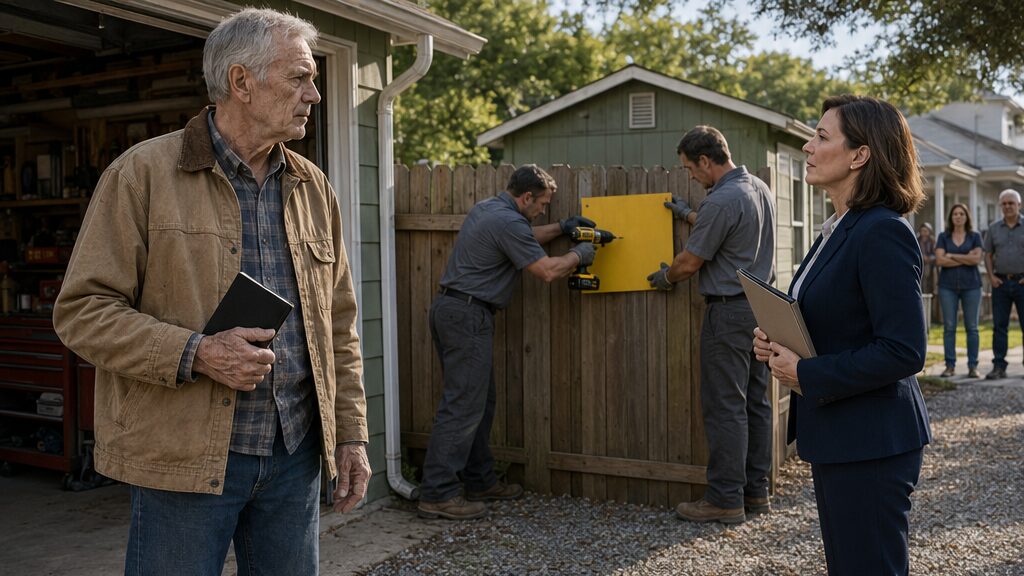
The drill bit struck the cedar fence at 8:14 on Saturday morning.
Richard Miller knew the time because he had looked at his watch the instant the motor started. The sound carried across the quiet cul-de-sac, hard and metallic, then softened as the screw pulled a yellow plastic placard tight against the boards he had installed nineteen years earlier.
NOTICE OF VIOLATION.
The two maintenance workers avoided his eyes. One held the sign level while the other drove a second screw through it.
Rachel Wright stood on the gravel driveway in white shoes and a navy suit, a folder tucked against her ribs. She looked prepared for a board meeting rather than a confrontation beside a wheelbarrow and a stack of cedar offcuts.
“The structure comes down,” she said. “Or the association will arrange removal.”
Richard stood between the open garage and the path to his backyard. He had not stepped toward the workers. He had not raised his voice. Six houses had porch lights on despite the morning sun, and Margaret Thompson was visible through the narrow gap in her curtains next door.
Rachel opened the folder.
“The initial fine is five thousand dollars.”
One of the workers stopped drilling.
Richard looked at the placard, then past it to the small green workshop behind his house. Its roofline sat below the fence. The windows faced inward. He had measured every setback twice before digging the first footing.
“When was the hearing?” he asked.
Rachel’s mouth tightened.
“You were notified of the inspection.”
“That wasn’t my question.”
“The board has authority to enforce the covenants.”
Richard reached into the inside pocket of his worn canvas jacket. Rachel’s chin lifted, as if she expected a phone.
He brought out a black notebook with softened corners and a carpenter’s pencil cut down to half its original length.
On a clean page, he wrote:
Saturday, 8:14 a.m.
Two contracted workers entered side fence line.
Yellow placard attached with two screws.
Rachel Wright present.
The worker with the drill glanced toward Rachel.
“Keep going,” she told him.
Richard added the words.
Rachel Wright instructed workers to continue.
“What exactly are you doing?” she asked.
“Writing it down.”
Her expression changed by less than an inch, but he saw it. Richard had spent forty-three years watching walls move before cracks appeared. Small shifts mattered.
Rachel stepped closer. “You received three notices about an unapproved exterior building.”
“I received two letters asking for photographs and one inspection notice.”
“You did not submit an architectural application.”
“I submitted county plans.”
“The county does not govern neighborhood appearance.”
Richard closed the notebook around the pencil, then opened it again.
“Would you repeat who authorized these men to enter my property?”
The maintenance worker holding the sign lowered his hands.
Rachel looked toward the houses. A man across the street stood beside his mailbox pretending to sort envelopes. Farther down, a garage door remained halfway open.
“The board authorized enforcement,” she said.
“At a meeting?”
“Yes.”
“On what date?”
“That information is in the notice.”
Richard turned to the yellow placard. It listed the workshop, the amount of the fine, and a deadline ten days away. No meeting date appeared.
“It isn’t.”
Rachel took one step toward the sign but stopped before reading it herself.
“The board’s decision is final unless you appeal.”
“How can I appeal a decision made before the hearing?”
“You had opportunities to cooperate.”
The sentence landed more sharply than the fine. It placed him in the familiar position of the unreasonable man who had forced everyone else to become severe.
Richard looked at the workshop door. He had painted it the green his wife had chosen for the garden gate, though the gate itself had been removed years ago. Inside were two workbenches, a wall of hand tools, and three unfinished repair jobs for older neighbors who had stopped asking contractors to return their calls.
None of that belonged in the driveway.
Rachel tapped the folder against her palm. “The structure affects neighboring views and resale comparisons. People bought here because the standards are enforced.”
Margaret’s curtain shifted.
Richard wrote: Rachel states structure affects comps and views.
“You don’t have to record every word I say.”
“I do when it concerns my property.”
The second worker put the drill back in its case. The placard sat slightly crooked. Richard noticed the left edge was three-eighths of an inch lower than the right, but he did not correct it.
Rachel removed a document from the folder and held it out. Richard took it by one corner.
The assessment showed five thousand dollars due immediately. A second line authorized daily penalties after the removal deadline. At the bottom, beneath dense paragraphs, three signature blocks contained names.
Rachel Wright.
Jonathan Moore.
Michelle Roberts.
Richard recognized all three. Rachel was the president. Jonathan handled the finances. Michelle kept the minutes and usually spoke so softly at meetings that people leaned forward to hear her.
He studied the dates.
The signatures had been entered Thursday.
The inspection notice in his mailbox had been dated Friday.
“You decided before the inspection,” he said.
Rachel did not answer at once. “The workshop has been visible for weeks.”
“So why inspect it?”
“To document the violation.”
“You’re documenting a decision already made.”
Her voice dropped. “Richard, you’ve lived here long enough to understand how this works.”
He had. That was why he wrote the sentence down exactly.
A pickup slowed at the end of the cul-de-sac, then continued. Rachel watched it leave.
“You have ten days,” she said. “After that, the fine doubles. If the account remains unpaid, the association may record a lien.”
The word altered the shape of the morning.
Richard looked beyond her at the brick house he had bought with his wife when the subdivision was still raw dirt and saplings. He had replaced the roof himself, rebuilt the porch, and widened the downstairs doorway when illness made narrow spaces difficult. The mortgage had been gone for eleven years.
Rachel had moved from a workshop to the house in one sentence.
Margaret came out onto her porch. She wore house slippers and held a mug with both hands.
“Everything all right?” she called.
Rachel turned toward her with the composed expression she used at annual meetings.
“It’s an association matter.”
Margaret looked at Richard instead.
He should have told her about the permit. He should have said the hearing had not happened. Instead, the old instinct closed around him: solve the problem before anyone saw how close it had come.
“I’ve got it,” he said.
Margaret remained on the porch for another moment, then went inside.
Rachel slid the folder under her arm. “I hope you’ll make this easier than it has to be.”
Richard looked at the holes in his fence.
“For whom?”
The workers carried their cases to the truck. One of them paused near Richard.
“We were told the property line had been cleared for access,” he said quietly.
Rachel heard him. “It was.”
Richard opened the notebook again.
“Who told you that?”
The worker glanced at Rachel, then shut the truck door without answering.
Rachel walked to her car. Before getting in, she turned back.
“You keep writing as though something was done improperly. Three board members signed the order, Richard. This isn’t personal.”
She drove away before he could reply.
The yellow placard remained bolted to his fence, bright enough to be seen from the intersection.
Richard stood alone in the driveway and copied the three names into his notebook. Under them, he wrote one question.
What meeting?
Chapter 2: The Permit Solved Less Than Expected
“The permit is valid,” the county clerk said, “but that doesn’t mean your association has to like the building.”
Richard stood at the counter beneath fluorescent lights, one hand resting on a cardboard plan tube. He had arrived when the county office opened Monday, carrying the approved drawings, inspection cards, photographs of the footings, and his notebook.
The clerk rotated the monitor so he could see the permit record.
Final inspection: passed.
The screen showed the date, the inspector’s initials, and the setback measurements Richard already knew by memory.
“Eight feet from the rear line,” he said. “Six from the side.”
“That’s what we have.”
“Height?”
“Twelve feet, four inches at the ridge. Under the county limit.”
“Electrical?”
“Separate permit. Finaled the same week.”
The clerk leaned back. “From our side, it’s a legal accessory structure.”
Richard felt the first loosening in his chest since Saturday.
Then the clerk tapped the plan tube.
“County approval doesn’t override private covenants. If your HOA requires architectural approval, that’s a civil issue.”
“I sent them the plans.”
“Did they approve them?”
“They didn’t respond.”
“That may matter. It may not. Depends on the documents.”
Richard gathered the papers more slowly than he had laid them out.
Outside, he sat in his truck and opened the notebook to Saturday’s entries. Beneath Rachel’s statement that the board had approved enforcement, he wrote:
County confirms structure meets code. Private covenant remains unresolved.
It was not the clean answer he had expected. A wall either carried the load or it did not. A setback either measured six feet or it did not. Association language had room inside it for people.
At home, the yellow placard faced him as he turned into the driveway.
A folded envelope was tucked beneath the front doormat. Margaret’s handwriting crossed the front: In case they say no one saw what happened.
Inside was a sheet of lined paper. She had written the time the workers arrived, the time Rachel raised her voice, and the license plate of their truck.
Richard carried it to the kitchen. He set it beside the notebook but did not call her.
The association documents filled two binders on the table. He found the section governing accessory structures after twenty minutes.
No exterior structure may be erected, installed, or maintained without prior written approval where such structure materially alters the visual character of the community or creates an unreasonable impact upon adjoining lots.
Richard read it twice.
Materially alters.
Unreasonable impact.
The workshop could not be seen from the street except through the narrow gap beside his house. Margaret’s upstairs window faced the opposite direction. The rear neighbor’s property sat beyond a line of mature trees.
But the clause did not define either phrase.
He turned to the architectural review procedure. Applications were supposed to receive a written decision within thirty days. If the committee requested additional information, the period restarted.
Richard found his certified-mail receipt from six weeks earlier. The association had signed for the plans. Nine days later, Rachel had sent a letter requesting exterior-color photographs. He had delivered them the next morning.
No approval had followed. No denial either.
He opened the enforcement notice from Saturday and compared its dates with his notebook.
Inspection scheduled: Saturday, 9:00 a.m.
Violation determination: Thursday.
Hearing available upon written request: the following Wednesday.
Richard placed the county permit beside the notice. The final inspection stamp sat inches from his entry recording the drill at 8:14.
The board had signed before its own inspection and imposed the fine before offering him a hearing.
That did not prove the workshop complied with the covenants. It proved something else.
They had chosen the result first.
At 11:32, his email chimed.
The message came from the HOA management address.
SECOND NOTICE—CONTINUING NONCOMPLIANCE.
The balance now showed ten thousand dollars.
Richard checked the time. The ten-day removal deadline had not passed. The appeal hearing had not occurred. The fine had doubled less than forty-eight hours after the placard went up.
He printed the email and added it to the table.
Then he called the management office.
The bookkeeper answered.
“I need the authority for the second assessment,” Richard said.
A keyboard clicked in the background. “The account reflects an escalation approved by the board.”
“On what date?”
“I only process what the board submits.”
“Was the second fine approved before or after Saturday?”
“I’d have to refer you to the board.”
“Who entered it?”
A pause.
“Mr. Miller, you should direct procedural questions to the president.”
“The president is the subject of the question.”
The bookkeeper lowered her voice. “I can send you an account ledger.”
“Send the authorization too.”
“I don’t have that.”
The line remained quiet long enough for Richard to hear someone speaking in the office behind her.
“I’ll send what I can,” she said, and ended the call.
The ledger arrived twelve minutes later. It showed the first fine entered Thursday afternoon and the second entered Monday at 9:20 a.m. The description for both was identical: Continued refusal after notice.
Richard had received the notice Saturday.
He wrote the sequence in the notebook.
Thursday: board signatures.
Saturday, 8:14: notice posted.
Monday, 9:20: fine doubled.
Hearing: Wednesday.
A knock came at the side door.
Margaret stood outside with the mug from Saturday, though this time it held no coffee. She nodded toward the kitchen table.
“You found something.”
“I found dates.”
“That sounds like something.”
“The permit doesn’t settle the HOA question.”
Her face fell briefly. “But it’s legal.”
“County legal.”
“And they can still make you tear it down?”
“They can try.”
Margaret looked toward the workshop. “You could tell people that. They think you built it without asking.”
“People can think what they want.”
“That’s convenient for Rachel.”
Richard stacked the papers into neat piles.
“I’m not conducting this in the street.”
“No. She is.”
He looked at her.
Margaret set the empty mug on the counter. “The neighborhood email says you refused an inspection and threatened the workers.”
“I asked who authorized them.”
“I know. I watched.”
“Then you know the email is wrong.”
“I do. Most people don’t.”
Richard slid her witness note back across the table.
“Keep the original.”
She did not take it.
“You always do this,” she said.
“Do what?”
“Wait until you’ve fixed the whole roof before admitting there was a leak.”
The words touched a place he kept boarded over. He folded the note once and handed it to her.
“I’ll call if I need it.”
Margaret took the paper, but not as agreement.
At four that afternoon, Richard prepared a written appeal. He attached the permit, the certified-mail receipt, photographs showing the workshop’s limited visibility, and a timeline of the enforcement actions.
He did not mention Margaret’s observations.
He delivered the packet by hand to the management office. The receptionist stamped his copy and placed the original in a tray.
“Wednesday’s hearing is still scheduled?” he asked.
She checked a calendar. “Six-thirty.”
“Who will be present?”
“The board.”
“The same three members who signed the fine?”
“I believe so.”
Richard looked at the tray. “Is there an architectural committee?”
“The board has been handling those duties.”
“So they approve, inspect, fine, and hear the appeal.”
The receptionist gave him a tired look. “I don’t make the rules.”
“No,” Richard said. “You just stamp the date.”
She looked down at the stamp in her hand.
When he returned home, a dark sedan was parked across from his mailbox. A man in a gray jacket stood at the front walk holding a large envelope.
“Richard Miller?”
“Yes.”
The man confirmed his identity, handed him the envelope, and left without stepping farther onto the property.
Across the top page, in capital letters, were the words:
NOTICE OF INTENT TO RECORD LIEN.
Richard read the amount, the property description, and the deadline.
The appeal hearing was still two days away.
Chapter 3: The Lien Arrived Before the Hearing
Richard had seen his address on permits, tax bills, warranties, and the deed he kept in a fireproof box.
He had never seen it beneath the word lien.
The notice lay flat on the kitchen table Tuesday morning, held at one corner by his coffee mug. The legal description of the property ran six lines. Beneath it, the association claimed ten thousand dollars in assessments, administrative charges, attorney review fees, and continuing daily penalties.
He read the paragraph authorizing recordation three times.
The house was not merely where he lived. It contained the marks of every year he had spent there: pencil lines behind a pantry shelf, a replaced stair tread, the patched section of drywall beside the downstairs bedroom. His wife’s gardening gloves still hung from a hook in the garage because removing them had always seemed like a job for another day.
A lien did not take the house that morning. Richard knew that.
It placed a hand on it.
Margaret appeared at the side door before nine. She held a printed copy of the neighborhood email chain.
“Rachel says you’ve hired a lawyer to attack the reserve fund.”
“I haven’t hired anyone.”
“She also says your refusal to comply may increase everyone’s dues.”
Richard looked at the printout but did not take it.
“I’m calling an attorney today.”
“Then let me speak to people before she does more damage.”
“No.”
“Richard.”
“This is between me and the association.”
“It stopped being between you and the association when she told forty-seven households they might have to pay for you.”
He picked up the lien notice and placed it inside a folder.
“I’ll handle it.”
Margaret’s jaw shifted. “You said that Saturday.”
“I meant it Saturday.”
“And I suppose you still mean it while she turns the street against you.”
He opened the notebook.
Tuesday, 8:46 a.m. Margaret offered to contact homeowners. Declined.
Margaret stared at the page.
“You wrote that down?”
“I write decisions that matter.”
“Does it say why you declined?”
Richard’s pencil stopped.
She waited. When he did not answer, she folded the email chain and put it back into her bag.
“You’re documenting everyone except yourself,” she said.
The side door closed behind her with controlled care.
By noon, Richard sat in the office of Paul Adams, a community-association attorney whose waiting room displayed no slogans and only one framed certificate.
Paul read the lien notice, the fine ledger, the permit, and the appeal packet without interrupting. He was younger than Richard had expected, perhaps forty, with a habit of aligning each page squarely before moving to the next.
Finally, he tapped the notice.
“They may have a covenant argument,” he said. “They do not have a good process.”
“How bad?”
“For them or for you?”
“For the house.”
Paul leaned back. “An intent notice is not a recorded lien. We have time. Not much.”
He pointed to the dates.
“The declaration requires written notice of the alleged violation, an opportunity to cure, and a hearing before monetary sanctions become final. Their own enforcement policy requires fifteen days between notice and hearing.”
“They gave me four.”
“And imposed the first fine before posting the notice.”
Richard nodded.
Paul continued. “The second assessment is worse. It calls your conduct continuing noncompliance before the initial cure period expired.”
“So it can be stopped.”
“It can be challenged. That isn’t the same thing.”
Richard disliked the distinction because it was accurate.
Paul examined the signature page. “Rachel Wright, Jonathan Moore, Michelle Roberts.”
“President, treasurer, secretary.”
“Where are the meeting minutes approving this?”
“Not attached.”
“Did they give you a meeting date?”
“Rachel said it was in the notice. It wasn’t.”
Paul made a note on a yellow pad.
“We’ll request the minutes, the enforcement policy in effect on the date of the alleged violation, the architectural decision, and proof of notice. We’ll also demand that they suspend lien activity until after the hearing.”
“Demand?”
“Strongly request, with consequences.”
Richard looked toward the window. “I don’t want this turned into a neighborhood lawsuit.”
Paul studied him. “They’re threatening your title.”
“I want the lien stopped and the workshop left alone.”
“That may be possible without litigation. But you need to understand something. Your desire to keep this small does not control whether they keep it small.”
Richard thought of Margaret’s folded printout.
Paul slid the notebook closer. “May I?”
Richard handed it over.
Paul read the Saturday entries, then Monday’s timeline. When he reached the line about Margaret, he paused but said nothing.
“This is useful,” he said. “Especially the statement that the board had already decided.”
“I wrote it as she said it.”
“Any witnesses?”
Richard looked at the notebook.
“My neighbor.”
“Will she sign a statement?”
“Probably.”
“Ask her.”
Richard closed the notebook. “Not yet.”
Paul’s expression remained neutral. “You’re trying to protect your privacy.”
“I’m trying not to pull other people into it.”
“They’re already in it. Rachel made sure of that.”
At three, Paul emailed a preservation demand and notice of representation to the management company and board. Before Richard left, Paul printed one copy for him.
“The lien is challengeable,” he said. “That’s the good news.”
“And the bad?”
“If the board refuses to pause, we may need emergency relief before they record it.”
Richard drove home with the folder on the passenger seat.
Two neighbors were speaking beside a trash bin when he entered the cul-de-sac. They stopped as his truck passed. One lifted a hand in a gesture too late to be casual.
The yellow placard remained on his fence.
Inside, his phone showed four unread messages. Three were from people asking whether the special assessment would rise because of his workshop. The fourth came from Rachel.
The board has been informed that your attorney is threatening association operations. Continued escalation may create costs chargeable to your account.
Richard read it twice, then forwarded it to Paul.
A reply arrived almost immediately.
Do not respond.
That evening, Richard attended the appeal hearing at the management office. Rachel sat at the center of the conference table. Jonathan Moore occupied the chair to her right, his hands folded over a calculator. Michelle Roberts sat to the left with a thin stack of papers and no eye contact.
No independent architectural committee appeared.
Rachel opened the meeting.
“This hearing concerns Mr. Miller’s refusal to remove an unapproved structure and his decision to involve counsel rather than cooperate.”
Richard placed his permit and timeline on the table.
“It concerns whether the board followed its own procedure.”
Jonathan looked at the documents. Michelle’s eyes moved to the date on the county stamp.
Rachel did not touch them.
“The structure lacked prior written approval.”
“I submitted the plans.”
“You began construction without receiving approval.”
“The application period expired without a decision.”
“The board requested more information.”
“I provided it the next day.”
Rachel’s voice stayed even. “Silence is not approval.”
“Then why didn’t you deny it before it was built?”
Jonathan shifted in his chair.
Rachel closed the folder in front of her. “The board is prepared to reduce the fine if you sign a removal agreement tonight.”
Richard looked at Michelle.
“Where are the minutes from the meeting that authorized the original fine?”
Michelle’s fingers tightened around her pen.
Rachel answered for her. “Counsel has advised us not to discuss privileged deliberations.”
“A board vote isn’t privileged.”
“You are not here to interrogate volunteers.”
“You put my house in a lien notice.”
Jonathan spoke for the first time. “Rachel, maybe we should provide the dates.”
She turned toward him. He lowered his eyes.
Richard saw the fracture and stored it without writing.
The hearing ended with no decision. Rachel said the board would respond in writing within five business days. She declined to suspend the lien process.
At home, Richard opened the governing documents again. He searched first for enforcement, then hearings, then minutes.
Near midnight, a cross-reference sent him to the article on member inspection rights.
Every member, upon written demand stating a proper purpose, may inspect and copy association financial records, contracts, meeting minutes, reserve-account statements, and supporting documentation for the preceding four years.
Richard read the sentence once.
Then again.
The lien authorization had three signatures but no minutes. Rachel had refused to identify the vote. Jonathan had nearly spoken. Michelle had stared at the permit date as though she had never seen it.
Richard pulled a clean sheet of paper from the printer.
At the top, he typed:
FORMAL DEMAND FOR INSPECTION OF ASSOCIATION RECORDS.
He listed four years of board minutes, reserve statements, special assessments, legal invoices, contracts, and every document supporting the fines and lien against his property.
Before printing, he added one final category.
All records concerning advances, loans, reimbursements, or other payments made to board members.
He did not know why he included it.
Only that Rachel had rushed everything except the records.
Chapter 4: Four Years of Missing Explanations
Several pages had been removed from the reserve-account binder.
Richard knew because the numbering jumped from 118 to 127, and because the torn paper stubs remained caught beneath the metal rings.
He sat alone at the end of a conference table in the management office, with his notebook open beside a legal pad and the association bookkeeper watching him from behind a glass partition. Rachel had limited the inspection to two hours. No photographs were permitted. Copies cost fifty cents per page and had to be requested in writing.
Richard touched the torn edge with one finger.
“Where are pages one-nineteen through one-twenty-six?”
The bookkeeper looked up from her monitor. “I provided the records the board gave me.”
“These came from the board?”
“Yes.”
“Not from your accounting system?”
Her eyes moved toward the closed door at the far end of the room.
“The statements came from accounting. The supporting documents came from the board.”
Richard wrote the distinction down.
He had sent the demand by certified mail Thursday morning. Rachel responded late Friday, agreeing to inspection while stating that his request was “overbroad, burdensome, and unrelated to the workshop matter.” Paul had replied that the reason for inspection was governance and enforcement procedure, both proper purposes under the bylaws.
Rachel still chose the room, the time, and the restrictions.
On the table lay four years of meeting minutes, reserve statements, invoices, and bank reconciliations. The stack looked substantial until Richard began comparing dates. Several meetings had no minutes. Three invoices referred to attachments that were absent. A reserve transfer listed only “temporary allocation.”
He began building columns in the notebook.
Date. Amount. Account. Authorization. Supporting record.
The method was familiar. On a job site, a failed wall rarely announced the first mistake. You followed the load backward until you found what had been omitted.
The first transfer appeared eighteen months earlier.
Twenty-four thousand dollars moved from the roof reserve to an account labeled MEMBER ADVANCE—R.W.
Richard copied it exactly.
Two months later, thirty-one thousand dollars had been moved from the drainage reserve to MEMBER ADVANCE—J.M.
The third entry came the following spring: twenty-seven thousand dollars to MEMBER ADVANCE—M.R.
The total sat at the bottom of his column.
$82,000.
He checked the addition twice.
The descriptions did not say reimbursement. They did not name vendors. No invoices matched them. No repayment schedule appeared in the binder.
Richard requested copies of all three ledger pages and the corresponding bank statements.
The bookkeeper came to the table, saw the entries, and stopped.
“I’ll need board approval for those.”
“The bank statements are association records.”
“I know.”
“Then why do you need approval?”
She pressed her lips together. “Because that’s what I was told.”
“By Rachel?”
“I’m not getting involved.”
“You already are.”
Her shoulders lowered slightly. “Mr. Miller, I enter what I’m given. I don’t approve it.”
Richard looked at the three initials.
R.W. Rachel Wright.
J.M. Jonathan Moore.
M.R. Michelle Roberts.
“Who classified these as member advances?”
“I don’t remember.”
“You entered them.”
“I enter dozens of transactions.”
“Not usually eighty-two thousand dollars to board members.”
The bookkeeper returned behind the glass without answering.
Richard went back to the minutes. The transfer dates fell near board meetings, but none of those minutes mentioned loans, advances, emergency assistance, or reserve reallocations. One set recorded a discussion about “maintaining homeowner confidence during pending capital obligations.” Another referred to a postponed drainage project due to “temporary liquidity constraints.”
The language was careful enough to reveal itself.
At 10:47, the door opened.
Michelle Roberts stepped inside carrying a gray accordion folder. She wore plain black slacks and a cardigan, not the navy blazer she used at meetings. Her eyes went first to the bookkeeper, then to Richard.
“I was told you requested the architectural records,” she said.
“I requested all records listed in my letter.”
Rachel appeared behind her.
“The architectural file is relevant,” Rachel said. “The board’s confidential matters are not.”
Richard turned the reserve binder so the torn stubs faced her.
“Were pages removed before or after my request?”
Rachel did not look at them. “Certain material is protected by privacy obligations.”
“Bank records?”
“Personal information.”
“Personal information about whom?”
“You are not entitled to use an enforcement appeal as a fishing expedition.”
Richard placed his pencil across the notebook.
“The enforcement appeal showed me there were no minutes attached to the lien authorization. The bylaws gave me inspection rights. I used them.”
“You are attempting to embarrass volunteers who have spent years keeping this neighborhood solvent.”
“Then the records should show that.”
Rachel’s face hardened. “This inspection ends at eleven.”
“My notice says noon.”
“I’m modifying access because of your conduct.”
“What conduct?”
“Hostile questioning of staff.”
The bookkeeper looked down at her keyboard.
Richard wrote the time and Rachel’s words.
Rachel watched him do it. “That notebook does not make your interpretations true.”
“No. The records do that.”
Michelle’s fingers tightened around the accordion folder.
Rachel turned toward her. “Bring the architectural file to my office.”
Michelle remained where she was.
“I thought he was entitled to the correspondence,” she said.
“He has the correspondence.”
“Not the committee drafts.”
“There was no committee decision.”
The room went still.
Richard looked from one woman to the other.
Rachel spoke quietly. “My office. Now.”
Michelle carried the folder out. Rachel followed, closing the door behind them.
At 11:03, the bookkeeper announced that the inspection period had ended. Richard requested forty-six pages in writing, including the reserve transfers, missing meeting minutes, bank statements, and every document supporting the three advances.
She stamped his request but would not promise delivery.
He packed his notebook and left.
Outside, the yellow placard was not visible from the management office parking lot, but he felt its presence anyway, as though it had followed him there.
He drove home by way of the neighborhood’s common buildings. A roofing contractor’s truck stood beside the townhome units near the entrance. Two workers had lifted a tarp over a damaged section where shingles curled away from the decking.
Margaret was speaking to the contractor when Richard stopped.
“They’re patching it again,” she said.
The contractor looked toward the roof. “Patch is all we were authorized to do.”
“How long will it hold?” Richard asked.
The man shrugged. “Depends on the next storm. Full replacement was in the original proposal.”
Margaret folded her arms. “The board said the reserve wasn’t ready.”
Richard looked toward the drainage channel behind the building. Mud had collected around a clogged outlet, leaving a dark waterline along the concrete.
“How much was the roof work?”
“Just under sixty thousand,” the contractor said. “That was last year’s number.”
Margaret watched Richard’s expression.
“What did you find?”
He almost said nothing. The answer rose automatically.
Instead, he asked, “Did the board tell you why the reserve wasn’t ready?”
“They said costs had risen.”
“They moved money out.”
Her gaze sharpened. “How much?”
“I’m still checking.”
“That isn’t an answer.”
“It’s the accurate one.”
She stepped closer. “Richard, people in these units have buckets under ceilings. If you know where the money went, you don’t get to make this only about your workshop.”
He disliked the accusation because it reached the part he had been protecting.
“I said I’m checking.”
“And while you check alone, Rachel tells everyone you’re the reason legal costs are rising.”
Richard opened the truck door.
Margaret put a hand on it before he could close it.
“I’m not asking you to gossip. I’m asking whether the roof money is gone.”
He met her eyes.
“Some of it is.”
Her hand dropped.
That afternoon, an envelope appeared in Richard’s mailbox without postage. Inside were photocopies of eight missing binder pages and a note written in compact blue ink.
These were removed Friday. I should have objected sooner.
No name appeared.
The copies contained draft minutes from three closed board discussions. Each referenced an emergency member advance but recorded no formal motion, vote count, repayment term, or disclosure plan.
At the bottom of the last page, a handwritten note read:
Hold discussion until after special assessment. R.W.
Richard laid the copies beside his notebook.
At six-fifteen, the side door opened without a knock. Margaret entered holding her phone.
“The board sent an update,” she said. “They’re delaying the roof again.”
Richard showed her the copied pages.
She read them standing up. When she reached the initials, she sat.
“Rachel, Jonathan, and Michelle?”
“That’s what the ledger says.”
“Did they steal it?”
“I don’t know.”
“They took it.”
“I know what they recorded. I don’t know why.”
Margaret looked at him as though the distinction offended her.
Richard turned to the final copy. A margin note had been written beside Rachel’s advance entry, faint but legible.
He had overlooked it at first because it sat close to a punched hole.
Before assessment notice—resolve Miller property issue. Likely opposition.
Richard read it twice.
The note predated the workshop inspection by three weeks.
His address was not collateral damage from a rushed enforcement process.
It had been selected before the drill ever touched his fence.
Chapter 5: The Money Was Not Spent Simply
“The money kept my son from living in his car.”
Jonathan Moore stood inside his garage with one hand resting on a closed tool chest. Behind him, shelves held paint cans, holiday decorations, and a folded wheelchair. He had opened the door only halfway, as if he had not yet decided whether Richard was welcome.
Richard held a copy of the reserve ledger but did not raise it.
“Thirty-one thousand dollars?”
“Hospital bills. Rent. Modifications to an apartment after he came home.”
“Association money.”
Jonathan’s face tightened. “I know whose money it was.”
“Do the homeowners?”
“No.”
“Was there a vote?”
“Rachel said the executive committee could authorize temporary advances.”
“There is no executive committee in the bylaws.”
“There were three officers.”
“That doesn’t create one.”
Jonathan stepped back from the opening. “You came for an explanation. That’s the explanation.”
Richard looked at the folded wheelchair. The footrests had been removed, leaving two empty brackets.
“Is your son still there?”
“He moved out last month.”
“Did you repay anything?”
“Six thousand.”
“The ledger doesn’t show it.”
“I paid Rachel.”
Richard’s attention sharpened. “Personally?”
“She said she would deposit it with the next reconciliation.”
“When?”
“January.”
It was now October.
Jonathan looked past him toward the street. “I didn’t ask for this to become public.”
“You signed a lien against my house.”
“I signed what Rachel put in front of us.”
“You’re the treasurer.”
“I was trying to keep my son housed.”
“And the roof?”
Jonathan closed his eyes briefly. “We thought the reserve could absorb it.”
“It couldn’t.”
“We expected the special assessment to replace the money before the projects came due.”
Richard understood the structure now. The assessment would refill the account without revealing why it had been depleted. Homeowners would pay again for money they believed they had already saved.
“You would have charged everyone to cover the advances.”
Jonathan’s voice dropped. “We would have stabilized the reserve.”
“That is not the same sentence.”
A car moved slowly past the garage. Jonathan waited until it turned the corner.
“Rachel said you would oppose the assessment,” he said. “You questioned the roof estimate last year.”
“I asked why the contractor’s number had changed.”
“You asked for the underlying bids. Other people started asking too.”
“So she marked my property for enforcement.”
“I didn’t know that.”
“You signed the order.”
“I knew about the workshop. I did not know she had decided before the inspection.”
Richard opened his notebook.
Jonathan looked at it, then at him. “Are you writing down what happened to my son?”
Richard held the pencil above the page.
The notebook had protected him because it reduced every confrontation to time, words, action. Facts did not ask him what to do with them.
He closed it.
“No.”
Jonathan’s shoulders shifted, not with relief exactly, but with the recognition that Richard had made a choice.
“That doesn’t change the money,” Richard said.
“I know.”
“Or your signature.”
“I know that too.”
Richard placed the ledger copy on the tool chest. “I’ll need proof of the six thousand.”
Jonathan nodded once.
At Margaret’s house that afternoon, the copied records covered her dining table. She had arranged them in clear sleeves and marked missing dates with removable tabs.
“You didn’t write about his son?” she asked.
“No.”
“Why not?”
“It wasn’t necessary to prove the advance.”
“It may be necessary to understand it.”
Richard looked at her.
Margaret slid the ledger toward him. “You keep acting as though the only choices are silence or exposure.”
“Those are usually the choices.”
“No. Those are the choices when one person controls all the information.”
He leaned back. “What do you suggest?”
“Tell people the reserve was used without approval. Don’t tell them the medical details.”
“They’ll ask.”
“Then say privacy doesn’t erase responsibility.”
The sentence sounded cleaner in her mouth than it felt in his hands.
Before he could answer, someone knocked.
Michelle stood on the porch holding the gray accordion folder from the records inspection.
Margaret let her in.
Michelle remained near the doorway. “Rachel doesn’t know I’m here.”
Richard gestured toward the table. “I assumed that.”
She saw the copied pages and pressed her lips together.
“I left those.”
“Why?”
“Because I certified minutes that weren’t complete.”
“Were the advances approved?”
“Not properly.”
“Did you take one?”
“Yes.”
Her answer came without defense.
“Twenty-seven thousand,” Richard said.
“My sister was losing her house after her husband died. I told myself it would be a bridge loan. I’ve repaid eleven.”
“None of that appears in the ledger.”
“Rachel kept the repayment records separately.”
“Why?”
“She said it protected us until the assessment restored the reserve.”
Margaret’s fingers tightened around the back of a chair. “Protected you from whom?”
“Everyone.”
Michelle sat at the edge of the sofa, still holding the folder. “Rachel believed the neighborhood would panic if people knew board members needed money. She said confidence was an asset.”
Richard thought of the yellow placard, the white shoes, the sentence about property values.
“When did she decide to lien my house?”
Michelle looked down at the folder.
“Before the inspection.”
“How long before?”
“The night you requested the reserve-study bids.”
“That was months ago.”
“She said you had become a pattern. First the bids, then the drainage contract, then the workshop plans. She thought if the board established that you were noncompliant, people would stop treating you as an authority.”
“I never claimed authority.”
“You knew how to read the documents. That was enough.”
Michelle opened the folder. Inside were printed emails, draft minutes, and a handwritten enforcement checklist.
The first line read:
Miller workshop—establish violation record before assessment mailing.
Richard felt no surprise. Only the hard settling of a measurement confirmed.
“The shed was never the issue,” Margaret said.
“It was an issue,” Michelle replied. “Rachel truly believes detached structures lower the appearance standard.”
“But she used it.”
“Yes.”
“And you signed.”
Michelle met Richard’s eyes. “Yes.”
There was no plea in her voice. That made the admission heavier.
Richard opened the notebook, then stopped.
“What happens if the advances become public?” he asked.
Michelle looked toward the window. “Rachel will say you are trying to destroy the association. Jonathan may lose his home if repayment is demanded immediately. My sister will know how I helped her. The special assessment will probably pass anyway because the roof still needs replacing.”
“And if they stay private?”
“Rachel withdraws your lien, perhaps. Then nothing changes.”
Margaret folded her arms. “Except everyone pays to refill the money.”
Michelle nodded.
A notification sounded on Margaret’s phone. Then another on Richard’s.
The message came from the HOA mailing list.
EMERGENCY MEMBER MEETING—FRIDAY, 7:00 P.M.
The stated purpose was to consider “temporary suspension of voting and inspection privileges for a member whose actions threaten association operations and confidential records.”
Richard’s name appeared in the second paragraph.
Margaret read it aloud, then looked at him.
“She’s removing your right to vote before the assessment.”
Michelle went pale. “She can’t suspend inspection rights.”
“She can try,” Richard said.
Margaret pointed at the records covering the table. “And you’re still worried about saying too much.”
“I’m worried about saying what can’t be taken back.”
“Rachel isn’t.”
“That does not require me to become her.”
Margaret’s anger sharpened. “No. But protecting every private reason while forty-seven households pay the bill does not make you kinder. It makes you another person deciding what they’re allowed to know.”
Richard looked at the closed notebook in front of him.
For the first time since the drill struck his fence, the object felt less like protection than a locked door.
Chapter 6: The Meeting Where Silence Stopped Helping
Rachel asked the homeowners to suspend Richard’s voting rights before he had removed his coat.
The clubhouse was already full. Folding chairs lined the walls, and people stood behind them holding printed emails and assessment notices. At the front table sat Rachel, Jonathan, and Michelle. A copied photograph of Richard’s yellow violation placard had been placed beside the sign-in sheet.
Richard stopped when he saw it.
His own fence had become evidence against him.
Rachel tapped the microphone, though the room was small enough not to need one.
“This emergency meeting concerns conduct that has exposed the association to unnecessary legal expense and compromised confidential board records.”
Several people turned toward Richard.
Margaret stood from a chair near the aisle. She had saved him a seat, but he remained at the back.
Rachel continued. “Mr. Miller’s refusal to comply with a routine architectural decision has now expanded into demands for private financial information unrelated to his violation.”
A homeowner near the front raised a hand. “Is that why the roof was delayed?”
Rachel’s expression did not change. “Capital projects are not on tonight’s agenda.”
“They are now,” someone else said.
Jonathan stared at the calculator in front of him.
Richard took out his notebook.
The familiar motion quieted him, but this time he did not lower his head over the page.
Rachel saw it. “Before Mr. Miller attempts to turn this into another interrogation, the board will consider a motion to suspend his voting privileges pending resolution of the enforcement action.”
“Under what article?” Richard asked.
Murmurs moved through the room.
Rachel’s voice sharpened. “You will have an opportunity to speak.”
“I’m asking what rule permits the suspension.”
“This meeting is being conducted under board authority.”
“That isn’t an article.”
A man along the wall unfolded a copy of the bylaws. “I don’t see it either.”
Rachel placed both hands on the table. “The association cannot function when one member uses inspection rights to intimidate volunteers and distribute incomplete records.”
Richard looked at Michelle.
“Did I distribute records?”
Michelle’s gaze moved to the homeowners, then to Rachel.
“No,” she said.
Rachel turned toward her. “We discussed this.”
“We discussed the missing pages.”
The room changed.
It did not become loud. It became attentive.
Rachel lowered the microphone. “Michelle, not here.”
“This is where you called the meeting.”
Michelle drew a folder from beneath the table.
“The draft minutes provided for inspection were incomplete. I certified them. That was wrong.”
Jonathan closed his eyes.
Rachel reached for the folder. Michelle moved it away.
A homeowner stood. “What minutes?”
Richard walked to the front, carrying only the notebook and one sheet of paper.
Rachel faced him. “You are not recognized.”
He set the paper beside the copied photograph of the violation placard.
“This is the timeline.”
“You are disrupting the meeting.”
“Thursday, the board signed a five-thousand-dollar fine. Saturday at 8:14 a.m., workers posted the notice. Monday at 9:20, the fine doubled. Wednesday, the board held the appeal.”
He opened the notebook and read each entry without raising his voice.
“The hearing followed the punishment. The inspection followed the decision. The lien notice followed before either was final.”
People looked from him to the placard.
Rachel said, “The structure remains unapproved.”
“That is a separate question.”
“It is the entire question.”
“No,” Richard said. “It stopped being the entire question when you placed my home in a lien process to keep me from asking about the reserve account.”
The room broke into overlapping voices.
Rachel struck the table with the heel of her hand. “There has been no theft.”
Richard waited until the room settled.
“I did not say theft.”
“You have implied it for a week.”
“I found three advances totaling eighty-two thousand dollars. They were not approved by a recorded vote. They were not disclosed. The supporting pages were removed before my inspection.”
A woman near the aisle covered her mouth.
Someone asked, “To whom?”
Richard felt the weight of the names in his notebook.
Jonathan’s folded wheelchair.
Michelle’s sister’s house.
Rachel’s unknown reason.
He could answer the question in a way that would make the room turn. For days, he had imagined the clean force of it.
Instead, he closed the notebook halfway.
“To three board officers,” he said. “The records establish that. Their private circumstances are not mine to disclose.”
Margaret watched him from the aisle.
Rachel seized the pause.
“You see? He is presenting fragments without context. Temporary advances were made during emergencies and were always intended to be repaid.”
“Then why weren’t they in the minutes?” a homeowner asked.
“Confidentiality.”
“Why is the reserve short?”
“Timing.”
“What happened to the roof money?”
Rachel’s control began to narrow around her. “The board acted to protect residents during extraordinary circumstances.”
Richard looked at her. “Did you use the workshop enforcement to discourage records requests before the special assessment?”
“No.”
Michelle opened the folder.
“Rachel.”
The single word carried more force than accusation.
Rachel turned slowly.
Michelle removed a page. “The draft minutes say the Miller enforcement should be established before the assessment mailing.”
“That was about maintaining procedural order.”
“You wrote the lien checklist before the inspection.”
“I prepared contingencies.”
“You told us Richard had become a threat because people listened when he questioned bids.”
Jonathan spoke without looking up. “She did.”
Rachel stared at him.
The room went silent again.
Jonathan folded his hands. “I signed the lien. I should not have.”
Rachel’s face lost its practiced calm. Not all at once. First the jaw, then the shoulders.
“You both agreed that disclosure would destabilize the association.”
“We agreed because we were afraid,” Michelle said. “That doesn’t make the minutes accurate.”
Rachel looked toward the homeowners. “You want honesty? Fine. The roof estimate increased. The drainage work increased. Insurance increased. If people learned the reserve had been used temporarily, they would have refused the assessment, delayed the repairs, and blamed the board for every leak. I kept the process moving.”
“You kept control,” Margaret said.
Rachel’s eyes found her. “Control is what keeps forty-seven households from becoming forty-seven separate emergencies.”
Richard understood the belief because part of it resembled his own. Fix the whole roof before admitting there was a leak. Handle the problem alone. Keep other people from interfering.
The difference lay in whose property Rachel had been willing to risk.
She stepped away from the table and motioned Richard toward the side hallway.
“We can resolve your issue tonight,” she said quietly. “The board will withdraw the lien notice and waive the fines. You sign a private agreement acknowledging the workshop lacked approval, and you end the records challenge.”
The offer was low enough that only the nearest rows heard it.
Richard looked at the copied placard on the table.
His first goal stood within reach: house protected, workshop left standing, no court.
Paul had warned him that narrow settlements were often the cleanest.
Margaret said nothing.
Neither did Jonathan or Michelle.
Rachel held out a pen.
Richard opened the notebook to the first page from Saturday.
At the bottom, beneath What meeting?, he added one sentence.
Private release offered in exchange for abandoning financial inspection.
Then he turned the notebook so Rachel could read it.
“No.”
Her hand lowered.
“You are choosing litigation over resolution.”
“I’m choosing a resolution that applies to everyone.”
“You have no idea what that will cost.”
“I know what the roof already cost.”
The homeowners began asking for copies, an audit, repayment schedules, and a new election. The questions rose faster than Rachel could answer them.
Richard did not try to direct the room. He read only the entries he could prove. He gave dates, amounts, missing votes, and the sequence of the lien. When asked about the borrowers’ emergencies, he said the same thing each time.
“Context matters. It does not erase the obligation.”
By the end of the meeting, no vote had been taken on suspending him. No vote had been taken on the special assessment either. Rachel declared the meeting adjourned after several homeowners refused to leave.
Outside, beneath the clubhouse light, Margaret handed Richard his coat.
“You could have taken the deal,” she said.
“I nearly did.”
“I know.”
He looked at her. “How?”
“You held the pen too long.”
At home, Richard called Paul.
“The board refused to pause the lien,” he said. “They offered a private withdrawal if I dropped the records issue.”
“Did you accept?”
“No.”
Paul was quiet for a moment. “Then we file in the morning.”
“I want the complaint limited.”
“To what?”
“Emergency relief on the lien. Preservation of records. Independent accounting.”
“And the advances?”
“Include them. Don’t ask to seize anyone’s home.”
“That question may come later.”
“Then later I’ll answer it.”
Richard stood at the kitchen table after the call ended. The copied records, permit, lien notice, and notebook lay in separate stacks.
He had spent his life believing a well-kept record could stand in place of a person’s voice.
Now the record had carried him only to the point where silence became a choice.
He signed the verified statement Paul had emailed, attached copies of the notebook pages, and drove to the overnight filing box at the county courthouse.
The complaint entered the slot at 11:47 p.m.
By morning, the conflict would no longer belong to Rachel’s meeting agenda.
Chapter 7: The Court Could Count but Not Repair
“Do you want their homes used as security?”
The mediator asked the question without emphasis, as if she were asking which conference room needed more chairs.
Richard sat beside Paul at one end of the long table. Across from them were Rachel, Jonathan, Michelle, and the attorney retained by the association’s insurer. Three weeks had passed since the emergency meeting. The lien had not yet been recorded, but only because the court had issued a temporary order freezing enforcement and requiring the preservation of association records.
A stack of settlement papers lay between them.
Paul leaned toward Richard. “The bylaws permit security for unauthorized advances. We can request liens against the borrowers’ properties until repayment.”
Jonathan’s face changed. Michelle looked down at her hands.
Rachel remained still.
The mediator folded her glasses on top of the file. “I need an answer from the plaintiff, not his attorney.”
Richard had spent the morning listening to numbers.
Eighty-two thousand dollars advanced.
Seventeen thousand documented as repaid.
Sixty-five thousand outstanding, subject to verification.
Roof replacement now estimated at seventy-one thousand.
Drainage repair at twenty-eight.
Legal expenses increasing each week.
The arithmetic was plain. Its consequences were not.
“What happens to Jonathan if I ask for the liens?” Richard said.
Jonathan’s attorney started to speak, but the mediator raised a hand.
Jonathan answered himself. “My mortgage lender will treat it as a default risk.”
“And then?”
“I may have to sell.”
His voice did not break. That made the answer more difficult to dismiss.
Richard looked at Michelle.
“My house has equity,” she said. “I could refinance, though the payment would be difficult.”
Rachel said nothing.
Paul slid a marked copy of the bylaws toward Richard. “The security clause exists because association money belongs to every homeowner. Asking the court to enforce it is not revenge.”
“No,” Richard said. “But it can become revenge.”
Rachel gave a short breath that might have been disbelief.
Richard turned toward her. “You disagree?”
“I think you decided what this was the day you saw the ledger.”
“I decided the records were wrong.”
“You decided we were thieves.”
“I never used that word.”
“You made sure everyone else would.”
Michelle looked up. “He kept our private reasons out of the meeting.”
Rachel’s eyes shifted toward her. “After displaying enough facts to let people imagine worse.”
“You gave him the facts,” Michelle said. “We signed them.”
The mediator opened another folder.
“The independent accountant found no evidence that the funds were spent on luxury purchases or concealed assets. The advances were used for documented family emergencies. That does not make them authorized. It does affect the available remedies.”
Rachel’s attorney placed a proposed agreement on the table. It offered to withdraw the workshop violation, cancel all fines, reimburse Richard’s legal fees up to a fixed amount, and create repayment plans for the advances. In exchange, the board members would remain in office until the next annual election.
Richard stopped reading at that line.
“No.”
Rachel met his eyes. “The neighborhood needs continuity.”
“It needs records it can trust.”
“You think a new board will understand reserve schedules, insurance renewals, contractor bids, and collections on the first day?”
“No.”
“Then you are willing to trade competence for punishment.”
Richard opened his notebook to the copied margin note from the reserve file.
Before assessment notice—resolve Miller property issue. Likely opposition.
The accountant had traced it to Rachel’s handwriting. Additional emails showed she had identified Richard as a likely obstacle months earlier, after he asked for competing roof bids and questioned why the reserve estimate had changed.
He placed the copy in front of her.
“You did not enforce the workshop because you were competent,” he said. “You used it because you thought I would ask questions.”
Rachel looked at the note.
“When you challenged the roof estimate,” she said, “six people emailed me within a day. Two refused to pay a special assessment that had not even been proposed yet. One threatened to sue over drainage. The board was losing the ability to act.”
“So you made me look unreliable.”
“I established that you were not following the same process you demanded from everyone else.”
“You signed the fine before the inspection.”
“I knew the building existed.”
“You knew the outcome you wanted.”
Rachel’s hand remained beside the note.
“My husband lost his job last year,” she said.
No one moved.
She continued in the same controlled tone. “Our daughter was halfway through her final year of college. We had already borrowed against the house. I took twenty-four thousand dollars with the intention of repaying it after he found work.”
Richard had not known her reason. He had imagined many, most of them less ordinary.
Rachel looked toward the mediator rather than at him.
“Jonathan needed help immediately. Michelle’s sister was days from foreclosure. We told ourselves the association could carry the advances until the assessment. Then the roof estimate rose, insurance rose, and the drainage failure became urgent. If we disclosed the shortfall, the neighborhood would have frozen. No one would approve anything.”
“So you used fear,” Richard said.
Rachel finally looked at him.
“Yes.”
The word was quiet.
“I believed fear was the only thing people still responded to. Late fees. violation notices. deadlines. liens. Every time we asked, people argued. Every time we warned them what would happen, they acted.”
Richard thought of the way he had refused Margaret’s help, convinced that involving others would make the problem harder to control.
“You were afraid too,” he said.
Rachel’s mouth tightened. “That is not a defense.”
“No.”
It was the first thing she had said that sounded like acceptance rather than strategy.
The mediator gave them ten minutes apart.
In the smaller room, Paul placed four options on a legal pad.
“Maximum position,” he said. “Immediate repayment, personal liens, board removal, full fees.”
Richard shook his head.
“Second option: structured repayment secured by consent judgments, resignations, independent audit, special election.”
“What happens if someone misses a payment?”
“The judgment can be enforced later.”
“Against the house?”
“If necessary.”
“Not automatically.”
“No.”
“And the roof?”
“The verified repayments already made can be returned to the reserve immediately. The association will still need an assessment or financing for the remaining capital work.”
Richard looked at the notebook.
“What about the workshop?”
“Violation withdrawn. Formal variance recorded. No admission by either side.”
“The fence?”
Paul glanced at him. “The sign comes down.”
Richard closed the notebook.
When they returned, he spoke before Paul could.
“No personal liens now. Structured repayment based on verified ability to pay. Consent judgments held by the association, enforceable only after a missed plan and court review. Independent audit. The three officers resign. Records access procedures are rewritten. The lien against my home is released, the fines are canceled, and the workshop receives a permanent variance.”
Rachel’s attorney whispered to her.
Richard continued. “The association—not me—controls the repayment judgments after a new board is elected.”
Jonathan looked at him. “Why?”
“Because the money belongs to the neighborhood. So does the decision about enforcement.”
Rachel studied him across the table.
“You could have asked for our houses.”
“I know.”
“And you think this makes you better than us?”
“No,” Richard said. “I think it keeps me from becoming you.”
The words landed harder than he intended. Rachel looked down, and for a moment he regretted the shape of them, though not their meaning.
The settlement took four more hours.
By late afternoon, the parties entered the county courtroom. The judge reviewed the agreement, questioned the repayment schedules, and required quarterly public accounting. She suspended the association’s lien authority over Richard permanently for the disputed fines and ordered the workshop variance recorded within ten days.
Rachel, Jonathan, and Michelle signed resignations effective upon certification of a new election.
The judge looked over her glasses.
“This order can compel accurate accounting,” she said. “It cannot create trust. That remains the homeowners’ work.”
She approved the settlement.
Outside the courtroom, Jonathan stopped beside Richard.
“I’ll repay it,” he said.
Richard nodded. “Keep receipts.”
A faint, tired smile passed over Jonathan’s face.
Michelle handed Richard a sealed envelope containing copies of the complete minutes. “There should not be any more missing pages.”
“There shouldn’t.”
Rachel stood several feet away with her plans and legal papers pressed against her chest.
She did not apologize.
Richard did not ask her to.
The court had released his house and protected the workshop. It had counted the money and assigned the debt.
What it left unresolved waited back in the neighborhood, where forty-seven households now had to decide who would hold the records next.
Chapter 8: The Door He Finally Left Open
The old violation sign had required two screws, but Rachel’s workers had driven four holes into Richard’s fence.
Three months later, he stood in the driveway with a cedar plug in one hand and a chisel in the other, trimming the final repair flush with the board.
Margaret approached carrying a clipboard.
“You missed one,” she said.
Richard ran his thumb across the wood. “That’s a knot.”
“I meant a signature on the oversight petition.”
“No.”
She stopped beside him. “You haven’t read it.”
“I read it yesterday.”
“And?”
“I’m not joining another board.”
“It isn’t the board. It’s the records committee.”
“That sounds like a board with less honest naming.”
Margaret held out the clipboard anyway.
The neighborhood had elected five new directors six weeks after the settlement. None had run unopposed. Meetings now included printed financial packets, open homeowner questions, and attendance large enough that the clubhouse borrowed chairs from a nearby church.
The first repayments from Jonathan, Michelle, and Rachel had returned twenty-one thousand dollars to the reserve. Combined with a negotiated contractor schedule, the money had funded the drainage repair before winter rains. The roof project had been financed through a smaller special assessment, approved only after homeowners reviewed three bids and the reserve study.
No one had enjoyed paying it.
That, Richard thought, was different from not understanding it.
“The committee meets once a month,” Margaret said. “You already teach everyone what to look for.”
“Informally.”
“So make it formal.”
“No.”
She studied his face. “You fought to get the records open.”
“I fought to stop them being closed.”
“Same work.”
“Not the same job.”
Richard put the chisel into his tool belt. The repaired holes were visible because the new cedar was lighter than the weathered fence. In time, the colors would move closer together, though the grain would never match exactly.
A car stopped at the curb.
Rachel stepped out carrying a cardboard tube and a flat document envelope.
Margaret lowered the clipboard.
Rachel had sold neither her home nor her car. Her husband had found contract work, according to neighborhood talk Richard had not requested. She was making monthly payments under the settlement and had attended no association meeting since resigning.
She walked up the driveway in plain slacks and a gray sweater.
“These belong to you,” she said.
Richard recognized the plan tube before she handed it over.
“The workshop drawings.”
“The management company found another copy in the former president’s file.”
“Your file.”
“Yes.”
She held out the envelope. “This is the recorded variance.”
Richard took both.
Rachel looked at the fence. “The sign damaged it.”
“I repaired it.”
“I can see that.”
No apology followed.
Margaret glanced between them, then walked toward the workshop, giving them a privacy neither had requested.
Rachel watched her go.
“The new board asked me for a statement about the advances,” she said. “I gave them one.”
“Complete?”
“As complete as I could make it.”
Richard waited.
She looked toward the workshop roof beyond the fence. “I still think it should have gone through architectural review.”
“It should have.”
The answer surprised her.
Richard continued. “I submitted the plans and built after the response period expired. I was within the wording. That does not mean it was the best way to handle it.”
Rachel’s expression shifted.
“You never said that before.”
“You weren’t asking then.”
“No,” she said. “I wasn’t.”
For a moment they stood beside the place where the yellow sign had been.
Rachel touched the edge of the document envelope.
“I thought if one person openly challenged the process, everyone would stop cooperating.”
“They did stop cooperating.”
“I know.”
“Then they started participating.”
She looked at him. “You make that sound simple.”
“It wasn’t.”
A truck carrying drainage pipe passed the entrance road and turned toward the common area. Rachel watched it disappear behind the townhomes.
“My repayment will take four years,” she said.
“That’s what the agreement says.”
“You could have forced a sale.”
“Yes.”
She seemed to expect more.
Richard gave her none.
Rachel nodded once and returned to her car. Before opening the door, she looked back.
“I hope the workshop gets used.”
“It already does.”
She drove away.
Inside, Margaret had placed the clipboard on Richard’s workbench despite his refusal. Beside it sat a broken cabinet hinge, a lamp with a frayed cord, and a wooden drawer from one of the townhome kitchens.
Richard set the variance and plans on a shelf.
The workshop no longer looked as it had before the dispute. Too many people had begun stopping by. A row of labeled bins held donated hardware. A second stool stood beside the main bench. On Thursday evenings, Richard showed homeowners how to read contractor proposals, reserve tables, and meeting minutes before they signed anything.
He did not call it a class.
Margaret did.
“You’re still not joining?” she asked.
“No.”
“What will you do when the committee misreads something?”
“Show them.”
“And when they ignore you?”
“Write it down.”
She smiled. “There he is.”
Richard removed the notebook from his jacket.
Its early pages held Rachel’s words, the drill time, the fines, the lien, and every date that had once felt like a narrowing corridor. Later pages contained reserve figures, payment schedules, and meeting notes. The final written entry was from the day the judge signed the settlement.
He opened to a blank page.
Margaret watched as he wrote:
Tool sign-out and repair requests.
“You’re using that notebook?” she asked.
“It has pages left.”
He placed it on the front table beside a pencil. Margaret wrote her name first, then listed the cabinet hinge.
A knock sounded against the open doorframe.
Two homeowners stood outside carrying a warped section of baseboard removed after the drainage repair. Behind them, another neighbor waited with photographs of a roof leak and three contractor estimates.
Richard looked around the workshop.
For years, he had kept the door closed because tools lasted longer when no one else handled them. After his wife died, the habit had spread to nearly everything. Work, grief, decisions, trouble—he had stored each one where no one could disturb it.
Margaret moved the second stool closer to the table.
Richard stepped aside.
“Put the estimates here,” he told the neighbor. “We’ll start with what each one leaves out.”
The homeowners entered.
Outside, the repaired fence held no sign. The lighter cedar plugs remained visible, small circles marking where the screws had been. Richard had considered staining them to match, but decided against it.
He opened the workshop door as far as it would go and set the notebook where anyone at the table could reach it.
The story has ended.