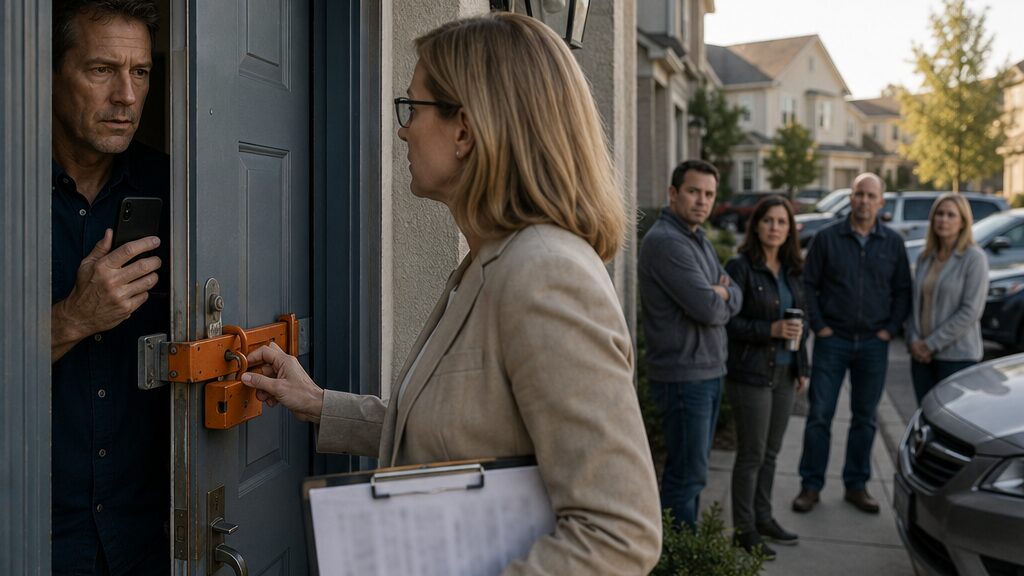
The Orange Lock on Jacob Carter’s Door Hid a Debt No Neighbor Was Allowed to See
Chapter 1: The Orange Lock Across Jacob’s Front Door
Metal struck the front door hard enough to rattle the framed photograph in Jacob Carter’s hallway.
He stopped halfway through buttoning his work shirt.
A second scrape followed, slower this time, metal dragging over painted wood. Then came the click of something heavy closing.
Jacob crossed the living room and pulled the door inward.
It moved less than two inches.
Through the narrow opening, he saw a length of bright orange steel stretched across the exterior security latch. A thick padlock joined the two ends. Beyond it stood Catherine Hall in a beige jacket, one hand holding a clipboard and the other resting on the lock as though she had just installed a new mailbox.
“You have until Friday,” she said.
Jacob stared at the orange bar. “Take that off my door.”
“Nine hundred dollars by Friday, or it stays.”
Across the shared sidewalk, a man loading a child’s backpack into an SUV stopped moving. Two doors down, a garage lowered before its owner had fully backed out. Catherine’s voice had carried exactly as far as she intended.
Jacob put one hand against the door and tested it again. The latch held.
“You locked me inside my house.”
“You have a rear exit.”
“That’s not the point.”
“The board approved emergency collection measures.”
Jacob’s first impulse was to shoulder the door until the screws tore out. He could already imagine the wood splitting, Catherine stepping back, neighbors pretending not to watch. Instead, he took his phone from the entry table and raised it through the gap.
Catherine’s expression tightened.
“Say that again,” he said.
“I’m not performing for your phone.”
“You said the board approved this lock.”
“I said the board approved collection measures.”
“Which section of the bylaws authorizes blocking an owner’s door?”
“You received three notices.”
“That isn’t an answer.”
Catherine shifted her clipboard against her hip. “Rules are rules, Jacob.”
“What contractor is doing the roof work?”
“The association has handled the appropriate review.”
“Name the contractor.”
“That information is part of the project file.”
“Show me one quote.”
Her mouth formed a thin line. Behind her, the man by the SUV shut the rear door and drove away without looking toward Jacob’s house.
Catherine tapped the clipboard. “Two hundred homes were assessed. You are not being singled out.”
Jacob lowered the phone half an inch. Two hundred homes. Nine hundred dollars each.
“One hundred eighty thousand dollars,” he said.
“The amount reflects the scale of the emergency.”
“What emergency?”
“Roof and drainage exposure.”
“Which buildings?”
“You can raise questions at the scheduled meeting.”
“When is it?”
“April.”
It was the second week of March.
Jacob lifted the phone again. “So you locked my front door in March for a meeting you won’t hold until April, over a repair you can’t identify, using a contractor you won’t name.”
Catherine glanced toward the neighboring houses. “Your refusal threatens everyone’s property.”
“My refusal to pay an invoice without a bid?”
“Your refusal to comply.”
There it was. Not repair. Not risk. Compliance.
Jacob stepped back and photographed the lock from three angles. He included the doorframe, the address plate, and the narrow gap showing that the door could not open. Years of preparing construction estimates had trained him to document before touching anything. Measurements first. Damage second. Opinions last.
Catherine knocked once on the orange bar with her knuckles.
“Friday,” she said.
She walked away without hurrying.
Jacob called the property manager. The call went to voicemail. He called the HOA office number printed on the assessment notice. The same voicemail answered. His third call went to the city’s nonemergency line, where a dispatcher transferred him twice before telling him an officer would not decide a private association dispute.
“I’m not asking anyone to decide the bill,” Jacob said. “I’m asking whether a private board can obstruct an occupied home’s exit.”
That changed the response.
Twenty-five minutes later, a municipal fire marshal stood outside Jacob’s door while Catherine returned from the clubhouse with the property manager. The marshal crouched, examined the latch, and asked who had installed the lock.
Catherine answered before the manager could.
“I authorized a temporary compliance device.”
The marshal looked up. “A what?”
“It does not prevent rear egress.”
“It prevents this door from opening.”
“The owner has another exit.”
The marshal stood. “Remove it.”
Catherine’s face remained controlled, but color rose above the collar of her blouse. “This is private property governed by association rules.”
“Remove it now, or I’ll have it cut and issue a safety citation.”
The property manager produced a key.
Jacob recorded the lock coming off. He recorded Catherine saying the financial obligation remained in force. He recorded the marshal explaining that he was ruling only on safe access, not on the assessment.
When the orange bar finally dropped free, it left two shallow marks in the blue-gray paint.
Catherine picked it up.
“No,” Jacob said.
She looked at him.
“That touched my property. I want it preserved.”
The marshal considered both of them, then told the property manager to place it in a clear maintenance bag until the dispute was resolved. Catherine objected, but quietly now.
By nine-thirty, everyone had gone. Jacob’s front door opened normally again, yet the house felt altered. The lock had lasted less than an hour. The humiliation remained fixed in every window that had watched.
He sat at his dining table with the assessment notice, the HOA covenants, and the meeting rules. He read the notice line by line.
Emergency roofing and drainage stabilization.
Nine hundred dollars per unit.
Payment due Friday.
Late charges to follow.
No contractor name. No bid number. No insurance claim. No project address. No schedule of work.
At the bottom, beneath Catherine’s printed signature, one sentence directed questions to the property manager.
Jacob called again.
This time, someone answered and immediately told him all project records were confidential until board review.
Jacob placed the phone beside the notice.
He had spent the morning asking whether Catherine had the right to lock his door.
By noon, that question felt smaller than the one sitting in front of him.
Who had received one hundred eighty thousand dollars for a project nobody could describe?
Chapter 2: Forty-Dollar Fines and Two Hundred Silent Houses
The violation envelope appeared before the repair compound around Jacob’s latch had dried.
It was tucked beneath the edge of his doormat, bright white against the gray porch.
UNAPPROVED EXTERIOR ITEM.
The photograph attached to the notice showed the doormat itself.
Jacob read the penalty twice. Forty dollars if the mat remained after twenty-four hours. An additional administrative charge if the violation required reinspection.
He carried the notice inside and laid it beside the photograph of the orange lock. The two documents looked absurd together: one accusing him of threatening community standards with a rectangle of woven rubber, the other showing the association blocking his door with steel.
By afternoon, he had started a petition.
He moved along the neighborhood’s curved streets with a clipboard of his own, though he hated how much it made him resemble Catherine. The development had been designed to look calm from any angle—matching rooflines, trimmed shrubs, pale siding, small porches set at equal distances from the sidewalk. But once Jacob began looking for notices, he saw them everywhere.
A yellow slip beneath a windshield wiper.
A white envelope taped inside a storm door.
A warning tied to the handle of a trash bin.
At the mail kiosk, a young tenant was peeling a citation from the window of a visitor’s car.
“My mother was here forty minutes,” she told Jacob. “They said guest parking requires advance registration.”
“Did you know that?”
“I rent. They don’t send me the board packets.”
She would not sign the petition.
Neither would the elderly man whose folding chair had been cited for remaining on his porch overnight. He listened to Jacob, nodded twice, then glanced toward the clubhouse.
“They can put a lien on your place,” he said.
“Not over a folding chair.”
“They can add fees until it isn’t about the chair anymore.”
Jacob had no answer ready for that.
By Thursday, fourteen residents had spoken to him privately. Only three had signed. Two asked him to remove their names after Catherine sent a community email describing “deliberate misinformation concerning essential structural repairs.”
Jacob replied to the group.
There is no contractor. There is no valid bid. The board is taking $180,000 under false pretenses.
He pressed send before rereading the last sentence.
Within an hour, one signer withdrew. The other called him.
“I agreed the lock was wrong,” the neighbor said. “I didn’t agree to accuse people of theft.”
“I said false pretenses.”
“You know what everyone will hear.”
Jacob looked at the sentence on his screen. It had felt precise when he typed it. Now it looked like anger dressed in formal language.
At the mail kiosk the next morning, people became occupied when he approached. One resident studied the same envelope for nearly a minute. Another crossed the street carrying no mail at all.
Catherine had not needed to defend the lock. Jacob’s accusation had allowed her to defend the neighborhood from him.
Ruth Rivera lived in the end unit of Building Six, where the sidewalk dipped slightly near a clogged drain. She was standing on her porch with a grocery bag against one hip when Jacob arrived.
“I’m not signing,” she said before he reached the steps.
“You haven’t read it.”
“I read your email.”
“The assessment has no supporting bid.”
“That doesn’t mean there isn’t a problem.”
“It means they can’t prove one.”
Ruth set the grocery bag down. “You think because Catherine did something outrageous, everything she said must be a lie.”
“She locked me in my house.”
“And that was wrong.”
“Then help me stop her.”
Ruth looked past him toward the street. “Stopping her and stopping the roof work may become the same thing if you keep shouting theft before you know what happened.”
Jacob felt the old heat rise into his face. “There is no roof work.”
Ruth’s expression changed—not fear, not submission. Weariness.
“You only started asking questions when the fines reached your door,” she said.
The words landed harder than he expected.
He remembered the visitor citations he had seen for months, the bin warnings, the elderly man removing his chair each evening. He had dismissed them as irritation. He had told himself he was too busy to attend meetings where neighbors argued about paint colors and parking decals.
“I’m asking now,” he said.
“Yes. About your lock.”
Jacob looked down at the petition. The page suddenly seemed smaller.
Ruth lifted her grocery bag. “People here aren’t silent because they admire Catherine. They are silent because they owe mortgages. Because they plan to sell. Because forty dollars becomes eighty, then legal fees. Because an association can make ordinary life expensive without ever raising its voice.”
“She raised hers at my door.”
“That is why you noticed.”
She went inside without signing.
That evening, a second notice appeared on Jacob’s porch. The association had added a late-processing fee to the unpaid assessment and warned that continued delinquency could result in collection action. The wording did not promise a lien, but it placed the word in bold among the possible remedies.
Jacob pinned the notices to the wall above his dining table. Beneath them, he arranged photographs of citations from around the neighborhood. Windshield slips. Bin warnings. Porch violations. His doormat.
The pattern was real. So was the fear.
His phone rang after nine.
Ruth asked him to come outside.
She stood at the bottom of his steps wearing a cardigan over her nightclothes. She did not come onto the porch.
“I still won’t sign what you wrote,” she said.
“All right.”
“And I don’t want my name used.”
“I understand.”
She held out a printed photograph.
The image showed a pale ceiling with a dark stain spreading from one corner. Near the center, the paint had swollen into a soft blister. A plastic storage tub sat beneath it.
“That’s my bedroom,” Ruth said. “Taken three weeks ago.”
Jacob studied the photograph.
“Did the HOA inspect it?”
“Someone came. Took pictures. Said the board was arranging emergency stabilization.”
“Who?”
“I don’t know. He didn’t give me a card.”
“Did they repair anything?”
Ruth shook her head.
Jacob turned the photograph over. A date had been written across the back in careful blue ink.
Before the assessment vote.
“There are two other units,” Ruth said. “Maybe three.”
For four days, Jacob had been asking whether Catherine had invented the emergency.
Now Ruth’s photograph gave him an answer he did not want.
Something was leaking.
The question was why a real leak required a false-looking bill.
Chapter 3: The Repair That Existed but Did Not Cost Enough
Ruth pressed her thumb against the swollen ceiling paint, and a clear bead of water formed around the nail.
“Don’t push it,” Jacob said.
“I barely touched it.”
The bead lengthened, released, and fell into the plastic tub beneath them with a hollow tap.
Jacob stood on a short ladder in Ruth’s bedroom while she held a flashlight. The room smelled faintly of damp drywall and cedar blocks. A brown line ran down the corner above the window, thin enough to disappear in ordinary light.
He eased open the attic access panel.
Cold insulation dust drifted onto his sleeve. Above the ceiling, the underside of the roof sheathing carried a dark water track toward a roof penetration. It was not catastrophic, but it was active. The wood meter he had brought from his estimating kit showed elevated moisture along two rafters.
Ruth watched his face.
“It’s real,” Jacob said.
“I knew it was real.”
He climbed down.
The apology caught behind his teeth. He had spent days using the absence of a bid as proof that the underlying problem did not exist. Ruth had shown him more evidence in ten minutes than Catherine had provided in three notices.
“I shouldn’t have called the whole repair false,” he said.
“No.”
“I should have checked.”
“Yes.”
Ruth moved the tub two inches to center it beneath another drop. She accepted the apology without rescuing him from it.
They visited the other affected units that morning. One had staining near a bathroom vent. Another had water entering above a shared stairwell during heavy rain. The damage followed the same roofline and drainage channel, suggesting a limited cluster rather than a development-wide failure.
At noon, Jacob called the property manager and asked for the inspection report.
“We cannot release vendor material during active procurement,” the manager said.
“Who performed the inspection?”
“That is part of the project file.”
“Did the inspector recommend one hundred eighty thousand dollars in work?”
“I’m not authorized to interpret technical documents.”
Jacob wrote down the exact sentence.
Through Ruth, he found the roofing inspector who had visited the units. The man agreed to meet at the edge of the property after Jacob explained that residents were being assessed based on what appeared to be his work.
He arrived in a plain truck with no company logo and brought a folded copy of his preliminary notes.
“I did not bid the job,” he said before Jacob finished introducing himself. “I was asked for a condition look.”
“By the property manager?”
“By a consultant.”
“How much work did you recommend?”
The inspector opened the notes on the hood of his truck. “Immediate patching around three penetrations, clearing two roof drains, replacing a short section of flashing. Temporary stabilization before the next storm.”
“How much?”
“My rough number was thirty-eight hundred to forty-two hundred, depending on access.”
Ruth folded her arms. “Not one hundred eighty thousand.”
The inspector looked between them. “Not for the immediate work.”
Jacob felt a sharp return of certainty. “So the assessment is fabricated.”
“I didn’t say that.”
The inspector pointed to another section of the notes. Several roof areas were nearing the end of their service life. Drainage design along two buildings was poor. A long-term replacement program would cost substantially more than four thousand dollars.
“How much more?” Jacob asked.
“I couldn’t price that without measurements, specifications, and bids.”
“Did anyone ask you for those?”
“No.”
“Did you submit a proposal to the board?”
“No.”
“A contract?”
“No.”
“A one-hundred-eighty-thousand-dollar estimate?”
The inspector’s expression hardened. “Absolutely not.”
Jacob photographed the notes with permission. For the first time, the numbers formed a shape he could trust. There was real damage. There was an immediate repair worth approximately four thousand dollars. There was a future maintenance problem no one had properly priced. And between those facts sat one hundred seventy-six thousand dollars without a clear purpose.
The inspector folded his notes again.
“You should know something else,” he said. “The person who called me seemed more interested in having proof of an emergency than in getting the repair scheduled.”
“What do you mean?”
“He asked whether I could state the condition posed an imminent community-wide risk. I told him I could only describe what I observed.”
“Who asked?”
The inspector glanced toward the clubhouse. “I’ll tell you after you show me you’re not putting half a sentence online.”
Jacob heard the rebuke beneath the condition. News of his email had traveled farther than he knew.
He put his phone away.
“I’m not posting anything,” he said.
The inspector studied him, then nodded once.
Before he could continue, Ruth’s phone chimed.
She read the message and handed it to Jacob.
A new association notice had been sent to every homeowner. Unpaid assessments would begin accruing daily late charges on Monday. Accounts remaining delinquent after thirty days could be referred for collection, with all legal and administrative costs charged to the owner.
The notice also stated that residents interfering with approved vendors could be fined.
“They’re making questions sound like interference,” Ruth said.
Jacob read the final paragraph twice. Catherine had attached no bid, no schedule, and no vendor name. She had simply made the consequences more official.
By late afternoon, Jacob had arranged the evidence on his dining table. The orange lock, still sealed in the clear maintenance bag, rested near the edge. Beside it lay Ruth’s ceiling photograph, moisture readings, the inspector’s preliminary notes, and the association notices.
The lock no longer proved the assessment was false.
It proved Catherine was willing to use force before showing what was true.
Jacob called the property manager once more and requested the vendor’s legal name. The manager refused.
He then searched the state contractor database using fragments from the inspector’s notes. Nothing matched. He searched county business registrations for recently formed roofing and property consulting companies. Too many results appeared.
At seven, the roofing inspector called.
“I checked my call log,” he said. “The consultant gave his name as Jonathan Hall.”
Jacob sat straighter.
“Hall?”
“That’s what he said.”
“Did he identify his relationship to the association?”
“He said he was coordinating emergency services for the board.”
Jacob looked at Catherine’s printed signature on the assessment notice.
Catherine Hall.
“Did Jonathan provide a company name?”
The inspector gave it to him.
Jacob wrote it beneath Catherine’s signature and circled both surnames.
The evidence had finally produced a specific person.
It had also produced a relationship Catherine had never disclosed.
Chapter 4: The Company Formed Seven Days Before the Vote
Jonathan Hall’s company registration listed Catherine’s home address.
Jacob checked the form twice before asking the county records clerk whether the image had been scanned correctly.
“It matches the original filing,” the clerk said.
The business had been formed seven days before the emergency assessment vote. Its stated purpose was broad enough to mean almost anything: property consulting, vendor coordination, maintenance administration. Jonathan was listed as organizer and sole manager. Catherine’s address appeared under both mailing contact and registered office.
Jacob photographed the screen, paid for a certified copy, and stepped into the hallway with the document warm from the printer.
A shared surname could be coincidence. A shared address was harder to dismiss.
He called Heather Gonzalez from the parking lot.
“I found the company.”
“That is not the same as finding wrongdoing.”
“It was formed a week before the vote.”
“Still not wrongdoing.”
“It uses Catherine’s address.”
There was a pause.
“Bring everything,” Heather said. “Not just the pieces that make you feel right.”
Her home office occupied the front bedroom of a townhouse near the south entrance. A former insurance claims examiner, Heather had kept the habits of the work after leaving it: labeled folders, sharpened pencils, a small scanner, and no patience for documents presented out of order.
Jacob spread the certified registration, inspection notes, assessment notice, and bank-summary pages across her desk.
Heather did not touch them at first.
“What exactly do you know?” she asked.
“That Catherine’s relative created a company before the vote and received association money.”
“You know he shares her surname and used her address. You do not yet know the relationship.”
Jacob leaned back. “You think they’re strangers?”
“I think facts survive meetings better than assumptions.”
She examined the registration, then searched public property records. Catherine had owned the address for eleven years. An older business filing linked Jonathan Hall to the same property before his current company existed.
Heather turned the screen toward Jacob.
“Now you can say there is a documented connection.”
“Can I say she hid it?”
“If the board minutes contain no disclosure.”
Jacob had requested those minutes three times. Each response claimed they were under legal review.
Heather tapped the assessment notice. “Where did this summary come from?”
“The property manager emailed it after I demanded the account totals.”
The summary showed one large disbursement to Jonathan’s company, followed by smaller expense categories: consulting, project travel, administrative meals, insurance review.
Heather’s eyes narrowed.
“This is not a bank statement.”
“It shows the payment.”
“It shows what someone chose to label the payment.”
She asked Jacob to request the underlying ledger and cleared checks. He sent the demand from her desk, citing the association’s record-access provision. Before he finished, she had divided his papers into two piles.
On the left, she placed verified facts: the $180,000 collection, the roughly $4,000 immediate repair estimate, the company formation date, Catherine’s address, and the lack of a disclosed bid.
On the right, she placed claims that remained unproven: personal theft, fabricated damage, private vacations paid entirely by homeowners.
Jacob looked at the right-hand stack.
“It’s thinner.”
“It is more dangerous.”
Two days later, the property manager released partial account records, possibly because Jacob had copied the association attorney. The documents arrived as one disorganized electronic file containing invoices, card statements, reimbursement requests, and meeting attachments.
Jacob printed all of it.
The orange lock remained sealed in its clear maintenance bag at the far end of his dining table. Between it and his laptop, he built Heather’s two stacks again.
The first suspicious charge was for a coastal resort.
Forty-one thousand dollars appeared across deposits, lodging, conference fees, and transportation. Jacob circled the total so hard the pen tore the paper.
Heather stopped him.
“Look at the dates.”
Three days overlapped with a regional insurance conference. The agenda included sessions on shared-property coverage, reserve funding, and catastrophic-loss exclusions. Catherine’s name appeared on the attendee list. So did Stephen Lewis’s.
“That does not justify forty-one thousand dollars,” Jacob said.
“No. But it means ‘beach vacation’ is not the whole truth.”
Several dinners exceeded six hundred dollars. One included eight attendees. Another had no names, only a handwritten note: vendor development.
Jonathan’s company had billed consulting hours on the same dates.
Heather traced each charge with the edge of a ruler.
“Some of this may be legitimate,” she said. “Some may be inflated. Some may have been moved into the project account because the operating account could not cover it.”
“That would still be misuse.”
“Yes. But not necessarily the simple kind you announced in your email.”
Jacob looked toward the lock.
He had imagined entering the April meeting with one clean accusation. Money collected for a roof had been stolen for a vacation. The documents refused to stay that simple.
Heather found the conflict disclosure form near midnight.
The page required board members to identify family, financial, or business relationships involving proposed vendors. Catherine had signed at the bottom.
The disclosure section was blank.
Jacob felt the first clean satisfaction he had experienced in days.
“There,” he said.
Heather nodded. “There.”
Whatever explanation Catherine gave for the expenses, she had authorized payments to a company connected to her address without declaring the relationship. That fact did not depend on tone, rumor, or motive.
Jacob moved the form to the verified stack.
By the end of the week, the two piles had grown high enough to lean. The left stack contained what he could prove. The right held what still needed explanation. The orange lock sat beyond both, no longer the center of the table but the object that had forced him to build it.
At eleven forty-three on Sunday night, his phone lit with a message from Stephen Lewis.
Jacob had approached the treasurer twice and received only formal replies. This message contained no greeting.
The reserve account was already empty.
Jacob read the line until the screen dimmed.
He turned it on again and typed, Empty before the assessment?
Three dots appeared, vanished, then returned.
No answer came.
The unexplained charges were no longer only about where the new money had gone.
They were about a debt that existed before residents were told there was an emergency.
Chapter 5: What Catherine Was Protecting Behind the Fines
Stephen unlocked a records closet Catherine had said did not exist.
The door stood behind a folding divider in the community room, painted the same beige as the wall. Inside were banker’s boxes, old binders, insurance folders, and a metal cash box with no key.
“You have forty minutes,” Stephen said.
Jacob remained in the doorway. “Why now?”
“Because you are going to speak at the meeting whether I help you or not.”
“And you want to control what I find.”
Stephen’s shoulders lowered. “I want you to understand what happens if you say the wrong thing.”
The April meeting was two days away. The room had already been arranged with rows of plastic chairs facing a projection screen. In the quiet, the fluorescent fixtures produced a faint electrical hum.
Stephen pulled three binders from the closet.
Reserve studies.
Insurance renewals.
Board minutes.
Jacob opened the oldest reserve binder first. Five years earlier, an engineering firm had recommended phased roof replacement, drainage correction, and an annual increase in reserve contributions. The board had postponed the increase after residents protested rising dues.
The next year, it postponed the first roof phase.
The year after that, it approved landscaping improvements instead.
Catherine had not been president for the earliest decisions. Her name first appeared in the margins as a homeowner asking why reserves remained below the recommended level.
Jacob looked at Stephen.
“She warned them.”
“More than once.”
“Then she knew exactly how bad it was when she took office.”
“Yes.”
The insurance folder showed premiums climbing sharply after regional storm losses. A renewal notice warned that unresolved roof conditions could lead to exclusions or cancellation. Another carrier had already declined coverage.
The association had less than thirty days to demonstrate active repairs.
“How empty was the reserve account?” Jacob asked.
Stephen gave him a figure so low that Jacob thought he had misheard.
“That wouldn’t cover one building.”
“It barely covered the deductible.”
“Where did it go?”
“Deferred maintenance. Insurance. Emergency plumbing. Legal fees. Years of keeping dues lower than they needed to be.”
“And the resort?”
Stephen rubbed both hands over his face. “The conference was real. Catherine believed she could negotiate better coverage in person. Jonathan arranged the travel and billed it through his company.”
“Forty-one thousand dollars.”
“Not all of that was travel.”
“What was the rest?”
Stephen pointed to a set of transfers. Jonathan’s company had received the assessment funds, then paid selected association expenses from its account. Insurance consulting. Legal retainers. Past-due vendor bills. The arrangement obscured the fact that the HOA’s own operating and reserve accounts could not meet their obligations.
Jacob felt anger sharpen, then change shape.
“They used a private company as a second treasury.”
Stephen did not object.
“Whose idea?”
“Catherine’s.”
“And you signed.”
“Yes.”
“Why?”
Stephen looked toward the rows of empty chairs. “Because the carrier wanted proof of funded repairs. Because contractors would not schedule without deposits. Because if we announced that the reserves were gone, people would stop paying, list their units, or sue. We thought we could stabilize it first.”
“We?”
Stephen’s mouth tightened. “I thought the transfer was temporary. Catherine thought Jonathan could coordinate everything faster than the management company.”
“Because he was her brother.”
Stephen looked at him.
There was the confirmation.
Jacob opened another binder. Meeting minutes recorded Catherine warning that the association was approaching insolvency. Her language was measured, almost clinical. She proposed higher dues, a reserve study update, and delayed cosmetic projects. Other board members rejected the proposals.
Later minutes showed her language changing. References to financial weakness disappeared. Compliance enforcement increased. Fines became more frequent. The board adopted shorter payment deadlines and broader administrative charges.
Catherine had first tried to tell the truth.
When the truth threatened her authority, she had replaced it with control.
“She believed panic would destroy the community,” Stephen said.
“So she locked my door.”
“That was not approved.”
“You knew about it.”
“Afterward.”
“And did nothing.”
Stephen turned away.
Jacob photographed the records in order, careful to capture page numbers and binder labels. His anger no longer offered the simple relief it had before. Catherine’s fear was visible in the documents. So were her choices.
She had inherited a failing system. She had also hidden it, employed her brother, and used residents’ fear to force money into an account they could not see.
Stephen closed the final binder.
“If you accuse her of stealing forty-one thousand dollars for a vacation, I will deny everything.”
Jacob looked up. “Because it isn’t true?”
“Because it is not proven. And because if the bank freezes the project funds, the insurer may cancel us before the roofs are stabilized.”
“You’re asking me to stay quiet.”
“I’m asking you not to burn the building to prove there was smoke.”
The line angered Jacob because it sounded reasonable.
He gathered his photographs and notes. At the closet door, he stopped.
“Will you testify that the reserve account was empty before the assessment?”
Stephen stared at the floor.
“If the board authorizes an independent audit.”
“That is not an answer.”
“It is the only one I have.”
Jacob left through the side entrance.
Catherine was waiting beside his car.
She wore no jacket, only a pale blouse with the sleeves folded neatly to her elbows. For the first time since the lock incident, she did not carry a clipboard.
“Stephen should not have let you into those records,” she said.
“You told me they didn’t exist.”
“I said the project files were restricted.”
“You said there was no separate archive.”
Catherine did not debate the wording. “You have enough pieces to frighten people and not enough to understand what you will cause.”
“That sounds familiar.”
“The association was weeks from losing coverage.”
“So you used Jonathan’s company to hide the deficit.”
“To move quickly.”
“You failed to disclose he was your brother.”
“I knew no other vendor who would extend terms.”
“He charged the association for dinners and a resort.”
“He attended meetings, negotiated with carriers, and carried expenses while residents delayed payment.”
“Did you plan to repay the unrelated charges?”
Catherine’s eyes moved toward the clubhouse windows.
“When property values stabilized and collections improved, I intended to restore funds to the proper accounts.”
“With whose money?”
She looked back at him. “You think disclosure is automatically moral. Sometimes disclosure is simply the fastest way to start a panic.”
“And sometimes secrecy is how people protect themselves.”
Her expression hardened.
Then she offered him the deal.
She would remove the forty-dollar doormat fine, the administrative charges, the late penalties, and the record of noncompliance related to the assessment. In return, Jacob would delay any public accusation until the next fiscal year, when the insurance renewal and emergency repairs were complete.
“The nine hundred dollars?” he asked.
“You still owe the legitimate assessment.”
“Which part is legitimate?”
“That can be reconciled later.”
Jacob almost laughed.
Catherine stood beside his car as if they were discussing a scheduling problem rather than the price of silence.
For one brief moment, he imagined accepting. His account would be cleared. His property would remain marketable. The neighborhood would avoid immediate financial shock. Catherine might even restore part of the money, exactly as she claimed.
Then he pictured Ruth moving the plastic tub beneath her ceiling while the board continued calling every number confidential.
“No,” he said.
Catherine’s face did not change.
“Then be precise at the meeting,” she said. “Because if you are wrong in public, the cost will not fall only on me.”
She walked back toward the clubhouse.
Jacob remained beside his car with two choices that no longer resembled truth and silence.
One offered exposure without a plan.
The other offered stability built on the same locked door.
Chapter 6: Two Stacks of Records Under Fluorescent Lights
Jacob’s unpaid balance filled the projection screen before he entered the room.
Nine hundred dollars in bold type. Beneath it were the late charge, administrative fee, and doormat violation, each arranged in a clean table beside his address.
Catherine stood at the front with a remote in one hand.
“We cannot maintain essential services,” she was saying, “when individual owners decide their obligations are optional.”
Every chair was occupied. Residents stood along the back wall and near the side doors. Ruth sat in the second row with her hands folded over a thin folder. Heather had chosen a chair near the aisle, her phone resting face down on her knee.
Jacob carried two document stacks in a file box.
Conversation dropped as he walked to the front.
Catherine changed the slide.
“You will have three minutes during owner comment.”
“I requested fifteen under the financial-disclosure rule.”
“The chair has discretion.”
“You are the chair.”
“Yes.”
Jacob set the box on the long table.
The sound of paper striking wood was smaller than he expected, but the room heard it.
He removed the first stack and placed it on the left. Verified records. Collection totals. Inspection notes. Company registration. Conflict form. Account transfers.
The second stack went on the right. Unverified charges, incomplete invoices, unanswered questions.
Between them, he placed the orange lock inside its clear evidence bag.
A murmur moved through the room.
Catherine’s gaze fixed on the lock.
“That object is unrelated to tonight’s financial agenda.”
“It is the reason I asked to see the agenda.”
She lifted the remote. “Your time has begun.”
Jacob turned toward the residents.
“The board collected nine hundred dollars from approximately two hundred homes. That is one hundred eighty thousand dollars.”
No one moved.
“The immediate roof and drainage work identified by the inspector was estimated at approximately four thousand dollars.”
He placed the inspector’s notes beside the collection summary.
“This does not mean there is no roof problem. There is. Three buildings have active water damage, and more long-term work will be needed.”
Ruth opened her folder but remained seated.
Jacob continued.
“The problem is that residents were told the full amount was an emergency repair assessment. Most of the money was transferred to a company formed seven days before the vote. That company used Catherine Hall’s home address.”
Catherine stepped forward.
“The company coordinated insurance, legal, and vendor services necessary to prevent coverage cancellation.”
“Then why was the relationship not disclosed?”
Jacob held up the signed conflict form.
The blank section faced the room.
Catherine looked past it. “The board acted under emergency authority.”
“There is no emergency exemption on this form.”
One of the unnamed board members whispered to the other.
Heather raised her phone and began recording.
Catherine noticed.
“This meeting concerns confidential financial material. Recording may expose the association to liability.”
“Keep recording,” Jacob said.
Catherine’s voice sharpened. “You do not control this meeting.”
“No. But neither do you control the record anymore.”
A few residents shifted in their chairs. There was no applause. The silence felt more serious than approval.
Jacob pointed to the two stacks.
“This pile is what I can prove. This pile is what still needs an independent audit.”
He did not use the word theft.
Catherine had expected it. He could see that in the brief pause before she answered.
“You have omitted the reserve crisis,” she said.
“I was getting to it.”
“Then explain all of it.”
She took the remote and projected an insurance notice. The carrier required evidence of roof stabilization and adequate reserves. Failure could result in nonrenewal.
“If the project account is frozen tonight,” Catherine said, “scheduled work may stop. If the work stops, we may lose coverage. Without coverage, lenders may refuse new mortgages. Sales may collapse. Every owner in this room may lose value.”
The room changed.
Residents began speaking at once.
“Is that true?”
“Are the repairs scheduled?”
“What happens to claims?”
“Can they cancel us immediately?”
Catherine let the questions rise before raising one hand.
“This is what I have been trying to prevent.”
For a moment, Jacob felt the confrontation slipping away from him. Catherine had turned disclosure into danger exactly as she warned she would. The residents were no longer looking at her blank conflict form. They were looking at the insurance notice.
Ruth stood.
Her voice was not loud, but the room quieted around it.
“My bedroom ceiling is leaking,” she said. “The repairs are real.”
Catherine gave a small nod, as if Ruth had confirmed her case.
Ruth continued.
“But no one told me the reserve account was empty. No one told me the president’s brother received our assessment. No one told me my nine hundred dollars was paying old bills and conference expenses.”
Catherine’s hand lowered.
Ruth opened her folder and held up the photograph she had given Jacob.
“I would have voted for repairs. I would not have voted for secrecy.”
The sentence changed the room more than any accusation could have.
Stephen sat at the end of the board table, pale beneath the fluorescent lights. Jacob looked at him.
“Was the reserve account already depleted before the emergency assessment?”
Catherine turned. “Stephen, do not answer incomplete questions.”
Stephen adjusted the papers in front of him.
Then he said, “Yes.”
The word moved through the room like a door opening.
“How long?” a resident asked.
Stephen swallowed. “Years below the recommended level. Critically low before the vote.”
Catherine closed her eyes for one second.
Jacob could have pressed harder. He could have named the resort total, the dinners, every vague invoice. He could have invited the room to demand immediate account freezes and refuse all payments.
A man near the back did it for him.
“Nobody pays another dollar,” he shouted. “Freeze everything tonight.”
Several residents agreed.
Catherine seized on the reaction. “If you do that, the insurer may walk.”
Jacob looked at Ruth’s photograph, then at the orange lock.
He understood the choice Catherine had offered beside his car. Exposure or stability. She had treated them as opposites because that made secrecy appear necessary.
They were not opposites. But joining them required more than proving she had lied.
“No,” Jacob said.
The room quieted again.
The man at the back frowned. “No what?”
“No blanket refusal. No freezing verified repair funds.”
Catherine stared at him.
Jacob removed a single page from the verified stack.
“I propose an emergency owner vote for an independent forensic audit, temporary removal of current officers from financial authorization, dual-signature control on all remaining funds, and a protected account limited to documented roof and drainage work.”
Heather lowered her phone just enough to look at him directly.
Jacob continued.
“All retaliatory fines connected to record requests or assessment disputes should be suspended. No payment should go to Jonathan Hall’s company without invoice review. Residents should receive a full accounting before any new charge.”
A board member objected that the proposal had not been placed on the agenda.
Heather spoke from the aisle.
“The bylaws allow an emergency owner motion when an undisclosed conflict threatens association funds.”
She held up a marked copy.
Catherine looked from Heather to Jacob.
“You planned this.”
“I verified it.”
The difference mattered to him now.
Questions came quickly. Who would conduct the audit? Could the association afford it? What work would continue? Would delinquent owners face liens?
Jacob answered only what the documents supported. Heather explained the audit process. Ruth insisted that vulnerable owners could not be punished while the board reconciled an assessment it had misrepresented.
Stephen finally removed his name from the account authorization sheet and placed the pen on the table.
Catherine remained standing.
A resident asked the question no one had yet stated plainly.
“Is Jonathan Hall your brother?”
Catherine’s face seemed to settle into stillness.
“Yes.”
The admission was quieter than the lock striking Jacob’s door, but it carried farther.
“Do you regret hiring him?” Jacob asked.
She looked at the insurance notice on the screen.
“No,” she said. “I regret that the board left me with no clean option.”
“You had disclosure.”
“I had panic.”
“You chose for everyone.”
“I chose to keep the association alive.”
The vote proceeded by written ballot. It was not unanimous. Some residents feared the audit cost. Others feared losing insurance more. A few still trusted Catherine’s judgment despite the undisclosed relationship.
But enough ballots favored independent control.
The motion passed.
Catherine placed the remote on the table. She did not apologize. She did not resign that night.
Instead, she looked at the orange lock sealed between the two stacks.
“You wanted that to prove I was a tyrant,” she said.
“At first.”
“And now?”
Jacob slid the evidence bag toward Heather for inclusion in the audit file.
“Now it proves why nobody should be asked to trust an emergency they are forbidden to examine.”
The room began to empty slowly, residents stopping in small groups rather than rushing for the doors.
Catherine remained beneath the projected balance bearing Jacob’s name.
Jonathan Hall was her brother. She had concealed it. The residents had finally taken control of the accounts.
Yet the roofs still leaked, the reserve fund was still empty, and one hundred eighty thousand dollars could not be recovered by the force of a vote.
The exposure was complete.
The accounting had only begun.
Chapter 7: The Door Opened, but the Debt Remained
“The association misled its owners,” the auditor said, “but the roofs are still damaged, and the money needed to repair them does not disappear because the accounting was dishonest.”
No one in the community room moved.
Six weeks had passed since the April meeting. The projection screen now showed no names, no delinquent balances, no warnings in red. Only columns of figures under the independent audit firm’s letterhead.
Jacob sat beside Ruth in the second row. Heather occupied a folding table near the front with three binders open before her. Stephen sat alone against the side wall, no longer at the board table. Catherine had chosen a chair in the final row, where she could see everyone without being required to face them.
The auditor advanced to the next page.
Of the one hundred eighty thousand dollars collected, a portion had funded legitimate inspection, temporary repairs, insurance consulting, and overdue association expenses. Some charges had been poorly documented but were likely related to association business. Others had no adequate support. Jonathan Hall’s company had billed excessive coordination fees, mixed personal-looking expenses with project costs, and received funds through an undisclosed conflict of interest.
Not all of it could be recovered.
The sentence drew the first audible reaction.
A resident near the aisle whispered, “So we pay twice.”
“In some respects,” the auditor said, “you are paying now for maintenance that should have been funded gradually over several years.”
The reserve account had not been emptied by a single theft. It had been weakened through repeated postponements, underfunded dues, emergency expenses, rising insurance costs, and decisions that had looked harmless when considered one year at a time.
Catherine had concealed the result.
Jonathan had profited from it.
Stephen had signed reports he knew were incomplete.
The owners had benefited from dues that remained artificially low.
The truth distributed responsibility without distributing it equally.
Jacob looked at the printed recovery plan in his hands. The verified portion of his assessment was lower than nine hundred dollars but not low enough to feel like victory. The audit recommended immediate roof stabilization, phased drainage work, a new reserve study, and monthly public account reports.
It also recommended civil action against Jonathan’s company.
The association attorney warned that litigation could cost more than the amount recovered. A negotiated repayment might return less money but sooner.
From the back row, Catherine spoke for the first time.
“Jonathan will cooperate.”
Heads turned.
Her posture remained straight, though the weeks had changed her face. The careful polish was still there, but it no longer carried authority. It looked like effort.
“How do you know?” a resident asked.
“Because I spoke to him.”
“You were told not to contact vendors about the audit,” Heather said.
“I did not discuss the audit. I told my brother that he would repay unsupported charges if he expected me to speak to him again.”
The room stayed quiet.
Jacob could not tell whether the statement was a threat, an apology, or another attempt to control the outcome.
The auditor continued. Catherine and Stephen had been removed from financial authorization. Stephen had formally resigned as treasurer. Catherine had submitted her resignation from the board that morning.
There was no applause.
Catherine folded her hands in her lap.
“I still believe immediate disclosure would have caused panic,” she said. “I still believe we would have lost coverage.”
Ruth turned halfway in her chair. “That does not mean you had the right to decide what we were allowed to know.”
“No,” Catherine said.
It was the closest she came to admitting fault.
“But secrecy bought us time,” she added.
“And cost us trust,” Jacob said.
Catherine looked at him. “Trust does not repair roofs.”
“Neither does fear.”
The auditor cleared his throat, and the meeting returned to the recovery plan.
The proposed payment schedule required owners to contribute only to verified repair and reserve needs. Those who had already paid the full assessment would receive credits. Those who had withheld payment would owe a corrected amount. Unsupported fines and administrative fees related to assessment disputes would be voided.
The correction still created hardship.
A flat payment, Ruth said, would punish the residents least able to absorb another mistake.
She stood with one page in her hand.
“I am proposing an amendment,” she said. “Owners may pay the verified assessment over twelve months without interest. Those on fixed incomes may apply for twenty-four months through a confidential hardship review. No lien referral while an approved plan is current.”
One board member objected that extended payments would slow the repair schedule.
Ruth did not raise her voice.
“My ceiling leaked while the board used my fear to keep me quiet. I will pay for my roof. I will not support a plan that takes someone else’s home to repair it.”
Jacob looked at the woman who had refused to sign his petition. She had not lacked courage. She had lacked a plan she could trust.
Heather added a requirement that hardship decisions be reviewed by two residents and the management company, preventing one board officer from controlling access.
The amendment passed.
When Jacob’s corrected invoice was called, he walked to the front with a check.
The room watched him more closely than he wanted.
He had spent weeks being described as the man who would not pay. Part of him wanted to explain the amount, the principle, the distinction between refusing secrecy and refusing obligation.
He said none of it.
He placed the check on the table.
It covered his verified share of the immediate repairs and reserve contribution. Not the fines. Not Jonathan’s unsupported charges. Not Catherine’s version of compliance.
Ruth gave him a small nod.
The gesture meant more than agreement.
After the meeting, the auditor handed Heather a plain records box containing the original financial exhibits and the orange lock. The maintenance bag had been resealed with an evidence label. Its bright paint looked almost childish beneath the fluorescent light.
“Closed item,” the auditor said. “No further need to retain it professionally.”
A resident suggested mounting it in the clubhouse.
“Put a plaque under it,” someone else said. “So nobody forgets.”
Jacob lifted the bag from the box.
For weeks, he had imagined the lock displayed where Catherine would have to pass it. He had imagined residents pointing to it whenever a board member used the word emergency. It would prove that he had been right before anyone believed him.
He looked across the room.
Catherine was signing her resignation documents. Stephen waited beside her, eyes lowered. Ruth discussed repair access with the property manager. Heather was already marking deadlines in the new reporting calendar.
The lock had done its work.
Hanging it on the wall would turn evidence into a trophy.
Jacob placed it back in the box.
“Keep it with the records,” he said.
No one argued.
Ruth’s roof repair began the following week. The damaged flashing was replaced, the drain cleared, and the stained section of her bedroom ceiling removed. Jacob stopped by after the workers left.
The plastic tub was gone.
Ruth stood beneath the repaired patch, looking up at fresh primer.
“It is not pretty,” she said.
“It needs another coat.”
“I meant the payment plan.”
“That too.”
She smiled.
Outside, rain began tapping against the porch rail. Not hard, but steadily enough to test the work.
Jacob walked home with Ruth beside him. When they reached his house, water ran in narrow lines along the curb toward the corrected drain.
His front door had been repainted where the orange bar had scarred it. The blue-gray surface was smooth again, though Jacob could still locate the marks by memory.
Ruth paused at the bottom step.
“You know,” she said, “I thought you were going to make the whole place choose between you and Catherine.”
“So did I.”
“What changed?”
Jacob opened the door.
“The roof leaked.”
Ruth considered that answer, then followed him inside.
The rain strengthened behind them. Water struck the roof, moved through the gutters, and disappeared into the drain without touching Ruth’s ceiling or Jacob’s hallway.
On the dining table, the notices and photographs were gone. The documents had been transferred to the shared records archive, where any owner could request them without explaining why.
Jacob held the door open until Ruth had crossed the threshold.
Then he let it close normally, with no steel across it and no one outside deciding when it could open again.
The story has ended.