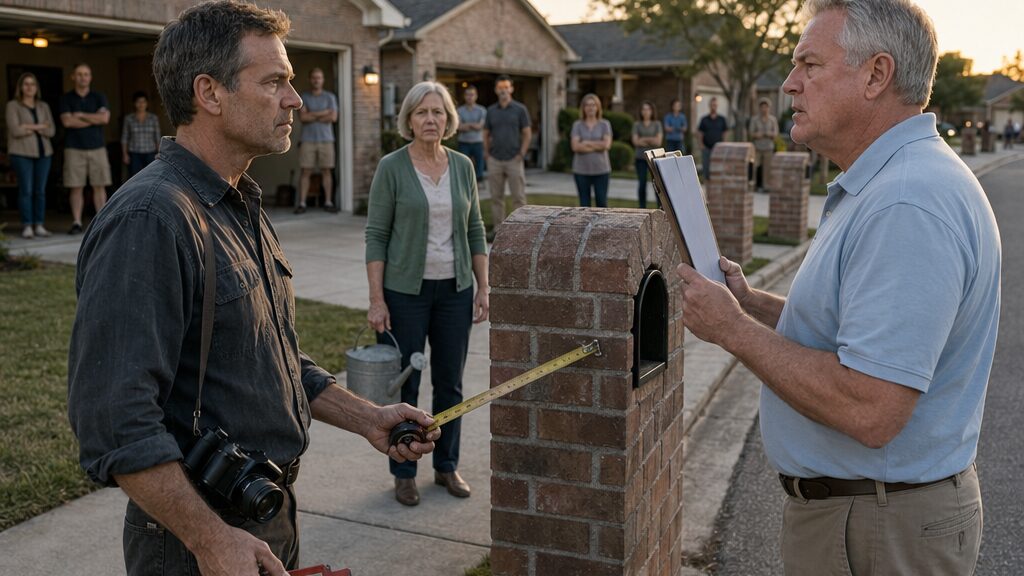
The HOA President Broke His Mailbox Flag, Then One Measurement Changed the Whole Street
Chapter 1: The Red Flag Broke Before Anyone Spoke
Ronald Wright’s hand closed around the red mailbox flag before Joseph Martin understood that the argument had already moved past rules.
The plastic hinge gave with a dry snap.
Three neighbors stood within sight of the curb—one beside a half-open garage, another watering a flower bed, a third pretending to check something inside an SUV. None of them looked away quickly enough.
Ronald held the broken flag between two thick fingers. His clipboard was tucked under his other arm, pressed against a pale button-down shirt that looked too formal for a Friday evening walk through the cul-de-sac.
“You have until next Friday,” he said. “After that, it’s fifty dollars a day.”
Joseph looked at the empty slot on the side of his black mailbox. The post was plain pressure-treated wood, square and solid. He had set it himself twelve years earlier, after the original metal post rusted through near the ground.
Ronald shook the broken piece once, as though it proved something.
“Until that ugly box is gone.”
Joseph’s work truck sat in the driveway behind him, ladder rack silhouetted against the lowering sun. A camera hung from his shoulder because he had been unloading equipment when Ronald crossed the street. The strap pressed into his neck.
He could have reached for the broken flag. He could have told Ronald to get off his property. He could have done several things that would have felt good for ten seconds and become expensive afterward.
Instead, he took the camera from his shoulder.
Ronald’s expression shifted.
“What are you doing?”
Joseph raised the camera and photographed the mailbox, the missing hinge, and the red plastic in Ronald’s hand.
The shutter sounded louder than it should have.
Ronald lowered the broken flag. “Don’t turn this into something it isn’t.”
“You broke it.”
“It was already loose.”
“It was attached when you walked over.”
One of the neighbors stopped watering the flowers. Water ran over the edge of the bed and darkened the mulch.
Ronald stepped closer until the clipboard nearly touched Joseph’s chest. He was taller by an inch or two and broader through the shoulders. For years he had carried himself as if the dimensions of his body supported the authority of every sentence.
“The board voted,” Ronald said. “Your mailbox is not an approved design.”
Joseph glanced across the cul-de-sac toward Ronald’s house. White columns framed the porch. The lawn was cut in diagonal stripes. At the curb stood a brick pillar with a black mailbox recessed into its face, identical to most of the others along the street.
Joseph’s box was the exception.
“What rule did I violate?” he asked.
Ronald tapped the clipboard.
“The community standard.”
“What measurement?”
“That isn’t the point.”
“What material restriction?”
“You know exactly what the point is.”
Joseph did know what Ronald meant. The brick pillars had been installed over the previous eighteen months, one section of the subdivision at a time. Owners had been encouraged, then pressed, then warned to replace their old posts. Joseph had ignored the first packet and discarded the second. He had not attended the vote.
He had also never agreed to spend nearly two thousand dollars replacing a working mailbox because Ronald preferred the street to look as though every house had been ordered from the same catalog.
Ronald pulled a sheet from beneath the clipboard clip.
“This is your formal notice.”
He walked past Joseph toward the front door.
Joseph followed. “You can hand it to me.”
Ronald did not stop. At the porch, he pressed the paper against the center of the door and smoothed two pieces of clear tape over the top corners. Then he struck the wood three times with the side of his fist.
The blows echoed inside the house.
Joseph’s jaw tightened.
The notice used the HOA letterhead. A bold line near the top identified a violation of architectural uniformity. The lower half described escalating daily fines beginning the following Friday.
Joseph scanned it once.
No section number.
No dimensional standard.
No reference to an approved material list.
Only a sentence stating that his mailbox failed to match the adopted neighborhood design.
Ronald had already turned toward the sidewalk.
“You didn’t cite the specification,” Joseph said.
Ronald stopped.
“What?”
“The standard you say I violated. It isn’t cited.”
“It was included with the neighborhood vote.”
“Then cite it.”
A faint flush spread above Ronald’s collar. “You don’t get to cross-examine me on your porch.”
“You put a fine notice on my door.”
“And you can appeal it at the next board meeting.”
“When is that?”
“Three weeks.”
“The fines start in one.”
Ronald’s mouth became a narrow line. “Then I suggest you replace the mailbox.”
He walked back across the lawn, still carrying the broken red flag.
Joseph lifted the camera again.
Ronald noticed and dropped the piece near the curb. It landed in the grass beside the mailbox post.
“There,” he said. “You’ve got your little evidence.”
Joseph photographed it where it fell.
A neighbor near the SUV shut the rear door with unnecessary force and went inside. The woman with the hose finally turned off the water. No one said anything to Ronald, and no one said anything to Joseph.
That silence bothered him more than he expected.
He crouched beside the mailbox and picked up the flag. The hinge had cracked cleanly through its narrow plastic neck. It was repairable. Almost anything was repairable if the break was simple enough and the person doing the work was patient.
He turned it over in his palm.
Across the street, Ronald climbed the steps to his white-columned porch. Before opening his door, he looked back.
The glance lasted only a second, but Joseph saw no uncertainty in it. Ronald believed the matter was finished.
Joseph carried the broken flag into the garage and placed it on the workbench beneath a bright task light. Around it lay the ordinary remains of his week: aluminum sign brackets, drill bits, a coil of wiring, a permit envelope from a shopping center job, and a steel tape measure scarred from years of use.
He removed the violation notice from his front door without tearing the tape. Then he laid the page flat beside the flag and photographed both.
His phone buzzed.
The neighborhood message group had already started.
A resident had written that the board was finally enforcing the mailbox standard consistently. Another asked whether the fines were real. Someone else replied that rules meant nothing if exceptions were allowed.
Joseph read the messages without answering.
He opened the attached photograph. It showed his mailbox from across the street, taken while Ronald had been standing near it. Joseph himself appeared in the background with the camera raised.
The caption said: Compliance issue being documented.
He stared at those four words.
He had spent most of his working life watching people use language that way. At construction sites, a project manager would call a mistake a field condition. A developer would call an unsafe shortcut a temporary solution. Someone with a clean shirt and no tools would use a neutral phrase to make another person’s problem sound inevitable.
Joseph looked at the blank space on Ronald’s notice where a technical citation should have been.
He picked up his phone and called across the cul-de-sac.
Ronald answered after four rings.
“What now?”
“You said the design was approved.”
“It was.”
“Send me the specifications.”
A pause.
“You received them.”
“Send them again.”
“You planning to comply?”
Joseph rested two fingers on the broken red flag.
“Send all of it,” he said. “Dimensions, setbacks, materials, installation drawings. Every approved page.”
Ronald was quiet long enough for Joseph to hear a television playing faintly in the background.
Then he gave a short, satisfied laugh.
“Fine,” he said. “I’ll bring you the packet.”
Chapter 2: The Packet Ronald Should Never Have Delivered
Ronald dropped the glossy packet on Joseph’s workbench hard enough to make the broken red flag jump.
It was after nine on Friday night. Ronald stood just inside the open garage door but did not cross the painted line on the concrete floor. He had changed into a dark polo shirt, though the clipboard was still under his arm.
“There,” he said. “Everything the board approved.”
Joseph looked at the packet. The cover showed a computer rendering of a brick mailbox pillar beneath the words Neighborhood Streetscape Improvement Standard.
“You want me to sign that I received it?” Joseph asked.
Ronald’s eyes narrowed.
“No.”
“Then I received nothing officially.”
“Don’t play games.”
“You brought enforcement documents to my house at night without a delivery record. I’m asking whether you want one.”
Ronald pushed the packet another inch across the bench. “Read it. Replace your box. This ends.”
He turned and walked down the driveway.
Joseph waited until Ronald crossed the street before closing the garage door.
The packet contained twenty-three pages. The first pages were mostly appearance: brick color, mortar tone, cap shape, approved address plaques. Later pages covered the mailbox insert, maximum pillar width, minimum foundation depth, and suggested placement relative to the driveway.
Joseph read each page once without marking it. Then he made coffee and read them again with a yellow pencil.
At work, he installed commercial signs above storefronts, beside road entrances, and on freestanding monuments. Every site came with layers of rules. Municipal code determined height and setback. Electrical code controlled wiring. A landlord controlled color and materials. A highway authority might control distance from the road. None of those rules erased the others.
The packet treated the mailbox as though only the HOA existed.
At eleven thirty, Joseph opened his laptop and searched the current roadside-delivery guidance published by the Postal Service. He downloaded the public specifications and printed the relevant pages.
Height from the road surface to the point of mail entry.
Distance from the curb.
Clear approach.
Carrier access.
Nothing dramatic. Nothing hidden. Just dimensions created so a driver could reach a box safely without leaving the vehicle or striking a fixed structure.
Joseph placed the HOA drawings beside the postal guidance.
The brick pillar had a listed overall height. The mailbox insert had listed exterior dimensions. The foundation had a listed depth. But the drawing did not specify the height of the actual mail-entry point after the insert was recessed into the brick opening.
He checked again.
No dimension.
He turned the page sideways and followed every leader line.
Still nothing.
Joseph pulled his tape measure from the bench and set it across both documents. The metal hook rested on the Postal Service page. The yellow blade crossed the glossy HOA drawing like a line connecting two separate versions of reality.
He felt the first clean release of pressure in his chest.
Ronald had threatened him with a standard that did not fully define the installation it required.
That alone did not prove the brick pillars were wrong. Contractors often filled in missing dimensions using manufacturer instructions or field conditions. Joseph knew enough not to mistake an incomplete drawing for a finished case.
But he also knew where incomplete drawings led when nobody asked the next question.
He went outside with a flashlight.
His mailbox stood thirty-seven inches from the road surface to the bottom of the box and just over forty-one inches to the mail-entry point. The front face sat back from the curb within the published range. He measured twice, photographed the tape, then checked the post for movement.
The box was weathered but solid.
His own installation was not elegant. It was functional.
At midnight, he returned to the garage and wrote the dimensions in a notebook.
He should have stopped there.
He had what he needed to challenge the fine. He could file an appeal, attach the postal guidance, and require the board to show that his working mailbox violated a valid rule. The dispute could have remained between his curb and Ronald’s clipboard.
Instead, he opened the neighborhood property photographs stored on the HOA website.
Most of the brick pillars appeared taller than his post, but the boxes were recessed several inches behind the front brick face. Some sat close to the road. Others had been aligned with landscaping beds or driveway edges rather than the curb.
He enlarged a photograph of Ronald’s mailbox.
The lower edge of the insert appeared unusually low relative to the curb. The brick surround projected around it on all four sides. A carrier would have to reach past the outer face to access the door.
Joseph leaned closer to the screen.
The design was repeated across the subdivision.
A mistake in one installation could be corrected quietly. A mistake built forty-two times became an expense.
That thought brought Ronald’s behavior back into focus: the insistence, the missing citation, the immediate threat, the broken flag.
Joseph looked across the garage at the closed door. Beyond it, Ronald’s brick pillar stood under a streetlamp.
At seven the next morning, Joseph called the local post office. An automated system routed him through several options before an employee answered.
He described the dispute without naming Ronald.
The employee explained that local delivery conditions could be reviewed by a postal supervisor and that roadside boxes generally had to meet placement and access requirements. She would not determine compliance over the phone.
“Would a brick enclosure change the standard?” Joseph asked.
“It can affect access.”
“What if the mailbox face is recessed?”
“That would need to be looked at.”
“What if an association requires the same design throughout a neighborhood?”
“The association doesn’t control delivery safety.”
Joseph wrote down the phrase.
“Can I request an inspection?”
“You can submit a service inquiry with photographs and measurements.”
He thanked her and ended the call.
The satisfaction came slowly, then all at once.
The board’s design was not automatically protected because it had been approved by a vote. Ronald’s packet did not outrank the practical requirements of the service using the box.
Joseph sat at the workbench and placed the broken red flag on the drawing of the brick pillar.
He imagined Ronald being told that his own showcase mailbox was defective. He imagined the expression leaving Ronald’s face while neighbors watched. The picture was so precise that Joseph almost smiled.
His phone showed the neighborhood message thread again. Residents were discussing landscaping reminders now. The mailbox photograph had moved upward, almost out of sight.
Joseph could have written a message.
Before anyone replaces a mailbox, the board’s design may need technical review.
The sentence formed easily.
He did not send it.
Instead, he packed his camera, notebook, level, and tape measure into a small canvas bag.
By late afternoon, weekend activity had returned to the cul-de-sac. A child rode a scooter along the sidewalk. Garage doors stood open. Someone was trimming hedges with an electric tool that rose and fell in pitch.
Joseph waited until the light softened.
He put the broken flag in his shirt pocket, slung the camera over his shoulder, and carried the tape measure in his hand.
When he reached the end of his driveway, Carol Thompson stepped onto her porch with a watering can.
“Doing a job?” she called.
“Checking a dimension.”
She looked toward Ronald’s house, then back at Joseph.
“Is this about yesterday?”
Joseph clipped the tape measure to his belt.
“It’s about the approved design.”
Carol’s mouth tightened with the caution of someone who sensed an argument and wanted no part of it.
Joseph crossed the street before she could say more.
Ronald was standing near his brick mailbox, as though he had been waiting.
Chapter 3: One Measurement Silenced the Entire Cul-de-Sac
Ronald stepped between Joseph’s camera and the brick pillar.
“You’re not touching my property.”
Joseph stopped at the curb. “I don’t need to.”
Neighbors had begun drifting outside in the slow, indirect way people approached conflict while pretending they had other reasons to be there. Carol remained on her porch. A garage door across the street stayed open, though no one moved inside it. The hedge trimmer had gone silent.
Ronald spread one arm across the front of the pillar.
“This is harassment.”
Joseph set his canvas bag on the asphalt. “The mailbox is within the road-delivery area.”
“It is on my lot.”
“The face is accessible from the street.”
“You lost the vote, Joseph.”
“I’m not voting.”
Ronald looked at the tape measure clipped to Joseph’s belt and gave a humorless laugh.
“You install store signs. That doesn’t make you an engineer.”
“No.”
“Or a postal inspector.”
“No.”
“Then take your little camera and go home.”
Joseph removed the tape measure.
The steel blade clicked as he pulled it out.
Ronald’s face changed. Not fear, exactly. Recognition. He understood that Joseph had found something, even if he did not know what.
Joseph hooked the metal end over the curb edge.
“I’m documenting the distance from the roadway to the mailbox face.”
“You are trespassing.”
“My feet are in the street.”
“You’re leaning over my property.”
Joseph crouched and extended the blade toward the brick pillar without touching it. The mailbox door sat several inches behind the outer brick face.
“Twenty-one inches to the brick,” he said. “More to the mail-entry point.”
A neighbor moved closer to the end of his driveway.
Ronald looked toward him. “Go back inside. This is board business.”
The neighbor did not move.
Joseph photographed the tape.
Ronald stepped forward, blocking the lens with his body.
“You don’t have permission to photograph my house.”
“I’m photographing the mailbox.”
“My mailbox.”
“The one you require everyone else to copy.”
Ronald pointed toward Joseph’s home. “Your violation is over there.”
Joseph stood and let the tape retract halfway with a sharp metallic whisper.
“You gave me the approved packet.”
“And?”
“The packet doesn’t show the required access clearance.”
“It was professionally designed.”
“Where is the postal approval?”
Ronald’s expression hardened. “The board approved it.”
“That wasn’t my question.”
“The contractor followed the plan.”
“Where is the clearance approval?”
Ronald looked toward the watching houses. His voice rose.
“You don’t get to come out here and conduct some fake inspection because you’re angry.”
Joseph reached into his shirt pocket and removed the broken red flag. He placed it on the flat concrete cap of the curbside drainage edge, not on Ronald’s pillar.
“I’m angry because you broke this,” he said. “The measurements don’t depend on that.”
He pulled the tape again, this time holding the blade vertically from the road surface toward the mailbox opening.
Ronald moved to block him.
Joseph shifted two feet down the curb and kept the tape straight.
“Thirty-six and a quarter to the lower edge,” Joseph said.
“That means nothing.”
“The recommended entry height begins above that.”
“You’re measuring wrong.”
“Show me.”
Ronald stared.
Joseph held out the tape measure.
For a moment, the entire cul-de-sac seemed to narrow around the yellow blade stretched between the road and the black mailbox door.
“Show me where the approved drawing sets this height,” Joseph said.
Ronald did not take the tape.
Carol had come down from her porch. She stood near the sidewalk with the watering can still in her hand.
“Is it too low?” she asked.
Ronald turned on her. “Carol, please. He is manufacturing a dispute.”
Joseph answered without looking away from Ronald.
“The entry point appears below the published range, and the box is recessed farther than the standard placement allows.”
“Appears,” Ronald repeated. “Listen to him. He doesn’t know.”
“That’s why I’m documenting it for someone who does.”
A low murmur moved among the neighbors.
Ronald heard it.
His shoulders lifted beneath his polo shirt. “This neighborhood spent years trying to correct inconsistent curb appearance. Broken posts. Leaning boxes. Rusted metal. People complained every month. We adopted one design so the street would stop looking neglected.”
It was the first explanation he had offered that did not sound like an order.
For a second, Joseph saw the problem as Ronald saw it: property listings photographed from the curb, complaints arriving in batches, owners demanding standards until the standards inconvenienced them.
Then Ronald pointed toward Joseph’s plain post.
“And one person decided the rule didn’t apply to him.”
The brief opening closed.
Joseph felt the old irritation rise—the familiar assumption that because he worked with his hands, he must be the least informed person in the conversation.
“I decided a working mailbox didn’t need two thousand dollars of brick around it.”
“You decided your preference mattered more than the community.”
“And you decided the community mattered more than the service using the box.”
Ronald stepped toward him. “You are a little nobody with a tape measure.”
Several neighbors went still.
The insult landed differently in public. It reached backward into job trailers, permit counters, and meetings where Joseph had supplied the dimensions while someone else repeated them more slowly and received the thanks.
He could have answered with every credential he possessed. He could have listed years, projects, approvals, inspections.
Instead, he held up the tape.
“Your rule made me curious.”
Someone near the open garage exhaled a short laugh before suppressing it.
Ronald’s face flushed deeply.
He grabbed the camera strap near Joseph’s shoulder.
The movement was quick and clumsy. The strap tightened against Joseph’s neck, pulling him half a step forward.
Joseph did not swing. He did not shove.
He placed one hand over Ronald’s wrist and said, quietly, “Let go.”
Ronald looked around.
Every watching neighbor had seen it.
He released the strap.
Joseph stepped back and checked the camera. The lens hood had struck the tape measure but had not cracked.
Carol set her watering can on the sidewalk.
“That was unnecessary,” she said.
Ronald turned toward her. “You don’t know what he’s doing.”
“I know what you just did.”
Joseph picked up the broken flag and returned it to his pocket. His breathing had become shallow, but his hands remained steady.
He took three more photographs: the mailbox opening, the tape aligned with the road, and the recessed door behind the brick face.
Then he looked along the street.
Pillar after pillar repeated the same dimensions. Same cap. Same inset. Same depth.
The recognition gave him a second chance to stop.
He could submit Ronald’s mailbox alone. He could challenge his own violation and leave the other residents out of it. He could warn Carol and the others that the design might be reviewed.
Ronald bent to retrieve his clipboard from the grass.
“This changes nothing,” he said. “Your fine begins Friday.”
Joseph looked at the brick pillars stretching toward the subdivision entrance.
“No,” he said. “It changes the question.”
Back in his garage, he transferred the photographs to his computer. He labeled each image with the date, location, and visible measurement. He scanned the HOA packet and attached the pages containing the incomplete placement drawing.
The postal-service inquiry form asked whether the concern affected a single address or multiple delivery points.
Joseph paused over the two options.
From the kitchen window, he could see Carol carrying the watering can back to her porch. Across the street, Ronald stood beside the pillar speaking to two board members. His gestures were sharp. Once, he pointed directly at Joseph’s house.
Joseph selected multiple delivery points.
He described the standardized design, the recessed mailbox faces, the measured height, and the possibility that the defect repeated across the subdivision. He attached photographs of Ronald’s pillar and wider images showing identical installations down the block.
At the bottom of the form, a blank field asked whether residents or the association had been notified.
Joseph left it empty.
He read the submission once.
Then he clicked Send.
Chapter 4: The Victory That Stopped Everyone’s Mail
The mail truck rolled past the first brick pillar without slowing.
Joseph stood in his driveway with a coffee mug in one hand and watched it pass Carol Thompson’s house, then the next, then the next. The carrier kept both hands on the wheel. No window lowered. No metal mailbox door opened.
At Joseph’s plain black box, the brake lights came on.
The carrier stopped, leaned across the passenger seat, and placed a bundle inside. Then the truck pulled away, leaving every brick pillar untouched.
Joseph felt the first sharp lift of satisfaction before he could stop it.
The inquiry had worked.
Across the cul-de-sac, Ronald stepped off his porch. He watched the truck disappear around the bend, then looked directly at Joseph.
Joseph raised his mug slightly.
Ronald did not return the gesture.
By nine o’clock, residents had begun finding white notices taped to their front doors. The papers instructed them to collect mail at the local post office while roadside access conditions were reviewed. The wording was careful, but the effect was not.
The neighborhood message group filled within minutes.
Why was delivery suspended?
How long would it last?
Did anyone receive advance warning?
One resident posted a photograph of the notice and demanded that the board explain itself. Another replied that the problem had started with Joseph’s complaint.
Ronald wrote only one message:
The board is addressing an improper external challenge to the approved community design.
Joseph read it twice.
External challenge.
He placed his mug on the workbench and opened the postal-service email confirming that his inquiry had been assigned to a local supervisor. It did not say delivery would be suspended. It said an access review had been initiated.
He told himself the carrier’s decision proved the concern was serious.
At noon, Carol crossed the street holding the white notice.
She had folded it into quarters, but the creases were uneven.
“Did you know they were going to stop delivery?” she asked.
Joseph leaned against the garage workbench. “I knew they might inspect.”
“That isn’t what I asked.”
“No. I didn’t know they would stop it this morning.”
Carol looked toward his mailbox. A small stack of envelopes was visible inside.
“You got yours.”
“My box meets the placement range.”
“I can see that.”
Her voice stayed quiet. That made it harder to answer.
She unfolded the notice and smoothed it against the bench. “I’m waiting for a letter from my prescription provider. They changed the approval process again. I need the reference number before the pharmacy can release the refill.”
“You can pick your mail up at the post office.”
“I don’t drive after dark, and the line there was out the door this morning.”
“It’s temporary.”
“You knew the design might affect everyone.”
Joseph looked at the broken red flag lying beside the tape measure.
“I knew the design repeated.”
“And you told nobody.”
“Ronald broke my property and threatened fines based on a design the board never verified.”
Carol’s expression did not change. “That’s true.”
The agreement gave him no relief.
She continued, “It is also true that you filed something affecting the entire street and didn’t knock on one door.”
Joseph folded his arms. “Would anyone have listened?”
“You didn’t give us the chance.”
She picked up the notice.
Behind her, Ronald stood beside one of the board members near the entrance to the subdivision. They were photographing the brick pillars and speaking into their phones.
Carol followed Joseph’s glance.
“I don’t trust him,” she said. “That doesn’t mean I have to trust what you did.”
She walked home with the notice pressed against her side.
That afternoon, Joseph drove to the local post office. The lobby was crowded with residents from the subdivision holding identification cards and collection slips. Conversation lowered when he entered.
Ronald stood near the service counter.
He moved toward Joseph immediately.
“You satisfied?”
Joseph kept his hands at his sides. “I came to speak to the supervisor.”
“You filed a complaint without notifying the board.”
“You fined me without citing a valid measurement.”
“And now forty families have to stand in line because you wanted to prove you were smarter than everyone.”
A woman near the parcel lockers turned away, but not before Joseph saw recognition in her face.
The postal supervisor emerged from a side door carrying a folder. She asked Joseph and Ronald to step away from the line.
“The review found legitimate access concerns,” she said. “Several mailbox faces are below the recommended delivery height or recessed beyond a safe reach from the carrier vehicle.”
Ronald lifted his clipboard. “These were approved through our association.”
“That does not approve them for roadside delivery.”
“So you’re refusing service?”
“We are holding delivery for affected addresses while corrective options are evaluated.”
Joseph heard the sentence he had wanted.
Legitimate access concerns.
Ronald heard something else.
“Affected addresses,” he said. “His address isn’t affected.”
“His box appears serviceable.”
Ronald pointed at Joseph. “Because he refused the community standard.”
The supervisor closed the folder. “That dispute is between the association and the homeowner. Our concern is safe delivery.”
Joseph expected vindication to feel cleaner.
Instead, he noticed Carol near the back of the line, holding an envelope the clerk had just handed her. She opened it, read the first page, and checked the date.
Her mouth tightened.
Joseph stepped toward her when Ronald turned away.
“Did it arrive in time?”
Carol folded the letter.
“The authorization expired yesterday.”
“I’m sorry.”
“The pharmacy is calling them.”
“Can I drive you?”
“I’ve already handled it.”
She placed the letter in her bag. “That’s what people do when rules fail them. They handle it.”
The words followed Joseph out of the building.
On Tuesday morning, he found three notes under his windshield wiper. One accused him of punishing the neighborhood. One demanded that he withdraw the complaint. The third simply asked whether he had a plan to restore delivery.
He had no plan.
His inquiry had been a straight line: measure, document, submit, prove.
The consequences had spread sideways.
Late that afternoon, Margaret Lee came into his garage without waiting to be invited. She carried a narrow binder against her chest.
As HOA treasurer, she usually spoke at meetings only when numbers were involved. Joseph had known her for six years and could not remember seeing her visibly angry.
She shut the garage door behind her.
“You were right about the missing clearance dimension,” she said.
Joseph looked at the binder. “Ronald admit that?”
“No.”
“Then how do you know?”
Margaret placed the binder on his workbench but kept one hand on it.
“Because the board received a warning before the first pillar was installed.”
Chapter 5: The Warning Hidden Behind a Unanimous Vote
Margaret opened the binder to a page numbered twelve, then turned directly to fourteen.
Page thirteen was missing.
Joseph looked at the exposed binding holes. A paper had been removed cleanly, not torn.
“The official minutes list an attachment between those pages,” Margaret said. “It is not in the board copy.”
“Who removed it?”
“I don’t know.”
“You brought me a binder with missing evidence.”
“I brought you proof that something is missing.”
She pulled out a chair at Joseph’s workbench and sat. He remained standing.
Outside, a delivery van slowed near the curb, then continued past the brick mailboxes.
Margaret watched it through the garage window.
“The board meeting was eighteen months ago,” she said. “You received the notice.”
Joseph’s attention moved back to her. “What does that have to do with the attachment?”
“You signed for the packet.”
“I probably did.”
“You did. I have the delivery sheet.”
He remembered the thick envelope. He had opened it over the trash can, glanced at the proposed cost, and discarded most of the pages.
“I wasn’t spending two thousand dollars on a mailbox.”
“That wasn’t the only item.”
“It was the only item Ronald cared about.”
“There was a public comment period.”
Joseph leaned against the bench. “You’re saying this is my fault because I skipped a meeting?”
“I’m saying Ronald’s conduct doesn’t erase yours.”
She turned the binder toward him.
The minutes recorded twenty-seven votes in favor, zero opposed, and fifteen owners absent. Ronald had repeatedly described the result as unanimous.
It had been unanimous only among those present.
Joseph’s name appeared on the absence list.
“You could have asked the same questions then,” Margaret said.
“And you could have verified the design before spending everyone’s money.”
“Yes.”
The direct answer stopped him.
Margaret took a breath. “I should have insisted. I saw a contractor note about postal clearance, but Ronald said the concern had been resolved verbally.”
“Did you believe him?”
“I wanted to.”
“Why?”
“Because we had already collected the first assessments. Because owners were angry about delays. Because the reserve account was lower than Ronald had told the neighborhood.”
Joseph looked at her.
“How much lower?”
Margaret did not answer. She closed the binder.
“First, you need to see the attachment.”
They drove separately to the county administrative building, where a right-of-way clerk searched archived permit correspondence. The HOA project had not required a building permit for every mailbox, but the contractor had submitted a general site sketch while asking about curb placement.
The clerk produced a scanned email chain.
Gary Clark’s name appeared at the top.
The message asked whether the proposed brick enclosures had been reviewed for postal reach and whether the board had obtained written delivery approval. A note beneath it stated that final offsets would be determined in the field.
Joseph read the language twice.
“This is the missing attachment?”
“Not exactly,” Margaret said. “This is the same question from another file.”
“So Gary warned you.”
“He asked for confirmation.”
“And Ronald said it had been handled.”
Margaret nodded.
The clerk found another record: a cover sheet from the HOA submission listing an attachment titled Carrier Access Confirmation.
No such confirmation followed.
Joseph photographed the screen.
For the first time since the mail stopped, the shape of the hidden problem became clear. The board had not merely overlooked a dimension. Someone had filled the gap with the suggestion that approval existed.
Outside the county building, Margaret stood beside her sedan with both hands clasped around the binder.
“The reserve has less than thirty thousand dollars,” she said.
Joseph stared at her. “For the entire association?”
“After drainage repairs and unpaid dues, yes.”
“How much would full replacement cost?”
“Gary’s last estimate was more than a hundred thousand.”
“That’s why Ronald is fighting.”
“That’s part of it.”
“And the other part?”
Margaret looked toward the parking lot before answering.
“He promised everyone the project would raise curb appeal without creating maintenance problems. He pushed the vote. He negotiated the contract. If the design fails, it is his name on every step.”
Joseph slipped his phone into his pocket.
“Then he should answer for it.”
“He should.”
Margaret’s tone carried no argument, yet Joseph felt one approaching.
“But if the association cannot pay, the owners will. Special assessment, emergency loan, or both.”
“He should have thought about that before threatening me.”
“Yes.”
Again, she refused to defend Ronald.
That left Joseph with nowhere easy to place his anger.
They returned to Margaret’s house, where she made coffee and spread additional records across her kitchen table. Payment schedules. Contractor invoices. Board emails. A list of delinquent dues.
Joseph found the original meeting attendance sheet.
His name was there, marked absent.
He removed the broken red flag from his pocket and placed it across the line containing his name.
Margaret watched him.
“You carry that now?”
“For evidence.”
“Is it still evidence when nobody is disputing that he broke it?”
Joseph did not answer.
She slid a printed email toward him. It was from Gary to Ronald two weeks before installation began.
Need written confirmation on final face depth and entry height before standardizing all units.
Ronald’s reply was one sentence:
Proceed with approved architectural drawing; board will address operational questions if raised.
Joseph felt something colder than satisfaction.
Ronald had known the question was unresolved.
“He buried it.”
Margaret folded her hands. “He delayed it.”
“That is a polite word.”
“It is the word I used when I let him do it.”
The admission landed harder than a defense would have.
Margaret had not removed the warning. She had watched Ronald step around it because stopping the project would have required admitting the board was already committed.
Caution had become permission.
Joseph photographed every page she allowed him to copy.
By evening, he had enough to challenge the fine, show prior knowledge, and demand an independent review. He also had enough to trigger a financial crisis for people already angry at him.
When he returned home, Ronald was waiting on his porch.
The white columns cast narrow shadows behind him. A single sheet of paper lay on the small table between two chairs.
Joseph stopped at the bottom step.
Ronald tapped the page.
“Your violation and all accumulated fines,” he said. “Cancelled.”
Joseph did not move.
“In exchange for what?”
“You withdraw the postal complaint and stop distributing internal board records.”
Joseph looked at the paper, then at Ronald.
“And everyone else’s mail?”
“We resolve it without more damage.”
“Quietly.”
“Responsibly.”
Ronald placed a pen beside the cancellation letter.
Joseph climbed one step, close enough to read the signature line waiting at the bottom.
Chapter 6: Ronald’s Offer Came With Everyone Else’s Silence
Ronald placed the cancellation letter beside the broken red flag when Joseph set it on the porch table.
For several seconds, neither man spoke.
The paper released Joseph from the violation, the daily fines, and any obligation to install the brick design. The final paragraph required him to withdraw his service inquiry and refrain from sharing internal association correspondence while the board pursued an informal solution.
“You wrote this before Margaret came to me,” Joseph said.
Ronald’s gaze flicked toward the flag. “Margaret should not have taken board records.”
“You knew she would.”
“I knew she was nervous.”
“You hid Gary’s warning.”
“I did not hide anything.”
“You told him to proceed without written confirmation.”
“The architecture had been approved.”
“Not for delivery.”
Ronald leaned back in the porch chair. For the first time since the conflict began, he looked older than powerful. The skin beneath his eyes was gray, and the collar of his shirt sat unevenly.
“We had owners threatening to sue because the project was delayed,” he said. “Others said inconsistent mailboxes were hurting sales. We had deposits paid and materials ordered.”
“So you ignored the question.”
“I expected it to be corrected in the field.”
“By whom?”
“The contractor.”
“Gary asked you for direction.”
Ronald’s hand closed around the pen.
“You think every volunteer board gets perfect information? You think we have engineers reviewing every decision? People demand results, then disappear when there is work to do.”
Joseph thought of the attendance sheet.
Ronald saw the hesitation.
“You did disappear,” he said. “You threw away the meeting packet. You never attended a vote. Then you waited until the project was finished to become the neighborhood expert.”
Joseph’s jaw tightened. “That doesn’t excuse what you did.”
“No.”
The answer was quiet.
Ronald looked across the street toward the rows of brick pillars.
“The reserve cannot replace them,” he said. “If this turns into a full removal order, some owners will owe thousands. Carol will owe thousands. Families already behind on dues will owe thousands.”
“You should have told them before the vote.”
“Yes.”
“And instead you broke my mailbox.”
Ronald’s face hardened again, as if shame could survive only a few seconds before it had to become anger.
“You made a public challenge out of everything.”
“You walked onto my lawn.”
“You refused every attempt at uniformity.”
“You threatened fifty dollars a day without a valid standard.”
“And now everyone’s mail is stopped.”
The two statements sat together, both true.
Joseph picked up the cancellation letter.
Ronald’s shoulders lowered slightly.
Then Joseph tore it once through the signature line.
Ronald stood.
“I’m not trading my fine for everyone else’s silence,” Joseph said.
“You think exposing the board fixes delivery?”
“No.”
“Then what exactly do you want?”
Joseph looked at the broken flag.
Until that moment, the answer had been simple. He wanted Ronald to lose. He wanted the neighbors who had watched the confrontation to see who understood the rules and who did not.
That answer no longer reached far enough.
“I want the records disclosed,” Joseph said. “I want the fine withdrawn without conditions. And I want a repair option that doesn’t bankrupt the street.”
Ronald gave a short laugh. “You have one?”
“Not yet.”
“Then you have a complaint, not a solution.”
Joseph gathered the torn letter and the flag.
“I’ll find out.”
Gary Clark’s workshop occupied the rear half of a masonry supply yard near the county line. Pallets of brick stood beneath corrugated awnings, each wrapped in cloudy plastic. Dust coated the door handle.
Gary listened without interrupting while Joseph described the postal findings.
When Joseph finished, Gary opened a flat file and removed the original shop drawings.
“These aren’t the dimensions in the field,” Joseph said.
Gary pointed to the mailbox recess. “Original face depth was four inches from the brick edge.”
“It’s closer to seven on Ronald’s.”
“Board wanted deeper shadow lines.”
“Who requested the change?”
Gary rubbed his thumb along the drawing edge. “Ronald approved it after the sample pillar.”
“In writing?”
“Not exactly.”
Joseph looked at him.
Gary sighed and pulled out his phone. He found a photograph of the sample pillar with handwritten notes visible on a paper taped to the side.
Deepen box three inches. Cleaner front elevation.
The initials beneath the note were Ronald’s.
“That changed carrier reach,” Joseph said.
“It changed cost too. Deeper insert let us use the standard interior support instead of fabricating a flush frame.”
“So it was cheaper.”
“Per unit.”
“And you installed it without written postal approval.”
“I installed what the association accepted.”
“You asked for confirmation.”
“I protected myself.”
“Not enough.”
Gary closed the file. “Be careful with that tone. I can walk away and let them fight me through insurance.”
“Would you?”
“If the board demands full replacement and full liability, yes.”
Joseph studied the original drawing again.
The brick pillars themselves did not necessarily need to be demolished. The mailbox inserts might be moved forward using a steel extension frame. Some units could also be raised within the existing opening if the upper brick course was modified.
He took out his tape measure.
“What would a retrofit frame cost?”
Gary frowned. “Depends on the unit.”
“Same pillar design. Same insert.”
“Field conditions vary.”
“But not by much.”
They spent the next hour measuring a leftover sample pillar behind the workshop. Joseph held the tape while Gary sketched a bracket that would bring the box face forward. Raising the insert would require cutting, patching, and new trim, but it was possible.
Not elegant.
Functional.
Gary calculated materials on the back of an invoice.
“It’s still money,” he said.
“Less than replacement.”
“A lot less.”
“Would you discount labor?”
Gary looked at him. “Why would I?”
“Because your original email proves you knew approval was missing.”
“And the board’s field change proves they altered my design.”
“Then you both have reasons not to litigate.”
Gary folded the invoice.
“I would cooperate if the association releases me from part of the claim and pays materials up front.”
Joseph nodded. It was not generosity. It was leverage shaped into a compromise.
By Thursday evening, Joseph’s garage had become a small drafting room. He repaired the broken red flag with a metal pin through the hinge and a thin layer of epoxy. The repair line remained visible.
He did not reinstall it.
Instead, he set it beside two folders.
The first contained the violation notice, photographs, postal guidance, Gary’s warning, the changed field dimensions, and Ronald’s cancellation offer.
The second contained retrofit sketches, estimated costs, phased scheduling, and a proposal to suspend cosmetic landscaping projects until delivery access was restored.
Carol appeared at the open garage door.
“I heard there’s an emergency meeting tomorrow,” she said.
“There is.”
“Ronald says you’re trying to remove the board.”
“I’m trying to remove his ability to issue fines alone.”
“That isn’t what I asked.”
Joseph closed the evidence folder.
“I’m asking for disclosure and an independent review.”
“And the mailboxes?”
He showed her the retrofit drawing.
Carol studied it without touching the page.
“Would it work?”
“Gary thinks so. The postal supervisor has to review a sample.”
“And what does it cost?”
“Enough to hurt. Not enough to ruin people.”
She looked at the repaired flag.
“You fixed that.”
“Yes.”
“Why isn’t it back on the box?”
Joseph glanced toward the curb.
“Because fixing the hinge was the easy part.”
Carol absorbed the answer, then nodded once.
“I still think you should have warned us.”
“I know.”
It was the first time he had said it without adding a defense.
After she left, Joseph printed the final pages and clipped them into the two folders.
At the top of the evidence file, he placed Ronald’s unconditional fine withdrawal request.
At the top of the repair file, he placed a photograph of the sample retrofit measurement.
The emergency meeting would begin at seven in the community room. Ronald expected Joseph to arrive demanding punishment. Margaret expected him to expose the records. The neighbors expected someone to tell them who would pay.
Joseph carried both folders to his truck.
When he entered the meeting room the following evening, every folding chair was occupied.
He walked to the front table and placed the folders side by side.
Chapter 7: The Rule Was Corrected, but the Street Remembered
Joseph placed the evidence folder on the left side of the meeting table and the repair folder on the right.
Every folding chair in the community room was occupied. Several residents stood along the back wall beneath framed photographs of subdivision picnics and landscaping projects. Carol sat in the second row with her hands folded over her purse. Margaret occupied the treasurer’s seat beside two other board members.
Ronald stood at the center of the table.
His clipboard lay in front of him, but he was not holding it.
“We will maintain order,” he said. “Homeowners will be recognized before speaking.”
Someone near the back muttered that order had not delivered anyone’s mail.
Ronald ignored it.
Joseph remained standing beside the two folders. The repaired red flag was in his coat pocket. He could feel its hard edge whenever he moved.
Ronald looked at the evidence folder first.
“You requested the floor,” he said. “State what action you want.”
Joseph had rehearsed the answer in his garage. Cancellation of the fine. Disclosure of the suppressed warning. Removal of unilateral enforcement authority. Independent review.
Each demand was supported.
Each one would hurt Ronald.
Joseph placed his hand on the left folder.
The room became still.
Then he opened the folder on the right.
A few residents shifted in their chairs.
Ronald’s eyes narrowed.
Joseph removed a drawing of the proposed steel extension frame and set it on the table.
“This is a retrofit for the existing brick pillars,” he said. “It moves the mailbox face forward and allows the insert height to be corrected without demolishing the full structure.”
One of the board members leaned closer.
“What does it cost?”
“Less than replacement. More than nothing.”
“That isn’t a number.”
“Gary Clark estimated materials and labor by unit. The final amount depends on field measurements, but phased repairs would cost a fraction of full removal.”
Joseph passed copies down both sides of the table.
The papers showed a simple frame anchored inside the brick opening. A second sketch showed how the mailbox insert could be raised by modifying the upper and lower edges of the recess.
A resident in the front row held the drawing at arm’s length.
“Has the post office approved this?”
“Not yet,” Joseph said. “The postal supervisor agreed to review a sample installation before the neighborhood commits to the full project.”
A low murmur moved through the room.
Ronald looked at him sharply. “You contacted the supervisor again?”
“Yes.”
“On whose authority?”
“My own.”
“That is exactly how this started.”
Joseph met his gaze.
“No. This started when the board standardized a design without written confirmation and then punished the one owner who did not install it.”
The room quieted again.
Joseph opened the evidence folder.
He placed Ronald’s violation notice on the table, followed by photographs of the broken flag, the HOA drawings, the postal placement guidance, Gary’s written request for confirmation, and the field-change photograph showing Ronald’s initials beneath the instruction to deepen the mailbox recess.
Ronald did not reach for any of them.
Margaret spoke from her seat.
“The records are authentic.”
One of the board members turned toward her. “You verified all of this?”
“I verified the correspondence, payment records, and meeting files. The carrier-access confirmation listed in the submission package does not exist in our records.”
Ronald’s hand flattened against the table.
“It may have been misplaced.”
Margaret looked at him.
“You told us it had been obtained verbally.”
“It was discussed.”
“With whom?”
Ronald’s silence answered before he did.
Joseph removed the torn cancellation letter from the folder.
“He offered to cancel my fine if I withdrew the postal inquiry and stopped sharing board records.”
The room erupted.
Questions rose from three directions. Someone demanded Ronald’s resignation. Another resident asked whether the HOA had insurance. A man near the door wanted to know how much the reserve account held.
Ronald struck the table with his palm.
“One at a time.”
No one stopped.
Joseph watched Ronald reach for the clipboard, then pull his hand back. For years, that board had spoken through notices, deadlines, and prepared minutes. Now the people who had ignored meetings were filling the room with questions the paperwork could not contain.
Margaret stood.
“The reserve balance is twenty-eight thousand four hundred dollars.”
The noise changed.
Anger remained, but fear entered it.
A resident asked what full replacement would cost.
“More than one hundred thousand dollars based on the latest estimate,” Margaret said.
Carol closed her eyes briefly.
Another resident pointed at Ronald. “You spent our money on something the mail carrier can’t use?”
Ronald looked around the room. His face had lost the flush Joseph remembered from the curbside confrontation.
“The project was approved because owners demanded a consistent streetscape,” Ronald said. “People complained about leaning posts, rusted boxes, broken numbers, and falling property values. We had a contractor, an architectural plan, and a vote.”
“You had a warning,” Joseph said.
Ronald turned toward him.
“Yes,” he said. “We had a question.”
“You treated it as an inconvenience.”
“I treated it as a field issue that could be corrected.”
“After forty-two pillars were built?”
Ronald’s jaw tightened. “I made the decision I believed would keep the project moving.”
“And when the problem surfaced?”
“I tried to contain the cost.”
“You tried to contain the truth.”
Ronald looked down at the cancellation letter.
For once, he did not deny it.
A resident near the back called for an immediate vote to remove the entire board.
Margaret raised one hand.
“If the board is dissolved tonight, no one will have authority to negotiate the contractor claim, insurance coverage, or emergency repairs.”
“Then Ronald resigns,” someone said.
Several voices agreed.
Ronald straightened.
“I will not resign tonight.”
The reaction was immediate.
He waited until it weakened.
“I signed the contract,” he said. “I negotiated the installation changes. The insurer and contractor will use my departure to delay responsibility. I will remain long enough to assist with those claims.”
“You mean control them,” Joseph said.
Ronald looked at him.
“No,” he said. “I mean finish the damage I helped create.”
There was no apology in the sentence, but there was no command either.
Margaret proposed an emergency resolution. Ronald would lose authority to issue violations, fines, or architectural approvals without a recorded board vote. All mailbox enforcement against Joseph would be withdrawn unconditionally. The association would authorize an independent compliance review and a sample retrofit.
Ronald would remain as a nonvoting project liaison during negotiations.
The room did not welcome the compromise. It examined it.
One resident demanded that Ronald personally repay the cost. Another argued that Gary should replace every unit for free. The board member beside Margaret warned that litigation could delay delivery for months.
Then Carol stood.
She did not move toward the front.
“I support the repair plan,” she said. “I also want the records disclosed and Ronald’s enforcement authority removed.”
Joseph looked at her.
She continued, “But I want the minutes to show that Joseph knew his complaint might affect the entire street and warned none of us.”
A few heads turned toward him.
Carol’s voice remained level.
“Being right about the mailbox did not make that right.”
Joseph felt the repaired flag press against his ribs.
He could have explained that he had not known delivery would stop immediately. He could have repeated that Ronald forced the conflict. He could have pointed to the official confirmation that his concern was valid.
Instead, he said, “Put it in the minutes.”
Carol held his gaze for a moment, then sat.
The emergency resolution passed without applause.
Ronald voted against the removal of his unilateral authority. Margaret and the other two board members voted for it. Residents authorized the sample retrofit and required public release of the relevant correspondence and financial records.
Joseph’s fine was cancelled.
The paper result was everything he had wanted on Friday night.
It did not restore the way neighbors looked at one another when they left the room.
Work began the following week.
Gary installed the first steel frame in a brick pillar near the subdivision entrance. Joseph measured the road height, curb setback, and final mailbox reach while the postal supervisor observed. The insert was raised, pulled forward, and secured behind a plain metal trim plate.
It was not as seamless as the original design.
It worked.
The carrier tested the door from the vehicle, reached it without leaning dangerously, and approved the sample for phased use.
Gary agreed to reduce labor charges. The HOA released him from part of the disputed field-change liability but preserved its claim for materials. Margaret filed an insurance notice. Cosmetic entrance landscaping and a planned clubhouse repaint were postponed.
No single decision solved the cost.
Together, they made it bearable.
For three weeks, Joseph spent evenings moving from pillar to pillar with his tape measure. Some residents thanked him. Others opened their doors only long enough to sign the access sheet. One man left the required measurements taped to his pillar so he would not have to speak to Joseph.
Carol brought him water during the second weekend.
She handed him the bottle without mentioning the pharmacy letter.
“Your box is next Tuesday,” Joseph said.
“I saw the schedule.”
“It should be completed before noon.”
She nodded. “Good.”
After a pause, she looked at the tape measure in his hand.
“You always carry that?”
“Most days.”
“Must be comforting.”
He considered the question.
“Sometimes.”
“And other times?”
“It tells you the mistake is real.”
Carol looked along the row of altered pillars.
“That isn’t the same as telling you what to do about it.”
“No,” Joseph said. “It isn’t.”
Ronald attended every contractor meeting. He no longer carried the clipboard around the street. When residents asked questions, he referred financial matters to Margaret and technical matters to Joseph or Gary.
He and Joseph spoke only when necessary.
One afternoon, while they inspected a pillar near Ronald’s property, Ronald stood beside the curb and watched Joseph mark the correct height.
“You could have limited the complaint to my address,” he said.
Joseph kept the tape straight.
“Yes.”
“Why didn’t you?”
Joseph locked the blade.
“Because I wanted you to see what your rule had done.”
Ronald looked toward the surrounding houses.
“I saw.”
“So did everyone else.”
“That was the point?”
“At the time.”
Ronald nodded once. The answer appeared to cost him something, though not enough to become forgiveness.
“My point was that one neglected thing becomes permission for the next,” Ronald said. “One leaning post, one unpaid due, one exception.”
Joseph released the tape. It snapped into the case.
“And you made people into the neglected thing.”
Ronald’s eyes moved to him.
Neither man added anything.
By the end of the month, roadside delivery resumed for the full subdivision.
Joseph waited until his own route was restored before reinstalling the red flag. He removed the mailbox door, drilled a narrow channel through the repaired hinge, and fitted the metal pin into place. The crack remained visible beneath the epoxy.
He could have replaced the entire flag for a few dollars.
He chose not to.
On the first morning of full delivery, the carrier stopped at Carol’s corrected pillar, then moved from house to house without passing a single address.
Joseph stood near his curb with the tape measure clipped to his belt.
Across the cul-de-sac, Ronald watched from his porch. Margaret was speaking with a resident beside the community notice board. Carol lifted a hand when the truck reached her house, but she did not look toward Joseph.
The neighborhood had regained its mail.
It had not regained its innocence about the people who made its rules—or the people who challenged them.
The carrier stopped at Joseph’s plain black mailbox and placed several envelopes inside. As the truck began to move, the carrier noticed the repaired red flag lying flat against the side.
A gloved hand reached through the open window.
The carrier lifted the flag until it clicked into place.
The red plastic stood above the old black box, the fracture line still visible in the morning light.
The story has ended.