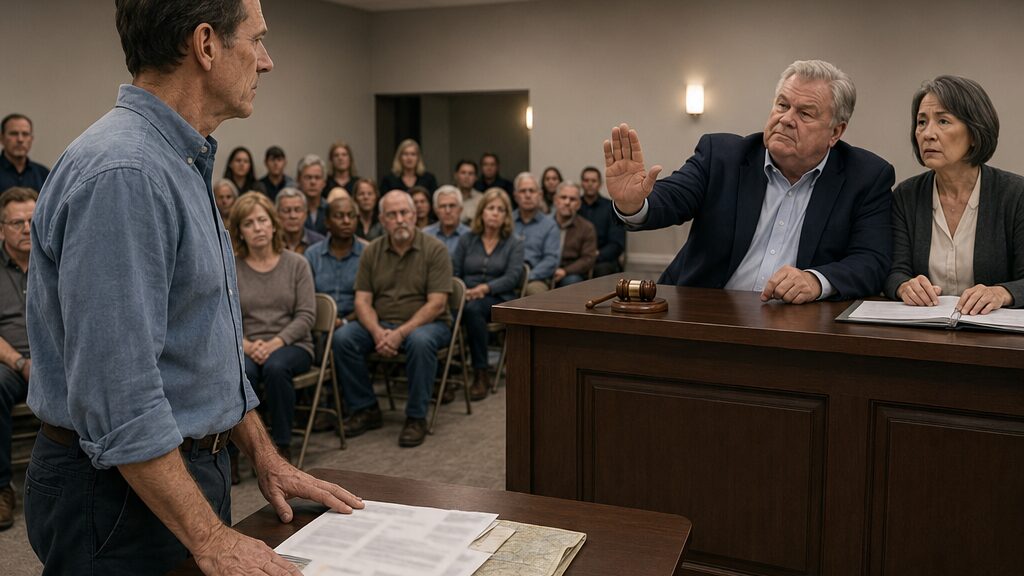
The HOA Said a Renter Had No Voice Until His Old Survey Map Changed Everything
Chapter 1: The Night the Board Said Renters Had No Voice
“Pick up your papers and leave.”
Donald Wright said it before Joshua Harris had finished his first sentence.
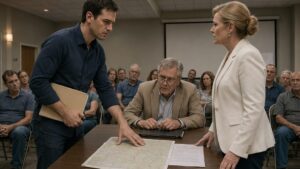
The clubhouse went still in the way crowded rooms sometimes did when people wanted to hear a humiliation without appearing interested. Nearly forty residents sat in folding chairs beneath fluorescent lights. At the front, five board members occupied a long table draped with a navy cloth. Donald sat in the center, broad-shouldered and settled deeply into his chair, one hand resting beside the wooden gavel he rarely needed to use.
Joshua remained standing at the small presentation table.
Spread in front of him were three notices: a two-hundred-dollar late fee, an eight-hundred-dollar violation, and a warning concerning his parking space. Beneath them lay a faded survey map folded into a rectangle no larger than a legal envelope.
“I’m asking who approved the assessment,” Joshua said.
“You are not on the agenda.”
“I submitted the request twelve days ago.”
“You are also not an owner.”
Donald leaned toward the microphone. His voice acquired the slow patience people used when they wanted an audience to understand that the person before them was being unreasonable.
“This is an owners’ meeting. Renters don’t speak during owner business.”
A few people lowered their eyes. Someone shifted a metal chair across the tile.
Joshua felt heat rise beneath his collar. He had spent most of his adult life in rooms where measurements mattered more than volume. Construction trailers, county counters, muddy rights-of-way—places where a number was either correct or it was not. He had never learned how to perform anger for a crowd.
He placed one finger on the first notice.
“This says I owe a late fee on an assessment that does not appear in the posted minutes.”
Donald gave a short laugh.
“Do you understand how ownership works, Mr. Harris?”
Joshua looked at him.
“You rent a box,” Donald continued. “The association manages the building. Owners vote. Renters follow the rules attached to the unit.”
“My lease requires me to follow properly adopted rules.”
“That sounds like something you should discuss with your landlord.”
“I did. He did not receive notice of this assessment either.”
Donald glanced toward the assistant property manager, who began sorting papers without looking up.
Joshua heard a woman in the second row whisper, “Just answer him.”
Donald heard it too. His mouth tightened.
“The amount is due,” he said. “If you don’t like the terms of living here, you are free to pack your things.”
Joshua kept both hands flat against the table.
“Who authorized it?”
“I did.”
The answer came quickly, almost proudly.
“And the eight-hundred-dollar fine?”
“The board approved enforcement.”
“That isn’t what I asked.”
Donald’s eyes narrowed. “I approved it.”
Joshua looked down at the notice. The violation description referred to unauthorized overnight parking and obstruction of a fire lane. His car had not moved from its assigned space during the dates listed. He had been away helping a drafting firm complete drainage plans in another county.
“Then I’d like the records showing the vote and the evidence supporting the violation.”
A tired sound moved through the room. Not a groan exactly, but the release of people who had realized the exchange would last longer than they hoped.
Donald sat back.
“You have no standing to demand board records.”
“Because I rent?”
“Because you are not a member of the association.”
Joshua studied him for a moment. Donald mistook the pause for surrender.
“You live here because an owner allows you to occupy a unit,” Donald said. “The association allows that arrangement to continue as long as everyone complies. That is your place in this structure.”
The sentence struck harder than the order to leave. Not because Joshua believed it, but because Donald said it with the calm certainty of someone describing gravity.
Joshua reached into his folder and removed a blank sheet of paper.
“Would you put that in writing?”
Donald blinked.
“The board’s position,” Joshua said. “That renters have no standing to question charges applied to them, and that our occupancy continues only at the association’s discretion.”
Margaret Lee, the board treasurer, turned toward Donald. She was a narrow-faced woman in her early sixties who had spent most of the meeting checking numbers in a binder. Now her hand stopped above the page.
Donald noticed.
“This is unnecessary,” Margaret said quietly.
Donald ignored her. “You want it in writing?”
“Yes.”
“With pleasure.”
He pulled the page toward himself. The assistant property manager slid him a pen. Donald wrote in firm block letters, pausing only once to ask Joshua to repeat the phrase “no standing.” Then he signed his name, added the date, and held the page up for the room.
“There,” he said. “Now there can be no confusion.”
He dropped it onto Joshua’s papers.
Joshua did not pick it up immediately.
At the bottom of the page, beneath Donald’s signature, the assistant property manager had stamped the association’s standard footer. It included the clubhouse address, management number, and parcel reference.
Joshua stared at the number.
For one second, the crowded room disappeared.
He had seen that sequence before—not on a notice, but written in red pencil beside a drainage easement more than twenty years earlier. Parcel 14-C. The original clubhouse tract.
His gaze moved to the folded map beneath the fines.
Donald tapped the table. “Are we finished?”
Joshua slid the signed page inside the map’s outer fold.
“Has the board reviewed the original land schedule for this parcel?”
The question changed something in Donald’s face. It was slight: a pause before the irritation returned.
“This board has reviewed every document relevant to its authority.”
“That wasn’t my question.”
“You’ve had more time than you were entitled to.”
Joshua gathered the notices. Around him, residents watched with the guarded expressions of people who might later insist they had noticed everything.
Margaret looked at the folded map.
“What land schedule?” she asked.
Donald struck the gavel once.
“Next item.”
Joshua returned to the aisle. An elderly resident moved her cane so he could pass. When he reached the rear doors, Donald’s amplified voice followed him.
“And Mr. Harris?”
Joshua stopped.
“If you submit a formal records request, management will charge the administrative retrieval fee. We do not use owner funds to satisfy fishing expeditions.”
“How much?”
Donald exchanged a glance with the assistant property manager.
“Whatever the actual cost requires.”
Joshua nodded once and pushed open the doors.
Outside, the night air carried the damp mineral smell of recently watered landscaping. Through the clubhouse windows, Donald was already speaking about pool-access hours as though nothing unusual had happened.
Joshua stood beneath the entry light and unfolded the map just far enough to expose the old parcel notation.
14-C.
Below it, in his own handwriting from twenty-three years earlier, were four words he had not expected to see again.
Consent schedule held in escrow.
Chapter 2: Three New Charges Arrived in One Certified Envelope
The certified envelope contained more money than Joshua usually spent on electricity, water, and groceries in a month.
He signed for it Sunday morning while still wearing the gray work shirt he used for weekend drafting. The delivery driver handed him the stiff white envelope and waited until Joshua closed the door before returning to the van.
Three notices were clipped together inside.
The first demanded four hundred dollars for records retrieval and administrative review.
The second added a one-hundred-fifty-dollar noncompliance charge for disrupting an official association meeting.
The third assessed three hundred dollars for parking in a fire lane on two separate nights.
Donald’s signature appeared at the bottom of the records notice.
Joshua set the pages on his kitchen table and took out the statement Donald had signed at the meeting. The phrasing was different, but the dates aligned too neatly to be accidental. He had asked for records Thursday. The new charges were entered Friday morning.
He opened the association website on his laptop.
The posted minutes for the previous four months contained landscaping approvals, pool repairs, contract renewals, and a long discussion about replacing hallway carpet. There was no recorded vote authorizing the special assessment. There was no motion concerning the eight-hundred-dollar violation. The page for executive-session actions listed only “collection matters,” without unit numbers or amounts.
Joshua printed everything.
By noon, the kitchen table had become a grid of dates, notices, and meeting records. He arranged them the way he once arranged field notes: source on the left, claimed action in the center, supporting record on the right.
Two rows had empty right-hand columns.
The parking notice seemed easier.
Joshua walked down to the garage with the photograph attached to the citation. The image had been taken at night from a distance. A dark sedan sat beside a red curb, its rear plate blurred by glare. The notice identified the vehicle as his.
His own car was a silver hatchback.
He stood in his assigned space and held the photograph beside it. Different body shape. Different taillights. The car in the citation had a dealership frame around the plate. Joshua’s plate sat inside a plain black holder he had installed six years earlier.
He photographed the comparison, then walked toward the fire lane.
A dark sedan occupied a visitor space near the elevator. Its taillights matched the citation.
The assistant property manager emerged from the service corridor carrying a cardboard box.
Joshua held up the notice. “Do you know whose car this is?”
She glanced at the photograph, then at the sedan.
“You’ll need to submit an appeal.”
“That isn’t what I asked.”
“I don’t discuss violations in the garage.”
“The plate isn’t mine.”
“Then the board will review your evidence.”
“Did the board review evidence before charging me?”
Her grip tightened around the box.
“You were instructed not to continue disruptive contact.”
“I’m standing beside my own parking space.”
She walked away without answering.
Joshua remained there until the elevator doors closed behind her.
The false parking charge should have relieved him. Instead, it sharpened his anger. A mistake could be corrected. A false accusation issued immediately after public disagreement was something else.
Back upstairs, he called Jeffrey Martin.
Jeffrey owned the unit and lived two states away. He had inherited it after his father’s death and rented it to Joshua below market rate, partly because Joshua handled minor repairs without complaint and partly because neither man enjoyed discussing the development that had once connected their families.
Jeffrey answered on the fourth ring.
“I heard about Thursday,” he said.
“From Donald?”
“From management. They say you disrupted the meeting and demanded access to privileged records.”
“I asked who approved a charge.”
“You’re a tenant, Josh.”
“I know what my lease says.”
“That isn’t the point.”
Joshua looked at the folded survey map on the table.
“What is the point?”
“The point is I’m the owner of record, and anything formal involving the association comes through me. You cannot turn this into a title fight without telling me.”
Joshua went still.
“I didn’t say anything about title.”
“No. But Donald did. He said you asked about the original land schedule.”
Jeffrey’s voice had lost its usual flat friendliness.
“What are you doing?”
“I’m checking records.”
“Why?”
“Because the parcel number on their notice matches the old clubhouse tract.”
Silence.
Jeffrey exhaled slowly. “Do not send anything in my name.”
“I wasn’t planning to.”
“Do not imply you represent the unit.”
“I understand.”
“And don’t jeopardize the lease because you want to prove Donald Wright is a bully. I already know he is.”
The line disconnected before Joshua could answer.
For several minutes, he stared at the phone.
Jeffrey had reason to be cautious. His father’s development company had collapsed under unpaid invoices, disputed change orders, and a lender’s withdrawal. Joshua’s final survey invoice had been among the amounts never settled. Years later, when Jeffrey offered him the unit, neither of them called it compensation. Neither called it guilt.
Joshua returned to the papers.
The map had not been opened fully in more than a decade. Its fold lines had whitened, and one corner bore a faint brown stain from coffee spilled in a construction trailer. He flattened only the section containing Parcel 14-C.
The handwritten note pointed to a reference number.
Escrow Schedule B-7.
He searched through an old metal file box in the bedroom closet. Tax records. Licensing renewals. Field books from jobs he had no reason to remember. At the bottom lay a narrow ledger bound in cracked green cloth.
He found the development under its original name.
Several pages listed control points, utility easements, drainage revisions, and invoices. On the final page, beside a payment notation crossed out twice, Joshua had written:
B-7 held pending final release. Original delivered to escrow agent.
Below that was another line, added six months later.
Release prepared. Recording not confirmed.
Joshua read it three times.
He had known the release was unfinished.
Not whether it remained legally effective. Not whether anyone had recorded it later. But he had known enough to ask.
Instead, he had packed the ledger away with the rest of the failed project and accepted silence as a form of closure.
Joshua lifted the certified envelope from the table. The new charges crackled beneath his fingers.
Then he opened the county recorder’s online index and typed his own name.
One result appeared beside Parcel 14-C.
Status: unreleased.
Chapter 3: The County Record Still Carried Joshua’s Name
Heather Clark turned the monitor toward Joshua and said, “Your name is still indexed against the clubhouse parcel.”
The county recorder’s office had barely opened. Behind them, fluorescent lights hummed over rows of public terminals, and a printer repeatedly clicked as it warmed. Joshua stood at Heather’s counter with the folded survey map under one arm and the green ledger inside a document sleeve.
“Indexed as what?” he asked.
“Secured party under a recorded land-use and completion agreement.” Heather scrolled through the entry. “Instrument recorded twenty-three years ago. There’s a reference to an escrow schedule and a conditional release.”
“Is the release recorded?”
“I don’t see one.”
She searched by parcel number, developer name, and instrument reference. Each query produced amendments, easements, condominium declarations, and lender documents. None produced the release.
Heather looked toward the records supervisor, who was helping a title researcher at another station.
“I can certify what is here,” she said. “I cannot certify that something was never submitted under a different indexing error.”
“I understand.”
“Do you?”
The question was not unkind.
Joshua met her eyes.
Heather tapped the original instrument on the screen. “Because people come in here, find an old document, and decide it means they own a shopping center or can stop a highway project. Recording establishes notice. It does not interpret every legal consequence.”
“I’m not claiming I own the condominium.”
“Good. Because this does not say that.”
She printed the document.
The agreement was fourteen pages long. Joshua recognized the signatures immediately: the developer, the lender, the escrow agent, and his own. His signature appeared beneath a section governing final survey certification, access corridors, drainage controls, and changes to the clubhouse parcel before completion of the development.
Heather unfolded his old map beside the certified plat.
The paper resisted at first. She placed clear weights on the corners, revealing the entire tract: buildings that had not yet existed, utility lines drawn in pencil, and the broad rectangle labeled 14-C.
Joshua had forgotten how much empty space surrounded it then.
Heather aligned the plat with the recorded exhibit.
“This schedule appears to give you consultation rights over boundary, drainage, and structural-footprint changes to this parcel until final release,” she said. “There may also be consent language for amendments affecting the secured work.”
“May?”
“I am not your attorney.”
“But that is what it says.”
“That is what the recorded words say. Whether those rights remain enforceable, whether they were satisfied another way, whether a court would limit them—those are legal questions.”
Joshua leaned over the page.
The agreement did not make him a hidden owner. It did not grant him control over every fine, parking rule, or assessment. The fantasy that had formed in his kitchen—that years of board decisions might collapse under one old signature—began to shrink.
Yet the document was not meaningless.
The clubhouse had been expanded six years earlier. Drainage had been redirected along the south walkway. A retaining wall now stood where his plan showed an access corridor. If those changes touched the schedule, the association should at least have investigated the exception.
Heather turned to a later amendment.
“This one modifies the common-area description.”
“Where is Schedule B?”
She followed the references. “Not attached.”
The next amendment also cited a schedule that did not appear in the scanned packet. So did a refinancing document.
Joshua took out the signed statement from the meeting and placed it beside the plat.
Heather read the first two lines, then stopped.
“He signed this?”
“In front of the board.”
“This is not a county-record issue.”
“No.”
“But you brought it for a reason.”
“The footer has the parcel reference.”
Heather compared the number.
“That is unusual for a resident-policy notice.”
“It’s on every notice they send.”
“Probably generated from their management software.”
“Probably.”
Joshua heard the restraint in his own answer. He had spent three days imagining Donald’s face when confronted with the old agreement. Now the record had given him less than revenge and more than certainty.
Heather gathered the certified pages.
“I can provide a chain of title, the original instrument, the amendments, and a certificate showing no separately indexed release under the names and reference numbers we searched.”
“How long?”
“If you wait, an hour.”
“I’ll wait.”
He moved to a public terminal and began reviewing the amendments in chronological order.
The earliest documents belonged to the developer years. Then came the condominium declaration, lender assignments, common-area adjustments, and board-filed amendments. Each reflected a small change in how the property described itself.
Four years earlier, the association had recorded a clubhouse-use amendment allowing storage construction along the rear wall and revised drainage access near the parking lot.
The document referenced the unresolved schedule.
At the signature line appeared a name Joshua knew.
Donald Wright, President.
Joshua printed the amendment and carried it back to Heather.
“Would he have seen the title exception?”
Heather examined the cover sheet.
“The preparer listed it in the legal-description notes.”
“So yes.”
“I can’t tell you what he read.”
“But it was in front of him.”
“It was in the recorded packet.”
The difference mattered, and Heather made sure he heard it.
Joshua looked again at Donald’s signature. Four years ago, he had been warned—not necessarily in plain language, not necessarily by a lawyer sitting across from him, but warned enough that the old agreement appeared in the same packet he signed.
“Can you certify this amendment too?” Joshua asked.
“Yes.”
Heather hesitated before collecting the page.
“Mr. Harris, be careful with the story you tell yourself from these documents.”
Joshua folded his arms.
“What story is that?”
“That because someone treated you badly, every fact you discover will belong entirely to your side.”
The words landed without accusation, which made them harder to reject.
Joshua looked down at the map stretched flat beneath the clear weights. His own old notes covered the margins. One notation marked the anticipated release date. Another recorded that final payment remained pending.
He had remembered Donald’s arrogance clearly. He had remembered the unpaid invoice clearly. He had not remembered writing that the release was prepared.
Or perhaps he had chosen not to.
The records supervisor stamped the certified copies. Each impact sounded small and final.
When Heather handed him the packet, Donald’s four-year-old signature sat on top.
Joshua slipped it into the document sleeve.
He now had proof that the board president had signed a filing containing the title exception.
What he did not have was proof of why Donald had ignored it—or whether Joshua himself had been waiting twenty-three years for someone else to resolve a silence he had helped create.
Chapter 4: The Strongest Document Was Not the Whole Truth
Jeffrey Martin was standing outside Joshua’s apartment when Joshua returned from the county recorder’s office.
He held a copy of Joshua’s certified demand letter in one hand.
The envelope had been opened carefully along the top, but Jeffrey’s grip had creased the pages inside.
“You sent this Friday.”
Joshua stopped three steps from his door.
“Yes.”
“You told me you were checking records.”
“I was.”
“This says the association may have acted without required consent and that you reserve the right to challenge every affected decision.”
“That is what the agreement appeared to say before I saw the full chain.”
Jeffrey stared at him. “Before?”
Joshua shifted the document sleeve beneath his arm. Inside it, Donald’s recorded amendment pressed against the certified agreement like two sides of an argument neither man wanted to begin in the hallway.
“Come in,” Joshua said.
Jeffrey did not move.
“Did you know the release was never recorded?”
The question struck with the force of an accusation because it was also the exact question Joshua had been avoiding.
“I knew recording had not been confirmed.”
“That is not what I asked.”
Joshua unlocked the door.
Jeffrey followed him inside but remained standing near the kitchen. He placed the demand letter on the table beside the certified fee notices.
“You let me rent this unit to you for six years without telling me your name was attached to the clubhouse property.”
“It was part of a failed completion agreement. I did not know it still had practical effect.”
“You knew enough to write this.”
Joshua removed the certified copies and set them down.
“The county confirmed there is no indexed release.”
Jeffrey did not look at the documents. “My father said you delayed the original closing.”
Joshua’s hand stopped above the table.
There it was, dragged out after two decades of polite avoidance.
“He said the lender was ready and you refused to sign the final survey certificate.”
“The work was not complete.”
“He said you changed your requirements.”
“The drainage grades did not match the approved plan. The south access corridor had been narrowed. I signed the boundary certification. I would not certify work I had not inspected.”
Jeffrey’s jaw tightened. “And then the financing collapsed.”
“The lender withdrew because your father had unpaid contractors and three unresolved change orders.”
“He blamed you until the day he died.”
Joshua looked toward the folded survey map.
“That does not make him right.”
“No. But you knew what that project did to him. You knew what it did to me.”
Joshua had no answer that did not sound like a defense.
Jeffrey finally picked up the certified agreement. He scanned the first page, then the signature section.
“Show me the map.”
Joshua did not move.
“Josh.”
“It is old.”
“So is all of this.”
The map lay folded beside the green ledger. Joshua placed one hand on it but did not open it.
Jeffrey watched him.
“You want Donald to disclose every record,” he said, “but you will not unfold one piece of paper in your own kitchen.”
The accuracy of it made Joshua angry.
He pulled the map toward himself.
“The release was prepared,” he said. “I wrote that in my ledger. I remembered it as unfinished business, not a right I still held.”
“Did you ever follow up?”
“No.”
“Why?”
Because the development had become a word people lowered their voices to say. Because subcontractors called Joshua for months asking whether he knew when payment would come. Because his own survey firm lost credit and then two employees. Because the state licensing board asked questions even though no complaint against him was sustained.
Because he had accepted Jeffrey’s below-market lease years later without asking what kind of debt it was meant to settle.
“I wanted it gone,” Joshua said.
Jeffrey laughed once without humor. “So you buried it until someone embarrassed you.”
Joshua looked up sharply.
“That is not fair.”
“It may not be. But it is close.”
The room seemed smaller with the map still folded between them.
Joshua opened the certified amendment bearing Donald’s signature.
“This was recorded four years ago. The title exception is listed in the packet.”
Jeffrey read the legal-description note.
“So Donald may have known.”
“Yes.”
“May have.”
Joshua heard Heather’s warning again: Be careful with the story you tell yourself.
Jeffrey tapped the demand letter.
“And you wrote as though you could invalidate assessments, parking rules, and every use of the clubhouse.”
“I wrote too broadly.”
“After telling me not to worry.”
“I did not say that.”
“You said you were checking records. Then you sent a legal threat connected to property I own.”
Joshua’s anger drained, leaving something heavier.
“What do you want me to do?”
“For one thing, stop representing yourself as acting through my unit.”
“I never claimed to be you.”
“The letter identifies you as the lawful occupant and references rights connected to the parcel. Management now says any further communication from you may affect my standing as an owner.”
“That is intimidation.”
“Perhaps. But it is my unit.”
Jeffrey took a breath and steadied his voice.
“Effective now, you do not have permission to speak for me at meetings, request owner records in my name, or make representations concerning the unit.”
Joshua stared at him.
“You are withdrawing my authorization?”
“I am narrowing it to nothing until I understand this.”
The words had a formal sound, almost as if Jeffrey had rehearsed them on the drive.
Joshua looked at the fines. Without owner authorization, Donald could keep him outside the formal process. Joshua still had whatever personal rights the old agreement gave him, but even those were now less certain than they had seemed that morning.
Jeffrey moved toward the door.
“I am not evicting you,” he said. “I am asking you not to turn my father’s failure into your private war.”
Joshua almost told him the war had begun when Donald charged him for a car he did not own. He almost unfolded the map then, out of defiance.
Instead, he let Jeffrey leave.
That afternoon, Joshua walked the property with the old plat in a clear sleeve. The clubhouse rear wall extended farther than the original footprint. A storage enclosure occupied part of the former access corridor. Near the south walkway, newer concrete directed runoff toward a grated drain that had not existed on his plan.
The agreement might matter.
It simply did not mean everything he wanted it to mean.
When he returned to the apartment, a message was waiting on his phone.
Margaret Lee had called from an unlisted number.
Her voice was quiet and careful.
“Mr. Harris, I believe you have records the board should have reviewed years ago. I also have records Mr. Wright does not know I kept.”
She gave the name of a neighborhood diner and a time two evenings later.
Then she added, “Please bring the map. All of it.”
Chapter 5: The Treasurer Had Kept the Minutes Donald Removed
Margaret placed two sets of meeting minutes on the diner table before Joshua had taken off his coat.
They looked nearly identical.
Both carried the same date, the same association heading, and the same list of board members present. One had been printed from the association website. The other was marked across the top in Margaret’s handwriting: Treasurer’s draft—not approved.
“What am I looking for?” Joshua asked.
Margaret slid the pages toward him.
“Page three.”
The approved version contained a short paragraph about planned clubhouse storage improvements. It recorded a unanimous authorization to seek bids and allowed Donald to sign necessary amendments.
The draft version contained four additional sentences.
Joshua read them twice.
Association counsel recommends title review before alteration of Parcel 14-C due to unresolved recorded schedule. President Wright states review is unnecessary and may delay urgent work. Treasurer requests written opinion. Request deferred.
“The title exception was discussed,” Joshua said.
“Briefly.”
“And then removed from the final minutes.”
Margaret stirred her coffee although she had added nothing to it.
“Donald said attorney-client matters did not belong in open minutes.”
“Was there a written legal opinion?”
“No.”
“Did counsel recommend removing the reference?”
“I never saw that recommendation.”
Joshua placed Donald’s recorded amendment beside the draft minutes.
Margaret looked at the signature but showed no surprise.
“You already knew he signed it,” Joshua said.
“I knew he signed something. Donald told the board it was a routine common-area correction.”
“Why keep the draft?”
Margaret folded her hands.
“Because I was the one who wrote it.”
A server passed their booth. Margaret waited until the coffee pot moved beyond them.
“I have been treasurer for seven years,” she continued. “When I began, our reserve fund was behind but manageable. Then the clubhouse roof started leaking. The estimates were high. Owners had already received two special assessments in five years.”
“So Donald avoided another one.”
“He delayed the roof replacement and used operating money for patchwork. Then insurance premiums rose. Delinquencies increased. Every month, the gap widened.”
Joshua thought of the fines issued within hours of his records request.
“He filled it with enforcement money.”
“Not entirely. But he became aggressive about collections. Late fees, parking fines, rental registration charges. He called it stabilizing cash flow.”
“And you approved it?”
Margaret’s expression hardened.
“I approved enforcing valid rules. I did not approve charging a man for a car he does not own.”
Joshua sat back.
She knew about the photograph.
Margaret reached into her binder and removed another page. It was an internal violation log. Beside Joshua’s parking citation was a note from the assistant property manager: Plate image inconclusive. President directed issue based on unit location.
“He knew the evidence was uncertain,” Joshua said.
“Yes.”
“And issued it anyway.”
“Yes.”
“Why give me this now?”
Margaret looked toward the window. Outside, headlights moved through the parking lot and disappeared.
“Because an elderly owner in Building Three received three fines for leaving her car overnight near the elevator. She uses a cane. Her assigned space is at the far end of the garage.”
“The woman who moved her cane for me at the meeting?”
Margaret nodded.
“She asked for a temporary accommodation while the board reviewed a space exchange. Donald said exceptions undermine enforcement.”
Joshua looked again at the two versions of the minutes.
“You stayed.”
“I believed leaving would give him fewer obstacles.”
“Did it?”
“No.”
The answer came without self-pity.
Joshua opened the document sleeve and removed the folded map.
Margaret touched one corner.
“Unfold it.”
He opened the first panel, revealing Parcel 14-C and the old drainage notation.
“All of it,” she said.
He hesitated.
The diner table was too small. Margaret moved the sugar dispenser, napkin holder, and both coffee cups to the empty booth beside them. Together they spread the map across the laminate surface.
The paper crossed the center seam between them.
Margaret compared it with the amendment and the draft minutes.
“This access corridor,” she said. “The storage enclosure covers part of it.”
“Yes.”
“And the new roof drains empty toward this line?”
“They appear to.”
She removed a recent maintenance report.
Water staining had been documented along the clubhouse’s south wall. Temporary interior supports were recommended in one room pending structural evaluation.
Joshua read the estimate.
The amount was worse than he expected.
“If I challenge all work on the parcel, repairs could stop.”
Margaret met his eyes. “That is why I asked you here.”
“You want me to surrender the agreement.”
“I want you to stop claiming it gives you control over everything.”
Joshua felt his shoulders tighten.
“It gives me rights the board ignored.”
“I believe it does. Limited rights.”
“You sound like the county clerk.”
“Then perhaps both of us are trying to keep you from making Donald’s mistake.”
He looked at her.
Margaret placed one finger on his demand letter, which she had printed from the board’s correspondence file.
“You wrote that prior decisions may be void.”
“They may be.”
“You included assessments and enforcement actions unrelated to land changes.”
Joshua said nothing.
“The association attorney will attack that,” Margaret continued. “If you overstate one part, Donald will use it to dismiss the rest.”
“What do you suggest?”
“Separate the misconduct from the property issue. Challenge your fines with the false photograph and missing minutes. Demand independent review of the title exception. Do not threaten emergency repairs.”
“You are asking me to protect the board.”
“No. I am asking you to protect the people who live under the roof.”
The words stayed between them.
Joshua looked across the open map at the repair report. He had entered the diner wanting proof Donald had concealed the agreement. Margaret had given him that proof, then made it less satisfying by attaching people to the consequences.
“Why did Donald remove the reference?” he asked.
“He said owners would panic if they heard the clubhouse title was unclear. He was afraid a review would trigger another special assessment, expose the deferred roof work, and cost him the presidency.”
“That explains the pressure.”
“It does not excuse the choice.”
Margaret gathered the unedited minutes but left Joshua the violation log and a copy of the maintenance report.
“I will confirm these records if there is an independent review,” she said. “I will not join a campaign to destroy the association.”
“I am not asking you to.”
“Not yet.”
The server returned with the check. Margaret reached for it, but Joshua covered the slip with his hand.
“I can pay for my own coffee.”
“That is not the debt we are discussing.”
For the first time, her voice softened.
Joshua refolded the map more slowly than usual. Each crease felt deliberate now, less like concealment and more like a decision he had not completed.
His phone vibrated against the table.
Donald Wright’s name appeared on the screen.
Margaret saw it.
“He knows about the county records,” she said.
“How?”
“The board received your letter this afternoon.”
Joshua let the phone ring twice more before answering.
Donald did not greet him.
“We need to resolve this privately,” he said. “Before the emergency meeting and before you cause damage neither of us can undo.”
Chapter 6: Donald Offered Silence Before the Roof Report Became Public
“What do you want?”
Donald’s voice was quieter than Joshua had ever heard it.
Joshua remained in the diner booth while Margaret watched from across the open map.
“What are you offering?” Joshua asked.
“Cancellation of every charge associated with your unit.”
“They are not valid charges.”
“Then cancellation costs you nothing.”
Donald paused.
“There may also be room for reimbursement of expenses and inconvenience.”
“How much?”
Margaret’s eyes narrowed, but Joshua raised one hand to stop her from speaking.
“Five thousand,” Donald said. “Possibly more if counsel approves.”
“In exchange for what?”
“A mutual confidentiality agreement. Withdrawal of the demand letter. No public claims concerning title or board authority.”
Joshua looked at the maintenance report.
“What about the records?”
“The board can review procedures internally.”
“And the false parking citation?”
“A clerical error.”
“You directed staff to issue it despite an inconclusive plate.”
Silence answered him.
Joshua glanced at Margaret. She did not appear pleased that he had revealed her information, but she did not interrupt.
Donald’s voice returned, firmer now.
“You have no idea what you are interfering with. The roof may require immediate work. We have elderly residents, families, people who cannot absorb another assessment. If you turn a technical defect into a title crisis, financing could freeze.”
“You knew about the exception four years ago.”
“I knew an obsolete schedule appeared in a title packet.”
“You signed the amendment.”
“I sign dozens of documents.”
“You refused legal review.”
“The board had to choose between paying attorneys to investigate dead paperwork and completing necessary improvements.”
“You chose improvements that touched the dead paperwork.”
Donald exhaled sharply.
“You think I enjoyed any of this? Owners scream when fees increase. They scream when repairs are delayed. Delinquencies are double what they were three years ago. Insurance nearly dropped us. Someone had to keep the place functioning.”
“So you used fines to fill the gap.”
“We enforced existing rules.”
“You charged me for another car.”
“That was a mistake.”
“You charged me for asking who approved an assessment.”
“That was an administrative cost.”
“You told a room full of people I lived here only because the association permitted it.”
Donald said nothing.
Joshua could hear faint movement on the line, perhaps papers being shifted across a desk.
“I can correct the language,” Donald said.
“Privately?”
“We can issue a written clarification.”
“To me?”
“To the necessary parties.”
The answer was careful enough to reveal its meaning.
Joshua looked down at the map. Parcel 14-C ran beneath Margaret’s hand.
“No,” he said.
Donald’s tone changed. “No to what?”
“No confidentiality agreement. No money.”
Margaret sat back.
“I want the fines withdrawn,” Joshua continued. “I want the parking accommodation cases reviewed. I want the title exception examined by independent counsel, and I want the board minutes preserved in their original form.”
“You are in no position to dictate board process.”
“Then why are you offering me five thousand dollars?”
The line went silent again.
When Donald spoke, the softness had vanished.
“Your claim is legally exaggerated. Our attorney will make that clear.”
“He may.”
“You are a tenant without owner authorization.”
“I know.”
That answer unsettled Donald more than an argument would have.
Joshua looked at Margaret.
“I will send a revised proposal tomorrow,” he said. “It will not claim control over unrelated assessments or enforcement decisions. It will not obstruct emergency repairs.”
Margaret held his gaze.
“But it will require public correction of the statement you signed,” Joshua added.
Donald’s breathing sharpened.
“You are making this personal.”
“You made it public.”
Joshua ended the call.
For several seconds, neither he nor Margaret moved.
“You told him about the violation log,” she said.
“I did not identify the source.”
“He will know.”
“I am sorry.”
“You should be.”
The rebuke was quiet and deserved.
Margaret gathered her copies.
“If I help you, Mr. Harris, you do not get to decide my risks without asking.”
Joshua closed his eyes briefly.
“You are right.”
She studied him, perhaps waiting for a defense. When none came, she slid the maintenance report back toward him.
“Then write something that protects the building as carefully as it protects you.”
By morning, temporary barriers surrounded the south side of the clubhouse.
A roof inspector stood on a ladder while another worker fastened yellow tape across the side entrance. Residents gathered along the walkway, asking whether the building was safe. The assistant property manager repeated that the closure was precautionary.
Joshua watched from beyond the tape.
A section of ceiling inside the meeting room had bowed near the exterior wall. Through the window, he could see two support posts braced beneath it.
Donald emerged from the clubhouse carrying a hard hat.
For one moment, he looked less like a president than an exhausted man who had been awake all night.
“You see the problem,” he said to Joshua.
“I do.”
“If the contractor walks because of your claim, people lose access to this building.”
“My proposal permits emergency stabilization.”
“Your proposal has not arrived.”
“It will.”
Donald glanced toward the residents. “They will blame you.”
“Some will.”
The admission stopped him.
Donald lowered his voice. “You think honesty will protect you from that?”
“No.”
“Then you are more naïve than I thought.”
He walked away toward the inspector.
At noon, the association attorney issued a community notice. It described Joshua’s position as an “overbroad interpretation of a historical agreement” and stated that no tenant possessed authority over association governance.
The notice was accurate in the narrowest sense. It was also designed to make the rest of his claim sound foolish.
Joshua read it twice at his kitchen table.
Then he removed the heavy books that had been pressing the old survey map flat since dawn.
He drafted a new letter.
It withdrew his claim that every assessment or enforcement decision might be invalid. It preserved his objection to the retaliatory fines. It requested independent title review limited to Parcel 14-C, preservation of unedited minutes, protection of emergency repairs, and reconsideration of accommodation-related parking penalties.
At the end, he added a separate request.
Joshua Harris requests speaking time at the emergency owner meeting in his individual capacity as a recorded party to Instrument B-7, not as representative of any condominium unit.
He signed his name and attached the certified agreement, Donald’s amendment, and the statement Donald had written at the first meeting.
Before sealing the envelope, Joshua looked at the map lying open across the table.
Then he added one final sentence.
He would disclose the complete history of his involvement, including the release he had known was never confirmed.
Joshua carried the request to the management office himself.
The assistant property manager accepted it without comment and stamped his copy.
At the bottom, beneath the time and date, she had written:
Speaking request forwarded to President Wright for determination.
Chapter 7: Joshua Unfolded the Map and Corrected His Own Claim
“Renters may observe, but they may not address the owners.”
Donald Wright delivered the ruling before Joshua reached the presentation table.
The emergency meeting had drawn more residents than the monthly session. Folding chairs filled the clubhouse’s usable half, while yellow tape blocked the section beneath the bowed ceiling. Temporary support posts rose behind the board like unfinished columns. Every few minutes, wind pressed against the patched roof and produced a low wooden complaint.
Joshua stopped in the center aisle.
“I am not requesting time as a renter or as a unit representative,” he said. “I am requesting time as a recorded party to Instrument B-7.”
Donald glanced at the association attorney seated at the end of the table.
The attorney leaned toward his microphone. “The association disputes Mr. Harris’s interpretation of that instrument.”
“So do I,” Joshua said.
A murmur moved across the room.
Donald’s expression shifted. He had expected defiance, perhaps a threat. Not agreement.
Joshua held up the stamped copy of his speaking request.
“I asked for five minutes to correct the record, including my own statements.”
Margaret Lee sat two places from Donald. Her binder was closed. On top of it rested both versions of the four-year-old minutes.
Donald tapped the gavel once.
“This meeting concerns emergency repairs.”
“Then my proposal concerns this meeting.”
“The chair has ruled.”
One of the dissenting board members raised a hand. “We received the certified instrument. I would like to hear what he is correcting.”
Donald did not look at him.
A second board member said, “So would I.”
The room waited.
Donald’s authority had not disappeared. It had simply become visible as something requiring support.
He leaned back, his gaze moving from the attorney to Margaret and then to the crowded rows.
“Five minutes,” he said. “No accusations, no legal conclusions, and no discussion of confidential board matters.”
Joshua approached the front table.
The same small presentation surface stood where it had during the earlier meeting. He placed Donald’s signed statement on the left. The recorded amendment went on the right. In the center, he set the faded survey map.
He unfolded it one panel at a time.
The paper extended beyond the table’s edges. Margaret rose without being asked and moved a water pitcher so the final section could lie flat.
Parcel 14-C appeared beneath the overhead lights.
Joshua rested both palms on the table.
“My demand letter claimed the old agreement might affect assessments, fines, and other association decisions unrelated to this land,” he began. “That claim was too broad.”
The room became quieter than it had when Donald ordered him out.
“The document does not make me owner of this condominium. It does not give me control over association governance. It does not cancel every action taken during the last four years.”
Donald’s shoulders eased slightly.
The association attorney began writing.
Joshua continued.
“I sent the letter before confirming the full recorded chain. I did that because I was angry, and because I wanted the document to mean more than I had proved.”
Jeffrey Martin stood near the rear wall. He had arrived moments before the meeting began and had not spoken to Joshua. Now he lifted his head.
“Twenty-three years ago, I worked on the original development survey. I refused to certify work that had not been completed according to the approved plan. The project failed. Contractors went unpaid. My own firm suffered. A conditional release was prepared, but I never confirmed that it was recorded.”
Joshua looked at Jeffrey.
“I knew that much. I chose not to resolve it because I wanted the entire project out of my life.”
No one interrupted.
“The county record still lists me as a secured party under a limited agreement. That agreement appears to require consultation, and possibly consent, for certain changes affecting the clubhouse footprint, drainage, and access corridor. Independent counsel must determine the exact effect.”
Donald reached for his microphone.
“That is precisely what our attorney has said.”
Joshua turned the recorded amendment toward the residents.
“But four years ago, the association filed this document. Its packet identifies the unresolved schedule. Donald Wright signed it as president.”
The easing in Donald’s posture vanished.
Joshua placed the unedited minutes beside the approved version.
“At the related board meeting, legal review was recommended. The reference was removed from the version later published to residents.”
Donald struck the gavel.
“You were instructed not to discuss confidential matters.”
Margaret opened her microphone.
“The draft minutes are mine.”
All attention shifted to her.
“I recorded the discussion,” she said. “I objected when it was removed. I kept the original because I believed the final version was incomplete.”
Donald stared at her. “You are violating your duties as treasurer.”
“My duty was not to alter the past.”
A resident near the front asked, “Did the board know there was a title problem?”
“It was not a title problem,” Donald said. “It was an obsolete exception that threatened to delay necessary work.”
“The roof work?” another owner called.
“The storage amendment,” Margaret answered.
Donald turned toward her. “You know why we moved forward. The reserve study was already behind. Another legal review would have cost thousands.”
“And the fines made money,” someone said from the rear.
The room grew restless.
Joshua lifted the false parking citation.
“This photograph is not my vehicle. The internal log says the plate was inconclusive. The charge was issued anyway after I requested records.”
Donald’s hand closed around the gavel.
“We had a responsibility to enforce parking rules consistently.”
The elderly resident with the cane stood slowly from the second row.
“Consistently?” she asked. “You fined me while I waited for a closer space.”
Donald looked toward the assistant property manager.
“The accommodation review was pending.”
“For four months.”
The woman sat again before anyone could turn her words into a performance.
Joshua looked at Donald. For the first time, he saw not only contempt but fear—the fear of a man who had spent years holding together a failing system by refusing to let anyone examine the joints.
Donald motioned toward the taped-off ceiling.
“You all see what happens when decisions are delayed,” he said. “That roof is unsafe. Insurance threatened nonrenewal. Owners refused another assessment. We used the tools available to maintain this property.”
“You used fines as revenue,” Margaret said.
“We collected money legally owed.”
“You issued a charge after staff documented that the evidence was uncertain.”
Donald’s face reddened.
“Because every exception becomes permission. Every delayed payment becomes another owner who decides rules are optional. I was trying to keep this association solvent.”
Joshua believed him.
That was the most difficult part.
Donald had not invented the leaking roof. He had not created the insurance market or the residents’ fear of assessments. But each pressure had given him another reason to hide information, and each hidden choice had made control feel more necessary.
Joshua touched the map.
“I am not asking anyone to stop emergency stabilization,” he said. “I will sign a written waiver confirming that I will not use Instrument B-7 to obstruct roof work required for safety.”
The attorney stopped writing.
Joshua continued. “I am asking for independent review of changes affecting Parcel 14-C, preservation of original minutes, cancellation of retaliatory charges, and review of parking penalties involving accommodation requests.”
A woman near the aisle asked, “And what do you get?”
“My valid expenses reviewed. Nothing confidential. No private payment.”
Donald stared at him.
Joshua took the signed statement from the first meeting and placed it over the map.
“And I want this corrected in the same room where it was written.”
The paper still carried Donald’s block lettering: renters have no standing to question charges applied through the association.
Joshua stepped back from the table.
Margaret opened her binder.
“I move that the association retain independent counsel to review Instrument B-7 and all affected amendments, preserve draft and approved minutes, suspend disputed enforcement charges, and authorize emergency roof stabilization without prejudice to any party’s rights.”
One dissenting board member seconded the motion.
Donald did not call for a vote.
Instead, he looked at the statement lying before him.
Margaret turned it so the handwriting faced him.
“There is one more part,” she said. “Before we vote, the president should read aloud what he signed.”
Chapter 8: The Resignation Came Without Applause and the Map Stayed Open
Three weeks later, Donald sat at the same table with a resignation letter where the fine notices had once been.
No one applauded.
The independent review had confirmed that Joshua’s agreement was limited, but still unresolved. It did not invalidate ordinary assessments or give him authority over the association. It did require formal consultation for certain physical changes to Parcel 14-C, including the storage enclosure and drainage modifications.
The review also found that Donald had been advised to seek clarification before signing the amendment.
More damaging was the enforcement record. Joshua’s parking charge lacked reliable evidence. The records fee had not been calculated from any actual retrieval cost. Draft minutes had been altered without a board vote, and accommodation requests had remained unresolved while fines continued.
Donald read the findings without expression.
Then he read his earlier statement aloud.
His voice caught only once, on the sentence saying renters occupied their homes because the association permitted them to do so.
When he finished, he placed the page beside his resignation.
“I believed strict enforcement was necessary to prevent financial collapse,” he said. “I still believe this board faced choices many residents refused to acknowledge. But I made decisions outside proper process, and I treated disagreement as disobedience.”
He did not look at Joshua.
“My resignation is effective at the end of this meeting.”
Silence followed. Not forgiveness. Not celebration. Only the sound of paper settling as Donald removed his hand.
Margaret accepted the resignation on behalf of the board.
The emergency roof contract had already been approved. Before the vote, Joshua signed a formal waiver stating that he would not obstruct safety work while the recorded agreement was resolved. The contractor would begin Monday.
The cost required a special assessment.
Several owners blamed Donald for hiding the shortage. Others blamed the board. A few blamed Joshua for forcing the problem into daylight.
One man stopped Joshua near the exit.
“My payment goes up because you wanted an apology.”
Joshua met his anger without answering quickly.
“The payment goes up because the roof was failing,” he said. “I made the timing harder. I did not make the damage.”
The man walked away unconvinced.
That, too, belonged to the outcome.
The board canceled Joshua’s disputed charges and opened a review of similar penalties. The elderly resident received a temporary parking space near the elevator while her accommodation request was processed. Margaret refused the interim presidency but agreed to remain treasurer until a special election.
At the county recorder’s office, Heather scanned the fully unfolded survey map as a supporting exhibit to the corrected parcel schedule.
“You finally brought the whole thing,” she said.
Joshua watched the scanner’s light travel beneath the paper.
“I should have done it years ago.”
“Probably.”
Heather did not soften the word.
The new agreement clarified Joshua’s remaining consultation rights and provided a process for final release after the drainage and access issues were corrected. He received no ownership interest, no windfall, and no power over association rules.
When the scanning was complete, Heather returned the map.
Joshua folded it along its old creases. This time, nothing important remained hidden inside.
Outside the recorder’s office, Jeffrey waited beside the courthouse steps with a folder under his arm.
“I brought a lease,” he said.
Joshua looked at him.
“Two years. Same rent for the first year, modest increase after that.”
“You do not owe me that.”
“No,” Jeffrey said. “I don’t.”
He handed Joshua the folder.
“There is also a copy of the corrected parcel schedule. Margaret asked whether you would review the measurements before they send it back to counsel.”
Joshua opened the folder. The schedule showed the clubhouse tract, the restored access corridor, and the drainage line that would be rebuilt after the roof work.
At the bottom was a blank space for technical comments.
Jeffrey looked at the folded map beneath Joshua’s arm.
“My father was wrong to blame you for everything.”
Joshua waited.
“But you were wrong to disappear from it.”
“Yes.”
The admission no longer felt like surrender.
They stood together on the steps while people moved through the recorder’s doors carrying deeds, releases, liens, and other unfinished pieces of the past.
Joshua took out a pencil.
He unfolded the map between them and began checking the first line.
The story has ended.