The HOA Buried a Sewer Line Beneath His Yard, Then Ordered Him to Sign
Chapter 1: The Signature Waiting on Ronald’s Kitchen Table
“The board will proceed with or without your signature.”
Heather Mitchell said it with both hands resting on Ronald Carter’s kitchen table, as if the papers beneath them had already settled the matter.
Ronald did not sit down.
The top page carried the association’s name, a parcel description, and a block of language granting permanent access across the rear portion of his property. Heather had marked three places with yellow tabs. One for initials. Two for signatures.
Through the window behind her, Ronald could see the edge of his backyard. The grass looked recently combed in one direction, a faint green seam crossing behind the old garden beds.
“You’re asking for a permanent easement,” he said.
“I’m asking you to formalize what was already approved.”
“By whom?”
Heather’s mouth tightened. She wore a navy jacket despite the heat, and her leather folder sat squarely beside the papers. “The prior owner was notified during the infrastructure project. The route has been part of the community plan for years.”
Ronald looked at the signature line again. “Notified isn’t the same as agreed.”
“The line serves the neighborhood.”
“That wasn’t my question.”
Heather glanced toward the clock above the sink. She had been in the house less than ten minutes and already behaved as though Ronald were wasting her morning.
“The contractor completed the connection last week,” she said. “The board cannot leave a critical utility in legal limbo because one document was delayed.”
Ronald’s eyes lifted from the paper.
“Completed?”
Heather did not answer quickly enough.
He moved past her and opened the back door.
The warm air carried the smell of damp clay. Near the fence, beyond the low stone border his wife had laid by hand, the grass had been replaced in a strip almost six feet wide. The sod was greener than the rest of the yard. Along the edge of the garden, two orange paint marks remained on a stone and the base of an oak.
Ronald walked outside without asking Heather to follow.
He crouched near the first mark and pressed his palm to the turf. The soil beneath it was loose. Farther down the strip, a round depression marked where heavy machinery had turned. Someone had raked the disturbed ground, laid sod over it, and expected the yard to forget.
Heather stopped several feet behind him.
“The contractor restored the surface.”
Ronald rubbed dirt between his fingers. “What size line?”
“I don’t have the engineering sheet with me.”
“What depth?”
“I’m not the project engineer.”
“Gravity or pressure?”
Heather gave a small, impatient breath. “Ronald, it’s an active sewer main. That’s the relevant fact.”
He stood.
For thirty-four years, before retirement made his mornings too quiet, Ronald had located buried utilities for construction crews, municipalities, and private contractors. He knew what orange paint meant. He knew the curve of settlement above a newly backfilled trench. He knew where cleanouts were usually placed and how access roads changed the soil long after tire tracks disappeared.
He followed the seam past the oak, across the back lawn, and toward the far fence. The route did not clip the corner of his property as the document suggested. It crossed nearly the full width of the rear acreage.
Heather stepped carefully over a patch of loose dirt.
“The route was selected to avoid the street and reduce costs.”
“To whom?”
“To everyone.”
Ronald turned. “Except me.”
Her expression hardened, but her voice remained even. “You bought in a managed community. Shared infrastructure requires cooperation.”
“I bought a lot with a clean title.”
“And the association has obligations to one hundred eighty-six homes.”
“That doesn’t create rights under mine.”
For the first time, Heather looked away from him and toward the garden beds. The old stone border was uneven now. One slab had been lifted and set back crooked. His wife had chosen every stone herself, rejecting the smooth ones because she said a garden needed edges that looked lived in.
Ronald walked to the oak. An orange line crossed one exposed root before disappearing under new sod.
“Who gave them access?” he asked.
“The board authorized the work.”
“The board does not own this yard.”
“The previous owner approved the alignment.”
“Show me.”
Heather tapped the folder under her arm. “The historical approval is in the project file. Today’s document simply records the easement properly.”
“Then bring me the recorded easement.”
“That’s what this is for.”
“No. This is what you need because you don’t have one.”
The silence between them changed.
Heather’s posture stayed straight, but the certainty in her face thinned.
“There was an approval,” she said. “It may not have been recorded in the usual sequence.”
Ronald looked past her to the kitchen window. On a shelf above the small desk sat a folded subdivision plat he had inherited with the house documents. He had not opened it in years. His wife used to call it the map nobody needed until somebody moved a fence.
Heather stepped closer.
“I need you to understand the consequences of refusing. The line is active. If this becomes a title dispute, the association will have to take formal action. Legal costs will be shared. Property values may be affected.”
“You buried it first.”
“The work had to stay on schedule.”
“And now you want me to sign backward.”
“We want the record corrected.”
Ronald’s jaw tightened. He knew that tone. He had heard it from contractors who called a strike a scratch, from supervisors who called an unmarked gas line an administrative oversight. The words were chosen to make the damage sound smaller than the decision.
He went back inside.
Heather followed him to the table. Ronald gathered the pages, aligned their corners, and pushed them toward her.
“I’m not signing today.”
“You should have counsel review them, then.”
“I will review my title first.”
She slid the papers into her folder. “The board has already waited as long as it can.”
Ronald looked at her. “You finished the line last week.”
Heather said nothing.
After she left, he locked the door, though he could not remember the last time he had done so in daylight.
He pulled the subdivision plat from the shelf. Dust marked the fold lines. Beside it, he laid the title policy from the closing file and read every exception listed in the schedule.
Drainage easement along the front ten feet.
Utility easement along the eastern boundary.
Access rights for the electric cooperative.
Nothing across the rear acreage.
Nothing for sewer.
Nothing matching the line beneath his wife’s garden.
Ronald read the schedule twice, then a third time. At the bottom of the page, the title company had printed a sentence certifying that no additional easements burdened the property as of the date of sale.
He placed Heather’s unsigned copy beside it.
One document said the right already existed.
The other said it never had.
Chapter 2: The Line Beneath the Garden Was Never Recorded
The county recorder searched the number Heather had written in the margin and frowned at the screen.
“That belongs to a drainage covenant,” she said.
Ronald stood on the other side of the counter with his title policy under one arm and the folded plat in his hand. “Not a sewer easement?”
“No.” She turned the monitor slightly, though the text was too small for him to read. “Different subdivision too.”
He gave her the parcel number.
She searched again.
The office was nearly empty. A copier hummed behind a half wall, and somewhere in the records room a metal drawer slammed shut. Ronald watched the recorder move through databases he knew only by name: grantor index, grantee index, plats, covenants, utility instruments.
She asked for the previous owner’s name. He gave it.
“No recorded sewer easement.”
“Try the association.”
She did.
Then the developer.
Then the municipal utility district that had inspected the connection.
The result did not change.
The recorder leaned back. “There could be an unrecorded agreement in a private file.”
“That would not put it in my chain of title.”
“No.”
“Would it give them the right to enter my property?”
She hesitated. “I can tell you what is recorded. Legal effect is for an attorney.”
Ronald nodded. “I’m not asking you to be one.”
He asked for certified copies of the parcel history, the plat, and the complete list of recorded burdens. While she prepared them, he called Benjamin Moore.
Benjamin arrived at Ronald’s property just after noon in a dust-coated pickup with survey equipment stacked behind the cab. He was younger than Ronald by perhaps fifteen years, though the sun had worked the skin around his eyes into permanent lines.
Ronald spread the old plat across the truck hood.
Benjamin pinned one corner with a tape measure and another with his phone.
“You said they claimed the route followed an existing utility corridor?”
“That’s what the paper implies.”
Benjamin traced the eastern boundary with one finger. “The recorded utility strip is here. Twenty feet wide.”
Ronald pointed toward the backyard. “Their trench is seventy yards west of that.”
Benjamin looked from the map to the orange marks. “That’s not a small miss.”
They walked the line together.
Near the oak, Benjamin drove a thin steel pin beside the paint mark and checked the coordinates against the plat. At the rear fence, he found disturbed soil extending beyond the landscaped portion and into the open strip Ronald had left unmowed for years.
The route continued.
They followed it past the garden, across the rear acreage, and toward a stand of pines at the far edge. Orange paint appeared at intervals on roots, rocks, and the base of old fence posts. Where the contractor had run out of visible surfaces, small flags had been pushed low into the grass.
Benjamin stopped beside a shallow mound.
“This looks like a junction.”
Ronald crouched. “Or an access structure they buried too high.”
Benjamin checked the elevation. “You were right about the direction. It’s running diagonally from the pump station parcel to the road beyond your north line.”
“How far on mine?”
Benjamin studied the readings on his equipment. “Close to nineteen hundred feet, depending on the curve under the trees.”
Ronald looked back toward the house. From this distance, the roof appeared small above the garden and oak. The line did not merely pass beneath his yard. It occupied the property from one side to the other.
Benjamin folded his arms.
“I see recording mistakes often,” he said. “A missing exhibit. A legal description copied wrong. A signature page filed under the wrong name.”
“This isn’t missing a comma.”
“No.”
“Would you have set this route without an easement?”
Benjamin glanced toward the orange flags. “Not if I knew.”
“Would the contractor?”
“They would rely on the owner or project manager to certify access.”
Ronald knew what Benjamin was avoiding. Local professionals survived by not accusing local boards until the evidence forced them to.
“So somebody certified it,” Ronald said.
“Somebody gave the crew permission to enter.”
They returned to the truck. Benjamin marked the actual sewer route on a copy of the plat in orange pencil. The line cut across the page like a wound someone had tried to draw straight.
Ronald’s phone rang before they finished.
The property manager identified herself and asked whether he had received Heather’s documents.
“I received them.”
“The board needs a response by Thursday.”
“I’m still looking for the recorded easement.”
A pause.
“The board’s position is that prior consent exists.”
“Then send me the recording number.”
“I’ll note your request.”
“Do that.”
Before she hung up, she added, “You should understand that the line serves all occupied phases of the neighborhood.”
“How many homes?”
“One hundred eighty-six.”
Ronald looked at Benjamin.
The manager continued. “Any interruption would be considered an emergency affecting public health.”
“I didn’t install it.”
“No one is saying you did.”
“They are asking me to legalize it.”
“We are asking for cooperation.”
The call ended.
Benjamin had heard enough to understand.
“That changes the leverage,” he said.
“It changes the consequences.”
Ronald folded the marked plat along its old creases. For a moment, he imagined the simplest remedy: a written demand, a judge, an excavator returning to remove every foot of pipe. He also imagined one hundred eighty-six homes unable to flush a toilet.
Vindication, he discovered, could arrive carrying somebody else’s disaster.
The certified records were ready the next morning.
The recorder slid them across the counter in a thick envelope bearing the county seal. Ronald checked the first page before leaving. No permanent sewer easement. No temporary construction access. No memorandum of agreement.
He stopped at the HOA mailbox cluster on his way home.
A bright notice had been posted behind the glass.
EMERGENCY COMMUNITY MEETING.
The text below warned of a potential legal challenge to essential sewer infrastructure, substantial unplanned expenses, and possible disruption to service. Homeowners were urged to attend Thursday evening.
The final paragraph named the cause without naming him.
One property owner had declined to formalize previously approved access.
Ronald stood before the notice long enough for two neighbors to read it over his shoulder.
Neither spoke to him.
Chapter 3: One Missing Number Silenced the Entire Clubhouse
“One homeowner’s refusal may leave every family in this room responsible for a six-figure emergency assessment.”
Heather’s voice carried cleanly through the clubhouse.
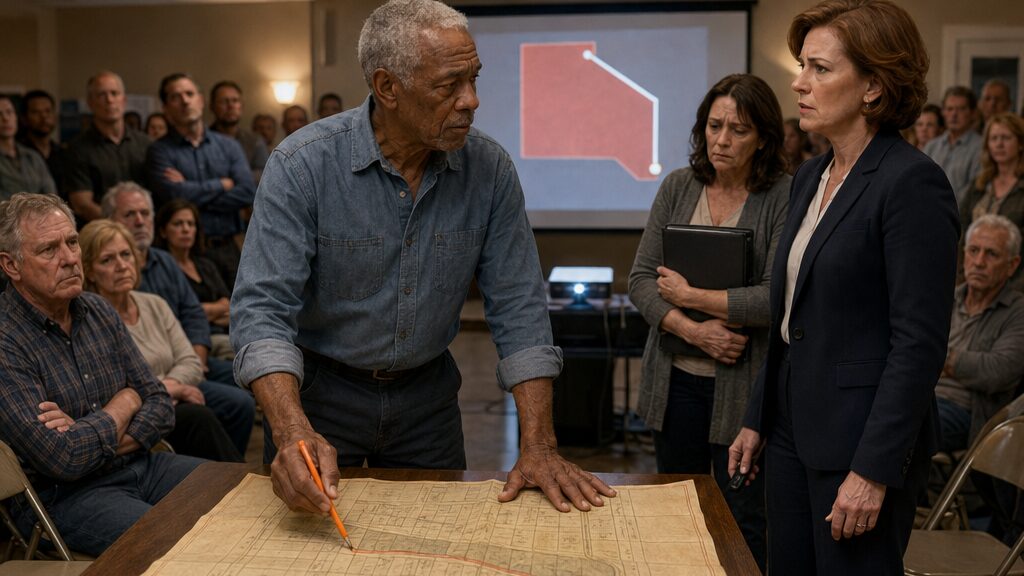
Every folding chair was occupied. More homeowners stood along the back wall, some with arms crossed, others holding copies of the meeting notice. A projector threw a subdivision map onto the white wall behind Heather. Ronald’s lot had been shaded red.
He remained near the door with the folded plat under one arm.
The property manager sat at a table beside Heather. Sarah Adams occupied the treasurer’s seat, her lips pressed together, a calculator and binder in front of her. She had lived next door to Ronald for nine years. Two days earlier, she had waved while collecting her mail. Tonight she did not look at him.
Heather pointed toward the projected sewer route.
“The association completed a necessary infrastructure upgrade approved under the capital plan. The line is operational and serves one hundred eighty-six homes. Unfortunately, a recording issue has created uncertainty over a portion of the route.”
“Recording issue?” someone called.
“A document has not yet been entered into the county record.”
A man in the second row turned toward Ronald. “So sign it.”
Murmurs followed.
Ronald did not answer.
Heather lifted one palm in a gesture of calm. “We are working to resolve this without litigation. The board has offered the affected owner a standard permanent easement consistent with the prior approval.”
Ronald watched the map. The line displayed on the wall barely touched the rear corner of his parcel.
Benjamin’s survey showed it crossing almost nineteen hundred feet.
Heather continued. “If the owner refuses, the association may have to reroute the main, defend legal action, or seek court authority. Preliminary estimates exceed several hundred thousand dollars.”
A woman near the aisle asked whether sewer service could stop.
“We do not expect an immediate interruption,” Heather said, “but access disputes can affect maintenance and emergency response.”
Ronald heard the shift. A missing document had become his refusal. An unauthorized line had become a threat he was creating.
Heather finally looked toward him.
“Ronald, you asked to address the membership.”
He walked to the front without hurrying.
Someone muttered, “Here we go.”
Ronald set the folded plat on the table. He did not touch the microphone.
“Can you put the easement on the screen?” he asked.
Heather’s expression remained composed. “The project map is already displayed.”
“I asked for the easement.”
“The route is shown.”
“A route is not a property right.”
Several people shifted in their chairs.
Heather glanced at the manager. “The previous owner approved the alignment during project planning.”
Ronald unfolded the plat. Its paper had yellowed at the creases. He laid it over the table, then held up the certified county record.
“What is the recording number?”
Heather paused.
“The documentation is being reconciled.”
“What is the number?”
“There are several project records.”
“The easement recording number.”
The room quieted.
Ronald waited.
Heather looked down at the binder before her. “The instrument was not recorded in the normal sequence.”
“Was it recorded in any sequence?”
The property manager leaned toward her microphone. “This is not a legal proceeding.”
“No,” Ronald said. “It’s the meeting where my neighbors were told I caused a problem that was buried under my land before anyone asked me.”
A low murmur moved through the room.
Heather’s face sharpened. “The board acted to complete essential work. The prior owner participated in planning.”
“Then show their signature.”
“We don’t have to litigate every file in public.”
“You shaded my lot red in public.”
That stopped her.
Ronald took the orange pencil from his shirt pocket. He unfolded Benjamin’s marked copy beside the original plat and placed both beneath the edge of the projector’s light.
“The map behind you shows the line clipping my northwest corner,” he said. “This survey was completed yesterday from field markings left by your contractor.”
He drew the orange route slowly across the paper.
From the pump station parcel, through the pines, across the open rear acreage, behind the garden, and toward the road.
The line was much longer than the one on the wall.
People in the front row leaned forward.
“How far?” someone asked.
“Approximately nineteen hundred feet on my property.”
Heather said, “That survey has not been reviewed by the association.”
“The county reviewed the records.”
Ronald placed the certified packet on top of the plat.
“No sewer easement. No temporary construction access. No memorandum from the prior owner. Nothing.”
Sarah finally looked up.
Ronald turned one page and held it so the room could see the county seal.
“The line was completed last week. Heather brought the permanent easement to my kitchen on Monday.”
A man near the aisle frowned. “You mean they installed it first?”
“Yes.”
Heather reached for the microphone.
“The contractor proceeded based on project authorization and historical consent. The board believed the documentation was complete.”
“Believed?” a woman said.
Heather’s voice grew firmer. “This community had a failing system and a limited construction window. Delaying the work would have increased costs for every owner.”
“That still doesn’t explain why the map is wrong,” someone else said.
The property manager lowered her eyes to the table.
Ronald looked at Heather. “Did you know there was no recording number when you told me the prior owner had approved it?”
Heather did not answer.
For several seconds, the clubhouse held only the projector’s faint fan noise.
The silence was not victory. Ronald could feel fear changing direction in the room, but it had not disappeared. People were no longer certain he was lying. They were beginning to understand that he might be right, and that being right could still cost them.
Sarah closed her binder.
“This doesn’t change the fact that the line serves our homes,” she said.
Her voice was quieter than Heather’s, but more personal.
Ronald faced her.
Sarah’s eyes were bright with anger or worry; he could not tell which. “My mortgage already went up. Insurance went up. If the board has to assess every house twenty or thirty thousand dollars because you demand removal, some of us can’t absorb that.”
“I didn’t put the line there.”
“No, but you can decide what happens next.”
The room turned toward him again.
Sarah stood.
“You have proof. Fine. You made your point. But if you use it to shut down the system or force a reroute, you’re not only hurting the board. You’re hurting every family connected to it.”
Ronald looked at the orange line across the plat.
His wife’s garden lay directly beneath his thumb.
Heather said nothing now. She no longer needed to. Sarah had found the argument that documents could not answer.
Ronald folded the plat carefully.
“I won’t discuss terms while the board continues calling this prior approval,” he said. “You entered private property without a recorded right. You installed a permanent line. Then you asked for permission afterward.”
“What are you going to do?” a homeowner asked.
Ronald looked around the room. Some faces were angry. Some embarrassed. A few avoided his eyes.
“I’m going to require the association to treat the problem as real.”
The next morning, he sat at his home office desk with the certified records, Benjamin’s survey, and the association’s unsigned easement arranged before him.
He wrote a formal demand requiring the HOA to remove or lawfully reroute the sewer main, restore the disturbed property, and compensate him for all damage and expenses. The deadline was ninety days.
He read it once.
Then again.
At the bottom, he signed his name.
When the delivery service arrived, Ronald placed the demand in the driver’s hand and watched the envelope leave his porch.
By noon, the HOA had proof of receipt.
By evening, every homeowner in the subdivision had received an email warning that Ronald Carter’s removal demand could make compromise impossible.
Chapter 4: The Victory Letter That Turned Every Neighbor Against Him
The first sign appeared before Ronald finished his coffee.
It had been pushed into the grass beside his mailbox sometime before sunrise, two pieces of white poster board stapled to a wooden stake.
DON’T HOLD 186 HOMES HOSTAGE.
By eight o’clock, three more stood along the street.
One said PAYDAY ISN’T JUSTICE.
Another had Ronald’s house number written beneath a drawing of a toilet crossed out in red marker.
He pulled the first sign from the ground and carried it to his garage. He did not tear it up. He leaned it against the wall beside the lawn mower, where he would not have to watch the cardboard soften in the morning dew.
Across the street, a garage door stopped halfway down.
The neighbor inside waited until Ronald turned away before closing it.
By noon, the association had circulated a cost estimate prepared by the sewer contractor. Rerouting the main through the recorded utility corridor would require new excavation, road cuts, pump modifications, permits, and temporary bypass equipment.
The projected cost exceeded six hundred thousand dollars.
The email did not mention that the contractor had entered Ronald’s land without a recorded easement. It did mention his ninety-day demand four times.
Ronald printed the estimate and placed it beside Benjamin’s survey.
The numbers bothered him less than the phrasing.
Owner-imposed rerouting.
Owner refusal.
Owner access restrictions.
He took a pen and circled each phrase until the paper looked bruised.
The doorbell rang shortly after two.
A municipal utility inspector stood on the porch wearing a reflective vest over a pale work shirt. A white service truck idled at the curb. Heather and the property manager waited beside it.
“We received an automated pressure alert,” the inspector said. “Nothing indicates a break, but we need access to the junction structure behind your garden.”
Ronald looked toward Heather. “You told them where it was?”
“The contractor provided the location.”
“After burying it.”
The inspector shifted his clipboard. “I’m not involved in the property dispute. I need to determine whether the alert is mechanical or hydraulic.”
“Is there an emergency?”
“Not yet.”
“Is sewage backing up?”
“No.”
“Any overflow?”
“No.”
“Then send me the inspection request in writing.”
Heather stepped forward. “Ronald, this is exactly what we warned the community about.”
“No. You warned them I was blocking emergency access. He just said there is no emergency.”
“There could be one.”
“There could always be one.”
The inspector kept his tone neutral. “The alert showed a pressure deviation. It could be a sensor fault. It could also indicate an obstruction developing upstream.”
Ronald knew the distinction. A real obstruction would produce a pattern, not one isolated deviation. He asked for the readings.
The inspector showed him a graph on a tablet. Ronald studied the pressure line, the pump cycle, and the time stamps.
The variation occurred during a restart after scheduled maintenance. It returned to normal within eleven minutes.
“You changed the pump setting,” Ronald said.
The inspector looked at him more closely. “The contractor adjusted the cycle yesterday.”
“And the alarm threshold wasn’t reset.”
“That’s possible.”
Heather folded her arms. “You are not qualified to make that determination.”
“I located and tested utility systems longer than you’ve lived in this neighborhood.”
“That does not give you authority over this line.”
Ronald looked at her. “Neither did your board.”
The inspector lowered the tablet.
“I still recommend a visual inspection,” he said. “It would take less than an hour.”
Ronald’s eyes moved to the backyard.
The orange markings cut through the garden beds his wife had planned around sun angles and drainage. The crooked stone still had not been reset. Every visit by the board came wrapped in the same assumption: because the line existed, access must follow.
“Put in writing that the association entered without a recorded easement,” he said. “Acknowledge that any access is temporary, does not create permanent rights, and does not waive my claims.”
Heather’s face changed.
“We cannot sign a legal conclusion on your porch.”
“Then you cannot enter.”
The inspector gave Ronald one last chance. “You understand that if the alert develops into a blockage, delay could increase the damage?”
“I understand.”
Heather stared at him. “And if homes back up?”
“Then bring me an emergency order or an honest letter.”
He closed the door.
For the next hour, Ronald moved between the kitchen window and his desk.
The service truck remained at the curb for twenty minutes, then left. Heather stayed longer, speaking to the property manager beside the mailbox cluster. Sarah came out of her house but did not cross the property line.
Ronald returned to the pressure graph he had copied from the inspector’s screen. He reconstructed the sequence on a notepad. Pump restart. Short surge. Normalization. No continuing rise. No evidence of immediate collapse.
He should have felt satisfied.
Instead, he kept seeing the inspector’s face when he asked whether Ronald understood the risk.
At dusk, his adult daughter called.
“I saw the neighborhood post.”
“It’s not accurate.”
“I know that. But are you really making them remove the whole line?”
“I gave them a deadline.”
“That isn’t what I asked.”
Ronald looked through the window at the garden. “They thought I’d sign because it was already done.”
“That was wrong.”
“Yes.”
“And if removal costs people their houses?”
“That cost belongs to the board.”
“Legally, maybe.”
He gripped the phone harder.
His daughter let the silence sit between them.
“Dad, Mom wanted you to protect the garden. She didn’t ask you to burn down the street around it.”
Ronald’s voice cooled. “You weren’t here when they dug it up.”
“No. And neither were you.”
The words landed more sharply than she intended.
Ronald ended the call soon afterward.
Outside, the orange line appeared almost luminous in the fading light. He walked to the garden and crouched beside the crooked border stone.
His wife had set that stone three times before she liked its angle. Ronald could still hear her telling him not to help because he always made things too square.
He placed both hands beneath it.
Then stopped.
A car door closed near the street.
Sarah stood at the end of his driveway, holding no folder, no meeting notice, nothing that could shield her from the reason she had come.
“Ronald,” she said.
He rose without inviting her closer.
Sarah glanced toward the neighboring houses. Curtains moved behind two windows.
“We need to talk somewhere they can’t see us.”
“You had a microphone Thursday.”
Her face tightened. “I know what I did.”
Ronald waited.
Sarah walked to the edge of the orange-marked grass but did not step across it.
“The board knew,” she said. “Before the contractor started. We knew the signature page was missing.”
Chapter 5: Sarah’s Confession Changed Who the Villain Was
“Heather didn’t forge an easement,” Sarah said. “She gambled that you would sign one after the line was installed.”
Ronald left her standing at the edge of the yard for several seconds.
Then he opened the back door.
Sarah entered the kitchen without removing her jacket. She sat in the same chair Heather had used when she brought the easement papers, but she kept her hands in her lap and did not look at the yellow tabs still visible beneath Ronald’s files.
“When did you know?” he asked.
“Three weeks before construction.”
“Weeks.”
Sarah nodded.
“And you certified the project file.”
Her eyes lifted. “I signed the funding verification.”
“That said access had been secured.”
“It said site control was complete.”
“Same lie with cleaner words.”
Sarah flinched but did not argue.
Ronald placed the certified county search between them. “Why?”
“The loan.”
“What loan?”
“The state infrastructure program. Low interest, fixed deadline. If we missed the construction window, we lost the rate and had to rebid next year.”
“That explains a schedule.”
“It explains the assessment.”
Sarah opened her purse and removed a folded sheet. The paper had been handled enough that the creases were soft.
She slid it toward him.
One column showed the financed project under the approved loan. Another showed the projected cost if the association delayed, rebid, and rerouted the main. At the bottom, an estimated special assessment had been calculated for each of the 186 homes.
The range began at twenty-four thousand dollars.
Some lots were higher.
Ronald read it twice.
“Who prepared this?”
“The property manager and the contractor.”
“And you believed them?”
“I believed the bank statement in front of me.”
Sarah leaned forward.
“My mortgage payment increased almost four hundred dollars this year. Insurance added another hundred and thirty. I have one child in college and another still at home. I don’t have twenty-four thousand dollars.”
“That didn’t give you my land.”
“No.”
Her answer came without defense.
Ronald looked up.
Sarah’s face had lost the anger she wore at the clubhouse. What remained was exhaustion.
“There are fourteen owners in the older section on fixed incomes,” she said. “Three are already behind on dues. If the association imposed that assessment, some would have to sell. If enough people defaulted, the rest of us would pay more.”
“So you chose the house least likely to fight.”
“No. Heather chose the route the engineer said was cheapest.”
“And when she discovered the route was not legal?”
“She said the previous owner had participated in early planning and that the missing signature was probably an administrative mistake. She thought you would understand once the work was done.”
Ronald gave a quiet, humorless breath. “She thought I would have no choice.”
Sarah looked down.
“Yes.”
That admission did more than an excuse would have.
Ronald picked up the project packet Sarah had brought. A copy of the subdivision plat was attached to the back. The proposed route crossed his land in pale blue. At the bottom, a box labeled PROPERTY OWNER APPROVAL remained blank.
Sarah touched the empty box with one finger.
“I saw this before I signed the funding certification.”
“You knew.”
“I knew it wasn’t complete.”
“Did Heather?”
“Yes.”
“Did the other board members?”
“They knew she was waiting for a signature. I don’t know how clearly she told them construction was starting anyway.”
Ronald studied Sarah’s hand. It trembled slightly against the paper.
“Why are you telling me now?”
“Because you were right at the meeting.”
“That didn’t trouble you when you stood up.”
“It did.”
“You still blamed me.”
“I was afraid.”
Her voice broke on the final word, not dramatically, but enough to strip the room of its clean sides.
Sarah pressed her palms together.
“I wanted everyone angry at you because if they were angry at you, they weren’t asking what I signed.”
Ronald sat back.
There it was—not another document, but the thing beneath it. Fear had made Sarah cruel before guilt made her honest.
He could use her confession. He could demand a written statement, call another meeting, place her signature and Heather’s decision in front of every owner who had planted signs along his street.
For a moment, he wanted to.
Then the kitchen lights flickered.
A low electronic alarm sounded outside, followed by the reversing beep of a utility truck.
Ronald stood.
Through the back window, red and amber lights moved along the service road beyond the pines. His phone rang almost immediately.
The municipal inspector spoke before Ronald could say hello.
“We have a confirmed partial obstruction near the junction on your property. No overflow yet, but upstream levels are rising.”
“How fast?”
“Slowly. We need to access the structure and clear it.”
Ronald looked at Sarah.
“How long?”
“If the access cover is where the contractor marked it, four to six hours.”
“Equipment?”
“Vacuum truck, inspection camera, two operators.”
“Excavation?”
“Not unless the access structure is damaged.”
Heather’s voice came faintly through the inspector’s phone, asking whether Ronald had agreed.
He had not.
The legal demand sat on his desk. The certified search lay open on the table. Sarah’s unsigned approval box waited beneath her finger.
Ronald’s first instinct was the same as before: make them acknowledge what they had done before they touched another inch of his land.
Then he pictured fourteen owners in the older section, toilets filling from below, floors ruined while the board argued over wording.
“Send me the request by email,” he said. “List the personnel, vehicles, hours, and exact work.”
“We need to start soon.”
“You’ll have terms in ten minutes.”
He ended the call.
Sarah watched him take a yellow legal pad from the desk.
“You’re letting them in?”
“For twelve hours.”
“What about your demand?”
“It stays.”
Ronald wrote by hand.
Emergency access only.
No waiver of claims.
No permanent right created.
No excavation outside the marked work zone.
Independent video inspection.
Full restoration of any disturbed surface.
He added a final condition: the HOA could not describe his permission as recognition of an existing easement.
Sarah read over his shoulder.
“Heather won’t like that.”
“She doesn’t have to like it.”
Ronald signed and dated the page, photographed it, and emailed it to the inspector, the property manager, and Heather.
The reply came four minutes later.
Heather objected to the language regarding trespass and existing rights.
Ronald typed one sentence.
Then the trucks remain outside.
Two minutes passed.
The inspector called again.
“The association accepted.”
Ronald unlocked the rear gate.
The vacuum truck arrived first, its engine vibrating through the kitchen floor. Workers laid protective mats across the lawn and followed the orange markings toward the buried junction. Ronald stood beneath the porch light with Sarah while Heather approached from the service road.
She held a printed copy of his conditions.
“This is not a concession,” she said.
Ronald looked at the workers opening the concealed access cover.
“Neither is mine.”
Heather’s gaze moved to Sarah, then to the packet on the kitchen table visible through the open door.
For an instant, fear passed between them.
Ronald saw it.
He stepped aside to let the crew work, but he kept the signed conditions in his hand until the first camera entered the line.
Chapter 6: Fifteen Thousand Dollars for Permanent Ground
Jennifer White placed the check offer beside the permanent easement and turned both documents toward Ronald.
“Fifteen thousand dollars,” she said. “In exchange for resolving all property claims related to the existing sewer main.”
Ronald did not touch either page.
The conference room belonged to Jennifer’s law firm, though the association’s insurer had arranged the meeting. Heather sat at the far end of the table with the property manager. A carafe of coffee cooled between them, untouched.
Ronald had brought no attorney.
Jennifer had noticed.
“The insurer would also reimburse reasonable landscaping costs,” she added.
“Define reasonable.”
“Documented restoration to preconstruction condition.”
“You already owe that.”
Jennifer’s expression did not change. “The offer accounts for the permanent easement and disputed entry.”
“Disputed by whom?”
Heather shifted in her chair.
Jennifer glanced at the agreement. “The association does not admit unlawful entry.”
“Then the money isn’t for unlawful entry.”
“It resolves the uncertainty.”
Ronald read the first paragraph.
The easement granted the association, its contractors, agents, successors, and assigns the perpetual right to enter, inspect, maintain, repair, replace, enlarge, relocate, and improve the sewer facilities. Access could occur with reasonable notice, or without notice during an emergency. The corridor stretched forty feet wide across nearly the full route.
The language gave them more than they had taken.
He pushed it back.
“No.”
Heather exhaled through her nose. “You haven’t made a counteroffer.”
“I haven’t found an offer yet.”
Jennifer folded her hands. “What number did you expect?”
Ronald looked at her. “You think this is about a number.”
“It is a property settlement.”
“It is a permanent burden. It affects where I can build, plant, dig, fence, sell, and insure. Your document lets the association widen the line and enter whenever it decides notice is unreasonable.”
“Those are standard maintenance rights.”
“On ground acquired before construction.”
Jennifer studied him more carefully.
“The insurer will cover liability within its policy,” she said. “It will not fund a complete reroute. That cost would fall on the association.”
Heather spoke then.
“Which means the homeowners.”
Ronald turned toward her. “You made that decision when you started without the signature.”
“Yes.”
The direct answer surprised him.
Heather looked tired. The polished certainty she had carried into his kitchen was gone, but not her resolve.
“I made the decision to keep the project moving,” she said. “I believed the prior owner’s participation and the board’s project authority gave us enough basis to finish the paperwork afterward.”
“You believed I would surrender once the pipe was active.”
“I believed you would negotiate.”
“You arrived with tabs on the signature lines.”
“Because the loan deadline had passed. The system was operating. We had no practical alternative.”
“You had one before construction.”
“At a cost this neighborhood could not afford.”
Jennifer lifted one hand before the exchange sharpened.
“Mr. Carter, the legal merits do not remove the physical reality. The main is in service. Removal would require months of engineering and substantial expense. The purpose of today’s meeting is to find compensation and protections that recognize your ownership without destabilizing the community.”
Ronald looked down at the easement.
The page was crisp and clean. It made no mention of the garden, the concealed trench, the false project map, or the morning Heather had told him the board would proceed with or without his signature.
He reached into his folder and removed the old subdivision plat.
Its fold lines no longer lay flat. He spread it across the table, weighting one corner with Jennifer’s offer and another with the coffee carafe.
Heather watched him mark the existing route in orange pencil.
“What are you doing?” she asked.
“Showing you the difference between what is under my land and what you are asking me to give away.”
He traced the forty-foot corridor from the draft in two parallel lines. It swallowed the rear garden, the oak, and most of the usable strip behind the house.
Then he drew a second corridor, narrower and irregular, following the actual pipe while avoiding the oak and limiting access around the garden.
“Fifteen feet,” he said. “Not forty.”
Jennifer leaned over the map.
“Maintenance vehicles need turning clearance.”
“At two designated access points. Not the full length.”
“Replacement could require excavation.”
“Then replacement stays inside the corridor unless I approve otherwise or a court does.”
Heather shook her head. “That is too restrictive.”
“That is what ownership looks like.”
Ronald added two small rectangles where equipment could stage without crossing the garden beds.
“No enlargement of capacity without a new agreement. Forty-eight hours’ written notice for nonemergency access. Independent inspection every three years. Copies of all camera reports. Full restoration after every entry. No chemicals stored on the property. No removal of trees without written consent.”
Jennifer took notes.
Heather stared at the plat.
Ronald continued.
“The association pays my legal and survey expenses. It pays for the original damage and for the easement. It installs permanent surface markers at the corridor boundaries, not over the center line. And the easement must state that emergency permission last week did not waive the trespass claim.”
The property manager whispered something to Heather.
Jennifer asked, “What compensation are you proposing?”
Ronald named a figure well above fifteen thousand but far below the reroute estimate.
Heather’s eyes narrowed. “That is still a significant assessment.”
“Smaller than six hundred thousand.”
“Not every owner can pay even a reduced one.”
“Then use reserves, insurance proceeds, and a payment schedule. The cost does not become mine because your budget is thin.”
Jennifer tapped the orange line.
“You are no longer demanding removal.”
“I am giving you a way to avoid it.”
Heather looked up. “In exchange for an admission.”
“In exchange for the truth.”
Her expression closed again.
“We cannot put language in a recorded easement accusing the association of trespass.”
“I didn’t say it had to go in the easement.”
Ronald opened a second sheet of paper.
“At the next membership meeting, the board president reads a statement into the minutes. The board confirms that construction began before a recorded easement or signed owner approval existed. It withdraws the notices describing me as the cause of the infrastructure problem.”
Heather’s chair creaked as she leaned back.
“No.”
Jennifer turned toward her. “Let’s discuss the wording.”
“There is no wording,” Heather said. “I will not stand in front of the neighborhood and accept sole responsibility for a project the entire board approved.”
Ronald folded his hands.
“Then the removal demand remains.”
“You want humiliation.”
“I want the record corrected.”
“The legal record?”
“The community record.”
Heather’s voice hardened. “You want everyone who put up a sign to know you won.”
Ronald thought of the cardboard leaning against his garage wall. He thought of Sarah at his kitchen table, pointing to the blank approval box.
“I want the next board to know that an urgent project does not turn somebody’s yard into common property.”
Jennifer looked from Ronald to Heather.
For the first time, she seemed to understand that neither the check nor the threat of litigation was the center of the dispute.
“Mr. Carter,” she said, “if the acknowledgment were made by the board rather than Mrs. Mitchell personally, would that satisfy you?”
“If she reads it as president.”
Heather stood.
“No.”
She gathered her folder, but Jennifer did not move to stop her.
Ronald drew one final line on the plat, closing the narrow corridor at the northern boundary.
“I’ll leave this proposal open for seven days,” he said. “After that, I proceed with removal.”
Heather looked at the orange route, then at the unsigned agreement.
“You would really force this neighborhood to pay for that?”
Ronald met her eyes.
“I’m offering you a cheaper choice.”
He left the plat copy on the conference table.
Before walking out, he placed a final page beside it: compensation terms, access restrictions, inspection requirements, governance reforms, and the exact acknowledgment Heather would have to read into the public record.
At the bottom, beneath the deadline, Ronald had written one sentence by hand.
No permanent right will be created through permanent silence.
Chapter 7: The Boundary Ronald Chose Instead of Revenge
Heather opened the meeting with Ronald’s statement in both hands.
No projector map glowed behind her this time. The clubhouse wall was bare except for the framed subdivision certificate and the clock above it. The same folding chairs filled the room, but no one spoke while Heather adjusted the microphone.
Ronald sat in the second row with the recorded easement packet resting on his knees.
Jennifer White occupied a chair beside the property manager. Sarah sat at the board table, not in her usual treasurer’s place but at the far end, with an empty seat between herself and Heather.
Heather looked down at the first page.
“The board acknowledges that construction of the neighborhood sewer main began before the association possessed a recorded easement or a signed approval from the owner of the affected property.”
Her voice was steady, though each word seemed to require separate effort.
“The board further acknowledges that prior notices to the membership incorrectly described the property owner’s refusal as the cause of the infrastructure problem. The dispute arose from the board’s decision to proceed before property rights were secured.”
A chair creaked near the back.
Ronald did not turn around.
Heather continued.
“The association withdraws those notices and accepts responsibility for correcting the record, compensating the affected owner, restoring the disturbed property, and adopting procedures intended to prevent a similar failure.”
She lowered the paper.
No one applauded.
The silence held more weight than applause would have.
Heather looked directly at Ronald. “That is the acknowledgment you required.”
“It is.”
The property manager distributed copies of the settlement summary along the rows. The pages listed the compensation amount, reimbursement for Ronald’s survey and legal review, restoration of the garden and rear field, and the association’s obligation to fund independent sewer inspections every three years.
The permanent easement corridor was fifteen feet wide, except at two designated maintenance areas. No enlargement of the line would be permitted without a new agreement. Nonemergency access required forty-eight hours’ written notice. Any disturbance had to be restored under standards verified by Benjamin Moore.
The agreement also required the association to retain a separate property-rights checklist for every future project. No contractor could begin work until a board member, the property manager, and independent counsel verified recorded access.
A homeowner in the front row raised his hand.
“How much is this costing us?”
The property manager gave the figure. It was substantial, but less than one quarter of the reroute estimate. Insurance covered the trespass claim and Ronald’s expenses. Association reserves covered restoration and part of the easement compensation. The remaining balance would be collected through a smaller assessment spread across eighteen months.
A few people whispered.
Heather did not blame Ronald.
“The board should have identified the risk before construction,” she said. “The cost exists because we failed to do that.”
The man lowered his hand.
Jennifer opened the governance resolution.
The board would lose the power to approve permanent property access by informal vote. Recorded documents would be available for member inspection. Any project affecting a privately owned lot would require written notice before bids were accepted, not after machinery arrived.
Sarah’s signature appeared at the bottom of the resolution.
Ronald saw it from his seat.
Heather asked for motions.
One board member moved to approve the settlement, the easement, and the governance reforms as a single package. Another seconded.
Before the vote, Heather looked toward Ronald.
“If this passes, will you withdraw the removal demand tonight?”
Ronald placed one hand on the packet.
“When the vote passes and the agreement is signed.”
A woman near the aisle turned to him. She had been one of the homeowners who asked whether sewer service might stop during the first meeting.
“You won’t wait for the recording?”
“The agreement requires recording within five business days. If they fail, the demand returns.”
Heather’s mouth tightened slightly, but she nodded.
The vote began.
Each board member answered aloud.
Sarah’s “yes” was almost too quiet for the microphone.
Heather voted last.
“Yes.”
The property manager recorded the result as unanimous.
Jennifer moved the signature copies to the center of the board table. Heather signed first in her capacity as president, then the property manager as witness. Ronald carried his packet forward.
The orange corridor on the attached plat was narrow now. It curved around the oak, passed behind the garden, and widened only at the two access points Ronald had selected. The page no longer showed the whole rear portion of his property as available ground.
He signed.
Jennifer notarized the documents.
Then Ronald removed the ninety-day demand from his folder. He had brought the original, not a copy. The letter looked harsher under the clubhouse lights than it had at his desk.
He drew a line through the removal requirement and wrote beneath it:
Withdrawn upon execution of settlement and reform resolution.
He signed the notation and handed the letter to Jennifer.
The room exhaled in small movements. Shoulders lowered. Someone closed a calculator. A man near the back folded the cost summary and slipped it into his coat pocket.
Heather remained behind the table.
Ronald returned to his seat, but Sarah intercepted him near the aisle.
“Can we talk?”
People moved around them, collecting papers and pushing chairs back into uneven rows.
Sarah looked thinner than she had two weeks earlier. She held no binder tonight.
“I’m sorry,” she said. “Not only for signing the certification. For what I said in front of everyone.”
Ronald glanced toward the board table. Heather was answering a homeowner’s question while Jennifer packed the notarized originals.
“You were afraid,” he said.
“That doesn’t excuse it.”
“No.”
Sarah waited.
Ronald knew what she wanted. A sentence that would close the space between their properties. A return to waving at the mailbox and sharing tomatoes across the fence. He was not ready to give it.
“I believe you regret it,” he said.
Her eyes dropped.
“That’s not forgiveness.”
“No.”
Sarah nodded once. “I understand.”
He watched her walk back to the table and gather the abandoned copies of the meeting packet. She stacked them carefully, aligning every edge.
Heather approached after most of the homeowners had left.
Without the microphone, she seemed smaller.
“The loan deadline was real,” she said.
“I know.”
“The assessment estimate was real too.”
“I know that.”
“I kept thinking if I could get the project completed, I could fix the paperwork before anyone was harmed.”
“You decided I was the part that could be fixed later.”
Heather looked toward the dark window. Their reflections floated over the empty parking lot.
“Yes.”
Ronald waited for an explanation, but she gave none.
That was the first honest thing she had offered without being forced to read it.
Two weeks later, Benjamin stood in Ronald’s backyard while the restoration contractor reset the final edge of the garden.
The trench had been compacted properly. Damaged shrubs had been replaced. Fresh soil filled the beds, and the crooked border stones had been lifted, cleaned, and returned one by one.
Small permanent markers now identified the easement boundaries near the two access areas. They were low enough not to dominate the yard, but clear enough that no future board could pretend the corridor was larger than it was.
Benjamin held the recorded plat on the hood of his pickup.
“The county stamped it yesterday,” he said.
Ronald ran a finger along the orange corridor. “And the access points?”
“Exactly where you marked them.”
“No extra language?”
“None.”
Benjamin folded the plat along its familiar creases and handed it over.
For years, the old map had been something Ronald kept on a shelf. Then it became proof that his property had been taken without permission. Now it carried a boundary he had chosen himself.
The contractor called to him from the garden.
One stone remained.
It was the rough slab his wife had reset three times because Ronald kept making it too straight.
He carried it to the border and lowered it above the newly bounded sewer line. The stone rocked under his hand.
His first impulse was to square it with the others.
Instead, Ronald turned it slightly, matching the angle she had preferred.
It settled into the soil.
Across the fence, Sarah stepped onto her porch with a bag of groceries. She saw him kneeling beside the garden and paused.
Neither of them waved.
Not yet.
Ronald pressed the soil around the stone, rose, and looked over the yard. The pipe remained beneath it. So did the memory of the trench, the signs, the public accusation, and the silence when Heather could not produce a recording number.
Nothing had been erased.
But the line no longer meant they could take whatever they needed and ask afterward.
It had edges now.
The story has ended.