They Denied Her Mother’s Wake, So She Followed Every Rule They Had Forgotten
Chapter 1: The Room They Would Not Open for Ruth
Margaret Hill brought the red stamp down across the application while Ruth Carter’s photograph still lay beside it.
DENIED.
The ink caught the edge of the picture, a narrow red crescent touching Ruth’s gray hair.
Rachel stared at it before she looked at Margaret.
“You stamped the photograph.”
Margaret lifted the stamp as if surprised to find it in her hand. “It was under the form.”
The clubhouse office smelled faintly of lemon polish and burnt coffee. Behind Margaret, a framed plaque listed the Maple Hollow board’s officers in brass lettering. Her own name appeared first. Beneath it hung a smaller wooden sign.
RULES ARE RULES.
Rachel reached across the desk and moved the photograph away from the wet ink. Ruth was smiling in it, standing beside a kitchen counter with both hands around a loaf of banana bread wrapped in waxed paper. The picture had been taken years ago, before her shoulders narrowed and before she began forgetting which burner she had turned on.
“The wake is Sunday from two to five,” Rachel said. “No alcohol. No amplified music. We’ll clean afterward. I already paid the deposit.”
Margaret folded her hands over the application. “The board reviewed your request.”
“The board met this morning?”
“We consulted.”
Rachel had spent twenty-two years listening to people choose words that sounded precise because the facts behind them were not. Consulted could mean a formal vote. It could mean a phone call. It could mean Margaret had decided while brushing her teeth.
“The clubhouse is available,” Rachel said.
Margaret’s expression tightened by half a degree. “Availability is not the only consideration.”
“What consideration disqualifies a memorial?”
“We try to keep the clubhouse appropriate for the whole community.”
Rachel waited.
Margaret glanced toward the closed office door. “A wake is a somber event. Some residents find that atmosphere distressing.”
“My mother was a resident for forty-one years.”
“And we are sorry for your loss.”
The sentence was clean and bloodless.
Rachel placed one finger on the application. “The rental policy permits family gatherings, religious observances, retirement receptions and celebrations of life.”
Margaret’s gaze dropped to the words, then returned to Rachel’s face. “This is not being presented as a celebration.”
“My mother is dead. I’m not going to rename that for you.”
For the first time, something unguarded moved in Margaret’s expression. Irritation, quickly covered.
“We have to apply standards consistently.”
“Then show me the standard.”
Margaret slid the paper toward her. The deposit receipt had been stapled to the back. Three hundred dollars. Beneath the denial, a second stamp read DEPOSIT FORFEITED.
Rachel looked up. “Why is the deposit forfeited?”
“Administrative costs.”
“You had the application for four hours.”
“The fee is nonrefundable.”
“The rental packet says the deposit is returned when the room is left clean.”
“It also says management may retain fees connected to denied or noncompliant reservations.”
“Where?”
Margaret did not reach for the packet. “Rachel, I understand you’re under strain.”
Rachel felt the familiar pressure behind her eyes and refused it. Her grief had become public property from the moment the hospice nurse had called. People lowered their voices around her. They touched her arm without asking. They explained her own reactions back to her.
“I’m asking where.”
Margaret picked up Ruth’s photograph and held it out. “The board’s decision is final.”
Rachel took the picture carefully. A damp red mark remained along one corner.
She left without raising her voice.
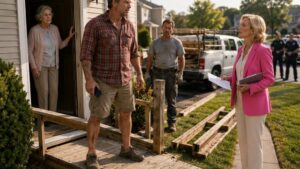
Outside, the clubhouse lawn had been cut into perfect diagonal bands. A white rental van idled by the service entrance while two men unloaded round tables draped in navy cloth. Rachel stopped beside the community notice case.
The monthly calendar was clipped behind glass.
Saturday showed a graduation party. Monday listed a quilting circle. Sunday afternoon—the hours she had requested—was blank.
A woman walking a terrier slowed near her. “Rachel?”
Rachel turned. The neighbor’s expression softened when she saw Ruth’s photograph.
“I heard about your mother. I’m so sorry.”
“Thank you.”
“Is the service here?”
“No. They denied it.”
The woman looked at the clubhouse, then back at Rachel. “Denied it?”
Before Rachel could answer, another neighbor approached carrying grocery bags. Within five minutes there were four people around the notice case, speaking in the careful, indignant tones of residents who feared being overheard by landscaping crews.
“My garage is heated,” one man said. “Not beautiful, but it’s clean.”
“We have folding chairs at the church,” another neighbor offered.
“I can bring coffee urns.”
“My driveway connects to his. You could use both.”
Rachel wanted to say no. Ruth had belonged in the clubhouse, not between a lawn mower and boxes of Christmas decorations. Accepting the garage felt like agreeing that Margaret had the authority to decide what kind of grief the neighborhood was allowed to see.
Then the woman with the terrier touched Ruth’s photograph.
“She brought us banana bread the day we moved in,” she said. “My son was six. He ate half of it before we found the plates.”
The others smiled.
One remembered Ruth leaving a loaf on a porch after a divorce. Another remembered her bringing one to a family whose moving truck arrived during a snowstorm. The stories were small and unpolished. None required a clubhouse.
Rachel looked back through the glass at the empty Sunday square.
“Forty-seven chairs,” she said. “That’s how many I have confirmed.”
The man with the heated garage nodded. “We’ll find forty-seven.”
At Ruth’s house that evening, Rachel sat at the kitchen table with the rental packet, the denial form and a yellow legal pad aligned in front of her. She told herself she was preparing an appeal. That was easier than opening the bedroom closet or deciding what to do with the medications arranged beside the sink.
Ruth’s address book lay under a stack of condolence cards. Rachel opened it to find the phone number of a former neighbor.
A stained index card slipped from between the pages.
BANANA BREAD, Ruth had written across the top in blue ink. The lower corner was translucent with old butter. Beside the measurements, she had added notes in the margins.
Less sugar for Daniel.
No walnuts for the Martins.
Double batch when somebody moves in.
Rachel pressed the card flat. She could see Ruth’s hand shaping each letter, patient and rounded. The last time Ruth had invited neighbors over, Rachel had been in Columbus finishing an audit. She had promised to come the next weekend.
There had not been another one.
Rachel placed the card beside the denial form and opened the rental packet again. This time she read the footnotes.
On the final page, below the cancellation policy, a sentence had been underlined in pencil:
Bereavement gatherings for residents or immediate family may receive expedited approval and waiver of standard scheduling restrictions at the board’s discretion.
In the margin, someone had written by hand:
Historically approved without vote.
The handwriting was not Ruth’s.
Rachel read it twice.
Then she turned the denial form over and found no board signatures, no meeting date and no recorded reason beyond Margaret’s single handwritten phrase:
Not suitable for community atmosphere.
Rachel set the recipe card on top of the form to keep her hand from trembling.
The room had been empty. The policy allowed the wake. The board had not signed the denial.
Margaret had not enforced a rule.
She had made one.
Chapter 2: Every Flower Became Another Violation Notice
The $400 notice had been fastened through the black ribbon of the funeral wreath with a silver roofing nail.
Rachel found it at seven the next morning.
The paper snapped in the wind against her front door, each movement pulling the nail deeper through the ribbon. At the top, beneath the Maple Hollow crest, bold type announced EXTERIOR DECORATION VIOLATION. Below it, someone had circled “unapproved door ornament” in red.
Rachel stood on the porch in her robe and read the inspection time.
6:42 a.m.
The wake had ended less than twelve hours earlier.
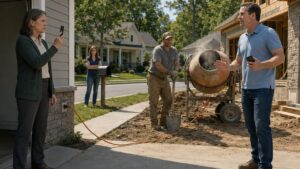
She removed the nail with pliers so the wreath would not tear further. Before touching the notice, she photographed it from three angles. Then she placed it in a clear plastic sleeve.
By eight, the garage smelled of coffee, flowers and the faint sweetness of six banana breads.
Forty-seven folding chairs had fit only because two neighbors had moved their vehicles to the street and another had loaned Rachel narrow church chairs instead of the wider metal kind. A white sheet hung over the storage cabinets. The projector had shown pictures of Ruth holding babies, shoveling snow in an oversized coat, waving from a porch crowded with flowerpots.
There had been no microphone. No alcohol. No music louder than the small speaker beside the tool bench.
People had still lingered until nearly seven.
Three separate neighbors had brought banana bread. Each had used a copy of Ruth’s recipe, though none had produced quite the same loaf. One was too dark at the edges. One had walnuts despite the note on the card. The third collapsed in the middle, and Ruth’s old friend Daniel Wilson had eaten two slices anyway.
“She’d say it was humble,” he had told Rachel.
“Humble?”
“That was her word for anything that didn’t turn out right.”
Rachel had laughed before she could stop herself. The sound startled her more than the grief that followed it.
Now, standing beneath the damaged wreath, she saw a dark sedan turn slowly onto Birchwood Lane.
Margaret’s sedan.
It passed the house without stopping.
Rachel watched it in the reflection of the storm door until it reached the corner.
The previous day, Margaret had driven by at 2:17, 4:06 and 6:31. Rachel knew because the neighbor across the street had a doorbell camera. On the second pass, Margaret had slowed enough to point her phone toward the garage.
At 9:20, another notice appeared.
This one was attached to a wooden stake beside the mailbox. A bouquet of white lilies and yellow roses rested on the grass where a neighbor had left it after the wake.
UNAPPROVED LAWN ITEM.
Fine: $200.
Rachel photographed the flowers, the stake, the width of the lawn and the absence of any obstruction. She measured the distance from the bouquet to the sidewalk. Thirty-eight inches.
A man from two houses down came over while she was writing it in a notebook.
“You’re not paying that, are you?”
“I’m documenting it.”
“That isn’t what I asked.”
Rachel capped her pen. “No.”
He looked relieved, then worried. “They can add late fees.”
“They can try.”
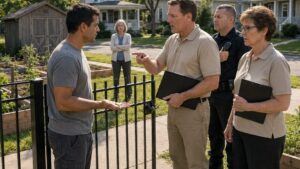
By noon, photographs of the notices had traveled through the neighborhood text chain. Residents began arriving at Rachel’s house with copies of their own old violations: a child’s chalk drawing, a planter two inches too wide, a trash bin left visible for forty minutes after collection.
Most had paid rather than fight.
Angela Martin, the board secretary, arrived without a folder or a badge. She stood at the edge of the driveway, arms folded against the cold.
“I’m sorry about Ruth,” she said.
Rachel waited.
Angela looked toward the lilies. “The board didn’t vote on that notice.”
“Did the board vote on the wreath?”
“I’m not here in an official capacity.”
“Then why are you here?”
Angela lowered her voice. “Because people are forwarding those pictures everywhere, and Margaret thinks you’re trying to turn the neighborhood against the association.”
“The association nailed a fine through my mother’s funeral wreath.”
“I know how it looks.”
Rachel glanced at the flowers. “How should it look?”
Angela flinched. She was younger than Margaret by at least twenty years, with the exhausted posture of someone who answered emails after putting children to bed.
“There was a complaint about the number of vehicles,” she said. “And the gathering limit is twelve.”
“Where is that limit written?”
“In the temporary-use resolution.”
“Adopted when?”
Angela hesitated.
“That’s what I thought.”
“I’m telling you this because Margaret is preparing another notice.”
“For what?”
Angela looked toward the garage.
The third notice came by certified mail that afternoon.
UNAPPROVED ASSEMBLY.
Attendance exceeding twelve persons.
Fine: $700.
Failure to pay within thirty days may result in additional collection costs and lien proceedings.
Rachel read the lien sentence twice.
Her mother’s house was still titled in the estate. The probate inventory was unfinished. A recorded lien, even a weak one, could delay transfer and increase legal costs. Margaret either understood that or had found someone who did.
Daniel came through the side door carrying a cardboard box of empty food trays.
“You’ve gone pale,” he said.
Rachel handed him the notice.
He read it standing beside Ruth’s kitchen counter.
“They threatened a lien over a funeral?”
“A gathering.”
“Same room, apparently.”
Rachel took the box from him and began stacking the trays more neatly than necessary. “I need the HOA’s governing documents. Full set. Amendments, resolutions, enforcement schedule.”
“Ask for them.”
“I did.”
“And?”
“Margaret sent me the public packet.”
Daniel’s eyes shifted.
It was slight, but Rachel saw it.
“You were treasurer,” she said.
“Years ago.”
“You know what records exist.”
“I know what used to exist.”
“Daniel.”
He rubbed one thumb along the edge of the notice. “There are annual reports online. Budgets. Tax filings. Some meeting minutes.”
“Some?”
“Margaret streamlined things after I stepped down.”
“Streamlined.”
“That was her word.”
Rachel opened her laptop at the kitchen table. She downloaded the most recent annual report, then the clubhouse rental summary. Ruth’s recipe card still lay beside the address book. Rachel used it to mark the page where Ruth had listed Daniel’s old number.
The report showed $18,240 in clubhouse rental revenue for the previous year.
Rachel entered the figure on a spreadsheet.
Then she took out her mother’s receipt for the denied reservation. The printed number at the top read 4187.
The annual report’s supporting schedule listed receipt numbers for approved rentals. The final recorded receipt of the year was 3921.
Rachel stared at the gap.
Two hundred sixty-six receipt numbers existed beyond the last one disclosed in the annual report.
Some could have been voided. Some might belong to deposits carried into the next period. But her own three-hundred-dollar payment had been processed through the same numbered system and did not appear anywhere in the reported rental total.
She searched the HOA website for prior reports. The sequence gaps widened.
Daniel leaned over her shoulder. “What does that mean?”
“It means the revenue line is incomplete.”
“By how much?”
“I don’t know yet.”
Outside, Margaret’s sedan rolled past the house for the fourth time.
Rachel closed the blinds, not because she wanted privacy, but because she no longer wanted Margaret to know where she was looking.
On the table, the $700 fine covered Ruth’s recipe card except for one handwritten line:
Double batch when somebody moves in.
Rachel slid the notice aside and began building a receipt ledger.
Chapter 3: The Numbers Behind the Clubhouse Doors
The two totals should have matched.
Rachel checked them a third time because numbers could be wrong without anyone lying. A deposit could be posted late. A refund could be netted against revenue. A fiscal year could close on a different date than the rental calendar.
But $41,360 had entered accounts linked to clubhouse activity.
Only $18,240 had been reported as clubhouse revenue.
The difference was $23,120.
At 1:14 in the morning, Rachel sat under the green banker’s lamp in Ruth’s spare room, surrounded by copied reports and handwritten reconciliations. The room still held the narrow desk Ruth had used for bills. A ceramic cup contained stamps that had increased in price three times since she bought them.
Rachel had sorted the gaps into categories.
Known rentals.
Refunded deposits.
Voided receipts.
Unexplained deposits.
The unexplained column remained too large.
She found three transfers from the clubhouse account into an account labeled FACILITY CONTINGENCY. The annual budget did not mention it. Neither did the year-end report distributed to residents.
That did not make it theft.
It made it concealed.
At eight the next morning, Rachel submitted a formal records request to Angela Martin. She cited the association bylaws, Ohio nonprofit inspection rights and the specific categories she wanted: vendor bids, reserve authorizations, bank reconciliations and meeting minutes approving transfers.
Angela replied eleven minutes later.
Your request is overly broad and unduly burdensome.
Rachel narrowed it to six documents.
The second reply took four minutes.
The requested materials were previously determined by the board to be confidential under the administrative efficiency resolution adopted March 14.
Rachel pulled the March 14 minutes from the association website.
The public copy contained no administrative efficiency resolution. It showed approval of landscaping renewal, gala planning and replacement of two pool pumps. Nothing about confidentiality.
She printed Angela’s email and drove to the clubhouse.
Angela was alone in the office, arranging gala place cards into alphabetical rows.
“I asked for the March fourteenth resolution,” Rachel said.
Angela did not look up. “I sent you the applicable language.”
“You sent me a summary of language that does not appear in the minutes.”
“The minutes are not transcripts.”
“A resolution restricting member access should still appear.”
Angela set down a place card. “Margaret said the board handled it in executive session.”
“Then there should be an executive-session entry.”
“You know more about this than I do.”
“I know enough to recognize a document created after the date printed on it.”
Angela looked toward the hallway, though no one else was there.
Rachel placed the email beside the public minutes. “The font is different. The header uses the association’s new logo. That logo was introduced in June.”
Angela’s face lost color.
“I didn’t write that attachment,” she said.
“You sent it.”
“Margaret gave it to me.”
“And you didn’t check?”
“I have a job. I have two children. I do board work after they go to bed.” Angela’s voice stayed low, but anger sharpened it. “Margaret has run this place for nine years. When she says something was approved, people believe her because the alternative is rebuilding every decision from scratch.”
“That is not an answer.”
“It’s the only one I have.”
Rachel gathered the papers. “Then find a better one before your name is attached to hers.”
The cruelty of the sentence reached her only after she had said it.
Angela’s jaw tightened. “Your mother never talked to people that way.”
Rachel stopped.
“No,” she said. “She usually brought bread.”
Angela looked down at the place cards. “And sometimes that let people avoid saying what needed to be said.”
Rachel left before she answered.
At the county records terminal, the financial trail changed shape.
The facility contingency account had been opened six years earlier with a board resolution signed by Daniel Wilson, then treasurer. Rachel printed the index record and drove directly to his house.
Daniel answered wearing work gloves, a bag of garden soil open behind him.
“You approved the reserve,” Rachel said.
He looked at the page and sighed. “Come inside.”
His kitchen table was scarred from years of use. He cleared seed packets from one end while Rachel laid out the records.
“The clubhouse roof leaked,” he said. “Badly. We had water in the ceiling and no proper reserve. If we’d announced a special assessment before we had contractor estimates, half the neighborhood would have gone to war.”
“So you hid revenue.”
“We redirected rental income temporarily.”
“Without reporting it.”
“We planned to disclose it with the repair package.”
“Did you?”
Daniel removed his glasses. “I resigned before the next annual meeting.”
“Why?”
He looked toward the back window. “Because Margaret wanted to keep the account off-budget after the roof was done.”
Rachel tapped the transfer schedule. “There’s more than roof money here.”
“I know.”
“How much did you authorize?”
“Up to twelve thousand.”
“The transfers total twenty-three.”
Daniel sat back.
For a moment, he looked not shocked but tired.
“I should have checked,” he said.
“Yes.”
“I thought leaving would force the board to replace me with someone who would.”
“It replaced you with Margaret’s preferred treasurer.”
“I know that now.”
Rachel wanted the clean answer she had carried into the house: Daniel had helped Margaret steal money. Instead she had a reserve created for a legitimate emergency, concealed through cowardice, then expanded through private control.
The facts were worse in one way and less satisfying in another.
“Do you have the original authorization?” she asked.
Daniel went to a cabinet and returned with a thin blue binder. Inside were minutes, estimates and a handwritten note from Ruth.
Daniel—
Don’t let them close the clubhouse while they argue about the roof. People need a place to gather before everything is perfect.
R.
Rachel read it once, then closed the binder.
“She knew?”
“She knew the roof fund existed. Not what happened later.”
“Why didn’t she tell me?”
Daniel gave her a sad, almost impatient look. “You were auditing hospitals in three states. She didn’t call you every time a ceiling tile got wet.”
Rachel slid the note back into the sleeve.
That afternoon, she reviewed the disclosed vendor ledger against bank payments. Most expenses were ordinary: pool service, snow removal, insurance, utilities.
Then one vendor repeated every month.
HILL GROUNDS AND LANDSCAPE LLC.
The invoices were round-numbered and unusually consistent. Mowing, edging, seasonal cleanup, drainage inspection. Each month ended within a few dollars of the same amount.
No competitive bids appeared in the records.
Rachel searched the Ohio business registry.
The company was active.
Registered agent: Anthony Hill.
Business address: a residential property on the south edge of Maple Hollow.
Margaret’s son.
Rachel zoomed in on the most recent invoice. Beneath the typed total, a faint scan line revealed a different number underneath, as though the document had been revised after signing.
The original amount appeared to begin with a four.
The approved payment began with a nine.
Rachel printed the invoice and placed it beside the altered March minutes.
She had not found a simple theft.
She had found a system in which emergencies became excuses, trust became procedure, and procedure became whatever Margaret needed it to mean.
At the bottom of Anthony Hill’s invoice was a certification line.
Approved by HOA President Margaret Hill.
Rachel circled the home address and reached for her coat.
Chapter 4: The Contract That Kept a Family Afloat
Anthony Hill’s company was not an empty mailbox.
Rachel saw the equipment before she reached the address: two commercial mowers beneath a corrugated awning, a dented utility trailer, coils of drainage pipe, and a salt-streaked pickup with HILL GROUNDS AND LANDSCAPE painted across the door.
A man in a hooded sweatshirt was replacing a mower belt in the gravel yard. He looked up when Rachel parked at the curb.
“If this is about an estimate, I’m booked through April.”
“I’m Rachel Carter.”
His hands stopped.
Up close, Anthony resembled Margaret around the eyes, though his face carried none of her polish. Oil darkened his fingers. A fresh split ran across one knuckle.
“You shouldn’t be here,” he said.
“Your business address is public.”
“That doesn’t mean you show up at somebody’s house.”
“It means your invoices led me here.”
Anthony dropped the wrench into a metal tray. “My mother said you were going through HOA records.”
“Your mother denied my mother’s wake.”
“I heard.”
“She also approved your contracts.”
He looked toward the house behind the yard. One curtain shifted and became still.
“I do the work,” he said.
Rachel glanced at the machinery. Grass clippings crusted one mower deck. The trailer carried three different municipal dump stickers. Whatever else the records concealed, the equipment had been used.
“I can see that.”
Anthony’s shoulders loosened, but only slightly.
“That isn’t the same as saying the invoices are accurate.”
He wiped his hands on a rag. “You came here to accuse me?”
“I came because this invoice was changed after it was signed.”
Rachel removed a copy from her folder. The scan line beneath the total was easier to see in daylight. Anthony took the page but did not pretend to study it.
“What did you originally submit?”
“I don’t remember every invoice.”
“This one was last month.”
“I was busy last month.”
“The visible number underneath begins with four. The payment approved was ninety-four hundred dollars.”
Anthony’s jaw worked.
Rachel waited. Silence had always been useful in interviews. Most people rushed to fill it. Anthony did not. He folded the paper once and handed it back.
“My price was forty-eight hundred.”
“For what work?”
“Fall cleanup, drainage clearing, two emergency tree removals and the retaining wall behind the pool.”
“The invoice describes routine grounds maintenance.”
“That’s how she wanted it listed.”
“Margaret?”
He bent to pick up the wrench, then set it down again without using it.
“My company lost two commercial accounts last year,” he said. “One apartment complex got bought. The other switched to a national outfit. I had three men on payroll and equipment loans that didn’t disappear because the contracts did.”
“That explains why you needed money. It doesn’t explain why the HOA paid more than you billed.”
“I didn’t ask her to rewrite anything.”
“But you accepted the payment.”
“The account was behind. She said the board had authorized an advance for winter service.”
“Did it?”
Anthony looked past Rachel toward the street. “You know the answer, or you wouldn’t be standing here.”
A mower engine started in a neighboring yard, loud enough to suspend the conversation. Rachel watched Anthony’s face while the noise passed between them. He was ashamed. That did not make him innocent.
“How many invoices were changed?” she asked.
“I don’t know.”
“How many payments did you receive above your submitted amounts?”
“I didn’t compare every deposit with every page.”
“You run a business.”
“I was trying to keep it running.”
Rachel closed the folder. “That’s not an answer either.”
He stepped closer, lowering his voice. “You think my mother built some fake company and moved money through me. Fine. Pull the bank records. You’ll find fuel, payroll, repairs, insurance and loan payments. You’ll also find I worked nights because Maple Hollow wanted the grounds looking perfect while half the residents complained about dues.”
“And the excess payments?”
“Some covered work I did months before and never billed because the association was broke.”
“Some?”
Anthony looked down at his injured hand.
“She said she would straighten it out after the gala.”
Rachel felt the phrase settle into place. After the gala. The same event whose place cards Angela had been arranging while denying her records.
“What happens before the gala?” Rachel asked.
“Donors come. Vendors come. People who sponsor the pool program and the food pantry collection come. The board shows them Maple Hollow isn’t falling apart.”
“Is it?”
Anthony gave a short laugh without humor. “The pool pumps are on credit. The west drainage line needs replacing. Three owners owe more than a year in dues. If everything becomes public at once, people stop paying because they assume the money’s gone.”
“Some of it is gone.”
“Some of it kept the place running.”
“And some kept your company running.”
He looked directly at her then. “Both can be true.”
The answer followed Rachel to Daniel Wilson’s kitchen.
Daniel sat across from her while she divided Anthony’s invoices into three stacks: supported work, questionable pricing, and unsupported additions. Ruth’s recipe card rested beneath the corner of the supported stack to keep the ceiling fan from lifting the papers.
Daniel studied a photograph of the retaining wall.
“That wall was collapsing,” he said. “He did repair it.”
“At almost twice the regional rate.”
“Margaret would say nobody else could start immediately.”
“Was that true?”
“I don’t know.”
“That sentence has become the association’s accounting policy.”
Daniel leaned back. “You found what you expected to find.”
“No. I expected a shell company.”
“And instead?”
“A real company receiving improper money.”
“Which is harder.”
Rachel looked at him. “Not legally.”
“I didn’t say legally.”
Daniel picked up Ruth’s recipe card and smiled at the note beside the walnuts.
“She brought me a loaf during the dues fight,” he said.
“What dues fight?”
“About fifteen years ago. The board proposed a special assessment for road repairs. People stopped speaking to each other. Ruth made twelve loaves and delivered them with copies of the paving estimates.”
Rachel frowned. “Bread and spreadsheets.”
“Your mother contained multitudes.”
“She avoided confrontation.”
“Sometimes. Sometimes she gave people something to do with their hands while they listened.”
Daniel returned the card. “You have proof of improper bidding and conflicted approvals. But if you call every dollar stolen, Margaret will show photographs of completed work and make you look reckless.”
Rachel knew he was right, which made her resent him.
“I am not reckless.”
“No. You’re angry with footnotes.”
The HOA records room was unlocked that afternoon for Rachel’s scheduled inspection. Angela sat at the far end of the table, watching her examine bid folders.
Only one bid existed for Anthony’s last three contracts.
On the fourth, two competing estimates had been inserted, but both were dated after Margaret signed Anthony’s agreement. Rachel photographed the metadata page and recorded the sequence.
Then she found a county parcel reference clipped to an old insurance file.
CLUBHOUSE ACCESS—EASEMENT RENEWAL.
The document itself was missing.
Rachel entered the parcel number into the county deed index. A 1983 instrument appeared, followed by periodic renewal notices. The latest entry contained no recorded extension.
Expiration date: March 31.
She checked the calendar.
The deadline had passed more than six months earlier.
Angela came to stand beside her. “What did you find?”
Rachel turned the screen slightly away.
“Property history.”
“For the clubhouse?”
“For the access route.”
Angela’s face tightened. “Margaret handles deeds.”
“Apparently not all of them.”
Rachel wrote down the instrument number and logged out.
Anthony’s contract had shown her how Margaret used money. The deed index suggested something more dangerous: Margaret might have lost the legal path by which the clubhouse’s parking lot was reached.
Rachel folded the note and slipped it behind Ruth’s recipe card.
For the first time since the wake had been denied, she held something Margaret could not convert into a fine.
Chapter 5: The Easement Ruth Never Meant as a Weapon
“The association does not currently have a valid right of passage.”
The county recorder said it quietly, as though Rachel had asked whether a document was double-sided.
Rachel remained seated at the counter.
“Across the entire drive?”
“The portion described in this instrument.” The recorder turned the map toward her and traced a narrow strip connecting Birchwood Lane to the clubhouse parking area. “The lot itself belongs to the association. This access strip does not.”
“Who owns it now?”
The recorder checked the estate filing on her screen. “Title remains with Ruth Carter’s estate pending transfer.”
Rachel looked at the highlighted strip. Every vehicle entering the clubhouse parking lot crossed land she controlled as executor.
“The original easement expired March thirty-first?”
“Unless there is an unrecorded agreement.”
“Would an unrecorded renewal bind the estate?”
“That is a question for an attorney.”
“But there is no recorded renewal.”
“No.”
The recorder opened a scanned file containing certified-mail receipts. Two renewal warnings had been sent to the HOA office. One in January, another in March.
Both bore Margaret Hill’s signature.
Rachel asked for certified copies.
While the clerk prepared them, she stood by the tall windows overlooking the courthouse square. For six months, Margaret had known the access right was expiring. She had denied Ruth’s wake, kept Rachel’s deposit, fined the wreath and threatened the estate with a lien, all while relying on the Carter property every time she drove to the clubhouse.
Rachel imagined the gala entrance filled with black cars and valets. She imagined Margaret discovering the boundary not in a private letter but beneath chandeliers, donor badges and watchful neighbors.
The image arrived with such clarity that Rachel felt calm.
At Ruth’s house, she spread the certified documents across the dining table. The original 1983 easement was stored in a flat archival envelope she found inside Ruth’s locked file box.
A paper clip held two things behind it.
The first was Ruth’s banana-bread recipe card.
The second was a handwritten letter.
The ink had faded to blue-gray.
To whoever has to decide this after me—
The clubhouse cannot do anybody much good if people cannot reach it. The road strip belongs to our parcel, but the use belongs to the neighborhood as long as the room is kept for the neighborhood.
Renew it when they ask fairly. Do not give it away forever. People take better care of shared things when they remember permission can carry duties.
Ruth
Rachel read the letter standing up.
The room was silent except for the refrigerator motor. On the counter, a bowl still held three apples Ruth had purchased before entering hospice. Their skins had begun to wrinkle.
Rachel placed the letter beneath the deed.
As long as the room is kept for the neighborhood.
Margaret had refused the room to Ruth. The condition had been broken before Rachel ever found the paper.
She called an attorney, confirmed the estate’s authority, and drafted a notice terminating permissive access until a new agreement could be negotiated. The attorney revised three phrases and warned her against physical obstruction that could create a public-safety hazard.
“Post notice,” the attorney said. “Mark the property. Do not block emergency vehicles. And send it now.”
Rachel looked at the gala invitation beside her computer.
Saturday, seven o’clock.
“If I send it Friday,” she said, “is that sufficient notice?”
“That depends on what you intend to do Saturday.”
“Enforce it.”
A pause.
“Mrs. Carter, legal authority and prudent timing are different questions.”
“I asked about authority.”
“Yes,” the attorney said carefully. “You did.”
Rachel sent the notice by certified mail to the HOA office Friday afternoon, late enough that the paper copy would not arrive until Monday. She also emailed it to the association’s general inbox, where Margaret controlled access.
She did not copy Angela.
That choice sat heavier than she expected.
Daniel arrived at Ruth’s house shortly after six. Rachel had asked him to witness the documents. He read the deed first, then the certified receipts. When he reached Ruth’s letter, he lowered himself into a chair.
“She never told me she wrote this.”
“She didn’t tell me either.”
Daniel read the last sentence again. “You plan to close the drive.”
“I plan to enforce the estate’s rights.”
“When?”
Rachel gathered the certified copies into a folder.
“During the gala.”
Daniel’s head lifted. “No.”
“Margaret signed both renewal warnings.”
“I can see that.”
“She knew the easement had expired before she threatened a lien against Ruth’s house.”
“I can see that too.”
“Then what part troubles you?”
“The part where three hundred people become props in a fight they don’t understand.”
“They are attending an event organized by the board.”
“They are guests.”
“They will turn around and leave.”
“Will they?” Daniel tapped the property map. “The drive narrows at the street. Valets will stack cars. Somebody will argue. Somebody will try to get through.”
“The attorney instructed me to preserve emergency access.”
“Then notify everyone now.”
“That gives Margaret time to obtain an injunction.”
“It gives her time to prevent a mess.”
Rachel slid Ruth’s letter back into its sleeve. “She had six months.”
“This isn’t about six months.”
“It is exactly about six months.”
“No.” Daniel’s voice remained quiet. “It is about making her stand outside a room she expected to control.”
Rachel met his gaze.
He did not look away.
“She made my mother’s wake happen in a garage,” Rachel said. “Then she fined every sign that people cared.”
“And you think Ruth wrote that letter so you could find a cleaner way to do the same thing?”
“The room is not serving the neighborhood.”
“Then change that.”
“I am.”
“You’re closing the road.”
“Temporarily.”
“On the one night when it will hurt most.”
Rachel snapped the document folder shut. “Pain is the only reason Margaret will listen.”
Daniel stood. “That may be true. It does not make every kind of pain useful.”
“You resigned and let her take control.”
The words landed harder than Rachel intended.
Daniel’s face changed, but he did not defend himself.
“Yes,” he said. “I did. I told myself leaving was cleaner than fighting. Ruth disagreed with me.”
He placed one finger on the recipe card.
“She said a door can be locked for a good reason and still leave the wrong person outside.”
Rachel felt anger rise because grief had nowhere else to go.
“You don’t have to support me.”
“I don’t.”
He moved toward the doorway, then stopped.
“If you do this, leave the emergency lane open from the beginning. Not after someone forces you.”
“I know the property.”
“That isn’t what I said.”
After he left, Rachel sat alone with the easement map.
At 8:12, Angela emailed her.
Margaret says your latest records request is closed. Any further disruption of gala operations will be treated as harassment.
Rachel read it twice. Margaret had received the electronic notice.
She had chosen not to acknowledge it.
Rachel opened the website of a local traffic-supply company. She ordered six orange cones, two folding barricades and reflective tape for pickup Saturday afternoon.
Then she prepared a notarized notice large enough to read from a car window.
At the bottom, she typed the effective time:
6:58 p.m.
Two minutes before the gala doors opened.
She clipped Ruth’s recipe card behind the original easement letter and placed both inside the folder.
Chapter 6: At 6:58, the Valet Line Stopped
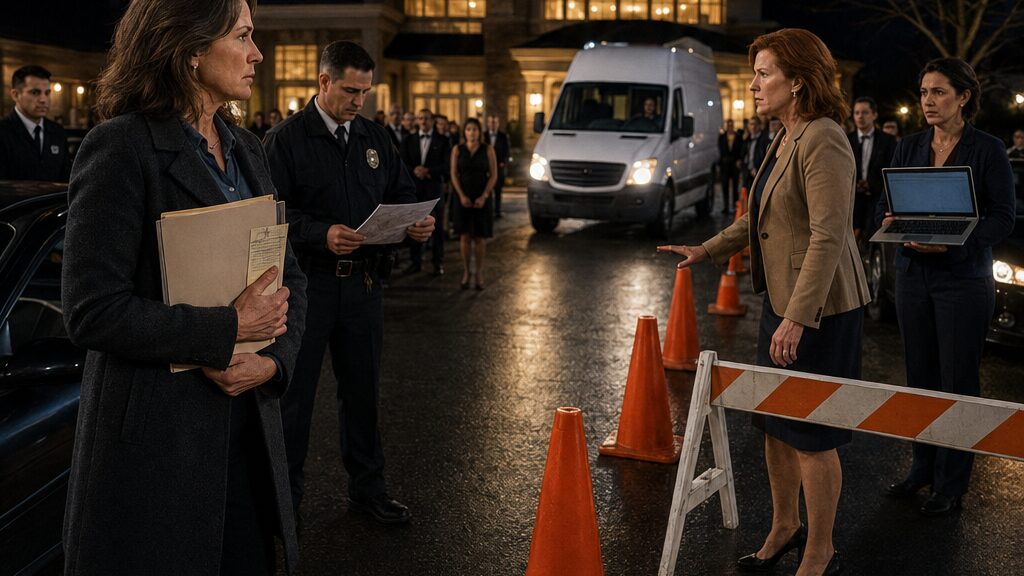
Rachel placed the first orange cone on the access strip as a line of black cars turned onto Birchwood Lane.
The dashboard clock in the lead sedan read 6:58.
Two valets in dark jackets watched her position the second cone. Behind them, the clubhouse windows glowed gold against the early winter dark. Guests moved inside carrying wine-auction cards and wrapped donations. A string quartet played somewhere beyond the glass.
The valet supervisor approached with one hand raised.
“Ma’am, you can’t put those there.”
Rachel unfolded the first barricade. “This is private property.”
“This is the clubhouse entrance.”
“Yes.”
He stared at her, waiting for the contradiction to resolve itself.
Rachel attached the notarized notice to the barricade with clear clips. The bold heading faced the arriving cars:
NOTICE OF SUSPENDED EASEMENT ACCESS.
She positioned the cones across the gala lane but left the narrower service lane open. Reflective tape marked it EMERGENCY ACCESS ONLY.
The first horn sounded.
Then a second.
Margaret emerged from the clubhouse without a coat. Her tan suit matched the warm light behind her, but her face did not.
“What are you doing?”
Rachel held out a certified copy of the deed.
“Enforcing the estate’s property rights.”
Margaret did not take it. “Move those barriers.”
“The association’s right of passage expired March thirty-first.”
“That matter is being handled.”
“No renewal was recorded.”
“We have continuous use.”
“You had a renewable easement. You signed two notices and allowed it to expire.”
Guests had begun lowering windows. A valet tried to wave the lead car toward the service lane.
Rachel stepped into his view. “Emergency vehicles only.”
Margaret pointed toward her. “This woman is a disgruntled resident. She is interfering with a charity event because the board denied a reservation.”
The words traveled down the waiting line.
A man in a tuxedo leaned from a car. “Can we get through or not?”
“Not through the private-event lane,” Rachel said.
Margaret turned on the valet supervisor. “Move the cones.”
He looked from her to the notarized notice. “I’m not touching anything until somebody confirms who owns this.”
“I am the HOA president.”
“And she has a deed.”
Margaret’s mouth tightened.
Rachel opened her folder. The original easement lay beneath the certified copy. Ruth’s recipe card remained clipped behind it, its grease-stained edge visible.
“You knew this was expiring,” Rachel said. “You received notice in January and March.”
“I receive hundreds of documents.”
“You signed for both.”
“That does not mean the board failed to act.”
“Then show the renewal.”
Margaret glanced toward the clubhouse doors. Angela stood there with two board members, all three visibly uncertain.
“Angela,” Margaret called, “tell her the renewal was approved.”
Angela did not answer.
The waiting cars now stretched past three houses. Neighbors had stepped onto porches. Some held phones, but no one cheered. The scene was too awkward for celebration.
Margaret walked close enough that only Rachel could hear her.
“You are humiliating yourself.”
Rachel thought of the nail through the funeral wreath.
“No,” she said. “I know exactly what this is.”
“You are blocking donors, vendors and elected officials because you didn’t get a room.”
“Because the association used land it no longer had permission to use while threatening my mother’s estate under rules you altered.”
Margaret’s face hardened. “People will lose services if you damage this gala.”
“Then convene the board.”
“Tonight?”
“Now.”
A police cruiser arrived without lights. The responding officer spoke first with Margaret, then with Rachel. He examined the deed, the recorder’s certification and the property map beneath the beam of his flashlight.
“I’m not deciding an easement dispute roadside,” he said. “But I’m also not removing barriers from land the county record identifies as belonging to the estate.”
Margaret folded her arms. “She is obstructing traffic.”
“So are the cars waiting to enter.” The officer looked at Rachel. “You need to keep a clear lane for emergency use.”
“It is marked.”
He inspected the service lane and nodded. “Nobody parks there. Nobody stands there. If an emergency vehicle comes, everything moves.”
Margaret gave a sharp, disbelieving laugh. “This is absurd.”
The sound of a horn rose from farther down the street, followed by several others.
Then Angela crossed the drive carrying a laptop and a paper folder.
“Margaret,” she said, “we need to talk inside.”
“Not now.”
“Yes. Now.”
Angela opened the folder. “There is no renewal resolution.”
Margaret’s expression did not change, but her shoulders became still.
“You haven’t reviewed the executive-session record,” she said.
“I did this afternoon.”
“Then you know it was approved.”
“The entry was added later.”
Rachel watched Angela’s hands. They were shaking.
Angela turned the laptop so the officer and the other board members could see. “The file history shows the minutes were edited in June. The original March version has no easement discussion. The current version says renewal authority was delegated to the president.”
Margaret’s voice dropped. “Close that computer.”
“I asked you about it. You told me the system timestamp was wrong.”
“It is.”
Angela removed a printed sheet. “The association’s cloud provider confirmed it.”
One of the board members stepped away from Margaret.
The shift was small, no more than two feet, but everyone saw it.
An engine rumbled at the end of the car line. Not a limousine. A white medical transport van edged around the stopped vehicles, its roof light flashing amber. The driver leaned on the horn and pointed toward the service lane.
“Patient pickup,” the driver called. “We need the rear entrance.”
The service lane led to the clubhouse loading door.
For one second, Rachel saw only the narrow strip on the map and Daniel’s warning: leave it open from the beginning.
Then the valet supervisor moved toward the lane, dragging a decorative rope stand out of the way. A guest had stepped into the marked area to take a photograph.
Rachel raised her voice.
“Clear the emergency lane. Now.”
She pulled the nearest cone aside, directed the officer to stop incoming cars, and walked ahead of the van to ensure the path remained open. The vehicle passed within inches of the barricade and continued behind the clubhouse.
A woman in the waiting line lowered her phone.
Margaret said, “You could have prevented all of this by contacting us properly.”
Rachel turned back. “I did.”
She held up the sent-email receipt.
“Yesterday at four thirteen. The association account opened it at four nineteen.”
Angela looked at Margaret.
Margaret said nothing.
The police officer spoke to both women. “The road cannot remain backed up. You either redirect the event or resolve access temporarily. I will not let anyone force through the barrier, and I will not let this become unsafe.”
Rachel looked toward the clubhouse.
Through the front windows, guests stood in clusters beneath white lights. On the wall behind the registration table hung the wooden plaque from Margaret’s office.
RULES ARE RULES.
Rachel had imagined this moment for days. Margaret stranded before her own event. The board unable to dismiss her. Every arriving guest seeing the cost of what had been done to Ruth.
The image had sustained her.
Now the medical van waited behind the building. Neighbors stood shivering on their porches. Valets were arguing with drivers who had nowhere to turn. The humiliation was real, but it had spread beyond the person Rachel intended to reach.
She opened Ruth’s folder.
The recipe card was clipped behind the easement letter. Its corner carried the note Daniel had read so many times:
Less sugar for Daniel.
Behind it lay Ruth’s final instruction.
The clubhouse cannot do anybody much good if people cannot reach it.
Rachel pressed her thumb against the paper.
“Call an emergency board meeting,” she said.
Margaret stared at her. “You do not dictate board procedure.”
“I dictate access across this parcel tonight.”
“You want money?”
“No.”
“The fines removed?”
“That is one condition.”
Margaret’s eyes narrowed. “How many?”
Rachel looked at Angela and the two board members.
“A recorded meeting. Open to residents. Right now. The board votes on interim access, an independent audit, preservation of all financial records and suspension of conflicted contracts pending review.”
“You prepared this.”
“Yes.”
“This was never about your mother.”
The accusation struck cleanly because part of it was true.
Rachel could have delivered the notice privately. She could have forced negotiations before the gala. She had chosen 6:58 because she wanted Margaret to feel the door close.
She looked through the glass at the plaque.
“It began with my mother,” Rachel said. “What happens next is about whether this room belongs to the neighborhood at all.”
Margaret glanced at the stalled cars and then at the board members who no longer stood beside her.
Angela closed the laptop.
“I call an emergency meeting,” she said. “As secretary and acting chair if the president refuses to address an immediate property-access issue.”
“You cannot appoint yourself acting chair,” Margaret said.
“One of us can move to suspend the chair for this agenda item,” a board member replied.
The valet supervisor approached Rachel. “What do I tell the drivers?”
Rachel moved one barricade far enough to create a single controlled entry lane.
“Tell them access is temporary and conditional. One car at a time. Keep the emergency lane clear.”
Margaret’s head snapped toward her. “You’re reopening it?”
“For the duration of the recorded meeting.”
“That is not your decision alone.”
Rachel handed the officer a written temporary license she had prepared.
“It is tonight.”
Inside the clubhouse, chairs were pulled from gala tables and arranged toward the board’s small platform. Guests who had come for an auction took seats beside residents arriving from their homes. The quartet stopped playing.
Rachel remained at the entrance until the last backed-up car had either entered or turned away.
Then she opened Ruth’s letter once more beneath the parking-lot light.
At the bottom, below the lines she had already read, Ruth had added one final sentence in smaller handwriting:
If they forget what the room is for, remind them—but leave them a way back in.
Rachel folded the letter along its old crease and walked toward the meeting carrying conditions she had not yet decided how to finish.
Chapter 7: What Rachel Chose to Leave Open
Rachel placed an unsigned renewal agreement on the board table.
The room had been rearranged in haste. Gala programs lay beneath folding chairs. Half-filled water glasses stood beside stacks of financial records. Beyond the closed doors, valets continued directing cars through the single temporary lane.
Margaret sat at the center of the table but no longer occupied the room as though it belonged to her. Angela had opened the association’s recording software. A red indicator glowed on the laptop screen.
Rachel rested Ruth’s recipe card beside the agreement.
“This is not a permanent easement,” she said. “It is a conditional renewal for five years.”
Margaret looked at the first page. “You expect the board to negotiate under duress.”
“I expect the board to address an access right it allowed to expire.”
“You created the emergency.”
“You received the notices.”
One of the board members cleared his throat. “The recording should reflect that the president signed both certified receipts.”
Angela entered the statement into the minutes.
Margaret turned toward her. “You are treating a clerical failure as misconduct.”
Angela’s hands paused above the keyboard. “The altered minutes were not clerical.”
Silence tightened around the table.
Rachel opened the renewal agreement.
“The estate will restore full access tonight if the board votes on four interim actions. First, all fines connected to Ruth Carter’s wake are suspended pending legal review. Second, the Hill Grounds contract is suspended while an independent auditor examines procurement and payment records. Third, all financial and board records are preserved. Fourth, the clubhouse adopts an equal-access rule for resident memorials and family gatherings.”
Margaret gave a thin smile. “You wrote policy for us too?”
“No. I wrote conditions for using the Carter property.”
A guest near the back shifted in his chair. Someone else whispered that the auction tables were still waiting. Rachel did not turn.
Margaret leaned forward. “You have told everyone here that money is missing. You have implied criminal conduct. But you know the reserve paid for the roof, the pumps and repairs residents refused to fund.”
“I know part of it did.”
“You know the association was weeks from a special assessment.”
“That does not authorize concealed accounts or conflicted contracts.”
“It authorized survival.”
“No,” Rachel said. “It required disclosure.”
Margaret looked around the room, seeking the familiar support of residents who preferred functioning lights to uncomfortable questions.
“We had owners behind on dues,” she said. “Insurance increased. The drainage work could not wait. Every time we discussed raising assessments, people threatened lawsuits or stopped paying. Someone had to make decisions.”
“You made some necessary decisions,” Rachel said. “Then you stopped believing anyone had the right to question them.”
Margaret’s gaze dropped to Ruth’s recipe card.
“That still does not explain this performance.”
Rachel almost answered with the deed. With the receipts. With the red stamp touching Ruth’s photograph.
Instead she said, “No. It doesn’t.”
The room shifted.
Rachel had spent weeks presenting facts because facts did not tremble. Now her voice did.
“My mother asked to use this room after living here forty-one years. I asked for one afternoon. You refused it, kept the deposit, and then fined the evidence that people came anyway.”
Margaret’s face remained controlled, but her fingers tightened around the agreement.
“You want to know why?” she asked.
Rachel waited.
“The board had approved private gala preparation in this building that weekend. Donor materials were already stored here. If we admitted the room was available for a memorial, residents would ask why certain committees and sponsors received access without appearing on the public calendar.”
Angela stared at her. “You told me the wake created an insurance issue.”
“It would have created several issues.”
“You targeted Rachel to protect an undisclosed reservation system,” Angela said.
Margaret’s composure cracked, not into anger but exhaustion.
“I protected the only fundraising event that covered programs people praise and refuse to pay for,” she said. “I told myself the wake could happen elsewhere. Then Rachel challenged the decision publicly, and every exception I had made became a threat.”
“So you issued the fines,” Rachel said.
“Yes.”
The answer was quiet.
Margaret looked toward Anthony, who stood near the wall with his work jacket folded over one arm.
“And I approved payments to my son’s company that should have gone through bids. He did the work. He did not create the numbers.”
Anthony lowered his eyes.
“I changed the invoices,” Margaret continued. “Not him.”
It did not absolve Anthony. He had accepted deposits he knew exceeded his bills. But Margaret’s admission placed responsibility where Rachel’s first theory had blurred it.
Angela called for motions.
The board suspended the memorial fines unanimously. The independent audit passed by three votes to one, Margaret abstaining after the HOA attorney advised her to do so. The contract suspension followed.
Then Angela asked about the renewal.
Rachel picked up Ruth’s letter.
“There is one more condition,” she said. “The clubhouse must remain available to residents under published standards. No private calendar. No unwritten exceptions. If access becomes selective again, the easement can be reviewed.”
Margaret read the clause.
“You could close it permanently.”
“Yes.”
“Why don’t you?”
Rachel unfolded Ruth’s letter and read only the final line.
“If they forget what the room is for, remind them—but leave them a way back in.”
No one applauded.
The absence mattered. It left the words where Ruth would have wanted them: not above the room, but inside it.
Rachel signed the agreement. Angela signed for the board after a formal vote. At 10:43 p.m., the valet supervisor removed the last barricade from the private-event lane.
The independent audit took eleven weeks.
It confirmed unauthorized transfers, altered minutes, improper procurement and overpayments to Anthony’s company. It also confirmed that the reserve had paid for a failing roof, pool repairs and emergency drainage work the neighborhood genuinely needed.
The board negotiated a repayment plan with Anthony based on the unsupported portion of the payments. His company lost the Maple Hollow contract. Margaret resigned before the findings were released, though her recorded statement prevented residents from placing every altered invoice on her son.
The audit also delivered an unwelcome number: dues had been kept artificially low for years.
At the spring meeting, residents approved an increase after two hours of argument. Nobody called it a victory.
Daniel joined the new open-records committee. Angela remained secretary and began posting draft minutes within seven days of every meeting. The memorial fines were voided, Rachel’s deposit was returned, and the handwritten plaque reading RULES ARE RULES disappeared from the clubhouse office.
Three months after the gala, Rachel used Ruth’s key to open the clubhouse kitchen.
She had reserved the room properly. The new public calendar showed her name, the time and the purpose:
Community welcome table.
Daniel measured flour while Angela greased loaf pans. Anthony delivered two folding tables and left before anyone could decide whether to ask him to stay.
Rachel followed Ruth’s recipe exactly until she reached the note about sugar.
“Less for Daniel,” she said.
“I’m not that old.”
“It’s in writing.”
He looked at the card. “Then I suppose rules are rules.”
Rachel glanced toward the office, where the old wooden plaque lay inside an open storage box.
“No,” she said. “That one was retired.”
The first loaf came out uneven, darker on one side and split along the top. Rachel set it on the cooling rack.
“Humble,” Daniel said.
This time Rachel understood.
Through the kitchen doorway, a new family entered the clubhouse carrying moving boxes and looking uncertain about where to stand. Rachel wrapped the loaf while it was still warm.
She left the easement agreement in the locked records cabinet.
The recipe card stayed in her hand.
The story has ended.