The Repair Bill Said He Caused The Mountain Crack Until His Old Records Changed Everything
Chapter 1: The Mountain Home Already Starting To Break
The first sound Eric Harris heard that morning was not an alarm, a phone call, or a warning.
It was the sound of his mountain beginning to come apart.
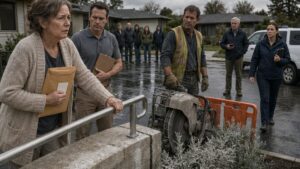
He stood behind the glass door of his kitchen and watched the excavator’s bucket disappear into the lower retaining wall beside the pool. The machine tore through concrete that had taken years to build, sending pieces of stone and wood down the slope in a cloud of gray dust.
For a moment, Eric could only stare.
The house across the narrow ravine had once been the kind of place people stopped to photograph. Dark timber beams. Floor-to-ceiling windows. A pool that seemed to float above the valley.
Now a yellow excavator was cutting into it like it was already abandoned.
His hand tightened around the edge of the folder sitting on the counter.
The folder had become heavier over the past month.
Not because of the paper inside.
Because of what those papers represented.
Warnings nobody wanted to hear.
He grabbed his jacket and stepped outside.
The mountain air was cold enough to sting his face. The sound of machinery echoed between the trees, making the quiet neighborhood feel unfamiliar.
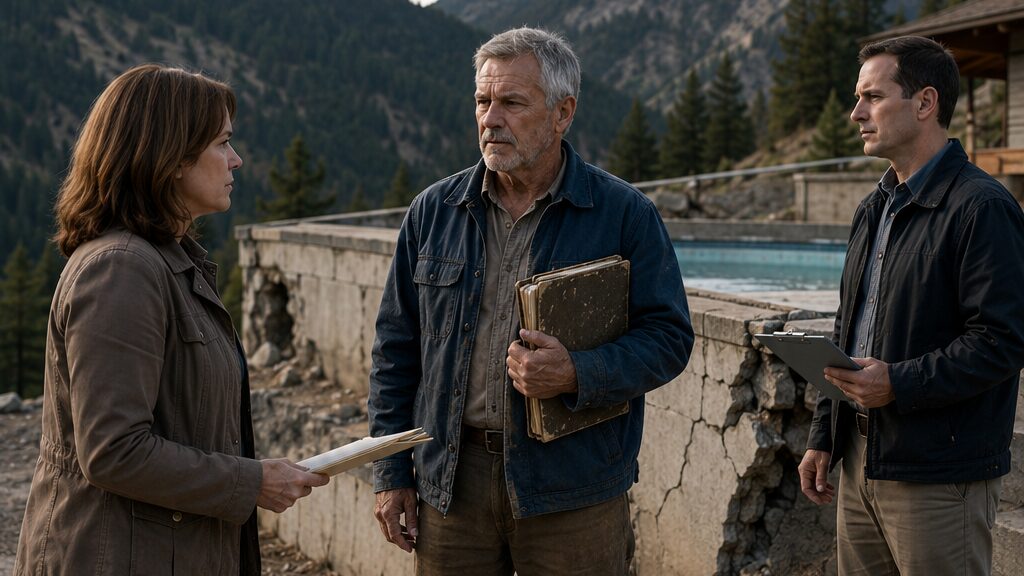
As he walked toward the boundary between his property and Kathleen Torres’s, he saw the damage clearly for the first time that morning.
The pool wall had split.
A dark crack ran down the concrete like a line drawn by someone with a ruler. Water poured through the opening, spilling over the edge and down the slope below.
Eric stopped several feet away.
He had imagined this moment many times.
Just never like this.
A month earlier, he had stood in the same place and told Kathleen the wall was moving.
He had shown her photographs.
He had pointed out the drainage problem.
He had suggested bringing in another engineer before the next heavy storm.
Kathleen had listened with the same expression she wore whenever she believed someone was exaggerating.
Now the crack was no longer a possibility.
It was a disaster.
“Eric.”
He turned.
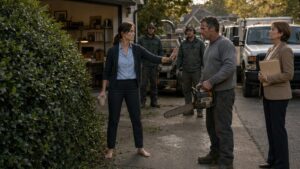
Kathleen stood near the driveway, wearing a bright jacket that looked too clean for the construction dust surrounding them. Her arms were crossed tightly.
Behind her, a contractor spoke with two workers beside the excavator.
“You need to stay back,” Kathleen said.
Eric looked from her to the damaged pool.
“I’m not near the equipment.”
“That’s not what I mean.”
Her voice carried across the property.
A worker glanced over.
Eric lowered his voice. “What happened?”
Kathleen gave a short laugh.
“What happened?”
The question sounded less like confusion and more like accusation.
“You know exactly what happened.”
Eric felt the familiar pressure of wanting to avoid an argument.
For years, he had learned that some disputes only grew when people fed them.
He had watched neighbors ruin friendships over fences, parking spaces, and property lines.
He had always believed facts lasted longer than anger.
But facts did not stop someone from speaking first.
“I warned you about the wall,” he said.
Kathleen’s expression hardened.
“You warned me that your side of the mountain was unstable.”
“That isn’t what I said.”
“That is what you implied.”
Eric looked back at the crack.
Water continued spilling through it.
“No,” he said quietly. “I told you the drainage system behind the pool was putting pressure on the wall.”
Kathleen stepped closer.
“And now my pool is damaged.”
Eric looked at her.
“My property is damaged too if that slope shifts.”
For a second, neither of them spoke.
Then Kathleen reached into her bag and pulled out a thick envelope.
The sight of it changed something.
Not because Eric knew what was inside.
Because he knew what kind of conversation started with an envelope.
“What is that?” he asked.
“A repair estimate.”
“From who?”
“The contractor who inspected everything.”
Eric looked toward the workers.
“You already hired someone?”
Kathleen’s eyes narrowed.
“I had to act.”
“You had to act after refusing an inspection.”
Her face tightened.
“Careful.”
Eric almost answered.
Almost.
Instead, he looked down at the folder in his own hand.
The old habit returned.
Stay calm.
Stay precise.
Do not let someone else decide what you meant.
“I want to see the estimate,” he said.
Kathleen shook her head.
“You don’t get to stand here and pretend this isn’t your responsibility.”
The words landed harder than he expected.
Not because he believed them.
Because he knew other people might.
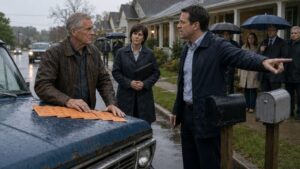
The mountain community was small. Everyone noticed everything. A disagreement between two homeowners never stayed between two homeowners.
A few minutes later, a neighbor walking past slowed down.
Then another person stopped near the road.
Kathleen noticed.
Her voice became louder.
“You caused the damage when you redirected water onto my property.”
Eric looked at her.
“That’s not true.”
“Then explain why my wall cracked.”
“Because the drainage problem was never repaired.”
Kathleen held up the envelope.
“This is going to cost more than eighty thousand dollars.”
The number hung between them.
Eric looked at the estimate in her hand.
Eighty thousand dollars.
A number large enough to make people stop asking questions.
Large enough to make people accept blame just to make the problem disappear.
Kathleen stepped forward.
“You can either handle this now, or I can involve insurance.”
Eric looked at the envelope.
Then at the cracked wall.
Then back at Kathleen.
A month ago, he might have tried to calm things down.
He might have offered to split the cost of another inspection.
He might have chosen peace over being understood.
But something had changed.
The accusation was no longer private.
“I will cooperate with an investigation,” he said.
Kathleen blinked.
“But I will not pay for something I didn’t do.”
Her expression changed.
Not anger.
Surprise.
As if she had expected resistance from the wall, not from him.
The contractor called something from behind her.
Kathleen ignored him.
“You’re making this difficult.”
Eric looked at the damaged structure.
“No.”
He held the folder against his side.
“I think this was difficult before today.”
The conversation ended without resolution.
But the situation did not.
By afternoon, Eric received an email from the insurance company.
A claim had been filed.
The accusation was official.
He opened the attachment.
His name was written beside the damage.
And for the first time, Eric understood that the problem was no longer just the crack in Kathleen’s wall.
It was the story being built around it.
Chapter 2: The Bill Delivered Before The Truth
The envelope was already waiting on Eric’s kitchen table when he returned home the next morning.
He had not heard Kathleen arrive.
That bothered him more than he expected.
Not because she had crossed the boundary.
Because it meant she was comfortable enough to believe the conversation was already decided.
Eric stood in the doorway, looking at the paper sitting beside his coffee cup.
A repair estimate.
His name handwritten across the top.
He did not touch it immediately.
Instead, he walked to the cabinet and removed the old folder.
The folder was worn at the corners. The color had faded from years of being carried between appointments, inspections, and conversations nobody wanted to remember.
He placed it beside the envelope.
Two versions of the same story.
One printed overnight.
One collected slowly.
A knock sounded.
Eric looked toward the door.
Kathleen stood outside.
“I need your answer,” she said.
Eric opened the door but stayed inside.
“My answer to what?”
“To the estimate.”
“You mean your demand.”
Her eyes narrowed.
“I’m trying to resolve this without making it worse.”
Eric almost smiled.
Not because it was funny.
Because he had heard those words before.
People often called something a resolution when they meant surrender.
“You brought me a bill before anyone determined responsibility.”
Kathleen stepped closer.
“Because we already know what happened.”
“No.”
Her face tightened.
“Yes.”
Eric looked at the envelope.
“You believe what happened.”
The distinction irritated her.
“Eric, you are making this complicated.”
“I’m asking for proof.”
“You have proof right there.”
She pointed toward the estimate.
Eric looked down.
“The estimate proves someone calculated a repair cost.”
Kathleen stared at him.
“It proves there is damage.”
“Yes.”
“And the damage is connected to your property.”
Eric shook his head.
“No. The damage is connected to a structure that was already showing signs of failure.”
The silence afterward felt heavier than the argument.
Kathleen looked past him and noticed the folder.
“What is that?”
Eric did not answer immediately.
Her expression changed slightly.
“You’ve been keeping records?”
“Yes.”
“Of me?”
“No.”
He paused.
“Of the problem.”
That answer seemed to bother her more.
Because it meant this was not an argument he had prepared for yesterday.
It was something he had been quietly watching for months.
Kathleen crossed her arms.
“So you’ve been collecting things instead of fixing it?”
The question struck a nerve.
Eric felt it.
The old frustration.
The accusation hidden inside another accusation.
“I reported it.”
“To whom?”
“To you.”
“That was a conversation.”
“It was also a warning.”
Kathleen shook her head.
“You think saving old papers makes you right?”
Eric looked at the folder.
“No.”
He opened it.
“It just makes sure nobody changes what happened.”
Inside were photographs.
Dates.
Inspection notes.
Messages printed from conversations.
Eric pulled out one photograph and placed it on the table.
The image showed the pool wall.
No dramatic crack.
No flooding.
Just a thin line running through the concrete.
Kathleen glanced at it.
“That proves nothing.”
“It proves the damage started before yesterday.”
She looked away.
Only for a second.
But Eric noticed.
That was the first moment he understood something important.
Kathleen was not surprised by the photograph.
She was surprised he had it.
“You still owe for the repair,” she said.
Eric placed the photograph back into the folder.
“I won’t sign anything saying I caused damage.”
Kathleen’s voice lowered.
“You realize what happens next?”
“Yes.”
“Insurance gets involved.”
“Yes.”
“People start asking questions.”
Eric closed the folder.
“I know.”
For the first time, Kathleen looked uncertain.
Not defeated.
Not convinced.
Just uncertain.
Then her expression hardened again.
“Fine.”
She stepped back.
“Let them ask.”
After she left, Eric sat at the kitchen table for a long time.
The folder remained open.
The first photograph rested on top.
He had spent years believing that keeping records was enough.
That if something was true, eventually people would see it.
But now he wondered if truth had to be carried further.
His phone rang.
He answered.
“Eric Harris?”
“Yes.”
“This is Mark Wright with the insurance review office.”
Eric looked toward the folder.
“Okay.”
“We received the claim regarding the mountain pool damage.”
Eric waited.
“We need your written statement.”
“When?”
“As soon as possible.”
There was a pause.
Then Mark added:
“Mr. Harris, I should tell you something.”
Eric sat straighter.
“What?”
“The claim file contains a contractor report.”
“And?”
“The report says the failure may have started from activity on your side of the property.”
Eric looked back at the photograph.
The thin crack.
The one nobody wanted to discuss.
“What contractor wrote that?”
Mark paused.
“I’m sending you the report.”
The call ended.
A few seconds later, Eric’s phone showed a new message.
A document was waiting.
And for the first time, Eric wondered whether the records he had saved were enough.
Chapter 3: The Records Hidden Inside The Old Folder
The contractor report was three pages long.
Eric read it once.
Then again.
The second time, he read it slower.
The words were careful.
Professional.
Almost impossible to argue with if someone only looked at the conclusion.
“Possible contribution from adjacent property activity.”
Possible.
Contribution.
Adjacent.
Three words that could turn uncertainty into blame.
Eric placed the paper beside his folder.
The difference between them was not just information.
It was intention.
The report described what someone suspected.
The folder contained what had happened before the suspicion existed.
He carried both outside.
The crack in the pool wall was larger than it had been two days earlier.
Water continued leaking through the damaged section.
The mountain did not care who people blamed.
It only responded to pressure.
Eric walked along the edge of his property and looked toward the drainage area.
That was where the problem had always been.
Not the surface.
Not the visible crack.
The water underneath.
His phone rang.
Mark Wright.
Eric answered.
“I saw the report.”
“I assumed you would.”
“Did the contractor inspect the drainage system?”
A pause.
“I’m not sure.”
“That should have been the first thing.”
Mark’s tone changed slightly.
“You believe the report is incomplete.”
“I believe it answers the easiest question.”
“What does that mean?”
“It asks who is closest to the damage.”
Eric looked toward Kathleen’s house.
“It does not ask what caused it.”
Mark did not respond immediately.
That silence told Eric something.
The inspector was listening.
“I need everything you have,” Mark said.
Eric looked at the folder.
“I have photographs.”
“Anything else?”
“Messages. Notes. Inspection records.”
“Send them.”
Eric hesitated.
For years, he had kept those records because he wanted to avoid exactly this kind of fight.
Now he was using them because avoiding the fight had not protected him.
“I’ll send them.”
After the call, Eric returned inside.
He spread the documents across his table.
The folder was no longer just a record of warnings.
It was a timeline.
The first inspection.
The first conversation.
The first request for a drainage review.
The unanswered message.
The second warning.
Then he stopped.
Something was missing.
Eric searched through the pages again.
Then again.
The engineering note from the spring inspection was not there.
He remembered holding it.
He remembered placing it into the folder.
But it was gone.
His stomach tightened.
Someone had removed a page.
Or he had misplaced it.
Either possibility bothered him.
Because the missing page was the one that connected everything.
He called the inspection company.
No answer.
He left a message.
Then he heard a vehicle outside.
Eric looked through the window.
A truck had stopped near Kathleen’s property.
The contractor stepped out.
He was carrying a clipboard.
Eric walked outside.
“What are you doing?”
The contractor looked over.
“Checking the damage.”
“Without telling me?”
The man shrugged.
“Kathleen hired us.”
Eric glanced toward the clipboard.
“What are you writing?”
“Observations.”
“About what?”
The contractor looked at the cracked wall.
“About how this happened.”
Eric felt his patience thinning.
“Before you write that, you should review the earlier reports.”
The contractor gave him a tired look.
“Mr. Harris, I’ve already reviewed enough.”
“Have you?”
“Yes.”
The answer came too quickly.
Eric noticed.
“So you saw the drainage records?”
The contractor looked away.
Only briefly.
But again, Eric noticed.
A small hesitation.
A missing piece.
The contractor closed the clipboard.
“Insurance will decide.”
“No.”
Eric looked at the damaged wall.
“Insurance decides based on what people give them.”
The contractor did not answer.
That evening, Mark called again.
Eric knew from his voice that something had changed.
“I reviewed the documents you sent.”
“And?”
“There is a problem.”
Eric gripped the phone.
“What problem?”
“The contractor report references an earlier inspection.”
Eric looked toward the folder.
“The one I’m missing?”
“Yes.”
His heart sank.
“Where did you find it?”
Mark paused.
“Mr. Harris, I didn’t find the original.”
Eric closed his eyes.
“Then what did you find?”
“A copy.”
The room went quiet.
“Where?”
“In the contractor’s old project file.”
Eric looked toward the dark window facing Kathleen’s property.
The mountain was quiet now.
But the story around it was not.
“Mark,” Eric said, “what does the copy say?”
The inspector’s answer came slowly.
“It says the drainage issue was identified before the crack became dangerous.”
Eric held the phone tighter.
“And who received that report?”
Another pause.
Then Mark said:
“Kathleen Torres.”
Eric looked at the folder sitting open on the table.
The missing page was no longer just missing.
Someone had known it mattered.
And now Eric had to find out why.
Chapter 4: The Repair Decision Nobody Wanted Remembered
The inspection team arrived before Eric had finished his first cup of coffee.
He saw the vehicles through the window and immediately knew the day would not be about opinions anymore.
It would be about what people could prove.
Mark Wright stepped out first, carrying a small case and a tablet. Behind him came an engineering technician and, a few minutes later, Kathleen walked down from her property wearing the same confident expression she had worn when she delivered the repair estimate.
Eric noticed something different, though.
She kept looking at Mark.
Not at the damaged wall.
Not at the water.
At Mark.
She was watching for an answer before the inspection even began.
Mark approached Eric.
“Thank you for meeting us.”
Eric nodded.
“I want this handled correctly.”
“That is what we’re here for.”
Kathleen joined them.
“I hope this doesn’t take all day.”
Mark looked toward the cracked pool structure.
“Given the damage, I expect it will take as long as necessary.”
Kathleen pressed her lips together.
Eric said nothing.
The old version of himself would have tried to make everyone comfortable.
He would have softened his words.
He would have explained that he was not trying to accuse anyone.
But standing beside the broken wall, he realized something.
Every time he avoided making someone uncomfortable, someone else had filled the silence with their own version of events.
The technician began photographing the damage.
The crack.
The surrounding slope.
The drainage channels.
The areas where water collected after storms.
Mark walked slowly around the property.
After several minutes, he stopped near the back edge of the pool.
“This area was modified recently?”
Kathleen answered quickly.
“The landscaping was updated.”
“By whom?”
“A contractor.”
“Before or after the first signs of cracking?”
Kathleen looked at him.
“I don’t understand the question.”
Mark turned toward her.
“The report references concerns about drainage pressure.”
Kathleen’s face changed slightly.
“Concerns are not failures.”
“No,” Mark said. “They are not.”
He looked down at his tablet.
“But they can become failures if they are ignored.”
The silence that followed was uncomfortable.
Eric watched Kathleen.
For the first time, she did not immediately have an answer.
The technician continued taking measurements.
Eric walked back toward his house to retrieve the folder.
When he returned, Mark was standing near the damaged wall.
Eric handed him several pages.
“The inspection notes.”
Mark scanned the first page.
Then the second.
His expression became more serious.
“This is the spring report?”
“Yes.”
“Where is the original?”
Eric looked at the empty space inside the folder.
“I don’t know.”
Mark looked at the copy.
“Did Kathleen receive this?”
“Yes.”
“Did she respond?”
Eric hesitated.
That question was harder.
Because the answer was not just a document.
It was a memory.
“She said she would consider options.”
Mark looked up.
“And?”
“And nothing happened.”
Kathleen stepped closer.
“That is not what happened.”
Everyone turned.
She pointed toward the papers.
“You’re leaving out the rest.”
Eric looked at her.
“What rest?”
“The part where you kept telling me the situation was dangerous because you wanted me to pay for improvements on my property.”
The accusation surprised even Eric.
Not because it was new.
Because she had turned the warning into a motive.
“You think I wanted this?”
Kathleen looked away.
“I think you wanted control.”
The words stayed between them.
Mark watched both of them.
Then he asked:
“Did Eric ever request money from you?”
Kathleen hesitated.
“No.”
“Did he threaten legal action?”
“No.”
“Did he benefit financially if your wall failed?”
The hesitation lasted longer.
“No.”
Mark looked back at the papers.
That answer mattered.
Because a warning and a profit motive were not the same thing.
Eric felt the familiar urge to defend every detail.
To explain.
To prove.
Instead, he stopped.
The documents were there.
The facts did not need him to chase every accusation.
Mark continued reading.
Then he found something.
A page near the bottom.
“This date.”
He tapped it.
Kathleen looked over.
“What?”
“This recommendation.”
Mark turned the page toward her.
“Was this discussed with you?”
Kathleen stared at the paper.
“It was a preliminary suggestion.”
“It says emergency stabilization was recommended before additional water pressure developed.”
Kathleen’s expression hardened.
“Recommended does not mean required.”
“No,” Mark said.
He lowered the paper.
“But refusing a recommendation is also a decision.”
Eric looked at the page.
There it was.
The missing connection.
Not the final answer.
But enough to change the shape of the story.
The damage was no longer just a question of who lived beside the wall.
It was a question of what happened after someone knew the wall was at risk.
Kathleen looked at Eric.
“You’re happy about this?”
Eric almost answered.
Then he stopped.
Because he was not happy.
The pool was still broken.
The mountain was still unstable.
Even if he was right, nobody was winning.
“No,” he said quietly.
“I’m tired of being blamed.”
For the first time, Kathleen had no immediate response.
Later that afternoon, Mark called Eric after reviewing the inspection notes.
“We found something important.”
Eric stood beside his kitchen table.
“What?”
“The insurance claim needs to be reopened.”
Eric looked toward the folder.
“Because of the report?”
“Because of the timeline.”
A pause.
Then Mark added:
“There is a signature on the original stabilization recommendation.”
Eric frowned.
“A signature?”
“Yes.”
“Whose?”
Mark’s voice became careful.
“Kathleen Torres.”
Chapter 5: The Cost Of Letting The Crack Grow
By the time the insurance review reopened, the neighborhood had already chosen sides.
Eric learned that quickly.
People did not wait for reports.
They waited for explanations that fit what they already believed.
Some neighbors stopped speaking when he walked by.
Others suddenly became very interested in asking questions.
The most common one was always the same.
“Is it true you were responsible for the damage?”
Eric stopped hearing the curiosity in the question.
He heard the accusation underneath it.
The morning the demolition crew arrived, he stood at the edge of his property and watched the excavator prepare to remove the damaged structure.
The same machine.
The same slope.
A different feeling.
Weeks earlier, the machine had looked like evidence that he had failed.
Now it looked like proof that something had gone wrong long before anyone wanted to admit it.
Mark arrived carrying a folder.
Not Eric’s folder.
A different one.
“The insurance review is moving forward,” Mark said.
Eric nodded.
“What did they find?”
Mark looked toward Kathleen’s property.
“The contractor’s original file contained more information.”
Eric waited.
“Why didn’t it appear in the first report?”
Mark did not answer immediately.
That answer was complicated.
“The first report focused on the damage location.”
“And the second?”
“The second focused on the timeline.”
Eric looked at the cracked wall.
“What changed?”
Mark opened the folder.
“The contractor inspected the drainage system before the failure.”
Eric felt his jaw tighten.
“And?”
“They documented the same concern you reported.”
The words were quiet.
But they carried weight.
For weeks, Eric had been trying to prove something simple.
Not that Kathleen was a bad person.
Not that she deserved what happened.
Only that the story being told about him was wrong.
A group of workers moved equipment nearby.
The sound of metal against stone filled the air.
Mark continued.
“There is also a signed recommendation.”
Eric already knew.
“Kathleen.”
Mark nodded.
“She approved receiving the report.”
Eric looked down.
“She knew.”
Mark did not answer.
He did not need to.
A person could know something and still convince themselves it was not serious.
That was what made the situation difficult.
Kathleen approached before Eric could say anything else.
Her face looked different.
Not softer.
Just more tired.
“Mark.”
He turned.
“I need to talk to you.”
“We can talk when the review is complete.”
Kathleen looked at Eric.
“This has gotten out of control.”
Eric almost laughed.
Almost.
Because that sentence sounded so different from the one she had used before.
Back then, he was making things difficult.
Now things were out of control.
“I agree,” Eric said.
Kathleen looked surprised.
Then frustrated.
“You know what I mean.”
Eric looked at the damaged property.
“I think I do.”
She lowered her voice.
“You’re making it sound like I ignored everything.”
Eric looked at her.
“Didn’t you?”
Her expression tightened.
“I was trying to make the right decision.”
That answer caught him off guard.
Because it sounded honest.
Not defensive.
Honest.
Kathleen looked toward the broken structure.
“I had already spent so much on that property.”
Eric said nothing.
“My husband and I built that place years ago.”
The words came out slowly.
“He passed away. After that, every repair felt like another reminder that I couldn’t keep everything the way it was.”
Eric had never heard that before.
He had only seen the confident neighbor.
The woman with the estimate.
The person pointing at him.
He had not seen the fear behind it.
Kathleen continued.
“When the engineer said the stabilization would cost what it did, I thought I had time.”
Eric looked at the wall.
“How much time?”
She did not answer.
That was answer enough.
The problem was not that Kathleen had never known.
The problem was that she had hoped knowing would be enough.
Mark stepped closer.
“Kathleen, the claim cannot continue as written.”
She looked at him.
“Why?”
“Because the evidence does not support Eric being responsible for the original failure.”
The words were simple.
But they changed everything.
Kathleen looked at Eric.
For a moment, he thought she might apologize.
Instead, she looked away.
The demolition continued.
Piece by piece, the damaged structure disappeared.
Eric stood there watching.
He had wanted the truth.
He had fought for the truth.
But seeing the mountain property reduced to fragments did not feel like victory.
It felt like arriving at the answer too late.
That evening, Eric returned home and placed the folder on the table.
For years, he had thought the folder was proof that he remembered correctly.
Now he understood something else.
It was proof that everyone had a moment when they could have chosen differently.
His phone rang.
Kathleen.
Eric stared at the screen.
He almost let it go.
Almost.
Then he answered.
“Hello?”
There was silence on the other end.
Then Kathleen said:
“Eric, I need to talk to you.”
He looked out the window toward the dark outline of the damaged property.
“About what?”
Her voice was quieter than he had ever heard.
“About what happens next.”
Chapter 6: The Neighbor Who Would Not Sign Away The Truth
The settlement papers arrived with one sentence highlighted.
Eric refused to sign.
He placed the documents back on the table and looked at the folder beside them.
For months, everything had come down to paper.
Reports.
Estimates.
Claims.
Warnings.
Forms asking him to accept a version of events he knew was wrong.
Now there was one more document.
One more decision.
Mark sat across from him.
“The insurance company is withdrawing the claim against you.”
Eric nodded.
He had expected relief.
Instead, he felt mostly tired.
“Does that mean Kathleen is responsible?”
Mark looked carefully at him.
“It means responsibility is being reassessed.”
Eric smiled slightly.
“Careful answer.”
“It is the accurate answer.”
That was why Eric trusted him.
Mark did not offer comfort by pretending things were simpler than they were.
He offered facts.
The final review meeting was held at the insurance office.
Kathleen sat across from Eric.
The first time they had been in the same room without shouting.
She looked older.
Not physically.
Emotionally.
The confidence she carried during the first accusation was gone.
A representative reviewed the findings.
“The claim against Eric Harris cannot be supported by the available evidence.”
Kathleen looked down.
“The original failure was connected to drainage issues and delayed stabilization.”
Nobody spoke.
The sentence was what everyone had been avoiding.
Not that Kathleen destroyed her own property.
Not that she intended harm.
Only that choices had consequences.
After the meeting, Kathleen stopped Eric near the exit.
“I owe you an apology.”
Eric looked at her.
She took a breath.
“I thought if I could prove someone else was responsible, I wouldn’t have to admit I missed something.”
Eric did not respond immediately.
Because that was the first honest thing she had said to him.
“I understand fear,” he said.
Kathleen looked surprised.
“But fear doesn’t change what happened.”
She nodded.
“I know.”
Outside, the mountain was quiet.
The damaged structure was gone.
The accusation was gone.
But not everything could be repaired.
Kathleen looked toward the empty space where the pool had been.
“I keep thinking about the first time you showed me those pictures.”
Eric looked at her.
“You thought I was trying to control you.”
“Yes.”
“And now?”
She looked down.
“Now I think you were trying to warn me.”
Eric accepted the answer.
Not because it fixed anything.
Because it was true.
When he returned home, he placed the folder in a drawer.
Not hidden.
Not displayed.
Just stored.
For a long time, he had carried it everywhere because he believed the next person might demand proof.
Now he knew something different.
Sometimes protecting the truth meant being willing to show it.
But sometimes it also meant knowing when to stop carrying the fight.
A week later, Eric received one final message from the insurance office.
The claim was officially closed.
No payment owed.
No responsibility assigned to him.
His name cleared.
He read the message once.
Then closed his phone.
The result was what he had wanted.
But the feeling was not what he expected.
Because winning against a false accusation did not restore everything that had been lost.
The mountain still had scars.
The neighbors would still remember the argument.
And some things could not return to the way they were before.
Eric walked outside and looked toward the damaged property.
The cracked wall was gone.
But the lesson remained.
Truth could survive pressure.
But only if someone refused to surrender it.
Chapter 7: The Home That Survived The False Claim
The first thing Eric noticed when he returned to the mountain property was what was missing.
The sound.
For months, there had always been something.
A machine running.
A truck arriving.
A contractor explaining.
A phone ringing.
A voice telling him what he was responsible for.
Now there was only silence.
Eric stood near the edge of his driveway and looked across the slope where Kathleen’s pool had once been. The structure was gone. The damaged wall had been removed. The ground had been stabilized enough to prevent another immediate failure.
But the empty space remained.
A reminder that being right did not mean nobody lost anything.
He walked back toward his house and opened the garage.
The folder was on the shelf.
He had placed it there three months earlier.
For a while, he thought he would never want to see it again.
The worn corners.
The faded tabs.
The photographs that had become the center of an argument he never wanted.
He picked it up.
The weight felt different now.
Not lighter.
Just different.
The folder had started as something he carried because he was afraid nobody would believe him.
Now it was something he kept because it reminded him that silence had a cost.
Eric sat at his workbench and opened it.
The first photograph showed the pool wall before the major crack appeared.
A small line.
Almost invisible.
A problem that could have been handled.
The next page showed his written warning.
Then the inspection notes.
Then the recommendation Kathleen had signed.
He looked at that page for a long time.
For weeks, he had been angry at her.
And he had a reason.
She had blamed him.
She had demanded money.
She had allowed people to believe a story that was not true.
But the longer he looked at the documents, the more complicated the truth became.
Kathleen had not ignored the problem because she wanted the damage.
She had ignored it because she believed there would be more time.
Eric understood that mistake more than he wanted to admit.
He had made his own version of it.
He had believed that if he stayed calm enough, people would eventually recognize the truth.
He had waited for facts to speak before realizing someone else was already speaking louder.
A knock came at the door.
Eric closed the folder.
When he opened it, Kathleen stood outside.
She looked toward the garage.
“I hope I’m not bothering you.”
Eric stepped aside slightly.
“What do you need?”
She held a small envelope.
“Something to give you.”
He looked at it.
“What is it?”
“The final paperwork.”
Eric accepted it but did not open it.
“The claim?”
“Yes.”
He nodded.
“I received confirmation.”
Kathleen looked down.
“I know.”
For a moment, neither of them spoke.
The distance between them felt larger than the physical space between their houses.
“I wanted to tell you something,” Kathleen said.
Eric waited.
“I was wrong about the damage.”
He listened.
“But I was also wrong about you.”
That surprised him.
Kathleen looked toward the mountain.
“When you first came over with those photographs, I thought you were trying to protect yourself.”
Eric said nothing.
“I thought you were looking for a reason not to help.”
“And now?”
She gave a small, tired smile.
“Now I think you were the only person trying to stop this from happening.”
Eric looked away.
He did not need the apology to prove anything.
But he realized he had wanted it.
Not because he wanted Kathleen to feel bad.
Because he wanted the truth to exist between them.
“I should have listened sooner,” she said.
Eric nodded.
“Yes.”
The honesty of his answer seemed to surprise her.
He continued.
“But I should have pushed harder.”
Kathleen looked at him.
“What?”
“I kept thinking the reports would be enough.”
He glanced toward the folder.
“I thought if I stayed reasonable, nobody could twist what happened.”
A quiet moment passed.
“But they did,” he said.
Kathleen nodded slowly.
“That’s why you kept fighting.”
“No.”
Eric looked back at the empty slope.
“That’s why I finally stopped avoiding it.”
Kathleen accepted that.
Maybe because it was true.
She did not ask him to forget.
She did not ask him to forgive immediately.
She only stood there for another moment before leaving.
That was enough.
Later that afternoon, Eric walked down toward the repaired section of his property.
The mountain still carried the marks of what happened.
Fresh supports.
New drainage work.
Areas where the ground looked different from before.
But his home remained.
Not because he had won a fight.
Because he had refused to accept a lie.
His phone buzzed.
A message from Mark.
The claim review was officially closed.
No payment owed by Eric Harris.
No responsibility assigned to him.
He read the message once.
Then put the phone away.
For months, he had imagined this moment.
He thought it would feel like a victory.
Instead, it felt quiet.
The kind of quiet that comes after something heavy finally leaves.
Eric returned to the garage and placed the folder back on the shelf.
Not hidden.
Not displayed.
Just kept.
He no longer needed to carry it everywhere.
He had already learned what it was meant to teach him.
Records mattered.
Truth mattered.
But sometimes the hardest part was not proving what happened.
It was finding the courage to stand there when everyone else wanted the easier answer.
Eric closed the garage door and looked once more toward the mountain.
The crack was gone.
The accusation was gone.
The relationship was changed forever.
But his