They Ordered Him to Remove One Flag, Then the Whole Neighborhood Opened Its Files
Chapter 1: The Notice Waiting on the Red Door
“Would you prefer the fines delivered daily or weekly?”
Gregory Clark stood beneath Daniel Harris’s flagpole as though he had come to discuss lawn service. The American flag moved once in the thin late-afternoon breeze, its lower edge lifting above Gregory’s pink Pinewood Estates polo and settling again.
Daniel remained on the top step of his porch. He had not yet removed his work shoes. His briefcase rested beside the red front door, and a cream-colored notice had been wedged under the brass knocker.
“I wasn’t aware those were the options,” Daniel said.
Gregory smiled. “I’m trying to be reasonable.”
Across the driveway, Elizabeth Clark held her phone upright at chest level. She had not greeted Daniel. The camera lens faced him.
Daniel looked from the phone to Gregory. “Are you recording this?”
“Just documenting the conversation,” Elizabeth said. “For accuracy.”
Her thumb moved over the screen.
Gregory pointed toward the flagpole. “The architectural committee reviewed the installation. It’s inconsistent with community aesthetic standards. The pole needs to come down by morning.”
“The pole has been there six years.”
“The board received complaints.”
“How many?”
“That isn’t relevant.”
Daniel descended one step and took the notice from the door. The paper was heavier than ordinary printer stock. A gold seal had been embossed at the top above the words PINEWOOD ESTATES COMMUNITY ASSOCIATION. Someone had chosen a typeface designed to resemble a courthouse inscription.
Below that, in bold, was a demand for removal before 8:00 a.m. The notice threatened an initial fine of two hundred dollars, followed by daily penalties.
Daniel read it once without moving his expression.
Gregory watched for a reaction. “We’ve been flexible about flags on porches. A full pole is different. It dominates the streetscape.”
“It’s twenty feet from the sidewalk.”
“It creates a visual imbalance.”
Daniel’s eyes reached the paragraph beneath the fine schedule. The notice cited Article Seven of the design rules, then referred vaguely to “applicable county standards” without naming a section, ordinance, setback, or height restriction.
He had spent thirty-one years reading documents written to sound stronger than they were. The weakest ones often had the most decorative borders.
“Which county standard?” he asked.
Gregory’s smile tightened. “The county doesn’t permit unrestricted permanent structures in front setbacks.”
“That isn’t a citation.”
“You work in law, Daniel. You understand that the board doesn’t need to litigate every instruction on someone’s doorstep.”
“I’m a paralegal.”
“Exactly. Then you know how expensive these things become.”
Elizabeth angled the phone slightly higher.
Daniel folded the notice once along its center. “Thank you for bringing it to my attention.”
Gregory glanced at Elizabeth, a quick flicker of satisfaction passing between them.
“So it’ll be removed?” he asked.
“I said I received the notice.”
“That isn’t the same answer.”
“It’s the answer I have for you.”
Gregory stepped closer to the porch. He wore an expensive watch that caught the light each time he moved his hand. “I’d hate for this to become adversarial. Property values depend on consistency. People move here because Pinewood looks controlled.”
Daniel slipped the folded notice into his jacket pocket.
The word controlled stayed between them.
His father had once received a letter with similar weight and similar confidence from a small-town land company in western Pennsylvania. It had informed him that an access lane crossing the family’s property belonged to someone else. His father had believed the seal, the legal phrases, and the signature block. By the time Daniel found an attorney willing to examine it, equipment had already widened the lane and removed half the orchard fence.
Daniel had been twenty-six. Old enough to know better, he had told himself for years.
He looked up at the flag. It had belonged to his father, though not in any ceremonial sense. His father had flown it beside a cinder-block garage until sun and weather had worn the first one thin. This was its replacement, folded and given to Daniel during the final cleanout of the house.
Gregory followed his gaze.
“Honestly,” he said, lowering his voice as if offering private advice, “it’s simply too patriotic for the scale of this neighborhood.”
Elizabeth gave a short laugh before she stopped herself.
Daniel looked at him.
Gregory’s expression changed just enough to show he knew the sentence had landed badly.
“What I mean,” he said, “is that it reads as a statement rather than decoration.”
“It is a flag.”
“Everything visible from the street makes a statement.”
Daniel let the silence extend. He had learned in depositions that people often became frightened by pauses and rushed to fill them.
Gregory did.
“The board has authority here. We’re trying to spare you the hearing process.”
“And the county supports this?”
“I already told you that.”
“No. You referred to the county.”
Gregory’s jaw shifted. “Eight tomorrow morning.”
Elizabeth lowered her phone. “I’ll let the neighborhood page know the matter is being resolved.”
“You’ll do what you think is appropriate,” Daniel said.
The answer seemed to please her. Perhaps she heard surrender in it. Gregory certainly did. He gave Daniel a neighborly pat on the upper arm, a gesture Daniel did not return, then walked with Elizabeth across the street toward their house.
Daniel stayed on the porch until their front door closed.
Inside, he placed his briefcase on the dining table and unfolded the notice under the pendant light. The gold seal glimmered when he tilted the page. Article Seven existed; he remembered the section generally. It gave the board authority over accessory structures but also required published standards and reasonably uniform enforcement.
The phrase about county requirements was unsupported.
The fine schedule was another problem. Pinewood’s governing documents required notice and an opportunity to be heard before continuing penalties could begin. The cream paper skipped directly from allegation to punishment.
Daniel went to his home office and pulled the association binder from the lower shelf. It had not been opened in years. He preferred Pinewood that way—dues paid automatically, shrubs trimmed, conversations limited to driveway greetings.
His work already involved clients who arrived angry, frightened, and convinced every inconvenience was unconstitutional. He reviewed deeds, easements, notices, survey disputes, and municipal records all day. He did not want to become the neighborhood’s free legal help at night.
He compared the rule to the notice and marked three lines with a pencil. Then he opened the county zoning portal and searched accessory structures, flagpoles, residential setbacks.
Nothing matched Gregory’s claim.
His phone lay beside the keyboard. A red indicator showed several unheard voicemails. Most were automated reminders and old calls he had never deleted. While searching for a number at the county, he brushed the voicemail icon.
A message began playing from four months earlier.
“Daniel, it’s Mary Allen from down the street.”
His hand stopped.
Mary’s voice was careful, almost apologetic.
“I know you said you don’t handle association matters outside work, and I understand. I just received another notice about the garden border. It looks official, but the wording doesn’t make sense to me. It says they can start adding fines every day. I was hoping you might look at one page. Just tell me whether I’m reading it wrong.”
There was a pause on the recording.
“The paper is cream-colored. Gold seal at the top.”
Daniel looked at the notice lying open beside his hand.
Mary’s message continued.
“Please call when you have a minute.”
The voicemail ended.
Daniel had never called her back.
Chapter 2: Three Calls Before the Sun Went Down
“The county never issued that rule.”
Sandra Rivera’s voice came through Daniel’s office speaker at 5:14 p.m., brisk and measured. Keyboard clicks sounded behind her.
Daniel stared at Gregory’s notice. “You’re certain?”
“I’m looking at the current residential table now. A freestanding flagpole under the specified height can be placed in a front yard if it meets sight-distance and utility-clearance requirements. Yours was permitted when installed, correct?”
“I have the approval.”
“Then county zoning isn’t ordering its removal.”
“Would you put that in an email?”
Sandra stopped typing.
“I can clarify the county requirements,” she said. “I cannot decide whether your private covenants impose additional restrictions.”
“I’m not asking you to.”
“You would be surprised how often people are asking exactly that while saying they aren’t.”
Daniel almost smiled. Sandra had been a records clerk when he first met her through a case fourteen years earlier. She had since become a zoning compliance officer and grown even more careful with verbs.
“I only need confirmation that the county standard cited in this notice does not exist.”
“Send me the page. I’ll respond before I leave.”
“Thank you.”
“And Daniel?”
“Yes?”
“Don’t write that the county approved your dispute with the association. We approved the pole.”
“I understand the difference.”
“I know you do. Your board president may not.”
After the call, Daniel scanned the notice and sent it to her. Then he opened Pinewood’s recorded declaration, design handbook, enforcement policy, and the minutes from the previous twelve board meetings.
The board could regulate location, size, lighting, and maintenance of exterior displays. It could not impose an unwritten preference as though it were an adopted standard. More important, its enforcement policy required a warning period and a hearing before daily fines.
He marked those provisions and drafted a response that used no adjectives.
At six, he called Joseph.
His brother answered over the hollow clang of something metal striking concrete.
“You caught me reorganizing,” Joseph said.
“You’ve been reorganizing that garage since 2009.”
“That’s how I know where everything is.”
“I need to borrow some flags.”
A pause.
“How many is some?”
“Five.”
The metal noise stopped.
Joseph said, “Start at the beginning.”
Daniel gave him the shortest version: the notice, the deadline, Gregory’s county claim, Elizabeth’s phone.
Joseph listened without interruption until Daniel repeated Gregory’s phrase about the flag being too patriotic.
“He actually said that?”
“Approximately.”
“Approximately isn’t a word people use when they’re not angry.”
“I need five regulation-size flags and temporary poles. Nothing illuminated. Nothing over the permitted height.”
Joseph laughed once. “So this is mature and restrained.”
“It will be compliant.”
“That wasn’t my question.”
“Can you bring them?”
“I can. The VFW has extras from the Memorial Day route. I’ll call the post commander.”
Daniel heard a cabinet open.
“Why six?” Joseph asked.
“One is already there.”
“You know what I mean.”
Daniel leaned back in his chair. Beyond the window, Gregory’s house stood across the street, its front beds clipped into precise geometric shapes.
“I want him to understand that unsupported threats do not become authority because they’re printed on expensive paper.”
“And after he understands?”
“The notice goes away.”
“What about Mary Allen’s?”
Daniel said nothing.
Joseph’s voice changed. “So that’s what this is.”
“No.”
“You listened to her message.”
“I found it while checking my phone.”
“You didn’t find it. It was sitting where you left it.”
“I am dealing with the issue in front of me.”
“You always say that when you’re choosing the smallest issue you can solve.”
Daniel looked down at the cream paper. “Bring the flags, Joseph.”
“I’ll bring them. But decide whether you’re defending one pole or avoiding one woman.”
The call ended before Daniel could answer.
At 6:42, Sandra’s email arrived. It was three paragraphs long and carefully limited. The county had no open violation concerning Daniel’s flagpole. The installation complied with the permit issued six years earlier. Any private-covenant question remained outside county zoning jurisdiction.
Daniel printed the message and placed it beside the notice.
His third call was to the VFW post commander, who confirmed the loan of five flags and bases used for parade routes and cemetery ceremonies. Daniel explained that they would stand overnight on residential property.
“No politics attached?” the commander asked.
“No event. No speeches.”
“Then have Joseph sign them out and bring them back clean.”
By seven, the sun had dropped behind the maples. Daniel ate half a sandwich standing at the counter and logged into the Pinewood resident portal.
He searched his address first. A violation entry had been created that afternoon. The status read PENDING OWNER COMPLIANCE. No hearing date appeared.
Then he entered Mary Allen’s address.
Her account showed twelve hundred dollars in outstanding fines. A new line had been added that morning: DAILY CONTINUING PENALTY—$50.
Daniel read it twice.
The alleged violation concerned a low stone border around her front garden. Rain had undermined one side, causing three stones to lean toward the walkway. The uploaded photograph was dated nearly five months earlier.
He opened the governing rule cited in her case.
It addressed unsecured construction materials.
Daniel returned to his own notice. Article Seven. Exterior accessory structures.
The descriptions differed, but the enforcement paragraph was identical down to the misplaced comma after “therefore.” He copied both sections into a document and aligned them side by side.
At 8:03, Joseph’s truck pulled into the driveway. Five rolled flags lay in the bed beside white temporary poles and weighted bases. Joseph climbed out wearing work pants and an old gray T-shirt.
He did not mention Mary.
They measured each placement from the curb and driveway edge. Daniel used the original property survey and marked six positions in an even line that remained clear of utilities and sight triangles. The permanent pole formed the center. The five temporary poles extended across the lawn with deliberate symmetry.
“This will look like a recruiting office,” Joseph said.
“It will look orderly.”
“That’ll frighten them more.”
They worked quietly. A few porch lights came on as neighbors noticed. Daniel felt eyes through windows but heard no questions.
On the porch, he placed Gregory’s notice under a clear acrylic document cover. Beside it he mounted Sandra’s zoning clarification and a brief statement explaining that the display would remain within county requirements while Daniel requested a proper association hearing.
He did not cite the federal flag statute as a magic shield. He knew better. The law limited outright prohibitions but allowed reasonable restrictions. Gregory’s error was not that every rule was forbidden. It was that Pinewood had not shown Daniel a valid, uniformly enforced one.
Joseph unrolled the last flag and clipped it to its pole.
“You’re enjoying this,” Daniel said.
“A little.”
“That concerns me.”
“What concerns me is that you’ve prepared twelve pages for your own flag and zero for Mary.”
Daniel tightened a base screw harder than necessary. “I have not reviewed her full file.”
“You could knock on her door.”
“I’m not representing her.”
“Talking isn’t representation.”
“It becomes expectation.”
Joseph straightened. “Maybe that’s what you’re afraid of.”
Before Daniel could answer, the resident portal chimed on his phone.
A new board announcement filled the screen.
NOTICE OF EMERGENCY ENFORCEMENT REVIEW.
The meeting was scheduled for the following evening. The description referred broadly to maintaining “community stability during a period of unexpected fiscal pressure.”
Daniel read the phrase again.
Fiscal pressure had no obvious connection to his flagpole.
Joseph looked over his shoulder. “That normal?”
“No.”
“What does it mean?”
“I don’t know yet.”
They finished after ten. The flags remained furled around their poles to keep them clean until morning. Joseph drove away with instructions to return at six.
Daniel went inside, printed his certified response, and used the postal service’s online system to schedule delivery confirmation. A physical copy would be handed to Gregory at sunrise; another would enter the mail stream when the post office opened.
He turned off the office lamp and crossed the dark front room.
A movement across the street caught his attention.
Gregory stood behind the glass of his upstairs window. The room behind him was lit, making his face difficult to see, but his outline was unmistakable.
He was looking down at the six poles.
When Daniel stepped closer to the window, Gregory did not move away.
Chapter 3: Six Flags Across a Quiet Lawn
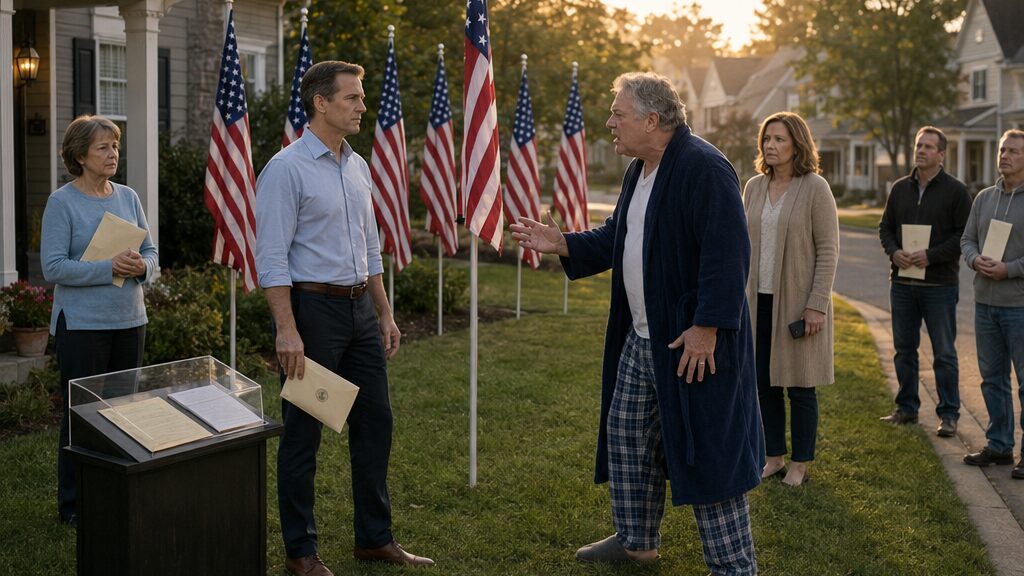
Gregory reached the curb in a navy bathrobe and stopped so abruptly that one slipper slid halfway off his heel.
Six American flags stood across Daniel’s lawn in the first light of morning.
The original flag moved above the permanent pole. Five others formed a measured line on either side, each mounted at the same height, each clear of the sidewalk and driveway. Beneath the porch light, the cream violation notice rested behind acrylic beside the county email.
Daniel stood near the center flag holding a certified envelope.
Joseph was tightening the final base when Gregory found his voice.
“What is this?”
“Good morning,” Daniel said.
Gregory looked from one flag to the next as if counting might make them disappear. His robe hung open over a white T-shirt and plaid sleep pants. “You were instructed to remove the installation.”
“I was instructed to remove one compliant pole under a rule the association did not identify.”
“This is deliberate provocation.”
“It is a temporary display.”
“You cannot turn your front yard into a political demonstration.”
Daniel glanced at the flags. “There are no campaign signs, slogans, or political materials.”
“You know exactly what you’re doing.”
“Yes.”
That answer drew the first neighbors from their porches. A garage door across the street paused halfway up. Someone walking a dog stopped near the corner.
Elizabeth hurried from the Clark house wearing sandals and a long cardigan over her clothes. Her phone was already in her hand.
“Gregory,” she said quietly.
He ignored her.
“These poles violate the front setback.”
Daniel removed Sandra’s email from beneath the clear cover and held it where Gregory could read the county letterhead.
“The county confirmed otherwise.”
“The county does not control our covenants.”
“Correct. Which is why your notice should not have claimed county authority.”
Gregory’s face reddened. “The board has broad discretion over exterior appearance.”
“Broad discretion is not unlimited discretion. Your published standards regulate height, lighting, placement, and condition. My original pole meets all four. The notice provides no hearing date and imposes continuing fines before the required review.”
Elizabeth’s phone tilted toward Daniel.
He looked directly at her. “Please record the documents as well as my face.”
Her hand lowered an inch.
Gregory stepped onto the grass. “Take these down now, and I’ll recommend that the board waive the initial fine.”
Daniel held out the certified envelope.
“This is my written request for the rule being enforced, the comparable enforcement history, and a hearing before penalties begin. It also preserves my objection to the unsupported county statement.”
Gregory did not take it.
Daniel kept his arm extended.
For several seconds, the only sound was the soft snapping of fabric above them.
Finally, Gregory seized the envelope. “You think because you work near lawyers you can intimidate volunteers?”
“No.”
“You’re creating unnecessary expense for every homeowner here.”
That sentence shifted Daniel’s attention.
“Expense from what?”
Gregory glanced toward the people gathering along the sidewalk. “Enforcement costs. Counsel. Administrative time.”
“The association created those costs when it issued the notice.”
“You have no idea what this community is dealing with.”
“Then disclose it.”
Elizabeth touched Gregory’s arm. “Maybe we should discuss this inside.”
He pulled away.
A woman approached from farther down the block. Mary Allen wore a pale blue sweater despite the warm morning. She carried a large envelope pressed against her side.
Daniel felt the muscles in his shoulders tighten.
Mary did not greet him. She walked past the nearest flag and stopped beside the acrylic cover on his porch. From her envelope, she removed a folded cream notice.
The gold seal at the top matched Daniel’s.
She placed it beside his display.
Gregory stared at her. “Mary, this matter has nothing to do with your landscaping case.”
Mary smoothed the fold with two fingers. “The enforcement paragraph is the same.”
“This is not the place.”
“You made my yard the place.”
A murmur moved among the neighbors.
Elizabeth stopped recording.
Daniel looked at Mary’s notice. The same heavy stock. The same seal. The same warning that continuing fines would begin without further action. Even the line spacing appeared identical.
Another homeowner crossed the street carrying a cream sheet inside a plastic grocery bag.
“My mailbox stain,” the man said. “Three hundred dollars.”
A second resident raised a notice from the edge of the crowd. “Trash can visible for forty minutes after pickup.”
Gregory turned in a slow circle, his earlier certainty thinning under the accumulating paper.
“These are separate compliance matters,” he said. “The board will not conduct hearings in the street.”
“No one asked you to,” Daniel replied.
Gregory faced him. “You arranged this.”
“I arranged the flags.”
“Don’t play games.”
“I did not ask anyone to bring a notice.”
Mary looked at Daniel then, and the disappointment in her face was quieter than anger.
“You didn’t have to,” she said. “People saw yours.”
The words landed more heavily than Gregory’s threats.
Daniel had imagined the morning ending with the withdrawal of his notice. He had prepared the law, the placement measurements, the certified response, and the visual answer. Every part had been designed to keep the conflict narrow enough to control.
Now four cream papers sat within sight of one another.
Gregory opened the envelope and scanned the first page. His expression altered as he reached Sandra’s zoning clarification and the quoted enforcement provisions. He read the same section twice.
“This does not mean the board lacks authority,” he said.
“No one said it did.”
“You’re implying selective enforcement.”
“I’m asking for the records that would answer that.”
Gregory folded the letter badly and pushed it back into the envelope. “Fine. Your flag matter is suspended pending review.”
“Suspended?”
“The board will not pursue the current notice at this time.”
Daniel kept his voice even. “Are you withdrawing it?”
Gregory looked toward Elizabeth, then toward the growing line of neighbors.
“Yes,” he said. “The flag notice is withdrawn.”
A few people exchanged satisfied looks. Joseph released a breath through his nose. The visible confrontation had ended exactly as Daniel intended.
But Gregory pointed at Mary’s paper.
“That does not affect valid violations at other properties.”
Mary’s mouth tightened. “You said mine could disappear.”
“I said the board would consider resolution.”
“If I signed.”
Gregory went still.
Daniel turned toward her. “Signed what?”
Mary kept her eyes on Gregory. “A confidentiality agreement.”
Elizabeth looked at her husband. “What agreement?”
“It was a standard settlement option,” Gregory said.
“For leaning stones?” Mary asked.
Gregory’s tone sharpened. “For resolving an ongoing dispute without creating additional cost.”
Again, cost.
Daniel watched him carefully. “Why is every enforcement question becoming a financial warning?”
Gregory tucked the certified envelope beneath his arm. “Because homeowners like you seem to believe association resources are endless. They are not. If residents force hearings, records reviews, counsel consultations, and special meetings over every notice, then everyone will pay.”
“How much?” someone called from the sidewalk.
Gregory’s eyes moved toward the voice. “That will be addressed at the emergency meeting.”
“What emergency?” another neighbor asked.
“This is exactly why information should be presented in an orderly setting.”
Mary picked up her notice and held it against her chest.
Gregory stepped back toward the street. His robe belt had loosened, but he no longer seemed aware of it.
“The flag notice is withdrawn,” he repeated. “Take your victory, Daniel. But if this turns into a broader challenge to necessary enforcement, the board may have no choice but to recommend a special assessment.”
The phrase silenced the sidewalk more effectively than a shout.
Pinewood Estates contained families who measured every increase in dues against child care, mortgage rates, medical bills, or retirement income. A special assessment could mean hundreds or thousands of dollars per household.
Gregory saw that he had regained their attention.
He turned and walked home with Elizabeth several paces behind him.
No one celebrated.
Joseph began checking the flag bases, giving Daniel space. The neighbors remained in small groups, speaking quietly and looking at the cream papers.
Mary approached Daniel after most of them had drifted away.
“You got yours withdrawn,” she said.
“For now.”
“He meant it. He won’t touch your flag again.”
Daniel studied her notice. “May I see the agreement he offered?”
“I didn’t bring it.”
“Did you sign?”
“No.”
“Why not?”
Mary gave him a tired look. “Because it said I couldn’t discuss the fines, the inspections, the photographs, or the board’s reasons for canceling them.”
“What reasons did they give?”
“They didn’t. That was the problem.”
Daniel looked across the street. Through the Clark house’s front window, Elizabeth stood motionless while Gregory moved behind her.
Mary refolded her notice along its old crease.
“They told me they would erase twelve hundred dollars if I promised never to show anyone the letters,” she said. “Then, when I asked why silence mattered so much, Gregory said the association could not afford another homeowner questioning where the money was going.”
Daniel’s attention returned to the emergency meeting announcement on his phone.
Unexpected fiscal pressure.
A special assessment.
Confidential settlements for minor violations.
Four notices written from the same template.
His six flags moved behind Mary, bright in the morning light. Minutes earlier, they had felt like an answer.
Now they looked like the first question.
Chapter 4: The Fines That Paid for Silence
Mary opened the kitchen drawer and said, “These are the ones you never saw.”
The drawer was deep enough for utensils, but there were no utensils inside. Cream-colored notices filled it from front to back, some folded, some still inside matching envelopes. Each bore the same gold Pinewood Estates seal.
Daniel stood beside her small kitchen table with his legal pad closed under one hand.
Mary removed the first notice and placed it in front of him. Then another. Then six more.
The oldest was dated seven months earlier.
“I thought you said the garden-border issue began in February,” Daniel said.
“That was the first fine. The letters started before Christmas.”
The initial notice concerned moss on a retaining stone. The next said the stones were “visually unstable.” A third reclassified the same border as unsecured construction material. The board had changed the description without changing the photograph.
Daniel arranged the pages by date.
Mary filled a kettle but did not turn on the burner. “I kept thinking I must have misunderstood something. The language changed every time I answered.”
“Did they inspect again?”
“Not that I saw.”
“Did you request a hearing?”
“Three times.”
“And?”
“The first one was postponed. The second was canceled because they said the management company had not prepared the file. The third never appeared on the agenda.”
Daniel reached the notice offering settlement. It was not signed, but a confidentiality provision occupied nearly half the page. In exchange for cancellation of the fines, Mary would agree not to discuss inspections, correspondence, board deliberations, or the terms of the settlement.
“What happened when you refused?” he asked.
“They doubled the continuing penalty.”
Mary sat opposite him. Her hands rested flat on the table, fingers spread as if keeping herself from gathering the papers back.
“I called you after the second notice,” she said.
Daniel looked down at the date. He remembered seeing her number on his phone. He had been preparing for a difficult easement hearing at work and had told himself that answering one neighbor would make him responsible for every neighbor.
“I should have returned the call.”
“You told me before that you didn’t give legal advice outside your job.”
“I could have looked at the page.”
Mary gave a slight nod, accepting the distinction without softening it.
Daniel opened his pad. “I can review the documents. I cannot represent you, and I can’t promise the fines will be canceled.”
“I’m not asking for a promise.”
“What are you asking for?”
“To know whether I’m losing my mind.”
He met her eyes.
“You’re not.”
The kettle remained cold on the stove.
Over the next two days, two other homeowners brought Daniel their files. One had been fined for a mailbox stain that did not appear in the association’s design standards. The other had received daily penalties because a trash container remained visible after collection while he was at a medical appointment.
The violations differed. The documents did not.
Each notice used the same enforcement paragraph, the same compressed deadline, and the same unsupported statement that continuing fines could begin automatically. In each case, the board had either delayed the requested hearing or never scheduled one.
Daniel created a comparison chart. He marked the cited rules, the alleged conditions, the inspection dates, and the penalties collected. By the end of the second evening, the pattern no longer looked like careless administration.
The board targeted small, visible conditions that could be described in broad language. It issued formal notices quickly. When an owner questioned the charge, the board offered private cancellation in exchange for silence or allowed the fines to accumulate.
He still did not know why.
The answer began in the HOA records room.
Pinewood’s clubhouse had once included a small leasing office. Now the room held metal filing cabinets, old meeting binders, and boxes of invoices. Under Virginia association law and Pinewood’s governing documents, members could inspect specified financial records after making a proper request. Daniel submitted one narrowly focused on fine revenue, legal expenses, reserve transfers, and the emergency meeting.
The HOA treasurer met him at the clubhouse on the third afternoon.
“You have two hours,” the treasurer said. “No original records leave the room.”
Daniel placed his phone facedown. “I’ll take written notes.”
The treasurer looked relieved.
The first binder contained monthly financial statements. Dues revenue appeared steady. Landscaping, utilities, and routine maintenance were predictable. Insurance premiums had risen, but not enough to explain Gregory’s warnings.
Then Daniel reached the reserve account.
Three years earlier, Pinewood had held nearly four hundred thousand dollars for long-term repairs. The balance had fallen below one hundred and forty thousand.
He traced the transfers. Roof work at the clubhouse. Emergency tree removal. A stormwater engineering study. Insurance deductibles after two basement flooding claims.
Beside several transfers, the board had written: temporary use pending owner assessment.
No assessment had occurred.
Daniel opened the enforcement ledger.
Fine revenue had averaged less than nine thousand dollars per year. In the previous eight months, it had exceeded forty-six thousand.
The increase began two weeks after the board postponed a vote on drainage repairs.
One line in the ledger caught his attention.
TEMPORARY RESERVE STABILIZATION—COMPLIANCE RECEIPTS.
Daniel read it again.
Fine payments had not merely entered the general operating account. They had been treated as a temporary substitute for reserve funding.
The treasurer noticed where he was looking. “That label was Gregory’s suggestion.”
“Were the funds transferred into reserves?”
“Some.”
“How much?”
“I’d have to check.”
“Was the membership told that violation revenue was being used this way?”
The treasurer’s chair creaked. “The statements show total revenue.”
“That wasn’t my question.”
“I’m not counsel.”
“Neither am I.”
The treasurer closed the binder halfway. “The board had a problem. The drainage estimate came in much higher than expected. Gregory believed a special assessment would panic people.”
“So the board increased enforcement.”
“The board increased compliance activity.”
“Against selected properties.”
“I didn’t choose the properties.”
Daniel reopened the binder.
Attached to one monthly statement was a spreadsheet listing expected fine collections. Mary’s account appeared under a column labeled HIGH PROBABILITY. So did the mailbox owner and the resident with the trash container.
Daniel copied the headings into his notes.
“Who prepared this?”
“The management company created the format.”
“Who supplied the projections?”
The treasurer looked toward the closed door.
“Gregory.”
At 4:17, Daniel’s phone vibrated. The resident portal had issued a new notice.
EMERGENCY BOARD HEARING—MANDATORY ENFORCEMENT POLICY RATIFICATION.
The proposed resolution would confirm that existing aesthetic provisions had always authorized the current violation program. It would also permit the board to continue daily penalties while hearings were pending.
“They’re trying to approve the authority after using it,” Daniel said.
The treasurer did not answer.
Daniel gathered his notes. On the way home, he stopped at Mary’s house and showed her the comparison chart. She read slowly, one finger beneath each line.
“So they needed money,” she said.
“It appears they expected enforcement revenue to help stabilize the association’s finances.”
“From people they thought would pay.”
“Or people they thought would not organize.”
Mary pushed her folded notices into a single stack.
Daniel had once believed the cream paper was designed to frighten homeowners individually. Now he understood the deeper function. Each notice kept the recipient alone.
At dusk, he returned to his office and began drafting a records summary for the meeting. He used cautious language: apparent pattern, preliminary figures, unresolved questions. He removed every accusation he could not support.
A soft knock came from the front door.
Elizabeth Clark stood outside alone.
She had no phone in her hand.
“I need to ask you something,” she said.
Daniel did not invite her in immediately.
“Is Gregory with you?”
“No.”
“Does he know you’re here?”
“No.”
That answer persuaded Daniel to open the door wider.
Elizabeth stepped into the entryway but refused the chair he offered. Her face looked different without the bright confidence she wore across the street.
“I saw the emergency resolution,” she said. “Gregory said it was routine.”
“It isn’t.”
“He says you’re trying to make the association insolvent.”
“I’m reviewing records members are entitled to inspect.”
“He told me the reserve account was low. I didn’t know how low.”
Daniel said nothing.
Elizabeth pressed her palms together.
“If a board president hides a reserve deficit,” she asked, “can he go to jail?”
Chapter 5: What Gregory Thought He Was Saving
“If we disclose everything now, every house in Pinewood will look financially toxic.”
Gregory stood at the kitchen island with a blank cream notice beneath his hand. The gold seals had already been printed. Only the address, alleged violation, and fine schedule remained empty.
Elizabeth stayed near the doorway.
“You told me the reserves were strained,” she said. “You didn’t tell me fines were replacing them.”
“They are not replacing them.”
“The ledger says stabilization.”
“That is accounting language.”
“It sounds like replacing them.”
Gregory removed his glasses and pinched the bridge of his nose. He had changed out of his robe hours earlier, but the image of standing among Daniel’s flags remained on the neighborhood page. Elizabeth had removed the video after several residents shared screenshots.
“The drainage system behind the east row has failed in three places,” he said. “The preliminary estimate is two hundred and eighty thousand dollars. That does not include pavement restoration.”
“Then tell people.”
“And watch listings sit for six months? Watch lenders ask questions? Watch every resident over sixty panic because they cannot absorb a five-thousand-dollar assessment?”
“They’re going to learn at the meeting.”
“They will learn when we have a controlled plan.”
Elizabeth looked at the stack of blank notices. “Is this the plan?”
Gregory followed her eyes.
“Compliance protects property values.”
“Does it also pay engineers?”
His silence answered her.
He carried the notice to the dining table, where a map of Pinewood lay beneath several financial reports. Red marks showed the drainage route behind twelve homes. Blue circles identified properties with open violations.
Elizabeth recognized the addresses. She had posted photographs of three of them on the neighborhood page under reminders about shared standards.
“You gave me those pictures,” she said.
“I gave you examples.”
“You told me residents had complained.”
“They had.”
“How many?”
Gregory set down the paper. “Why are you interrogating me as if I stole money?”
“Did you?”
“No.”
The answer came quickly and firmly.
Gregory had not placed funds in his own account. He had not altered checks or hidden invoices. He had watched reserve balances fall, contractors raise estimates, and insurers ask whether Pinewood had completed recommended stormwater work. Each time the board postponed an assessment, he had promised himself the delay would create room for a better solution.
Then violation revenue increased.
At first, the money was incidental. A few thousand dollars from neglected paint and unauthorized fences. But when owners paid rather than request hearings, Gregory saw a way to narrow the shortfall without frightening the entire community.
The decisions had felt temporary.
Temporary decisions had accumulated into policy.
“I was trying to keep people from losing value,” he said.
Elizabeth touched one of the red marks on the map. “Mary almost listed her house.”
“That was her choice.”
“Was it?”
Gregory folded the blank notice along its center, then flattened it again. “Daniel is presenting this as targeted harassment because he wants to embarrass the board.”
“He withdrew your flag notice in front of everyone.”
“I withdrew it.”
“Because it was wrong?”
“Because continuing the fight would cost more than it was worth.”
Elizabeth stared at him. “You still don’t hear yourself.”
Across the street, Daniel sat in his office with Gregory’s reserve figures spread beneath the desk lamp.
Elizabeth had not supplied documents. She had offered context: Gregory took late calls from the insurer, kept drainage estimates in a locked drawer, and became agitated whenever residents discussed assessments online. She admitted that he sent her photographs before enforcement campaigns and suggested language for posts about declining standards.
None of that proved misuse by itself.
Daniel called the association’s outside counsel from his work number and explained that he was a member seeking procedural clarification, not professional advice.
The attorney sounded tired before Daniel finished.
“I can tell you what I told the board,” counsel said. “Any enforcement policy must follow the governing documents and applicable law. Retroactive ratification creates risk.”
“Were you informed that fine revenue was projected as reserve stabilization?”
A pause.
“I cannot discuss privileged communications.”
“That wasn’t my question.”
“It is the answer I can give.”
“What happens if members publicly accuse the board of concealing insolvency before the records are reviewed?”
“Language matters. Pinewood is not insolvent based on the statements I’ve seen.”
“But the reserves are inadequate.”
“Many associations have inadequate reserves. Public claims of fraud or insolvency could affect sales, refinancing, insurance relationships, and potential litigation. Be accurate.”
Daniel looked at his notes. The word fraud did not appear anywhere.
“The drainage work still has to be paid for,” counsel continued. “Removing a president does not repair a culvert.”
“I understand.”
“Do you? Because your neighbors may leave the meeting believing that if they defeat the enforcement resolution, the financial problem disappears.”
That was the danger Gregory understood and Daniel had not yet fully faced.
Exposing improper fines could protect homeowners from selective pressure. It could also force the community to confront an assessment Gregory had postponed. Mary might win twelve hundred dollars and receive a bill several times larger.
After the call, Daniel removed the sentence stating that the board had concealed a financial emergency. He replaced it with: The available records raise questions regarding whether enforcement revenue influenced the timing or selection of violation activity.
The weaker sentence was more defensible.
It was also less satisfying.
At nine, Gregory crossed the street.
He wore a navy jacket over an open-collar shirt and carried a white envelope without the association seal. The six flags remained across Daniel’s lawn, dark shapes beneath the porch lights.
Daniel met him outside.
“I’m not here to argue,” Gregory said.
“That would be new.”
Gregory ignored the remark. “I spoke to counsel.”
“So did I.”
“I assumed you would.”
He handed Daniel the envelope.
Inside was a proposed settlement. The association would withdraw the flag notice permanently, waive any related charges, reimburse Daniel’s certified-mail expense, and confirm that the existing pole could remain.
In exchange, Daniel would withdraw all records requests beyond his own account and agree not to challenge the enforcement resolution based on his flag dispute.
Daniel read the final paragraph twice.
“This only applies to me.”
“Yes.”
“What about Mary?”
“Mary has her own matter.”
“And the others?”
“Separate matters.”
“You used the same defective process.”
“That is your interpretation.”
“The settlement requires me to stop asking.”
“It requires you to accept that your issue has been resolved.”
Gregory looked toward the flags.
“You wanted the pole,” he said. “You have it. You wanted the notice withdrawn. It is withdrawn. You wanted acknowledgment that the county claim was inaccurate. The agreement gives you that.”
Everything Daniel had initially wanted appeared in four pages.
Gregory lowered his voice.
“You know what happens if residents leave tomorrow believing the association is collapsing. People rush to list. Buyers request records. Lenders become cautious. The insurer asks whether the board can fund repairs. You may be right about the notices and still damage every person on this street.”
Daniel folded the settlement along its center.
The paper was white, not cream. It carried no gold seal and needed none.
“Why did you choose those homeowners?” he asked.
“We enforced visible violations.”
“You projected their payments.”
“We projected all receivables.”
“Mary was marked high probability.”
“She lives alone. She has no mortgage. We assumed she could resolve the balance.”
Daniel looked at him.
Gregory seemed to realize what he had admitted.
“I meant financially,” he said.
“I know what you meant.”
Gregory’s face hardened. “Do not turn a difficult management decision into a moral performance.”
Daniel held the settlement at his side.
“Sign it before noon,” Gregory said. “You walk into the meeting with your property protected and no exposure. Reject it, and you help create a fight whose cost you cannot control.”
He crossed the street without waiting for an answer.
Daniel remained beneath the original flagpole. The settlement was complete, precise, and limited to one name.
His own.
Chapter 6: The Settlement With Only One Name
The first sentence required Daniel to stop asking questions about everyone else.
He read it at 6:10 the next morning beneath the light over his kitchen table. Gregory’s settlement lay beside four cream notices: his own, Mary’s, the mailbox case, and the trash-container case.
One white agreement offered safety.
Four cream pages showed its price.
Daniel picked up a pen, then set it down.
At work, he would have advised a client to evaluate the offer by stated objectives, litigation risk, cost, and available proof. His original objectives were satisfied. The flag stayed. The notice vanished. The county misstatement was acknowledged.
Signing would be rational.
The word felt thin.
He drove to Mary’s house before eight. She answered in gardening gloves, with damp soil darkening both knees of her jeans. Three stones had been removed from the damaged border and placed in a neat row on the walkway.
“I’m rebuilding it before they accuse me of storing construction materials,” she said.
Daniel held up the white envelope. “Gregory offered a settlement.”
Mary looked at it but did not reach for it.
“For all of us?”
“For me.”
She removed one glove finger by finger. “Of course.”
“It requires me to withdraw the broader records requests and not challenge the enforcement resolution through my flag case.”
“Are you going to sign?”
“I haven’t decided.”
Mary turned toward the garden. The exposed edge looked smaller without the stones, just a narrow line of earth separating mulch from grass.
Daniel had prepared several careful explanations on the drive over. None survived the sight of her working alone.
“I owe you an apology,” he said.
Mary kept her back to him.
“You asked me to look at your notice months ago. I heard the message. I decided returning the call would create an obligation I didn’t want.”
She pulled a weed from the open border.
“I told myself I was protecting professional boundaries,” Daniel continued. “The truth is, I wanted Pinewood to remain easy for me. I let your problem stay yours because mine had not started yet.”
Mary dropped the weed into a bucket.
“You don’t need to make this dramatic.”
“I’m not.”
“It sounds dramatic.”
“I was wrong.”
She finally faced him.
Daniel did not ask whether she forgave him. He did not tell her he would fix the fines or defeat Gregory. The promises available to him were smaller.
“I will put the records I can support before the members,” he said. “I will be precise about what I don’t know. If you want your case included, I’ll help organize the documents. If you don’t, I won’t use your name.”
Mary looked at the settlement again.
“I almost sold the house,” she said.
Daniel’s grip tightened on the envelope.
“When?”
“In March. A real estate agent came through. She told me the garden would need to be redone and the open violation disclosed. After fees and moving costs, I would have lost more than I could manage.”
“Why didn’t you tell anyone?”
“Because I was embarrassed.”
“You had nothing to be embarrassed about.”
“I know that now.”
Her answer contained no comfort for him.
Mary returned to the porch and came back with a folder. Inside was the unsigned confidentiality agreement and a handwritten list of every call, canceled hearing, and payment demand.
“I don’t want you speaking for me tonight,” she said.
“I understand.”
“I want help putting these in order.”
Daniel accepted the folder.
“And I want three minutes at the microphone.”
The smallest weight lifted from his chest.
“Then we’ll make sure you have three minutes.”
By noon, Daniel had not signed the settlement.
At 12:07, Gregory emailed a reminder that the offer would expire when the hearing began. At 12:19, the association’s outside counsel issued a proposed agenda that placed member comments after executive session and board adjournment.
Daniel called counsel.
“You cannot schedule member comments after adjournment.”
“The board may revise the agenda.”
“Will it?”
“I advise the board. I do not control it.”
“Have you advised them that the enforcement resolution should not be applied retroactively?”
Another pause.
“I have advised them to avoid unnecessary statements before the hearing.”
“That sounds like yes.”
“It sounds like what I said.”
By midafternoon, Daniel’s dining table had become a document station. He prepared one packet for each disputed notice: allegation, cited rule, hearing request, board response, and account ledger. He placed the settlement on top of his own packet but did not include it in the copies.
Joseph arrived carrying a cardboard tray of coffee.
“You look terrible,” he said.
“Thank you.”
“Did you sign?”
“No.”
Joseph saw the white agreement beside the cream notices. “You planning to tear it up in front of everyone?”
“No.”
“Missed opportunity.”
“Tearing documents is theater.”
“Says the man with six flags in his yard.”
Daniel looked toward the window. “Those were evidence.”
“Those were also theater.”
Joseph handed him coffee. “The difference is you approved of that theater.”
Daniel accepted the point without answering.
At five, Mary arrived with the two other homeowners. Daniel reviewed the order of speakers and warned them that the board might adjourn before public comment.
“Can they do that?” the mailbox owner asked.
“They can attempt it. Members can object under the bylaws and request a motion from the floor, but the procedure may become disputed.”
“So Gregory still controls the room.”
“He controls the agenda. Not every decision.”
Mary practiced her opening line once.
“My garden stones did not create Pinewood’s financial problem.”
She stopped.
“That’s enough,” Daniel said.
At 6:20, they walked toward the clubhouse.
Cars lined both sides of the street. Residents who rarely attended annual elections were carrying folders and printed portal screenshots. The six flags across Daniel’s lawn remained visible from the clubhouse parking lot.
Inside, every folding chair was occupied. People stood along the walls. Gregory sat at the board table with Elizabeth to one side and outside counsel to the other. A large photograph had been placed facedown before him.
The treasurer avoided Daniel’s eyes.
At 6:28, counsel approached.
“The board intends to enter executive session after presenting the resolution,” the attorney said. “I have recommended adjournment if discussion becomes accusatory.”
“Member questions are on the notice.”
“They are listed after board business.”
“After the word adjournment.”
Counsel’s mouth tightened. “I did not draft the agenda.”
“Will you tell them they cannot use adjournment to avoid properly noticed participation?”
“I will advise them in the room.”
“That is not an answer.”
“It is the only one you’re getting.”
The attorney returned to the table.
Daniel placed his packets on an empty side table. He removed Gregory’s white settlement from his folder and laid it beside Mary’s first cream notice.
One name on one page.
Four names absent from the other.
At 6:30, Gregory struck the gavel.
“This emergency hearing will come to order.”
Daniel picked up both documents.
He tore neither.
Then he carried them into the packed room and took the seat directly in front of Gregory.
Chapter 7: When the Neighborhood Read the Same Page
Gregory began the hearing by holding up a photograph of Daniel’s six flags.
The image had been printed on glossy paper and enlarged until it nearly covered Gregory’s chest. In it, the flags stood bright against Daniel’s lawn while Gregory, caught at the edge of the frame in his bathrobe, looked less like a board president than a man who had wandered into someone else’s ceremony.
“This,” Gregory said, “is what happens when a routine compliance matter is turned into public spectacle.”
No one laughed.
The clubhouse air-conditioning rattled above the packed rows. Daniel sat in the first chair with Gregory’s white settlement on his left knee and the original cream notice on his right. Behind him, Mary held her folder against her ribs. Joseph stood along the wall near the rear exit.
Gregory lowered the photograph onto the board table.
“The proposed resolution does not target any resident,” he continued. “It clarifies authority the association has always possessed and protects Pinewood from escalating administrative costs.”
Daniel glanced at outside counsel. The attorney’s expression remained carefully neutral.
Gregory read the resolution aloud. It authorized continuing fines before hearings, broadened the board’s discretion over visible conditions, and declared that prior enforcement actions had been consistent with the community’s governing documents.
When he finished, a board member moved for approval.
“Point of order,” Daniel said.
Gregory’s gaze fixed on him. “Member comments occur after board business.”
“The circulated agenda lists member questions concerning the resolution.”
“After the vote.”
“Then the questions have no function.”
Murmurs moved through the room.
Gregory touched the gavel. “Mr. Harris, you will have an opportunity to speak.”
“When?”
“After executive session.”
Outside counsel leaned toward Gregory and spoke too softly for the room to hear. Gregory’s jaw tightened.
The attorney then addressed the table. “Because the meeting notice references member questions, I recommend allowing limited comment before the vote.”
Gregory stared at him.
“For procedural clarity,” counsel added.
The board member withdrew the motion with visible reluctance.
Gregory set the gavel down. “Three minutes per member. Comments must concern the proposed resolution. Personal accusations will be ruled out of order.”
Mary rose before Daniel could.
She walked to the microphone carrying only her first notice.
“My garden stones did not create Pinewood’s financial problem,” she said.
Her voice trembled on the first sentence, then steadied.
She explained the leaning border, the repeated notices, the canceled hearings, and the offer to erase twelve hundred dollars if she signed a confidentiality agreement. She did not call Gregory corrupt. She did not mention Daniel’s charts. She described opening her mailbox each afternoon and wondering whether another fifty dollars had been added while she waited for a hearing the board would not schedule.
“I was told enforcement protects property values,” she said. “I nearly sold my property because of enforcement.”
The room stayed quiet when she returned to her seat.
The mailbox owner spoke next. Then the resident fined over the trash container. Their accounts differed in detail but repeated the same sequence: vague allegation, immediate financial threat, delayed review, pressure to resolve privately.
Gregory wrote something on a yellow pad.
When Daniel’s name was called, he carried the white settlement and four cream notices to the front table.
He placed the notices in a row beneath the photograph of the flags.
The gold seals aligned.
Then he opened the blank notice template obtained from the association’s records file and laid it beside them.
A woman in the second row leaned forward.
Daniel adjusted the microphone. “I want to be precise about what these documents establish and what they do not.”
Gregory folded his arms.
“The association has legitimate maintenance obligations. It has authority to enforce adopted restrictions. It also has a drainage problem that will cost money regardless of who is president after tonight.”
Several residents turned toward the board.
Daniel continued. “The available financial statements show declining reserves and a substantial increase in fine revenue after the drainage repair was postponed. They also show that expected compliance receipts were described as temporary reserve stabilization.”
The treasurer looked down.
“This does not prove money was stolen,” Daniel said. “I have found no evidence that any board member personally took association funds.”
Gregory’s posture eased slightly.
“It does show,” Daniel continued, “that enforcement revenue became part of the board’s response to a financial shortfall. At the same time, homeowners received notices that misstated procedure, cited standards inconsistently, and threatened continuing penalties before requested hearings occurred.”
He lifted the blank template.
“The alleged conditions changed. The pressure language did not.”
A resident near the aisle asked, “How many notices?”
“Those records are incomplete. I can document four cases with the same process and several additional entries requiring review.”
“So you don’t know,” Gregory said.
“I know enough to oppose retroactively validating the process before an independent review.”
Gregory leaned toward his microphone. “You are omitting that your own matter was resolved.”
Daniel looked at the white paper still lying apart from the cream notices.
“No,” he said. “I’m not.”
He opened the settlement and read the provision requiring him to withdraw broader records requests. The room became still enough for the air vent’s metallic ticking to carry.
“This agreement would permanently protect my flagpole and cancel every charge against me,” Daniel said. “It would also require me to stop challenging the wider enforcement process.”
He placed the unsigned agreement in front of Gregory.
“I reject it.”
A few chairs shifted. There was no applause.
Gregory’s face hardened. “That was a confidential settlement communication.”
“It contains no confidentiality restriction unless signed.”
Outside counsel closed his eyes briefly.
Daniel turned toward the residents.
“There is something else you should know before deciding what weight to give me.”
Mary looked up.
“Months before my notice arrived, Mary Allen asked me to review hers. I did not return her call.”
The sentence seemed smaller in the microphone than it had in Mary’s kitchen.
“I told myself I was maintaining professional boundaries. The truth is that I did not want other people’s disputes entering my life. I understood enough to recognize that official-looking paper can frighten someone into surrendering rights they may have. I chose not to look until the same method reached my own door.”
Gregory watched him with an expression Daniel could not read.
“I am not standing here because I saw injustice sooner than everyone else,” Daniel said. “I am standing here because I saw it late.”
He stepped away from the microphone.
For several seconds, no one moved.
Then Elizabeth rose from her seat beside the board table.
Gregory turned. “What are you doing?”
She faced the room. Her phone was absent. In its place she carried a printed stack of neighborhood-page posts.
“I wrote these,” she said. “Some were based on photographs Gregory gave me before notices were issued.”
Gregory’s chair scraped the floor. “Elizabeth.”
“I thought I was reminding people about standards. I did not know enforcement projections were being discussed with the reserve problem.”
“You don’t understand the financial records.”
“No,” she said. “I made sure not to.”
The simplicity of the admission changed the room more than an accusation would have.
She placed the posts beside the notices. Dates showed that public reminders about “declining care” and “shared responsibility” often appeared one or two days before enforcement letters reached specific homes.
“I deleted the post about Daniel’s flag,” Elizabeth said. “The others are still archived. Members should be able to see them.”
Gregory stared at her. “You’re making private conversations public.”
“I’m making my own actions public.”
He looked suddenly tired rather than angry.
The board attempted to move into executive session. Residents objected. Outside counsel advised that the proposed resolution be withdrawn pending review, warning that retroactive approval could worsen the association’s exposure.
The treasurer finally spoke.
“The reserve account is one hundred thirty-seven thousand dollars,” he said.
The number settled heavily over the room.
“What should it be?” someone asked.
The treasurer swallowed. “The last study recommended just over four hundred thousand at this point.”
Voices rose.
Gregory reached for the gavel, then stopped.
“The drainage repair cannot wait another year,” he said. “Two basements flooded during the last major storm. The insurer has asked for a corrective schedule. I was trying to prevent a special assessment until we had alternatives.”
“By charging Mary?” a resident called.
“By enforcing rules people agreed to follow.”
“Not the same rules,” Daniel said.
Gregory looked at him.
“No,” Gregory said after a moment. “Not always the same.”
It was not an apology. It was the nearest thing to one he could give in that room.
The board did not vote on the enforcement resolution. Instead, after two hours of motions, objections, and procedural confusion, the members approved three immediate measures: suspension of disputed continuing fines, an independent financial and enforcement review, and a special membership meeting to consider removal of board officers.
The drainage bill remained.
When one resident demanded that the board promise there would be no assessment, Daniel stood again.
“No one can promise that,” he said.
The anger in the room turned briefly toward him.
He let it.
“The notices were improper,” he continued. “The repair is still real. Correcting one does not erase the other.”
The special meeting occurred twelve days later.
Gregory was removed as president by a clear but not unanimous vote. He remained a homeowner and sat through the count without speaking. The treasurer resigned. Two board members retained their seats after supporting the independent review.
The review found no personal theft. It found inadequate reserve planning, improper use of enforcement projections, inconsistent citations, delayed hearings, and communications designed to pressure owners into private resolutions.
All disputed fines issued under the defective process were suspended pending individual review. Most were later canceled.
The members also approved a revised enforcement policy requiring clear rule citations, photographs dated within ten days of a notice, a hearing before continuing penalties, and quarterly reporting of fine revenue.
Then came the assessment.
It was smaller than Gregory’s worst prediction and larger than most residents wanted. Pinewood financed part of the drainage repair and divided the remaining cost across two years. Mary sat at the back of the meeting when the amount was announced, closed her eyes, and then asked whether residents on fixed incomes could use a payment plan.
The new board said yes.
Gregory did not attend that meeting.
Elizabeth did. She sat alone near the aisle and left before Daniel could decide whether to speak to her.
One month after the sunrise confrontation, Joseph returned with his truck.
The five borrowed flags had remained in place longer than Daniel intended. They had survived two rainstorms and become a landmark for delivery drivers. Children counted them while riding bicycles past the house.
Joseph loosened the first base.
“Still think they were evidence?” he asked.
“Yes.”
“And theater?”
Daniel lifted the second pole from its stand. “Also theater.”
Joseph smiled. “Growth.”
They rolled each flag carefully and returned it to its sleeve. No neighbors gathered. No one recorded them. The removal was ordinary work: metal clasps, damp grass, canvas bags, bases lifted into the truck.
Across the street, Gregory trimmed a hedge. He and Daniel saw each other but did not wave.
Mary was rebuilding the final section of her garden border. The board had canceled her fines, and the new policy required no further action, but she wanted the stones straight for herself.
Daniel carried the last temporary base to Joseph’s truck.
“Five down,” Joseph said.
Daniel looked at the original flag above the permanent pole.
“One stays.”
“That was always the point.”
Daniel watched Mary set a stone, test it with both hands, and shift it half an inch until it rested level.
“No,” he said. “I don’t think it was.”
Joseph followed his gaze but did not ask him to explain.
After the truck left, Daniel crossed the lawn with the original cream notice. Its fold had weakened from being opened and closed. The gold seal was scratched where the acrylic cover had pressed against it.
Mary looked up from the border.
“What are you going to do with that?”
“I haven’t decided.”
“You could frame it.”
“I’ve had enough theater.”
She smiled faintly.
Daniel unfolded the notice one final time. The words had not changed, but their authority had. What once looked like a command now looked like a template someone had expected no one to compare.
He folded it again and placed it in the records box he carried beneath his arm—not as a trophy, but as the first page in a file available to any resident who asked to see it.
The flag moved above them.
Beside Mary’s restored border, the last stone held its place.
The story has ended.