The Ship They Named Wrong
Part I — The Note in the Mail Bag
The first time Mara Vance saw the words, they were written in blue pen across a photocopied gossip sheet, the letters pressed so hard the paper had torn under the O.
LOVE BOAT.
The mail drop had come in by helicopter just after dawn, the whole deck rattling with rotor wash and shouted orders. Stateside newspapers. stale magazines. a few padded envelopes. And one sheaf of copied pages that had no business being there at all, already soft from too many hands.
Mara only picked it up because it had slid under the lip of a bulkhead beside sick bay. She was on her way back from the flight deck, still tasting aviation fuel at the back of her throat, when she saw the paper snagged against the steel.
There was a grainy photo on the top page. Their ship, taken from a bad angle, small and gray and ordinary against a wide black sea.
Under it, a line someone had circled twice.
Mixed-gender warship earning a new kind of reputation in the Gulf.
Mara read it once. Then again.
Then Seaman Talia Neves appeared in the hatchway behind her and said, too fast, “Petty Officer Vance, I need another test.”
Mara turned.
Talia stood with both hands flat against the frame as if she needed the ship itself to hold her up. She was twenty-two, maybe, small and hard-eyed, with grease still trapped under two fingernails from a maintenance detail she should have washed off an hour ago. Her face had gone pale in a way that never came from seasickness.
Mara folded the sheet once and slid it under her clipboard.
“Come in,” she said.
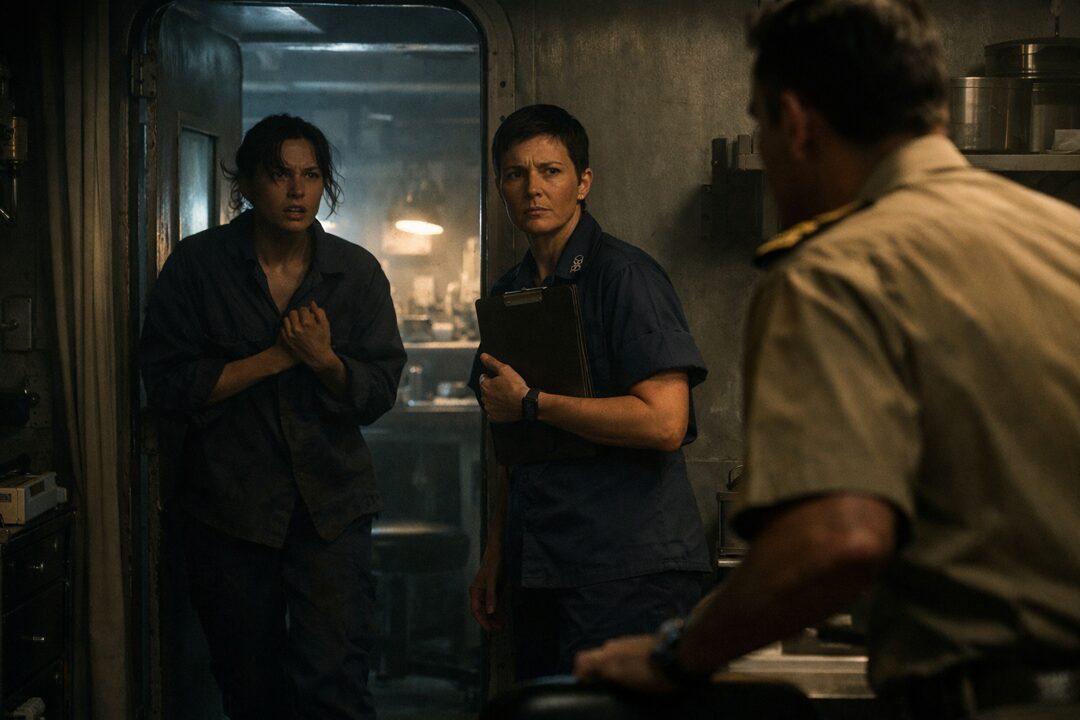
Sick bay was cold from the overworked air system. Stainless steel. cabinets latched tight. a faint layered smell of alcohol wipes, latex, rust, and human fear. Mara had always liked the clarity of it. Bodies lied less than people did.
Talia sat on the edge of the exam bench and kept staring at the deck.
“This the same reason as last week?” Mara asked.
Talia nodded.
Last week had been nausea. missed cycle. denial dressed up as caution. Mara had run the test, watched the negative line sit there like a pardon, and told herself to forget the tremor in the girl’s hands.
She handed Talia the cup and waited behind the curtain. Water hummed through the pipes somewhere behind the wall. The ship rolled once, slow and patient. Outside, a bosun’s whistle cut the corridor and died.
When Talia passed the cup back, her fingers were shaking harder.
Mara set the cassette test on the metal tray between them. She didn’t speak while the reagent crept through the strip.
She had done this too many times to pretend there was mercy in delay.
Talia whispered, “If it’s positive, who gets told?”
Mara looked at her.
“That depends what medical action is needed.”
“That’s not what I asked.”
No, it wasn’t.
Mara picked up the test.
Two lines.
A small thing. Cheap plastic. A result that could move a human life more decisively than most officers ever did.
Talia saw Mara’s face before she saw the strip. She let out one hard breath, not quite a gasp, not quite a laugh. Then she pressed the heels of her hands into her eyes.
“Hell,” she said. “Hell.”
Mara set the test down carefully.
It was not the first positive she’d seen on this deployment.
That was the part that changed everything.
Outside sick bay, the ship kept moving with the same mechanical faith it had held all month. Engines. watches. maintenance logs. meal lines. briefings. men and women in matching uniforms pretending the same steel corridors did not make every private mistake louder.
Inside, Mara opened Talia’s chart and felt the story shifting around her.
Not because a sailor was pregnant.
Because now there was a pattern.
Talia dragged her hands down her face. “You can’t put me off the watch bill yet.”
“That’s not your call.”
“You don’t understand.”
“I understand enough to know you’re not deciding this based on pride.”
Talia gave a bitter half-smile. “Pride’s cheap. I’m deciding it because once this gets out, this ship will eat me alive.”
Mara thought of the photocopied page under her clipboard.
Of the words Love Boat, written like a joke somebody wanted to become history.
“Who knows?” Mara asked.
“No one.”
“That’s rarely true.”
Talia lifted her chin. “Then let me keep it true a little longer.”
Mara looked at her for a moment.
The girl was frightened, yes. But that wasn’t the strongest thing in her face.
It was calculation.
That was worse.
Mara closed the chart.
“You’ll come back after evening chow. We’ll confirm, run bloodwork, talk next steps.”
Talia stood. “And nobody gets told before then?”
Mara answered the only way she could. “Medical information stays in medical unless it affects immediate operational readiness.”
Talia laughed once, without humor. “That sounds like a sentence built to betray me.”
Before Mara could answer, the hatch opened and Lieutenant Commander Daniel Reeve stepped in without knocking.
He stopped just inside the room. Crisp khakis. collar still exact despite the flight deck wind. A face that always looked as if it had already considered three versions of the conversation ahead.
His gaze moved from Mara to Talia to the test on the tray.
Just once.
That was enough.
“Talia,” he said evenly, “you’re due aft in seven minutes.”
Talia straightened on instinct. “Yes, sir.”
She passed him with her shoulders locked tight.
Reeve waited until the hatch closed behind her.
Then he looked at Mara and said, “How many?”
Mara did not pretend not to understand him.
“That’s not a medical question, sir.”
“It’s a readiness question.”
“It became a medical question first.”
His jaw shifted once. Not anger. Restraint.
“Mara.”
He only used her first name when no one else was around. That made it worse, not better.
“How many?” he repeated.
She thought of the sheet under the clipboard. The ship photo. The circled line. The blue-ink joke already outrunning the truth.
Then she said, “Too many for you to be asking that way.”
His eyes flicked to the clipboard. “Then I suggest we both start being careful.”
He left without another word.
When the hatch closed, Mara took out the photocopied page again.
The paper shook slightly in her hand, though the ship was steady.
For a long moment she stared at the grainy image of her ship and the words somebody had forced onto it. Not a vessel. Not a crew. Not a war deployment. A nickname.
That was how it started.
Not with the pregnancies.
With the joke.
And once a joke found a name, it became very hard to kill.
Part II — Numbers That Could Walk
By evening, everyone who mattered knew something was wrong, even if they didn’t know what.
That was how ships worked. Information moved through steel the way heat did. Through overheard names. altered duty rosters. the wrong silence in a chow line. Someone sees a sailor go to sick bay twice in one day, and by lights-out the whole deck has built itself a theory.
Talia came back alone.
Mara confirmed the result with bloodwork. There was no error to hide behind.
Talia sat through the explanation with the stillness of somebody enduring weather.
“How far?” she asked.
“Too early to be exact.”
Talia gave a short nod. “Can I keep standing duty for now?”
“For now, maybe. Not for long.”
“Then make it long.”
Mara capped a vial and labeled it. “Who’s the father?”
Talia looked straight past her. “No.”
“That wasn’t a request built out of curiosity.”
“I know what it was.” Talia’s voice stayed level. “It’s still no.”
Mara leaned against the counter. “If there’s coercion involved, if there’s rank pressure—”
“There isn’t.”
“You answered that too fast.”
Talia finally looked at her. “You want the truth? Fine. The truth is, if I say a name, I don’t just give you a father. I give this ship a story. And once this ship has a story, it will make the rest for me.”
She stood before Mara dismissed her.
At the hatch she stopped and said, “They won’t care whether I was stupid, scared, in love, lonely, drunk, or none of those things. They’ll hear one word and make me carry the rest.”
Then she left Mara alone with the labeled vials.
An hour later Reeve appeared in sick bay again.
He didn’t sit. Officers rarely did in medical spaces unless they had to surrender something.
“Give me impact numbers,” he said.
Mara kept writing.
“I can give you medical recommendations when they exist.”
“I don’t need names.”
“That’s convenient.”
He ignored it. “I need a count. Potential transfers. work restrictions. anything that affects the mission.”
Mara set down her pen.
“You’re asking for numbers that can walk around in people’s uniforms.”
He held her gaze. “I’m asking for command awareness.”
“No. You’re asking for just enough truth to manage optics and not enough to protect the people inside it.”
For the first time, something flashed in his face. Fatigue, maybe. Or anger too controlled to break the surface.
“This is a war deployment.”
“It is also a ship full of bodies.”
“You think I need that explained?”
“I think you need to hear it.”
He stepped closer, lowering his voice. “You know what happens if this gets out cleanly shaped as scandal. Not nuance. Not context. Scandal. You know exactly who pays first.”
Mara did know.
The women.
Always the women first. Then the idea of them.
Still she said, “That doesn’t buy you my charts.”
Reeve exhaled slowly. “No one’s asking for charts.”
“Not yet.”
He looked toward the closed hatch, then back at her.
“Off the record,” he said, “the captain’s already hearing from squadron. Somebody onshore got hold of a rumor. They want reassurance that this is manageable.”
“And is it?”
“That depends on whether people start acting like this ship is a floating confession booth.”
The line was polished enough to sound rehearsed. Mara hated that she could also hear the fear under it.
He left with nothing official in his hand.
By midnight, the rumor had evolved.
Not pregnancy yet. Not in words. But sailors started counting who came to sick bay. Who left with pale faces. Which female berthings went quiet when someone walked in. On the mess decks, Mara heard laughter cut off too sharply. Heard one male petty officer mutter, “Guess the war isn’t the only thing getting active out here,” and heard another tell him to shut up in a tone that meant the damage was already done.
Chief Lena Sato cornered Mara outside the ladderwell the next morning.
Sato looked forged, not born. Broad shoulders. hair pulled so tight it altered her face. A woman who had spent years making herself harder than every room she entered.
“It’s Talia, isn’t it?” she said.
Mara kept her expression flat. “You know I don’t discuss medical.”
Sato snorted. “You don’t have to discuss it. I have eyes.”
She leaned in slightly.
“I pulled two men off a near-fight over some garbage in berthing last night. One of them used that damn nickname.”
Mara said nothing.
Sato’s mouth tightened. “They’re turning this ship into a punchline.”
“This ship may be helping.”
Sato looked at her for a beat too long. “You think command doesn’t know that?”
“I think command is scared.”
“So am I.”
The honesty of it landed harder than Mara expected.
Sato folded her arms. “You know what men say when one woman screws up on a ship? They say all women screw up. They never miss a chance to turn one person into policy.”
“There’s more than one person.”
Sato’s face hardened again. “That doesn’t help.”
No, Mara thought. It didn’t.
That afternoon the captain ordered a mandatory conduct briefing.
Nothing makes a ship feel guiltier than being told, in formal language, that it remains professional.
The crew packed into a machinery-hot compartment and stood shoulder to shoulder while the captain spoke in clipped, righteous phrases about standards, conduct, operational focus, personal responsibility. No names. no accusation. Which made it worse. Every omission glowed.
Mara watched faces.
Men looking bored too carefully.
Women looking angry in different directions.
Talia in the third row, jaw set, gaze fixed on a point just above the captain’s head as if discipline could make her invisible.
Reeve stood off to the side with his hands clasped behind his back.
He looked like a man trying to hold a crack closed with posture alone.
After the briefing, two women from supply passed Talia in the passageway. One looked away too fast. The other didn’t.
“Congratulations,” she said softly, with cruelty so polished it almost sounded kind.
Talia stopped walking.
Mara was half a corridor behind and saw the exact second Talia decided not to swing.
Instead she said, “You don’t know enough to hate me this much.”
The other woman flushed, but not from shame.
That night, Mara found a folded note slid under the sick bay door.
No signature. Just four words.
How many girls now?
She burned it in a metal tray and watched the ash curl.
The next morning, one of her supply lockers jammed.
She yanked it open harder than she meant to, and an old transfer log spilled sideways. A routine packet. misfiled. unremarkable except for one name she recognized.
Petty Officer Claire Darnell.
Transferred off ship three weeks earlier for “acute stress response and family hardship.”
Mara frowned.
Claire had not looked like family hardship.
She had looked like someone trying to remain inside her own skin.
Mara sat with the file in her lap while the ship hummed around her, and for the first time the rumor aboard Acadia stopped feeling merely dirty.
It started feeling useful.
Useful to someone.
Part III — What They Let the Story Cover
Mara asked for Claire Darnell’s medical packet through the clean channels first.
It came back incomplete.
She asked again, this time through supply records and transfer clearance.
The pages arrived with sections copied so badly entire lines had vanished into black blur. Dates. signatures. a counseling notation. an attachment referenced but missing.
That was what raised the hair on her arms.
On a Navy ship, incompetence was common. Missing paperwork that pointed in one direction was not.
She took the packet to Reeve’s office.
He was alone, jacket off, sleeves rolled with precision that made even fatigue look regulated. The overhead light cut hollows under his eyes.
He read her face before he saw the file.
“What is it?”
Mara put the papers on his desk.
“Claire Darnell.”
A tiny pause. Not enough for a careless person to see. Enough for Mara.
“She transferred out,” he said.
“I noticed.”
“She was unstable.”
“That’s one word for it.”
His expression cooled. “What are you asking?”
“I’m asking why her medical packet is missing the attachment tied to a counseling referral.”
Reeve didn’t touch the papers.
“That would be because not every matter aboard this ship is purely medical.”
“Coercion is.”
His eyes lifted to hers.
There it was. The room changing shape around a single word.
Mara said, “Was she pressured by a senior petty officer?”
Reeve’s jaw tightened once.
He stood and went to the hatch, checked the passageway, closed it again. When he turned back, his voice had dropped.
“She made an allegation.”
“And?”
“And it was not substantiated to the standard required for formal escalation before transfer.”
Mara stared at him.
“That sentence,” she said quietly, “is doing a lot of work.”
Reeve looked tired enough to be honest for exactly one minute.
“She wanted off the ship. She got off the ship.”
“That’s your answer?”
“That is the operational reality.”
“No.” Mara stepped closer. “Operational reality is steel and fuel and sleep deprivation. This is narrative management.”
He flinched at the accuracy of it.
“Do you think I don’t know how bad this can get?” he asked. “You think I’m blind to what happens if rumor, sex, pregnancy, and an unproven coercion allegation all hit shore as one story?”
“It wouldn’t be one story if you didn’t let it become one.”
He looked away.
That was answer enough.
When Mara left his office, she understood the scandal differently.
The pregnancies were real. The gossip was real. The fear was real.
But there was also something else underneath them—a previous wound, half-buried, convenient to leave blurred because once everyone aboard started saying Love Boat, every uglier truth got folded into the same laugh.
By evening, a third pregnancy was confirmed.
Not Talia. Another sailor, older, married, furious at herself in a quieter way.
Mara finished the exam and sat alone for a full minute after the woman left.
Three.
Three had become a count, which meant command would turn it into a percentage soon if they hadn’t already. Something tidy. Something repeatable.
Numbers were clean. Bodies weren’t.
Chief Sato came in near lights-out, ostensibly for aspirin.
Mara handed her the bottle.
Sato didn’t leave.
“You heard about the third one.”
It wasn’t a question.
Mara said, “You heard too.”
“I hear everything by the time it’s useless.”
She leaned against the counter, looking more worn than Mara had ever seen her.
“When I was an E-3,” Sato said, “I had a chief tell me women on ships are like glass instruments. One crack, and people act like the whole design failed.”
Mara waited.
Sato gave a dry laugh. “I spent fifteen years trying not to be anyone’s crack.”
“And now?”
“Now I’m watching girls get measured like cautionary posters.”
Mara looked at her. “You’ve been hard on them too.”
Sato’s face didn’t move. “I know.”
That was all she offered. It was enough.
The next day Talia came in for bloodwork and found Mara finishing notes over Claire Darnell’s packet.
Her eyes caught the name.
“What happened to her?” Talia asked.
Mara closed the file.
“Why do you know that name?”
Talia shrugged, but it was too fast. “People talk.”
“About what?”
Talia stared at the countertop. “About how she got sent home. About why.”
“Why don’t you tell me what version they tell.”
For a second Mara thought Talia would refuse.
Then she said, “Depends who’s telling it. Men say she couldn’t handle deployment. Women say she got too close to someone she shouldn’t have. Some say she lied. Some say she learned how this place works.”
Mara said, “And what do you say?”
Talia’s mouth tightened.
“I say nobody cares which part was true once the ship has a better story.”
The line hit so cleanly Mara nearly repeated it back to her.
Instead she asked, “Who have you been protecting?”
Talia went still.
“That’s not the same as asking who the father is.”
“No,” Mara said. “It’s more important.”
Talia looked at the shut hatch. Then at Mara.
“At first I thought if I kept my mouth shut, people would run out of breath.”
She smiled once. It was a young person’s smile stripped of youth.
“They don’t. They just get creative.”
Mara waited her out.
Finally Talia said, “Everyone thinks it was Chief Rainer.”
Rainer. A senior enlisted man on engineering. Married. Too friendly. already half-convicted in rumor.
“It wasn’t,” Talia said. “That’s what’s funny.”
“Funny.”
“You know what I mean.”
Mara did.
“Who was it?”
Talia pressed her lips together. “Miguel Ortega.”
The name surprised Mara.
Ortega was a mechanic. Enlisted. Same paygrade tier. Married, yes, but no formal power over Talia beyond the ordinary thousand small imbalances of a ship.
“Why protect him?” Mara asked.
Talia’s throat moved. “Because he has kids. Because if I say his name, I become the woman who ruined a family instead of the woman who ruined a deployment. Because this ship can only process one woman at a time.”
The cruelty of it was so precise Mara almost admired it.
“And Claire?” she asked.
Talia shook her head. “Different thing.”
“You know that?”
“I know enough.”
Mara stepped closer. “Enough to say it?”
Talia’s eyes flashed with panic. “No.”
“There may already be a record—”
“Then let the record be brave. I’m not.”
For a moment neither of them spoke.
Then Talia said, very quietly, “You think silence is cowardice because you still believe truth arrives clean. It doesn’t. It arrives wearing whoever can survive it.”
Mara had no answer ready for that.
After Talia left, Reeve sent for Mara again.
This time he didn’t circle.
Years earlier, he told her, before this ship, before this war, he had fought in staffing meetings and policy rooms and recommendation boards to get mixed-gender deployment assignments treated as ordinary, not experimental. He had argued competence over custom. He had lost promotions for it once. nearly lost command track entirely. He had believed history could be forced to move by paperwork if nothing else.
“And now?” Mara asked.
“And now one ship becomes a headline, and twenty men in Washington get to call themselves practical.”
He did not sound self-pitying.
That made it worse.
“If this turns into a morality tale,” he said, “women won’t be the authors of it. They’ll be the evidence.”
Mara looked at him for a long time.
It was the first moment she understood that his fear was not only career. Career was in it, yes. Pride was in it. But so was conviction, damaged and compromised and still partly real.
That was the problem with men like Daniel Reeve.
Sometimes they were protecting something worth keeping.
And sometimes that made them more dangerous.
Part IV — The Report They Wanted
Squadron sent language two days later.
Not in those exact words, of course. It arrived as a request for summary readiness documentation in advance of at-sea transfer operations. Neat. bloodless. asking only what was “necessary for mission planning.”
Mara read the template and felt cold.
Pregnancy cases would be counted under non-battle attrition risk.
No names, no distinction, no mention of Claire Darnell, no note that one thread aboard the ship involved private consensual disaster and another involved an allegation command had chosen to let dissolve into fog.
Just numbers.
Numbers that would travel upward, then outward, then eventually downward again as a story simpler than any person on board had lived.
Reeve came to sick bay after midnight.
The ship was rolling harder now, the sea finally rough after weeks of deceptive calm. Somewhere forward, metal thudded with the rhythm of unsecured strain corrected too late.
He put a folder on Mara’s desk.
“I need your certification on the medical summary.”
She didn’t open it. “No.”
“I haven’t asked yet.”
“You didn’t need to.”
He stood there, one hand on the back of the chair opposite her, not sitting in it.
“This doesn’t erase anything in your records.”
“It erases the line between things that should never have been blurred.”
“It limits who gets crushed.”
Mara let out a quiet breath. “That’s what you keep telling yourself.”
“It happens to be true.”
“Not true enough.”
Reeve’s voice sharpened. “Do you want the whole ship branded by this? Do you want every woman aboard remembered as a punchline because you needed the satisfaction of moral completeness?”
The words hung there.
Mara rose so fast the chair legs scraped.
“Moral completeness?” she said. “Is that what you think this is? I’m trying to keep abuse from being filed beside gossip because it’s administratively convenient.”
His face changed, just slightly. He knew he’d said too much.
But he didn’t take it back.
Instead he said, more quietly, “If you force open every piece of this, the cleanest truth won’t win. The dirtiest version will.”
That was the most honest thing he had said to her.
It might even have been right.
Which was what made the moment unbearable.
Before she could answer, someone knocked once and opened the hatch.
Talia.
Her face was pale from lack of sleep, her eyes too bright.
“I need to talk to Petty Officer Vance.”
Reeve turned. “This isn’t the time.”
“It is for me, sir.”
There was something in her voice that made even him step back.
Mara nodded toward the exam room. Talia followed her inside.
For a long moment, Talia didn’t speak. Then she reached into her pocket and took out a folded scrap of paper.
A note.
Mara unfolded it.
Two lines in cramped handwriting. Miguel Ortega’s name. an off-ship contact number. And underneath: I’m not saying this for me.
Talia hugged her own elbows.
“They’re going to fly me off tomorrow, right?”
“Probably.”
“They’ll talk anyway.”
“Yes.”
Talia swallowed. “Then let them talk about the right sins.”
Mara waited.
Talia looked at the deck.
“Claire told me once not to be alone in the auxiliary machine room with Senior Chief Hollis. She said it like a joke. Like advice girls pass to girls so nobody has to file paperwork.” Her mouth shook once, then steadied. “After she got sent off, people started saying she’d made trouble because she couldn’t handle the men. Then this started, and suddenly every story on the ship became one story. You understand?”
Mara did.
“Why are you telling me now?” she asked.
“Because I kept thinking if I protected one man, I was controlling something.” Talia looked up. “But all I did was help them keep everything muddy.”
She drew in a thin breath.
“I don’t want my baby to start as a rumor.”
The sentence landed so hard Mara had to look away.
When they came back out, Reeve was still there.
His eyes went to the paper in Mara’s hand, then to Talia’s face.
Something in him understood immediately that the center of the story had shifted again.
Talia stood straighter under his gaze than most lieutenants did.
“I’m naming the father for medical record,” she said. “And I’m confirming Claire warned me about Hollis.”
Reeve closed his eyes for one beat. Not long. Enough.
Then he said, “You may go.”
After she left, the compartment felt smaller.
“She’s right,” Mara said.
Reeve did not answer.
“She’s naming the difference. You can’t keep filing difference as risk.”
He looked at the folder on the desk.
“You think I don’t know Hollis should have been handled harder?”
“Should have been?”
A long silence.
Then Reeve said, “You want my confession or my cooperation? Tonight, you may get one.”
Outside, the ship lurched. Something heavy slammed and was caught. Over the 1MC, a clipped voice announced storm preparations for the transfer window.
Mara opened the folder.
The summary sheet was already typed.
Case counts. temporary restrictions. evacuation recommendations. sterile phrasing stripped to bone.
At the bottom, a line for medical certification.
She could feel the whole ship pressing toward that blank space.
Reeve said, “If you attach language that names a coercion pathway, this report changes category. It triggers review beyond this deployment. It will drag everyone named or unnamed through a version of the story they do not control.”
Mara picked up her pen.
“They don’t control it now.”
He watched her.
“Neither do you.”
“No,” she said. “But I can stop helping you lie about what it is.”
For the first time that night, his voice lost all officer polish.
“You think history rewards nuance?” he asked. “It doesn’t. It remembers whatever can fit on one line.”
Mara thought of the photocopied sheet. The blue pen. The joke.
Then she said, “That’s exactly why I’m writing more than one line.”
Part V — What Could Still Be Kept
The storm made the ship feel alive in all the ugliest ways.
Steel groaned. loose vibration lived in the walls. passageway lights trembled with every harder roll. Outside, black water smashed itself into white along the hull, invisible except when lightning made the windows into brief, terrible mirrors.
Mara sat at the desk in sick bay and wrote the addendum by hand first.
Not dramatic language. Not accusation built for headlines.
Just fact.
A cluster of pregnancy cases affecting readiness.
Distinction between consensual relationships and unresolved misconduct concerns.
Reference to prior transfer linked to allegation pathway omitted from summary treatment.
Need for protected review.
Need for separate handling.
Need for record.
Her handwriting stayed steady. That pleased her more than it should have.
When she typed it up, the keys struck hard under her fingers.
Reeve stood by the hatch, reading without interrupting.
At one point he said, “If this goes forward, your career stalls.”
She kept typing.
“At least it’ll be my career.”
He said nothing after that.
When she finished, she attached the addendum under seal to the summary packet and signed only the documents she could live with.
Then she slid both across the desk.
The ship rolled hard enough that the folder moved an inch by itself.
Reeve put one hand on it to stop it.
For a second Mara thought he might remove the addendum. Tear it. delay it. cite procedure. There were a dozen ways a man in his position could make truth slower.
Instead he opened the folder, read the first page again, then the sealed notation, then closed it.
The overhead light left his face half in shadow.
“This will not save the public story,” he said.
“I know.”
“It may not even save the private one.”
“I know.”
His hand stayed on the folder.
Then, with a motion so small it might have been mistaken for fatigue, he turned the packet so the routing stamp faced him and signed the operational transmission line beneath it.
Not approval.
Not agreement.
Passage.
It was the most he could give without becoming someone else.
Mara understood that and hated that she did.
“Why?” she asked.
He capped the pen.
“Because if I kill it now, then I become exactly the thing they’ll never have to write down.”
That was not absolution. It didn’t sound like any.
But it was enough.
Over the speakers came the transfer call. Medical evac prep. weather window narrowing. The ship already moving to give one helicopter a chance to take the sea’s permission before it changed its mind.
Talia was waiting in the passageway with a seabag at her feet.
No tears. no scene. Her face looked younger without defiance holding it up, and older for the same reason.
Mara handed her the paperwork envelope.
“Your records.”
Talia took it carefully. “Did you put his name in?”
“Yes.”
“And Claire?”
“Yes.”
Talia nodded once.
The corridor shook with another wave.
“I used to think the worst thing that could happen was everybody knowing,” she said.
Mara waited.
Talia looked down at the envelope.
“It’s worse when they know the wrong thing.”
Mara felt that sentence settle somewhere she would not get rid of.
At the far end of the passageway, Chief Sato appeared, arms folded, waiting to walk Talia topside.
She looked at the seabag, then at Talia.
When she spoke, her voice was rougher than usual.
“Keep your chin up, Neves.”
Talia almost smiled. “That your version of kindness, Chief?”
“It’s the only regulation-compliant kind.”
For a second all three women stood there with the ship groaning around them, every difference between them still intact, every debt unpaid. Yet something had shifted.
Not healing.
Recognition.
As Sato bent to lift the heavier end of the bag, she said without looking at Mara, “For what it’s worth, you did the harder thing.”
Mara answered, “That doesn’t make it the better one.”
Sato glanced up.
“No,” she said. “But it keeps me from hating us quite as much.”
Then she and Talia headed toward the ladderwell.
Mara watched them go until the corridor swallowed them.
Later, after the helicopter had taken one body and a sealed packet off the ship, after the storm began to ease, after the men in berthing started joking again because people mistook resumed noise for recovered innocence, Mara returned to sick bay and found the photocopied gossip sheet still tucked under the edge of her desk.
She almost threw it away.
Instead she folded it neatly and put it inside the back of Claire Darnell’s duplicated packet.
Let the joke live beside what it had covered.
Let the record keep its own accusation.
Part VI — The Brass Plaque
The nickname survived.
Of course it did.
Months later, off deployment and back under safer skies, Mara heard it in a base parking lot from two sailors laughing over cigarettes. Heard it again in a clipped radio segment about “strange stories from the Gulf.” Years later, a civilian magazine used it in a sidebar so smug and brief it made the whole thing sound like a drunken cruise anecdote with uniforms.
Nobody ever told it correctly.
Talia gave birth stateside to a girl with dark hair and a serious face. Mara got a photograph once in a plain envelope with no note inside. Just the picture. Mother and child. Both staring at the camera as if daring it to flatten them.
Miguel Ortega disappeared into the long, dull punishment of private fallout. His marriage did not survive. That was not triumph. It was merely consequence.
Senior Chief Hollis was never publicly shattered the way rumors wanted villains shattered. But a protected review reopened Claire Darnell’s case file. Training billets changed. One recommendation quietly vanished from his record. He did not go on to shape the next generation of mixed-gender crews.
That was not justice either.
But it was a scar in the system, and scars were proof the body had not passed through untouched.
Mara’s own notice came as a terse line in a personnel packet: promotion deferred, assignment track redirected, no explanation worth the paper it came on.
Daniel Reeve transferred sideways.
Not disgraced. Not advanced.
Just moved, the Navy’s preferred way of admitting that something mattered without ever saying so.
She never saw him again.
Not until years later, if seeing counted when it happened through memory first.
The harbor museum smelled of waxed floors, old rope, and air-conditioning. Mara had gone there on a gray afternoon because she was in the city for something else and made the mistake of having an hour to fill.
She found the model in the naval gallery.
USS Acadia, rendered in perfect miniature. Clean deck lines. bright brass rail. a plaque below it polished by strangers’ hands.
The text was dry enough to be almost holy.
Service dates. class. displacement. deployment theater. commendations.
Nothing about the pregnancies.
Nothing about Claire.
Nothing about the brief, ugly season when steel corridors taught people how fast a human life could become a category.
Behind Mara, two college-aged tourists stopped to read the plaque.
One of them snorted softly. “Is this the ship they called the Love Boat?”
The other laughed. “No way. That one?”
Mara didn’t turn around.
“Guess sailors get bored,” the first one said.
Then they moved on, already carrying the story away in its thinnest form.
Mara stood alone with the model.
The brass plaque gleamed under the lights. Official language. official memory. a ship reduced to what could fit in a block of engraved text.
Slowly, she put her hand against the edge of the case.
Cold glass.
She saw Talia in the sick bay chair, trying not to shake.
Saw Claire’s half-missing file.
Saw Sato lifting the seabag with her face set like stone.
Saw Reeve in the storm light, hand resting on a folder he could still have closed forever.
A museum could preserve a ship.
It could not preserve the difference between the things people did, the things done to them, and the things history decided to call all by one name.
Mara stood there until her own reflection started to appear over the miniature gray hull.
Then she said, so quietly only the glass could hear it, “You were never the joke they made of you.”
She left her hand there one second longer.
Then she walked out, carrying the wrong story and the truer one both, as if that was still the price of having stayed.