The HOA Ordered Daniel to Tear Down His Wall, Then the Clubhouse Began to Split Apart
Chapter 1: The Plaque Appeared Between the Falling Blocks
The third concrete block struck the ground hard enough to shake dust from Daniel Moore’s porch railing.
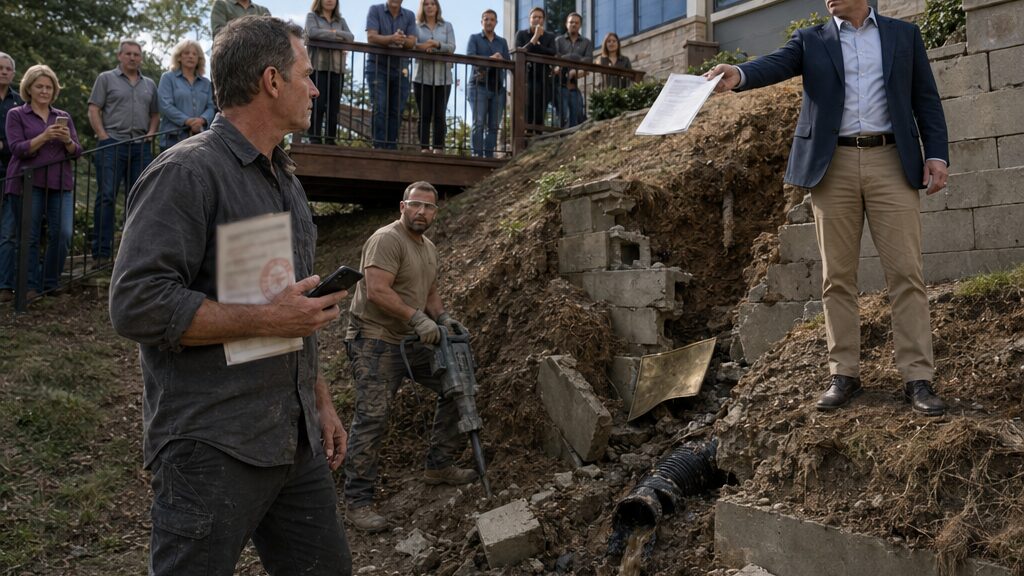
When the pale gray cloud cleared, a rectangle of brass showed between the exposed courses of the retaining wall. The demolition worker stopped with the hydraulic hammer raised above his shoulder.
DANIEL MOORE, P.E.
The rest of the engraved line remained buried behind the next block, but Daniel knew what it said: SLOPE RETENTION AND DRAINAGE CONTROL.
Nicholas Carter looked at the plaque, then at Daniel.
“So you signed your landscaping,” he said.
Two neighbors standing near the property line laughed uncertainly. Neither looked at Daniel afterward.
Daniel lifted his phone and took a photograph. The screen caught the broken wall, the brass plaque, Nicholas’s polished shoes, and the yellow violation sheet folded beneath his arm.
“It isn’t landscaping,” Daniel said.
Nicholas gave the demolition worker a small forward motion with two fingers.
“Continue.”
The hammer came down.
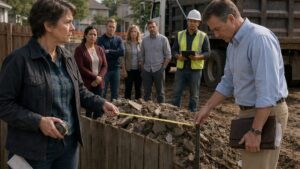
The worker was employed by a general property-maintenance company, not a structural contractor. He had arrived in a white truck with pruning tools in the rack and a small excavator on a trailer. Daniel had asked whether he had been shown the stamped slope drawings.
The worker had looked toward Nicholas before answering.
“I was told to remove six courses.”
Now he drove the steel point between two blocks. The upper course shifted. Soil spilled through the opening in a damp brown ribbon.
Daniel stepped closer.
“Move downhill from that cut.”
The worker lowered the tool. “What?”
“Don’t stand directly below the exposed face. The fill is saturated near the base.”
Nicholas exhaled through his nose. “Daniel, you’ve made your position clear.”
“This isn’t a position.”
“It is exactly a position. The board has one. You have another.”
Daniel pointed toward the clubhouse beyond the crest of the slope. Only the roof and rear windows were visible above the trimmed hedge.
“The clubhouse drain outlets discharge into this grade. Once you remove the wall, the soil has no lateral restraint along this section.”
Nicholas unfolded the violation sheet as though Daniel had not spoken. A photograph was stapled to it, showing a steel tape measure stretched from the lower patio to the wall cap.
“Forty-two inches,” Nicholas said. “The architectural guidelines allow thirty-six without prior written approval.”
“The exposed height varies with grade.”
“The highest visible point is forty-two.”
“The wall was designed from the footing, not from the mulch line.”
Nicholas turned the page so the neighbors could see the measurement. “Six inches is not a rounding error.”
“No,” Daniel said. “It is also not an engineering review.”
The words came out sharper than he intended. Nicholas’s mouth tightened with something close to satisfaction.
For three weeks, Daniel had submitted the same request in increasingly formal forms: suspend enforcement for seventy-two hours; hire an independent geotechnical engineer; review the drainage plan filed with the county; confirm the clubhouse runoff route before disturbing the slope.
Each response had come back through the HOA management portal.
Violation remains active.
Owner must restore compliant condition.
Board decision final.
That morning Nicholas had arrived before eight with two board members, the maintenance crew, and a printed copy of the bylaws. No engineer. No county inspector. No one from the contractor who had built the wall with Daniel.
John Ramirez had offered to come, but Daniel had told him not to.
There was no reason to pull John’s company into a dispute the board had already decided to frame as defiance.
Now another block broke loose. It struck the patio edge and split. The embedded plaque bent at one corner but did not separate from the mortar.
The sound traveled across the quiet row of backyards.
A woman watching from her deck raised her phone. Daniel could not tell whether she was recording the demolition or him.
Nicholas stepped beside the damaged plaque.
“This is what happens when residents decide their professional opinion places them above the rules.”
Daniel felt the heat rise under his collar.
He could have answered in half a dozen ways. He could have listed his licenses. He could have explained hydrostatic pressure, soil creep, surcharge load, and the difference between a decorative garden wall and an engineered retaining structure.
Instead, he photographed Nicholas standing beside the exposed plaque.
The timestamp appeared at the top of the image: 8:43 a.m.
Nicholas noticed.
“You’re documenting me now?”
“I’m documenting the condition.”
“For litigation?”
“For sequence.”
Nicholas studied him for a moment. “That sounds like a threat.”
Daniel lowered the phone. “It sounds like a record.”
The worker restarted the hammer.
By ten, the upper half of the wall was gone. The soil behind it had begun slumping into shallow shelves. Water-darkened lines marked the paths where runoff had moved through the fill after storms. Daniel photographed each one.
Near the center section, a black corrugated drainpipe appeared behind the removed blocks.
The worker stopped again. “This yours?”
“It connects to the interceptor drain.”
Nicholas walked over. “Is that approved?”
Daniel looked at him.
“That pipe receives water from the slope above.”
“I asked whether it was approved.”
“It appears on the drainage drawing.”
“That is not the same thing.”
Daniel crouched and brushed soil away from the pipe. Its end had been crushed by the hammer. A thin stream of muddy water seeped through the split plastic.
He stood.
“You need to stop now.”
Nicholas folded his arms.
“The pipe is damaged.”
“The crew can replace a pipe.”
“You don’t know where it leads.”
“It leads into your wall.”
“It leads from HOA property.”
One of the board members shifted her weight. “Nicholas, maybe we should call someone.”
Nicholas did not look at her. “We have already called counsel. The association has the right to correct a continuing violation.”
Daniel reached into the folder on his patio table and removed a single stamped page. The heading read NOTICE OF POTENTIAL SLOPE INSTABILITY FOLLOWING REMOVAL OF RETAINING STRUCTURE.
He held it out.
“I am asking for a temporary stop pending independent review. I will pay for the review.”
Nicholas glanced at the stamp but did not take the page.
“You had months to comply.”
“I had months to ask you to read this.”
“We read your submissions.”
“Then tell me where the clubhouse roof drains discharge.”
Nicholas’s gaze flicked toward the hill.
It lasted less than a second, but Daniel saw it.
So did the board member beside him.
Nicholas took the warning at last, folded it once, and placed it beneath the violation notice.
“The board’s answer remains no.”
The worker looked between them. “You want me to keep going?”
Nicholas’s voice was quieter when he replied.
“Yes.”
Daniel stepped backward.
He stopped arguing after that.
He photographed the crushed pipe, the opened slope, the removed blocks stacked near the curb, and the brass plaque when it finally fell free. The plaque landed face down in the dirt. Daniel picked it up, wiped the mud from his name with his thumb, and placed it on the workbench inside his garage.
At noon, the crew left half the blocks in a pile and spread loose soil along the cut face. Nicholas handed Daniel a notice stating that the association would bill him for corrective action.
“The property is now closer to compliance,” Nicholas said.
Daniel looked past him at the raw slope. The clubhouse windows reflected the white noon sky.
“No,” Daniel said. “It is closer to movement.”
Nicholas shook his head and walked away.
Daniel went inside, scanned every photograph, and attached them to the warning he had prepared the night before. He included the crushed drainpipe, the exposed fill, the time-stamped image of Nicholas beside the plaque, and the board’s refusal to pause work.
At 3:17 p.m., he submitted the packet to the county building and safety office.
Under AFFECTED STRUCTURE, he did not enter his own address.
He typed the name and parcel number of the HOA clubhouse.
Chapter 2: The Rule Was Simple, the Ground Was Not
The county records clerk searched the database twice before turning the monitor toward Daniel.
“There’s no final approval letter,” she said.
Daniel remained standing at the counter. “Search the architectural review number.”
“I did.”
“The submission was made in March.”
“I see a drainage plan received in March. I see a retaining-wall detail added in April. I see an HOA acknowledgment attached in May.” She pointed to the screen. “But I don’t see a final association approval.”
Daniel knew what the next question would be before she asked it.
“When did construction begin?”
He looked through the glass wall behind her at the rows of flat files and rolled plans.
“Late April.”
The clerk’s expression did not change, but her silence did.
Daniel placed both hands on the counter. “The association’s review period had expired.”
“That may matter under their procedures. It doesn’t create an approval document.”
“I received no denial.”
“I’m not deciding the dispute, Mr. Moore. I’m telling you what the file contains.”
He had come to the county office expecting the records to support a clean sequence: submission, acknowledgment, construction, completion, notice. Instead, the absence on the screen widened into its own kind of crack.
He had built before receiving the final written letter.
Not secretly. Not recklessly. The board had acknowledged the plans. The review deadline had passed. John’s crew had already been scheduled, and the rainy season was approaching. Daniel had believed the stamped drawings and the expired review period were enough.
Technically, he had treated silence as consent.
He thanked the clerk and asked for certified copies of everything.
Back in his office, he spread the documents across the drafting table. The original wall photographs showed clean courses, compacted gravel, perforated drainpipe, and the brass plaque fixed near the center.
In one photograph, John stood beside the finished wall with a level resting on the cap.
Daniel remembered John asking, “You get the HOA letter?”
“They missed their deadline,” Daniel had said.
“That isn’t what I asked.”
Daniel had changed the subject.
Now he found the email he had sent Nicholas after construction began.
Work is proceeding based on the submitted engineered plan and the association’s failure to respond within the stated review period.
Nicholas’s reply had arrived two days later.
Your assumption is noted.
At the time, Daniel had read it as irritation.
Now it looked like a warning.
The wall’s function remained unchanged. The slope did not care whether the correct letter had been issued. But the missing approval gave Nicholas a simpler story to tell: Daniel had built first and justified later.
That evening, the HOA board held a special compliance session in the clubhouse. Daniel arrived with a binder and placed the certified county plans on the table.
Nicholas sat at the center beneath a framed photograph of the subdivision entrance. Susan Clark sat two seats away with a calculator beside her notebook.
Daniel had spoken with her only in passing before. She was the treasurer, precise about dues, quick to remind residents that landscaping improvements could affect shared maintenance costs.
Nicholas opened the meeting.
“We are here to address continued misinformation regarding a completed enforcement action.”
Daniel looked at the empty chair where an independent engineer should have been.
Nicholas continued. “Mr. Moore’s wall exceeded the permitted height and lacked final architectural approval.”
Both statements were true.
Placed together, they made everything else sound irrelevant.
Daniel opened his binder. “The wall retained a shared drainage slope.”
“It occupied your lot.”
“The runoff originates above my lot.”
“The clubhouse has operated for nineteen years.”
“And the grade has been repaired repeatedly.”
Susan looked up. “What repairs?”
Nicholas’s head turned slightly toward her. “Routine drainage maintenance.”
Daniel slid a stamped grading plan across the table.
Blue contour lines descended from the clubhouse patio toward the rear property boundary. Three roof-drain symbols fed a swale that crossed the HOA parcel and narrowed above Daniel’s yard.
“The wall intercepted this flow,” Daniel said. “It reduced erosion at the toe and limited lateral movement toward my foundation.”
Nicholas tapped the bold dimension on the wall detail.
“Forty-two inches.”
Daniel tapped the contour lines.
“Water does not read the architectural guidelines.”
One of the other board members nearly smiled, then stopped when Nicholas looked over.
Susan drew the plan closer. “Why is the clubhouse runoff shown entering his drainage system?”
“Because that is how the site was graded,” Daniel said.
Nicholas closed the drawing with his palm. “This is becoming theatrical.”
“No. It is becoming expensive.”
The room went still.
Daniel regretted the sentence immediately. Not because it was false, but because it sounded like he wanted the cost to come.
Nicholas leaned back.
“There it is.”
“What?”
“The threat beneath all these reports. Approve what you built, or something bad will happen.”
“I didn’t create the slope.”
“You altered it without approval.”
“I stabilized it.”
“You say you stabilized it.”
“My license says I am qualified to make that determination.”
“And your missing approval says you believed your license exempted you from procedure.”
Daniel felt the room shift away from the drawings and toward him.
Susan spoke quietly. “Did you begin before the final letter?”
Daniel could have explained the expired deadline, the weather window, the contractor schedule, the unanswered emails.
“Yes,” he said.
Nicholas nodded as though the case had ended.
The next morning, every homeowner received a community notice through the association portal.
The board had successfully corrected an unapproved structure after repeated owner noncompliance. Residents were reminded that professional credentials did not replace architectural authorization.
Daniel read it twice.
His name was not printed, but the photographs made identification unnecessary. One showed the wall before removal. Another showed the measured height. A third showed the stacked blocks near his driveway.
By afternoon, two neighbors had cancelled informal requests for him to review drainage issues on their properties.
One wrote, Sorry, don’t want to get caught in the middle.
Daniel saved the message in the same folder as the board notices.
That night, he returned to the county plans.
He enlarged the original subdivision grading sheet until the blue lines broke into pixels. A note near the clubhouse rear patio referred to DETAIL 7—SLOPE DRAINAGE IMPROVEMENT.
Detail 7 was not included in the scanned set.
The next morning, Daniel called the clerk.
She searched the archived index.
“There should be an attachment,” she said. “Maintenance responsibility and inspection schedule.”
“Can you locate it?”
“Not in this file.”
“Was it removed?”
“I can’t say that.”
“Who submitted the scanned package?”
“The association, nine years ago.”
Daniel wrote the date down.
Across the subdivision, Susan Clark was reviewing the same community notice Nicholas had sent. She noticed the line claiming that no engineering evidence had established a shared drainage function.
She opened the digital board archive to verify it.
Inside the folder labeled CLUBHOUSE MAINTENANCE, the numbering jumped from Attachment C to Attachment E.
Attachment D was missing.
Chapter 3: What the Board Never Put in the Minutes
Susan placed the maintenance log on Daniel’s kitchen table and kept one hand resting on it.
“I was told this file didn’t exist,” she said.
It was six-thirty in the morning. Daniel had not invited her inside immediately. She had stood on his porch holding a canvas grocery bag while the sprinklers clicked along the opposite curb.
Now the bag lay open beside her chair. Inside were three binders, a bundle of invoices, and a folded reserve-study summary.
Daniel did not touch them.
“Who told you?”
“Nicholas.”
“When?”
“Last night.”
She looked tired rather than frightened. That made Daniel more cautious.
“You voted for removal,” he said.
Susan’s fingers tightened on the log.
“Yes.”
The admission landed more heavily than a denial would have.
Daniel pulled out the chair across from her. “Then why are you here?”
“Because I voted on the file I was given.”
“And now?”
“Now I’m not sure it was the whole file.”
The maintenance log covered eleven years. Handwritten entries documented recurring water intrusion at the clubhouse’s rear foundation, erosion beneath the patio edge, clogged roof drains, and repeated placement of gravel along the upper slope.
Several repairs had been described as temporary.
Daniel turned the pages slowly.
Three years earlier: Soil washout below southeast downspout. Filled and compacted.
Two years earlier: Patio settlement observed. Monitor after winter rains.
Fourteen months earlier: Rear door sticking during wet season. Adjusted hinges.
He looked up.
“The door was already moving.”
Susan nodded. “A little.”
“A door does not care about your reserve balance.”
Her expression hardened. “You think I don’t know that now?”
Daniel pushed the log back toward her.
“I think you came here because you want me to say Nicholas deceived you.”
“I came because the records don’t match the minutes.”
“That is not the same thing.”
“No.” She looked down at the log. “It’s worse.”
The missing attachment had not appeared in the digital archive, but Susan had found a reference to it in an old invoice box inside the clubhouse storage room. Behind the invoices was a folded report from a civil engineering firm that no longer operated under the same name.
Daniel opened it.
The first pages described surface drainage. The final page contained a recommendation in plain language: reinforce the lower slope, install a continuous interceptor drain, and monitor movement near the clubhouse slab.
The report was dated seven years before Daniel built his wall.
He read the recommendation again.
“Who received this?”
“The board president at the time. Nicholas was vice president.”
“Was it discussed?”
“Not in any minutes I can find.”
“Was the work performed?”
Susan gave a small shake of her head.
Daniel turned to the estimate attached behind the report.
The cost had been significant then, but not extraordinary. Below it, a handwritten note read: Defer pending reserve review. No immediate life-safety concern.
“Who wrote that?”
“I don’t know.”
“You recognize the handwriting.”
Susan looked toward the window.
Daniel waited.
Finally she said, “It looks like Nicholas’s.”
He leaned back.
The explanation was no longer simple arrogance. The board had inherited a known drainage problem, deferred the repair, and allowed the risk to disappear into storage. Daniel’s wall had stabilized the lower section without requiring the HOA to admit that the clubhouse needed expensive work.
Then the wall became visible.
It exceeded the rule.
Approving it would have meant acknowledging why it was necessary.
Susan removed the folded reserve summary from the grocery bag.
“We have thirty-eight thousand dollars in unrestricted reserves.”
Daniel looked at the figure.
“For the entire association?”
“Yes.”
“The clubhouse repair recommendation alone was more than that seven years ago.”
“I know.”
“Then the wall dispute was never about six inches.”
“It was about six inches at first.”
He watched her carefully.
Susan pressed her lips together. “Nicholas said that if we recognized your drainage argument, we could become responsible for maintaining part of the structure. He said homeowners would ask why the clubhouse slope had never been disclosed in the reserve study. He said we would trigger a special assessment based on a problem that might never become serious.”
“And you agreed.”
“I agreed that we needed consistent enforcement.”
“That is not what I asked.”
She met his eyes.
“Yes. I agreed.”
The anger Daniel had carried since demolition had been clean when directed at Nicholas. Susan complicated it. She had not mocked him. She had not stood beside the worker and ordered the hammer down. But she had voted without demanding the full file because the alternative threatened the budget she was responsible for.
“You could have read the plans,” he said.
“You could have waited for approval.”
The sentence stopped him.
Susan seemed startled that she had said it, but she did not withdraw it.
Daniel looked at the engineering report between them.
They were both sitting beside evidence of preventable choices.
After Susan left, Daniel carried the copied pages to his garage. The bent brass plaque remained on the workbench exactly where he had placed it after demolition. Mud had dried across the lower line of text.
He set the old engineering report beside it and photographed them together.
One document proved the problem had existed years before his wall. The plaque proved what his wall had been designed to address.
Neither proved that he had followed every procedure.
At ten, Susan unlocked the clubhouse storage room and returned the original report to the invoice box. She stood for several seconds with her hand on the lid.
Nicholas entered behind her.
“You found what you were looking for?”
She turned.
He wore the same controlled expression he used during meetings, but his eyes had already moved to the open box.
“You told me there was no prior engineering report.”
“I told you there was no current report.”
“That isn’t what I asked.”
“Old recommendations are not automatically relevant.”
“It recommended reinforcing the same slope.”
“And no failure occurred for seven years.”
“Because something may have been holding it.”
Nicholas’s face changed slightly.
Susan saw that he understood exactly what she meant.
“You gave Daniel those records,” he said.
“I gave him copies of materials relevant to his property.”
“You disclosed association documents without authorization.”
“I’m the treasurer.”
“You are one vote.”
“So were you when the old board deferred the work.”
Nicholas closed the storage-room door.
“The reserves could not support that project then. They cannot support it now. Every household in this community has a budget. Retirees. Families with children. People who bought here because the dues were stable.”
“So you removed the one structure reducing the risk?”
“We removed an unauthorized wall before it became an association responsibility.”
Susan stared at him.
For the first time, she understood that he did not believe he had ignored the danger. He believed he had contained a financial threat. In his mind, accepting Daniel’s wall would have transferred an old liability into the present, while enforcement preserved the boundary between private property and HOA obligation.
That logic had allowed him to dismiss every fact that complicated it.
“You withheld the report from us,” she said.
“I prevented an obsolete estimate from distorting a straightforward compliance decision.”
“You made the decision straightforward by hiding what made it difficult.”
Nicholas opened the door.
“You should think carefully before accusing the board president of concealment.”
Susan picked up her notebook.
“I just did.”
That afternoon, Daniel received a scanned copy of the reserve summary from her private email address. Beneath it she had written one sentence:
I voted for demolition, and I need that included in whatever you do next.
He read the line twice.
Then his phone displayed a weather alert.
A slow-moving storm system was expected to settle over the county by the weekend. Rainfall totals had been revised upward. The forecast no longer showed scattered showers.
It showed four consecutive days of rain.
Daniel walked to the rear window.
Beyond the raw strip where the wall had stood, loose soil had already begun gathering at the bottom of the slope.
Chapter 4: The First Crack Crossed the Clubhouse Floor
The custodian found the crack because one leg of a folding table would no longer sit flat.
He dragged the table aside and saw a dark line running across the vinyl tile beneath it. At first he thought someone had spilled coffee into a seam. Then he followed the line toward the rear wall and watched it disappear beneath the baseboard.
He called Susan before seven.
By seven-twenty, she had sent Daniel three photographs.
The first showed the table leaning.
The second showed the crack crossing two tiles.
The third showed the rear door frame, where the painted trim had separated from the wall by the width of a fingernail.
Daniel stood in his kitchen with the phone in one hand and the weather report playing quietly from the television. Rain had fallen through most of the night. Water still tapped against the metal vent above the stove.
Susan’s message appeared beneath the photographs.
Nicholas says it is cosmetic. Can you tell from these?
Daniel enlarged the second image until the pixels blurred.
No engineer could responsibly diagnose movement from a phone photograph. He typed that sentence, deleted it, and wrote instead:
I need measurements and access.
Her reply came almost immediately.
Come before the board arrives.
The clubhouse parking lot was empty except for Susan’s car and the custodian’s pickup. Rainwater ran along the curb in a continuous gray ribbon. The rear lawn shone under the security lights.
Susan opened the side door before Daniel reached it.
“You have twenty minutes,” she said.
“Before what?”
“Before Nicholas finds out I called you.”
Daniel stepped inside.
The clubhouse smelled of damp carpet and floor cleaner. Folding chairs were stacked against one wall from a meeting held earlier that week. The custodian stood near the table with his hands in his pockets.
“I’ve worked here nine years,” he said. “Floor’s never done that.”
Daniel crouched beside the crack.
It crossed the tile at an angle, passed beneath the rear wall, and continued outside toward the patio slab. He pressed a straightedge across it. One side sat slightly higher than the other.
Not much.
Enough.
He removed a small level from his bag and set it on the floor.
Susan watched the bubble shift.
“What does that mean?”
“It means the floor moved.”
“Since when?”
“I can’t tell you that without a baseline.”
“You took photographs after the wall came down.”
“Of the slope. Not this floor.”
The custodian pointed toward the rear door. “That started rubbing yesterday.”
Daniel opened it. The lower corner scraped the threshold with a low wooden groan.
Outside, the rain had softened to mist. The patio slab extended ten feet from the building before meeting the upper slope. Water pooled along its outer edge where the grade should have carried it away.
Daniel followed the flow.
At the crest of the slope, the old swale had overtopped. Water had cut a narrow channel through the bare soil left after demolition. It ran toward the place where the interceptor pipe had been crushed and disappeared into the loose fill.
He descended carefully along the property boundary.
The wall’s former line remained visible as a shallow bench in the ground. Soil had slumped across the bottom course, covering two of the remaining foundation blocks. Daniel found the brass plaque in his garage photographs and used its former position to align the before-and-after views.
The slope had moved downhill several inches at the center.
He set two temporary reference points and stretched his steel tape between them.
Susan stood above him beneath an umbrella.
“Is that bad?”
“It is movement.”
“That isn’t what I asked.”
Daniel looked up at her.
“It is more movement than should have occurred after one night.”
A car door slammed in the parking lot.
Nicholas came around the clubhouse carrying no umbrella. Rain dotted the shoulders of his coat.
“What is he doing here?”
Susan closed her eyes briefly.
“I asked him to inspect the crack.”
“You do not have authority to retain professional services.”
“He isn’t billing us.”
“That is not the point.”
Daniel reeled in the tape. “The floor has displaced and water is cutting behind the removed wall line.”
Nicholas stopped near the patio.
“The floor has a hairline crack.”
“It has differential movement.”
“Based on twenty minutes?”
“Based on the crack, the binding door, the ponding water, and the slope displacement.”
Nicholas looked toward the custodian. “Close the clubhouse until Monday.”
Daniel had expected an argument. The quick closure surprised him.
Then Nicholas added, “We’ll have the maintenance contractor patch the tile and adjust the door.”
“That won’t address the cause.”
“We don’t know the cause.”
“You removed the restraint at the toe of the slope.”
“We corrected an unauthorized condition.”
“The ground is moving.”
Nicholas pointed toward Daniel’s lot. “And you are standing on association property without authorization.”
Susan stepped between them. “Nicholas, stop.”
He turned to her.
“You shared records with him. Now you have invited him into a closed facility. You are exposing the association to exactly the liability you claim to be preventing.”
“I’m trying to determine whether the building is safe.”
“That is not your role.”
“Then whose is it?”
Nicholas’s jaw tightened.
Daniel packed the level into his bag. “Hire an independent engineer today.”
“We will follow counsel’s advice.”
“Counsel does not measure slopes.”
“And you are not the association’s engineer.”
The sentence struck with more force than Daniel expected.
Nicholas was right about that narrow point. Daniel had no contractual authority inside the clubhouse. His license did not give him ownership of every risk he could recognize.
Daniel stepped off the patio.
“I’ll send Susan the measurements I took.”
“You will send nothing to board members directly,” Nicholas said. “Future communications go through management.”
Daniel paused.
“Then I’ll update the county hazard notice.”
Nicholas gave a humorless smile. “Of course you will.”
Daniel returned home through the wet grass.
For the first hour, vindication carried him. The crack existed. The door bound. The slope had moved exactly as he had warned.
He entered the measurements into his field notes and aligned the new photographs beside the demolition images. The brass plaque’s former location provided a fixed reference. The change was unmistakable.
Then he noticed something in the magnified image.
Below the crushed pipe, the soil had opened along a curved line rather than slumping evenly. It suggested a deeper plane of movement.
Daniel enlarged the photograph again.
If the curve continued beneath the patio, the visible crack inside the clubhouse was not the beginning of the problem. It was the first part anyone had noticed.
He called Susan.
Nicholas answered her phone.
“Board communications are now being handled through counsel,” he said.
“Put Susan on.”
“No.”
“The slope may be failing below the patio.”
“You were directed to leave association property.”
“I’m not asking to return. I’m telling you to keep the building closed and get a geotechnical engineer.”
“The clubhouse is closed.”
“Keep everyone off the rear patio.”
A pause followed.
Then Nicholas said, “Do not contact staff or residents with unverified claims.”
The line went dead.
At dusk, Daniel walked the edge of his own property. Rain had stopped, but water still drained from the upper ground. He photographed the exposed soil without crossing the line Nicholas had marked with orange flags.
The rear clubhouse door stood above him.
The custodian was inside moving chairs away from the crack. He reached for the door, pulled, and then tried again with both hands.
The frame had shifted farther since morning.
The door would not open.
Chapter 5: The Gap Reached Almost One Full Inch
Daylight showed through the gap beneath the clubhouse slab.
Susan’s photograph arrived at 6:12 a.m.
She had placed a quarter on its edge beside the opening for scale. The coin fit easily. Behind it, a narrow strip of pale morning light cut between the concrete patio and the block foundation.
Her message contained only four words.
You need to see this.
Daniel arrived with his field bag and found the parking lot crowded. Two board members stood near the entrance. The HOA attorney was speaking into a phone beside a black sedan. A white rental car with an insurance company placard occupied the fire lane.
Nicholas waited at the rear corner of the clubhouse.
He did not tell Daniel to leave.
That frightened Daniel more than another argument would have.
Susan led him toward the patio. Yellow caution tape had been tied across the rear doors, although one strand sagged low enough for anyone to step over.
The separation ran nearly six feet along the slab edge. Mud had washed from beneath it, leaving a shadowed opening.
Daniel extended his steel tape.
The hook slid into the gap.
He read the measurement twice.
“What is it?” Susan asked.
“Nine-tenths.”
“Of an inch?”
He adjusted the tape against the widest point.
“Zero point nine five.”
Nicholas stared at the numbers.
Six weeks earlier, he had held a violation sheet showing Daniel’s wall six inches above the architectural limit. The measurement had been presented as proof that rules were objective and argument was unnecessary.
Now less than one inch carried more weight than the entire bylaw binder.
Daniel photographed the tape in place.
Nicholas said, “Is the building going to collapse?”
“I don’t know.”
“That is not an acceptable answer.”
“It is the only honest one without investigation.”
“You said this would happen.”
“I said removal could cause movement.”
“So tell us what happens next.”
Daniel looked at the clubhouse wall. A diagonal crack had appeared in the mortar near the rear window. The lower corner of the frame sat out of square.
“Everyone stays out. The rear slope gets covered to reduce infiltration. The roof drains need temporary extensions away from this area. Then you hire a geotechnical engineer and a structural engineer who have no connection to me or the association.”
Nicholas rubbed a hand across his mouth.
The gesture stripped years from him. For the first time, he did not look like a man protecting authority. He looked like a homeowner calculating what authority had cost.
A woman in a navy raincoat approached from the parking lot carrying a hard-sided document case.
“Patricia Green,” she said. “Property claims.”
She offered no one her hand.
The HOA attorney joined them and began explaining that the association had discovered sudden movement after an unusually persistent storm.
Patricia looked at the slope.
“How unusual?”
“We’ve had several days of rain.”
“I mean compared with local design assumptions.”
The attorney glanced toward Nicholas.
Daniel answered. “Not unusual enough to explain this by itself.”
Patricia turned to him. “You are?”
“Daniel Moore. Adjacent owner.”
“The engineer who designed the removed wall?”
“Yes.”
Nicholas spoke quickly. “An unapproved wall.”
Patricia’s eyes moved between them.
“I’ll need the full chronology.”
By noon, the clubhouse conference room had become an emergency claims office. No residents were allowed inside, so the board met in the front lobby beneath buzzing fluorescent lights. Patricia placed a recorder on the reception desk after asking consent.
Daniel sat apart from the board.
Nicholas described the wall as a private structure installed without final approval. He explained the height violation, the enforcement notices, and the association’s right to correct noncompliance.
Patricia listened without interruption.
Then she asked, “When did the association first receive written notice that removal could affect the clubhouse?”
Nicholas opened the bylaw binder.
“The homeowner made numerous broad assertions.”
“That was not my question.”
Susan looked at Daniel.
He removed a certified copy of the hazard notice from his folder and placed it on the desk.
“The board received this the morning of demolition,” he said. “The county received the expanded filing that afternoon.”
Patricia read the first page.
Her finger stopped at the line identifying the clubhouse parcel.
“Who authorized demolition after receiving this?”
Nicholas said, “The board.”
“Unanimously?”
“No,” Susan said.
Everyone turned toward her.
“The original compliance vote was four to one. The decision to proceed after the final warning was made by Nicholas under the existing enforcement authorization.”
Nicholas’s face went pale with anger.
“You agreed the violation had to be corrected.”
“I did. I did not see this notice before the crew started.”
“It was another version of the same objection.”
Patricia looked up. “Did the board retain an engineer to evaluate it?”
“No,” Nicholas said. “Counsel advised that we were enforcing property restrictions, not evaluating a capital project.”
The HOA attorney shifted his weight. “That advice was based on the information provided at the time.”
Nicholas stared at him.
Patricia continued through the documents. She asked about the old drainage report. Nicholas described it as obsolete. Susan produced the maintenance log. The attorney requested a private consultation. Patricia refused to pause until she understood who had known what and when.
Daniel watched the meeting move toward the conclusion he had imagined during the weeks after demolition. The board had received written warning. It had not obtained independent review. The damage followed the mechanism described in the warning.
He should have felt the satisfaction of sequence becoming proof.
Instead, he kept seeing the sagging caution tape outside.
A family had held a child’s birthday party in the clubhouse the previous Saturday. Daniel had seen balloons tied to the mailbox. At that point, he had already photographed the curved line forming in the slope.
He had updated the county file.
He had not knocked on the family’s door.
Patricia closed the maintenance log.
“There may be a coverage issue,” she said.
Nicholas gripped the edge of the desk. “What kind of issue?”
“The policy contains exclusions involving known conditions and intentional decisions made contrary to professional recommendations. I am not making a determination today.”
“You cannot call enforcement intentional damage.”
“I did not.”
“We acted under the governing documents.”
“I understand your position.”
“You keep saying that as though it means the opposite.”
Patricia’s expression remained neutral. “It means I understand what you are saying.”
The foundation repair estimator arrived during the final hour. After a brief exterior inspection, he gave a preliminary range that made Susan sit down.
The board did not have enough unrestricted reserves to cover even the low end.
Nicholas began asking about emergency loans, partial insurance advances, and whether Daniel’s construction error could shift liability to his professional policy.
Daniel said nothing.
Patricia returned his hazard notice.
“Mr. Moore, I need to ask you something directly.”
He looked at her.
“When you observed the later movement, did you believe occupants of this building could be in danger?”
The room became still.
Daniel could have limited his answer to the date of his formal notice. He could have explained that he lacked access, authority, and complete data. All of it would have been true.
Patricia waited.
Daniel looked through the glass door toward the rear slope.
“Yes,” he said.
Chapter 6: Being Right Was Not the Same as Acting
John Ramirez was waiting in Daniel’s garage when he returned from the meeting.
He stood beside the workbench holding the bent brass plaque.
“Why didn’t you call me when the cracks started?”
Daniel closed the garage door behind him.
“Put that down.”
John did, but only after turning it faceup.
Mud filled the engraved letters.
“You called the county,” John said. “You sent emails. You added photographs to a file. Why didn’t you call me?”
“You didn’t want your company involved.”
“I didn’t want to get dragged into the demolition fight.”
“This is the same fight.”
“No. This is a building moving.”
Daniel set his folder on the workbench harder than necessary.
“The clubhouse is closed.”
“Now.”
“I told Nicholas to close it after the first crack.”
“And when he kept minimizing it?”
Daniel reached for a rag.
John did not move aside.
“I warned them before removal,” Daniel said. “I warned them during removal. I filed the hazard notice. I updated it after the rain.”
“I know what you documented.”
“Then what are you asking?”
“I’m asking why you never called me.”
Daniel began wiping the plaque. The mud had dried into the narrow cuts of his name. He worked at it with the corner of the rag.
John leaned against the bench.
“You knew I could have brought shoring panels. Pumps. Tarps. Something.”
“Onto HOA property without authorization?”
“We could have offered.”
“They would have refused.”
“Maybe.”
“They barred me from the site.”
“So you let that be the end of it.”
Daniel stopped cleaning.
The accusation was not fair. That was why it hurt.
He had followed every professional step available without entering property he had been ordered to leave. He had created a record no insurer or attorney could dismiss. He had protected his license, his home, and John’s company.
He had also watched the slope deepen through a camera lens.
“You think I wanted this?” Daniel asked.
“No.”
“Then don’t speak as if I did.”
“I think you wanted never to be blamed again.”
The garage seemed to narrow around them.
Years earlier, Daniel had designed a support system for a commercial renovation. During construction, the owner rejected a temporary bracing recommendation because it would delay reopening. Daniel had written three warnings and withdrawn from the project.
A worker was injured when part of the structure shifted.
The investigation cleared Daniel. His letters were cited in the final report. His insurer praised the completeness of his documentation.
None of that changed the photograph of the worker’s crushed hard hat beside a yellow column.
Afterward, Daniel had adopted a rule he never wrote down: warn clearly, record everything, and never confuse responsibility with control.
John knew the history. He had known Daniel before and after it.
“They ignored me then too,” Daniel said.
“I know.”
“I could not force them.”
“I know.”
“Everyone told me the record proved I had done my job.”
John looked at the plaque.
“Did it feel true?”
Daniel pressed the rag into the engraved word DRAINAGE until his knuckles whitened.
His phone sounded.
A severe-weather alert filled the screen. Another storm system was expected within forty-eight hours, with heavier rainfall than the previous one.
John read it over his shoulder.
“That slope won’t take another round.”
Daniel opened the latest photographs on his tablet. The curved soil break had widened. Water had already removed support beneath part of the slab.
He began listing options aloud, not for John but because calculation was easier than admission.
“Surface cover over the exposed face. Temporary drain extensions. Sandbag diversion at the swale. Lightweight shoring along the slab edge. No heavy equipment near the crest.”
John nodded. “We can stage materials by morning.”
“They haven’t authorized anything.”
“Then make them say no again.”
Daniel looked toward the workbench.
The plaque was cleaner now, but the bent corner remained. His name caught the overhead light while the words beneath it stayed dark.
He had treated the plaque as proof that he had designed the wall correctly. Nicholas had treated it as evidence of vanity.
Neither interpretation was useful now.
Daniel turned the plaque over.
By sunrise, he had prepared a six-page emergency stabilization concept. It was not a permanent repair and did not pretend to be one. The plan called for temporary runoff diversion, impermeable slope covering, controlled drainage, exclusion zones, and shoring subject to field verification.
He included limitations in bold type.
He also included a statement he had never placed in any previous communication:
This proposal is offered to reduce immediate risk before questions of fault, reimbursement, or insurance coverage are resolved.
John read the sentence in the contractor yard while crews loaded tarps and modular panels onto a truck.
“That’ll upset your lawyer,” he said.
“I don’t have one.”
“You will.”
“Probably.”
John closed the plan set. “What if Nicholas refuses?”
Daniel watched the crew secure the last strap.
“Then I send it to every board member, the adjuster, the county, and the fire marshal.”
“That sounds like the old Daniel.”
“No.”
Daniel took the plans back.
“The old Daniel would have stopped after sending them.”
At eight-fifteen, the board assembled by video call. Patricia joined from her rental car. The HOA attorney appeared from an office. Nicholas sat in the clubhouse parking lot because no one was permitted inside.
Daniel shared the stabilization drawing on screen.
Nicholas interrupted before he reached the second page.
“You expect the association to retain you after alleging negligence?”
“I expect you to keep water out of an unstable slope.”
“And what liability do you accept if your temporary design fails?”
“The same professional liability I accept on any engineering work performed under a written scope.”
Susan asked, “Can it be done before the storm?”
“If authorization is issued by ten. John’s crew can begin today.”
Nicholas’s face tightened when John’s name appeared in the contractor section.
“So the same people who built the unapproved wall now profit from repairing its consequences.”
John leaned into Daniel’s camera frame.
“My crew gets paid at cost until the emergency is over. You can audit every invoice.”
Nicholas ignored him.
Patricia spoke. “Emergency mitigation may be treated differently from permanent repair under the policy. I cannot guarantee coverage, but failure to mitigate could create additional problems.”
The HOA attorney muted himself, then returned.
“The board should consider the proposal.”
Nicholas looked from one small screen to another. His authority had not vanished. It had become visible as a choice.
Daniel waited.
At last Nicholas said, “I will not authorize Mr. Moore to control association property.”
Daniel closed the presentation.
Susan raised her hand, an unnecessary gesture on a five-person call.
“I move that the board authorize emergency stabilization under independent field control, with Daniel as engineer and John as contractor, subject to insurer and county access.”
A second board member supported the motion.
Nicholas’s face changed.
Before he could speak, Daniel added, “I have one condition.”
Susan looked at him. “What?”
“All site decisions related to stabilization must be made through the written scope. No verbal overrides. No board member directing the crew.”
Nicholas stared into the camera.
Daniel held his gaze.
This time, stepping aside was not an option.
Chapter 7: The Claim Denial Did Not Feel Like Victory
Patricia Green began with the exclusion before anyone had taken a seat.
She stood at the end of the temporary meeting table in the community library, one hand resting on a closed file.
“The carrier will not cover damage attributable to a known condition that was materially worsened by an intentional association decision made after professional warning.”
No one moved.
The clubhouse remained closed behind yellow fencing across the street. Through the library windows, Daniel could see blue tarps stretched over the exposed slope and John’s crew checking the temporary drainage hoses before the next storm.
Nicholas sat opposite Patricia with the bylaw binder open in front of him.
“You are calling enforcement an intentional act,” he said.
“I am calling demolition intentional.”
“The wall was unauthorized.”
“That may be relevant to responsibility between the association and the homeowner. It does not erase the warning issued before removal.”
Nicholas turned toward Daniel.
“There was no approved wall. That is the fact everyone keeps avoiding.”
Daniel had brought three binders, the bent brass plaque, and the certified county packet. He had arranged them in sequence but kept his hands beneath the table.
Nicholas continued.
“Mr. Moore began construction before receiving final approval. He altered a shared drainage area unilaterally. The association was correcting his violation.”
Patricia opened the file.
“The carrier has not concluded that Mr. Moore bears no responsibility. We have concluded that the association was advised removal could destabilize the clubhouse slope and proceeded without independent review.”
The distinction landed without satisfying anyone.
One of the board members asked whether emergency mitigation would still be considered.
“Potentially,” Patricia said. “Reasonable costs intended to prevent additional covered loss remain under review. Permanent repair is a separate question.”
Susan sat with the reserve study in front of her. She had not spoken since arriving.
Nicholas looked at her.
“This is the time to clarify that the entire board believed Daniel’s claims were self-serving.”
Susan opened the maintenance log.
“I believed they might be.”
“Might be?”
“I voted for removal.”
Nicholas nodded quickly. “Exactly.”
Susan’s next words came slowly.
“I voted without seeing Attachment D.”
The room tightened.
Daniel watched Nicholas’s expression rather than Susan’s. He did not look surprised. He looked betrayed.
Susan removed the old engineering report from a clear sleeve and placed it beside the reserve study.
“This report recommended reinforcing the lower slope seven years ago. It also documented patio settlement, drainage concentration, and seasonal door movement.”
Nicholas leaned forward.
“That report was outdated.”
“You told me no prior engineering report existed.”
“I told you there was no current recommendation applicable to Daniel’s structure.”
“You did not give it to the board.”
“It was not relevant to whether his wall complied.”
Susan looked toward the two other board members.
“Did either of you receive this before the demolition vote?”
Both shook their heads.
The silence that followed was different from the one after Patricia’s coverage statement. That first silence had been financial shock. This one was personal.
Nicholas closed the bylaw binder.
“If we had treated every archived recommendation as an emergency, dues would have doubled years ago.”
Susan’s voice remained quiet.
“You made that decision for everyone.”
“I protected the community from a special assessment over a speculative risk.”
“And then you removed the structure reducing that risk.”
“An unapproved structure.”
Daniel finally spoke.
“You keep using that phrase as though it changes the ground.”
Nicholas turned on him.
“And you keep speaking as though your license excuses your own violation.”
“It doesn’t.”
The answer stopped him.
Daniel slid the certified plan forward.
“I built before I had final written approval. I believed the expired review period and the acknowledged submission were enough. They were not. That was my mistake.”
Several homeowners seated along the library wall shifted in their chairs.
Daniel continued before Nicholas could use the admission.
“But the board’s enforcement decision came later. By then, you had the drainage plan, the hazard warning, the old maintenance history, and an offer for independent review.”
Nicholas pointed at the brass plaque.
“You put your name on that wall before anyone approved it.”
Daniel looked at the bent corner.
“Yes.”
For weeks, he had imagined this meeting ending with that plaque placed in front of Nicholas like a verdict. He had imagined the county stamp, the photographs, and the insurance language doing what argument could not.
Now the object looked less like proof than a piece of damaged metal.
Patricia turned a page.
“The preliminary permanent repair estimate is ninety-four thousand dollars, excluding interior finishes and any additional foundation work discovered after excavation.”
A sound moved through the room—not outrage, not yet. Calculation.
Homeowners looked toward spouses. One man opened the calculator on his phone. An older woman near the door asked what that meant per household.
Susan answered because she was still the treasurer.
“If the carrier maintains the exclusion and reserves are used first, the remaining assessment could be several thousand dollars per property.”
The older woman lowered her eyes.
Daniel knew her house. She lived alone and paid dues in quarterly checks delivered by hand.
The denial he had expected to feel like justice suddenly had addresses.
Nicholas saw the room turning and reached for the only defense he had left.
“The association should pursue Mr. Moore’s professional policy. His unapproved construction created the condition.”
John, standing near the back wall, gave a short breath of disbelief.
Daniel remained seated.
Patricia said, “That question will be addressed separately. It does not alter today’s coverage decision.”
Nicholas looked around the room.
“Then what do you expect this board to do?”
No one answered immediately.
Daniel looked through the window again. John’s crew had weighted the tarps with sandbags. Temporary pipes carried roof water past the disturbed slope. The work was holding, but only for now.
He opened the top binder.
“I will complete the stabilization design and assist with permanent repair.”
Nicholas laughed once, without humor.
“Under your control?”
“Under an independent scope.”
Daniel placed a one-page list on the table.
“Separate engineering review. Full access to all maintenance records. No verbal direction from board members. Weekly cost reporting to homeowners. County inspection at each major stage.”
Nicholas read the page.
“You are dictating governance now?”
“No. I’m defining professional conditions.”
“And if the board refuses?”
“I withdraw.”
Susan read the list, then passed it to the other board members.
One of them asked, “Would you still charge your normal rate?”
“Yes.”
A few faces hardened.
Daniel added, “My time on immediate stabilization will be deferred until the responsibility review is complete. John’s emergency work remains at cost. Permanent work will be competitively bid.”
The older woman near the door raised her head.
Nicholas closed the binder.
“You expect me to sign away board authority to the man who created the original violation.”
Daniel met his eyes.
“No. I expect the board to remove you from control of this project.”
The words did not produce applause. They produced a long, uncomfortable stillness.
Then Susan made the motion.
One board member seconded it.
Nicholas looked at each of them as the vote was called. When the majority passed, he remained seated, one hand flat on the cover of the bylaw binder.
Across the street, John’s crew opened another roll of drainage pipe.
Daniel watched them through the glass while Susan placed the approved conditions beside his hand.
The community had accepted his help.
Now it would have to accept what that help cost.
Chapter 8: The New Wall Carried No Man’s Name
The excavator uncovered the original foundation line beneath three feet of wet soil.
John shut down the engine and called Daniel over.
A row of concrete footing blocks emerged from the mud, still level despite everything above them. One carried a smear of old mortar where the brass plaque had once been embedded.
Daniel crouched and brushed the surface clean.
Three months had passed since the emergency meeting.
The clubhouse stood open again, though the rear room remained unfinished. The damaged slab had been removed, the slope regraded, and a new reinforced retaining system built farther uphill with independent drainage channels and inspection ports.
The repair cost had settled slightly below the first estimate, but not enough to spare the homeowners entirely.
Each property received an assessment.
It was manageable for most, painful for some, and forgiven by none.
Nicholas had resigned as board president two weeks after losing control of the project. He remained in the neighborhood. Daniel sometimes saw him collecting mail or walking the perimeter path near dusk. They acknowledged each other with brief nods and nothing more.
The new board adopted a rule requiring independent technical review whenever enforcement could affect drainage, structure, or shared utilities. It also ordered a new reserve study and published the old maintenance records to every homeowner.
Susan remained treasurer.
At the first meeting after the assessment notices went out, she read her own demolition vote into the minutes.
No one thanked her.
That had seemed appropriate.
John climbed down from the excavator.
“Foundation was better than I expected,” he said.
“It was never the weak part.”
“No.” John looked uphill toward the new wall. “The weak part was everything people decided above it.”
Daniel glanced at him.
“You’ve been saving that line?”
“Since October.”
The new wall was lower in appearance than the old one because the slope had been reshaped, but its actual structural system extended deeper. Drainage stone filled the space behind it. Roof runoff now traveled through dedicated solid pipe instead of spilling into the shared swale.
Nothing about it was decorative.
A board member approached carrying a small cardboard box.
“We wanted to ask you something before the final inspection.”
Daniel stood.
Inside the box lay a new brass plaque.
The engraving was clean and deep.
DANIEL MOORE, P.E.
SLOPE STABILIZATION AND DRAINAGE RESTORATION
Below it was the date.
Daniel looked toward Susan, who waited several yards away with the inspection folder.
“Whose idea was this?”
“The board discussed it.”
“That doesn’t answer the question.”
The board member gave a cautious smile. “Several homeowners thought your role should be recognized.”
Daniel ran his thumb across the new lettering.
Months earlier, the old plaque had been proof of authorship. During demolition, Nicholas had turned it into evidence of ego. Daniel had preserved it because it fixed a point in time and because he had wanted something solid to confirm he had been right.
The new wall did not need his name to perform its work.
He closed the box.
“Put the project number on the inspection port instead.”
The board member blinked. “You don’t want it?”
“I didn’t say that.”
Daniel carried the box to his truck.
The old plaque rested on a shelf in his office now, its bent corner still visible. He would place the new one beside it—not as an award, but as a reminder that being asked back was not the same as being absolved.
At the final inspection, the county official checked the drainage outlets, reinforcement records, compaction reports, and slab elevations. An independent engineer reviewed Daniel’s calculations and signed the acceptance page beneath his name.
No one objected.
Near the clubhouse entrance, the older woman who had asked about the assessment waited until the others moved away.
“My payment plan was approved,” she told Daniel.
“I’m glad.”
“I’m still angry.”
“You should be.”
She studied him. “At Nicholas?”
Daniel looked toward the new slope.
“At more than one person.”
She nodded, apparently satisfied with that answer.
The clubhouse rear door opened without rubbing. Inside, the repaired floor crossed the room in one continuous level plane. No folding table rocked. No fresh paint concealed a moving crack.
Susan joined Daniel outside.
“The board is drafting a letter acknowledging your original warning.”
“You don’t need a letter.”
“It will go in the permanent record.”
“That part matters.”
She closed the inspection folder.
“I’ve wondered whether you would have helped if Patricia hadn’t asked that question.”
Daniel knew which question she meant.
Did you believe people were in danger?
“I don’t know,” he said.
Susan accepted the answer without softening it.
“That may be the most useful thing you’ve said to me.”
They walked to the lower drainage channel. Clear water moved through the lined swale after a light overnight rain, passing the clubhouse and discharging beyond the repaired slope exactly as designed.
Daniel knelt and extended his steel tape across the channel.
The same tape had measured the wall’s six-inch violation. Later, it had entered a gap less than one inch wide and revealed how much damage a smaller number could carry.
Now the channel matched the approved dimension.
John called from uphill. “Good?”
Daniel checked the mark once more.
“Good.”
He retracted the tape.
The metal blade slid into its case with a quick, controlled snap.
The story has ended.