When My Neighbor Threatened Me Over a Halloween Skeleton, Her Sunroom Exposed the Real Violation
Chapter 1: The Letter Beside the Laughing Skeleton
The courier fastened the legal envelope to the skeleton’s rib cage with two strips of clear packing tape.
Sandra Miller saw him do it through the narrow window beside her front door. He stepped backward, checked the address on his phone, then photographed the envelope hanging against the plastic bones as though he had served papers on a living person.
By the time Sandra opened the door, his van was already rolling away.
The skeleton stood beneath the maple tree with one bony hand raised in greeting. A knitted orange scarf covered its neck joint. In the other hand, it held a small chalkboard on which Sandra had written:
STILL WAITING FOR THE HOA TO APPROVE MY BODY.
She had expected a few groans from the neighbors. Perhaps a photograph in the Maple Ridge community group. Not a cream envelope marked FORMAL NOTICE OF CLAIM.
Sandra peeled the tape away carefully. It took a flake of white paint from one rib.
Across the street, a curtain moved in the upstairs window of the Carter house.
Sandra carried the envelope inside.
Her kitchen still smelled of coffee and toasted rye bread. She sat at the table without removing her cardigan and opened the letter with the butter knife she kept beside the mail basket.
The first page came from Edward Carter’s law office.
Sandra knew Edward was an attorney. His wife, Nicole, had mentioned it twice during their first conversation and once more at the fall landscaping committee meeting, each time in the same casual tone people used when making certain a fact had been properly valued.
The letter was not casual.
It alleged a “pattern of targeted intimidation,” a “deliberate visual intrusion,” and “emotional injury to minor children.” It demanded that Sandra remove the skeleton immediately, issue a written apology, agree never to place decorations facing the Carter property, and pay eighteen thousand dollars to resolve the matter without litigation.
Sandra read the amount twice.
Then she looked through the kitchen window at the skeleton.
Its jaw hung slightly crooked because the lower hinge had snapped the previous year. In the morning light, it appeared less threatening than mildly confused.
Sandra turned to the second page.
Edward’s letter claimed that the decoration had been “positioned with unmistakable intent toward the private living areas of the Carter residence.” Attached was a color photograph taken from an upstairs room across the street. The skeleton stood in the center of Sandra’s lawn, its hollow eye sockets aligned with the camera.
The angle made the chalkboard unreadable.
It also made the skeleton appear to be pointing directly at the Carter house.
Sandra felt the first clean edge of fear then—not because the accusation was persuasive, but because it had been dressed to look persuasive. She had spent thirty-one years reading complaints, applications, objections, site plans, affidavits, and letters written to make ordinary facts feel inevitable.
A document did not have to be true to become expensive.
Her telephone rang.
“Sandra?” Jacob Roberts said. “I was hoping to catch you before you saw the email.”
“What email?”
There was a pause long enough to tell her he had hoped the courier would arrive later.
“The board received a complaint from the Carters. Given the legal language and the fact that minors are mentioned, we’re scheduling an emergency hearing tomorrow evening.”
“Tomorrow?”
“We want to resolve it before Halloween.”
Sandra looked at the demand letter. “Did the board verify any part of their complaint?”
“We’re not taking sides.”
“That wasn’t my question.”
Jacob exhaled. She pictured him in his home office, one hand pressed to his forehead, surrounded by the framed certificates he displayed during video meetings.
“The hearing is for everyone to be heard,” he said. “It would help if you removed the decoration until then.”
“Has the board issued a violation?”
“No.”
“Then on what authority are you asking?”
“As a neighbor, Sandra.”
She looked across the street again. Nicole was now standing on her front porch in fitted black slacks and a pale sweater, speaking into her phone. Even at that distance, her posture conveyed attention without uncertainty.
“I’ve been a neighbor here for eleven years,” Sandra said. “No one has needed a lawyer to speak to me before.”
“I know. That’s why I think an apology could settle this quickly.”
“For what?”
“For making them feel targeted.”
Sandra’s grip tightened on the telephone.
A familiar answer rose in her throat: feelings were not measurements, discomfort was not encroachment, and an accusation did not become evidence because an attorney placed it on letterhead.
She swallowed all of it.
“I’ll attend the hearing,” she said.
After the call, she studied the photograph again.
The skeleton occupied the foreground. Behind it stood the Carter house, its brick facade broken by the broad new sunroom extending from the south side. The room had tall black-framed windows and a low sloping roof. It had looked handsome while the contractors were finishing it in August.
Sandra had tried not to examine it too closely.
Now the photograph made that impossible.
The roofline appeared nearly level with the property fence. The downspout ended above a narrow strip of soil rather than connecting to an approved drainage route. From the angle of the upstairs photograph, Sandra could also see the projection of the foundation beyond the original wall.
She placed a fingertip on the image.
The addition was too close to the side boundary.
Perhaps not by much. Perhaps the photograph distorted the distance. But her eye had been trained over decades to notice the places where lines did not agree.
She carried the letter to the front room and opened the blinds.
Nicole remained on her porch. When she saw Sandra, she ended her call and crossed the street.
Sandra stepped outside before Nicole reached the walkway.
“Edward sent the letter,” Nicole said. She kept her hands tucked into her sweater pockets. “I assume you’ve read it.”
“I have.”
“We didn’t want it to come to this.”
Sandra glanced at the envelope still hanging loosely from one of the skeleton’s ribs where a strip of tape remained.
“You sent a courier to serve a plastic decoration.”
“He served you.”
“He photographed the skeleton.”
“Because that is the subject of the complaint.”
Nicole’s voice was measured, but there were faint shadows beneath her eyes. Sandra had noticed them before, during the landscaping meeting, and had assumed they came from the move.
“I could turn it toward my house,” Sandra said.
“That would be a start.”
“A start toward paying you eighteen thousand dollars?”
Nicole’s mouth tightened. “That figure came from Edward.”
“Did the claim?”
For one second, Nicole’s composure slipped.
“You heard what happened in our house,” she said.
Sandra frowned. “What are you talking about?”
“Two weeks ago. The windows were open.”
A memory surfaced: a boy shouting, a door slamming, Nicole saying something in a low urgent voice. Sandra had been trimming dead stems beside her driveway. She had gone inside when she realized the sound carried.
“I heard an argument,” Sandra said. “I don’t know what it was about.”
“Then you put that thing facing his room.”
Sandra looked from Nicole to the skeleton.
Its head had turned slightly in the wind. One empty socket pointed toward the Carter house.
“That was not my intention.”
“But you knew which room was his.”
“I know which windows belong to which rooms because I live across the street.”
Nicole gave a short, humorless laugh. “That is exactly the kind of answer Edward said you would give.”
She walked back across the street before Sandra could respond.
The skeleton’s chalkboard knocked lightly against its thigh.
Sandra took it down.
For several minutes, she stood in the yard holding the board while dry leaves scraped along the curb. She could have carried the entire decoration into the garage. She could have written the apology Jacob wanted. She could have allowed the accusation to become the official version simply because resisting it would be unpleasant.
Instead, she turned the skeleton so that it faced sideways along the street.
Then she went into the spare bedroom she had converted into a study after retirement.
At the back of the closet, behind winter blankets and a broken floor lamp, sat a black document case with brass corners. Dust softened the surface. A small combination lock held it closed.
Sandra set it on the desk.
For five years, she had told herself she kept it because some records should not be discarded. She had not admitted that she was afraid of what opening it might restore: the authority she missed, the mistakes she did not, and the last file bearing her sister’s name.
She entered the combination.
The lock released with a quiet metallic click.
Chapter 2: The Hearing Where Everyone Saw a Threat
The skeleton was already seated when Sandra entered the clubhouse.
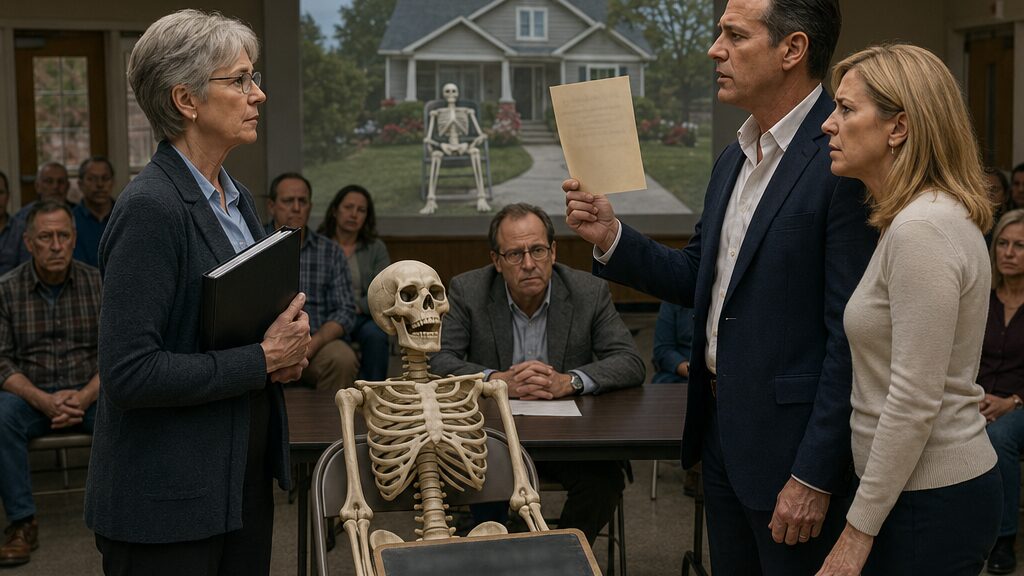
Someone had placed it in a folding chair at the center of the meeting room, facing the board table. Its orange scarf had been removed, and the chalkboard rested across its knees like an exhibit in a trial.
A few neighbors turned toward Sandra. Others looked quickly away.
Jacob Roberts stood beside the projector, adjusting a cable. “We thought it would be useful to have the actual item here.”
“You entered my property and removed it?”
“The property manager collected it from beside your garage.”
“That is still my property.”
Jacob lowered his voice. “Let’s not begin with another issue.”
Sandra held the black binder against her side. “You already have.”
Edward and Nicole sat at the front table. Edward wore a navy suit without a tie, an arrangement meant to suggest that he was present as a resident rather than an attorney. A leather portfolio lay open before him.
Nicole did not look at Sandra.
The board members took their seats. Jacob called the hearing to order and stated that its purpose was to address “an urgent interpersonal and community-standards concern.”
There was no reference to a specific covenant section.
Sandra noticed.
Edward rose first.
He spoke calmly, never raising his voice. That made the accusation sound more serious.
He described the skeleton’s placement, its orientation toward the Carter residence, the repeated refusal to remove it, and the emotional distress caused to his children. He projected the upstairs photograph onto the clubhouse wall.
In the enlarged image, Sandra’s house seemed farther away than it was. The skeleton appeared isolated against the lawn, one hand extended toward the viewer.
“Our son’s bedroom is directly behind the window from which this photograph was taken,” Edward said. “Ms. Miller was aware of that fact.”
Sandra heard whispers behind her.
Edward changed slides. The next image showed the chalkboard at an angle. Only three words were legible:
STILL WAITING FOR.
“The message is ambiguous,” he said. “In context, ambiguity is part of the intimidation.”
Sandra almost smiled.
He had turned an HOA joke into coded menace.
Then Edward opened his portfolio and removed the demand letter.
“To avoid unnecessary proceedings, we offered a private resolution in the amount of eighteen thousand dollars.”
The property manager, who was taking minutes, stopped typing.
“Could you repeat that?” she asked.
“Eighteen thousand dollars.”
Her keyboard clicked as she entered the figure into the official record.
Sandra felt every face turn toward her.
Jacob leaned toward his microphone. “Sandra, before we get into technicalities, I think the board would like to know whether you’re willing to apologize for the distress caused.”
“Before I’m allowed to respond to the factual allegations?”
“No one said you weren’t allowed.”
“You asked for an apology first.”
Jacob’s expression tightened. “A good-faith gesture might lower the temperature.”
Sandra set the binder on the table beside the skeleton.
“I will apologize for any action I can truthfully identify,” she said. “I will not apologize to validate a claim that has not been examined.”
Nicole finally looked at her. “You knew.”
“Knew what?”
“You heard our son that night.”
The room changed.
The dispute was no longer about decoration placement. Sandra could feel the neighbors’ attention sharpen around the mention of a child and something private.
Nicole’s fingers closed around the edge of the table.
“He had a panic episode,” she said. “A severe one. The windows were open. You were outside. Two days later, the skeleton was facing his room.”
Sandra remembered Nicole in the driveway the following morning. Sandra had waved. Nicole had looked at the half-dead mums beside Sandra’s steps and said, “Some people stop noticing what the rest of the street has to look at.”
Sandra had gone inside angry.
That afternoon, while securing the skeleton against the wind, she had turned its base.
Not toward the boy’s room, she told herself. Toward Nicole’s house.
The distinction felt thinner in the hearing room.
“I heard raised voices,” Sandra said. “I did not know your son was having a panic episode.”
“But you turned it.”
“I adjusted it.”
Nicole stared at her. “Toward us.”
Edward stood again. “Intent can be inferred from conduct.”
“So can a property line,” Sandra said.
The words came out before she decided to use them.
Edward paused.
Sandra opened the black binder.
Inside were transparent overlays, old subdivision plats, and copies of public right-of-way maps. She removed a clear sheet and walked toward the projector.
“May I?”
Jacob looked uncertain. “What exactly are you presenting?”
“The location of the decoration.”
“That isn’t in dispute.”
“The claim says the skeleton created a physical and visual intrusion. Those are location-based assertions.”
Edward folded his arms. “This is not a zoning hearing.”
“No. In a zoning hearing, facts would have been reviewed before damages were proposed.”
A few people shifted in their chairs.
Sandra placed the transparent map over the projected photograph and adjusted it until the curb lines aligned.
“This is the recorded subdivision plat,” she said. “This line marks my parcel. This line marks the public sidewalk easement. The skeleton stood nine feet inside my property and twenty-seven feet from the Carter facade.”
Edward said, “Distance does not eliminate harassment.”
“No. But it eliminates the suggestion that the decoration crossed, overhung, obstructed, or occupied anything belonging to your family.”
She pointed to the angle of the photograph.
“The image was taken through a telephoto setting or digital zoom. That compresses distance. It makes the skeleton appear closer to the house and more directly aligned with the window.”
Nicole looked at Edward. He did not return the glance.
Sandra continued.
“The skeleton’s arm is fixed. It cannot point independently. Its head turns in the wind because the neck joint is loose. The chalkboard message refers to the HOA architectural-review process, not to any member of the Carter family.”
One of the board members bent forward to read the actual sign.
A quiet laugh escaped someone in the back, then stopped.
For the first time that evening, the room’s certainty loosened.
Sandra felt a small surge of satisfaction.
It was familiar and dangerous. She had felt it years ago when a disputed map finally aligned under her hand and everyone else in the room understood that she had been right.
She looked at Nicole and saw not defeat but exhaustion.
Sandra returned to the binder.
Behind the plat lay photographs of the Carter sunroom, copies of county drainage standards, and measurements she had made from the sidewalk in August. One page would have changed the entire meeting.
Her hand rested on it.
Jacob noticed. “Is there something else?”
Sandra thought of the downspout emptying toward the sidewalk. The roof edge near the side boundary. The photograph in Edward’s own demand package.
She also thought of why she had done nothing for two months.
“No,” she said, closing the binder. “Not on this complaint.”
Edward’s confidence returned by degrees.
Jacob cleared his throat. “The board can acknowledge that the skeleton remained on Sandra’s property while still finding that its orientation caused distress.”
“Then identify the covenant provision,” Sandra said.
The property manager searched through a printed packet.
No one answered.
At last, the board agreed to postpone any violation finding until its attorney reviewed the governing documents. Edward’s private demand remained unresolved. The skeleton would be returned to Sandra after the hearing.
It was not victory, but it was enough to stop the accusation from becoming a formal HOA violation that night.
As people stood, Nicole approached Sandra.
“You enjoyed that,” she said quietly.
Sandra glanced toward the board table, where Edward was gathering his papers too precisely.
“I enjoyed correcting a false claim.”
“That isn’t what I said.”
Nicole walked away.
Sandra carried the skeleton home under one arm and the binder under the other. Its feet dragged over the sidewalk, clicking at each seam.
Inside her kitchen, she had just set the binder down when her phone rang.
The caller ID showed a municipal number she still recognized.
“Sandra Miller?” a woman said.
“Yes.”
“This is Katherine Lewis with county code compliance.”
Sandra straightened.
They had worked in adjacent departments years earlier, though Katherine had been new then.
“I received an inquiry connected to the Maple Ridge property on Greenway Court,” Katherine said. “Before I decide how to route it, I need to ask you something directly.”
Sandra looked across the street at the dark outline of the sunroom.
Katherine’s tone remained professional.
“If you observed that drainage discharge in August, why was it never reported?”
Chapter 3: The Measurements Sandra Chose Not to File
Rainwater crossed the public sidewalk in a brown, fast-moving sheet before dawn.
Sandra stood beneath her porch light in rubber-soled shoes, watching runoff spill from the Carter sunroom roof, strike the narrow side bed, and cut across the pavement toward the storm drain. The drain sat uphill from the flow. Most of the water continued along the curb and spread toward Sandra’s driveway.
A thinner stream slipped into the seam beside her foundation.
She photographed it.
The timestamp read 6:18 a.m.
Katherine had not accused her the night before. That made the question harder to dismiss.
If you observed that drainage discharge in August, why was it never reported?
Sandra had answered that she was no longer a municipal employee and had no duty to inspect private property.
Katherine had said, “That wasn’t what I asked.”
Now Sandra measured the flow from the edge of the Carter downspout to the sidewalk using a steel tape. She remained on public pavement. She photographed each position, then recorded the distance in a yellow field notebook she had once used for retirement gardening plans.
Across the street, Nicole opened her garage.
They saw each other at the same time.
Nicole looked at the tape, the notebook, and the water.
“So this is what you were hiding in the binder,” she said.
Sandra retracted the tape. “I’m documenting runoff on the public sidewalk.”
“After telling everyone last night that you weren’t retaliating.”
“I didn’t say that.”
“No. You said just enough to sound innocent.”
Nicole stepped around a stack of flattened moving boxes in the garage. Behind them, against the interior wall, stood a folded hospital-style walker.
Sandra looked away before Nicole noticed.
“You could have spoken to me in August,” Nicole said.
“You could have spoken to me before sending a damages demand.”
“My husband sent that.”
“Your name is on the claim.”
The rain softened, but water continued dripping from the sunroom roof.
Nicole crossed her arms. “Do what you’re going to do.”
She closed the garage door.
Sandra remained on the sidewalk until the runoff slowed to a narrow ribbon. Her notebook was damp at the edges.
At nine, she drove to the county records office.
The clerk at the permit counter recognized her, though it took him a moment to place the face behind the silver hair.
“You used to sit on the other side,” he said.
“Long enough to know what I’m asking for.”
He smiled, then grew cautious when she provided the Carter address.
“All public records?”
“Only public records.”
He entered the parcel number.
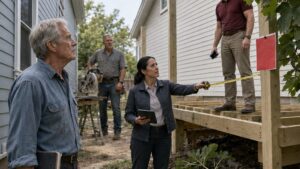
The screen showed one active permit issued in July for interior remodeling: electrical relocation, flooring, and nonstructural partition work. No foundation permit appeared. No exterior wall approval. No drainage review. No recorded variance for the side setback.
Sandra asked him to check archived and pending applications.
He did.
“Nothing else,” he said.
“Architectural drawings?”
“Not in the county file.”
“Inspection history?”
“One rough electrical inspection. It passed because the application described interior work.”
Sandra stared at the screen.
The sunroom was not a minor oversight. Someone had described an exterior addition as interior remodeling or expanded the work after the permit had been issued.
The clerk printed the record.
In the parking lot, Sandra sat in her car with the pages on her lap. A clean complaint could now be assembled in less than an hour. Parcel map. Permit record. Public photographs. Drainage video. Side-yard measurements.
It would be valid.
It would also arrive less than forty-eight hours after Edward demanded eighteen thousand dollars.
No one would believe timing was irrelevant.
Sandra drove home without turning on the radio.
In her study, she opened the black binder and arranged the records by date. She found photographs from August on an old memory card. The first showed framing lumber stacked beside the Carter driveway. The second showed fresh concrete forms. The third showed the side wall rising close to the fence.
She had taken them from her front porch.
At the time, she had told herself she was documenting changes in the neighborhood because old habits persisted. But one image had a measurement written in the margin: APPROX. 4 FT. REQUIRED 7?
She had known enough to question it.
She had chosen silence.
Beneath those photographs lay another file, thinner and older than the rest.
Her sister’s surname appeared on the tab.
Sandra did not open it. She did not need to. She remembered the small addition behind her sister’s house, built to create a ground-floor bedroom for their father after his stroke. She remembered identifying the setback conflict during an internal review. She had insisted the application follow the same rules as every other case.
Her sister had called it betrayal.
Sandra had called it consistency.
The addition was never built. Their father entered a care facility. Her sister stopped inviting Sandra to Sunday dinner. By the time illness brought them into the same room again, apology had become too large and time too small.
Sandra placed the Carter permit record over the old file.
Rules mattered. So did what people did with them.
At noon, Katherine arrived in a county vehicle.
She wore a rain jacket over office clothes and carried no clipboard, which told Sandra this was not yet a formal inspection.
They walked the public sidewalk together.
Katherine studied the roof edge, downspout, grade, and side-yard distance.
“You haven’t entered their property?” she asked.
“No.”
“Used a drone?”
“No.”
“Photographed through windows?”
“Of course not.”
Katherine gave Sandra a level look. “I have to ask.”
“I know.”
They stopped opposite the side wall.
Katherine estimated the setback visually but did not offer a conclusion.
“The county record only shows interior work,” Sandra said.
“I saw that.”
“The addition appears structural.”
“It does.”
“And the discharge crosses the sidewalk.”
“Yes.”
Sandra waited.
Katherine closed her umbrella. “The facts are enough for an inspection referral. Your history with the complainant is also relevant.”
“To the code?”
“To how the complaint will be handled. If this becomes an appeal, motive will be raised.”
“Motive does not alter a measurement.”
“No. It alters whether people trust the person holding the tape.”
The sentence landed with more force than Edward’s entire letter.
Back in her study, Sandra completed the complaint form.
Under DATE FIRST OBSERVED, she could have written that morning. That was when she had recorded active runoff.
Instead, she entered August 14.
Under DESCRIPTION, she listed the apparent unpermitted exterior expansion, possible side-setback deficiency, and stormwater discharge across a public walkway. She attached the August photographs alongside the new ones.
Then she added a statement Katherine had not requested:
The reporting party became involved in a separate private dispute with the property owners on October 27. The conditions described above were observed before that dispute but were not previously reported.
Sandra read the sentence three times.
It weakened the clean appearance of her complaint.
It also made the record true.
She submitted the packet through the county portal at 3:42 p.m.
The confirmation number appeared immediately.
Less than a minute later, an automated email stated that the matter had been assigned for preliminary review.
Sandra closed the laptop.
Across the street, the sunroom windows reflected the lowering sky. From this angle, the room looked finished, warm, and entirely ordinary.
Her phone buzzed.
A message from Katherine contained only one sentence:
I received the complete filing, including the date you could have omitted.
Chapter 4: The Violation Notice That Solved Nothing
The red notice appeared on the Carter front door at 7:26 Friday morning, twelve minutes before the school bus reached Greenway Court.
Sandra saw Katherine press the adhesive strip flat against the glass, step back, and photograph it. The paper was impossible to miss. STOP WORK AND CORRECTION ORDER ran across the top in black block letters. Beneath it, smaller lines listed the parcel number, inspection date, and three cited conditions.
Nicole’s younger daughter came outside wearing a backpack shaped like a fox.
She stopped when she saw Katherine.
“What’s that?”
Nicole followed her onto the porch. Her hair was unbrushed, and she had one shoe on.
“Go wait by the mailbox,” she told the child.
The girl did not move.
Edward emerged behind them, buttoning a cuff. He read the notice without touching it. His face changed only once, when he reached the line stating that corrective action was required before occupancy of the addition.
“This is defective service,” he said.
Katherine lowered her phone. “It is an administrative notice, not a summons.”
“You inspected without our consent.”
“I inspected exterior conditions visible from public property and reviewed the county permit file. Your contractor also allowed access to the active work area yesterday afternoon.”
Edward looked toward the driveway. A pickup belonging to the contractor sat there with its tailgate open.
Nicole turned toward the truck as if it had betrayed her.
The school bus rounded the corner.
Its brakes sighed at the curb. Two children across the street stared openly at the red notice. Nicole stepped between her daughter and the door.
“Get on the bus,” she said.
The girl’s eyes moved from her mother to the skeleton in Sandra’s yard.
Sandra had turned its chalkboard backward after the hearing. From the street, it showed only a blank black rectangle.
When the bus pulled away, Nicole crossed the road.
Sandra remained on her porch.
“You filed it,” Nicole said.
“Yes.”
“You waited until after the hearing.”
“I filed the next day.”
“You know what I mean.”
Sandra did.
Katherine was still at the Carter property, measuring from the foundation wall to the marked boundary reference. Edward followed her with his phone raised, recording every step.
Nicole stood at the bottom of Sandra’s walkway.
“Did you know they would post that while my children were leaving for school?”
“No.”
“But you knew there would be a notice.”
“I knew there would be an inspection if the county found sufficient cause.”
“You found sufficient cause months ago.”
Sandra’s hand tightened around the porch rail.
“I included that in my filing.”
Nicole gave a bitter smile. “How honorable.”
The word stayed between them.
Sandra could have answered with the missing permit, the runoff, or the setback. Instead she watched Nicole return across the street and pull the red paper from the door.
Katherine made her put it back.
By noon, the contractor had set a folding table in the Carter driveway. Plans were spread beneath a pair of paint cans to keep them from lifting in the wind. The drainage engineer arrived with a level and a survey rod. Edward paced beside them, speaking into his phone.
Sandra told herself not to watch.
She watched anyway.
At three, a printed estimate appeared under the Carter windshield wiper. Nicole found it first. She opened the folded pages beside the truck, read halfway down, and sat on the front step.
Edward took the estimate from her.
“What did they say?” Sandra asked Katherine when the inspector stopped at the curb.
Katherine looked toward the Carter house before answering.
“The foundation projects into the required side setback. The roof drainage was never approved. There is also no structural permit for the exterior addition.”
“Correctable?”
“Anything is correctable with enough money.”
“How much?”
“The contractor’s preliminary figure is thirty-one thousand.”
Sandra had expected satisfaction.
She felt none.
Katherine continued. “That assumes they can preserve most of the foundation. The drainage engineer thinks one wall can be moved inward and the roofline rebuilt. If the footing cannot be modified, the number rises.”
“The notice says daily penalties.”
“They have ten calendar days to submit a correction plan before those begin.”
“And if they cannot?”
“The county can extend for demonstrated progress. It cannot ignore the condition.”
Sandra looked at the blank side of the skeleton’s chalkboard.
Across the street, Nicole remained on the step. Edward had gone inside. The contractor and engineer spoke in low voices near the unfinished side wall.
“Did you tell them I disclosed the August date?” Sandra asked.
“It is in the public complaint file.”
“That wasn’t my question.”
Katherine studied her.
“I told them the report was factually supported and that the reporting party had acknowledged a related dispute. I did not discuss your motives.”
“Because they don’t matter?”
“They matter differently.”
Before Sandra could ask what that meant, Edward came out of the house carrying the cream demand letter.
He crossed the street alone.
His suit jacket was gone. The cuffs of his white shirt were rolled unevenly, one higher than the other.
He stopped at Sandra’s gate.
“Effective immediately, the settlement demand is suspended,” he said.
“Suspended.”
“Pending resolution of the municipal matter.”
“Not withdrawn.”
“I am not discussing legal strategy on the sidewalk.”
“You brought it to the sidewalk.”
His jaw worked once.
“Nicole asked me to pause it.”
That surprised Sandra more than the words themselves.
Edward looked back at his house. “You made your point.”
“This is not a point. Water is crossing a public walkway, and the addition lacks the permit it required.”
“Yes. You have demonstrated that you know how to cause damage through procedure.”
Sandra felt heat rise behind her face.
“I did not build the room.”
“No. You waited until it could hurt the most.”
He turned before she could answer.
That evening, the Carter garage remained open. Through it, Sandra saw Nicole moving boxes from the back wall. A narrow bed frame leaned beside the walker Sandra had noticed earlier. There were sealed cartons labeled LINENS, BATHROOM, and MOM—WINTER.
Nicole carried a lamp into the sunroom, then stopped beneath the unfinished ceiling.
Sandra crossed the street before she could reconsider.
Nicole saw her through the open glass door and came out.
“You should not be here,” she said.
“I’m on the driveway.”
“That is still our property.”
Sandra stepped back to the sidewalk.
“What is the room for?”
Nicole looked toward the garage.
“You already know everything else.”
“I know what is in the county file.”
“My mother’s house was sold in September. She has early mobility problems and cannot manage stairs much longer. This room was supposed to give her a bedroom and a small sitting area on the ground floor.”
Sandra glanced at the stacked boxes.
“Why wasn’t it permitted correctly?”
“We applied through the HOA. Jacob walked the yard with us. The property manager said the county permit could be handled as an interior remodel because most of the framing tied into the existing house.”
“That is not how structural work is classified.”
“I know that now.”
“Edward is an attorney.”
“Edward practices employment law. He believed the contractor and the board.”
Sandra heard the defensiveness, but beneath it was something else—fatigue worn too long to remain hidden.
Nicole folded her arms.
“My mother is staying with my sister until the end of next week. After that, she has nowhere set up for her. The county can start daily fines before we even know whether the wall can be saved.”
“The county may grant time for a submitted plan.”
“May.”
“Yes.”
Nicole nodded toward Sandra’s house.
“Was it worth it?”
Sandra looked at the skeleton’s blank chalkboard.
“I don’t know.”
Nicole’s expression changed, not toward forgiveness but toward disbelief that Sandra had answered honestly.
At that moment Jacob’s SUV pulled into the Carter driveway.
He got out holding a folder and wearing the strained smile he used when he wanted everyone to behave as if a problem remained manageable.
“We need to discuss board exposure,” he said.
Nicole did not move aside.
“Good,” she said. “Then we can discuss this.”
She took out her phone, opened an email, and held it toward Sandra.
The sender was Jacob Roberts.
The date was July 9.
The message read:
The board sees no issue with the proposed sunroom footprint as discussed. Proceed with the contractor, and we can complete the formal review paperwork afterward.
Sandra read it twice.
Jacob’s smile disappeared.
Chapter 5: The Approval Nobody Wanted in Writing
The architectural-review file for the Carter addition contained one empty manila folder.
Sandra stood in the HOA records room on Saturday morning while Jacob searched the cabinet a second time, moving the same folders aside with increasing care.
“It was here,” he said.
“What was?”
“The application packet.”
“You just said they never completed one.”
“They submitted preliminary materials.”
“Then where are they?”
The property manager sat at the narrow desk behind them. She had brought coffee for everyone but had not touched her own.
“I scanned what I received,” she said.
“Where is the digital copy?” Sandra asked.
Her eyes shifted toward Jacob.
He closed the drawer.
“This is getting adversarial.”
“It became adversarial when an eighteen-thousand-dollar demand was entered into meeting minutes before the board identified a violated rule.”
“We are trying to correct that.”
“By making Nicole’s family solely responsible for a project you encouraged?”
Jacob placed both hands on the cabinet.
“I said the board saw no aesthetic issue. I did not approve construction.”
“You told them to proceed.”
“I assumed their contractor would obtain county approval.”
“Then why say the formal paperwork could come later?”
His silence answered more cleanly than an explanation would have.
The property manager opened a folder on her computer.
“I received an elevation sketch and two photographs,” she said. “No site plan. No setback dimensions.”
“Did you tell them the submission was incomplete?” Sandra asked.
“I told Nicole we needed the remaining items before final approval.”
“By email?”
“A phone call.”
Sandra looked at Jacob.
Every important decision had been left in conversation. Encouragement in one message. Conditions by telephone. Responsibility dispersed until no one held enough of it to be blamed.
Jacob lowered his voice.
“The practical issue is the correction order. The board can assist with redesign guidance, but we cannot accept liability for county permits.”
“You can accept responsibility for your own process.”
“That would expose every homeowner to increased dues.”
“There it is.”
“What?”
“The reason you want Nicole to absorb everything.”
“I want to protect the association.”
“You want to protect the board from admitting it told a family to build first and document later.”
Jacob stepped closer.
“You filed this complaint after a personal dispute. Do not pretend you are the neutral party.”
Sandra felt the accusation strike because it was true enough.
“I am not neutral.”
“Then perhaps you should let the county handle the violation and stay out of the board’s response.”
“You mean let you bury the email.”
“No one is burying anything.”
The empty folder remained open between them.
Sandra left before anger decided the rest of the conversation for her.
At home, she opened the black binder on the dining table and added printed copies of Jacob’s email, the permit record, and the county notice. The binder no longer contained only evidence against the Carters. It contained the board’s omissions and her own dated photographs.
When she shifted the older files to make room, a thin folder slipped free and fell open.
Her sister’s name appeared above an application number.
Sandra sat down.
The file held a site plan for a modest rear addition. One bedroom. One accessible bathroom. A ramp drawn along the east wall. The proposed structure crossed a required setback by eighteen inches.
A yellow routing slip bore Sandra’s signature beneath the words DENIAL RECOMMENDED—NO HARDSHIP UNIQUE TO PARCEL.
She remembered writing it.
She also remembered refusing to attend the appeal because her sister had asked her not as an employee but as family.
“You know why we need it,” her sister had said.
“That cannot change the standard.”
“It changes whether you stand beside me.”
Sandra had not.
She ran her thumb over the signature until the ink blurred beneath her eyes.
A knock sounded at the front door.
Nicole stood outside holding two printed pages.
Sandra almost closed the binder. Instead, she left it open.
“I am not here to argue about the notice,” Nicole said. “Jacob told us the board may refuse to cover any part of the redesign.”
“He told me the same thing in different language.”
Nicole entered when Sandra stepped aside.
At the dining table, she noticed the old site plan.
“What is that?”
“A mistake I once called consistency.”
Nicole waited.
Sandra did not explain further.
Nicole placed her pages beside Jacob’s email. One was a text-message printout from the property manager. The other was a contractor invoice showing an architectural-review deposit paid to the HOA.
“They took the fee,” Nicole said. “Then they told us we could begin while the paperwork caught up.”
“Why did you accept an interior-remodel permit for an exterior room?”
“Because the contractor said it was temporary and would be amended. Edward asked whether that was normal. The contractor said it happened all the time.”
“And you believed him.”
“We needed the room before winter.”
Sandra looked at the boxes visible through the Carter garage window across the street.
Nicole sat opposite her.
“For what it is worth, I did not ask Edward to demand eighteen thousand at first.”
“What did you ask?”
“A letter telling you to remove the skeleton and stop directing things at our house.”
“Things?”
“Your porch chair. Your camera. That chalkboard.”
“My porch chair faces the street.”
“It faces our house.”
“So does my front door.”
Nicole rubbed her forehead.
“You heard my son.”
“I heard shouting.”
“He had stopped going to school for six days. He was having panic attacks. That night he said he thought everyone on the street knew. The next afternoon, the skeleton was turned toward his window with a sign about waiting for approval.”
Sandra felt the room contract around the sentence.
“The sign was about the HOA.”
“I know that now.”
“And I did not know about his panic attacks.”
“But you turned it.”
Sandra looked at the open sister file.
Nicole’s voice softened, which made it harder to resist.
“You turned it after I said something about your yard, didn’t you?”
The memory arrived intact.
Nicole standing at the curb, looking at Sandra’s dying chrysanthemums.
Some people stop noticing what the rest of the street has to look at.
Sandra had waited until Nicole went inside. Then she had gripped the skeleton’s metal base and rotated it across the grass.
Not toward the upstairs window specifically. Not toward the boy.
Toward Nicole.
“Yes,” Sandra said.
Nicole went still.
“I turned it because I was angry with you.”
“And at the hearing?”
“I said I adjusted it.”
“That was not the same answer.”
“No.”
Nicole gathered her pages, but Sandra placed a hand on them.
“I will say it at the next meeting.”
Nicole searched her face.
“You would destroy your own complaint.”
“The complaint does not depend on whether I behaved well.”
“People will say it does.”
“They may.”
“And Edward will use it.”
“I know.”
Nicole pulled the papers free.
“Why tell me first?”
Sandra glanced at her sister’s denied plan.
“Because I have spent too much of my life believing that a true measurement excuses every other failure.”
Nicole did not thank her.
At the door, she paused.
“If you admit it publicly, I will not pretend the legal demand was reasonable.”
It was not reconciliation. It was an exchange of truths neither woman could use without harming herself.
Sandra nodded.
“I’ll bring the complete binder.”
Nicole looked toward the black cover on the table.
“This time, open all of it.”
Chapter 6: The Night Sandra Refused an Easy Victory
Edward placed the reactivated demand letter beside the county violation notice as though the two documents carried equal weight.
The emergency meeting room was full before Jacob called it to order. Neighbors stood along the back wall. The skeleton occupied its former chair near Sandra’s table, its chalkboard still turned blank.
On the projector screen, the agenda contained one item:
CARTER ADDITION—ASSOCIATION RESPONSE AND OWNER COMPLIANCE.
Nothing mentioned the harassment complaint.
Nothing mentioned Sandra.
Edward changed that before Jacob finished the opening statement.
“My clients reserve all rights arising from Ms. Miller’s admitted retaliatory conduct,” he said, sliding the cream letter forward. “The prior settlement proposal is reinstated pending full review.”
Nicole sat beside him but did not touch the document.
Sandra opened the black binder.
Jacob raised a hand. “This meeting concerns the addition and the county order. We are not reopening the decoration matter.”
“You entered the demand into official minutes,” Sandra said. “You cannot separate it now because separation is convenient.”
A murmur moved through the room.
Jacob looked toward the board’s attorney, who sat near the property manager with a legal pad. The attorney gave no signal.
Katherine stood at the side wall beside a rolled drainage plan. She was present only to explain the correction options. Her expression warned everyone not to expect her to arbitrate motives.
Jacob said, “Then keep your comments factual.”
Sandra rose.
“I turned the skeleton toward the Carter house because Nicole insulted the condition of my yard.”
The room went silent so quickly that the projector fan became audible.
Edward leaned back.
Nicole stared at the table.
Sandra continued before fear could make the admission smaller.
“I did not know her son was experiencing panic attacks. I did not intend the decoration as a message to him. But I was angry, and I aimed it toward their house. At the last hearing, I described that as an adjustment. That was incomplete.”
Edward reached for the demand letter.
“So intent is now admitted.”
“Petty intent,” Sandra said. “Not harassment of a child. Not an eighteen-thousand-dollar injury. Not an intrusion onto your property.”
“You do not define the consequences of your conduct.”
“No. Neither do you merely by placing a number on letterhead.”
Jacob tapped his microphone. “Sandra—”
She turned toward him.
“I am not finished.”
The old version of Sandra would have waited for permission. The punitive version would have enjoyed taking it. This time she simply continued.
“I also observed possible drainage and setback problems in August. I did not report them then. I reported them after receiving the demand. The complaint is factually valid, but my timing was affected by anger.”
The board’s attorney stopped writing.
Edward stood. “That admission compromises the entire enforcement action.”
Katherine spoke from the wall.
“No, it does not.”
Every face turned toward her.
She unrolled the drainage plan and pinned its corners.
“Code findings are based on verified conditions. The addition lacks the required structural permit, projects into the side setback, and discharges stormwater across a public walkway. Ms. Miller’s motive does not change those facts.”
Edward’s mouth tightened. “It affects credibility.”
“It would have affected credibility more if she had concealed the August photographs. She submitted them herself.”
Sandra had not expected defense from Katherine. The inspector’s tone made clear it was not personal defense at all. It was the protection of a complete record.
Katherine pointed to the plan.
“The county will approve a phased correction if a compliant design is filed within ten days. The south wall must move inward. The roof drainage must connect to an approved system. Part of the existing foundation may remain if the engineer certifies it.”
Nicole looked up. “How much of the room can remain?”
“Approximately sixty percent of the planned interior area.”
The answer passed through the room like air released from something overfilled.
Not destruction. Not preservation. A reduced room.
Jacob seized the opening.
“The association is prepared to support the redesign process, but construction and permitting remain the homeowners’ responsibility.”
Sandra removed Jacob’s July email from the binder.
“The association told them to proceed.”
He looked at the projected agenda instead of the page in her hand.
“That message addressed aesthetic compatibility.”
“It says the board saw no issue with the footprint.”
“Informally.”
“Exactly.”
The property manager’s face had gone pale.
Sandra laid out the contractor deposit receipt and the text promising that paperwork could follow.
The board members leaned toward one another.
Edward said, “If the association induced reliance, my clients will seek indemnification.”
Nicole turned to him. “Stop saying ‘my clients.’”
He looked at her.
“We live across the street from her,” Nicole said. “This is our house.”
The words did not absolve her. They did, however, strip the room of the legal distance Edward had been trying to maintain.
Jacob asked for a recess.
The board’s attorney shook his head.
“Before recess,” she said, “I need one fact entered clearly. Did the board authorize the property manager to accept an architectural-review deposit without a completed application?”
Jacob hesitated.
“No formal vote occurred.”
“Did you direct the owners to proceed?”
“I communicated that the concept appeared acceptable.”
“That is not an answer.”
His shoulders lowered.
“Yes.”
The property manager began typing again.
A phone rang in the back of the room and was silenced.
Then the board attorney’s own phone vibrated. She read the screen, stood, and stepped into the hallway. When she returned, she held a new email open.
“The association’s insurer has reviewed the documents forwarded this afternoon,” she said. “Coverage for any claim related to the informal approval may be denied unless the board records the communication and cooperates with a corrective-resolution process.”
Jacob’s face emptied.
The choice he had avoided for months had arrived in a form that could not be handled by tone or delay.
Sandra took a piece of chalk from her binder.
She turned the skeleton’s board toward the room.
The old joke had been erased, leaving faint white scratches. She wrote slowly:
LOOK AT WHAT IS ACTUALLY THERE.
No one laughed.
She set the chalk down.
“The Carters should withdraw the damages demand,” she said. “I will provide a written apology for turning the decoration toward their house and for minimizing that choice at the first hearing. The county findings should stand. The room should be rebuilt to the compliant design Katherine described.”
Edward folded his arms. “And the cost?”
“The Carters chose to build without final approval. The board encouraged them and accepted money without completing its own process. Responsibility is shared.”
Jacob said, “You are proposing that every owner pay for a private addition.”
“I am proposing that the association’s portion come from its liability reserve and insurer negotiation, not a special assessment, and that the Carters bear the construction cost they would have paid for a lawful room in the first place. The board should cover the avoidable redesign and drainage costs created by its informal approval.”
The board attorney looked at Katherine.
“Is that administratively possible?”
“The county does not care who pays,” Katherine said. “Only that the correction occurs.”
Sandra turned to Nicole.
“The smaller room will not be what you planned.”
“No,” Nicole said.
“It can still have an accessible entrance and ground-floor bathroom.”
Nicole looked at the drainage plan.
Edward whispered something to her. She shook her head.
Then she stood.
“I exaggerated the claim,” she said.
Edward closed his eyes briefly.
Nicole faced the room.
“I believed Sandra had aimed the skeleton at my son. I still believe she aimed it at our house. But I let fear turn that into something larger because I wanted the board and Edward to make it stop immediately. The eighteen-thousand-dollar figure was not based on treatment costs. It was leverage.”
Several neighbors shifted, but no one spoke.
Sandra felt no triumph. Only the strange steadiness of a room in which every person had finally lost the protection of a partial story.
Nicole continued.
“We relied on Jacob’s email. We also knew the county permit did not describe the whole project. We told ourselves the contractor would amend it.”
Edward looked at her, hurt and proud at once.
Jacob rubbed both hands over his face.
The board attorney began outlining a resolution: record the informal approval, notify the insurer, suspend HOA penalties, support the county correction plan, and revise the architectural-review process. Edward w
Chapter 7: What Remained After the Walls Came Down
The last noncompliant wall came down on a cold January morning, leaving a pale rectangular outline across the Carter foundation where the larger room had once stood.
Sandra watched from her porch as two workers lowered the framed section instead of letting it crash. The windows had already been removed. Without them, the structure looked less like a room than a diagram of one—studs, joints, and exposed decisions.
The revised foundation occupied only part of the old footprint. New drainage pipe ran beneath the side yard toward an approved connection near the street. Fresh gravel filled the trench, its sharp gray line cutting through the dormant lawn.
Nicole stood beside the contractor with a rolled plan beneath one arm. She wore a heavy coat and held a paper cup in both hands. When the final wall reached the ground, she closed her eyes for a moment.
Sandra did not cross the street.
Three months had not made the distance between their houses wider, but it had changed how every ordinary action felt. Collecting mail. Moving a trash bin. Turning on a porch light. Each could be mistaken for a gesture if either woman wanted it to be.
The agreement approved at the emergency meeting had survived two insurance reviews, one county revision, and several strained exchanges between attorneys. Edward had withdrawn the damages demand in writing. Sandra had signed an apology acknowledging that she had turned the skeleton toward the Carter house in anger and then minimized that fact at the first hearing.
Neither document pretended nothing had happened.
The Carters paid for the portion of the project that a properly permitted room would have required. The HOA’s insurer covered most of the redesign, demolition, drainage correction, and duplicate professional fees. The board used a small part of its reserve for the deductible.
No special assessment was imposed.
Jacob had called that a victory.
Sandra had not.
A victory did not usually leave one family with a smaller room, another with a public apology in the minutes, and an entire board forced to hire a consultant to explain procedures it should already have followed.
But it was fairer than the alternatives.
The contractor noticed Sandra watching and raised a gloved hand.
She returned the gesture.
Across the street, Nicole looked up. For a second, Sandra thought she might wave too.
Instead, Nicole turned back to the plans.
At ten, a message arrived from the HOA property manager.
The revised architectural-review policy had passed by a vote of four to one. Every application would now require a recorded intake date, written completeness review, conflict disclosure, and final decision before work began. Informal approvals by individual board members were prohibited.
A second message followed five minutes later.
Jacob Roberts has resigned as board president, effective immediately.
Sandra read it twice.
He had not spoken to her since the insurer accepted partial responsibility. At the final policy workshop, he had sat at the far end of the table and corrected punctuation while avoiding the paragraphs that described what he had done.
His resignation letter was attached.
He wrote that the community needed leadership unconnected to recent mistakes. He did not call those mistakes misunderstandings. He did not blame the contractor, the property manager, Nicole, Edward, or Sandra.
It was the closest thing to accountability he had offered.
Sandra printed the letter and placed it in the black binder.
Then she stopped.
For months, the binder had expanded each time someone failed: Edward’s demand, Nicole’s accusation, Jacob’s email, the property manager’s texts, Sandra’s dated photographs. It had become an orderly archive of every error except the ones that could not be reduced to paper.
She removed Jacob’s resignation and placed it in the recycling bin.
The doorbell rang before noon.
Nicole stood outside.
Behind her, a dark sedan waited at the curb with its hazard lights blinking. An older woman sat in the passenger seat. A folded walker was visible through the rear window.
“My mother arrived early,” Nicole said.
Sandra looked toward the unfinished room.
The exterior wall had been framed, but there were no windows, no flooring, and no usable bathroom. Plastic sheeting covered the opening to the main house.
“I thought she was staying with your sister until February.”
“She was. That stopped working this morning.”
Nicole’s voice remained controlled, but the cup in her hand trembled enough to ripple the coffee.
“The guest room upstairs is ready,” she continued. “The problem is the stairs. Edward and the contractor are trying to set up the dining room temporarily.”
Sandra glanced toward the sedan.
The older woman was watching the workers with the patient stillness of someone accustomed to being discussed from a distance.
“What do you need?” Sandra asked.
Nicole seemed surprised by the question.
“A ramp,” she said. “Just for today. The temporary one the medical company delivered is too steep for our front step. The correct section will not arrive until tomorrow.”
Sandra had a modular aluminum ramp stored along the side of her garage. She had bought it years earlier when her husband’s knee surgery had made the porch steps difficult. She had kept it after he died because disposing of useful things felt more final than keeping them.
“It may fit your side entrance,” Sandra said.
Nicole hesitated. “I can pay to rent it.”
“It is not for rent.”
Sandra retrieved the sections.
The contractor helped carry them across the street. Together, they positioned the ramp at the side door, where the grade was lower. Sandra checked the rise, adjusted the support legs, and tested the rails with both hands.
Nicole’s mother watched from the sedan.
“You still measure everything,” Nicole said.
Sandra tightened the final brace.
“I measure the things that can hurt someone.”
Nicole absorbed the sentence without looking away.
The older woman used the ramp slowly, one hand on her walker and the other on Nicole’s arm. When she reached the landing, she paused beside Sandra.
“You are the neighbor,” she said.
It was impossible to know what Nicole had told her.
“Yes.”
The older woman looked at the stripped-down addition.
“I was promised more windows.”
Nicole gave a startled laugh. It was the first sound Sandra had heard from her in months that was not guarded.
“You will still have three,” she said.
“I was promised five.”
“The county objected.”
The older woman looked at Sandra’s tape measure clipped to her coat pocket.
“Did you object?”
Sandra considered the question.
“To where the wall was,” she said. “Not to you being here.”
The older woman nodded as though this distinction made perfect sense.
Inside, workers cleared a path through the dining room. Nicole’s younger daughter carried in a pillow. Her teenage son appeared briefly at the hallway entrance, saw Sandra, and stopped.
Sandra did not smile too brightly or look away too quickly.
“Your grandmother made it up the ramp,” she said.
He nodded.
“Thanks.”
It was a small word, offered carefully. Sandra accepted it the same way.
By late afternoon, the temporary bedroom was arranged. The ramp held. The contractor covered the open construction area before leaving.
Nicole walked Sandra back across the street.
At the curb, she said, “Edward wanted me to ask whether you intend to speak to the reporter.”
A local reporter had attended the final board meeting after the public agenda drew attention online. She had left Sandra two messages asking about the legal demand, the sunroom, and the revised HOA policy.
“I declined,” Sandra said.
“Why?”
“Because the public record contains enough.”
Nicole looked toward the skeleton stored inside Sandra’s garage.
“You could have made us look worse.”
“I could have made all of us look worse.”
“That has not stopped some people.”
“No.”
The subdivision’s online group had divided the dispute into simple parts. Sandra was either a brave retiree who exposed entitled neighbors or a vindictive former bureaucrat who weaponized code enforcement. Nicole was either a bully or a desperate daughter. Edward was either a predatory attorney or a husband who had overreacted. Jacob was either corrupt or merely weak.
The truth had been less satisfying to summarize.
Nicole placed her hands in her coat pockets.
“The smaller room will work,” she said. “My mother says she did not need five windows.”
“She just told you she did.”
“She enjoys having something to complain about.”
Sandra looked toward the Carter house. The new wall sat well inside the setback now. The revised roof pitched toward the approved drainage line. The room was smaller, but the side yard no longer looked crowded or strained.
“I am sorry it became more expensive than it needed to be,” Sandra said.
Nicole nodded. “I am sorry I tried to make fear look like proof.”
They stood facing one another without the relief of complete forgiveness.
Sandra was grateful for that.
Easy reconciliation would have felt like another false document—clean language laid over inconvenient facts.
In February, the replacement room passed final inspection.
Nicole’s mother moved into it on a Tuesday. Three windows faced the backyard, and a fourth narrow window looked toward the side garden. The accessible bathroom fit beside the interior wall. A small ramp connected the room to the patio.
The old foundation outline remained visible outside, a pale border in the concrete where the larger plan had been cut away.
The HOA posted its new approval checklist online. The first page stated in bold type that verbal guidance did not constitute authorization.
No one objected to the wording.
When October returned, Sandra brought the skeleton down from the garage shelf.
She repaired the loose neck joint and washed dust from its plastic hands. The orange scarf had vanished somewhere during the hearings, so she gave it a faded blue one instead.
For several minutes, she stood in the yard deciding which direction it should face.
The street was quiet. The Carter sunroom glowed across the road. Through one window, Nicole’s mother sat reading beneath a lamp. The teenage son passed behind her carrying a plate, then pulled the curtain halfway—not as a rebuke, Sandra thought, but because curtains were meant to be used.
Sandra positioned the skeleton toward her own porch.
She attached the chalkboard to its hands and wrote:
LOOK FIRST. THEN DECIDE.
The message faced her front door.
The next morning, Sandra found a small pumpkin beside the skeleton’s feet.
There was no note.
Across the street, Nicole stood beside her mailbox. She did not wave. Sandra did not either.
But when the wind shifted the chalkboard slightly toward the Carter house, Nicole crossed the road, straightened it back toward Sandra’s porch, and tightened the cord so it would stay.
Then she returned home without saying anything.
The skeleton remained where both women had placed it, facing neither accusation nor victory, only the house of the person who had finally learned to read her own message.
The story has ended.