The Names He Carried Out
Part I — The Volunteer
“If I get word out,” Captain Jan Różycki said, “will anyone move?”
The room went still.
The officers around the table had been whispering about the camp system for weeks in the same careful language men used when facts were too monstrous to trust. Labor. Transit. Resettlement. Containment. Even now none of them used the worse words out loud. They sat in a shuttered apartment above a tailor’s shop, with blackout cloth pinned to the windows and a single lamp throwing hard yellow light over maps, ration slips, forged papers, and four men who suddenly looked older than they had an hour ago.
Jan stayed standing.
He had not raised his voice. He had not tried to sound brave. That made the question harder to bear.
Colonel Dąbek, who had lost two sons and most of his sleep but not his posture, folded his hands and stared at the map instead of at Jan. “We cannot promise outcomes.”
“That wasn’t what I asked.”
No one answered him.
The silence told him more than any briefing had.
Reliable intelligence from inside the camp was nearly impossible. Rumors leaked out by accident, or from dying men, or through transport workers who saw too little. But there were enough fragments now to suggest something worse than imprisonment. Something organized. Something built.
They needed proof.
They needed names, routines, numbers, routes, guards, schedules, sickness, disappearances. They needed something that could survive disbelief.
And that meant someone had to go in on purpose.
The first time the idea had been said aloud, one officer had laughed from nerves, then apologized. Tonight no one laughed. Jan had listened to the arguments, the objections, the practical obstacles. The mission was nearly suicidal. Infiltration might fail before it began. If he survived entry, he could lose his mind, his health, or the ability to contact anyone outside. Even success could vanish into the war’s larger machinery.
But what kept striking him was not the danger.
It was the possibility of accomplishing it and changing nothing.
Jan reached into his coat and touched the small metal medallion sewn into the lining near his ribs. A regimental token, rubbed thin at the edges by years of fingers and rain and worry. It felt smaller than it used to.
“I’ll volunteer,” he said.
The colonel looked up. “You understand this is not a gesture.”
“I know.”
“You may be in there for months.”
“I know.”
“You may see enough to wish you hadn’t.”
Jan held his gaze. “Then I’ll see it.”
That earned him something harder than approval. Pity, perhaps. Or recognition.
At the far wall, Zofia Markham uncrossed her arms. She had been silent through the entire meeting, a plain-faced courier in a dark coat, forgettable by design. Jan had worked with her for nearly a year and still sometimes had the absurd feeling that she became more invisible the longer one looked at her. She carried messages through train stations and checkpoints and occupied streets as if she had been born to pass through danger unnoticed.
She was the only one in the room who would know his full route into the camp and the only one outside who could recognize any message that truly came from him.
When the colonel dismissed the others, she stayed behind.
Jan waited until the footsteps had gone down the stairs.
“Say it,” he told her.
Zofia took off her gloves one finger at a time. “You think being closest to hell is the same thing as being most useful.”
“It usually is.”
“No.” She set the gloves on the table. “It just feels purer.”
He almost smiled. “Is that meant to stop me?”
“It’s meant to make you harder to admire.”
“That would be a mercy.”
Her expression did not change. “Heroic missions are easy to praise afterward. Harder to help while they still matter.”
Jan looked at the map again. At train lines. At districts. At a black mark where rumor had thickened into mission.
“If I fail,” he said, “you burn every name tied to me.”
“If you vanish, I will assume you are still working until I have proof otherwise.”
It was the closest thing to tenderness she ever offered.
Two days later he was in a city square with a forged work card in one pocket and dirt under his nails to match his papers. The roundup came at noon. Trucks. Dogs. Commands barked in German. Panic breaking in waves across the street as men tried to melt into doorways too late.
Jan did not run.
That was the first humiliation. Not the arrest itself, but the choice to accept it with the right amount of fear and the wrong amount of resistance.
A woman screamed when a rifle butt caught her husband under the jaw. Someone fell. Boots pounded cobblestones. Jan let himself be shoved toward the truck, shoulder to shoulder with strangers whose terror was real in a way his was not, not yet.
Then he saw Zofia across the square.
She stood by a shuttered bakery carrying an empty market satchel, looking like any tired woman who had learned to look away from violence in order to survive it. Only her eyes found his.
No salute. No farewell. Just one glance, cold and exact, as if she were fixing him in memory before the machine swallowed him.
Then a guard struck the back of his head with a stick and the square tilted, and Jan was thrown up into the truck among the captured.
By the time the gates rose out of the distance, he had stopped feeling like a man who had made a decision.
He felt like cargo.
Part II — The Number
The camp stripped him faster than pain could keep up.
Names first. Then clothing. Then papers, belt, watch, dignity. Orders snapped in a language designed to reduce. A queue. A shove. Another queue. Hair clipped away. Cold. Numbers. The smell of wet fabric, human waste, and something sweet rotting beneath smoke.
Jan kept his eyes low and his mind working.
Count the barracks. Count the towers. Count the time between whistles. Count which guards watched for defiance and which watched only for excuses. Count who vanished from one line to the next. Count the wagons. Count the chimneys.
If he stopped counting, he would start feeling.
The first night he lay on a wooden bunk with three other men pressed against him for warmth and listened to coughing, muttered prayers, someone weeping into straw. Every few minutes boots crossed outside. Every few minutes someone woke hard, as if dragged upward from a dream they had no right to keep.
At dawn, a man two bunks over did not get up.
By noon his place had already been filled.
Ordinary espionage logic died quickly in there. There were no safe meetings, no protected couriers, no room for cleverness without consequence. Hunger blunted thought. Fear narrowed it. Disease made time viscous. Jan learned that the camp did not merely punish bodies. It attacked sequence, memory, solidarity. It made yesterday unreliable and tomorrow obscene.
That was why he clung to discipline like a private religion.
He memorized the order of blocks and the placement of work details. He tracked which prisoners were moved where and which never returned. He repeated transport markings under his breath at night until they settled into place. He constructed invisible ledgers in his mind.
Three days in, a kapo caught him looking too carefully at a cart schedule and beat him with a length of wood until his vision whitened at the edges.
After that Jan learned to observe as if by accident.
He met Dr. Elias Varga in the infirmary barrack after a fever took him off a labor line for half a day. Elias had the hands of a man who once belonged in clean rooms: long fingers, stained nails, deliberate touch. His face was lined beyond his years, and his heavy-lidded eyes gave him the look of someone permanently tired of being surprised.
“You’re new,” Elias said while checking the welt on Jan’s ribs.
“That is how time works.”
The doctor’s mouth twitched. “You still sound like a man who expects language to help him.”
Jan said nothing.
Elias worked in silence for a few moments, then murmured, “If you want to live here, don’t stare at things as if they owe you explanation.”
Jan held his gaze. “Do many men still want to live here?”
“Enough to make dying complicated.”
There was intelligence in the answer. And discipline. More important, there was no false comfort in it.
Over the next week Jan came back when he could—once for a split palm, once carrying another prisoner half-conscious with diarrhea, once on the pretext of asking where a work detail had been moved. Elias never asked the real question directly. Men in that place learned to leave motives wrapped until they had a reason to trust the hands offering them.
The opening came when Jan said, too quickly, “How many died in Block Seven this week?”
Elias was sorting scraps of bandage. “Which one?”
Jan frowned.
“The one who had two daughters and kept trying to trade his bread for buttons because he thought the war could still be bargained with? Or the violin teacher whose feet were so infected I could smell him before he reached the door? Or the boy with the burned wrist who apologized for bleeding on my floor?”
Jan felt the rebuke land.
“Names matter more than numbers,” Elias said quietly. “Numbers are for people outside.”
That night Jan repeated three names before sleep took him.
He found Stefan Mikołaj in the quarry line.
Even starved, Stef carried himself like a man prepared to strike first and regret later. Broken nose. Scar through one brow. Head shaved to stubble. He moved rock as if the stone had personally offended him. Other prisoners made space around him without seeming to, the way men did around old violence.
Jan offered him half a heel of bread earned by shifting work assignments with a sick man.
Stef looked at the bread, then at Jan. “What do you want, Captain?”
The title hit like a thrown knife.
“I wasn’t aware my posture had become so famous.”
“Your posture says you’ve given orders more often than you’ve taken them.”
Jan crouched beside him under the noise of shouted counts. “I want to know which barracks the guards search most often after transports.”
Stef laughed once without humor. “There it is. A plan.”
“I asked a question.”
“And I’ll ask one back. Did they drag you in from the street like the rest of us?”
Jan kept his face still.
That was answer enough.
Stef spat into the dirt. “Of course. You have the look of a man who still thinks suffering can be arranged into usefulness.”
A guard shouted. Men bent harder over stone.
Jan said, “I can get information out.”
Stef kept working. “Then get out of my sight.”
It was not refusal. Not quite. More like a door left unlocked in mockery.
The fourth corner of the network arrived in the shape of a boy who was trying very hard to look older than sixteen. Marek handled paperwork near the rail sidings under supervision so thin it was almost contempt. He had quick eyes, a nervous cough, and a gift for remembering painted markings on incoming wagons.
“Why should I tell you anything?” he whispered one evening while unloading sacks near a fence line.
“Because you already remember it all,” Jan said. “And because if you keep it only in your own head, they’ll bury it with you.”
Marek went pale at the bluntness of that.
Then he started reciting numbers.
Not all at once. Never enough to ruin them all if caught. But enough.
Enough for Jan to begin building the invisible ledger into something living.
The first message went out in pieces through labor routes and bribed intermediaries, disguised inside supply tallies and smudged account slips. A barracks count here. A transport pattern there. Guard names. Capacity changes. Disease loads. Disappearances.
Before it left, Jan wanted totals.
Elias pressed the paper scrap back into his hand. “Put this instead.”
There were six names on it.
Men whose families might still be looking for them. Men who had entered on specific dates and vanished after specific selections. Men who could not be mistaken for rumor if someone outside still remembered they existed.
Jan added the names.
When the first transmission disappeared into the camp’s cracks, he felt something close to relief.
It frightened him how quickly relief turned into need.
Part III — The Proof
Hope entered the camp the way illness did—quietly, then all at once.
A week after the first transmission, a labor foreman miscounted the sacks in Jan’s detail and handed him a folded strip of dirty paper to “correct.” The numbers on it were wrong. Deliberately wrong. Hidden among them was a single phrase in cipher.
Received. Continue. Verification required.
Jan read it twice before passing it on.
For the first time since the gates had closed behind him, the world outside felt real.
That changed the camp in dangerous ways.
Marek started taking greater risks at the sidings, memorizing entire sequences of transport markings, dates, routes. Elias smuggled names through the infirmary with packets of discarded labels. Even Stef stopped pretending he had no stake in any of it.
“What happens if they believe you?” Stef asked one night in the latrine trench, speaking without turning his head.
“They act.”
Stef gave a dry grunt. “You still talk like an officer.”
Jan said, “And you still listen.”
That nearly counted as trust.
The reports grew bolder. Not just numbers now, but patterns. Not just work assignments, but evidence that the camp’s purpose exceeded labor. That bodies were being processed by design. That disappearance had become system, not accident.
Jan expected—he would later hate how much he expected—some answer large enough to justify what they were risking.
Sabotage. Bombing. Rail disruption. Orders from outside. Proof that knowledge had changed the scale of obligation.
What came back was thin enough to fit under a fingernail.
Received. Action uncertain. Continue if possible.
Jan read it in the infirmary while Elias stitched a split ear on another prisoner.
“What does it say?” Elias asked.
Jan folded the slip until his nails cut the paper. “That they know.”
“And?”
He could not say the rest without sounding childish.
Elias looked at him and understood anyway. “Knowing is not the same as moving.”
Jan stared at the blood on the floorboards.
“That’s not why I came here,” he said.
“No,” Elias answered. “But it may be why you have to leave.”
Jan almost laughed. Leave. The idea felt obscene. He had not yet earned the right even to imagine it.
The crackdown began with a missing ledger and ended in gunfire.
No one ever discovered exactly which act had triggered it. A guard bribed too often. A prisoner searched too thoroughly. A labor detail watched too closely. In the camp, cause and punishment rarely traveled in equal measure.
Barracks were overturned before dawn. Straw ripped open. Men dragged out into mud barefoot. Paper scraps found, though none of them incriminating by themselves. That did not matter.
The guards needed fear more than proof.
Three prisoners from a neighboring block were shot against a wall before noon.
One of them had been on no one’s list.
By evening Jan found Stef behind a coal shed, his face rigid with a fury so controlled it looked like calm from a distance.
“You wanted movement,” Stef said.
Jan opened his mouth, then closed it.
Stef stepped closer. “Do you know what your plans cost in here?”
“Our plans,” Jan said.
“No.” Stef’s voice stayed low. That made it worse. “Not mine. I was dragged into this place. So was the doctor. So was the boy. Men like you always have words for risk because someone else pays the first installment.”
Jan felt the accusation where it belonged.
“You think coming here made you one of us,” Stef went on. “It didn’t. We didn’t choose this. That difference does not disappear because you suffer honestly.”
The coal dust on the shed wall had turned Jan’s knuckles black where he had braced a hand against it. He looked at them and thought absurdly of the conference room, the map, the confidence with which he had offered himself to the mission.
He had mistaken entry for equality.
Stef saw the realization and did not soften. “If you make another move, make it knowing that.”
Then he walked away.
That night Marek whispered from the bunk below Jan’s that a transfer list had been posted near the sidings. He had seen two names he recognized from the network and a blank space where another would be added by morning.
“Mine?” Jan asked.
“No.” The boy swallowed. “Probably mine.”
Jan did not sleep.
At dawn Elias slipped him a crust of bread and a folded rag.
Inside the rag was the medallion Jan had hidden months ago, then traded to Elias in exchange for morphine pills to bribe a worker in another block.
“I thought you lost this,” Jan said.
“I borrowed it,” Elias corrected. “You may need to remember who you were.”
Jan closed his fingers around the metal. It was warm from the doctor’s skin.
Then Elias leaned close enough that Jan could smell lye, sweat, sickness, and the faint medicinal bitterness that clung to him like a second life.
“There’s a message from outside,” he murmured. “From your courier.”
Jan’s pulse stumbled.
“She says command wants you out. Immediately.”
For a moment the words made no sense. Then they did, and he hated them.
“No.”
Elias’s eyes did not leave his. “Your memory is worth more outside than your body is in here.”
“No.”
“You don’t get to refuse because refusing feels nobler.”
Jan looked away first.
The whistle blew for work detail, shrill as panic. All around them men were already moving.
Elias said, “If you stay now, who are you serving?”
Part IV — The Weight of Leaving
Once escape existed as an option, the camp changed shape around Jan.
Before, every day had been about duration. Endure the count. Endure the cold. Endure the selections, the labor, the smoke, the filthy arithmetic of survival. But now time narrowed. Every routine became a chance missed or seized. Every guard’s glance felt sharper. Every conversation carried the taste of finality.
The order from outside should have settled the question. It did the opposite.
If command wanted him out, then his work had value. But if it had value, how could he justify leaving those still trapped inside it? What was testimony worth if it walked away from the mouths that produced it?
Pride disguised itself well under the language of duty. Jan knew that. It still took him too long to recognize the disguise in himself.
At the rail sidings he found Marek moving slower than usual, his hands trembling on a crate latch.
“Your name?” Jan asked.
The boy shook his head once. “Not yet. But Piotr from Barrack Eleven is gone. They called his number before dawn. He left his spoon.”
In there, leaving a spoon behind could sound more tragic than leaving a body.
“Marek.”
The boy finally looked at him. His face had narrowed over the months, all youth burned off except the eyes.
“If you can get out,” Marek whispered, “take the markings. Not just the totals. The markings. They’ll say they didn’t know where the trains came from.”
Jan nodded.
“Memory is the only weapon that gets through the fence,” Marek said. Then he gave a small, embarrassed shrug. “The doctor said that. Not me.”
It should have been Elias saying it that weakened Jan.
Instead it was the fact that Marek believed him.
That afternoon a guard stopped Jan at the end of roll call.
Nothing dramatic. Just a hand to the chest and a long stare.
“You,” the guard said in accented Polish. “You walk like a teacher.”
Jan lowered his eyes.
The guard’s mouth bent. “Or an officer.”
He let him pass.
Jan felt the recognition settle over his shoulders like a mark.
That night the network gathered in fragments rather than as a whole, because whole things were too easy to destroy.
Stef met him first, in the shadow behind the latrine trench.
“You’re leaving,” he said.
It was not a question.
“Command wants the reports delivered in person.”
Stef smiled with one side of his mouth. “Listen to that. Still making it sound like a promotion.”
“I didn’t ask for this.”
“No. You asked to come in.”
Jan let that stand between them.
After a while Stef said, “Good.”
Jan blinked. “Good?”
“If you stay now, you turn yourself into a statue. We have enough dead men already.” He shifted, glancing toward the barracks. “The distraction will have to be ugly. Ugly enough to look stupid, not organized.”
“You don’t owe me that.”
Stef’s eyes flashed. “I am not doing it for you.”
It was the closest thing to loyalty either of them could accept.
Later, Elias told him the plan in the infirmary while pretending to inventory spoiled dressings. A storm was expected. One labor detail would be sent beyond the inner perimeter to unload lime sacks before the ground turned to sludge. Visibility would be poor. Guard discipline would slacken just enough in bad weather to create confusion, not enough to create opportunity by itself. Opportunity would need help.
“You come with me,” Jan said quietly.
Elias went on sorting rags.
“You come with me,” Jan repeated.
The doctor sighed. “You still think survival can be assigned.”
“I’m not leaving you.”
“You are leaving with what I know in your head and what you know in your own. That is the point.”
Jan took the medallion from his pocket and set it on the table between them. “Then keep this.”
Elias looked at the metal token and for the first time seemed almost angry.
“I am not your confessor.”
“No,” Jan said. “You’re the reason I still know what a man is.”
The doctor’s face changed at that. Not softened. Just briefly unguarded.
He closed his hand over the token.
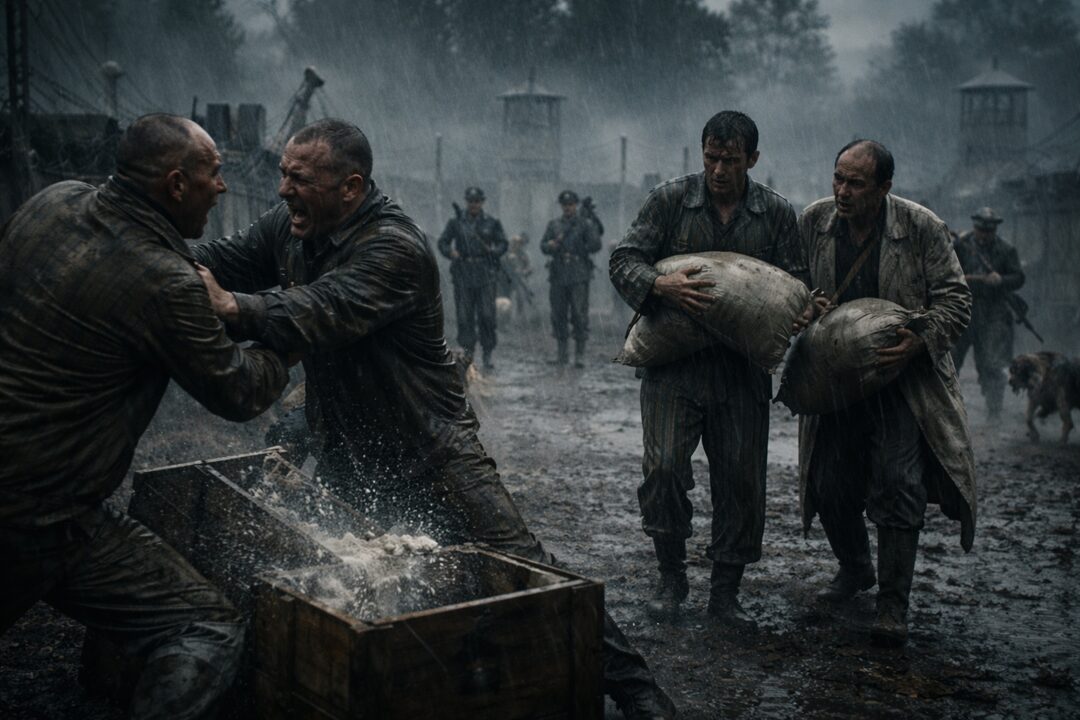
The next day the storm came late, gathering first as a bruise over the wire. By the time the outer labor detail formed, rain had begun to needle sideways across the yard. Mud swallowed boots. Guards cursed the weather and one another. The world beyond the fence dissolved into gray fields and darker trees.
Jan and Elias bent under the weight of lime sacks with eight other prisoners while rifles tracked them from a distance. Every few minutes thunder rolled low over the camp like something heavy being dragged.
Halfway through the detail, shouting erupted near the cart line.
A fight. Clumsy, loud, reckless.
Too reckless.
Stef had chosen well. Nothing about it looked planned. Two men grappling in the mud, another guard slipping while swinging a baton, a crate splitting open, sacks bursting, white powder blowing into the rain. Swearing. Dogs barking. For one impossible second all eyes broke the same direction.
“Now,” Elias said.
They did not run at first.
Running would have turned suspicion into certainty. They moved as men moved in chaos—wrong direction, fast enough to seem frightened, bent low under weather and confusion.
Then a shot cracked behind them.
Then another.
They ran.
Part V — The Cargo
Escape was not freedom. It was mud, branches, lungs on fire, and the animal certainty that the next sound might be a bullet.
Jan and Elias plunged through a drainage ditch, crawled beneath thorn scrub, slid down an embankment slick with rain and clay. The camp behind them became noise, then lights, then rumor. Dogs barked somewhere far off or too near; Jan could no longer tell. He had imagined the moment of leaving often enough to distrust any part of it that felt cinematic.
There was nothing cinematic in Elias falling the first time.
Jan hauled him up by the arm. The doctor’s breath came sharp and wet.
“Leave me,” Elias said.
“No.”
“I dislike repeating myself.”
Jan tightened his grip and kept moving.
They reached a ruined shed near the edge of a harvested field just before dawn. The rain had thinned to a cold drift. Jan wedged the door shut with a broken board and lowered Elias against the wall.
Only then did he really look at him.
The doctor’s skin had gone gray beneath the grime. His lips carried the wrong color. Every breath seemed to require decision.
Jan dropped to one knee. “What is it?”
Elias gave him a look so dry it almost counted as affection. “Months of this place, Captain. That is what it is.”
Jan searched his coat, his pockets, the cloth pouch tied beneath his shirt. The packet of names was still there, wrapped in oilskin. The coded notes he had memorized were still in him. The medallion—
Elias opened his hand.
The token lay in his palm.
“I was going to return it more gracefully,” he said.
Jan closed Elias’s fingers back over it. “Save your strength.”
“For what?” The doctor’s voice thinned. “A future where I explain triage to polite men?”
Jan leaned closer. “For witness.”
Elias studied him for a long second. Rain tapped weakly on the roof overhead. Somewhere outside, a branch cracked under water weight.
“You’ve changed,” the doctor said.
“Not enough.”
“No. Exactly enough.”
His hand moved with effort, pressing the medallion into Jan’s palm this time and not taking it