The HOA Dug Through Her Yard, Then Learned Why She Kept Measuring in Silence
Chapter 1: The Trench Was Already Crossing Her Yard
The trench began where Deborah Hall’s garden path ended.
At first, standing in the open back doorway with one hand still wrapped around her coffee mug, she could not make sense of the interruption. The flagstone path curved past the rosemary bed as it always had, then disappeared beneath a strip of raw brown earth wide enough for a wheelbarrow and deep enough to expose the pale roots of her maple.
A black plastic pipe lay at the bottom.
Her mug touched the doorframe with a small ceramic click.
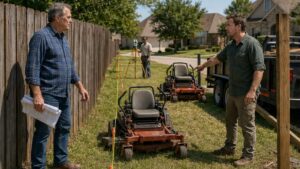
Beyond the torn sod, a compact excavator sat near the rear fence. Its bucket was suspended over a mound of soil. Two workers in reflective vests were feeding pipe toward the common swale behind the row of houses.
Deborah set the mug down.
“Stop.”
The nearest worker looked up but did not move.
She crossed the lawn carefully, avoiding the fractured edge of the trench. The air smelled of wet clay and cut grass. A row of flattened liriope marked where one of the machines had turned.
“I said stop.”
The excavator engine dropped to idle.
A man climbed down from the cab. He was younger than Deborah, broad through the shoulders, with dust across the knees of his work pants. He removed one glove.
“Ma’am, we’re almost through this section.”
“This section is my property.”
He glanced toward the fence, then toward the side gate. “We’re working for the association.”
“That does not answer what I said.”
He hesitated. “You’ll need to talk to Frank.”
Deborah looked down into the trench. The pipe was not perforated. It was solid-wall storm line, large enough to carry more than incidental yard drainage. The bedding beneath it was uneven, and the cut ran toward the northwest corner of her foundation.
Her work bag sat inside the kitchen, where she had dropped it Friday evening. A steel measuring tape was clipped to one side. She could picture it without looking.
“Who is the contractor?”
“Stephen Perez.”
“You?”
He nodded.
“Did you see a signed access agreement?”
Stephen’s eyes shifted toward the excavator.
“Frank said the board handled it.”
“That is not what I asked.”
A low mechanical hum came from behind the fence. Then water appeared at the open end of the pipe.
It began as a dark sheen, then gathered into a shallow stream that slid along the bottom and disappeared under the section already laid. Deborah followed its direction with her eyes. The grade looked too aggressive. The pipe was not simply passing through her yard. It was delivering water toward it.
Stephen noticed her expression.
“The common swale backed up twice last month,” he said. “This relieves it.”
“Where does it discharge?”
“Front inlet.”
“Through my side yard?”
He looked away again.
Deborah took out her phone and photographed the trench, the pipe, the damaged sod, the excavator, and Stephen’s truck parked beyond the gate. She included its company name in one frame.
“You are not placing another foot of pipe until I see the authorization.”
“Frank told us to finish before lunch.”
“Then Frank can come explain why.”
She walked through the house without changing her muddy shoes. Frank Wright lived three doors down on the corner lot, in a house with white columns and a flag mounted beside the garage. He had chaired the homeowners’ association for twelve years and had perfected the expression of a man interrupted while solving other people’s problems.
He opened the door before she knocked a second time.
“Deborah.”
“There is an excavation through my backyard.”
“Yes. The drainage correction.”
“You mean the unpermitted trench.”
His eyebrows lifted slightly. “It is permitted.”
“Not through my lot.”
“The board approved the route last Thursday.”
“The board cannot grant access to property it does not own.”
Frank stepped onto the porch and closed the door behind him. He wore a pale golf shirt tucked into pressed khakis, though it was barely eight in the morning.
“This is an emergency measure,” he said. “Emma’s basement has taken water three times. The swale is overloaded. Your lot is the low point.”
“Gravity does not create an easement.”
“No one said it did.”
“You sent a contractor onto my property.”
“With your consent.”
For the first time, Deborah’s composure shifted. Not enough for Frank to see anger, perhaps, but enough that she felt it in the muscles along her jaw.
“I gave no consent.”
“We discussed the drainage problem after the spring meeting.”
“You asked whether a temporary bypass was technically possible. I said several alignments might be studied.”
“You said your side yard was the logical route.”
“I said it was one possible corridor subject to survey, design, permit review, and written access.”
Frank spread his hands. “That is not how I remember it.”
“Then your memory should not be operating heavy equipment.”
A curtain moved in the window of the house across the street. Frank noticed it too. His voice lowered.
“People are frightened, Deborah. Emma has her mother living in the basement room. We could not wait through another round of studies while the forecast keeps changing.”
“There is no emergency exception that lets you excavate private property without notice.”
“We had notice.”
“To whom?”
“The board.”
She stared at him.
Frank’s face lost a fraction of its polish. “The association’s counsel reviewed the access form.”
“What access form?”
“I will send it to you.”
“You will send me the permit, the design, the contractor’s insurance certificate, the board resolution, and whatever document you believe gave you permission to enter my property.”
“Fine.”
“And Stephen stops.”
“He has half a day of work left.”
“He stops now.”
Frank folded his arms. “Deborah, this is exactly why neighborhoods struggle to complete anything. Everyone supports drainage improvements until a strip of grass gets disturbed.”
She let the silence remain between them.
“It is not a strip of grass,” she said. “It is a utility installation beside my foundation, carrying water from property I do not own, under a route I did not approve.”
“You are making this adversarial.”
“You brought an excavator.”
When she returned home, the machine was off. Stephen stood beside it speaking into his phone. Deborah retrieved her work bag and clipped the steel tape from its side, but she did not extend it yet.
She walked the trench from the common swale to the point where it angled toward the side yard. The torn sod had been stacked carelessly, roots exposed to the morning heat. At the bend, the pipe sat higher than she expected. The downstream fall would carry flow quickly until the line approached the house, where the available grade narrowed.
A harmless temporary drain would not have been laid like this.
Stephen ended his call.
“Frank says we’re standing down until he sends paperwork.”
“Do not cover the pipe.”
“That leaves the trench open.”
“Barricade it. Covering it destroys evidence and makes correction harder.”
He rubbed the back of his neck. “I priced restoration.”
“Before asking whether you had the right to dig?”
His expression hardened, then softened just as quickly. “I was told you’d agreed.”
“Did you see my signature?”
“I saw the packet.”
“That was not my question.”
He picked up his gloves. “Frank handled the approvals.”
By noon, Deborah had created a folder on her computer with thirty-seven photographs, a hand-drawn site sketch, the truck information, and a time-stamped account of every conversation.
Frank sent the email at 12:18.
The subject line read: ACCESS AUTHORIZATION—LOT 41.
There was no greeting.
The attached form carried the association logo, a description of temporary drainage access, and her typed name beneath a blank signature line. In the lower corner, someone had written “owner approved verbally” and added a date from six days earlier.
Below that notation were Frank Wright’s initials.
Deborah read the page twice.
Then she enlarged the bottom margin and saw the file code embedded in the footer.
DRAFT—NOT FOR EXECUTION.
Chapter 2: The Signature Was Missing for a Reason
The permit map ended in a clean blue line exactly where the trench crossed onto Deborah’s property.
She leaned closer to the county clerk’s monitor, though the boundary could not have been clearer. The approved work ran within the HOA-owned common swale behind the houses. A proposed connection was shown near the rear inlet, but no pipe crossed Lot 41, and no private access attachment appeared in the permit file.
“Can you print the full set?” Deborah asked.
The clerk looked at the line, then at the photographs Deborah had brought. “This is what was submitted.”
“Are there revisions?”
“None in the system.”
“Field change authorization?”
The clerk searched again. “No.”
Deborah placed the unsigned HOA form beside the printed map. “Does the county keep owner access documents?”
“If work enters a private parcel, yes. They are usually attached before issuance.”
“There is nothing for Lot 41?”
“Nothing.”
Outside the permit office, Deborah sat in her car with the papers resting across the steering wheel. She had expected a discrepancy. She had not expected the approved project to stop so decisively at her boundary.
For several seconds, vindication felt clean.
Then her phone displayed three missed calls from Emma Ramirez.
Deborah drove home before returning them. Stephen’s crew was gone, but orange safety fencing now surrounded the trench. She set the permit drawings on a folding table near the patio and retrieved the steel tape.
The distance from the pipe centerline to the foundation was less than she had estimated that morning.
She measured twice.
Then she drove a narrow marking flag beside the trench and wrote the distance in her notebook. At the upstream end, she checked the invert elevation against the patio slab and the swale. The numbers were preliminary, but the pattern was not.
A larger storm would fill the line quickly. If debris obstructed the front inlet—or if the pipe capacity had been estimated from ordinary rainfall rather than peak flow—the surcharge would occur near the house.
Stephen returned alone just after two.
He stopped at the gate when he saw Deborah measuring.
“I came for the laser level.”
“It is beside the machine.”
He entered, gathered the equipment, and tried not to look at the permit map on the table.
“The county approved only the common area,” Deborah said.
Stephen set the level case down.
“I have the map.”
“So do I.”
“Then why did you cross the boundary?”
He exhaled slowly. “Frank gave me the route sketch.”
“Not this route.”
“A field sketch. Red marker. He said you had approved access and wanted it kept close to the fence.”
“Did he show you a signed form?”
“He showed me a packet.”
“Stephen.”
“No.” His answer came sharply, as though he resented the relief of finally giving it. “I didn’t see a signature.”
“Did you ask?”
“I asked whether access was cleared. He said it was.”
“You know better than that.”
“Yes.”
The word sat between them with more weight than an excuse would have carried.
Stephen looked toward the open pipe. “I have three employees waiting on this invoice. The association has given me work for six years. When the president says counsel cleared a form, I do not usually call the owner myself.”
“You chose not to verify.”
“I did.”
“Frank wrote that I verbally approved it.”
“He told me you had.”
“When?”
“Friday afternoon.”
Deborah opened the draft authorization on her phone. “The notation says Tuesday.”
Stephen stared at the screen.
“That is not the date he spoke to me.”
It was the first fact he had offered that did not protect himself.
Deborah wrote it down.
Emma called again while Stephen loaded the level into his truck. This time Deborah answered.
“Can you come over?” Emma asked. “Please.”
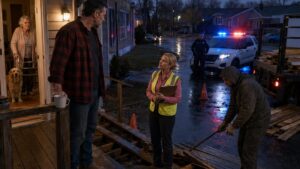
Emma’s house looked dry from the outside. The lawn was trimmed, the flower boxes under the windows newly planted. Inside, the air carried the faint mineral smell of a dehumidifier running too long.
Emma led Deborah downstairs.
A pale horizontal mark crossed the concrete wall behind a storage shelf, nearly eight inches above the floor. The baseboard along one finished section had been removed. A stack of folded towels sat beside a wet vacuum.
“That was the last storm,” Emma said. “The one before it reached the bed frame.”
Deborah looked toward the closed door at the end of the room.
“My mother sleeps there,” Emma said. “She cannot move fast by herself.”
“Why didn’t you tell me it had gotten this bad?”
“I told the board. Repeatedly.”
“That is not what I asked.”
Emma’s face tightened. “You stopped coming to meetings.”
The dehumidifier clicked off. The sudden quiet made the unfinished room feel smaller.
Emma folded her arms. “Frank said the pipe would divert the common swale before the next heavy rain. Yesterday was the first time in months water did not rise against that window well.”
“He had no right to cross my property.”
“I know.”
“Do you?”
“Yes, Deborah. I do.” Emma’s voice trembled, but she did not raise it. “I also know I slept downstairs during every storm because my mother was afraid the alarm would not wake her.”
Deborah looked again at the flood line.
On the folding table upstairs, the county map had made the conflict simple: permitted land on one side, private property on the other. Here, the same line seemed to run through two houses.
“The installed pipe is unsafe,” Deborah said.
Emma gave a tired laugh. “Unsafe for whom?”
“For both of us, potentially.”
“But it is moving the water now.”
“Until it fails.”
“And if you make them remove it today?”
Deborah did not answer immediately.
That silence changed Emma’s expression more than any technical explanation could have.
“You do not know,” Emma said.
“I have not completed the analysis.”
“You filed a stop request.”
“I requested that unauthorized work cease.”
“Before you knew where the water would go.”
Deborah felt the accusation land because it was precise.
Emma looked toward her mother’s closed door. “I am not saying Frank was right. I am saying you were not the only person he frightened.”
Back home, Deborah spread the county permit, the draft access form, Stephen’s route sketch, and her measurements across the dining table. She traced the common swale uphill through the subdivision. Several rear-yard drains and downspouts appeared to feed it. The original inlet was too small for the accumulated area.
She opened the weather service forecast.
A slow-moving storm system was expected Friday night. The advisory mentioned repeated thunderstorms and locally heavy rainfall.
Deborah printed the forecast and placed it beside the permit map.
For the first time since discovering the trench, she did not ask how quickly she could stop the pipe.
She asked what would happen when it was gone.
Chapter 3: Everyone Watched Her Measure the Foundation
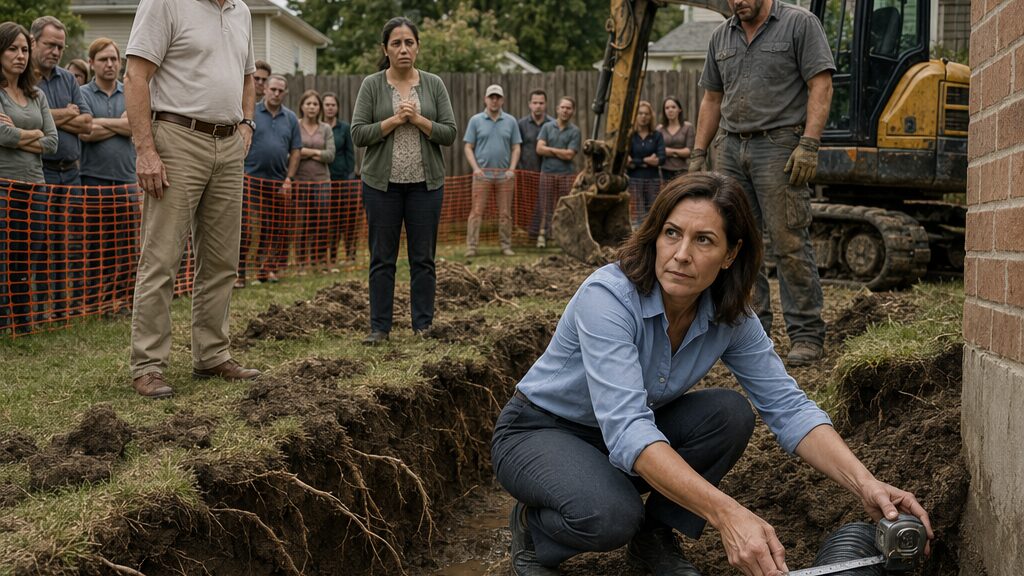
By six o’clock Wednesday evening, twelve residents were standing in Deborah’s torn backyard as though she had summoned them to defend herself.
She had not.
Frank had called it an emergency site walk and sent the notice through the neighborhood email list. The message described “a dispute concerning temporary flood protection” and invited affected owners to observe the conditions before the county inspection.
People arrived already carrying opinions.
One man stood near the patio with his hands in his pockets, studying the damaged sod. Two women spoke quietly beside the fence and stopped when Deborah passed. Emma remained near the rear corner of her own lot, close enough to hear but not close enough to appear allied with anyone.
Frank positioned himself beside the orange safety barrier.
“We all understand that private property matters,” he began. “But we also have to balance individual concerns against an urgent threat to another home.”
Deborah held the steel tape at her side.
Frank gestured toward the trench. “This temporary line was intended to protect Emma’s basement until the board could complete a permanent correction. Work stopped because Deborah objected to access across a narrow strip of grass.”
The phrase moved through the group in glances.
A narrow strip of grass.
Deborah looked at the raw trench, the severed irrigation tube, the maple roots exposed along one edge, and the pipe turning toward her foundation.
Frank turned to her with an expression of public patience.
“Deborah, perhaps you can explain why you believe the line should remain unfinished while rain is approaching.”
He had phrased it carefully. Not why the line was unsafe. Not why no consent existed. Why she believed it should remain unfinished.
She could have answered with the county map.
Instead, she crouched beside the trench and hooked the steel tape over the exposed edge of the pipe.
The metal blade snapped outward with a bright, dry sound.
Conversation stopped.
Deborah extended it toward the foundation wall. The tape crossed the raw earth, passed beneath the shadow of the patio, and reached the brick veneer near the basement corner.
She read the distance aloud.
Then she measured the pipe depth.
Frank watched without speaking.
Deborah moved upstream and took another reading from the common swale. She used a compact level from her bag to estimate fall. The numbers matched what she had recorded the day before.
One of the residents shifted closer.
“What does that mean?” he asked.
“It means the line accelerates flow from the swale, then loses available depth as it approaches the house.”
Frank said, “That is an interpretation.”
“It is geometry.”
He gave a small smile. “Engineers can disagree.”
“Yes.”
The smile held.
“Then this is not as settled as you are suggesting.”
Deborah retracted several feet of tape, moved to the pipe bend, and extended it again.
“Where is the overflow structure?”
Frank looked toward Stephen, who stood near his truck at the side gate.
Stephen said nothing.
Deborah continued. “Where does the water go when this line reaches capacity?”
“The front inlet,” Frank said.
“That is where the pipe goes. I asked where the water goes when the pipe cannot accept more.”
A breeze lifted one corner of the permit set on the folding table.
Frank’s tone tightened. “The line was sized for the anticipated flow.”
“Using what drainage area?”
“The contractor’s calculation.”
Stephen looked up. “I did not calculate the watershed.”
Every face turned toward him.
Frank’s jaw moved once. “The board reviewed the available information.”
Deborah pointed to the open upstream end. “The common swale receives runoff from at least seven rear drainage connections, plus surface flow from the upper lots. If this pipe surcharges, water follows the excavation because the trench has created a preferential path.”
She drew the tape toward the foundation until the blade touched brick.
“It follows this.”
The resident nearest the patio stepped back from the trench.
Frank said, “You are describing a worst-case event.”
“I am describing the event the board claims required emergency construction.”
No one answered.
Deborah let the tape remain stretched between pipe and house. Its narrow silver line made the distance look smaller than it had from across the yard.
A vehicle door closed in the street.
The county drainage inspector entered through the side gate carrying a clipboard and wearing mud-darkened work boots. He introduced himself without ceremony, then walked the trench from end to end.
He asked Stephen for the approved plans.
Stephen handed him the county set.
The inspector compared the blue alignment with the exposed pipe.
“This work leaves the permitted area here,” he said, pointing to the rear boundary.
Frank stepped forward. “The owner verbally approved temporary access.”
“I did not,” Deborah said.
The inspector looked at her, then at Frank. “Is there a recorded easement or signed temporary construction agreement?”
Frank reached into a folder. “There is an authorization form.”
Deborah placed the draft on the table before he could.
“It has no signature,” she said.
The inspector read the footer. His expression did not change, but he set the page apart from the approved documents.
“Nothing else gets installed,” he said. “Nothing gets backfilled. I need the trench stabilized and protected from runoff until we complete a field review.”
Frank’s voice lowered. “Leaving it open creates greater risk.”
“Then it should not have been opened outside the approved limits.”
A few residents looked away.
The order should have felt like relief. Deborah had wanted official confirmation since Monday morning. Instead, she saw Emma press her lips together and glance toward the sky.
Frank saw it too.
“So now what?” Emma asked.
The inspector answered carefully. “The association must provide a compliant stabilization plan. If the line is removed, flow must be managed within the permitted system or through lawful temporary access.”
“And before Friday?” she asked.
“That depends on what is submitted.”
Emma turned to Deborah.
“You proved it is unsafe,” she said. “You proved they had no permission. What are you proposing instead?”
Deborah heard the fairness in the question and resented it before she could stop herself.
“I am not the association’s engineer.”
“No,” Emma said. “You are the engineer who knew enough to stop it.”
A murmur passed through the group, not hostile but unsettled.
Deborah looked at the stretched steel tape. An hour earlier, she had imagined this moment as clarity: one measurement exposing what Frank had hidden. It had done that. It had also measured the distance between being correct and being responsible.
“I need the full drainage records,” she said.
Frank gave a humorless laugh. “Now you want to participate?”
“I want the original calculations, reserve studies, prior repair proposals, and all board minutes related to this swale.”
“You resigned from the drainage committee four years ago.”
“I did.”
“After giving us recommendations.”
“Preliminary recommendations.”
Frank opened his folder.
The paper he removed was older than the access form. Deborah recognized the formatting before she saw the seal at the bottom.
Her own.
Frank held it where the nearest residents could read the heading.
“Temporary Surface Diversion Options,” he said. “Prepared by Deborah Hall.”
The backyard went still again.
Deborah took the memo from him.
On the first page, beneath her name and license number, one sentence had been highlighted in yellow:
A temporary bypass along the western edge of Lot 41 may provide interim relief from common-swale surcharge.
Frank watched her read it.
“You did not just know this route was possible,” he said. “It was your idea.”
Chapter 4: Her Old Memo Changed the Entire Argument
Deborah recognized her seal before she recognized the words around it.
Frank had highlighted one sentence, but the faint impression at the bottom of the page pulled her attention first: her name, her license number, and the embossed mark she had pressed into the paper four years earlier.
The residents waited while she read.
A temporary bypass along the western edge of Lot 41 may provide interim relief from common-swale surcharge.
Frank tapped the highlighted line. “Your recommendation.”
Deborah turned the page.
There should have been three pages behind it.
“This is incomplete.”
“It is the memorandum you submitted.”
“It is the first page.”
Frank’s expression did not change. “The relevant conclusion is there.”
“No. The option is there.”
She held the sheet toward the county inspector. “My limitations and required second phase were on the following pages.”
One of the board members asked, “What second phase?”
Frank closed the folder.
The movement was small, but Deborah saw Mary Torres look at him.
Deborah looked around the yard. Several residents who had stepped closer during the measurements now seemed uncertain where to stand. Emma remained near the fence, her arms folded tightly.
“I prepared a preliminary review after the first basement flooding complaints,” Deborah said. “I identified possible temporary routes. I did not design this pipe, approve this alignment, or authorize construction across my property.”
“But you identified your property as the logical route,” Frank said.
“As one possible route, subject to written access, survey, capacity analysis, and a permanent repair to the common system.”
“You stopped serving on the committee before any of that was completed.”
“Yes.”
The answer quieted him for half a second.
Deborah folded the page along an existing crease. “Send me the full memo.”
Frank slipped the folder under his arm. “You wrote it. Surely you have a copy.”
She did.
At eight the next morning, Deborah found the original digital file in an archive labeled DRAINAGE COMMITTEE—2019. It opened with the same sentence Frank had highlighted. Page two contained assumptions for a temporary diversion. Page three contained a boxed warning:
Interim routing shall not substitute for enlargement and reconstruction of the common-area inlet and downstream conveyance. Temporary use beyond one wet season will increase risk and maintenance liability.
Below it, she had recommended a reserve contribution and phased capital project beginning the following fiscal year.
She remembered the meeting now. Not every word, but the shape of it: residents complaining that dues had already risen, Frank promising that the board could “manage the immediate issue,” and Deborah refusing to soften the cost estimate. Afterward, emails had circulated accusing the committee of engineering an unnecessary assessment.
She had resigned two weeks later.
At the time, she had called it professional distance.
Now she saw what it had allowed.
Deborah printed the full memo and carried it to Emma’s house. Emma opened the door without inviting her in.
“I need to see the basement again.”
“My mother is resting.”
“I will be quiet.”
Emma studied the pages in Deborah’s hand. “Is that the report Frank showed everyone?”
“The complete version.”
They went downstairs.
Deborah clipped the end of her steel tape to the floor and extended it up the concrete wall. The old water mark reached seven and three-quarter inches. A second, fainter stain behind a cabinet sat higher.
“When was this one?”
“Two summers ago.”
“You did not report that height.”
“I reported flooding.”
“To the board?”
“To Frank.”
Deborah wrote the measurement in her notebook.
Emma watched her. “Are you collecting proof that his pipe helped me?”
“I am calculating what the swale is doing.”
“That is not an answer.”
Deborah retracted the tape. “The pipe helped during the last small storm. That does not make it safe during a large one.”
“And your memo?”
“My memo said a temporary route might work if it was designed, permitted, and followed by reconstruction of the common inlet.”
“Did you follow up?”
“No.”
“Why?”
“Because the board would not fund it.”
Emma’s face hardened. “That is Frank’s answer.”
Deborah looked at the flood line. “I also stopped pushing.”
For the first time since the site walk, Emma’s anger shifted. It did not disappear. It became more careful.
“What would the permanent work cost?”
“Four years ago, roughly one hundred and twenty thousand dollars.”
Emma gave a short, disbelieving breath.
“It will be more now,” Deborah said.
Upstairs, Emma’s mother called her name. Emma turned toward the stairway, then stopped.
“If the board had told everyone that number,” she said, “they would have voted it down.”
“That does not make the trench lawful.”
“No. But it explains why Frank thought no one would let him do the right thing.”
At the HOA records room that afternoon, Mary Torres unlocked a metal filing cabinet and removed three reserve-study binders.
Frank had not attended.
Mary kept her voice low. “He said the county issue was operational, not financial.”
“It became financial four years ago.”
Mary placed a spreadsheet on the table. Several planned contributions had been reduced after annual meetings. Roof replacement at the clubhouse had cost more than expected. A retaining wall repair had consumed most of the remaining contingency.
The drainage reserve contained less than thirty thousand dollars.
Deborah turned another page. “You cannot fund the permanent repair.”
“No.”
“Could you fund stabilization and design?”
“Possibly, if we delay pavement sealing and cancel the landscaping contract.”
“That still leaves construction.”
Mary rubbed her thumb along the binder edge. “A special assessment.”
“How much per home?”
“Depending on the final bid, three to five thousand dollars.”
Deborah looked at her.
Mary’s eyes were tired rather than evasive. “People threatened to recall the board over a three-hundred-dollar dues increase last year.”
“So Frank chose work no one had voted on.”
“He chose something he believed would keep Emma dry until we had time.”
“He used an unsigned draft as access.”
“I did not know that until yesterday.”
“But you knew the permanent phase was never funded.”
Mary looked down.
“Yes.”
The admission did not feel like victory. It widened the circle of responsibility.
Deborah placed her complete memo beside Frank’s one-page copy. The missing pages transformed the highlighted sentence, but they did not erase her name from the first page.
She had written the temporary option. She had known the permanent system was failing. Then she had allowed the matter to become someone else’s problem.
A knock sounded at the records-room door.
The county inspector entered carrying a bright notice sealed inside a clear weatherproof sleeve.
“Field review is complete,” he said. “The installed line does not match the permit, private access is not established, and the open excavation needs immediate stabilization.”
He handed the notice to Mary.
The order allowed forty-eight hours.
No additional pipe could be placed. No section could be buried. The association had to submit a lawful stabilization or removal plan before the deadline.
Mary read the final paragraph twice.
Deborah’s phone vibrated with an updated forecast. The storm had accelerated. Heavy rain could begin Friday evening.
Mary looked from the order to Deborah’s full memorandum.
“What can we build in forty-eight hours?”
Deborah stared at the number on the flood-height page, then at the missing second phase of her own recommendation.
For the first time, the question was no longer whether she could prove the board wrong.
It was whether she was willing to help after proving it.
Chapter 5: Forty-Eight Hours Before the Water Returned
The safest temporary route still crossed Deborah’s property.
She discovered it at 1:17 Friday morning, after rejecting three other alignments.
One required excavation beneath the community sidewalk and could not be permitted before the storm. Another pushed flow toward the rear lots downhill. The third depended on the undersized inlet that had caused the problem in the first place.
The remaining route followed Deborah’s side yard, but not where Frank had ordered the trench. It stayed farther from the foundation, used a shallow armored channel rather than a buried full-flow pipe, and discharged through a controlled connection within the common area.
It would require a narrow temporary easement.
Voluntarily granted.
Deborah sat back from the drawings. Her untouched coffee had gone cold beside the keyboard.
She had spent four days insisting that no one had the right to use her land without consent. Now the most defensible emergency plan depended on her giving that consent.
At dawn, she carried stakes into the side yard. The damaged trench remained behind orange fencing, dark with overnight moisture. She hooked the steel tape to the rear boundary marker and walked toward the front.
Six feet.
That was the corridor required for construction and maintenance access. No more.
She drove the first stake into the grass.
By seven, Stephen stood beside her studying the sketch.
“This is not a pipe trench,” he said.
“Not until the permanent design is approved. This is a lined bypass with check controls at the inlet and energy dissipation at discharge.”
“You expect it to carry Friday’s storm?”
“I expect it to reduce the peak entering Emma’s low point without concentrating failure beside either house.”
He crouched and examined the proposed grade. “We can shape this.”
“Can you finish before rain?”
“If materials are released by ten and inspections happen as we work.”
“Insurance?”
“Current.”
“County approval?”
“Needs the board submission.”
“Written access?”
Stephen looked at her.
Deborah held up a draft easement. “Signed only after every condition is accepted.”
He gave a faint, exhausted smile. “I will never start another HOA job without calling the owner.”
“That would be a useful lesson.”
His expression sobered. “I should not have started this one.”
It was not an apology polished for protection. That made it harder to dismiss.
Emma arrived while Stephen was checking quantities. She wore a sweater over sleep clothes and carried a folder of photographs from her basement.
“Mary said you found an option.”
Deborah showed her the alignment.
Emma followed the stakes with her eyes. “It still uses your yard.”
“Yes.”
“And it keeps water away from the foundation?”
“If it is constructed correctly and maintained during the storm.”
“What does it cost?”
“The temporary work can be covered by current reserves if the board delays two projects. The permanent repair cannot.”
Emma looked at the narrow corridor. “The assessment.”
“Yes.”
“How much?”
“Likely several thousand per property.”
Emma closed her folder. “People will say I caused it.”
“They may.”
“And they will say you designed it.”
“They may say that too.”
Emma studied her face. “Will you still present it?”
Deborah looked toward the torn sod from the unauthorized trench. “Yes.”
At nine, they met Frank and Mary in the board conference room. The county inspector joined by video. Stephen placed a material list beside Deborah’s plan.
Frank read the first page without sitting.
“This is excessive for a temporary measure.”
“It is the minimum safe work that can be approved before the storm,” Deborah said.
“You have added monitoring, erosion controls, inspection fees, and restoration.”
“Those are not additions. They are parts of the work.”
Frank turned to Stephen. “Can you simplify it?”
Stephen did not look at him. “Not if I am putting my company on the permit.”
Mary opened the reserve spreadsheet. “We can release the funds.”
Frank flipped to the easement. “And Deborah grants access?”
“Under listed conditions,” Deborah said. “Limited duration, defined corridor, inspection rights, full restoration, and automatic termination when the permanent system is operational.”
“This clause requires the association to acknowledge the prior excavation lacked valid consent.”
“Yes.”
Frank set the pages down. “That is unnecessary.”
“It is necessary to distinguish this agreement from the draft you used.”
“We are trying to prevent flooding, not litigate the past.”
“The past is why no contractor can legally begin.”
Mary said, “Frank, the county needs proof of access.”
“They need her signature, not a confession.”
Deborah remained seated. “You wrote that I had verbally approved the first route.”
“You discussed it.”
“I discussed conditions you did not meet.”
“We acted under an emergency.”
“You acted before the forecast became an emergency.”
His face colored. “Emma’s basement had flooded repeatedly. Every delay increased the association’s exposure.”
Emma, seated near the door, spoke for the first time.
“You could have told us the real repair cost.”
Frank turned toward her. “And watched the neighborhood reject it again?”
“You did not let us decide.”
“I knew what would happen.”
The room became still.
Frank looked at the plan, then at the reserve spreadsheet. “Leadership sometimes means acting before a room full of people understands the risk.”
Deborah slid the easement toward him. “Leadership does not mean manufacturing my consent.”
He pushed it back.
“I will authorize the work without that sentence.”
“You cannot authorize work on my property.”
“The board can accept a temporary easement.”
“There is no easement until I sign it.”
The steel tape lay on the table beside Deborah’s drawings, retracted into its scratched metal case. She placed one finger on it.
“The corridor is six feet wide. The term is sixty days unless extended in writing. Access is limited to the approved work. Any change requires my consent. That is what permission looks like.”
Frank’s jaw tightened. “You are using the storm to force a public admission.”
“No. The storm is forcing us to decide whether the rules apply when following them is inconvenient.”
The county inspector’s voice came through the speaker. “Without an executed easement and board authorization, I cannot approve construction.”
Stephen checked the time. “If I do not have release by eleven, I cannot guarantee completion.”
Mary closed the reserve binder.
“Then we need a board vote.”
Frank looked at her sharply. “We have enough members here.”
“Not for an open emergency expenditure tied to a special-assessment plan.”
“The assessment is separate.”
“It cannot be separate anymore.”
Mary gathered the documents into one stack. Her hands shook slightly, but her voice did not.
“I am calling an emergency open meeting for six tonight.”
Frank stared at her.
Mary continued. “The agenda will include the temporary bypass, funding for permanent design, a special-assessment process, acknowledgment of unauthorized access, and removal of the president.”
Stephen stopped writing.
Emma looked at Deborah.
Frank’s face became unreadable. “You do not have grounds.”
Mary placed the unsigned draft form on top of the agenda papers.
“We will let the board decide that in public.”
Chapter 6: The Meeting Could Not Call It Temporary
Frank opened the emergency meeting by calling the trench a success.
“The disputed installation prevented additional flooding during the most recent rainfall,” he told the packed clubhouse. “Its purpose was temporary, protective, and necessary.”
Deborah sat at the end of the first table with her steel tape, the unsigned access form, and the phased repair plan aligned before her.
Rain had begun tapping against the windows.
Mary occupied the treasurer’s seat beside Frank. The other two board members sat between them, both avoiding the empty space where residents usually approached during comment periods.
Nearly every folding chair was filled.
Frank continued. “We are here because procedural objections have interrupted an emergency measure. We now have an alternative proposal, but it carries significant cost.”
There it was: procedural objections.
Deborah watched Emma shift in her seat among the residents.
Mary read the agenda. Her voice remained formal until she reached the last item.
“Consideration of removal of the association president.”
A murmur moved across the room.
Frank did not look at her. “We will address drainage first.”
Stephen presented the construction schedule. The county inspector, again connected by video, confirmed that Deborah’s temporary bypass could receive expedited approval if the easement and funding authorization were executed that night.
Then Mary displayed the reserve figures.
The room changed.
People leaned forward when the projected special assessment appeared: between thirty-eight hundred and forty-six hundred dollars per property, depending on bids and financing.
A resident near the aisle said, “For one flooded basement?”
Emma turned in her chair.
Deborah spoke before she could.
“No. For a common drainage system that has been undersized and deferred for years.”
Frank tapped his pen. “We are not debating the permanent design tonight.”
“We are funding its first phase,” Mary said. “Residents need to know what follows.”
Another resident asked why the board had not disclosed the problem earlier.
Frank answered carefully. “Previous engineering advice supported temporary diversion while the association built reserves.”
He lifted Deborah’s old memorandum.
This time, she was ready.
“That statement is incomplete,” she said.
Frank looked toward her. “The memorandum speaks for itself.”
“Yes. All three pages do.”
Deborah distributed copies of the full document. Paper moved from hand to hand. The boxed warning on page three had been enlarged.
She could have allowed the missing pages to condemn Frank.
Instead, she stood.
“I wrote this memo four years ago. It identified an interim bypass as one possible measure. It also required permanent enlargement of the common inlet and downstream system.”
She paused.
“I knew the board did not fund that second phase.”
Frank’s pen stopped.
Deborah continued. “I objected. Residents objected to the projected cost. I resigned from the committee and stopped attending most meetings.”
A woman in the second row asked, “Are you saying you knew this could happen?”
“I knew the system would continue to fail. I did not know anyone would excavate my property without consent.”
“But you walked away.”
“Yes.”
The answer produced no satisfying silence. It produced discomfort.
Deborah let it remain.
“I believed a correct memorandum was enough. It was not. Frank chose an unauthorized shortcut. Stephen began work without verifying access. The board failed to fund the permanent phase. I stopped pressing after my recommendation became unpopular. Those responsibilities are not equal, but they are connected.”
Emma stood near the back.
“And people like me kept cleaning up water,” she said.
No one contradicted her.
Frank’s expression had tightened, but his voice stayed measured. “This is precisely why the board acted. We could not wait indefinitely while everyone debated blame.”
Mary slid the draft authorization toward him. “When did you write ‘owner approved verbally’?”
Frank looked at the page.
“During project preparation.”
“Tuesday or Friday?”
“That distinction is irrelevant.”
Stephen spoke from the side wall. “You told me Friday that consent was secured. The form is dated Tuesday.”
Frank turned toward him. “You had the project packet.”
“I had a draft.”
“You accepted it.”
“I did. I should not have.”
Mary asked again, “When did Deborah approve access?”
Frank’s patience broke at the edges.
“She discussed the route. She knew it was the logical corridor. I believed she would not obstruct emergency work once she understood Emma’s situation.”
Deborah said, “That is not consent.”
“You would have refused.”
“I might have required this plan.”
“There was no time for this plan.”
“You began excavation before the severe forecast.”
Frank looked around the room, searching the faces of people who had trusted him for twelve years.
“I made a decision,” he said. “Because I knew an assessment vote would fail. I knew another study would take months. And I knew that if Emma’s mother was trapped during a flood, every person in this room would ask why the board had done nothing.”
The room held the truth inside his defense.
He had been afraid. He had also chosen to make that fear someone else’s burden.
Emma approached the front table and placed her basement photographs beside the unsigned form.
“I wanted the water stopped,” she said. “I did not ask you to lie about Deborah agreeing.”
Frank lowered his eyes.
Mary turned to Deborah. “Will you execute the new easement if the board approves the plan?”
Deborah rested her hand on the measuring tape.
“Yes, under the written conditions.”
A man near the aisle asked, “Even after they destroyed your yard?”
“The bypass protects both houses. It does not excuse what happened.”
“And you expect all of us to pay four thousand dollars?”
“I expect all of us to pay for the common system we all own.”
The answer drew several angry whispers.
Deborah looked directly at the residents.
“I cannot promise the assessment will feel fair. Deferred work does not become cheaper because no one wants the bill. But if you reject the permanent project, this temporary route becomes another excuse to wait. I will not grant access for that.”
Frank leaned back. “There. Her permission is conditional on the neighborhood accepting her engineering recommendation.”
“My permission is conditional on the temporary work remaining temporary.”
“You are holding flood protection hostage.”
“No,” Emma said. “She is preventing us from doing to her what we already did.”
Mary separated the motions.
The first authorized the temporary bypass and reserve expenditure. It passed unanimously.
The second initiated permanent design and the special-assessment process. One board member hesitated before voting yes. The other followed. Frank voted no.
Then Mary placed the acknowledgment of unauthorized access before the board.
Frank refused to sign.
“I will not characterize an emergency action as misconduct,” he said.
Mary’s voice softened. “No one asked you to call it misconduct. The statement says Deborah did not provide written or verbal consent.”
“She discussed the route.”
“That is not the question.”
Frank looked at Deborah. “You would really stop construction over that sentence?”
The rain struck harder against the clubhouse windows.
Deborah saw Emma’s flood photographs, Stephen’s schedule, her old memo, and the steel tape gathered on the table. Each object marked a different failure. None could be repaired by pretending the failures were the same.
“Yes,” she said. “Because if my no can be rewritten as a yes whenever the board feels justified, then no agreement we sign tonight means anything.”
Mary drew a breath.
“The chair has refused to acknowledge the owner’s right to withhold consent,” she said. “We will proceed to the final agenda item.”
Frank’s face went pale.
Mary lifted the written motion.
“All in favor of removing Frank Wright as president of the association, effective immediately, raise your hand.”
Chapter 7: The New Easement Had Her Real Signature
Deborah signed the easement only after reading every condition aloud.
The clubhouse had nearly emptied, but the rain had not eased. It pressed against the windows in steady sheets while Mary sat in the president’s chair for the first time, one hand resting beside the vote tally.
Frank had lost the position by three votes to one.
He had remained at the table.
His nameplate had been moved aside, but he did not leave when Mary reopened the temporary-access agreement. He sat with both hands folded in front of him and listened as Deborah read the limits governing her property.
“Six-foot construction corridor,” she said. “Access restricted to approved personnel and equipment. Sixty-day term. No change in alignment without written owner approval. Daily inspection during active storm conditions. Full restoration after removal.”
Stephen nodded at each item.
The county inspector appeared on a laptop screen at the end of the table. “Those conditions match the plan submitted.”
Deborah reached the final clause.
“This easement does not ratify or excuse prior entry, excavation, or installation on Lot 41.”
Frank looked at the tabletop.
Mary signed on behalf of the association.
Then Deborah signed.
Her name filled the line intended for it. The pen left a small dark mark where she paused before lifting the tip.
There was nothing dramatic about the signature. That was what made it feel different. No typed name. No handwritten notation claiming approval. No one interpreting a conversation on her behalf.
Consent had a date, terms, and limits.
Stephen took the executed copy and stood. “We need to move.”
By the time they reached Deborah’s yard, his crew had arrived with rolls of erosion-control fabric, stone, lumber, and a compact loader. Portable lights threw white circles across the wet grass.
Deborah clipped the steel tape to the rear boundary stake.
“Six feet,” she said.
Stephen held the far end while she extended the blade toward the house. Together they marked the corridor with stakes and bright cord. It passed outside the unsafe trench, bending gradually along the side yard before returning to the HOA common area.
The first trench remained open behind its orange barrier, a dark cut through the lawn.
Frank appeared at the side gate carrying a rain jacket over one arm.
No one had asked him to come.
Mary stopped beside him. “You are no longer authorized to direct the contractor.”
“I know.”
“Then why are you here?”
He looked toward the common swale. “The inlet screen clogs with leaves from the upper lots. Someone has to keep it clear during the storm.”
Stephen glanced at Deborah.
She did not invite Frank in, but she did not ask him to leave.
“Stay outside the marked corridor unless Stephen assigns you a task,” she said.
Frank nodded once.
Construction moved by measured stages. The crew shaped the shallow route, lined it, checked the grade, and installed controls to slow the flow before discharge. Deborah watched every elevation reading. Stephen called out numbers; she recorded them.
There was no argument over her presence now.
Near midnight, the county inspector approved the work by live video after Stephen walked the camera from inlet to outlet. The bypass was not elegant. Its fabric lining and sandbags looked temporary because they were temporary.
That distinction mattered.
The first heavy band of rain arrived twenty minutes later.
Water rose in the common swale, carrying leaves and small branches toward the inlet. Frank stood behind the fence with a rake and pulled debris from the screen. Stephen’s crew watched the check structures. Deborah remained beside the corridor in a hooded raincoat, holding a flashlight over the first control point.
The flow entered the bypass.
For several seconds, it moved exactly as her calculations predicted.
Then the downstream water level climbed faster than expected.
“Second check is backing up,” Stephen called.
Deborah followed the beam of his light. Water had begun to curl over one edge of the fabric.
“Reduce the inlet opening.”
“That sends more toward Emma.”
“Only until the outlet drops.”
A crew member adjusted the control plate. The bypass flow slowed, but the common swale rose against the rear fence.
Emma appeared at her basement doorway across the property line.
“It is at the window well,” she shouted.
Deborah looked from Emma’s house to her own foundation. The original trench had been cut closer to her wall, and rain was pooling along its exposed bottom despite the temporary cover.
The system was balancing two risks in real time.
“Open the first control two inches,” Deborah told Stephen. “Place another stone bag at the outer bend.”
He gave the order.
Water surged through the channel, struck the added weight, and spread more evenly across the lined bottom. The downstream level rose, hesitated, then began to fall.
Emma stayed in the doorway.
Deborah crossed to the fence. “Check the basement floor.”
Emma disappeared inside.
Minutes passed.
The rain struck the patio roof hard enough to drown out conversation. Deborah watched water run through a corridor she had permitted rather than one imposed upon her. That did not make it harmless. It made everyone accountable for how it behaved.
Emma returned.
“Dry,” she said.
Deborah turned toward her own house. The pooled water in the abandoned trench had stopped advancing toward the foundation.
Stephen checked the outlet again. “It is holding.”
No one celebrated. They remained at their positions until the worst band passed.
Near dawn, Frank leaned the rake against the fence. His shirt was soaked beneath the open rain jacket.
“I voted against the assessment,” he said to Deborah.
She was retracting the measuring tape after checking the corridor width near the outlet.
“I know.”
“I still think many owners cannot afford it.”
“They may not be able to.”
“And you think the vote was right.”
“I think the system must be repaired.”
He stared at the water moving through the temporary route. “Both can be true.”
“Yes.”
Frank looked toward Emma’s house. “I thought if I solved the flooding first, people would forgive how I did it.”
Deborah pressed the release, and the steel blade slid into its case.
“You did not ask them to forgive it. You told them it was not wrong.”
He accepted the sentence without defense.
At the next board meeting, Frank remained an ordinary member long enough to vote on the financing package. Mary presented a payment plan for owners unable to cover the assessment at once. The permanent project passed by a narrow margin.
Frank voted yes.
Six weeks later, the unlawful pipe was gone.
The permanent common-area inlet had been enlarged, and the downstream conveyance was under construction. The temporary bypass had been removed from Deborah’s side yard after the county signed off on the new connection.
Restoration took three days.
The landscape crew replaced the sod and repaired the irrigation line, but the mature liriope along the old garden path could not be saved. The maple survived, though one exposed root had to be cut cleanly and treated.
The yard looked whole from the patio.
Up close, the new grass was a different shade.
Emma stood beside Deborah while the restoration crew loaded its final wheelbarrow.
“My mother asked whether you were going to measure it again,” she said.
Deborah held the steel tape.
“I am.”
She hooked it to the rear boundary marker and walked the restored line. The measurement matched the recorded plan. The permanent work remained in the common area. The temporary easement had terminated exactly as written.
Emma watched the tape stretch across the grass.
“I was unfair to you,” she said.
“You were frightened.”
“That is not the same as being fair.”
Deborah looked toward Emma’s basement window. “I stopped the work before I understood what stopping it meant for you.”
“You were still right to stop it.”
“Both can be true.”
Emma smiled faintly at the borrowed words.
At the rear fence, one survey stake remained beside the repaired swale. The crew had missed it, or perhaps assumed Deborah wanted it left until final inspection.
She retracted the tape slowly.
The first time she had used it, the steel line had marked what others had taken without asking. During the storm, it had marked what she was willing to give under conditions everyone could see.
Now it measured neither anger nor generosity.
Only the boundary they had finally agreed to respect.
Deborah left the survey stake in place.
Not as a warning.
As a record.
The story has ended.