No One Left in the Dark
Part I — The Man They Left
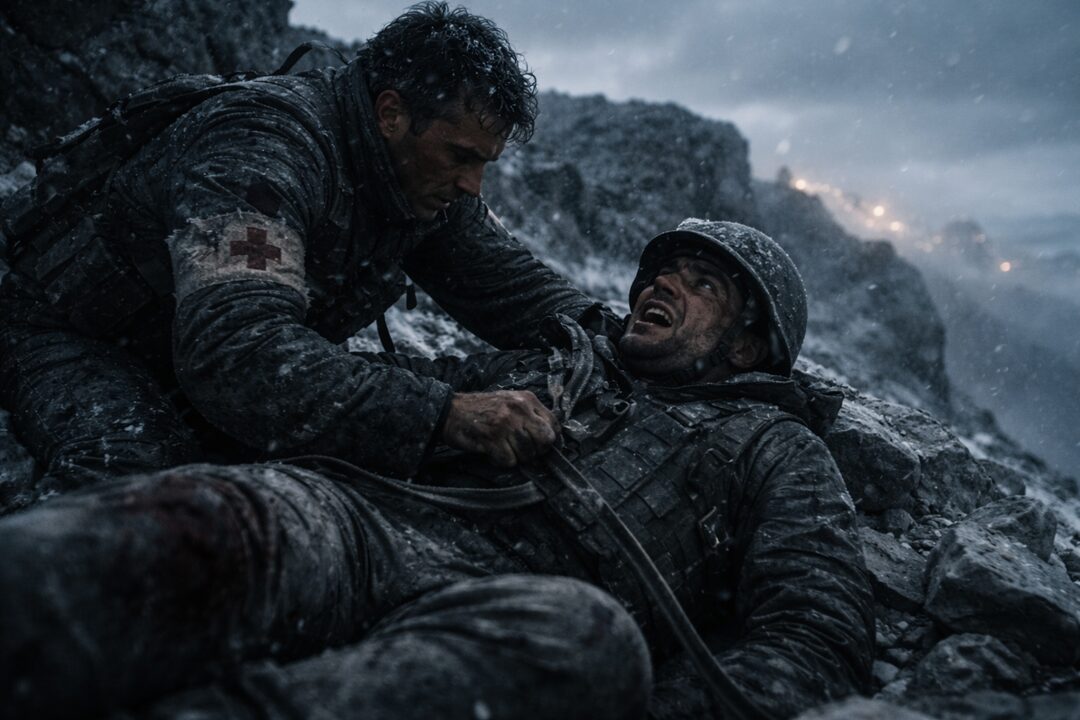
The flare burned white above the ridge, then died.
For one second the mountain was all bone and silver—shattered stone, snapped wire, bodies that looked like broken packs dropped in the snow. Then darkness rushed back in, and with it the sound: distant artillery, closer rifle bursts, wind scraping through the blasted communications tower like something alive.
Corporal Danner Holt lay on his back with one leg pinned under rock and half his blood in the dirt. His mouth tasted like copper and wet ash. He had stopped trying to sit up ten minutes ago. Maybe twenty. Time had gone strange.
He heard boots sliding over stone.
Not careful boots. Not enemy boots either. Somebody moving like he was already too tired to be afraid.
Holt forced his head toward the sound and saw a shape drop beside him.
“Easy,” the man said.
Holt recognized the voice before he recognized the face, and the shame of it hit harder than the pain in his leg.
“No,” he muttered. “Not you.”
The man ignored him. He was lean, dark armband visible even in the gloom, one cheek striped with soot. He pulled a strap from his shoulder and began working it under Holt’s back with quick scarred hands.
“You’re not dying here,” Staff Sergeant Elias Vale said.
Holt gave a weak laugh that broke into a grunt. “You don’t even carry a rifle.”
Vale tightened the sling around Holt’s chest. “Lucky for you, I brought everything useful.”
A shell landed somewhere down the slope. The mountain shook. Pebbles rattled over Holt’s face.
He looked past Vale toward the ridge line where the company had broken hours ago. Men had run. Men had crawled. Men had dragged each other into the dark. Holt remembered Captain Keene shouting withdrawal over the roar, remembered the path collapsing under mortar fire, remembered deciding that if the medic got stranded, that was God’s way of sorting the serious men from the soft ones.
And now the “soft” one was here.
Vale leaned close, his voice lower now. “Listen to me. Cable’s still holding on the tower side. I lower you to the ravine, Mara receives you, then I come back up.”
“You keep coming back?” Holt asked, half from blood loss, half because the answer made no sense.
Vale braced his shoulder under Holt and hauled. Pain tore through Holt’s leg so hard his vision flashed white.
“No one gets left in the dark,” Vale said.
It sounded like something foolish. It sounded like something a man said right before he died.
But Vale had already saved men tonight. Holt knew that now. He’d heard voices below, stretchers improvised from torn webbing and antenna poles. He had watched shapes disappear over the cliff one by one while tracer fire searched the fog.
“How many?” Holt asked.
Vale paused only a second. “Enough to keep moving.”
Then he dragged Holt toward the broken tower.
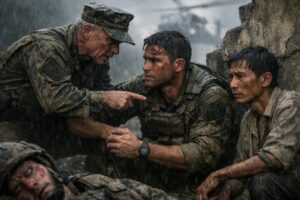
The cable rig was anchored through steel that had once held satellite dishes. Now it groaned under blood and frost. Vale clipped Holt in, checked the knot with fingers gone nearly numb, and for the first time Holt saw the man clearly.
Not fearless. Not glowing with noble purpose.
Just exhausted beyond language and still going.
Holt had called him dead weight once.
He had hit him, too.
That memory rose now with stupid, perfect detail: barracks gym, sweat and fluorescent light, Holt shoving him after drills while the others laughed. Carrying a weapon’s the first rule of staying alive, medic. Or did they issue you prayers instead?
Vale had looked at him then with flat, almost tired eyes and said nothing.
Now Holt grabbed a fistful of Vale’s sleeve.
“Why are you still here?”
Vale cinched the last strap and met his stare. Wind pushed loose snow against both their faces.
“Because you are.”
He shoved Holt over the edge.
For a sick second the world vanished. Then the line snapped taut. Holt spun over black air, biting down a scream as his ruined leg swung loose. Below him, lantern-shaded in a pocket of stone, someone waved once.
A narrow face. Knit cap. Blood-dark sleeve.
Mara Quill.
The new signal girl.
She caught the line, cursed, and started hauling him sideways toward cover while Vale’s silhouette already moved away above, back toward the dead men and the not-dead-yet.
Holt stared upward, breath ragged.
The dark swallowed him.
And still, impossibly, Elias Vale kept going back.
Part II — Orders for the Ridge
Eight hours earlier, the men had still been cold in the ordinary way.
Not the animal cold of shock. Just mountain cold—wind in the collar, metal stinging the hands, breath smoking under dim red lamps as Company F assembled below the transport trucks.
Mara Quill sat on an ammo crate with her field radio between her knees, logging call signs in grease pencil on the inside of a ration tin because the paper roster had gone damp. She liked lists. Lists held still when people didn’t.
Across the gravel lot, Captain Rowan Keene stood under the floodlight with his helmet tucked under one arm, listening to the battalion major with the expression he wore for everything important: jaw set, back straight, as if someone might be grading his posture from heaven.
He was the kind of officer soldiers obeyed before they liked him.
He turned once, scanning the loading line, and his gaze caught on Elias Vale.
Even from thirty yards away, Mara saw it—the tiny tightening around the eyes, the irritation too controlled to be called anger.
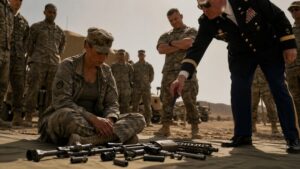
Vale was checking med kits with methodical speed, rifle rack untouched beside him. He wore a sidearm holster because regulation required it, but everyone knew it was unloaded.
The jokes about that had run for months.
Most of the infantrymen kept their mockery casual because it was easier than admitting they liked having him around when things went bad. Men who needed stitching liked medics more than they liked principles.
Captain Keene did not joke.
He crossed the yard and stopped in front of Vale. “You’re attached to my company again?”
Vale didn’t look up from the bandage packs. “That’s what the manifest says, sir.”
“I objected.”
“I know.”
That flat answer sharpened the air around them.
Mara looked down at her tin and pretended not to hear.
Keene lowered his voice, which somehow made it cut harder. “My men are walking into a live zone near a broken ceasefire line. I need a medic who understands what that means.”
Vale snapped the kit closed. “I do understand.”
“You understand medicine,” Keene said. “I’m less certain you understand force.”
A few soldiers nearby went still without appearing to. Holt, slinging his rifle over his shoulder, smirked openly.
Vale finally looked up. His face was narrow, wind-burned, crooked at the nose from some old break. He never looked defiant. That was part of what unsettled men. There was no performance in him to push against.
“I understand what bullets do when they hit people,” he said. “That’s usually enough.”
Keene’s eyes hardened. “You refuse the most basic responsibility of a soldier.”
“No,” Vale said. “Just one category of it.”
The silence that followed had edges.
For a second Mara thought Keene might remove him on the spot, manifest or no manifest. Instead the captain took a step closer.
“If one of my riflemen dies because the medic beside him won’t fire back, that’s on you.”
Vale held his gaze. “If one of your riflemen lives because I stayed with him, that’s on me too.”
It was the wrong thing to say to a man like Keene. Or maybe the only thing.
The captain turned away before anyone had to decide whether that counted as insubordination.
By the time the trucks moved, the whole company knew the atmosphere had shifted.
The mission briefing, delivered in the back of the transport over engine noise, sounded simple enough. An abandoned observation ridge near the ceasefire line. Hold it through the night. Confirm whether insurgent movement had resumed through the pass. Command believed resistance would be scattered at worst.
Scattered at worst.
Mara wrote that phrase in the margin of the tin without meaning to, then scratched it out.
Vale sat opposite her on the bench, med bag between his boots. Holt was two seats down, cleaning his nails with the tip of a combat knife.
“You know the ridge?” Mara asked Vale when the truck hit a rut and almost threw them together.
He nodded. “Used to run mule trails above it. Before enlistment. Carried supplies for a clinic on the border villages.”
“You from here?”
“Near enough.”
Holt gave a short laugh. “Great. We’ve got a tour guide.”
Vale ignored him.
Mara kept her voice neutral. “Any alternate descent routes?”
“One old maintenance line on the tower side. Maybe a rear track if the mountain hasn’t eaten it.”
Keene, standing by the tailgate, looked over. “You should’ve mentioned that in briefing.”
Vale met his eyes. “You didn’t ask.”
That bought him a stare so cold it almost had weight.
The company reached the ridge at dusk.
The first thing Mara noticed was the silence.
No wildlife. No distant village noise. Even the wind felt wrong, as if the mountain were holding its breath.
The second thing she noticed was that the observation bunker wasn’t abandoned. Not exactly. It was empty, but recently empty. Fresh tire grooves. Ration foil in a burn pit still warm underneath the ash.
She relayed it up.
Keene absorbed the report, then ordered the perimeter established.
That was the moment, later, everyone would remember as the line between bad information and disaster.
The first mortar landed three minutes after full dark.
The second took the eastern wall off the bunker.
Then the ridge lit up from three directions at once.
No scattered resistance. No weak probe.
Prepared positions. Interlocking fields of fire. Their maps had led them into a bowl.
The world became noise and dirt and shouted names. Mara fell against the radio set, ears ringing, trying to raise battalion through static. Holt and his rifle team pushed toward the north berm. Keene moved through it all with brutal precision, redirecting fire, collapsing loose clusters of panic into shape.
And Vale was everywhere the bullets had already been.
Mara saw him tackle a private behind sandbags just before stone exploded where the boy’s head had been. Saw him seal a chest wound with both hands while shells walked the ridge. Saw him drag a man by webbing and collar through a rain of dirt, not fast enough to look heroic, just fast enough to matter.
The retreat order came late and broken over the radio.
Withdraw south immediately. Route Delta.
Company F tried.
Then a mortar punched the path apart.
The ledge sheared away in a rush of rock and screaming. Men skidded into the dark. The only organized exit was gone.
For the first time, Mara saw Captain Keene hesitate.
Not fear.
Calculation.
He turned, took in the wounded scattered across the shattered ridge, the severed route, the muzzle flashes closing tighter through the fog.
“Mobile units with me!” he shouted. “Command core first. We regroup below and push rescue at first light.”
The logic was brutal and clean. Save who could still move. Save the structure. Save enough force to survive.
A soldier with his arm hanging open at the elbow began to cry out from beside the bunker.
Vale was kneeling over another man, tightening a tourniquet with his teeth.
Keene strode to him. “Sergeant. Move.”
Vale looked up once at the ridge, at the stranded wounded, at the empty black where the path had been.
Then he stood.
For one breath, Mara thought he would obey.
Instead he pulled spare line from his bag, slung it across his shoulder, and said, “I can still get them down on the tower side.”
Keene stared at him as if he had spoken another language.
“That’s not an order,” the captain said.
“No, sir,” Vale replied. “It’s a fact.”
Another shell burst somewhere behind them. Holt, bleeding from the temple, grabbed Keene’s sleeve. “Captain, we need to move now.”
Keene’s face changed then—not softening, not exactly, but tightening around a decision he would have to live inside afterward.
“Fall back,” he ordered.
Vale did not move.
Mara looked from one man to the other and felt something ugly and final pass through the company like a current. The shape of abandonment. The kind institutions renamed later to make them easier to file.
Keene turned away first.
Men began pulling back in staggered lines through smoke toward the surviving slope.
Mara should have gone with them.
Instead she picked up the radio, the ration tin, and the emergency battery pack, and followed Vale toward the broken tower.
He glanced once over his shoulder. “You should leave.”
“So should you,” she said.
That almost earned a smile.
Then the mountain shook again, and the night began in earnest.
Part III — One More
The first man Vale lowered was unconscious and so heavy with gear Mara thought the cable would shear through both their hands.
The second woke halfway down and tried to claw himself free, convinced he was falling into enemy capture. Vale talked him through the whole descent in the same tone a man might use to calm a horse in a storm.
The third was a boy from third platoon whose jaw had been shattered. He could only make wet, terrified sounds. Vale pressed his forehead briefly to the boy’s temple before sending him over.
“Breathe through your nose,” he said. “I’ve got you.”
Mara caught them all in the ravine hollow below the tower, dragging each body into the shelf of rock that kept them hidden from the ridge. She marked a line on the ration tin for every survivor who made it down breathing.
At five, her hand started shaking.
At eight, she stopped thinking in names and started thinking in weight, blood loss, tourniquet status, airway.
At ten, she looked up and realized Vale was beginning to limp.
He still kept going back.
The enemy figured something out around the ninth rescue. Mara could feel it in the changing fire pattern. Random suppressive bursts narrowed toward the dead ground near the tower. Someone up there had noticed movement where there should have been none.
When Vale slid down beside her with a soldier whose face was burned raw on one side, Mara grabbed his sleeve.
“They’re tracking you.”
He was winding the cable again, hands moving automatically. “Good. Means they haven’t figured the ravine.”
“You can’t keep this pace.”
He gave her the man’s field dressing packet. “No one asked the mountain.”
There was blood on his mouth. She couldn’t tell if it was his.
He vanished upward again before she could say anything else.
The eleventh man came down conscious enough to whisper, “Thought he was dead.”
“The medic?” Mara asked.
The soldier nodded. “No one else would stay.”
That was when the rescue count changed for her. It stopped being casualty management. It became a refusal. Line by line on a ration tin, a record of one man rejecting the category of acceptable loss.
She looked at the marks, greasy and uneven under her flashlight hood.
Eleven.
Then twelve.
Then thirteen.
Around the fourteenth, Vale brought down a soldier with two dog tags around his neck—his own and another man’s. He pressed the extra tag into Mara’s hand before he went back up.
“Didn’t make it,” he said.
Nothing in his voice broke. That was almost worse.
The wind sharpened. Snow began to blow sideways through the ravine mouth.
Mara tightened a pressure bandage on her own upper arm with her teeth and forced the radio to life again. Static answered. Then, briefly, a fractured battalion channel, too far to use.
On the ridge above, a machine gun stuttered and went silent.
Vale did not come down for several minutes.
When he finally appeared at the lip of the ravine, he was not lowering a casualty.
He was half-carrying, half-dragging Captain Rowan Keene.
For a heartbeat Mara thought she was seeing things wrong.
Keene’s helmet was gone. Blood soaked one trouser leg. One hand clutched a leather command ledger tight against his chest even while Vale tried to pry it free enough to secure him in the sling.
The captain’s face was gray with pain and something worse than pain.
He saw Mara staring and said, too sharply, “Eyes off that.”
She almost laughed. The man was bleeding through his fingers and still trying to command the angle of other people’s attention.
Vale crouched in front of him. “You went back.”
Keene’s mouth tightened. “For what matters.”
“For a book?”
Keene’s eyes flicked once toward Mara, then away. Even now, even half-delirious, he was measuring what could be said in front of whom.
“It contains operational records,” he said. “If taken—”
Vale cut in. “You returned to an encircled ridge for paper.”
Keene let out a breath that might have been a laugh if it hadn’t hurt him. “You returned for men.”
Something changed in the silence after that. Not forgiveness. Not agreement.
Just recognition that each of them had reached back into the fire for the thing he could not leave.
Vale strapped him into the rig.
Keene caught his wrist with surprising force. “Take the ledger. Leave me.”
Mara looked up sharply.
Vale didn’t even answer at first. He checked the knot, checked the cable, checked Keene’s pulse like the question had been logistical, not moral.
Then he said, “No.”
“Sergeant.” Keene’s voice dropped, stripped of rank by exhaustion. “Listen carefully. If command records are captured, the ridge doesn’t matter. The whole sector changes.”
Mara heard it then—not the words themselves, but the hole behind them.
This was bigger than map grids.
“What’s in it?” she asked.
Keene ignored her.
Vale did not. “Something he’s more afraid of losing than his own life.”
That landed.
Keene looked at him, and for the first time all night the captain seemed older than his years. Not physically. Morally. Like a man who had followed enough bad orders to stop recognizing which part of the stain was his.
Mara understood very little of command politics, but she understood shame when it was standing right in front of her.
“Take the men first,” she said to Vale. “If the ledger matters, fine. If he matters, fine. But don’t let the whole ridge die for a secret.”
Vale finally turned to her.
Snow clung to his lashes. There was dried blood under both nails and on the cuff of his armband. He looked almost translucent with fatigue.
“I’m not choosing who deserves mercy,” he said.
It was such a terrible thing to say in a war zone because it sounded impossible.
Then he lowered Keene into the ravine like he’d said nothing unusual at all.
When Mara received the captain at the bottom, Keene was shivering hard enough to shake the line.
She eased him against the rock wall and reached for the ledger.
His hand closed over it even then.
“Don’t,” he said.
Mara met his stare. “You’re not exactly in a position.”
The captain’s eyes moved past her to the ration tin beside the wounded.
Line after line of grease pencil. Small black marks in the dark.
“How many?” he asked.
She glanced down. “Fifteen alive down here. A few worse than that.”
Keene looked up toward the ridge.
Vale was already gone again.
Something like disbelief crossed the captain’s face—not disbelief that Vale was physically capable of it, but disbelief that a man he had spent months treating as a dangerous exception was now the only functioning center of his ruined command.
He closed his eyes once and said, almost to himself, “I thought conscience made men weak.”
Mara tucked the ledger under her own leg where neither of them could easily reach it.
“Maybe you just needed it to,” she said.
Part IV — The Broken Rig
By the time the line snapped, Mara had counted nineteen.
The twentieth was still halfway down when a shell burst somewhere above the tower. The steel anchor screamed. The cable jerked once, then parted with a sound like bone cracking inside the mountain.
The soldier dropped the last fifteen feet into the ravine and hit hard enough to knock the breath out of everyone listening.
Mara stumbled toward him.
Above, the severed cable lashed uselessly in the dark.
For the first time all night, there was no immediate sound of Vale coming back.
The silence was so wrong it seemed louder than artillery.
Keene tried to rise and failed. “He’ll need another route.”
“There isn’t one,” Mara snapped, then hated herself for saying it out loud.
But there was.
It came back to her a minute later, not from her own memory but from a half-heard conversation in the truck. Mule trails. The back face of the mountain.
She looked up just as a figure slid down the shale into the ravine mouth.
Vale hit one knee, caught himself, and nearly pitched forward.
No cable. No soldier. Just him, breathing too hard.
“Tower’s done,” he said.
Mara was already speaking. “The old rear track. You said there was one.”
Vale wiped a hand over his mouth. “If the snow didn’t bury it.”
“And if it didn’t?”
He looked toward the far side of the ravine where the mountain curled back around itself in a long exposed shelf.
“Machine gun nest north ridge has line of sight across the approach.”
Keene, pale with blood loss, forced himself upright against the rock. “Then you stagger movement between bursts. Draw their eye high. Make them think retreat’s still on the tower side.”
Vale looked at him.
Not as subordinate to commander. Not even as medic to patient.
As the man who now had to decide whether the captain’s voice carried any authority worth using.
“Can you stand?” he asked.
Keene’s face tightened. “Enough.”
“Then listen carefully, sir.”
Mara had never heard him use the title like that. It wasn’t obedience. It was precision.
Vale crouched in the dirt and drew the mountain with his finger. Ravine. Broken tower. Exposed shelf. Mule track cutting behind a rock outcropping.
“Wounded move first in pairs if they can walk. Mara, you call intervals off muzzle flash. I need counts. No bunching. No one runs unless I say.”
Keene said, “And you?”
“I bring the ones who can’t.”
The captain started to object. Stopped. Swallowed it.
For the first time since Mara had known Company F, Rowan Keene nodded to Elias Vale like a man accepting command.
It should have felt satisfying.
Instead it felt expensive.
They began moving.
The walking wounded went first, bent double against the rock, boots slipping in snow and scree. Mara counted between bursts under her breath, then shoved them forward with the flat of her hand.
“Now.”
“Wait.”
“Now.”
Above them, enemy fire kept searching the dead tower line.
Keene climbed partway up the ravine mouth and fired single deliberate shots from a recovered rifle toward the opposite slope, changing position after each one. False target pattern. Draw the eye. Feed the illusion.
The first time he fired, Vale glanced up.
Neither man said anything. They didn’t need to. The gesture was obvious: Keene, the officer who had measured courage in return fire, was now using violence only to buy time for mercy.
The track existed.
That felt like a miracle until Mara saw what “existed” meant: two feet of half-buried mountain edge curving over a drop that vanished into fog. The men crossing it did not look alive so much as stubborn.
One slipped. Vale caught his harness and shoved him flat against the cliff.
Another froze mid-step, whispering he couldn’t do it, couldn’t do it, couldn’t—
Vale put both hands on the man’s face and said, “Look at me. You don’t need courage for the whole mountain. You need it for three steps.”
The soldier took the steps.
Mara marked more lines on the tin with hands so numb the pencil barely held.
Twenty-three.
Twenty-five.
Twenty-eight.
The count no longer felt real.
Keene sank back into the ravine after another covering burst, breath ragged. Mara saw blood spreading again down his damaged leg.
“You’re reopening it,” she said.
He gave a humorless half-smile. “I’ve had worse staff meetings.”
Then his eyes found the tin in her hand.
“How many left above?”
“Don’t know,” she said. “He stopped telling me names.”
Keene looked toward the ridge where Vale had vanished again. “No. He started carrying all of them.”
That line sat between them while snow hissed over the rock.
A few minutes later, Vale returned with two men at once—one slung across his shoulders, another stumbling under his arm. Mara moved to help and nearly blacked out when she stood.
The edges of her vision folded inward.
Vale caught her before she fell.
“You’re hit worse than you said.”
“So are you,” she said, hearing how weak her own voice sounded.
He looked down at the blood soaking through his side as if he’d forgotten it belonged to him.
“It can wait.”
“No,” she said, angrier than she meant to be. “That’s what everybody says right before they become a problem.”
A strange thing happened then.
Vale laughed.
It was quiet, almost surprised, and over in a second. But it changed the shape of his face enough for Mara to remember he was not made only of endurance.
He tightened the pressure wrap on her arm himself and said, “Stay conscious long enough to count. After that, you can collapse on principle.”
She did.
At thirty-one, the enemy found the track.
Machine-gun fire raked the exposed shelf, chewing sparks off stone. One of the wounded screamed and went down hard, though whether from a bullet or fear Mara couldn’t tell.
Keene dragged himself up again, jaw clenched so tight the muscles jumped.
“Captain—” Mara started.
He cut her off. “If they fix the line, it’s over.”
He fired. Moved. Fired again.
Not enough to silence the nest. Only enough to make them answer him.
Only enough to say: aim here instead.
Vale turned once from the track, saw what Keene was doing, and for a moment their eyes met across the ravine.
Mara could not have said what passed between them.
Not absolution.
Not even trust, exactly.
Something harder. More costly.
A man finally seeing the shape of another man’s courage when it could no longer be useful to deny it.
Then Vale was gone again.
Dawn was beginning to thin the dark.
And there was still one man left above.
Part V — The Last Man
Holt heard Vale before he saw him.
Stone sliding. Breath too controlled to be panic. The same impossible return.
By then the sky had gone from black to iron gray. Dawn did not brighten the ridge. It only exposed it.
Holt was wedged behind a slab of fractured concrete from the old observation post. His shattered leg had swollen tight against the tourniquet. Every few seconds he thought he might pass out and did not. That had become its own punishment.
When Vale dropped beside him, Holt looked at the blood soaked down the medic’s side and said, “You look terrible.”
Vale started securing the drag harness. “You always this charming in the morning?”
A laugh tore out of Holt and turned into a groan.
Below them, machine-gun bursts ripped across the slope. The track had been found. There was no more hiding the route, only gambling against the enemy’s aim and the mountain’s angles.
“You need to leave me,” Holt said.
Vale did not answer.
“I mean it.” Holt gripped his sleeve. “You’ve already done enough.”
There was real urgency in it now, not false nobility. Holt had spent his whole life hating helplessness. The thought of being the reason this man finally died made his throat close.
Vale looped the strap under his shoulders.
“Everyone says that at the end,” he replied.
“This isn’t the end. It’s math.”
“That’s the trouble with math,” Vale said. “It counts the wrong things.”
A burst struck stone above them, showering both men with grit.
Holt shut his eyes. For one second he was back in the training yard months earlier, shoving Vale hard enough to make him hit the lockers. The others had laughed. Holt had leaned close and said, “Men die next to people like you.”
Vale had only picked up the medic bag and walked away.
Now Holt opened his eyes into the gray of the ridge and said, because there was no dignity left except the truth, “I hit you.”
Vale checked the knot.
“I remember.”
“I called you dead weight.”
“I remember that too.”
“Why are you still here?”
Vale looked at him then. Not angry. Not saintly. Just tired enough to be honest.
“Because if I start picking which men are worth carrying, I become the thing I came here not to be.”
The line landed in Holt like shrapnel.
Below them, a rifle cracked—Keene’s position, farther and weaker now. Drawing fire again. Buying seconds he didn’t have.
Vale braced himself and dragged.
Holt screamed despite himself as his leg moved. They slid out from cover and into open slope. Tracer fire slashed overhead. Vale kept low, hauling him by inches toward the track.
“Stop,” Holt gasped. “Leave me. Save yourself.”
Vale did not even look back.
“No one gets left in the dark.”
Holt had heard him say it before. To others. To strangers. To men better than him.
Now the words were for him.
The machine gun stitched the rock ahead, trapping them behind a narrow outcrop ten yards short of the track.
Vale flattened over Holt instinctively as fragments spat around them.
For a few seconds there was nothing but the impact of his body shielding Holt’s chest, the sound of bullets hitting stone, the raw animal fact that the man Holt had despised was covering him like a brother.
Holt swallowed hard against something far worse than pain.
When the burst paused, Vale moved again.
They reached the track in a slide of shale and blood. Holt could barely see below, only fog and void and, farther down, a figure at the bend—Mara, one arm bound, waving them on with the ration tin in her good hand like a signal flag from some ruined kingdom.
The path was narrower than Holt remembered.
Vale half-carried, half-dragged him across. Once Holt’s boot slipped over nothing and he felt the whole mountain open under him. Vale hauled him back with a sound more like a grunt of anger than effort.
Halfway through, enemy fire found them again.
A round punched the cliff near Vale’s shoulder. Another hit the dirt at Holt’s side. Vale twisted, turning his own body toward the open line.
“Don’t,” Holt said, horror suddenly clean in his voice. “Don’t do that.”
Vale almost smiled. “Then move faster.”
They made the bend.
Keene was waiting below the outcrop, propped on one knee with the recovered rifle across a rock, face ashen and lips bloodless. He looked once at Holt, once at Vale, then up toward the ridge they had emptied almost clean.
“How many?” he asked Mara.
She stared at the ration tin, counting lines through numbness and blood and disbelief.
“Thirty-two,” she whispered. Then, louder, as if she needed the mountain to hear it. “Thirty-two alive.”
Holt looked at Vale.
The medic’s eyes closed for one second—not in triumph, not relief exactly, but something quieter. A man letting the number exist outside his own body at last.
Then artillery began to fall farther up the pass—friendly this time, delayed and ugly and finally useful. The corridor reopened in thunder. The enemy fire broke.
The survivors started moving.
Keene tried to stand and almost collapsed. Vale caught him under one arm despite everything.
For a brief, absurd second the three of them were bound together—captain, medic, rifleman—the hierarchy of the whole night reduced to weight and need.
Keene looked at Vale and said, very softly, “I was wrong.”
Vale adjusted his grip. “Yes, sir.”
It should have been sharper than that. Vindication, accusation, something.
But the mountain had taken too much for ceremony.
They moved downhill into the opening barrage, into the gray of morning, carrying with them thirty-two live men and all the dead they would still remember.
Part VI — The Names That Remained
Three weeks later, the boardroom was warm enough to feel insulting.
The windows were clean. The flags stood straight. The officers at the long table had polished shoes, dry uniforms, and the particular faces of men determined to arrange disaster into language that could survive public contact.
Staff Sergeant Elias Vale stood at attention in borrowed dress greens because his own jacket still had blood that would not wash out.
His medal citation lay printed in front of them already. Gallantry. Repeated rescue under fire. Extraordinary devotion to life-saving duty in the face of overwhelming enemy action.
All of it was true.
Not all of it was enough.
To one side of the room sat Mara Quill with her arm in a sling and the ration tin in her lap like contraband. On the other side sat Danner Holt, leg cased in steel and bandages, shoulders too large for the chair, scarred brow rigid above eyes that no longer looked at Vale the same way.
Captain Rowan Keene entered last.
He had lost weight. The gray at his temples looked harsher under the overhead lights. There were rumors already—investigations, command review, sealed records pulled from the ledger recovered on the ridge. Nothing formal enough to say aloud.
He took the witness chair.
One of the generals began with the usual questions. Tactical sequence. Survivor count. Line integrity under fire. Whether Sergeant Vale’s refusal to carry a firearm had at any point impeded operational defense.
Keene could have answered in six safe words and saved pieces of himself.
No impediment observed under emergency conditions.
Instead he looked straight ahead and said, “His refusal exposed ours.”
The room shifted.
The general frowned. “Clarify.”
Keene’s voice stayed even, but it no longer had that old clipped steel. It sounded more dangerous now because it cost him something to keep it steady.
“I believed courage was proven in one language,” he said. “Aggression. Obedience. Return fire. I believed a man unwilling to kill when ordered was a liability to those who would.”
No one interrupted him.
“On that ridge,” he went on, “my command structure failed. My intelligence failed. My judgment failed in ways now under review. The only thing that did not fail was a medic I had spent months treating as if conviction were weakness.”
The silence in the room sharpened.
Vale kept his eyes forward.
Keene turned his head then, just slightly, enough to include him without making a performance of it.
“Sergeant Vale’s refusal to carry a rifle never endangered my company,” he said. “What endangered my company was the assumption that violence is the only form duty can take.”
No one moved.
It was not a speech designed to save himself. That was the strange, almost unbearable thing about it. It was too late for that and everyone knew it.
It was testimony.
Holt spoke after him. Briefly. Awkwardly. He was a man built for force, not witness, but the room listened harder because of that.
“He came back for me last,” Holt said. “After everybody worth saving was already moving.”
A general looked up. “You believe you were not worth saving?”
Holt’s mouth twisted. “I believe he had reasons not to.”
That was all.
The board recessed for forty minutes.
When they returned, the citation was read aloud.
Highest decoration for valor by a noncombatant in active conflict.
The words reached the room clean and official. They should have changed everything. In practice, they changed only what could be written down.
Afterward, people shook Vale’s hand.
Mara hugged him one-armed and muttered into his shoulder, “Thirty-two. Don’t let them turn it into a rounder number.”
“I won’t.”
Holt stepped forward last. He stood there too long, the way men do when apology feels like a tool built for finer hands.
Then he said, “I was wrong about what made a man dangerous.”
Vale looked at him.
Holt added, rougher now, “And I was wrong about you.”
Vale nodded once. “I know.”
That mercy nearly undid him more than anger would have.
Later, when the room had emptied and the ceremony had dissolved into paperwork and footsteps and distant phones, Vale walked alone through the recovery ward.
Some of the men from the ridge were sleeping. Some were writing letters. One lifted two fingers in greeting from a bed near the far wall. Mara’s ration-tin count had become names on charts, stitches, fevers, requests for stronger coffee, nightmares loud enough to wake neighboring cots.
Lives, not legend.
He stopped beside an empty chair and took a folded packet from his breast pocket. Personal effects returned after the ridge. Among them, a second dog tag from the soldier who had not come down alive.
On the back of the tag, scratched so shallow he had missed it the first time, was a name:
Noah.
Vale sat.
For a long moment he just looked at the letters.
Not the dead soldier’s name. His brother’s.
Or maybe not. Maybe just the same one. But that was enough. Enough to reach across years into a freezing field where a boy had fallen because Elias had not known how quickly one careless finger could ruin a world.
He had spent so long carrying that silence he had mistaken it for bone.
Now, in the warm sterile quiet of the ward, with thirty-two men breathing somewhere behind him, he let it shift.
“My brother was named Noah,” he said aloud, to no one and not to no one.
The words did not heal anything. They did not redeem the mountain or the ledger or the men still missing from the count.
But they made room.
A nurse passed at the far end of the ward. Someone coughed. Snow tapped lightly against the dark hospital window.
Vale looked down the line of beds, at the men he had dragged out of black air one by one, and felt the ache arrive whole at last—not as guilt alone, not as pride, not as grief separate from service, but all of it together.
He set the tag carefully on the windowsill.
Then he stood, rolled his sleeves once, and walked toward the next patient who needed him.