The HOA Called His Father’s Car an Eyesore Until the Garage Door Finally Opened
Chapter 1: The Tow Sticker Appeared Before Sunrise
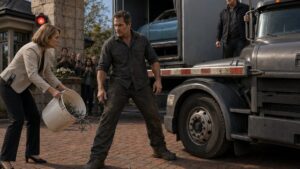
The tow authorization was tucked beneath the driver-side windshield wiper before the sun cleared the roofs.
Justin Rivera saw it from his kitchen window: a square of white paper edged in red, bright against the faded blue hood. For a moment he stood with one hand around his coffee mug, waiting for the shape to become something else.
Then a diesel engine idled at the curb.
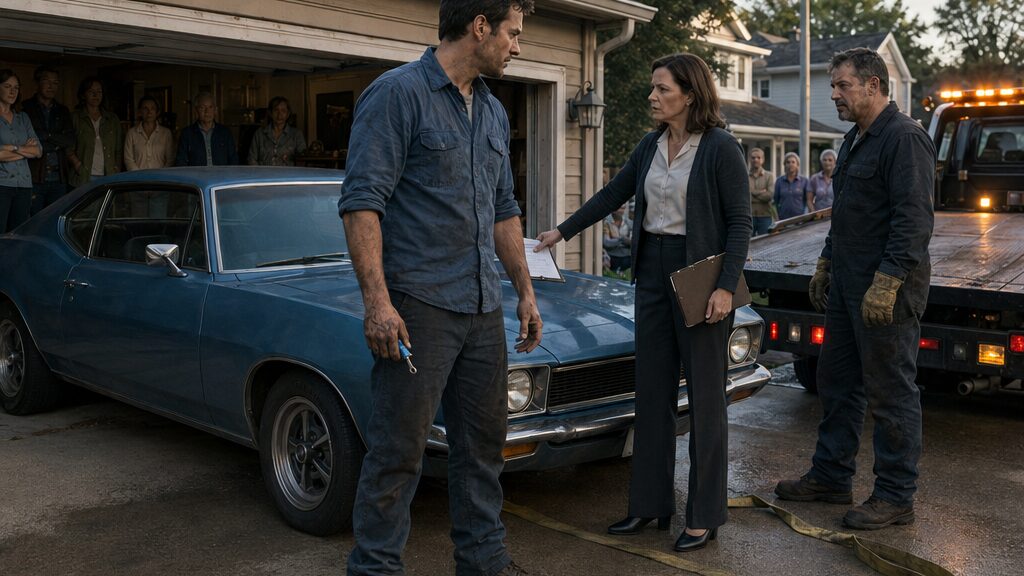
He set the mug down and crossed the garage in his socks. The concrete was cold beneath his feet. Tools lay in measured rows on the rolling cart, exactly where he had left them after midnight. The old coupe occupied the center of the driveway with its hood raised, one front wheel chocked and a battery tender cable trailing back into the garage.
A flatbed tow truck waited twenty feet away.
Angela Thompson stood beside it in a beige cardigan, holding a clipboard against her chest. She looked prepared for a meeting rather than a confrontation. The driver was already lowering his ramp.
Justin stepped outside.
“Stop,” he said.
The driver looked toward Angela.
Angela answered before he could. “The association issued the removal order after the final deadline.”
“The final deadline is next Saturday.”
“The courtesy period ended yesterday.”
“That isn’t what the last notice says.”
Angela’s mouth tightened. “The vehicle has been visibly inoperable for more than thirty days.”
Justin pulled the authorization from beneath the wiper. The paper resisted, dampened by overnight condensation.
ABANDONED OR INOPERABLE VEHICLE.
The words sat above his address.
He folded the paper once and looked at the driver. “You hook this car, I call the police and report an unauthorized removal.”
The driver raised both hands slightly. “I’m not touching anything until the paperwork is clear.”
Angela exhaled through her nose. “Justin, this does not have to become theatrical.”
A porch light clicked on across the street.
He glanced toward it and saw Betty Green standing behind her screen door in a robe, one hand gripping the frame.
“It became theatrical when you brought a truck before sunrise,” Justin said.
“I scheduled it at the first available service window.”
“You scheduled it before the inspection.”
“You refused inspection.”
“I refused to let you walk through my garage and photograph everything I own.”
Angela shifted the clipboard under one arm. “The board asked for proof of active restoration. You supplied none.”
Justin looked past her at the tow truck’s empty bed.
He had supplied nothing because every request from the HOA had sounded less like verification than permission to stare. The first envelope had been marked Courtesy Notice. The second had included photographs taken from the sidewalk. The third had listed daily fines. He had placed all three unopened beneath a stack of parts invoices on the kitchen counter.
The fourth had threatened removal.
He had opened that one.
The tow driver approached the car but stopped outside arm’s reach. “Does it run?”
Justin’s fingers closed around the key in his pocket.
The worn brass edge pressed into his palm. The black plastic head had cracked years ago and been wrapped with two careful layers of blue electrical tape. His father had said the tape made it easier to find when it fell between the seats.
Justin had not turned it in the ignition since Dennis died.
“It’s under restoration,” he said.
“That wasn’t my question.”
Angela looked at him without blinking.
Justin could have opened the door. He could have sat in the unfinished cabin, pressed the clutch, and turned the key. The fuel system was connected. The starter had tested clean on the bench. The rebuilt engine had fired once using a remote switch.
But the dashboard was still apart, the brake lines were unfinished, and the last time Dennis had sat behind that wheel, he had rested both hands on the cracked rim and said, When we hear it run, we finish it. No more excuses.
“It isn’t ready to be started,” Justin said.
Angela’s expression changed by only a fraction, but he saw the satisfaction in it.
The driver rubbed his jaw. “The order says it is incapable of starting.”
“The order is wrong.”
“Can you prove that?”
“Not safely this morning.”
Angela uncapped a pen. “Then the classification stands.”
Justin walked to the garage and returned with a clear plastic folder. He removed the registration, insurance card, and current municipal property-tax receipt.
“The title is active,” he said. “Registration is current. Insurance is current. It is not abandoned.”
The driver examined the documents and nodded. “He’s right about that part.”
Angela did not take the papers. “The covenant does not require legal abandonment. It prohibits visibly inoperable vehicles stored in driveways.”
“It’s a restoration project.”
“Then provide evidence.”
Justin pointed toward the open hood. New wiring looms followed the firewall. Clean brake tubing ran beneath the master cylinder. Fresh engine mounts sat against a block still carrying assembly markings.
“You’re looking at evidence.”
“I’m looking at a vehicle without a dashboard, front grille, or current safety inspection.”
“It doesn’t need a state inspection while it isn’t being driven.”
“That does not resolve the association violation.”
The tow driver handed Justin back the folder. “I’m not taking it today. The abandonment language is too broad, and he’s disputing operation.”
Angela turned to him. “The association is your client.”
“The association can send a revised order.”
The ramp began to rise with a hydraulic whine.
Justin felt relief, but it was thin and temporary. Angela wrote something on her clipboard as the truck pulled away.
By then three neighbors had appeared outside. One pretended to collect a newspaper. Another stood beside a dog that had not moved from the same patch of grass.
Betty crossed the street after the truck turned the corner.
“I thought they were only coming to inspect,” she said.
“So did I.”
Angela clipped the pen back into place. “The driver declined because the paperwork used the wrong classification. That does not mean the violation was withdrawn.”
Betty looked at the car. “Dennis worked on this, didn’t he?”
Justin put the documents back into the folder. “He started it.”
“I remember him talking about an engine.”
Angela glanced from Betty to Justin. “Personal history does not create an exemption.”
“No one said it did,” Justin replied.
“You keep suggesting the board is acting unfairly while refusing every ordinary request.”
“I refused you access to my garage.”
“You refused to answer emails.”
“I work ten-hour shifts.”
“You had six weeks.”
Justin looked toward the garage. On the workbench, beneath an oil-stained rag, lay the three earlier notices. He could not deny them without lying.
Angela opened her clipboard and removed a fresh form.
“Final compliance demonstration,” she said. “Next Saturday at nine in the morning. You may demonstrate that the vehicle is operational in place. You may also provide repair records and proof that the project is not commercial activity.”
“Commercial activity?”
“We have received reports of frequent parts deliveries and mechanical noise.”
“I am repairing one car.”
“Then documentation should be easy.”
Betty frowned. “Why wasn’t this option offered before the tow truck?”
Angela’s gaze stayed on Justin. “It was offered in substance. Mr. Rivera chose not to cooperate.”
Justin took the form.
Nine o’clock. Seven days.
The key was still in his fist. When he opened his hand, the blue tape had left a shallow pattern across his skin.
Angela stepped closer, lowering her voice.
“If the car cannot demonstrate operation next Saturday, the board will authorize immediate towing under corrected paperwork. There will not be another extension.”
She walked back toward her house.
Justin remained beside the open hood while the neighbors slowly withdrew. Betty lingered long enough to look as though she wanted to say something, then returned across the street.
Inside the garage, Justin placed the inspection notice beside the ignition key.
The car could run.
That was not the problem.
The problem was that next Saturday someone would expect him to turn the key.
Chapter 2: Every Finished Part Became Unfinished Again
The municipal parts clerk held up the ignition module and looked from it to Justin.
“You bought this exact part eleven days ago.”
Justin kept his work badge turned inward against his shirt. “That one tested inconsistently.”
“Did it fail?”
“The resistance drifted.”
“Outside specification?”
Justin paused.
The clerk knew enough not to accept a vague answer. The municipal fleet shop supplied buses, utility trucks, and maintenance vans, not personal projects, but employees could order private parts through the same distributor at cost.
“Near the upper limit,” Justin said.
“So it passed.”
“Barely.”
The clerk set the new module on the counter instead of sliding it across. “You want my opinion?”
“No.”
“You are getting it free.”
Justin stared at the cardboard box.
“You’ve bought two coils, two modules, three sets of plugs, and enough terminal connectors to rewire a school bus. Either that car has electrical problems, or you do.”
Justin reached for the box.
The clerk kept one hand on it. “Dennis used to return parts when he realized the old ones were fine.”
“My father returned things because he hated wasting money.”
“He also knew when a repair was done.”
Justin removed his hand.
Behind the counter, the wall clock read 6:42. His shift began at seven. Through the open shop door came the metallic cough of a city truck starting cold.
“I’ll take the old one back tonight,” he said.
The clerk pushed the box toward him. “Bring this one too.”
At lunch, Justin sat in the cab of a disabled refuse truck with the HOA inspection form spread across the steering wheel. The requirements were simple: evidence of active restoration, confirmation that the vehicle could start, current registration, and a written statement that no paid mechanical work was being performed on the property.
He had all of it except the demonstration.
His phone showed three unanswered emails from Angela and one new message from Betty Green.
I found something in the old board records. Call me when you can.
He waited until his shift ended.
Betty answered on the second ring. “I was treasurer for twelve years. I knew we had dealt with a restoration before.”
Justin leaned against his truck in the employee lot. “What did you find?”
“Minutes from fourteen years ago. A resident rebuilt a pickup in his driveway. The board allowed it under conditions—current registration, no fluid discharge, limited hours, and periodic inspection.”
“Is it still valid?”
“The covenant language hasn’t changed.”
“Send it to Angela.”
“I did.”
He heard hesitation in her silence.
“What?”
“She replied that your case is different because you denied access.”
“To my garage.”
“She says the board cannot verify safe storage without seeing inside.”
“My garage is not common property.”
“I know.”
“Did you tell her that?”
“I told her the old decision required inspection of the vehicle, not the homeowner’s entire garage.”
Justin looked across the lot at the rows of white municipal trucks. Every one carried a maintenance record. Every repair had a date, a technician number, torque values, test results, and a supervisor’s initials.
The blue coupe had none of that.
He had kept receipts in a grocery bag, measurements on masking tape, and test results in his head. Dennis had worked the same way at home. Their garage had never needed paperwork because neither of them had imagined proving anything to strangers.
“I’ll create a repair log,” Justin said.
“That would help.”
“Did Angela accept the exception?”
“No. She said no decision would be made before Saturday.”
That evening Justin stood beneath the garage lights and photographed everything.
He photographed the new fuel lines, capped and secured. The cleaned carburetor. The wiring harness. The jack stands stacked against the wall rather than supporting the car. The metal drip tray beneath the engine, clean except for a dark coin-sized stain. He arranged receipts by date and entered each repair into a notebook.
January: fuel tank removed, cleaned, sealed.
February: starter rebuilt.
March: wiring harness replaced.
April: cooling system pressure-tested.
May: ignition system installed and tested.
He stopped at the last line.
Installed and tested.
The ignition module lay on the workbench in two pieces.
He had removed it the previous Sunday after the engine had responded correctly to every bench test. He had told himself the casing felt warmer than it should. Then he had disconnected the coil, pulled the distributor cap, and ordered replacements.
Now he placed the old module beside the new one.
Same manufacturer. Same markings. Same resistance.
He tested both three times.
Both passed.
Justin sat on the rolling stool and stared at the dismantled assembly.
The deadline had not caused this delay. Angela had not caused it. The HOA had not reached into the garage and removed a functioning part.
He had.
A knock sounded against the raised door frame.
Betty stood at the edge of the driveway holding a printed page.
“I brought the minutes.”
Justin wiped his hands before taking them.
The document described an “active hobby restoration” and specified that a board representative could inspect the exterior work area at a mutually agreed time. It did not authorize entry into the residence or closed storage.
“This should settle it,” he said.
“It should narrow it.”
He looked at her.
Betty folded her arms. “You did ignore the notices.”
“I know.”
“You told Angela the car would be finished in two weeks. That was almost two months ago.”
“I thought it would be.”
“Was it close?”
Justin glanced toward the module.
“Yes.”
Betty followed his gaze but did not ask.
She stepped closer to the coupe. “Dennis used to wash this car every Sunday, even when the paint had already started fading.”
“He said dirt trapped moisture.”
“He said a lot of things as though the rest of us had requested a lecture.”
Justin almost smiled.
Betty touched the edge of the fender, then pulled her hand back before making contact. “I thought you had abandoned it.”
“So did everyone.”
“You did not exactly make it easy to think otherwise.”
The sentence landed without accusation, which made it harder to reject.
After she left, Justin reassembled the ignition system using the original module. He tightened each connection once. Then he forced himself not to check them again.
Near midnight, he installed the dashboard cluster. The gauges glowed amber when he connected the battery.
The key waited in the ignition.
Justin sat behind the wheel.
The cabin smelled of vinyl, dust, and the faint sharpness of electrical cleaner. He pressed the clutch and turned the key to the accessory position.
The fuel gauge lifted. The temperature needle trembled at its stop. A small red warning light appeared.
One more turn would engage the starter.
His hand tightened.
Dennis had sat in the passenger seat during the last test they had performed together. He had been thinner then, his wrists loose inside his work gloves.
Next time, Dennis had said, we hear it.
Justin released the key.
The gauges went dark.
He climbed out too quickly and struck his shoulder against the door frame. Swearing under his breath, he reached beneath the dashboard to check the harness.
His fingers found a folded strip of masking tape stuck to the underside of the instrument panel.
There was handwriting on it.
Not a measurement. Not a wire color.
Dennis’s block letters filled the narrow strip.
STOP CORRECTING WHAT ALREADY WORKS.
Justin remained crouched beneath the dashboard, one hand holding the tape, while the key hung untouched above his shoulder.
Chapter 3: The Garage Door Opened Under a Tow Order
The tow truck arrived at 8:41, while Justin was still placing the second wheel chock.
Its amber lights flashed against the closed garage door.
He straightened slowly, holding the rubber chock in both hands. The inspection was scheduled for nine. The property manager was not there. Neither was Charles Campbell.
Angela stepped from the passenger side of the truck.
She carried a revised authorization.
“You are early,” Justin said.
“The towing contractor had an opening.”
“The board inspection is in nineteen minutes.”
“The authorization permits removal if the vehicle remains visibly noncompliant.”
“It is inside my garage.”
“The front half is still over the driveway line.”
Justin looked down. The coupe sat exactly where it had all week, nose beneath the raised portion of the garage ceiling, rear wheels just outside the threshold to allow exhaust ventilation.
The tow driver from the previous Saturday was not the same man. This one wore dark coveralls and began unrolling a yellow strap without speaking.
“Do not attach anything,” Justin said.
Angela held out the order. “The classification has been corrected.”
He read it.
INOPERABLE VEHICLE. REPEATED NONCOMPLIANCE. AUTHORIZED FOR IMMEDIATE REMOVAL.
At the bottom was Angela’s signature and an electronic approval attributed to Charles.
Justin pulled out his phone and called him.
Voicemail.
Across the street, Betty opened her front door. Two houses down, a garage door paused halfway up. Curtains shifted in a front window.
Angela noticed the movement and lowered her voice. “You were given every opportunity.”
“I was given a demonstration time.”
“And the vehicle is not prepared.”
“You have not inspected it.”
“You refused inspection.”
“I refused entry into my house.”
The driver crouched near the front wheel.
Justin moved between him and the car. “Step back.”
The driver stood. “I’m not looking for trouble.”
“Then wait until nine.”
Angela looked at her watch. “The order is active.”
Justin felt the worn key in his pocket. Beside it was Dennis’s strip of masking tape, folded once.
He had slept less than two hours. He had finished assembling the dashboard, checked the fluids, secured the battery, and connected a temporary exhaust extension. He had not touched the brakes beyond confirming that the pedal held pressure. The car could start. It could not legally or safely leave the driveway.
Angela pointed toward the truck. “Please move.”
“No.”
The word came out quieter than he expected.
Betty crossed the street carrying the old board minutes.
“Angela, the inspection period has not begun.”
“This is an enforcement action, Betty.”
“You told the board there would be a demonstration.”
“The resident remained noncompliant overnight.”
Betty looked at the revised order. “Did Charles approve this morning?”
“He approved enforcement yesterday.”
“That is not what I asked.”
Angela did not answer.
Justin turned to the driver. “Give me ten minutes. You can watch the demonstration. If the engine does not start, I will not obstruct you.”
Angela’s eyes narrowed. “An engine start does not establish full compliance.”
“No. But it establishes that your order calls the car inoperable without evidence.”
The driver looked from one of them to the other. “Ten minutes.”
Angela began to object.
“My equipment, my liability,” he said. “I am waiting.”
Justin walked to the garage wall and pressed the control.
The door began to rise.
Its rollers rattled along the track, louder than they had ever sounded. Morning light slid across the concrete in a widening strip. First it revealed the front bumper resting on padded stands. Then the faded blue hood, polished only enough to show the original paint beneath oxidation. Then the windshield, clean and newly sealed.
The driver stopped unrolling the strap.
Someone across the street lifted a phone, then lowered it when Justin looked over.
He did not want a performance. He wanted a test.
“Everyone behind the sidewalk seam,” he said.
Angela did not move.
“Exhaust and moving components,” he added. “If you are here for safety, follow the safety boundary.”
That moved her.
Justin set a fire extinguisher beside the garage column. He checked both wheel chocks, then placed the transmission in neutral and opened the hood. He pointed to the temporary fuel-pressure gauge, the secured battery, and the exhaust hose routed beyond the garage opening.
“The cooling system was pressure-tested Thursday,” he said. “Fuel lines are new. Electrical connections are fused. No external fuel container. No fluid leak beneath the engine.”
The driver leaned slightly closer but stayed behind the line.
Angela held the clipboard against herself. “None of this has been independently verified.”
“That is what today was for.”
Justin opened the driver’s door.
The seat springs pressed unevenly beneath him. The steering wheel remained cracked. The car was not beautiful yet. It was not the polished answer anyone seemed to expect.
It was simply ready enough to speak for itself.
He inserted the key.
His thumb rested on the blue tape.
For one second he saw Dennis’s hand reaching across the workbench, taking away a wrench after Justin had tightened the same bolt for the third time.
You can break a good thing trying to make it perfect.
Justin pressed the clutch.
The key turned to accessory.
The gauges glowed amber.
A murmur moved through the neighbors.
He turned it farther.
The starter engaged with a hard mechanical rotation. Once. Twice.
The engine caught.
A deep, smooth rumble filled the garage. Exhaust vapor moved through the hose and rolled white into the cool morning air. The oil-pressure needle rose. The alternator gauge steadied. The idle settled below one thousand revolutions.
Justin kept his hand near the switch and listened.
No knock. No belt squeal. No hunting idle.
Only the even rhythm he and Dennis had built toward.
For a moment the neighborhood disappeared. There was no Angela, no tow truck, no violation file. There was only the engine running beneath the faded blue hood and an empty passenger seat beside him.
Then he saw Angela through the windshield.
Her arms were no longer crossed.
The tow driver looked beneath the car and then toward the exhaust. “That is not an abandoned vehicle.”
Betty smiled once, quickly, as if she did not want to make the moment larger than Justin could bear.
He watched the temperature gauge climb to its normal range. After ninety seconds, he turned the key back.
The engine stopped.
Silence returned in pieces: a bird on a roofline, the hydraulic ticking of hot metal, the distant engine of a lawn mower.
Angela recovered first.
“Can it move under its own power?”
“Yes.”
“Then move it fully inside.”
“No.”
Her eyebrows lifted. “You just said—”
“The brake system has not received final certification.”
The tow driver looked at him sharply. “You have brakes?”
“I have hydraulic pressure and newly installed lines. I have not completed the road-load test.”
Angela opened the folder. “Then it remains inoperable.”
“It remains under active restoration.”
“You cannot claim vindication and then admit the vehicle is unsafe.”
“I did not claim vindication.”
The words quieted the watching neighbors.
Justin stepped out and removed the key. His palm was damp around it.
“I demonstrated exactly what was requested,” he said. “The engine and electrical system are functional. I am not driving an uncertified braking system to satisfy an appearance rule.”
The driver nodded. “I will not tow it with an unresolved operational dispute and active safety work.”
Angela turned on him. “The board authorization is clear.”
“The car starts. The owner has current documents. It is secured on private property. You need a different basis or a court order.”
He began winding the strap.
Relief should have come then. Instead Justin felt exposed. Everyone had seen the engine run. Everyone had also heard him admit the car was not finished.
Betty approached the garage line. “How long until the brakes are done?”
Justin looked at the open tool chest.
“The work should take one day.”
Angela heard him. “Should?”
He could have said the parts were delayed. He could have blamed the HOA, his schedule, or the inspection dispute.
Instead he said, “The parts have been here for weeks.”
Betty studied him. “Then why aren’t they installed?”
Justin placed the key on the roof.
“I kept rechecking work that had already passed.”
Angela’s face changed, not toward sympathy but calculation. “So the project has been intentionally prolonged.”
“No.”
“You just admitted—”
“I admitted I made it take longer than necessary.”
“That distinction may matter to you.”
“It matters to the truth.”
Charles’s car entered the subdivision and stopped behind the tow truck. He stepped out without closing his door.
“What is happening?”
Angela handed him the revised order. “The vehicle started, but Mr. Rivera admits it cannot be safely operated and that he has delayed completion.”
Charles looked toward the coupe, then at the tow truck. “Why is removal happening before the nine o’clock inspection?”
“I understood yesterday’s authorization to permit immediate enforcement.”
“I authorized preparation of the corrected paperwork.”
“You approved enforcement.”
“After inspection.”
Angela’s jaw tightened.
The property manager arrived moments later, carrying a tablet and wearing the strained expression of someone who had already received too many calls.
Justin showed the repair log, registration, insurance, photographs, and Betty’s copied minutes. The manager photographed the engine bay and clean drip tray from the driveway. No one entered the garage.
By ten fifteen, Charles suspended the tow order pending a formal board review.
It felt, briefly, like the conflict had broken open in Justin’s favor.
The truck left. The neighbors drifted back toward their houses. Betty returned the minutes to her folder. Charles promised written confirmation by evening.
Angela remained beside the driveway.
She looked at the parts boxes stacked on the garage shelves, each labeled with a shipping tag. Her gaze moved to the compressed-air hose, the rolling tool cabinet, and the municipal work shirts hanging beside the side door.
“You receive frequent deliveries,” she said.
“I order parts.”
“You own professional equipment.”
“I am a mechanic.”
“And residents have reported mechanical work on multiple weekends.”
“On this car.”
“That has not been established.”
Justin felt the small relief inside him close.
Angela opened her clipboard and wrote across a blank violation form.
“What are you doing?”
“The abandoned-vehicle matter is suspended,” she said. “The covenants separately prohibit commercial automotive activity in residential garages and driveways.”
“I do not run a business.”
“Then you can prove that at the hearing.”
She tore off the yellow copy and placed it beneath the same windshield wiper that had held the tow authorization.
UNAUTHORIZED COMMERCIAL REPAIR ACTIVITY.
The engine was still warm beneath the hood when Justin read the new violation.
This time Angela had not called the car abandoned.
She had found a different way to make finishing it an offense.
Chapter 4: His Father’s Note Was Not Permission to Stop
STOP CORRECTING WHAT ALREADY WORKS.
Justin read the words again beneath the garage light.
The strip of masking tape had yellowed at the edges. Dennis’s block letters leaned slightly to the right, pressed hard enough that the ink had bled through the paper fibers. Justin could picture the black marker in his father’s hand, the cap clenched between his teeth, irritation concealed beneath the practical act of leaving an instruction.
He set the tape beside the ignition key on the workbench.
The yellow commercial-repair notice remained beneath the windshield wiper outside. Angela had given him until the emergency hearing on Wednesday to prove he was not operating a business from the property.
It was Monday evening.
Justin opened Dennis’s old repair notebook.
Most pages were filled with part numbers, measurements, torque settings, and blunt reminders. CHECK GROUND BEFORE BUYING PARTS. DO NOT TRUST NEW HOSE CLAMPS. The notes grew less steady near the back, written during the months when Dennis had begun sitting more often than standing.
The final completed page listed the coupe’s brake work.
Front lines replaced.
Master cylinder bench-bled.
Rear drums measured.
Flexible hoses ordered.
Below that, Dennis had drawn a box around one sentence.
Justin finishes installation. We take first drive past the east gate.
Justin closed the notebook too quickly.
The sound echoed through the garage.
He remembered the day Dennis had written it. They had been working with both garage doors open, the car still covered in dust from the storage unit where they had found it. Dennis had leaned against the fender after carrying a box that should not have tired him.
“You finish the brakes,” he had said.
“You’re better at drums.”
“I’m better at telling you what you did wrong.”
“That part I know.”
Dennis had smiled, but his color had been wrong.
Two weeks later he entered the hospital. He never came back to the garage.
Justin sat on the rolling stool and turned to the open brake assembly.
The parts had been ready for nearly a month. New cylinders. New springs. Cleaned drums. He had installed the passenger side twice, then dismantled it because the adjuster felt rough. He had replaced the adjuster, installed everything again, and removed it after deciding the spring angle looked uneven.
The components on the driver’s side still lay in labeled trays.
He picked up the first spring.
By nine o’clock, both rear assemblies were complete.
Justin adjusted them until each drum produced the same faint drag. He pressed the brake pedal. Firm pressure built beneath his foot.
He released it.
The pedal returned cleanly.
His first instinct was to check the passenger side again.
He reached for the jack.
Then he saw the strip of masking tape.
Stop correcting what already works.
Justin put the jack handle down.
He photographed both assemblies before replacing the wheels. He entered the measurements into the repair log and wrote one sentence beneath them.
Installation complete. No unnecessary rework.
The words looked childish, as if he were documenting a lesson everyone else had learned years before.
A notification sounded from his phone.
EMERGENCY COMPLIANCE HEARING—WEDNESDAY, 7:00 P.M.
The attached notice listed three allegations: unauthorized commercial vehicle repair, persistent mechanical activity, and storage of an unsafe vehicle.
Justin read the third twice.
The car had not leaked fluid. No customer vehicle had ever entered the property. The only engine started on the premises had been his own, under controlled conditions.
Yet the phrase unsafe vehicle had enough shape to survive without proof. It could be repeated at a meeting. Printed in minutes. Shared between neighbors until it became what people remembered.
He opened the HOA portal and uploaded the repair log, receipts, registration, insurance, and photographs.
Before pressing submit, he removed the page containing Dennis’s note.
The board did not need that.
He was not going to turn his father into evidence.
The portal confirmed receipt at 10:14 p.m.
At 10:21, Angela replied.
Documentation does not establish that no commercial activity occurred. Please provide income records, customer records, or other evidence addressing the volume of deliveries and repeated mechanical work.
Justin stared at the screen.
He typed: There are no customer records because there are no customers.
He deleted it.
He typed: You watched me work on one car for six months.
He deleted that too.
Finally he wrote: I will address the allegations at the hearing.
He sent it and closed the laptop.
The house felt quieter than the garage. On the kitchen counter, the first three unopened HOA envelopes remained beneath the grocery bag of receipts. Justin pulled them free.
The first was not a fine. It was a request to contact the property manager within ten days.
The second offered an exterior inspection by appointment.
The third warned that failure to respond could lead to formal enforcement.
Justin had remembered them as accusations. On paper, the first two were less severe than he had allowed himself to believe.
His silence had given Angela room to define him, but it had also prevented anyone else from verifying what he was doing.
He carried the envelopes back to the garage and placed them beside his repair log.
The next afternoon, Betty appeared at the edge of the driveway with a manila folder pressed against her side.
“I need to show you something,” she said.
Justin lowered the hood but did not latch it. “More minutes?”
“Emails.”
She stepped inside only as far as the threshold.
Betty had spent the morning reviewing files from her years as treasurer. She was no longer an officer, but Charles had asked her to help locate precedent after the tow dispute. In an archived board folder, she had found correspondence from two weeks earlier.
The property manager had proposed a controlled inspection.
The message described almost exactly what had happened Saturday: exterior access only, proof of registration, photographs of the work area, and a supervised engine start. If Justin complied, the abandoned-vehicle matter could be suspended while the restoration continued under written conditions.
The proposal had been sent to Angela.
Her reply appeared beneath it.
Not recommended. Homeowner has challenged enforcement consistency and is unlikely to cooperate in good faith. Immediate compliance may be necessary to preserve board authority.
Justin read the final sentence again.
“Did Charles see this?”
“He was copied on the original proposal, but not on Angela’s reply. The manager sent it only to her because she was handling compliance.”
“Why didn’t the manager contact me?”
“Angela said she would.”
Justin looked toward Angela’s house. Her blinds were closed against the afternoon sun.
Betty held out the printed pages. “I have not shown Charles yet.”
“Why not?”
“Because I wanted to know whether there was something else. Something you said to her.”
Justin remembered the board meeting in March. Angela had cited a homeowner for a basketball hoop left near the curb while ignoring another one two streets over. Justin had asked whether enforcement depended on who complained loudest. Several residents had laughed.
Angela had flushed and told him he was out of order.
“I challenged her in a meeting,” he said.
“About inconsistent enforcement?”
“Yes.”
“Did you threaten her?”
“No.”
“Insult her?”
“I said the rule seemed flexible when her friends were involved.”
Betty winced. “That would not have improved matters.”
“It also doesn’t justify a tow truck.”
“No.”
She placed the pages on the workbench beside Dennis’s notebook.
For the first time, Justin noticed that Betty’s hands were trembling slightly.
“You could have brought this straight to Charles,” he said.
“I could have.”
“Why didn’t you?”
She looked at the coupe. “Because I spent weeks telling myself this was between you and the board. That I did not want to be dragged into another neighborhood fight. Meanwhile, I assumed you were neglecting the car because you looked like a man neglecting everything else.”
Justin waited.
Betty took a breath. “I was wrong about the car. I may still be partly right about you.”
The remark would have angered him a week earlier.
Now he looked at the finished brake assembly hidden behind the wheel and the duplicate ignition module waiting to be returned.
“Partly,” he said.
Betty nodded toward the pages. “Then we both have something to correct.”
She left the copies with him.
That night Justin completed the brake-fluid bleed. The pedal held. Each wheel released cleanly. He tightened the reservoir cap and closed the tool chest before he could invent another reason to open it.
The key lay beside Dennis’s notebook.
Justin picked it up, then set it on the closed cover.
His father’s note had not told him to keep the car untouched.
It had told him to stop hiding inside the work.
At 11:03 p.m., Betty forwarded the archived inspection proposal to Charles Campbell and the property manager.
Justin was copied on the message.
So was Angela.
Chapter 5: The Rule She Feared Became the Rule She Bent
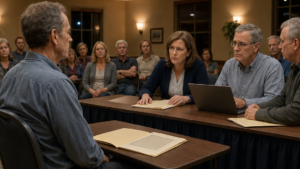
Angela began the emergency hearing by placing six color photographs on the clubhouse table.
Cardboard boxes on Justin’s porch.
A delivery van at the curb.
An air hose stretched across the garage floor.
The coupe with its hood open.
A municipal work shirt hanging near the side door.
A stack of tires beside the wall.
“These images document repeated automotive activity inconsistent with ordinary residential use,” she said.
The folding chairs behind Justin shifted as residents leaned to see.
Charles Campbell sat at the center of the table with the property manager on one side and two board members on the other. Betty occupied a chair near the aisle, her manila folder on her lap.
Justin sat alone at the front.
The ignition key pressed against his thigh inside his pocket.
Angela tapped the photograph of the boxes. “There were at least nine automotive deliveries during the last six weeks.”
“They were parts for one vehicle,” Justin said.
“You will have time to respond.”
“You asked what they were.”
Charles raised one hand. “Let her finish.”
Justin leaned back.
Angela continued in the same measured tone she used when reading landscaping violations. “Residents reported impact-tool noise, engine activity, and frequent mechanical work. The association’s insurer has repeatedly advised us to limit residential commercial activity involving fuel, batteries, welding, or vehicle lifting.”
The property manager looked down at her tablet.
Angela placed another paper on the table. “Three years ago, a garage fire in the western section of the subdivision caused significant damage to two homes. The source was an improperly stored fuel container used during vehicle repair.”
A murmur moved through the room.
Justin remembered the fire. Everyone did. Smoke had been visible above the roofs. One family lived in a hotel for months.
Angela looked directly at him.
“I will not apologize for taking fire and liability risk seriously.”
For the first time, Justin saw more than authority in her posture. Her left hand remained flat against the table as though holding it steady.
Charles asked, “Was Mr. Rivera observed storing fuel improperly?”
“No.”
“Welding?”
“No documented welding.”
“Servicing other residents’ vehicles?”
“Not directly observed.”
One board member frowned. “Then what establishes commercial activity?”
“The volume, equipment, and repeated work pattern.”
Justin removed a folder from his bag.
“My municipal job explains the shirts. The tires belong to this car. Every receipt matches a part installed on this car. I have no business license, customer invoices, advertisements, payment records, or customer vehicles because there is no business.”
He passed copies to the board.
Angela turned toward him. “Absence of invoices does not prove absence of payment.”
“No. But an accusation should require more than boxes on a porch.”
Several residents murmured agreement.
Angela’s expression tightened. “You also declined multiple attempts to inspect.”
“I ignored notices. That was wrong.”
The room quieted.
Justin had not planned to say it so early. He felt the key against his leg and left it there.
“The first notice asked me to contact management,” he continued. “The second offered an exterior inspection. I did not respond. I assumed the board had already decided what the car was, so I treated every request as harassment. That made the record worse.”
Angela watched him closely, perhaps expecting him to add a justification.
He did not.
Charles asked, “Why did you refuse the later inspection?”
“Because it included access to my garage and photographs of personal property beyond the vehicle. I should have proposed narrower conditions instead of saying no.”
The property manager spoke for the first time. “A narrower inspection was proposed internally.”
Angela turned toward her.
Betty stood.
“I have that proposal.”
She walked to the front before anyone invited her and handed copies to Charles and the two board members. Angela did not reach for one.
Charles read the first page, then the reply beneath it.
His face changed slowly.
“Angela,” he said, “this recommendation would have allowed exterior access, document review, and a supervised engine start.”
“I believed it was inadequate.”
“You told the manager you would contact Mr. Rivera.”
“I intended to.”
“The reply says immediate compliance was necessary to preserve board authority.”
Angela’s chin lifted. “Because he had publicly challenged enforcement and refused every request. If we allowed him to dictate the inspection after months of noncompliance, other residents would assume deadlines were optional.”
Betty remained standing. “So this became about authority.”
“It became about consistent enforcement.”
“You withheld a compliant option.”
“I rejected an option I did not believe would protect the association.”
Charles placed the paper flat on the table. “Did you tell the rest of the board?”
“No.”
“Did you tell me before arranging the tow?”
“I sent the enforcement summary.”
“That summary did not mention this proposal.”
Angela’s hand remained pressed to the table.
The room had turned against her, but she did not collapse into apology. Instead she looked toward the residents behind Justin.
“You all want this reduced to an ugly car and a difficult neighbor,” she said. “But when something happens, you ask why the board failed to act. You ask why no one enforced the rules. You ask why insurance costs increase.”
Her voice had sharpened, though it did not rise.
“I stood in the street during that garage fire. I watched flames reach the next roof while people waited to learn whether their homes were gone. The insurer told us afterward that informal repair activity creates unreported risk. Since then, every time I see fuel lines, batteries, or a vehicle on stands, I see that roof burning.”
No one spoke.
Justin understood her fear.
He also understood what she had done with it.
“You could have asked to see the extinguisher,” he said. “You could have checked the fuel storage. You could have used the inspection your manager proposed.”
Angela faced him. “And you could have answered the first letter.”
“Yes.”
The answer stopped her.
Justin continued. “My silence made this worse. Your fear did too. But only one of us signed a tow order before the agreed inspection.”
Charles looked at the property manager. “Was the vehicle ever technically classified as abandoned under the covenant?”
“No,” she said. “It was registered, insured, and owned by the resident. The enforceable question was visible inoperability, not abandonment.”
“And commercial activity?”
“Evidence is insufficient at this stage.”
One board member removed her glasses. “Then the tow authorization bypassed review and used an unsupported classification.”
Angela’s face went pale.
Charles turned toward Justin. “That does not eliminate your violations. You failed to respond to notices. The vehicle remained visibly incomplete beyond the allowed period. The board still needs a safety determination.”
“I understand.”
“Do you?”
Justin placed his repair log on the table. “The brake installation is finished. The engine and electrical systems passed functional checks. I am requesting a complete inspection by an independent qualified inspector within forty-eight hours. I will pay for it.”
Angela looked at him with open suspicion. “And if it fails?”
“I correct the failed item.”
“Not dismantle everything?”
Justin thought of the duplicate module, the reopened brake drums, and Dennis’s note.
“No.”
The word required more effort than starting the engine had.
Charles conferred quietly with the board members. The residents shifted in their chairs. Betty returned to her seat.
After several minutes, Charles announced the decision.
The tow order was suspended. The commercial-activity allegation would remain open pending inspection and document review. Daily fines would pause but not disappear. If the car failed to meet safety and active-restoration conditions, enforcement could resume.
Angela gathered her photographs.
Charles stopped her.
“The board will also review the authorization process.”
Her hands froze on the stack.
“Are you removing me from compliance?”
“Not tonight. But no unilateral towing actions will occur until review is complete.”
Angela placed the photographs into her folder one at a time.
Justin watched her and felt no triumph. She had bent a rule because she feared losing control. He had ignored rules because he feared being seen. Neither motive erased the damage that followed.
Outside the clubhouse, Betty caught up with him.
“You did not mention Dennis.”
“He was not relevant to whether the car is safe.”
“He is relevant to why you kept it unfinished.”
“That is not the board’s business.”
Betty considered him. “Maybe not. But it is yours.”
Justin reached into his pocket and closed his fingers around the key.
Across the parking lot, Angela stood beside her car, speaking with Charles. Her shoulders looked smaller without the table in front of her.
The property manager approached Justin with an inspection form.
“Thursday morning,” she said. “Eight o’clock. Independent inspector. Full mechanical and safety review within the scope of storage and operation.”
Justin signed.
At the bottom of the page was a line labeled OWNER ACKNOWLEDGMENT.
He read it twice.
By signing, the owner agreed to accept documented findings and correct only identified deficiencies before further operation.
Justin’s pen hovered.
Then he wrote his name.
Chapter 6: The Final Inspection Required More Than an Engine
The inspector set his clipboard on the coupe’s roof and asked, “If I find one failed item, are you prepared to leave the rest of the car alone?”
Justin looked at him.
It was 8:06 Thursday morning. The garage door stood fully open. Every tool had been returned to its drawer. The workbench held only the repair log, receipts, registration, insurance documents, extinguisher, and Dennis’s notebook turned facedown.
Angela stood near the sidewalk with Charles and the property manager.
Betty watched from her porch.
“I am prepared to correct the failed item,” Justin said.
“That was not my question.”
The inspector was in his fifties, compact and unsentimental, with a flashlight clipped to his belt. He had already reviewed Justin’s municipal credentials and made clear they did not exempt him from anything.
Justin glanced at the closed tool chest.
“Yes,” he said. “I can leave the rest alone.”
“Good. Start with documentation.”
For the next half hour, the inspector matched receipts to installed components and repair-log entries. He verified the registration and insurance. He photographed the vehicle identification number and checked the garage for fuel containers, open solvents, welding cylinders, customer signage, and evidence of other vehicle work.
He found none.
The boxes Angela had photographed were flattened against the recycling wall, each shipping label corresponding to an entry in Justin’s log.
“No commercial indicators,” the inspector said.
The property manager entered the finding into her tablet.
Angela’s expression did not change.
The mechanical inspection began with the car cold.
Justin opened the hood. The inspector checked fuel connections, battery restraint, wiring protection, belt alignment, fluid levels, and the clean tray beneath the engine.
“Turn the key,” he said.
Justin sat behind the wheel.
The brass key slid into the ignition without resistance.
He did not pause.
The gauges illuminated, the starter turned, and the engine caught on the second rotation. Its idle settled evenly through the temporary exhaust extension.
The inspector watched the oil-pressure gauge, tested the charging voltage, and checked for leaks. Then he signaled for Justin to shut it down.
“Engine operation passes.”
The sentence was plain, almost disappointing in its lack of ceremony.
Justin removed the key.
The inspector moved to the braking system. He checked the reservoir, lines, flexible hoses, pedal travel, parking brake, and drum adjustment. The coupe was lowered from its stands and positioned for a controlled test along the flat stretch of subdivision street in front of Justin’s house.
The inspector sat in the passenger seat.
Justin gripped the wheel.
“Ten miles an hour,” the inspector said. “Straight-line stop at the marker.”
Justin eased the car forward.
For the first time, all four tires rolled beneath engine power.
The movement was so gentle that the hanging garage-door pull cord barely swayed as they passed beneath it. Neighbors stood at a distance, quieter than they had been during the tow confrontation.
At the marker, Justin pressed the brake pedal.
The coupe stopped straight.
The inspector made a note.
“Again. Fifteen.”
On the second stop, the car drifted slightly right.
Justin felt it before the inspector spoke.
“Right front is engaging early.”
“I can adjust it.”
“One adjustment.”
Justin returned the car to the driveway and raised the right front corner. He removed the wheel and reached for the drum.
The inspector stopped him. “External adjuster.”
“I need to inspect the shoe contact.”
“You need to correct the documented pull.”
“The drum could be—”
“The drum measurement is in your log and within specification.”
Justin stared at the wheel assembly.
A familiar urge moved through him: remove the drum, inspect the shoes, remeasure the cylinder, compare spring tension, open the other side for symmetry.
His hand tightened around the wrench.
On the workbench, Dennis’s notebook rested beneath the garage light.
Stop correcting what already works.
Justin inserted the adjuster tool and moved the star wheel two clicks.
“Test it,” he said.
The third stop was straight.
The inspector repeated it at twenty miles an hour, then tested the parking brake on the driveway incline.
“Braking system passes after minor adjustment.”
Justin lowered the car.
His hands felt unoccupied.
The inspector continued through lights, horn, steering play, tire condition, mirrors, seat belts, exhaust routing, and fluid containment. Two items failed: a rear marker light and a loose battery-cover fastener.
Justin replaced the bulb and tightened the fastener.
Nothing else.
By 10:17, the inspector signed the final sheet.
SAFE FOR CONTROLLED OPERATION. ACTIVE NONCOMMERCIAL RESTORATION. NO EVIDENCE OF ABANDONMENT OR COMMERCIAL REPAIR ACTIVITY.
The property manager read the findings aloud.
Charles turned to Angela. “The abandoned-vehicle classification is withdrawn. The commercial-activity allegation is closed.”
Angela looked at the car, not at Justin.
“It was visibly incomplete,” she said.
“Yes,” Charles replied. “But it did not meet the covenant definition used in the tow order.”
She drew a slow breath.
“The order should not have called it abandoned.”
It was not an apology.
It was enough to put the truth into the record.
Charles handed Justin a revised compliance letter. The towing charge and daily fines after the disputed authorization were rescinded. A smaller administrative fine remained for failure to respond to the original notices.
Justin read the amount.
“You can appeal it,” Charles said.
“No.”
Angela finally looked at him.
Justin folded the letter. “I ignored valid requests before the process became improper. I will pay that part.”
The inspector closed his toolbox.
Charles seemed almost relieved, but Justin did not mistake the outcome for friendship or complete repair. The board would review Angela’s authority. A new restoration policy would be drafted. None of it would change the weeks of accusation or the fact that Justin had helped create the space in which they grew.
The property manager asked him to sign the inspection record.
He did.
Angela gathered her folder and stepped toward the sidewalk.
“Mr. Rivera,” she said.
Justin waited.
“If you conduct future restoration work, the new policy will require advance notice.”
“Then I will give it.”
Her eyes moved to the open garage, the extinguisher, the organized receipts, and the coupe idling cleanly in the driveway.
For a moment it seemed she might say more.
She did not.
After everyone left, Betty crossed the street.
“Well?” she asked.
Justin held up the inspection sheet.
“I saw.”
“Then why ask?”
“I wanted to hear how you would say it.”
He looked at the car.
“It passed.”
Betty smiled. “That sounded almost convincing.”
Justin opened the garage and carried the repair log to the workbench. He could have spent the afternoon polishing the paint, aligning the grille, or replacing the cracked steering wheel. There were still dozens of imperfections.
Instead he closed the tool chest.
The metallic click settled through the garage.
He picked up Dennis’s notebook and the worn key.
Then he opened the passenger door.
The seat had been cleaned but not reupholstered. A shallow split remained near the edge where Dennis’s work pants had caught for years. Justin placed the notebook there and secured it beneath the lap belt.
He stood outside the car for a moment, looking at the empty seat.
The inspection had answered every question the board was entitled to ask.
One question remained that no form could settle.
Justin walked around to the driver’s side, opened the door, and put the key into the ignition.
Chapter 7: The Car Left the Driveway Without Erasing Anyone
The neighbors were already outside when Justin pressed the garage-door button.
The door rose slowly, its rollers carrying the sound down the quiet street. No tow truck waited at the curb this time. No clipboard appeared beside the windshield. Still, people stood on porches, paused beside mailboxes, or lingered near parked cars with the careful posture of residents pretending they had not gathered to watch.
The coupe emerged inch by inch beneath the lifting door.
Its paint remained blue.
Justin had polished the original finish until the color deepened, but he had not repainted it. Scratches still crossed the lower doors. A pale patch remained near the rear fender where years of sun had worked through the clear coat. The chrome was clean without being flawless.
Dennis had chosen that blue before they brought the car home.
Justin had found the reason the previous night in the back of the repair notebook.
Blue stays honest, Dennis had written beside the original paint code. A car this old should look used. Otherwise someone will be afraid to drive it.
The notebook now rested on the passenger seat beneath the lap belt.
Justin stopped the car just beyond the garage threshold and set the parking brake. The engine idled in a steady low rhythm. He had checked the fluids once that morning and had not checked them again.
Betty stood near her driveway in a navy sweater, holding a travel mug.
“You are late,” she called.
Justin looked at the dashboard clock. “By three minutes.”
“Your father would have called that early.”
“He would have been wrong.”
Betty smiled.
Charles Campbell approached from the sidewalk with a white envelope. He wore jeans instead of the button-down shirt he favored at meetings.
“The board completed its vote last night,” he said.
Justin shut off the engine.
Charles handed him the envelope.
Inside was a formal withdrawal of the abandoned-vehicle and commercial-repair violations. The remaining administrative fine had been reduced to the amount discussed at the inspection. A second page summarized a new restoration-project policy requiring advance notice, current vehicle documents, controlled work hours, fluid containment, and exterior safety inspections by appointment.
It was stricter than the old informal exception.
It was also clear.
“No garage access without owner consent or a separate legal basis,” Justin read.
Charles nodded. “Betty insisted on that sentence.”
From across the street, Betty lifted her mug.
“And the towing procedure?” Justin asked.
“Two board approvals and management confirmation before dispatch.”
Justin folded the letter.
Charles looked toward the coupe. “You taking it far?”
“Far enough.”
“That sounds specific.”
“It is.”
Charles seemed ready to say something about the hearing or his own delay in reviewing Angela’s actions. Instead he offered a small nod.
“We should have looked closer sooner.”
Justin met his eyes. “I should have answered sooner.”
Neither statement repaired the weeks behind them.
Together they made the morning easier to stand inside.
Angela emerged from her house carrying another envelope.
The watching neighbors grew quieter.
She crossed the lawn rather than following the sidewalk. Her expression held none of the authority she wore at meetings, but neither did it hold apology.
She stopped at the edge of Justin’s driveway.
“This is your copy of the withdrawn notice,” she said.
Charles glanced at the envelope in Justin’s hand. “I already gave him the board decision.”
“This one is from compliance.”
Justin accepted it.
Across the top, the word WITHDRAWN had been stamped in blue ink over the commercial-repair allegation. Angela’s initials appeared beside the date.
“Thank you,” he said.
Her gaze moved over the car.
“It looks different.”
“It is cleaner.”
“I meant from before.”
“It runs now.”
Angela folded her arms, then seemed to notice the gesture and lowered them.
“Do you plan to keep repairing cars in the driveway?”
The question drew attention from the porches.
Justin could have heard it as another threat. A week earlier, he would have.
“Not as a business,” he said. “If I take on another restoration, I will file notice under the new policy.”
Angela looked toward Charles.
“The policy is not an invitation to turn the street into a workshop.”
“No,” Justin said. “It is a way to tell the difference between a project and a nuisance.”
Her mouth tightened at the echo of their dispute.
Then she looked past him into the garage. The floor was clear. The extinguisher remained mounted near the door. No boxes blocked the wall. The tool chest was closed.
“I still think the board was right to ask questions,” she said.
“So do I.”
That unsettled her more than an argument might have.
Justin continued. “I think you were wrong to decide the answers before the inspection.”
Angela held his gaze.
“Yes,” she said finally. “The tow order should not have been issued when it was.”
It was more than she had said during the inspection and less than an apology.
Justin did not ask for another sentence.
Angela stepped back from the driveway.
The engine had cooled enough that the exhaust no longer ticked. Justin opened the driver’s door.
Betty approached before he could get in.
“Are you taking the notebook?”
“It is on the passenger seat.”
“Dennis would complain about that.”
“He complained about everything placed on seats.”
“He said paper corners damaged vinyl.”
“He also kept loose screws in his pockets.”
Betty glanced through the passenger window at the worn notebook beneath the belt.
“Are you coming back with it?” she asked.
Justin understood what she meant.
“Yes.”
The answer came without effort.
He got behind the wheel and turned the key.
The engine started cleanly.
This time no one looked surprised.
He released the parking brake and eased into the street. The coupe moved past Betty, Charles, and Angela, then continued between the houses where the dispute had grown large enough to define him.
Children on bicycles waited at the corner. A man washing a pickup raised one hand. The woman two houses down stood with her phone lowered at her side rather than pointed at the car.
Justin kept both hands light on the wheel.
At the subdivision’s east gate, the road divided.
The left turn led toward the municipal shops and the parts store. He had driven that route nearly every day in his truck.
The right turn led beyond the neighborhood, past a row of warehouses and up toward an old municipal overlook above the river.
Dennis had wanted the first drive to go there.
Justin turned right.
The car gathered speed without strain. The steering carried a little play at center, exactly as the inspector had documented. Wind entered through a weak seal near the passenger window. The dashboard vibrated over rough pavement.
Each imperfection announced itself.
Justin did not turn around.
At a red light, the notebook shifted beneath the lap belt. He reached across and steadied it.
For months he had believed the unfinished car kept Dennis near. Every removed part created another Saturday in the garage, another problem that could still be discussed in his father’s language. Torque. Clearance. Timing. Pressure.
Completion had seemed like an ending.
But the garage had held only the parts Dennis had touched. The road held the choice Dennis had asked Justin to make.
The light changed.
Justin drove on.
The overlook was empty except for a city maintenance vehicle parked near the far fence. He pulled into a space facing the river and shut off the engine.
For several seconds, he did not move.
Then he took Dennis’s notebook from beneath the belt and opened it to the page with the paint code.
Blue stays honest.
Beneath it, in smaller writing, Dennis had added another line.
Finish it, drive it, then find something else worth doing.
Justin read the sentence twice.
He had seen the first line before. The second had been hidden beneath a grease-darkened receipt tucked into the fold.
A laugh escaped him, brief and uneven.
Even at the end, Dennis had left an instruction against turning memory into a shrine.
Justin closed the notebook.
The river below moved between concrete banks, carrying leaves and reflected light beyond the industrial district. Traffic crossed the bridge in the distance. Nothing in the view asked him to say goodbye.
He rested the ignition key in his palm.
The blue tape around its cracked head was worn smooth now. He had thought of replacing it. A new key would have been stronger, cleaner, easier to trust.
He kept the old one.
Not because the car could not move without it. A locksmith could cut another in minutes.
He kept it because it had opened something, and because opening was different from holding shut.
Justin started the engine again.
On the return drive, he did not take the shortest route. He followed the river road, crossed beneath the bridge, and let the coupe settle into the speed Dennis had once called the place where old engines told the truth.
The gauges held steady.
When Justin reached the subdivision, the porches were empty again. Ordinary Saturday sounds had returned: a lawn mower, a basketball striking pavement, a screen door closing.
Angela’s house stood quiet.
Betty had left a paper cup on Justin’s workbench with a note beneath it.
For the driver. Not the mechanic.
Justin parked inside the garage rather than stopping in the driveway.
He removed Dennis’s notebook from the passenger seat and set it on the shelf above the closed tool chest. Then he turned off the engine and pulled the key free.
For a moment he stood between the car and the open street.
He had expected the completed drive to feel like losing his father for a second time.
Instead it felt like bringing back only what could still move with him.
Justin pressed the wall button.
The garage door began to descend, but before it reached the ground, he stepped beneath it and stopped the motion.
He raised it again.
The blue car remained visible from the street, no longer unfinished and no longer hidden.
Justin placed the worn key in his pocket and walked into the house, leaving the garage door open behind him.
The story has ended.