Every Evening He Put a Chair by the Curb Until the HOA Tried to Take It Away
Chapter 1: The Chair Appeared at Three Forty-Two
The red notice was already taped to Robert Miller’s chair when he carried it out of the garage.
It hung from the top slat like a warning flag, its plastic sleeve flashing in the afternoon sun. Robert stopped halfway down the driveway, one hand gripping the worn wooden backrest and the other supporting the seat. He had sanded that chair twice in twenty years. He knew every split in its grain. He also knew he had left it inside the garage that morning.
Someone had entered far enough to attach the notice.
He set the chair down and removed his reading glasses from his shirt pocket.
PROPERTY VIOLATION.
The words were printed larger than the explanation beneath them.
Robert read the paragraphs once, then again. Personal furniture could not remain near a sidewalk, curb, common access route, or other area visible from the street. The chair allegedly created an obstruction, diminished uniform appearance, and exposed the association to liability.
He looked toward the sidewalk.
The chair was still thirty inches inside his driveway, where it had stood every weekday afternoon since Anna began third grade. It had never touched the concrete path.
His watch read 3:31.
Robert peeled the notice from the chair, folded it twice, and slid it into his pocket. Then he carried the chair toward its usual place.
Across the street, a blind shifted.
Daniel Rivera was in his yard trimming a hedge that did not need trimming. He watched Robert position the chair at the left edge of the driveway, just beyond the shadow of the mailbox.
“You got company,” Daniel said.
Robert did not have to turn around.
Cynthia Wright approached with a folder held flat against her beige jacket. She walked with the measured pace she used at board meetings, as though every sidewalk were a corridor and every conversation already had minutes.
“Mr. Miller.”
“Cynthia.”
“I see you received the notice.”
“I found it.”
Her gaze moved to the chair. “Then you understand it needs to be removed.”
Robert checked its legs. All four rested on his property.
“It gets removed every afternoon.”
“That isn’t what the rule means.”
“It’s there for twelve minutes.”
“Duration doesn’t eliminate the obstruction.”
“Obstruction to what?”
Cynthia pointed toward the sidewalk, though the chair was not on it. “Pedestrian movement. Sightlines. General access.”
“A person could drive a riding mower between this chair and that sidewalk.”
“That isn’t the standard.”
Robert sat.
The chair creaked beneath him. He rested his hands on his knees and looked toward the neighborhood entrance, where the road curved behind a row of ornamental pear trees.
Cynthia remained standing.
“Who are you waiting for?” she asked.
Robert’s thumb moved once across the edge of his watch.
“That isn’t part of your rule.”
“It may be relevant to an accommodation.”
“Then tell me the accommodation process.”
Her mouth tightened slightly. “We can discuss reasonable alternatives.”
“After I tell you who I’m waiting for?”
“I’m trying to understand the purpose.”
“You issued the violation before you understood it.”
From across the street came the soft click of Daniel’s shears closing on empty air.
Cynthia looked toward him. “Mr. Rivera, do you know why he does this?”
Daniel leaned one elbow on the hedge trimmer. “You’ll see.”
“I would prefer a direct answer.”
“So would most people,” Daniel said. “But sometimes the answer comes down the road.”
Robert almost smiled, but his watch read 3:38.
A landscaping truck turned into the neighborhood and briefly blocked his view of the entrance. He leaned forward until it passed.
Cynthia noticed.
“You could wait on your porch,” she said. “It would resolve this immediately.”
“No.”
“You would still be outside.”
“No.”
“You would still be able to greet whoever you’re waiting for.”
Robert looked back at the porch. Two boxwoods rose on either side of the steps. Beyond them, a delivery van was parked along the curb. From the porch, the entrance road vanished behind the neighbor’s magnolia and a line of vehicles.
“No,” he repeated.
Cynthia opened her folder. “Refusal to comply after written notice may result in a hearing and fine.”
“Then schedule one.”
“That seems unnecessary.”
“It seemed unnecessary when somebody came into my garage.”
Her face changed. Not much, but enough.
“The property manager attached the notice to an item visible from the driveway.”
“The chair was behind a closed door.”
“I’ll look into that.”
Robert turned his attention back to the road.
At 3:41, the distant diesel engine became audible.
Daniel set down the hedge trimmer.
A yellow school bus appeared beyond the pear trees, its roof bright above the parked cars. Robert’s shoulders lowered by a fraction. He shifted the chair two inches—not toward the sidewalk, but toward the open angle between the mailbox and the magnolia.
Cynthia glanced from him to the bus.
The vehicle stopped with a sigh of brakes. Red lights began flashing. The folding door opened.
Anna Miller appeared on the steps in a purple backpack nearly as wide as her shoulders. Her eyes moved first to the mailbox, then to the left edge of the driveway.
She saw Robert.
Her face opened.
“Grandpa!”
She came down the steps quickly, paused for the driver’s signal, then crossed in front of the bus and ran the last stretch up the driveway.
Robert rose before she reached him. She struck him at the waist with enough force to move him half a step. He folded both arms around her.
“You’re early,” he said.
“By one minute.”
“Unacceptable.”
She laughed into his shirt.
Cynthia stood a few feet away, the open folder lowered at her side.
Anna noticed her. “Hi, Ms. Wright.”
“Hello, Anna.”
“Are you having a meeting?”
“Something like that.”
Anna removed one arm from Robert and touched the chair. “Grandpa, can I sit for a second? My backpack weighs a million pounds.”
“You said that yesterday.”
“It gained weight.”
Robert lifted the backpack from her shoulders and set it on the chair. Anna rolled her neck, then reached for his hand.
Cynthia watched the movement. For a moment, her expression lost its official arrangement.
Then she closed the folder.
“The purpose doesn’t change the location,” she said.
Robert looked at her.
“You just watched a child use it.”
“I watched a child arrive safely. That can happen from the porch.”
Anna’s fingers tightened around his.
Robert did not answer immediately. He could have told Cynthia that Anna looked for this exact spot before her feet touched the first bus step. He could have said that visible meant more than present. He could have explained that some promises were built around where a person stood, not merely whether that person was nearby.
But the explanation belonged to Anna too.
He picked up the backpack and handed it to her.
“Go wash up,” he said. “There are apple slices in the refrigerator.”
“Are you coming?”
“In a minute.”
Anna looked from him to Cynthia, then walked toward the house.
Cynthia removed a second sheet from the folder. “I’ll note that you declined voluntary correction.”
Robert took the page without looking at it.
“You do that.”
“Friday evening. Six-thirty. Association clubhouse.”
“A hearing?”
“A violation hearing.”
He unfolded the sheet after she left.
At the bottom, beneath the date and location, a line stated that failure to correct the condition before the hearing could result in continuing fines and removal of the offending property.
Robert looked at the chair.
Then he looked toward the porch, where Anna had stopped at the door to make sure he was following.
He lifted the chair and carried it inside.
Chapter 2: The Rule That Looked Reasonable
The photographs on Cynthia Wright’s desk showed a child’s bicycle twisted beneath a hedge.
One wheel lay flat against the sidewalk. A folding table leaned against a mailbox. In another photograph, orange extension cords crossed a walkway beneath a row of temporary decorations. The final image showed an ambulance at the curb.
The pictures were four years old and came from a community where Cynthia had served as board secretary. The lawsuit had outlasted the decorations, the bicycle, and nearly every member of that board.
She closed the file when the property manager entered.
“Robert Miller’s response came in,” he said.
“He filed one?”
“He wrote two words on the compliance form.”
Cynthia held out her hand.
The form read: CHAIR REMOVED DAILY.
Below it, Robert had written: Define obstruction.
The property manager gave a dry laugh. Cynthia did not.
“Did you enter his garage yesterday?”
The man hesitated. “The door was up.”
“Fully?”
“Enough to see the chair.”
“That wasn’t my question.”
He shifted the tablet under his arm. “I attached the notice where he would find it.”
“You should have used the front door.”
“I thought the object was the issue.”
“The process is the issue.”
He looked surprised, perhaps because she had said it sharply.
Cynthia opened the governing documents. The rule had been written after several residents left sports equipment, furniture, and landscaping materials beside sidewalks. It did not mention temporary supervised use. It did not define how long an object had to remain before it became storage.
Ambiguity created arguments. Exceptions created more.
At noon she called Robert.
“I have a possible resolution,” she said.
“I’m listening.”
“Move the chair to the porch. No fine will be recommended if you begin today.”
Silence.
“It remains on your property,” she continued. “You can greet Anna from there, and the board avoids setting a curbside-furniture precedent.”
“You know her name now.”
“I saw her yesterday.”
“You also saw the chair wasn’t blocking anyone.”
“I saw the purpose. The location is separate.”
“Come at three-thirty.”
“For what?”
“To see your solution.”
She almost declined. Then she looked at the old bicycle photographs.
“I’ll be there.”
At 3:32, Robert’s chair stood on his porch between the front door and a ceramic planter. He sat in it with his wristwatch visible beneath his cuff.
Cynthia remained near the walkway. Daniel Rivera stood at the end of his own driveway, arms folded.
“From where you’re sitting,” Cynthia said, “you’re safely inside your property line.”
“I was inside it yesterday.”
“You’re away from pedestrian traffic.”
“So was I yesterday.”
She chose not to answer.
At 3:37, a delivery van parked across from Robert’s house. Its tall white body blocked part of the street. Two cars were already stationed along the curb, one beneath the magnolia and one near the corner.
Robert pointed toward the entrance. “Tell me when you see the bus.”
Cynthia stepped beside the porch column.
The pear trees hid the first section of road. The van concealed the rest.
She heard the engine before she saw yellow reflected in the neighbor’s windshield.
“Now,” she said.
“It passed the entrance eight seconds ago.”
“That doesn’t seem significant.”
Robert did not respond.
The bus slowed near the stop. From the porch, the lower half disappeared behind the van. When the door opened, Anna was briefly invisible.
Then her head appeared through the bus window.
She was looking toward the driveway.
Not the porch.
Her gaze moved across the empty place beside the mailbox. Once. Then again.
Robert stood.
“Anna,” he called.
She did not hear through the bus glass and engine noise.
The door opened. Anna descended more slowly than she had the day before. Her hand remained on the rail as she leaned forward, searching the curb.
The driver said something to her.
Only then did she look toward the porch and see Robert waving.
Her shoulders dropped, but she did not run. She crossed after the driver signaled, walked up the driveway, and stopped at the empty place where the chair usually stood.
“Why were you up there?” she asked.
“Trying something.”
“You’re supposed to be here.”
“I was right there.”
“But I couldn’t see you.”
Cynthia felt the words land before Robert looked at her.
Anna turned toward the porch. “Was this about the meeting?”
“No,” Robert said too quickly.
Daniel crossed the street.
“Bus comes in from the southwest,” he told Cynthia. “Afternoon glare hits those windows. A child looking out the right side gets maybe three seconds to find somebody before the vanishing point.”
“You timed it?” she asked.
“Drove that route eleven years.”
Cynthia studied the curb and porch as though the angle might change if examined long enough.
“We could require him to stand at the driveway instead of using furniture,” she said.
Daniel looked at Robert’s knees.
Robert said, “I can stand.”
Anna looked up at him. “Not for long.”
“I can stand long enough.”
She did not seem reassured.
Cynthia’s phone vibrated. A message from the property manager appeared with an attached complaint.
RESIDENT APPEARS TO BE STAGING DAILY CONFRONTATIONS TO EMBARRASS THE BOARD. CHILDREN PRESENT. PLEASE ADDRESS ESCALATING SPECTACLE.
The complaint was anonymous.
She read it twice.
Robert lifted the chair from the porch and carried it back toward the garage. His movement was controlled, but halfway down the steps his right knee caught. He stopped, shifted his weight, and continued before Anna could reach for him.
Cynthia saw it.
She also saw two residents watching from across the street.
By evening, the board had begun an email discussion. One member favored suspending action until the hearing. Another warned that visible noncompliance after notice would weaken future enforcement. The property manager recommended removal if the chair returned.
Cynthia typed that enforcement should remain consistent.
She did not mention Anna scanning the curb.
At 9:14 p.m., the board voted three to two to authorize removal after one additional violation.
Cynthia stared at the approval on her screen.
The rule looked reasonable in writing.
So did the porch.
Chapter 3: They Removed It Before the Bus Came
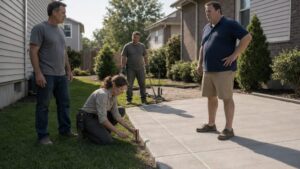
The maintenance cart was parked beside Robert’s driveway when he opened the garage.
His chair sat in the back beneath a gray moving blanket.
The property manager stood near the curb with a yellow tag in his hand. Cynthia was beside him, one arm folded across her waist.
Robert checked his watch.
3:34.
“You came early,” he said.
“The chair was placed in the restricted area again,” the manager replied.
“It was inside my garage.”
“It was outside when we documented it.”
Robert looked at Cynthia. “What time?”
She answered after a pause. “Three-twenty-seven.”
He had carried it out before going inside for his jacket. Seven minutes. The chair had stood empty in its usual place while he filled Anna’s water glass and set apple slices on a plate.
The yellow tag was looped through the back slat.
ABANDONED OR NONCOMPLIANT PERSONAL PROPERTY.
Robert stepped toward the cart.
The manager moved between them. “You can retrieve it after the hearing.”
“It isn’t abandoned.”
“The authorization permits temporary removal.”
“It was supervised.”
“You were inside.”
“For seven minutes.”
Cynthia’s voice remained low. “Robert, do not make this harder.”
He looked at her. “For whom?”
A garage door across the street rose halfway. Daniel emerged, wiping his hands on a cloth.
“What are you doing?” he asked.
“Enforcing the board’s decision,” Cynthia said.
Daniel looked at the chair. “At three-thirty?”
“The timing is coincidental.”
“No,” Robert said. “It isn’t.”
The manager began securing the moving blanket.
Robert’s hands curled once, then opened. He had spent thirty-four years around heavy machinery and men who believed volume was authority. He knew how quickly a physical obstruction could become an accusation.
He stepped back.
“Take it,” he said.
The property manager seemed relieved.
The cart’s electric motor whined as it rolled away. The chair’s legs disappeared around the corner, one worn foot protruding from beneath the blanket.
Robert stared at the empty patch of driveway.
3:38.
A pale rectangle remained where the chair had blocked the sun. Near its edge, one of the legs had left a shallow circular mark in the dust.
Daniel crossed over. “Use mine.”
“No.”
“I’ve got a folding chair.”
“No.”
“You can’t stand that long.”
“I don’t need to.”
Robert walked to the curb.
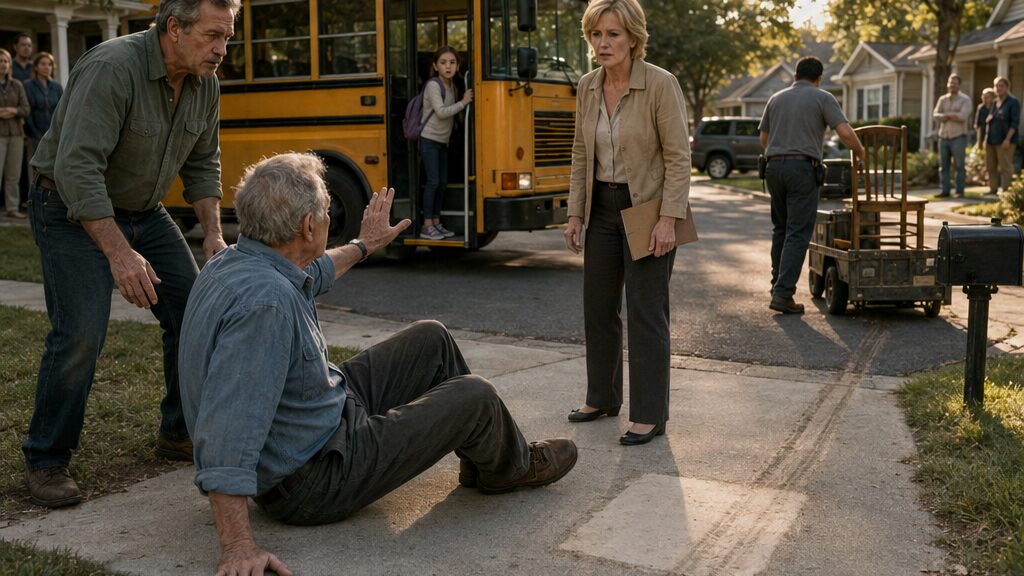
His right knee resisted before he reached it. He placed one hand on the mailbox post, turned carefully, and lowered himself onto the concrete gutter where the chair had faced the road.
Pain moved up his thigh in a clean, bright line.
Cynthia stepped forward. “You cannot sit in the street.”
“I’m not in the street.”
“You’re creating a worse hazard.”
“Then perhaps the chair was the reasonable option.”
A woman two houses down had come outside with her phone held low. Another neighbor stood near a stroller, watching without pretending not to.
Cynthia glanced at them.
“This doesn’t need to be a performance,” she said.
Robert rested his forearms on his knees. “Then stop performing.”
The words came out harder than he intended.
Cynthia’s face closed.
At 3:40, the road remained empty.
Robert felt the watch against his wrist like a second pulse.
He remembered the chair under his hands every afternoon: lift, turn, carry, set. A task small enough to repeat without thought. A promise translated into wood and time.
Daniel crouched beside him. “You want me to call Jennifer?”
“No.”
“She should know.”
“She’s working.”
“That stopped being the main problem five minutes ago.”
Robert looked toward the entrance.
“Not yet.”
At 3:41, the bus engine sounded beyond the trees.
The neighbors heard it too. Conversations stopped. The woman with the stroller turned toward the road. Cynthia remained near the driveway, her folder held against her side though there was no paper in her hands.
The yellow roof appeared.
Robert tried to rise.
His knee failed halfway.
Daniel caught his elbow.
“Stay down,” he said.
Robert pulled free, not in anger but from instinct. He could not let Anna see someone holding him up. He settled back onto the curb and lifted one hand.
The bus approached.
Through the glare of the windows, he could not see Anna clearly. The vehicle stopped. Brakes exhaled. Red lights flashed against the mailbox.
The door folded open.
Anna appeared at the top step.
Her eyes went immediately to the empty place.
She did not move.
The driver turned and spoke to her. Anna leaned farther out, looking toward the garage, then the porch. Her fingers tightened around the rail.
Robert raised his hand higher.
“Anna.”
The bus engine swallowed his voice.
She looked at the curb but seemed not to recognize him there. Her face changed—not into tears, not yet, but into a blank stillness that Robert knew too well.
The driver descended one step and followed Anna’s gaze.
Then she saw Robert.
She pointed.
Anna’s eyes found his raised hand.
Air seemed to return to her body all at once. She stepped down, but when her shoe reached the pavement she stopped again.
“Grandpa?”
“I’m here.”
“Why are you down there?”
“I’m all right.”
The driver waited beside her until she crossed. Anna walked quickly at first, then broke into a run. She dropped her backpack before reaching him and knelt on the driveway.
“You weren’t there.”
“I was right here.”
“You weren’t in the chair.”
“They moved it.”
She looked toward Cynthia.
Cynthia took one step closer. “Anna, no one was trying to upset you.”
Anna’s breathing shortened.
Robert saw it before anyone else did—the rigid shoulders, the small repeated swallow, the way her eyes jumped from the empty patch to the maintenance cart’s tracks and back again.
He reached for both her hands.
“Look at me.”
She did.
“I’m here.”
“You’re supposed to be there.”
“I know.”
“You said you would be.”
“I am.”
“That’s not there.”
Her voice cracked on the last word.
The neighbors became very quiet.
Robert shifted closer despite the pain in his knee. “Count with me.”
Anna shook her head.
“Four in,” he said. “Just like we practiced.”
She tried. The first breath caught. The second went deeper.
The bus driver remained at the curb, delaying the route.
Robert counted softly until Anna’s fingers stopped trembling inside his.
When she could stand, Daniel picked up her backpack. The driver asked Robert whether someone should be called.
“No,” he said. “Her mother is coming.”
He had not called Jennifer, but Daniel already had.
Cynthia stood near the mailbox, her face pale beneath its practiced composure.
“This reaction wasn’t disclosed,” she said.
Robert looked up at her from the curb.
“She is nine years old. She is not an exhibit for your board.”
“I didn’t say she was.”
“You asked for a reason as though you were entitled to every part of it.”
“We could have considered an accommodation.”
“You don’t have an accommodation process.”
Cynthia’s silence confirmed what he already suspected.
A car turned sharply into the neighborhood twenty minutes later and stopped half over the curb. Jennifer stepped out before the engine was off.
She crossed the lawn at a run.
Anna was seated on Robert’s front step by then, wrapped in Daniel’s light jacket. Robert stood near the garage, favoring his right leg. Cynthia and the property manager had left, though the yellow tag remained on the driveway where it had fallen.
Jennifer knelt in front of Anna.
“What happened?”
“They took Grandpa’s chair.”
Jennifer looked at Robert. “Why?”
“HOA violation.”
“I know that part. Why did she react like this?”
Robert glanced toward Anna.
Anna stared down at her shoes.
Jennifer stood. “Inside.”
In the kitchen, she shut the door harder than necessary. The apple slices remained untouched on the counter. A glass of water had gathered a ring beneath it.
Jennifer kept her voice low, but anger sharpened every word.
“I asked you Monday whether this was upsetting her.”
“You asked whether the argument was upsetting her.”
“Don’t do that.”
Robert leaned against the counter.
“What aren’t you telling me?”
He looked toward the hallway. Anna was in the living room with Daniel, close enough that a raised voice would carry.
“Not now.”
Jennifer’s eyes filled, though her expression did not soften. “You have been sitting at that curb for three years. You check your watch every thirty seconds. She sees an empty space and can’t get off a bus. This did not begin with an HOA notice.”
Robert said nothing.
Jennifer stepped closer.
“The first time you were late,” she said, “what happened?”
His hand moved instinctively toward his watch.
Jennifer saw it.
“What happened to my daughter that afternoon?”
Robert looked at the clock above the stove, then at the untouched chair visible through the open garage door—an empty place where the object should have been.
He had spent three years believing silence kept the worst moment contained.
Now Anna’s frightened breathing still seemed to fill the house.
Jennifer waited.
Robert removed his watch and placed it on the kitchen table.
Then he said, “Your mother collapsed before the bus arrived.”
Chapter 4: The Afternoon Nobody Came for Her
Jennifer stared at the watch on the kitchen table.
It was not the one Robert wore every afternoon. This one had a cracked leather band and a narrow silver face. Its hands had stopped at 3:47.
“Your mother collapsed before the bus arrived,” Robert said again.
The refrigerator hummed behind him. In the living room, Daniel spoke softly to Anna, keeping his voice low enough that the words blurred.
Jennifer picked up the watch. Dust had gathered beneath the buckle.
“When?”
“Three years ago. The Tuesday before Thanksgiving.”
“I remember Mom going to the hospital.”
“You remember me calling from the emergency room.”
Jennifer looked at him. “You said a neighbor met Anna.”
“A neighbor did. Eventually.”
The watch felt unexpectedly heavy in her palm.
Robert pulled out a chair but did not sit. “Your mother was in the laundry room. I heard the basket fall. When I got there, she was on the floor and couldn’t answer me.”
Jennifer’s expression tightened. “And Anna was on the bus.”
“I knew.”
“You knew what time it was?”
“I looked at this.” He nodded toward the watch. “Three thirty-nine.”
The memory seemed to alter his posture. His shoulders remained straight, but one hand flattened against the counter as though the floor had shifted.
“I called emergency services,” he continued. “Then I called you. It went to voicemail. I called the school transportation office. They transferred me twice.”
Jennifer remembered the voicemail. She had been in a conference room with her phone turned face down, defending a project schedule that no longer mattered.
“Why didn’t you tell the dispatcher about Anna?”
“I did. They sent someone to the bus stop.”
“But no one was there when she arrived.”
Robert’s eyes dropped to the stopped watch.
“The route was early.”
Jennifer closed her fingers around it.
The bus had reached the corner before anyone understood that Robert would not be standing beside the driveway. Anna had been six years old. The driver, seeing no authorized adult, kept her on board and radioed the transportation office.
That should have been the end of it.
It was not.
A substitute driver had been running the route. He had been told to continue and return Anna to school after completing the remaining stops. But road construction blocked the usual turn, and the bus sat for nearly twenty minutes on a side street while the driver waited for instructions.
Anna could see neither her house nor anyone she knew.
“She thought we had left her,” Robert said.
Jennifer flinched. “She told you that?”
“Not that day.”
“When?”
“Weeks later.”
“And you didn’t tell me?”
“You had just lost your mother.”
“That was my daughter.”
Robert’s jaw tightened. “And my granddaughter.”
The words struck hard enough to leave silence behind them.
Jennifer set the watch down.
“What happened when the bus came back?”
“The school counselor rode with her. Daniel was waiting here by then. I was at the hospital.”
“Mom was still alive.”
“Yes.”
“For two more days.”
“Yes.”
Jennifer pressed both palms to the edge of the table. She could see the timeline assembling itself now: her mother unconscious, Robert in an ambulance, Anna trapped on a rerouted bus, Jennifer driving toward the hospital with no idea that another crisis was unfolding behind her.
“Why didn’t anyone tell me how bad it was?”
“You were signing hospital forms.”
“That is not an answer.”
Robert pulled the kitchen chair out farther and finally sat. His right knee made him lower himself carefully.
“Anna stopped sleeping alone,” he said. “She asked whether every siren meant somebody in the family was dying. For two months, she wanted the bus driver to call the house before opening the door.”
Jennifer remembered the night-light. The sudden insistence on checking every locked door. The way Anna had asked for detailed pickup plans even for short trips.
They had called it grief.
Maybe some of it had been.
“What did you tell her?” Jennifer asked.
“That I would be there.”
“Every day?”
“Every day I was responsible for her.”
“And the chair?”
“My knee got worse. Standing became difficult. She needed to see me before the bus stopped, so I moved the chair nearer the road.”
Jennifer looked toward the front window. From the kitchen, only the top of the mailbox was visible.
“You made the whole thing a promise.”
“It was a promise.”
“No. You made it a rule.”
Robert looked up sharply.
“You check your watch every thirty seconds,” she said. “You won’t go to a doctor’s appointment after two because you might be late. You missed my work ceremony last spring.”
“That was downtown.”
“You said traffic could delay you.”
“It could have.”
“So could anything. A flat tire. A fall. Another ambulance.”
His face changed at the last word.
Jennifer lowered her voice. “You think being in that chair means the worst day cannot happen again.”
“I think she deserves to know someone is coming.”
“She does. But you never told her why you were late.”
Robert said nothing.
The realization came slowly.
“You let her think you chose not to be there.”
“I did not choose that.”
“But you never explained.”
“She was six.”
“She’s nine now.”
Robert rubbed the pale band of skin where his everyday watch usually rested. “There never seemed to be a good time.”
“No. There was never a time that felt good to you.”
The living room fell quiet.
Jennifer turned.
Anna stood in the kitchen doorway. Daniel was behind her, holding the jacket she had been wearing.
“How long have you been there?” Jennifer asked.
Anna looked at the old watch.
“Grandma fell down?”
Robert pushed his chair back. “Anna—”
“And that’s why you weren’t there?”
He stopped.
Jennifer glanced at him, waiting to see whether he would answer for Anna again.
Robert’s mouth opened, then closed.
“Yes,” he said at last. “That’s why.”
Anna entered the room. Her backpack was still zipped, one strap twisted beneath it.
“Did she die because you came to get me late?”
“No.” Robert stood too quickly and gripped the table. “No. I went with her in the ambulance. The doctors did everything they could.”
“Then why didn’t you tell me?”
“I thought you were too young.”
Anna looked at Jennifer. “Did Mom know?”
“No,” Jennifer said. “Not all of it.”
Anna turned back to Robert. “You promised because you thought I was scared.”
“You were scared.”
“I still get scared.”
His face tightened.
“But not because of the chair.”
Robert stared at her.
Anna pointed toward the window. “Today I thought something happened to you. The chair was gone. You were on the ground. Everybody was watching. Ms. Wright looked scared too.”
“I was not on the ground.”
“You were sitting in the street.”
“The curb.”
“That’s almost the street.”
Daniel quietly stepped back into the living room, leaving the family alone.
Robert reached for Anna’s hand. She let him take it, but she did not move closer.
“I will fix this,” he said.
Her fingers remained still inside his.
“That’s what you always say.”
The words were not angry. That made them worse.
Jennifer sat beside her. “What do you want, sweetheart?”
Anna looked toward the garage.
“I want Grandpa there.”
Robert breathed out.
“But I don’t want him fighting everybody because of me.”
“It isn’t because of you,” he said.
“It is. They took the chair because you said I need it.”
“I never told them that.”
“You told Mom. You told Mr. Daniel. Everybody keeps talking about what I need.”
Robert released her hand.
The old watch lay between them, its frozen hands marking an afternoon none of them had understood the same way.
Anna touched the cracked band with one finger.
“You keep thinking I need the promise you made when I was six,” she said. “But you never asked what I need now.”
Chapter 5: Anna Finally Chose Her Own Promise
“Would you still wait for me if I said I didn’t need you to?”
Anna asked the question before Robert had poured milk into her cereal.
Thursday morning had begun with three unopened HOA emails on Jennifer’s phone, a folded blanket on the couch where she had slept, and the empty space in the garage where the chair should have been.
Robert set down the carton.
“I would want to.”
“That’s not what I asked.”
Jennifer looked over the rim of her coffee cup but did not intervene.
Robert sat across from Anna. “Yes. I would still wait.”
“Why?”
“Because I like seeing you come home.”
Anna pushed one cereal square beneath the milk with her spoon. “That’s different.”
“From what?”
“From waiting because you think something bad will happen if you don’t.”
Robert’s gaze moved to his wrist. He had put on his everyday watch again, though he had checked it only once since waking.
“What do you think happens?” he asked.
Anna took time to answer.
“When nobody is where they said they would be, I think maybe there was an accident. Or they got sick. Or their phone is in a hospital bag and nobody knows the password.”
Jennifer’s hand tightened around her mug.
“I don’t think the chair stops that,” Anna continued. “It just lets me see you faster.”
The distinction landed with more force than any accusation Cynthia had made.
Robert leaned back. “Then what would help?”
Anna looked surprised that he had asked.
“A place I can see from the bus.”
“That is the chair.”
“It could be something that doesn’t move.”
Jennifer set down her coffee. “Like a bench?”
Anna nodded. “Inside the yard. Mr. Daniel said the bus window can see the left side better.”
Robert considered the strip of grass between the driveway and the front flower bed. It was inside his property line and clear of the sidewalk. A bench fixed there would not be temporary furniture.
“The board may still object,” he said.
“Then show them where it goes.”
“They are not interested in where it goes.”
Anna frowned. “Then why are you talking to them?”
Robert almost answered that some people cared more about winning than solving. He stopped before the words formed.
“To make them interested,” he said.
At school, the counselor met with Anna before class. Jennifer had arranged it after the previous afternoon, and Robert waited in the office lobby beneath a bulletin board covered with paper leaves.
When Anna emerged, she carried a small index card.
“What’s that?” he asked.
“A plan.”
She handed it to him.
On one side, in careful pencil, she had written:
FIRST: LOOK FOR GRANDPA OR MOM.
SECOND: ASK DRIVER TO CALL.
THIRD: GO BACK TO SCHOOL OFFICE.
On the other side were Jennifer’s number, Robert’s number, and Daniel’s.
Robert read it twice.
“You put Daniel before emergency services,” he said.
“He answers.”
A smile reached him before he could prevent it.
The counselor joined them. “Anna said you may have a meeting tomorrow.”
“Violation hearing.”
“She asked whether she had to speak.”
Robert looked at Anna. “No.”
“What if I want to?”
“You don’t owe them anything.”
“That wasn’t my question.”
He heard Jennifer’s voice in hers.
Robert folded the card carefully but did not pocket it. “You can decide later. And you can decide what I’m allowed to say.”
Anna studied his face to see whether he meant it.
“You can say I was scared when the bus came and you weren’t there,” she said. “You can say I like seeing you.”
“Anything else?”
“You can say the chair helps, but don’t tell them about Grandma.”
Robert felt resistance rise automatically. The full history would make the board understand. It would explain the watch, the exact time, the years of repetition.
It would also turn Anna’s worst afternoon into evidence.
“All right,” he said.
“And don’t say I have a condition.”
“I would not.”
“Ms. Wright said accommodation.”
“She did.”
“That sounds like something is wrong with me.”
Robert crouched so they were closer to eye level. “There is nothing wrong with you.”
“Then tell them the rule doesn’t work for everybody.”
He nodded.
At noon, Jennifer sent Cynthia a sketch of the proposed bench location. It showed the property line, sidewalk clearance, and sightline from the bus approach. Daniel had measured the angles. Robert had marked the dimensions.
Cynthia replied within nineteen minutes.
The proposed structure could not be approved informally while an active violation remained pending. Robert could request architectural review after the hearing, a process that might take thirty days.
Jennifer read the message aloud at Robert’s kitchen table.
“Thirty days,” she said.
“The bus comes today,” Robert replied.
“And tomorrow.”
He opened the association documents. For the first time, he was not searching for a sentence that would excuse his chair. He was searching for the absence of one.
There was no procedure for temporary functional exceptions. No standard for supervised objects. No definition of obstruction beyond “impeding customary use.” No route for a resident to request a safety-related modification without classifying it as an architectural change.
Daniel tapped the page. “They built a rule with one door and locked it from the inside.”
Robert looked at Anna’s index card beside the documents.
First. Second. Third.
A plan did not prevent bad things. It gave people choices when they happened.
At 3:35, Robert stood at the left edge of the driveway. No chair. No curb. Daniel waited across the street, and Jennifer had arranged to leave work early.
When the bus appeared, Anna found Robert immediately.
She stepped down, waited for the driver’s signal, and walked toward him rather than running.
“You saw me?” he asked.
“Yes.”
“From the turn?”
“After the white van.”
His knee began to ache before they reached the house.
Anna noticed. “The bench would be better.”
“It would.”
Inside, Robert removed the hearing notice from the refrigerator. At the bottom was a box marked REQUESTED RESOLUTION.
He had originally written: Return chair and dismiss violation.
He drew a line through it.
Jennifer watched over his shoulder. “What are you asking for?”
Robert wrote slowly.
Adopt a process for safe, functional exceptions available to all residents. Suspend removal authority until that process exists.
“That is bigger than your chair,” she said.
“It should have been bigger from the start.”
“And if they offer to return it?”
Robert glanced at Anna, who was placing her backpack on the clean rectangle of garage floor where the chair used to rest.
“Then I’ll tell them no.”
Chapter 6: The Hearing Was Never About Furniture
The chair stood beside the board table like a defendant.
The yellow removal tag still hung from its backrest. Someone had wiped dust from the seat but left the worn arms untouched.
Robert stopped inside the clubhouse door.
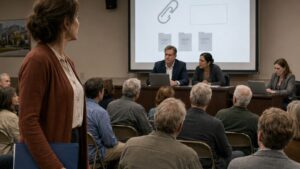
Cynthia sat at the center of the raised table with two board members beside her. The property manager occupied a smaller desk near the wall. Twelve folding chairs faced them, most already filled.
Jennifer sat in the second row. Daniel had chosen the aisle. Anna was at home with a neighborhood parent, by her own decision.
Cynthia tapped the microphone.
“This hearing concerns repeated placement of personal furniture near a sidewalk after formal notice.”
Robert looked at his chair.
“No,” he said. “It concerns what happened after you decided that was the only thing worth seeing.”
A few residents shifted. Cynthia’s expression remained composed.
“You’ll have an opportunity to speak.”
“I’m speaking now.”
One board member leaned toward the microphone. “Mr. Miller, please follow procedure.”
Robert sat in the empty front-row seat. “Then begin.”
The property manager presented photographs: the chair near the driveway, the red notice, Robert seated at the curb after removal. The final image showed Anna kneeling beside him.
Jennifer inhaled sharply.
Robert had not known anyone had taken that photograph.
Cynthia looked at the manager. “Why is the child visible?”
“It documents the consequence of continued noncompliance.”
“No,” Robert said. “It documents the consequence of enforcement.”
The room went still.
When his turn came, Robert carried a folder to the lectern. He did not bring medical records, counselor letters, or a written account of the day his wife collapsed.
He brought a property survey, Daniel’s sightline measurements, photographs taken from the porch, and Anna’s backup plan with her personal information covered.
“My granddaughter rides the afternoon bus,” he said. “She looks for a familiar adult before she steps down. The porch is not visible soon enough. Standing at the driveway works, but not safely for me every day. The chair was supervised, inside my property, and clear of the sidewalk.”
Cynthia folded her hands. “The board offered an alternative.”
“You offered a location without testing it.”
“We observed the porch trial.”
“After calling it a solution.”
One board member looked at the photographs. “Is there a diagnosed medical requirement?”
Robert felt Jennifer’s attention on him.
He could have used the question as an opening. He could have described Anna’s panic, his wife’s death, and the old watch stopped at 3:47. He could have made the room feel what he had felt.
Instead he said, “A child should not need a diagnosis before adults consider whether a rule is causing harm.”
The board member frowned. “That doesn’t answer the question.”
“It answers the one you should be asking.”
Cynthia leaned toward her microphone. “We cannot administer rules based on private circumstances we are not told.”
“That is true,” Robert said.
The admission unsettled her more than resistance would have.
“I should have explained the chair’s function sooner. I believed silence protected my family. It did not. But your process gave me two choices: disclose private information or be treated as defiant. That is not an accommodation process.”
Daniel came forward next.
He described the bus approach, afternoon glare, parked vehicles, and the three-second visibility window from the right-side seats. He did not mention Anna’s fear. He did not need to.
A parent in the back row raised her hand. “My son waits for me by the same corner. He has hearing aids. If I’m on the porch, he can’t tell whether I’m calling him.”
Another resident spoke about an elderly father who used a walker and needed a chair near the rideshare pickup point. A third said the sidewalk rules had prevented temporary placement of a delivery ramp until the board approved it days later.
Cynthia listened without interruption. The property manager began tapping one finger against his tablet.
Robert returned to the lectern.
“I am not asking you to declare every chair safe,” he said. “I am asking you to stop pretending every chair is the same.”
The board recessed for ten minutes.
During the break, Cynthia approached him near the water fountain.
“We can return your chair tonight,” she said. “No fine. Temporary exception until architectural review.”
It was the offer he had wanted on Monday.
Robert looked at the chair across the room.
“Only mine?”
“This hearing concerns your property.”
“What happens when the next resident has a reason you did not anticipate?”
“They can request review.”
“Through which procedure?”
Her gaze hardened. “Do not reject a practical solution because it is not a policy revolution.”
“I’m rejecting mercy.”
“That is not what this is.”
“It depends on who has to ask.”
For the first time, frustration broke through her restraint.
“Four years ago, a board I served on ignored complaints about objects along a sidewalk. A child hit a folding table while riding a bicycle. His family sued. The insurer said enforcement had been inconsistent, and the board had no defensible standard.”
Robert waited.
“I signed minutes saying the complaints were minor,” she continued. “I told people common sense was enough.”
“So now common sense is forbidden.”
“Now I know what happens when exceptions become habits.”
“And I know what happens when rules stop looking at people.”
They stood facing each other beside a humming vending machine, neither softened by the other’s history.
Cynthia returned to the table.
When the hearing resumed, she asked the property manager to explain the insurer’s requirements for sidewalk furniture.
He shifted in his chair. “The insurer recommends clear pedestrian access and documented enforcement.”
“Does it require removal of supervised objects positioned entirely within a private driveway?”
“Not in those exact terms.”
“Did the insurer direct us to remove Mr. Miller’s chair?”
“No.”
A murmur moved through the room.
Cynthia’s eyes narrowed. “Then why did your recommendation state that removal was necessary for insurance compliance?”
“I said it reduced liability exposure.”
“That was not my question.”
The manager looked down at his tablet. “No. The insurer did not direct removal.”
One board member removed his glasses.
The discovery did not solve the argument. The rule still existed. The chair had still been placed near the sidewalk. Robert had still refused the first notice.
But the claim of necessity was gone.
Cynthia called for discussion.
The first board member favored returning the chair and issuing no fine, but opposed changing policy without legal review. The second supported a temporary suspension of removal authority for supervised objects while standards were drafted.
The vote split one to one.
Cynthia held the deciding vote.
Before she cast it, she looked at Robert.
“You acknowledge that you should have communicated the chair’s purpose?”
“Yes.”
“And you acknowledge the board has a legitimate duty to keep sidewalks clear?”
“Yes.”
“Do you acknowledge that placing an object near a public route can create risk?”
“Of course.”
She seemed almost disappointed by his agreement.
Robert placed both hands on the lectern.
“But duty is not the same as permission to stop thinking,” he said. “You removed the chair because the rule allowed it. You never asked whether removing it made anyone safer.”
Cynthia looked toward the photograph of Anna beside the curb.
Then she read the motion into the record: immediate return of Robert’s property, dismissal of pending fines, temporary permission for supervised seating within the property line, suspension of removal actions in comparable cases, and a thirty-day review to create a general functional-accommodation process.
“All in favor?” she asked.
Two hands rose.
Cynthia’s remained on the table.
For several seconds, she looked at the old chair beside her.
Then she raised her hand.
Chapter 7: A Bench Inside the Property Line
Robert cut through the chair’s backrest at 8:17 on Monday morning.
The saw teeth caught briefly in the old oak, then broke through with a dry snap. One curved slat fell onto the workbench. The yellow removal tag, which he had forgotten to detach, fluttered from the remaining half.
Daniel stood in the garage doorway holding two paper cups of coffee.
“You know they voted to give that back to you,” he said.
Robert adjusted the board against the vise. “They gave me permission to use it temporarily.”
“That is generally what people want after a fight over a chair.”
“I don’t want it back the way it was.”
Daniel set one cup beside the tape measure. “Anna know you’re cutting it apart?”
“She chose the bench height.”
“That wasn’t my question.”
Robert looked at the severed backrest.
Anna had drawn the bench on graph paper at Jennifer’s kitchen table: two seats, one narrow armrest, and enough open space beneath it that no one could mistake it for stored furniture. Robert had corrected the dimensions. Anna had corrected them again because his first version was too tall for her feet to touch the ground.
“She knows,” he said.
Daniel ran a thumb along the cut edge. “Good wood.”
“It should remain useful.”
Robert had spent the weekend measuring the approved site. The bench would sit twelve inches inside his property line, parallel to the street but clear of the sidewalk. From the approaching bus, it would appear between the mailbox and the magnolia at almost the same angle as the old chair.
Almost.
The board’s temporary permission had arrived Friday night. The policy-review notice came Sunday. It promised a process for functional exceptions involving visibility, mobility, child pickup, and temporary access needs. Legal counsel would review the language. Residents could submit comments.
There had been no apology.
Robert had not expected one.
He removed the yellow tag and laid it flat on the bench. “Save this?”
Daniel asked.
“No.”
“Evidence.”
“The hearing is over.”
“Not everything becomes useless when the hearing ends.”
Robert folded the tag once, then placed it in the trash.
By noon, the chair had become pieces: the seat, two arms, four legs, and the slatted back that had carried Anna’s backpack on hundreds of afternoons. Robert sanded away the worn finish and shaped the usable boards for the bench. Fresh wood appeared beneath the gray surface.
Jennifer arrived carrying sandwiches and found him fitting the old seat into the new frame.
“You could have bought lumber,” she said.
“I did.”
She looked at the boards. “Then why use the chair?”
Robert tightened a clamp. “Because it belongs here.”
Jennifer set the food on the workbench. “That sounds suspiciously sentimental.”
“It matches.”
“It does not match. Half of it is oak and half is cedar.”
“It will when it is stained.”
Anna came in behind her, still wearing her school spirit shirt from the morning. She walked around the frame and pressed one hand against the unfinished seat.
“Which part was the chair?”
Robert showed her.
She sat carefully before he could object.
Her feet touched the garage floor.
“Right height,” she said.
“I had it right the first time.”
“No, you didn’t.”
Jennifer gave him a look that said this correction applied to more than carpentry.
Robert returned to the clamps.
The bench was finished Thursday evening. On Friday morning, the municipal accessibility inspector confirmed the sidewalk clearance and turning space. The HOA property manager photographed the placement markers but kept his shoes on the concrete rather than entering the garage.
At 1:10 that afternoon, Cynthia Wright appeared with a rolled site plan under one arm.
Robert was digging the first posthole.
“You are three inches too close to the driveway edge,” she said.
He continued digging. “According to whose measurement?”
She unrolled the plan on the hood of Daniel’s truck and pointed to a blue mark. “The approved location begins here.”
Robert measured from the property pin.
“The plan measures from the sidewalk joint,” he said.
“It was prepared from the survey you submitted.”
“It was prepared incorrectly.”
Cynthia looked at the tape, then at the plan. “The difference matters because of wheelchair clearance.”
“I know.”
Her mouth tightened, but she crouched and held one end of the tape while he remeasured. The approved mark was wrong by two and three-quarter inches.
Cynthia drew a line through it.
“I’ll correct the record,” she said.
Robert placed the shovel against the garage wall.
She handed him a second page. “The board approved the temporary placement through the policy-review period. This version reflects the inspector’s notes.”
He read it.
“Thank you.”
Cynthia seemed surprised by the words, perhaps because they were neither warm nor hostile.
She looked at the unfinished holes. “The review language includes supervised seating, fixed pickup points, and expedited requests involving scheduled transportation.”
“That is better.”
“It is not final.”
“No.”
She rolled the plan again but did not leave.
“The community where the bicycle accident happened,” she said, “had complaints for months. Decorations, tables, basketball equipment. People kept saying nothing had happened yet.”
Robert waited.
“When something finally did happen, everyone remembered warning someone else had ignored.” She stared toward the sidewalk. “I decided I would never be the person who ignored the warning again.”
“You became the person who ignored everything else.”
“Yes.”
The answer was so plain that Robert looked at her.
Cynthia did not apologize. She did not explain the pressure from the board or ask him to understand. She simply stood beside the corrected measurement.
Robert nodded once toward the second posthole. “That one needs another four inches.”
She looked at her beige shoes.
Then she picked up the shovel.
They worked without conversation until both holes were deep enough. Cynthia left before the bench was lowered into place.
At 3:30, Jennifer arrived from work. Daniel stood near the mailbox with a level he had no reason to keep using. Anna’s index card was clipped inside her backpack, and a copy of the backup plan had been given to the school-bus office.
Robert sat on the new bench for the first time.
The old chair’s seat formed the center section. Its arms had become narrow side rails. Beneath them, the new cedar supports were bolted to concrete footings inside the property line.
Anna’s side was marked by a small uneven patch where she had applied too much stain.
Robert checked his watch.
3:33.
Then 3:35.
Jennifer noticed. “You know the driver has the plan.”
“I know.”
“And I am here.”
“I can see that.”
“And Daniel is standing ten feet away pretending to inspect a mailbox.”
Daniel looked up from the post. “Loose hinge.”
Robert checked the time again.
3:36.
Anna’s bus usually entered the neighborhood at 3:41 and reached the driveway at 3:42. The schedule had held for months, aside from the one-minute early arrival on Monday.
At 3:37, a diesel engine sounded beyond the pear trees.
Robert stood.
Jennifer turned toward the entrance. “That cannot be hers.”
The yellow roof appeared around the curve.
Four minutes early.
Robert’s heart kicked once, hard. His hand went to his watch. The numbers were clear. His calculations were not wrong.
The bus was early.
He stepped away from the bench, then stopped.
Jennifer was beside him. Daniel was at the driveway. The driver had the numbers. Anna had the card.
The plan did not depend on one man controlling every minute.
Robert lowered himself onto the bench again.
The bus approached. Sunlight flashed across its windows. For a second he could not see inside.
His thumb pressed against the watch face.
Then he covered it completely with his palm.
The bus slowed.
Anna was already looking toward the left side of the driveway.
She saw the bench.
She saw Jennifer.
She saw Daniel.
Then she saw Robert seated in the center, his hand still resting over his watch.
The door opened.
Anna came down the steps and paused for the driver’s signal. She crossed the road without running.
Robert felt the old impulse to stand and meet her halfway. He remained seated.
She walked up the driveway, placed her backpack beside the bench, and examined the stain.
“You put it in the right place,” she said.
“You chose the place.”
“I chose it three inches over.”
“The plan was wrong.”
“Ms. Wright’s plan?”
“Yes.”
Anna looked toward Cynthia’s house. “Did she get in trouble?”
“No.”
“Did she say sorry?”
“No.”
“Are you still mad?”
Robert considered the question.
“A little.”
Anna nodded as though that were a reasonable measurement.
She sat beside him. Her shoes rested flat on the ground exactly as intended.
The bus pulled away, its engine fading beyond the magnolia. Jennifer picked up Anna’s backpack and carried it toward the house. Daniel finally stopped inspecting the mailbox hinge.
Robert removed his hand from the watch.
3:40.
He had been early. The bus had been earlier. Nothing terrible had happened.
Anna leaned against his arm.
“Best part of your day?” she asked.
He looked at the bench made partly from the chair, at the cleared sidewalk, and at the empty road where the bus had disappeared.
“One of them,” he said.
She lifted her head. “What’s the other one?”
Robert placed the watch in his pocket.
“Finding out I don’t have to earn this every afternoon.”
Anna did not answer. She simply took his hand and stayed beside him as the sunlight shifted across the driveway.
The chair was gone.
The promise was not.
The story has ended.