The HOA Called His Faded Blue Mailbox an Eyesore Until Its Missing Pieces Exposed the Neighborhood’s Oldest Promise
Chapter 1: The Notice Nailed Beside the Blue Mailbox
The orange tag had been wired through the mailbox handle so tightly that Joseph Carter had to fetch side cutters from the garage.
He stood at the curb in his work shirt and house slippers, one hand steadying the faded blue box while the other worked the jaws beneath the twisted wire. The paper snapped in the morning breeze, bright against chipped paint and rust-dark seams.
FINAL COMPLIANCE ACTION, it said across the top.
Below that, in smaller print, the architectural committee had listed peeling finish, unstable support, nonapproved color, and diminished neighborhood appearance.
Joseph read the last phrase twice.
A delivery van rolled past. The driver glanced toward him, then toward the tag. Across the street, a garage door paused halfway down before continuing.
Joseph clipped the wire.
“You shouldn’t remove official notices.”
Melissa King was walking toward him from two houses away, carrying a slim white binder against her cardigan. She had dressed as though the sidewalk were a committee room: pressed slacks, low heels, hair pinned back, no coffee in her hand to soften the visit.
Joseph folded the tag once.
“It was attached to my property.”
“It was attached so it wouldn’t blow away.”
“It didn’t.”
Melissa stopped beside the mailbox but did not touch it. She looked over the box with the practiced disapproval of someone checking a contractor’s poor work.
“The committee has given you more than enough time,” she said. “Two maintenance notices, one courtesy extension, and now a final action.”
“I answered the first notice.”
“You wrote, ‘The mailbox stays.’”
“That was my answer.”
“It wasn’t a maintenance plan.”
Joseph slipped the cutters into his back pocket. Up close, the mailbox looked worse than it had from the porch. A crescent of paint had lifted along the door. The post leaned slightly toward the street. The red flag had faded almost pink where years of sun had struck it.
Melissa tapped her binder.
“We have neighborhood appraisals beginning next week. Three homes on this block are preparing to list. The committee cannot explain why one homeowner is exempt from standards everyone else follows.”
“I’m not exempt.”
“You’re refusing.”
“My family likes it.”
Melissa’s mouth tightened, not quite a smile.
“Your family doesn’t live here.”
The words landed cleanly because she had not raised her voice.
Joseph looked at her then. She knew about Benjamin, at least enough to know he had not been seen on the street in years. In a neighborhood where curtains moved when repair trucks arrived, absence became common knowledge.
Melissa opened the binder and showed him a glossy page. A black metal mailbox with a rounded top stood on a white post, clean and anonymous.
“This is the approved replacement. The association negotiated a group rate. Installation is included.”
“You ordered one?”
“We reserved one.”
“For my house.”
“For any noncompliant property in this phase.”
Joseph took the page between two fingers, studied it, and handed it back.
“It looks like every other box on the street.”
“That is the point.”
“No,” he said. “That is the preference.”
Her expression changed slightly. He had seen the same shift years earlier in clients who realized the quiet carpenter had noticed a measurement they hoped he would overlook.
“The point,” Melissa said, “is consistent standards. People bought here with expectations.”
“So did I.”
“The governing documents were revised.”
“Documents don’t rewrite ownership.”
“They regulate exterior appearance. You know that.”
Joseph glanced toward the houses. Most mailboxes were black or dark green. Two had decorative stone bases. One had a polished brass number plate. None looked like his.
His had once looked like nothing else on the street.
That was the part he refused to say.
Melissa removed a form from the binder.
“The contractor will inspect the post Wednesday afternoon. If it is structurally unsound, the association may act to prevent a roadside hazard.”
“My appeal is Saturday.”
“The deadline for requesting an appeal is today.”
“I requested it Friday.”
“You left a voicemail after office hours.”
“At four twelve.”
“The office closes at four.”
Joseph unfolded the orange tag and pointed to a paragraph near the bottom.
“Written requests may be delivered electronically within ten calendar days of notice.”
Melissa looked where he indicated.
“I emailed at four fourteen,” he said. “Delivery receipt is in my kitchen.”
For the first time, she stopped looking certain.
She read the paragraph again, then closed the binder.
“The property manager will review it.”
“The hearing stays Saturday.”
“If your request is valid.”
“It is.”
Melissa’s gaze moved to the post.
“The inspection still proceeds. An appeal does not suspend a safety review.”
Joseph put one hand on the blue box.
“It isn’t unsafe.”
“Then the contractor will confirm that.”
She turned away, then stopped.
“For what it’s worth, Joseph, this is not personal. People keep saying the committee gives longtime owners exceptions. I have to be able to show that the rules apply evenly.”
He watched her walk back toward her house.
He believed she meant it. That made the visit worse.
Inside, Joseph placed the orange tag on the kitchen table beside the two earlier notices. The first was cream-colored and almost polite. The second carried a red border and a warning about daily fines. He had kept both unopened for several days before reading them, as though delay could turn them into someone else’s problem.
He found the email receipt on his laptop and printed it.
Then he opened the drawer beneath the telephone.
A stack of envelopes lay inside, bound with a rubber band. The top one bore Benjamin’s handwriting, though the return address was seven years old. Joseph did not lift it. He took a clear plastic folder from beneath the stack instead.
Inside were maintenance estimates he had never accepted.
Replace damaged decorative panels.
Stabilize post foundation.
Restore original finish where feasible.
The oldest proposal was six years old. The newest was eighteen months.
Joseph closed the folder.
From the kitchen window, the mailbox stood at the curb with the wire still looped through its handle. Without the orange tag, it looked smaller. More tired.
He went outside with a level and a folding rule.
The post was cedar beneath layers of paint and weather. He had set it himself, sunk below frost depth, packed with gravel so water would drain away. The base remained firm. The looseness came from higher up, where the horizontal arm entered the post.
Joseph placed both hands around it and tested the joint.
The wood shifted.
Not much. Less than half an inch.
But it shifted.
His chest tightened.
He crouched and ran his thumb beneath the lower edge of the blue-painted collar. A hairline crack traveled along the seam. He pressed gently.
Something clicked inside.
Joseph held still.
A small piece slid from the crack, struck the concrete curb, and landed in the grass.
He picked it up.
It was blue glass, no larger than his thumbnail, cloudy with dust on one side and bright as deep water on the other. Along one edge remained a thin ridge of old white grout.
For several seconds, the street disappeared around him.
Then Joseph closed his hand over the tile and looked toward Melissa King’s house.
Chapter 2: When the Wooden Post Split Open
The sound reached Joseph before he turned onto his street.
A power tool whining against wood.
He pressed harder on the accelerator.
At the curb outside his house, a contractor knelt beside the blue mailbox with a reciprocating saw angled toward the horizontal support. A white utility truck blocked half the driveway. Melissa stood near the passenger door with the property manager, both holding papers.
Joseph stopped in the street instead of the driveway.
He was out of the car before the engine finished ticking.
“Turn it off.”
The contractor looked up but kept the saw running.
Joseph crossed the lawn.
“I said turn it off.”
This time the man released the trigger.
The sudden silence drew faces toward windows. A neighbor two houses down came onto his porch. Across the street, Shirley Moore stood beside her hydrangeas with a white mug in both hands.
Melissa stepped forward.
“Joseph, the inspection found severe internal deterioration.”
“You started cutting before I got home.”
“The contractor called you.”
“I was at the hardware store.”
“He left a message.”
Joseph looked at the saw blade. It had entered the wood almost two inches.
“My hearing is Saturday.”
“The inspection found an immediate hazard.”
“Show me.”
The property manager held out a clipboard. Joseph did not take it.
“Show me the hazard,” he repeated.
The contractor rose slowly. He was younger than Joseph had expected, broad through the shoulders, with sawdust on his forearms.
“The crossarm’s hollowed out,” he said. “I can move the box by hand.”
“So can I. That doesn’t make it dangerous.”
“There’s rot inside.”
“There’s a cavity inside.”
The contractor glanced at Melissa.
Joseph saw the glance and understood that nobody had told the man what the post was.
Melissa opened her binder.
“The association is authorized to secure exterior structures that present a risk to pedestrians, postal workers, or vehicles.”
“My appeal was accepted this morning.”
“The hearing concerns appearance compliance. Safety is separate.”
“You ordered removal.”
“We ordered stabilization.”
“With a saw.”
The contractor shifted his weight.
“I was told to detach the box and take down the damaged support.”
Joseph stepped between him and the mailbox.
“No.”
Melissa lowered her voice.
“Please don’t make this a scene.”
Joseph looked past her at the neighbors gathering in doorways.
“You brought a truck.”
“The contractor has another appointment.”
“Then he should go.”
Melissa’s expression hardened.
“The appeal period for the appearance violation does not prevent emergency work.”
“There is no emergency.”
“The post is compromised.”
Joseph reached for the blue mailbox and lifted gently from beneath. The support moved, but the post remained upright.
“That box has survived wind, snowplows, and thirty winters.”
“Which may be why it is failing now.”
The remark was reasonable. Joseph hated it for that.
He turned to the contractor.
“Back the blade out.”
The man looked at Melissa again.
“Do it,” Joseph said.
The contractor crouched. He gripped the saw with both hands and eased the blade backward.
The crossarm cracked.
It happened with less force than Joseph expected. A dry pop, like a cabinet joint surrendering after years of strain.
The blue mailbox lurched sideways.
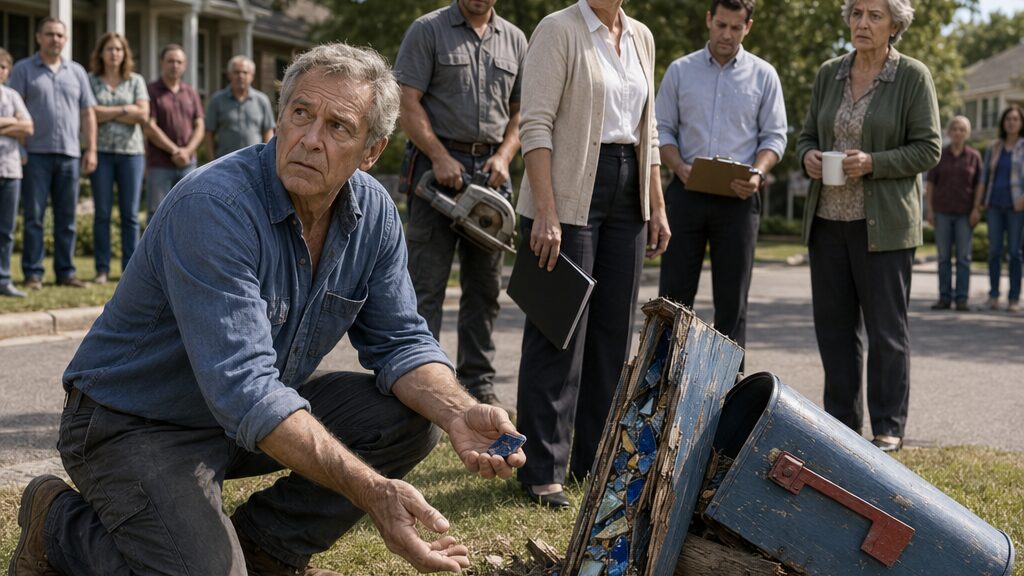
Joseph caught the metal box against his shoulder, but the wooden arm split along a concealed seam. A section of painted cedar dropped into the grass and broke open.
Blue pieces scattered across the lawn.
Not one or two.
Dozens.
Glass tiles, ceramic shards, narrow strips of mirror, and several pieces painted with pale lines lay among the splinters. Sunlight struck them and threw small moving reflections across Joseph’s trousers.
Nobody spoke.
The contractor lowered the saw.
Joseph set the mailbox gently on the grass and knelt.
His fingers moved without permission. He turned over a triangular tile, then a curved piece of cobalt glass. White grout clung to the edges. Beneath the blue paint on the broken cedar, an older layer showed through—patches of yellow, green, and rust-red.
The post had not been hollow from rot.
It had been built around something.
Joseph found the square piece near the curb.
Two letters had been scratched into its back before firing.
B.C.
The marks were uneven, the B larger than the C.
Benjamin had been fourteen when he made them.
Joseph closed his hand around the tile.
“What is that?” someone asked from the sidewalk.
Melissa came closer but stopped short of the fragments.
“Joseph?”
He looked up at the contractor.
“Do not touch another piece.”
“I didn’t know—”
“Now you do.”
The property manager crouched near the broken section.
“Was this decorative material inside the post?”
“It wasn’t inside the post,” Joseph said. “The post was built over it.”
Melissa stared at the colored surface beneath the blue paint.
“You painted over a mosaic?”
Joseph did not answer.
“Why?” she asked.
He began gathering the fragments, placing them in the open toolbox he had left in his car. He arranged them faceup, keeping the grout edges from rubbing.
“Joseph, if this has historical or artistic significance, you were required to submit documentation.”
He looked at her.
“You never asked what it was.”
“We sent three notices.”
“You told me what it looked like.”
“The committee cannot investigate the private history of every noncompliant object.”
“No,” he said. “You just cut them down.”
Melissa flushed.
“That is unfair.”
The contractor stepped away from the post.
“I’m not continuing,” he said.
Melissa turned sharply. “The box still has to be secured.”
“It’s on the ground.”
“It cannot remain on the verge.”
Joseph placed another fragment in the toolbox.
“It stays here.”
“The postal service cannot deliver to a detached receptacle.”
“They won’t deliver today anyway.”
“The association has responsibility once a contractor has identified a hazard.”
“You have no responsibility for what you broke.”
The property manager spoke carefully.
“We should transport the metal box to the management storage area until Saturday. The fragments can remain with the owner.”
Joseph stood.
“No.”
Melissa held out the inspection form.
“The box itself is association-visible property subject to compliance.”
“It is my mailbox.”
“It sits within the easement.”
“That doesn’t make it yours.”
The neighbors were close enough now to hear every word. Shirley had crossed the street. Her mug was gone.
Melissa looked at the watching residents, then at the damaged box.
“This cannot stay like this,” she said. “The contractor will secure the metal receptacle. We will document its condition. Nothing will be disposed of before the hearing.”
Joseph saw fear beneath her composure—not fear of him, but of losing authority in front of the street.
He also saw the utility truck, the open tool compartment, and the property manager already photographing the debris.
If he blocked them physically, the story would become about that.
Joseph stepped aside.
“Photograph every surface before you lift it.”
The contractor nodded.
“Use blankets,” Joseph said. “No straps across the door. The hinge is original.”
Melissa watched him.
“You said it was just a mailbox.”
“I never said that.”
The contractor wrapped the blue box in moving pads and carried it to the truck. The worn red flag remained raised until the box disappeared behind the utility door.
Joseph stayed beside the fragments.
By the time the truck left, the crowd had thinned. The property manager promised an inventory by email. Melissa said the hearing packet would be updated. Neither apology reached the air.
Shirley remained.
Joseph crouched again, sorting mirror from glass, ceramic from painted wood. He placed Benjamin’s tile alone in his shirt pocket.
Shirley lowered herself slowly beside him.
“You covered all of it,” she said.
“It was coming apart.”
“That wasn’t what I asked.”
Joseph found a curved yellow shard, one edge shaped like a feather.
“I kept what I could.”
“You kept it where nobody could see it.”
“It was mine to keep.”
Shirley picked up a piece of blue glass but did not place it in the toolbox.
“No,” she said. “That was the mistake.”
Joseph looked at her hand.
She turned the fragment over. On the back, beneath old mortar, someone had written a date in black marker.
Eighteen years earlier.
Shirley’s thumb rested over the final digit.
“You were not the only person who promised to protect it,” she said.
Chapter 3: The Photograph Shirley Kept Face Down
Shirley placed the photograph face down between them.
The sound of its edge touching the dining table was soft, but Joseph felt it like a challenge.
Her house had changed little in twenty years. The same oak table stood beneath the brass light fixture. The same glass-front cabinet held wedding china nobody used. On the wall beside the kitchen doorway hung a framed map of the original subdivision, each lot outlined in fading green ink.
Joseph set the blue glass fragment beside the photograph.
“You said you had records.”
“I said I had some things.”
“You brought me here to show them.”
“I brought you here because if I hand you that box, you’ll use it to make yourself the only injured person in the room.”
Joseph leaned back.
“My mailbox was taken.”
“Yes.”
“Before my hearing.”
“Yes.”
“They cut into it.”
“I saw.”
“Then what part is unclear?”
Shirley folded her hands.
“The part where you pretend nothing happened before Wednesday.”
Joseph looked toward the closed cardboard file box near her chair.
“You supported them.”
“I supported replacing something that had been allowed to rot.”
“It wasn’t rotting.”
“The wings were gone.”
His jaw tightened.
“The outer panels failed.”
“And you painted over what remained.”
“To seal it.”
“You sealed it from weather. You also sealed it from everybody who helped make it.”
Joseph picked up the blue fragment.
“This survived because I sealed it.”
“Is survival the same as keeping a promise?”
He did not answer.
Shirley turned the photograph over.
The mailbox in the image barely resembled the faded blue box that had stood at Joseph’s curb.
Its central body was blue, but two broad mosaic wings extended from the post, built from pieces of glass, ceramic, mirror, and painted tile. Children crowded around it in winter coats and school sweatshirts. Adults stood behind them, some smiling at the camera, others looking toward a woman near the center.
Joseph did not need to study her face.
His wife’s hand rested on Benjamin’s shoulder.
Benjamin was fourteen, taller than several adults already, with grout streaked across one sleeve. He was squinting into the sun and trying not to smile.
Across the bottom of the photograph, someone had written the contest year and the words COMMUNITY CHOICE AWARD.
Joseph’s fingers tightened around the edge.
“You kept this face down?”
“I kept it in a drawer.”
“That isn’t what I asked.”
Shirley looked toward the kitchen.
“For a while, I kept it framed. Then people asked why the mailbox in the picture didn’t exist anymore.”
“It existed.”
“Not where anyone could recognize it.”
Joseph studied the photograph. The wings rose from both sides of the post in layered curves. He remembered cutting the plywood forms in his workshop while his wife stood behind him reading names from a clipboard. Twelve children. Seven adults. Donations from the hardware store. Broken dishes from half the kitchens on the street.
He set the photograph down.
“The center survived.”
“The center was never the whole thing.”
Shirley pulled the cardboard box closer and opened it. Inside were folders, envelopes, and a spiral-bound notebook swollen with loose pages.
She removed a sheet of tracing paper.
A pencil drawing showed the wing pattern divided into numbered sections. Several shapes had been shaded blue. Others were marked for mirror or yellow tile.
At the bottom, in teenage block letters, was Benjamin Carter.
Joseph stared at the name.
“He designed the wings,” Shirley said.
“I know.”
“Do you?”
Joseph looked up.
“You speak about that mailbox as though it was something your wife left you. Benjamin built as much of it as anyone.”
“He left.”
“He asked to repair it first.”
Joseph pushed the tracing paper away.
“He wanted to replace the backing.”
“Because it was splitting.”
“He wanted composite board.”
“He wanted it to last.”
“It would have changed the structure.”
Shirley gave him a tired look.
“You hear yourself, don’t you?”
Joseph stood and crossed to the window. Shirley’s yard backed toward the community walking path. Beyond the fence, porch lights had begun to come on one by one.
“He hadn’t been home in three years,” Joseph said. “Then he showed up with plans to take it apart.”
“He showed up because I called him.”
Joseph turned.
Shirley did not look away.
“The lower wing had already fallen,” she said. “You put it in your garage and told everyone you would fix it. A year passed. Then the other side started shedding tiles.”
“I was working.”
“You were retired.”
“I was not ready.”
“That is true.”
The agreement in her voice unsettled him more than accusation would have.
Shirley took three envelopes from the box and placed them on the table.
Each was addressed to Joseph. Each carried a different date.
Restoration proposal.
Volunteer repair plan.
Historic-feature documentation request.
He recognized all three.
“The HOA did not invent the problem,” Shirley said.
“I never said they did.”
“You let everyone believe Melissa woke up one morning and decided to attack a harmless old mailbox.”
“She ordered it removed before the hearing.”
“And she was wrong.”
Shirley tapped the envelopes.
“You were wrong first.”
Joseph remained by the window.
The first proposal had offered donated labor. The second included materials paid through a neighborhood arts fund. The third asked only for permission to photograph and document the remaining work before repairs began.
He had rejected each without meeting anyone.
Not formally. He had simply declined to answer until the deadlines passed.
“I promised it would stay,” he said.
“Your wife did not ask you to let it fall apart.”
“You weren’t there.”
“I was in the hospital room when she asked both of us.”
Joseph looked at her.
Shirley’s face had gone pale, but her voice stayed level.
“She said, ‘Keep the children’s work where people can see it.’ That was the promise. Not keep every board. Not refuse every hand. Keep the work visible.”
Joseph looked down at the blue fragment.
He had remembered the sentence differently for years. Or perhaps he had shortened it because the shorter version demanded less of him.
Keep it.
Possession was easier than stewardship.
Shirley opened the spiral notebook. Inside were meeting notes, donation lists, sketches, and snapshots. One page recorded the town’s youth-art contest. Another listed the mailbox as a permanent community installation maintained through volunteer agreement with the homeowner.
“This will help at the hearing,” Joseph said.
“It will also show that maintenance was shared.”
“Good.”
“And that you refused access.”
He said nothing.
Shirley closed the notebook.
“I’ll give Emma copies of the contest pages. I’ll tell the board Melissa had no right to remove it early.”
Joseph waited.
“But I will not sit there and tell them you protected that mailbox properly.”
“I didn’t ask you to lie.”
“You were going to let me.”
The words struck because they were true.
Shirley reached into the box again and removed a small card. She slid it across the table.
Benjamin’s current phone number was written on it.
Joseph did not touch it.
“He won’t come,” he said.
“You don’t know that.”
“He hasn’t answered me in two years.”
“Have you called?”
Joseph looked at the number.
Shirley’s voice softened, though not enough to offer comfort.
“I will not testify without him, Joseph. The wings were his design. The promise included him whether you like it or not.”
She placed the photograph beside the card.
Benjamin’s younger face stared past the camera, one hand resting on a mosaic wing that no longer existed.
Joseph picked up the card.
Outside, somewhere along the street, a mailbox door slammed shut.
Chapter 4: His Son Wanted the Landmark Gone
“Did they finally take it down?”
Benjamin answered on the fourth ring, and the question came before hello.
Joseph stood in his workshop with Shirley’s card in one hand and the square blue tile in the other. Dust lay across the workbench where projects had once lined up in careful stages. Now only clamps, sharpening stones, and a half-repaired drawer occupied the space.
“They removed the box,” Joseph said.
A pause.
“Then why are you calling me?”
“The post broke open.”
Another pause, shorter this time.
“What do you mean, broke open?”
“The mosaic was inside.”
Benjamin exhaled through his nose. Joseph could picture him looking away, jaw set the same way it had been at fourteen whenever an adult corrected him.
“You painted over it,” Benjamin said.
“I sealed what was left.”
“You buried it.”
“The backing failed.”
“So you put house paint over everyone’s work.”
“It kept the center dry.”
“And now you want me to tell the HOA it’s priceless.”
Joseph looked down at the tile. The initials were pressed into the clay from the back, made before firing, when Benjamin’s fingers had been smaller and less certain.
“There’s a hearing Saturday.”
“I’m not coming.”
“You designed the wings.”
“I know what I designed.”
“Shirley has the drawings.”
“Of course she does.”
Joseph set the tile on the bench.
“They cut it down before the appeal.”
“That was wrong.”
The answer came too quickly to be mistaken for support.
“But?”
“But you don’t get to turn this into a story where you were protecting something and everybody else failed to understand.”
Joseph gripped the edge of the bench.
“I kept it standing.”
“You kept the body standing. The wings disappeared one piece at a time.”
“I was going to rebuild them.”
“When?”
Joseph said nothing.
Benjamin laughed once, without humor.
“That’s what I thought.”
The line went quiet except for a faint background hum, perhaps traffic or a ventilation system. Joseph heard the distance between them as clearly as the static.
“Meet me,” he said.
“No.”
“Half an hour.”
“I’m working.”
“After.”
“Why?”
“Because the contractor took the box, and Melissa King is calling it a safety action.”
“That sounds like Melissa.”
“You know her?”
“I emailed the committee three years ago.”
Joseph straightened.
“What did you tell them?”
“That the mailbox should be removed if you wouldn’t let anyone repair it.”
For a moment, the workshop seemed to tilt.
“You asked them to take it.”
“I asked them to stop pretending decay was preservation.”
“You had no right.”
“It had my name on it too.”
Joseph looked at the tile between them, though Benjamin was miles away.
“You left.”
“I left the house. I didn’t leave my work.”
“You didn’t answer my calls.”
“You called when you needed something fixed.”
“That isn’t true.”
“Then tell me the last time you called to ask how I was.”
Joseph searched for a date and found only occasions: a roof leak, a tax form, a package delivered to the old address.
Benjamin spoke into the silence.
“There’s a diner off Route Nine. Six thirty. I have forty minutes.”
Then he ended the call.
At six twenty-five, Joseph sat in a booth beneath a framed photograph of a high school football team. He had brought the blue tile wrapped in a shop rag and the tracing paper Shirley had allowed him to borrow.
Benjamin arrived in a dark work jacket with an ID badge clipped near the zipper. He looked older than Joseph expected and younger than the years between them.
He did not sit immediately.
“You look thinner,” Joseph said.
“That’s what you’ve got?”
Benjamin slid into the opposite seat.
Joseph placed the tracing paper on the table.
Benjamin stared at it.
The waitress came, and neither man ordered food. Benjamin asked for coffee. Joseph kept his hands around a glass of water he did not drink.
“Shirley said you still have the full template,” Joseph said.
Benjamin’s eyes remained on the drawing.
“I do.”
“We need it for the hearing.”
“We?”
“The mailbox belongs at the curb.”
“The mailbox belongs in a record of things people meant to do and didn’t.”
Joseph unfolded the shop rag and placed the tile on the paper.
Benjamin’s expression changed before he could stop it.
He picked up the square carefully.
“You found this in the post?”
“Yes.”
“I thought this one was gone.”
“It has your initials.”
“I know.”
Benjamin rubbed his thumb over the back. His anger did not leave, but it became less simple.
“Mom made everybody mark one piece,” he said. “So nobody could say later they hadn’t helped.”
Joseph looked at the tabletop.
“She made lists for everything.”
“She made people show up.”
The coffee arrived. Benjamin waited until the waitress left.
“You told me it had to stay exactly as she left it,” he said.
“It was the last project she finished.”
“No. It was the last project she started. We finished it after she died.”
Joseph looked up.
Benjamin held his gaze.
“That matters.”
The words opened something Joseph had kept closed by renaming it. He had called the mailbox hers because that made guarding it feel like loyalty. But the final grout had been mixed after the funeral. The children had worked in silence that first morning until Benjamin turned on a radio. Shirley had brought sandwiches nobody ate. Joseph had cut the mounting braces while his hands shook.
They had finished it without her.
That was why he could not bear to alter it.
Benjamin set the tile down.
“When the left wing sagged, I came with a new backing design. You told me composite board was cheap.”
“It expands differently.”
“It doesn’t rot.”
“It wasn’t what we used.”
“No. It was what would have kept the work visible.”
Joseph heard Shirley’s words again.
Keep the children’s work where people can see it.
Benjamin reached into his jacket and removed his phone. He scrolled through photographs until he found one of a large paper template pinned to a wall.
“I still have both wing patterns,” he said. “Rolled in a tube above my garage shelves.”
Relief came too quickly. Joseph leaned forward.
“Bring them Saturday.”
Benjamin locked the phone.
“I said I have them. I didn’t say I’m helping you.”
“You just said the work should stay visible.”
“I also said you helped destroy it.”
Joseph’s voice lowered.
“I did not cut it down.”
“You let it disappear before anybody touched a saw.”
Benjamin took a sip of coffee and stood.
His forty minutes had become twenty-three.
At the counter, Joseph’s phone vibrated. He expected Shirley.
The message was from Emma Robinson.
I found the contest file. I also found three restoration notices with your signature on the delivery receipts. We need to talk before I publish anything.
Joseph read it twice.
Benjamin saw his face.
“What happened?”
Joseph turned the screen toward him.
Benjamin did not look surprised.
Emma called before Joseph could answer.
He stepped away from the booth.
“Mr. Carter,” she said, “I need to ask you something directly.”
“Go ahead.”
“Did the HOA erase a community landmark, or did you help erase it first?”
Across the diner, Benjamin folded the tracing paper and slipped it into his jacket.
Chapter 5: The Rule Was Real, the Removal Was Not
The disposal invoice was dated Tuesday.
Joseph held it beneath the fluorescent light in the HOA management office while the property manager stood behind the counter with both hands flat on a folder.
The contractor had cut the mailbox down Wednesday.
“This was prepared before the inspection,” Joseph said.
“It was generated when the work order was opened.”
“It says disposal and replacement.”
“That is the standard billing category.”
“It lists haul-away.”
“The contractor uses a template.”
Joseph turned the invoice toward the manager.
“It also lists one black approved mailbox.”
The manager’s eyes shifted toward the closed conference-room door.
“Melissa requested a provisional estimate.”
“Before anyone inspected my post.”
“She expected the committee’s action to be upheld.”
“My appeal had already been submitted.”
“The confirmation was entered Wednesday morning.”
“The invoice is Tuesday.”
The manager lowered his voice.
“I did not approve removal before the hearing.”
“Who did?”
The manager did not answer.
Joseph placed the invoice beside a small plastic container holding three blue fragments. Emma stood near the filing cabinets with a legal pad under one arm. She had not yet published her story. The delay had cost her an evening deadline and, from the tightness around her mouth, patience.
She pointed to the contractor’s paperwork.
“Does the association have a written storage policy for property removed under emergency authority?”
The manager pulled another folder from the counter.
“Structures determined to be an immediate hazard may be secured.”
“That isn’t what I asked.”
He looked at Joseph.
“The hearing will address these issues tomorrow.”
“My mailbox may not exist tomorrow,” Joseph said.
The manager opened the folder and scanned several pages.
“There should have been an inventory email.”
“There wasn’t.”
“A storage receipt?”
“No.”
The manager’s face changed.
He turned toward his computer and typed. After a moment, he frowned.
“The contractor marked the work incomplete.”
“He took the box.”
“He marked the post removal incomplete and material disposition pending.”
Emma wrote that down.
Joseph watched the manager scroll.
“What does pending mean?”
“It means the material has not been logged into association storage.”
“Then where is it?”
“I don’t know.”
Joseph gathered the invoice and fragments.
The manager held up one hand.
“You cannot take the original.”
“Make me a copy.”
While the copier ran, Emma moved closer.
“This helps you,” she said quietly.
“It proves they planned it.”
“It proves someone expected removal. That is not the same as proving the whole committee authorized it.”
Joseph looked at her.
“You still think I’m the story.”
“I think several people are.”
The copier clicked.
The manager returned with a copy and a thin packet of governing documents.
“The maintenance standard is here,” he said, tapping a marked section. “Peeling finish, unstable supports, unapproved alteration, and obstruction of postal access.”
Joseph read the paragraph.
The wording was plain. The committee had grounds to require repair. The lean of the post, the chipped paint, the missing decorative panels—none had been invented.
Below it, however, another section described enforcement.
Written notice. Opportunity to cure. Appeal hearing. Final decision. If association action became necessary, removed property had to be photographed, inventoried, and stored for thirty days unless the owner signed a disposal release.
Joseph looked up.
“I never signed a release.”
The manager shifted.
“Melissa said you verbally surrendered the mailbox during the inspection.”
Emma stopped writing.
Joseph felt the old reflex rise—to reject the entire claim, close the folder, walk out before anyone could make him explain.
Instead he said, “Who heard me?”
“The contractor and Melissa.”
“The contractor heard me tell him not to touch it.”
“That will be addressed.”
“Did Melissa put my surrender in writing?”
“No.”
“Did she ask me to confirm it?”
“No.”
Joseph closed the packet.
“Then the rule was real,” he said. “The removal was not.”
The sentence settled the room.
It did not make him innocent. It gave him something more useful: a boundary he could defend honestly.
At the municipal archive, the records clerk brought out a gray box labeled COMMUNITY ARTS, eighteen years earlier. Emma had called ahead, and a local newspaper photographer waited near a reading table with his camera still capped.
Joseph disliked the arrangement.
“I said no photographs of me.”
“Of the records,” Emma said. “Not you.”
The clerk removed a folder containing entry forms, judging sheets, and a folded agreement.
Emma opened it carefully.
The title read YOUTH COMMUNITY INSTALLATION AND MAINTENANCE AGREEMENT.
The property address was Joseph’s.
The project description named a sculptural mailbox created by neighborhood youth using donated household materials. The ownership line was more complicated.
The central metal receptacle remained the homeowner’s property. The decorative structure and design were designated a community installation maintained jointly by the homeowner and volunteer committee.
Joseph read the paragraph again.
“They can’t claim the whole thing,” he said.
“No,” Emma replied. “And neither can you.”
He felt irritation, then recognized it as shame wearing a familiar coat.
The agreement carried three signatures.
His wife’s.
His own.
Shirley Moore’s, as volunteer treasurer.
Emma turned the page.
A maintenance schedule had been attached. Annual inspections. Repair access by appointment. Written approval for major alterations.
Joseph had followed none of it after the first five years.
The records clerk brought a smaller envelope.
“These were filed with the contest packet.”
Inside were paint chips and photographs of the original blue finish. Joseph placed one surviving fragment beside them. The color matched beneath the dust.
For the first time since the removal, something eased in him. The mailbox could be identified. The design could be reconstructed. The facts did not depend on his memory alone.
Then Emma pulled out the sign-in sheet from a recent records request.
Someone had accessed the same folder two months earlier.
Melissa King.
Joseph stared at the signature.
“She knew,” he said.
“Maybe,” Emma replied. “Or she checked whether the exception was documented and found your maintenance failures.”
“She knew it was community art.”
“She knew there was a file.”
The distinction mattered, though he did not want it to.
The photographer took a picture of the agreement, the paint sample, and Joseph’s fragments aligned on the table. Joseph moved his hand out of frame.
Emma closed the folder.
“I can write that the removal violated procedure,” she said. “I can also write that the preservation agreement was neglected for years.”
“You should.”
She studied him.
“That is different from last night.”
“Last night I wanted you to prove I was right.”
“And now?”
“Now I want the box found.”
His phone rang.
The property manager’s number appeared.
Joseph answered.
“We found a security entry,” the manager said. “Someone accessed the management office Tuesday night, after the provisional order was prepared.”
“Melissa?”
“No. Shirley Moore.”
Joseph looked at Shirley’s signature on the old agreement.
“What was she doing there?”
“She signed in as an architectural committee consultant. There’s no note explaining why.”
Emma watched his face.
The manager continued.
“The disposal instruction was printed twenty-six minutes after she entered.”
Chapter 6: What Melissa Feared the Street Would See
The red flag protruded from beneath a gray contractor’s tarp behind Melissa King’s garage.
Joseph saw it from the sidewalk.
He had gone to her house intending to ask about Shirley’s visit to the management office. Instead, he stood beside Melissa’s side gate staring at the faded strip of metal that had once signaled letters waiting to be carried away.
The flag was bent near the hinge.
Melissa opened the front door before he knocked.
“You cannot be back there.”
“My mailbox is back there.”
Her eyes moved toward the gate.
“It is being secured.”
“In your yard?”
“The contractor could not log it into storage after office hours.”
“It was removed Wednesday afternoon.”
“He had scheduling problems.”
Joseph walked past the porch steps toward the gate.
Melissa came down after him.
“Joseph, stop.”
He opened the latch.
The central metal box lay on two sawhorses under the tarp. One side was dented. The door hung slightly low, but the hinge remained attached. A moving blanket had been wrapped around it and fastened with a strap across the bottom, exactly where he had told the contractor not to place one.
Joseph pulled the tarp back farther.
The blue paint was scarred but intact across most of the top.
“You said it was in association storage.”
“I said it would be secured.”
“You let everyone believe it had been logged.”
“I did not discuss the storage location.”
“That is not an answer.”
Melissa closed the gate behind them.
For the first time since the conflict began, she looked less like a committee chair than a tired homeowner standing in a narrow strip of yard between a garage and a fence. Cardboard boxes were stacked near the wall. Several carried real-estate company logos.
Joseph noticed them.
Melissa followed his gaze.
“My sister is moving in,” she said.
He waited.
“She lost her lease. I tried to refinance so I could finish the basement. The appraisal came in lower than expected.”
“And my mailbox caused that?”
“No.”
“Then why mention it?”
“Because every person who wants to sell blames the committee for whatever lowers an offer. Uneven lawns. Old fences. Work trucks. Mailboxes. If we enforce one rule and ignore another, they accuse us of favoritism.”
“You skipped my hearing to prove you were fair.”
“I believed your deadline had passed.”
“You had the email confirmation.”
“I saw it Wednesday morning.”
“The removal invoice was Tuesday.”
Melissa looked toward the covered mailbox.
“I asked for an estimate.”
“You asked Shirley to come to the office.”
Her face tightened.
“She came on her own.”
“She accessed the art file.”
“She told me there had once been a volunteer agreement.”
“Once?”
“She said it had been abandoned.”
Joseph stepped closer.
“What else did she say?”
“That you refused every repair attempt. That the decorative portions were gone. That what remained was a private mailbox in violation.”
“And you chose the version that let you remove it.”
“I chose the version supported by the property’s current condition.”
Joseph looked at the bent flag.
“No. You chose the version that required no conversation with me.”
Melissa’s voice sharpened.
“I tried conversation. You answered every notice with one sentence.”
He could not deny it.
She continued, quieter now.
“Do you know how many residents told me you expected special treatment because you had lived here longer? Do you know how many said I would never enforce against you?”
“So this was about showing them.”
“It was about showing that standards meant something.”
“And when the post broke open?”
Melissa looked away.
The answer was there before she spoke.
“I told the contractor to stop disposing of anything.”
“After he took it.”
“I expected him to bring it to storage.”
“He brought it here.”
“The office bay was locked. He called me. I did not want it left in his truck overnight.”
“You could have called me.”
“You were accusing me of destroying it in front of the street.”
“I watched your contractor cut it.”
“I did not know what was inside.”
“You did know there had been artwork.”
“I knew there had been artwork eighteen years ago. I did not know pieces remained under the paint.”
Joseph lifted the tarp and examined the bottom seam. Repairable. The dent could be worked from inside. The door could be squared.
His hands understood the object faster than his anger did.
Melissa saw him measuring the damage with his eyes.
“It can be repaired,” she said.
“Yes.”
Relief crossed her face.
Then she said, “I can release it to you tonight.”
Joseph straightened.
“In exchange for what?”
Her pause answered him.
“You withdraw the complaint about premature removal,” she said. “The committee agrees to waive fines. You install the approved replacement at the curb, and you keep this one wherever you want on your property.”
“In my garage.”
“Or your workshop.”
“Where no one can see it.”
“It would be protected.”
Joseph looked at her.
The offer was neat. It would return his property, end the fines, and spare both of them a public hearing.
It was also the same mistake he had made for years.
Keep it hidden. Keep it unchanged. Keep it safe from other people.
Melissa folded her arms.
“This does not have to become a public spectacle.”
“It already became public when you brought a saw.”
Her face reddened.
“I am trying to resolve it.”
“You are trying to make the record clean.”
“And you aren’t?”
The question held him.
She stepped toward the sawhorses.
“You ignored repairs. You refused documentation. You let that structure become unsafe. If the story is told honestly, it will not make either of us look good.”
“I know.”
Melissa studied him, unsettled by the answer.
Joseph removed the strap from the blanket.
“What are you doing?”
“Taking my mailbox.”
“You cannot remove association-secured material without a release.”
“You just offered to release it.”
“Under an agreement.”
“I’m not accepting the agreement.”
She moved between him and the gate.
“Then it stays until the hearing.”
Joseph took out his phone.
“I’ll call the property manager and ask why my personal property is being stored at your house without an inventory.”
Melissa did not move.
For several seconds, neither spoke.
Then she stepped aside.
Joseph wrapped the blanket properly, protecting the hinge and door. Melissa helped lift the box despite herself. It was heavier than it looked.
At the gate, she stopped.
“I did not tell the contractor to destroy it.”
“No,” Joseph said. “You only gave him authority before you had the right.”
She flinched.
He carried the mailbox to his truck and set it in the bed between two wooden braces.
Before closing the tailgate, he raised the bent red flag.
It stayed up.
Melissa stood at the end of her driveway.
“Joseph.”
He turned.
“If you tell them everything tomorrow,” she said, “you will have to tell them about the repair offers too.”
“I know.”
“And the maintenance agreement.”
“I know.”
“And your son.”
Joseph rested one hand on the tailgate.
“That part is not yours to warn me about.”
He drove toward the clubhouse with the damaged blue mailbox secured behind him, though the hearing would not begin until morning.
For the first time, he was not carrying it home to hide.
Chapter 7: The Hearing Where Nobody Stayed Innocent
Joseph placed the damaged mailbox in the center of the hearing table.
The bent red flag pointed toward Melissa King.
Around it, he arranged the surviving mosaic fragments on a folded drop cloth: blue glass, yellow ceramic, strips of mirror, and the square tile marked B.C. The fluorescent lights caught the mirrored pieces and scattered pale reflections across the clubhouse ceiling.
The room had been set for an ordinary compliance hearing. Three committee members sat behind nameplates. The property manager had stacked governing documents beside a digital recorder. Residents filled two rows of folding chairs, some holding printed copies of Emma Robinson’s unpublished article draft that had circulated without her permission.
Joseph remained standing.
The committee member at the center cleared his throat.
“Mr. Carter, you may begin.”
Joseph looked at the prepared statement in his hand.
Then he folded it once and set it beneath the mailbox.
“This was removed before my hearing,” he said. “That violated the association’s enforcement procedure.”
Melissa sat at the far end of the table with her binder closed. She did not look at him.
“The removal was classified as emergency stabilization,” the property manager said.
Joseph placed the contractor’s invoice beside the fragments.
“The replacement and disposal estimate was prepared before the safety inspection.”
Murmurs moved through the chairs.
The central committee member raised one hand.
“We will maintain order.”
Joseph waited until the room settled.
“The post needed repair,” he continued. “The paint was failing. The decorative structure had been neglected. The association had grounds to require maintenance.”
Melissa finally looked up.
Several residents shifted. They had expected Joseph to deny everything.
He touched the dent in the mailbox’s side.
“But the association did not have grounds to take this before the appeal, store it at a committee chair’s home, or claim I surrendered it without written confirmation.”
The property manager lowered his eyes to the documents.
Joseph could have stopped there. He had the early invoice, the missing inventory, the contractor’s incomplete work order, and the mailbox itself. The facts were enough to make Melissa’s decision look indefensible.
They were not enough to tell the truth.
The clubhouse door opened.
Benjamin entered carrying a long cardboard tube beneath one arm.
Joseph forgot the next sentence.
Benjamin walked past the chairs and stopped beside the table. He placed the tube next to the mailbox but did not sit.
“I’m here to identify the design,” he said. “Not to defend everything my father did.”
The words landed harder than any accusation Melissa had made.
Joseph nodded once.
“That is fair.”
Benjamin removed two rolled sheets from the tube. He flattened them with water glasses borrowed from the committee table. Pencil lines formed the outline of broad mosaic wings, each section numbered for glass, tile, mirror, or painted ceramic.
The square marked near the center matched the fragment bearing his initials.
Emma stood near the rear wall with her notebook closed. She had brought no photographer.
Benjamin pointed to the drawing.
“The neighborhood children designed the surface. My father built the frame. My mother organized the project.”
A resident raised her hand without waiting to be recognized.
“Was it really a town contest winner?”
“Yes,” Benjamin said. “But that isn’t why it mattered.”
He looked at Joseph.
The room waited.
Joseph rested his palm on the blue metal.
“My wife began the project before she became too sick to finish it,” he said. “The children completed it after she died.”
No one murmured this time.
“She made Shirley and me promise to keep their work where people could see it. For years, we did.”
Shirley sat in the front row with the spiral notebook on her lap. She stared at the floor.
Joseph continued.
“When the backing began to fail, Benjamin offered to rebuild the wings with different material. I refused.”
Benjamin’s jaw tightened, but he said nothing.
“I said changing the structure would change the work. What I meant was that I could not bear to take apart the last project connected to my wife.”
Joseph picked up one blue fragment.
“So I removed the loosest pieces. I stored some. I covered what remained with blue paint to keep water out. I told myself I was preserving it.”
He set the fragment down.
“I was making it invisible.”
Melissa’s posture changed. The certainty she had worn all week gave way to something more guarded.
One of the committee members opened the old maintenance agreement Emma had copied from the municipal archive.
“This document required shared annual maintenance,” he said.
“It did,” Joseph replied.
“And you denied volunteer access?”
“Yes.”
“You rejected three repair proposals?”
“Yes.”
A resident behind Joseph whispered, “Then why are we here?”
Joseph turned slightly.
“Because neglect does not authorize someone else to ignore procedure.”
The central committee member looked toward Melissa.
“Ms. King, did you authorize removal before the appeal?”
Melissa opened her binder but did not remove a paper.
“I authorized a provisional safety action based on the contractor’s expected findings.”
“Before he inspected?”
“Yes.”
“Did you instruct him to dispose of the mailbox?”
“I approved a standard removal estimate. I expected salvageable property to be stored.”
“Why was it at your residence?”
“The management storage bay was unavailable.”
The property manager spoke.
“I was not informed of that arrangement.”
Melissa looked at him.
“You did not answer your phone.”
“That does not authorize private storage.”
Her face flushed.
She turned toward the committee.
“I had residents accusing us of selective enforcement. Several properties are on the market. Standards mean nothing if longtime homeowners can ignore notices indefinitely.”
“That pressure was real,” Joseph said.
Melissa looked at him, surprised.
“So was the mailbox’s condition,” he continued. “But you wanted the street to see you enforce the rule. You stopped caring whether you were enforcing it correctly.”
Melissa’s lips parted, then closed.
Shirley rose from the front row.
“I need to say something.”
She carried the spiral notebook to the table and set it beside Benjamin’s drawings.
“I told Melissa the volunteer agreement had been abandoned,” Shirley said. “I told her Joseph had refused repairs. Both statements were true.”
Joseph watched her grip the back of an empty chair.
“I did not tell her that I still had the archive. I did not tell her the agreement called the artwork a community installation. I thought removing the mailbox might force Joseph to stop hiding behind it.”
Benjamin looked at her.
“You supported taking it?”
“Yes.”
“Why?”
“Because I was angry.” Shirley’s voice shook. “Your mother asked me to help protect it, and I watched your father shut everyone out. After a while, I decided he no longer cared.”
Joseph met her eyes.
“You could have asked.”
“So could you.”
Neither looked away.
The central committee member closed the governing documents.
“This hearing cannot resolve every relationship connected to this object.”
“No,” Joseph said. “But it can resolve the rule.”
He unfolded the statement he had brought, then pushed it aside without reading.
“I am not asking for a permanent exemption. The post was unstable. The finish failed. I will repair both.”
Benjamin’s expression sharpened.
Joseph continued before he could interrupt.
“I am asking the association to recognize the original community agreement and approve a restoration plan with measurable standards—structural inspection, weather-resistant backing, scheduled maintenance, and shared access.”
“You would accept new backing?” Benjamin asked.
Joseph looked at the wing template.
“Yes.”
The single word cost less than he had feared and more than anyone in the room could know.
“I will complete the work by a deadline set by the board,” he said. “If I fail, the association may enforce the standard after a proper hearing.”
The committee member looked down the table.
“And the complaint concerning premature removal?”
“It remains.”
Melissa lowered her gaze.
Joseph did not soften the next part.
“She bypassed the appeal process. Shirley withheld relevant information. I neglected the installation. The contractor acted on a bad order. Nobody here gets a clean version.”
The room stayed quiet.
The central committee member conferred with the other two. Their whispered discussion lasted several minutes.
When they finished, he announced that fines would be suspended, disposal prohibited, and the mailbox returned formally to Joseph pending a restoration plan. The committee would review Melissa’s authorization separately and draft a preservation procedure for resident-created installations.
Melissa closed her binder.
“I will step down from the architectural committee during that review,” she said.
No one applauded.
Joseph was grateful.
The hearing ended in the scrape of folding chairs and the low confusion of people deciding what version of the story they would repeat.
Benjamin began rolling the templates.
Joseph stopped him.
“Leave them open.”
Benjamin looked at the damaged mailbox and the scattered fragments.
“You know we can’t rebuild it exactly.”
“I know.”
“Some pieces are gone.”
“I know.”
“The new backing will show at the edges.”
Joseph placed the tile marked B.C. in the empty square on the drawing.
“Then we do not pretend nothing happened.”
Chapter 8: They Left One Scar in the Blue Paint
Benjamin caught Joseph’s sanding block before it touched the final dent.
“Leave that one.”
They stood at the curb six weeks after the hearing, surrounded by clamps, tile trays, extension cords, and two folding tables borrowed from the clubhouse. The restored mailbox waited on a new cedar post, its mosaic wings extending from either side in layered blues, yellows, and narrow flashes of mirror.
One panel of the central metal box remained faded and scarred.
Joseph looked at the dent beneath Benjamin’s hand.
“It will collect water if the edge stays raised.”
“Seal the edge. Leave the mark.”
“It will look unfinished.”
Benjamin released the sanding block.
“It is unfinished.”
Behind them, neighborhood volunteers pressed replacement tiles into fresh mortar. Shirley sat at a table recording each donated piece in the original spiral notebook. Emma photographed only the work, never asking anyone to pose.
Joseph ran his thumb along the dent. He had already repaired the hinge, squared the door, and treated the rust beneath the paint. Removing the final scar would take less than ten minutes.
He set the sanding block down.
“All right.”
Benjamin nodded, as though accepting a measurement rather than forgiveness.
The new backing was composite board, cut from Benjamin’s template. Joseph had resisted its clean gray edges until Benjamin suggested painting them the same deep blue used in the original design. Even then, they had left a narrow line visible behind the wings.
New material should not pretend to be old.
A car stopped beside the curb.
Melissa stepped out carrying the original red flag in both hands.
She wore no committee badge and carried no binder.
The flag had been straightened but not repainted. Its surface showed pale scratches where the contractor’s strap had pressed against it.
“I found the mounting pin in the blanket,” she said.
Joseph took the flag.
“Thank you.”
Melissa looked at the restored wings.
“The board approved the preservation policy Thursday.”
Benjamin wiped grout from his fingers.
“What does it require?”
“An inventory, a maintenance schedule, and written consent before alteration or removal. Resident-made installations can be registered through a community trust.”
Joseph had read the draft. The trust provision remained the part he disliked.
Registering the design meant he would no longer control it alone. Future repairs could proceed through a committee of residents and family representatives. If he sold the house, the artwork could remain under an easement agreement or be relocated by mutual decision.
Melissa seemed to read his hesitation.
“You can still decline registration,” she said.
“And keep sole ownership.”
“Yes.”
Benjamin looked at Joseph but said nothing.
That silence felt different from the ones between them before. It did not demand. It left room.
Joseph turned the red flag over in his hands.
His wife had never asked him to own the children’s work. She had asked him to keep it visible.
“Bring me the trust form,” he said.
Melissa nodded.
“I’ll leave it in your mailbox.”
The sentence almost became a joke. None of them smiled, but some of the tightness left her face.
“I am sorry,” she said. “For authorizing the removal.”
Joseph fitted the flag into its old bracket.
“I believe you did not intend for it to be destroyed.”
“That is not the same as forgiveness.”
“No.”
She accepted that.
Before leaving, Melissa placed one small white ceramic piece on Shirley’s table. It came from a broken serving dish, plain except for a thin blue rim.
“For the record,” she said.
Shirley wrote her name beside it.
By late afternoon, the mortar had begun to set. The wings were not identical to the originals. Several missing sections had been filled with new household pieces: a cracked coffee mug, a child’s painted tile, fragments from an old kitchen plate. Benjamin had placed his original square near the center, initials turned inward but location marked in the notebook.
Joseph stepped back to inspect the whole structure.
The scarred blue panel sat between the bright wings like a piece of sky after a storm—damaged, visible, still carrying its color.
A mail truck rolled to the curb.
The mail carrier lowered the window.
“Is it operational?”
Joseph opened the door. The hinge moved cleanly.
“It is now.”
The carrier placed a small bundle inside and raised the old red flag in acknowledgment before driving on.
Joseph and Benjamin stood beside the post.
The flag caught the light, faded and scratched above the new mosaic.
Benjamin reached for it, then stopped.
Joseph could have lowered it himself. He had done so thousands of times.
Instead, he stepped aside.
Benjamin closed his hand around the flag and brought it down slowly until it rested against the blue metal.
The click was small, ordinary, and final.
Joseph looked at the restored wings, the visible scar, and his son’s hand still resting on the mailbox.
This time, he did not ask anyone to leave it untouched.
The story has ended.