She Let Him Blame Her for the Dying Farm Until the Sunflowers Proved What He Refused to See
Chapter 1: The Report Richard Threw Across the Sunflower Fence
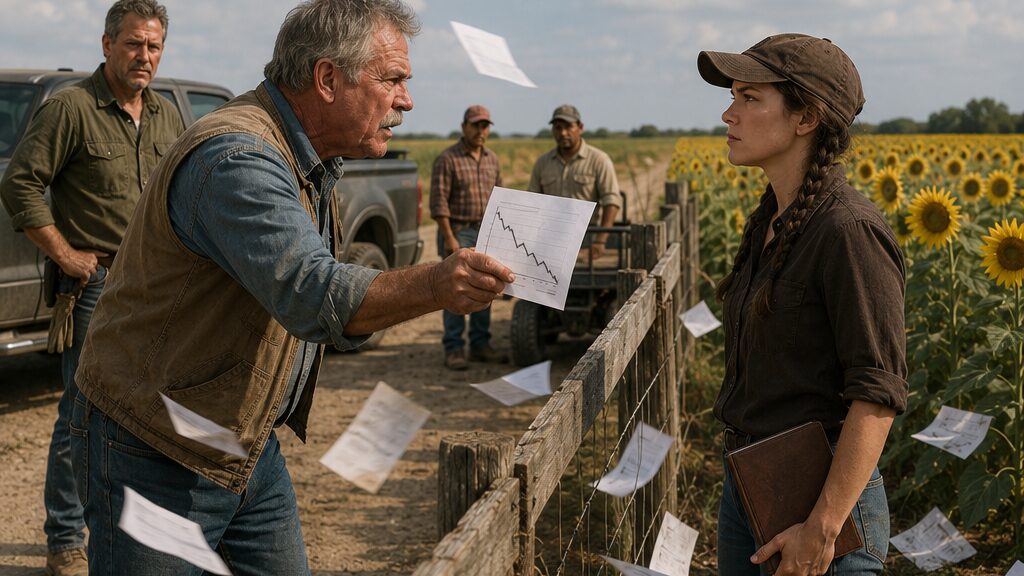
Richard Allen held the graph so close to Katherine’s face that the corner of the paper trembled against the brim of her hat.
“Explain that.”
The black line plunged across the page from left to right. Behind it, forty acres of late-August sunflowers stood in orderly rows, their heavy heads turned east as though refusing to witness what was happening at the entrance fence.
Katherine kept one hand around her brown field notebook. The other rested against the top rail.
“I already did,” she said.
“Then do it so a farmer can understand.”
Two seasonal workers had stopped beside the utility cart. Samuel Baker stood near his truck on the county road, a wrench still in his hand. Richard had chosen the one place where no answer could remain private.
He slapped the report with two fingers. “Projected yield is down eighteen percent. Revenue is worse. You changed the irrigation sequence, cut fertilizer on the west side, and told me to wait.”
“I told you the numbers from last season were inflated.”
“You told me your trial needed time.”
“It does.”
“We don’t have time.”
His voice traveled over the field. One of the workers lowered his eyes. Samuel looked toward the sunflowers instead of either of them.
Katherine glanced at the report. The heading read August Yield Projection, but the figures beneath it mixed estimated seed weight with contracted price assumptions. Richard had circled the lowest number in red.
“That graph doesn’t show what you think it shows,” she said.
“It shows what came out of the ground.”
“No. It shows what the seed supplier expects us to sell after quality deductions.”
“And whose job was quality?”
The accusation landed harder because part of it was true.
Katherine’s fingers tightened around the notebook. Inside were daily moisture readings, root-depth measurements, photographs taped beside dates, and two pages she had not shown Richard. She had believed silence would give her time to separate the farm’s old damage from her own decisions.
Instead, silence had given him the story first.
Richard pushed the report closer. “You came back here with certifications and colored charts. You said the west field could recover.”
“I said it could recover if we stopped treating every acre like it was healthy.”
“My father planted that field.”
“And the ground doesn’t care who planted it.”
Samuel shifted beside his truck.
Richard’s expression changed—not louder, not yet, but wounded in a place Katherine recognized. He lowered the paper.
“You hear that?” he asked the others. “Forty acres in this family, and now the ground doesn’t care.”
“That isn’t what I said.”
“It’s exactly what you said.”
He lifted the stack of reports from the fence post. Katherine saw the yield sheets, the irrigation map, and the copy of her trial summary. Beneath them was a cream-colored envelope she had noticed twice on his desk and never asked about.
Richard shook the papers at her.
“You were given one field,” he said. “One season. I let you turn the valves, change the rows, bring the county into our business. And this is what we got.”
Katherine could have opened the notebook then. She could have shown him the entries copied from her mother’s old calendars, the west field readings from two summers before Katherine returned, the repeated notes about standing water near the south trench.
She could also have told Samuel and the workers that Richard had known something was wrong long before he called her home.
But his face had gone pale beneath the sun. For one more second, she mistook protecting him for mercy.
Richard flung the papers.
The stack broke apart above the fence. White sheets lifted in the dry air, slapped against sunflower stalks, and sailed between the rows. One page caught on the wire. Another landed faceup in the dust, the black line still falling.
Neither worker moved.
Katherine did not chase the pages.
She opened her notebook.
Richard pointed toward the irrigation shed. “You’re done making changes. I’m taking the controls back today.”
She turned to a marked page. “July seventeenth.”
“I said you’re done.”
“Two years ago, July seventeenth.” Her voice was quiet enough that everyone had to listen. “West field, row thirty-two. Water remained at four inches after thirty-six hours. Root depth reduced. Lower leaves yellow before bloom.”
Richard stared at her.
She turned another page.
“August third. Same year. Compaction at the north end. Yield loss estimated between nine and twelve percent.”
“You weren’t here.”
“No. Mom was.”
The field seemed to go still around them.
Katherine held up the notebook, though she did not hand it over. “I copied her measurements from the calendars in the kitchen drawer. The decline started before my trial. Before I came home.”
Richard’s jaw worked once.
Samuel looked from Katherine to him. “Rich?”
Richard ignored him. “And what about this year?”
“I changed the irrigation sequence.”
“Without asking.”
“Yes.”
The admission surprised everyone except Katherine.
She closed the notebook halfway. “That decision belongs to me. But the whole decline does not.”
Richard stepped toward the gate. “You think admitting one thing lets you accuse me of another?”
“I’m asking why you showed them one season when you had three.”
His eyes sharpened. “My farm. My records.”
“Our land doesn’t improve because you hide the older numbers.”
The workers stood close enough to hear Richard breathe.
He pointed past Katherine toward the field. “Stay away from the controls. If I find one valve moved, you can pack that notebook and go back to the office job you left.”
Katherine felt the old reflex rise—to lower her voice, wait until they were alone, spare him the humiliation of being challenged in front of men who had known him for decades.
Then she looked at the scattered pages.
“No,” she said. “You don’t get to make this public and demand that my answer stay private.”
Richard’s hand dropped.
A gust rolled dust along the road. The sheet caught on the wire tore free and slid beneath Samuel’s truck.
The cream-colored envelope landed near Katherine’s boot.
She bent before Richard could reach it.
A bank logo filled the upper corner. His name appeared beneath a stamped line: PERSONAL AND TIME-SENSITIVE.
Richard stepped through the gate.
“Give me that.”
Katherine looked at the unopened envelope, then at the fear he had tried to disguise as anger.
“What did you do?” she asked.
Chapter 2: The Field Notes That Began Two Years Too Early
The irrigation control box was locked before Katherine reached it.
A new brass padlock hung through the latch, bright against the rusted metal. Richard had not merely taken back authority. He had made sure she would see it.
She stood beside the west field with the bank envelope tucked inside her shirt pocket and called Susan Martin.
Susan arrived forty minutes later in a county truck carrying soil probes, sample bags, and the expression of someone who had learned not to enter family disputes without gloves.
“Your father know I’m here?” she asked.
“He knows you were scheduled.”
“That wasn’t my question.”
Katherine led her toward row thirty-two.
The west field looked healthy from the road. The sunflowers stood shoulder-high, yellow faces bright above broad leaves. But several rows inside, the soil changed beneath their boots. It hardened into gray-brown plates. Some stalks leaned at shallow angles, their heads smaller, their lower leaves crisp.
Susan drove a probe into the ground and met resistance before six inches.
“That isn’t from one season,” she said.
Katherine felt no triumph. “No.”
They sampled three points along the row. Near the northern trench, the probe came out wet and sour-smelling beneath a dry crust.
“Restricted drainage,” Susan said. “Probably compaction underneath. Maybe an old equipment path.”
“My mother noted standing water here.”
“You have the records?”
Katherine opened the notebook. The oldest entries were in her handwriting, copied from scraps her mother had kept: calendars, seed invoices, notes written on the backs of church bulletins. Katherine had organized them by date after returning that spring.
Susan read without touching the pages.
“You didn’t generate these measurements.”
“No. I reconstructed them.”
“That distinction matters.”
“I know.”
“Does Richard?”
Katherine looked toward the locked control box.
Susan crouched beside a stalk and pulled loose soil from its base. “Your general diagnosis is probably right. The west field was declining before you took over.”
“Probably?”
“I don’t certify family conclusions. I certify what the soil supports.”
They moved south, where Katherine’s trial rows began. Here the spacing widened and a low-growing cover crop filled the gaps between stalks. The plants were shorter but more uniform.
Susan made another test, then frowned.
“What was your watering interval here?”
“Four days, then six after the first root check.”
“And after the heat warning?”
Katherine turned toward the next row.
“Katherine.”
“I shortened it.”
“To what?”
“Two days.”
“For how long?”
“Three cycles.”
Susan walked ten yards downhill. The soil there gave under her boot.
She dug with the probe. Water gleamed in the hole.
“This section is saturated.”
“The surface dried each afternoon.”
“The surface isn’t where the roots suffocate.”
Katherine crouched and pressed two fingers into the soil. She had checked the upper eight inches, not the lower pocket where the old grade dipped. She had known the field drained unevenly. She had also known the seed supplier’s inspection date was approaching.
“How much damage?” she asked.
“Too early to know. Some root stress. Possibly reduced fill.” Susan stood. “Why did you change the schedule without logging approval?”
“Richard would have said no.”
“That explains why you didn’t ask. It doesn’t explain why you did it.”
Katherine closed the notebook.
The answer was in the calendar on her phone: supplier inspection, contract deadline, projected quality grade. She had wanted one clean section of the farm to prove that returning had been more than guilt dressed as expertise.
“I thought the crop could catch up,” she said.
Susan’s gaze stayed on her. “That sounds like a farmer.”
It was not a compliment.
By noon, they had confirmed two separate truths. The broader decline came from years of compacted soil, drainage failure, and inconsistent maintenance. The damaged pocket inside Katherine’s trial came from her decision to push water during the hottest week.
Susan labeled the final sample.
“You need complete field records,” she said. “Not only yield. Maintenance, drainage work, loan-funded improvements, everything.”
“Loan-funded?”
“The north expansion was listed as a capital improvement when the county reviewed the conservation application.”
Katherine looked toward the farm office. “What expansion?”
Susan stopped writing.
“You added twelve irrigated acres three years ago.”
“We planted twelve more. Richard said he paid from the equipment reserve.”
“I saw a lender certification attached to the application.”
The bank envelope seemed to press against Katherine’s ribs.
They returned to the office. Richard’s truck was gone, but the door stood open. Inside, the wall calendar had been turned to September. Katherine noticed the irrigation key missing from its hook.
She set her notebook beside the desk and opened the bottom file drawer.
Old maintenance folders sat in front. Behind them were loan summaries, folded lengthwise and pushed flat against the back panel.
Susan remained near the doorway. “I’m not helping you search his private files.”
“They’re farm records.”
“That depends on how the business is structured.”
Katherine pulled out the oldest summary she could reach.
The document listed an operating loan, then an amendment. Beneath the amendment was a line for expanded production acreage and irrigation installation. The amount was larger than the farm’s annual seed costs.
The west field appeared as collateral.
Susan read the heading from where she stood.
“Who approved that expansion?” she asked.
Katherine stared at Richard’s signature.
The authorization date was six weeks after her mother’s first note about standing water and declining root depth.
Chapter 3: The Mistake Katherine Could Not Blame on Her Father
Samuel Baker was unbolting the shared pump when Katherine reached the equipment shed.
His flatbed trailer stood backed to the concrete pad. A chain ran from the pump frame to the truck’s winch, already drawn tight.
“What are you doing?” she asked.
Samuel did not stop turning the wrench. “Taking my half home.”
“We need it for harvest cleanup.”
“You need a lot of things.”
Richard stood inside the shed, sorting fittings into a wooden crate. He did not look at Katherine.
The pump had served both farms for eleven years. Samuel owned the motor; the Allens owned the housing and lines. Every spring, the two men split maintenance costs with a handshake and a penciled figure in Richard’s ledger.
Katherine stepped between the trailer and the pump.
“What happened to the agreement?”
Samuel wiped his hands on a rag. “Agreement assumed both sides paid.”
“We did.”
“Not this year.”
She turned to Richard. “Is that true?”
He lifted another fitting. “Move out of his way.”
Samuel’s face tightened. “I’m not looking to make a scene.”
“You brought a winch.”
“I heard the west field might not produce enough to cover harvest. I’m not leaving my motor tied up if this place gets frozen by the bank.”
The rumor had traveled faster than Susan’s soil samples.
Katherine looked at Richard. “Did you tell him I concealed the losses?”
Richard placed the fitting in the crate.
Samuel answered instead. “He said you had the field records.”
“That wasn’t the question.”
Richard finally met her eyes. “You did have them.”
“You told him I knew the crop was failing and kept going.”
“You shortened the irrigation cycle.”
“And you knew the field was failing before I came home.”
Samuel exhaled through his nose. “This is exactly why I’m taking the pump.”
Katherine could have defended herself with the older measurements. She could have shown him the loan authorization or the compacted soil report. Every fact she had pointed toward Richard.
None erased the water standing beneath her own trial rows.
She moved away from the trailer.
“I changed the schedule without approval,” she said. “Three cycles during the heat warning. The lower section held more water than I calculated.”
Richard’s hands stopped inside the crate.
Samuel studied her. “How bad?”
“Some root stress. Susan hasn’t estimated the loss yet.”
“So Richard was right.”
“About that section.”
“And the rest?”
“The decline began years earlier.”
Richard shut the crate hard enough to rattle the tools.
Katherine continued. “I should have logged the change. I didn’t because I wanted the supplier inspection to show improvement.”
Samuel coiled the loose chain around his hand. “You wanted proof.”
“I wanted the field to give me proof before I had earned it.”
For the first time that morning, his expression softened, though not enough to change his decision.
“That’s more honest than what I heard,” he said.
Richard stepped forward. “You don’t need to stand here judging either of us.”
“I’m judging whether my motor comes back in one piece.”
“We’ve shared equipment since before she could drive.”
“And you’re behind on the maintenance share.”
Katherine looked at Richard.
Samuel named the amount. It was not enough to ruin the farm. It was enough to reveal that ordinary obligations had begun slipping.
“When was it due?” she asked.
“May.”
“I’ll arrange it.”
“With what authority?” Richard said.
The words struck with more precision than his shouting at the fence.
Samuel lowered the winch control. “Payment clears, we can talk. Until then, the motor stays with me.”
The chain tightened. Metal scraped across concrete as the pump shifted toward the trailer.
Richard watched eleven years of cooperation move six inches at a time and said nothing.
Later, Katherine walked the west field alone. She stopped at the overwatered pocket and opened her notebook.
For several minutes, she held her pen above the page.
Her earlier entries described causes with careful language: probable compaction, suspected drainage restriction, inconsistent pressure. Each phrase left room for correction.
She wrote the date.
Unauthorized irrigation change. Two-day interval for three cycles. Decision made to accelerate visible recovery before supplier inspection. Lower section saturated. Probable root damage. Responsibility: Katherine Allen.
The last two words looked severe on the page.
She did not cross them out.
At the property line, Samuel’s truck disappeared behind a row of cottonwoods with the pump strapped to the trailer. Richard had already returned to the office.
Katherine followed.
He was seated behind the desk with the old loan file open. The bank envelope lay beside his elbow, still sealed.
“You went through my drawer,” he said.
“I went through the farm records.”
“Same excuse your mother used.”
Katherine stopped.
Richard seemed to regret the sentence, but he did not take it back.
She placed her notebook on the desk and opened to the entry she had just written.
“My mistake is recorded.”
He glanced down.
“No qualification,” she said. “No blaming the grade or the supplier or you.”
“What do you want, a medal?”
“I want the same standard applied to everything else.”
His face closed.
Katherine pulled Samuel’s maintenance ledger from the shelf. The unpaid amount had been entered in May, then marked transferred. No destination appeared beside it.
She opened the operating-loan summary and compared the dates.
The same week Samuel’s payment had been due, Richard had made an unscheduled principal payment to the bank. The amount matched the maintenance share within twelve dollars.
“You used the pump money for the loan.”
“I used farm money for a farm debt.”
“And let Samuel think we ignored him.”
“I intended to replace it after the seed contract.”
“The contract you knew was at risk.”
Richard stood. “You have no idea what I knew.”
“Then open the envelope.”
He looked toward it.
Katherine pushed it across the desk. “You made the field carry the loan. You made the equipment reserve carry the payment. Now you’re making me carry the explanation.”
“I kept this place operating.”
“You kept it looking like it was operating.”
His palm came down on the desk, but his voice remained low. “Careful.”
“No. That’s what got us here.”
The words left a silence neither of them could soften.
Richard picked up the bank envelope. For a moment Katherine thought he would open it. Instead, he slipped it into the inside pocket of his vest.
“You’re still locked out of the controls,” he said.
He walked past her and out of the office.
Katherine sat in his chair after the screen door slammed. She returned to the loan file and traced the entries backward—principal payment, amended balance, deferred equipment purchase, interest adjustment.
At the bottom of the most recent summary, a typed note referred to a pending collateral review.
The review date was less than a month away.
She turned the page and found the property schedule.
The farmhouse, equipment shed, and all forty acres were listed together.
Chapter 4: The Debt Hidden Beneath Forty Acres of Pride
The bank notice gave them thirty days.
Katherine found it beneath the windshield wiper of Richard’s truck the following Monday, sealed in a clear plastic sleeve against the morning dew. The envelope was different from the one he had taken from the office. This one bore a red line beneath the return address and required acknowledgment of receipt.
Richard stood three rows into the sunflower field with a moisture meter in his hand, pretending not to see her reading it.
The notice was brief. Allen Sunflower Farm had until September thirtieth to submit a lender-approved recovery plan, updated collateral valuation, and proof of sufficient operating cash for harvest. Failure to comply could trigger review of the entire secured property.
The entire secured property.
Katherine folded the page and crossed the field.
“You knew this was coming.”
Richard pushed the meter into the soil. “They send notices.”
“This one has a deadline.”
“They all have deadlines.”
“They listed the house.”
He removed the meter, wiped its tip on his jeans, and moved to the next plant.
Katherine stepped in front of him. “How long have you been making payments by taking money from maintenance?”
His eyes stayed on the ground. “Long enough to know a payment missed is worse than a belt replaced late.”
“We lost Samuel’s pump because of that.”
“We lost use of a motor for a week.”
“We may lose forty acres.”
“Not if you stop talking like it’s already gone.”
The words were sharp, but his grip on the meter had gone white around the knuckles.
Katherine opened her notebook. The dirt-marked pages Richard had thrown at the fence were now clipped inside the back cover. She had collected them after he left, smoothing what could be saved and leaving the boot prints visible.
“I need every loan record,” she said. “Every maintenance deferral. Every yield report.”
“You need to manage the field you damaged.”
“And you need a plan the bank will accept.”
“I have one.”
“What is it?”
“Harvest what we can. Renew the seed contract. Carry the balance through winter.”
“That isn’t a recovery plan. That’s another season of pretending.”
Richard stepped around her. “County meeting’s at two. You wanted Susan involved. She’s involved.”
The county extension office occupied a low brick building beside the fairgrounds. By the time Katherine arrived, two neighboring growers were already seated at the long table with Susan Martin, the bank loan officer, and a stack of forms.
Richard came in last carrying a folder thin enough to make Katherine’s stomach tighten.
The loan officer began without ceremony.
“The lender is not foreclosing today,” he said. “But the current structure is no longer supportable without documented changes.”
Richard leaned back. “Crop hasn’t been sold yet.”
“The issue isn’t one crop.”
Katherine watched his face.
The officer slid a summary across the table. Three years of reduced yields. Two equipment purchases deferred. Drainage work postponed. Interest capitalized twice.
The pattern matched her notebook more closely than Richard’s August graph had.
Susan placed Katherine’s field samples beside it. “The west acreage shows long-term compaction and drainage restriction. That supports her argument that the decline predates this year.”
Richard turned toward Katherine as if the word argument had betrayed him.
Susan continued. “It does not remove responsibility for the overwatered section in her trial.”
“I’ve recorded that,” Katherine said.
The loan officer glanced at her notebook. “What authority did you have to alter irrigation?”
“Operational discretion in the trial rows.”
Richard cut in. “Not for that schedule.”
Katherine looked at him. “You knew the system pressure had been uneven.”
“I knew it needed repair.”
“And the repair money went to the loan.”
The room became still.
One of the neighboring growers lowered his pen.
Richard’s voice flattened. “You went through private records.”
“Farm records.”
“You were not invited into them.”
“The bank invited the whole farm into them.”
The loan officer raised a hand before Richard could answer. “We need facts, not family boundaries.”
Katherine almost laughed at the phrase. The farm had survived for years by treating those boundaries as the same thing.
Susan asked about the farmhouse roof, the south drainage trench, and the irrigation control replacement. Each expense had been delayed. Each delay had protected a loan payment or seed purchase. Richard answered in clipped amounts, never full sentences.
Then the loan officer reached the oldest amendment.
“This capital advance was designated for irrigated expansion and field improvement.”
Katherine saw Richard’s shoulders stiffen.
“How much of the improvement was completed?” the officer asked.
“The new acreage was planted,” Richard said.
“That wasn’t my question.”
Richard stared at the table.
Katherine understood before he answered. The borrowed money had opened twelve more acres, but the drainage correction listed in the same amendment had never been finished.
“You expanded into damaged ground,” she said.
“I expanded production because prices were strong.”
“You used the west field as collateral after Mom’s notes showed it was failing.”
“We had contracts to fill.”
“You knew.”
“I knew a low section held water.”
“You knew enough to borrow for repairs.”
“And then the house foundation shifted.”
Katherine stopped.
Richard looked at no one. “We had water in the basement. Your mother was sick. The insurance covered part of it.”
The room’s hard edges changed.
The loan officer checked the file. “There was no residential claim listed in the farm documents.”
“It wasn’t your business.”
“It became the farm’s business when operating funds covered it.”
Katherine remembered the year after her mother’s diagnosis: the new support posts beneath the kitchen, the refinished pantry floor, Richard insisting everything had been handled. She had never asked how.
He had preserved the house while the field beneath the loan deteriorated.
Understanding did not excuse him. It made anger harder to hold cleanly.
The two seasonal workers were waiting outside when the meeting ended. One had a folded cap in his hands.
“We need to know if wages are secure through harvest,” he said.
Richard answered too quickly. “They are.”
Katherine looked at the loan officer, who looked away.
The worker saw it.
“My brother can get us on a soybean crew by Friday,” he said. “We can’t wait until the end of the month.”
Richard stepped closer. “You’ve worked here six seasons.”
“That’s why I’m asking now.”
Katherine said, “Give us forty-eight hours.”
Richard turned on her. “Don’t promise what isn’t yours.”
“No,” she said. “That is exactly what we have to stop doing.”
The workers left without agreeing to stay.
Back in the office, Katherine spread the loan notice, old yield sheets, and dirt-marked report pages across the desk. Richard stood by the window while she compared dates to her notebook.
“The house mattered,” she said.
He did not answer.
“Mom mattered. Keeping her there mattered.”
His reflection moved in the dark glass.
“But you let every other part of the farm pay for it,” Katherine continued. “Then you blamed me because the bill finally arrived.”
“You think I wanted you here for this?”
“I think you called because you needed help.”
“I called because the west field needed someone who understood the new programs.”
“That’s help.”
He faced her. His eyes were tired now, the anger stripped down to something older.
“You always do this,” he said. “You decide what people need, then make yourself responsible for it.”
Katherine closed the notebook.
“You asked me to come home.”
“I asked you to look at the fields.”
“What’s the difference?”
“The difference is your mother made me promise I would never ask you to save this farm.”
Chapter 5: The Promise That Turned Silence Into Another Kind of Harm
The page in her mother’s handwriting had been hidden inside the notebook cover.
Katherine found it the next morning when the worn cardboard lining separated at one corner. A narrow sheet, folded twice, slipped onto the kitchen table.
The writing leaned slightly to the right, the way it had on grocery lists and birthday cards.
South plot still holding too long after rain. West roots shallow again. Richard says we can correct next season.
Below that, separated by a line:
Do not let Katherine come back because she thinks she owes us. Tell her the truth and let her choose.
Katherine read the last sentence three times.
Richard stood at the sink rinsing soil from a coffee mug. He saw the page in her hand and went still.
“You knew this was here.”
“I knew she wrote things everywhere.”
“She wrote this to you.”
He dried the mug slowly. “She wrote it when the treatments got worse.”
“She told you to tell me the truth.”
“She told me not to make you responsible.”
“That isn’t the same thing.”
“It is when you know your daughter.”
Katherine set the note beside her notebook. “You don’t get to decide that for me.”
“I knew what you’d do. You’d leave your position, come back, and make this place the measure of whether you’d been a decent daughter.”
The accuracy of it made her angrier.
“You called me.”
“For the field review. Not for the debt.”
“You thought I could fix the soil without knowing what we could afford?”
“I thought you’d make recommendations and go.”
“Then why blame me publicly?”
Richard’s gaze dropped to the mug.
Outside, a truck passed on the county road. The kitchen window rattled in its frame.
“Katherine.”
“No. Say it.”
He set the mug down.
“I thought if you believed the trial had failed, you might leave before the bank made any of this public.”
The answer landed without drama. That made it worse.
“You tried to drive me out.”
“I tried to keep you from tying your life to mine.”
“You threw my work into the dirt.”
“I was angry.”
“You told Samuel I concealed losses.”
“I didn’t say those words.”
“You let him believe them.”
Richard pressed both hands against the counter. “You had an offer waiting in another state. Benefits. A salary that didn’t depend on rain. Your mother wanted that for you.”
“My mother wanted me informed.”
“She wanted you free.”
“You made those opposites.”
He turned toward the window.
For years Katherine had carried a clean version of her leaving. Her mother had encouraged the graduate program. Richard had said little. Katherine had taken the silence as approval and later as resentment, depending on which hurt she needed.
Now she saw the same habit in both of them: each had made choices for the other, then called the secrecy love.
She picked up the note.
“I knew the farm was worse than you admitted,” she said.
Richard looked back.
“I saw the deferred maintenance in June. Not the full debt, but enough. I knew the west field could not recover in one season.”
“Then why did you stay?”
“Because I thought I could fix enough before you had to say it.”
A bitter smile touched his mouth. “So you lied too.”
“I stayed quiet.”
“Different word.”
“Same harm.”
The admission settled between them.
That afternoon they walked to the abandoned south plot, where weeds had taken the old rows and the ground dipped toward a clogged drainage ditch. Her mother’s notes matched what lay beneath their boots: cracked surface, wet soil underneath, shallow roots from volunteer plants.
Richard stopped beside a rusted marker post.
“She used to bring a chair out here,” he said. “Sit and write while I worked.”
“I remember.”
“She knew the numbers before I did. Usually didn’t say so until I was ready to hear them.”
“That sounds convenient for you.”
“It was.”
He rubbed the back of his neck. “After she got sick, I kept thinking if I could hold the house, hold the fields, keep everything looking the same, then maybe the illness hadn’t changed all of it.”
Katherine watched him kick dirt from the ditch edge.
“You knew it had,” she said.
“Yes.”
The word came out almost soundless.
Her phone rang before she could answer. The display showed the company she had left in the spring.
She stepped away to take it.
The position she had been offered was still open, but not for long. They needed a decision before the end of the week. If she declined, they would move to the next candidate.
When she ended the call, Richard did not ask who it was.
“You should take it,” he said.
“You don’t know what they said.”
“I know your face.”
Katherine looked across the south plot toward the sunflower field beyond it. The flowers were bright from a distance. Up close, some heads were thin, some stalks hollowed by stress.
“I’m not deciding today.”
“You’ve got nothing to prove here.”
“That’s part of the problem. I’ve treated everything here like proof.”
Richard looked at her.
“The trial,” she said. “Coming back. Staying quiet. I wanted the farm to show I hadn’t abandoned Mom. Then I wanted fixing it to show I hadn’t abandoned you.”
“She never thought that.”
“I did.”
They returned to the farmhouse after dark. Katherine spread the field notes, loan pages, and her mother’s hidden sheet across the kitchen table. She drafted a recovery plan that reduced sunflower acreage, rested the west field, repaired drainage before expansion, and separated household costs from farm operations.
The numbers did not save everything.
They required selling part of the south acreage. They required written authority over operating decisions. They required admitting the farm could no longer preserve every outward sign of continuity.
Richard read the first page and pushed it back.
“You’re planning the sale before the bank asks for it.”
“I’m planning what survival costs.”
“This was your grandfather’s land.”
“And the bank does not care.”
“I care.”
“So do I. That doesn’t make forty acres sacred and the truth disposable.”
He looked at the signature line beneath the proposal.
“You’ll put your irrigation mistake in this?”
“Yes.”
“And the maintenance transfers?”
“Yes.”
“My loan decisions?”
“Yes.”
His face hardened again, but the old force had gone out of it.
“You mean to stand in that room and make all of it public.”
“I mean to make all of it usable.”
He rose from the table.
Katherine did not stop him.
At the doorway he asked, “And if the truth costs us the farm?”
She placed her mother’s note inside the open notebook.
“Then at least it won’t cost us the truth too.”
Chapter 6: The Meeting Where Neither of Them Could Stay Innocent
Richard arrived carrying the graph he had torn and thrown across the sunflower fence.
He had taped the pages together from the back. Dirt darkened one corner, and the black line still descended through the creases. He placed it beside Katherine’s open notebook on the county meeting table, then sat without looking at her.
Susan Martin arranged the soil reports. Samuel Baker took a chair near the wall. The bank loan officer placed two proposed restructuring plans in front of him.
One kept all forty acres in production.
The other was Katherine’s.
The officer tapped the first plan. “Full planting preserves projected gross revenue, but it requires another operating advance and assumes improved yield on the west acreage.”
“It can produce,” Richard said.
Susan answered, “Not under the current drainage conditions.”
“With a dry spring—”
“You cannot finance a recovery plan with favorable weather as the primary control.”
Richard’s jaw tightened.
The first plan looked better on paper. More acres. Higher projected sales. No land sale. It preserved the farm’s shape.
It also postponed drainage repair again and pushed the last healthy field into continuous sunflower production.
Katherine closed the folder.
“I won’t support it.”
Richard turned toward her. “You wrote half the assumptions.”
“I wrote them to test the option.”
“It keeps the property intact.”
“It keeps the boundary intact. It exhausts the north field to make the farm look unchanged for one more year.”
Samuel shifted against the wall.
Richard leaned forward. “You don’t sell family land because one extension report tells you the ground is tired.”
“No. You sell part because three years of records, two missed maintenance cycles, a collateral review, and the roots all tell you the same thing.”
The loan officer opened Katherine’s plan. “Twenty-six acres remain in active production. Eight enter staged recovery. Six from the south edge are sold or placed under contract. Drainage is completed before any future expansion.”
Richard stared at the acreage map.
“And the house?” he asked.
“Separated from the operating line if the valuation supports it,” the officer said. “But only with reduced debt.”
Katherine knew what he was hearing. Not rescue. Reduction.
The loan officer continued. “The lender also requires dual authorization for major operating transfers and a designated operations manager with documented authority.”
Richard’s eyes moved to Katherine.
“No.”
The word filled the room.
Susan said, “Richard—”
“I own the farm.”
“You own the collateral,” the officer replied. “The bank is asking who will control operating decisions under restructuring.”
“I’ve controlled them for thirty-seven years.”
Katherine looked at the repaired graph. “That is part of the record.”
He turned on her. “So this is what you wanted.”
“No.”
“Your name on the controls. Your plan. Your county people.”
Susan’s expression sharpened, but Katherine raised a hand before she spoke.
“This is what I avoided,” Katherine said.
She opened the notebook to the entry she had written beside the saturated trial rows.
“August twenty-sixth. Unauthorized irrigation change. Two-day interval for three cycles. Decision made to accelerate visible recovery before supplier inspection. Lower section saturated. Probable root damage. Responsibility: Katherine Allen.”
She read it without lowering her voice.
Samuel looked down at his boots.
Katherine turned several pages.
“July seventeenth, two years earlier. Standing water at four inches after thirty-six hours. Root depth reduced. August third. Compaction at the north end. Yield loss estimated nine to twelve percent.”
Richard’s face went still.
“These came from my mother’s records,” Katherine said. “I copied them after I returned. I did not show them when I should have. I thought protecting my father from public shame would give me time to fix the field quietly.”
The loan officer asked, “Did you know about the refinancing deadline?”
“Not the full deadline. I knew the finances were worse than he admitted.”
“And you proceeded with the trial?”
“Yes.”
“Why?”
Katherine looked at the torn graph.
“Because I wanted the crop to prove I belonged here before anyone had to ask whether I did.”
No one wrote for several seconds.
The surprise on Richard’s face was small, almost private. He had believed her silence came from judgment. She had believed his came from contempt. Both had been wrong in ways that had still caused damage.
Katherine slid the notebook toward the center of the table.
“The west field was not ruined by one decision,” she said. “Neither was this farm. But one good explanation won’t repair it. My mistake belongs in the plan. So do the maintenance transfers, the unfinished drainage work, and the loan expansion.”
Richard rested his hand beside the repaired report, not touching it.
Samuel cleared his throat. “If the plan names who authorizes spending and puts the maintenance repayment in writing, I’ll return the pump motor for harvest. Limited use.”
Richard looked toward him. “You already took it.”
“Because I didn’t trust what I was being told.”
Katherine said, “You repeated what you heard.”
Samuel accepted the correction with a short nod. “I did.”
The loan officer added Samuel’s terms to the draft.
It was a small opening, not a rescue. The workers’ wages could be covered if the pump returned, the seed contract held at a reduced volume, and the bank released a controlled harvest advance.
Then the officer turned the signature page around.
“Richard remains owner. Katherine becomes operations manager during the restructuring period. Major transfers require both signatures. Field decisions fall under the approved plan.”
Richard did not reach for the pen.
“You’re asking me to request permission on my own land.”
“I’m asking you to accept controls in exchange for time,” the officer said.
“You mean in exchange for not taking it.”
“That is one way to say it.”
Richard looked at Katherine. “And if I refuse?”
The answer belonged to the bank, but everyone watched her.
Katherine kept her hands flat on the table.
“Then I still submit the records,” she said. “I will not sign the full-production plan.”
“You’d let them sell it.”
“I won’t help borrow against fields we know cannot carry the debt.”
“Your mother would never have—”
“She told you to tell me the truth and let me choose.”
The sentence struck him harder than any accusation.
He looked at the notebook, then at the taped graph he had once used as proof against her.
For a moment Katherine thought he might sign.
Instead, he stood.
The chair legs scraped across the floor.
The loan officer said, “The review vote is tomorrow morning. We need an executed plan before then.”
Richard picked up neither the report nor the notebook.
At the door, he stopped with his back to Katherine.
“You always did know how to make leaving sound like responsibility,” he said.
Then he walked out.
The door closed behind him.
The unsigned line remained between Katherine and the pen.
Chapter 7: What the Farm Could Keep After the Truth
At nine twelve on the deadline morning, Richard’s signature line was still empty.
Katherine stood in the farm office with the restructuring agreement open beneath her hand. The bank loan officer had told her the review committee would accept scanned signatures until ten. After that, the file would move forward without an approved recovery plan.
Her own name was already on the page.
Outside, the stripped pump motor rattled to life near the equipment shed. Samuel had returned it before sunrise under a temporary written agreement. One seasonal worker had come back to help with harvest preparation. The other had taken the soybean job.
The farm was already becoming smaller in ways no map showed.
Katherine checked the road again.
No truck.
At nine twenty, she called Richard. His phone rang inside the farmhouse.
She found it charging on the kitchen counter beside his keys.
For one frightened second, she imagined him collapsed in the south plot or sitting alone somewhere with the bank notice folded in his pocket. Then she saw that his work boots were gone.
He had left on foot.
Katherine returned to the office and opened the lender portal. The unsigned plan waited on the screen. She could submit her records and her refusal of the full-production proposal. She could protect herself professionally. She could also leave the farm without the only agreement that gave it a reasonable chance to survive.
At nine thirty-one, she placed the cursor over Submit.
The screen door opened.
Richard entered carrying the taped graph and the dirt-stained pages he had thrown across the fence.
His jeans were wet to the knee from walking through the south drainage ditch. Mud filled the seams of his boots. He laid the papers on the desk beside the agreement.
“You went to the south plot,” Katherine said.
“The ditch is worse than I thought.”
“You’ve known it was bad.”
“I knew it from the tractor seat.”
He looked at the signature page.
“That’s different from standing in it.”
Katherine waited.
Richard pulled out the chair but did not sit. “There’s a clause on page six.”
“The disclosure clause?”
“The one that says prior fund transfers may be treated as undocumented management adjustments.”
“It keeps the bank from classifying them as misuse while they review the restructuring.”
“It also makes it sound like nobody decided to do it.”
Katherine studied him.
He turned to page six and drew a line through the sentence. Beneath it he wrote, Transfers authorized by Richard Allen for debt service and household repairs without formal operating approval.
“If they’re putting your irrigation entry in the record,” he said, “they can put mine in.”
The correction might make the bank ask harder questions. It might narrow the terms. It removed the last place he could hide inside careful language.
Katherine said, “They may reject the change.”
“Then they reject what happened.”
“That is not how lenders think.”
“No.” Richard picked up the pen. “But it’s how I should have.”
He signed.
The letters were uneven but unmistakable.
Katherine scanned the pages and sent them at nine forty-four. The confirmation appeared less than a minute later.
Received for committee review.
Nothing changed outside. No bell rang. No debt vanished. The pump kept running with a rough vibration that meant its bearings would need replacement before spring.
Richard picked up the taped graph.
“I was wrong about the whole field,” he said.
Katherine closed the laptop. “You were right about my section.”
“I know.”
It was the closest they had come to an apology, and because neither of them tried to make it larger, she believed it.
The bank approved the plan that afternoon with additional conditions. Six acres along the south edge would be listed before winter. The west field would be divided between recovery cover and limited production. Richard would remain owner, but operating decisions during restructuring would belong to Katherine within the approved budget. Any transfer above the set amount required both signatures.
The news did not feel like winning.
At the property line, survey flags appeared where sunflowers had grown every year Katherine could remember. The farmhouse remained. The equipment shed remained. The north field would be planted again. The southern strip, with its rusted marker and clogged ditch, would belong to someone else by spring if a buyer came.
Samuel read the final equipment agreement twice before signing it.
“You put everything in writing now?” he asked.
“Everything that can cost another person money,” Katherine said.
He nodded toward Richard, who was tightening a coupling near the pump. “He taking orders?”
“He’s following the plan.”
“That wasn’t what I asked.”
Katherine almost smiled. “Some days.”
The reduced harvest came in below Richard’s old projections and slightly above Katherine’s revised estimate. It covered wages, the maintenance share, and enough of the operating balance to satisfy the first condition. It did not restore what had been lost.
By early winter, the sunflower stalks had been cut down. The west field lay under a low green cover crop. Bare earth showed where the fence had been opened for survey access.
Katherine found her brown notebook on the kitchen table one morning.
Richard had repaired the loosened cardboard cover with narrow strips of cloth tape. Inside, after her mother’s final note and Katherine’s own recorded mistake, he had inserted a clean sheet.
At the top he had written only:
Next season.
She carried the notebook to the entrance fence.
Richard was replacing the rail he had loosened the morning he threw the reports. He held one end in place while Katherine set the notebook on the post and lifted the other.
“Higher,” he said.
“It’s level.”
“Road side drops.”
“The post leans.”
He looked along the rail, then shifted his end half an inch.
“There.”
They fastened it without discussing who had been right.
Beyond the fence, twenty-six acres remained under the plan. The land no longer looked whole from that angle. Survey stakes marked what would be sold, and the empty sunflower rows made the distance between them visible.
Katherine opened the notebook to the blank page.
She tested the soil near the repaired post, pressing the probe down until it met resistance, then recording the depth, temperature, and winter moisture.
Richard gathered the old nails into his palm.
“What does it say?” he asked.
She looked at the new entry.
“Ground’s holding less water than last year.”
“Good?”
“Better.”
He nodded as though better were a word he was still learning to trust.
Katherine added the date beneath the measurement. Then she left space below it—not for proof, not for blame, but for whatever the field showed them next.
Richard lifted his hammer and began securing the final board while she kept writing beside him.
The story has ended.