They Built a Community Garden on His Missouri Pasture—Then Ordered Him Off His Own Land
Chapter 1: The Morning They Told Robert His Pasture Was No Longer His
“Mr. Hall, you need to leave.”
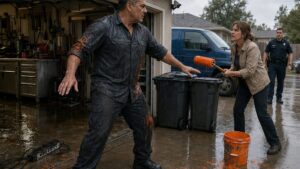
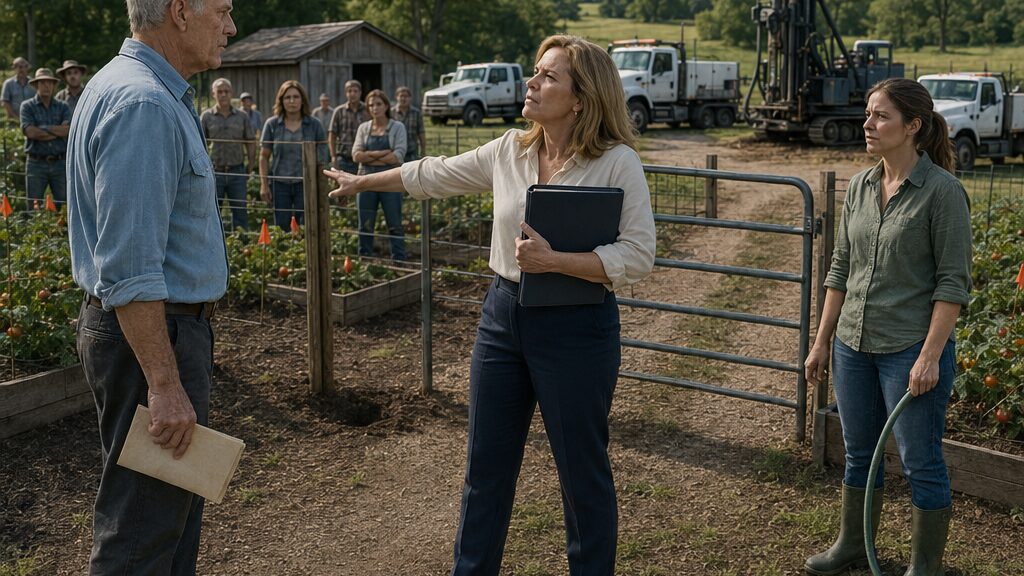
Cynthia Green stood between Robert and the nearest raised bed, one arm extended toward the gate as if she were directing traffic. Behind her, three women kept watering tomatoes. The spray from one hose struck the dark soil in a steady hiss.
Robert stopped beside a row of waist-high wooden boxes he had never agreed to put there.
The back pasture had once been open enough that he could stand at the eastern fence and see the walnut trees along the creek. Now there were fourteen planting beds, a tool shed with a green metal roof, two rain barrels, and a hand-painted sign that read COMMUNITY GARDEN in blue letters.
The sign leaned slightly to the left.
So did the corner post behind it, because someone had pulled the old boundary stake from the ground.
Robert looked at Cynthia’s pointing hand, then at the binder pressed against her blouse.
“Leave where?” he asked.
“The garden.”
“This is my pasture.”
Cynthia’s expression did not change. She had the settled smile of someone who had already rehearsed the exchange.
“This space has been adopted by the association for community use.”
“Adopted.”
“Yes.”
Robert glanced past her. A woman in jeans and rubber boots had stopped watering. Another held a basket against her hip. The third, Susan Adams, was tying tomato stems to a wire cage, but she was watching him closely.
Robert had seen Susan before at the mailbox cluster near the county road. He knew she had two children because they sometimes rode bicycles past his north fence. He had never spoken more than six words to her.
He looked back at Cynthia.
“I’ve got the deed in my truck.”
“That won’t be necessary.”
For the first time that morning, something in Robert’s chest moved faster than the rest of him.
He had spent thirty-eight years measuring land for people who argued over inches, drainage lines, fence corners, easements, old stones, and trees planted by men long dead. He had learned that anger made people careless. Carelessness made them say more than they intended.
So he kept his voice level.
“You’re telling me you won’t look at the deed.”
“I’m telling you this matter has already been reviewed.”
“By whom?”
“The board.”
The answer came so quickly it sounded less like confidence than habit.
Robert stepped closer, not enough to threaten her, only enough to see the tab on the binder. PROPERTY COMMITTEE had been printed in black on a white adhesive label. Beneath it, tucked into the clear front sleeve, was an association notice with his full name and mailing address.
He recognized the format immediately. It was not a casual letter. It had been issued as an official compliance notice.
Cynthia shifted the binder against her chest.
“You received our communication,” she said.
“I did.”
“Then you understand that interference with the garden could create liability.”
A short laugh escaped him before he could stop it.
Not because anything was funny.
Because the idea was so complete in its wrongness.
Susan set down the roll of garden twine. “Cynthia said you approved this.”
Robert turned toward her.
Susan’s face held no smugness. Only suspicion and a little embarrassment.
“She said you didn’t want your name attached to it,” Susan continued. “That you were fine with the land being used as long as the association handled insurance and maintenance.”
Robert looked back at Cynthia.
“That what you told them?”
Cynthia’s chin lifted. “We explained that there was an understanding.”
“There was no understanding.”
“There was correspondence.”
“There was a refusal.”
The hose kept running. Water overflowed one bed and made a muddy channel between the boards.
Cynthia’s smile disappeared.
“We are not going to debate board history in the garden.”
“My garden?”
“The community garden.”
“My pasture.”
Susan stepped forward. “Then why did nobody stop us last year?”
Robert turned to her again.
The honest answer was that he had expected the first letter to be enough. Then he had expected the second. After that, he had told himself that if he spoke to individual families, Cynthia would accuse him of harassment. He had watched the first beds go in from the kitchen window. He had watched the shed arrive on a flatbed trailer. Each time, he had folded another document into the file in his desk and decided the paper would speak when the time came.
He could hear now how silence had sounded from their side.
Like permission.
He did not say that.
Instead he said, “You should ask your board to show you what I signed.”
Susan’s eyes moved toward Cynthia.
Cynthia opened the binder just enough to remove a single sheet. She did not offer it to Robert. She held it at chest height, the association seal visible near the top.
“This property has been designated a protected neighborhood asset pending formal resolution of ownership questions.”
“There are no ownership questions.”
“Our counsel advised us not to allow disruption.”
“Your counsel seen the deed?”
“That is not something I’m discussing with you here.”
Robert looked at the locked chain around the pasture gate. The association had added its own brass padlock beside his weathered one. They had not cut his lock. They had simply made the gate impossible to open without theirs.
A careful insult.
The kind done by people who expected to explain later that they had technically damaged nothing.
Robert walked to the gate and touched the new lock.
Cynthia said, “Do not remove association property.”
He let his hand fall.
Across the fence, the lower pasture grass had begun turning gold in the June heat. Beyond the garden, near the rise, stood the two old cedar posts his wife had insisted they preserve when the county widened the road. She had called the pasture the quiet half of the property. The half nobody needed to improve.
He had promised her it would stay that way.
For twelve years after her death, it had.
Until the boxes, the shed, and the blue sign.
Robert returned to his truck without another word.
Cynthia called after him, “Mr. Hall, we would prefer to handle this cooperatively.”
He opened the driver’s door and looked back.
“Then you should’ve started that way.”
Susan stood beside the tomato bed, no longer touching the plants.
Cynthia hugged the binder tighter.
Robert climbed into the truck. He did not retrieve the deed. He did not call the sheriff. He did not call the county commissioner whose home line he still knew from his years in the survey office.
He sat with both hands on the steering wheel until his breathing slowed.
Then he took his phone from the cup holder and found a number he had not used in almost three years.
The exploration crew supervisor answered on the fourth ring.
“Hall?”
“It’s Robert.”
A pause. “Been a while.”
“I need access work done on the south tract.”
“What kind?”
“Subsurface testing. Full rights notice. Recorded route.”
The man’s voice sharpened. “You have a clear entry?”
Robert looked through the windshield at the new lock, the shed, the raised beds, and Cynthia standing in the middle of them as if the earth beneath her had already changed hands.
“I have an old service road from County Nine,” he said. “Use the coordinates from the 1998 filing.”
“How soon?”
Robert watched Susan pick up the hose and shut off the water.
“Before noon.”
Chapter 2: The Letter Buried Beneath the Garden’s Good Intentions
The first garden bed appeared on a Tuesday morning, squared neatly inside Robert’s fence as if it had grown there overnight.
He saw it from the kitchen window.
Four fresh boards. Dark soil. Metal corner brackets that flashed in the sun.
For several seconds he stood with his coffee halfway to his mouth, trying to decide whether distance had fooled him. Then he set the cup down and walked to the pasture.
The bed sat twenty-three feet inside his property line.
He knew the distance without measuring.
Two summers earlier, Cynthia Green had come to his porch carrying a folder and a paper cup from the gas station in town. She had been association president for less than a month. The subdivision beyond Robert’s north fence was still new enough that half the trees had support straps around them.
“We’re trying to create something useful,” she had said.
She showed him a sketch of six raised beds in the northeast corner of the pasture. There would be no permanent structures. No vehicles. No public access outside daylight hours. The association would maintain the fence.
Robert had read every line.
“Who owns the liability?” he asked.
“We’d carry coverage.”
“For injury?”
“Yes.”
“Water?”
“We’d bring it in.”
“Access?”
“Through the subdivision easement.”
“There is no subdivision easement onto my land.”
Cynthia smiled as though that were a detail to be handled later.
“We thought perhaps you could grant one.”
Robert closed the folder.
“No.”
Her smile held. “You haven’t seen the full proposal.”
“I’ve seen enough.”
“This could help families.”
“I’m not saying it couldn’t.”
“Then why refuse?”
Because his wife had asked him to.
Because the pasture was the last part of the property that had not been divided, leased, widened, crossed, or improved by someone with a plan.
Because every temporary use he had surveyed in his career eventually acquired a shed, a gate, a lawyer, and a memory of permission broader than the permission itself.
He told Cynthia only, “I don’t want public use on that tract.”
She asked him to reconsider.
He said he would answer in writing.
The next morning, Robert typed a single-page letter. He identified the parcel by legal description, denied the proposed garden and any related access, and stated that no verbal discussions should be interpreted as permission.
He mailed it certified.
The return receipt came back signed.
He put both copies in a manila folder.
For almost a year, nothing happened.
Then he found the first bed.
By Friday, there were three.
A week later, someone had removed two survey stakes near the eastern fence. Robert found one in the weeds, its faded pink ribbon torn away. The other was gone.
He called the association office and left a message.
No one returned it.
He sent a second letter with photographs.
Cynthia responded by email: The board is reviewing historical understandings related to the parcel.
Robert printed the email and placed it in the folder.
When the shed arrived the following month, he stood by the fence and watched four residents guide it off a trailer. Susan Adams was among them. She was laughing as the men lowered the skids onto concrete blocks.
Robert could have walked down then.
He could have held up the refusal letter.
He could have asked them who had told them they belonged there.
Instead he turned away.
Paper was cleaner than confrontation. Paper did not interrupt. Paper did not accuse him of being an old man standing against children and tomatoes.
The association meeting that fall was held in a rented room behind the volunteer fire station. Robert attended because the published agenda included “garden continuity.”
Cynthia sat at the center of a folding table with Virginia Harris beside her taking minutes.
Robert waited through discussions about streetlights, drainage, and mailbox repairs. When the garden item came up, Cynthia described it as “a successful pilot project serving fourteen households.”
Robert raised his hand.
Cynthia saw him and kept talking.
She mentioned a county wellness grant.
That was the first time Robert heard money had been involved.
“How much?” someone asked.
“Eight thousand five hundred,” Cynthia said. “Most of it has already been allocated.”
Robert stood.
“The land isn’t yours.”
The room quieted.
Cynthia’s gaze moved to him slowly. “Mr. Hall, public comment comes after the board report.”
“I denied this in writing before anything was built.”
Several residents turned toward her.
Virginia stopped typing.
Cynthia folded her hands. “There is an unresolved discrepancy regarding informal approval.”
“There is no discrepancy.”
“We have differing accounts.”
“You have my letter.”
“We have extensive correspondence.”
“Then read it.”
A board member cleared his throat. Another looked down at the table.
Cynthia thanked Robert for his comment and moved to the next agenda item.
He left before public comment.
That was his mistake, though he would not name it that until much later.
He believed leaving preserved his dignity.
What it preserved was Cynthia’s control of the explanation.
By spring, the garden had fourteen beds, a shed, rain barrels, and the blue sign. Families came on Saturday mornings with gloves, coolers, folding chairs, and children who chased each other along the fence.
Then the formal notice arrived.
The envelope carried the association’s return address. Inside was a document titled NOTICE OF PROTECTED COMMUNITY USE.
It advised Robert that the garden had been adopted as a neighborhood asset and warned that interference could expose him to claims related to crop loss, grant repayment, and resident safety.
Robert read it twice.
Then he checked the certified-mail receipt from his first refusal.
The signature was still there.
Cynthia Green.
He called the delivery service and requested the archived record. Two days later, they emailed a scan confirming the date, address, and recipient.
He printed it.
He added it to the folder.
He did not speak to Susan or any of the other families. When he saw them near the fence, he stayed inside. He told himself they had chosen their side.
At the next board meeting, Virginia Harris opened the approved minutes from the previous fall and searched for Robert’s objection.
It was not there.
The record stated only: Resident raised general concerns regarding future maintenance.
Virginia read the sentence three times.
She remembered Robert standing in the back row. She remembered his exact words: The land isn’t yours.
Her original draft minutes had included them.
The version approved by the board did not.
Virginia looked toward Cynthia at the center of the table.
Cynthia was discussing summer volunteer schedules as if nothing had been removed.
Chapter 3: Orange Flags Rose Between the Tomatoes Before Noon
At eleven thirteen, two white work trucks turned off County Nine and entered Robert’s old service road.
The brass association lock still hung on the main gate half a mile north. It did not matter. The service road had been recorded decades before the subdivision existed, a narrow strip of packed gravel leading from the county ditch to the south tract.
Robert stood beside the exploration crew supervisor as the first truck crossed the pasture.
“You sure about the route?” the supervisor asked.
“I laid it out.”
“That wasn’t what I asked.”
Robert looked toward the garden.
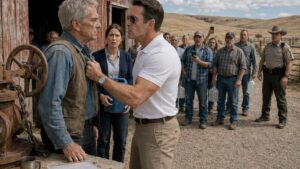
Cynthia had returned. She stood near the shed with Susan and four other residents. From that distance, Robert could not hear them, but he saw Cynthia lift her phone.
“The route is legal,” he said.
The supervisor studied him for another second, then signaled the crew forward.
A compact drilling rig came behind the trucks on a low trailer. Its steel mast lay folded flat. Bundles of orange flags rattled in a plastic bin.
The sound carried across the pasture.
Susan stepped through the garden gate first.
“What is that?”
Robert did not answer. He handed the supervisor a photocopy of the recorded access description and pointed toward the eastern line.
“Test points at twenty-five-foot intervals until the creek buffer. Keep the rig outside the marked drainage.”
The supervisor nodded to two workers. They collected flag bundles and started walking.
Cynthia hurried toward Robert, the same binder pressed against her chest.
“You cannot bring equipment in here.”
Robert took a folded notice from his shirt pocket.
“I can.”
“This is protected community property.”
“No. It’s occupied private property.”
“You were told not to interfere.”
“And you were told not to build.”
One of the workers pushed the first orange flag into the soil beside a tomato bed.
Cynthia turned at the movement.
The thin plastic marker trembled between green leaves.
“What are they doing?”
“Marking exploration points.”
“You can’t dig through our crops.”
“We’re not digging through your crops.”
“That machine is a drill.”
“It’s an exploration rig.”
Her face changed then. Not to fear exactly. To the recognition that Robert was using words she did not control.
She opened the binder and pulled out the association notice.
“Our attorney has advised—”
“Give him this.”
Robert held out his document.
She did not take it.
Susan did.
The heading read NOTICE OF EXERCISE OF RESERVED MINERAL AND GAS ACCESS RIGHTS. Beneath it were recording references, parcel numbers, and the route description.
Susan read the first page, then looked at Robert.
“You had this planned.”
“I had it available.”
“That isn’t what I said.”
Another flag went into the ground, then another. Orange points began forming a line along the beds.
Cynthia called someone.
Within twenty minutes, a dark sedan arrived at the end of the service road. Michael Brown stepped out wearing a white shirt with the sleeves buttoned despite the heat. He carried a leather portfolio and walked quickly without running.
“Stop all operations,” he said before reaching Robert.
The crew supervisor looked at Robert.
Robert said, “Keep marking. No drilling until counsel reads the filing.”
Michael’s expression tightened. “You don’t direct me.”
“No. I direct them.”
Cynthia handed Michael the association notice. Susan handed him Robert’s.
Michael read standing between the trucks. His eyes moved more slowly over Robert’s document than Cynthia’s.
“Where is the deed?” he asked.
“In my truck.”
“Bring it.”
Cynthia said, “Michael, the board adopted this space. We have continuous community use.”
“That may matter,” Michael said, still reading. “It may not matter the way you think.”
Her mouth opened, then closed.
Robert retrieved a worn envelope from behind the truck seat. The deed inside was not impressive. Cream paper. County stamps. Typed legal description. The mineral reservation appeared halfway down the second page.
Michael read it once.
Then again.
“You retained full subsurface rights,” he said.
“Yes.”
“And surface access necessary to evaluate them.”
“Yes.”
“Subject to reasonable-use limitations.”
“Of course.”
Cynthia stepped closer. “So stop them.”
Michael did not look at her. “I did not say the association can stop them.”
The words landed more heavily than Robert expected.
For months he had imagined some version of this moment: an attorney reading the paper, Cynthia losing her certainty, the garden no longer protected by repetition and a binder.
He had expected satisfaction.
Instead he noticed Susan standing beside the nearest bed, staring at the orange flag among the tomato vines.
A child’s name had been painted on the wooden side in purple.
Cynthia said, “Families have invested money here.”
“So have I,” Robert replied.
“Not in the garden.”
“In the land.”
“You don’t use this corner.”
“That doesn’t make it yours.”
Susan folded the mineral-rights notice. “We were shown a map.”
Robert looked at her.
“What map?”
“The donation map.”
“There is no donation map.”
“Yes, there is.” She pointed toward the shed. “It was in every volunteer packet. It showed the garden parcel separated from your pasture.”
Cynthia’s voice sharpened. “Susan, that is not relevant right now.”
Susan turned on her. “You told us he donated it.”
“I said there was an understanding.”
“You said the map had been approved.”
Michael looked up from the deed. “I need to see that document.”
Cynthia held his gaze for a moment too long.
Susan walked to the shed.
The crew continued planting flags. One beside the beans. One at the edge of the gravel path. One near the blue sign.
When Susan returned, she carried a laminated sheet with a simplified aerial drawing. The garden area had been shaded green. A dashed line separated it from the rest of Robert’s pasture. In the lower corner was a reproduction of a professional survey stamp.
Michael took the map first.
Robert saw the stamp over his shoulder.
The outer ring carried his old county certification number. The center bore the initials he had used for nearly three decades.
R.H.
For a moment, the garden, the crew, and Cynthia’s voice receded.
Robert took the laminated sheet from Michael.
The stamp was real.
Or at least it had once been real.
He knew the line weight, the spacing, the imperfect lower curve where the rubber had worn down after years in his field case.
It came from one of his surveys.
But he had never drawn that garden boundary.
He looked at the shaded parcel, then at Cynthia.
“Where did you get this?”
Cynthia’s answer came carefully.
“It was in the association’s property file.”
Robert ran his thumb over the smooth plastic covering his own reproduced mark.
The question was no longer whether the board had ignored his refusal.
Someone had taken work bearing his name and made it appear that he had measured away a piece of his own land.
Chapter 4: The Map Was Genuine, but the Story Around It Was Not
The county recorder placed the original survey beside the laminated garden map and aligned their lower corners.
“They’re from the same drawing,” she said.
Robert already knew.
The creek line had the same shallow bend. The old fence was marked with the same broken dash near the north corner. Even the slight tilt in the certification stamp matched.
But the association copy ended six inches sooner on the page.
The missing strip contained the title block, the parcel owner’s name, and a note Robert had written by hand before the survey was filed:
NO DIVISION OR TRANSFER OF OWNERSHIP SHOWN OR INTENDED.
The recorder tapped the note with one fingernail.
“Whoever made the smaller version cropped the margin.”
“Can you tell when?”
“Not from paper somebody laminated.”
“Can you tell who requested the original?”
She turned to her computer. “Maybe.”
The recorder’s office occupied the first floor of the county courthouse, a high-ceilinged room that smelled of dust, toner, and the old books stored behind glass. Robert had worked in and out of it for most of his career. He had once known every clerk by voice. Now the younger employees called him Mr. Hall and asked for identification before retrieving files he had helped create.
The recorder searched the archive log.
“This survey was scanned eight years ago as part of the digitization project,” she said. “After that, anyone using the public terminal could print it.”
“So there’s no request record.”
“Not unless somebody ordered a certified copy.”
She checked another screen and frowned.
“One certified copy was ordered last October.”
“By whom?”
“Green Valley Neighborhood Association.”
Robert looked at the association map again.
The date was months after the first garden beds had been built.
“They were already using the land,” he said.
The recorder nodded cautiously. “Looks that way.”
“So the map didn’t justify the garden. It was made to justify what they’d already done.”
“I can’t tell you why they requested it.”
“You just did.”
She leaned back from the desk.
“No, Robert. I told you what the log says.”
Her restraint stopped him.
He had spent years correcting clients who turned measurements into motives. A line could show where a fence stood. It could not prove why someone placed it there.
He gathered both copies.
“No forgery,” he said.
“Not exactly.”
“Misrepresentation.”
“That’s a question for counsel.”
Robert almost smiled. County employees learned that sentence early.
Before leaving, he asked for a certified copy of the full survey and the access filing attached to his deed. The recorder stamped each page, pressed the seal into the corner, and slid them across the counter.
The raised mark under his thumb felt more solid than anything Cynthia had said.
By noon the following day, the exploration company had suspended physical work while Michael reviewed the documents. The crew left the rig parked inside the south gate, its mast still folded. Orange flags remained throughout the garden.
The association posted yellow caution tape around the beds.
No residents were permitted past it.
Robert returned from town to find Susan standing outside his pasture gate with two plastic water jugs at her feet.
The brass association lock was gone. His old lock remained, and a temporary county notice had been wired to the chain.
SUSPENDED ACCESS PENDING SITE REVIEW.
Susan held up one jug.
“The tomatoes haven’t been watered since yesterday.”
“The notice applies to everyone.”
“Your crew went in.”
“They’re insured.”
“So am I.”
“Not for an active exploration site.”
“There’s no active exploration. The machine hasn’t moved.”
Robert climbed out of his truck.
“It can.”
“That supposed to make me feel better?”
“No.”
Susan glanced through the fence. Several tomato plants had begun to curl in the heat. One of the orange flags leaned against a wire cage, its plastic strip flicking in the breeze.
“My youngest planted those,” she said. “He checked them every morning before camp.”
Robert put the certified copies beneath his arm.
“I didn’t tell you to plant there.”
“No. Cynthia did.”
“She told you I donated it.”
“She showed us the map.”
“And when you never saw a deed?”
Susan’s face tightened. “I trusted the people running the project.”
“That was a mistake.”
“So was letting us keep building while you watched.”
The words struck cleanly because they did not excuse Cynthia.
Robert looked toward the beds.
“I sent letters.”
“To the board.”
“They represented you.”
“They represented themselves.”
He did not answer.
Susan stepped nearer the gate. “You could open this long enough for us to water.”
“I could also become responsible if somebody trips over a test marker or interferes with equipment.”
“We could sign waivers.”
“It’s not that simple.”
“Nothing seems simple when you don’t want it to be.”
Robert’s grip tightened on the documents.
“You think I wanted a garden built on my land?”
“I think you wanted them scared.”
He looked at her.
Susan’s eyes were red around the edges, but her voice stayed controlled.
“Maybe they deserved to be scared. I’m not arguing that. But you didn’t call us. You didn’t put a notice on the beds. You waited until everybody was here, then brought in trucks.”
“I used my legal access.”
“I know.”
The absence of argument made the accusation heavier.
“You were right,” she said. “And you chose the version of right that hurt the most people.”
Robert opened the truck’s rear door and placed the certified copies on the seat.
“There are liability issues.”
“There are always liability issues. That’s what people say when they don’t want to say what they mean.”
“What do you think I mean?”
“I think you wanted Cynthia to stand where you stood.”
He shut the door harder than necessary.
Susan picked up the water jugs.
“If the plants die, that’s on the board,” Robert said.
“Not all of it.”
She carried the jugs back toward her car.
Robert watched her go, then looked through the fence at the flags.
The line they formed was technically correct. Each point fell within the recorded exploration corridor. He had reviewed the coordinates twice.
He had also chosen that corridor from three available routes.
The eastern route crossed the garden.
The western route did not.
That evening, Robert spread the original survey and the association copy across his kitchen table.
The full map showed his name in the margin. The cropped version showed only his stamp.
Someone had not altered his work.
They had removed everything that explained it.
At eight forty, headlights swept across the front windows.
A small sedan stopped beside the porch.
Virginia Harris got out carrying a thick sealed folder against her chest.
Robert met her at the door.
She did not offer the folder.
“You need to let me explain before you open this,” she said.
“What is it?”
“The part of the record Cynthia thought was gone.”
Her hands were shaking.
Robert stepped aside.
Virginia entered the house but remained standing.
“I knew your letter existed,” she said. “And I knew the minutes had been changed.”
Robert looked at the sealed folder.
“How long?”
Virginia swallowed.
“Long enough that silence became a vote.”
Chapter 5: Virginia’s Silence Cost More Than the Board’s Missing Minutes
The folder contained Robert’s original refusal letter, Virginia’s first draft of the meeting minutes, and a second version covered with Cynthia’s handwritten changes.
Robert laid the pages in a row across the kitchen table.
In Virginia’s draft, the sentence was plain:
Robert Hall stated that the garden occupies his private property without permission and requested immediate removal.
In the approved version, it had become:
Resident raised general concerns regarding future maintenance.
Robert read both lines twice.
“You kept copies.”
“I kept everything.”
“But you let the altered version pass.”
Virginia sat across from him, both hands wrapped around a glass of water she had not touched.
“Yes.”
“Why?”
“At first? Because I thought it was temporary.”
“The lie?”
“The garden.”
Robert leaned back.
Virginia looked older than she had at the board meetings, though he supposed guilt could do that faster than years.
“The grant deadline was in September,” she said. “Cynthia had already told the county partnership office that site control was complete. Lumber was ordered. Insurance had been quoted. Families had paid participation fees.”
“Before she came to me.”
“Yes.”
Robert’s eyes moved to the certified-mail receipt bearing Cynthia’s signature.
“So my answer didn’t matter.”
“It mattered. That was the problem.”
Virginia told him what had happened after the refusal arrived. Cynthia had called an emergency board session and argued that Robert’s letter was a negotiating position, not a final decision. She said he had been friendly during the porch meeting. She claimed older landowners often rejected first proposals to improve terms.
“Did you believe her?” Robert asked.
“For a while.”
“And after the beds went in?”
Virginia looked down at the water.
“I told myself you would stop us if you truly objected.”
“I sent another letter.”
“I know.”
“You saw it?”
“Yes.”
The word came quietly.
Robert stood and walked to the sink.
Outside the window, the pasture lay dark beyond the yard light. He could not see the garden from there, but he knew exactly where each orange flag stood.
“Why are you here now?”
“Because Cynthia is telling the board you approved exploration years ago and are using it as leverage to force a sale.”
Robert turned.
“That isn’t even close.”
“I know.”
“You knew the other things too.”
Virginia flinched but did not defend herself.
“The board is meeting tomorrow,” she said. “Michael asked for every version of the minutes. Cynthia told me the drafts were destroyed.”
“And you decided not to lie this time.”
“Yes.”
The honesty left no easy place for Robert’s anger.
Virginia removed one final page from the folder. It was a budget worksheet. The garden grant had required matching funds, much of it promised through resident fees and local donations. If the project failed before two full seasons of operation, the association might owe repayment.
Cynthia’s handwritten notes filled the margin.
Cannot lose site now.
Public failure impossible.
Find legal route after opening.
Robert stared at the last line.
“She knew.”
“She believed she could negotiate after the garden became valuable enough that you wouldn’t make families remove it.”
“Build sympathy first.”
“She called it community reliance.”
“Same thing with better stationery.”
Virginia finally drank from the glass.
“She wasn’t trying to take your farm.”
“She took part of it.”
“She thought you would accept compensation later.”
“She never offered any.”
“She couldn’t. The association didn’t have the money.”
Robert looked again at the worksheet.
There it was: not greed, exactly. Not a plan to seize acreage and sell it. Something more ordinary and, in its way, more dangerous.
Cynthia had promised a result before securing the right to deliver it. Once money, reputation, and families were attached, every warning became an obstacle to manage.
Virginia said, “She kept saying the garden was doing good.”
“Was it?”
“Yes.”
Robert waited.
“That doesn’t make what we did right,” Virginia added.
“We.”
Her eyes lifted.
“I voted to continue.”
“After the second letter?”
“Yes.”
“Why?”
“Because I didn’t want to be the person who shut it down.”
“So you let me be that person.”
Virginia closed her eyes for a moment.
“Yes.”
The next morning, Michael called.
He spoke without greeting.
“The association’s counsel position has changed.”
“You’re the association’s counsel.”
“I’m aware.”
“What changed?”
“I reviewed the complete survey, the certified-mail records, and the documents Virginia provided.”
Robert looked toward the folder still open on the table.
“And?”
“The association has no defensible claim of ownership or permanent access.”
“That took a while.”
“It took evidence.”
“The deed was evidence.”
“The deed established ownership. It did not establish what representations were made afterward.”
Robert let the silence lengthen.
Michael continued. “Your exploration rights are valid, subject to reasonable use. The company may resume under the recorded filing.”
“For how long?”
“The permit window allows ninety-one days.”
Robert had known that.
Hearing it aloud made the number feel different.
Michael said, “There may be a less disruptive route.”
“There may.”
“You identified three potential corridors in the preliminary plan.”
“I did.”
“The western corridor avoids the garden.”
“It also adds cost and crosses soft ground.”
“The company says the difference is manageable.”
“Then why are you calling?”
“Because the eastern route remains legal, and you appear determined to use it.”
Robert looked through the window toward the pasture.
“I am using the route that follows the old service alignment.”
“You are using the route that puts the rig where Cynthia can see it.”
Robert’s jaw tightened.
“Careful.”
“I’m not accusing you of anything unlawful.”
“No. Just explaining my motives to me.”
“I’m asking whether you want the dispute resolved or displayed.”
Robert ended the call.
For the next week, the rig remained parked. The association’s insurer prohibited garden access until the route question was settled. Leaves browned. Beans sagged against their strings. The orange flags leaned in the wind, bright against plants losing color.
Robert drove past each morning.
He told himself the association could agree to remove the beds at any time.
He told himself the families could sue the board.
He told himself the garden was evidence of trespass, not a collection of individual labor.
On the sixth evening, he stopped beside the fence.
Susan stood on the subdivision side with her arms crossed.
Neither of them spoke at first.
“You still have the western route,” she said.
“So everybody tells me.”
“Is it unsafe?”
“No.”
“Illegal?”
“No.”
“Then why not use it?”
“Because it costs more and turns near the creek.”
“How much more?”
“That’s between me and the company.”
Susan nodded once.
“Then this isn’t only about boundaries.”
Robert looked at the rows beyond her.
“Cynthia knew my answer before the first board went in.”
“I know that now.”
“She used my work to make you think I agreed.”
“I know.”
“She locked me out.”
“I know.”
“Then stop asking me to make this easy for her.”
Susan’s face hardened.
“I’m not asking for her.”
Behind her, a child’s painted name showed through dust on the nearest bed.
“I’m asking you not to make us carry every pound of what she did.”
Robert had no answer that did not sound like a defense.
Susan turned away.
The next morning, a cardboard produce box sat on Robert’s porch.
Inside were split tomatoes, soft beans, and one cucumber gone yellow at the ends. The smell was sweet and sour in the heat.
Beneath them lay a photocopy of his first refusal letter.
Someone had circled one sentence in red:
No verbal discussions should be interpreted as permission.
On the bottom of the page, Susan had written six words.
Neither should silence be interpreted as guilt.
Robert stood with the box in his hands while a truck engine started beyond the pasture.
The exploration supervisor had arrived to ask which route Robert wanted marked for drilling.
Chapter 6: The Emergency Meeting Where Nobody Could Claim Innocence
Forty-two residents faced an empty row of six folding chairs.
The chairs belonged to board members who had resigned that afternoon.
Robert counted them before taking a seat near the back of the community pavilion. He had spent his working life counting objects people assumed were unimportant: stakes, corners, feet, signatures, missing pages.
Tonight, the empty chairs said more than the occupied ones.
On the table in front of him lay a bent orange survey flag.
He had pulled it from beside Susan’s tomato bed that morning after telling the exploration supervisor not to drill until further notice.
Cynthia sat alone at the center table. Michael occupied one end. Virginia sat at the other with a stack of copied records.
Susan stood with several garden families near the pavilion’s open side. No one spoke to Robert.
The county commissioner opened the meeting by stating that ownership of the disputed tract was not in question. Robert Hall held title. The association possessed no recorded easement, lease, license, or transfer.
A murmur passed through the chairs.
Cynthia did not look up.
The commissioner continued. The meeting would address board conduct, financial liability, garden access, and possible settlement. It would not determine criminal wrongdoing, because none had been alleged.
A resident near the front raised a hand.
“Then why did six people resign?”
Virginia answered before the commissioner could.
“Because we approved actions we should not have approved.”
She distributed copies of the altered minutes.
People read in silence. Paper shifted. A chair scraped concrete.
One man asked, “Who changed the wording?”
Virginia looked toward Cynthia.
Cynthia lifted her head.
“I did.”
The answer produced less noise than denial would have.
She folded her hands on the table.
“I changed it because the original wording presented the dispute as settled when I believed it was not.”
“You had his refusal,” Susan said.
“Yes.”
“You signed for it.”
“Yes.”
“You told us he agreed.”
Cynthia’s composure cracked at the edges.
“I told you we had a path forward.”
“You said donated.”
“I said dedicated.”
“You showed us a map.”
“The map came from county records.”
Robert spoke from the back.
“The map came from my survey. The meaning you put around it did not.”
Heads turned.
Cynthia looked at him for the first time.
“You could have stopped construction.”
“I tried.”
“You wrote letters.”
“That is how land matters are handled.”
“You watched families build.”
“And you watched them build on land you knew wasn’t yours.”
The commissioner raised a hand. “One at a time.”
Cynthia leaned back.
“The garden served fourteen households,” she said. “Some of those families were dealing with grocery costs, medical bills, and reduced work hours. We had grant funds that would have been lost. We had volunteers. We had a vacant corner of land Mr. Hall had not actively used in years.”
“It was not vacant,” Robert said. “It was pasture.”
“You didn’t graze it.”
“I didn’t owe you proof of use.”
“No,” Cynthia said. “You didn’t.”
Her agreement unsettled the room.
She looked toward the garden families.
“I made a decision. I believed that once the project existed, Mr. Hall would negotiate rather than remove it. I believed the benefit would outweigh the procedural problem.”
“Procedural problem,” someone repeated bitterly.
Cynthia’s voice sharpened. “You can call it what you like. But before everyone decides I acted for vanity, remember who asked for the beds. Remember who came to meetings demanding the board do something useful. Remember who praised the garden when the newspaper photographed the first harvest.”
Several residents looked down.
Cynthia turned to Robert.
“And remember that he had another route.”
The pavilion became still.
Michael removed his glasses.
Robert felt the bent flag beneath his fingertips.
Susan spoke. “What other route?”
Cynthia looked at Michael. “Tell them.”
Michael did not answer immediately.
Robert could have stopped him. The exploration plan was private. The route comparison involved costs, soil conditions, and access rights none of the residents fully understood.
Instead he said, “There were three.”
Susan stared at him.
“The western corridor avoids the beds,” Cynthia said. “It costs more, but it avoids them.”
The commissioner looked toward Robert. “Is that accurate?”
“Yes.”
“Why did you select the eastern alignment?”
Robert looked at the orange flag.
The plastic shaft had bent where a truck tire pressed it into the soil. It would never stand straight again.
“The eastern route follows the old service line,” he said.
“That isn’t the whole answer,” Susan said.
No anger lifted her voice. That made evasion impossible.
Robert looked across the pavilion at the residents, the resigned chairs, Virginia’s records, Cynthia’s binder, and the families whose plants had gone without water while adults argued over which version of permission sounded official.
He could still defend the route.
It was shorter. Firmer. Cheaper. Recorded.
All true.
Not complete.
“I wanted the board to understand what it felt like,” he said.
Nobody moved.
“To be told the decision was already made. To stand on your own ground and have somebody hold up a paper as if you were the problem.”
Cynthia’s face went pale.
Robert continued before pride could close his mouth.
“The eastern route was lawful. It was also the route that put the equipment through the garden. I knew that.”
Susan looked away.
“I told myself the families chose a side,” Robert said. “I did not ask whether they had been given the truth. I had the right to act. I used that right while I was angry.”
Cynthia gave a short, humorless breath.
“So now I’m wrong and you’re noble because you admit it.”
“No.”
Robert met her eyes.
“You were wrong. I was not noble.”
The distinction held the room.
Virginia pushed a document toward Michael. “What happens now?”
Michael outlined the association’s exposure: unauthorized occupation, possible grant repayment, restoration costs, crop claims, and legal fees. Then he placed a proposed settlement on the table.
The association would pay Robert a lump sum. In exchange, he would grant a broad permanent easement covering the existing garden, access lane, utilities, and future improvements.
Robert read the first page.
The language called the garden an established community use.
It required him to waive all claims related to prior entry.
It gave the association authority to expand improvements with reasonable notice.
The money was more than the garden corner was worth.
Cynthia watched him.
“This resolves everything,” she said.
“No.”
A resident muttered in frustration.
Michael said, “Review the full document.”
“I’ve reviewed enough.”
“What term is unacceptable?”
“The easement.”
“That is the basis of the offer.”
“Then there is no offer.”
Cynthia pushed back her chair. “You don’t want compensation. You want surrender.”
Robert lifted the bent flag from the table.
“No. I want the boundary recognized.”
“The garden has to go?”
“The permanent garden does.”
Susan’s face tightened, but she stayed silent.
Robert turned to Michael.
“Draft something else.”
Michael waited.
Robert placed the flag across the proposed settlement.
“One supervised harvest period for anything still alive. No construction. No new planting. The association pays documented crop losses and restores my pasture. The garden relocates to land it actually owns.”
“There is no prepared site,” Cynthia said.
“The common parcel behind the pavilion is large enough.”
“It has drainage issues.”
“I know.”
Cynthia stared at him.
Robert continued. “I’ll mark a usable section. At cost. The association records the new boundary, carries insurance, and acknowledges in writing that no use of my land was ever authorized.”
Michael began making notes.
“And the exploration?” he asked.
Robert looked toward Susan.
“Western route.”
A low murmur moved through the pavilion.
“The additional cost?” Michael asked.
“Mine.”
Cynthia’s mouth tightened. “You expect me to sign a confession.”
“I expect the association to correct the record.”
“And if I refuse?”
“Then the permit remains active for ninety-one days, and your insurer keeps the garden closed.”
The answer was firm, but it no longer pleased him.
Michael gathered the rejected agreement.
“I can draft revised terms.”
“Not revisions,” Robert said. “A different document.”
Michael studied him, then nodded.
Cynthia closed her binder.
For the first time since Robert had met her, she looked less like a president than a woman calculating the full cost of a promise made too soon.
As the meeting ended, Susan approached the table.
“You’ll really move the route?”
“Yes.”
“Even if she doesn’t sign?”
Robert looked at Cynthia, still seated beneath the pavilion lights.
“If she doesn’t sign, I’ll decide what happens next.”
Susan touched the bent flag but did not take it.
“That isn’t an answer.”
“It’s the one I have tonight.”
Michael slid a blank legal pad between them.
“What exactly do you want the new agreement to say?”
Robert pulled out a chair.
This time, instead of handing someone an old document and expecting it to speak for him, he began dictating
Chapter 7: The New Boundary Was Signed Before the Last Harvest
Robert pulled the first orange flag from the tomato bed before anyone else arrived.
The plastic shaft resisted for an inch, then came free with a small sound from the damp soil. Its lower half was stained brown. The top leaned permanently to one side where a truck tire had bent it.
He laid it across the tailgate.
Beyond the old garden, new flags formed a straight line across the common parcel behind the pavilion. Robert had placed them the previous afternoon with a county map, a level, and Susan walking ten paces behind him carrying the stakes.
The new site was not perfect. Water gathered along its western edge after heavy rain, and the soil would need compost before spring. But it belonged to the association. No cropped survey, verbal understanding, or future board could change that.
Michael arrived with three copies of the agreement in a leather folder.
Cynthia came separately.
She parked near the pavilion and remained in her car until Susan and several garden families had gathered by the gate. Then she stepped out carrying the association binder. The white PROPERTY COMMITTEE label had begun peeling at one corner.
Robert unlocked the pasture himself.
“No children inside the marked corridor,” he said. “Adults stay between the white stakes. Nothing gets replanted.”
Susan nodded. “We understand.”
A woman behind her asked, “What about the beans near the shed?”
“If they’re alive, take them.”
“And the beds?”
“They come out after harvest.”
Nobody argued.
The temporary access agreement allowed one morning for gathering surviving produce. The association’s insurer had approved the plan after reviewing the route change and the crew’s safety requirements. The exploration rig had already been moved west, away from the garden, leaving only tire impressions and the orange flags behind.
Robert watched the families enter.
The garden no longer looked like the place Cynthia had defended a month earlier. Tomato leaves hung curled and gray at the edges. Several bean vines had collapsed against their strings. Weeds filled the paths where people had once carried watering cans.
Still, there was food.
Susan knelt beside the bed with her child’s name painted in purple. She turned over leaves carefully and found three red tomatoes sheltered near the center.
She placed them in a cardboard box rather than a basket.
Robert recognized the box. It was not the same one left on his porch, but it had the same grocery-store lettering on the side.
Cynthia approached him while the families worked.
“The board approved the payment schedule,” she said.
Robert looked toward Michael.
Michael opened the folder. “Documented crop losses will be paid from association reserves and insurance proceeds. Restoration costs are separate. Grant repayment remains under review.”
“And the acknowledgment?” Robert asked.
“Included exactly as requested.”
Michael handed him the agreement.
The relevant paragraph appeared on the second page:
The Association acknowledges that no prior use of the Hall property was authorized by deed, easement, lease, license, donation, dedication, or enforceable verbal agreement.
Robert read it twice.
The next paragraph granted temporary supervised access for harvesting only. Another required removal of the shed, beds, rain barrels, signs, locks, and all introduced materials within thirty days. The association would restore the pasture surface under Robert’s approval.
The final section described the relocated garden parcel using the measurements Robert had prepared.
Not an understanding.
Not a colored area on a cropped map.
A legal description.
Cynthia stood with her arms folded.
“You got every sentence you wanted.”
“No,” Robert said.
She looked at him.
“I removed the personal-liability clause.”
“That was Michael’s recommendation.”
“It was mine.”
Her expression changed slightly.
The first draft had required Cynthia and the six resigned board members to accept individual responsibility for all costs. Robert had crossed it out. The association had acted through its board, and the association would answer through its records, insurance, reserves, and elections.
He had no interest in turning the agreement into a private weapon.
Cynthia looked toward the families harvesting what remained.
“They still blame me.”
“They should.”
“And you?”
“They should blame me for part of it.”
She gave a faint, bitter smile. “That admission has been very useful to you.”
“It didn’t feel useful.”
“No. But people forgive a man who says he was angry. They don’t forgive a woman who says she believed she could make something work.”
Robert folded the agreement along its center but did not put it away.
“You didn’t just believe.”
“I know.”
“You hid my refusal.”
“I know.”
“You changed the record.”
“I know.”
The repetition did not soften anything. It did, however, end the need to prove it again.
Cynthia watched Susan lift another box from the bed.
“The garden did help people,” she said.
“I know.”
That answer seemed to hurt her more than denial would have.
Michael called them to the folding table under the pavilion. Three pens waited beside the documents.
Susan arrived carrying dirt on both knees.
“Why am I signing?” she asked.
“As garden coordinator,” Michael said. “You’re acknowledging the relocation plan, harvest conditions, and future verification requirements.”
Cynthia pulled out a chair but did not sit.
Susan read every page.
Robert noticed she paused longest at the paragraph stating that no future garden site could be used until ownership, insurance, and recorded access were independently confirmed.
She signed first.
The scratch of her pen across the paper was the only sound beneath the pavilion.
Cynthia stared at the signature.
“You could have waited,” she said.
Susan set down the pen. “We waited before. That was the problem.”
Cynthia sat and signed beneath her.
Her handwriting was narrow and controlled. When she finished, she closed the binder and pushed it away from herself.
“I’m resigning at the end of the week,” she said.
Michael stopped arranging the copies.
“That isn’t required by the agreement.”
“It’s required by the neighborhood.”
Susan did not respond.
Robert signed last.
He felt no triumph when his name appeared under theirs. Only the weight of something finally stated in full.
At the county filing office that afternoon, the recorder reviewed the legal description and pressed the seal into the document.
“Different kind of map this time,” she said.
“Yes.”
She handed Robert the recorded copy.
Outside, Susan waited beside her car with the last box of tomatoes on the hood. The association had already removed the blue community-garden sign. In its place, on the common parcel, the new flags stood in a clean line from the pavilion toward the drainage swale.
Robert walked to his truck, then stopped.
The bent orange flag lay behind the seat.
He took it out and carried it to Susan.
She looked at it but did not reach for it.
“What am I supposed to do with that?”
“Keep it until the new beds are built.”
“As a warning?”
“As proof somebody measured first.”
Susan accepted the flag by its crooked shaft.
For a moment they stood without speaking.
Cynthia drove past the courthouse entrance without slowing. She did not wave. Robert had not expected her to.
Susan rested the flag across the tomato box.
“My son asked whether he can paint his name on the new bed.”
“That land belongs to the association.”
“That wasn’t my question.”
Robert looked at the recorded agreement in his hand.
“Yes,” he said. “After the boundary markers are set.”
Susan nodded.
Robert climbed into his truck and watched her drive toward the new garden site, the bent flag visible through the rear window.
It no longer marked where people had ignored a line.
It marked where they had finally agreed to draw one.
The story has ended.