He Built a Shed Seven Feet Over My Property Line, So I Let the Boundary Speak
Chapter 1: The Green Shed Beyond the Old Iron Line
The concrete footing sat where Raymond Adams’s garden path was supposed to end.
He stopped with one boot on the last flat stone and stared at the pale gray block rising from the soil. It was still new enough to show the wooden form’s grain along one side. Above it stood the corner of Jack Mitchell’s green metal shed, its aluminum wall catching the thin morning light.
Raymond looked down the path, then toward the oak tree near the back corner of his lot.
The distance was wrong.
He had lived on the half-acre property for nineteen years. He knew the places where water collected after heavy rain, where Rebecca’s daffodils appeared first each spring, and where the remains of an old iron boundary line disappeared beneath the grass. He could walk the yard in darkness without stepping into the shallow dip beside the oak.
The shed changed that familiar geometry. It occupied space his eyes remembered as open.
Jack had mentioned buying a prefabricated building. He had said he needed somewhere dry for tools and contracting equipment. Raymond had nodded from his driveway and said it sounded useful.
He had not asked where Jack planned to put it.
That omission now felt like a decision he had made without knowing it.
Raymond crossed the grass slowly. The shed’s long wall ran parallel to the old line, or nearly parallel. Its rear corner seemed to sit well beyond the rusted iron remnant that protruded from the ground near the oak.
He crouched beside the footing. The soil around it had been dug, leveled, and packed. A tire track crossed the narrow strip where Raymond sometimes pushed his wheelbarrow.
Something bright showed beneath a clot of mud.
He pulled at it with two fingers and uncovered a bent orange survey flag. Its thin wire stem had been folded flat and pressed into the disturbed earth.
Raymond held it by the wire.
For several seconds, he heard his father’s voice as clearly as if the old man were standing behind him.
Don’t start something unless you’re ready to finish it.
His father had used the sentence before arguments, during arguments, and occasionally after throwing something. Raymond had spent most of his adult life proving that silence could stop trouble before it started.
He pushed the memory aside and studied the flag. Orange plastic was common. Utility companies used it. Landscapers used it. Surveyors used it.
It proved nothing by itself.
The shed door opened on Jack’s side. Metal scraped against metal, and Jack stepped out carrying a coil of extension cord. He wore work jeans and a sleeveless green shirt despite the chill.
“You checking out the new palace?” Jack called.
Raymond stood. “I was looking at the footing.”
Jack glanced at it without coming closer. “Crew poured them deep. Thing won’t move in a hurricane.”
“That’s what I was wondering about.”
Jack grinned as if Raymond had complimented the work. “I’m done losing half a day because rain got into my saw cases.”
Raymond looked from Jack to the buried flag. A direct question formed in his mind.
Did you check the line?
He imagined Jack’s shoulders tightening. He imagined the conversation carrying over the fence, Rebecca hearing it from the kitchen, neighboring curtains shifting. He imagined himself becoming louder than he intended.
Instead, he lifted the orange flag.
“Found this under the dirt.”
Jack’s expression changed only slightly. “Install crew had markers everywhere.”
“What were they marking?”
“Utilities, probably.”
Jack bent to pick up the extension cord. The answer was casual enough to end the exchange if Raymond allowed it.
Raymond did.
He carried the flag back to the house and placed it on the workbench in the garage.
Rebecca was making coffee when he entered the kitchen.
“Jack’s shed is finished,” she said.
“So I saw.”
“It’s bigger than I expected.”
Raymond opened the cabinet beneath the desk where they kept property papers, appliance warranties, and tax records. The folders leaned against one another in no useful order.
Rebecca watched him pull them out.
“What are you looking for?”
“The survey from when we bought the house.”
Her hand stopped above the coffee tin. “Is something wrong?”
“I don’t know yet.”
He found the closing folder beneath an envelope containing an expired furnace warranty. The survey was folded into quarters, the creases soft from age. When he opened it on the kitchen table, the paper resisted lying flat.
The lot appeared as clean black lines. Measurements ran along each edge. The house, patio, oak tree, and drainage easement were marked with the confidence of things that could not move.
Raymond traced the rear boundary with his finger. From the corner of the house to the iron pin near the oak, the distance was written plainly.
He looked through the window at the green shed.
Even allowing for perspective, the rear footing stood on the wrong side of that line.
Rebecca leaned over the paper. “How far?”
“I need to measure it.”
“That isn’t what I asked.”
Raymond folded the survey again, more carefully than necessary.
“Maybe a few feet.”
Rebecca followed his gaze outside. “Did Jack ask you?”
“No.”
“Then you should ask him.”
“I should verify it first.”
She studied his face but did not argue. That almost made the pressure worse.
The following Saturday, Jack lit a charcoal grill beside the shed.
Raymond smelled it before he saw it. Smoke drifted over the yard in a low gray sheet, struck the metal wall, and curled toward the Adams house. An easterly breeze pushed it through the open kitchen window.
Rebecca coughed and hurried to close the sash. Smoke had already rolled above the sink and gathered beneath the ceiling.
She grabbed the dish towel and waved it toward the back door.
“Raymond.”
“I see it.”
“The curtains are going to smell for a week.”
Outside, Jack stood at the grill with tongs in one hand. His teenage son carried a tray from the house. Neither appeared to notice the smoke crossing the yard.
Raymond went to the back door and put his hand on the knob.
His pulse was hard enough to feel in his fingertips.
He could walk over. He could point at the smoke, the shed, and the buried flag. He could demand an explanation while the charcoal was hot and Jack’s son was watching.
Instead, Raymond closed the kitchen window more firmly and turned the lock.
Rebecca let the towel fall to the counter. “You’re not going to say anything?”
“I’m going to know exactly what I’m saying first.”
“You always say that.”
The words landed more sharply than she seemed to intend.
Raymond carried the survey into the yard with a tape measure and a small notebook. He began at the rear corner of the house and followed the dimensions shown on the paper. His first measurement placed the legal line beneath the shed’s roof.
He repeated it.
The second result was nearly identical.
The wall itself appeared more than six feet over. The footing extended farther. Depending on the location of the buried corner pin, the deepest section might be close to seven feet inside Raymond’s lot.
He photographed the tape beside the rusted iron remnant. Then he photographed the shed from three angles.
At the oak tree, he searched for the original corner marker. He cleared leaves, pressed a screwdriver into the soil, and dug carefully with a hand trowel.
He found no iron pin.
Instead, beneath two inches of fresh fill, the concrete footing continued toward the exact point where the survey said the marker should have been.
Raymond sat back on his heels.
The issue was no longer whether the shed looked too close. Fresh concrete covered the place where the legal corner was supposed to exist.
He looked toward Jack’s yard.
Jack stood beside the grill, speaking to his son as if nothing had changed between the two properties.
Raymond pushed the bent orange flag into the soil beside the footing.
It leaned at an angle, bright and undeniable against the green wall.
Chapter 2: The Measurements That Changed Their History
Joshua Torres’s measuring rod landed inside the locked shed.
The electronic receiver chirped once, and Joshua looked at the coordinates on his controller. Then he looked at the green wall blocking the point where the rod needed to stand.
“That’s inconvenient,” he said.
Raymond folded his arms. “Is that the corner?”
“No. It’s a point on the boundary run.” Joshua adjusted his cap and checked the screen again. “The rear corner should be farther back. But based on the deed calls, this line passes through the structure.”
Three days had passed since Raymond found the footing over the missing marker. During that time, he had slept poorly and created a folder labeled MITCHELL SHED in block letters. It contained photographs, copies of the deed, the old survey, and notes of every exchange he could remember having with Jack about the side yard.
There were fewer notes than he wanted.
Joshua had spent the first hour locating reference monuments farther down the street. Now two new orange flags stood in Raymond’s grass, connected in his mind by a line that cut through Jack’s building.
“How far over?” Raymond asked.
Joshua did not answer immediately. “I need to finish the fieldwork before I certify anything.”
“Approximately.”
“Approximately seven feet at the rear corner. Less at the front. The shed isn’t perfectly aligned with the legal boundary.”
Raymond stared at the wall.
Seven feet sounded different when spoken by a licensed surveyor.
The shed door opened. Jack came around the corner carrying a cordless drill. He stopped when he saw Joshua’s tripod, rod, and flags.
“What’s all this?”
“A boundary survey,” Raymond said.
Jack’s jaw shifted. “You hired a surveyor without talking to me?”
“I tried to establish the line myself first.”
“That’s not talking to me.”
Joshua lowered the rod. “I’m only here to locate the deed boundary. I’m not making a legal determination about ownership or use.”
Jack gave him a short look. “Then tell him the HOA approved my shed.”
“That’s outside my scope.”
Jack turned back to Raymond. “You could’ve knocked on my door.”
Raymond thought of the buried flag and the smoke in Rebecca’s kitchen.
“I’m knocking now.”
“No, you brought equipment.”
Joshua stepped away to enter another reading, making his neutrality visible.
Raymond kept his voice level. “The preliminary line goes through the shed.”
“Your old line does.”
“The deed line.”
Jack laughed once without humor. “You think I poured concrete based on a guess?”
“I don’t know what you based it on.”
“I based it on approval.”
Jack walked toward his garage. He returned carrying a clear plastic sleeve with a sheet inside. A rectangular blue stamp showed near the bottom.
He held it out, but not close enough for Raymond to take.
The page was a site sketch showing both houses, a dashed side line, and a small rectangle labeled accessory structure. The HOA stamp read APPROVED, with a date from six weeks earlier.
“The board signed off,” Jack said. “Placement, exterior color, roof height. Everything.”
Raymond studied the dashed line. It ran several feet closer to his house than the boundary shown on his deed survey.
“Where did this line come from?”
“The management office.”
“That doesn’t make it a property survey.”
“It makes it approved.”
Joshua returned from the tripod. “Those are separate questions.”
Jack turned on him. “Is my shed over the line or not?”
Joshua’s expression remained flat. “My field evidence indicates that it is. I’ll provide a certified drawing after I reconcile the corner evidence.”
“What corner evidence?”
“The recorded monument at the rear appears to be missing or obstructed.”
Jack looked toward the concrete footing. “There was never a pin there.”
Raymond watched him closely. “How would you know?”
For the first time, Jack hesitated.
“I’ve lived here twelve years.”
“So you looked for it?”
“I mow the area.”
“You also buried an orange flag.”
Jack’s eyes moved to the bent flag Raymond had reset beside the shed.
“That could’ve belonged to anybody.”
“It was under the fill.”
“Then ask the crew. I didn’t install the thing myself.”
His voice had risen enough that one of the neighboring homeowners had stepped onto a back deck.
Raymond felt the old instinct to retreat, to reduce the size of the moment before it became public. He almost told Joshua they could finish later.
Instead, he opened his notebook.
“When did the crew pour the footings?”
Jack stared at the notebook as though it were an insult.
“You’re documenting me now?”
“I’m documenting the property.”
“That strip was never an issue until this week.”
“It became an issue when you put a building on it.”
Jack stepped close enough that Raymond could smell sawdust and coffee on his clothes.
“I have a stamped approval,” he said quietly. “You have a photocopy from nineteen years ago.”
Joshua cleared his throat. “Mr. Mitchell, I need access near the rear footing to complete the measurements.”
“You’re not entering my shed.”
“I don’t need to enter. I need to measure around it.”
Jack looked at Raymond. “He stays on your property.”
“That appears to be where the shed is,” Raymond said.
The sentence escaped before Raymond could soften it.
Jack’s face hardened. For a moment, neither man moved.
Then Jack shoved the approval sketch back into its sleeve and walked away.
Joshua waited until the shed door slammed.
“That exchange won’t help the accuracy of my work,” he said.
“I know.”
“Do you?”
Raymond looked at him.
Joshua pointed toward the flags. “People think a survey settles an argument. It settles a measurement. Sometimes that creates a larger argument.”
By afternoon, Joshua had found the front corner monument and two subdivision control points. The rear marker remained inaccessible beneath or beside the footing, but the surrounding evidence was consistent.
At the county records office, Raymond and Joshua compared the original subdivision plat with Raymond’s deed description. The clerk retrieved a scanned survey from a neighboring parcel completed eight years earlier.
All three records placed the boundary along the same path.
Joshua marked the encroachment in red pencil on a working copy.
Six feet eight inches at the front corner of the shed.
Seven feet three inches at the rear.
The roof overhang extended another ten inches.
“There’s your professional confirmation,” Joshua said. “Subject to the final certified drawing.”
Raymond should have felt relief. Instead, he imagined the green wall standing over those numbers and understood how much money, labor, and pride had already hardened around the mistake.
That evening, his phone chimed while he was washing charcoal odor from the kitchen curtains.
The email came from Lisa Clark, the HOA property-compliance manager.
Raymond opened it with wet hands.
The message thanked him for his inquiry and stated that the architectural review committee had examined Jack Mitchell’s application. According to HOA records, the accessory structure had been reviewed and properly approved before installation.
Because boundary ownership was considered a private civil matter, the association would take no enforcement action against the shed.
A final sentence appeared below Lisa’s signature.
Any alteration, barrier, or landscaping installed in response to the dispute would remain subject to HOA approval.
Raymond read the sentence twice.
The licensed measurements placed the shed seven feet inside his land.
The HOA had now declared it properly approved.
Chapter 3: Fourteen Thorn Bushes and One Warning
The nursery employee held the thorny cane between two gloved fingers and looked at Raymond as if offering him one last chance to reconsider.
“This variety doesn’t make a polite hedge,” she said. “Once it fills in, you won’t walk through it without leaving something behind.”
Raymond examined the rows of dormant plants. Each stood in a black container, bare except for reddish stems and hooked thorns nearly two inches long.
“That’s the point of a barrier.”
“There are softer options.”
“Are they as dense?”
“Not this fast.”
“Are they prohibited?”
She glanced at the order sheet on her clipboard. “Not by us.”
Rebecca stood ten feet away beside the cart, her mouth set in a line Raymond recognized. She had agreed to come because her car had more cargo space. She had not agreed with the purchase.
Raymond selected fourteen plants.
At home, he arranged the certified survey, county ordinance, and HOA covenants across his desk. Joshua’s final drawing showed the boundary as a heavy line passing through the green shed. The county rule allowed natural barriers planted entirely within a property owner’s lot, subject to visibility requirements near streets and drainage easements.
The side yard involved neither.
The HOA covenants required approval for fences and permanent structures. They mentioned ornamental landscaping but imposed no application requirement for shrubs under four feet at planting.
Raymond highlighted each relevant sentence.
Then he called a local attorney.
The conversation lasted eighteen minutes. The attorney warned him not to touch Jack’s shed, block lawful access to Jack’s property, or represent the county ordinance as a final legal judgment. A demand letter could be prepared, but litigation would be slow and expensive.
“Can I plant shrubs on my own land?” Raymond asked.
“Generally, yes, assuming no easement or covenant prohibits them.”
“What if they’re thorny?”
A pause followed.
“Your motive matters less than compliance until somebody has to explain it to a judge. Then motive can matter quite a lot.”
Raymond looked through the office window at the green wall.
“I want the line protected.”
“Then protect the line. Don’t create a trap.”
On Friday afternoon, Raymond stretched a mason’s string between Joshua’s orange flags. The string passed so close to the shed that its shadow touched the siding.
He marked fourteen planting points, each eighteen inches apart.
The first shovel cut into soft soil. The second struck a thin root. By the fifth hole, sweat darkened the back of his shirt despite the cool air.
Rebecca came outside carrying two glasses of water.
“You measured every one?”
“Twice.”
She handed him a glass and looked at the rows of containers.
“What happens when they grow?”
“They form a hedge.”
“You know what I’m asking.”
Raymond drank without answering.
Rebecca stepped carefully over the string. “Do you want protection, or do you want punishment?”
“The shed is on our property.”
“That isn’t an answer.”
“He ignored the boundary.”
“And now you’re planting something designed to hurt anyone who comes near it.”
“I’m planting on our side.”
“You chose the thorniest thing at the nursery.”
“It’s dense. It grows quickly.”
“You smiled when she warned you.”
Raymond set down the glass.
The accusation was small and accurate. That made it difficult to dismiss.
“I’m tired of people treating restraint like permission,” he said.
Rebecca’s expression softened, but only slightly. “Then tell him no. Don’t make the plants say it for you.”
Raymond returned to the hole.
His father had never struggled to say no. The word had filled rooms, ended meals, and sometimes sent Raymond’s mother outside until dark. Raymond had built a life around the belief that careful preparation was the opposite of anger.
Yet as he set the first thorn bush beside the green shed, he imagined Jack trying to reach the wall and being forced back.
The image gave him satisfaction.
He disliked that Rebecca had seen it.
By sunset, the first row stood upright beneath the orange flags. Raymond watered each plant, photographed its position against the survey string, and measured the distance from every trunk to the legal boundary.
Saturday morning, he planted a staggered second row where the yard widened near the rear footing. Sunday, he spread hardwood mulch around the roots.
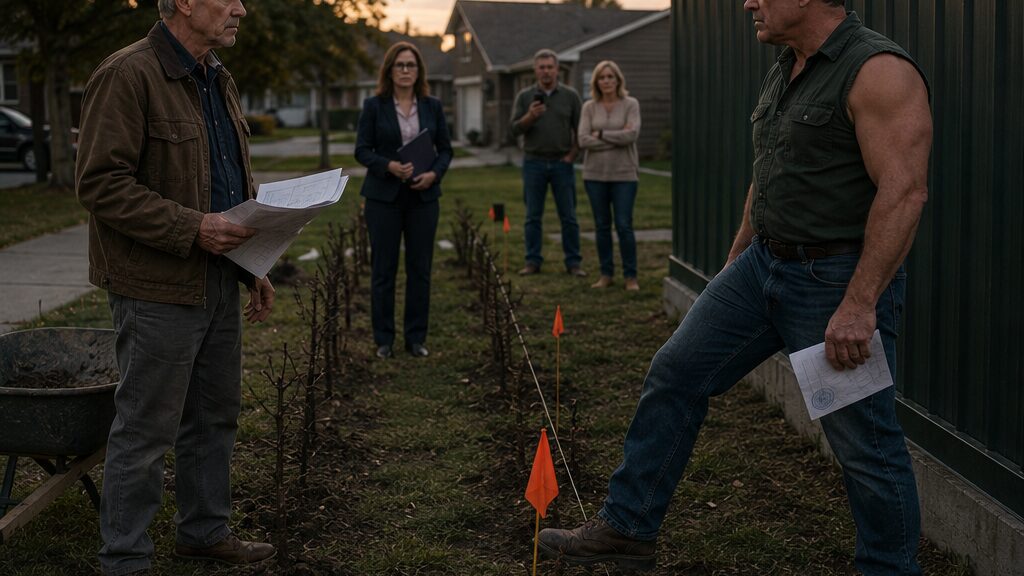
The hedge looked unimpressive—thin reddish canes, bare soil, and orange flags beside an oversized metal building.
Its meaning was larger than its size.
Late Sunday afternoon, Jack emerged with his phone.
He photographed the plants from his driveway. Then he moved toward the shed and took several more pictures.
Raymond continued spreading mulch.
“What are those?” Jack asked.
“Boundary shrubs.”
Jack laughed. “Boundary shrubs.”
“They’re entirely on my property.”
“You planning to grow them against my building?”
“The building is already against my property.”
Jack raised the phone and photographed Raymond.
“Lisa will want to see this.”
“I’ve read the covenants.”
“So have I.”
Raymond stood and brushed mulch from his gloves. “Then you know shrubs at this size don’t require architectural approval.”
“You think wording is going to save you?”
“Save me from what?”
“Harassment. Interference. Whatever my attorney calls it.”
Raymond felt a pulse of doubt. He had not considered Jack obtaining counsel, though the possibility should have been obvious.
He retrieved the clear sleeve from the patio table. Inside were Joshua’s survey, the county rule, and the attorney’s preliminary notice.
Jack’s gaze fixed on the papers.
Two neighboring homeowners had stopped near the sidewalk. Lisa Clark stood beside her car across the street, holding a folder against her coat. Raymond had not seen her arrive.
The private dispute had acquired an audience.
Jack came through the gap between the properties. His boots passed the first orange flag and stopped on Raymond’s side of the string.
“Take them out,” he said.
Raymond remained beside the wheelbarrow.
“You’re standing across the certified line.”
“I’m standing where I’ve stood for twelve years.”
“That doesn’t make it yours.”
Jack folded his arms. He was broader than Raymond by several inches, and close enough that Raymond had to look slightly upward.
“Those thorns damage my siding, you’re paying for it.”
Raymond unfolded Joshua’s survey against the green metal wall. The heavy boundary line crossed directly beneath Jack’s elbow.
“This is the rear monument,” Raymond said, pointing. “This is the front monument. The certified line runs between them. Your front footing is six feet eight inches over. The rear is seven feet three.”
Jack’s expression did not change.
Raymond placed the county ordinance over the survey.
“This permits a natural barrier within my boundary. The shrubs are inside it.”
He held up the attorney’s notice last.
“And this asks you to stop using the strip and discuss removal of the encroachment.”
The two neighboring homeowners watched without speaking. Lisa opened her folder but did not step closer.
For one clean second, Raymond felt the balance shift. Jack had arrived with size, anger, and assumption. Raymond had answered with measurements, rules, and a written demand.
Then Jack reached into his back pocket.
He pulled out a folded sheet protected by clear plastic and slapped it against the shed beside Raymond’s survey.
A blue HOA stamp showed at the bottom.
“Approved placement,” Jack said. “Approved dimensions. Approved before a drop of concrete was poured.”
Lisa finally approached.
“That is the plan in our file,” she said.
Raymond looked from the dashed line on Jack’s sketch to the heavy line on Joshua’s certified survey. They divided the same two yards in two different places.
Jack tapped the blue stamp.
“You’re acting like I stole something,” he said. “I built exactly where they told me I could.”
The orange flag between their boots trembled in the breeze.
Raymond had proof that the shed crossed his deeded boundary.
Jack had proof that someone had approved it anyway.
Chapter 4: The Approval Stamp That Should Not Exist
The violation notice arrived before breakfast on Tuesday.
Raymond found it taped inside the storm door, sealed in a white envelope bearing the HOA’s return address. The letter gave him ten days to remove the thorn shrubs or submit an approved landscaping plan. Failure to comply could result in daily fines and a hearing before the board.
He read it twice before carrying it into the kitchen.
Rebecca was opening the curtains. Beyond the glass, the fourteen young bushes stood in two raw rows beside the green shed, their thin canes almost harmless in the morning light.
“They moved quickly,” she said.
Raymond placed the notice on the table.
“They’re calling the hedge an unapproved barrier.”
Rebecca read the first page, then looked toward Jack’s yard. “And the shed?”
“Still approved.”
The contradiction burned more than the deadline. The association had refused to intervene because the shed was supposedly a private property matter, yet it had found authority over shrubs planted inside the very boundary it claimed not to adjudicate.
Raymond gathered Joshua’s certified survey, Jack’s stamped sketch, the county ordinance, and the violation letter into his folder. By ten that morning, he was seated across from Lisa Clark in the HOA management office.
Lisa’s desk was too small for the amount of paper stacked on it. Architectural applications, violation photographs, insurance forms, and meeting packets filled three trays. She appeared tired rather than hostile, which made Raymond more careful with his anger.
“You approved a permanent structure without confirming the property line,” he said.
Lisa folded her hands. “The architectural committee approved the design and proposed placement shown on the submitted plan.”
“The proposed placement is on my land.”
“That is what your survey indicates.”
“It isn’t just an indication.”
“I understand that you have a licensed survey.”
Raymond slid both drawings onto the desk.
Joshua’s certified line was heavy and exact. The HOA sketch showed a dashed orange line several feet closer to Raymond’s house.
“These cannot both describe the same boundary.”
Lisa studied the pages without touching them.
“The association is not a surveying authority.”
“Then why did you stamp a drawing that pretended to show a property line?”
“It was submitted as a site plan.”
“Where did that line come from?”
Lisa’s eyes shifted toward her computer.
Raymond saw the answer before she spoke.
“I’ll need to review the original file.”
“You already said the committee reviewed it.”
“They reviewed the application.”
“That isn’t what I asked.”
Lisa exhaled slowly. “Mr. Adams, I’m trying to separate two issues. Your ownership dispute with Mr. Mitchell is civil. The hedge is an association compliance issue.”
“You separated them because that protects the association.”
Her expression tightened. “That isn’t fair.”
“Neither is fining me for marking land your approval helped him occupy.”
Lisa turned to her computer and opened the scanned file. She enlarged the original application page, then another attachment beneath it.
Raymond leaned forward.
The orange line had not been drawn for the shed application at all. It appeared on an older landscaping diagram showing irrigation zones, tree placement, and a proposed flower bed. Someone had copied that page into Jack’s application file and used the orange line as though it were the legal boundary.
“Is there a survey in the file?” Raymond asked.
Lisa clicked through the remaining pages.
There was a product brochure, a photograph of the siding color, roof dimensions, and a contractor’s estimate.
No survey.
Lisa sat back.
“The committee should have requested one.”
“Did they?”
“No.”
“Did Jack submit one separately?”
“Not in this file.”
The admission should have felt like victory. Instead, Raymond watched Lisa’s face and saw fear taking shape beneath her professional restraint.
“This approval is defective,” he said.
“It may be incomplete.”
“You approved a building across a deeded line based on a landscaping sketch.”
“The board approved it. I processed the packet.”
“You stamped it.”
“Yes.”
The word came out quietly.
Lisa closed the file. “I can recommend that the board suspend your hedge deadline while the matter is reviewed.”
“Recommend?”
“I don’t have authority to withdraw a board-issued violation.”
“But you had authority to send it.”
Her mouth tightened again. “That is the process.”
Raymond gathered his papers. At the door, Lisa stopped him.
“Mr. Mitchell says the strip has been treated as shared space for years.”
Raymond turned.
“What does that mean?”
“He says he has mowed it, stored materials there, and accessed the rear of his property across it without objection.”
“That doesn’t make it his.”
“I didn’t say it did. But it is part of the history he provided.”
“History doesn’t move a deed line.”
“No,” Lisa said. “But silence can make disputes harder.”
The sentence followed Raymond home.
That evening, he spread old photo albums across the kitchen table. Rebecca helped him search for pictures showing the side yard before the shed.
They found birthday photographs, storm-damage pictures, and images of the oak after an ice storm. In several, Jack’s ladders or lumber rested on the disputed strip. In one photograph, taken during a fence repair four years earlier, an orange flag lay bent beneath a stack of boards.
Raymond remembered seeing it.
He had said nothing because the materials were temporary.
Rebecca held the photograph by its edges.
“You knew he was using that space.”
“I knew he left things there.”
“You never told him not to.”
“He never built on it before.”
She placed the photograph beside the violation notice.
“There was another time.”
Raymond looked up.
Rebecca rubbed her thumb against the corner of the picture.
“Two summers ago, when Jack’s garage flooded, he asked if he could keep equipment along the side until the concrete dried.”
“For a week.”
“I told him it was fine.”
“You told him he could use our land?”
“I told a neighbor he could keep tools on the grass temporarily.”
“Did you say temporarily?”
Rebecca did not answer at once.
“I assumed he understood.”
Raymond looked toward the dark window. The green shed reflected the kitchen light, solid and close.
For days, he had believed the mistake belonged entirely to Jack and the HOA. Now an old photograph and Rebecca’s remembered permission had opened a third line through the dispute—one neither survey showed.
Chapter 5: What Raymond Allowed Before He Objected
“Did you ever tell him to stop?”
The local attorney asked the question without looking up from the photographs spread across his desk.
Raymond had prepared for questions about the deed, the survey, the shed footings, and the HOA approval. He had not prepared for that one.
“Not formally.”
The attorney raised his eyes.
“Informally?”
“I asked him once not to leave a trailer near the oak.”
“That isn’t the strip in dispute.”
“No.”
“So did you ever tell him he could not mow it, store equipment on it, or cross it?”
Raymond looked at a photograph of Jack’s lumber stacked beside the old iron remnant.
“No.”
The attorney leaned back. “That does not transfer title. It does not automatically create an easement. But it gives him a story.”
“A false story.”
“A useful story. He says the area functioned as shared space and that you accepted his use.”
“I accepted temporary use.”
“Did you say that?”
“Rebecca did.”
“In writing?”
“No.”
The attorney closed the folder.
“You still have a strong deed case. The certified survey matters. His HOA approval does not convey your property. But litigation could take months, possibly longer if he raises reliance, boundary acquiescence, or equitable arguments.”
“Can he win?”
“He can make it expensive.”
The answer settled heavily between them.
Outside the office, Raymond sat in his truck without starting it. He had spent years believing that refusing to make an issue of small things made him generous. Now each unspoken objection had become material another person could arrange into permission.
When he returned home, Jack’s teenage son was carrying two tool cases toward the shed.
One case slipped from his hand and struck the concrete. The lid opened. Drill batteries, measuring equipment, and invoices scattered near the thorn shrubs.
Raymond crossed the yard before thinking.
“Hold on. Don’t reach into those.”
The boy froze beside the canes.
Raymond put on work gloves and retrieved the fallen papers. Several invoices bore the name of Jack’s contracting business. A payment notice was stamped past due.
The boy took the stack quickly.
“Thanks.”
“Careful near the thorns.”
“My dad says they’re coming out.”
Raymond looked at the shed. “That hasn’t been decided.”
The boy’s face tightened in a way that resembled Jack’s, but the expression lacked force.
“He needs this place.”
“For tools?”
“For everything. He let the storage unit go after he built it.”
Raymond said nothing.
The boy lowered his voice. “Work’s been slow. He sold the enclosed trailer, too.”
Jack appeared at the shed door.
“What happened?”
“I dropped the case,” his son said.
Jack saw Raymond holding one remaining invoice. He crossed the distance quickly and took it.
“You going through my business now?”
“I picked it out of the dirt.”
“Stay away from my equipment.”
“It fell on my side of the line.”
Jack looked toward his son, and something in his face changed. Not softness exactly, but exposure.
“Take the cases inside,” he said.
The boy obeyed.
Jack waited until the shed door closed.
“You think because you hired people with clipboards, you know what this costs me?”
“You could have asked before you built it.”
“I asked the people I was required to ask.”
“You didn’t ask the landowner.”
“The HOA drawing showed the line.”
“And the marker?”
Jack’s jaw tightened. “There was no marker.”
Raymond pointed toward the orange flags.
“There is now.”
Jack looked at the rows of thorn bushes. New green buds had begun to appear along several canes.
“You did all this because smoke got in your kitchen once.”
“It was more than once.”
“You could’ve said something.”
The accusation struck too close to Lisa’s warning and the attorney’s question.
“So could you,” Raymond said.
Jack looked away first.
That afternoon, Rebecca brought out an older box of photographs from the hall closet. They found more evidence of the years when neither household had treated the strip carefully. Jack had mowed across it because the terrain made a straight pass easier. Raymond had once allowed him to stage fence panels there. During a neighborhood cleanup, both men had piled branches near the oak without discussing ownership.
In one image, Raymond himself stood beside Jack, holding the far end of a lumber rack placed over the line.
He remembered the day. Jack had helped repair storm damage to Raymond’s porch without charging for labor. Raymond had let him store materials in return.
The memory did not excuse the shed.
It did, however, explain why Jack might have mistaken courtesy for permanence.
That evening, Raymond told Rebecca what Jack’s son had said.
She sat at the kitchen table, where the curtains still carried a faint charcoal smell despite being washed.
“You feel sorry for him,” she said.
“I understand why he doesn’t want to move it.”
“That isn’t the same thing.”
“No.”
“Would you let him keep it?”
Raymond looked through the glass at the shed roof.
“No.”
The answer came quickly. It also felt different than before. He no longer wanted Jack to lose the structure because Jack deserved pain. He wanted the land restored because allowing the shed to remain would turn every future kindness into another uncertain line.
His phone rang.
Joshua’s name appeared on the screen.
“I found something in the installation packet,” Joshua said. “The crew supervisor kept a field note separate from the HOA file.”
“What kind of note?”
“A marker-conflict notice. The crew found evidence that the site sketch did not align with the ground monuments.”
Raymond stood.
“Did they stop work?”
“Temporarily.”
“Who authorized them to continue?”
“I only have a copy of the note. There should be a signed work order attached.”
“Does Jack’s name appear?”
“Not on this page.”
Raymond gripped the phone more tightly.
Joshua continued, “I’m sending it now.”
The email arrived while they were still speaking.
The scanned note contained one typed sentence beneath the installation date:
Owner advised that proposed rear footing conflicts with apparent boundary evidence; placement continued at owner’s direction pending final verification.
The signature page was missing.
Someone had been warned before the concrete was poured.
The remaining question was whether Jack had received the warning—or whether someone else had allowed the building to continue in his name.
Chapter 6: The Warning Jack Buried With the Concrete
Raymond recognized Jack’s signature before he finished reading the warning above it.
The work order lay on the HOA meeting-room table beneath a clear protective sleeve. An orange carbon-copy slip remained attached to the bottom, faded but legible.
Owner acknowledges field conflict between approved placement sketch and apparent property marker. Owner directs installation to proceed and accepts responsibility for final location verification.
Below the sentence, Jack Mitchell had signed in dark ink.
Lisa sat at the far end of the table. The HOA board president stood behind her, one hand resting on the back of an empty chair. Joshua had brought the document after obtaining it from the shed company’s archived installation file.
Jack remained standing.
“That isn’t what they told me,” he said.
Joshua pointed to the date. “The crew supervisor wrote the initial note at nine twelve. This work order was signed at ten forty-three.”
“I signed six pages that morning.”
“You signed this one.”
“They said the marker was probably old utility steel.”
Raymond looked at Jack. “You told me there was no marker.”
“There wasn’t one I trusted.”
“So you knew there was something.”
Jack’s face darkened. “I knew a crew member found rust in the dirt. I had an approved plan.”
Lisa opened the HOA file. “The approved plan was not based on a licensed survey.”
“I didn’t know that.”
“You knew it conflicted with evidence on the ground,” Raymond said.
Jack struck the table with the flat of his hand. The sound made Lisa flinch.
“I had a crew charging by the day, materials delivered, concrete scheduled, and a stamped approval in my hand.”
“You could have stopped.”
“And paid for what? Another layout? Another delivery? A new foundation design?”
“You chose the risk.”
Jack’s eyes fixed on Raymond.
“Yes,” he said. “I chose it.”
The room became still.
The admission lacked apology. It carried something harsher: exhaustion.
Jack pulled out the chair but did not sit.
“I chose the paper that said I could build over a rusted pin nobody had cared about in years. I chose the line everybody had been using. I chose not to lose five thousand dollars because a crew supervisor wanted protection in his file.”
“And you chose my land,” Raymond said.
Jack gave a short, bitter laugh.
“You never called it your land when my mower crossed it. You never called it your land when my ladders sat there. You never called it your land when I spent two weekends fixing your porch.”
“That didn’t make it yours.”
“No. It made me think you weren’t going to turn seven feet of grass into a war.”
The board president intervened.
“We need to keep this discussion productive.”
Raymond turned toward him. “Productive would have been verifying the line before approval.”
“The association acted on the materials submitted.”
“The association reused a landscaping map.”
Lisa looked down.
The board president’s tone became firmer. “Responsibility may be shared.”
Joshua gathered his equipment. “My role here is complete. The structure crosses the deed boundary. The installation record shows the owner was warned of conflicting evidence.”
He slid a copy of the certified survey toward Raymond.
“What anyone chooses to do with those facts is not surveying.”
After the meeting, Jack caught Raymond beside the mailboxes.
“Walk with me.”
Raymond almost refused. Instead, he followed Jack toward the driveway, keeping several feet between them.
Jack stopped beside his truck.
“You want to know why I didn’t stop the pour?”
“I know why. Money.”
“You know one word.”
Jack opened the truck door and pulled out a folder. Inside were loan statements, equipment invoices, and a college tuition estimate.
“My son starts community college in the fall. He wants the electrical program. I used part of what we set aside because I needed dry storage to keep taking jobs.”
Raymond did not touch the papers.
“That doesn’t make the boundary disappear.”
“I know.”
It was the first time Jack had said it plainly.
“If I tear that shed out and rebuild it, I lose the storage, the concrete, and jobs I already booked. If the HOA walks away, I could lose the business.”
“You gambled that I would stay quiet.”
Jack closed the folder.
“Yes.”
The word was nearly inaudible.
“You’ve stayed quiet for years,” he continued. “You get that look like you’re angry, then you go inside. I figured you’d complain to Rebecca, maybe measure it, then let it go.”
Raymond felt the insult because it was true enough to hurt.
“So you counted on my weakness.”
“I counted on your pattern.”
A car passed at the end of the street. Jack waited until it was gone.
“I should’ve stopped the crew,” he said. “But by then everything was moving. I told myself the HOA line must be right. Then your flag showed up, and I knew what I’d done.”
“Why didn’t you come to me?”
Jack’s mouth twisted.
“Same reason you didn’t come to me. Pride. Fear. Pick one.”
For a moment, Raymond saw not the broad-shouldered neighbor crossing the survey flags, but a man trapped behind his own certainty. The recognition did not erase the shed or the smoke. It made anger less simple.
The next afternoon, an envelope arrived by certified mail from the HOA’s attorney.
Inside was a proposed settlement.
The association would reimburse Raymond for the cost of Joshua’s survey, his preliminary legal consultation, and removal of the thorn hedge. It would also pay him a lump sum for a permanent boundary adjustment.
In exchange, Raymond would sign a revised property description transferring the disputed seven-foot strip to Jack. He would release the HOA from liability, withdraw all complaints, and agree not to discuss the approval process publicly.
Rebecca read the amount twice.
“It would cover the survey, the lawyer, and most of the patio work we postponed.”
Raymond looked at the attached drawing.
The new property line curved neatly around Jack’s shed. On paper, the violation disappeared. The structure remained untouched. The HOA’s approval became harmless because Raymond’s land would be changed to fit it.
At the bottom of the page, a blank signature line waited beneath his name.
For the first time since finding the concrete footing, Raymond had been offered an easy ending.
All he had to do was sell the boundary they had ignored.
Chapter 7: The Meeting Where Silence Became Consent
The settlement agreement already contained Raymond’s revised property description.
He saw it before he sat down.
The legal page lay at his assigned place in the HOA community room, clipped beneath a confidentiality clause and a payment schedule. A curved boundary line had been drafted around Jack’s shed as though the land had always bent to accommodate it.
Rebecca sat beside Raymond. Across the table, Jack kept both hands folded over the same battered folder he had shown Raymond near the mailboxes. Lisa Clark occupied the chair nearest the board president, a legal pad open in front of her.
At the center of the table stood a plastic pitcher of water no one had touched.
Raymond placed the unsigned agreement beside his folder.
Then he set one orange survey flag across the top page.
The thin metal stem made a small scraping sound.
The board president looked at it. “Is that necessary?”
“Yes,” Raymond said.
The president adjusted his glasses. “We are here to discuss a resolution, not make demonstrations.”
“It marks the part the agreement leaves out.”
Jack shifted in his chair. “We all know where the line is now.”
“Now,” Raymond repeated.
The HOA attorney began reviewing the offer. The association would pay Raymond a fixed amount, reimburse documented expenses, waive the hedge violation, and record the adjusted boundary. Jack would retain the shed. All parties would release claims and keep the terms confidential.
“It resolves the matter without prolonged litigation,” the attorney said.
“It resolves your liability,” Raymond replied.
The board president leaned forward. “It resolves everyone’s uncertainty.”
“There is no uncertainty about the deed line.”
“There is uncertainty about cost, responsibility, and outcome.”
Rebecca touched Raymond’s sleeve once. Not to silence him. To slow him.
The president continued. “Mr. Adams, you allowed use of the strip for years. Mr. Mitchell relied on an approved plan. The association acknowledges that the review should have been more thorough. This proposal reflects shared responsibility.”
Raymond looked at Lisa.
“Shared equally?”
Lisa’s pen remained still. “Not necessarily equally.”
“Then why does the land come only from me?”
No one answered immediately.
Jack opened his folder. “Because moving the shed could put me under.”
Raymond turned toward him.
Jack’s voice was controlled, but the tendons in his neck stood out.
“I signed the warning. I’ve admitted that. But I also had approval. I spent money based on it. I can’t pretend that doesn’t matter.”
“It matters,” Raymond said. “It doesn’t make the property yours.”
The attorney interjected. “The proposed compensation recognizes that.”
Raymond looked at the amount printed near his signature line. Three months earlier, it might have seemed substantial. Now it looked like a price assigned to nineteen years of avoiding difficult conversations.
The board president slid a pen toward him.
“This is a practical solution.”
Raymond stared at the pen.
He thought of the day Jack helped repair the porch. Of ladders left on the grass. Of Rebecca’s permission during the garage flood. Of every time he had seen the strip used and chosen not to speak because speaking felt too close to becoming his father.
He also thought of the thorn bushes.
The attorney had warned him not to create a trap. Rebecca had asked whether he wanted protection or punishment. Raymond had answered with measurements because measurements were safer than motive.
He lifted the orange flag.
“I need to say something before anybody signs anything.”
The board president glanced at the clock. “Go ahead.”
Raymond looked first at Jack, then at Lisa.
“The survey is correct. The shed is on my property. Jack knew there was a conflict before the concrete was poured, and the HOA approved a placement without requiring a survey.”
Jack’s expression hardened, but he did not interrupt.
Raymond continued.
“I also let that strip become unclear in practice. I watched equipment sit there. I accepted mowing across it. Rebecca gave temporary permission once, and I never corrected the impression after that.”
The board president nodded as if Raymond had finally reached the point the agreement was designed to establish.
Then Raymond said, “And the hedge was not only about protecting the line.”
Rebecca’s hand withdrew from his sleeve.
Raymond felt heat rise along his neck.
“I chose those plants because they were legal. I measured every trunk because I wanted no one to accuse me of crossing onto Jack’s land. But I also chose them because I wanted him to feel trapped by the same line he had ignored.”
Jack looked at the orange flag.
Lisa stopped writing.
Raymond forced himself to continue.
“I wanted to be able to call it compliance while knowing it was punishment.”
The board president sat back. “That seems relevant to the violation.”
“It is relevant,” Raymond said. “That’s why I’m saying it.”
The attorney exchanged a glance with the president.
Jack gave a short breath that might have been a laugh.
“So you admit it.”
“Yes.”
“You planted those things to damage my shed.”
“No. I planted them to make access difficult. That was wrong enough without inventing more.”
Jack’s chair scraped backward.
“This is ridiculous. You admit harassment, and somehow I’m still the one losing my building?”
Raymond met his eyes.
“You signed the warning and built anyway.”
“And you stood there smiling while you planted thorns.”
“Yes.”
The word stopped Jack more effectively than denial would have.
Raymond placed the flag back on the agreement.
“I’m not selling the strip. I’m also not filing for an emergency injunction tomorrow.”
Rebecca turned toward him.
The board president frowned. “Then what are you proposing?”
“A correction.”
Raymond opened his folder and removed a single-page plan he had prepared with measurements from Joshua’s survey and cost estimates from the shed company.
“The encroaching section can be dismantled and the structure reduced. The concrete on my side can be removed. The remaining shed can stay on Jack’s property if it meets setback requirements.”
Jack shook his head. “That still costs more than I have.”
“The HOA pays the portion caused by approving a plan without verification. You pay the portion caused by directing the crew to continue after the warning. I pay to remove the hedge sections that block the work, because I planted them knowing what I wanted them to do.”
The room went quiet again.
The board president scanned the page. “You cannot assign financial responsibility unilaterally.”
“No. But I can refuse to transfer my land. I can also file suit and name the association.”
The attorney leaned toward the president and whispered something.
Raymond continued before they could close ranks.
“Thirty days. The HOA suspends all fines and notifies its insurer. Lisa releases the complete architectural file. Jack provides access for the removal crew. Joshua marks the line during demolition. Afterward, the association adopts a rule requiring licensed boundary verification for structures within ten feet of a lot line.”
Lisa looked up. “That policy should already exist.”
The board president turned toward her.
She did not look away.
Jack studied the cost page. “And if I can’t pay my share?”
Raymond had expected the question.
“You can perform approved labor on the reconstruction if the contractor credits it. You said this is your trade.”
Jack’s eyes narrowed. “You want me to cut apart my own shed.”
“I want you to take responsibility without losing your business.”
The anger in Jack’s face shifted into something less certain.
The board president tapped the agreement.
“This proposal exposes the association to a claim.”
“The claim already exists,” Lisa said.
Everyone looked at her.
She closed the architectural file.
“We approved a structure using a landscape diagram. We issued a violation against the affected owner before reviewing our own record. Pretending the exposure disappears if he signs this won’t change what happened.”
The president’s face tightened. “Lisa.”
“She’s right,” the HOA attorney said quietly.
The confidentiality agreement remained on the table, unsigned.
Raymond pushed his correction plan toward the center.
“I stayed silent when the strip was used because I thought silence kept peace. Jack counted on it. The HOA treated it as consent. I won’t make that mistake again.”
He turned the agreement over so the blank signature line faced down.
“This is the offer I will consider.”
The board president read the first paragraph again. Jack stared at the line assigning him labor credit. Lisa began making notes in the margin.
No one accepted.
No one rejected it either.
For the first time, the room was no longer deciding whether Raymond would surrender the land.
It was deciding who would admit what the boundary had cost.
Chapter 8: The Line They Finally Chose to See
The saw cut into the green shed wall exactly above Raymond’s deeded line.
Its blade screamed against the metal siding, sending a bright shiver through the structure. Joshua Torres stood several feet away with his measuring equipment, watching the cut track along a chalk mark he had placed between two verified points.
An orange flag stood beneath the blade.
Thirty days had passed since the HOA meeting.
The association’s insurer had accepted partial responsibility after reviewing Lisa’s complete file. The board suspended Raymond’s violation and paid for the concrete removal, professional layout, and part of the reconstruction. Jack agreed to cover the remaining materials through a payment schedule and receive credit for approved labor.
Raymond paid to remove six thorn plants that blocked the crew’s access.
The correction cost all of them something.
That fact made the work feel more honest.
A contractor pulled the first section of siding free. Behind it, shelves crowded with saw cases, extension cords, levels, and boxes of fasteners filled the interior. Jack and his son had spent the previous weekend moving equipment into a rented container in the driveway.
Jack stood beside the crew wearing gloves and a tool belt. He had spoken to Raymond only when necessary that morning.
“The next brace carries the roof load,” he told the contractor. “Support it before you cut.”
The contractor nodded.
Rebecca watched from the patio with Lisa. The compliance manager held a folder containing the amended approval and a copy of the new HOA policy. Any future permanent structure proposed within ten feet of a property boundary would require either a licensed survey or written acknowledgment from both affected owners.
It was not dramatic reform. No one applauded when the board adopted it.
It would have prevented the shed.
That was enough.
The crew removed the exterior panels and exposed the wooden frame. When they reached the rear corner, the saw operator paused.
“The footing extends farther than the wall,” he said.
Raymond already knew. Joshua’s survey showed the concrete crossing the line by more than seven feet at its deepest point.
“We’ll cut the slab after the frame is secured,” the contractor replied.
Jack stepped inside the open shed and examined the roof brace. His son waited near the rented container.
For several minutes, work resumed. Bolts came free. A roof panel lifted. The section on Raymond’s side began to separate from the portion that would remain.
Then one of the crew members reached for the final support beam.
“Stop,” Jack said.
The man lowered his drill.
Jack looked at the exposed frame. The shortened shed would still hold most of his equipment, but the rear shelving system had to be rebuilt. A row of pencil marks showed where he had measured tool heights before installation.
“I’ll take that section,” Jack said.
The contractor glanced at the work order. “You don’t have to.”
“It’s part of my labor credit.”
“That beam is under tension.”
“I know what it’s doing.”
Jack climbed onto the temporary platform. His son handed him a wrench. Together, they loosened the bolts while the crew supported the roof.
Raymond watched from beside the orange flag.
Jack did not perform the work theatrically. He did not look toward the neighbors who had gathered at a respectful distance. He concentrated on each connection, lowering the beam without twisting the remaining frame.
When the last bolt came free, he held the cut section for a moment before passing it down.
The green wall that had occupied Raymond’s land opened to the sky.
Later, the crew broke the encroaching concrete with a compact demolition hammer. The sound traveled through the soil and into Raymond’s boots. Piece by piece, the footing came out of the place where the original monument had once been buried.
Joshua knelt in the cleared earth with a metal detector and hand tools.
“There,” he said.
Beneath the concrete debris, a rusted iron pin remained angled in the soil. It had not vanished. The installation had driven it sideways and covered it.
Joshua removed the damaged marker and set a new permanent monument at the certified corner. Then he pressed an orange flag into the loose ground beside it.
This time the flag stood straight.
Rebecca came down from the patio.
“What about the remaining bushes?” she asked.
Raymond looked at the eight thorn plants still lining the restored strip. They had begun leafing out, green growth softening the hard canes.
“We move them away from the line,” he said.
“You want to keep them?”
“Some. Not as a wall.”
Rebecca nodded.
They had chosen a lower row of native shrubs for the open space—dense enough to define the yard, without thorns long enough to turn every crossing into a threat. The remaining thorn plants would be replanted near the back drainage area, where they could discourage deer without speaking for Raymond.
By late afternoon, the shortened shed stood entirely on Jack’s side. Its new rear wall was unfinished plywood, but the frame was square and weatherproof. The grill had been moved to a paved area near Jack’s patio, where smoke rose without striking the metal wall and funneling toward Raymond’s kitchen.
Lisa approached with the completed file.
“The board signed the revised approval,” she said. “The survey is now the controlling site document.”
Raymond accepted the folder.
“And the violation?”
“Withdrawn. Not waived. Withdrawn.”
The distinction mattered to her. Raymond understood why.
“Thank you for releasing everything,” he said.
Lisa looked toward the reconstructed shed.
“I should have reviewed it before sending the first letter.”
“Yes.”
She gave a small nod. There was no easy comfort in the answer, but there was no cruelty either.
Jack’s son carried the last tool case into the shed. Jack remained near the removed concrete, collecting scraps into a wheelbarrow.
When the crew left, the two yards seemed wider.
Raymond picked up his shovel from beside the mulch pile and began loosening soil for the new shrubs. After several minutes, he realized he had left the measuring tape near the shed.
Before he could retrieve it, Jack walked toward the boundary carrying both the tape and the shovel Raymond had loaned the crew that morning.
He stopped at the orange flag.
The distance between them was less than three feet.
Jack looked down at the new marker, then at Raymond.
“Can I come across?”
The question was plain. No witnesses leaned closer. No document needed to be unfolded.
Raymond stepped aside.
“Yes.”
Jack crossed the line and handed him the shovel.
The story has ended.